An ideal state.
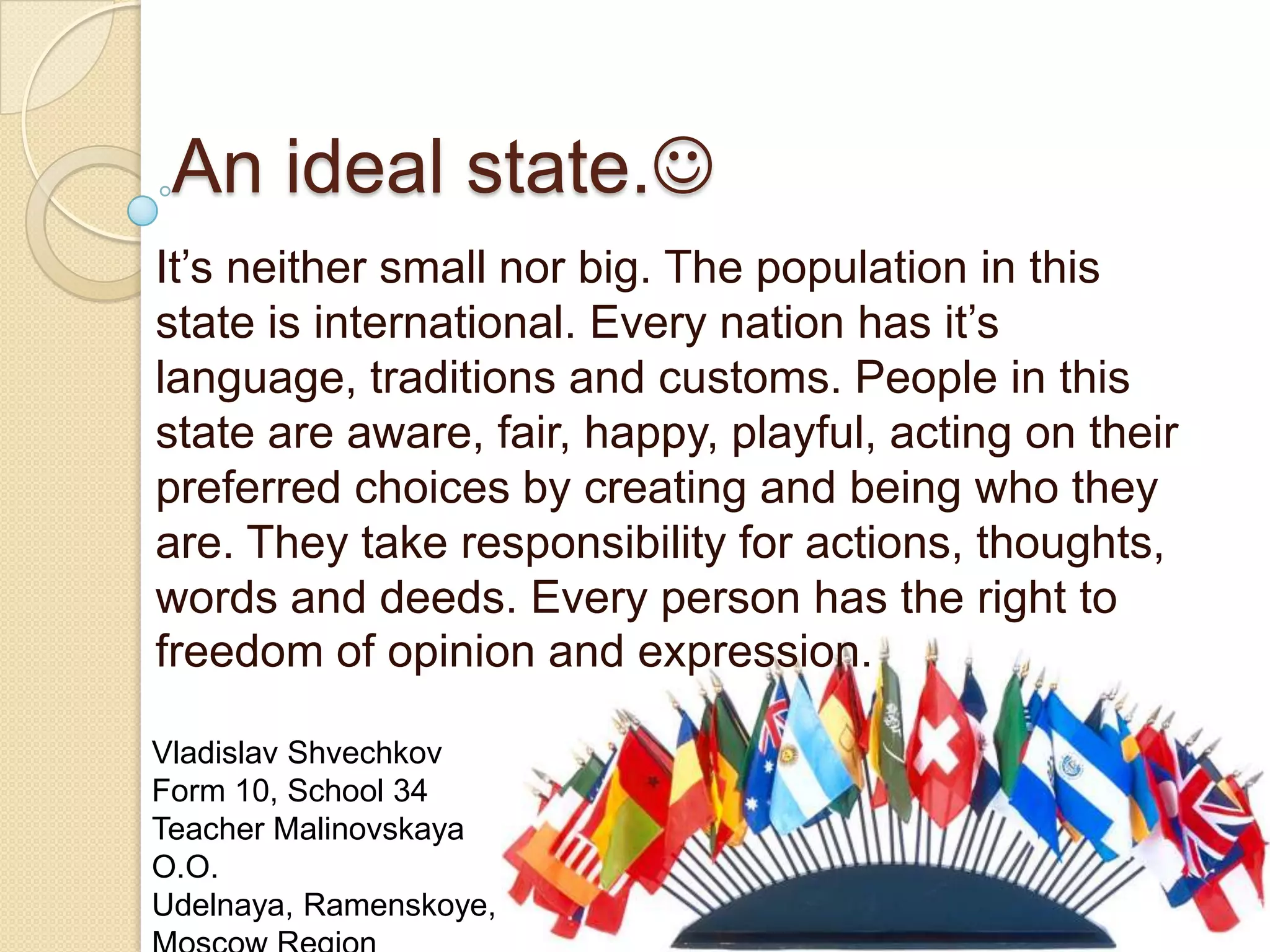
It’s neither small nor big. The population in this
state is international. Every nation has it’s
language, traditions and customs. People in this
state are aware, fair, happy, playful, acting on their
preferred choices by creating and being who they
are. They take responsibility for actions, thoughts,
words and deeds. Every person has the right to
freedom of opinion and expression.
Vladislav Shvechkov
Form 10, School 34
Teacher Malinovskaya
O.O.
Udelnaya, Ramenskoye,
 If all these things can be done in a
state then this would be the paradise
on the Earth where everything is pure
at heart and in soul.
 Peace and order is established.
 The society is ecstatic and there exists
no reason to violate the doctrine or
laws of God.
In order to promote unity,
love and respect, the
appointed one should also
begin it with himself before
promoting it to others.
State Ruler
The person who rules the
country should be ambitious,
gifted, clever, risky a little bit,
power-loving and pliable.
Characteristics of an ideal enlightened ruler include the
following: firstly, the ruler should use logic and reason
while ruling his domain. Secondly, he should ensure that
the people have their natural rights, such as, equality
before the law, freedom of religious worship, freedom of
speech, and the right to own property. Thirdly, the
enlightened ruler should promote and develop arts,
sciences and education. Fourthly, the enlightened ruler
himself should obey the law and enforce fairly upon his
people.
Political system
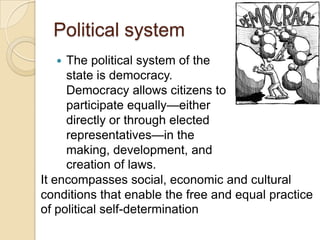
 The political system of the
state is democracy.
Democracy allows citizens to
participate equally—either
directly or through elected
representatives—in the
making, development, and
creation of laws.
It encompasses social, economic and cultural
conditions that enable the free and equal practice
of political self-determination
Democracy as a system of government consists of
four key elements:
 1. A political system for choosing and replacing
the government through free and fair elections.
 2. The active participation of the people, as
citizens, in politics and civil life.
 3. The protection of the human rights of all
citizens.
 4. The rule of law, in which the laws and
procedures apply equally to all citizens.
Rights
 Freedom of speech
 Freedom of typing
 Freedom of action (within the
framework of the law)
 Equality before the law
Constitution
 It contains a principle of division of
authorities.
 It fixes rights and freedom of the
person and the citizens.
 Recognition, observance and
protection of rights and freedom are
the main aims of the constitution.
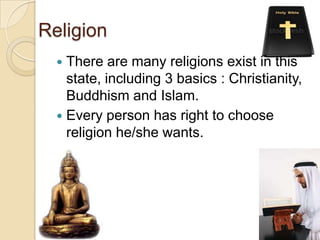
Religion
 There are many religions exist in this
state, including 3 basics : Christianity,
Buddhism and Islam.
 Every person has right to choose
religion he/she wants.

An ideal state, as i understand it

  • 1.
    An ideal state. It’sneither small nor big. The population in this state is international. Every nation has it’s language, traditions and customs. People in this state are aware, fair, happy, playful, acting on their preferred choices by creating and being who they are. They take responsibility for actions, thoughts, words and deeds. Every person has the right to freedom of opinion and expression. Vladislav Shvechkov Form 10, School 34 Teacher Malinovskaya O.O. Udelnaya, Ramenskoye,
  • 2.
     If allthese things can be done in a state then this would be the paradise on the Earth where everything is pure at heart and in soul.  Peace and order is established.  The society is ecstatic and there exists no reason to violate the doctrine or laws of God. In order to promote unity, love and respect, the appointed one should also begin it with himself before promoting it to others.
  • 3.
    State Ruler The personwho rules the country should be ambitious, gifted, clever, risky a little bit, power-loving and pliable. Characteristics of an ideal enlightened ruler include the following: firstly, the ruler should use logic and reason while ruling his domain. Secondly, he should ensure that the people have their natural rights, such as, equality before the law, freedom of religious worship, freedom of speech, and the right to own property. Thirdly, the enlightened ruler should promote and develop arts, sciences and education. Fourthly, the enlightened ruler himself should obey the law and enforce fairly upon his people.
  • 4.
    Political system  Thepolitical system of the state is democracy. Democracy allows citizens to participate equally—either directly or through elected representatives—in the making, development, and creation of laws. It encompasses social, economic and cultural conditions that enable the free and equal practice of political self-determination
  • 5.
    Democracy as asystem of government consists of four key elements:  1. A political system for choosing and replacing the government through free and fair elections.  2. The active participation of the people, as citizens, in politics and civil life.  3. The protection of the human rights of all citizens.  4. The rule of law, in which the laws and procedures apply equally to all citizens.
  • 6.
    Rights  Freedom ofspeech  Freedom of typing  Freedom of action (within the framework of the law)  Equality before the law
  • 7.
    Constitution  It containsa principle of division of authorities.  It fixes rights and freedom of the person and the citizens.  Recognition, observance and protection of rights and freedom are the main aims of the constitution.
  • 8.
    Religion  There aremany religions exist in this state, including 3 basics : Christianity, Buddhism and Islam.  Every person has right to choose religion he/she wants.