UV Curable Coating.
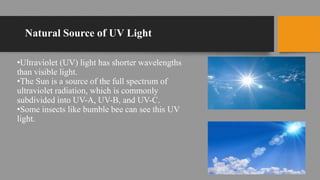
Natural Source of UV Light
•Ultraviolet (UV) light has shorter wavelengths
than visible light.
•The Sun is a source of the full spectrum of
ultraviolet radiation, which is commonly
subdivided into UV-A, UV-B, and UV-C.
•Some insects like bumble bee can see this UV
light.
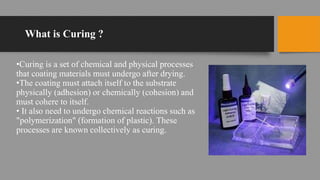
What is Curing ?
•Curing is a set of chemical and physical processes
that coating materials must undergo after drying.
•The coating must attach itself to the substrate
physically (adhesion) or chemically (cohesion) and
must cohere to itself.
• It also need to undergo chemical reactions such as
"polymerization" (formation of plastic). These
processes are known collectively as curing.
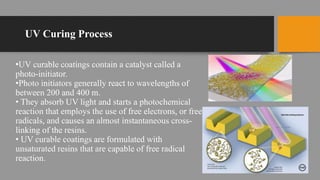
UV Curing Process
•UV curable coatings contain a catalyst called a
photo-initiator.
•Photo initiators generally react to wavelengths of
between 200 and 400 m.
• They absorb UV light and starts a photochemical
reaction that employs the use of free electrons, or free
radicals, and causes an almost instantaneous cross-
linking of the resins.
• UV curable coatings are formulated with
unsaturated resins that are capable of free radical
reaction.
•
Preparation
•UV curable coating, especially suitable for antirust decoration of
metal surface It is composed of active oligomer, active diluent,
photopolymerization initiator and diluent Its main components are
maleic anhydride modified epoxy acrylate and adhesion
enhancing resin containing epoxy group
•Most commercially used UV curable coatings are based on
acrylate chemistry that cures via free radical polymerization.
These liquid compositions typically contain a mixture of a
reactive oligomer (30 – 60%), one or more reactive monomers
(20 – 40%), a UV light-absorbing component (3 – 5%), and one
or more additives (<1%).
Properties
•Suffering energy to break bonds in coating to generate free
radicals.
•Can penetrate into and through a coating and through
substrates.
•Generate little or no heat.
•Precision controlled.
•Not affected by pigmentations or transparency of coating
or substrate.
Application
•Coating for wood furniture and flooring.
•Coating for plastic, metal and paper.
•Coatings for electronic components
•Coating used on automotive components.

UV Curable Coating.pptx

  • 1.
  • 2.
    Natural Source ofUV Light •Ultraviolet (UV) light has shorter wavelengths than visible light. •The Sun is a source of the full spectrum of ultraviolet radiation, which is commonly subdivided into UV-A, UV-B, and UV-C. •Some insects like bumble bee can see this UV light.
  • 3.
    What is Curing? •Curing is a set of chemical and physical processes that coating materials must undergo after drying. •The coating must attach itself to the substrate physically (adhesion) or chemically (cohesion) and must cohere to itself. • It also need to undergo chemical reactions such as "polymerization" (formation of plastic). These processes are known collectively as curing.
  • 4.
    UV Curing Process •UVcurable coatings contain a catalyst called a photo-initiator. •Photo initiators generally react to wavelengths of between 200 and 400 m. • They absorb UV light and starts a photochemical reaction that employs the use of free electrons, or free radicals, and causes an almost instantaneous cross- linking of the resins. • UV curable coatings are formulated with unsaturated resins that are capable of free radical reaction. •
  • 5.
    Preparation •UV curable coating,especially suitable for antirust decoration of metal surface It is composed of active oligomer, active diluent, photopolymerization initiator and diluent Its main components are maleic anhydride modified epoxy acrylate and adhesion enhancing resin containing epoxy group •Most commercially used UV curable coatings are based on acrylate chemistry that cures via free radical polymerization. These liquid compositions typically contain a mixture of a reactive oligomer (30 – 60%), one or more reactive monomers (20 – 40%), a UV light-absorbing component (3 – 5%), and one or more additives (<1%).
  • 7.
    Properties •Suffering energy tobreak bonds in coating to generate free radicals. •Can penetrate into and through a coating and through substrates. •Generate little or no heat. •Precision controlled. •Not affected by pigmentations or transparency of coating or substrate.
  • 8.
    Application •Coating for woodfurniture and flooring. •Coating for plastic, metal and paper. •Coatings for electronic components •Coating used on automotive components.