1
1. Abstract:
An ultraviolet UV curable coating is one of the best finishing method in the paper and
packaging industry for protecting ink layer from physical and mechanical defects.
Physical surface treatment especially coating process is usually used to produce
papers with better resistance to moisture or water penetration and mechanical
scratch. UV curable varnishes are commonly used to give a high gloss and rub
resistance to paperboard in the CMYK printing process, but changes in paperboard’s
optical properties. The extent of the cure is determined by factors including lamp
characteristics, cure environment, coating thickness, substrate, temperature, UV
radiation dose and coating formulation. Therefore it is important to control each of
the formulation components and other variables. Some of these variables have been
studied before; others are objects of this study. The aim of this study is to evaluate
the combine effect of coating thickness, belt speed and lamp power of curing
process on paperboard.
2
2. Introduction:
The surface finishing of a print is an extra process in which a layer of material is
coated on already printed sheet. The aim of such coating is to improve the
appearance properties as well as some physical properties of the print. Such coating
application involves the number of factors such as method of application of coating,
type of substrate etc. Study of these parameters is very important in determining the
suitability of coating for a particular print.
UV coating is basically a compound which is applied to paper in wet condition and
dried instantly by a ultraviolet light. Different types of coatings are available
depending upon their composition which includes the type of resin and embedded
photo initiators. Choice of coating is depend upon the application and desired degree
of gloss.
3
3. Project Objectives:
1. To understand the effect of coating thickness on paperboard.
2. To understand the effect of belt speed of curing machine on paperboard.
3. To understand the effect of UV coating on different substrates.
4. To understand the color reproduction before and after UV coating.
5. To understand the print gloss before and after UV coating.
4
4. Literature Review:
4.1 Background Work:
In the last ten years the UV coating process has been increasingly used. The reason
for that is the ability of forming the transparent layers of greater thickness, better
mechanical properties and visibly better reflectance (gloss) from such treated
printing substrate.9
The quality of UV radiation cure depends on lamp characteristics,
film thickness, curing environment, substrate and temperature. Based on the best
knowledge of the several researchers, the decrease in optical properties of the paper
boards were recognized as the main problem during the different steps of the
finishing processes, including printing, coating, and packaging.6,5
C.S.B Ruiz, L.D.B. Machado, J.E. Volponi & E.S. Pino1
performed the experiment on
“Influence of Sample Composition and Processing Parameters on the UV Cure
of Clear Coatings”. It was studied by using Two coating formulations A (without
additives) & B (with stabilizer additives). The solutions were cured at room
temperature by using a Lab cure UV tunnel. The experiment was divided into three
parts. In first part effect of photo initiator concentration were examined for
determining the cure degree. It was studied by taking 0.5%, 1%, 2%, 3%, 4% or 5%
Photo initiator Content for both the coatings A & B. Cure degree were calculated by
using relation formula, which shows that 3% PI Content is most effective photo
initiator content, so it was taken for subsequent studies. In second part effect of layer
thickness were evaluated for both the samples A & B with 3% photo initiator content
with various layer thicknesses ranges from 110 µm to 560 µm. The result shows that
layer thickness more than 200 µm did not achieve a curing reaction even when
submitted to high UV dose. In third part effect of UV radiation dose were examined
by keeping 3 % photo initiator content and 200 µm layer thickness for both coating
solutions A & B. These samples were cured by 50, 100, 200 & 600 mJcm2
. The final
result shows that coating B samples (with stabilizer additive) presented cure degrees
lower than samples of coating A (without additives) cured under the same condition.
However, doses higher than 200 mJcm2
did not significantly increase the extent of
cure in coating A sample.
Pooneh Kardar, Morteza Ebrabhimi & Saeed Bastani2
conducted a experiment on
“Inflence of Temperature and Light Intensity on the Photocuring Process and
Kinetics Parameters of a Pigmented UV Curable System”. They worked on the
5
effect of photo polymerization temperature and light intensity on the curing behavior
by taking 4 different temperatures 25, 45, 65 & 850
C and 4 light intensities 2, 20, 40
& 80 mWcm2
. Standard Bisphenol A Epoxy Diacrylate Resin (EA) as an oligomer
and Trimethylol Propane Triacrylate (TMPTA) as a dilutant were taken. Titanium
Dioxide pigments were used by keeping original particle size of 200 nm.
Measurements were taken by using Photo-Differential Scanning Calorimetry. From
the result it was observed that the rate of conversion and final conversion values
were affected by the temperature and UV light intensity. In case of unpigmented
formulation it was found that ultimate conversion had their maximum values at 650
C,
on the other hand, for pigmented formulation it was even up to 850
C. In case of UV
light intensity for unpigmented formulation, rate of polymerization increased up to 20
mWcm2
adn then decreased, for pigmented formulation UV light intensity increased
up to 40 mWcm2
Igor Karlovic, Draglijub Novakovic, Erzsebet Novotny3
performed an experiment on
“The Influence of Surface Topography of UV Coated and Printed Cardboard on
the Print Gloss”. It was performed on Glazed Cardboard Casino Classic having 320
GSM. The prints were taken by Heidelberg Speedmaster SM 4-color offset machine.
The offline coating operation was performed by using screen coating machine. The
different amount of coatings were achieved by using 3 different screen stencils of
180 threads/cm, 150 threads/cm and 120 threads/cm thread count. The differences
in thread count changes the amount of coating solution applied to the print, which
was 6.5 GSM, 9.6 GSM & 17.2 GSM respectively. UV glossy and matte coating from
Unico 946 series were used as a coating solution. For the surface evaluation Vecco
CP-II SPM scanning probe microscope and JEOL 046OLV electron microscope were
used. Gloss measurement was taken by using QPP Glossmaster 3 angle gloss
measurement instrument. It was measured on the 100% tone value patches of the
CMYK colors. After the inspection of printed as well as coated samples with
microscopy it was observed that glossy UV coating has smoothened the surface
while UV matte coating gave a rougher surface. The amount of gloss is higher on
glossy UV coated samples in comparison to the matte coated samples. In both the
cases larger amount of coating results in a higher print gloss than the previous
smaller amount of coating solution. These results can be used for production
optimization and reduction in coating usage and can influence the choice of coating
quantity, type and method of application.
6
Mojtaba Soltani, Ramin Veisi4
conducted a experiment on “Influence of UV curable
coating process on CMYK Printed Duplex Paperboard, Part I: Mechanical and
Optical Properties”. The substrate used for the experiment was a commercial
glazed duplex paperboard 230 GSM. A CMYK test pattern in the machine direction
was printed on the top side of the substrate. The ideal inking parameters were
adjusted using the same standard offset inks. The room temperature was ± 220
C
and the relative humidity was 650
. The coating was then applied using an industrial
screen coating machine. A commercially acrylic UV curable glossy varnish was used
for the coating step. The coating was done by using a screen stencil of 180
threads/cm. The coated papers were then dried using a standard UV lamps 300
watts/inch and UV wavelength 350-420 nm. For optical properties the CIE L*a*b*
color parameter were computed with the TAPPI standard T524-OM-02.
The UV curable coating process was applied to the printed paperboard and it’s effect
on the mechanical property and the optical stability of paperboard that had
undergone a CMYK printing process was investigated. The findings of this research
are a significant reduction was observed in the fold and tear resistances of the
printed coated paperboard. The UV-curable coater tangibly changed the ink
reflection from light to dark. Likewise, the highest variances in the relative optical
parameters were observed for the M,Y & K ink and resulted in a yellowing of the
coated paperboard. Except for the Cyan ink, the whiteness of the other inks was
reduced by the coating. In addition, the brightness of the inks on the printed
paperboard was also decreased. In contrast, the variations in total color difference
(∆E-L*a*b*) evidenced a considerable stability of the cyan ink.
Majnaric Igor, Golubovic Kristijan, Bolanca Mirkovic Ivana5
conducted a experiment
on “New Methods of Varnishing and Their Influence on Optical Properties of
Cardboard Packaging”. The experiment was performed on standard ECI printing
form whose digitalized version is illuminated on CTP. Substrates used was a high
quality cardboard coated on both sides. The prints were made on 6 color offset
printing machine KBA Rapida (105/6+L), which can inline print and varnish. The
CMYK prints were obtained as a sample 1 and CMYK + UV varnish as a sample 2.
Varnish used was UV varnish 14-HC-144. For the experimental UV inkjet varnish the
UV inkjet printer cutter roland versa LEC 300 was used. The optical properties of the
varnished and unvarnished prints were measured with two devices, one is
7
spectrophotometer X-rite DTP20 and the device for gloss measuring which was
Electrometer 407.
The result says Inkjet UV varnishing and the offset UV varnishing differently
influence the print quality which is confirmed by the measured value of the volume
gamut. The optical properties of the print gloss are not in the direct correlation with
the colormetric measurements. It means the greatest reproduction gamut is not at
the same time glossiest print. The inline gloss offset UV varnishing gives lesser gloss
than the UV inkjet because the short drying time of ink. To achieve the additional
value varnishing process can serve as the tool for emphasizing the defined oriented
surface. The continuation of investigation will be based on the parameter analyzed of
gloss and color value with the creation of the mathematical model and inclusion of
the UV varnishing process in color management. The composition of UV varnish,
radiation source in drying processes, migration processes with the postulates of
ecological sustainability will be important frame of reference.
Igor Majnaric, Ivana Balanca Mirkovic, Kristijan Golubovic6
performed a experiment
on “Influence of UV Curing Varnish Coating on Surface Properties of Paper”.
The experiment was conducted on three types of digitalised printing forms were
constructed whose coverage range from 0 to 100% screen value in a step of 33% of
a screen value. For experimental printing the UV inkjet printer cutter roland versa
LEC 300 was used which apart from a standard CMYK uses UV varnish and UV
white ink. 3 standard printing substrates were used in the experiment Offset paper
master print 140 GSM, Matt Calendared Paper 115 GSM & Fine Art Paper 130
GSM. The optical properties of varnished and non varnished paper were measured
with two devices, one is spectrophotometer X-rite DTP20 and the another device for
gloss measuring which was Electrometer 407. CIE L*a*b* and gloss unit results
obtained from which the color differences and gloss differences were calculated.
The investigation result shows that by UV varnishing of smoother substrates grate
chromatic changes appear which are visible with the naked eyes Delta E >1.5. The
most intense yellowness appears at maximum UV varnish coating. If the tone
change on the natural paper is not desirable, the felt side has to be varnished. The
varnish application with the smaller surface coverage 33% UV varnish is not relevant
for the tested optical and mechanical properties of the natural paper. Maximum
varnish coverage 100% does not give the expected economical effect. Considerable
changes of the optical properties are achieved by 66% coating which is specially
8
visible from the measured roughness. The process of UV varnishing enables the
application of fine art paper as possible protection from moisture. It is not the case of
natural paper which becomes more absorbent by UV processing; such paper can be
used as roll blotter.
9
4.2 UV Coating:
Ultraviolet light is the dominant form of radiation used to cure coatings. In practice,
applications entailing conventional, i.e. radically curing UV coatings, outweigh all
others. Epoxy resin-based, catatonically cured UV inks and coatings, which first hit
the market in the 1980s, offer a raft of benefits, first and foremost the fact that they
cure all the way through – albeit slowly – and are suitable for food and drug
packaging.10
UV coatings consist of synthetic resins with an embedded photo initiator. The free
radicals or cations released upon exposure to UV-C radiation trigger the hardening
process in the synthetic resins. Developers of UV coatings for pharmaceutical and
food packaging take care to use photo initiators which, when split, do not release
products that migrate or are hazardous to health. If energy-saving excimer lamps are
to be the source of radiation, then UV inks and coatings must be used in which the
photo initiators are specifically formulated for UV-B and only react with specific
synthetic resin prepolymers. Synthetic resins in which the photo initiators trigger
polymerisation when they split are composed of reactive organic molecules – some
monomolecular (monomers), some pre-cross-linked on a low level (oligomers, pre
polymers).
Because cationic coatings contain photo initiators formed from organic acids, they
are unsuitable for alkaline substrates (e.g. paper whose coating includes calcium
carbonate) since there is a risk that the sheets will block and gloss be impaired. If the
emphasis is on coating properties and quality rather cost efficiency then a cationic
coating will require a prior application of primer to seal the substrate. Radical
coatings consequently have a broader, more differentiated range of applications than
cationic ones – among them hybrid production in conjunction with a matt or
granulating overprint varnish.
UV coatings are predominantly used as clear high-gloss coatings, less often as matt
or metallic-effect coatings.12
they can easily be combined with UV-curable inks,
provided the inks are cured in an interdict dryer prior to coating. If a UV coating is to
be applied to conventional inks then a water-based primer must be applied in
advance to seal the surface, and this primer must be dried immediately. Two coater
presses were designed specifically for such applications. With hybrid inks there is no
need for this energy-intensive intermediate application of primer because a UV
10
coating can be applied directly. No primer is normally needed if a UV coating is
applied to conventional inks offline.
If UV coatings are applied inline, the 8 μm (0.3 thou) thick coating layers deliver a
high degree of gloss because the coating has excellent flow characteristics. Offline
coating machines can apply even thicker layers of coating and thus deliver gloss
levels of 100 with ease. Both methods represent a viable alternative to lamination.
4.3 Advantages and Drawbacks of UV Coatings:
Economical advantages:
1. Energy saving (commonly rapid cure at room temperature)
2. High production speed
3. Small space requirements
4. Immediate post cure processing possible
Ecological advantages:
1. In general solvent free formulations (VOC reduction)
2. Possibility of easy recycling (waste reduction)
3. Energy saving
Performance advantages:
1. Low substrate heating
2. High product durability
3. Application versatility
4. High scratch resistance and chemical resistance
5. Exceptional abrasion, stain and solvent resistance
6. Superior toughness
Drawbacks:
1. Material costs are higher than, e.g., alkyds, polyesters or epoxies
2. 3D curing equipment development is in its infancy
3. UV curing in the presence of UV stabilizers decelerated
4. Oxygen inhibition at the surface (in many radical curing systems)
5. Sensitivity to moisture (cationic curing system)
6. Difficult through-cure of pigmented coatings (at thicknesses >5 μm)
11
Topics to eliminate weaknesses:
1. Improving adhesion to metal, plastics
2. Minimizing skin irritation caused by some reactive diluents
3. Reducing odor (of the formulations)
4. Reducing extractable of cured coatings
5. Improving photo initiators (cost, migration, volatility)
6. Direct food contact packaging approval
While the advantages and good performance characteristics of this technology are
very obvious, the reasons for the limited penetration into large volume coating
applications must lie in some substantial disadvantages. Major reasons are the
limited availability of three-dimensional curing equipment, the very limited use of UV
cured coatings in exterior applications, due to the existing paradigm that UV curing
would not be possible in the presence of UV exterior durability stabilizers, and higher
material costs compared to conventional coatings. 7
One of the major reasons for the almost exclusive application of UV curing in two-
dimensional curing systems is the fact that the radiant power of the lamp decreases
with the square of the distance. Thus, it is difficult to control the effective energy
(radiant power arriving at the surface/curing time) necessary to cure the coating
sufficiently at every point of a three dimensional substrate. Major advances in the
design and radiometric control of three-dimensional curing equipment have already
been achieved, but still have to be improved.
The development of UV curable coatings for exterior applications had been
disregarded in the past, since such coatings have to be stabilized with UV absorbers
and radical scavengers (HALS types) in order to provide enough long-term stability.
This was due to the preconception, that the UV induced radical polymerization could
not be possible in the presence of UV absorbers and radical scavengers. Since this
prejudice has been disproved, the whole field of exterior applications opened to UV
coatings, which had seemed closed to UV curing forever. Especially the high scratch
resistance obtainable with UV cured coatings, as proven in parquet flooring, has
attracted the attention of automotive companies, which are looking for coatings
which can withstand the typical scratches resulting in car wash units.
When thinking about curing of such complex geometries as available in car bodies
(doors, hoods) it is getting obvious that solutions have to be found to cure areas
12
within three-dimensional shapes, which are in the shadow of the exposure source.
Dual cure coatings for example are developed in order to cure also shadow areas of
complex three-dimensional objects. They may use as a second functionality, besides
the UV curing chemistry, the complete range of available thermal curing chemistries,
like isocyanates (in combination with hydroxyl-functional compounds, known as 2
component PU systems) or carbonate groups (curable with melamine chemistry,
known as 1 C coatings). The problem of curing in shadow areas has also been
tackled from the equipment side, which resulted in the development of UV curing in a
plasma chamber or under inert conditions.
Further improvements have to be achieved in order to overcome the oxygen
inhibition effect, which leaves a tacky surface, unless very intense radiation or other
measures are employed. This effect is caused by the high reactivity of oxygen with
radical species and the formation of an unreactive peroxy radical, which does not
continue the curing chain reaction. Therefore, the cross-linking reaction and the
formation of a solid network are retarded until all oxygen is consumed. Since the use
of high energy density radiation is undesirable several alternative measures will be
discussed.
The discussion of tackling the drawbacks of UV technology, the evaluation of
structure property relationships, relating mainly to mechanical and scratch resistant
properties, constitutes the basis for understanding the advantages of using this
technology for exterior, especially for automotive and industrial applications.
The economical and ecological benefits of UV curable coatings often appear when
the question arises “which coating system should be chosen in order to coat a
specific surface area” and different coating alternatives may be considered. This is
preferably done by comparing the whole process of coating a substrate from cradle
to grave with the eco efficiency method.
4.4 The UV Curing Process:
The UV curing process is predominantly determined by the desired application of the
coating. The intended end-product governs the substrate to be coated. This may be
an abrasion resistant clear coat for ready-to-install parquet or an overprint varnish for
paper cards, a colored base coat and a clear coat for plastic automotive parts or
metal coils, as well as a flexible protective coat for window frames. The function of
the coating, for instance the coloration of the part, the protection against corrosion,
13
scratching, and chemical attack or against weathering deterioration, determines the
type and property requirements of the coating as well as the thickness required.
The targeted properties, like high gloss appearance, abrasion resistance, color
effects, hardness, flexibility, resistance against chemicals or scratches, have to be
provided by the chemical formulation, consisting of base resins, diluents, photo
initiators and various additives. Furthermore, an appropriate selection of the
components has to be done in order to enable an effective curing process; for
instance, in coatings containing pigments or UV light stabilizers, the spectral
absorbance of the photo initiator has to be adjusted to a spectral region where the
pigments or UV absorbers are fairly transparent. This fine tuning is necessary to
match the characteristics of the lamp system with the chemistry of the coating to
provide an economic curing process.
Besides the physical properties of the cured material to be obtained, the economics
of the coating process is the most important variable which decides over the type of
coating used. Thus, in order to calculate the total costs of a coating process, not only
materials costs but the whole process design and the equipment set-up have to be
considered in order to compare different coating processes with each other. UV
curable coatings are always in competition with thermally curable systems of the
classical solvent-type, water-based or powder coatings.
Some economic factors of UV curing have been discussed with cost examples for
ink, coating and adhesive applications in comparison with thermal hardening, if
applicable. UV curing in general offers a number of advantages over competitive
coatings, while some can be related to costs, others relate to performance,
environmentally compliance or processes not achievable with other methods.
However, no general comparison of process economics can be made; it has to be
done rather in a case to case study. 9, 11
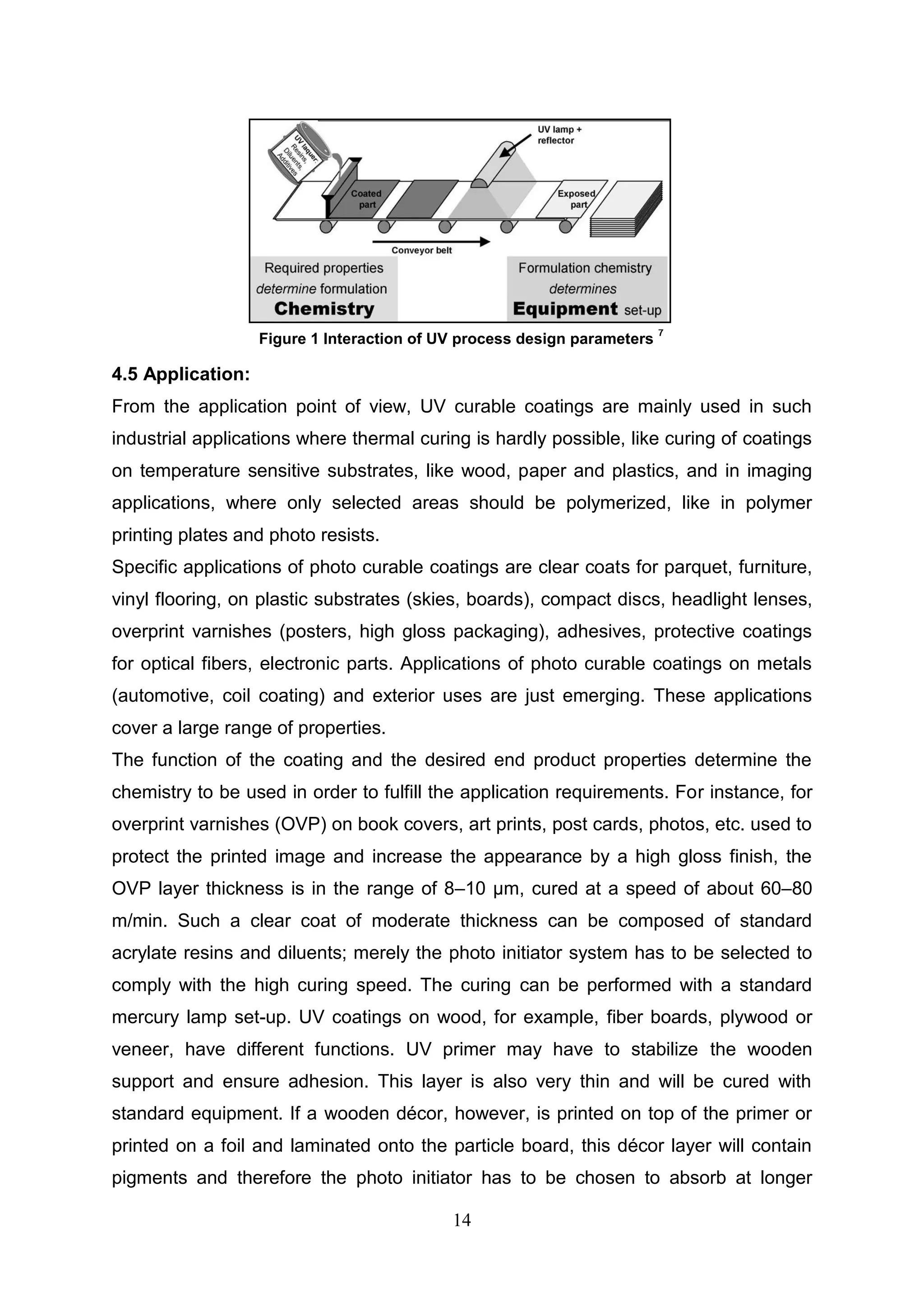
Thus, the UV curing process relies crucially on an efficient cogging of the required
application properties with the chemistry chosen to fulfill the performance
requirements as well as the UV curing equipment applied to provide a fast and
complete cure in order to meet the economical and ecological aspects of coating
technology (Figure 1). UV curing in its basics is a fast, room temperature curing
process indicating low energy consumption and requiring little space for the
equipment.
14
4.5 Application:
From the application point of view, UV curable coatings are mainly used in such
industrial applications where thermal curing is hardly possible, like curing of coatings
on temperature sensitive substrates, like wood, paper and plastics, and in imaging
applications, where only selected areas should be polymerized, like in polymer
printing plates and photo resists.
Specific applications of photo curable coatings are clear coats for parquet, furniture,
vinyl flooring, on plastic substrates (skies, boards), compact discs, headlight lenses,
overprint varnishes (posters, high gloss packaging), adhesives, protective coatings
for optical fibers, electronic parts. Applications of photo curable coatings on metals
(automotive, coil coating) and exterior uses are just emerging. These applications
cover a large range of properties.
The function of the coating and the desired end product properties determine the
chemistry to be used in order to fulfill the application requirements. For instance, for
overprint varnishes (OVP) on book covers, art prints, post cards, photos, etc. used to
protect the printed image and increase the appearance by a high gloss finish, the
OVP layer thickness is in the range of 8–10 μm, cured at a speed of about 60–80
m/min. Such a clear coat of moderate thickness can be composed of standard
acrylate resins and diluents; merely the photo initiator system has to be selected to
comply with the high curing speed. The curing can be performed with a standard
mercury lamp set-up. UV coatings on wood, for example, fiber boards, plywood or
veneer, have different functions. UV primer may have to stabilize the wooden
support and ensure adhesion. This layer is also very thin and will be cured with
standard equipment. If a wooden décor, however, is printed on top of the primer or
printed on a foil and laminated onto the particle board, this décor layer will contain
pigments and therefore the photo initiator has to be chosen to absorb at longer
Figure 1 Interaction of UV process design parameters
7
15
wavelength in order to match with a transparent area of the pigment. In this case, a
lamp system should be chosen, which also has significant emissions in the longer
wavelength range. The same applies if a clear coat is used for exterior applications,
for instance a clear coat for polycarbonate headlamps. Here a UV light absorber has
to be used, which also absorbs at least in the UV-B range.
UV printing inks are used for example in the offset, flexographic and gravure printing
process at a layer thickness in the range of up to 2 μm. Since these inks are highly
pigmented, even at the relatively low thickness, the through-cure is often difficult to
achieve.
These few examples have been selected to demonstrate, that the required
properties of the coating determine the chemistry to be used, and that
photochemistry and the exposure equipment then have to be adjusted to achieve the
target properties in an efficient cure process.
16
Photo DSC:
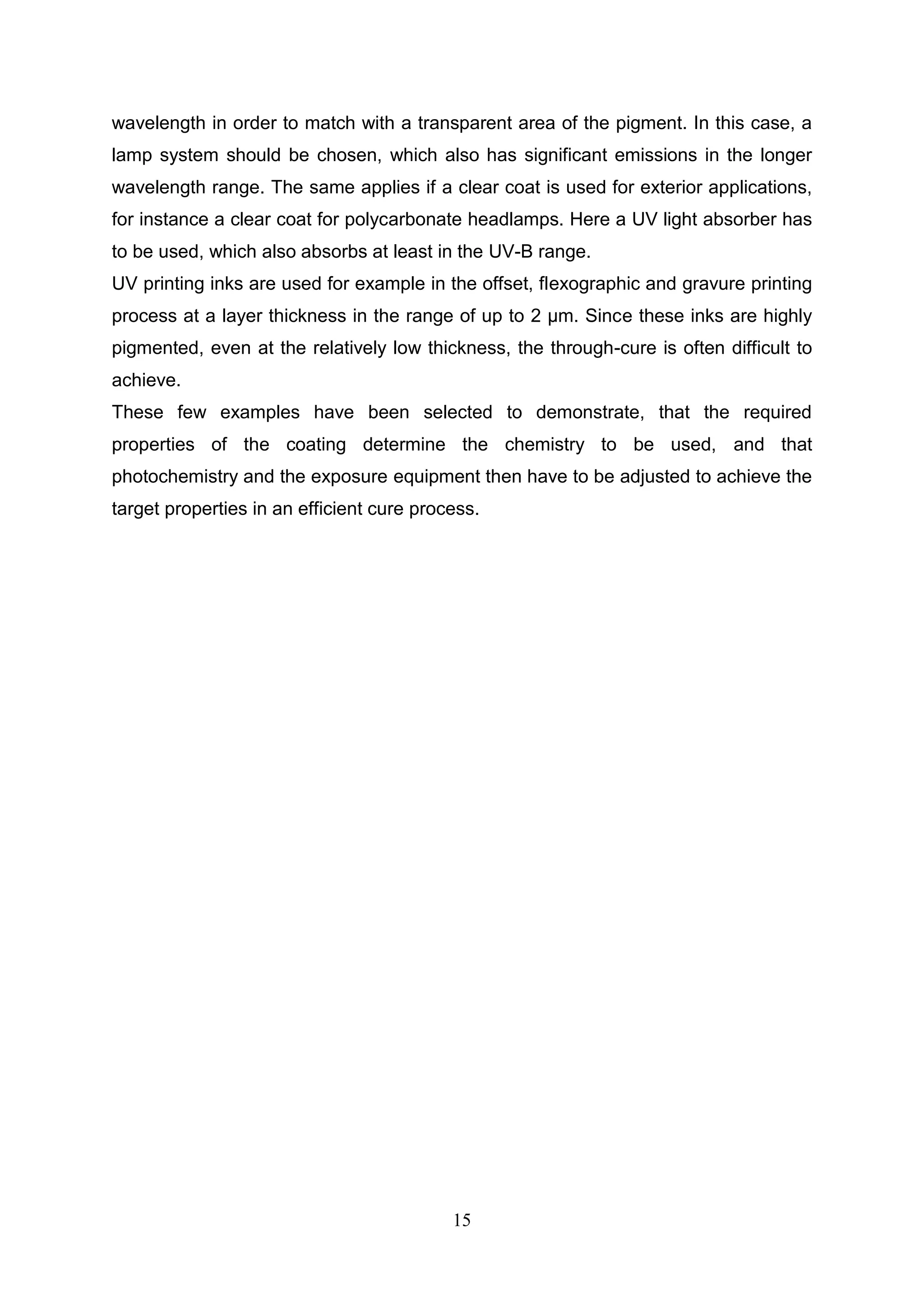
The differential scanning calorimetric (DSC) is the most widely used technique to
study photo curing reactions (Figure). It is very well suited for the determination of
kinetic parameters, like enthalpy, degree of conversion, rate constants, Arrhenius
parameters, etc., however, since the DSC has relatively long response times (2 s),
the monitoring of fast UV polymerizations is less accurate, unless low irradiance
exposures are chosen.
4.6 UV Line Equipment:
A UV curing line for coatings consists of:
1. One or more UV lamps;
2. Lamp housings and reflectors;
3. Power supply and electric or electronic control;
4. Shielding and cooling;
5. Conveyor, printer or other transport units;
6. And auxiliary parts.
All these components are available individually or as complete systems.
UV Lamps:
It is one of the important factors for UV curing is the applied energy density at the
coating surface, which is characterized by the irradiance multiplied with the exposure
time in seconds (common unit is mJ cm−2). Thus, important factors to be known
about the UV lamp are the irradiance, the profile of radiant power (W/cm2) and the
wavelength range, as well as the spectral distribution, which is the radiant power as
a function of wavelength.
The second factor, which determines the energy density (the time integral of
irradiance), is the curing time. The curing time is often characterized in UV curing
Figure 2 Differential photo calorimetry set-up
7
17
lines by the curing speed, determined by the velocity of the conveyor belt. The curing
speed also influences the heat applied on the surface of the coating, since the heat
evolution of the lamp is a factor to be considered. Depending on the coating system
and the substrate, the amount of emitted IR radiation may be useful (heating up the
coating and increasing conversion) or harmful (plastic substrates may be destroyed).
For the design of an exposure unit, the information of the irradiance profile, the
wavelength range and curing time has therefore to be considered in order to design
the whole exposure process, since different irradiance profiles can produce different
physical properties in the UV cured coating.
Reflectors:
Since a UV lamp emits in all
directions, a reflector is used
to direct the light emitted in
the “wrong direction” onto
the surface of the coating.
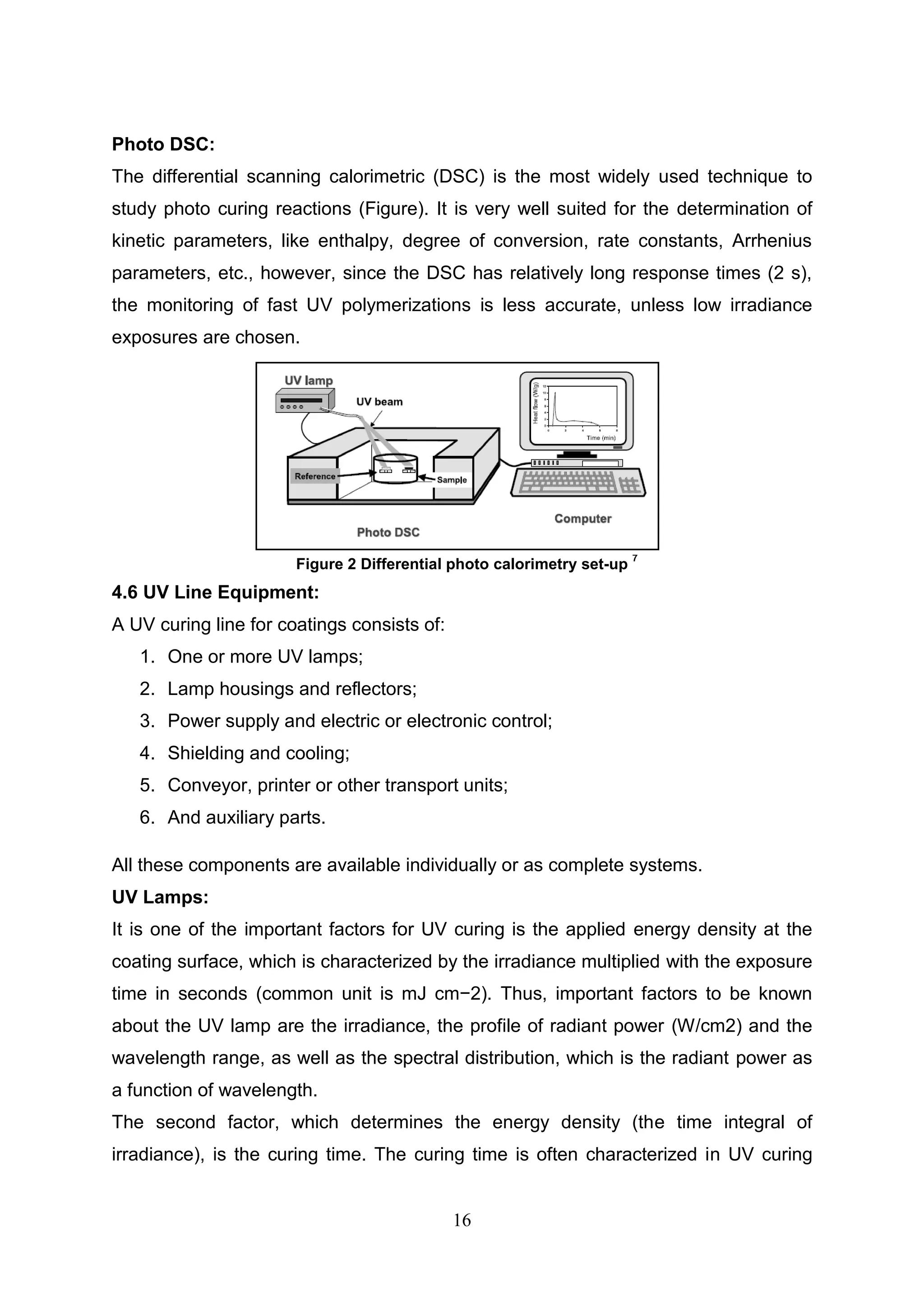
Well designed reflectors
collect and project about
75% of the radiant energy from the bulb to the surface, whereas parabolic reflectors
collect no more than 55% (Figure 3). The material of the reflector is mainly
aluminum. Aluminum, however, also reflects IR, which may lead to unwanted heat
up of the surface. Therefore, reflectors have been developed, which also reflect UV
radiation very well, but not visible and IR radiation. Furthermore, the geometry of the
reflector is responsible for the light distribution at the surface, whether
homogeneously distributed or well focused.
Exposure Parameter Measurement:
When a UV cured coating has been developed to exhibit satisfactory performance
characteristics with a specific equipment setup, the operator often does not know
what UV exposure conditions are required to obtain this cure. Furthermore, it is
difficult to define the necessary conditions for repeating the process later or even at
a different curing line.
For practical reasons it is important to measure and compare the total energy density
applied on the coating for the setup of an exposure unit. However, since a lot of
other equipment specific parameters may not be the same, this may not lead to
Figure 3 Reflector geometries
7
18
exactly the same curing results, assessed by curing extent and coating performance.
Reasons for such deviations may be that the wavelength spectrum of the lamp,
which in conjunction with the absorbance characteristics of the coating determines
the rate of polymerization, can be different. Second, the configuration of the unit
determines the distance to the coating and thus the heat distribution at the coating
surface. Furthermore it is important how the energy is measured, since the tools are
registering an integral spectral distribution.
In the process design, the choice of the appropriate UV lamp type is dependant on
the matching of the photo initiator (PI) absorption and lamp spectrum. After the
choice of the proper lamp type, the effective energy arriving at the surface can be
optimized by several factors, like reflector design, irradiance, or peak irradiance.
These factors have to be correlated with the efficiency of curing. Thus, the photo
initiator type and content, the absorption characteristics of interfering additives, like
pigments or UV absorbers, the cure speed and other factors have to be correlated
with the exposure parameters and optimized to result in the desired coating
properties.
If the key parameters are identified, the “process window” can be determined and the
control and monitoring of the curing can then be done by monitoring only few key
parameters.
19
4.7 Optical Properties:
Brightness
Brightness may or may not add much value to the 'useful' properties of the paper but
it is the most important selling feature. It is a bragging right every paper
manufacturer want to have that he/she produces most bright paper. Brightness is
defined as the percentage reflectance of blue light only at a wavelength of 457 nm.
Whiteness refers to the extent that paper diffusely reflects light of all wave lengths
throughout the visible spectrum. Whiteness is an appearance term.
Brightness is measured with two different standards - TAPPI/GE and ISO. Though
there is correlation, ISO brightness of a sample is usually lower by 1-1.5 units over
GE brightness. The standards are as per TAPPI T 452.
Table 1 Typical Brightness Values
18
Typical Brightness Values
Grade % ISO
Newsprint 62-65
Fully Bleached Pulp 90
Office/Business Paper 80-95
Bond 70-92
Coated Paper 85-90
Color
The quality of light given off by a sheet as described by its hue (tint), saturation
(strength), and value (darkness or lightness). A whiter sheet reflects equal amounts
of red, green, and blue light - the entire visual spectrum. While most balanced white
sheets have a slightly yellowish cast, most people will perceive a sheet with a slightly
blue tint to be whiter. Color is related to perception and therefore measured or
specified in terms of color space. A commonly used system is the CIE L*,a*,b*
system. This is based on the idea of color opposites.
L*- Measure of luminance and varies from 100 for perfect white to 0 for perfect black.
a*- Redness to greenness
b*- Yellowness to blueness.
20
Whiteness
Whiteness is the extent to which paper diffusely reflects light of all wavelengths
throughout the visible spectrum i.e. the magnitude &uniformity of spectral reflectance
measured as the percent light reflectance for the whole wavelength range. The
procedural standards for the measurement of whiteness are explained in ISO 11475.
Gloss
It is the specularly and diffusely reflected light component measurement against a
known standard. Gloss is important for magazine advertisements printing. The level
of gloss desired is very dependent on the end use of the paper. Gloss and
smoothness are different properties and are not dependent on each other. Gloss is
the specular reflection of light, which is reflected at an equal and opposite angle,
normally measured at 750
or 200
. Generally, gloss of unprinted sheet/ board is
measured at 750
(except for cast coated papers). Printed and varnished surfaces are
measured at 600
angles. The standard procedures are laid out in TAPPI T 480.
Table 2 Typical Gloss Values
18
Typical Gloss Values
Grade Gloss at 750
Uncoated Printing Paper 4-6
Matt Coated 10-30
Silk Coated 25-50
Art Coated 65-86
21
4.8 CIE L*
A*
B*
COLOR MODEL:
The commission international de I’Eclairag (CIE), also known as the international
commission on illumination, is responsible for international recommendations for
colorimetric measurements. In 1979, the CIE developed the CIE L
*
a
*
b
*
or CIELAB
color model for quantifying color values numerically.
It was intended to provide a standard, approximately uniform color model that could
be used by the industry so that color values could be easily compared or expressed.
The CIE color model utilizes three coordinates to locate a color in a color model. In a
uniform color model, the differences between points plotted in the color model
correspond to the visual differences between the colors plotted.
The CIELAB color space is organized in a cube form. The L
*
axis runs from top to
bottom. The maximum for L
*
is 100, which represents a perfect reflecting diffuser.
The minimum for L
*
is zero, which represents black. The +a
*
and +b
*
axis have no
specific numerical limits. A +a
*
is indication of red and a
*
is green color in the color
model. Additionally, +b
*
is yellow and b
*
is blue. The centre of this model
represents the neutral or gray colors. These color scales are based on the opponent
color theory of color vision, which means that two colors cannot be both green and
red at the same time, nor blue and yellow at the same time.
The following equations are used by the spectrophotometer to calculate the CIE L
*
a
*
b
*
Values.
L
*
= 116 (Y/Yn) 1/3 16
a
*
= 500[(X/Xn)1/3 (Y/Yn)1/3]
b
*
= 200[(Y/Yn)1/3 (Z/Zn)1/3]
Where Xn, Yn, and Zn: tristimulus values of XYZ for 2 standard observer editing
required.
22
4.9 CIE COLOR DIFFERENCE ( E):
Assessment of color is more than a numeric expression. Usually it’s an
assessment of the difference in the color sensation (delta) from a known standard. In
CIELAB color model, two colors can be compared and differentiated. The expression
for these color differences is expressed as E (delta E or difference in color
sensation).
23
5. Problem and Statement:
UV coatings are predominantly used as clear high-gloss coatings, less often as matt
or metallic-effect coatings. UV coating enhances the surface material but it also
affects the optical properties as well as final appearance of the printed product. The
considerable gloss increases the reproduction quality (gamut), while too high gloss
makes good tone visualization impossible. Such high degree of gloss as well as
color variation of the printed sheet may lead to wastage of ink, substrate, time as
well as material. These defects may be minimized by optimizing the UV coating
process parameters. Hence it is necessary to determine the variations in color and in
gloss of the printed cardboard packaging in the technique of the offset printing.
24
6. Significance of the Project:
The influence of UV coating on paperboard is studied by considering different
parameters such as Viscosity, amount of coating and different substrates. But, the
combined effect of UV process parameters on optical properties is still not
completely understood. This study will focus on some UV process parameters which
significantly affects the optical properties of paperboard. Hence by controlling or
following such parameters may reduce color variation and maintain gloss of the print.
25
7. Project Methodology:
1. Selection of Parameters involved in UV coating process.
2. Preparation of design of experiment.
3. Conducting trials as per design of experiment.
4. Collection and analysis of data.
5. Identifying the process parameters and selecting the best suitable
combination for UV coating process.
6. Checking for consistency
26
8. Test Chart:
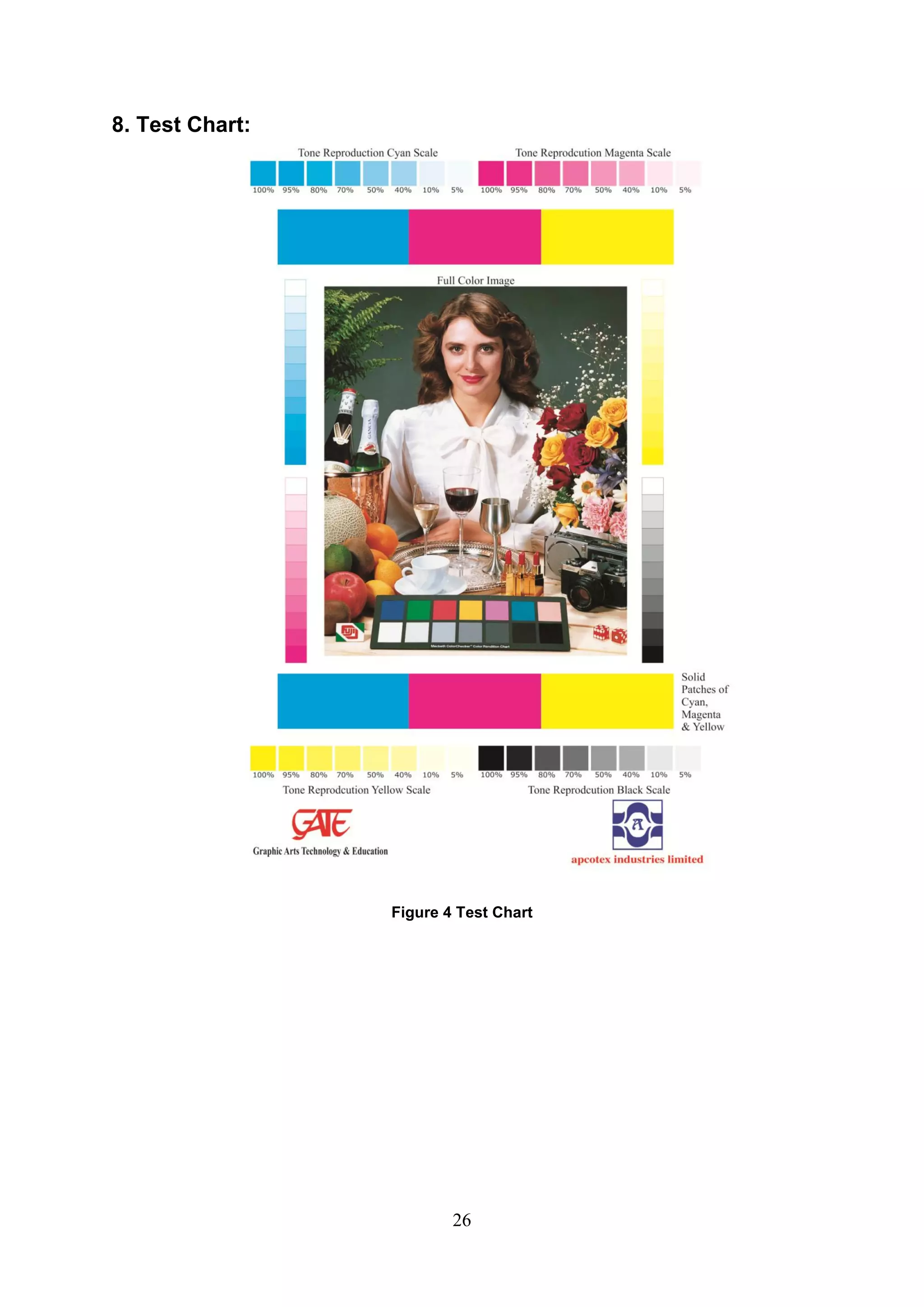
Figure 4 Test Chart
27
9. Project Parameters:
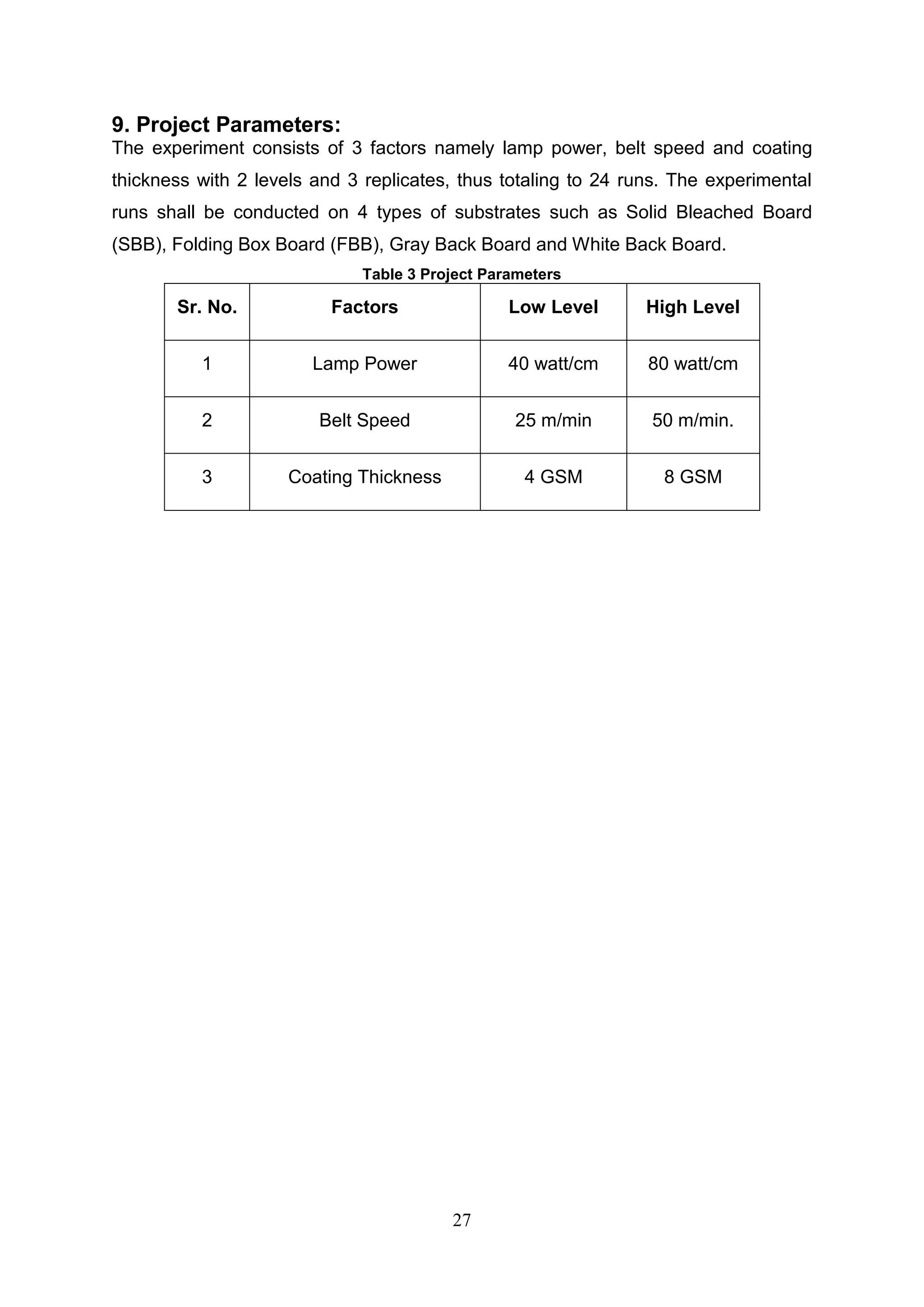
The experiment consists of 3 factors namely lamp power, belt speed and coating
thickness with 2 levels and 3 replicates, thus totaling to 24 runs. The experimental
runs shall be conducted on 4 types of substrates such as Solid Bleached Board
(SBB), Folding Box Board (FBB), Gray Back Board and White Back Board.
Table 3 Project Parameters
Sr. No. Factors Low Level High Level
1 Lamp Power 40 watt/cm 80 watt/cm
2 Belt Speed 25 m/min 50 m/min.
3 Coating Thickness 4 GSM 8 GSM
28
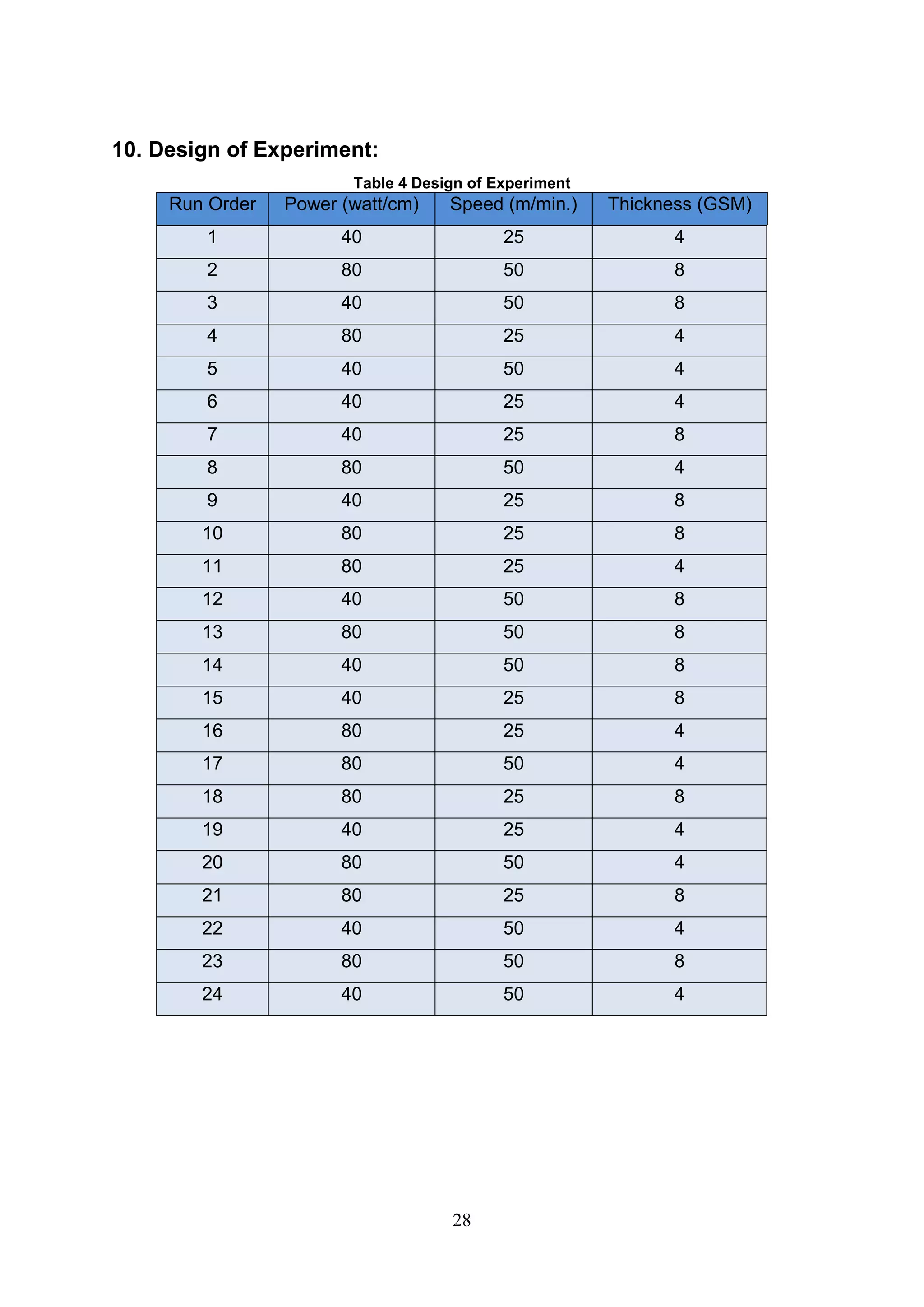
10. Design of Experiment:
Table 4 Design of Experiment
Run Order Power (watt/cm) Speed (m/min.) Thickness (GSM)
1 40 25 4
2 80 50 8
3 40 50 8
4 80 25 4
5 40 50 4
6 40 25 4
7 40 25 8
8 80 50 4
9 40 25 8
10 80 25 8
11 80 25 4
12 40 50 8
13 80 50 8
14 40 50 8
15 40 25 8
16 80 25 4
17 80 50 4
18 80 25 8
19 40 25 4
20 80 50 4
21 80 25 8
22 40 50 4
23 80 50 8
24 40 50 4
29
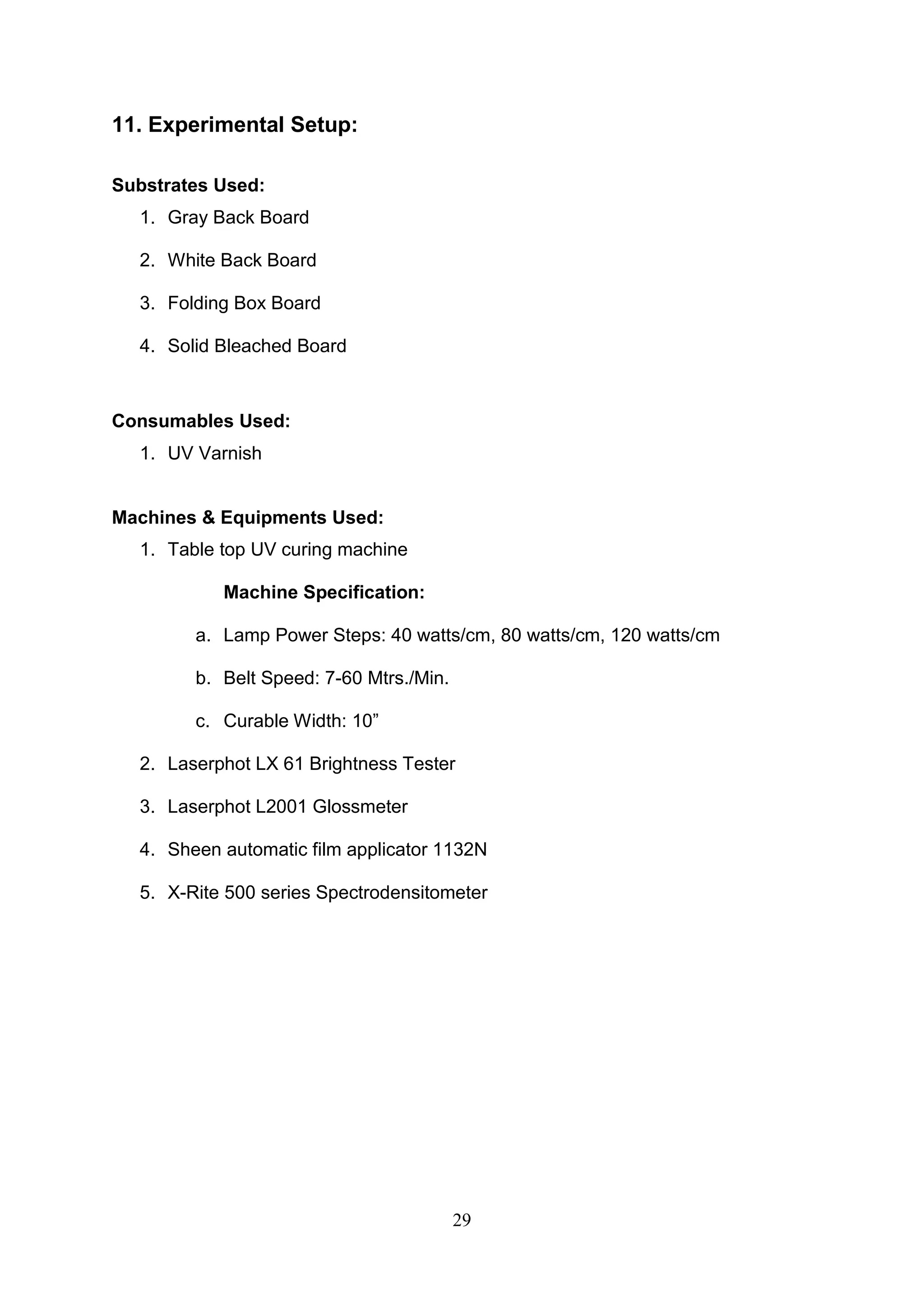
11. Experimental Setup:
Substrates Used:
1. Gray Back Board
2. White Back Board
3. Folding Box Board
4. Solid Bleached Board
Consumables Used:
1. UV Varnish
Machines & Equipments Used:
1. Table top UV curing machine
Machine Specification:
a. Lamp Power Steps: 40 watts/cm, 80 watts/cm, 120 watts/cm
b. Belt Speed: 7-60 Mtrs./Min.
c. Curable Width: 10”
2. Laserphot LX 61 Brightness Tester
3. Laserphot L2001 Glossmeter
4. Sheen automatic film applicator 1132N
5. X-Rite 500 series Spectrodensitometer
30
12. Data Analysis:
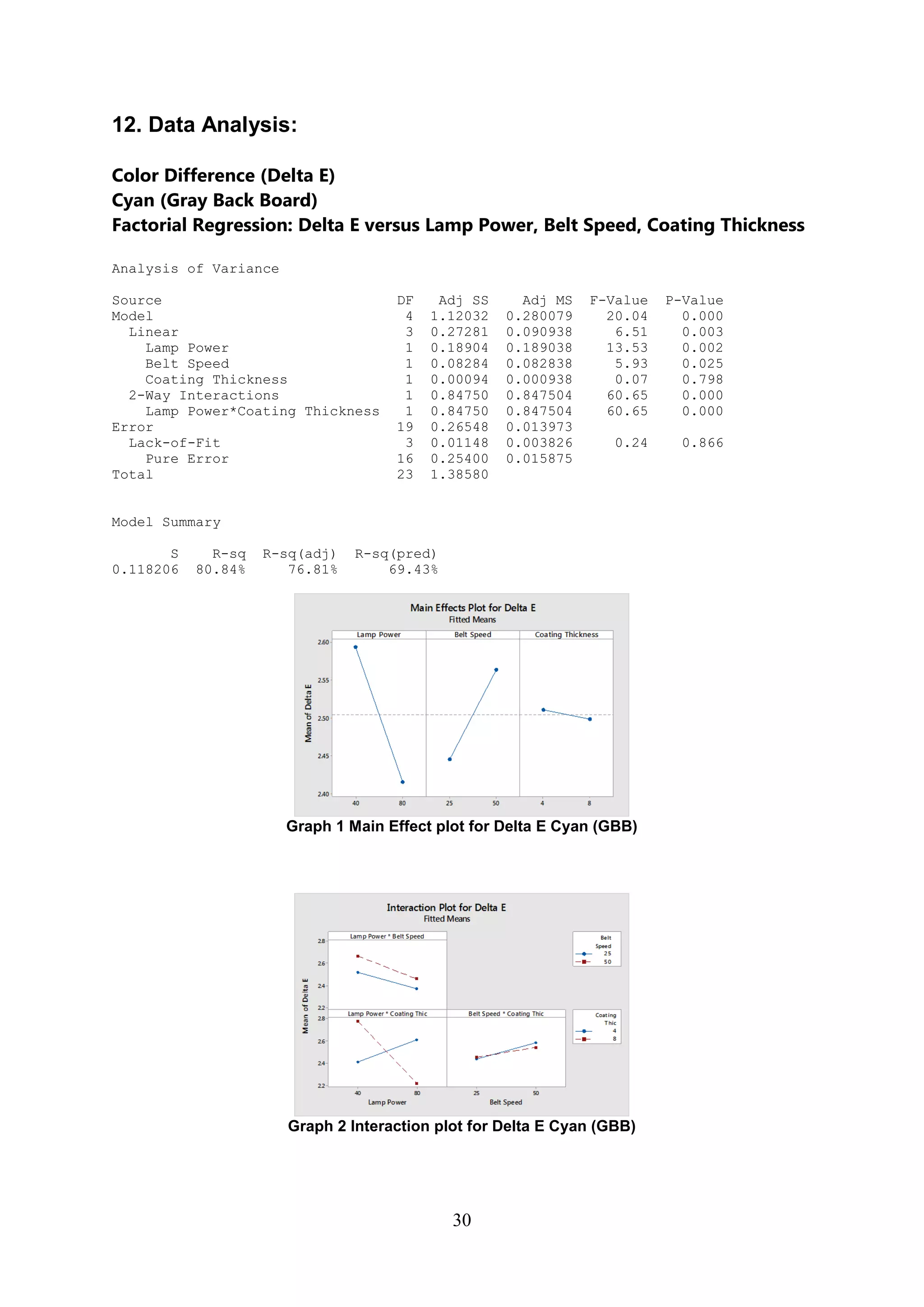
Color Difference (Delta E)
Cyan (Gray Back Board)
Factorial Regression: Delta E versus Lamp Power, Belt Speed, Coating Thickness
Analysis of Variance
Source DF Adj SS Adj MS F-Value P-Value
Model 4 1.12032 0.280079 20.04 0.000
Linear 3 0.27281 0.090938 6.51 0.003
Lamp Power 1 0.18904 0.189038 13.53 0.002
Belt Speed 1 0.08284 0.082838 5.93 0.025
Coating Thickness 1 0.00094 0.000938 0.07 0.798
2-Way Interactions 1 0.84750 0.847504 60.65 0.000
Lamp Power*Coating Thickness 1 0.84750 0.847504 60.65 0.000
Error 19 0.26548 0.013973
Lack-of-Fit 3 0.01148 0.003826 0.24 0.866
Pure Error 16 0.25400 0.015875
Total 23 1.38580
Model Summary
S R-sq R-sq(adj) R-sq(pred)
0.118206 80.84% 76.81% 69.43%
Graph 1 Main Effect plot for Delta E Cyan (GBB)
Graph 2 Interaction plot for Delta E Cyan (GBB)
31
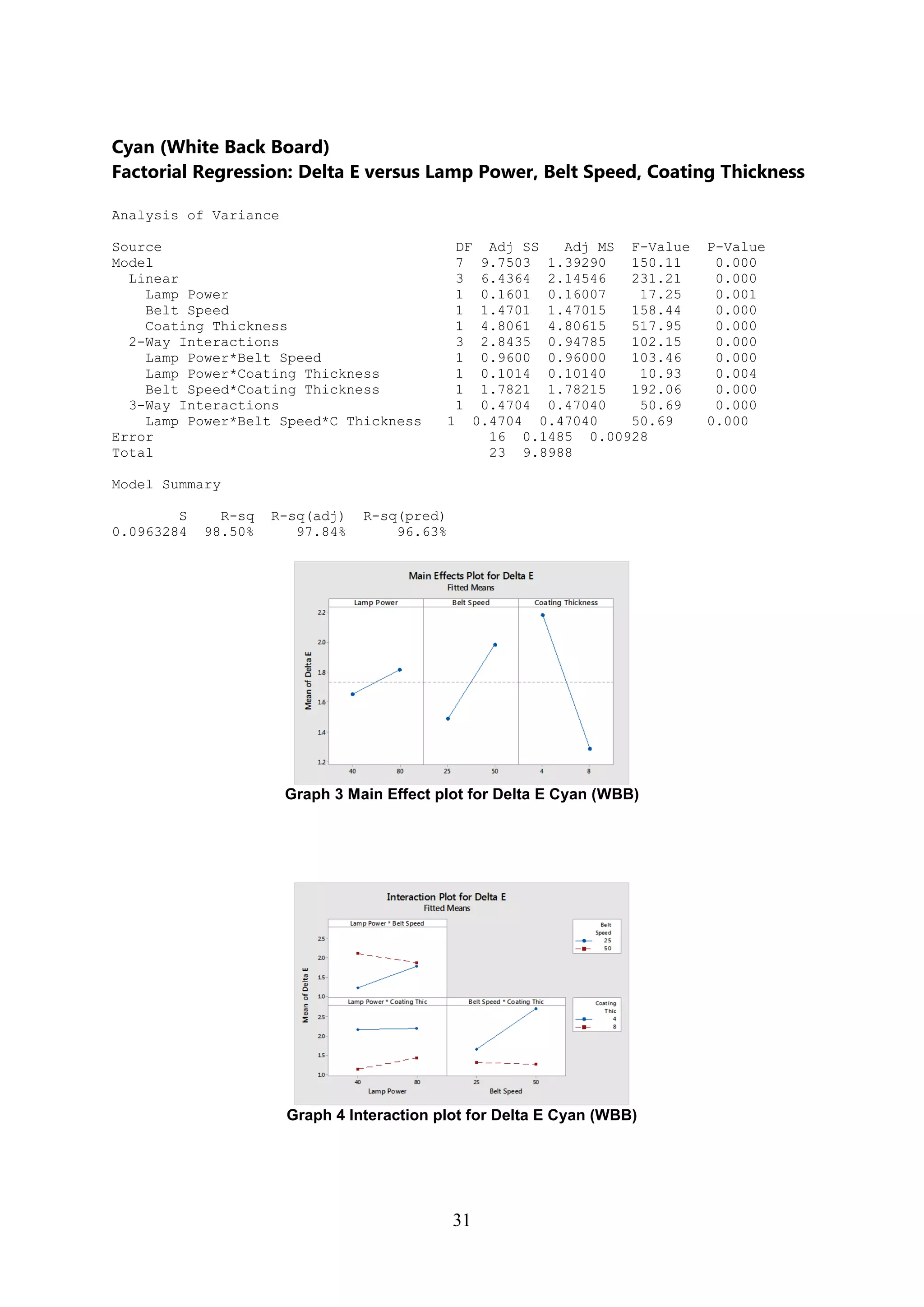
Cyan (White Back Board)
Factorial Regression: Delta E versus Lamp Power, Belt Speed, Coating Thickness
Analysis of Variance
Source DF Adj SS Adj MS F-Value P-Value
Model 7 9.7503 1.39290 150.11 0.000
Linear 3 6.4364 2.14546 231.21 0.000
Lamp Power 1 0.1601 0.16007 17.25 0.001
Belt Speed 1 1.4701 1.47015 158.44 0.000
Coating Thickness 1 4.8061 4.80615 517.95 0.000
2-Way Interactions 3 2.8435 0.94785 102.15 0.000
Lamp Power*Belt Speed 1 0.9600 0.96000 103.46 0.000
Lamp Power*Coating Thickness 1 0.1014 0.10140 10.93 0.004
Belt Speed*Coating Thickness 1 1.7821 1.78215 192.06 0.000
3-Way Interactions 1 0.4704 0.47040 50.69 0.000
Lamp Power*Belt Speed*C Thickness 1 0.4704 0.47040 50.69 0.000
Error 16 0.1485 0.00928
Total 23 9.8988
Model Summary
S R-sq R-sq(adj) R-sq(pred)
0.0963284 98.50% 97.84% 96.63%
Graph 3 Main Effect plot for Delta E Cyan (WBB)
Graph 4 Interaction plot for Delta E Cyan (WBB)
32
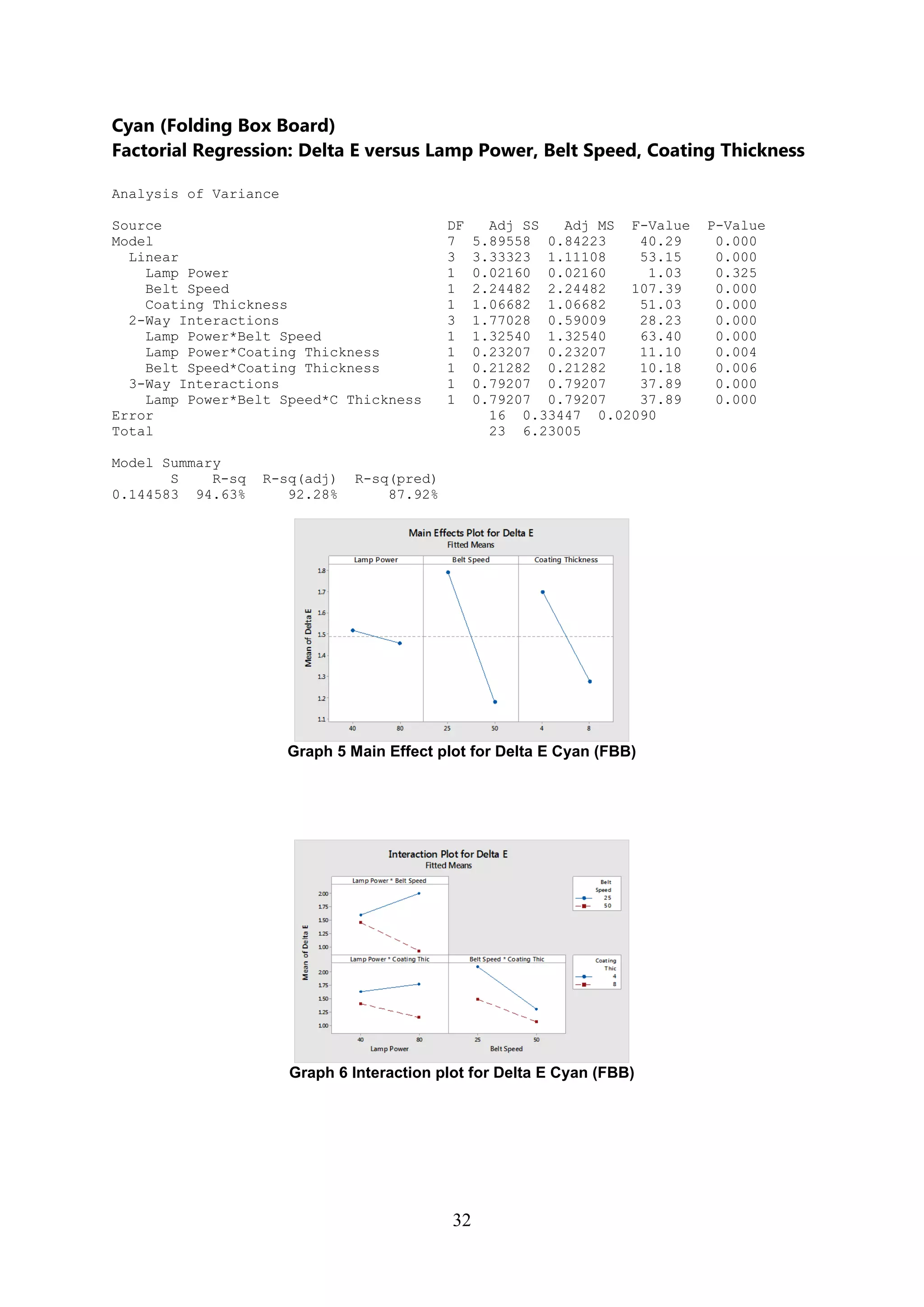
Cyan (Folding Box Board)
Factorial Regression: Delta E versus Lamp Power, Belt Speed, Coating Thickness
Analysis of Variance
Source DF Adj SS Adj MS F-Value P-Value
Model 7 5.89558 0.84223 40.29 0.000
Linear 3 3.33323 1.11108 53.15 0.000
Lamp Power 1 0.02160 0.02160 1.03 0.325
Belt Speed 1 2.24482 2.24482 107.39 0.000
Coating Thickness 1 1.06682 1.06682 51.03 0.000
2-Way Interactions 3 1.77028 0.59009 28.23 0.000
Lamp Power*Belt Speed 1 1.32540 1.32540 63.40 0.000
Lamp Power*Coating Thickness 1 0.23207 0.23207 11.10 0.004
Belt Speed*Coating Thickness 1 0.21282 0.21282 10.18 0.006
3-Way Interactions 1 0.79207 0.79207 37.89 0.000
Lamp Power*Belt Speed*C Thickness 1 0.79207 0.79207 37.89 0.000
Error 16 0.33447 0.02090
Total 23 6.23005
Model Summary
S R-sq R-sq(adj) R-sq(pred)
0.144583 94.63% 92.28% 87.92%
Graph 5 Main Effect plot for Delta E Cyan (FBB)
Graph 6 Interaction plot for Delta E Cyan (FBB)
33
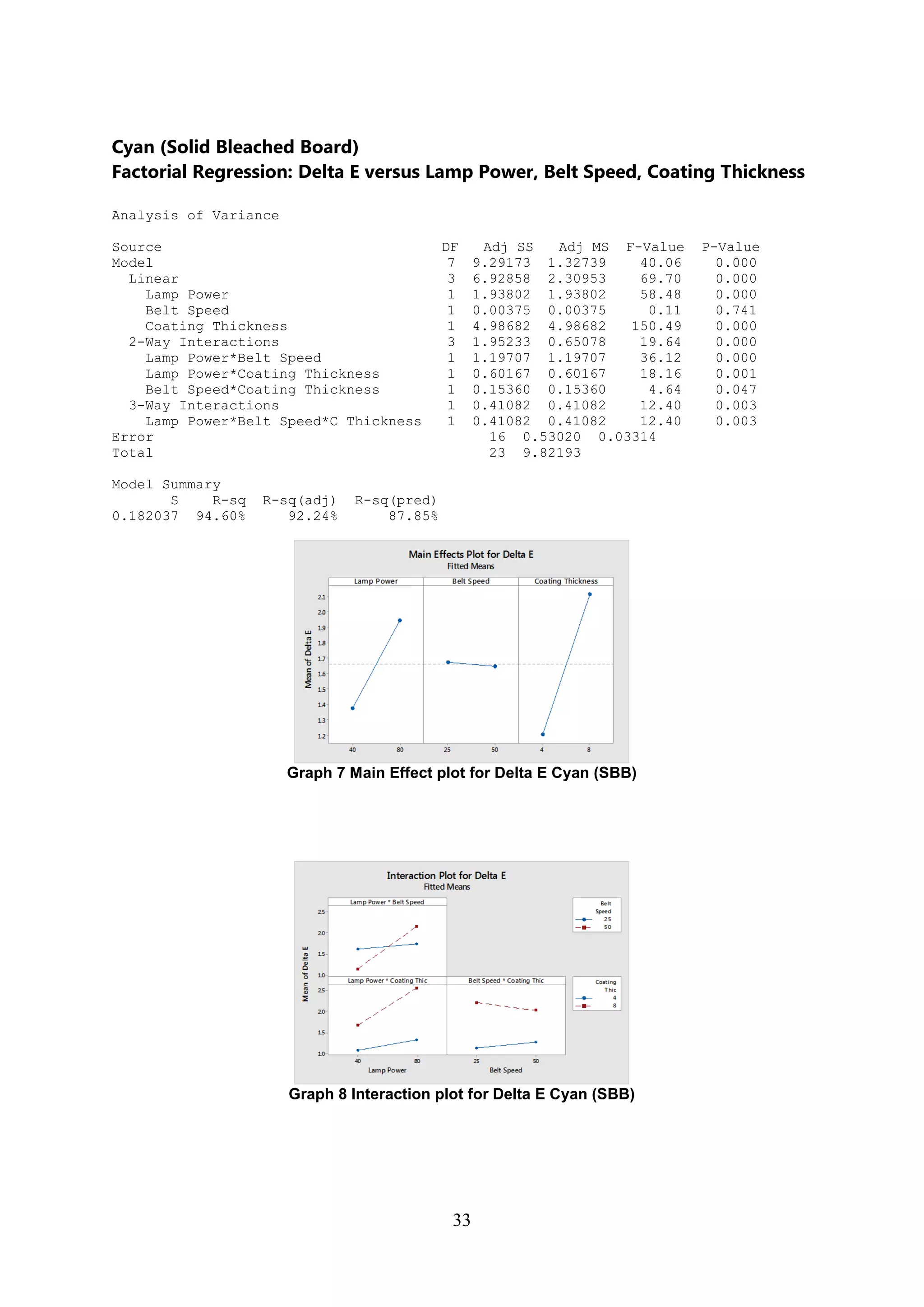
Cyan (Solid Bleached Board)
Factorial Regression: Delta E versus Lamp Power, Belt Speed, Coating Thickness
Analysis of Variance
Source DF Adj SS Adj MS F-Value P-Value
Model 7 9.29173 1.32739 40.06 0.000
Linear 3 6.92858 2.30953 69.70 0.000
Lamp Power 1 1.93802 1.93802 58.48 0.000
Belt Speed 1 0.00375 0.00375 0.11 0.741
Coating Thickness 1 4.98682 4.98682 150.49 0.000
2-Way Interactions 3 1.95233 0.65078 19.64 0.000
Lamp Power*Belt Speed 1 1.19707 1.19707 36.12 0.000
Lamp Power*Coating Thickness 1 0.60167 0.60167 18.16 0.001
Belt Speed*Coating Thickness 1 0.15360 0.15360 4.64 0.047
3-Way Interactions 1 0.41082 0.41082 12.40 0.003
Lamp Power*Belt Speed*C Thickness 1 0.41082 0.41082 12.40 0.003
Error 16 0.53020 0.03314
Total 23 9.82193
Model Summary
S R-sq R-sq(adj) R-sq(pred)
0.182037 94.60% 92.24% 87.85%
Graph 7 Main Effect plot for Delta E Cyan (SBB)
Graph 8 Interaction plot for Delta E Cyan (SBB)
34
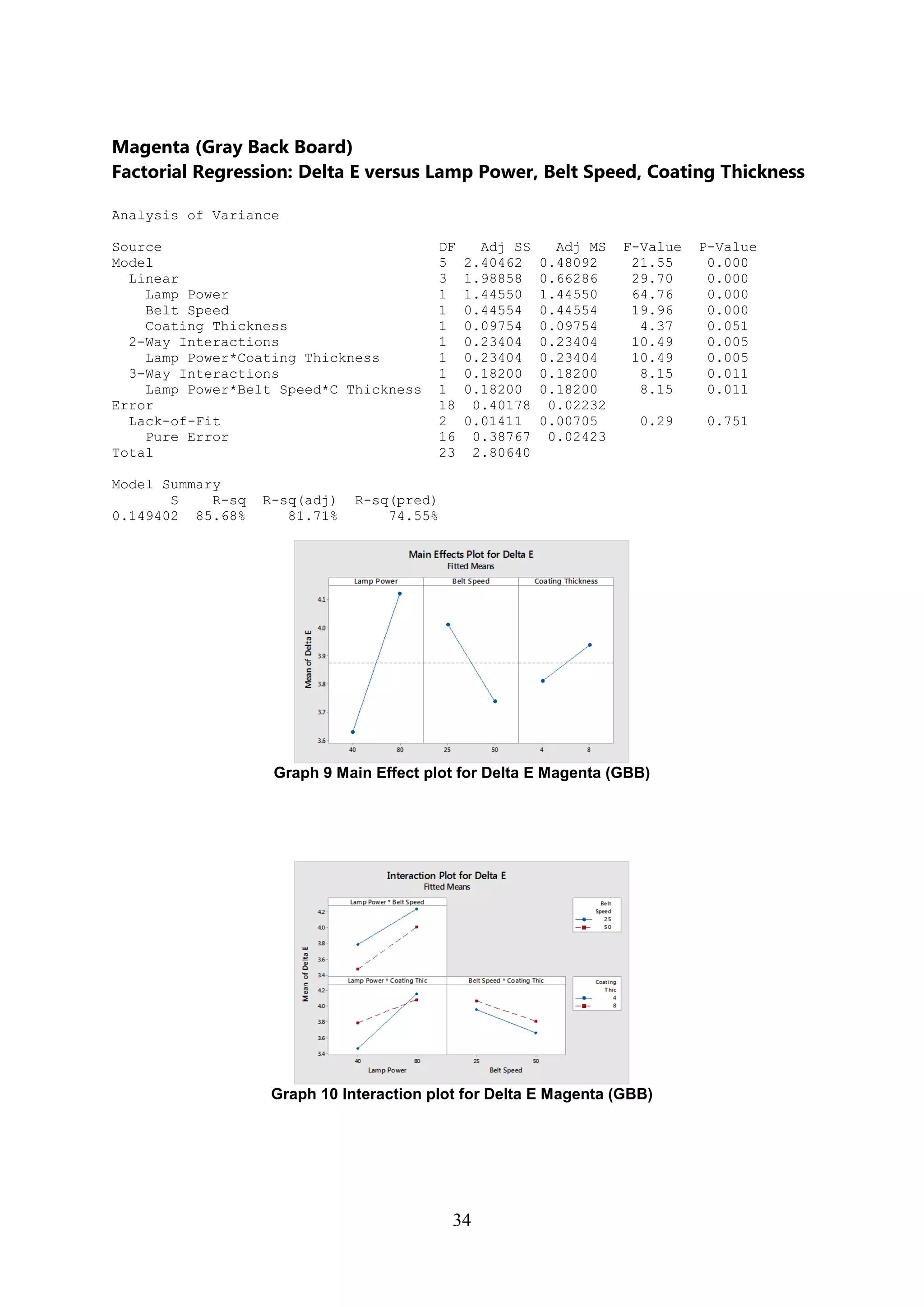
Magenta (Gray Back Board)
Factorial Regression: Delta E versus Lamp Power, Belt Speed, Coating Thickness
Analysis of Variance
Source DF Adj SS Adj MS F-Value P-Value
Model 5 2.40462 0.48092 21.55 0.000
Linear 3 1.98858 0.66286 29.70 0.000
Lamp Power 1 1.44550 1.44550 64.76 0.000
Belt Speed 1 0.44554 0.44554 19.96 0.000
Coating Thickness 1 0.09754 0.09754 4.37 0.051
2-Way Interactions 1 0.23404 0.23404 10.49 0.005
Lamp Power*Coating Thickness 1 0.23404 0.23404 10.49 0.005
3-Way Interactions 1 0.18200 0.18200 8.15 0.011
Lamp Power*Belt Speed*C Thickness 1 0.18200 0.18200 8.15 0.011
Error 18 0.40178 0.02232
Lack-of-Fit 2 0.01411 0.00705 0.29 0.751
Pure Error 16 0.38767 0.02423
Total 23 2.80640
Model Summary
S R-sq R-sq(adj) R-sq(pred)
0.149402 85.68% 81.71% 74.55%
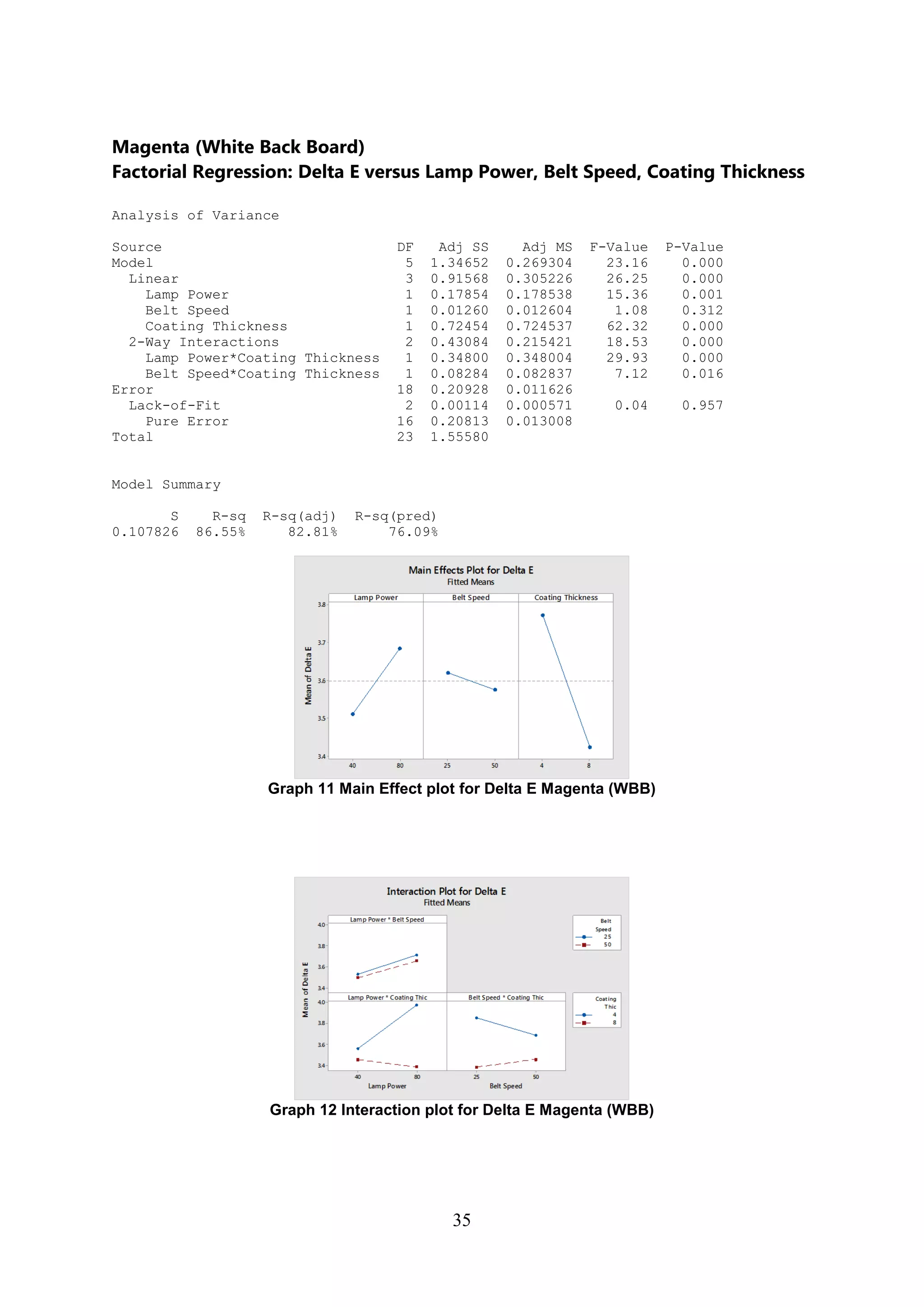
Graph 9 Main Effect plot for Delta E Magenta (GBB)
Graph 10 Interaction plot for Delta E Magenta (GBB)
35
Magenta (White Back Board)
Factorial Regression: Delta E versus Lamp Power, Belt Speed, Coating Thickness
Analysis of Variance
Source DF Adj SS Adj MS F-Value P-Value
Model 5 1.34652 0.269304 23.16 0.000
Linear 3 0.91568 0.305226 26.25 0.000
Lamp Power 1 0.17854 0.178538 15.36 0.001
Belt Speed 1 0.01260 0.012604 1.08 0.312
Coating Thickness 1 0.72454 0.724537 62.32 0.000
2-Way Interactions 2 0.43084 0.215421 18.53 0.000
Lamp Power*Coating Thickness 1 0.34800 0.348004 29.93 0.000
Belt Speed*Coating Thickness 1 0.08284 0.082837 7.12 0.016
Error 18 0.20928 0.011626
Lack-of-Fit 2 0.00114 0.000571 0.04 0.957
Pure Error 16 0.20813 0.013008
Total 23 1.55580
Model Summary
S R-sq R-sq(adj) R-sq(pred)
0.107826 86.55% 82.81% 76.09%
Graph 11 Main Effect plot for Delta E Magenta (WBB)
Graph 12 Interaction plot for Delta E Magenta (WBB)
36
Magenta (Folding Box Board)
Factorial Regression: Delta E versus Lamp Power, Belt Speed, Coating Thickness
Analysis of Variance
Source DF Adj SS Adj MS F-Value P-Value
Model 6 6.11162 1.01860 67.26 0.000
Linear 3 4.38621 1.46207 96.54 0.000
Lamp Power 1 4.14170 4.14170 273.46 0.000
Belt Speed 1 0.13650 0.13650 9.01 0.008
Coating Thickness 1 0.10800 0.10800 7.13 0.016
2-Way Interactions 2 1.55371 0.77685 51.29 0.000
Lamp Power*Belt Speed 1 0.27950 0.27950 18.45 0.000
Belt Speed*Coating Thickness 1 1.27420 1.27420 84.13 0.000
3-Way Interactions 1 0.17170 0.17170 11.34 0.004
Lamp Power*Belt Speed*C Thickness 1 0.17170 0.17170 11.34 0.004
Error 17 0.25747 0.01515
Lack-of-Fit 1 0.00034 0.00034 0.02 0.887
Pure Error 16 0.25713 0.01607
Total 23 6.36910
Model Summary
S R-sq R-sq(adj) R-sq(pred)
0.123066 95.96% 94.53% 91.94%
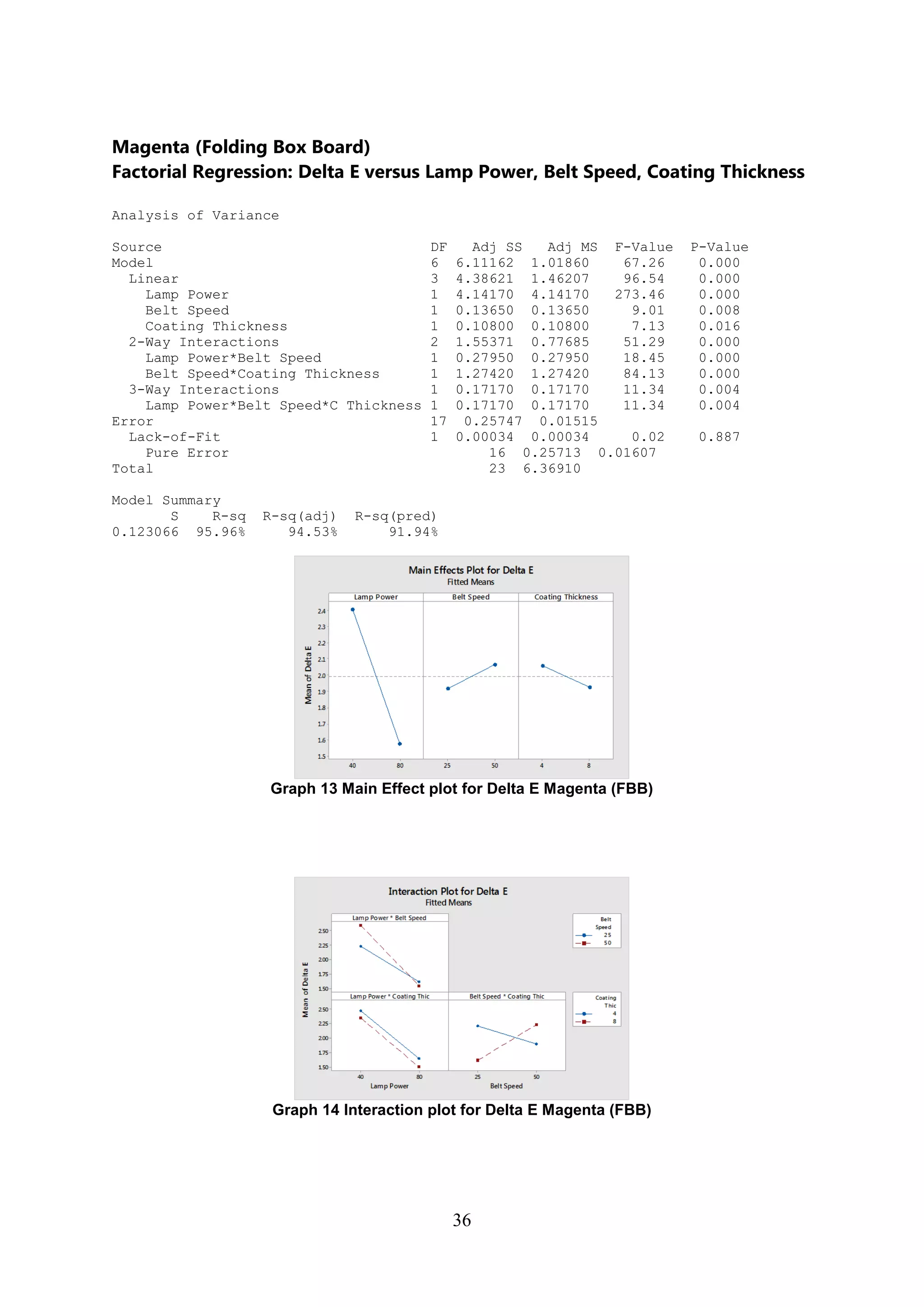
Graph 13 Main Effect plot for Delta E Magenta (FBB)
Graph 14 Interaction plot for Delta E Magenta (FBB)
37
Magenta (Solid Bleached Board)
Factorial Regression: Delta E versus Lamp Power, Belt Speed, Coating Thickness
Analysis of Variance
Source DF Adj SS Adj MS F-Value P-Value
Model 7 9.0586 1.29409 105.60 0.000
Linear 3 2.7481 0.91604 74.75 0.000
Lamp Power 1 0.1107 0.11070 9.03 0.008
Belt Speed 1 0.8932 0.89320 72.89 0.000
Coating Thickness 1 1.7442 1.74420 142.34 0.000
2-Way Interactions 3 6.0958 2.03194 165.82 0.000
Lamp Power*Belt Speed 1 1.7550 1.75500 143.22 0.000
Lamp Power*Coating Thickness 1 1.0626 1.06260 86.71 0.000
Belt Speed*Coating Thickness 1 3.2782 3.27820 267.52 0.000
3-Way Interactions 1 0.2147 0.21470 17.52 0.001
Lamp Power*Belt Speed*C Thickness 1 0.2147 0.21470 17.52 0.001
Error 16 0.1961 0.01225
Total 23 9.2547
Model Summary
S R-sq R-sq(adj) R-sq(pred)
0.110699 97.88% 96.95% 95.23%
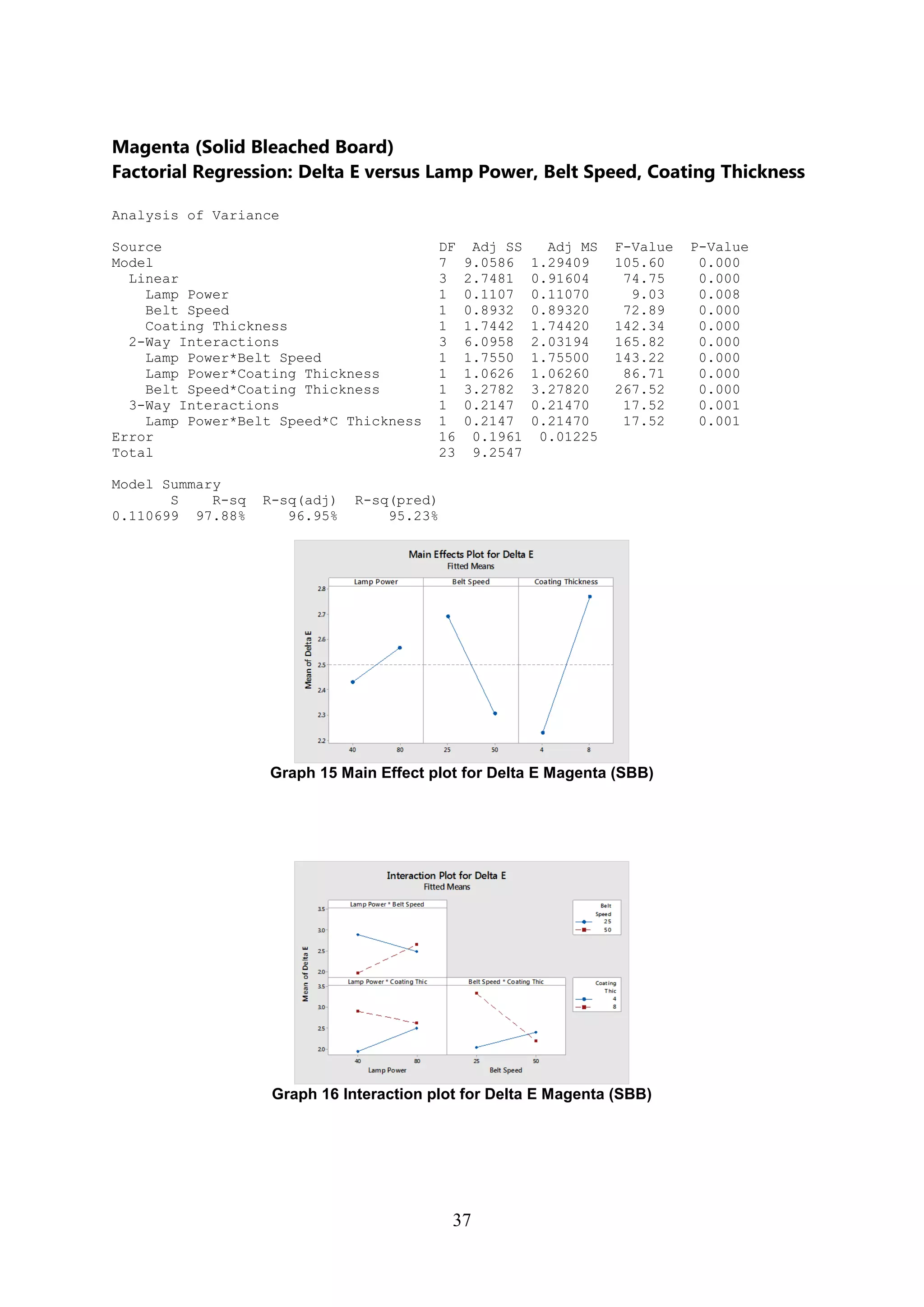
Graph 15 Main Effect plot for Delta E Magenta (SBB)
Graph 16 Interaction plot for Delta E Magenta (SBB)
38
Yellow (Gray Back Board)
Factorial Regression: Delta E versus Lamp Power, Belt Speed, Coating Thickness
Analysis of Variance
Source DF Adj SS Adj MS F-Value P-Value
Model 6 5.96547 0.99424 90.23 0.000
Linear 3 2.33648 0.77883 70.68 0.000
Lamp Power 1 1.14407 1.14407 103.82 0.000
Belt Speed 1 0.49882 0.49882 45.27 0.000
Coating Thickness 1 0.69360 0.69360 62.94 0.000
2-Way Interactions 2 2.05817 1.02908 93.39 0.000
Lamp Power*Belt Speed 1 0.34082 0.34082 30.93 0.000
Belt Speed*Coating Thickness 1 1.71735 1.71735 155.84 0.000
3-Way Interactions 1 1.57082 1.57082 142.55 0.000
Lamp Power*Belt Speed*C Thickness 1 1.57082 1.57082 142.55 0.000
Error 17 0.18733 0.01102
Lack-of-Fit 1 0.00807 0.00807 0.72 0.409
Pure Error 16 0.17927 0.01120
Total 23 6.15280
Model Summary
S R-sq R-sq(adj) R-sq(pred)
0.104974 96.96% 95.88% 93.93%
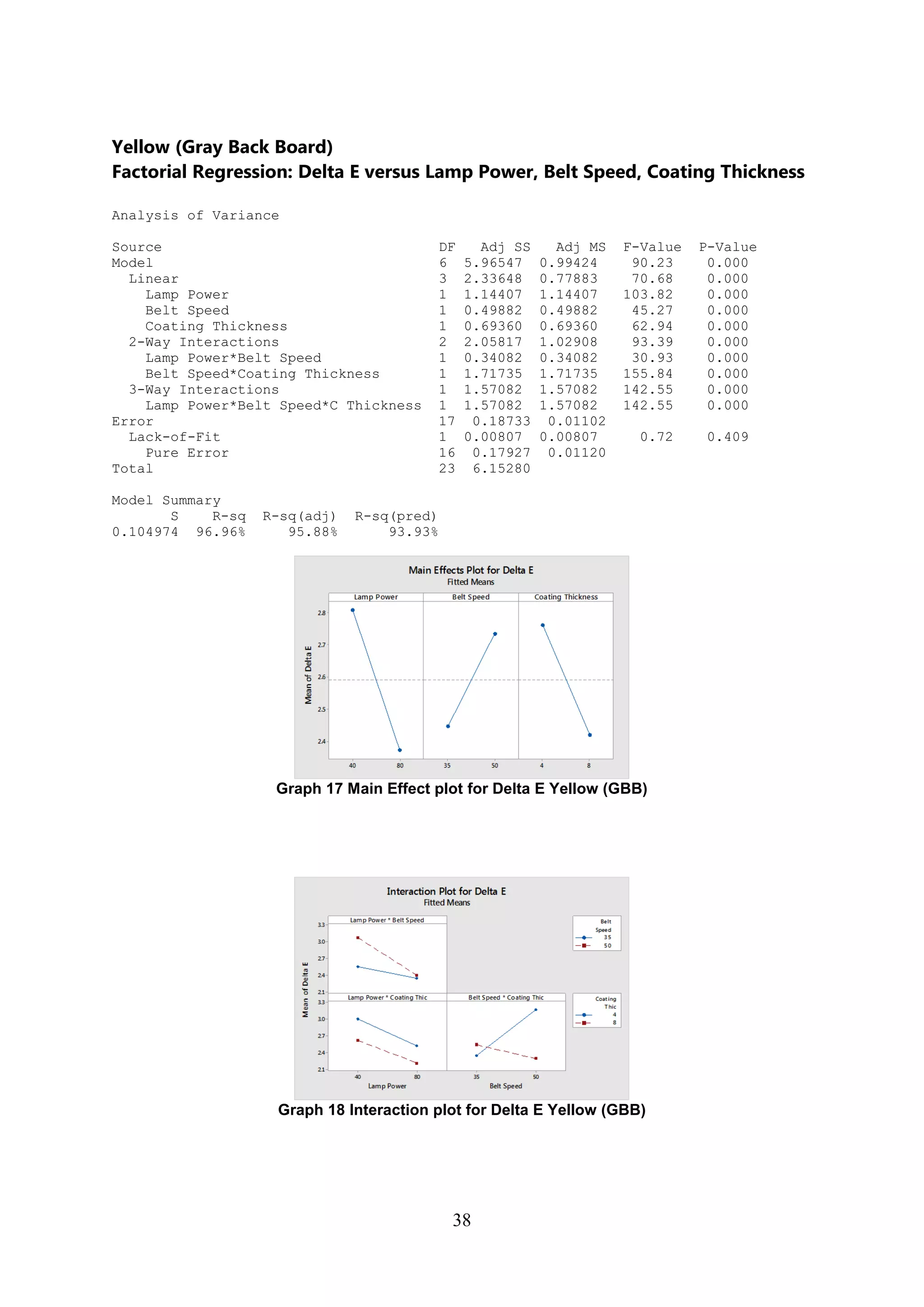
Graph 17 Main Effect plot for Delta E Yellow (GBB)
Graph 18 Interaction plot for Delta E Yellow (GBB)
39
Yellow (White Back Board)
Factorial Regression: Delta E versus Lamp Power, Belt Speed, Coating Thickness
Analysis of Variance
Source DF Adj SS Adj MS F-Value P-Value
Model 7 5.70132 0.81447 61.05 0.000
Linear 3 1.36843 0.45614 34.19 0.000
Lamp Power 1 0.06000 0.06000 4.50 0.050
Belt Speed 1 0.60802 0.60802 45.57 0.000
Coating Thickness 1 0.70042 0.70042 52.50 0.000
2-Way Interactions 3 4.26882 1.42294 106.65 0.000
Lamp Power*Belt Speed 1 0.40560 0.40560 30.40 0.000
Lamp Power*Coating Thickness 1 0.29040 0.29040 21.77 0.000
Belt Speed*Coating Thickness 1 3.57282 3.57282 267.79 0.000
3-Way Interactions 1 0.06407 0.06407 4.80 0.044
Lamp Power*Belt Speed*C Thickness 1 0.06407 0.06407 4.80 0.044
Error 16 0.21347 0.01334
Total 23 5.91478
Model Summary
S R-sq R-sq(adj) R-sq(pred)
0.115506 96.39% 94.81% 91.88%
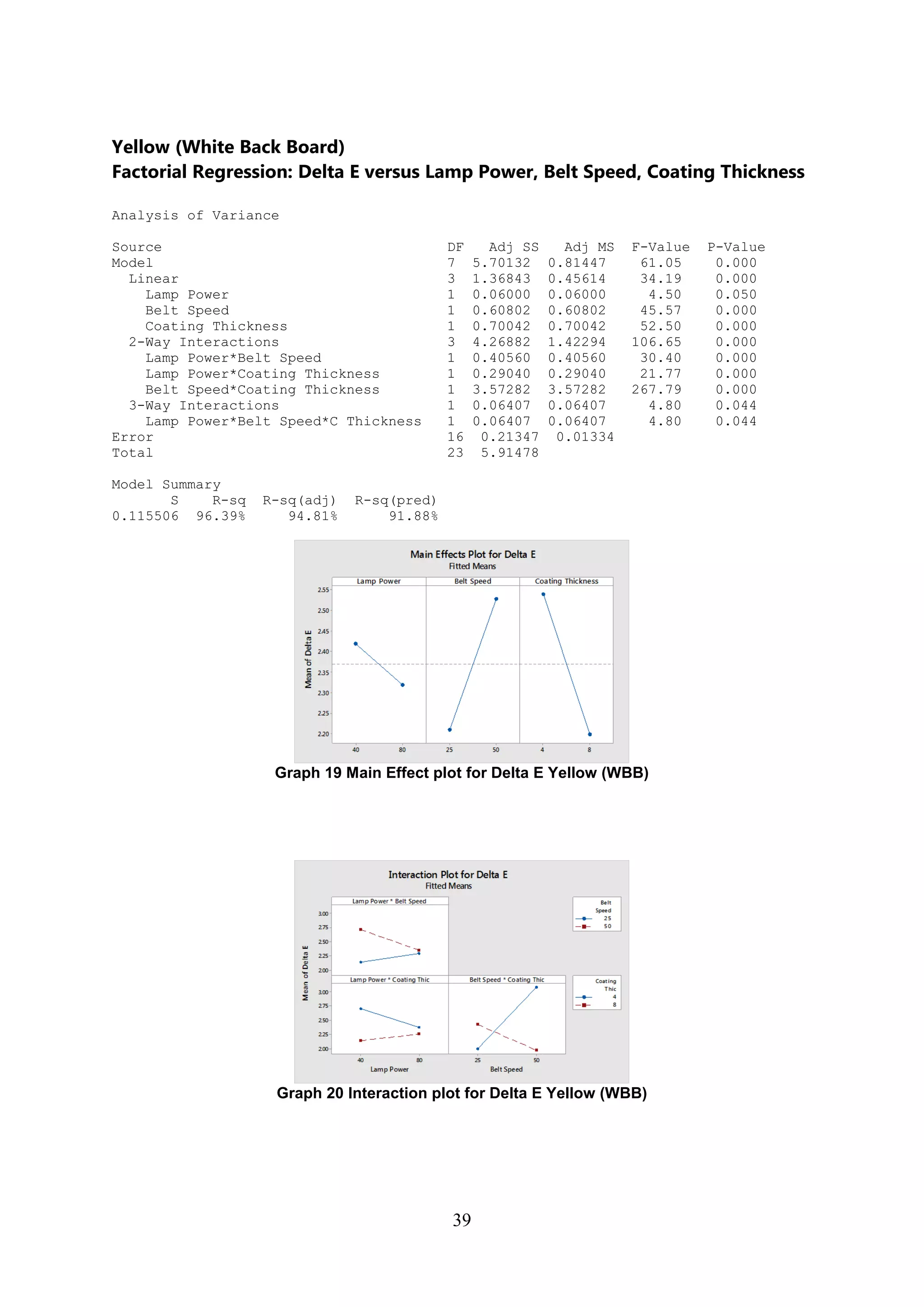
Graph 19 Main Effect plot for Delta E Yellow (WBB)
Graph 20 Interaction plot for Delta E Yellow (WBB)
40
Yellow (Folding Box Board)
Factorial Regression: Delta E versus Lamp Power, Belt Speed, Coating Thickness
Analysis of Variance
Source DF Adj SS Adj MS F-Value P-Value
Model 7 7.03450 1.00493 66.70 0.000
Linear 3 2.12225 0.70742 46.95 0.000
Lamp Power 1 1.77670 1.77670 117.92 0.000
Belt Speed 1 0.01654 0.01654 1.10 0.310
Coating Thickness 1 0.32900 0.32900 21.84 0.000
2-Way Interactions 3 3.23215 1.07738 71.51 0.000
Lamp Power*Belt Speed 1 1.52510 1.52510 101.22 0.000
Lamp Power*Coating Thickness 1 1.13970 1.13970 75.64 0.000
Belt Speed*Coating Thickness 1 0.56734 0.56734 37.66 0.000
3-Way Interactions 1 1.68010 1.68010 111.51 0.000
Lamp Power*Belt Speed*C Thickness 1 1.68010 1.68010 111.51 0.000
Error 16 0.24107 0.01507
Total 23 7.27556
Model Summary
S R-sq R-sq(adj) R-sq(pred)
0.122746 96.69% 95.24% 92.54%
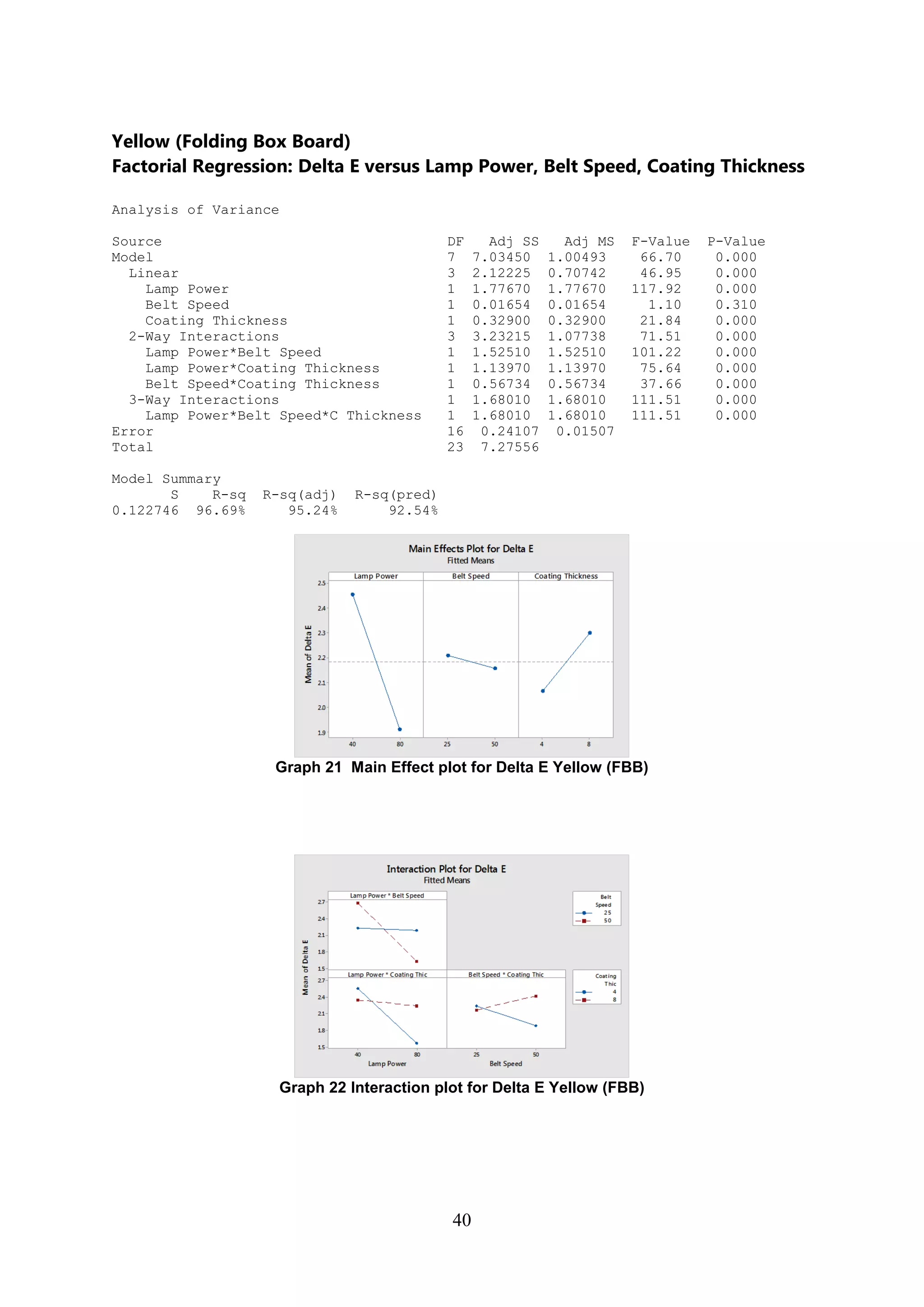
Graph 21 Main Effect plot for Delta E Yellow (FBB)
Graph 22 Interaction plot for Delta E Yellow (FBB)
41
Yellow (Solid Bleached Board)
Factorial Regression: Delta E versus Lamp Power, Belt Speed, Coating Thickness
Analysis of Variance
Source DF Adj SS Adj MS F-Value P-Value
Model 6 4.86049 0.81008 54.70 0.000
Linear 3 1.75355 0.58452 39.47 0.000
Lamp Power 1 1.06260 1.06260 71.75 0.000
Belt Speed 1 0.04084 0.04084 2.76 0.115
Coating Thickness 1 0.65010 0.65010 43.90 0.000
2-Way Interactions 2 2.65594 1.32797 89.67 0.000
Lamp Power*Coating Thickness 1 0.90094 0.90094 60.83 0.000
Belt Speed*Coating Thickness 1 1.75500 1.75500 118.50 0.000
3-Way Interactions 1 0.45100 0.45100 30.45 0.000
Lamp Power*Belt Speed*C Thickness 1 0.45100 0.45100 30.45 0.000
Error 17 0.25177 0.01481
Lack-of-Fit 1 0.02470 0.02470 1.74 0.206
Pure Error 16 0.22707 0.01419
Total 23 5.11226
Model Summary
S R-sq R-sq(adj) R-sq(pred)
0.121697 95.08% 93.34% 90.18%
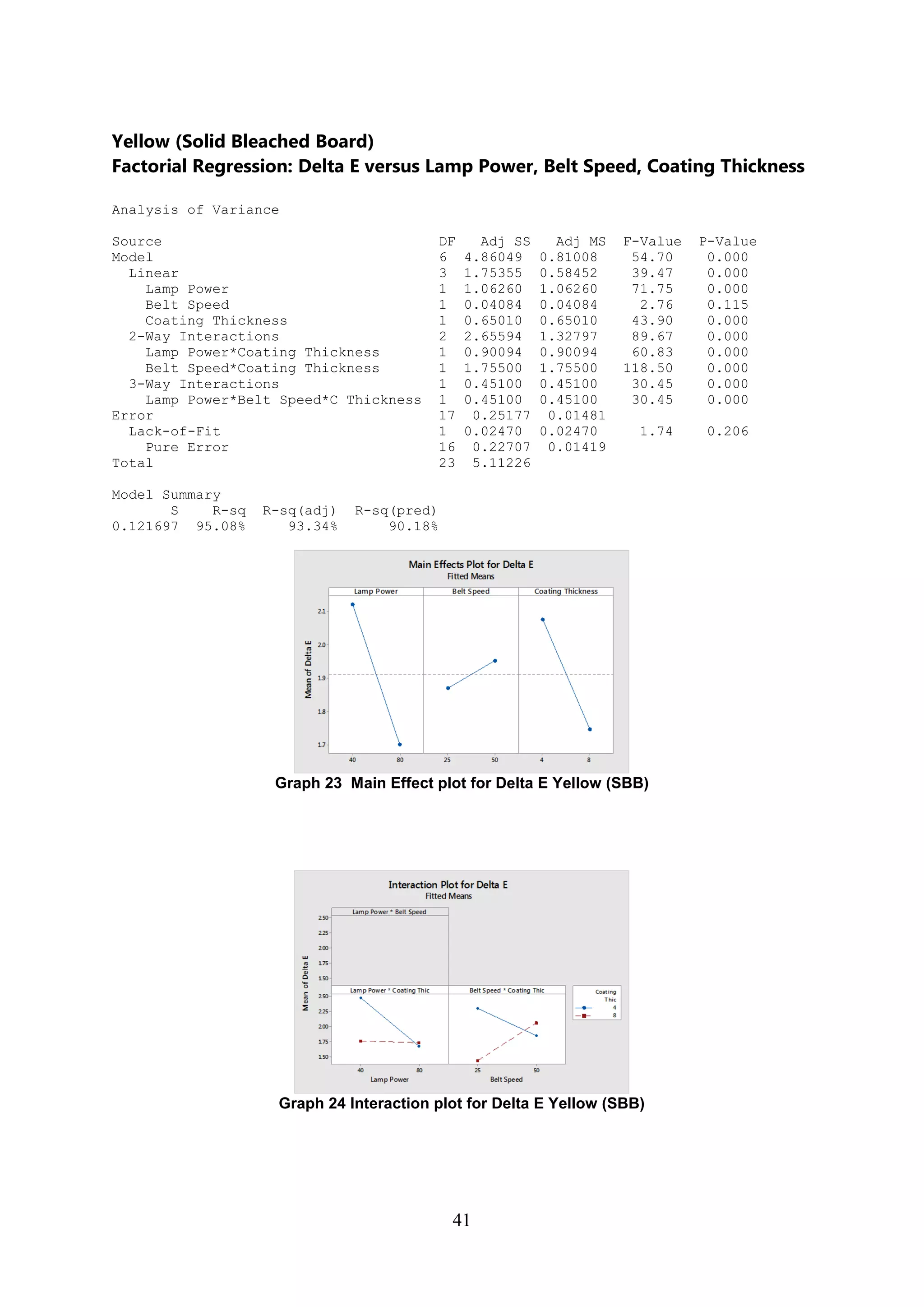
Graph 23 Main Effect plot for Delta E Yellow (SBB)
Graph 24 Interaction plot for Delta E Yellow (SBB)
42
Black (Gray Back Board)
Factorial Regression: Delta E versus Lamp Power, Belt Speed, Coating Thickness
Analysis of Variance
Source DF Adj SS Adj MS F-Value P-Value
Model 7 29.4566 4.2081 120.10 0.000
Linear 3 22.5832 7.5277 214.85 0.000
Lamp Power 1 7.5264 7.5264 214.81 0.000
Belt Speed 1 0.2360 0.2360 6.74 0.020
Coating Thickness 1 14.8208 14.8208 423.00 0.000
2-Way Interactions 3 6.7000 2.2333 63.74 0.000
Lamp Power*Belt Speed 1 0.4593 0.4593 13.11 0.002
Lamp Power*Coating Thickness 1 5.6454 5.6454 161.12 0.000
Belt Speed*Coating Thickness 1 0.5953 0.5953 16.99 0.001
3-Way Interactions 1 0.1734 0.1734 4.95 0.041
Lamp Power*Belt Speed*C Thickness 1 0.1734 0.1734 4.95 0.041
Error 16 0.5606 0.0350
Total 23 30.0172
Model Summary
S R-sq R-sq(adj) R-sq(pred)
0.187183 98.13% 97.32% 95.80%
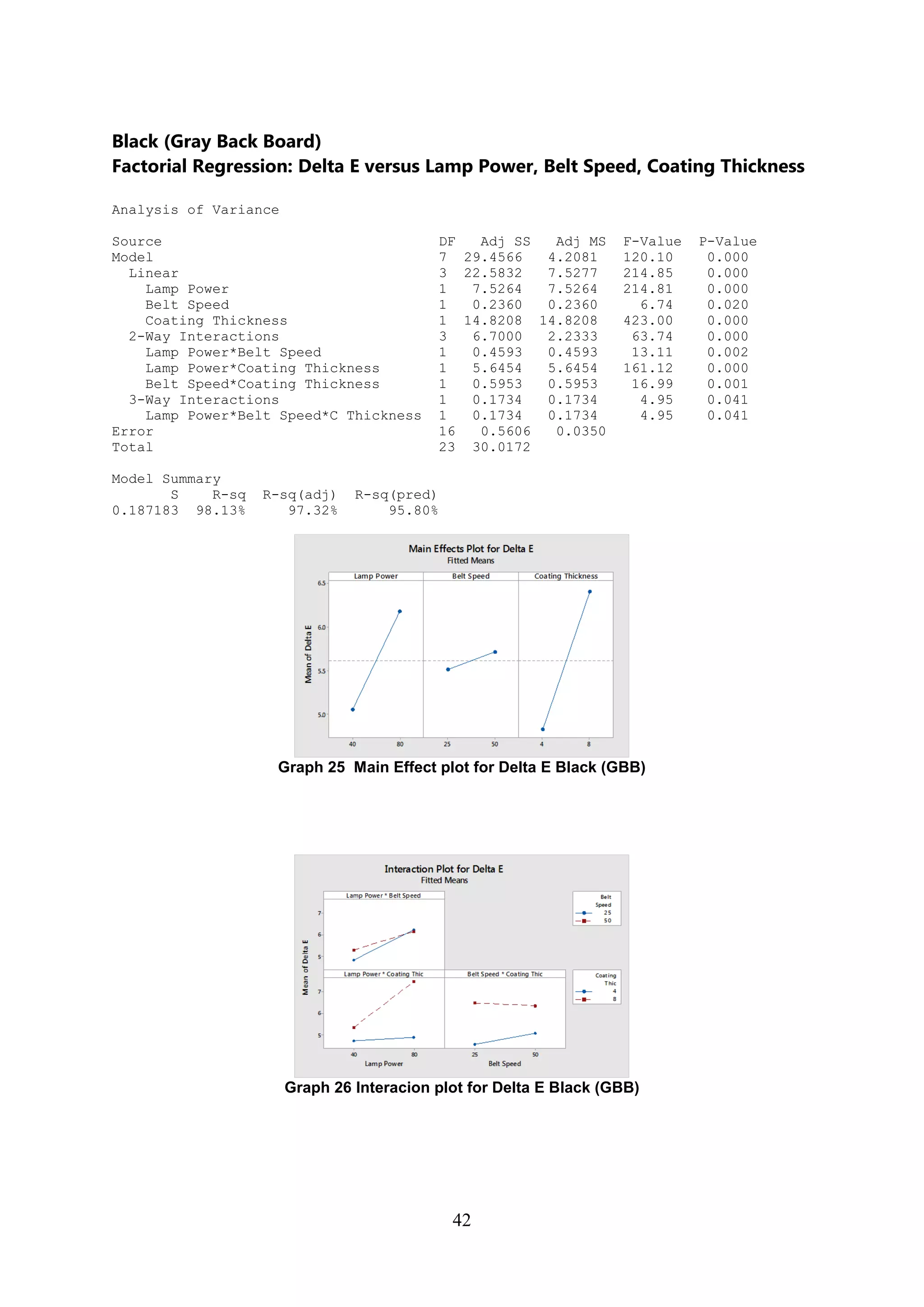
Graph 25 Main Effect plot for Delta E Black (GBB)
Graph 26 Interacion plot for Delta E Black (GBB)
43
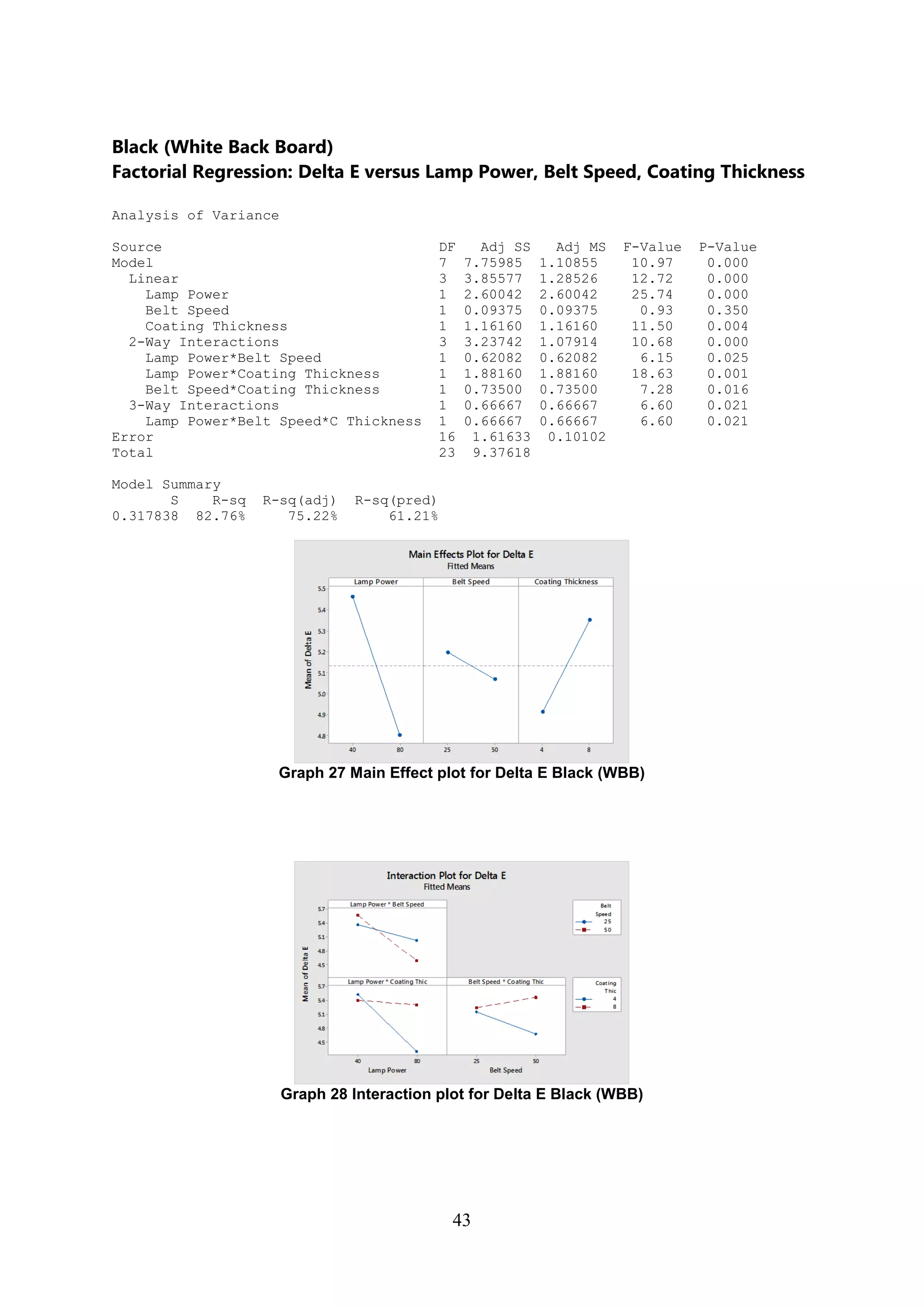
Black (White Back Board)
Factorial Regression: Delta E versus Lamp Power, Belt Speed, Coating Thickness
Analysis of Variance
Source DF Adj SS Adj MS F-Value P-Value
Model 7 7.75985 1.10855 10.97 0.000
Linear 3 3.85577 1.28526 12.72 0.000
Lamp Power 1 2.60042 2.60042 25.74 0.000
Belt Speed 1 0.09375 0.09375 0.93 0.350
Coating Thickness 1 1.16160 1.16160 11.50 0.004
2-Way Interactions 3 3.23742 1.07914 10.68 0.000
Lamp Power*Belt Speed 1 0.62082 0.62082 6.15 0.025
Lamp Power*Coating Thickness 1 1.88160 1.88160 18.63 0.001
Belt Speed*Coating Thickness 1 0.73500 0.73500 7.28 0.016
3-Way Interactions 1 0.66667 0.66667 6.60 0.021
Lamp Power*Belt Speed*C Thickness 1 0.66667 0.66667 6.60 0.021
Error 16 1.61633 0.10102
Total 23 9.37618
Model Summary
S R-sq R-sq(adj) R-sq(pred)
0.317838 82.76% 75.22% 61.21%
Graph 27 Main Effect plot for Delta E Black (WBB)
Graph 28 Interaction plot for Delta E Black (WBB)
44
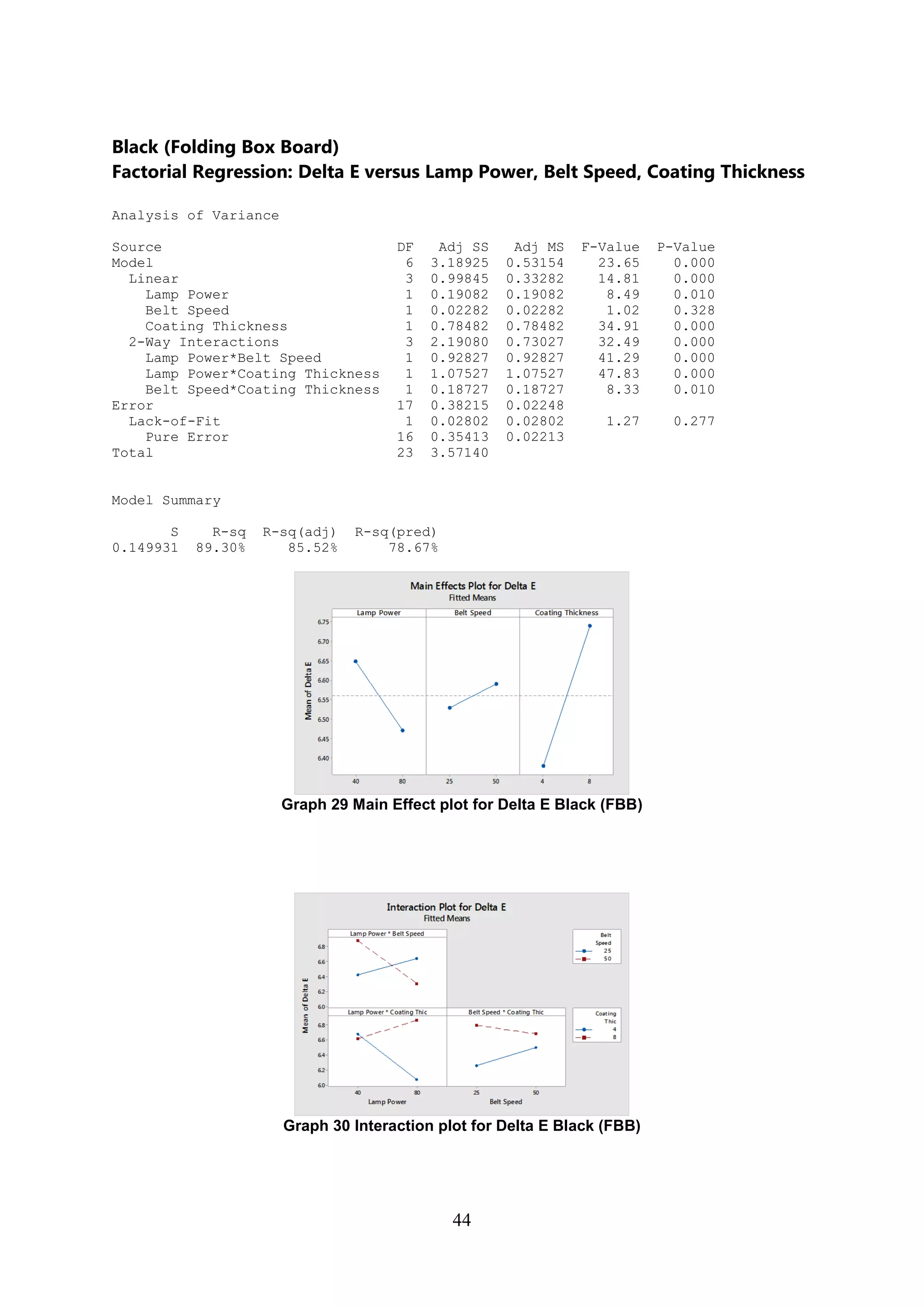
Black (Folding Box Board)
Factorial Regression: Delta E versus Lamp Power, Belt Speed, Coating Thickness
Analysis of Variance
Source DF Adj SS Adj MS F-Value P-Value
Model 6 3.18925 0.53154 23.65 0.000
Linear 3 0.99845 0.33282 14.81 0.000
Lamp Power 1 0.19082 0.19082 8.49 0.010
Belt Speed 1 0.02282 0.02282 1.02 0.328
Coating Thickness 1 0.78482 0.78482 34.91 0.000
2-Way Interactions 3 2.19080 0.73027 32.49 0.000
Lamp Power*Belt Speed 1 0.92827 0.92827 41.29 0.000
Lamp Power*Coating Thickness 1 1.07527 1.07527 47.83 0.000
Belt Speed*Coating Thickness 1 0.18727 0.18727 8.33 0.010
Error 17 0.38215 0.02248
Lack-of-Fit 1 0.02802 0.02802 1.27 0.277
Pure Error 16 0.35413 0.02213
Total 23 3.57140
Model Summary
S R-sq R-sq(adj) R-sq(pred)
0.149931 89.30% 85.52% 78.67%
Graph 29 Main Effect plot for Delta E Black (FBB)
Graph 30 Interaction plot for Delta E Black (FBB)
45
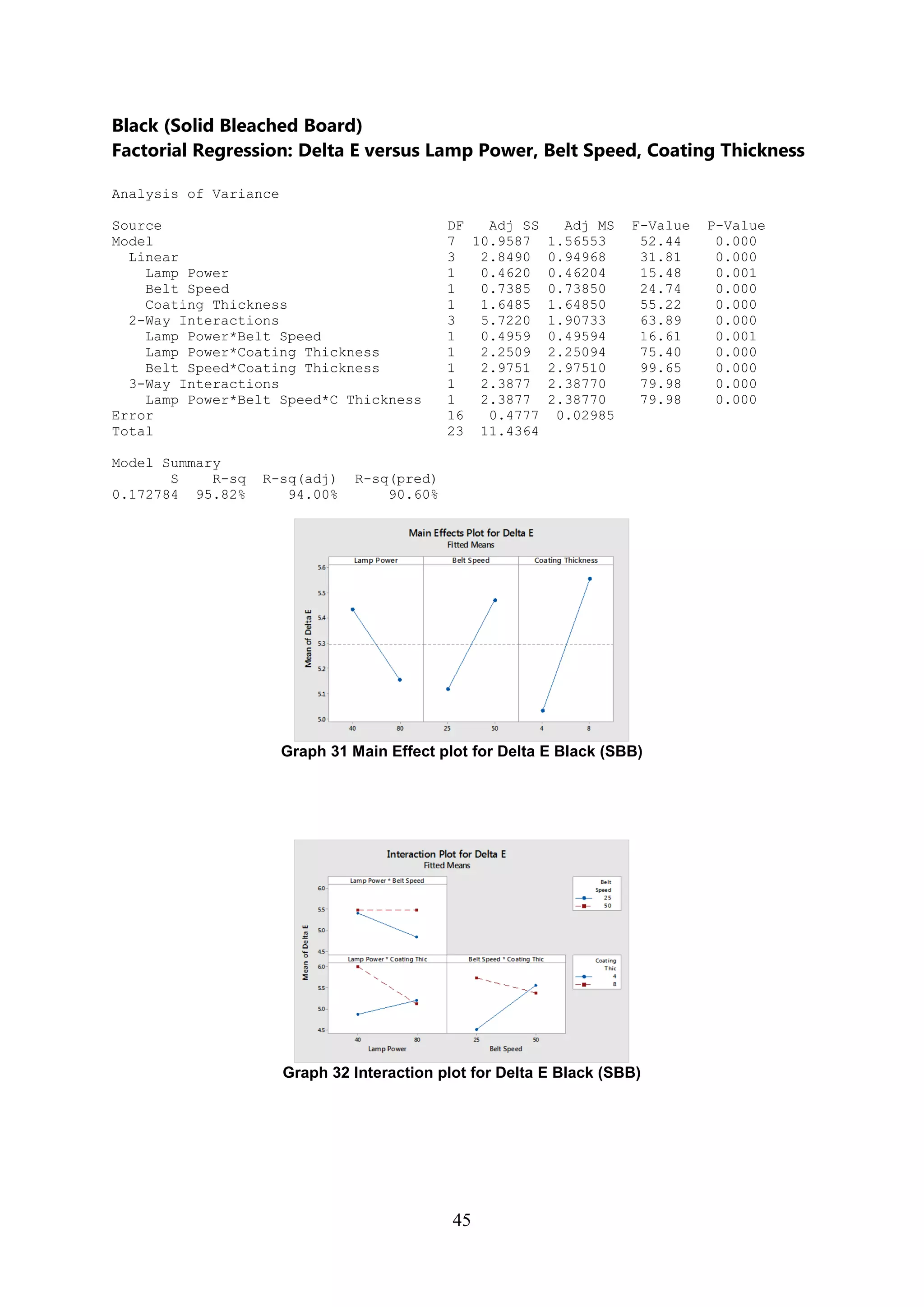
Black (Solid Bleached Board)
Factorial Regression: Delta E versus Lamp Power, Belt Speed, Coating Thickness
Analysis of Variance
Source DF Adj SS Adj MS F-Value P-Value
Model 7 10.9587 1.56553 52.44 0.000
Linear 3 2.8490 0.94968 31.81 0.000
Lamp Power 1 0.4620 0.46204 15.48 0.001
Belt Speed 1 0.7385 0.73850 24.74 0.000
Coating Thickness 1 1.6485 1.64850 55.22 0.000
2-Way Interactions 3 5.7220 1.90733 63.89 0.000
Lamp Power*Belt Speed 1 0.4959 0.49594 16.61 0.001
Lamp Power*Coating Thickness 1 2.2509 2.25094 75.40 0.000
Belt Speed*Coating Thickness 1 2.9751 2.97510 99.65 0.000
3-Way Interactions 1 2.3877 2.38770 79.98 0.000
Lamp Power*Belt Speed*C Thickness 1 2.3877 2.38770 79.98 0.000
Error 16 0.4777 0.02985
Total 23 11.4364
Model Summary
S R-sq R-sq(adj) R-sq(pred)
0.172784 95.82% 94.00% 90.60%
Graph 31 Main Effect plot for Delta E Black (SBB)
Graph 32 Interaction plot for Delta E Black (SBB)
46
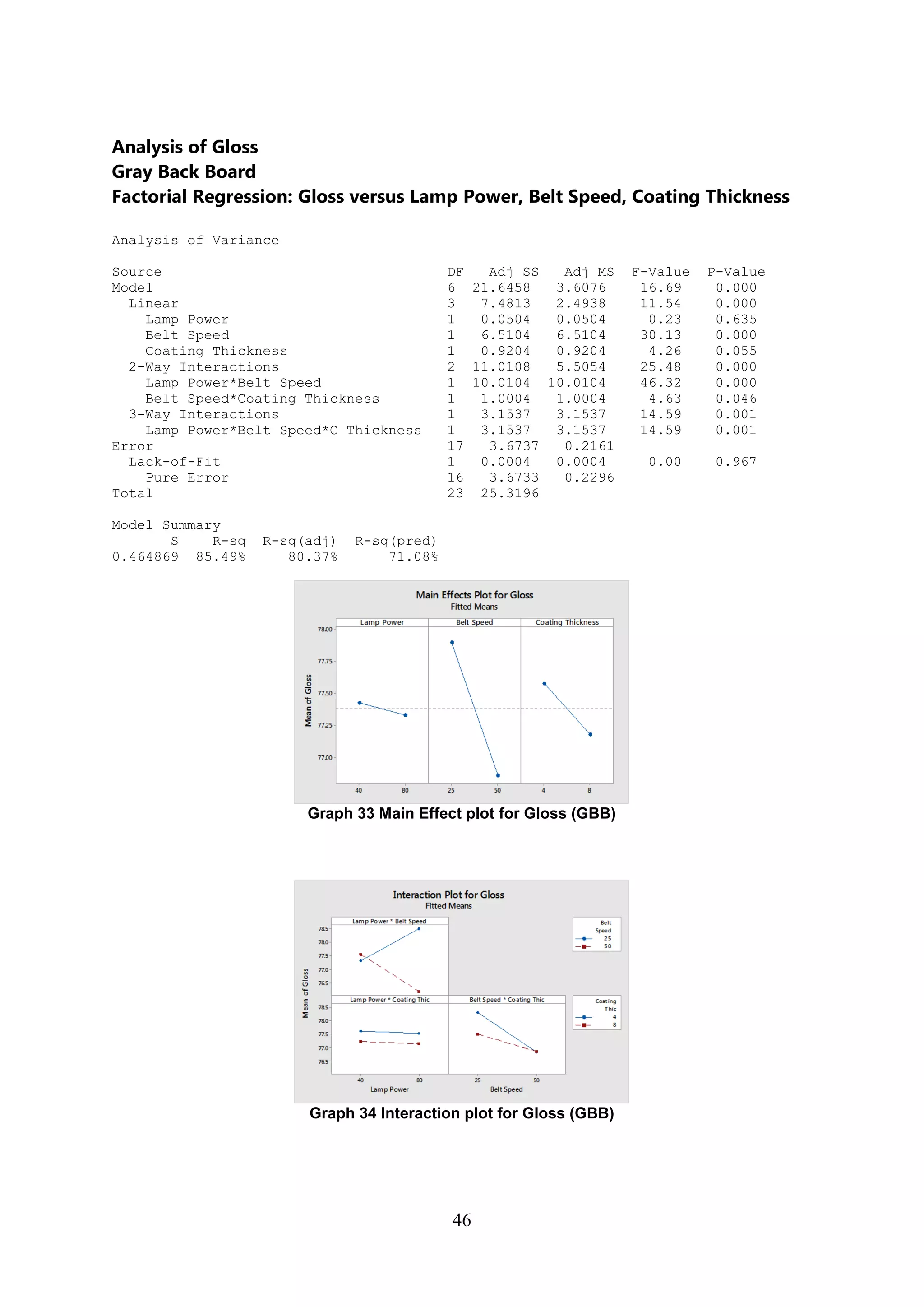
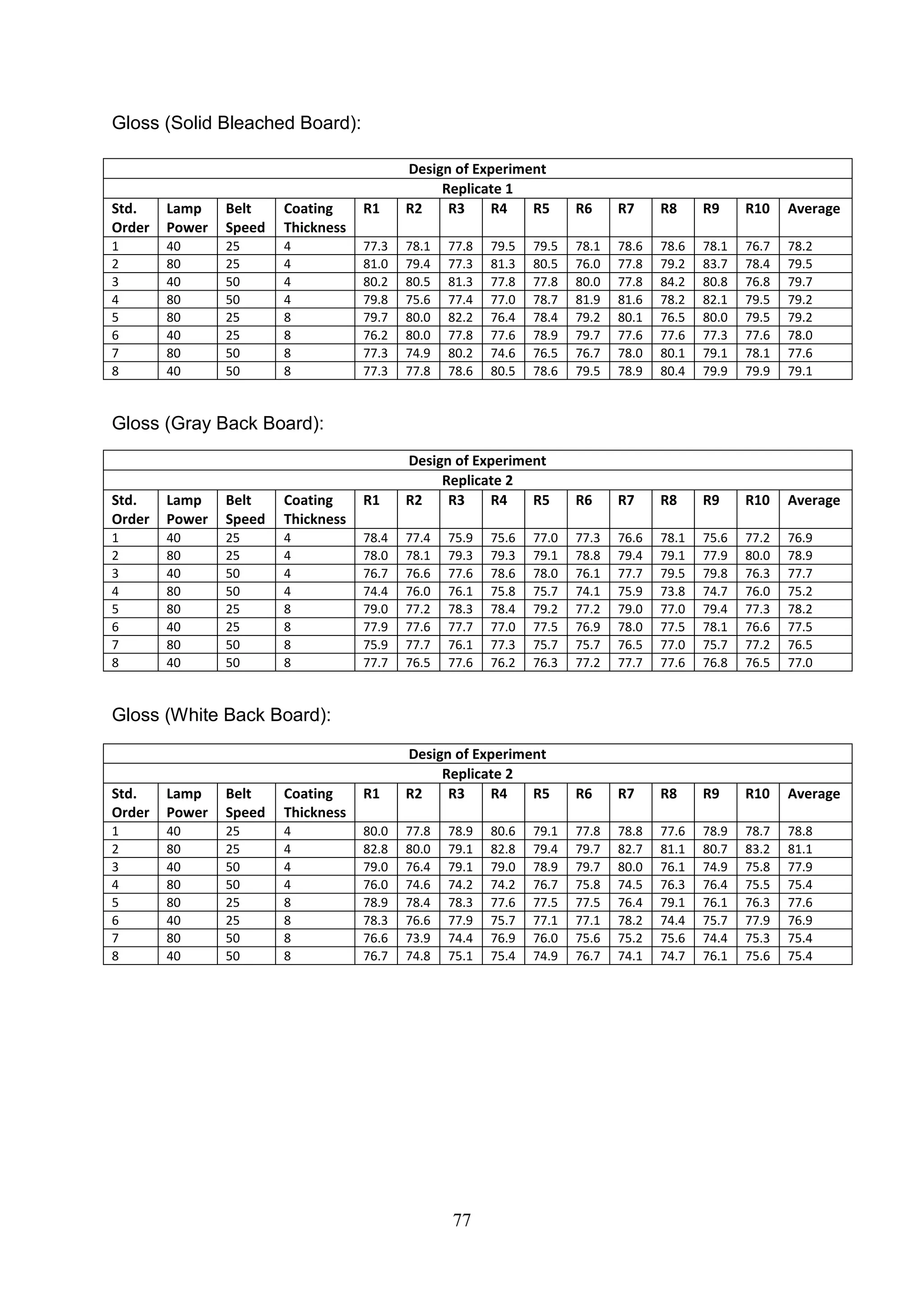
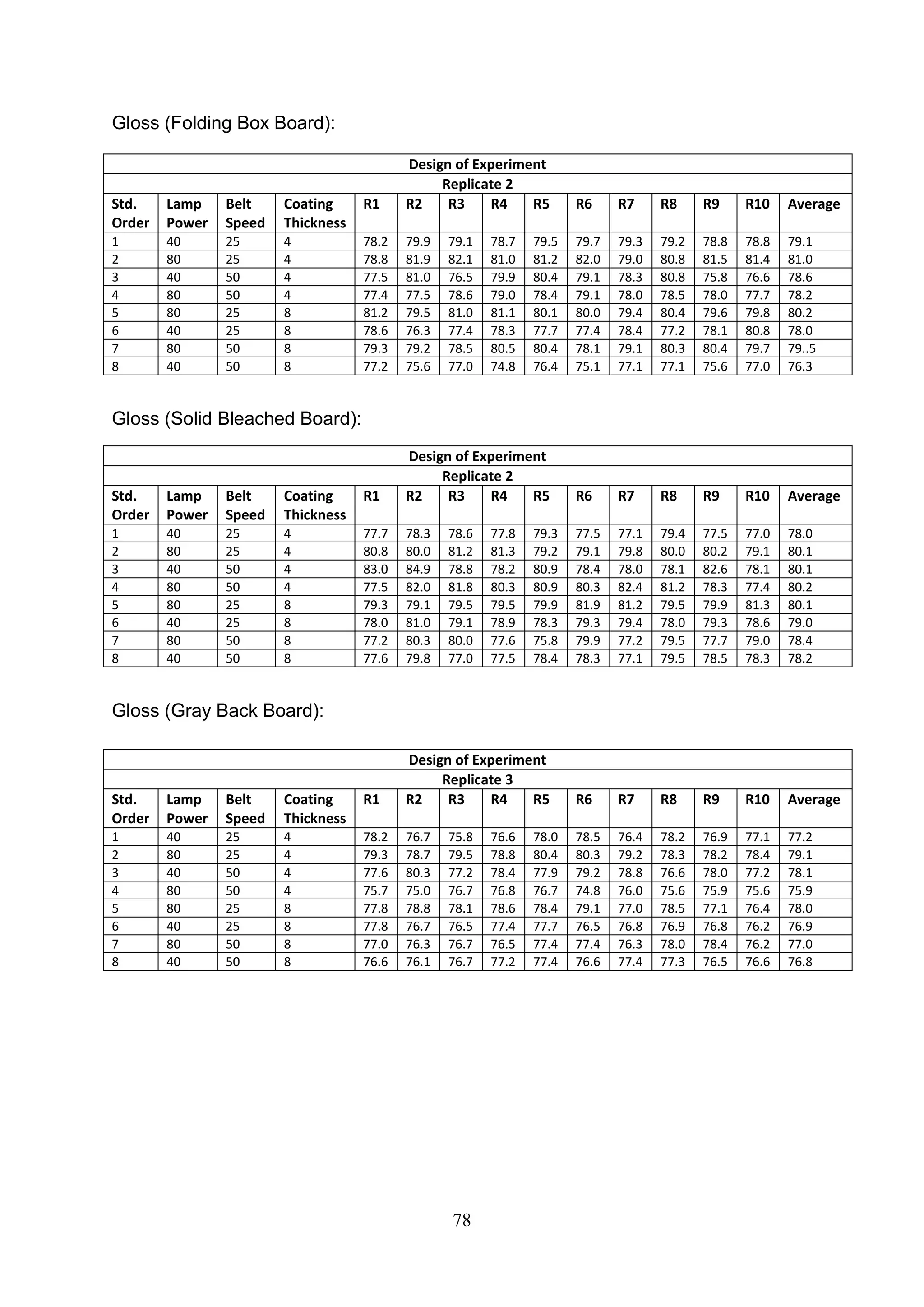
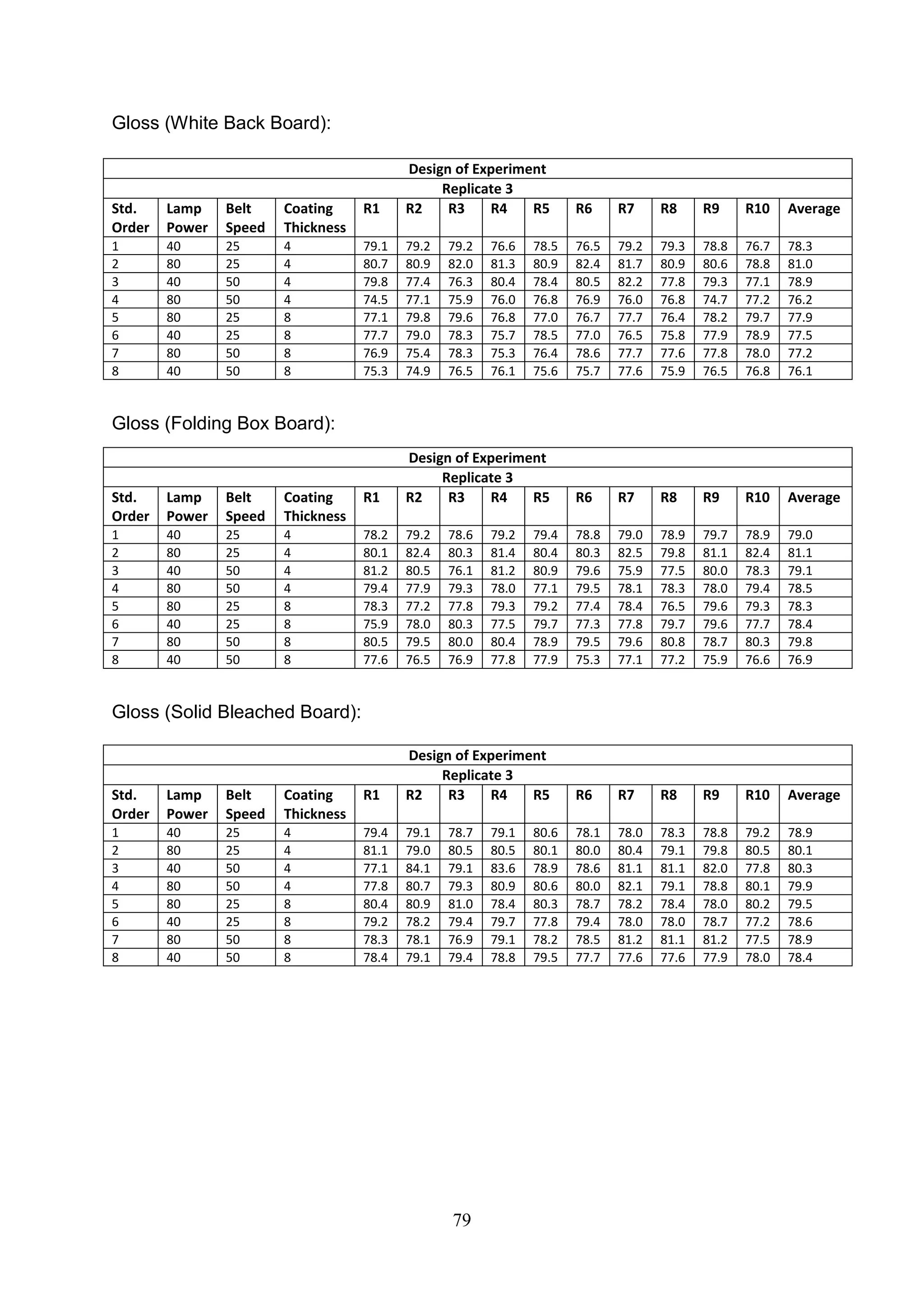
Analysis of Gloss
Gray Back Board
Factorial Regression: Gloss versus Lamp Power, Belt Speed, Coating Thickness
Analysis of Variance
Source DF Adj SS Adj MS F-Value P-Value
Model 6 21.6458 3.6076 16.69 0.000
Linear 3 7.4813 2.4938 11.54 0.000
Lamp Power 1 0.0504 0.0504 0.23 0.635
Belt Speed 1 6.5104 6.5104 30.13 0.000
Coating Thickness 1 0.9204 0.9204 4.26 0.055
2-Way Interactions 2 11.0108 5.5054 25.48 0.000
Lamp Power*Belt Speed 1 10.0104 10.0104 46.32 0.000
Belt Speed*Coating Thickness 1 1.0004 1.0004 4.63 0.046
3-Way Interactions 1 3.1537 3.1537 14.59 0.001
Lamp Power*Belt Speed*C Thickness 1 3.1537 3.1537 14.59 0.001
Error 17 3.6737 0.2161
Lack-of-Fit 1 0.0004 0.0004 0.00 0.967
Pure Error 16 3.6733 0.2296
Total 23 25.3196
Model Summary
S R-sq R-sq(adj) R-sq(pred)
0.464869 85.49% 80.37% 71.08%
Graph 33 Main Effect plot for Gloss (GBB)
Graph 34 Interaction plot for Gloss (GBB)
47
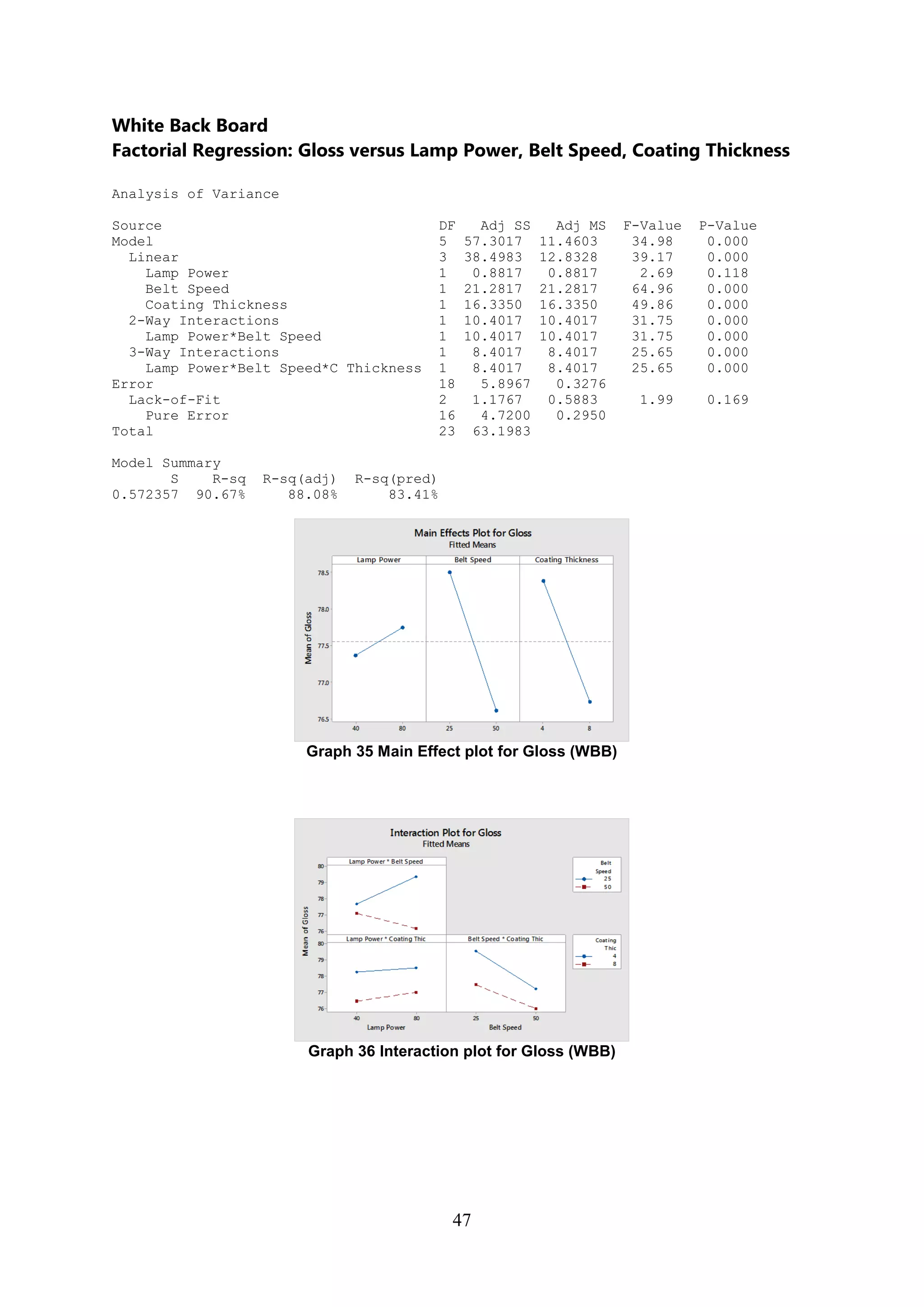
White Back Board
Factorial Regression: Gloss versus Lamp Power, Belt Speed, Coating Thickness
Analysis of Variance
Source DF Adj SS Adj MS F-Value P-Value
Model 5 57.3017 11.4603 34.98 0.000
Linear 3 38.4983 12.8328 39.17 0.000
Lamp Power 1 0.8817 0.8817 2.69 0.118
Belt Speed 1 21.2817 21.2817 64.96 0.000
Coating Thickness 1 16.3350 16.3350 49.86 0.000
2-Way Interactions 1 10.4017 10.4017 31.75 0.000
Lamp Power*Belt Speed 1 10.4017 10.4017 31.75 0.000
3-Way Interactions 1 8.4017 8.4017 25.65 0.000
Lamp Power*Belt Speed*C Thickness 1 8.4017 8.4017 25.65 0.000
Error 18 5.8967 0.3276
Lack-of-Fit 2 1.1767 0.5883 1.99 0.169
Pure Error 16 4.7200 0.2950
Total 23 63.1983
Model Summary
S R-sq R-sq(adj) R-sq(pred)
0.572357 90.67% 88.08% 83.41%
Graph 35 Main Effect plot for Gloss (WBB)
Graph 36 Interaction plot for Gloss (WBB)
48
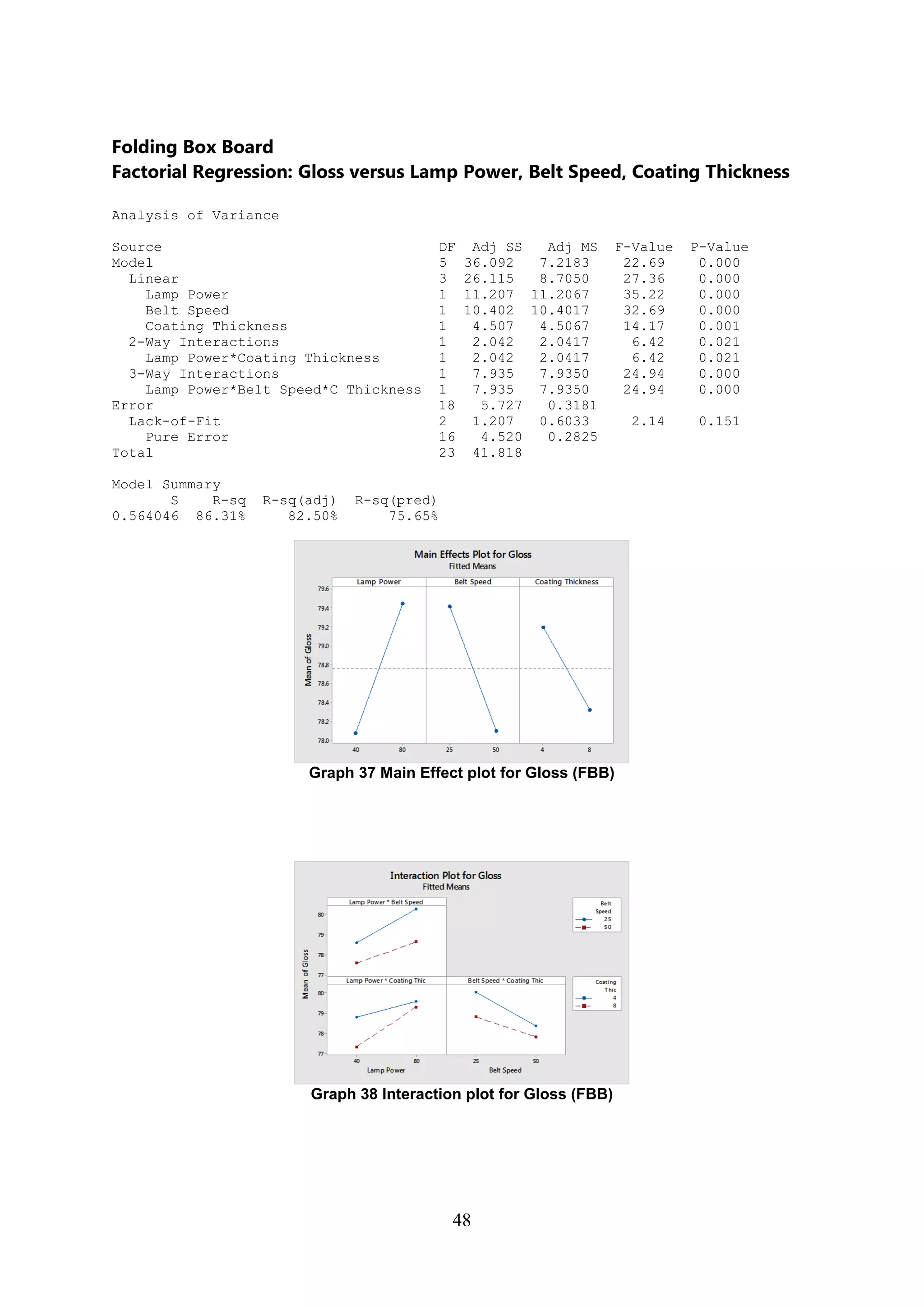
Folding Box Board
Factorial Regression: Gloss versus Lamp Power, Belt Speed, Coating Thickness
Analysis of Variance
Source DF Adj SS Adj MS F-Value P-Value
Model 5 36.092 7.2183 22.69 0.000
Linear 3 26.115 8.7050 27.36 0.000
Lamp Power 1 11.207 11.2067 35.22 0.000
Belt Speed 1 10.402 10.4017 32.69 0.000
Coating Thickness 1 4.507 4.5067 14.17 0.001
2-Way Interactions 1 2.042 2.0417 6.42 0.021
Lamp Power*Coating Thickness 1 2.042 2.0417 6.42 0.021
3-Way Interactions 1 7.935 7.9350 24.94 0.000
Lamp Power*Belt Speed*C Thickness 1 7.935 7.9350 24.94 0.000
Error 18 5.727 0.3181
Lack-of-Fit 2 1.207 0.6033 2.14 0.151
Pure Error 16 4.520 0.2825
Total 23 41.818
Model Summary
S R-sq R-sq(adj) R-sq(pred)
0.564046 86.31% 82.50% 75.65%
Graph 37 Main Effect plot for Gloss (FBB)
Graph 38 Interaction plot for Gloss (FBB)
49
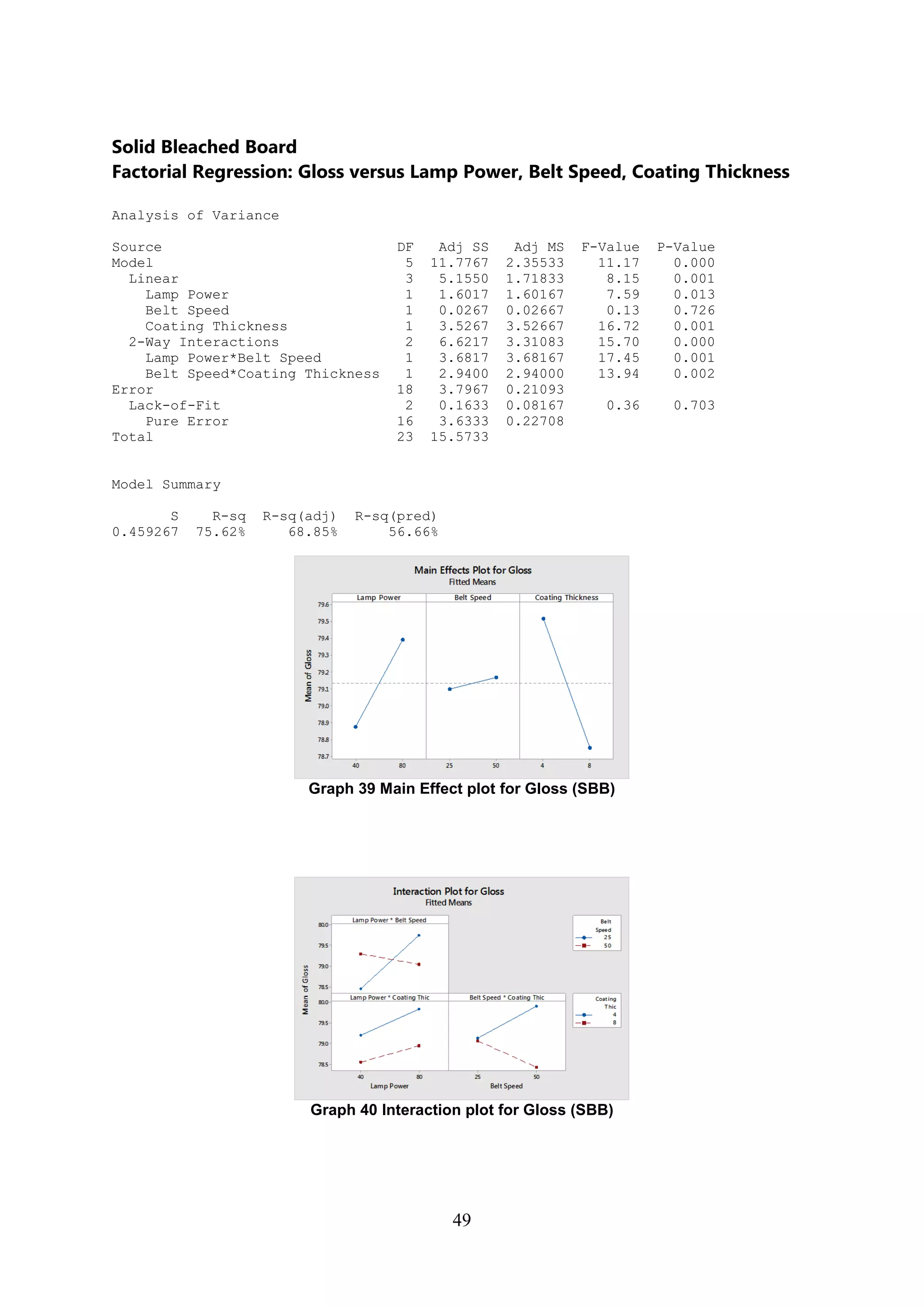
Solid Bleached Board
Factorial Regression: Gloss versus Lamp Power, Belt Speed, Coating Thickness
Analysis of Variance
Source DF Adj SS Adj MS F-Value P-Value
Model 5 11.7767 2.35533 11.17 0.000
Linear 3 5.1550 1.71833 8.15 0.001
Lamp Power 1 1.6017 1.60167 7.59 0.013
Belt Speed 1 0.0267 0.02667 0.13 0.726
Coating Thickness 1 3.5267 3.52667 16.72 0.001
2-Way Interactions 2 6.6217 3.31083 15.70 0.000
Lamp Power*Belt Speed 1 3.6817 3.68167 17.45 0.001
Belt Speed*Coating Thickness 1 2.9400 2.94000 13.94 0.002
Error 18 3.7967 0.21093
Lack-of-Fit 2 0.1633 0.08167 0.36 0.703
Pure Error 16 3.6333 0.22708
Total 23 15.5733
Model Summary
S R-sq R-sq(adj) R-sq(pred)
0.459267 75.62% 68.85% 56.66%
Graph 39 Main Effect plot for Gloss (SBB)
Graph 40 Interaction plot for Gloss (SBB)
50
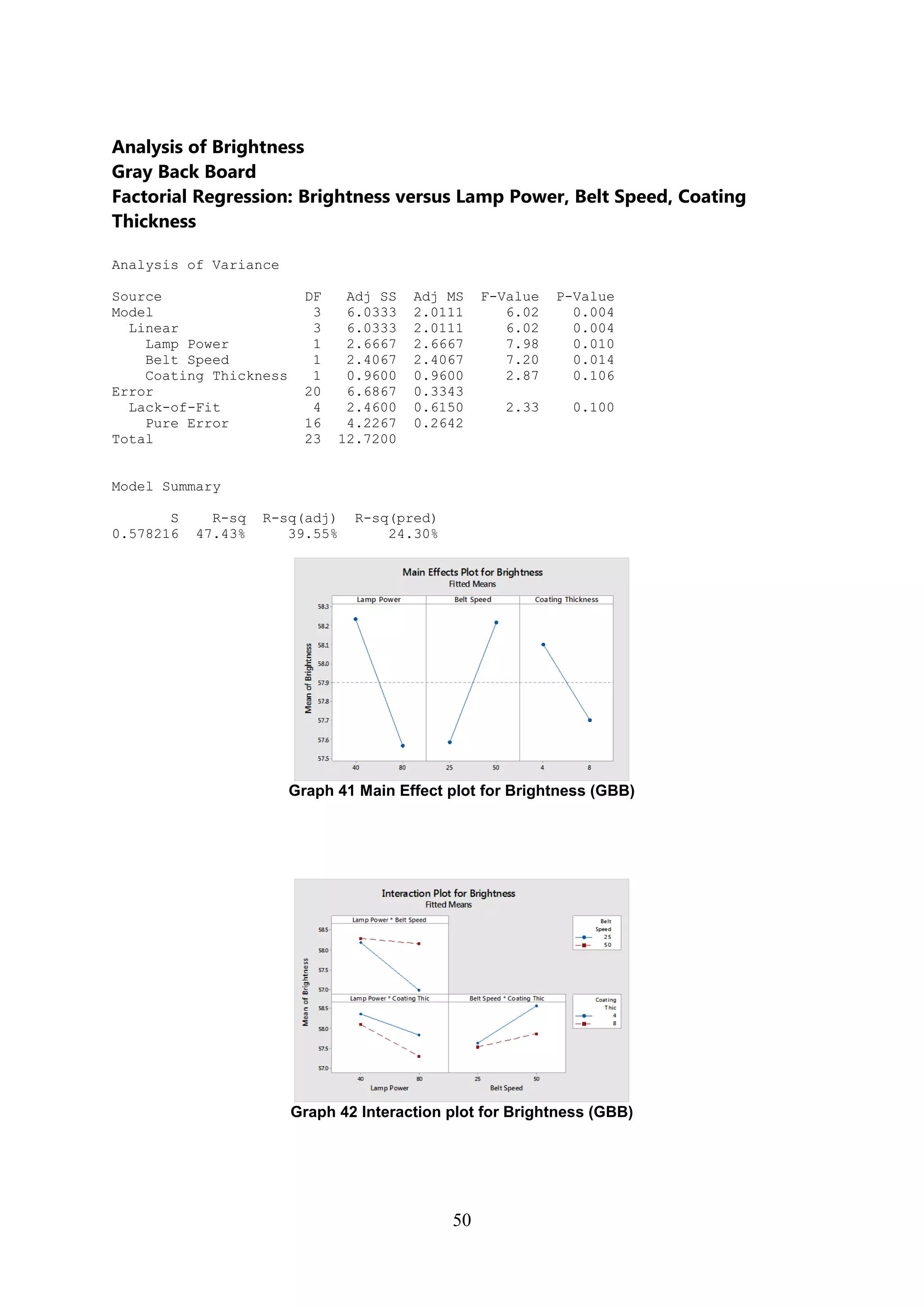
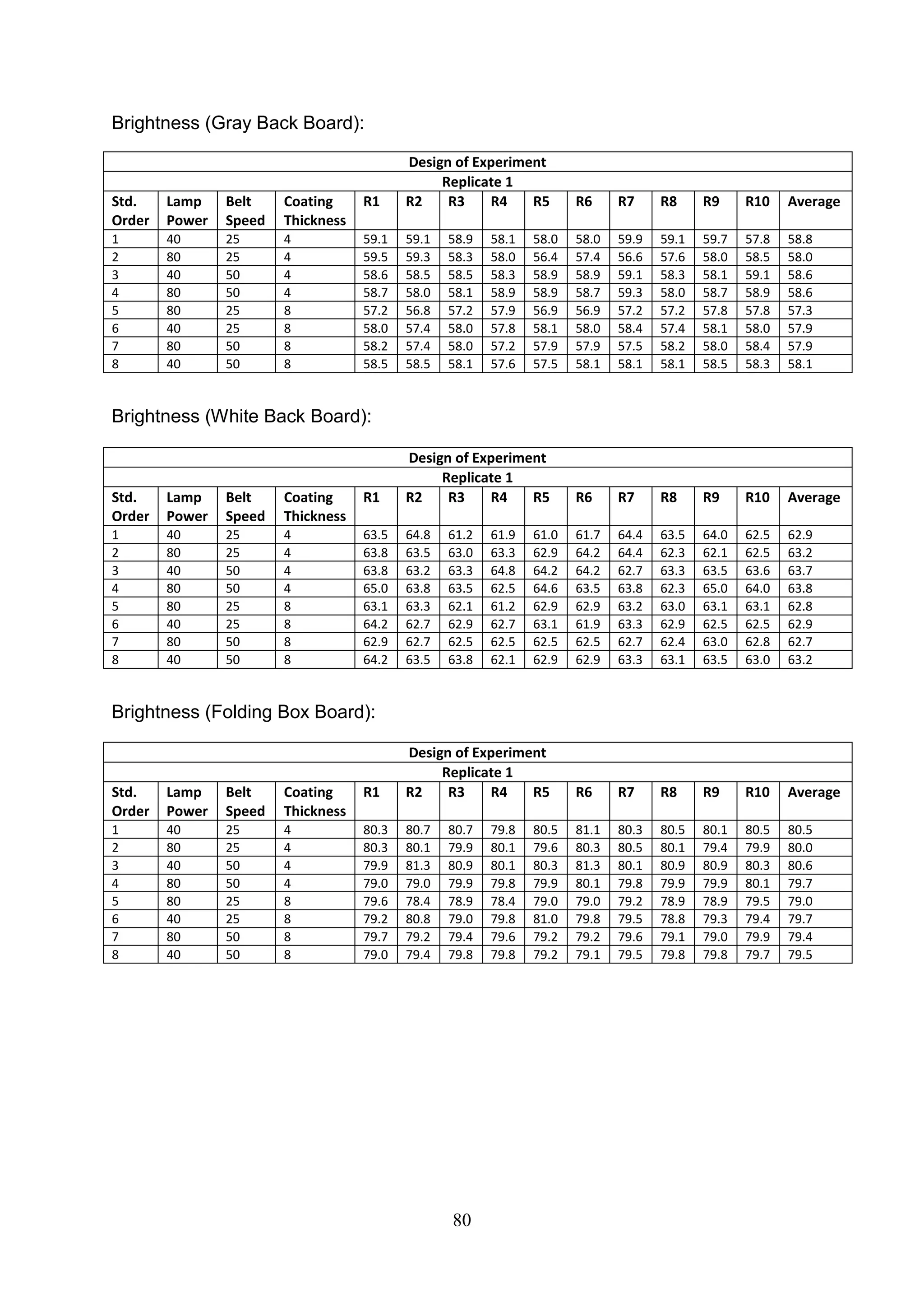
Analysis of Brightness
Gray Back Board
Factorial Regression: Brightness versus Lamp Power, Belt Speed, Coating
Thickness
Analysis of Variance
Source DF Adj SS Adj MS F-Value P-Value
Model 3 6.0333 2.0111 6.02 0.004
Linear 3 6.0333 2.0111 6.02 0.004
Lamp Power 1 2.6667 2.6667 7.98 0.010
Belt Speed 1 2.4067 2.4067 7.20 0.014
Coating Thickness 1 0.9600 0.9600 2.87 0.106
Error 20 6.6867 0.3343
Lack-of-Fit 4 2.4600 0.6150 2.33 0.100
Pure Error 16 4.2267 0.2642
Total 23 12.7200
Model Summary
S R-sq R-sq(adj) R-sq(pred)
0.578216 47.43% 39.55% 24.30%
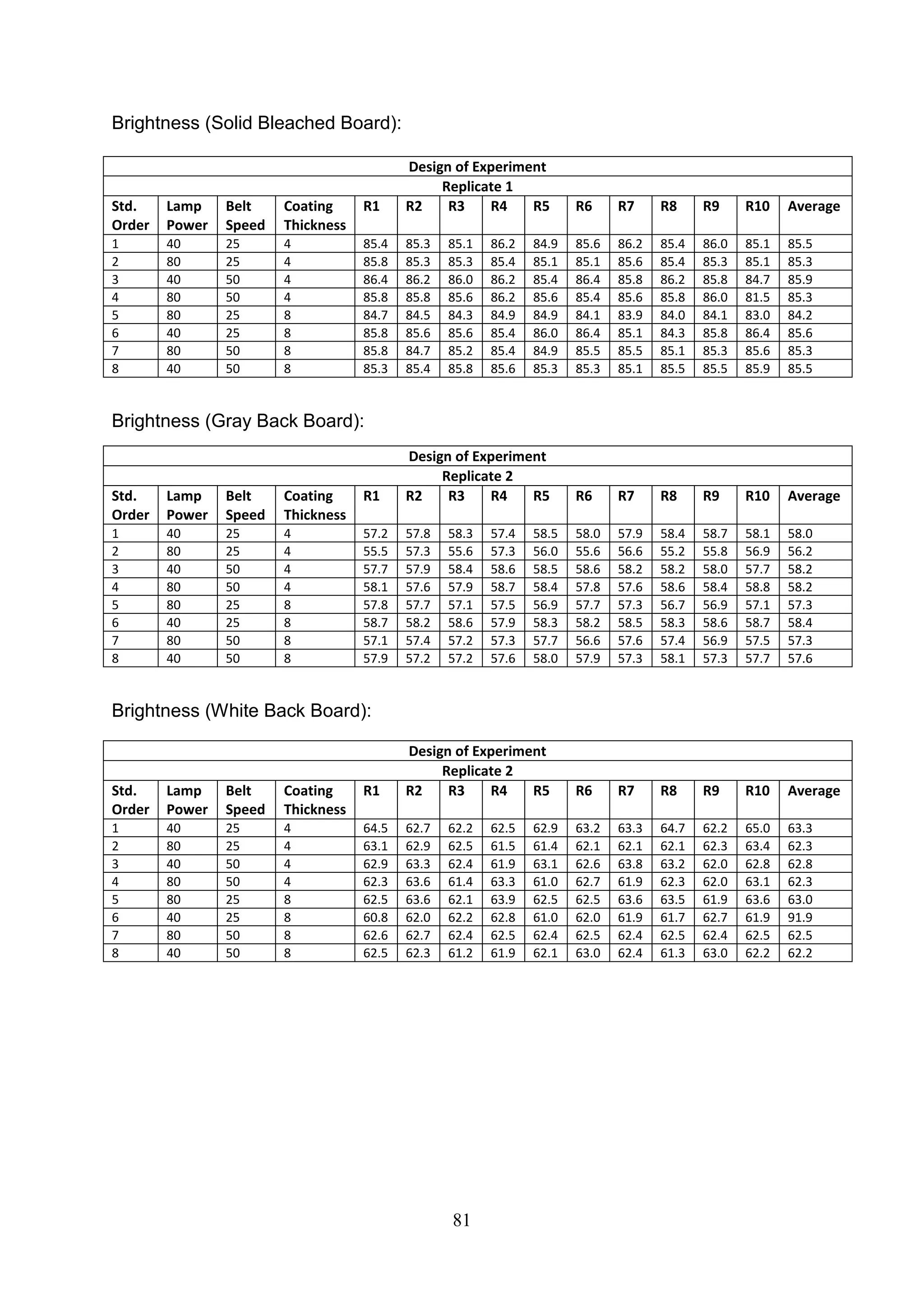
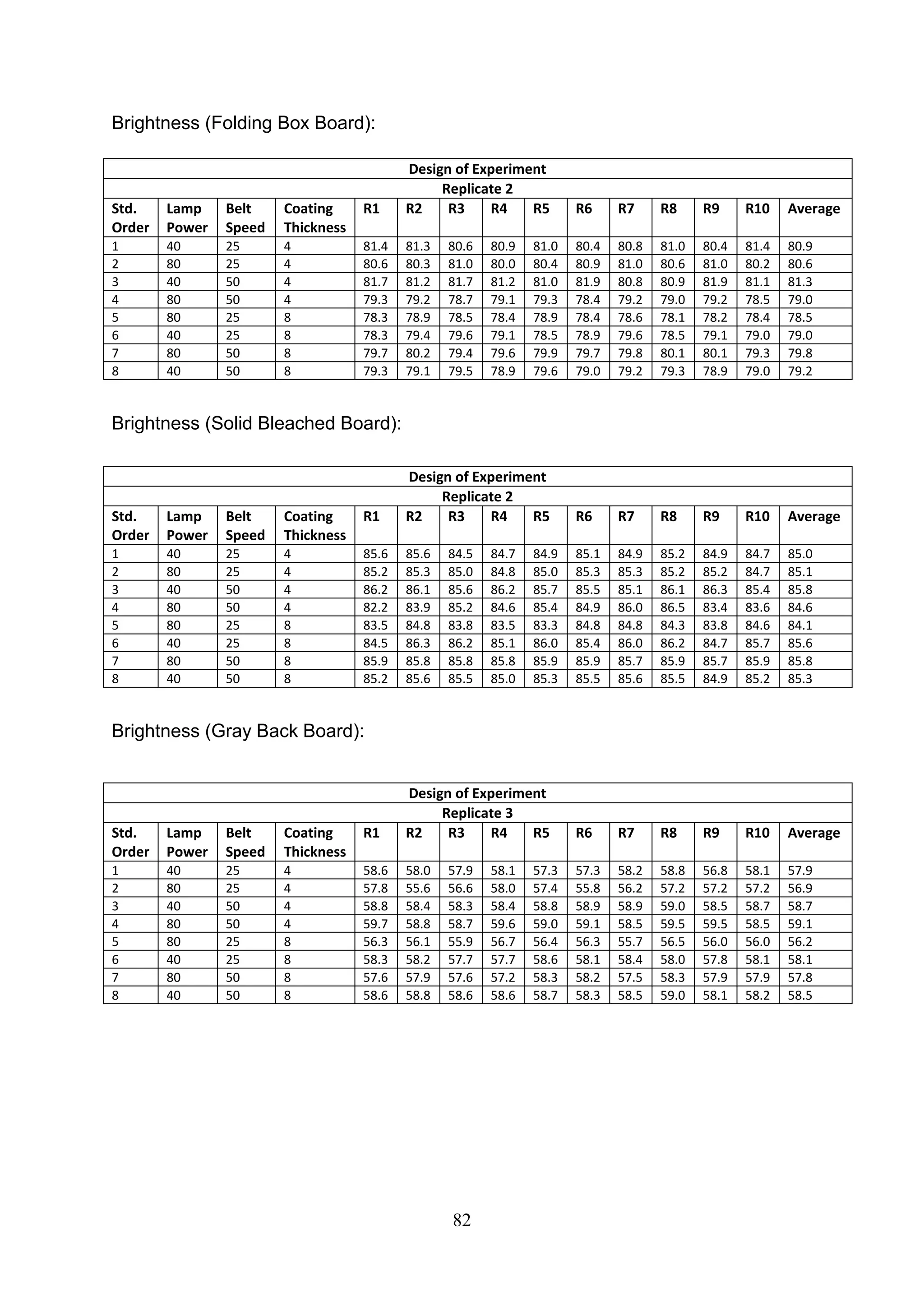
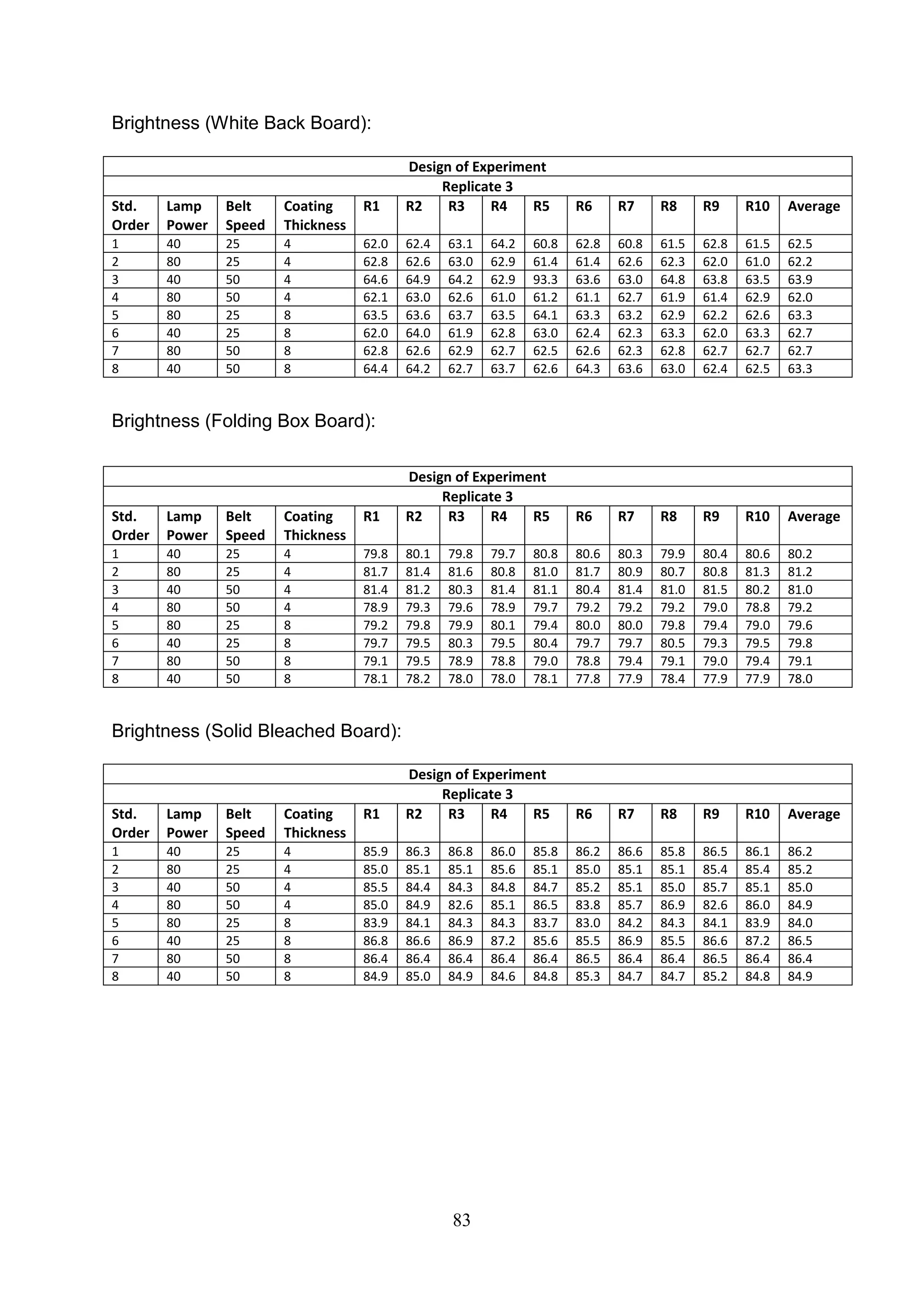
Graph 41 Main Effect plot for Brightness (GBB)
Graph 42 Interaction plot for Brightness (GBB)
51
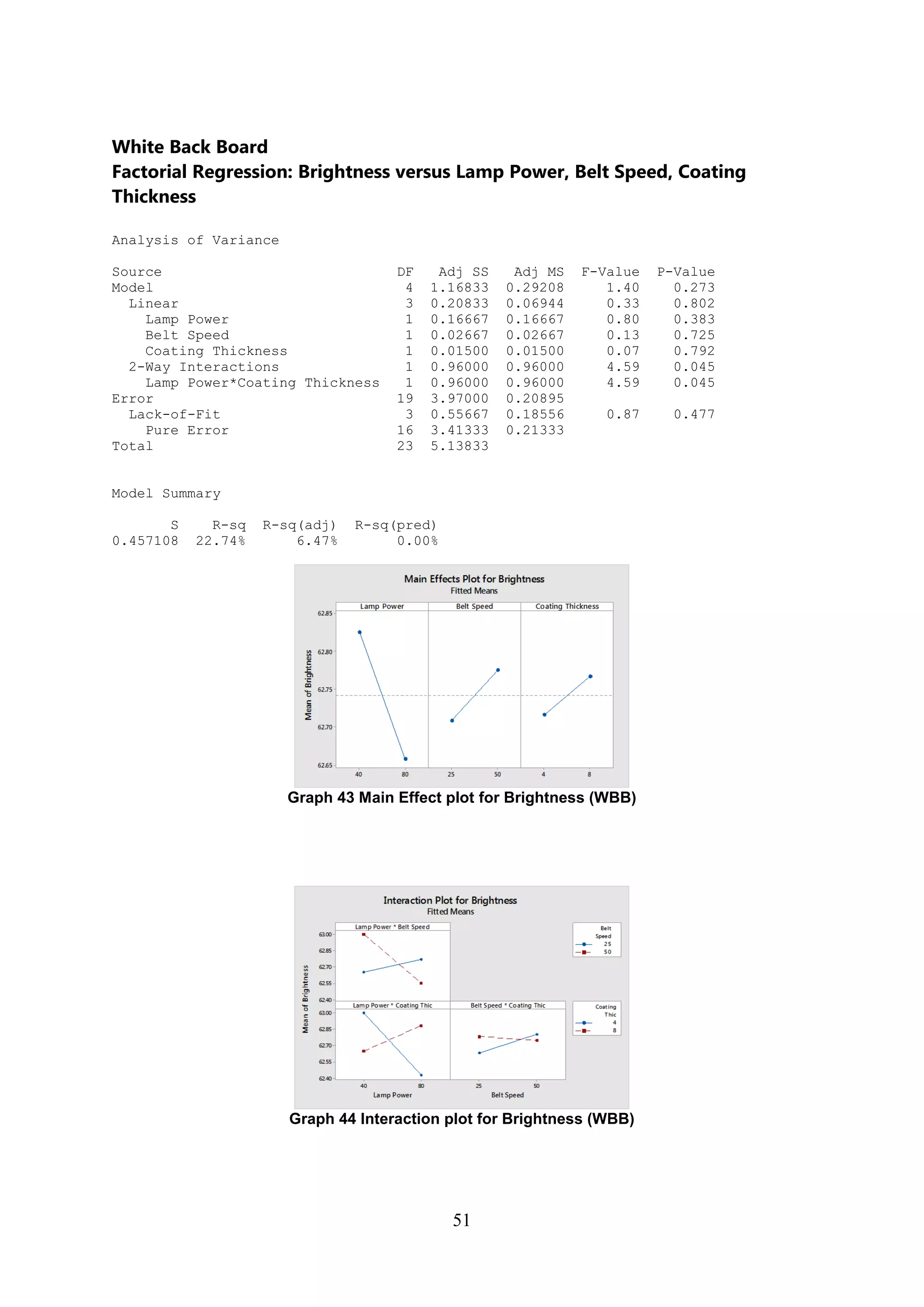
White Back Board
Factorial Regression: Brightness versus Lamp Power, Belt Speed, Coating
Thickness
Analysis of Variance
Source DF Adj SS Adj MS F-Value P-Value
Model 4 1.16833 0.29208 1.40 0.273
Linear 3 0.20833 0.06944 0.33 0.802
Lamp Power 1 0.16667 0.16667 0.80 0.383
Belt Speed 1 0.02667 0.02667 0.13 0.725
Coating Thickness 1 0.01500 0.01500 0.07 0.792
2-Way Interactions 1 0.96000 0.96000 4.59 0.045
Lamp Power*Coating Thickness 1 0.96000 0.96000 4.59 0.045
Error 19 3.97000 0.20895
Lack-of-Fit 3 0.55667 0.18556 0.87 0.477
Pure Error 16 3.41333 0.21333
Total 23 5.13833
Model Summary
S R-sq R-sq(adj) R-sq(pred)
0.457108 22.74% 6.47% 0.00%
Graph 43 Main Effect plot for Brightness (WBB)
Graph 44 Interaction plot for Brightness (WBB)
52
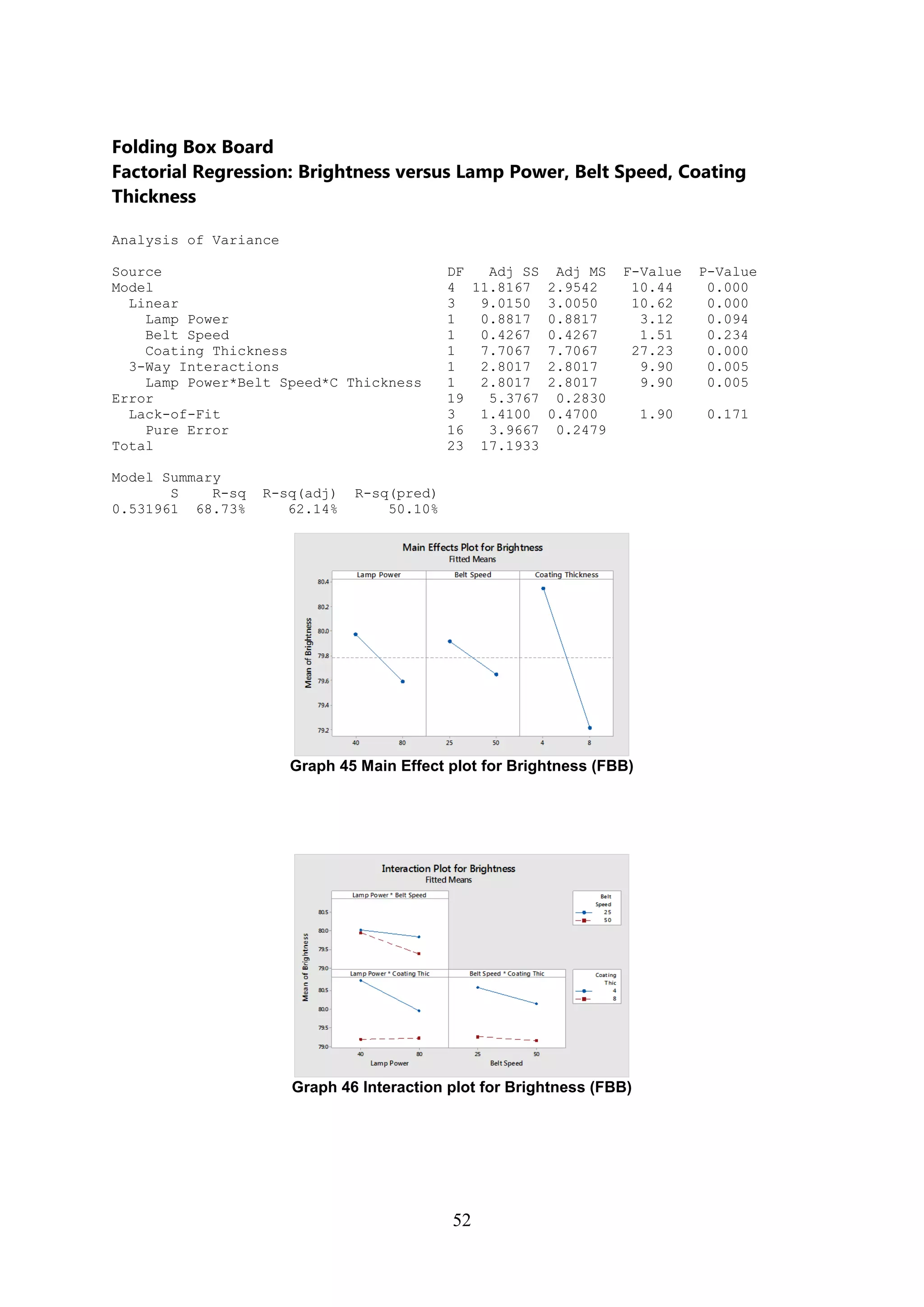
Folding Box Board
Factorial Regression: Brightness versus Lamp Power, Belt Speed, Coating
Thickness
Analysis of Variance
Source DF Adj SS Adj MS F-Value P-Value
Model 4 11.8167 2.9542 10.44 0.000
Linear 3 9.0150 3.0050 10.62 0.000
Lamp Power 1 0.8817 0.8817 3.12 0.094
Belt Speed 1 0.4267 0.4267 1.51 0.234
Coating Thickness 1 7.7067 7.7067 27.23 0.000
3-Way Interactions 1 2.8017 2.8017 9.90 0.005
Lamp Power*Belt Speed*C Thickness 1 2.8017 2.8017 9.90 0.005
Error 19 5.3767 0.2830
Lack-of-Fit 3 1.4100 0.4700 1.90 0.171
Pure Error 16 3.9667 0.2479
Total 23 17.1933
Model Summary
S R-sq R-sq(adj) R-sq(pred)
0.531961 68.73% 62.14% 50.10%
Graph 45 Main Effect plot for Brightness (FBB)
Graph 46 Interaction plot for Brightness (FBB)
53
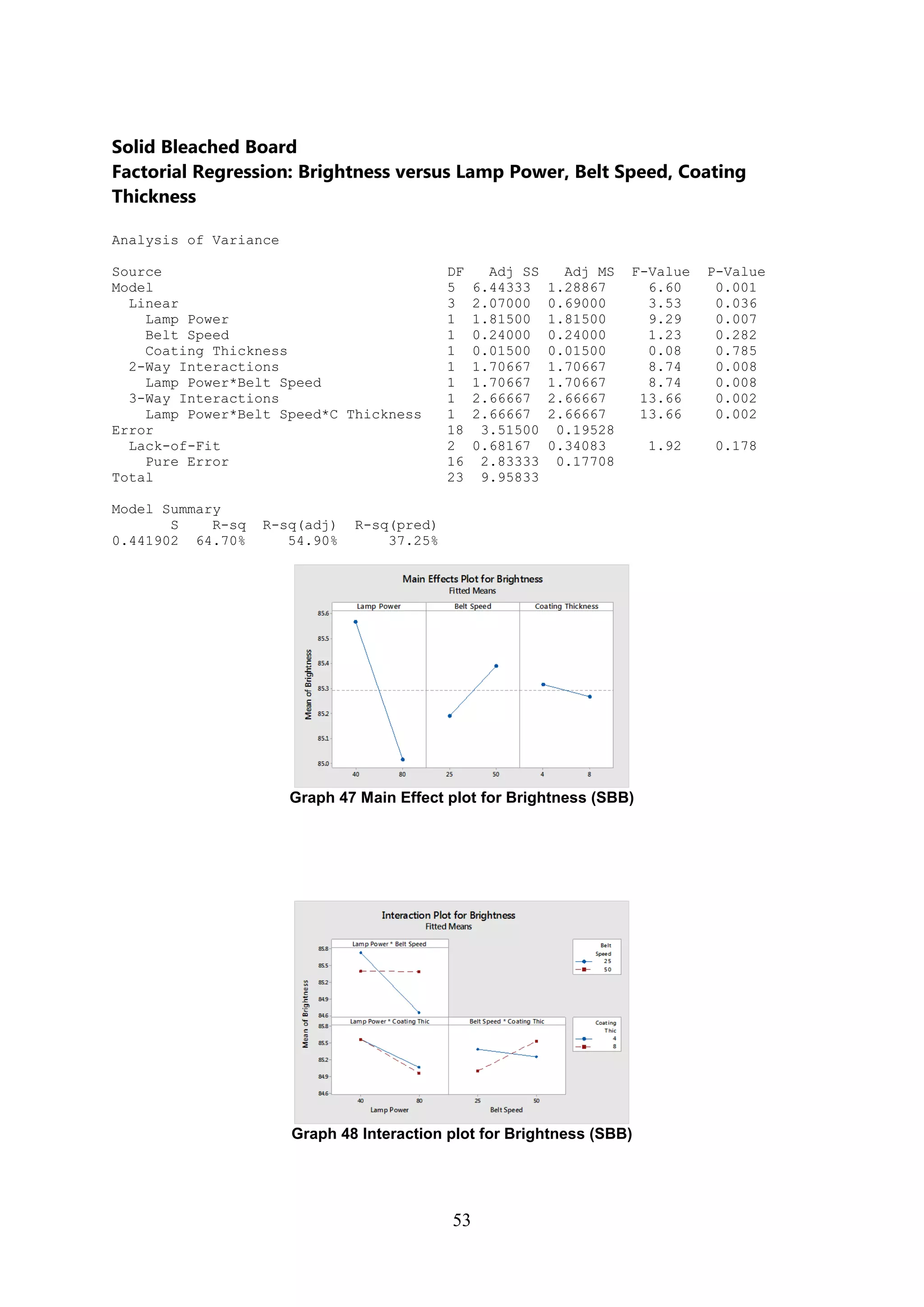
Solid Bleached Board
Factorial Regression: Brightness versus Lamp Power, Belt Speed, Coating
Thickness
Analysis of Variance
Source DF Adj SS Adj MS F-Value P-Value
Model 5 6.44333 1.28867 6.60 0.001
Linear 3 2.07000 0.69000 3.53 0.036
Lamp Power 1 1.81500 1.81500 9.29 0.007
Belt Speed 1 0.24000 0.24000 1.23 0.282
Coating Thickness 1 0.01500 0.01500 0.08 0.785
2-Way Interactions 1 1.70667 1.70667 8.74 0.008
Lamp Power*Belt Speed 1 1.70667 1.70667 8.74 0.008
3-Way Interactions 1 2.66667 2.66667 13.66 0.002
Lamp Power*Belt Speed*C Thickness 1 2.66667 2.66667 13.66 0.002
Error 18 3.51500 0.19528
Lack-of-Fit 2 0.68167 0.34083 1.92 0.178
Pure Error 16 2.83333 0.17708
Total 23 9.95833
Model Summary
S R-sq R-sq(adj) R-sq(pred)
0.441902 64.70% 54.90% 37.25%
Graph 47 Main Effect plot for Brightness (SBB)
Graph 48 Interaction plot for Brightness (SBB)
54
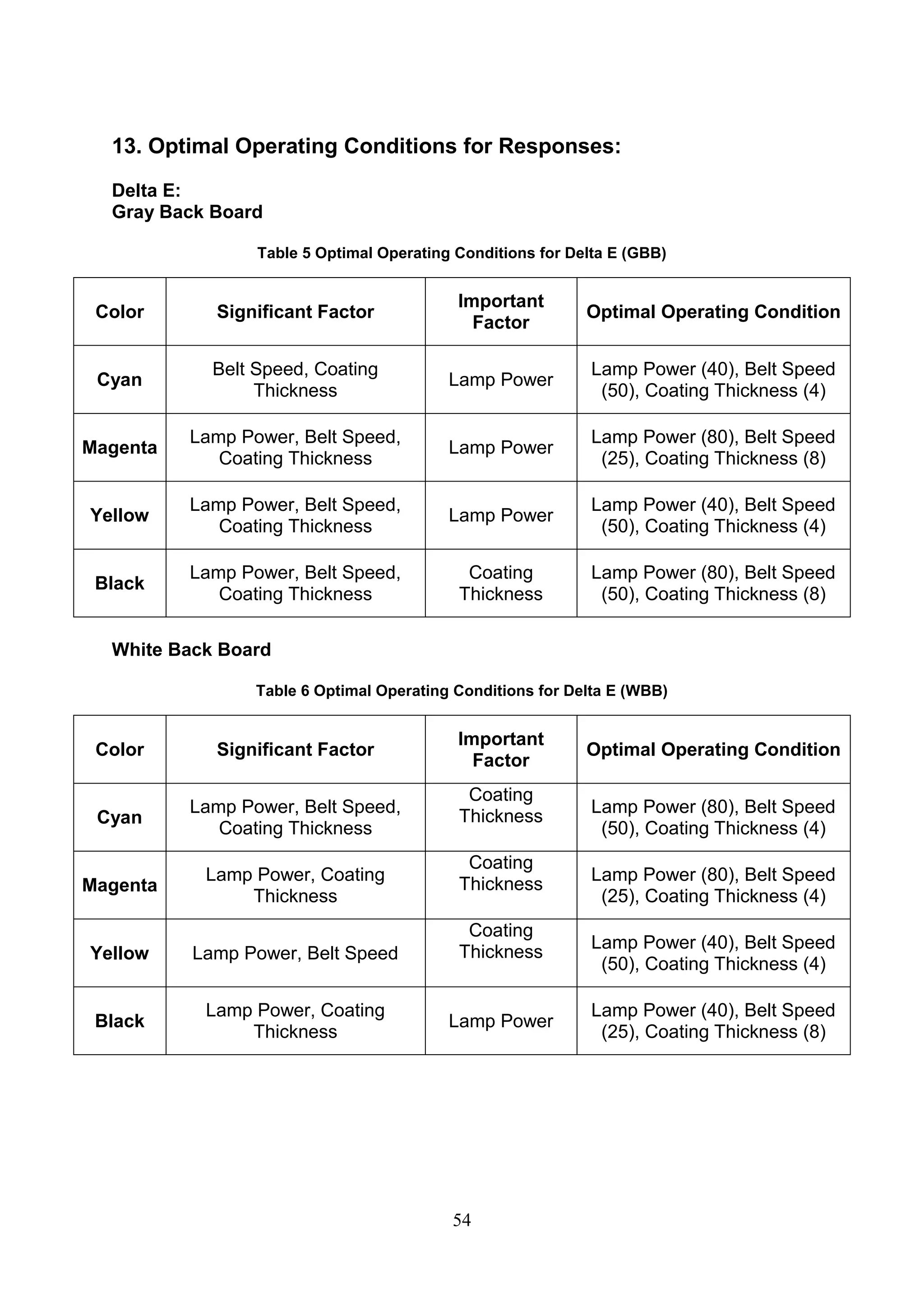
13. Optimal Operating Conditions for Responses:
Delta E:
Gray Back Board
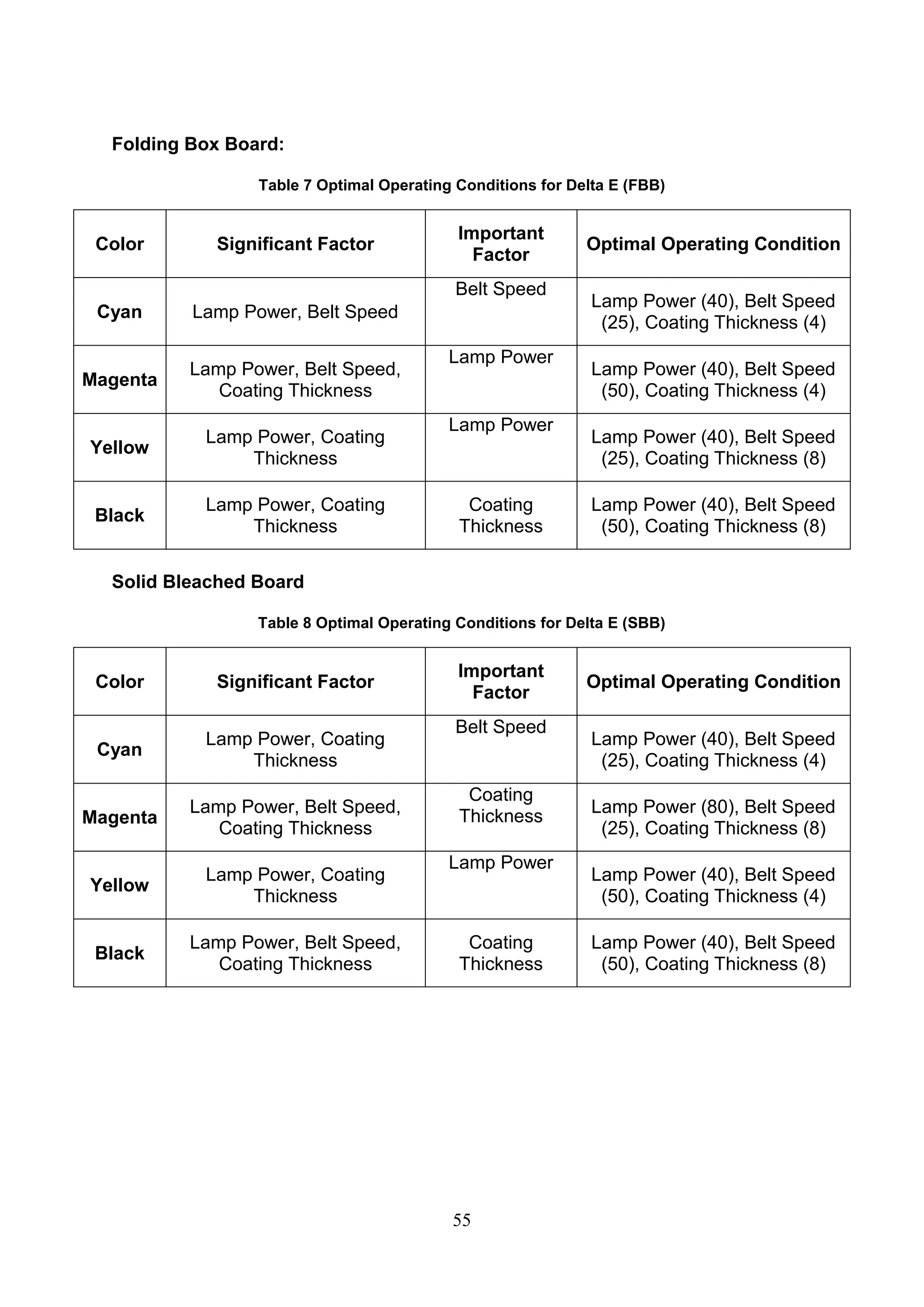
Table 5 Optimal Operating Conditions for Delta E (GBB)
Color Significant Factor
Important
Factor
Optimal Operating Condition
Cyan
Belt Speed, Coating
Thickness
Lamp Power
Lamp Power (40), Belt Speed
(50), Coating Thickness (4)
Magenta
Lamp Power, Belt Speed,
Coating Thickness
Lamp Power
Lamp Power (80), Belt Speed
(25), Coating Thickness (8)
Yellow
Lamp Power, Belt Speed,
Coating Thickness
Lamp Power
Lamp Power (40), Belt Speed
(50), Coating Thickness (4)
Black
Lamp Power, Belt Speed,
Coating Thickness
Coating
Thickness
Lamp Power (80), Belt Speed
(50), Coating Thickness (8)
White Back Board
Table 6 Optimal Operating Conditions for Delta E (WBB)
Color Significant Factor
Important
Factor
Optimal Operating Condition
Cyan
Lamp Power, Belt Speed,
Coating Thickness
Coating
Thickness
Lamp Power (80), Belt Speed
(50), Coating Thickness (4)
Magenta
Lamp Power, Coating
Thickness
Coating
Thickness
Lamp Power (80), Belt Speed
(25), Coating Thickness (4)
Yellow Lamp Power, Belt Speed
Coating
Thickness
Lamp Power (40), Belt Speed
(50), Coating Thickness (4)
Black
Lamp Power, Coating
Thickness
Lamp Power
Lamp Power (40), Belt Speed
(25), Coating Thickness (8)
55
Folding Box Board:
Table 7 Optimal Operating Conditions for Delta E (FBB)
Color Significant Factor
Important
Factor
Optimal Operating Condition
Cyan Lamp Power, Belt Speed
Belt Speed
Lamp Power (40), Belt Speed
(25), Coating Thickness (4)
Magenta
Lamp Power, Belt Speed,
Coating Thickness
Lamp Power
Lamp Power (40), Belt Speed
(50), Coating Thickness (4)
Yellow
Lamp Power, Coating
Thickness
Lamp Power
Lamp Power (40), Belt Speed
(25), Coating Thickness (8)
Black
Lamp Power, Coating
Thickness
Coating
Thickness
Lamp Power (40), Belt Speed
(50), Coating Thickness (8)
Solid Bleached Board
Table 8 Optimal Operating Conditions for Delta E (SBB)
Color Significant Factor
Important
Factor
Optimal Operating Condition
Cyan
Lamp Power, Coating
Thickness
Belt Speed
Lamp Power (40), Belt Speed
(25), Coating Thickness (4)
Magenta
Lamp Power, Belt Speed,
Coating Thickness
Coating
Thickness
Lamp Power (80), Belt Speed
(25), Coating Thickness (8)
Yellow
Lamp Power, Coating
Thickness
Lamp Power
Lamp Power (40), Belt Speed
(50), Coating Thickness (4)
Black
Lamp Power, Belt Speed,
Coating Thickness
Coating
Thickness
Lamp Power (40), Belt Speed
(50), Coating Thickness (8)
56
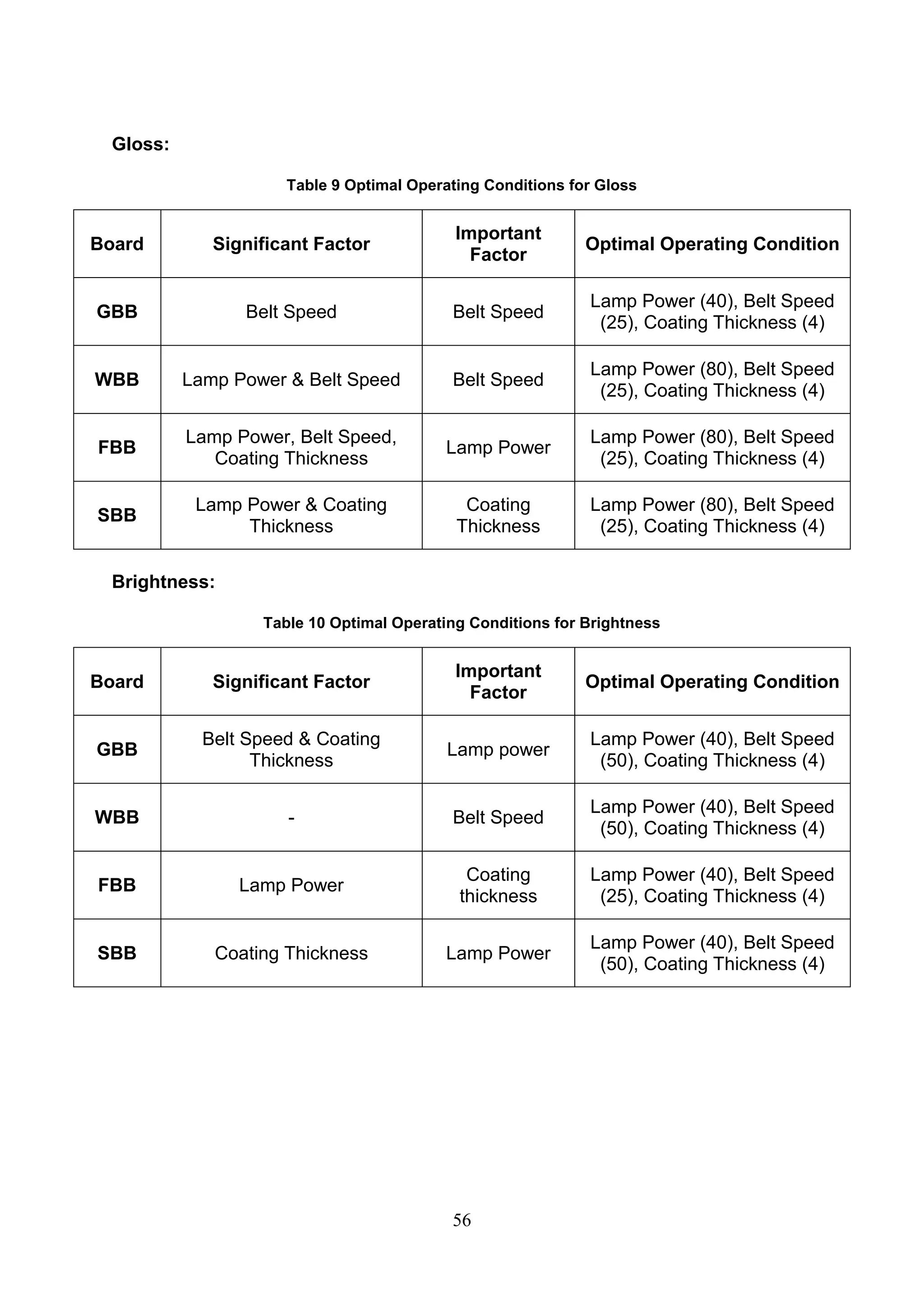
Gloss:
Table 9 Optimal Operating Conditions for Gloss
Board Significant Factor
Important
Factor
Optimal Operating Condition
GBB Belt Speed Belt Speed
Lamp Power (40), Belt Speed
(25), Coating Thickness (4)
WBB Lamp Power & Belt Speed Belt Speed
Lamp Power (80), Belt Speed
(25), Coating Thickness (4)
FBB
Lamp Power, Belt Speed,
Coating Thickness
Lamp Power
Lamp Power (80), Belt Speed
(25), Coating Thickness (4)
SBB
Lamp Power & Coating
Thickness
Coating
Thickness
Lamp Power (80), Belt Speed
(25), Coating Thickness (4)
Brightness:
Table 10 Optimal Operating Conditions for Brightness
Board Significant Factor
Important
Factor
Optimal Operating Condition
GBB
Belt Speed & Coating
Thickness
Lamp power
Lamp Power (40), Belt Speed
(50), Coating Thickness (4)
WBB - Belt Speed
Lamp Power (40), Belt Speed
(50), Coating Thickness (4)
FBB Lamp Power
Coating
thickness
Lamp Power (40), Belt Speed
(25), Coating Thickness (4)
SBB Coating Thickness Lamp Power
Lamp Power (40), Belt Speed
(50), Coating Thickness (4)
57
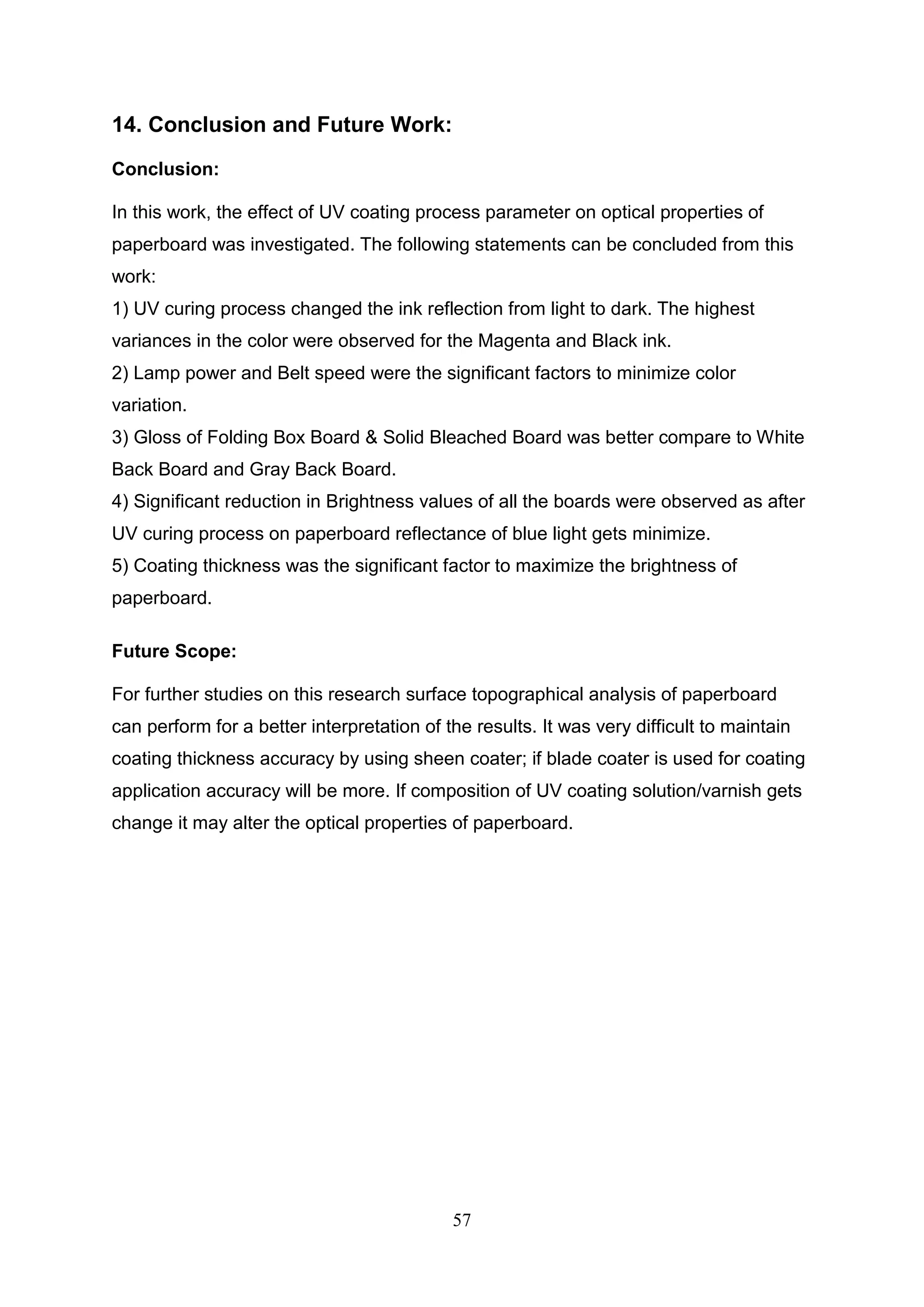
14. Conclusion and Future Work:
Conclusion:
In this work, the effect of UV coating process parameter on optical properties of
paperboard was investigated. The following statements can be concluded from this
work:
1) UV curing process changed the ink reflection from light to dark. The highest
variances in the color were observed for the Magenta and Black ink.
2) Lamp power and Belt speed were the significant factors to minimize color
variation.
3) Gloss of Folding Box Board & Solid Bleached Board was better compare to White
Back Board and Gray Back Board.
4) Significant reduction in Brightness values of all the boards were observed as after
UV curing process on paperboard reflectance of blue light gets minimize.
5) Coating thickness was the significant factor to maximize the brightness of
paperboard.
Future Scope:
For further studies on this research surface topographical analysis of paperboard
can perform for a better interpretation of the results. It was very difficult to maintain
coating thickness accuracy by using sheen coater; if blade coater is used for coating
application accuracy will be more. If composition of UV coating solution/varnish gets
change it may alter the optical properties of paperboard.
58
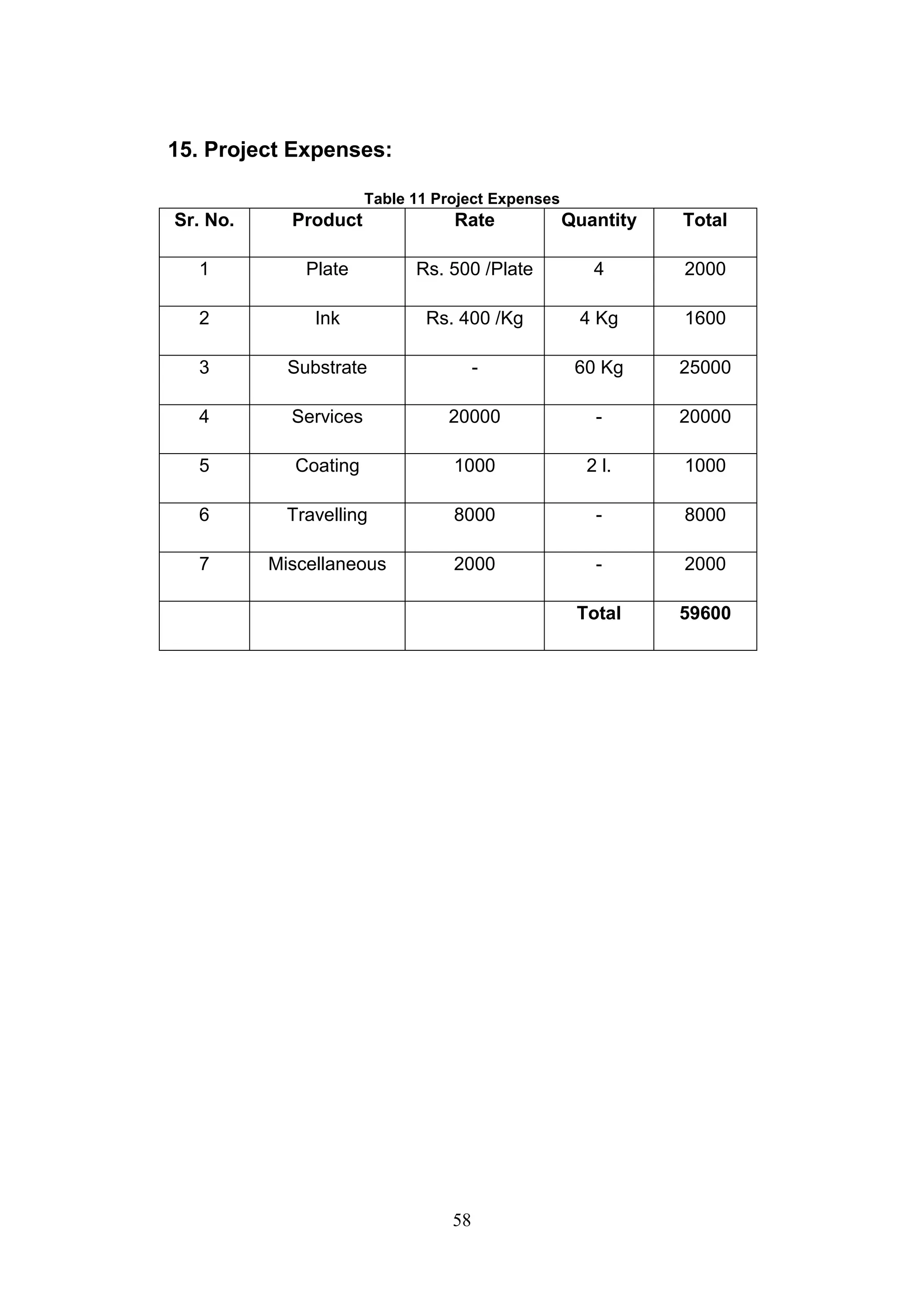
15. Project Expenses:
Table 11 Project Expenses
Sr. No. Product Rate Quantity Total
1 Plate Rs. 500 /Plate 4 2000
2 Ink Rs. 400 /Kg 4 Kg 1600
3 Substrate - 60 Kg 25000
4 Services 20000 - 20000
5 Coating 1000 2 l. 1000
6 Travelling 8000 - 8000
7 Miscellaneous 2000 - 2000
Total 59600
59
16. References:
1. C.S.B. Ruiz, L.D.B. Machado, J.E. Volponi, E.S. Pino, “Influence of sample
composition and processing parameters on the UV cure of clear coatings”,
Nuclear Insturments and Methods in Physics Research B 208 (2003) 309-313
2. Pooneh Kardar, Morteza Ebrahimi, Saeed Bastani, “Influence of temperature
and light intensity on the photocuring process and kinetics parameters of a
pigmented UV curable system”, J Therm Anal Calorim (2014) 118:541-549.
3. Igor Karlovic, Dragoljub Novakovic, Erzsebet Novotny, “The influence of
surface topography of UV coated and printed cardboard on thr print gloss”,
Faculty of Technical Sciences- Graphic Engineering and Design.
4. Mojtaba Soltani, Ramin Veisi, Ali Asghar Rohani, “UV-Curable Coating
Process on CMYK Printed Duplex Paperboard, Part I: Mechanical and Optical
Properties”, Peer Reviewed Article.
5. Majnaric Igor, Golubovic Kristijan, Bolanca Mirkovic Ivana, “New methods of
varnishing and their influence on optical properties of cardboard packaging”.
6. Igor Majnaric, Ivana Bolanca Mirkovic, Kristijan Golubovic, “Influence of UV
Curing varnish coating on surface properties of paper”, Technicki vjesnik 19,
1(2012), 51-56
7. Reinhold Schwalm, “UV Coatings: Basics, Recent Developments and
Applications”, Elsevier Science 21st
December 2006, Pg. nos. 17, 25,28,42,50
8. KBA, “Process technologies, consumables and applications for inline coating
in sheetfed offset”, Process 4-2007.
9. Heidelberg Print Media Academy, “Profi Tip: Coating, Drying & Powdering”
10.Scott Sabreen & Normal Roobol, the Sabreen Group, Inc., “Breaking Down
UV Curable Coatings”
11.Paul Mills, “Ultraviolet (UV) Measurement for Formulators: Part I”, EIT
Incorporated, Sterling, VA
12.MOHAWK PAPERS, “Specifying Press Coatings”, June 2006
13.IGESSUND PAPERBOARD, Reference Manual, “Paperboard and Converting
Performance”
14.STORAENSO, Paperboard Guide, “Products and end uses”
15.AALSTO-YILOPISTO, Teknillinen Korkeakoulu, “Finishing & Converting
Processes”
16.http://www.eit.com/uv-products/technical-papers-presentations
17.http://radtech.org/index.php?option=com_content&view=article&id=48&Itemid
=56
18.http://www.paperonweb.com/paperpro.htm
60
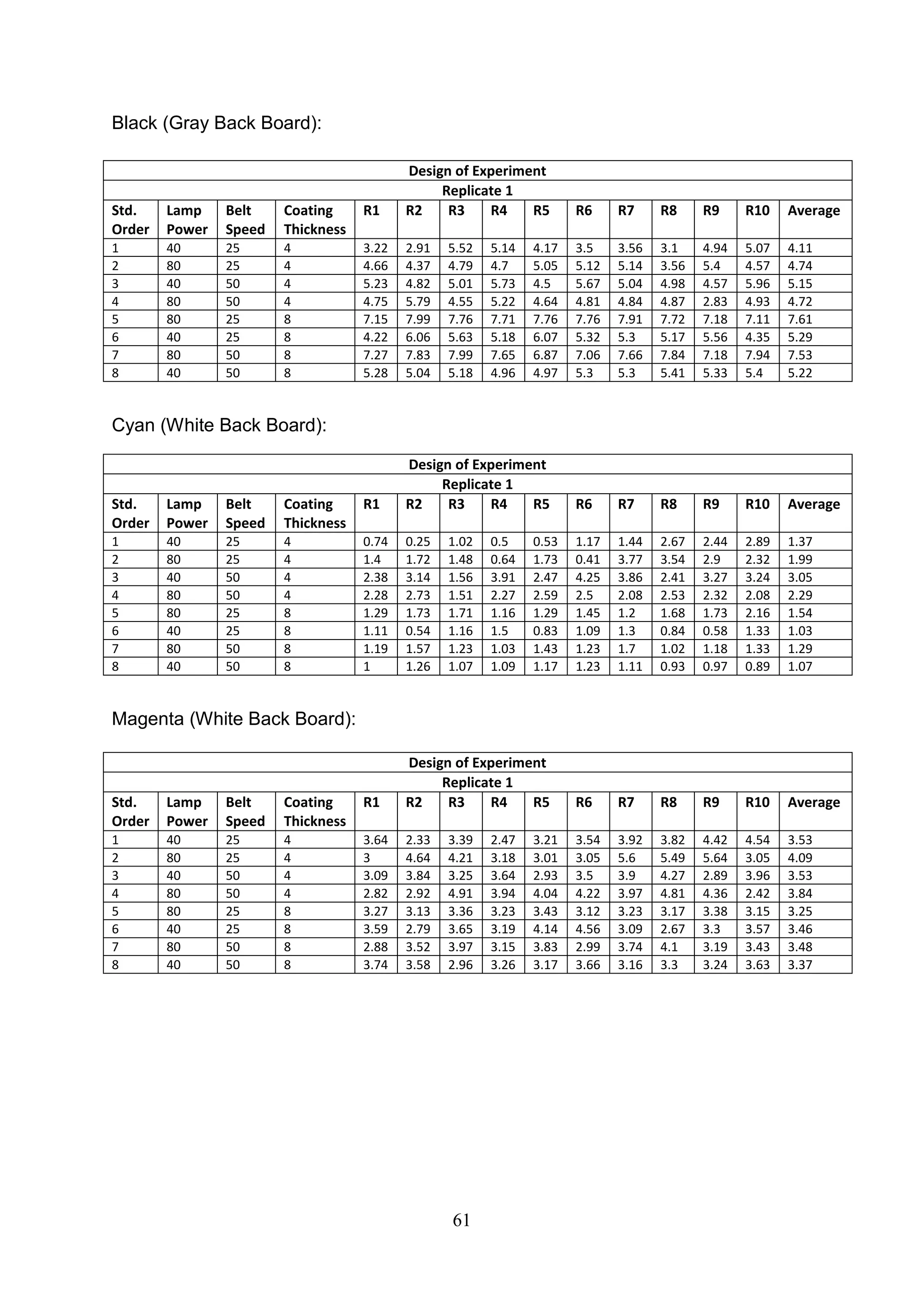
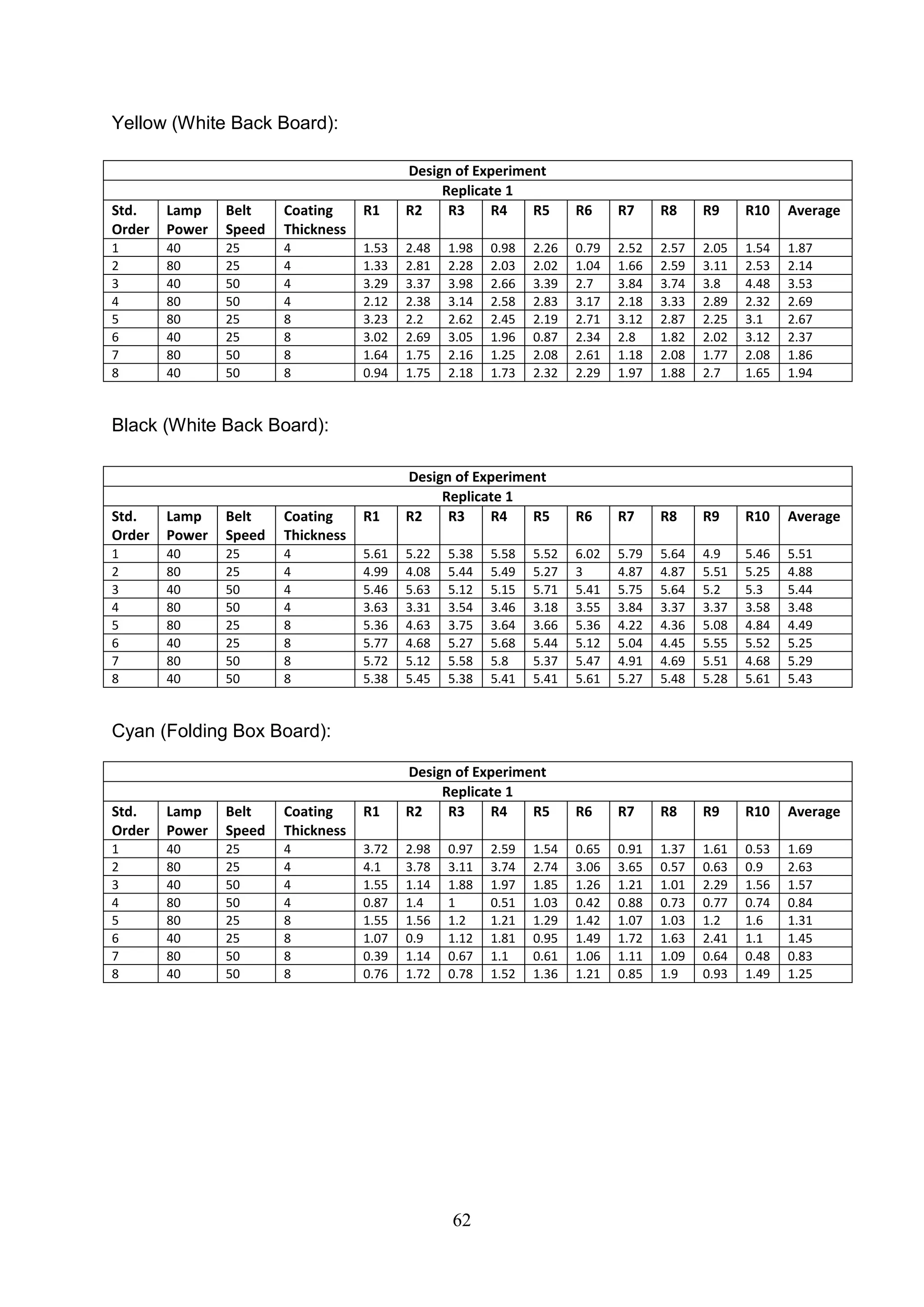
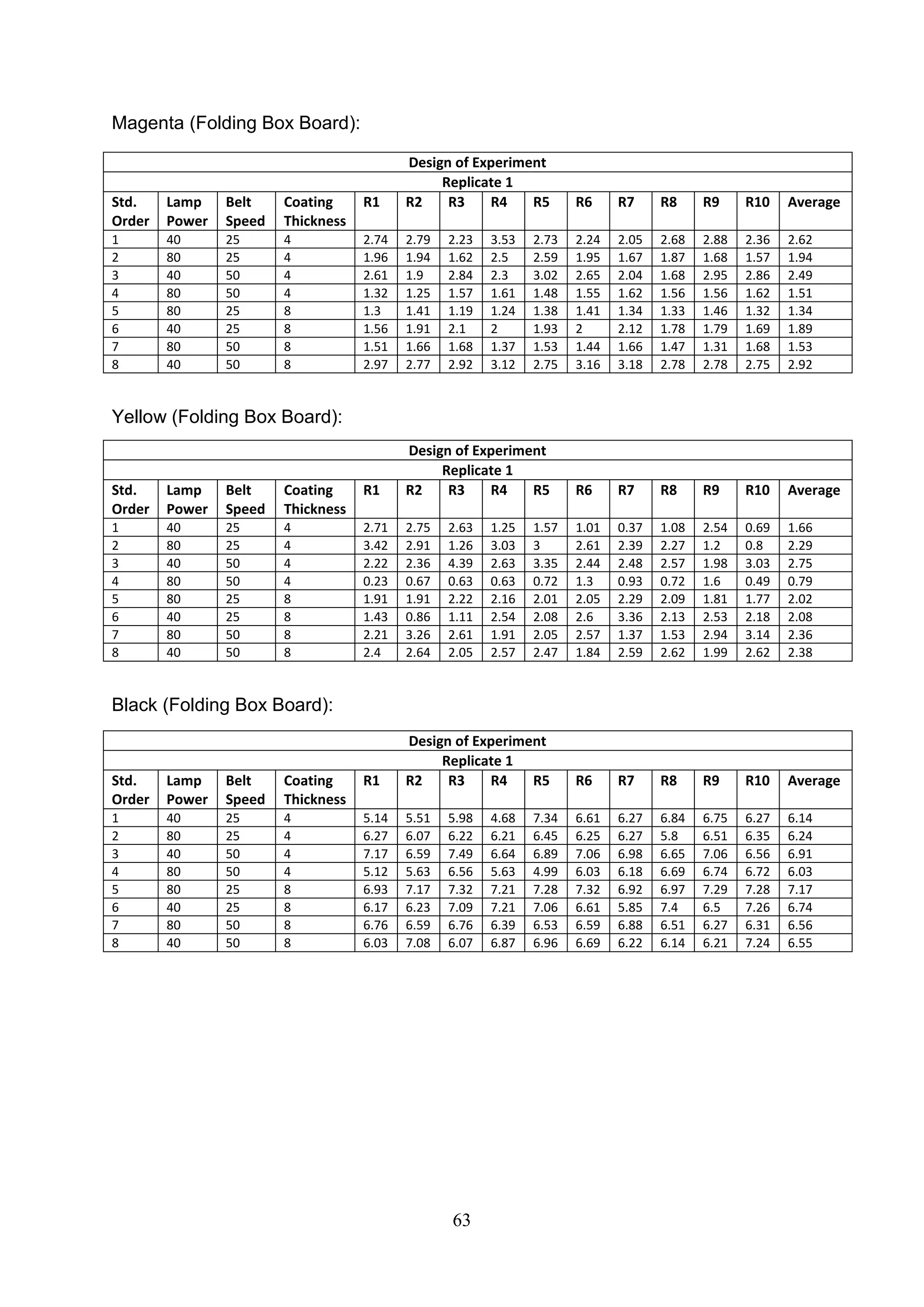
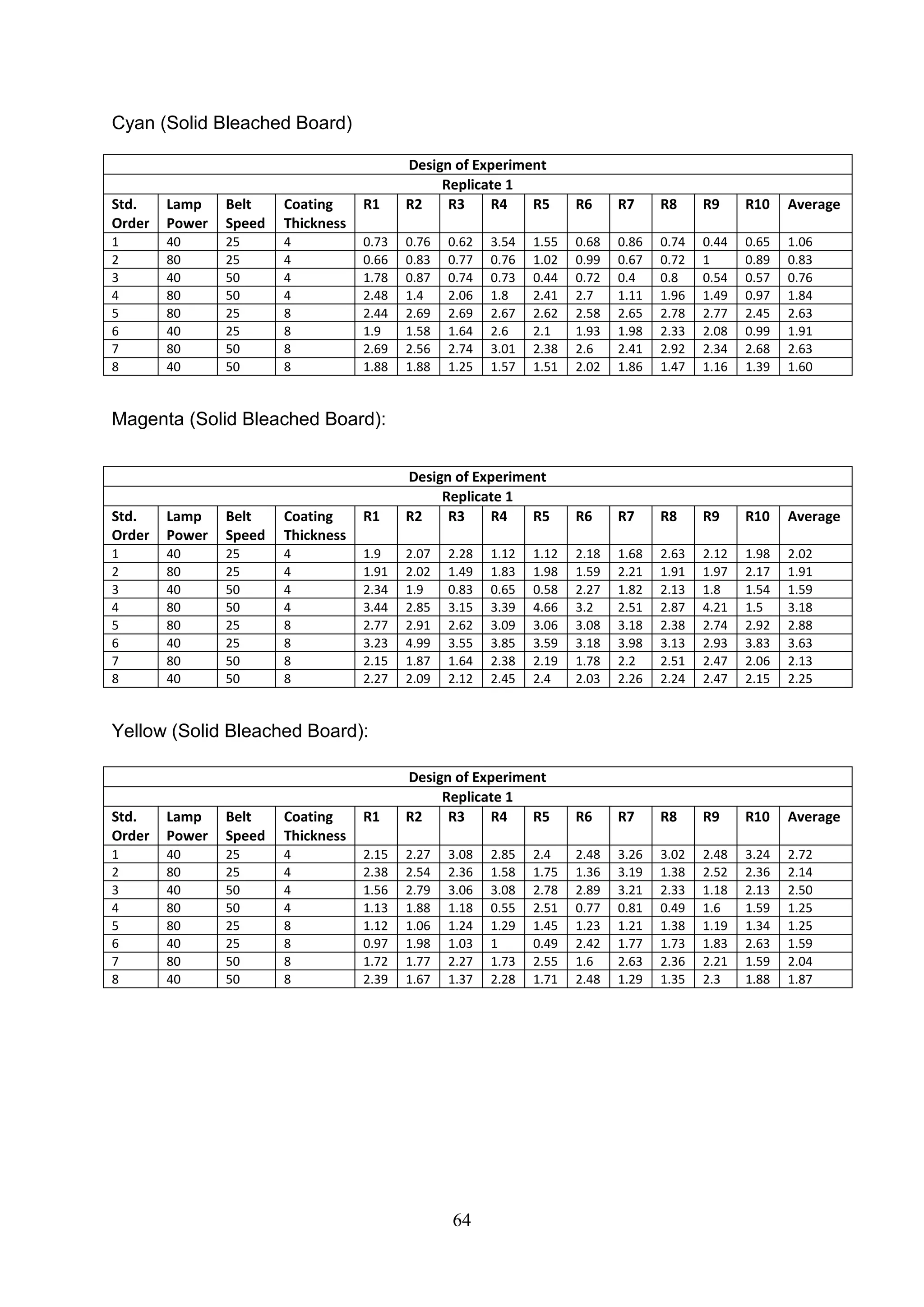
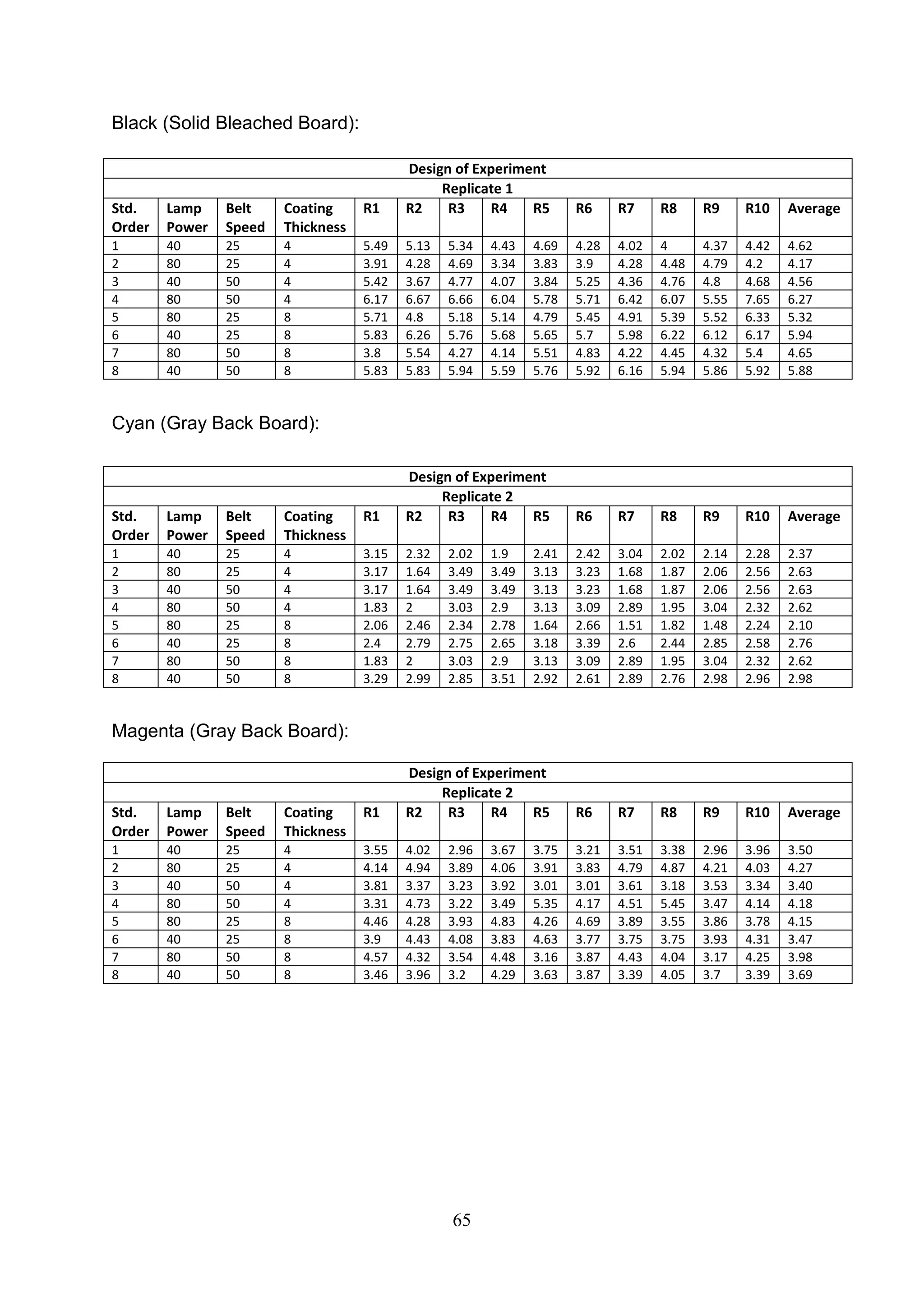
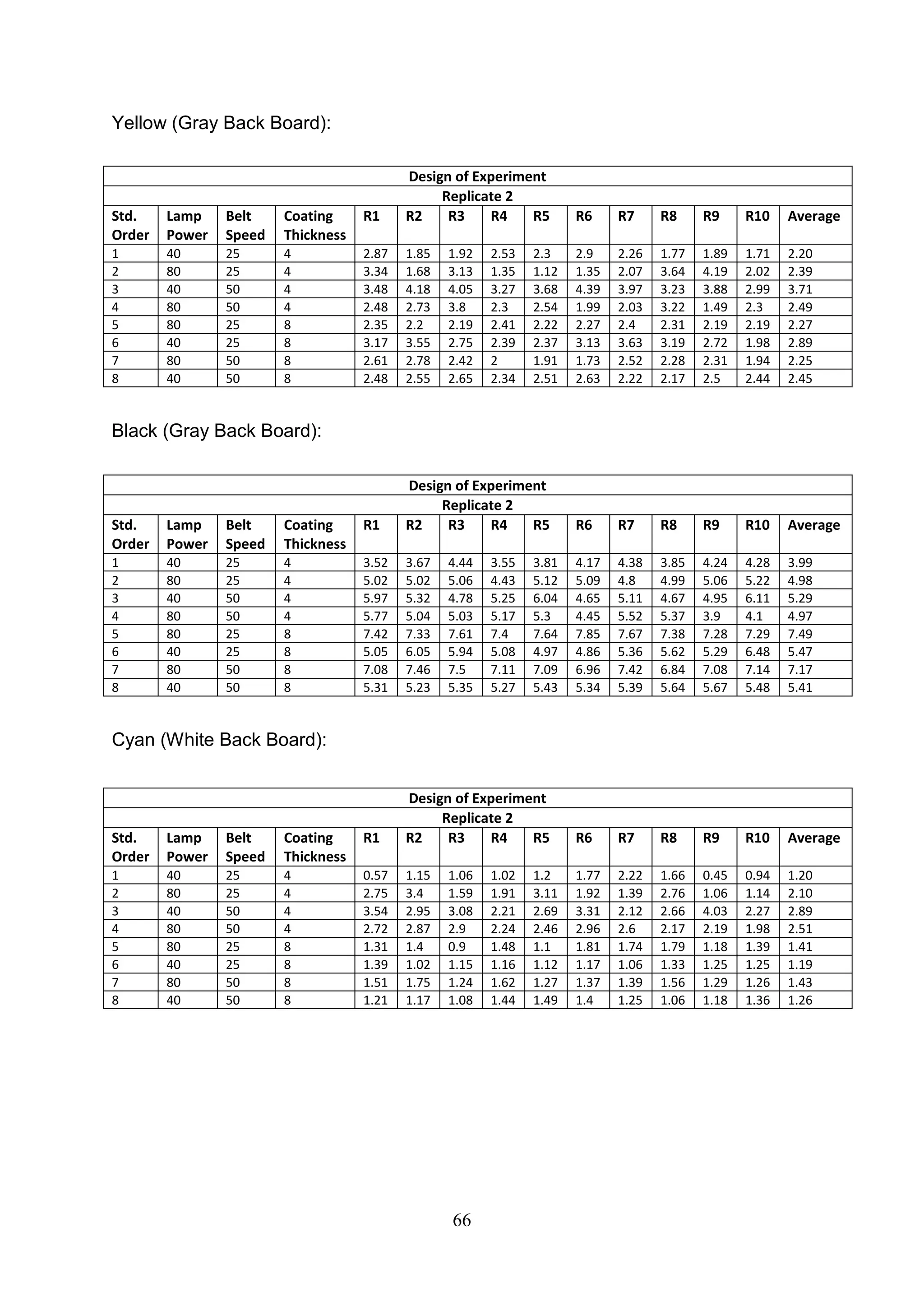
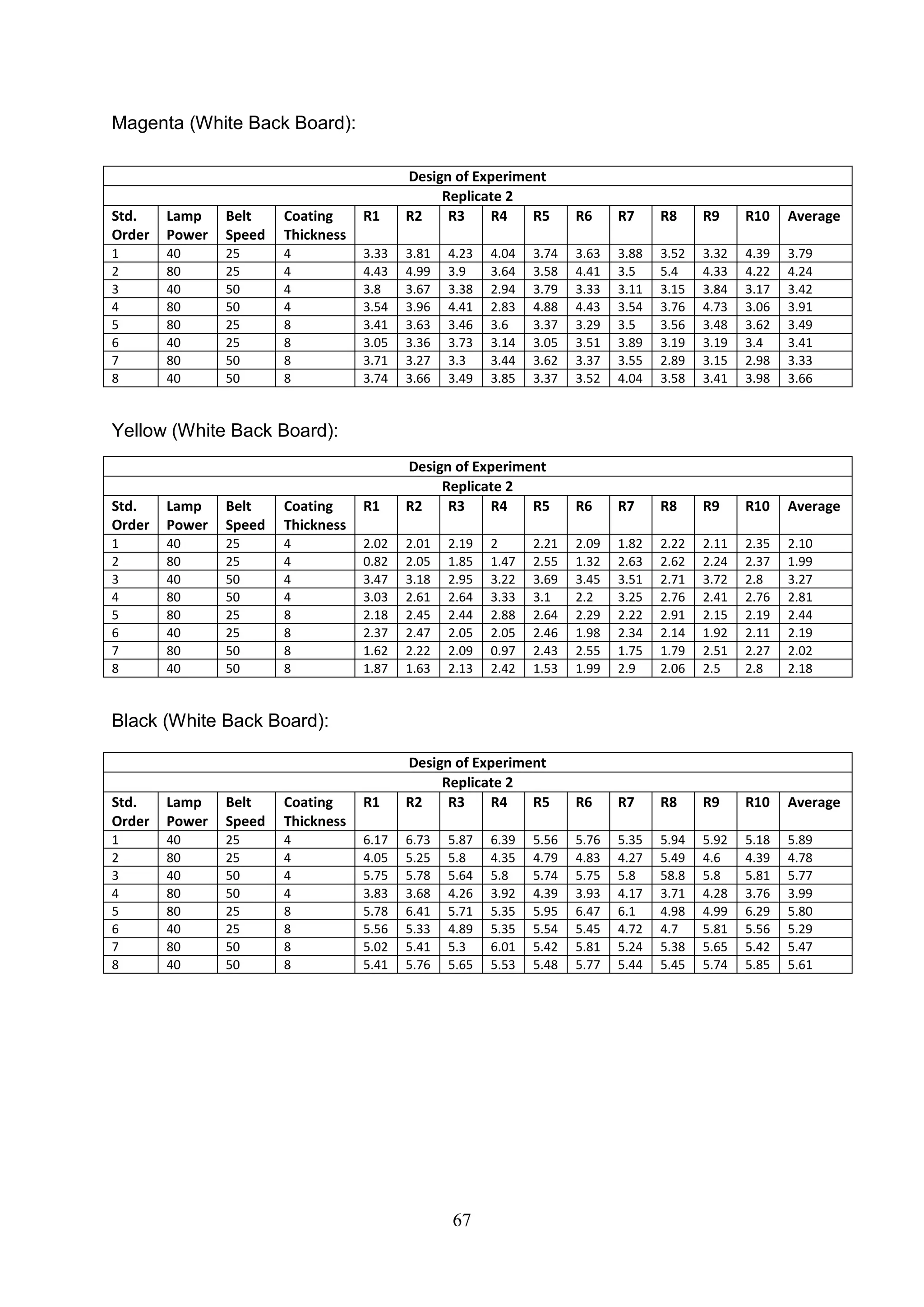
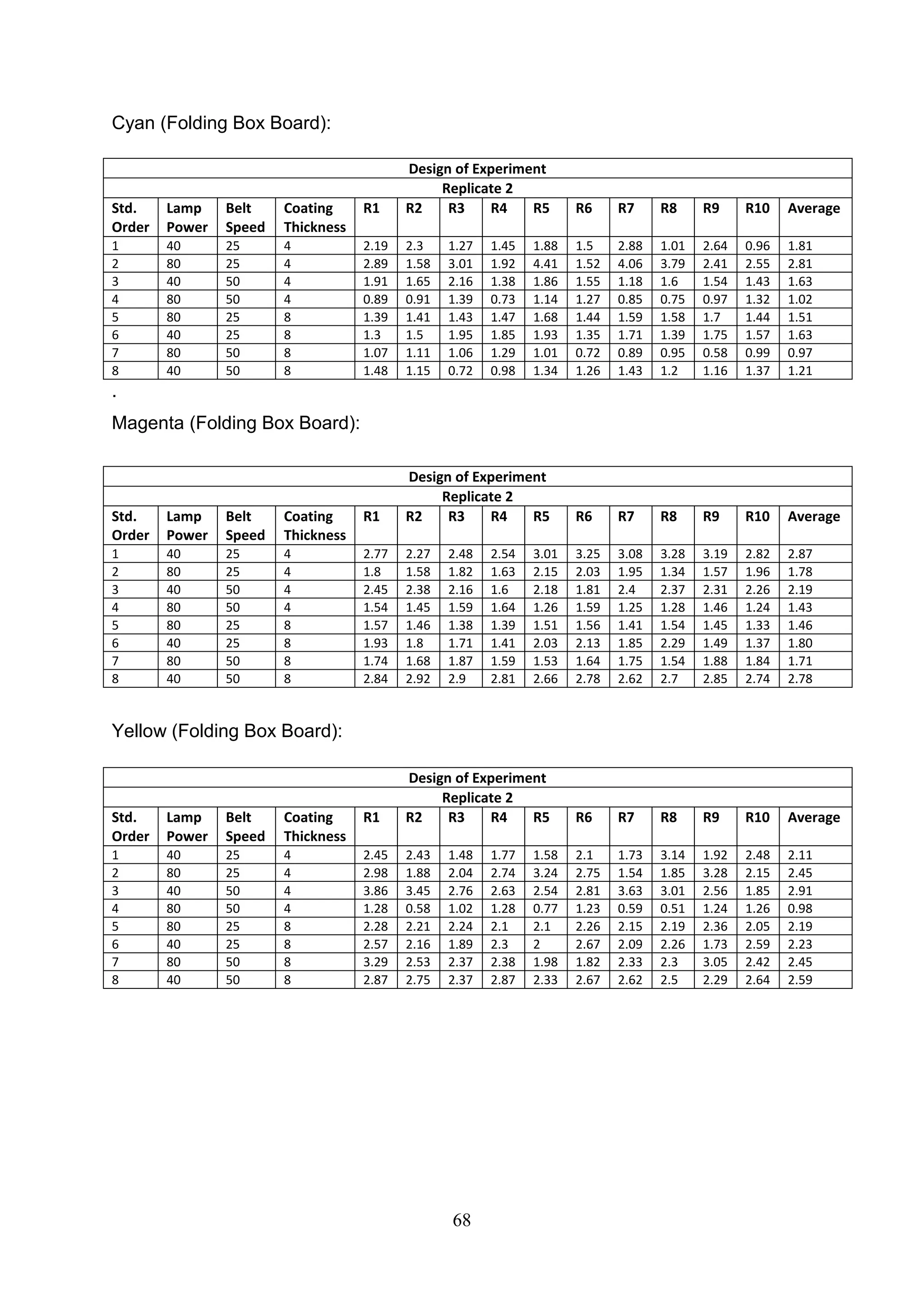
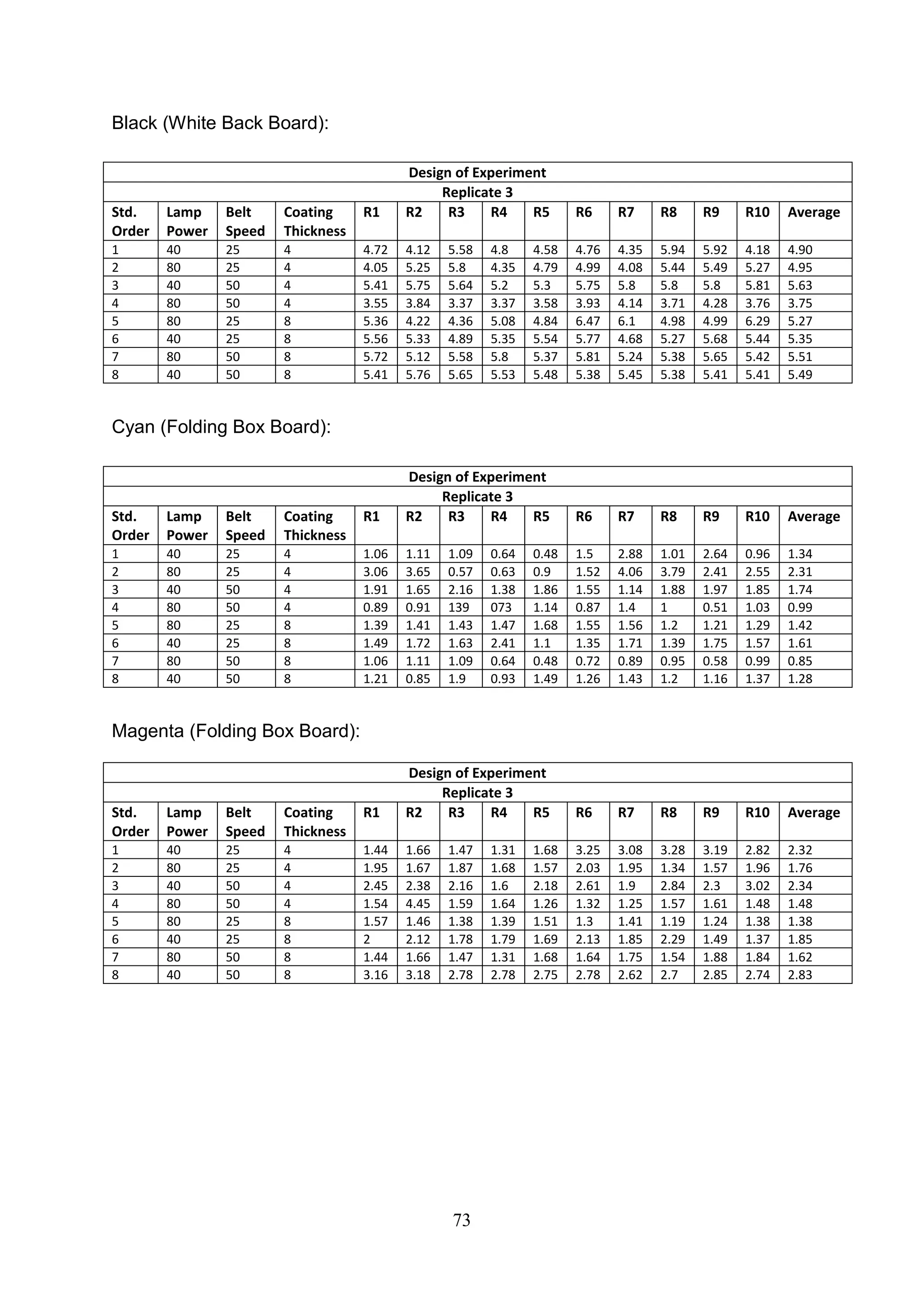
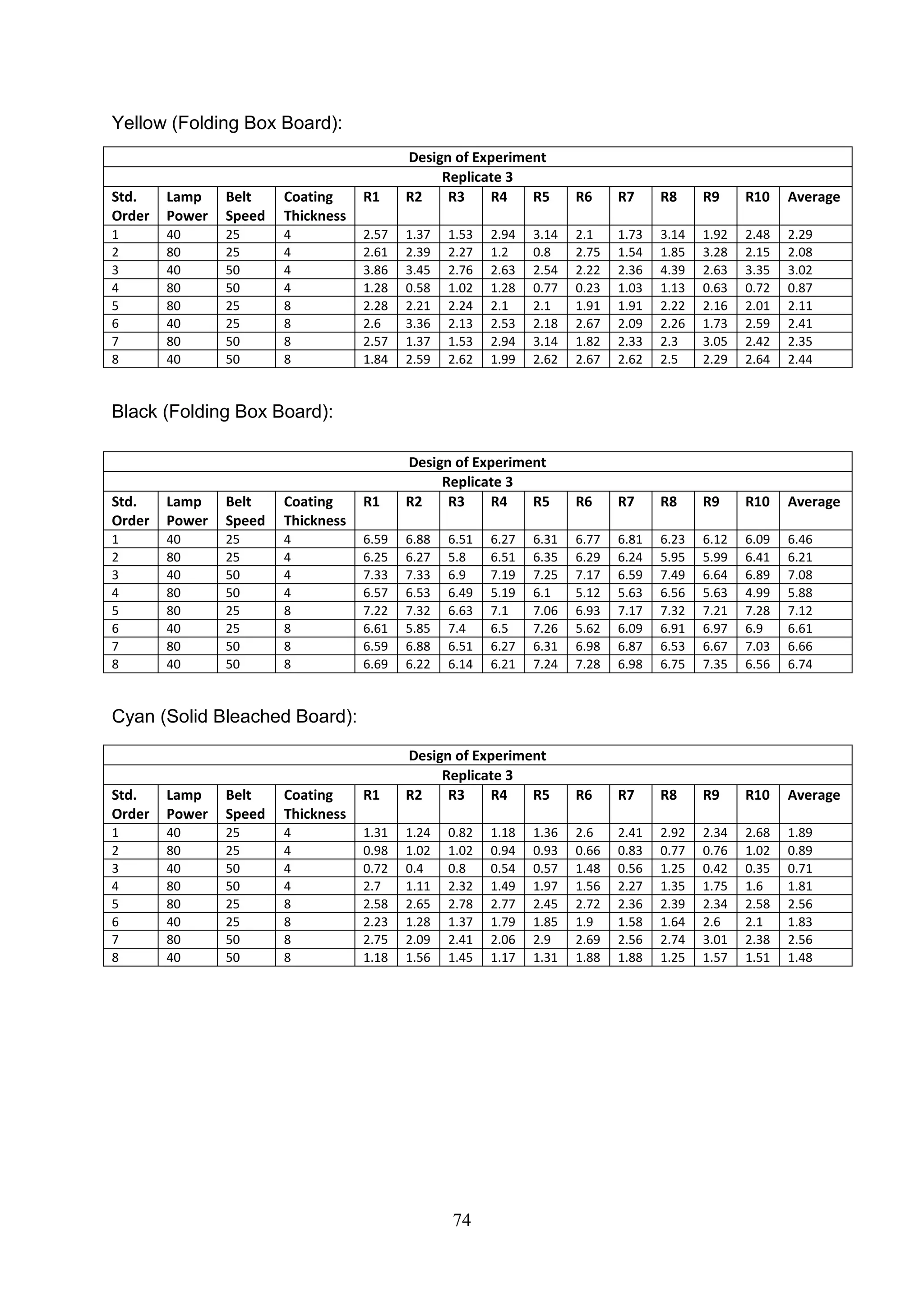
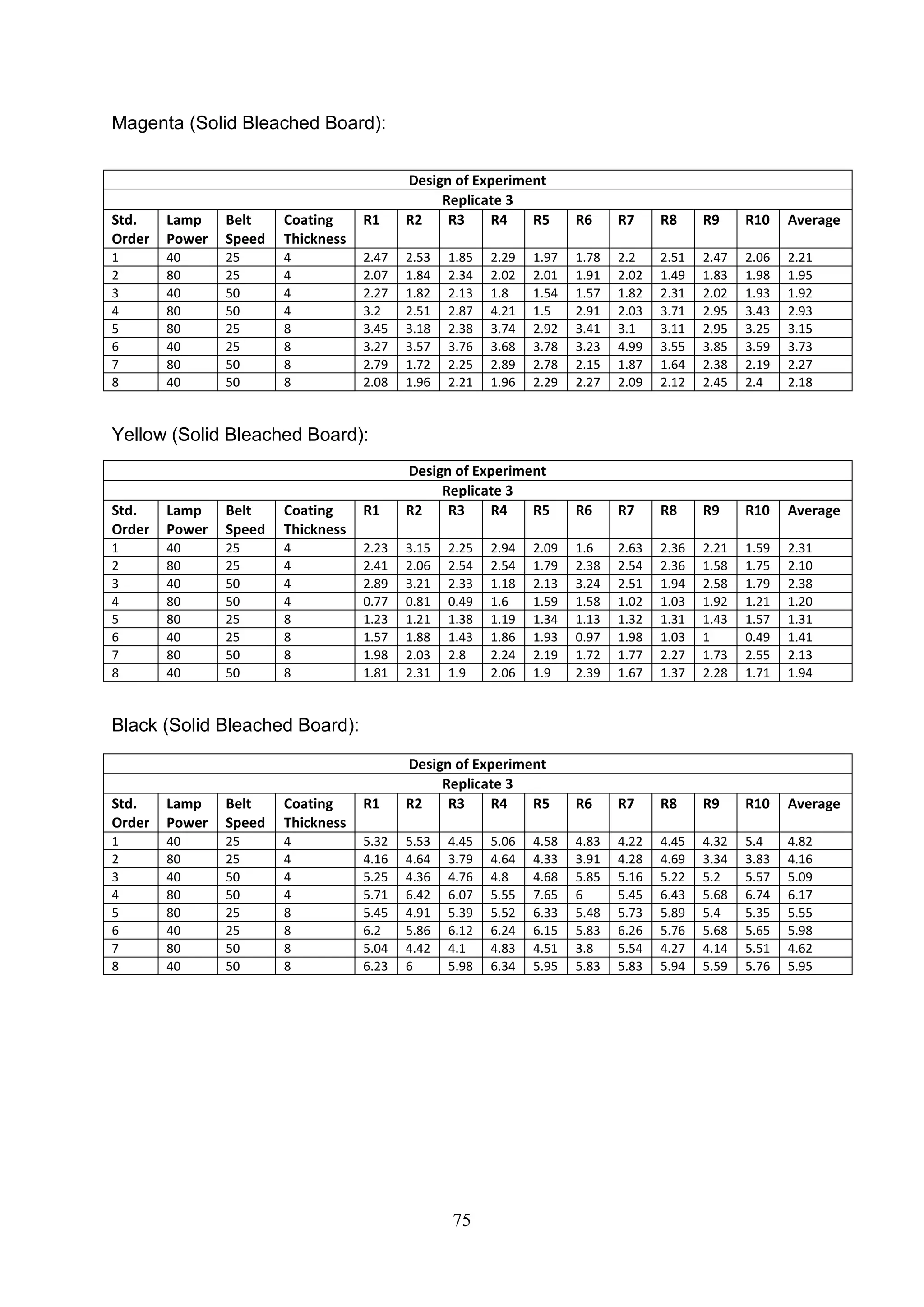
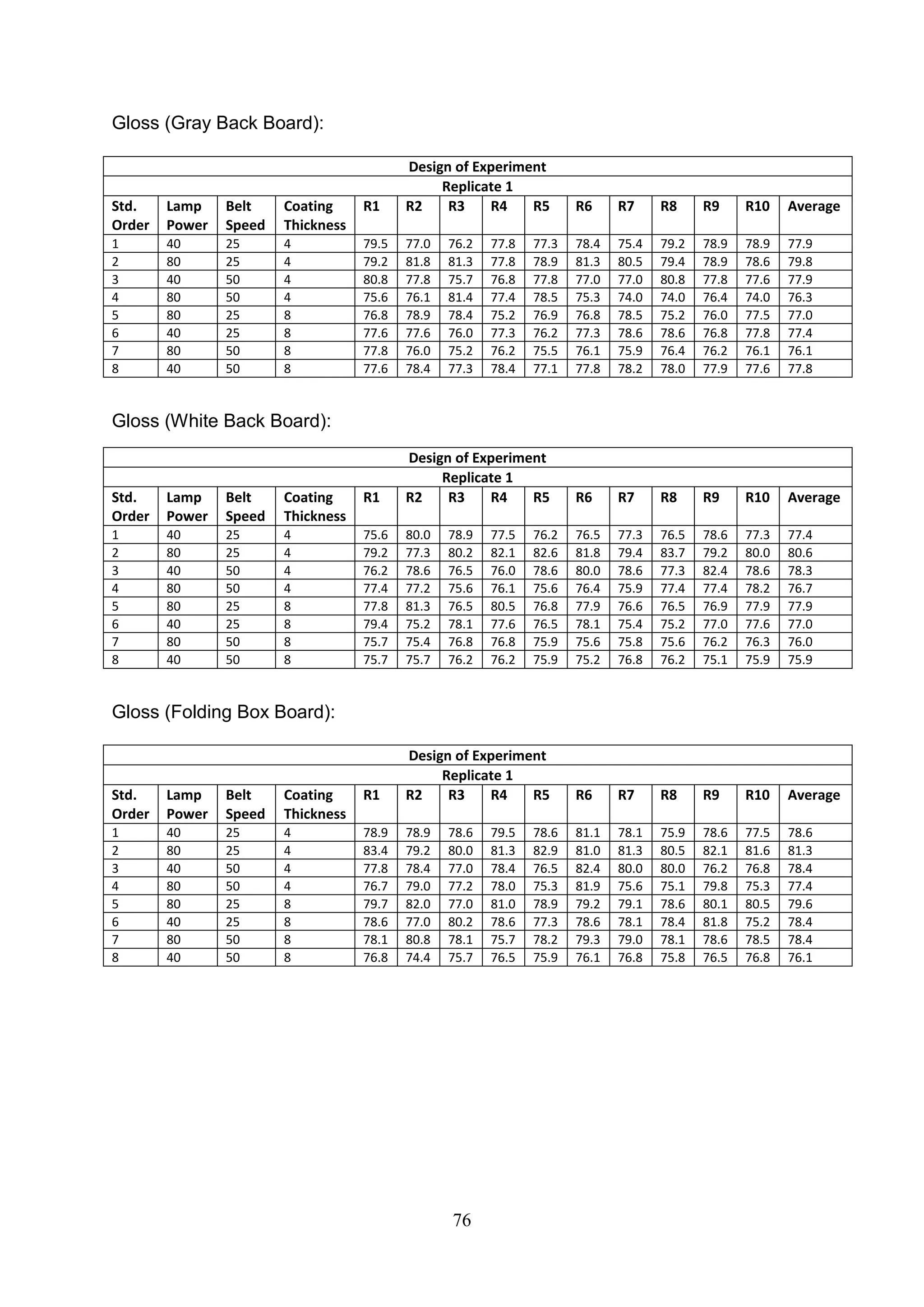
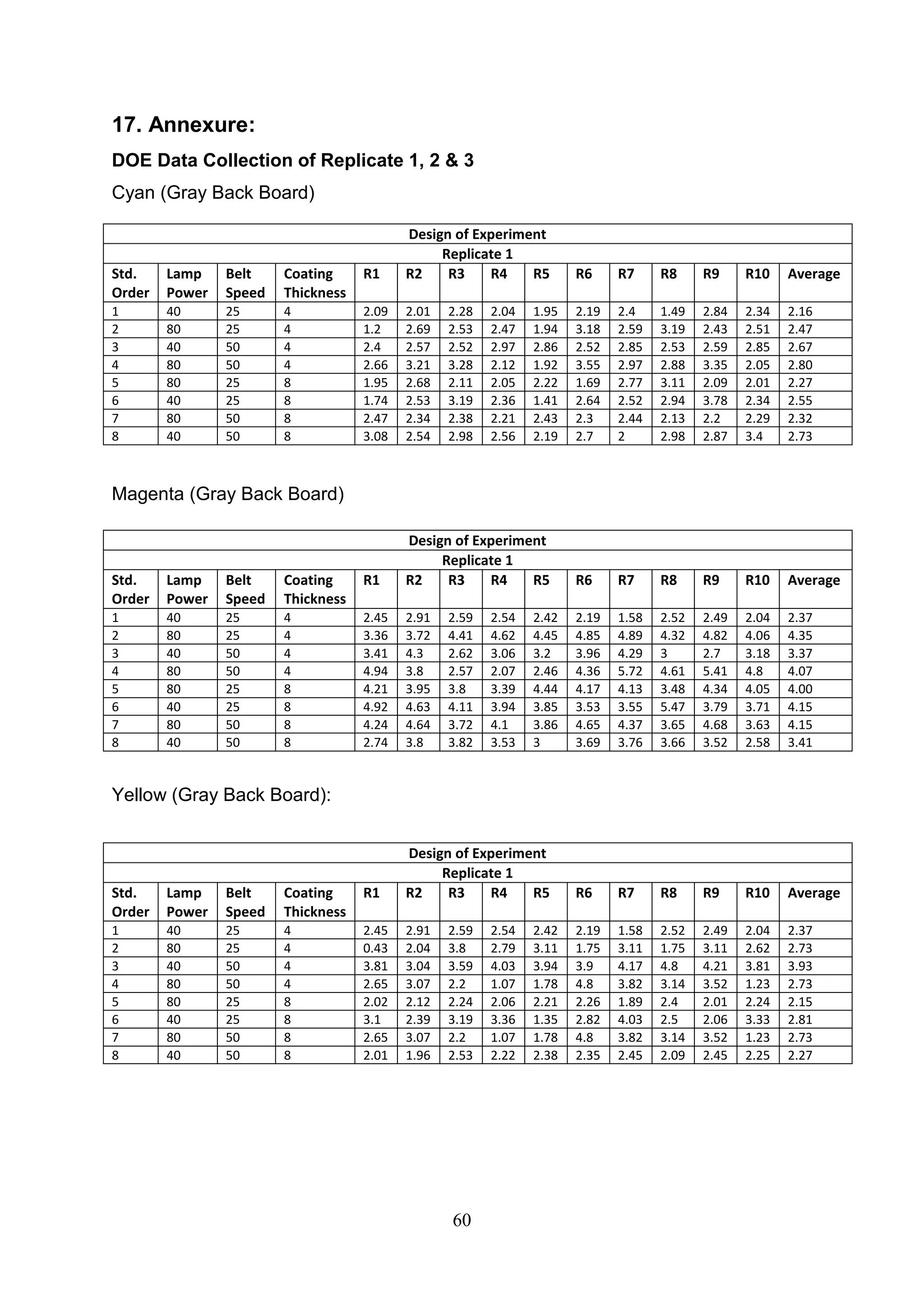
17. Annexure:
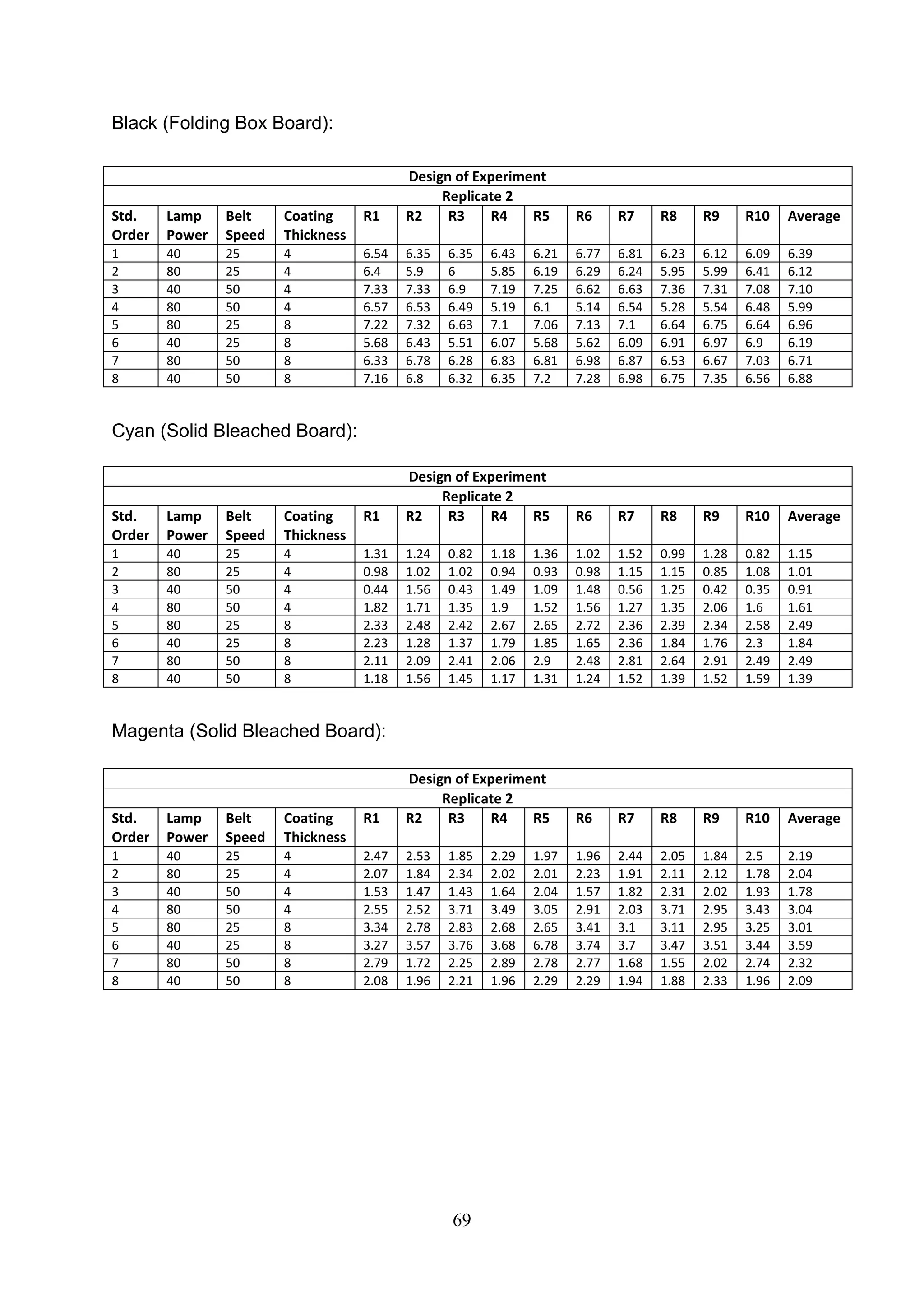
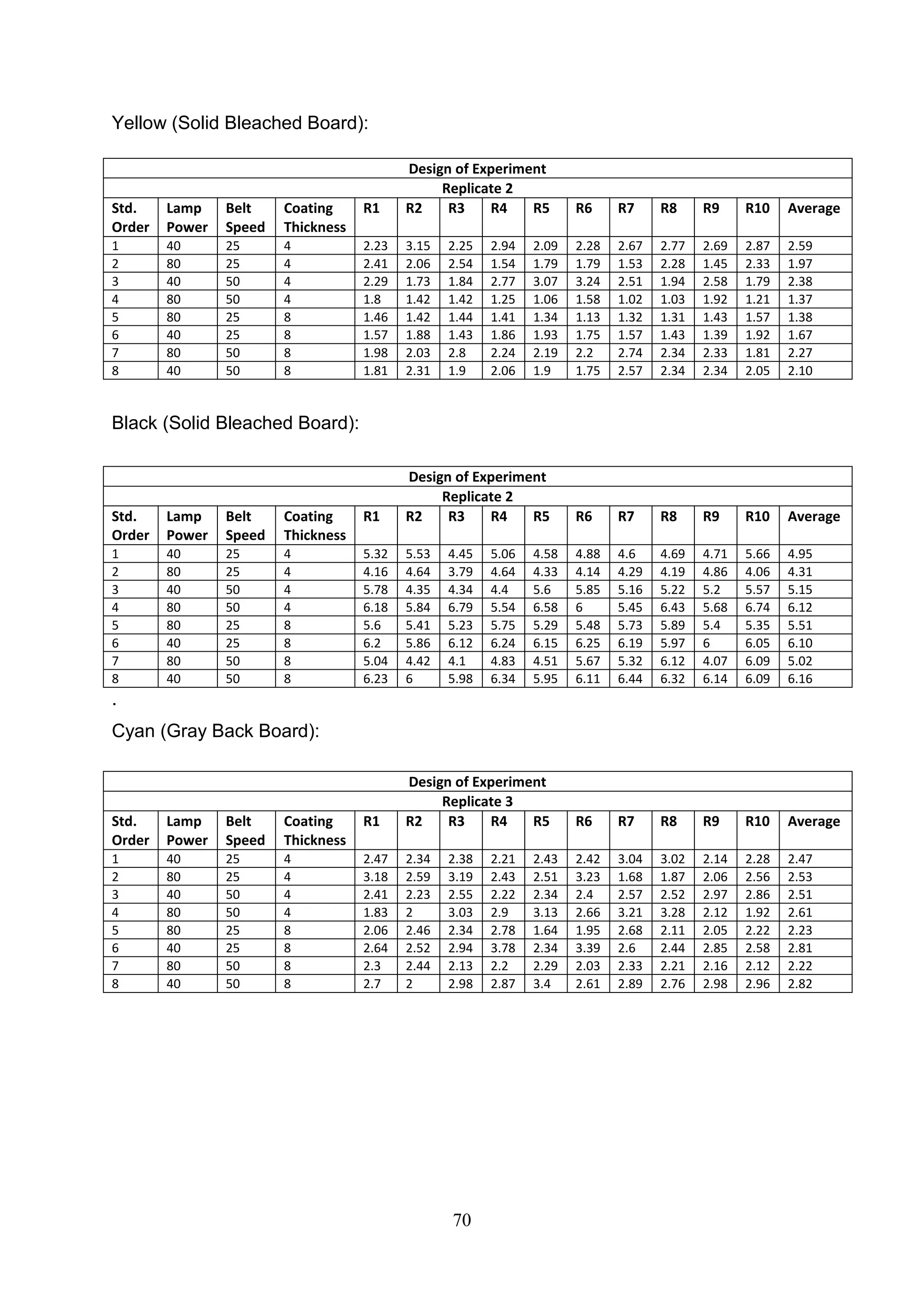
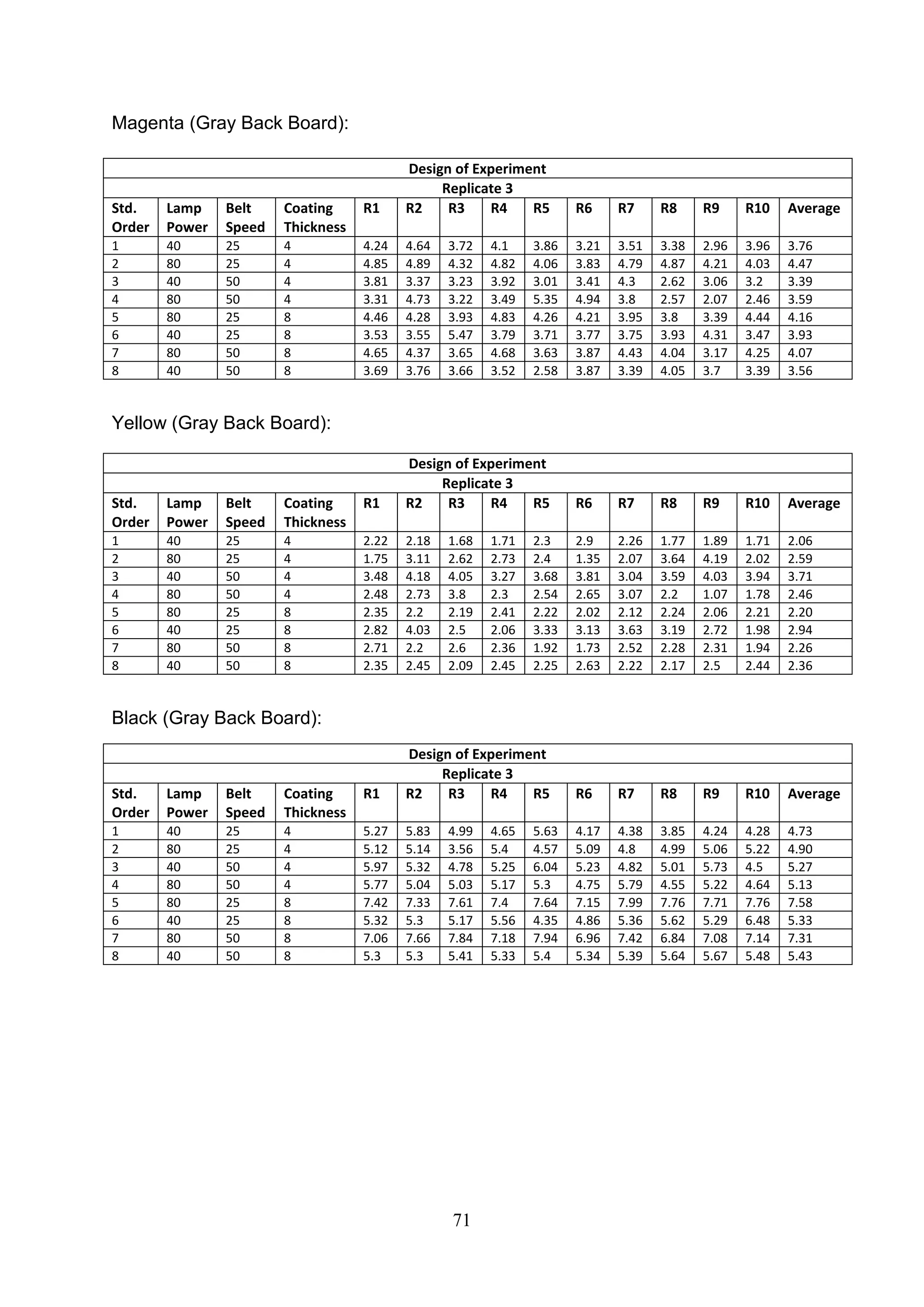
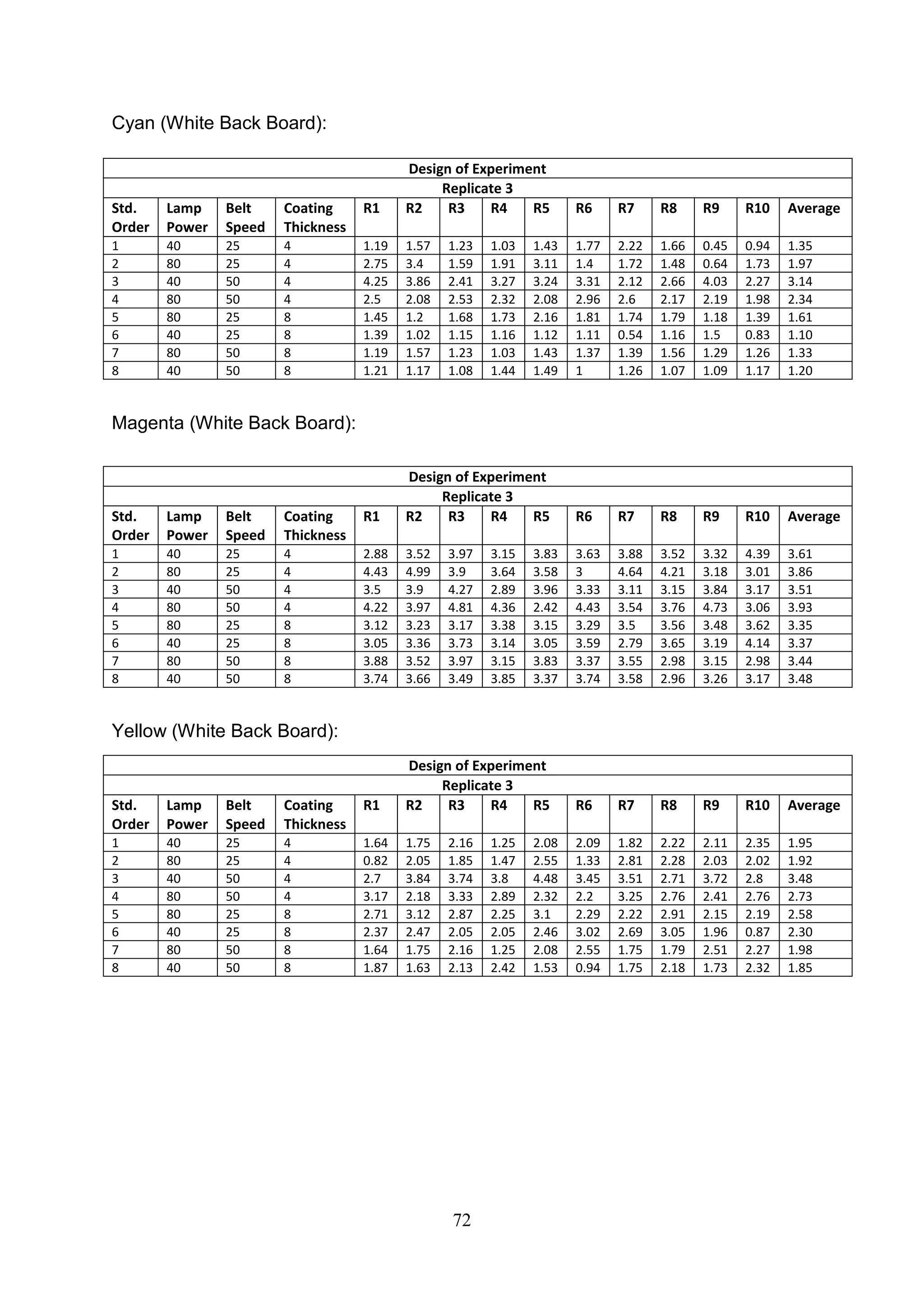
DOE Data Collection of Replicate 1, 2 & 3
Cyan (Gray Back Board)
Magenta (Gray Back Board)
Yellow (Gray Back Board):
Design of Experiment
Replicate 1
Std.
Order
Lamp
Power
Belt
Speed
Coating
Thickness
R1 R2 R3 R4 R5 R6 R7 R8 R9 R10 Average
1 40 25 4 2.09 2.01 2.28 2.04 1.95 2.19 2.4 1.49 2.84 2.34 2.16
2 80 25 4 1.2 2.69 2.53 2.47 1.94 3.18 2.59 3.19 2.43 2.51 2.47
3 40 50 4 2.4 2.57 2.52 2.97 2.86 2.52 2.85 2.53 2.59 2.85 2.67
4 80 50 4 2.66 3.21 3.28 2.12 1.92 3.55 2.97 2.88 3.35 2.05 2.80
5 80 25 8 1.95 2.68 2.11 2.05 2.22 1.69 2.77 3.11 2.09 2.01 2.27
6 40 25 8 1.74 2.53 3.19 2.36 1.41 2.64 2.52 2.94 3.78 2.34 2.55
7 80 50 8 2.47 2.34 2.38 2.21 2.43 2.3 2.44 2.13 2.2 2.29 2.32
8 40 50 8 3.08 2.54 2.98 2.56 2.19 2.7 2 2.98 2.87 3.4 2.73
Design of Experiment
Replicate 1
Std.
Order
Lamp
Power
Belt
Speed
Coating
Thickness
R1 R2 R3 R4 R5 R6 R7 R8 R9 R10 Average
1 40 25 4 2.45 2.91 2.59 2.54 2.42 2.19 1.58 2.52 2.49 2.04 2.37
2 80 25 4 3.36 3.72 4.41 4.62 4.45 4.85 4.89 4.32 4.82 4.06 4.35
3 40 50 4 3.41 4.3 2.62 3.06 3.2 3.96 4.29 3 2.7 3.18 3.37
4 80 50 4 4.94 3.8 2.57 2.07 2.46 4.36 5.72 4.61 5.41 4.8 4.07
5 80 25 8 4.21 3.95 3.8 3.39 4.44 4.17 4.13 3.48 4.34 4.05 4.00
6 40 25 8 4.92 4.63 4.11 3.94 3.85 3.53 3.55 5.47 3.79 3.71 4.15
7 80 50 8 4.24 4.64 3.72 4.1 3.86 4.65 4.37 3.65 4.68 3.63 4.15
8 40 50 8 2.74 3.8 3.82 3.53 3 3.69 3.76 3.66 3.52 2.58 3.41
Design of Experiment
Replicate 1
Std.
Order
Lamp
Power
Belt
Speed
Coating
Thickness
R1 R2 R3 R4 R5 R6 R7 R8 R9 R10 Average
1 40 25 4 2.45 2.91 2.59 2.54 2.42 2.19 1.58 2.52 2.49 2.04 2.37
2 80 25 4 0.43 2.04 3.8 2.79 3.11 1.75 3.11 1.75 3.11 2.62 2.73
3 40 50 4 3.81 3.04 3.59 4.03 3.94 3.9 4.17 4.8 4.21 3.81 3.93
4 80 50 4 2.65 3.07 2.2 1.07 1.78 4.8 3.82 3.14 3.52 1.23 2.73
5 80 25 8 2.02 2.12 2.24 2.06 2.21 2.26 1.89 2.4 2.01 2.24 2.15
6 40 25 8 3.1 2.39 3.19 3.36 1.35 2.82 4.03 2.5 2.06 3.33 2.81
7 80 50 8 2.65 3.07 2.2 1.07 1.78 4.8 3.82 3.14 3.52 1.23 2.73
8 40 50 8 2.01 1.96 2.53 2.22 2.38 2.35 2.45 2.09 2.45 2.25 2.27
61
Black (Gray Back Board):
Cyan (White Back Board):
Magenta (White Back Board):
Design of Experiment
Replicate 1
Std.
Order
Lamp
Power
Belt
Speed
Coating
Thickness
R1 R2 R3 R4 R5 R6 R7 R8 R9 R10 Average
1 40 25 4 0.74 0.25 1.02 0.5 0.53 1.17 1.44 2.67 2.44 2.89 1.37
2 80 25 4 1.4 1.72 1.48 0.64 1.73 0.41 3.77 3.54 2.9 2.32 1.99
3 40 50 4 2.38 3.14 1.56 3.91 2.47 4.25 3.86 2.41 3.27 3.24 3.05
4 80 50 4 2.28 2.73 1.51 2.27 2.59 2.5 2.08 2.53 2.32 2.08 2.29
5 80 25 8 1.29 1.73 1.71 1.16 1.29 1.45 1.2 1.68 1.73 2.16 1.54
6 40 25 8 1.11 0.54 1.16 1.5 0.83 1.09 1.3 0.84 0.58 1.33 1.03
7 80 50 8 1.19 1.57 1.23 1.03 1.43 1.23 1.7 1.02 1.18 1.33 1.29
8 40 50 8 1 1.26 1.07 1.09 1.17 1.23 1.11 0.93 0.97 0.89 1.07
Design of Experiment
Replicate 1
Std.
Order
Lamp
Power
Belt
Speed
Coating
Thickness
R1 R2 R3 R4 R5 R6 R7 R8 R9 R10 Average
1 40 25 4 3.22 2.91 5.52 5.14 4.17 3.5 3.56 3.1 4.94 5.07 4.11
2 80 25 4 4.66 4.37 4.79 4.7 5.05 5.12 5.14 3.56 5.4 4.57 4.74
3 40 50 4 5.23 4.82 5.01 5.73 4.5 5.67 5.04 4.98 4.57 5.96 5.15
4 80 50 4 4.75 5.79 4.55 5.22 4.64 4.81 4.84 4.87 2.83 4.93 4.72
5 80 25 8 7.15 7.99 7.76 7.71 7.76 7.76 7.91 7.72 7.18 7.11 7.61
6 40 25 8 4.22 6.06 5.63 5.18 6.07 5.32 5.3 5.17 5.56 4.35 5.29
7 80 50 8 7.27 7.83 7.99 7.65 6.87 7.06 7.66 7.84 7.18 7.94 7.53
8 40 50 8 5.28 5.04 5.18 4.96 4.97 5.3 5.3 5.41 5.33 5.4 5.22
Design of Experiment
Replicate 1
Std.
Order
Lamp
Power
Belt
Speed
Coating
Thickness
R1 R2 R3 R4 R5 R6 R7 R8 R9 R10 Average
1 40 25 4 3.64 2.33 3.39 2.47 3.21 3.54 3.92 3.82 4.42 4.54 3.53
2 80 25 4 3 4.64 4.21 3.18 3.01 3.05 5.6 5.49 5.64 3.05 4.09
3 40 50 4 3.09 3.84 3.25 3.64 2.93 3.5 3.9 4.27 2.89 3.96 3.53
4 80 50 4 2.82 2.92 4.91 3.94 4.04 4.22 3.97 4.81 4.36 2.42 3.84
5 80 25 8 3.27 3.13 3.36 3.23 3.43 3.12 3.23 3.17 3.38 3.15 3.25
6 40 25 8 3.59 2.79 3.65 3.19 4.14 4.56 3.09 2.67 3.3 3.57 3.46
7 80 50 8 2.88 3.52 3.97 3.15 3.83 2.99 3.74 4.1 3.19 3.43 3.48
8 40 50 8 3.74 3.58 2.96 3.26 3.17 3.66 3.16 3.3 3.24 3.63 3.37
62
Yellow (White Back Board):
Black (White Back Board):
Cyan (Folding Box Board):
Design of Experiment
Replicate 1
Std.
Order
Lamp
Power
Belt
Speed
Coating
Thickness
R1 R2 R3 R4 R5 R6 R7 R8 R9 R10 Average
1 40 25 4 1.53 2.48 1.98 0.98 2.26 0.79 2.52 2.57 2.05 1.54 1.87
2 80 25 4 1.33 2.81 2.28 2.03 2.02 1.04 1.66 2.59 3.11 2.53 2.14
3 40 50 4 3.29 3.37 3.98 2.66 3.39 2.7 3.84 3.74 3.8 4.48 3.53
4 80 50 4 2.12 2.38 3.14 2.58 2.83 3.17 2.18 3.33 2.89 2.32 2.69
5 80 25 8 3.23 2.2 2.62 2.45 2.19 2.71 3.12 2.87 2.25 3.1 2.67
6 40 25 8 3.02 2.69 3.05 1.96 0.87 2.34 2.8 1.82 2.02 3.12 2.37
7 80 50 8 1.64 1.75 2.16 1.25 2.08 2.61 1.18 2.08 1.77 2.08 1.86
8 40 50 8 0.94 1.75 2.18 1.73 2.32 2.29 1.97 1.88 2.7 1.65 1.94
Design of Experiment
Replicate 1
Std.
Order
Lamp
Power
Belt
Speed
Coating
Thickness
R1 R2 R3 R4 R5 R6 R7 R8 R9 R10 Average
1 40 25 4 5.61 5.22 5.38 5.58 5.52 6.02 5.79 5.64 4.9 5.46 5.51
2 80 25 4 4.99 4.08 5.44 5.49 5.27 3 4.87 4.87 5.51 5.25 4.88
3 40 50 4 5.46 5.63 5.12 5.15 5.71 5.41 5.75 5.64 5.2 5.3 5.44
4 80 50 4 3.63 3.31 3.54 3.46 3.18 3.55 3.84 3.37 3.37 3.58 3.48
5 80 25 8 5.36 4.63 3.75 3.64 3.66 5.36 4.22 4.36 5.08 4.84 4.49
6 40 25 8 5.77 4.68 5.27 5.68 5.44 5.12 5.04 4.45 5.55 5.52 5.25
7 80 50 8 5.72 5.12 5.58 5.8 5.37 5.47 4.91 4.69 5.51 4.68 5.29
8 40 50 8 5.38 5.45 5.38 5.41 5.41 5.61 5.27 5.48 5.28 5.61 5.43
Design of Experiment
Replicate 1
Std.
Order
Lamp
Power
Belt
Speed
Coating
Thickness
R1 R2 R3 R4 R5 R6 R7 R8 R9 R10 Average
1 40 25 4 3.72 2.98 0.97 2.59 1.54 0.65 0.91 1.37 1.61 0.53 1.69
2 80 25 4 4.1 3.78 3.11 3.74 2.74 3.06 3.65 0.57 0.63 0.9 2.63
3 40 50 4 1.55 1.14 1.88 1.97 1.85 1.26 1.21 1.01 2.29 1.56 1.57
4 80 50 4 0.87 1.4 1 0.51 1.03 0.42 0.88 0.73 0.77 0.74 0.84
5 80 25 8 1.55 1.56 1.2 1.21 1.29 1.42 1.07 1.03 1.2 1.6 1.31
6 40 25 8 1.07 0.9 1.12 1.81 0.95 1.49 1.72 1.63 2.41 1.1 1.45
7 80 50 8 0.39 1.14 0.67 1.1 0.61 1.06 1.11 1.09 0.64 0.48 0.83
8 40 50 8 0.76 1.72 0.78 1.52 1.36 1.21 0.85 1.9 0.93 1.49 1.25
63
Magenta (Folding Box Board):
Yellow (Folding Box Board):
Black (Folding Box Board):
Design of Experiment
Replicate 1
Std.
Order
Lamp
Power
Belt
Speed
Coating
Thickness
R1 R2 R3 R4 R5 R6 R7 R8 R9 R10 Average
1 40 25 4 2.74 2.79 2.23 3.53 2.73 2.24 2.05 2.68 2.88 2.36 2.62
2 80 25 4 1.96 1.94 1.62 2.5 2.59 1.95 1.67 1.87 1.68 1.57 1.94
3 40 50 4 2.61 1.9 2.84 2.3 3.02 2.65 2.04 1.68 2.95 2.86 2.49
4 80 50 4 1.32 1.25 1.57 1.61 1.48 1.55 1.62 1.56 1.56 1.62 1.51
5 80 25 8 1.3 1.41 1.19 1.24 1.38 1.41 1.34 1.33 1.46 1.32 1.34
6 40 25 8 1.56 1.91 2.1 2 1.93 2 2.12 1.78 1.79 1.69 1.89
7 80 50 8 1.51 1.66 1.68 1.37 1.53 1.44 1.66 1.47 1.31 1.68 1.53
8 40 50 8 2.97 2.77 2.92 3.12 2.75 3.16 3.18 2.78 2.78 2.75 2.92
Design of Experiment
Replicate 1
Std.
Order
Lamp
Power
Belt
Speed
Coating
Thickness
R1 R2 R3 R4 R5 R6 R7 R8 R9 R10 Average
1 40 25 4 2.71 2.75 2.63 1.25 1.57 1.01 0.37 1.08 2.54 0.69 1.66
2 80 25 4 3.42 2.91 1.26 3.03 3 2.61 2.39 2.27 1.2 0.8 2.29
3 40 50 4 2.22 2.36 4.39 2.63 3.35 2.44 2.48 2.57 1.98 3.03 2.75
4 80 50 4 0.23 0.67 0.63 0.63 0.72 1.3 0.93 0.72 1.6 0.49 0.79
5 80 25 8 1.91 1.91 2.22 2.16 2.01 2.05 2.29 2.09 1.81 1.77 2.02
6 40 25 8 1.43 0.86 1.11 2.54 2.08 2.6 3.36 2.13 2.53 2.18 2.08
7 80 50 8 2.21 3.26 2.61 1.91 2.05 2.57 1.37 1.53 2.94 3.14 2.36
8 40 50 8 2.4 2.64 2.05 2.57 2.47 1.84 2.59 2.62 1.99 2.62 2.38
Design of Experiment
Replicate 1
Std.
Order
Lamp
Power
Belt
Speed
Coating
Thickness
R1 R2 R3 R4 R5 R6 R7 R8 R9 R10 Average
1 40 25 4 5.14 5.51 5.98 4.68 7.34 6.61 6.27 6.84 6.75 6.27 6.14
2 80 25 4 6.27 6.07 6.22 6.21 6.45 6.25 6.27 5.8 6.51 6.35 6.24
3 40 50 4 7.17 6.59 7.49 6.64 6.89 7.06 6.98 6.65 7.06 6.56 6.91
4 80 50 4 5.12 5.63 6.56 5.63 4.99 6.03 6.18 6.69 6.74 6.72 6.03
5 80 25 8 6.93 7.17 7.32 7.21 7.28 7.32 6.92 6.97 7.29 7.28 7.17
6 40 25 8 6.17 6.23 7.09 7.21 7.06 6.61 5.85 7.4 6.5 7.26 6.74
7 80 50 8 6.76 6.59 6.76 6.39 6.53 6.59 6.88 6.51 6.27 6.31 6.56
8 40 50 8 6.03 7.08 6.07 6.87 6.96 6.69 6.22 6.14 6.21 7.24 6.55
64
Cyan (Solid Bleached Board)
Magenta (Solid Bleached Board):
Yellow (Solid Bleached Board):
Design of Experiment
Replicate 1
Std.
Order
Lamp
Power
Belt
Speed
Coating
Thickness
R1 R2 R3 R4 R5 R6 R7 R8 R9 R10 Average
1 40 25 4 0.73 0.76 0.62 3.54 1.55 0.68 0.86 0.74 0.44 0.65 1.06
2 80 25 4 0.66 0.83 0.77 0.76 1.02 0.99 0.67 0.72 1 0.89 0.83
3 40 50 4 1.78 0.87 0.74 0.73 0.44 0.72 0.4 0.8 0.54 0.57 0.76
4 80 50 4 2.48 1.4 2.06 1.8 2.41 2.7 1.11 1.96 1.49 0.97 1.84
5 80 25 8 2.44 2.69 2.69 2.67 2.62 2.58 2.65 2.78 2.77 2.45 2.63
6 40 25 8 1.9 1.58 1.64 2.6 2.1 1.93 1.98 2.33 2.08 0.99 1.91
7 80 50 8 2.69 2.56 2.74 3.01 2.38 2.6 2.41 2.92 2.34 2.68 2.63
8 40 50 8 1.88 1.88 1.25 1.57 1.51 2.02 1.86 1.47 1.16 1.39 1.60
Design of Experiment
Replicate 1
Std.
Order
Lamp
Power
Belt
Speed
Coating
Thickness
R1 R2 R3 R4 R5 R6 R7 R8 R9 R10 Average
1 40 25 4 1.9 2.07 2.28 1.12 1.12 2.18 1.68 2.63 2.12 1.98 2.02
2 80 25 4 1.91 2.02 1.49 1.83 1.98 1.59 2.21 1.91 1.97 2.17 1.91
3 40 50 4 2.34 1.9 0.83 0.65 0.58 2.27 1.82 2.13 1.8 1.54 1.59
4 80 50 4 3.44 2.85 3.15 3.39 4.66 3.2 2.51 2.87 4.21 1.5 3.18
5 80 25 8 2.77 2.91 2.62 3.09 3.06 3.08 3.18 2.38 2.74 2.92 2.88
6 40 25 8 3.23 4.99 3.55 3.85 3.59 3.18 3.98 3.13 2.93 3.83 3.63
7 80 50 8 2.15 1.87 1.64 2.38 2.19 1.78 2.2 2.51 2.47 2.06 2.13
8 40 50 8 2.27 2.09 2.12 2.45 2.4 2.03 2.26 2.24 2.47 2.15 2.25
Design of Experiment
Replicate 1
Std.
Order
Lamp
Power
Belt
Speed
Coating
Thickness
R1 R2 R3 R4 R5 R6 R7 R8 R9 R10 Average
1 40 25 4 2.15 2.27 3.08 2.85 2.4 2.48 3.26 3.02 2.48 3.24 2.72
2 80 25 4 2.38 2.54 2.36 1.58 1.75 1.36 3.19 1.38 2.52 2.36 2.14
3 40 50 4 1.56 2.79 3.06 3.08 2.78 2.89 3.21 2.33 1.18 2.13 2.50
4 80 50 4 1.13 1.88 1.18 0.55 2.51 0.77 0.81 0.49 1.6 1.59 1.25
5 80 25 8 1.12 1.06 1.24 1.29 1.45 1.23 1.21 1.38 1.19 1.34 1.25
6 40 25 8 0.97 1.98 1.03 1 0.49 2.42 1.77 1.73 1.83 2.63 1.59
7 80 50 8 1.72 1.77 2.27 1.73 2.55 1.6 2.63 2.36 2.21 1.59 2.04
8 40 50 8 2.39 1.67 1.37 2.28 1.71 2.48 1.29 1.35 2.3 1.88 1.87
65
Black (Solid Bleached Board):
Cyan (Gray Back Board):
Magenta (Gray Back Board):
Design of Experiment
Replicate 1
Std.
Order
Lamp
Power
Belt
Speed
Coating
Thickness
R1 R2 R3 R4 R5 R6 R7 R8 R9 R10 Average
1 40 25 4 5.49 5.13 5.34 4.43 4.69 4.28 4.02 4 4.37 4.42 4.62
2 80 25 4 3.91 4.28 4.69 3.34 3.83 3.9 4.28 4.48 4.79 4.2 4.17
3 40 50 4 5.42 3.67 4.77 4.07 3.84 5.25 4.36 4.76 4.8 4.68 4.56
4 80 50 4 6.17 6.67 6.66 6.04 5.78 5.71 6.42 6.07 5.55 7.65 6.27
5 80 25 8 5.71 4.8 5.18 5.14 4.79 5.45 4.91 5.39 5.52 6.33 5.32
6 40 25 8 5.83 6.26 5.76 5.68 5.65 5.7 5.98 6.22 6.12 6.17 5.94
7 80 50 8 3.8 5.54 4.27 4.14 5.51 4.83 4.22 4.45 4.32 5.4 4.65
8 40 50 8 5.83 5.83 5.94 5.59 5.76 5.92 6.16 5.94 5.86 5.92 5.88
Design of Experiment
Replicate 2
Std.
Order
Lamp
Power
Belt
Speed
Coating
Thickness
R1 R2 R3 R4 R5 R6 R7 R8 R9 R10 Average
1 40 25 4 3.15 2.32 2.02 1.9 2.41 2.42 3.04 2.02 2.14 2.28 2.37
2 80 25 4 3.17 1.64 3.49 3.49 3.13 3.23 1.68 1.87 2.06 2.56 2.63
3 40 50 4 3.17 1.64 3.49 3.49 3.13 3.23 1.68 1.87 2.06 2.56 2.63
4 80 50 4 1.83 2 3.03 2.9 3.13 3.09 2.89 1.95 3.04 2.32 2.62
5 80 25 8 2.06 2.46 2.34 2.78 1.64 2.66 1.51 1.82 1.48 2.24 2.10
6 40 25 8 2.4 2.79 2.75 2.65 3.18 3.39 2.6 2.44 2.85 2.58 2.76
7 80 50 8 1.83 2 3.03 2.9 3.13 3.09 2.89 1.95 3.04 2.32 2.62
8 40 50 8 3.29 2.99 2.85 3.51 2.92 2.61 2.89 2.76 2.98 2.96 2.98
Design of Experiment
Replicate 2
Std.
Order
Lamp
Power
Belt
Speed
Coating
Thickness
R1 R2 R3 R4 R5 R6 R7 R8 R9 R10 Average
1 40 25 4 3.55 4.02 2.96 3.67 3.75 3.21 3.51 3.38 2.96 3.96 3.50
2 80 25 4 4.14 4.94 3.89 4.06 3.91 3.83 4.79 4.87 4.21 4.03 4.27
3 40 50 4 3.81 3.37 3.23 3.92 3.01 3.01 3.61 3.18 3.53 3.34 3.40
4 80 50 4 3.31 4.73 3.22 3.49 5.35 4.17 4.51 5.45 3.47 4.14 4.18
5 80 25 8 4.46 4.28 3.93 4.83 4.26 4.69 3.89 3.55 3.86 3.78 4.15
6 40 25 8 3.9 4.43 4.08 3.83 4.63 3.77 3.75 3.75 3.93 4.31 3.47
7 80 50 8 4.57 4.32 3.54 4.48 3.16 3.87 4.43 4.04 3.17 4.25 3.98
8 40 50 8 3.46 3.96 3.2 4.29 3.63 3.87 3.39 4.05 3.7 3.39 3.69
66
Yellow (Gray Back Board):
Black (Gray Back Board):
Cyan (White Back Board):
Design of Experiment
Replicate 2
Std.
Order
Lamp
Power
Belt
Speed
Coating
Thickness
R1 R2 R3 R4 R5 R6 R7 R8 R9 R10 Average
1 40 25 4 2.87 1.85 1.92 2.53 2.3 2.9 2.26 1.77 1.89 1.71 2.20
2 80 25 4 3.34 1.68 3.13 1.35 1.12 1.35 2.07 3.64 4.19 2.02 2.39
3 40 50 4 3.48 4.18 4.05 3.27 3.68 4.39 3.97 3.23 3.88 2.99 3.71
4 80 50 4 2.48 2.73 3.8 2.3 2.54 1.99 2.03 3.22 1.49 2.3 2.49
5 80 25 8 2.35 2.2 2.19 2.41 2.22 2.27 2.4 2.31 2.19 2.19 2.27
6 40 25 8 3.17 3.55 2.75 2.39 2.37 3.13 3.63 3.19 2.72 1.98 2.89
7 80 50 8 2.61 2.78 2.42 2 1.91 1.73 2.52 2.28 2.31 1.94 2.25
8 40 50 8 2.48 2.55 2.65 2.34 2.51 2.63 2.22 2.17 2.5 2.44 2.45
Design of Experiment
Replicate 2
Std.
Order
Lamp
Power
Belt
Speed
Coating
Thickness
R1 R2 R3 R4 R5 R6 R7 R8 R9 R10 Average
1 40 25 4 3.52 3.67 4.44 3.55 3.81 4.17 4.38 3.85 4.24 4.28 3.99
2 80 25 4 5.02 5.02 5.06 4.43 5.12 5.09 4.8 4.99 5.06 5.22 4.98
3 40 50 4 5.97 5.32 4.78 5.25 6.04 4.65 5.11 4.67 4.95 6.11 5.29
4 80 50 4 5.77 5.04 5.03 5.17 5.3 4.45 5.52 5.37 3.9 4.1 4.97
5 80 25 8 7.42 7.33 7.61 7.4 7.64 7.85 7.67 7.38 7.28 7.29 7.49
6 40 25 8 5.05 6.05 5.94 5.08 4.97 4.86 5.36 5.62 5.29 6.48 5.47
7 80 50 8 7.08 7.46 7.5 7.11 7.09 6.96 7.42 6.84 7.08 7.14 7.17
8 40 50 8 5.31 5.23 5.35 5.27 5.43 5.34 5.39 5.64 5.67 5.48 5.41
Design of Experiment
Replicate 2
Std.
Order
Lamp
Power
Belt
Speed
Coating
Thickness
R1 R2 R3 R4 R5 R6 R7 R8 R9 R10 Average
1 40 25 4 0.57 1.15 1.06 1.02 1.2 1.77 2.22 1.66 0.45 0.94 1.20
2 80 25 4 2.75 3.4 1.59 1.91 3.11 1.92 1.39 2.76 1.06 1.14 2.10
3 40 50 4 3.54 2.95 3.08 2.21 2.69 3.31 2.12 2.66 4.03 2.27 2.89
4 80 50 4 2.72 2.87 2.9 2.24 2.46 2.96 2.6 2.17 2.19 1.98 2.51
5 80 25 8 1.31 1.4 0.9 1.48 1.1 1.81 1.74 1.79 1.18 1.39 1.41
6 40 25 8 1.39 1.02 1.15 1.16 1.12 1.17 1.06 1.33 1.25 1.25 1.19
7 80 50 8 1.51 1.75 1.24 1.62 1.27 1.37 1.39 1.56 1.29 1.26 1.43
8 40 50 8 1.21 1.17 1.08 1.44 1.49 1.4 1.25 1.06 1.18 1.36 1.26
67
Magenta (White Back Board):
Yellow (White Back Board):
Black (White Back Board):
Design of Experiment
Replicate 2
Std.
Order
Lamp
Power
Belt
Speed
Coating
Thickness
R1 R2 R3 R4 R5 R6 R7 R8 R9 R10 Average
1 40 25 4 3.33 3.81 4.23 4.04 3.74 3.63 3.88 3.52 3.32 4.39 3.79
2 80 25 4 4.43 4.99 3.9 3.64 3.58 4.41 3.5 5.4 4.33 4.22 4.24
3 40 50 4 3.8 3.67 3.38 2.94 3.79 3.33 3.11 3.15 3.84 3.17 3.42
4 80 50 4 3.54 3.96 4.41 2.83 4.88 4.43 3.54 3.76 4.73 3.06 3.91
5 80 25 8 3.41 3.63 3.46 3.6 3.37 3.29 3.5 3.56 3.48 3.62 3.49
6 40 25 8 3.05 3.36 3.73 3.14 3.05 3.51 3.89 3.19 3.19 3.4 3.41
7 80 50 8 3.71 3.27 3.3 3.44 3.62 3.37 3.55 2.89 3.15 2.98 3.33
8 40 50 8 3.74 3.66 3.49 3.85 3.37 3.52 4.04 3.58 3.41 3.98 3.66
Design of Experiment
Replicate 2
Std.
Order
Lamp
Power
Belt
Speed
Coating
Thickness
R1 R2 R3 R4 R5 R6 R7 R8 R9 R10 Average
1 40 25 4 2.02 2.01 2.19 2 2.21 2.09 1.82 2.22 2.11 2.35 2.10
2 80 25 4 0.82 2.05 1.85 1.47 2.55 1.32 2.63 2.62 2.24 2.37 1.99
3 40 50 4 3.47 3.18 2.95 3.22 3.69 3.45 3.51 2.71 3.72 2.8 3.27
4 80 50 4 3.03 2.61 2.64 3.33 3.1 2.2 3.25 2.76 2.41 2.76 2.81
5 80 25 8 2.18 2.45 2.44 2.88 2.64 2.29 2.22 2.91 2.15 2.19 2.44
6 40 25 8 2.37 2.47 2.05 2.05 2.46 1.98 2.34 2.14 1.92 2.11 2.19
7 80 50 8 1.62 2.22 2.09 0.97 2.43 2.55 1.75 1.79 2.51 2.27 2.02
8 40 50 8 1.87 1.63 2.13 2.42 1.53 1.99 2.9 2.06 2.5 2.8 2.18
Design of Experiment
Replicate 2
Std.
Order
Lamp
Power
Belt
Speed
Coating
Thickness
R1 R2 R3 R4 R5 R6 R7 R8 R9 R10 Average
1 40 25 4 6.17 6.73 5.87 6.39 5.56 5.76 5.35 5.94 5.92 5.18 5.89
2 80 25 4 4.05 5.25 5.8 4.35 4.79 4.83 4.27 5.49 4.6 4.39 4.78
3 40 50 4 5.75 5.78 5.64 5.8 5.74 5.75 5.8 58.8 5.8 5.81 5.77
4 80 50 4 3.83 3.68 4.26 3.92 4.39 3.93 4.17 3.71 4.28 3.76 3.99
5 80 25 8 5.78 6.41 5.71 5.35 5.95 6.47 6.1 4.98 4.99 6.29 5.80
6 40 25 8 5.56 5.33 4.89 5.35 5.54 5.45 4.72 4.7 5.81 5.56 5.29
7 80 50 8 5.02 5.41 5.3 6.01 5.42 5.81 5.24 5.38 5.65 5.42 5.47
8 40 50 8 5.41 5.76 5.65 5.53 5.48 5.77 5.44 5.45 5.74 5.85 5.61
68
Cyan (Folding Box Board):
.
Magenta (Folding Box Board):
Yellow (Folding Box Board):
Design of Experiment
Replicate 2
Std.
Order
Lamp
Power
Belt
Speed
Coating
Thickness
R1 R2 R3 R4 R5 R6 R7 R8 R9 R10 Average
1 40 25 4 2.19 2.3 1.27 1.45 1.88 1.5 2.88 1.01 2.64 0.96 1.81
2 80 25 4 2.89 1.58 3.01 1.92 4.41 1.52 4.06 3.79 2.41 2.55 2.81
3 40 50 4 1.91 1.65 2.16 1.38 1.86 1.55 1.18 1.6 1.54 1.43 1.63
4 80 50 4 0.89 0.91 1.39 0.73 1.14 1.27 0.85 0.75 0.97 1.32 1.02
5 80 25 8 1.39 1.41 1.43 1.47 1.68 1.44 1.59 1.58 1.7 1.44 1.51
6 40 25 8 1.3 1.5 1.95 1.85 1.93 1.35 1.71 1.39 1.75 1.57 1.63
7 80 50 8 1.07 1.11 1.06 1.29 1.01 0.72 0.89 0.95 0.58 0.99 0.97
8 40 50 8 1.48 1.15 0.72 0.98 1.34 1.26 1.43 1.2 1.16 1.37 1.21
Design of Experiment
Replicate 2
Std.
Order
Lamp
Power
Belt
Speed
Coating
Thickness
R1 R2 R3 R4 R5 R6 R7 R8 R9 R10 Average
1 40 25 4 2.77 2.27 2.48 2.54 3.01 3.25 3.08 3.28 3.19 2.82 2.87
2 80 25 4 1.8 1.58 1.82 1.63 2.15 2.03 1.95 1.34 1.57 1.96 1.78
3 40 50 4 2.45 2.38 2.16 1.6 2.18 1.81 2.4 2.37 2.31 2.26 2.19
4 80 50 4 1.54 1.45 1.59 1.64 1.26 1.59 1.25 1.28 1.46 1.24 1.43
5 80 25 8 1.57 1.46 1.38 1.39 1.51 1.56 1.41 1.54 1.45 1.33 1.46
6 40 25 8 1.93 1.8 1.71 1.41 2.03 2.13 1.85 2.29 1.49 1.37 1.80
7 80 50 8 1.74 1.68 1.87 1.59 1.53 1.64 1.75 1.54 1.88 1.84 1.71
8 40 50 8 2.84 2.92 2.9 2.81 2.66 2.78 2.62 2.7 2.85 2.74 2.78
Design of Experiment
Replicate 2
Std.
Order
Lamp
Power
Belt
Speed
Coating
Thickness
R1 R2 R3 R4 R5 R6 R7 R8 R9 R10 Average
1 40 25 4 2.45 2.43 1.48 1.77 1.58 2.1 1.73 3.14 1.92 2.48 2.11
2 80 25 4 2.98 1.88 2.04 2.74 3.24 2.75 1.54 1.85 3.28 2.15 2.45
3 40 50 4 3.86 3.45 2.76 2.63 2.54 2.81 3.63 3.01 2.56 1.85 2.91
4 80 50 4 1.28 0.58 1.02 1.28 0.77 1.23 0.59 0.51 1.24 1.26 0.98
5 80 25 8 2.28 2.21 2.24 2.1 2.1 2.26 2.15 2.19 2.36 2.05 2.19
6 40 25 8 2.57 2.16 1.89 2.3 2 2.67 2.09 2.26 1.73 2.59 2.23
7 80 50 8 3.29 2.53 2.37 2.38 1.98 1.82 2.33 2.3 3.05 2.42 2.45
8 40 50 8 2.87 2.75 2.37 2.87 2.33 2.67 2.62 2.5 2.29 2.64 2.59
69
Black (Folding Box Board):
Cyan (Solid Bleached Board):
Magenta (Solid Bleached Board):
Design of Experiment
Replicate 2
Std.
Order
Lamp
Power
Belt
Speed
Coating
Thickness
R1 R2 R3 R4 R5 R6 R7 R8 R9 R10 Average
1 40 25 4 6.54 6.35 6.35 6.43 6.21 6.77 6.81 6.23 6.12 6.09 6.39
2 80 25 4 6.4 5.9 6 5.85 6.19 6.29 6.24 5.95 5.99 6.41 6.12
3 40 50 4 7.33 7.33 6.9 7.19 7.25 6.62 6.63 7.36 7.31 7.08 7.10
4 80 50 4 6.57 6.53 6.49 5.19 6.1 5.14 6.54 5.28 5.54 6.48 5.99
5 80 25 8 7.22 7.32 6.63 7.1 7.06 7.13 7.1 6.64 6.75 6.64 6.96
6 40 25 8 5.68 6.43 5.51 6.07 5.68 5.62 6.09 6.91 6.97 6.9 6.19
7 80 50 8 6.33 6.78 6.28 6.83 6.81 6.98 6.87 6.53 6.67 7.03 6.71
8 40 50 8 7.16 6.8 6.32 6.35 7.2 7.28 6.98 6.75 7.35 6.56 6.88
Design of Experiment
Replicate 2
Std.
Order
Lamp
Power
Belt
Speed
Coating
Thickness
R1 R2 R3 R4 R5 R6 R7 R8 R9 R10 Average
1 40 25 4 1.31 1.24 0.82 1.18 1.36 1.02 1.52 0.99 1.28 0.82 1.15
2 80 25 4 0.98 1.02 1.02 0.94 0.93 0.98 1.15 1.15 0.85 1.08 1.01
3 40 50 4 0.44 1.56 0.43 1.49 1.09 1.48 0.56 1.25 0.42 0.35 0.91
4 80 50 4 1.82 1.71 1.35 1.9 1.52 1.56 1.27 1.35 2.06 1.6 1.61
5 80 25 8 2.33 2.48 2.42 2.67 2.65 2.72 2.36 2.39 2.34 2.58 2.49
6 40 25 8 2.23 1.28 1.37 1.79 1.85 1.65 2.36 1.84 1.76 2.3 1.84
7 80 50 8 2.11 2.09 2.41 2.06 2.9 2.48 2.81 2.64 2.91 2.49 2.49
8 40 50 8 1.18 1.56 1.45 1.17 1.31 1.24 1.52 1.39 1.52 1.59 1.39
Design of Experiment
Replicate 2
Std.
Order
Lamp
Power
Belt
Speed
Coating
Thickness
R1 R2 R3 R4 R5 R6 R7 R8 R9 R10 Average
1 40 25 4 2.47 2.53 1.85 2.29 1.97 1.96 2.44 2.05 1.84 2.5 2.19
2 80 25 4 2.07 1.84 2.34 2.02 2.01 2.23 1.91 2.11 2.12 1.78 2.04
3 40 50 4 1.53 1.47 1.43 1.64 2.04 1.57 1.82 2.31 2.02 1.93 1.78
4 80 50 4 2.55 2.52 3.71 3.49 3.05 2.91 2.03 3.71 2.95 3.43 3.04
5 80 25 8 3.34 2.78 2.83 2.68 2.65 3.41 3.1 3.11 2.95 3.25 3.01
6 40 25 8 3.27 3.57 3.76 3.68 6.78 3.74 3.7 3.47 3.51 3.44 3.59
7 80 50 8 2.79 1.72 2.25 2.89 2.78 2.77 1.68 1.55 2.02 2.74 2.32
8 40 50 8 2.08 1.96 2.21 1.96 2.29 2.29 1.94 1.88 2.33 1.96 2.09
70
Yellow (Solid Bleached Board):
Black (Solid Bleached Board):
.
Cyan (Gray Back Board):
Design of Experiment
Replicate 2
Std.
Order
Lamp
Power
Belt
Speed
Coating
Thickness
R1 R2 R3 R4 R5 R6 R7 R8 R9 R10 Average
1 40 25 4 2.23 3.15 2.25 2.94 2.09 2.28 2.67 2.77 2.69 2.87 2.59
2 80 25 4 2.41 2.06 2.54 1.54 1.79 1.79 1.53 2.28 1.45 2.33 1.97
3 40 50 4 2.29 1.73 1.84 2.77 3.07 3.24 2.51 1.94 2.58 1.79 2.38
4 80 50 4 1.8 1.42 1.42 1.25 1.06 1.58 1.02 1.03 1.92 1.21 1.37
5 80 25 8 1.46 1.42 1.44 1.41 1.34 1.13 1.32 1.31 1.43 1.57 1.38
6 40 25 8 1.57 1.88 1.43 1.86 1.93 1.75 1.57 1.43 1.39 1.92 1.67
7 80 50 8 1.98 2.03 2.8 2.24 2.19 2.2 2.74 2.34 2.33 1.81 2.27
8 40 50 8 1.81 2.31 1.9 2.06 1.9 1.75 2.57 2.34 2.34 2.05 2.10
Design of Experiment
Replicate 2
Std.
Order
Lamp
Power
Belt
Speed
Coating
Thickness
R1 R2 R3 R4 R5 R6 R7 R8 R9 R10 Average
1 40 25 4 5.32 5.53 4.45 5.06 4.58 4.88 4.6 4.69 4.71 5.66 4.95
2 80 25 4 4.16 4.64 3.79 4.64 4.33 4.14 4.29 4.19 4.86 4.06 4.31
3 40 50 4 5.78 4.35 4.34 4.4 5.6 5.85 5.16 5.22 5.2 5.57 5.15
4 80 50 4 6.18 5.84 6.79 5.54 6.58 6 5.45 6.43 5.68 6.74 6.12
5 80 25 8 5.6 5.41 5.23 5.75 5.29 5.48 5.73 5.89 5.4 5.35 5.51
6 40 25 8 6.2 5.86 6.12 6.24 6.15 6.25 6.19 5.97 6 6.05 6.10
7 80 50 8 5.04 4.42 4.1 4.83 4.51 5.67 5.32 6.12 4.07 6.09 5.02
8 40 50 8 6.23 6 5.98 6.34 5.95 6.11 6.44 6.32 6.14 6.09 6.16
Design of Experiment
Replicate 3
Std.
Order
Lamp
Power
Belt
Speed
Coating
Thickness
R1 R2 R3 R4 R5 R6 R7 R8 R9 R10 Average
1 40 25 4 2.47 2.34 2.38 2.21 2.43 2.42 3.04 3.02 2.14 2.28 2.47
2 80 25 4 3.18 2.59 3.19 2.43 2.51 3.23 1.68 1.87 2.06 2.56 2.53
3 40 50 4 2.41 2.23 2.55 2.22 2.34 2.4 2.57 2.52 2.97 2.86 2.51
4 80 50 4 1.83 2 3.03 2.9 3.13 2.66 3.21 3.28 2.12 1.92 2.61
5 80 25 8 2.06 2.46 2.34 2.78 1.64 1.95 2.68 2.11 2.05 2.22 2.23
6 40 25 8 2.64 2.52 2.94 3.78 2.34 3.39 2.6 2.44 2.85 2.58 2.81
7 80 50 8 2.3 2.44 2.13 2.2 2.29 2.03 2.33 2.21 2.16 2.12 2.22
8 40 50 8 2.7 2 2.98 2.87 3.4 2.61 2.89 2.76 2.98 2.96 2.82
71
Magenta (Gray Back Board):
Yellow (Gray Back Board):
Black (Gray Back Board):
Design of Experiment
Replicate 3
Std.
Order
Lamp
Power
Belt
Speed
Coating
Thickness
R1 R2 R3 R4 R5 R6 R7 R8 R9 R10 Average
1 40 25 4 4.24 4.64 3.72 4.1 3.86 3.21 3.51 3.38 2.96 3.96 3.76
2 80 25 4 4.85 4.89 4.32 4.82 4.06 3.83 4.79 4.87 4.21 4.03 4.47
3 40 50 4 3.81 3.37 3.23 3.92 3.01 3.41 4.3 2.62 3.06 3.2 3.39
4 80 50 4 3.31 4.73 3.22 3.49 5.35 4.94 3.8 2.57 2.07 2.46 3.59
5 80 25 8 4.46 4.28 3.93 4.83 4.26 4.21 3.95 3.8 3.39 4.44 4.16
6 40 25 8 3.53 3.55 5.47 3.79 3.71 3.77 3.75 3.93 4.31 3.47 3.93
7 80 50 8 4.65 4.37 3.65 4.68 3.63 3.87 4.43 4.04 3.17 4.25 4.07
8 40 50 8 3.69 3.76 3.66 3.52 2.58 3.87 3.39 4.05 3.7 3.39 3.56
Design of Experiment
Replicate 3
Std.
Order
Lamp
Power
Belt
Speed
Coating
Thickness
R1 R2 R3 R4 R5 R6 R7 R8 R9 R10 Average
1 40 25 4 2.22 2.18 1.68 1.71 2.3 2.9 2.26 1.77 1.89 1.71 2.06
2 80 25 4 1.75 3.11 2.62 2.73 2.4 1.35 2.07 3.64 4.19 2.02 2.59
3 40 50 4 3.48 4.18 4.05 3.27 3.68 3.81 3.04 3.59 4.03 3.94 3.71
4 80 50 4 2.48 2.73 3.8 2.3 2.54 2.65 3.07 2.2 1.07 1.78 2.46
5 80 25 8 2.35 2.2 2.19 2.41 2.22 2.02 2.12 2.24 2.06 2.21 2.20
6 40 25 8 2.82 4.03 2.5 2.06 3.33 3.13 3.63 3.19 2.72 1.98 2.94
7 80 50 8 2.71 2.2 2.6 2.36 1.92 1.73 2.52 2.28 2.31 1.94 2.26
8 40 50 8 2.35 2.45 2.09 2.45 2.25 2.63 2.22 2.17 2.5 2.44 2.36
Design of Experiment
Replicate 3
Std.
Order
Lamp
Power
Belt
Speed
Coating
Thickness
R1 R2 R3 R4 R5 R6 R7 R8 R9 R10 Average
1 40 25 4 5.27 5.83 4.99 4.65 5.63 4.17 4.38 3.85 4.24 4.28 4.73
2 80 25 4 5.12 5.14 3.56 5.4 4.57 5.09 4.8 4.99 5.06 5.22 4.90
3 40 50 4 5.97 5.32 4.78 5.25 6.04 5.23 4.82 5.01 5.73 4.5 5.27
4 80 50 4 5.77 5.04 5.03 5.17 5.3 4.75 5.79 4.55 5.22 4.64 5.13
5 80 25 8 7.42 7.33 7.61 7.4 7.64 7.15 7.99 7.76 7.71 7.76 7.58
6 40 25 8 5.32 5.3 5.17 5.56 4.35 4.86 5.36 5.62 5.29 6.48 5.33
7 80 50 8 7.06 7.66 7.84 7.18 7.94 6.96 7.42 6.84 7.08 7.14 7.31
8 40 50 8 5.3 5.3 5.41 5.33 5.4 5.34 5.39 5.64 5.67 5.48 5.43
72
Cyan (White Back Board):
Magenta (White Back Board):
Yellow (White Back Board):
Design of Experiment
Replicate 3
Std.
Order
Lamp
Power
Belt
Speed
Coating
Thickness
R1 R2 R3 R4 R5 R6 R7 R8 R9 R10 Average
1 40 25 4 1.19 1.57 1.23 1.03 1.43 1.77 2.22 1.66 0.45 0.94 1.35
2 80 25 4 2.75 3.4 1.59 1.91 3.11 1.4 1.72 1.48 0.64 1.73 1.97
3 40 50 4 4.25 3.86 2.41 3.27 3.24 3.31 2.12 2.66 4.03 2.27 3.14
4 80 50 4 2.5 2.08 2.53 2.32 2.08 2.96 2.6 2.17 2.19 1.98 2.34
5 80 25 8 1.45 1.2 1.68 1.73 2.16 1.81 1.74 1.79 1.18 1.39 1.61
6 40 25 8 1.39 1.02 1.15 1.16 1.12 1.11 0.54 1.16 1.5 0.83 1.10
7 80 50 8 1.19 1.57 1.23 1.03 1.43 1.37 1.39 1.56 1.29 1.26 1.33
8 40 50 8 1.21 1.17 1.08 1.44 1.49 1 1.26 1.07 1.09 1.17 1.20
Design of Experiment
Replicate 3
Std.
Order
Lamp
Power
Belt
Speed
Coating
Thickness
R1 R2 R3 R4 R5 R6 R7 R8 R9 R10 Average
1 40 25 4 2.88 3.52 3.97 3.15 3.83 3.63 3.88 3.52 3.32 4.39 3.61
2 80 25 4 4.43 4.99 3.9 3.64 3.58 3 4.64 4.21 3.18 3.01 3.86
3 40 50 4 3.5 3.9 4.27 2.89 3.96 3.33 3.11 3.15 3.84 3.17 3.51
4 80 50 4 4.22 3.97 4.81 4.36 2.42 4.43 3.54 3.76 4.73 3.06 3.93
5 80 25 8 3.12 3.23 3.17 3.38 3.15 3.29 3.5 3.56 3.48 3.62 3.35
6 40 25 8 3.05 3.36 3.73 3.14 3.05 3.59 2.79 3.65 3.19 4.14 3.37
7 80 50 8 3.88 3.52 3.97 3.15 3.83 3.37 3.55 2.98 3.15 2.98 3.44
8 40 50 8 3.74 3.66 3.49 3.85 3.37 3.74 3.58 2.96 3.26 3.17 3.48
Design of Experiment
Replicate 3
Std.
Order
Lamp
Power
Belt
Speed
Coating
Thickness
R1 R2 R3 R4 R5 R6 R7 R8 R9 R10 Average
1 40 25 4 1.64 1.75 2.16 1.25 2.08 2.09 1.82 2.22 2.11 2.35 1.95
2 80 25 4 0.82 2.05 1.85 1.47 2.55 1.33 2.81 2.28 2.03 2.02 1.92
3 40 50 4 2.7 3.84 3.74 3.8 4.48 3.45 3.51 2.71 3.72 2.8 3.48
4 80 50 4 3.17 2.18 3.33 2.89 2.32 2.2 3.25 2.76 2.41 2.76 2.73
5 80 25 8 2.71 3.12 2.87 2.25 3.1 2.29 2.22 2.91 2.15 2.19 2.58
6 40 25 8 2.37 2.47 2.05 2.05 2.46 3.02 2.69 3.05 1.96 0.87 2.30
7 80 50 8 1.64 1.75 2.16 1.25 2.08 2.55 1.75 1.79 2.51 2.27 1.98
8 40 50 8 1.87 1.63 2.13 2.42 1.53 0.94 1.75 2.18 1.73 2.32 1.85
73
Black (White Back Board):
Cyan (Folding Box Board):
Magenta (Folding Box Board):
Design of Experiment
Replicate 3
Std.
Order
Lamp
Power
Belt
Speed
Coating
Thickness
R1 R2 R3 R4 R5 R6 R7 R8 R9 R10 Average
1 40 25 4 4.72 4.12 5.58 4.8 4.58 4.76 4.35 5.94 5.92 4.18 4.90
2 80 25 4 4.05 5.25 5.8 4.35 4.79 4.99 4.08 5.44 5.49 5.27 4.95
3 40 50 4 5.41 5.75 5.64 5.2 5.3 5.75 5.8 5.8 5.8 5.81 5.63
4 80 50 4 3.55 3.84 3.37 3.37 3.58 3.93 4.14 3.71 4.28 3.76 3.75
5 80 25 8 5.36 4.22 4.36 5.08 4.84 6.47 6.1 4.98 4.99 6.29 5.27
6 40 25 8 5.56 5.33 4.89 5.35 5.54 5.77 4.68 5.27 5.68 5.44 5.35
7 80 50 8 5.72 5.12 5.58 5.8 5.37 5.81 5.24 5.38 5.65 5.42 5.51
8 40 50 8 5.41 5.76 5.65 5.53 5.48 5.38 5.45 5.38 5.41 5.41 5.49
Design of Experiment
Replicate 3
Std.
Order
Lamp
Power
Belt
Speed
Coating
Thickness
R1 R2 R3 R4 R5 R6 R7 R8 R9 R10 Average
1 40 25 4 1.06 1.11 1.09 0.64 0.48 1.5 2.88 1.01 2.64 0.96 1.34
2 80 25 4 3.06 3.65 0.57 0.63 0.9 1.52 4.06 3.79 2.41 2.55 2.31
3 40 50 4 1.91 1.65 2.16 1.38 1.86 1.55 1.14 1.88 1.97 1.85 1.74
4 80 50 4 0.89 0.91 139 073 1.14 0.87 1.4 1 0.51 1.03 0.99
5 80 25 8 1.39 1.41 1.43 1.47 1.68 1.55 1.56 1.2 1.21 1.29 1.42
6 40 25 8 1.49 1.72 1.63 2.41 1.1 1.35 1.71 1.39 1.75 1.57 1.61
7 80 50 8 1.06 1.11 1.09 0.64 0.48 0.72 0.89 0.95 0.58 0.99 0.85
8 40 50 8 1.21 0.85 1.9 0.93 1.49 1.26 1.43 1.2 1.16 1.37 1.28
Design of Experiment
Replicate 3
Std.
Order
Lamp
Power
Belt
Speed
Coating
Thickness
R1 R2 R3 R4 R5 R6 R7 R8 R9 R10 Average
1 40 25 4 1.44 1.66 1.47 1.31 1.68 3.25 3.08 3.28 3.19 2.82 2.32
2 80 25 4 1.95 1.67 1.87 1.68 1.57 2.03 1.95 1.34 1.57 1.96 1.76
3 40 50 4 2.45 2.38 2.16 1.6 2.18 2.61 1.9 2.84 2.3 3.02 2.34
4 80 50 4 1.54 4.45 1.59 1.64 1.26 1.32 1.25 1.57 1.61 1.48 1.48
5 80 25 8 1.57 1.46 1.38 1.39 1.51 1.3 1.41 1.19 1.24 1.38 1.38
6 40 25 8 2 2.12 1.78 1.79 1.69 2.13 1.85 2.29 1.49 1.37 1.85
7 80 50 8 1.44 1.66 1.47 1.31 1.68 1.64 1.75 1.54 1.88 1.84 1.62
8 40 50 8 3.16 3.18 2.78 2.78 2.75 2.78 2.62 2.7 2.85 2.74 2.83
74
Yellow (Folding Box Board):
Black (Folding Box Board):
Cyan (Solid Bleached Board):
Design of Experiment
Replicate 3
Std.
Order
Lamp
Power
Belt
Speed
Coating
Thickness
R1 R2 R3 R4 R5 R6 R7 R8 R9 R10 Average
1 40 25 4 2.57 1.37 1.53 2.94 3.14 2.1 1.73 3.14 1.92 2.48 2.29
2 80 25 4 2.61 2.39 2.27 1.2 0.8 2.75 1.54 1.85 3.28 2.15 2.08
3 40 50 4 3.86 3.45 2.76 2.63 2.54 2.22 2.36 4.39 2.63 3.35 3.02
4 80 50 4 1.28 0.58 1.02 1.28 0.77 0.23 1.03 1.13 0.63 0.72 0.87
5 80 25 8 2.28 2.21 2.24 2.1 2.1 1.91 1.91 2.22 2.16 2.01 2.11
6 40 25 8 2.6 3.36 2.13 2.53 2.18 2.67 2.09 2.26 1.73 2.59 2.41
7 80 50 8 2.57 1.37 1.53 2.94 3.14 1.82 2.33 2.3 3.05 2.42 2.35
8 40 50 8 1.84 2.59 2.62 1.99 2.62 2.67 2.62 2.5 2.29 2.64 2.44
Design of Experiment
Replicate 3
Std.
Order
Lamp
Power
Belt
Speed
Coating
Thickness
R1 R2 R3 R4 R5 R6 R7 R8 R9 R10 Average
1 40 25 4 6.59 6.88 6.51 6.27 6.31 6.77 6.81 6.23 6.12 6.09 6.46
2 80 25 4 6.25 6.27 5.8 6.51 6.35 6.29 6.24 5.95 5.99 6.41 6.21
3 40 50 4 7.33 7.33 6.9 7.19 7.25 7.17 6.59 7.49 6.64 6.89 7.08
4 80 50 4 6.57 6.53 6.49 5.19 6.1 5.12 5.63 6.56 5.63 4.99 5.88
5 80 25 8 7.22 7.32 6.63 7.1 7.06 6.93 7.17 7.32 7.21 7.28 7.12
6 40 25 8 6.61 5.85 7.4 6.5 7.26 5.62 6.09 6.91 6.97 6.9 6.61
7 80 50 8 6.59 6.88 6.51 6.27 6.31 6.98 6.87 6.53 6.67 7.03 6.66
8 40 50 8 6.69 6.22 6.14 6.21 7.24 7.28 6.98 6.75 7.35 6.56 6.74
Design of Experiment
Replicate 3
Std.
Order
Lamp
Power
Belt
Speed
Coating
Thickness
R1 R2 R3 R4 R5 R6 R7 R8 R9 R10 Average
1 40 25 4 1.31 1.24 0.82 1.18 1.36 2.6 2.41 2.92 2.34 2.68 1.89
2 80 25 4 0.98 1.02 1.02 0.94 0.93 0.66 0.83 0.77 0.76 1.02 0.89
3 40 50 4 0.72 0.4 0.8 0.54 0.57 1.48 0.56 1.25 0.42 0.35 0.71
4 80 50 4 2.7 1.11 2.32 1.49 1.97 1.56 2.27 1.35 1.75 1.6 1.81
5 80 25 8 2.58 2.65 2.78 2.77 2.45 2.72 2.36 2.39 2.34 2.58 2.56
6 40 25 8 2.23 1.28 1.37 1.79 1.85 1.9 1.58 1.64 2.6 2.1 1.83
7 80 50 8 2.75 2.09 2.41 2.06 2.9 2.69 2.56 2.74 3.01 2.38 2.56
8 40 50 8 1.18 1.56 1.45 1.17 1.31 1.88 1.88 1.25 1.57 1.51 1.48
75
Magenta (Solid Bleached Board):
Yellow (Solid Bleached Board):
Black (Solid Bleached Board):
Design of Experiment
Replicate 3
Std.
Order
Lamp
Power
Belt
Speed
Coating
Thickness
R1 R2 R3 R4 R5 R6 R7 R8 R9 R10 Average
1 40 25 4 2.47 2.53 1.85 2.29 1.97 1.78 2.2 2.51 2.47 2.06 2.21
2 80 25 4 2.07 1.84 2.34 2.02 2.01 1.91 2.02 1.49 1.83 1.98 1.95
3 40 50 4 2.27 1.82 2.13 1.8 1.54 1.57 1.82 2.31 2.02 1.93 1.92
4 80 50 4 3.2 2.51 2.87 4.21 1.5 2.91 2.03 3.71 2.95 3.43 2.93
5 80 25 8 3.45 3.18 2.38 3.74 2.92 3.41 3.1 3.11 2.95 3.25 3.15
6 40 25 8 3.27 3.57 3.76 3.68 3.78 3.23 4.99 3.55 3.85 3.59 3.73
7 80 50 8 2.79 1.72 2.25 2.89 2.78 2.15 1.87 1.64 2.38 2.19 2.27
8 40 50 8 2.08 1.96 2.21 1.96 2.29 2.27 2.09 2.12 2.45 2.4 2.18
Design of Experiment
Replicate 3
Std.
Order
Lamp
Power
Belt
Speed
Coating
Thickness
R1 R2 R3 R4 R5 R6 R7 R8 R9 R10 Average
1 40 25 4 2.23 3.15 2.25 2.94 2.09 1.6 2.63 2.36 2.21 1.59 2.31
2 80 25 4 2.41 2.06 2.54 2.54 1.79 2.38 2.54 2.36 1.58 1.75 2.10
3 40 50 4 2.89 3.21 2.33 1.18 2.13 3.24 2.51 1.94 2.58 1.79 2.38
4 80 50 4 0.77 0.81 0.49 1.6 1.59 1.58 1.02 1.03 1.92 1.21 1.20
5 80 25 8 1.23 1.21 1.38 1.19 1.34 1.13 1.32 1.31 1.43 1.57 1.31
6 40 25 8 1.57 1.88 1.43 1.86 1.93 0.97 1.98 1.03 1 0.49 1.41
7 80 50 8 1.98 2.03 2.8 2.24 2.19 1.72 1.77 2.27 1.73 2.55 2.13
8 40 50 8 1.81 2.31 1.9 2.06 1.9 2.39 1.67 1.37 2.28 1.71 1.94
Design of Experiment
Replicate 3
Std.
Order
Lamp
Power
Belt
Speed
Coating
Thickness
R1 R2 R3 R4 R5 R6 R7 R8 R9 R10 Average
1 40 25 4 5.32 5.53 4.45 5.06 4.58 4.83 4.22 4.45 4.32 5.4 4.82
2 80 25 4 4.16 4.64 3.79 4.64 4.33 3.91 4.28 4.69 3.34 3.83 4.16
3 40 50 4 5.25 4.36 4.76 4.8 4.68 5.85 5.16 5.22 5.2 5.57 5.09
4 80 50 4 5.71 6.42 6.07 5.55 7.65 6 5.45 6.43 5.68 6.74 6.17
5 80 25 8 5.45 4.91 5.39 5.52 6.33 5.48 5.73 5.89 5.4 5.35 5.55
6 40 25 8 6.2 5.86 6.12 6.24 6.15 5.83 6.26 5.76 5.68 5.65 5.98
7 80 50 8 5.04 4.42 4.1 4.83 4.51 3.8 5.54 4.27 4.14 5.51 4.62
8 40 50 8 6.23 6 5.98 6.34 5.95 5.83 5.83 5.94 5.59 5.76 5.95
76
Gloss (Gray Back Board):
Gloss (White Back Board):
Gloss (Folding Box Board):
Design of Experiment
Replicate 1
Std.
Order
Lamp
Power
Belt
Speed
Coating
Thickness
R1 R2 R3 R4 R5 R6 R7 R8 R9 R10 Average
1 40 25 4 79.5 77.0 76.2 77.8 77.3 78.4 75.4 79.2 78.9 78.9 77.9
2 80 25 4 79.2 81.8 81.3 77.8 78.9 81.3 80.5 79.4 78.9 78.6 79.8
3 40 50 4 80.8 77.8 75.7 76.8 77.8 77.0 77.0 80.8 77.8 77.6 77.9
4 80 50 4 75.6 76.1 81.4 77.4 78.5 75.3 74.0 74.0 76.4 74.0 76.3
5 80 25 8 76.8 78.9 78.4 75.2 76.9 76.8 78.5 75.2 76.0 77.5 77.0
6 40 25 8 77.6 77.6 76.0 77.3 76.2 77.3 78.6 78.6 76.8 77.8 77.4
7 80 50 8 77.8 76.0 75.2 76.2 75.5 76.1 75.9 76.4 76.2 76.1 76.1
8 40 50 8 77.6 78.4 77.3 78.4 77.1 77.8 78.2 78.0 77.9 77.6 77.8
Design of Experiment
Replicate 1
Std.
Order
Lamp
Power
Belt
Speed
Coating
Thickness
R1 R2 R3 R4 R5 R6 R7 R8 R9 R10 Average
1 40 25 4 75.6 80.0 78.9 77.5 76.2 76.5 77.3 76.5 78.6 77.3 77.4
2 80 25 4 79.2 77.3 80.2 82.1 82.6 81.8 79.4 83.7 79.2 80.0 80.6
3 40 50 4 76.2 78.6 76.5 76.0 78.6 80.0 78.6 77.3 82.4 78.6 78.3
4 80 50 4 77.4 77.2 75.6 76.1 75.6 76.4 75.9 77.4 77.4 78.2 76.7
5 80 25 8 77.8 81.3 76.5 80.5 76.8 77.9 76.6 76.5 76.9 77.9 77.9
6 40 25 8 79.4 75.2 78.1 77.6 76.5 78.1 75.4 75.2 77.0 77.6 77.0
7 80 50 8 75.7 75.4 76.8 76.8 75.9 75.6 75.8 75.6 76.2 76.3 76.0
8 40 50 8 75.7 75.7 76.2 76.2 75.9 75.2 76.8 76.2 75.1 75.9 75.9
Design of Experiment
Replicate 1
Std.
Order
Lamp
Power
Belt
Speed
Coating
Thickness
R1 R2 R3 R4 R5 R6 R7 R8 R9 R10 Average
1 40 25 4 78.9 78.9 78.6 79.5 78.6 81.1 78.1 75.9 78.6 77.5 78.6
2 80 25 4 83.4 79.2 80.0 81.3 82.9 81.0 81.3 80.5 82.1 81.6 81.3
3 40 50 4 77.8 78.4 77.0 78.4 76.5 82.4 80.0 80.0 76.2 76.8 78.4
4 80 50 4 76.7 79.0 77.2 78.0 75.3 81.9 75.6 75.1 79.8 75.3 77.4
5 80 25 8 79.7 82.0 77.0 81.0 78.9 79.2 79.1 78.6 80.1 80.5 79.6
6 40 25 8 78.6 77.0 80.2 78.6 77.3 78.6 78.1 78.4 81.8 75.2 78.4
7 80 50 8 78.1 80.8 78.1 75.7 78.2 79.3 79.0 78.1 78.6 78.5 78.4
8 40 50 8 76.8 74.4 75.7 76.5 75.9 76.1 76.8 75.8 76.5 76.8 76.1
77
Gloss (Solid Bleached Board):
Gloss (Gray Back Board):
Gloss (White Back Board):
Design of Experiment
Replicate 1
Std.
Order
Lamp
Power
Belt
Speed
Coating
Thickness
R1 R2 R3 R4 R5 R6 R7 R8 R9 R10 Average
1 40 25 4 77.3 78.1 77.8 79.5 79.5 78.1 78.6 78.6 78.1 76.7 78.2
2 80 25 4 81.0 79.4 77.3 81.3 80.5 76.0 77.8 79.2 83.7 78.4 79.5
3 40 50 4 80.2 80.5 81.3 77.8 77.8 80.0 77.8 84.2 80.8 76.8 79.7
4 80 50 4 79.8 75.6 77.4 77.0 78.7 81.9 81.6 78.2 82.1 79.5 79.2
5 80 25 8 79.7 80.0 82.2 76.4 78.4 79.2 80.1 76.5 80.0 79.5 79.2
6 40 25 8 76.2 80.0 77.8 77.6 78.9 79.7 77.6 77.6 77.3 77.6 78.0
7 80 50 8 77.3 74.9 80.2 74.6 76.5 76.7 78.0 80.1 79.1 78.1 77.6
8 40 50 8 77.3 77.8 78.6 80.5 78.6 79.5 78.9 80.4 79.9 79.9 79.1
Design of Experiment
Replicate 2
Std.
Order
Lamp
Power
Belt
Speed
Coating
Thickness
R1 R2 R3 R4 R5 R6 R7 R8 R9 R10 Average
1 40 25 4 78.4 77.4 75.9 75.6 77.0 77.3 76.6 78.1 75.6 77.2 76.9
2 80 25 4 78.0 78.1 79.3 79.3 79.1 78.8 79.4 79.1 77.9 80.0 78.9
3 40 50 4 76.7 76.6 77.6 78.6 78.0 76.1 77.7 79.5 79.8 76.3 77.7
4 80 50 4 74.4 76.0 76.1 75.8 75.7 74.1 75.9 73.8 74.7 76.0 75.2
5 80 25 8 79.0 77.2 78.3 78.4 79.2 77.2 79.0 77.0 79.4 77.3 78.2
6 40 25 8 77.9 77.6 77.7 77.0 77.5 76.9 78.0 77.5 78.1 76.6 77.5
7 80 50 8 75.9 77.7 76.1 77.3 75.7 75.7 76.5 77.0 75.7 77.2 76.5
8 40 50 8 77.7 76.5 77.6 76.2 76.3 77.2 77.7 77.6 76.8 76.5 77.0
Design of Experiment
Replicate 2
Std.
Order
Lamp
Power
Belt
Speed
Coating
Thickness
R1 R2 R3 R4 R5 R6 R7 R8 R9 R10 Average
1 40 25 4 80.0 77.8 78.9 80.6 79.1 77.8 78.8 77.6 78.9 78.7 78.8
2 80 25 4 82.8 80.0 79.1 82.8 79.4 79.7 82.7 81.1 80.7 83.2 81.1
3 40 50 4 79.0 76.4 79.1 79.0 78.9 79.7 80.0 76.1 74.9 75.8 77.9
4 80 50 4 76.0 74.6 74.2 74.2 76.7 75.8 74.5 76.3 76.4 75.5 75.4
5 80 25 8 78.9 78.4 78.3 77.6 77.5 77.5 76.4 79.1 76.1 76.3 77.6
6 40 25 8 78.3 76.6 77.9 75.7 77.1 77.1 78.2 74.4 75.7 77.9 76.9
7 80 50 8 76.6 73.9 74.4 76.9 76.0 75.6 75.2 75.6 74.4 75.3 75.4
8 40 50 8 76.7 74.8 75.1 75.4 74.9 76.7 74.1 74.7 76.1 75.6 75.4
78
Gloss (Folding Box Board):
Gloss (Solid Bleached Board):
Gloss (Gray Back Board):
Design of Experiment
Replicate 2
Std.
Order
Lamp
Power
Belt
Speed
Coating
Thickness
R1 R2 R3 R4 R5 R6 R7 R8 R9 R10 Average
1 40 25 4 78.2 79.9 79.1 78.7 79.5 79.7 79.3 79.2 78.8 78.8 79.1
2 80 25 4 78.8 81.9 82.1 81.0 81.2 82.0 79.0 80.8 81.5 81.4 81.0
3 40 50 4 77.5 81.0 76.5 79.9 80.4 79.1 78.3 80.8 75.8 76.6 78.6
4 80 50 4 77.4 77.5 78.6 79.0 78.4 79.1 78.0 78.5 78.0 77.7 78.2
5 80 25 8 81.2 79.5 81.0 81.1 80.1 80.0 79.4 80.4 79.6 79.8 80.2
6 40 25 8 78.6 76.3 77.4 78.3 77.7 77.4 78.4 77.2 78.1 80.8 78.0
7 80 50 8 79.3 79.2 78.5 80.5 80.4 78.1 79.1 80.3 80.4 79.7 79..5
8 40 50 8 77.2 75.6 77.0 74.8 76.4 75.1 77.1 77.1 75.6 77.0 76.3
Design of Experiment
Replicate 2
Std.
Order
Lamp
Power
Belt
Speed
Coating
Thickness
R1 R2 R3 R4 R5 R6 R7 R8 R9 R10 Average
1 40 25 4 77.7 78.3 78.6 77.8 79.3 77.5 77.1 79.4 77.5 77.0 78.0
2 80 25 4 80.8 80.0 81.2 81.3 79.2 79.1 79.8 80.0 80.2 79.1 80.1
3 40 50 4 83.0 84.9 78.8 78.2 80.9 78.4 78.0 78.1 82.6 78.1 80.1
4 80 50 4 77.5 82.0 81.8 80.3 80.9 80.3 82.4 81.2 78.3 77.4 80.2
5 80 25 8 79.3 79.1 79.5 79.5 79.9 81.9 81.2 79.5 79.9 81.3 80.1
6 40 25 8 78.0 81.0 79.1 78.9 78.3 79.3 79.4 78.0 79.3 78.6 79.0
7 80 50 8 77.2 80.3 80.0 77.6 75.8 79.9 77.2 79.5 77.7 79.0 78.4
8 40 50 8 77.6 79.8 77.0 77.5 78.4 78.3 77.1 79.5 78.5 78.3 78.2
Design of Experiment
Replicate 3
Std.
Order
Lamp
Power
Belt
Speed
Coating
Thickness
R1 R2 R3 R4 R5 R6 R7 R8 R9 R10 Average
1 40 25 4 78.2 76.7 75.8 76.6 78.0 78.5 76.4 78.2 76.9 77.1 77.2
2 80 25 4 79.3 78.7 79.5 78.8 80.4 80.3 79.2 78.3 78.2 78.4 79.1
3 40 50 4 77.6 80.3 77.2 78.4 77.9 79.2 78.8 76.6 78.0 77.2 78.1
4 80 50 4 75.7 75.0 76.7 76.8 76.7 74.8 76.0 75.6 75.9 75.6 75.9
5 80 25 8 77.8 78.8 78.1 78.6 78.4 79.1 77.0 78.5 77.1 76.4 78.0
6 40 25 8 77.8 76.7 76.5 77.4 77.7 76.5 76.8 76.9 76.8 76.2 76.9
7 80 50 8 77.0 76.3 76.7 76.5 77.4 77.4 76.3 78.0 78.4 76.2 77.0
8 40 50 8 76.6 76.1 76.7 77.2 77.4 76.6 77.4 77.3 76.5 76.6 76.8
79
Gloss (White Back Board):
Gloss (Folding Box Board):
Gloss (Solid Bleached Board):
Design of Experiment
Replicate 3
Std.
Order
Lamp
Power
Belt
Speed
Coating
Thickness
R1 R2 R3 R4 R5 R6 R7 R8 R9 R10 Average
1 40 25 4 79.1 79.2 79.2 76.6 78.5 76.5 79.2 79.3 78.8 76.7 78.3
2 80 25 4 80.7 80.9 82.0 81.3 80.9 82.4 81.7 80.9 80.6 78.8 81.0
3 40 50 4 79.8 77.4 76.3 80.4 78.4 80.5 82.2 77.8 79.3 77.1 78.9
4 80 50 4 74.5 77.1 75.9 76.0 76.8 76.9 76.0 76.8 74.7 77.2 76.2
5 80 25 8 77.1 79.8 79.6 76.8 77.0 76.7 77.7 76.4 78.2 79.7 77.9
6 40 25 8 77.7 79.0 78.3 75.7 78.5 77.0 76.5 75.8 77.9 78.9 77.5
7 80 50 8 76.9 75.4 78.3 75.3 76.4 78.6 77.7 77.6 77.8 78.0 77.2
8 40 50 8 75.3 74.9 76.5 76.1 75.6 75.7 77.6 75.9 76.5 76.8 76.1
Design of Experiment
Replicate 3
Std.
Order
Lamp
Power
Belt
Speed
Coating
Thickness
R1 R2 R3 R4 R5 R6 R7 R8 R9 R10 Average
1 40 25 4 78.2 79.2 78.6 79.2 79.4 78.8 79.0 78.9 79.7 78.9 79.0
2 80 25 4 80.1 82.4 80.3 81.4 80.4 80.3 82.5 79.8 81.1 82.4 81.1
3 40 50 4 81.2 80.5 76.1 81.2 80.9 79.6 75.9 77.5 80.0 78.3 79.1
4 80 50 4 79.4 77.9 79.3 78.0 77.1 79.5 78.1 78.3 78.0 79.4 78.5
5 80 25 8 78.3 77.2 77.8 79.3 79.2 77.4 78.4 76.5 79.6 79.3 78.3
6 40 25 8 75.9 78.0 80.3 77.5 79.7 77.3 77.8 79.7 79.6 77.7 78.4
7 80 50 8 80.5 79.5 80.0 80.4 78.9 79.5 79.6 80.8 78.7 80.3 79.8
8 40 50 8 77.6 76.5 76.9 77.8 77.9 75.3 77.1 77.2 75.9 76.6 76.9
Design of Experiment
Replicate 3
Std.
Order
Lamp
Power
Belt
Speed
Coating
Thickness
R1 R2 R3 R4 R5 R6 R7 R8 R9 R10 Average
1 40 25 4 79.4 79.1 78.7 79.1 80.6 78.1 78.0 78.3 78.8 79.2 78.9
2 80 25 4 81.1 79.0 80.5 80.5 80.1 80.0 80.4 79.1 79.8 80.5 80.1
3 40 50 4 77.1 84.1 79.1 83.6 78.9 78.6 81.1 81.1 82.0 77.8 80.3
4 80 50 4 77.8 80.7 79.3 80.9 80.6 80.0 82.1 79.1 78.8 80.1 79.9
5 80 25 8 80.4 80.9 81.0 78.4 80.3 78.7 78.2 78.4 78.0 80.2 79.5
6 40 25 8 79.2 78.2 79.4 79.7 77.8 79.4 78.0 78.0 78.7 77.2 78.6
7 80 50 8 78.3 78.1 76.9 79.1 78.2 78.5 81.2 81.1 81.2 77.5 78.9
8 40 50 8 78.4 79.1 79.4 78.8 79.5 77.7 77.6 77.6 77.9 78.0 78.4
80
Brightness (Gray Back Board):
Brightness (White Back Board):
Brightness (Folding Box Board):
Design of Experiment
Replicate 1
Std.
Order
Lamp
Power
Belt
Speed
Coating
Thickness
R1 R2 R3 R4 R5 R6 R7 R8 R9 R10 Average
1 40 25 4 59.1 59.1 58.9 58.1 58.0 58.0 59.9 59.1 59.7 57.8 58.8
2 80 25 4 59.5 59.3 58.3 58.0 56.4 57.4 56.6 57.6 58.0 58.5 58.0
3 40 50 4 58.6 58.5 58.5 58.3 58.9 58.9 59.1 58.3 58.1 59.1 58.6
4 80 50 4 58.7 58.0 58.1 58.9 58.9 58.7 59.3 58.0 58.7 58.9 58.6
5 80 25 8 57.2 56.8 57.2 57.9 56.9 56.9 57.2 57.2 57.8 57.8 57.3
6 40 25 8 58.0 57.4 58.0 57.8 58.1 58.0 58.4 57.4 58.1 58.0 57.9
7 80 50 8 58.2 57.4 58.0 57.2 57.9 57.9 57.5 58.2 58.0 58.4 57.9
8 40 50 8 58.5 58.5 58.1 57.6 57.5 58.1 58.1 58.1 58.5 58.3 58.1
Design of Experiment
Replicate 1
Std.
Order
Lamp
Power
Belt
Speed
Coating
Thickness
R1 R2 R3 R4 R5 R6 R7 R8 R9 R10 Average
1 40 25 4 63.5 64.8 61.2 61.9 61.0 61.7 64.4 63.5 64.0 62.5 62.9
2 80 25 4 63.8 63.5 63.0 63.3 62.9 64.2 64.4 62.3 62.1 62.5 63.2
3 40 50 4 63.8 63.2 63.3 64.8 64.2 64.2 62.7 63.3 63.5 63.6 63.7
4 80 50 4 65.0 63.8 63.5 62.5 64.6 63.5 63.8 62.3 65.0 64.0 63.8
5 80 25 8 63.1 63.3 62.1 61.2 62.9 62.9 63.2 63.0 63.1 63.1 62.8
6 40 25 8 64.2 62.7 62.9 62.7 63.1 61.9 63.3 62.9 62.5 62.5 62.9
7 80 50 8 62.9 62.7 62.5 62.5 62.5 62.5 62.7 62.4 63.0 62.8 62.7
8 40 50 8 64.2 63.5 63.8 62.1 62.9 62.9 63.3 63.1 63.5 63.0 63.2
Design of Experiment
Replicate 1
Std.
Order
Lamp
Power
Belt
Speed
Coating
Thickness
R1 R2 R3 R4 R5 R6 R7 R8 R9 R10 Average
1 40 25 4 80.3 80.7 80.7 79.8 80.5 81.1 80.3 80.5 80.1 80.5 80.5
2 80 25 4 80.3 80.1 79.9 80.1 79.6 80.3 80.5 80.1 79.4 79.9 80.0
3 40 50 4 79.9 81.3 80.9 80.1 80.3 81.3 80.1 80.9 80.9 80.3 80.6
4 80 50 4 79.0 79.0 79.9 79.8 79.9 80.1 79.8 79.9 79.9 80.1 79.7
5 80 25 8 79.6 78.4 78.9 78.4 79.0 79.0 79.2 78.9 78.9 79.5 79.0
6 40 25 8 79.2 80.8 79.0 79.8 81.0 79.8 79.5 78.8 79.3 79.4 79.7
7 80 50 8 79.7 79.2 79.4 79.6 79.2 79.2 79.6 79.1 79.0 79.9 79.4
8 40 50 8 79.0 79.4 79.8 79.8 79.2 79.1 79.5 79.8 79.8 79.7 79.5
81
Brightness (Solid Bleached Board):
Brightness (Gray Back Board):
Brightness (White Back Board):
Design of Experiment
Replicate 1
Std.
Order
Lamp
Power
Belt
Speed
Coating
Thickness
R1 R2 R3 R4 R5 R6 R7 R8 R9 R10 Average
1 40 25 4 85.4 85.3 85.1 86.2 84.9 85.6 86.2 85.4 86.0 85.1 85.5
2 80 25 4 85.8 85.3 85.3 85.4 85.1 85.1 85.6 85.4 85.3 85.1 85.3
3 40 50 4 86.4 86.2 86.0 86.2 85.4 86.4 85.8 86.2 85.8 84.7 85.9
4 80 50 4 85.8 85.8 85.6 86.2 85.6 85.4 85.6 85.8 86.0 81.5 85.3
5 80 25 8 84.7 84.5 84.3 84.9 84.9 84.1 83.9 84.0 84.1 83.0 84.2
6 40 25 8 85.8 85.6 85.6 85.4 86.0 86.4 85.1 84.3 85.8 86.4 85.6
7 80 50 8 85.8 84.7 85.2 85.4 84.9 85.5 85.5 85.1 85.3 85.6 85.3
8 40 50 8 85.3 85.4 85.8 85.6 85.3 85.3 85.1 85.5 85.5 85.9 85.5
Design of Experiment
Replicate 2
Std.
Order
Lamp
Power
Belt
Speed
Coating
Thickness
R1 R2 R3 R4 R5 R6 R7 R8 R9 R10 Average
1 40 25 4 57.2 57.8 58.3 57.4 58.5 58.0 57.9 58.4 58.7 58.1 58.0
2 80 25 4 55.5 57.3 55.6 57.3 56.0 55.6 56.6 55.2 55.8 56.9 56.2
3 40 50 4 57.7 57.9 58.4 58.6 58.5 58.6 58.2 58.2 58.0 57.7 58.2
4 80 50 4 58.1 57.6 57.9 58.7 58.4 57.8 57.6 58.6 58.4 58.8 58.2
5 80 25 8 57.8 57.7 57.1 57.5 56.9 57.7 57.3 56.7 56.9 57.1 57.3
6 40 25 8 58.7 58.2 58.6 57.9 58.3 58.2 58.5 58.3 58.6 58.7 58.4
7 80 50 8 57.1 57.4 57.2 57.3 57.7 56.6 57.6 57.4 56.9 57.5 57.3
8 40 50 8 57.9 57.2 57.2 57.6 58.0 57.9 57.3 58.1 57.3 57.7 57.6
Design of Experiment
Replicate 2
Std.
Order
Lamp
Power
Belt
Speed
Coating
Thickness
R1 R2 R3 R4 R5 R6 R7 R8 R9 R10 Average
1 40 25 4 64.5 62.7 62.2 62.5 62.9 63.2 63.3 64.7 62.2 65.0 63.3
2 80 25 4 63.1 62.9 62.5 61.5 61.4 62.1 62.1 62.1 62.3 63.4 62.3
3 40 50 4 62.9 63.3 62.4 61.9 63.1 62.6 63.8 63.2 62.0 62.8 62.8
4 80 50 4 62.3 63.6 61.4 63.3 61.0 62.7 61.9 62.3 62.0 63.1 62.3
5 80 25 8 62.5 63.6 62.1 63.9 62.5 62.5 63.6 63.5 61.9 63.6 63.0
6 40 25 8 60.8 62.0 62.2 62.8 61.0 62.0 61.9 61.7 62.7 61.9 91.9
7 80 50 8 62.6 62.7 62.4 62.5 62.4 62.5 62.4 62.5 62.4 62.5 62.5
8 40 50 8 62.5 62.3 61.2 61.9 62.1 63.0 62.4 61.3 63.0 62.2 62.2
82
Brightness (Folding Box Board):
Brightness (Solid Bleached Board):
Brightness (Gray Back Board):
Design of Experiment
Replicate 2
Std.
Order
Lamp
Power
Belt
Speed
Coating
Thickness
R1 R2 R3 R4 R5 R6 R7 R8 R9 R10 Average
1 40 25 4 81.4 81.3 80.6 80.9 81.0 80.4 80.8 81.0 80.4 81.4 80.9
2 80 25 4 80.6 80.3 81.0 80.0 80.4 80.9 81.0 80.6 81.0 80.2 80.6
3 40 50 4 81.7 81.2 81.7 81.2 81.0 81.9 80.8 80.9 81.9 81.1 81.3
4 80 50 4 79.3 79.2 78.7 79.1 79.3 78.4 79.2 79.0 79.2 78.5 79.0
5 80 25 8 78.3 78.9 78.5 78.4 78.9 78.4 78.6 78.1 78.2 78.4 78.5
6 40 25 8 78.3 79.4 79.6 79.1 78.5 78.9 79.6 78.5 79.1 79.0 79.0
7 80 50 8 79.7 80.2 79.4 79.6 79.9 79.7 79.8 80.1 80.1 79.3 79.8
8 40 50 8 79.3 79.1 79.5 78.9 79.6 79.0 79.2 79.3 78.9 79.0 79.2
Design of Experiment
Replicate 2
Std.
Order
Lamp
Power
Belt
Speed
Coating
Thickness
R1 R2 R3 R4 R5 R6 R7 R8 R9 R10 Average
1 40 25 4 85.6 85.6 84.5 84.7 84.9 85.1 84.9 85.2 84.9 84.7 85.0
2 80 25 4 85.2 85.3 85.0 84.8 85.0 85.3 85.3 85.2 85.2 84.7 85.1
3 40 50 4 86.2 86.1 85.6 86.2 85.7 85.5 85.1 86.1 86.3 85.4 85.8
4 80 50 4 82.2 83.9 85.2 84.6 85.4 84.9 86.0 86.5 83.4 83.6 84.6
5 80 25 8 83.5 84.8 83.8 83.5 83.3 84.8 84.8 84.3 83.8 84.6 84.1
6 40 25 8 84.5 86.3 86.2 85.1 86.0 85.4 86.0 86.2 84.7 85.7 85.6
7 80 50 8 85.9 85.8 85.8 85.8 85.9 85.9 85.7 85.9 85.7 85.9 85.8
8 40 50 8 85.2 85.6 85.5 85.0 85.3 85.5 85.6 85.5 84.9 85.2 85.3
Design of Experiment
Replicate 3
Std.
Order
Lamp
Power
Belt
Speed
Coating
Thickness
R1 R2 R3 R4 R5 R6 R7 R8 R9 R10 Average
1 40 25 4 58.6 58.0 57.9 58.1 57.3 57.3 58.2 58.8 56.8 58.1 57.9
2 80 25 4 57.8 55.6 56.6 58.0 57.4 55.8 56.2 57.2 57.2 57.2 56.9
3 40 50 4 58.8 58.4 58.3 58.4 58.8 58.9 58.9 59.0 58.5 58.7 58.7
4 80 50 4 59.7 58.8 58.7 59.6 59.0 59.1 58.5 59.5 59.5 58.5 59.1
5 80 25 8 56.3 56.1 55.9 56.7 56.4 56.3 55.7 56.5 56.0 56.0 56.2
6 40 25 8 58.3 58.2 57.7 57.7 58.6 58.1 58.4 58.0 57.8 58.1 58.1
7 80 50 8 57.6 57.9 57.6 57.2 58.3 58.2 57.5 58.3 57.9 57.9 57.8
8 40 50 8 58.6 58.8 58.6 58.6 58.7 58.3 58.5 59.0 58.1 58.2 58.5
83
Brightness (White Back Board):
Brightness (Folding Box Board):
Brightness (Solid Bleached Board):
Design of Experiment
Replicate 3
Std.
Order
Lamp
Power
Belt
Speed
Coating
Thickness
R1 R2 R3 R4 R5 R6 R7 R8 R9 R10 Average
1 40 25 4 62.0 62.4 63.1 64.2 60.8 62.8 60.8 61.5 62.8 61.5 62.5
2 80 25 4 62.8 62.6 63.0 62.9 61.4 61.4 62.6 62.3 62.0 61.0 62.2
3 40 50 4 64.6 64.9 64.2 62.9 93.3 63.6 63.0 64.8 63.8 63.5 63.9
4 80 50 4 62.1 63.0 62.6 61.0 61.2 61.1 62.7 61.9 61.4 62.9 62.0
5 80 25 8 63.5 63.6 63.7 63.5 64.1 63.3 63.2 62.9 62.2 62.6 63.3
6 40 25 8 62.0 64.0 61.9 62.8 63.0 62.4 62.3 63.3 62.0 63.3 62.7
7 80 50 8 62.8 62.6 62.9 62.7 62.5 62.6 62.3 62.8 62.7 62.7 62.7
8 40 50 8 64.4 64.2 62.7 63.7 62.6 64.3 63.6 63.0 62.4 62.5 63.3
Design of Experiment
Replicate 3
Std.
Order
Lamp
Power
Belt
Speed
Coating
Thickness
R1 R2 R3 R4 R5 R6 R7 R8 R9 R10 Average
1 40 25 4 79.8 80.1 79.8 79.7 80.8 80.6 80.3 79.9 80.4 80.6 80.2
2 80 25 4 81.7 81.4 81.6 80.8 81.0 81.7 80.9 80.7 80.8 81.3 81.2
3 40 50 4 81.4 81.2 80.3 81.4 81.1 80.4 81.4 81.0 81.5 80.2 81.0
4 80 50 4 78.9 79.3 79.6 78.9 79.7 79.2 79.2 79.2 79.0 78.8 79.2
5 80 25 8 79.2 79.8 79.9 80.1 79.4 80.0 80.0 79.8 79.4 79.0 79.6
6 40 25 8 79.7 79.5 80.3 79.5 80.4 79.7 79.7 80.5 79.3 79.5 79.8
7 80 50 8 79.1 79.5 78.9 78.8 79.0 78.8 79.4 79.1 79.0 79.4 79.1
8 40 50 8 78.1 78.2 78.0 78.0 78.1 77.8 77.9 78.4 77.9 77.9 78.0
Design of Experiment
Replicate 3
Std.
Order
Lamp
Power
Belt
Speed
Coating
Thickness
R1 R2 R3 R4 R5 R6 R7 R8 R9 R10 Average
1 40 25 4 85.9 86.3 86.8 86.0 85.8 86.2 86.6 85.8 86.5 86.1 86.2
2 80 25 4 85.0 85.1 85.1 85.6 85.1 85.0 85.1 85.1 85.4 85.4 85.2
3 40 50 4 85.5 84.4 84.3 84.8 84.7 85.2 85.1 85.0 85.7 85.1 85.0
4 80 50 4 85.0 84.9 82.6 85.1 86.5 83.8 85.7 86.9 82.6 86.0 84.9
5 80 25 8 83.9 84.1 84.3 84.3 83.7 83.0 84.2 84.3 84.1 83.9 84.0
6 40 25 8 86.8 86.6 86.9 87.2 85.6 85.5 86.9 85.5 86.6 87.2 86.5
7 80 50 8 86.4 86.4 86.4 86.4 86.4 86.5 86.4 86.4 86.5 86.4 86.4
8 40 50 8 84.9 85.0 84.9 84.6 84.8 85.3 84.7 84.7 85.2 84.8 84.9

Influence of uv coating process parameters on optical parameters of boards

  • 1.
    1 1. Abstract: An ultravioletUV curable coating is one of the best finishing method in the paper and packaging industry for protecting ink layer from physical and mechanical defects. Physical surface treatment especially coating process is usually used to produce papers with better resistance to moisture or water penetration and mechanical scratch. UV curable varnishes are commonly used to give a high gloss and rub resistance to paperboard in the CMYK printing process, but changes in paperboard’s optical properties. The extent of the cure is determined by factors including lamp characteristics, cure environment, coating thickness, substrate, temperature, UV radiation dose and coating formulation. Therefore it is important to control each of the formulation components and other variables. Some of these variables have been studied before; others are objects of this study. The aim of this study is to evaluate the combine effect of coating thickness, belt speed and lamp power of curing process on paperboard.
  • 2.
    2 2. Introduction: The surfacefinishing of a print is an extra process in which a layer of material is coated on already printed sheet. The aim of such coating is to improve the appearance properties as well as some physical properties of the print. Such coating application involves the number of factors such as method of application of coating, type of substrate etc. Study of these parameters is very important in determining the suitability of coating for a particular print. UV coating is basically a compound which is applied to paper in wet condition and dried instantly by a ultraviolet light. Different types of coatings are available depending upon their composition which includes the type of resin and embedded photo initiators. Choice of coating is depend upon the application and desired degree of gloss.
  • 3.
    3 3. Project Objectives: 1.To understand the effect of coating thickness on paperboard. 2. To understand the effect of belt speed of curing machine on paperboard. 3. To understand the effect of UV coating on different substrates. 4. To understand the color reproduction before and after UV coating. 5. To understand the print gloss before and after UV coating.
  • 4.
    4 4. Literature Review: 4.1Background Work: In the last ten years the UV coating process has been increasingly used. The reason for that is the ability of forming the transparent layers of greater thickness, better mechanical properties and visibly better reflectance (gloss) from such treated printing substrate.9 The quality of UV radiation cure depends on lamp characteristics, film thickness, curing environment, substrate and temperature. Based on the best knowledge of the several researchers, the decrease in optical properties of the paper boards were recognized as the main problem during the different steps of the finishing processes, including printing, coating, and packaging.6,5 C.S.B Ruiz, L.D.B. Machado, J.E. Volponi & E.S. Pino1 performed the experiment on “Influence of Sample Composition and Processing Parameters on the UV Cure of Clear Coatings”. It was studied by using Two coating formulations A (without additives) & B (with stabilizer additives). The solutions were cured at room temperature by using a Lab cure UV tunnel. The experiment was divided into three parts. In first part effect of photo initiator concentration were examined for determining the cure degree. It was studied by taking 0.5%, 1%, 2%, 3%, 4% or 5% Photo initiator Content for both the coatings A & B. Cure degree were calculated by using relation formula, which shows that 3% PI Content is most effective photo initiator content, so it was taken for subsequent studies. In second part effect of layer thickness were evaluated for both the samples A & B with 3% photo initiator content with various layer thicknesses ranges from 110 µm to 560 µm. The result shows that layer thickness more than 200 µm did not achieve a curing reaction even when submitted to high UV dose. In third part effect of UV radiation dose were examined by keeping 3 % photo initiator content and 200 µm layer thickness for both coating solutions A & B. These samples were cured by 50, 100, 200 & 600 mJcm2 . The final result shows that coating B samples (with stabilizer additive) presented cure degrees lower than samples of coating A (without additives) cured under the same condition. However, doses higher than 200 mJcm2 did not significantly increase the extent of cure in coating A sample. Pooneh Kardar, Morteza Ebrabhimi & Saeed Bastani2 conducted a experiment on “Inflence of Temperature and Light Intensity on the Photocuring Process and Kinetics Parameters of a Pigmented UV Curable System”. They worked on the
  • 5.
    5 effect of photopolymerization temperature and light intensity on the curing behavior by taking 4 different temperatures 25, 45, 65 & 850 C and 4 light intensities 2, 20, 40 & 80 mWcm2 . Standard Bisphenol A Epoxy Diacrylate Resin (EA) as an oligomer and Trimethylol Propane Triacrylate (TMPTA) as a dilutant were taken. Titanium Dioxide pigments were used by keeping original particle size of 200 nm. Measurements were taken by using Photo-Differential Scanning Calorimetry. From the result it was observed that the rate of conversion and final conversion values were affected by the temperature and UV light intensity. In case of unpigmented formulation it was found that ultimate conversion had their maximum values at 650 C, on the other hand, for pigmented formulation it was even up to 850 C. In case of UV light intensity for unpigmented formulation, rate of polymerization increased up to 20 mWcm2 adn then decreased, for pigmented formulation UV light intensity increased up to 40 mWcm2 Igor Karlovic, Draglijub Novakovic, Erzsebet Novotny3 performed an experiment on “The Influence of Surface Topography of UV Coated and Printed Cardboard on the Print Gloss”. It was performed on Glazed Cardboard Casino Classic having 320 GSM. The prints were taken by Heidelberg Speedmaster SM 4-color offset machine. The offline coating operation was performed by using screen coating machine. The different amount of coatings were achieved by using 3 different screen stencils of 180 threads/cm, 150 threads/cm and 120 threads/cm thread count. The differences in thread count changes the amount of coating solution applied to the print, which was 6.5 GSM, 9.6 GSM & 17.2 GSM respectively. UV glossy and matte coating from Unico 946 series were used as a coating solution. For the surface evaluation Vecco CP-II SPM scanning probe microscope and JEOL 046OLV electron microscope were used. Gloss measurement was taken by using QPP Glossmaster 3 angle gloss measurement instrument. It was measured on the 100% tone value patches of the CMYK colors. After the inspection of printed as well as coated samples with microscopy it was observed that glossy UV coating has smoothened the surface while UV matte coating gave a rougher surface. The amount of gloss is higher on glossy UV coated samples in comparison to the matte coated samples. In both the cases larger amount of coating results in a higher print gloss than the previous smaller amount of coating solution. These results can be used for production optimization and reduction in coating usage and can influence the choice of coating quantity, type and method of application.
  • 6.
    6 Mojtaba Soltani, RaminVeisi4 conducted a experiment on “Influence of UV curable coating process on CMYK Printed Duplex Paperboard, Part I: Mechanical and Optical Properties”. The substrate used for the experiment was a commercial glazed duplex paperboard 230 GSM. A CMYK test pattern in the machine direction was printed on the top side of the substrate. The ideal inking parameters were adjusted using the same standard offset inks. The room temperature was ± 220 C and the relative humidity was 650 . The coating was then applied using an industrial screen coating machine. A commercially acrylic UV curable glossy varnish was used for the coating step. The coating was done by using a screen stencil of 180 threads/cm. The coated papers were then dried using a standard UV lamps 300 watts/inch and UV wavelength 350-420 nm. For optical properties the CIE L*a*b* color parameter were computed with the TAPPI standard T524-OM-02. The UV curable coating process was applied to the printed paperboard and it’s effect on the mechanical property and the optical stability of paperboard that had undergone a CMYK printing process was investigated. The findings of this research are a significant reduction was observed in the fold and tear resistances of the printed coated paperboard. The UV-curable coater tangibly changed the ink reflection from light to dark. Likewise, the highest variances in the relative optical parameters were observed for the M,Y & K ink and resulted in a yellowing of the coated paperboard. Except for the Cyan ink, the whiteness of the other inks was reduced by the coating. In addition, the brightness of the inks on the printed paperboard was also decreased. In contrast, the variations in total color difference (∆E-L*a*b*) evidenced a considerable stability of the cyan ink. Majnaric Igor, Golubovic Kristijan, Bolanca Mirkovic Ivana5 conducted a experiment on “New Methods of Varnishing and Their Influence on Optical Properties of Cardboard Packaging”. The experiment was performed on standard ECI printing form whose digitalized version is illuminated on CTP. Substrates used was a high quality cardboard coated on both sides. The prints were made on 6 color offset printing machine KBA Rapida (105/6+L), which can inline print and varnish. The CMYK prints were obtained as a sample 1 and CMYK + UV varnish as a sample 2. Varnish used was UV varnish 14-HC-144. For the experimental UV inkjet varnish the UV inkjet printer cutter roland versa LEC 300 was used. The optical properties of the varnished and unvarnished prints were measured with two devices, one is
  • 7.
    7 spectrophotometer X-rite DTP20and the device for gloss measuring which was Electrometer 407. The result says Inkjet UV varnishing and the offset UV varnishing differently influence the print quality which is confirmed by the measured value of the volume gamut. The optical properties of the print gloss are not in the direct correlation with the colormetric measurements. It means the greatest reproduction gamut is not at the same time glossiest print. The inline gloss offset UV varnishing gives lesser gloss than the UV inkjet because the short drying time of ink. To achieve the additional value varnishing process can serve as the tool for emphasizing the defined oriented surface. The continuation of investigation will be based on the parameter analyzed of gloss and color value with the creation of the mathematical model and inclusion of the UV varnishing process in color management. The composition of UV varnish, radiation source in drying processes, migration processes with the postulates of ecological sustainability will be important frame of reference. Igor Majnaric, Ivana Balanca Mirkovic, Kristijan Golubovic6 performed a experiment on “Influence of UV Curing Varnish Coating on Surface Properties of Paper”. The experiment was conducted on three types of digitalised printing forms were constructed whose coverage range from 0 to 100% screen value in a step of 33% of a screen value. For experimental printing the UV inkjet printer cutter roland versa LEC 300 was used which apart from a standard CMYK uses UV varnish and UV white ink. 3 standard printing substrates were used in the experiment Offset paper master print 140 GSM, Matt Calendared Paper 115 GSM & Fine Art Paper 130 GSM. The optical properties of varnished and non varnished paper were measured with two devices, one is spectrophotometer X-rite DTP20 and the another device for gloss measuring which was Electrometer 407. CIE L*a*b* and gloss unit results obtained from which the color differences and gloss differences were calculated. The investigation result shows that by UV varnishing of smoother substrates grate chromatic changes appear which are visible with the naked eyes Delta E >1.5. The most intense yellowness appears at maximum UV varnish coating. If the tone change on the natural paper is not desirable, the felt side has to be varnished. The varnish application with the smaller surface coverage 33% UV varnish is not relevant for the tested optical and mechanical properties of the natural paper. Maximum varnish coverage 100% does not give the expected economical effect. Considerable changes of the optical properties are achieved by 66% coating which is specially
  • 8.
    8 visible from themeasured roughness. The process of UV varnishing enables the application of fine art paper as possible protection from moisture. It is not the case of natural paper which becomes more absorbent by UV processing; such paper can be used as roll blotter.
  • 9.
    9 4.2 UV Coating: Ultravioletlight is the dominant form of radiation used to cure coatings. In practice, applications entailing conventional, i.e. radically curing UV coatings, outweigh all others. Epoxy resin-based, catatonically cured UV inks and coatings, which first hit the market in the 1980s, offer a raft of benefits, first and foremost the fact that they cure all the way through – albeit slowly – and are suitable for food and drug packaging.10 UV coatings consist of synthetic resins with an embedded photo initiator. The free radicals or cations released upon exposure to UV-C radiation trigger the hardening process in the synthetic resins. Developers of UV coatings for pharmaceutical and food packaging take care to use photo initiators which, when split, do not release products that migrate or are hazardous to health. If energy-saving excimer lamps are to be the source of radiation, then UV inks and coatings must be used in which the photo initiators are specifically formulated for UV-B and only react with specific synthetic resin prepolymers. Synthetic resins in which the photo initiators trigger polymerisation when they split are composed of reactive organic molecules – some monomolecular (monomers), some pre-cross-linked on a low level (oligomers, pre polymers). Because cationic coatings contain photo initiators formed from organic acids, they are unsuitable for alkaline substrates (e.g. paper whose coating includes calcium carbonate) since there is a risk that the sheets will block and gloss be impaired. If the emphasis is on coating properties and quality rather cost efficiency then a cationic coating will require a prior application of primer to seal the substrate. Radical coatings consequently have a broader, more differentiated range of applications than cationic ones – among them hybrid production in conjunction with a matt or granulating overprint varnish. UV coatings are predominantly used as clear high-gloss coatings, less often as matt or metallic-effect coatings.12 they can easily be combined with UV-curable inks, provided the inks are cured in an interdict dryer prior to coating. If a UV coating is to be applied to conventional inks then a water-based primer must be applied in advance to seal the surface, and this primer must be dried immediately. Two coater presses were designed specifically for such applications. With hybrid inks there is no need for this energy-intensive intermediate application of primer because a UV
  • 10.
    10 coating can beapplied directly. No primer is normally needed if a UV coating is applied to conventional inks offline. If UV coatings are applied inline, the 8 μm (0.3 thou) thick coating layers deliver a high degree of gloss because the coating has excellent flow characteristics. Offline coating machines can apply even thicker layers of coating and thus deliver gloss levels of 100 with ease. Both methods represent a viable alternative to lamination. 4.3 Advantages and Drawbacks of UV Coatings: Economical advantages: 1. Energy saving (commonly rapid cure at room temperature) 2. High production speed 3. Small space requirements 4. Immediate post cure processing possible Ecological advantages: 1. In general solvent free formulations (VOC reduction) 2. Possibility of easy recycling (waste reduction) 3. Energy saving Performance advantages: 1. Low substrate heating 2. High product durability 3. Application versatility 4. High scratch resistance and chemical resistance 5. Exceptional abrasion, stain and solvent resistance 6. Superior toughness Drawbacks: 1. Material costs are higher than, e.g., alkyds, polyesters or epoxies 2. 3D curing equipment development is in its infancy 3. UV curing in the presence of UV stabilizers decelerated 4. Oxygen inhibition at the surface (in many radical curing systems) 5. Sensitivity to moisture (cationic curing system) 6. Difficult through-cure of pigmented coatings (at thicknesses >5 μm)
  • 11.
    11 Topics to eliminateweaknesses: 1. Improving adhesion to metal, plastics 2. Minimizing skin irritation caused by some reactive diluents 3. Reducing odor (of the formulations) 4. Reducing extractable of cured coatings 5. Improving photo initiators (cost, migration, volatility) 6. Direct food contact packaging approval While the advantages and good performance characteristics of this technology are very obvious, the reasons for the limited penetration into large volume coating applications must lie in some substantial disadvantages. Major reasons are the limited availability of three-dimensional curing equipment, the very limited use of UV cured coatings in exterior applications, due to the existing paradigm that UV curing would not be possible in the presence of UV exterior durability stabilizers, and higher material costs compared to conventional coatings. 7 One of the major reasons for the almost exclusive application of UV curing in two- dimensional curing systems is the fact that the radiant power of the lamp decreases with the square of the distance. Thus, it is difficult to control the effective energy (radiant power arriving at the surface/curing time) necessary to cure the coating sufficiently at every point of a three dimensional substrate. Major advances in the design and radiometric control of three-dimensional curing equipment have already been achieved, but still have to be improved. The development of UV curable coatings for exterior applications had been disregarded in the past, since such coatings have to be stabilized with UV absorbers and radical scavengers (HALS types) in order to provide enough long-term stability. This was due to the preconception, that the UV induced radical polymerization could not be possible in the presence of UV absorbers and radical scavengers. Since this prejudice has been disproved, the whole field of exterior applications opened to UV coatings, which had seemed closed to UV curing forever. Especially the high scratch resistance obtainable with UV cured coatings, as proven in parquet flooring, has attracted the attention of automotive companies, which are looking for coatings which can withstand the typical scratches resulting in car wash units. When thinking about curing of such complex geometries as available in car bodies (doors, hoods) it is getting obvious that solutions have to be found to cure areas
  • 12.
    12 within three-dimensional shapes,which are in the shadow of the exposure source. Dual cure coatings for example are developed in order to cure also shadow areas of complex three-dimensional objects. They may use as a second functionality, besides the UV curing chemistry, the complete range of available thermal curing chemistries, like isocyanates (in combination with hydroxyl-functional compounds, known as 2 component PU systems) or carbonate groups (curable with melamine chemistry, known as 1 C coatings). The problem of curing in shadow areas has also been tackled from the equipment side, which resulted in the development of UV curing in a plasma chamber or under inert conditions. Further improvements have to be achieved in order to overcome the oxygen inhibition effect, which leaves a tacky surface, unless very intense radiation or other measures are employed. This effect is caused by the high reactivity of oxygen with radical species and the formation of an unreactive peroxy radical, which does not continue the curing chain reaction. Therefore, the cross-linking reaction and the formation of a solid network are retarded until all oxygen is consumed. Since the use of high energy density radiation is undesirable several alternative measures will be discussed. The discussion of tackling the drawbacks of UV technology, the evaluation of structure property relationships, relating mainly to mechanical and scratch resistant properties, constitutes the basis for understanding the advantages of using this technology for exterior, especially for automotive and industrial applications. The economical and ecological benefits of UV curable coatings often appear when the question arises “which coating system should be chosen in order to coat a specific surface area” and different coating alternatives may be considered. This is preferably done by comparing the whole process of coating a substrate from cradle to grave with the eco efficiency method. 4.4 The UV Curing Process: The UV curing process is predominantly determined by the desired application of the coating. The intended end-product governs the substrate to be coated. This may be an abrasion resistant clear coat for ready-to-install parquet or an overprint varnish for paper cards, a colored base coat and a clear coat for plastic automotive parts or metal coils, as well as a flexible protective coat for window frames. The function of the coating, for instance the coloration of the part, the protection against corrosion,
  • 13.
    13 scratching, and chemicalattack or against weathering deterioration, determines the type and property requirements of the coating as well as the thickness required. The targeted properties, like high gloss appearance, abrasion resistance, color effects, hardness, flexibility, resistance against chemicals or scratches, have to be provided by the chemical formulation, consisting of base resins, diluents, photo initiators and various additives. Furthermore, an appropriate selection of the components has to be done in order to enable an effective curing process; for instance, in coatings containing pigments or UV light stabilizers, the spectral absorbance of the photo initiator has to be adjusted to a spectral region where the pigments or UV absorbers are fairly transparent. This fine tuning is necessary to match the characteristics of the lamp system with the chemistry of the coating to provide an economic curing process. Besides the physical properties of the cured material to be obtained, the economics of the coating process is the most important variable which decides over the type of coating used. Thus, in order to calculate the total costs of a coating process, not only materials costs but the whole process design and the equipment set-up have to be considered in order to compare different coating processes with each other. UV curable coatings are always in competition with thermally curable systems of the classical solvent-type, water-based or powder coatings. Some economic factors of UV curing have been discussed with cost examples for ink, coating and adhesive applications in comparison with thermal hardening, if applicable. UV curing in general offers a number of advantages over competitive coatings, while some can be related to costs, others relate to performance, environmentally compliance or processes not achievable with other methods. However, no general comparison of process economics can be made; it has to be done rather in a case to case study. 9, 11 Thus, the UV curing process relies crucially on an efficient cogging of the required application properties with the chemistry chosen to fulfill the performance requirements as well as the UV curing equipment applied to provide a fast and complete cure in order to meet the economical and ecological aspects of coating technology (Figure 1). UV curing in its basics is a fast, room temperature curing process indicating low energy consumption and requiring little space for the equipment.
  • 14.
    14 4.5 Application: From theapplication point of view, UV curable coatings are mainly used in such industrial applications where thermal curing is hardly possible, like curing of coatings on temperature sensitive substrates, like wood, paper and plastics, and in imaging applications, where only selected areas should be polymerized, like in polymer printing plates and photo resists. Specific applications of photo curable coatings are clear coats for parquet, furniture, vinyl flooring, on plastic substrates (skies, boards), compact discs, headlight lenses, overprint varnishes (posters, high gloss packaging), adhesives, protective coatings for optical fibers, electronic parts. Applications of photo curable coatings on metals (automotive, coil coating) and exterior uses are just emerging. These applications cover a large range of properties. The function of the coating and the desired end product properties determine the chemistry to be used in order to fulfill the application requirements. For instance, for overprint varnishes (OVP) on book covers, art prints, post cards, photos, etc. used to protect the printed image and increase the appearance by a high gloss finish, the OVP layer thickness is in the range of 8–10 μm, cured at a speed of about 60–80 m/min. Such a clear coat of moderate thickness can be composed of standard acrylate resins and diluents; merely the photo initiator system has to be selected to comply with the high curing speed. The curing can be performed with a standard mercury lamp set-up. UV coatings on wood, for example, fiber boards, plywood or veneer, have different functions. UV primer may have to stabilize the wooden support and ensure adhesion. This layer is also very thin and will be cured with standard equipment. If a wooden décor, however, is printed on top of the primer or printed on a foil and laminated onto the particle board, this décor layer will contain pigments and therefore the photo initiator has to be chosen to absorb at longer Figure 1 Interaction of UV process design parameters 7
  • 15.
    15 wavelength in orderto match with a transparent area of the pigment. In this case, a lamp system should be chosen, which also has significant emissions in the longer wavelength range. The same applies if a clear coat is used for exterior applications, for instance a clear coat for polycarbonate headlamps. Here a UV light absorber has to be used, which also absorbs at least in the UV-B range. UV printing inks are used for example in the offset, flexographic and gravure printing process at a layer thickness in the range of up to 2 μm. Since these inks are highly pigmented, even at the relatively low thickness, the through-cure is often difficult to achieve. These few examples have been selected to demonstrate, that the required properties of the coating determine the chemistry to be used, and that photochemistry and the exposure equipment then have to be adjusted to achieve the target properties in an efficient cure process.
  • 16.
    16 Photo DSC: The differentialscanning calorimetric (DSC) is the most widely used technique to study photo curing reactions (Figure). It is very well suited for the determination of kinetic parameters, like enthalpy, degree of conversion, rate constants, Arrhenius parameters, etc., however, since the DSC has relatively long response times (2 s), the monitoring of fast UV polymerizations is less accurate, unless low irradiance exposures are chosen. 4.6 UV Line Equipment: A UV curing line for coatings consists of: 1. One or more UV lamps; 2. Lamp housings and reflectors; 3. Power supply and electric or electronic control; 4. Shielding and cooling; 5. Conveyor, printer or other transport units; 6. And auxiliary parts. All these components are available individually or as complete systems. UV Lamps: It is one of the important factors for UV curing is the applied energy density at the coating surface, which is characterized by the irradiance multiplied with the exposure time in seconds (common unit is mJ cm−2). Thus, important factors to be known about the UV lamp are the irradiance, the profile of radiant power (W/cm2) and the wavelength range, as well as the spectral distribution, which is the radiant power as a function of wavelength. The second factor, which determines the energy density (the time integral of irradiance), is the curing time. The curing time is often characterized in UV curing Figure 2 Differential photo calorimetry set-up 7
  • 17.
    17 lines by thecuring speed, determined by the velocity of the conveyor belt. The curing speed also influences the heat applied on the surface of the coating, since the heat evolution of the lamp is a factor to be considered. Depending on the coating system and the substrate, the amount of emitted IR radiation may be useful (heating up the coating and increasing conversion) or harmful (plastic substrates may be destroyed). For the design of an exposure unit, the information of the irradiance profile, the wavelength range and curing time has therefore to be considered in order to design the whole exposure process, since different irradiance profiles can produce different physical properties in the UV cured coating. Reflectors: Since a UV lamp emits in all directions, a reflector is used to direct the light emitted in the “wrong direction” onto the surface of the coating. Well designed reflectors collect and project about 75% of the radiant energy from the bulb to the surface, whereas parabolic reflectors collect no more than 55% (Figure 3). The material of the reflector is mainly aluminum. Aluminum, however, also reflects IR, which may lead to unwanted heat up of the surface. Therefore, reflectors have been developed, which also reflect UV radiation very well, but not visible and IR radiation. Furthermore, the geometry of the reflector is responsible for the light distribution at the surface, whether homogeneously distributed or well focused. Exposure Parameter Measurement: When a UV cured coating has been developed to exhibit satisfactory performance characteristics with a specific equipment setup, the operator often does not know what UV exposure conditions are required to obtain this cure. Furthermore, it is difficult to define the necessary conditions for repeating the process later or even at a different curing line. For practical reasons it is important to measure and compare the total energy density applied on the coating for the setup of an exposure unit. However, since a lot of other equipment specific parameters may not be the same, this may not lead to Figure 3 Reflector geometries 7
  • 18.
    18 exactly the samecuring results, assessed by curing extent and coating performance. Reasons for such deviations may be that the wavelength spectrum of the lamp, which in conjunction with the absorbance characteristics of the coating determines the rate of polymerization, can be different. Second, the configuration of the unit determines the distance to the coating and thus the heat distribution at the coating surface. Furthermore it is important how the energy is measured, since the tools are registering an integral spectral distribution. In the process design, the choice of the appropriate UV lamp type is dependant on the matching of the photo initiator (PI) absorption and lamp spectrum. After the choice of the proper lamp type, the effective energy arriving at the surface can be optimized by several factors, like reflector design, irradiance, or peak irradiance. These factors have to be correlated with the efficiency of curing. Thus, the photo initiator type and content, the absorption characteristics of interfering additives, like pigments or UV absorbers, the cure speed and other factors have to be correlated with the exposure parameters and optimized to result in the desired coating properties. If the key parameters are identified, the “process window” can be determined and the control and monitoring of the curing can then be done by monitoring only few key parameters.
  • 19.
    19 4.7 Optical Properties: Brightness Brightnessmay or may not add much value to the 'useful' properties of the paper but it is the most important selling feature. It is a bragging right every paper manufacturer want to have that he/she produces most bright paper. Brightness is defined as the percentage reflectance of blue light only at a wavelength of 457 nm. Whiteness refers to the extent that paper diffusely reflects light of all wave lengths throughout the visible spectrum. Whiteness is an appearance term. Brightness is measured with two different standards - TAPPI/GE and ISO. Though there is correlation, ISO brightness of a sample is usually lower by 1-1.5 units over GE brightness. The standards are as per TAPPI T 452. Table 1 Typical Brightness Values 18 Typical Brightness Values Grade % ISO Newsprint 62-65 Fully Bleached Pulp 90 Office/Business Paper 80-95 Bond 70-92 Coated Paper 85-90 Color The quality of light given off by a sheet as described by its hue (tint), saturation (strength), and value (darkness or lightness). A whiter sheet reflects equal amounts of red, green, and blue light - the entire visual spectrum. While most balanced white sheets have a slightly yellowish cast, most people will perceive a sheet with a slightly blue tint to be whiter. Color is related to perception and therefore measured or specified in terms of color space. A commonly used system is the CIE L*,a*,b* system. This is based on the idea of color opposites. L*- Measure of luminance and varies from 100 for perfect white to 0 for perfect black. a*- Redness to greenness b*- Yellowness to blueness.
  • 20.
    20 Whiteness Whiteness is theextent to which paper diffusely reflects light of all wavelengths throughout the visible spectrum i.e. the magnitude &uniformity of spectral reflectance measured as the percent light reflectance for the whole wavelength range. The procedural standards for the measurement of whiteness are explained in ISO 11475. Gloss It is the specularly and diffusely reflected light component measurement against a known standard. Gloss is important for magazine advertisements printing. The level of gloss desired is very dependent on the end use of the paper. Gloss and smoothness are different properties and are not dependent on each other. Gloss is the specular reflection of light, which is reflected at an equal and opposite angle, normally measured at 750 or 200 . Generally, gloss of unprinted sheet/ board is measured at 750 (except for cast coated papers). Printed and varnished surfaces are measured at 600 angles. The standard procedures are laid out in TAPPI T 480. Table 2 Typical Gloss Values 18 Typical Gloss Values Grade Gloss at 750 Uncoated Printing Paper 4-6 Matt Coated 10-30 Silk Coated 25-50 Art Coated 65-86
  • 21.
    21 4.8 CIE L* A* B* COLORMODEL: The commission international de I’Eclairag (CIE), also known as the international commission on illumination, is responsible for international recommendations for colorimetric measurements. In 1979, the CIE developed the CIE L * a * b * or CIELAB color model for quantifying color values numerically. It was intended to provide a standard, approximately uniform color model that could be used by the industry so that color values could be easily compared or expressed. The CIE color model utilizes three coordinates to locate a color in a color model. In a uniform color model, the differences between points plotted in the color model correspond to the visual differences between the colors plotted. The CIELAB color space is organized in a cube form. The L * axis runs from top to bottom. The maximum for L * is 100, which represents a perfect reflecting diffuser. The minimum for L * is zero, which represents black. The +a * and +b * axis have no specific numerical limits. A +a * is indication of red and a * is green color in the color model. Additionally, +b * is yellow and b * is blue. The centre of this model represents the neutral or gray colors. These color scales are based on the opponent color theory of color vision, which means that two colors cannot be both green and red at the same time, nor blue and yellow at the same time. The following equations are used by the spectrophotometer to calculate the CIE L * a * b * Values. L * = 116 (Y/Yn) 1/3 16 a * = 500[(X/Xn)1/3 (Y/Yn)1/3] b * = 200[(Y/Yn)1/3 (Z/Zn)1/3] Where Xn, Yn, and Zn: tristimulus values of XYZ for 2 standard observer editing required.
  • 22.
    22 4.9 CIE COLORDIFFERENCE ( E): Assessment of color is more than a numeric expression. Usually it’s an assessment of the difference in the color sensation (delta) from a known standard. In CIELAB color model, two colors can be compared and differentiated. The expression for these color differences is expressed as E (delta E or difference in color sensation).
  • 23.
    23 5. Problem andStatement: UV coatings are predominantly used as clear high-gloss coatings, less often as matt or metallic-effect coatings. UV coating enhances the surface material but it also affects the optical properties as well as final appearance of the printed product. The considerable gloss increases the reproduction quality (gamut), while too high gloss makes good tone visualization impossible. Such high degree of gloss as well as color variation of the printed sheet may lead to wastage of ink, substrate, time as well as material. These defects may be minimized by optimizing the UV coating process parameters. Hence it is necessary to determine the variations in color and in gloss of the printed cardboard packaging in the technique of the offset printing.
  • 24.
    24 6. Significance ofthe Project: The influence of UV coating on paperboard is studied by considering different parameters such as Viscosity, amount of coating and different substrates. But, the combined effect of UV process parameters on optical properties is still not completely understood. This study will focus on some UV process parameters which significantly affects the optical properties of paperboard. Hence by controlling or following such parameters may reduce color variation and maintain gloss of the print.
  • 25.
    25 7. Project Methodology: 1.Selection of Parameters involved in UV coating process. 2. Preparation of design of experiment. 3. Conducting trials as per design of experiment. 4. Collection and analysis of data. 5. Identifying the process parameters and selecting the best suitable combination for UV coating process. 6. Checking for consistency
  • 26.
  • 27.
    27 9. Project Parameters: Theexperiment consists of 3 factors namely lamp power, belt speed and coating thickness with 2 levels and 3 replicates, thus totaling to 24 runs. The experimental runs shall be conducted on 4 types of substrates such as Solid Bleached Board (SBB), Folding Box Board (FBB), Gray Back Board and White Back Board. Table 3 Project Parameters Sr. No. Factors Low Level High Level 1 Lamp Power 40 watt/cm 80 watt/cm 2 Belt Speed 25 m/min 50 m/min. 3 Coating Thickness 4 GSM 8 GSM
  • 28.
    28 10. Design ofExperiment: Table 4 Design of Experiment Run Order Power (watt/cm) Speed (m/min.) Thickness (GSM) 1 40 25 4 2 80 50 8 3 40 50 8 4 80 25 4 5 40 50 4 6 40 25 4 7 40 25 8 8 80 50 4 9 40 25 8 10 80 25 8 11 80 25 4 12 40 50 8 13 80 50 8 14 40 50 8 15 40 25 8 16 80 25 4 17 80 50 4 18 80 25 8 19 40 25 4 20 80 50 4 21 80 25 8 22 40 50 4 23 80 50 8 24 40 50 4
  • 29.
    29 11. Experimental Setup: SubstratesUsed: 1. Gray Back Board 2. White Back Board 3. Folding Box Board 4. Solid Bleached Board Consumables Used: 1. UV Varnish Machines & Equipments Used: 1. Table top UV curing machine Machine Specification: a. Lamp Power Steps: 40 watts/cm, 80 watts/cm, 120 watts/cm b. Belt Speed: 7-60 Mtrs./Min. c. Curable Width: 10” 2. Laserphot LX 61 Brightness Tester 3. Laserphot L2001 Glossmeter 4. Sheen automatic film applicator 1132N 5. X-Rite 500 series Spectrodensitometer
  • 30.
    30 12. Data Analysis: ColorDifference (Delta E) Cyan (Gray Back Board) Factorial Regression: Delta E versus Lamp Power, Belt Speed, Coating Thickness Analysis of Variance Source DF Adj SS Adj MS F-Value P-Value Model 4 1.12032 0.280079 20.04 0.000 Linear 3 0.27281 0.090938 6.51 0.003 Lamp Power 1 0.18904 0.189038 13.53 0.002 Belt Speed 1 0.08284 0.082838 5.93 0.025 Coating Thickness 1 0.00094 0.000938 0.07 0.798 2-Way Interactions 1 0.84750 0.847504 60.65 0.000 Lamp Power*Coating Thickness 1 0.84750 0.847504 60.65 0.000 Error 19 0.26548 0.013973 Lack-of-Fit 3 0.01148 0.003826 0.24 0.866 Pure Error 16 0.25400 0.015875 Total 23 1.38580 Model Summary S R-sq R-sq(adj) R-sq(pred) 0.118206 80.84% 76.81% 69.43% Graph 1 Main Effect plot for Delta E Cyan (GBB) Graph 2 Interaction plot for Delta E Cyan (GBB)
  • 31.
    31 Cyan (White BackBoard) Factorial Regression: Delta E versus Lamp Power, Belt Speed, Coating Thickness Analysis of Variance Source DF Adj SS Adj MS F-Value P-Value Model 7 9.7503 1.39290 150.11 0.000 Linear 3 6.4364 2.14546 231.21 0.000 Lamp Power 1 0.1601 0.16007 17.25 0.001 Belt Speed 1 1.4701 1.47015 158.44 0.000 Coating Thickness 1 4.8061 4.80615 517.95 0.000 2-Way Interactions 3 2.8435 0.94785 102.15 0.000 Lamp Power*Belt Speed 1 0.9600 0.96000 103.46 0.000 Lamp Power*Coating Thickness 1 0.1014 0.10140 10.93 0.004 Belt Speed*Coating Thickness 1 1.7821 1.78215 192.06 0.000 3-Way Interactions 1 0.4704 0.47040 50.69 0.000 Lamp Power*Belt Speed*C Thickness 1 0.4704 0.47040 50.69 0.000 Error 16 0.1485 0.00928 Total 23 9.8988 Model Summary S R-sq R-sq(adj) R-sq(pred) 0.0963284 98.50% 97.84% 96.63% Graph 3 Main Effect plot for Delta E Cyan (WBB) Graph 4 Interaction plot for Delta E Cyan (WBB)
  • 32.
    32 Cyan (Folding BoxBoard) Factorial Regression: Delta E versus Lamp Power, Belt Speed, Coating Thickness Analysis of Variance Source DF Adj SS Adj MS F-Value P-Value Model 7 5.89558 0.84223 40.29 0.000 Linear 3 3.33323 1.11108 53.15 0.000 Lamp Power 1 0.02160 0.02160 1.03 0.325 Belt Speed 1 2.24482 2.24482 107.39 0.000 Coating Thickness 1 1.06682 1.06682 51.03 0.000 2-Way Interactions 3 1.77028 0.59009 28.23 0.000 Lamp Power*Belt Speed 1 1.32540 1.32540 63.40 0.000 Lamp Power*Coating Thickness 1 0.23207 0.23207 11.10 0.004 Belt Speed*Coating Thickness 1 0.21282 0.21282 10.18 0.006 3-Way Interactions 1 0.79207 0.79207 37.89 0.000 Lamp Power*Belt Speed*C Thickness 1 0.79207 0.79207 37.89 0.000 Error 16 0.33447 0.02090 Total 23 6.23005 Model Summary S R-sq R-sq(adj) R-sq(pred) 0.144583 94.63% 92.28% 87.92% Graph 5 Main Effect plot for Delta E Cyan (FBB) Graph 6 Interaction plot for Delta E Cyan (FBB)
  • 33.
    33 Cyan (Solid BleachedBoard) Factorial Regression: Delta E versus Lamp Power, Belt Speed, Coating Thickness Analysis of Variance Source DF Adj SS Adj MS F-Value P-Value Model 7 9.29173 1.32739 40.06 0.000 Linear 3 6.92858 2.30953 69.70 0.000 Lamp Power 1 1.93802 1.93802 58.48 0.000 Belt Speed 1 0.00375 0.00375 0.11 0.741 Coating Thickness 1 4.98682 4.98682 150.49 0.000 2-Way Interactions 3 1.95233 0.65078 19.64 0.000 Lamp Power*Belt Speed 1 1.19707 1.19707 36.12 0.000 Lamp Power*Coating Thickness 1 0.60167 0.60167 18.16 0.001 Belt Speed*Coating Thickness 1 0.15360 0.15360 4.64 0.047 3-Way Interactions 1 0.41082 0.41082 12.40 0.003 Lamp Power*Belt Speed*C Thickness 1 0.41082 0.41082 12.40 0.003 Error 16 0.53020 0.03314 Total 23 9.82193 Model Summary S R-sq R-sq(adj) R-sq(pred) 0.182037 94.60% 92.24% 87.85% Graph 7 Main Effect plot for Delta E Cyan (SBB) Graph 8 Interaction plot for Delta E Cyan (SBB)
  • 34.
    34 Magenta (Gray BackBoard) Factorial Regression: Delta E versus Lamp Power, Belt Speed, Coating Thickness Analysis of Variance Source DF Adj SS Adj MS F-Value P-Value Model 5 2.40462 0.48092 21.55 0.000 Linear 3 1.98858 0.66286 29.70 0.000 Lamp Power 1 1.44550 1.44550 64.76 0.000 Belt Speed 1 0.44554 0.44554 19.96 0.000 Coating Thickness 1 0.09754 0.09754 4.37 0.051 2-Way Interactions 1 0.23404 0.23404 10.49 0.005 Lamp Power*Coating Thickness 1 0.23404 0.23404 10.49 0.005 3-Way Interactions 1 0.18200 0.18200 8.15 0.011 Lamp Power*Belt Speed*C Thickness 1 0.18200 0.18200 8.15 0.011 Error 18 0.40178 0.02232 Lack-of-Fit 2 0.01411 0.00705 0.29 0.751 Pure Error 16 0.38767 0.02423 Total 23 2.80640 Model Summary S R-sq R-sq(adj) R-sq(pred) 0.149402 85.68% 81.71% 74.55% Graph 9 Main Effect plot for Delta E Magenta (GBB) Graph 10 Interaction plot for Delta E Magenta (GBB)
  • 35.
    35 Magenta (White BackBoard) Factorial Regression: Delta E versus Lamp Power, Belt Speed, Coating Thickness Analysis of Variance Source DF Adj SS Adj MS F-Value P-Value Model 5 1.34652 0.269304 23.16 0.000 Linear 3 0.91568 0.305226 26.25 0.000 Lamp Power 1 0.17854 0.178538 15.36 0.001 Belt Speed 1 0.01260 0.012604 1.08 0.312 Coating Thickness 1 0.72454 0.724537 62.32 0.000 2-Way Interactions 2 0.43084 0.215421 18.53 0.000 Lamp Power*Coating Thickness 1 0.34800 0.348004 29.93 0.000 Belt Speed*Coating Thickness 1 0.08284 0.082837 7.12 0.016 Error 18 0.20928 0.011626 Lack-of-Fit 2 0.00114 0.000571 0.04 0.957 Pure Error 16 0.20813 0.013008 Total 23 1.55580 Model Summary S R-sq R-sq(adj) R-sq(pred) 0.107826 86.55% 82.81% 76.09% Graph 11 Main Effect plot for Delta E Magenta (WBB) Graph 12 Interaction plot for Delta E Magenta (WBB)
  • 36.
    36 Magenta (Folding BoxBoard) Factorial Regression: Delta E versus Lamp Power, Belt Speed, Coating Thickness Analysis of Variance Source DF Adj SS Adj MS F-Value P-Value Model 6 6.11162 1.01860 67.26 0.000 Linear 3 4.38621 1.46207 96.54 0.000 Lamp Power 1 4.14170 4.14170 273.46 0.000 Belt Speed 1 0.13650 0.13650 9.01 0.008 Coating Thickness 1 0.10800 0.10800 7.13 0.016 2-Way Interactions 2 1.55371 0.77685 51.29 0.000 Lamp Power*Belt Speed 1 0.27950 0.27950 18.45 0.000 Belt Speed*Coating Thickness 1 1.27420 1.27420 84.13 0.000 3-Way Interactions 1 0.17170 0.17170 11.34 0.004 Lamp Power*Belt Speed*C Thickness 1 0.17170 0.17170 11.34 0.004 Error 17 0.25747 0.01515 Lack-of-Fit 1 0.00034 0.00034 0.02 0.887 Pure Error 16 0.25713 0.01607 Total 23 6.36910 Model Summary S R-sq R-sq(adj) R-sq(pred) 0.123066 95.96% 94.53% 91.94% Graph 13 Main Effect plot for Delta E Magenta (FBB) Graph 14 Interaction plot for Delta E Magenta (FBB)
  • 37.
    37 Magenta (Solid BleachedBoard) Factorial Regression: Delta E versus Lamp Power, Belt Speed, Coating Thickness Analysis of Variance Source DF Adj SS Adj MS F-Value P-Value Model 7 9.0586 1.29409 105.60 0.000 Linear 3 2.7481 0.91604 74.75 0.000 Lamp Power 1 0.1107 0.11070 9.03 0.008 Belt Speed 1 0.8932 0.89320 72.89 0.000 Coating Thickness 1 1.7442 1.74420 142.34 0.000 2-Way Interactions 3 6.0958 2.03194 165.82 0.000 Lamp Power*Belt Speed 1 1.7550 1.75500 143.22 0.000 Lamp Power*Coating Thickness 1 1.0626 1.06260 86.71 0.000 Belt Speed*Coating Thickness 1 3.2782 3.27820 267.52 0.000 3-Way Interactions 1 0.2147 0.21470 17.52 0.001 Lamp Power*Belt Speed*C Thickness 1 0.2147 0.21470 17.52 0.001 Error 16 0.1961 0.01225 Total 23 9.2547 Model Summary S R-sq R-sq(adj) R-sq(pred) 0.110699 97.88% 96.95% 95.23% Graph 15 Main Effect plot for Delta E Magenta (SBB) Graph 16 Interaction plot for Delta E Magenta (SBB)
  • 38.
    38 Yellow (Gray BackBoard) Factorial Regression: Delta E versus Lamp Power, Belt Speed, Coating Thickness Analysis of Variance Source DF Adj SS Adj MS F-Value P-Value Model 6 5.96547 0.99424 90.23 0.000 Linear 3 2.33648 0.77883 70.68 0.000 Lamp Power 1 1.14407 1.14407 103.82 0.000 Belt Speed 1 0.49882 0.49882 45.27 0.000 Coating Thickness 1 0.69360 0.69360 62.94 0.000 2-Way Interactions 2 2.05817 1.02908 93.39 0.000 Lamp Power*Belt Speed 1 0.34082 0.34082 30.93 0.000 Belt Speed*Coating Thickness 1 1.71735 1.71735 155.84 0.000 3-Way Interactions 1 1.57082 1.57082 142.55 0.000 Lamp Power*Belt Speed*C Thickness 1 1.57082 1.57082 142.55 0.000 Error 17 0.18733 0.01102 Lack-of-Fit 1 0.00807 0.00807 0.72 0.409 Pure Error 16 0.17927 0.01120 Total 23 6.15280 Model Summary S R-sq R-sq(adj) R-sq(pred) 0.104974 96.96% 95.88% 93.93% Graph 17 Main Effect plot for Delta E Yellow (GBB) Graph 18 Interaction plot for Delta E Yellow (GBB)
  • 39.
    39 Yellow (White BackBoard) Factorial Regression: Delta E versus Lamp Power, Belt Speed, Coating Thickness Analysis of Variance Source DF Adj SS Adj MS F-Value P-Value Model 7 5.70132 0.81447 61.05 0.000 Linear 3 1.36843 0.45614 34.19 0.000 Lamp Power 1 0.06000 0.06000 4.50 0.050 Belt Speed 1 0.60802 0.60802 45.57 0.000 Coating Thickness 1 0.70042 0.70042 52.50 0.000 2-Way Interactions 3 4.26882 1.42294 106.65 0.000 Lamp Power*Belt Speed 1 0.40560 0.40560 30.40 0.000 Lamp Power*Coating Thickness 1 0.29040 0.29040 21.77 0.000 Belt Speed*Coating Thickness 1 3.57282 3.57282 267.79 0.000 3-Way Interactions 1 0.06407 0.06407 4.80 0.044 Lamp Power*Belt Speed*C Thickness 1 0.06407 0.06407 4.80 0.044 Error 16 0.21347 0.01334 Total 23 5.91478 Model Summary S R-sq R-sq(adj) R-sq(pred) 0.115506 96.39% 94.81% 91.88% Graph 19 Main Effect plot for Delta E Yellow (WBB) Graph 20 Interaction plot for Delta E Yellow (WBB)
  • 40.
    40 Yellow (Folding BoxBoard) Factorial Regression: Delta E versus Lamp Power, Belt Speed, Coating Thickness Analysis of Variance Source DF Adj SS Adj MS F-Value P-Value Model 7 7.03450 1.00493 66.70 0.000 Linear 3 2.12225 0.70742 46.95 0.000 Lamp Power 1 1.77670 1.77670 117.92 0.000 Belt Speed 1 0.01654 0.01654 1.10 0.310 Coating Thickness 1 0.32900 0.32900 21.84 0.000 2-Way Interactions 3 3.23215 1.07738 71.51 0.000 Lamp Power*Belt Speed 1 1.52510 1.52510 101.22 0.000 Lamp Power*Coating Thickness 1 1.13970 1.13970 75.64 0.000 Belt Speed*Coating Thickness 1 0.56734 0.56734 37.66 0.000 3-Way Interactions 1 1.68010 1.68010 111.51 0.000 Lamp Power*Belt Speed*C Thickness 1 1.68010 1.68010 111.51 0.000 Error 16 0.24107 0.01507 Total 23 7.27556 Model Summary S R-sq R-sq(adj) R-sq(pred) 0.122746 96.69% 95.24% 92.54% Graph 21 Main Effect plot for Delta E Yellow (FBB) Graph 22 Interaction plot for Delta E Yellow (FBB)
  • 41.
    41 Yellow (Solid BleachedBoard) Factorial Regression: Delta E versus Lamp Power, Belt Speed, Coating Thickness Analysis of Variance Source DF Adj SS Adj MS F-Value P-Value Model 6 4.86049 0.81008 54.70 0.000 Linear 3 1.75355 0.58452 39.47 0.000 Lamp Power 1 1.06260 1.06260 71.75 0.000 Belt Speed 1 0.04084 0.04084 2.76 0.115 Coating Thickness 1 0.65010 0.65010 43.90 0.000 2-Way Interactions 2 2.65594 1.32797 89.67 0.000 Lamp Power*Coating Thickness 1 0.90094 0.90094 60.83 0.000 Belt Speed*Coating Thickness 1 1.75500 1.75500 118.50 0.000 3-Way Interactions 1 0.45100 0.45100 30.45 0.000 Lamp Power*Belt Speed*C Thickness 1 0.45100 0.45100 30.45 0.000 Error 17 0.25177 0.01481 Lack-of-Fit 1 0.02470 0.02470 1.74 0.206 Pure Error 16 0.22707 0.01419 Total 23 5.11226 Model Summary S R-sq R-sq(adj) R-sq(pred) 0.121697 95.08% 93.34% 90.18% Graph 23 Main Effect plot for Delta E Yellow (SBB) Graph 24 Interaction plot for Delta E Yellow (SBB)
  • 42.
    42 Black (Gray BackBoard) Factorial Regression: Delta E versus Lamp Power, Belt Speed, Coating Thickness Analysis of Variance Source DF Adj SS Adj MS F-Value P-Value Model 7 29.4566 4.2081 120.10 0.000 Linear 3 22.5832 7.5277 214.85 0.000 Lamp Power 1 7.5264 7.5264 214.81 0.000 Belt Speed 1 0.2360 0.2360 6.74 0.020 Coating Thickness 1 14.8208 14.8208 423.00 0.000 2-Way Interactions 3 6.7000 2.2333 63.74 0.000 Lamp Power*Belt Speed 1 0.4593 0.4593 13.11 0.002 Lamp Power*Coating Thickness 1 5.6454 5.6454 161.12 0.000 Belt Speed*Coating Thickness 1 0.5953 0.5953 16.99 0.001 3-Way Interactions 1 0.1734 0.1734 4.95 0.041 Lamp Power*Belt Speed*C Thickness 1 0.1734 0.1734 4.95 0.041 Error 16 0.5606 0.0350 Total 23 30.0172 Model Summary S R-sq R-sq(adj) R-sq(pred) 0.187183 98.13% 97.32% 95.80% Graph 25 Main Effect plot for Delta E Black (GBB) Graph 26 Interacion plot for Delta E Black (GBB)
  • 43.
    43 Black (White BackBoard) Factorial Regression: Delta E versus Lamp Power, Belt Speed, Coating Thickness Analysis of Variance Source DF Adj SS Adj MS F-Value P-Value Model 7 7.75985 1.10855 10.97 0.000 Linear 3 3.85577 1.28526 12.72 0.000 Lamp Power 1 2.60042 2.60042 25.74 0.000 Belt Speed 1 0.09375 0.09375 0.93 0.350 Coating Thickness 1 1.16160 1.16160 11.50 0.004 2-Way Interactions 3 3.23742 1.07914 10.68 0.000 Lamp Power*Belt Speed 1 0.62082 0.62082 6.15 0.025 Lamp Power*Coating Thickness 1 1.88160 1.88160 18.63 0.001 Belt Speed*Coating Thickness 1 0.73500 0.73500 7.28 0.016 3-Way Interactions 1 0.66667 0.66667 6.60 0.021 Lamp Power*Belt Speed*C Thickness 1 0.66667 0.66667 6.60 0.021 Error 16 1.61633 0.10102 Total 23 9.37618 Model Summary S R-sq R-sq(adj) R-sq(pred) 0.317838 82.76% 75.22% 61.21% Graph 27 Main Effect plot for Delta E Black (WBB) Graph 28 Interaction plot for Delta E Black (WBB)
  • 44.
    44 Black (Folding BoxBoard) Factorial Regression: Delta E versus Lamp Power, Belt Speed, Coating Thickness Analysis of Variance Source DF Adj SS Adj MS F-Value P-Value Model 6 3.18925 0.53154 23.65 0.000 Linear 3 0.99845 0.33282 14.81 0.000 Lamp Power 1 0.19082 0.19082 8.49 0.010 Belt Speed 1 0.02282 0.02282 1.02 0.328 Coating Thickness 1 0.78482 0.78482 34.91 0.000 2-Way Interactions 3 2.19080 0.73027 32.49 0.000 Lamp Power*Belt Speed 1 0.92827 0.92827 41.29 0.000 Lamp Power*Coating Thickness 1 1.07527 1.07527 47.83 0.000 Belt Speed*Coating Thickness 1 0.18727 0.18727 8.33 0.010 Error 17 0.38215 0.02248 Lack-of-Fit 1 0.02802 0.02802 1.27 0.277 Pure Error 16 0.35413 0.02213 Total 23 3.57140 Model Summary S R-sq R-sq(adj) R-sq(pred) 0.149931 89.30% 85.52% 78.67% Graph 29 Main Effect plot for Delta E Black (FBB) Graph 30 Interaction plot for Delta E Black (FBB)
  • 45.
    45 Black (Solid BleachedBoard) Factorial Regression: Delta E versus Lamp Power, Belt Speed, Coating Thickness Analysis of Variance Source DF Adj SS Adj MS F-Value P-Value Model 7 10.9587 1.56553 52.44 0.000 Linear 3 2.8490 0.94968 31.81 0.000 Lamp Power 1 0.4620 0.46204 15.48 0.001 Belt Speed 1 0.7385 0.73850 24.74 0.000 Coating Thickness 1 1.6485 1.64850 55.22 0.000 2-Way Interactions 3 5.7220 1.90733 63.89 0.000 Lamp Power*Belt Speed 1 0.4959 0.49594 16.61 0.001 Lamp Power*Coating Thickness 1 2.2509 2.25094 75.40 0.000 Belt Speed*Coating Thickness 1 2.9751 2.97510 99.65 0.000 3-Way Interactions 1 2.3877 2.38770 79.98 0.000 Lamp Power*Belt Speed*C Thickness 1 2.3877 2.38770 79.98 0.000 Error 16 0.4777 0.02985 Total 23 11.4364 Model Summary S R-sq R-sq(adj) R-sq(pred) 0.172784 95.82% 94.00% 90.60% Graph 31 Main Effect plot for Delta E Black (SBB) Graph 32 Interaction plot for Delta E Black (SBB)
  • 46.
    46 Analysis of Gloss GrayBack Board Factorial Regression: Gloss versus Lamp Power, Belt Speed, Coating Thickness Analysis of Variance Source DF Adj SS Adj MS F-Value P-Value Model 6 21.6458 3.6076 16.69 0.000 Linear 3 7.4813 2.4938 11.54 0.000 Lamp Power 1 0.0504 0.0504 0.23 0.635 Belt Speed 1 6.5104 6.5104 30.13 0.000 Coating Thickness 1 0.9204 0.9204 4.26 0.055 2-Way Interactions 2 11.0108 5.5054 25.48 0.000 Lamp Power*Belt Speed 1 10.0104 10.0104 46.32 0.000 Belt Speed*Coating Thickness 1 1.0004 1.0004 4.63 0.046 3-Way Interactions 1 3.1537 3.1537 14.59 0.001 Lamp Power*Belt Speed*C Thickness 1 3.1537 3.1537 14.59 0.001 Error 17 3.6737 0.2161 Lack-of-Fit 1 0.0004 0.0004 0.00 0.967 Pure Error 16 3.6733 0.2296 Total 23 25.3196 Model Summary S R-sq R-sq(adj) R-sq(pred) 0.464869 85.49% 80.37% 71.08% Graph 33 Main Effect plot for Gloss (GBB) Graph 34 Interaction plot for Gloss (GBB)
  • 47.
    47 White Back Board FactorialRegression: Gloss versus Lamp Power, Belt Speed, Coating Thickness Analysis of Variance Source DF Adj SS Adj MS F-Value P-Value Model 5 57.3017 11.4603 34.98 0.000 Linear 3 38.4983 12.8328 39.17 0.000 Lamp Power 1 0.8817 0.8817 2.69 0.118 Belt Speed 1 21.2817 21.2817 64.96 0.000 Coating Thickness 1 16.3350 16.3350 49.86 0.000 2-Way Interactions 1 10.4017 10.4017 31.75 0.000 Lamp Power*Belt Speed 1 10.4017 10.4017 31.75 0.000 3-Way Interactions 1 8.4017 8.4017 25.65 0.000 Lamp Power*Belt Speed*C Thickness 1 8.4017 8.4017 25.65 0.000 Error 18 5.8967 0.3276 Lack-of-Fit 2 1.1767 0.5883 1.99 0.169 Pure Error 16 4.7200 0.2950 Total 23 63.1983 Model Summary S R-sq R-sq(adj) R-sq(pred) 0.572357 90.67% 88.08% 83.41% Graph 35 Main Effect plot for Gloss (WBB) Graph 36 Interaction plot for Gloss (WBB)
  • 48.
    48 Folding Box Board FactorialRegression: Gloss versus Lamp Power, Belt Speed, Coating Thickness Analysis of Variance Source DF Adj SS Adj MS F-Value P-Value Model 5 36.092 7.2183 22.69 0.000 Linear 3 26.115 8.7050 27.36 0.000 Lamp Power 1 11.207 11.2067 35.22 0.000 Belt Speed 1 10.402 10.4017 32.69 0.000 Coating Thickness 1 4.507 4.5067 14.17 0.001 2-Way Interactions 1 2.042 2.0417 6.42 0.021 Lamp Power*Coating Thickness 1 2.042 2.0417 6.42 0.021 3-Way Interactions 1 7.935 7.9350 24.94 0.000 Lamp Power*Belt Speed*C Thickness 1 7.935 7.9350 24.94 0.000 Error 18 5.727 0.3181 Lack-of-Fit 2 1.207 0.6033 2.14 0.151 Pure Error 16 4.520 0.2825 Total 23 41.818 Model Summary S R-sq R-sq(adj) R-sq(pred) 0.564046 86.31% 82.50% 75.65% Graph 37 Main Effect plot for Gloss (FBB) Graph 38 Interaction plot for Gloss (FBB)
  • 49.
    49 Solid Bleached Board FactorialRegression: Gloss versus Lamp Power, Belt Speed, Coating Thickness Analysis of Variance Source DF Adj SS Adj MS F-Value P-Value Model 5 11.7767 2.35533 11.17 0.000 Linear 3 5.1550 1.71833 8.15 0.001 Lamp Power 1 1.6017 1.60167 7.59 0.013 Belt Speed 1 0.0267 0.02667 0.13 0.726 Coating Thickness 1 3.5267 3.52667 16.72 0.001 2-Way Interactions 2 6.6217 3.31083 15.70 0.000 Lamp Power*Belt Speed 1 3.6817 3.68167 17.45 0.001 Belt Speed*Coating Thickness 1 2.9400 2.94000 13.94 0.002 Error 18 3.7967 0.21093 Lack-of-Fit 2 0.1633 0.08167 0.36 0.703 Pure Error 16 3.6333 0.22708 Total 23 15.5733 Model Summary S R-sq R-sq(adj) R-sq(pred) 0.459267 75.62% 68.85% 56.66% Graph 39 Main Effect plot for Gloss (SBB) Graph 40 Interaction plot for Gloss (SBB)
  • 50.
    50 Analysis of Brightness GrayBack Board Factorial Regression: Brightness versus Lamp Power, Belt Speed, Coating Thickness Analysis of Variance Source DF Adj SS Adj MS F-Value P-Value Model 3 6.0333 2.0111 6.02 0.004 Linear 3 6.0333 2.0111 6.02 0.004 Lamp Power 1 2.6667 2.6667 7.98 0.010 Belt Speed 1 2.4067 2.4067 7.20 0.014 Coating Thickness 1 0.9600 0.9600 2.87 0.106 Error 20 6.6867 0.3343 Lack-of-Fit 4 2.4600 0.6150 2.33 0.100 Pure Error 16 4.2267 0.2642 Total 23 12.7200 Model Summary S R-sq R-sq(adj) R-sq(pred) 0.578216 47.43% 39.55% 24.30% Graph 41 Main Effect plot for Brightness (GBB) Graph 42 Interaction plot for Brightness (GBB)
  • 51.
    51 White Back Board FactorialRegression: Brightness versus Lamp Power, Belt Speed, Coating Thickness Analysis of Variance Source DF Adj SS Adj MS F-Value P-Value Model 4 1.16833 0.29208 1.40 0.273 Linear 3 0.20833 0.06944 0.33 0.802 Lamp Power 1 0.16667 0.16667 0.80 0.383 Belt Speed 1 0.02667 0.02667 0.13 0.725 Coating Thickness 1 0.01500 0.01500 0.07 0.792 2-Way Interactions 1 0.96000 0.96000 4.59 0.045 Lamp Power*Coating Thickness 1 0.96000 0.96000 4.59 0.045 Error 19 3.97000 0.20895 Lack-of-Fit 3 0.55667 0.18556 0.87 0.477 Pure Error 16 3.41333 0.21333 Total 23 5.13833 Model Summary S R-sq R-sq(adj) R-sq(pred) 0.457108 22.74% 6.47% 0.00% Graph 43 Main Effect plot for Brightness (WBB) Graph 44 Interaction plot for Brightness (WBB)
  • 52.
    52 Folding Box Board FactorialRegression: Brightness versus Lamp Power, Belt Speed, Coating Thickness Analysis of Variance Source DF Adj SS Adj MS F-Value P-Value Model 4 11.8167 2.9542 10.44 0.000 Linear 3 9.0150 3.0050 10.62 0.000 Lamp Power 1 0.8817 0.8817 3.12 0.094 Belt Speed 1 0.4267 0.4267 1.51 0.234 Coating Thickness 1 7.7067 7.7067 27.23 0.000 3-Way Interactions 1 2.8017 2.8017 9.90 0.005 Lamp Power*Belt Speed*C Thickness 1 2.8017 2.8017 9.90 0.005 Error 19 5.3767 0.2830 Lack-of-Fit 3 1.4100 0.4700 1.90 0.171 Pure Error 16 3.9667 0.2479 Total 23 17.1933 Model Summary S R-sq R-sq(adj) R-sq(pred) 0.531961 68.73% 62.14% 50.10% Graph 45 Main Effect plot for Brightness (FBB) Graph 46 Interaction plot for Brightness (FBB)
  • 53.
    53 Solid Bleached Board FactorialRegression: Brightness versus Lamp Power, Belt Speed, Coating Thickness Analysis of Variance Source DF Adj SS Adj MS F-Value P-Value Model 5 6.44333 1.28867 6.60 0.001 Linear 3 2.07000 0.69000 3.53 0.036 Lamp Power 1 1.81500 1.81500 9.29 0.007 Belt Speed 1 0.24000 0.24000 1.23 0.282 Coating Thickness 1 0.01500 0.01500 0.08 0.785 2-Way Interactions 1 1.70667 1.70667 8.74 0.008 Lamp Power*Belt Speed 1 1.70667 1.70667 8.74 0.008 3-Way Interactions 1 2.66667 2.66667 13.66 0.002 Lamp Power*Belt Speed*C Thickness 1 2.66667 2.66667 13.66 0.002 Error 18 3.51500 0.19528 Lack-of-Fit 2 0.68167 0.34083 1.92 0.178 Pure Error 16 2.83333 0.17708 Total 23 9.95833 Model Summary S R-sq R-sq(adj) R-sq(pred) 0.441902 64.70% 54.90% 37.25% Graph 47 Main Effect plot for Brightness (SBB) Graph 48 Interaction plot for Brightness (SBB)
  • 54.
    54 13. Optimal OperatingConditions for Responses: Delta E: Gray Back Board Table 5 Optimal Operating Conditions for Delta E (GBB) Color Significant Factor Important Factor Optimal Operating Condition Cyan Belt Speed, Coating Thickness Lamp Power Lamp Power (40), Belt Speed (50), Coating Thickness (4) Magenta Lamp Power, Belt Speed, Coating Thickness Lamp Power Lamp Power (80), Belt Speed (25), Coating Thickness (8) Yellow Lamp Power, Belt Speed, Coating Thickness Lamp Power Lamp Power (40), Belt Speed (50), Coating Thickness (4) Black Lamp Power, Belt Speed, Coating Thickness Coating Thickness Lamp Power (80), Belt Speed (50), Coating Thickness (8) White Back Board Table 6 Optimal Operating Conditions for Delta E (WBB) Color Significant Factor Important Factor Optimal Operating Condition Cyan Lamp Power, Belt Speed, Coating Thickness Coating Thickness Lamp Power (80), Belt Speed (50), Coating Thickness (4) Magenta Lamp Power, Coating Thickness Coating Thickness Lamp Power (80), Belt Speed (25), Coating Thickness (4) Yellow Lamp Power, Belt Speed Coating Thickness Lamp Power (40), Belt Speed (50), Coating Thickness (4) Black Lamp Power, Coating Thickness Lamp Power Lamp Power (40), Belt Speed (25), Coating Thickness (8)
  • 55.
    55 Folding Box Board: Table7 Optimal Operating Conditions for Delta E (FBB) Color Significant Factor Important Factor Optimal Operating Condition Cyan Lamp Power, Belt Speed Belt Speed Lamp Power (40), Belt Speed (25), Coating Thickness (4) Magenta Lamp Power, Belt Speed, Coating Thickness Lamp Power Lamp Power (40), Belt Speed (50), Coating Thickness (4) Yellow Lamp Power, Coating Thickness Lamp Power Lamp Power (40), Belt Speed (25), Coating Thickness (8) Black Lamp Power, Coating Thickness Coating Thickness Lamp Power (40), Belt Speed (50), Coating Thickness (8) Solid Bleached Board Table 8 Optimal Operating Conditions for Delta E (SBB) Color Significant Factor Important Factor Optimal Operating Condition Cyan Lamp Power, Coating Thickness Belt Speed Lamp Power (40), Belt Speed (25), Coating Thickness (4) Magenta Lamp Power, Belt Speed, Coating Thickness Coating Thickness Lamp Power (80), Belt Speed (25), Coating Thickness (8) Yellow Lamp Power, Coating Thickness Lamp Power Lamp Power (40), Belt Speed (50), Coating Thickness (4) Black Lamp Power, Belt Speed, Coating Thickness Coating Thickness Lamp Power (40), Belt Speed (50), Coating Thickness (8)
  • 56.
    56 Gloss: Table 9 OptimalOperating Conditions for Gloss Board Significant Factor Important Factor Optimal Operating Condition GBB Belt Speed Belt Speed Lamp Power (40), Belt Speed (25), Coating Thickness (4) WBB Lamp Power & Belt Speed Belt Speed Lamp Power (80), Belt Speed (25), Coating Thickness (4) FBB Lamp Power, Belt Speed, Coating Thickness Lamp Power Lamp Power (80), Belt Speed (25), Coating Thickness (4) SBB Lamp Power & Coating Thickness Coating Thickness Lamp Power (80), Belt Speed (25), Coating Thickness (4) Brightness: Table 10 Optimal Operating Conditions for Brightness Board Significant Factor Important Factor Optimal Operating Condition GBB Belt Speed & Coating Thickness Lamp power Lamp Power (40), Belt Speed (50), Coating Thickness (4) WBB - Belt Speed Lamp Power (40), Belt Speed (50), Coating Thickness (4) FBB Lamp Power Coating thickness Lamp Power (40), Belt Speed (25), Coating Thickness (4) SBB Coating Thickness Lamp Power Lamp Power (40), Belt Speed (50), Coating Thickness (4)
  • 57.
    57 14. Conclusion andFuture Work: Conclusion: In this work, the effect of UV coating process parameter on optical properties of paperboard was investigated. The following statements can be concluded from this work: 1) UV curing process changed the ink reflection from light to dark. The highest variances in the color were observed for the Magenta and Black ink. 2) Lamp power and Belt speed were the significant factors to minimize color variation. 3) Gloss of Folding Box Board & Solid Bleached Board was better compare to White Back Board and Gray Back Board. 4) Significant reduction in Brightness values of all the boards were observed as after UV curing process on paperboard reflectance of blue light gets minimize. 5) Coating thickness was the significant factor to maximize the brightness of paperboard. Future Scope: For further studies on this research surface topographical analysis of paperboard can perform for a better interpretation of the results. It was very difficult to maintain coating thickness accuracy by using sheen coater; if blade coater is used for coating application accuracy will be more. If composition of UV coating solution/varnish gets change it may alter the optical properties of paperboard.
  • 58.
    58 15. Project Expenses: Table11 Project Expenses Sr. No. Product Rate Quantity Total 1 Plate Rs. 500 /Plate 4 2000 2 Ink Rs. 400 /Kg 4 Kg 1600 3 Substrate - 60 Kg 25000 4 Services 20000 - 20000 5 Coating 1000 2 l. 1000 6 Travelling 8000 - 8000 7 Miscellaneous 2000 - 2000 Total 59600
  • 59.
    59 16. References: 1. C.S.B.Ruiz, L.D.B. Machado, J.E. Volponi, E.S. Pino, “Influence of sample composition and processing parameters on the UV cure of clear coatings”, Nuclear Insturments and Methods in Physics Research B 208 (2003) 309-313 2. Pooneh Kardar, Morteza Ebrahimi, Saeed Bastani, “Influence of temperature and light intensity on the photocuring process and kinetics parameters of a pigmented UV curable system”, J Therm Anal Calorim (2014) 118:541-549. 3. Igor Karlovic, Dragoljub Novakovic, Erzsebet Novotny, “The influence of surface topography of UV coated and printed cardboard on thr print gloss”, Faculty of Technical Sciences- Graphic Engineering and Design. 4. Mojtaba Soltani, Ramin Veisi, Ali Asghar Rohani, “UV-Curable Coating Process on CMYK Printed Duplex Paperboard, Part I: Mechanical and Optical Properties”, Peer Reviewed Article. 5. Majnaric Igor, Golubovic Kristijan, Bolanca Mirkovic Ivana, “New methods of varnishing and their influence on optical properties of cardboard packaging”. 6. Igor Majnaric, Ivana Bolanca Mirkovic, Kristijan Golubovic, “Influence of UV Curing varnish coating on surface properties of paper”, Technicki vjesnik 19, 1(2012), 51-56 7. Reinhold Schwalm, “UV Coatings: Basics, Recent Developments and Applications”, Elsevier Science 21st December 2006, Pg. nos. 17, 25,28,42,50 8. KBA, “Process technologies, consumables and applications for inline coating in sheetfed offset”, Process 4-2007. 9. Heidelberg Print Media Academy, “Profi Tip: Coating, Drying & Powdering” 10.Scott Sabreen & Normal Roobol, the Sabreen Group, Inc., “Breaking Down UV Curable Coatings” 11.Paul Mills, “Ultraviolet (UV) Measurement for Formulators: Part I”, EIT Incorporated, Sterling, VA 12.MOHAWK PAPERS, “Specifying Press Coatings”, June 2006 13.IGESSUND PAPERBOARD, Reference Manual, “Paperboard and Converting Performance” 14.STORAENSO, Paperboard Guide, “Products and end uses” 15.AALSTO-YILOPISTO, Teknillinen Korkeakoulu, “Finishing & Converting Processes” 16.http://www.eit.com/uv-products/technical-papers-presentations 17.http://radtech.org/index.php?option=com_content&view=article&id=48&Itemid =56 18.http://www.paperonweb.com/paperpro.htm
  • 60.
    60 17. Annexure: DOE DataCollection of Replicate 1, 2 & 3 Cyan (Gray Back Board) Magenta (Gray Back Board) Yellow (Gray Back Board): Design of Experiment Replicate 1 Std. Order Lamp Power Belt Speed Coating Thickness R1 R2 R3 R4 R5 R6 R7 R8 R9 R10 Average 1 40 25 4 2.09 2.01 2.28 2.04 1.95 2.19 2.4 1.49 2.84 2.34 2.16 2 80 25 4 1.2 2.69 2.53 2.47 1.94 3.18 2.59 3.19 2.43 2.51 2.47 3 40 50 4 2.4 2.57 2.52 2.97 2.86 2.52 2.85 2.53 2.59 2.85 2.67 4 80 50 4 2.66 3.21 3.28 2.12 1.92 3.55 2.97 2.88 3.35 2.05 2.80 5 80 25 8 1.95 2.68 2.11 2.05 2.22 1.69 2.77 3.11 2.09 2.01 2.27 6 40 25 8 1.74 2.53 3.19 2.36 1.41 2.64 2.52 2.94 3.78 2.34 2.55 7 80 50 8 2.47 2.34 2.38 2.21 2.43 2.3 2.44 2.13 2.2 2.29 2.32 8 40 50 8 3.08 2.54 2.98 2.56 2.19 2.7 2 2.98 2.87 3.4 2.73 Design of Experiment Replicate 1 Std. Order Lamp Power Belt Speed Coating Thickness R1 R2 R3 R4 R5 R6 R7 R8 R9 R10 Average 1 40 25 4 2.45 2.91 2.59 2.54 2.42 2.19 1.58 2.52 2.49 2.04 2.37 2 80 25 4 3.36 3.72 4.41 4.62 4.45 4.85 4.89 4.32 4.82 4.06 4.35 3 40 50 4 3.41 4.3 2.62 3.06 3.2 3.96 4.29 3 2.7 3.18 3.37 4 80 50 4 4.94 3.8 2.57 2.07 2.46 4.36 5.72 4.61 5.41 4.8 4.07 5 80 25 8 4.21 3.95 3.8 3.39 4.44 4.17 4.13 3.48 4.34 4.05 4.00 6 40 25 8 4.92 4.63 4.11 3.94 3.85 3.53 3.55 5.47 3.79 3.71 4.15 7 80 50 8 4.24 4.64 3.72 4.1 3.86 4.65 4.37 3.65 4.68 3.63 4.15 8 40 50 8 2.74 3.8 3.82 3.53 3 3.69 3.76 3.66 3.52 2.58 3.41 Design of Experiment Replicate 1 Std. Order Lamp Power Belt Speed Coating Thickness R1 R2 R3 R4 R5 R6 R7 R8 R9 R10 Average 1 40 25 4 2.45 2.91 2.59 2.54 2.42 2.19 1.58 2.52 2.49 2.04 2.37 2 80 25 4 0.43 2.04 3.8 2.79 3.11 1.75 3.11 1.75 3.11 2.62 2.73 3 40 50 4 3.81 3.04 3.59 4.03 3.94 3.9 4.17 4.8 4.21 3.81 3.93 4 80 50 4 2.65 3.07 2.2 1.07 1.78 4.8 3.82 3.14 3.52 1.23 2.73 5 80 25 8 2.02 2.12 2.24 2.06 2.21 2.26 1.89 2.4 2.01 2.24 2.15 6 40 25 8 3.1 2.39 3.19 3.36 1.35 2.82 4.03 2.5 2.06 3.33 2.81 7 80 50 8 2.65 3.07 2.2 1.07 1.78 4.8 3.82 3.14 3.52 1.23 2.73 8 40 50 8 2.01 1.96 2.53 2.22 2.38 2.35 2.45 2.09 2.45 2.25 2.27
  • 61.
    61 Black (Gray BackBoard): Cyan (White Back Board): Magenta (White Back Board): Design of Experiment Replicate 1 Std. Order Lamp Power Belt Speed Coating Thickness R1 R2 R3 R4 R5 R6 R7 R8 R9 R10 Average 1 40 25 4 0.74 0.25 1.02 0.5 0.53 1.17 1.44 2.67 2.44 2.89 1.37 2 80 25 4 1.4 1.72 1.48 0.64 1.73 0.41 3.77 3.54 2.9 2.32 1.99 3 40 50 4 2.38 3.14 1.56 3.91 2.47 4.25 3.86 2.41 3.27 3.24 3.05 4 80 50 4 2.28 2.73 1.51 2.27 2.59 2.5 2.08 2.53 2.32 2.08 2.29 5 80 25 8 1.29 1.73 1.71 1.16 1.29 1.45 1.2 1.68 1.73 2.16 1.54 6 40 25 8 1.11 0.54 1.16 1.5 0.83 1.09 1.3 0.84 0.58 1.33 1.03 7 80 50 8 1.19 1.57 1.23 1.03 1.43 1.23 1.7 1.02 1.18 1.33 1.29 8 40 50 8 1 1.26 1.07 1.09 1.17 1.23 1.11 0.93 0.97 0.89 1.07 Design of Experiment Replicate 1 Std. Order Lamp Power Belt Speed Coating Thickness R1 R2 R3 R4 R5 R6 R7 R8 R9 R10 Average 1 40 25 4 3.22 2.91 5.52 5.14 4.17 3.5 3.56 3.1 4.94 5.07 4.11 2 80 25 4 4.66 4.37 4.79 4.7 5.05 5.12 5.14 3.56 5.4 4.57 4.74 3 40 50 4 5.23 4.82 5.01 5.73 4.5 5.67 5.04 4.98 4.57 5.96 5.15 4 80 50 4 4.75 5.79 4.55 5.22 4.64 4.81 4.84 4.87 2.83 4.93 4.72 5 80 25 8 7.15 7.99 7.76 7.71 7.76 7.76 7.91 7.72 7.18 7.11 7.61 6 40 25 8 4.22 6.06 5.63 5.18 6.07 5.32 5.3 5.17 5.56 4.35 5.29 7 80 50 8 7.27 7.83 7.99 7.65 6.87 7.06 7.66 7.84 7.18 7.94 7.53 8 40 50 8 5.28 5.04 5.18 4.96 4.97 5.3 5.3 5.41 5.33 5.4 5.22 Design of Experiment Replicate 1 Std. Order Lamp Power Belt Speed Coating Thickness R1 R2 R3 R4 R5 R6 R7 R8 R9 R10 Average 1 40 25 4 3.64 2.33 3.39 2.47 3.21 3.54 3.92 3.82 4.42 4.54 3.53 2 80 25 4 3 4.64 4.21 3.18 3.01 3.05 5.6 5.49 5.64 3.05 4.09 3 40 50 4 3.09 3.84 3.25 3.64 2.93 3.5 3.9 4.27 2.89 3.96 3.53 4 80 50 4 2.82 2.92 4.91 3.94 4.04 4.22 3.97 4.81 4.36 2.42 3.84 5 80 25 8 3.27 3.13 3.36 3.23 3.43 3.12 3.23 3.17 3.38 3.15 3.25 6 40 25 8 3.59 2.79 3.65 3.19 4.14 4.56 3.09 2.67 3.3 3.57 3.46 7 80 50 8 2.88 3.52 3.97 3.15 3.83 2.99 3.74 4.1 3.19 3.43 3.48 8 40 50 8 3.74 3.58 2.96 3.26 3.17 3.66 3.16 3.3 3.24 3.63 3.37
  • 62.
    62 Yellow (White BackBoard): Black (White Back Board): Cyan (Folding Box Board): Design of Experiment Replicate 1 Std. Order Lamp Power Belt Speed Coating Thickness R1 R2 R3 R4 R5 R6 R7 R8 R9 R10 Average 1 40 25 4 1.53 2.48 1.98 0.98 2.26 0.79 2.52 2.57 2.05 1.54 1.87 2 80 25 4 1.33 2.81 2.28 2.03 2.02 1.04 1.66 2.59 3.11 2.53 2.14 3 40 50 4 3.29 3.37 3.98 2.66 3.39 2.7 3.84 3.74 3.8 4.48 3.53 4 80 50 4 2.12 2.38 3.14 2.58 2.83 3.17 2.18 3.33 2.89 2.32 2.69 5 80 25 8 3.23 2.2 2.62 2.45 2.19 2.71 3.12 2.87 2.25 3.1 2.67 6 40 25 8 3.02 2.69 3.05 1.96 0.87 2.34 2.8 1.82 2.02 3.12 2.37 7 80 50 8 1.64 1.75 2.16 1.25 2.08 2.61 1.18 2.08 1.77 2.08 1.86 8 40 50 8 0.94 1.75 2.18 1.73 2.32 2.29 1.97 1.88 2.7 1.65 1.94 Design of Experiment Replicate 1 Std. Order Lamp Power Belt Speed Coating Thickness R1 R2 R3 R4 R5 R6 R7 R8 R9 R10 Average 1 40 25 4 5.61 5.22 5.38 5.58 5.52 6.02 5.79 5.64 4.9 5.46 5.51 2 80 25 4 4.99 4.08 5.44 5.49 5.27 3 4.87 4.87 5.51 5.25 4.88 3 40 50 4 5.46 5.63 5.12 5.15 5.71 5.41 5.75 5.64 5.2 5.3 5.44 4 80 50 4 3.63 3.31 3.54 3.46 3.18 3.55 3.84 3.37 3.37 3.58 3.48 5 80 25 8 5.36 4.63 3.75 3.64 3.66 5.36 4.22 4.36 5.08 4.84 4.49 6 40 25 8 5.77 4.68 5.27 5.68 5.44 5.12 5.04 4.45 5.55 5.52 5.25 7 80 50 8 5.72 5.12 5.58 5.8 5.37 5.47 4.91 4.69 5.51 4.68 5.29 8 40 50 8 5.38 5.45 5.38 5.41 5.41 5.61 5.27 5.48 5.28 5.61 5.43 Design of Experiment Replicate 1 Std. Order Lamp Power Belt Speed Coating Thickness R1 R2 R3 R4 R5 R6 R7 R8 R9 R10 Average 1 40 25 4 3.72 2.98 0.97 2.59 1.54 0.65 0.91 1.37 1.61 0.53 1.69 2 80 25 4 4.1 3.78 3.11 3.74 2.74 3.06 3.65 0.57 0.63 0.9 2.63 3 40 50 4 1.55 1.14 1.88 1.97 1.85 1.26 1.21 1.01 2.29 1.56 1.57 4 80 50 4 0.87 1.4 1 0.51 1.03 0.42 0.88 0.73 0.77 0.74 0.84 5 80 25 8 1.55 1.56 1.2 1.21 1.29 1.42 1.07 1.03 1.2 1.6 1.31 6 40 25 8 1.07 0.9 1.12 1.81 0.95 1.49 1.72 1.63 2.41 1.1 1.45 7 80 50 8 0.39 1.14 0.67 1.1 0.61 1.06 1.11 1.09 0.64 0.48 0.83 8 40 50 8 0.76 1.72 0.78 1.52 1.36 1.21 0.85 1.9 0.93 1.49 1.25
  • 63.
    63 Magenta (Folding BoxBoard): Yellow (Folding Box Board): Black (Folding Box Board): Design of Experiment Replicate 1 Std. Order Lamp Power Belt Speed Coating Thickness R1 R2 R3 R4 R5 R6 R7 R8 R9 R10 Average 1 40 25 4 2.74 2.79 2.23 3.53 2.73 2.24 2.05 2.68 2.88 2.36 2.62 2 80 25 4 1.96 1.94 1.62 2.5 2.59 1.95 1.67 1.87 1.68 1.57 1.94 3 40 50 4 2.61 1.9 2.84 2.3 3.02 2.65 2.04 1.68 2.95 2.86 2.49 4 80 50 4 1.32 1.25 1.57 1.61 1.48 1.55 1.62 1.56 1.56 1.62 1.51 5 80 25 8 1.3 1.41 1.19 1.24 1.38 1.41 1.34 1.33 1.46 1.32 1.34 6 40 25 8 1.56 1.91 2.1 2 1.93 2 2.12 1.78 1.79 1.69 1.89 7 80 50 8 1.51 1.66 1.68 1.37 1.53 1.44 1.66 1.47 1.31 1.68 1.53 8 40 50 8 2.97 2.77 2.92 3.12 2.75 3.16 3.18 2.78 2.78 2.75 2.92 Design of Experiment Replicate 1 Std. Order Lamp Power Belt Speed Coating Thickness R1 R2 R3 R4 R5 R6 R7 R8 R9 R10 Average 1 40 25 4 2.71 2.75 2.63 1.25 1.57 1.01 0.37 1.08 2.54 0.69 1.66 2 80 25 4 3.42 2.91 1.26 3.03 3 2.61 2.39 2.27 1.2 0.8 2.29 3 40 50 4 2.22 2.36 4.39 2.63 3.35 2.44 2.48 2.57 1.98 3.03 2.75 4 80 50 4 0.23 0.67 0.63 0.63 0.72 1.3 0.93 0.72 1.6 0.49 0.79 5 80 25 8 1.91 1.91 2.22 2.16 2.01 2.05 2.29 2.09 1.81 1.77 2.02 6 40 25 8 1.43 0.86 1.11 2.54 2.08 2.6 3.36 2.13 2.53 2.18 2.08 7 80 50 8 2.21 3.26 2.61 1.91 2.05 2.57 1.37 1.53 2.94 3.14 2.36 8 40 50 8 2.4 2.64 2.05 2.57 2.47 1.84 2.59 2.62 1.99 2.62 2.38 Design of Experiment Replicate 1 Std. Order Lamp Power Belt Speed Coating Thickness R1 R2 R3 R4 R5 R6 R7 R8 R9 R10 Average 1 40 25 4 5.14 5.51 5.98 4.68 7.34 6.61 6.27 6.84 6.75 6.27 6.14 2 80 25 4 6.27 6.07 6.22 6.21 6.45 6.25 6.27 5.8 6.51 6.35 6.24 3 40 50 4 7.17 6.59 7.49 6.64 6.89 7.06 6.98 6.65 7.06 6.56 6.91 4 80 50 4 5.12 5.63 6.56 5.63 4.99 6.03 6.18 6.69 6.74 6.72 6.03 5 80 25 8 6.93 7.17 7.32 7.21 7.28 7.32 6.92 6.97 7.29 7.28 7.17 6 40 25 8 6.17 6.23 7.09 7.21 7.06 6.61 5.85 7.4 6.5 7.26 6.74 7 80 50 8 6.76 6.59 6.76 6.39 6.53 6.59 6.88 6.51 6.27 6.31 6.56 8 40 50 8 6.03 7.08 6.07 6.87 6.96 6.69 6.22 6.14 6.21 7.24 6.55
  • 64.
    64 Cyan (Solid BleachedBoard) Magenta (Solid Bleached Board): Yellow (Solid Bleached Board): Design of Experiment Replicate 1 Std. Order Lamp Power Belt Speed Coating Thickness R1 R2 R3 R4 R5 R6 R7 R8 R9 R10 Average 1 40 25 4 0.73 0.76 0.62 3.54 1.55 0.68 0.86 0.74 0.44 0.65 1.06 2 80 25 4 0.66 0.83 0.77 0.76 1.02 0.99 0.67 0.72 1 0.89 0.83 3 40 50 4 1.78 0.87 0.74 0.73 0.44 0.72 0.4 0.8 0.54 0.57 0.76 4 80 50 4 2.48 1.4 2.06 1.8 2.41 2.7 1.11 1.96 1.49 0.97 1.84 5 80 25 8 2.44 2.69 2.69 2.67 2.62 2.58 2.65 2.78 2.77 2.45 2.63 6 40 25 8 1.9 1.58 1.64 2.6 2.1 1.93 1.98 2.33 2.08 0.99 1.91 7 80 50 8 2.69 2.56 2.74 3.01 2.38 2.6 2.41 2.92 2.34 2.68 2.63 8 40 50 8 1.88 1.88 1.25 1.57 1.51 2.02 1.86 1.47 1.16 1.39 1.60 Design of Experiment Replicate 1 Std. Order Lamp Power Belt Speed Coating Thickness R1 R2 R3 R4 R5 R6 R7 R8 R9 R10 Average 1 40 25 4 1.9 2.07 2.28 1.12 1.12 2.18 1.68 2.63 2.12 1.98 2.02 2 80 25 4 1.91 2.02 1.49 1.83 1.98 1.59 2.21 1.91 1.97 2.17 1.91 3 40 50 4 2.34 1.9 0.83 0.65 0.58 2.27 1.82 2.13 1.8 1.54 1.59 4 80 50 4 3.44 2.85 3.15 3.39 4.66 3.2 2.51 2.87 4.21 1.5 3.18 5 80 25 8 2.77 2.91 2.62 3.09 3.06 3.08 3.18 2.38 2.74 2.92 2.88 6 40 25 8 3.23 4.99 3.55 3.85 3.59 3.18 3.98 3.13 2.93 3.83 3.63 7 80 50 8 2.15 1.87 1.64 2.38 2.19 1.78 2.2 2.51 2.47 2.06 2.13 8 40 50 8 2.27 2.09 2.12 2.45 2.4 2.03 2.26 2.24 2.47 2.15 2.25 Design of Experiment Replicate 1 Std. Order Lamp Power Belt Speed Coating Thickness R1 R2 R3 R4 R5 R6 R7 R8 R9 R10 Average 1 40 25 4 2.15 2.27 3.08 2.85 2.4 2.48 3.26 3.02 2.48 3.24 2.72 2 80 25 4 2.38 2.54 2.36 1.58 1.75 1.36 3.19 1.38 2.52 2.36 2.14 3 40 50 4 1.56 2.79 3.06 3.08 2.78 2.89 3.21 2.33 1.18 2.13 2.50 4 80 50 4 1.13 1.88 1.18 0.55 2.51 0.77 0.81 0.49 1.6 1.59 1.25 5 80 25 8 1.12 1.06 1.24 1.29 1.45 1.23 1.21 1.38 1.19 1.34 1.25 6 40 25 8 0.97 1.98 1.03 1 0.49 2.42 1.77 1.73 1.83 2.63 1.59 7 80 50 8 1.72 1.77 2.27 1.73 2.55 1.6 2.63 2.36 2.21 1.59 2.04 8 40 50 8 2.39 1.67 1.37 2.28 1.71 2.48 1.29 1.35 2.3 1.88 1.87
  • 65.
    65 Black (Solid BleachedBoard): Cyan (Gray Back Board): Magenta (Gray Back Board): Design of Experiment Replicate 1 Std. Order Lamp Power Belt Speed Coating Thickness R1 R2 R3 R4 R5 R6 R7 R8 R9 R10 Average 1 40 25 4 5.49 5.13 5.34 4.43 4.69 4.28 4.02 4 4.37 4.42 4.62 2 80 25 4 3.91 4.28 4.69 3.34 3.83 3.9 4.28 4.48 4.79 4.2 4.17 3 40 50 4 5.42 3.67 4.77 4.07 3.84 5.25 4.36 4.76 4.8 4.68 4.56 4 80 50 4 6.17 6.67 6.66 6.04 5.78 5.71 6.42 6.07 5.55 7.65 6.27 5 80 25 8 5.71 4.8 5.18 5.14 4.79 5.45 4.91 5.39 5.52 6.33 5.32 6 40 25 8 5.83 6.26 5.76 5.68 5.65 5.7 5.98 6.22 6.12 6.17 5.94 7 80 50 8 3.8 5.54 4.27 4.14 5.51 4.83 4.22 4.45 4.32 5.4 4.65 8 40 50 8 5.83 5.83 5.94 5.59 5.76 5.92 6.16 5.94 5.86 5.92 5.88 Design of Experiment Replicate 2 Std. Order Lamp Power Belt Speed Coating Thickness R1 R2 R3 R4 R5 R6 R7 R8 R9 R10 Average 1 40 25 4 3.15 2.32 2.02 1.9 2.41 2.42 3.04 2.02 2.14 2.28 2.37 2 80 25 4 3.17 1.64 3.49 3.49 3.13 3.23 1.68 1.87 2.06 2.56 2.63 3 40 50 4 3.17 1.64 3.49 3.49 3.13 3.23 1.68 1.87 2.06 2.56 2.63 4 80 50 4 1.83 2 3.03 2.9 3.13 3.09 2.89 1.95 3.04 2.32 2.62 5 80 25 8 2.06 2.46 2.34 2.78 1.64 2.66 1.51 1.82 1.48 2.24 2.10 6 40 25 8 2.4 2.79 2.75 2.65 3.18 3.39 2.6 2.44 2.85 2.58 2.76 7 80 50 8 1.83 2 3.03 2.9 3.13 3.09 2.89 1.95 3.04 2.32 2.62 8 40 50 8 3.29 2.99 2.85 3.51 2.92 2.61 2.89 2.76 2.98 2.96 2.98 Design of Experiment Replicate 2 Std. Order Lamp Power Belt Speed Coating Thickness R1 R2 R3 R4 R5 R6 R7 R8 R9 R10 Average 1 40 25 4 3.55 4.02 2.96 3.67 3.75 3.21 3.51 3.38 2.96 3.96 3.50 2 80 25 4 4.14 4.94 3.89 4.06 3.91 3.83 4.79 4.87 4.21 4.03 4.27 3 40 50 4 3.81 3.37 3.23 3.92 3.01 3.01 3.61 3.18 3.53 3.34 3.40 4 80 50 4 3.31 4.73 3.22 3.49 5.35 4.17 4.51 5.45 3.47 4.14 4.18 5 80 25 8 4.46 4.28 3.93 4.83 4.26 4.69 3.89 3.55 3.86 3.78 4.15 6 40 25 8 3.9 4.43 4.08 3.83 4.63 3.77 3.75 3.75 3.93 4.31 3.47 7 80 50 8 4.57 4.32 3.54 4.48 3.16 3.87 4.43 4.04 3.17 4.25 3.98 8 40 50 8 3.46 3.96 3.2 4.29 3.63 3.87 3.39 4.05 3.7 3.39 3.69
  • 66.
    66 Yellow (Gray BackBoard): Black (Gray Back Board): Cyan (White Back Board): Design of Experiment Replicate 2 Std. Order Lamp Power Belt Speed Coating Thickness R1 R2 R3 R4 R5 R6 R7 R8 R9 R10 Average 1 40 25 4 2.87 1.85 1.92 2.53 2.3 2.9 2.26 1.77 1.89 1.71 2.20 2 80 25 4 3.34 1.68 3.13 1.35 1.12 1.35 2.07 3.64 4.19 2.02 2.39 3 40 50 4 3.48 4.18 4.05 3.27 3.68 4.39 3.97 3.23 3.88 2.99 3.71 4 80 50 4 2.48 2.73 3.8 2.3 2.54 1.99 2.03 3.22 1.49 2.3 2.49 5 80 25 8 2.35 2.2 2.19 2.41 2.22 2.27 2.4 2.31 2.19 2.19 2.27 6 40 25 8 3.17 3.55 2.75 2.39 2.37 3.13 3.63 3.19 2.72 1.98 2.89 7 80 50 8 2.61 2.78 2.42 2 1.91 1.73 2.52 2.28 2.31 1.94 2.25 8 40 50 8 2.48 2.55 2.65 2.34 2.51 2.63 2.22 2.17 2.5 2.44 2.45 Design of Experiment Replicate 2 Std. Order Lamp Power Belt Speed Coating Thickness R1 R2 R3 R4 R5 R6 R7 R8 R9 R10 Average 1 40 25 4 3.52 3.67 4.44 3.55 3.81 4.17 4.38 3.85 4.24 4.28 3.99 2 80 25 4 5.02 5.02 5.06 4.43 5.12 5.09 4.8 4.99 5.06 5.22 4.98 3 40 50 4 5.97 5.32 4.78 5.25 6.04 4.65 5.11 4.67 4.95 6.11 5.29 4 80 50 4 5.77 5.04 5.03 5.17 5.3 4.45 5.52 5.37 3.9 4.1 4.97 5 80 25 8 7.42 7.33 7.61 7.4 7.64 7.85 7.67 7.38 7.28 7.29 7.49 6 40 25 8 5.05 6.05 5.94 5.08 4.97 4.86 5.36 5.62 5.29 6.48 5.47 7 80 50 8 7.08 7.46 7.5 7.11 7.09 6.96 7.42 6.84 7.08 7.14 7.17 8 40 50 8 5.31 5.23 5.35 5.27 5.43 5.34 5.39 5.64 5.67 5.48 5.41 Design of Experiment Replicate 2 Std. Order Lamp Power Belt Speed Coating Thickness R1 R2 R3 R4 R5 R6 R7 R8 R9 R10 Average 1 40 25 4 0.57 1.15 1.06 1.02 1.2 1.77 2.22 1.66 0.45 0.94 1.20 2 80 25 4 2.75 3.4 1.59 1.91 3.11 1.92 1.39 2.76 1.06 1.14 2.10 3 40 50 4 3.54 2.95 3.08 2.21 2.69 3.31 2.12 2.66 4.03 2.27 2.89 4 80 50 4 2.72 2.87 2.9 2.24 2.46 2.96 2.6 2.17 2.19 1.98 2.51 5 80 25 8 1.31 1.4 0.9 1.48 1.1 1.81 1.74 1.79 1.18 1.39 1.41 6 40 25 8 1.39 1.02 1.15 1.16 1.12 1.17 1.06 1.33 1.25 1.25 1.19 7 80 50 8 1.51 1.75 1.24 1.62 1.27 1.37 1.39 1.56 1.29 1.26 1.43 8 40 50 8 1.21 1.17 1.08 1.44 1.49 1.4 1.25 1.06 1.18 1.36 1.26
  • 67.
    67 Magenta (White BackBoard): Yellow (White Back Board): Black (White Back Board): Design of Experiment Replicate 2 Std. Order Lamp Power Belt Speed Coating Thickness R1 R2 R3 R4 R5 R6 R7 R8 R9 R10 Average 1 40 25 4 3.33 3.81 4.23 4.04 3.74 3.63 3.88 3.52 3.32 4.39 3.79 2 80 25 4 4.43 4.99 3.9 3.64 3.58 4.41 3.5 5.4 4.33 4.22 4.24 3 40 50 4 3.8 3.67 3.38 2.94 3.79 3.33 3.11 3.15 3.84 3.17 3.42 4 80 50 4 3.54 3.96 4.41 2.83 4.88 4.43 3.54 3.76 4.73 3.06 3.91 5 80 25 8 3.41 3.63 3.46 3.6 3.37 3.29 3.5 3.56 3.48 3.62 3.49 6 40 25 8 3.05 3.36 3.73 3.14 3.05 3.51 3.89 3.19 3.19 3.4 3.41 7 80 50 8 3.71 3.27 3.3 3.44 3.62 3.37 3.55 2.89 3.15 2.98 3.33 8 40 50 8 3.74 3.66 3.49 3.85 3.37 3.52 4.04 3.58 3.41 3.98 3.66 Design of Experiment Replicate 2 Std. Order Lamp Power Belt Speed Coating Thickness R1 R2 R3 R4 R5 R6 R7 R8 R9 R10 Average 1 40 25 4 2.02 2.01 2.19 2 2.21 2.09 1.82 2.22 2.11 2.35 2.10 2 80 25 4 0.82 2.05 1.85 1.47 2.55 1.32 2.63 2.62 2.24 2.37 1.99 3 40 50 4 3.47 3.18 2.95 3.22 3.69 3.45 3.51 2.71 3.72 2.8 3.27 4 80 50 4 3.03 2.61 2.64 3.33 3.1 2.2 3.25 2.76 2.41 2.76 2.81 5 80 25 8 2.18 2.45 2.44 2.88 2.64 2.29 2.22 2.91 2.15 2.19 2.44 6 40 25 8 2.37 2.47 2.05 2.05 2.46 1.98 2.34 2.14 1.92 2.11 2.19 7 80 50 8 1.62 2.22 2.09 0.97 2.43 2.55 1.75 1.79 2.51 2.27 2.02 8 40 50 8 1.87 1.63 2.13 2.42 1.53 1.99 2.9 2.06 2.5 2.8 2.18 Design of Experiment Replicate 2 Std. Order Lamp Power Belt Speed Coating Thickness R1 R2 R3 R4 R5 R6 R7 R8 R9 R10 Average 1 40 25 4 6.17 6.73 5.87 6.39 5.56 5.76 5.35 5.94 5.92 5.18 5.89 2 80 25 4 4.05 5.25 5.8 4.35 4.79 4.83 4.27 5.49 4.6 4.39 4.78 3 40 50 4 5.75 5.78 5.64 5.8 5.74 5.75 5.8 58.8 5.8 5.81 5.77 4 80 50 4 3.83 3.68 4.26 3.92 4.39 3.93 4.17 3.71 4.28 3.76 3.99 5 80 25 8 5.78 6.41 5.71 5.35 5.95 6.47 6.1 4.98 4.99 6.29 5.80 6 40 25 8 5.56 5.33 4.89 5.35 5.54 5.45 4.72 4.7 5.81 5.56 5.29 7 80 50 8 5.02 5.41 5.3 6.01 5.42 5.81 5.24 5.38 5.65 5.42 5.47 8 40 50 8 5.41 5.76 5.65 5.53 5.48 5.77 5.44 5.45 5.74 5.85 5.61
  • 68.
    68 Cyan (Folding BoxBoard): . Magenta (Folding Box Board): Yellow (Folding Box Board): Design of Experiment Replicate 2 Std. Order Lamp Power Belt Speed Coating Thickness R1 R2 R3 R4 R5 R6 R7 R8 R9 R10 Average 1 40 25 4 2.19 2.3 1.27 1.45 1.88 1.5 2.88 1.01 2.64 0.96 1.81 2 80 25 4 2.89 1.58 3.01 1.92 4.41 1.52 4.06 3.79 2.41 2.55 2.81 3 40 50 4 1.91 1.65 2.16 1.38 1.86 1.55 1.18 1.6 1.54 1.43 1.63 4 80 50 4 0.89 0.91 1.39 0.73 1.14 1.27 0.85 0.75 0.97 1.32 1.02 5 80 25 8 1.39 1.41 1.43 1.47 1.68 1.44 1.59 1.58 1.7 1.44 1.51 6 40 25 8 1.3 1.5 1.95 1.85 1.93 1.35 1.71 1.39 1.75 1.57 1.63 7 80 50 8 1.07 1.11 1.06 1.29 1.01 0.72 0.89 0.95 0.58 0.99 0.97 8 40 50 8 1.48 1.15 0.72 0.98 1.34 1.26 1.43 1.2 1.16 1.37 1.21 Design of Experiment Replicate 2 Std. Order Lamp Power Belt Speed Coating Thickness R1 R2 R3 R4 R5 R6 R7 R8 R9 R10 Average 1 40 25 4 2.77 2.27 2.48 2.54 3.01 3.25 3.08 3.28 3.19 2.82 2.87 2 80 25 4 1.8 1.58 1.82 1.63 2.15 2.03 1.95 1.34 1.57 1.96 1.78 3 40 50 4 2.45 2.38 2.16 1.6 2.18 1.81 2.4 2.37 2.31 2.26 2.19 4 80 50 4 1.54 1.45 1.59 1.64 1.26 1.59 1.25 1.28 1.46 1.24 1.43 5 80 25 8 1.57 1.46 1.38 1.39 1.51 1.56 1.41 1.54 1.45 1.33 1.46 6 40 25 8 1.93 1.8 1.71 1.41 2.03 2.13 1.85 2.29 1.49 1.37 1.80 7 80 50 8 1.74 1.68 1.87 1.59 1.53 1.64 1.75 1.54 1.88 1.84 1.71 8 40 50 8 2.84 2.92 2.9 2.81 2.66 2.78 2.62 2.7 2.85 2.74 2.78 Design of Experiment Replicate 2 Std. Order Lamp Power Belt Speed Coating Thickness R1 R2 R3 R4 R5 R6 R7 R8 R9 R10 Average 1 40 25 4 2.45 2.43 1.48 1.77 1.58 2.1 1.73 3.14 1.92 2.48 2.11 2 80 25 4 2.98 1.88 2.04 2.74 3.24 2.75 1.54 1.85 3.28 2.15 2.45 3 40 50 4 3.86 3.45 2.76 2.63 2.54 2.81 3.63 3.01 2.56 1.85 2.91 4 80 50 4 1.28 0.58 1.02 1.28 0.77 1.23 0.59 0.51 1.24 1.26 0.98 5 80 25 8 2.28 2.21 2.24 2.1 2.1 2.26 2.15 2.19 2.36 2.05 2.19 6 40 25 8 2.57 2.16 1.89 2.3 2 2.67 2.09 2.26 1.73 2.59 2.23 7 80 50 8 3.29 2.53 2.37 2.38 1.98 1.82 2.33 2.3 3.05 2.42 2.45 8 40 50 8 2.87 2.75 2.37 2.87 2.33 2.67 2.62 2.5 2.29 2.64 2.59
  • 69.
    69 Black (Folding BoxBoard): Cyan (Solid Bleached Board): Magenta (Solid Bleached Board): Design of Experiment Replicate 2 Std. Order Lamp Power Belt Speed Coating Thickness R1 R2 R3 R4 R5 R6 R7 R8 R9 R10 Average 1 40 25 4 6.54 6.35 6.35 6.43 6.21 6.77 6.81 6.23 6.12 6.09 6.39 2 80 25 4 6.4 5.9 6 5.85 6.19 6.29 6.24 5.95 5.99 6.41 6.12 3 40 50 4 7.33 7.33 6.9 7.19 7.25 6.62 6.63 7.36 7.31 7.08 7.10 4 80 50 4 6.57 6.53 6.49 5.19 6.1 5.14 6.54 5.28 5.54 6.48 5.99 5 80 25 8 7.22 7.32 6.63 7.1 7.06 7.13 7.1 6.64 6.75 6.64 6.96 6 40 25 8 5.68 6.43 5.51 6.07 5.68 5.62 6.09 6.91 6.97 6.9 6.19 7 80 50 8 6.33 6.78 6.28 6.83 6.81 6.98 6.87 6.53 6.67 7.03 6.71 8 40 50 8 7.16 6.8 6.32 6.35 7.2 7.28 6.98 6.75 7.35 6.56 6.88 Design of Experiment Replicate 2 Std. Order Lamp Power Belt Speed Coating Thickness R1 R2 R3 R4 R5 R6 R7 R8 R9 R10 Average 1 40 25 4 1.31 1.24 0.82 1.18 1.36 1.02 1.52 0.99 1.28 0.82 1.15 2 80 25 4 0.98 1.02 1.02 0.94 0.93 0.98 1.15 1.15 0.85 1.08 1.01 3 40 50 4 0.44 1.56 0.43 1.49 1.09 1.48 0.56 1.25 0.42 0.35 0.91 4 80 50 4 1.82 1.71 1.35 1.9 1.52 1.56 1.27 1.35 2.06 1.6 1.61 5 80 25 8 2.33 2.48 2.42 2.67 2.65 2.72 2.36 2.39 2.34 2.58 2.49 6 40 25 8 2.23 1.28 1.37 1.79 1.85 1.65 2.36 1.84 1.76 2.3 1.84 7 80 50 8 2.11 2.09 2.41 2.06 2.9 2.48 2.81 2.64 2.91 2.49 2.49 8 40 50 8 1.18 1.56 1.45 1.17 1.31 1.24 1.52 1.39 1.52 1.59 1.39 Design of Experiment Replicate 2 Std. Order Lamp Power Belt Speed Coating Thickness R1 R2 R3 R4 R5 R6 R7 R8 R9 R10 Average 1 40 25 4 2.47 2.53 1.85 2.29 1.97 1.96 2.44 2.05 1.84 2.5 2.19 2 80 25 4 2.07 1.84 2.34 2.02 2.01 2.23 1.91 2.11 2.12 1.78 2.04 3 40 50 4 1.53 1.47 1.43 1.64 2.04 1.57 1.82 2.31 2.02 1.93 1.78 4 80 50 4 2.55 2.52 3.71 3.49 3.05 2.91 2.03 3.71 2.95 3.43 3.04 5 80 25 8 3.34 2.78 2.83 2.68 2.65 3.41 3.1 3.11 2.95 3.25 3.01 6 40 25 8 3.27 3.57 3.76 3.68 6.78 3.74 3.7 3.47 3.51 3.44 3.59 7 80 50 8 2.79 1.72 2.25 2.89 2.78 2.77 1.68 1.55 2.02 2.74 2.32 8 40 50 8 2.08 1.96 2.21 1.96 2.29 2.29 1.94 1.88 2.33 1.96 2.09
  • 70.
    70 Yellow (Solid BleachedBoard): Black (Solid Bleached Board): . Cyan (Gray Back Board): Design of Experiment Replicate 2 Std. Order Lamp Power Belt Speed Coating Thickness R1 R2 R3 R4 R5 R6 R7 R8 R9 R10 Average 1 40 25 4 2.23 3.15 2.25 2.94 2.09 2.28 2.67 2.77 2.69 2.87 2.59 2 80 25 4 2.41 2.06 2.54 1.54 1.79 1.79 1.53 2.28 1.45 2.33 1.97 3 40 50 4 2.29 1.73 1.84 2.77 3.07 3.24 2.51 1.94 2.58 1.79 2.38 4 80 50 4 1.8 1.42 1.42 1.25 1.06 1.58 1.02 1.03 1.92 1.21 1.37 5 80 25 8 1.46 1.42 1.44 1.41 1.34 1.13 1.32 1.31 1.43 1.57 1.38 6 40 25 8 1.57 1.88 1.43 1.86 1.93 1.75 1.57 1.43 1.39 1.92 1.67 7 80 50 8 1.98 2.03 2.8 2.24 2.19 2.2 2.74 2.34 2.33 1.81 2.27 8 40 50 8 1.81 2.31 1.9 2.06 1.9 1.75 2.57 2.34 2.34 2.05 2.10 Design of Experiment Replicate 2 Std. Order Lamp Power Belt Speed Coating Thickness R1 R2 R3 R4 R5 R6 R7 R8 R9 R10 Average 1 40 25 4 5.32 5.53 4.45 5.06 4.58 4.88 4.6 4.69 4.71 5.66 4.95 2 80 25 4 4.16 4.64 3.79 4.64 4.33 4.14 4.29 4.19 4.86 4.06 4.31 3 40 50 4 5.78 4.35 4.34 4.4 5.6 5.85 5.16 5.22 5.2 5.57 5.15 4 80 50 4 6.18 5.84 6.79 5.54 6.58 6 5.45 6.43 5.68 6.74 6.12 5 80 25 8 5.6 5.41 5.23 5.75 5.29 5.48 5.73 5.89 5.4 5.35 5.51 6 40 25 8 6.2 5.86 6.12 6.24 6.15 6.25 6.19 5.97 6 6.05 6.10 7 80 50 8 5.04 4.42 4.1 4.83 4.51 5.67 5.32 6.12 4.07 6.09 5.02 8 40 50 8 6.23 6 5.98 6.34 5.95 6.11 6.44 6.32 6.14 6.09 6.16 Design of Experiment Replicate 3 Std. Order Lamp Power Belt Speed Coating Thickness R1 R2 R3 R4 R5 R6 R7 R8 R9 R10 Average 1 40 25 4 2.47 2.34 2.38 2.21 2.43 2.42 3.04 3.02 2.14 2.28 2.47 2 80 25 4 3.18 2.59 3.19 2.43 2.51 3.23 1.68 1.87 2.06 2.56 2.53 3 40 50 4 2.41 2.23 2.55 2.22 2.34 2.4 2.57 2.52 2.97 2.86 2.51 4 80 50 4 1.83 2 3.03 2.9 3.13 2.66 3.21 3.28 2.12 1.92 2.61 5 80 25 8 2.06 2.46 2.34 2.78 1.64 1.95 2.68 2.11 2.05 2.22 2.23 6 40 25 8 2.64 2.52 2.94 3.78 2.34 3.39 2.6 2.44 2.85 2.58 2.81 7 80 50 8 2.3 2.44 2.13 2.2 2.29 2.03 2.33 2.21 2.16 2.12 2.22 8 40 50 8 2.7 2 2.98 2.87 3.4 2.61 2.89 2.76 2.98 2.96 2.82
  • 71.
    71 Magenta (Gray BackBoard): Yellow (Gray Back Board): Black (Gray Back Board): Design of Experiment Replicate 3 Std. Order Lamp Power Belt Speed Coating Thickness R1 R2 R3 R4 R5 R6 R7 R8 R9 R10 Average 1 40 25 4 4.24 4.64 3.72 4.1 3.86 3.21 3.51 3.38 2.96 3.96 3.76 2 80 25 4 4.85 4.89 4.32 4.82 4.06 3.83 4.79 4.87 4.21 4.03 4.47 3 40 50 4 3.81 3.37 3.23 3.92 3.01 3.41 4.3 2.62 3.06 3.2 3.39 4 80 50 4 3.31 4.73 3.22 3.49 5.35 4.94 3.8 2.57 2.07 2.46 3.59 5 80 25 8 4.46 4.28 3.93 4.83 4.26 4.21 3.95 3.8 3.39 4.44 4.16 6 40 25 8 3.53 3.55 5.47 3.79 3.71 3.77 3.75 3.93 4.31 3.47 3.93 7 80 50 8 4.65 4.37 3.65 4.68 3.63 3.87 4.43 4.04 3.17 4.25 4.07 8 40 50 8 3.69 3.76 3.66 3.52 2.58 3.87 3.39 4.05 3.7 3.39 3.56 Design of Experiment Replicate 3 Std. Order Lamp Power Belt Speed Coating Thickness R1 R2 R3 R4 R5 R6 R7 R8 R9 R10 Average 1 40 25 4 2.22 2.18 1.68 1.71 2.3 2.9 2.26 1.77 1.89 1.71 2.06 2 80 25 4 1.75 3.11 2.62 2.73 2.4 1.35 2.07 3.64 4.19 2.02 2.59 3 40 50 4 3.48 4.18 4.05 3.27 3.68 3.81 3.04 3.59 4.03 3.94 3.71 4 80 50 4 2.48 2.73 3.8 2.3 2.54 2.65 3.07 2.2 1.07 1.78 2.46 5 80 25 8 2.35 2.2 2.19 2.41 2.22 2.02 2.12 2.24 2.06 2.21 2.20 6 40 25 8 2.82 4.03 2.5 2.06 3.33 3.13 3.63 3.19 2.72 1.98 2.94 7 80 50 8 2.71 2.2 2.6 2.36 1.92 1.73 2.52 2.28 2.31 1.94 2.26 8 40 50 8 2.35 2.45 2.09 2.45 2.25 2.63 2.22 2.17 2.5 2.44 2.36 Design of Experiment Replicate 3 Std. Order Lamp Power Belt Speed Coating Thickness R1 R2 R3 R4 R5 R6 R7 R8 R9 R10 Average 1 40 25 4 5.27 5.83 4.99 4.65 5.63 4.17 4.38 3.85 4.24 4.28 4.73 2 80 25 4 5.12 5.14 3.56 5.4 4.57 5.09 4.8 4.99 5.06 5.22 4.90 3 40 50 4 5.97 5.32 4.78 5.25 6.04 5.23 4.82 5.01 5.73 4.5 5.27 4 80 50 4 5.77 5.04 5.03 5.17 5.3 4.75 5.79 4.55 5.22 4.64 5.13 5 80 25 8 7.42 7.33 7.61 7.4 7.64 7.15 7.99 7.76 7.71 7.76 7.58 6 40 25 8 5.32 5.3 5.17 5.56 4.35 4.86 5.36 5.62 5.29 6.48 5.33 7 80 50 8 7.06 7.66 7.84 7.18 7.94 6.96 7.42 6.84 7.08 7.14 7.31 8 40 50 8 5.3 5.3 5.41 5.33 5.4 5.34 5.39 5.64 5.67 5.48 5.43
  • 72.
    72 Cyan (White BackBoard): Magenta (White Back Board): Yellow (White Back Board): Design of Experiment Replicate 3 Std. Order Lamp Power Belt Speed Coating Thickness R1 R2 R3 R4 R5 R6 R7 R8 R9 R10 Average 1 40 25 4 1.19 1.57 1.23 1.03 1.43 1.77 2.22 1.66 0.45 0.94 1.35 2 80 25 4 2.75 3.4 1.59 1.91 3.11 1.4 1.72 1.48 0.64 1.73 1.97 3 40 50 4 4.25 3.86 2.41 3.27 3.24 3.31 2.12 2.66 4.03 2.27 3.14 4 80 50 4 2.5 2.08 2.53 2.32 2.08 2.96 2.6 2.17 2.19 1.98 2.34 5 80 25 8 1.45 1.2 1.68 1.73 2.16 1.81 1.74 1.79 1.18 1.39 1.61 6 40 25 8 1.39 1.02 1.15 1.16 1.12 1.11 0.54 1.16 1.5 0.83 1.10 7 80 50 8 1.19 1.57 1.23 1.03 1.43 1.37 1.39 1.56 1.29 1.26 1.33 8 40 50 8 1.21 1.17 1.08 1.44 1.49 1 1.26 1.07 1.09 1.17 1.20 Design of Experiment Replicate 3 Std. Order Lamp Power Belt Speed Coating Thickness R1 R2 R3 R4 R5 R6 R7 R8 R9 R10 Average 1 40 25 4 2.88 3.52 3.97 3.15 3.83 3.63 3.88 3.52 3.32 4.39 3.61 2 80 25 4 4.43 4.99 3.9 3.64 3.58 3 4.64 4.21 3.18 3.01 3.86 3 40 50 4 3.5 3.9 4.27 2.89 3.96 3.33 3.11 3.15 3.84 3.17 3.51 4 80 50 4 4.22 3.97 4.81 4.36 2.42 4.43 3.54 3.76 4.73 3.06 3.93 5 80 25 8 3.12 3.23 3.17 3.38 3.15 3.29 3.5 3.56 3.48 3.62 3.35 6 40 25 8 3.05 3.36 3.73 3.14 3.05 3.59 2.79 3.65 3.19 4.14 3.37 7 80 50 8 3.88 3.52 3.97 3.15 3.83 3.37 3.55 2.98 3.15 2.98 3.44 8 40 50 8 3.74 3.66 3.49 3.85 3.37 3.74 3.58 2.96 3.26 3.17 3.48 Design of Experiment Replicate 3 Std. Order Lamp Power Belt Speed Coating Thickness R1 R2 R3 R4 R5 R6 R7 R8 R9 R10 Average 1 40 25 4 1.64 1.75 2.16 1.25 2.08 2.09 1.82 2.22 2.11 2.35 1.95 2 80 25 4 0.82 2.05 1.85 1.47 2.55 1.33 2.81 2.28 2.03 2.02 1.92 3 40 50 4 2.7 3.84 3.74 3.8 4.48 3.45 3.51 2.71 3.72 2.8 3.48 4 80 50 4 3.17 2.18 3.33 2.89 2.32 2.2 3.25 2.76 2.41 2.76 2.73 5 80 25 8 2.71 3.12 2.87 2.25 3.1 2.29 2.22 2.91 2.15 2.19 2.58 6 40 25 8 2.37 2.47 2.05 2.05 2.46 3.02 2.69 3.05 1.96 0.87 2.30 7 80 50 8 1.64 1.75 2.16 1.25 2.08 2.55 1.75 1.79 2.51 2.27 1.98 8 40 50 8 1.87 1.63 2.13 2.42 1.53 0.94 1.75 2.18 1.73 2.32 1.85
  • 73.
    73 Black (White BackBoard): Cyan (Folding Box Board): Magenta (Folding Box Board): Design of Experiment Replicate 3 Std. Order Lamp Power Belt Speed Coating Thickness R1 R2 R3 R4 R5 R6 R7 R8 R9 R10 Average 1 40 25 4 4.72 4.12 5.58 4.8 4.58 4.76 4.35 5.94 5.92 4.18 4.90 2 80 25 4 4.05 5.25 5.8 4.35 4.79 4.99 4.08 5.44 5.49 5.27 4.95 3 40 50 4 5.41 5.75 5.64 5.2 5.3 5.75 5.8 5.8 5.8 5.81 5.63 4 80 50 4 3.55 3.84 3.37 3.37 3.58 3.93 4.14 3.71 4.28 3.76 3.75 5 80 25 8 5.36 4.22 4.36 5.08 4.84 6.47 6.1 4.98 4.99 6.29 5.27 6 40 25 8 5.56 5.33 4.89 5.35 5.54 5.77 4.68 5.27 5.68 5.44 5.35 7 80 50 8 5.72 5.12 5.58 5.8 5.37 5.81 5.24 5.38 5.65 5.42 5.51 8 40 50 8 5.41 5.76 5.65 5.53 5.48 5.38 5.45 5.38 5.41 5.41 5.49 Design of Experiment Replicate 3 Std. Order Lamp Power Belt Speed Coating Thickness R1 R2 R3 R4 R5 R6 R7 R8 R9 R10 Average 1 40 25 4 1.06 1.11 1.09 0.64 0.48 1.5 2.88 1.01 2.64 0.96 1.34 2 80 25 4 3.06 3.65 0.57 0.63 0.9 1.52 4.06 3.79 2.41 2.55 2.31 3 40 50 4 1.91 1.65 2.16 1.38 1.86 1.55 1.14 1.88 1.97 1.85 1.74 4 80 50 4 0.89 0.91 139 073 1.14 0.87 1.4 1 0.51 1.03 0.99 5 80 25 8 1.39 1.41 1.43 1.47 1.68 1.55 1.56 1.2 1.21 1.29 1.42 6 40 25 8 1.49 1.72 1.63 2.41 1.1 1.35 1.71 1.39 1.75 1.57 1.61 7 80 50 8 1.06 1.11 1.09 0.64 0.48 0.72 0.89 0.95 0.58 0.99 0.85 8 40 50 8 1.21 0.85 1.9 0.93 1.49 1.26 1.43 1.2 1.16 1.37 1.28 Design of Experiment Replicate 3 Std. Order Lamp Power Belt Speed Coating Thickness R1 R2 R3 R4 R5 R6 R7 R8 R9 R10 Average 1 40 25 4 1.44 1.66 1.47 1.31 1.68 3.25 3.08 3.28 3.19 2.82 2.32 2 80 25 4 1.95 1.67 1.87 1.68 1.57 2.03 1.95 1.34 1.57 1.96 1.76 3 40 50 4 2.45 2.38 2.16 1.6 2.18 2.61 1.9 2.84 2.3 3.02 2.34 4 80 50 4 1.54 4.45 1.59 1.64 1.26 1.32 1.25 1.57 1.61 1.48 1.48 5 80 25 8 1.57 1.46 1.38 1.39 1.51 1.3 1.41 1.19 1.24 1.38 1.38 6 40 25 8 2 2.12 1.78 1.79 1.69 2.13 1.85 2.29 1.49 1.37 1.85 7 80 50 8 1.44 1.66 1.47 1.31 1.68 1.64 1.75 1.54 1.88 1.84 1.62 8 40 50 8 3.16 3.18 2.78 2.78 2.75 2.78 2.62 2.7 2.85 2.74 2.83
  • 74.
    74 Yellow (Folding BoxBoard): Black (Folding Box Board): Cyan (Solid Bleached Board): Design of Experiment Replicate 3 Std. Order Lamp Power Belt Speed Coating Thickness R1 R2 R3 R4 R5 R6 R7 R8 R9 R10 Average 1 40 25 4 2.57 1.37 1.53 2.94 3.14 2.1 1.73 3.14 1.92 2.48 2.29 2 80 25 4 2.61 2.39 2.27 1.2 0.8 2.75 1.54 1.85 3.28 2.15 2.08 3 40 50 4 3.86 3.45 2.76 2.63 2.54 2.22 2.36 4.39 2.63 3.35 3.02 4 80 50 4 1.28 0.58 1.02 1.28 0.77 0.23 1.03 1.13 0.63 0.72 0.87 5 80 25 8 2.28 2.21 2.24 2.1 2.1 1.91 1.91 2.22 2.16 2.01 2.11 6 40 25 8 2.6 3.36 2.13 2.53 2.18 2.67 2.09 2.26 1.73 2.59 2.41 7 80 50 8 2.57 1.37 1.53 2.94 3.14 1.82 2.33 2.3 3.05 2.42 2.35 8 40 50 8 1.84 2.59 2.62 1.99 2.62 2.67 2.62 2.5 2.29 2.64 2.44 Design of Experiment Replicate 3 Std. Order Lamp Power Belt Speed Coating Thickness R1 R2 R3 R4 R5 R6 R7 R8 R9 R10 Average 1 40 25 4 6.59 6.88 6.51 6.27 6.31 6.77 6.81 6.23 6.12 6.09 6.46 2 80 25 4 6.25 6.27 5.8 6.51 6.35 6.29 6.24 5.95 5.99 6.41 6.21 3 40 50 4 7.33 7.33 6.9 7.19 7.25 7.17 6.59 7.49 6.64 6.89 7.08 4 80 50 4 6.57 6.53 6.49 5.19 6.1 5.12 5.63 6.56 5.63 4.99 5.88 5 80 25 8 7.22 7.32 6.63 7.1 7.06 6.93 7.17 7.32 7.21 7.28 7.12 6 40 25 8 6.61 5.85 7.4 6.5 7.26 5.62 6.09 6.91 6.97 6.9 6.61 7 80 50 8 6.59 6.88 6.51 6.27 6.31 6.98 6.87 6.53 6.67 7.03 6.66 8 40 50 8 6.69 6.22 6.14 6.21 7.24 7.28 6.98 6.75 7.35 6.56 6.74 Design of Experiment Replicate 3 Std. Order Lamp Power Belt Speed Coating Thickness R1 R2 R3 R4 R5 R6 R7 R8 R9 R10 Average 1 40 25 4 1.31 1.24 0.82 1.18 1.36 2.6 2.41 2.92 2.34 2.68 1.89 2 80 25 4 0.98 1.02 1.02 0.94 0.93 0.66 0.83 0.77 0.76 1.02 0.89 3 40 50 4 0.72 0.4 0.8 0.54 0.57 1.48 0.56 1.25 0.42 0.35 0.71 4 80 50 4 2.7 1.11 2.32 1.49 1.97 1.56 2.27 1.35 1.75 1.6 1.81 5 80 25 8 2.58 2.65 2.78 2.77 2.45 2.72 2.36 2.39 2.34 2.58 2.56 6 40 25 8 2.23 1.28 1.37 1.79 1.85 1.9 1.58 1.64 2.6 2.1 1.83 7 80 50 8 2.75 2.09 2.41 2.06 2.9 2.69 2.56 2.74 3.01 2.38 2.56 8 40 50 8 1.18 1.56 1.45 1.17 1.31 1.88 1.88 1.25 1.57 1.51 1.48
  • 75.
    75 Magenta (Solid BleachedBoard): Yellow (Solid Bleached Board): Black (Solid Bleached Board): Design of Experiment Replicate 3 Std. Order Lamp Power Belt Speed Coating Thickness R1 R2 R3 R4 R5 R6 R7 R8 R9 R10 Average 1 40 25 4 2.47 2.53 1.85 2.29 1.97 1.78 2.2 2.51 2.47 2.06 2.21 2 80 25 4 2.07 1.84 2.34 2.02 2.01 1.91 2.02 1.49 1.83 1.98 1.95 3 40 50 4 2.27 1.82 2.13 1.8 1.54 1.57 1.82 2.31 2.02 1.93 1.92 4 80 50 4 3.2 2.51 2.87 4.21 1.5 2.91 2.03 3.71 2.95 3.43 2.93 5 80 25 8 3.45 3.18 2.38 3.74 2.92 3.41 3.1 3.11 2.95 3.25 3.15 6 40 25 8 3.27 3.57 3.76 3.68 3.78 3.23 4.99 3.55 3.85 3.59 3.73 7 80 50 8 2.79 1.72 2.25 2.89 2.78 2.15 1.87 1.64 2.38 2.19 2.27 8 40 50 8 2.08 1.96 2.21 1.96 2.29 2.27 2.09 2.12 2.45 2.4 2.18 Design of Experiment Replicate 3 Std. Order Lamp Power Belt Speed Coating Thickness R1 R2 R3 R4 R5 R6 R7 R8 R9 R10 Average 1 40 25 4 2.23 3.15 2.25 2.94 2.09 1.6 2.63 2.36 2.21 1.59 2.31 2 80 25 4 2.41 2.06 2.54 2.54 1.79 2.38 2.54 2.36 1.58 1.75 2.10 3 40 50 4 2.89 3.21 2.33 1.18 2.13 3.24 2.51 1.94 2.58 1.79 2.38 4 80 50 4 0.77 0.81 0.49 1.6 1.59 1.58 1.02 1.03 1.92 1.21 1.20 5 80 25 8 1.23 1.21 1.38 1.19 1.34 1.13 1.32 1.31 1.43 1.57 1.31 6 40 25 8 1.57 1.88 1.43 1.86 1.93 0.97 1.98 1.03 1 0.49 1.41 7 80 50 8 1.98 2.03 2.8 2.24 2.19 1.72 1.77 2.27 1.73 2.55 2.13 8 40 50 8 1.81 2.31 1.9 2.06 1.9 2.39 1.67 1.37 2.28 1.71 1.94 Design of Experiment Replicate 3 Std. Order Lamp Power Belt Speed Coating Thickness R1 R2 R3 R4 R5 R6 R7 R8 R9 R10 Average 1 40 25 4 5.32 5.53 4.45 5.06 4.58 4.83 4.22 4.45 4.32 5.4 4.82 2 80 25 4 4.16 4.64 3.79 4.64 4.33 3.91 4.28 4.69 3.34 3.83 4.16 3 40 50 4 5.25 4.36 4.76 4.8 4.68 5.85 5.16 5.22 5.2 5.57 5.09 4 80 50 4 5.71 6.42 6.07 5.55 7.65 6 5.45 6.43 5.68 6.74 6.17 5 80 25 8 5.45 4.91 5.39 5.52 6.33 5.48 5.73 5.89 5.4 5.35 5.55 6 40 25 8 6.2 5.86 6.12 6.24 6.15 5.83 6.26 5.76 5.68 5.65 5.98 7 80 50 8 5.04 4.42 4.1 4.83 4.51 3.8 5.54 4.27 4.14 5.51 4.62 8 40 50 8 6.23 6 5.98 6.34 5.95 5.83 5.83 5.94 5.59 5.76 5.95
  • 76.
    76 Gloss (Gray BackBoard): Gloss (White Back Board): Gloss (Folding Box Board): Design of Experiment Replicate 1 Std. Order Lamp Power Belt Speed Coating Thickness R1 R2 R3 R4 R5 R6 R7 R8 R9 R10 Average 1 40 25 4 79.5 77.0 76.2 77.8 77.3 78.4 75.4 79.2 78.9 78.9 77.9 2 80 25 4 79.2 81.8 81.3 77.8 78.9 81.3 80.5 79.4 78.9 78.6 79.8 3 40 50 4 80.8 77.8 75.7 76.8 77.8 77.0 77.0 80.8 77.8 77.6 77.9 4 80 50 4 75.6 76.1 81.4 77.4 78.5 75.3 74.0 74.0 76.4 74.0 76.3 5 80 25 8 76.8 78.9 78.4 75.2 76.9 76.8 78.5 75.2 76.0 77.5 77.0 6 40 25 8 77.6 77.6 76.0 77.3 76.2 77.3 78.6 78.6 76.8 77.8 77.4 7 80 50 8 77.8 76.0 75.2 76.2 75.5 76.1 75.9 76.4 76.2 76.1 76.1 8 40 50 8 77.6 78.4 77.3 78.4 77.1 77.8 78.2 78.0 77.9 77.6 77.8 Design of Experiment Replicate 1 Std. Order Lamp Power Belt Speed Coating Thickness R1 R2 R3 R4 R5 R6 R7 R8 R9 R10 Average 1 40 25 4 75.6 80.0 78.9 77.5 76.2 76.5 77.3 76.5 78.6 77.3 77.4 2 80 25 4 79.2 77.3 80.2 82.1 82.6 81.8 79.4 83.7 79.2 80.0 80.6 3 40 50 4 76.2 78.6 76.5 76.0 78.6 80.0 78.6 77.3 82.4 78.6 78.3 4 80 50 4 77.4 77.2 75.6 76.1 75.6 76.4 75.9 77.4 77.4 78.2 76.7 5 80 25 8 77.8 81.3 76.5 80.5 76.8 77.9 76.6 76.5 76.9 77.9 77.9 6 40 25 8 79.4 75.2 78.1 77.6 76.5 78.1 75.4 75.2 77.0 77.6 77.0 7 80 50 8 75.7 75.4 76.8 76.8 75.9 75.6 75.8 75.6 76.2 76.3 76.0 8 40 50 8 75.7 75.7 76.2 76.2 75.9 75.2 76.8 76.2 75.1 75.9 75.9 Design of Experiment Replicate 1 Std. Order Lamp Power Belt Speed Coating Thickness R1 R2 R3 R4 R5 R6 R7 R8 R9 R10 Average 1 40 25 4 78.9 78.9 78.6 79.5 78.6 81.1 78.1 75.9 78.6 77.5 78.6 2 80 25 4 83.4 79.2 80.0 81.3 82.9 81.0 81.3 80.5 82.1 81.6 81.3 3 40 50 4 77.8 78.4 77.0 78.4 76.5 82.4 80.0 80.0 76.2 76.8 78.4 4 80 50 4 76.7 79.0 77.2 78.0 75.3 81.9 75.6 75.1 79.8 75.3 77.4 5 80 25 8 79.7 82.0 77.0 81.0 78.9 79.2 79.1 78.6 80.1 80.5 79.6 6 40 25 8 78.6 77.0 80.2 78.6 77.3 78.6 78.1 78.4 81.8 75.2 78.4 7 80 50 8 78.1 80.8 78.1 75.7 78.2 79.3 79.0 78.1 78.6 78.5 78.4 8 40 50 8 76.8 74.4 75.7 76.5 75.9 76.1 76.8 75.8 76.5 76.8 76.1
  • 77.
    77 Gloss (Solid BleachedBoard): Gloss (Gray Back Board): Gloss (White Back Board): Design of Experiment Replicate 1 Std. Order Lamp Power Belt Speed Coating Thickness R1 R2 R3 R4 R5 R6 R7 R8 R9 R10 Average 1 40 25 4 77.3 78.1 77.8 79.5 79.5 78.1 78.6 78.6 78.1 76.7 78.2 2 80 25 4 81.0 79.4 77.3 81.3 80.5 76.0 77.8 79.2 83.7 78.4 79.5 3 40 50 4 80.2 80.5 81.3 77.8 77.8 80.0 77.8 84.2 80.8 76.8 79.7 4 80 50 4 79.8 75.6 77.4 77.0 78.7 81.9 81.6 78.2 82.1 79.5 79.2 5 80 25 8 79.7 80.0 82.2 76.4 78.4 79.2 80.1 76.5 80.0 79.5 79.2 6 40 25 8 76.2 80.0 77.8 77.6 78.9 79.7 77.6 77.6 77.3 77.6 78.0 7 80 50 8 77.3 74.9 80.2 74.6 76.5 76.7 78.0 80.1 79.1 78.1 77.6 8 40 50 8 77.3 77.8 78.6 80.5 78.6 79.5 78.9 80.4 79.9 79.9 79.1 Design of Experiment Replicate 2 Std. Order Lamp Power Belt Speed Coating Thickness R1 R2 R3 R4 R5 R6 R7 R8 R9 R10 Average 1 40 25 4 78.4 77.4 75.9 75.6 77.0 77.3 76.6 78.1 75.6 77.2 76.9 2 80 25 4 78.0 78.1 79.3 79.3 79.1 78.8 79.4 79.1 77.9 80.0 78.9 3 40 50 4 76.7 76.6 77.6 78.6 78.0 76.1 77.7 79.5 79.8 76.3 77.7 4 80 50 4 74.4 76.0 76.1 75.8 75.7 74.1 75.9 73.8 74.7 76.0 75.2 5 80 25 8 79.0 77.2 78.3 78.4 79.2 77.2 79.0 77.0 79.4 77.3 78.2 6 40 25 8 77.9 77.6 77.7 77.0 77.5 76.9 78.0 77.5 78.1 76.6 77.5 7 80 50 8 75.9 77.7 76.1 77.3 75.7 75.7 76.5 77.0 75.7 77.2 76.5 8 40 50 8 77.7 76.5 77.6 76.2 76.3 77.2 77.7 77.6 76.8 76.5 77.0 Design of Experiment Replicate 2 Std. Order Lamp Power Belt Speed Coating Thickness R1 R2 R3 R4 R5 R6 R7 R8 R9 R10 Average 1 40 25 4 80.0 77.8 78.9 80.6 79.1 77.8 78.8 77.6 78.9 78.7 78.8 2 80 25 4 82.8 80.0 79.1 82.8 79.4 79.7 82.7 81.1 80.7 83.2 81.1 3 40 50 4 79.0 76.4 79.1 79.0 78.9 79.7 80.0 76.1 74.9 75.8 77.9 4 80 50 4 76.0 74.6 74.2 74.2 76.7 75.8 74.5 76.3 76.4 75.5 75.4 5 80 25 8 78.9 78.4 78.3 77.6 77.5 77.5 76.4 79.1 76.1 76.3 77.6 6 40 25 8 78.3 76.6 77.9 75.7 77.1 77.1 78.2 74.4 75.7 77.9 76.9 7 80 50 8 76.6 73.9 74.4 76.9 76.0 75.6 75.2 75.6 74.4 75.3 75.4 8 40 50 8 76.7 74.8 75.1 75.4 74.9 76.7 74.1 74.7 76.1 75.6 75.4
  • 78.
    78 Gloss (Folding BoxBoard): Gloss (Solid Bleached Board): Gloss (Gray Back Board): Design of Experiment Replicate 2 Std. Order Lamp Power Belt Speed Coating Thickness R1 R2 R3 R4 R5 R6 R7 R8 R9 R10 Average 1 40 25 4 78.2 79.9 79.1 78.7 79.5 79.7 79.3 79.2 78.8 78.8 79.1 2 80 25 4 78.8 81.9 82.1 81.0 81.2 82.0 79.0 80.8 81.5 81.4 81.0 3 40 50 4 77.5 81.0 76.5 79.9 80.4 79.1 78.3 80.8 75.8 76.6 78.6 4 80 50 4 77.4 77.5 78.6 79.0 78.4 79.1 78.0 78.5 78.0 77.7 78.2 5 80 25 8 81.2 79.5 81.0 81.1 80.1 80.0 79.4 80.4 79.6 79.8 80.2 6 40 25 8 78.6 76.3 77.4 78.3 77.7 77.4 78.4 77.2 78.1 80.8 78.0 7 80 50 8 79.3 79.2 78.5 80.5 80.4 78.1 79.1 80.3 80.4 79.7 79..5 8 40 50 8 77.2 75.6 77.0 74.8 76.4 75.1 77.1 77.1 75.6 77.0 76.3 Design of Experiment Replicate 2 Std. Order Lamp Power Belt Speed Coating Thickness R1 R2 R3 R4 R5 R6 R7 R8 R9 R10 Average 1 40 25 4 77.7 78.3 78.6 77.8 79.3 77.5 77.1 79.4 77.5 77.0 78.0 2 80 25 4 80.8 80.0 81.2 81.3 79.2 79.1 79.8 80.0 80.2 79.1 80.1 3 40 50 4 83.0 84.9 78.8 78.2 80.9 78.4 78.0 78.1 82.6 78.1 80.1 4 80 50 4 77.5 82.0 81.8 80.3 80.9 80.3 82.4 81.2 78.3 77.4 80.2 5 80 25 8 79.3 79.1 79.5 79.5 79.9 81.9 81.2 79.5 79.9 81.3 80.1 6 40 25 8 78.0 81.0 79.1 78.9 78.3 79.3 79.4 78.0 79.3 78.6 79.0 7 80 50 8 77.2 80.3 80.0 77.6 75.8 79.9 77.2 79.5 77.7 79.0 78.4 8 40 50 8 77.6 79.8 77.0 77.5 78.4 78.3 77.1 79.5 78.5 78.3 78.2 Design of Experiment Replicate 3 Std. Order Lamp Power Belt Speed Coating Thickness R1 R2 R3 R4 R5 R6 R7 R8 R9 R10 Average 1 40 25 4 78.2 76.7 75.8 76.6 78.0 78.5 76.4 78.2 76.9 77.1 77.2 2 80 25 4 79.3 78.7 79.5 78.8 80.4 80.3 79.2 78.3 78.2 78.4 79.1 3 40 50 4 77.6 80.3 77.2 78.4 77.9 79.2 78.8 76.6 78.0 77.2 78.1 4 80 50 4 75.7 75.0 76.7 76.8 76.7 74.8 76.0 75.6 75.9 75.6 75.9 5 80 25 8 77.8 78.8 78.1 78.6 78.4 79.1 77.0 78.5 77.1 76.4 78.0 6 40 25 8 77.8 76.7 76.5 77.4 77.7 76.5 76.8 76.9 76.8 76.2 76.9 7 80 50 8 77.0 76.3 76.7 76.5 77.4 77.4 76.3 78.0 78.4 76.2 77.0 8 40 50 8 76.6 76.1 76.7 77.2 77.4 76.6 77.4 77.3 76.5 76.6 76.8
  • 79.
    79 Gloss (White BackBoard): Gloss (Folding Box Board): Gloss (Solid Bleached Board): Design of Experiment Replicate 3 Std. Order Lamp Power Belt Speed Coating Thickness R1 R2 R3 R4 R5 R6 R7 R8 R9 R10 Average 1 40 25 4 79.1 79.2 79.2 76.6 78.5 76.5 79.2 79.3 78.8 76.7 78.3 2 80 25 4 80.7 80.9 82.0 81.3 80.9 82.4 81.7 80.9 80.6 78.8 81.0 3 40 50 4 79.8 77.4 76.3 80.4 78.4 80.5 82.2 77.8 79.3 77.1 78.9 4 80 50 4 74.5 77.1 75.9 76.0 76.8 76.9 76.0 76.8 74.7 77.2 76.2 5 80 25 8 77.1 79.8 79.6 76.8 77.0 76.7 77.7 76.4 78.2 79.7 77.9 6 40 25 8 77.7 79.0 78.3 75.7 78.5 77.0 76.5 75.8 77.9 78.9 77.5 7 80 50 8 76.9 75.4 78.3 75.3 76.4 78.6 77.7 77.6 77.8 78.0 77.2 8 40 50 8 75.3 74.9 76.5 76.1 75.6 75.7 77.6 75.9 76.5 76.8 76.1 Design of Experiment Replicate 3 Std. Order Lamp Power Belt Speed Coating Thickness R1 R2 R3 R4 R5 R6 R7 R8 R9 R10 Average 1 40 25 4 78.2 79.2 78.6 79.2 79.4 78.8 79.0 78.9 79.7 78.9 79.0 2 80 25 4 80.1 82.4 80.3 81.4 80.4 80.3 82.5 79.8 81.1 82.4 81.1 3 40 50 4 81.2 80.5 76.1 81.2 80.9 79.6 75.9 77.5 80.0 78.3 79.1 4 80 50 4 79.4 77.9 79.3 78.0 77.1 79.5 78.1 78.3 78.0 79.4 78.5 5 80 25 8 78.3 77.2 77.8 79.3 79.2 77.4 78.4 76.5 79.6 79.3 78.3 6 40 25 8 75.9 78.0 80.3 77.5 79.7 77.3 77.8 79.7 79.6 77.7 78.4 7 80 50 8 80.5 79.5 80.0 80.4 78.9 79.5 79.6 80.8 78.7 80.3 79.8 8 40 50 8 77.6 76.5 76.9 77.8 77.9 75.3 77.1 77.2 75.9 76.6 76.9 Design of Experiment Replicate 3 Std. Order Lamp Power Belt Speed Coating Thickness R1 R2 R3 R4 R5 R6 R7 R8 R9 R10 Average 1 40 25 4 79.4 79.1 78.7 79.1 80.6 78.1 78.0 78.3 78.8 79.2 78.9 2 80 25 4 81.1 79.0 80.5 80.5 80.1 80.0 80.4 79.1 79.8 80.5 80.1 3 40 50 4 77.1 84.1 79.1 83.6 78.9 78.6 81.1 81.1 82.0 77.8 80.3 4 80 50 4 77.8 80.7 79.3 80.9 80.6 80.0 82.1 79.1 78.8 80.1 79.9 5 80 25 8 80.4 80.9 81.0 78.4 80.3 78.7 78.2 78.4 78.0 80.2 79.5 6 40 25 8 79.2 78.2 79.4 79.7 77.8 79.4 78.0 78.0 78.7 77.2 78.6 7 80 50 8 78.3 78.1 76.9 79.1 78.2 78.5 81.2 81.1 81.2 77.5 78.9 8 40 50 8 78.4 79.1 79.4 78.8 79.5 77.7 77.6 77.6 77.9 78.0 78.4
  • 80.
    80 Brightness (Gray BackBoard): Brightness (White Back Board): Brightness (Folding Box Board): Design of Experiment Replicate 1 Std. Order Lamp Power Belt Speed Coating Thickness R1 R2 R3 R4 R5 R6 R7 R8 R9 R10 Average 1 40 25 4 59.1 59.1 58.9 58.1 58.0 58.0 59.9 59.1 59.7 57.8 58.8 2 80 25 4 59.5 59.3 58.3 58.0 56.4 57.4 56.6 57.6 58.0 58.5 58.0 3 40 50 4 58.6 58.5 58.5 58.3 58.9 58.9 59.1 58.3 58.1 59.1 58.6 4 80 50 4 58.7 58.0 58.1 58.9 58.9 58.7 59.3 58.0 58.7 58.9 58.6 5 80 25 8 57.2 56.8 57.2 57.9 56.9 56.9 57.2 57.2 57.8 57.8 57.3 6 40 25 8 58.0 57.4 58.0 57.8 58.1 58.0 58.4 57.4 58.1 58.0 57.9 7 80 50 8 58.2 57.4 58.0 57.2 57.9 57.9 57.5 58.2 58.0 58.4 57.9 8 40 50 8 58.5 58.5 58.1 57.6 57.5 58.1 58.1 58.1 58.5 58.3 58.1 Design of Experiment Replicate 1 Std. Order Lamp Power Belt Speed Coating Thickness R1 R2 R3 R4 R5 R6 R7 R8 R9 R10 Average 1 40 25 4 63.5 64.8 61.2 61.9 61.0 61.7 64.4 63.5 64.0 62.5 62.9 2 80 25 4 63.8 63.5 63.0 63.3 62.9 64.2 64.4 62.3 62.1 62.5 63.2 3 40 50 4 63.8 63.2 63.3 64.8 64.2 64.2 62.7 63.3 63.5 63.6 63.7 4 80 50 4 65.0 63.8 63.5 62.5 64.6 63.5 63.8 62.3 65.0 64.0 63.8 5 80 25 8 63.1 63.3 62.1 61.2 62.9 62.9 63.2 63.0 63.1 63.1 62.8 6 40 25 8 64.2 62.7 62.9 62.7 63.1 61.9 63.3 62.9 62.5 62.5 62.9 7 80 50 8 62.9 62.7 62.5 62.5 62.5 62.5 62.7 62.4 63.0 62.8 62.7 8 40 50 8 64.2 63.5 63.8 62.1 62.9 62.9 63.3 63.1 63.5 63.0 63.2 Design of Experiment Replicate 1 Std. Order Lamp Power Belt Speed Coating Thickness R1 R2 R3 R4 R5 R6 R7 R8 R9 R10 Average 1 40 25 4 80.3 80.7 80.7 79.8 80.5 81.1 80.3 80.5 80.1 80.5 80.5 2 80 25 4 80.3 80.1 79.9 80.1 79.6 80.3 80.5 80.1 79.4 79.9 80.0 3 40 50 4 79.9 81.3 80.9 80.1 80.3 81.3 80.1 80.9 80.9 80.3 80.6 4 80 50 4 79.0 79.0 79.9 79.8 79.9 80.1 79.8 79.9 79.9 80.1 79.7 5 80 25 8 79.6 78.4 78.9 78.4 79.0 79.0 79.2 78.9 78.9 79.5 79.0 6 40 25 8 79.2 80.8 79.0 79.8 81.0 79.8 79.5 78.8 79.3 79.4 79.7 7 80 50 8 79.7 79.2 79.4 79.6 79.2 79.2 79.6 79.1 79.0 79.9 79.4 8 40 50 8 79.0 79.4 79.8 79.8 79.2 79.1 79.5 79.8 79.8 79.7 79.5
  • 81.
    81 Brightness (Solid BleachedBoard): Brightness (Gray Back Board): Brightness (White Back Board): Design of Experiment Replicate 1 Std. Order Lamp Power Belt Speed Coating Thickness R1 R2 R3 R4 R5 R6 R7 R8 R9 R10 Average 1 40 25 4 85.4 85.3 85.1 86.2 84.9 85.6 86.2 85.4 86.0 85.1 85.5 2 80 25 4 85.8 85.3 85.3 85.4 85.1 85.1 85.6 85.4 85.3 85.1 85.3 3 40 50 4 86.4 86.2 86.0 86.2 85.4 86.4 85.8 86.2 85.8 84.7 85.9 4 80 50 4 85.8 85.8 85.6 86.2 85.6 85.4 85.6 85.8 86.0 81.5 85.3 5 80 25 8 84.7 84.5 84.3 84.9 84.9 84.1 83.9 84.0 84.1 83.0 84.2 6 40 25 8 85.8 85.6 85.6 85.4 86.0 86.4 85.1 84.3 85.8 86.4 85.6 7 80 50 8 85.8 84.7 85.2 85.4 84.9 85.5 85.5 85.1 85.3 85.6 85.3 8 40 50 8 85.3 85.4 85.8 85.6 85.3 85.3 85.1 85.5 85.5 85.9 85.5 Design of Experiment Replicate 2 Std. Order Lamp Power Belt Speed Coating Thickness R1 R2 R3 R4 R5 R6 R7 R8 R9 R10 Average 1 40 25 4 57.2 57.8 58.3 57.4 58.5 58.0 57.9 58.4 58.7 58.1 58.0 2 80 25 4 55.5 57.3 55.6 57.3 56.0 55.6 56.6 55.2 55.8 56.9 56.2 3 40 50 4 57.7 57.9 58.4 58.6 58.5 58.6 58.2 58.2 58.0 57.7 58.2 4 80 50 4 58.1 57.6 57.9 58.7 58.4 57.8 57.6 58.6 58.4 58.8 58.2 5 80 25 8 57.8 57.7 57.1 57.5 56.9 57.7 57.3 56.7 56.9 57.1 57.3 6 40 25 8 58.7 58.2 58.6 57.9 58.3 58.2 58.5 58.3 58.6 58.7 58.4 7 80 50 8 57.1 57.4 57.2 57.3 57.7 56.6 57.6 57.4 56.9 57.5 57.3 8 40 50 8 57.9 57.2 57.2 57.6 58.0 57.9 57.3 58.1 57.3 57.7 57.6 Design of Experiment Replicate 2 Std. Order Lamp Power Belt Speed Coating Thickness R1 R2 R3 R4 R5 R6 R7 R8 R9 R10 Average 1 40 25 4 64.5 62.7 62.2 62.5 62.9 63.2 63.3 64.7 62.2 65.0 63.3 2 80 25 4 63.1 62.9 62.5 61.5 61.4 62.1 62.1 62.1 62.3 63.4 62.3 3 40 50 4 62.9 63.3 62.4 61.9 63.1 62.6 63.8 63.2 62.0 62.8 62.8 4 80 50 4 62.3 63.6 61.4 63.3 61.0 62.7 61.9 62.3 62.0 63.1 62.3 5 80 25 8 62.5 63.6 62.1 63.9 62.5 62.5 63.6 63.5 61.9 63.6 63.0 6 40 25 8 60.8 62.0 62.2 62.8 61.0 62.0 61.9 61.7 62.7 61.9 91.9 7 80 50 8 62.6 62.7 62.4 62.5 62.4 62.5 62.4 62.5 62.4 62.5 62.5 8 40 50 8 62.5 62.3 61.2 61.9 62.1 63.0 62.4 61.3 63.0 62.2 62.2
  • 82.
    82 Brightness (Folding BoxBoard): Brightness (Solid Bleached Board): Brightness (Gray Back Board): Design of Experiment Replicate 2 Std. Order Lamp Power Belt Speed Coating Thickness R1 R2 R3 R4 R5 R6 R7 R8 R9 R10 Average 1 40 25 4 81.4 81.3 80.6 80.9 81.0 80.4 80.8 81.0 80.4 81.4 80.9 2 80 25 4 80.6 80.3 81.0 80.0 80.4 80.9 81.0 80.6 81.0 80.2 80.6 3 40 50 4 81.7 81.2 81.7 81.2 81.0 81.9 80.8 80.9 81.9 81.1 81.3 4 80 50 4 79.3 79.2 78.7 79.1 79.3 78.4 79.2 79.0 79.2 78.5 79.0 5 80 25 8 78.3 78.9 78.5 78.4 78.9 78.4 78.6 78.1 78.2 78.4 78.5 6 40 25 8 78.3 79.4 79.6 79.1 78.5 78.9 79.6 78.5 79.1 79.0 79.0 7 80 50 8 79.7 80.2 79.4 79.6 79.9 79.7 79.8 80.1 80.1 79.3 79.8 8 40 50 8 79.3 79.1 79.5 78.9 79.6 79.0 79.2 79.3 78.9 79.0 79.2 Design of Experiment Replicate 2 Std. Order Lamp Power Belt Speed Coating Thickness R1 R2 R3 R4 R5 R6 R7 R8 R9 R10 Average 1 40 25 4 85.6 85.6 84.5 84.7 84.9 85.1 84.9 85.2 84.9 84.7 85.0 2 80 25 4 85.2 85.3 85.0 84.8 85.0 85.3 85.3 85.2 85.2 84.7 85.1 3 40 50 4 86.2 86.1 85.6 86.2 85.7 85.5 85.1 86.1 86.3 85.4 85.8 4 80 50 4 82.2 83.9 85.2 84.6 85.4 84.9 86.0 86.5 83.4 83.6 84.6 5 80 25 8 83.5 84.8 83.8 83.5 83.3 84.8 84.8 84.3 83.8 84.6 84.1 6 40 25 8 84.5 86.3 86.2 85.1 86.0 85.4 86.0 86.2 84.7 85.7 85.6 7 80 50 8 85.9 85.8 85.8 85.8 85.9 85.9 85.7 85.9 85.7 85.9 85.8 8 40 50 8 85.2 85.6 85.5 85.0 85.3 85.5 85.6 85.5 84.9 85.2 85.3 Design of Experiment Replicate 3 Std. Order Lamp Power Belt Speed Coating Thickness R1 R2 R3 R4 R5 R6 R7 R8 R9 R10 Average 1 40 25 4 58.6 58.0 57.9 58.1 57.3 57.3 58.2 58.8 56.8 58.1 57.9 2 80 25 4 57.8 55.6 56.6 58.0 57.4 55.8 56.2 57.2 57.2 57.2 56.9 3 40 50 4 58.8 58.4 58.3 58.4 58.8 58.9 58.9 59.0 58.5 58.7 58.7 4 80 50 4 59.7 58.8 58.7 59.6 59.0 59.1 58.5 59.5 59.5 58.5 59.1 5 80 25 8 56.3 56.1 55.9 56.7 56.4 56.3 55.7 56.5 56.0 56.0 56.2 6 40 25 8 58.3 58.2 57.7 57.7 58.6 58.1 58.4 58.0 57.8 58.1 58.1 7 80 50 8 57.6 57.9 57.6 57.2 58.3 58.2 57.5 58.3 57.9 57.9 57.8 8 40 50 8 58.6 58.8 58.6 58.6 58.7 58.3 58.5 59.0 58.1 58.2 58.5
  • 83.
    83 Brightness (White BackBoard): Brightness (Folding Box Board): Brightness (Solid Bleached Board): Design of Experiment Replicate 3 Std. Order Lamp Power Belt Speed Coating Thickness R1 R2 R3 R4 R5 R6 R7 R8 R9 R10 Average 1 40 25 4 62.0 62.4 63.1 64.2 60.8 62.8 60.8 61.5 62.8 61.5 62.5 2 80 25 4 62.8 62.6 63.0 62.9 61.4 61.4 62.6 62.3 62.0 61.0 62.2 3 40 50 4 64.6 64.9 64.2 62.9 93.3 63.6 63.0 64.8 63.8 63.5 63.9 4 80 50 4 62.1 63.0 62.6 61.0 61.2 61.1 62.7 61.9 61.4 62.9 62.0 5 80 25 8 63.5 63.6 63.7 63.5 64.1 63.3 63.2 62.9 62.2 62.6 63.3 6 40 25 8 62.0 64.0 61.9 62.8 63.0 62.4 62.3 63.3 62.0 63.3 62.7 7 80 50 8 62.8 62.6 62.9 62.7 62.5 62.6 62.3 62.8 62.7 62.7 62.7 8 40 50 8 64.4 64.2 62.7 63.7 62.6 64.3 63.6 63.0 62.4 62.5 63.3 Design of Experiment Replicate 3 Std. Order Lamp Power Belt Speed Coating Thickness R1 R2 R3 R4 R5 R6 R7 R8 R9 R10 Average 1 40 25 4 79.8 80.1 79.8 79.7 80.8 80.6 80.3 79.9 80.4 80.6 80.2 2 80 25 4 81.7 81.4 81.6 80.8 81.0 81.7 80.9 80.7 80.8 81.3 81.2 3 40 50 4 81.4 81.2 80.3 81.4 81.1 80.4 81.4 81.0 81.5 80.2 81.0 4 80 50 4 78.9 79.3 79.6 78.9 79.7 79.2 79.2 79.2 79.0 78.8 79.2 5 80 25 8 79.2 79.8 79.9 80.1 79.4 80.0 80.0 79.8 79.4 79.0 79.6 6 40 25 8 79.7 79.5 80.3 79.5 80.4 79.7 79.7 80.5 79.3 79.5 79.8 7 80 50 8 79.1 79.5 78.9 78.8 79.0 78.8 79.4 79.1 79.0 79.4 79.1 8 40 50 8 78.1 78.2 78.0 78.0 78.1 77.8 77.9 78.4 77.9 77.9 78.0 Design of Experiment Replicate 3 Std. Order Lamp Power Belt Speed Coating Thickness R1 R2 R3 R4 R5 R6 R7 R8 R9 R10 Average 1 40 25 4 85.9 86.3 86.8 86.0 85.8 86.2 86.6 85.8 86.5 86.1 86.2 2 80 25 4 85.0 85.1 85.1 85.6 85.1 85.0 85.1 85.1 85.4 85.4 85.2 3 40 50 4 85.5 84.4 84.3 84.8 84.7 85.2 85.1 85.0 85.7 85.1 85.0 4 80 50 4 85.0 84.9 82.6 85.1 86.5 83.8 85.7 86.9 82.6 86.0 84.9 5 80 25 8 83.9 84.1 84.3 84.3 83.7 83.0 84.2 84.3 84.1 83.9 84.0 6 40 25 8 86.8 86.6 86.9 87.2 85.6 85.5 86.9 85.5 86.6 87.2 86.5 7 80 50 8 86.4 86.4 86.4 86.4 86.4 86.5 86.4 86.4 86.5 86.4 86.4 8 40 50 8 84.9 85.0 84.9 84.6 84.8 85.3 84.7 84.7 85.2 84.8 84.9