1
Water-based UV-
systems with the focus
on LED-curing
Décio Lima, Klaus Menzel
BASF SA
S-ED/SET
decio.lima@basf.com
Tel.: +55 12 3955-1549
UV-LED-Lamps:
What advantages are discussed
 “Cold” curing
 No IR-radiation to the substrate but the diode needs to be cooled
– Perfect for heat sensitive substrates (e.g. plastic foil)
 Standby time extremely short
 Perfect for non continuous application processes
– Helps to save energy
 Environment-friendly
 No mercury is needed / used
 No UV-B and UV-C  ozone free process
– No need to connect the UV-unit to the waste air system
UV-LED-Lamps:
What advantages are discussed
 Safety
 Since no UV-B and UV-C wavelengths will be emitted – less risk for
human skin and eye
– Less protection needs to be designed at the UV-unit
 Small and flexible lamp design
 LED-UV-lamps can be easily carried by an robot- since they are light
and small (ink-jet application)
 Different diode arrays can be combined to adjust the lamp to the
substrate
 Reduced power consumption compared to an mercury lamp
 Seams to be right but needs an individual case study
LED-UV versus Mercury vapor Lamp
230 255 280 305 330 355 380 405 430 455
Wavelength (nm)
Intensity
LED: 395 nm ± 20 nm
The different wavelengths distribution affects heat-, ozone-development
and the selection of raw materials (photoinitiators, binders, …)
Source: Phoseon
Mercury lamp
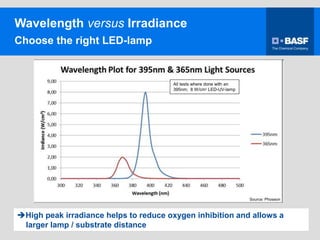
Wavelength versus Irradiance
Choose the right LED-lamp
High peak irradiance helps to reduce oxygen inhibition and allows a
larger lamp / substrate distance
Source: Phoseon
All tests where done with an
395nm; 8 W/cm² LED-UV-lamp
LED-UV lamp – photoinitiators
what fits best …
The absorption characteristic of the initiator has to fit into the narrow
emission spectrum of the LED-UV lamp
0
0,5
1
1,5
2
2,5
3
3,5
4
4,5
5
320 330 340 350 360 370 380 390 400 410 420
Wavelength [nm]
Extinction
BAPO
MBF
MAPO
HCPK/BP
LED 395 nm
BAPO – bis(2,6-trimethylbenzoyl)-phenylphosphineoxide
MAPO – 2,4,6-trimethylbenzoyl-diphenylphosphine oxide
MBF – phenyl glyoxylic acid methyl ester
HCPK – 1-hydroxy-cyclohexyl-phenyl-ketone
BP – benzophenone
Photoinitiator / UV-lamp relation
100% UV resin and a-Hydroxy-ketone PI
Coating:
Resin: 100% PE (Polyester acrylate)
Initiator: HPCK/BP
UV-source: mercury / LED
Atmosphere: air / N2
UV-source: Mercury lamp
atmosphere: air
UV-source: LED-UV
atmosphere: air
UV-source: LED-UV
atmosphere : N2
 a-Hydroxy-ketone PI does not work with an LED-UV-lamp
0%
10%
20%
30%
40%
50%
60%
70%
80%
90%
100%
0 5 10 15 20 25 30
depth [µm]
conversionrate[%]
Coating:
Resin: 100% PE (Polyester acrylate)
Initiator: BAPO
UV-source: mercury / LED
Ambiance: air / N2
UV-source: LED-UV
atmosphere: N2
UV-source: mercury
atmosphere: air
UV-source: LED-UV
atmosphere: air
 Phosphine oxides do work with an LED-UV lamp but need N2 atmosphere to
overcome oxygen inhibition (under air: surface still tacky)
0%
20%
40%
60%
80%
100%
0 5 10 15 20 25 30
depth [µm]
conversionrate[%]
Photoinitiator / UV-lamp relation
100% UV resin and Phosphine oxide PI
Coating:
Resin: PUD (UV-Polyurethane
acrylate dispersion)
Initiator: BAPO (emulsified version)
UV-source: LED-UV
Ambiance: air / N2
UV-source: LED-UV
atmosphere: N2
Physical dried (15 min 60°C)
atmosphere: air
UV-source: LED-UV
atmosphere: air
 Conversion rate almost independent on curing atmosphere (air or N2);
surface always tack-free, minimized oxygen inhibition
20%
30%
40%
50%
60%
70%
80%
90%
0 5 10 15 20 25 30
depth [µm]
conversionrate[%]
Photoinitiator / UV-lamp relation
Waterbased resin and Phosphine oxide PI
Curing Conditions versus Conversion Rate
12
22
424
50
60
70
80
90
1 2 3 4 5 6
conversion[%]
conversion [%] difference to LED/ N2
PUD (water-based)
Curing after drying
PE (100%)
UV-lamp:
Atmosphere:
Initiator:
Mercury . .
Air .
HPCK / BP .
Mercury .
Air .
BAPO .
LED .
Air .
BAPO .
LED .
N2 .
BAPO .
LED .
Air .
BAPO*.
LED .
N2 .
BAPO* .
* Emulsified version
Chemical resistance versus
curing conditions
Residence
time
Detergent
PE (100%)
LED / air
PE (100%)
LED / N2
PUD (water)
phys. dried
PUD (water)
LED / air
PUD (water)
LED / N2
16 h coffee 1* 3-4 1 3-4 4
6 h Mustard 1* 3 1 3 3-4
6 h Red wine 1* 4 1 4 4-5
1 h Ethanol 1* 4 1 5 5
1 h Detergent 1* 5 1 5 5
2 min Ammonia 1* 5 1 5 5
10 sec Acetone 1* 5 1 4 4
5 = excellent 1 = bad 1* = not suitable due to tacky surface
 for water-based dispersions the curing conditions do effect the chemical
resistance just marginal
Types of water based UV-products
Dispersions:
• Polyurethane 40% solid content
• best hardness / flexibility relation
• lowest viscosity of the liquid binder
• physical drying independent of UV exposure
Emulsions:
• 100% products (polyester acrylates)
modified with a protective colloid
• 50% solid content
• no physical drying
Water soluble:
• 100% solid content
• Polyether- or Epoxy acrylate
• highly hydrophilic backbone
• soluble with up to 25% of water
• no physical drying
 different types show different characteristics
Does this excellent behaviour apply for all waterbased UV coatings?
Hardness after drying resp. curing
0
20
40
60
80
100
120
140
160
UV-water soluble
(polyether acrylate)
UV-emulsion
(polyester acrylate)
UV-dispersion
(polyurethane acrylate)
pendulumhardness[osc.]
water evaporated / uncured (physical dried) LED-air LED-N2
solid
 Physical drying stops the oxygen inhibition
= PD Test not possible
tacky
Liquid(0,5Pas)
Liquid(6,0Pa*s)
tacky
Why does physical drying affect oxygen inhibition ?
Polymerization rate versus viscosity
h (Pa.s)
Rp
[M]0
( )max
0
1
2
3
4
0.1 1 10 100 1000 10000
CO
2
-19°C
6°C
6°C
RT
RT50°C
50°C
80°C
80°C air
-19°C
 curing the same coating at higher film-viscosity (before curing) under air
increases the polymerization rate due to reduced oxygen inhibition
Resin: Polyurethane acrylate
UV-lamp: Mercury
Irradiance: 15 mW/cm²
Rp - rate of polymerization
Source: R. Schwalm, UV Coatings (Elsevier, 2006), p. 243
Perspective: oxygen inhibition free chemistry
Thiole modification of a Polyurethane dispersion
0
20
40
60
80
100
120
140
LED / air LED / N2 1 day 3 day 5 day
pendulumhardness[osc.]
PUD PUD thiole modified
UV-cured UV-uncured,
storage at room temperature
 thiole modification helps to overcome the oxygen inhibition and
allows a satisfying curing in shadow areas
Crosslinking of thiole modified
acrylate dispersions
network
UV/PI
O
O
OS
RT
Michael addition
Michael addition
Reaction in shadow areas
R SH
SH
SH
MF Thiol
O O
O
PI *
MFA O
O
O
+ MFA (multifunctional acrylate) under inert conditions
R S*
SH
SH MFA
O O
O
PI
OOH
MF Thiol
+
O2
O O
O
PI
OO*
R
SSH
SH
OOH
R
SSH
SH
H
R S*
X
SH
without O2
with O2
+
network
*
R
S
S
O2** +Thiol
+O2Poly-ene
(acrylate)
R S*
SH
SH
+
+
X may be SH or ene residue
The Thiol – Ene reaction:
Why is it not oxygen inhibited ?
R SH
SH
SH
R* +
- RH
..because the hydroperoxy radical can abstract a „labile“ hydrogen radical from a thiol,
and the thiol radical does add to an acrylate monomer,
whereas the hydroperoxy radical does not initiate the acrylate polymerization
Monomer
Water-based UV-systems LED-cured
 Conclusion:
 The choice of the right photoinitiator is mandatory
(Acylphophine oxides are preferred)
 Oxygen penetration into the uncured film needs to be minimized
 UV-curable dispersions (physical drying) do work even at
ambient atmosphere (air)
 100% UV-resins (liquid) do need inert (O2-reduced) atmosphere
 Outlook:
 Thiole modified products can overcome the oxygen-inhibition …
 and help to cure shadow areas
 Smell and speed of curing needs to be optimized
Thanks for your attention …
… any questions ?

Abrafati 2013 led - BASF

  • 1.
    1 Water-based UV- systems withthe focus on LED-curing Décio Lima, Klaus Menzel BASF SA S-ED/SET decio.lima@basf.com Tel.: +55 12 3955-1549
  • 2.
    UV-LED-Lamps: What advantages arediscussed  “Cold” curing  No IR-radiation to the substrate but the diode needs to be cooled – Perfect for heat sensitive substrates (e.g. plastic foil)  Standby time extremely short  Perfect for non continuous application processes – Helps to save energy  Environment-friendly  No mercury is needed / used  No UV-B and UV-C  ozone free process – No need to connect the UV-unit to the waste air system
  • 3.
    UV-LED-Lamps: What advantages arediscussed  Safety  Since no UV-B and UV-C wavelengths will be emitted – less risk for human skin and eye – Less protection needs to be designed at the UV-unit  Small and flexible lamp design  LED-UV-lamps can be easily carried by an robot- since they are light and small (ink-jet application)  Different diode arrays can be combined to adjust the lamp to the substrate  Reduced power consumption compared to an mercury lamp  Seams to be right but needs an individual case study
  • 4.
    LED-UV versus Mercuryvapor Lamp 230 255 280 305 330 355 380 405 430 455 Wavelength (nm) Intensity LED: 395 nm ± 20 nm The different wavelengths distribution affects heat-, ozone-development and the selection of raw materials (photoinitiators, binders, …) Source: Phoseon Mercury lamp
  • 5.
    Wavelength versus Irradiance Choosethe right LED-lamp High peak irradiance helps to reduce oxygen inhibition and allows a larger lamp / substrate distance Source: Phoseon All tests where done with an 395nm; 8 W/cm² LED-UV-lamp
  • 6.
    LED-UV lamp –photoinitiators what fits best … The absorption characteristic of the initiator has to fit into the narrow emission spectrum of the LED-UV lamp 0 0,5 1 1,5 2 2,5 3 3,5 4 4,5 5 320 330 340 350 360 370 380 390 400 410 420 Wavelength [nm] Extinction BAPO MBF MAPO HCPK/BP LED 395 nm BAPO – bis(2,6-trimethylbenzoyl)-phenylphosphineoxide MAPO – 2,4,6-trimethylbenzoyl-diphenylphosphine oxide MBF – phenyl glyoxylic acid methyl ester HCPK – 1-hydroxy-cyclohexyl-phenyl-ketone BP – benzophenone
  • 7.
    Photoinitiator / UV-lamprelation 100% UV resin and a-Hydroxy-ketone PI Coating: Resin: 100% PE (Polyester acrylate) Initiator: HPCK/BP UV-source: mercury / LED Atmosphere: air / N2 UV-source: Mercury lamp atmosphere: air UV-source: LED-UV atmosphere: air UV-source: LED-UV atmosphere : N2  a-Hydroxy-ketone PI does not work with an LED-UV-lamp 0% 10% 20% 30% 40% 50% 60% 70% 80% 90% 100% 0 5 10 15 20 25 30 depth [µm] conversionrate[%]
  • 8.
    Coating: Resin: 100% PE(Polyester acrylate) Initiator: BAPO UV-source: mercury / LED Ambiance: air / N2 UV-source: LED-UV atmosphere: N2 UV-source: mercury atmosphere: air UV-source: LED-UV atmosphere: air  Phosphine oxides do work with an LED-UV lamp but need N2 atmosphere to overcome oxygen inhibition (under air: surface still tacky) 0% 20% 40% 60% 80% 100% 0 5 10 15 20 25 30 depth [µm] conversionrate[%] Photoinitiator / UV-lamp relation 100% UV resin and Phosphine oxide PI
  • 9.
    Coating: Resin: PUD (UV-Polyurethane acrylatedispersion) Initiator: BAPO (emulsified version) UV-source: LED-UV Ambiance: air / N2 UV-source: LED-UV atmosphere: N2 Physical dried (15 min 60°C) atmosphere: air UV-source: LED-UV atmosphere: air  Conversion rate almost independent on curing atmosphere (air or N2); surface always tack-free, minimized oxygen inhibition 20% 30% 40% 50% 60% 70% 80% 90% 0 5 10 15 20 25 30 depth [µm] conversionrate[%] Photoinitiator / UV-lamp relation Waterbased resin and Phosphine oxide PI
  • 10.
    Curing Conditions versusConversion Rate 12 22 424 50 60 70 80 90 1 2 3 4 5 6 conversion[%] conversion [%] difference to LED/ N2 PUD (water-based) Curing after drying PE (100%) UV-lamp: Atmosphere: Initiator: Mercury . . Air . HPCK / BP . Mercury . Air . BAPO . LED . Air . BAPO . LED . N2 . BAPO . LED . Air . BAPO*. LED . N2 . BAPO* . * Emulsified version
  • 11.
    Chemical resistance versus curingconditions Residence time Detergent PE (100%) LED / air PE (100%) LED / N2 PUD (water) phys. dried PUD (water) LED / air PUD (water) LED / N2 16 h coffee 1* 3-4 1 3-4 4 6 h Mustard 1* 3 1 3 3-4 6 h Red wine 1* 4 1 4 4-5 1 h Ethanol 1* 4 1 5 5 1 h Detergent 1* 5 1 5 5 2 min Ammonia 1* 5 1 5 5 10 sec Acetone 1* 5 1 4 4 5 = excellent 1 = bad 1* = not suitable due to tacky surface  for water-based dispersions the curing conditions do effect the chemical resistance just marginal
  • 12.
    Types of waterbased UV-products Dispersions: • Polyurethane 40% solid content • best hardness / flexibility relation • lowest viscosity of the liquid binder • physical drying independent of UV exposure Emulsions: • 100% products (polyester acrylates) modified with a protective colloid • 50% solid content • no physical drying Water soluble: • 100% solid content • Polyether- or Epoxy acrylate • highly hydrophilic backbone • soluble with up to 25% of water • no physical drying  different types show different characteristics
  • 13.
    Does this excellentbehaviour apply for all waterbased UV coatings? Hardness after drying resp. curing 0 20 40 60 80 100 120 140 160 UV-water soluble (polyether acrylate) UV-emulsion (polyester acrylate) UV-dispersion (polyurethane acrylate) pendulumhardness[osc.] water evaporated / uncured (physical dried) LED-air LED-N2 solid  Physical drying stops the oxygen inhibition = PD Test not possible tacky Liquid(0,5Pas) Liquid(6,0Pa*s) tacky
  • 14.
    Why does physicaldrying affect oxygen inhibition ? Polymerization rate versus viscosity h (Pa.s) Rp [M]0 ( )max 0 1 2 3 4 0.1 1 10 100 1000 10000 CO 2 -19°C 6°C 6°C RT RT50°C 50°C 80°C 80°C air -19°C  curing the same coating at higher film-viscosity (before curing) under air increases the polymerization rate due to reduced oxygen inhibition Resin: Polyurethane acrylate UV-lamp: Mercury Irradiance: 15 mW/cm² Rp - rate of polymerization Source: R. Schwalm, UV Coatings (Elsevier, 2006), p. 243
  • 15.
    Perspective: oxygen inhibitionfree chemistry Thiole modification of a Polyurethane dispersion 0 20 40 60 80 100 120 140 LED / air LED / N2 1 day 3 day 5 day pendulumhardness[osc.] PUD PUD thiole modified UV-cured UV-uncured, storage at room temperature  thiole modification helps to overcome the oxygen inhibition and allows a satisfying curing in shadow areas
  • 16.
    Crosslinking of thiolemodified acrylate dispersions network UV/PI O O OS RT Michael addition Michael addition Reaction in shadow areas R SH SH SH MF Thiol O O O PI * MFA O O O + MFA (multifunctional acrylate) under inert conditions R S* SH SH MFA O O O PI OOH MF Thiol + O2 O O O PI OO*
  • 17.
    R SSH SH OOH R SSH SH H R S* X SH without O2 withO2 + network * R S S O2** +Thiol +O2Poly-ene (acrylate) R S* SH SH + + X may be SH or ene residue The Thiol – Ene reaction: Why is it not oxygen inhibited ? R SH SH SH R* + - RH ..because the hydroperoxy radical can abstract a „labile“ hydrogen radical from a thiol, and the thiol radical does add to an acrylate monomer, whereas the hydroperoxy radical does not initiate the acrylate polymerization Monomer
  • 18.
    Water-based UV-systems LED-cured Conclusion:  The choice of the right photoinitiator is mandatory (Acylphophine oxides are preferred)  Oxygen penetration into the uncured film needs to be minimized  UV-curable dispersions (physical drying) do work even at ambient atmosphere (air)  100% UV-resins (liquid) do need inert (O2-reduced) atmosphere  Outlook:  Thiole modified products can overcome the oxygen-inhibition …  and help to cure shadow areas  Smell and speed of curing needs to be optimized
  • 19.
    Thanks for yourattention … … any questions ?