Creating Canvas Experiences:
Strategies for Maximising New Opportunities
to Increase Engagement and Authenticity
Bronwyn Hemsley, Alison McEwen, Chris Jacobs, Emily Oquist, Emma Power
@BronwynHemsley @McEwen_Alison @Jacobs_ChrisJ @EmilyOquist @Dr_EPower
#UTSltf19
Paper Presented at the UTS Teaching and Learning Forum 12th Nov 2019
Acknowledgements
• Subject Coordinators in each of the subjects providing examples
• All photographs have been used with permission
Creating Canvas Experiences
Jan McLean, learning.futures Hana Roch, GSH Emily Oquist and Kevin Millingham, PG.f
@BronwynHemsley @McEwen_Alison @Jacobs_ChrisJ @EmilyOquist @Dr_EPower
Overview
Our professions
Padlet reviewStrategies
Our aims
How we have used Canvas
to achieve our aims
Key Messages
Creating Canvas Experiences@BronwynHemsley @McEwen_Alison @Jacobs_ChrisJ @EmilyOquist @Dr_EPower
Creating Canvas Experiences
Genetic counselling is…
Authentic
learning
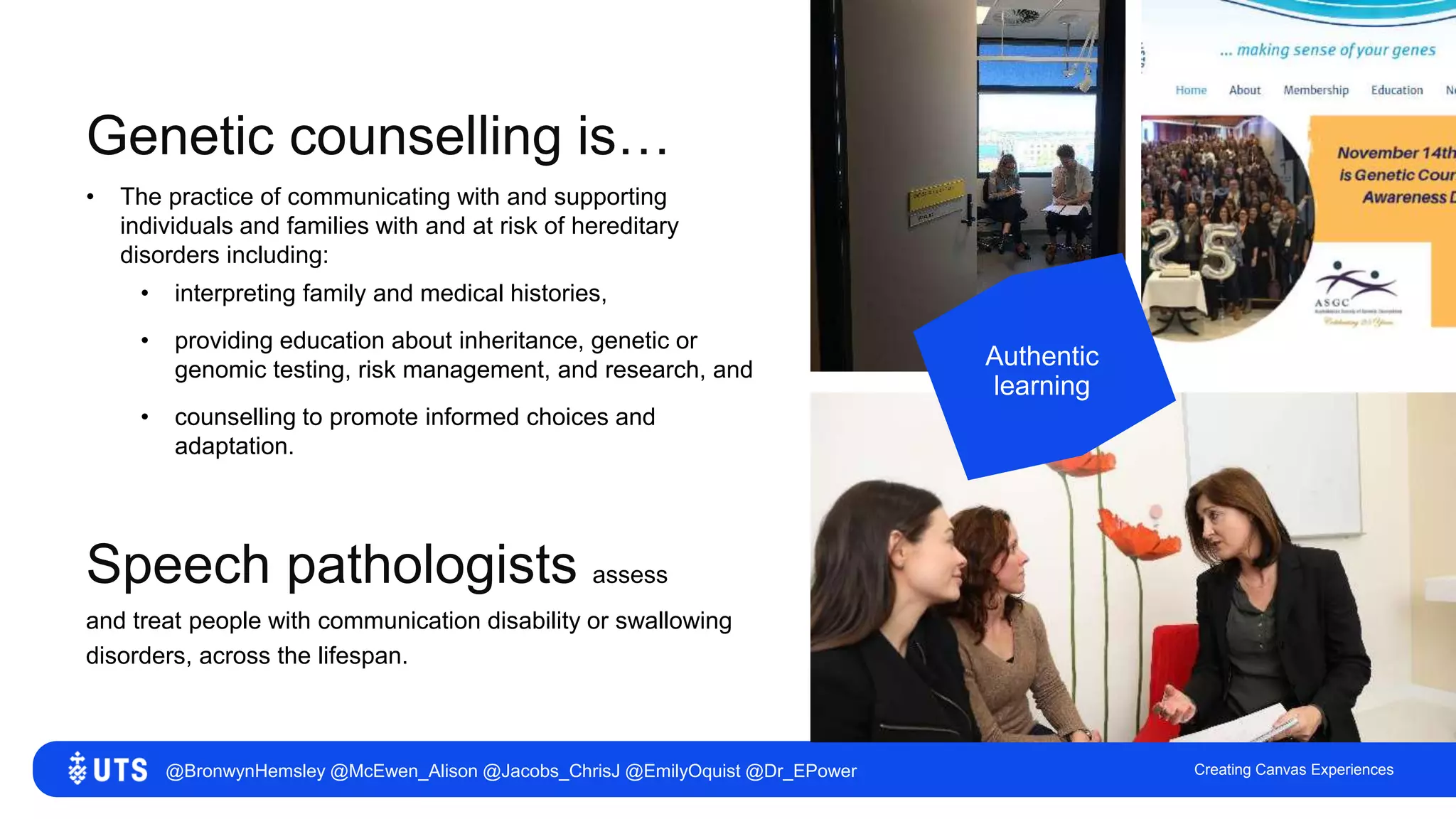
• The practice of communicating with and supporting
individuals and families with and at risk of hereditary
disorders including:
• interpreting family and medical histories,
• providing education about inheritance, genetic or
genomic testing, risk management, and research, and
• counselling to promote informed choices and
adaptation.
Speech pathologists assess
and treat people with communication disability or swallowing
disorders, across the lifespan.
@BronwynHemsley @McEwen_Alison @Jacobs_ChrisJ @EmilyOquist @Dr_EPower
Mutual aims of Genetic Counselling and
Speech Pathology as GSH disciplines
To produce graduates who are:
• work-ready,
• savvy with technology,
• independent lifelong learners, and
• well-equipped to embrace the opportunities of the
rapidly changing health and employment landscape.
Creating Canvas Experiences
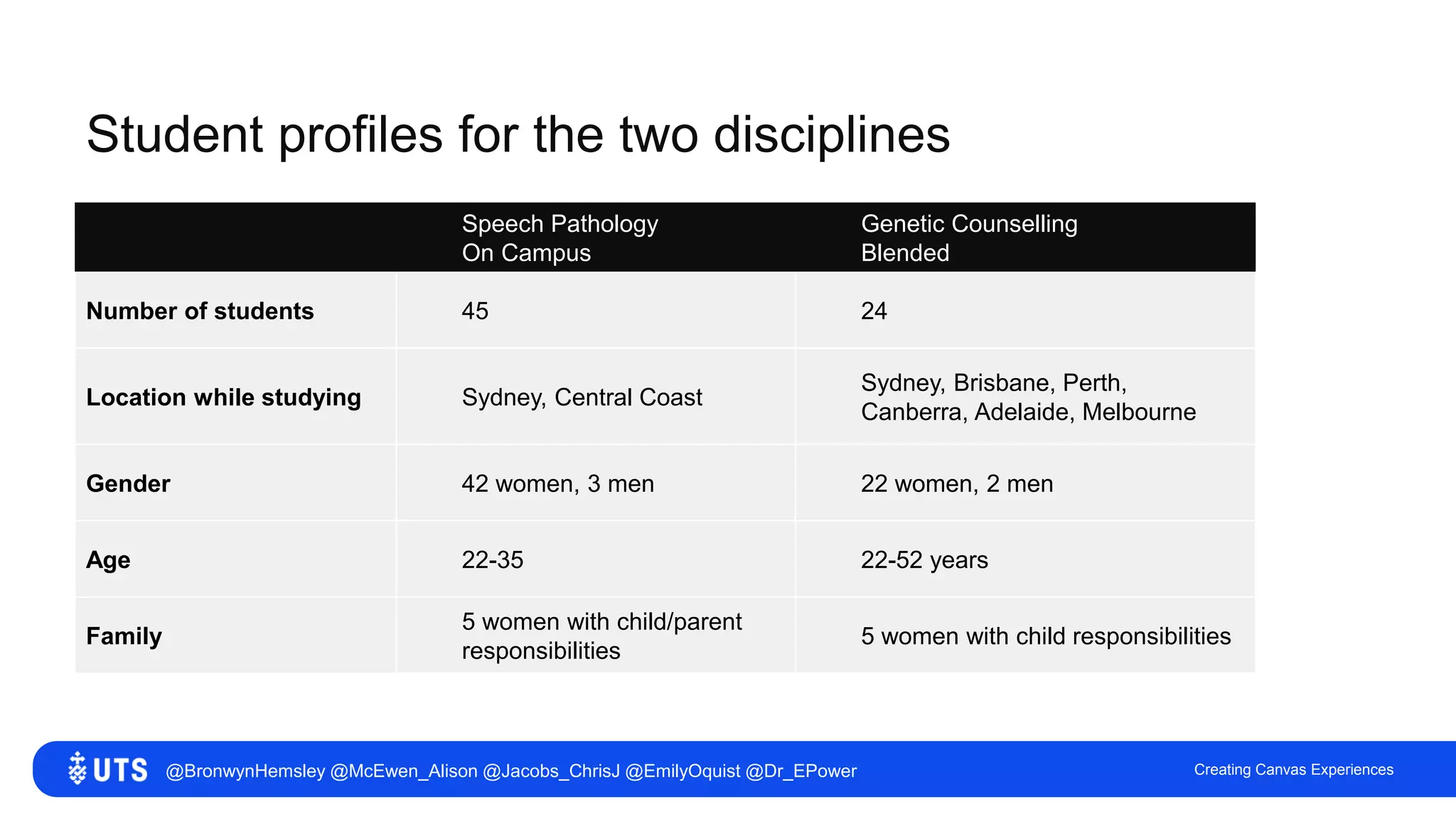
Student profiles for the two disciplines
Speech Pathology
On Campus
Genetic Counselling
Blended
Number of students 45 24
Location while studying Sydney, Central Coast
Sydney, Brisbane, Perth,
Canberra, Adelaide, Melbourne
Gender 42 women, 3 men 22 women, 2 men
Age 22-35 22-52 years
Family
5 women with child/parent
responsibilities
5 women with child responsibilities
Creating Canvas Experiences@BronwynHemsley @McEwen_Alison @Jacobs_ChrisJ @EmilyOquist @Dr_EPower
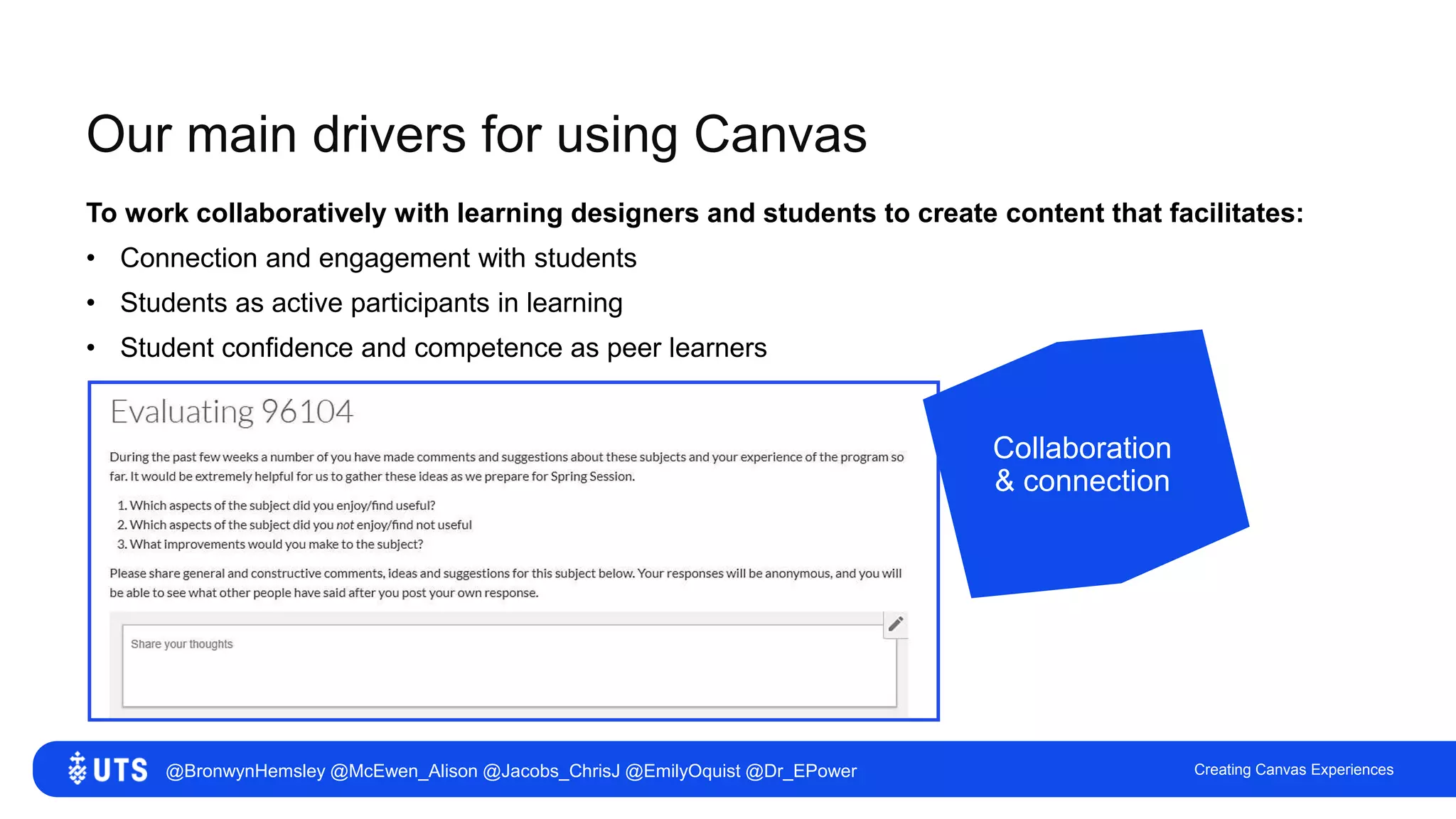
Our main drivers for using Canvas
To work collaboratively with learning designers and students to create content that facilitates:
• Connection and engagement with students
• Students as active participants in learning
• Student confidence and competence as peer learners
Creating Canvas Experiences
Collaboration
& connection
@BronwynHemsley @McEwen_Alison @Jacobs_ChrisJ @EmilyOquist @Dr_EPower
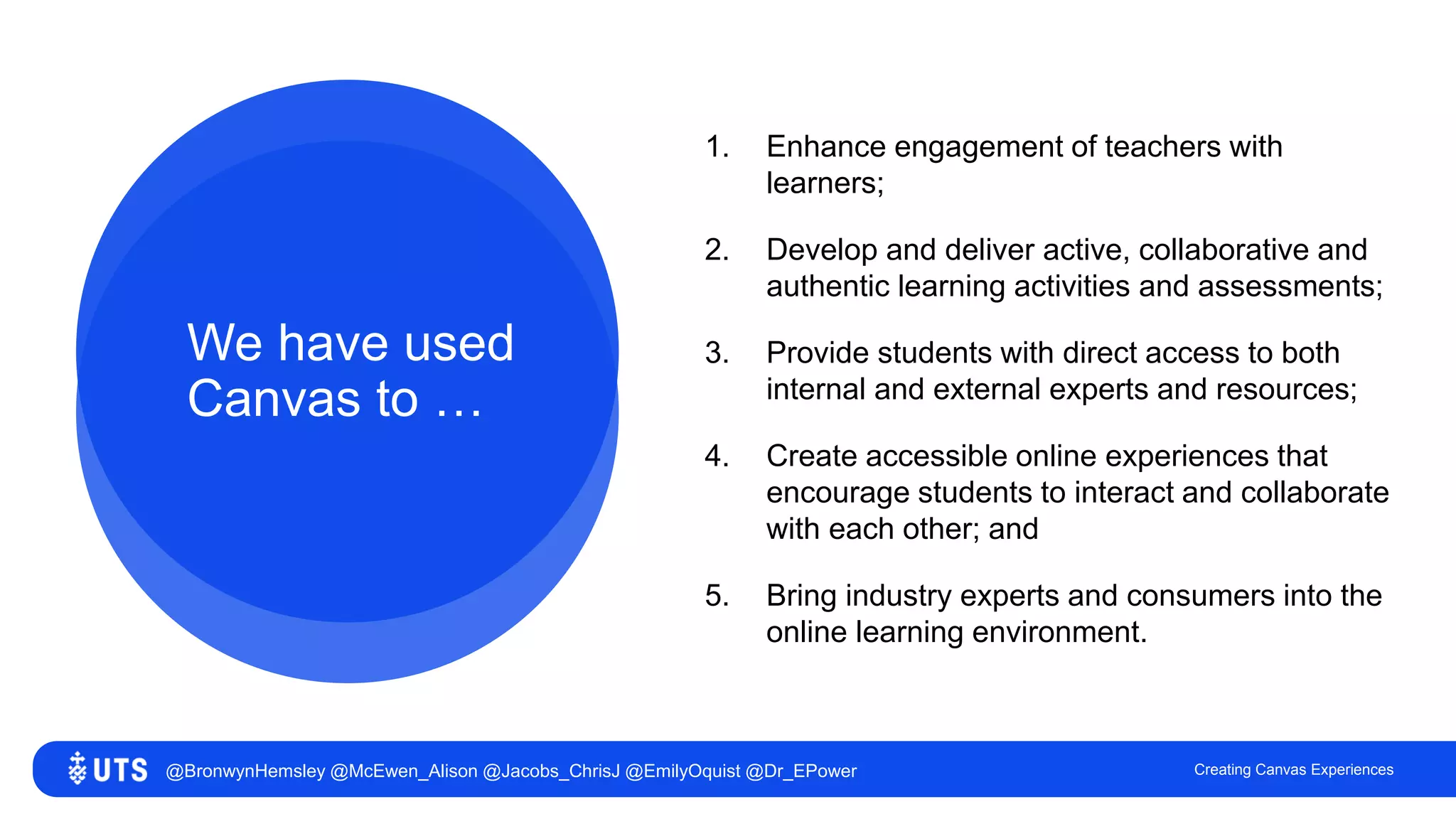
We have used
Canvas to …
1. Enhance engagement of teachers with
learners;
2. Develop and deliver active, collaborative and
authentic learning activities and assessments;
3. Provide students with direct access to both
internal and external experts and resources;
4. Create accessible online experiences that
encourage students to interact and collaborate
with each other; and
5. Bring industry experts and consumers into the
online learning environment.
Creating Canvas Experiences@BronwynHemsley @McEwen_Alison @Jacobs_ChrisJ @EmilyOquist @Dr_EPower
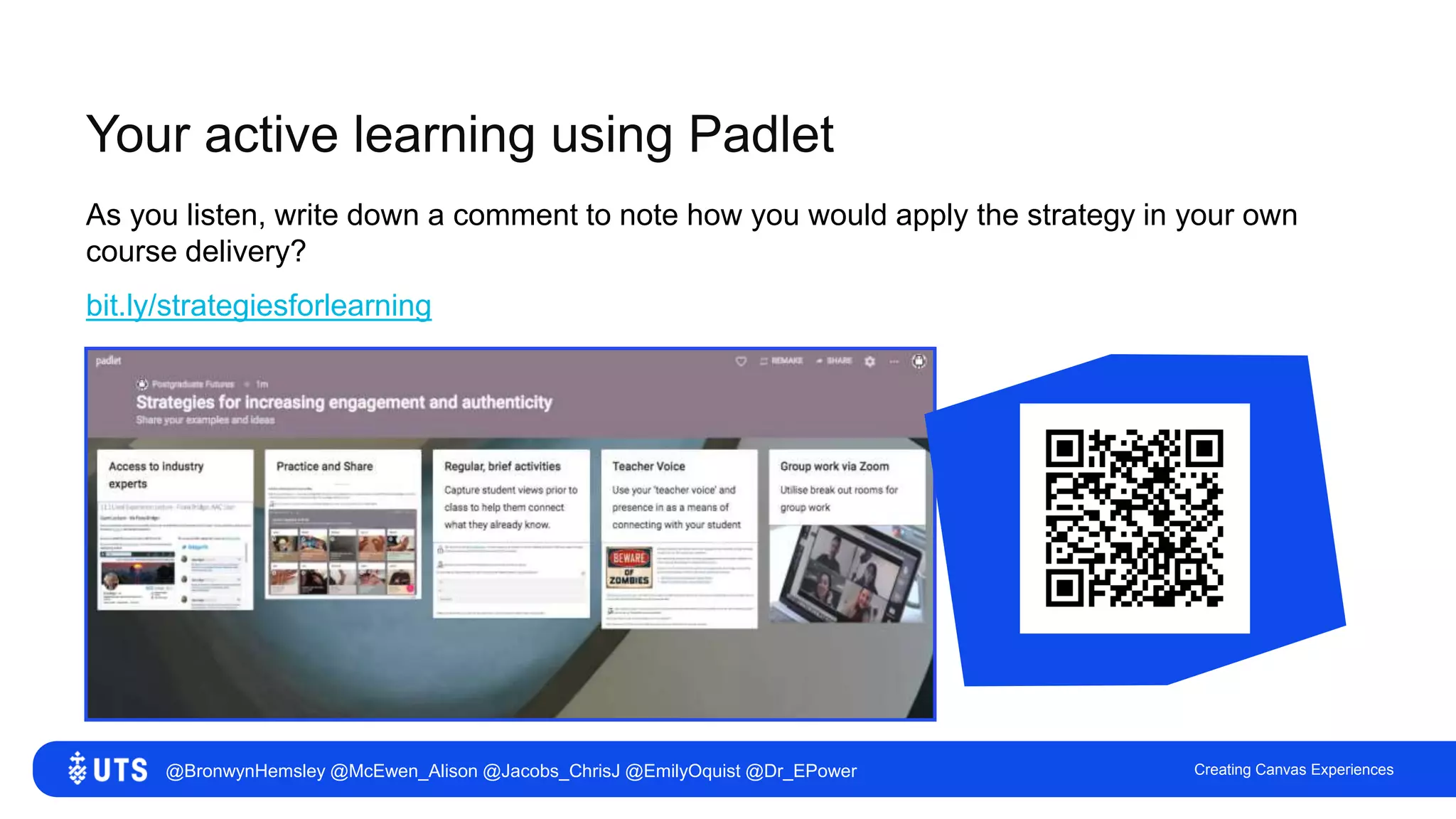
Your active learning using Padlet
As you listen, write down a comment to note how you would apply the strategy in your own
course delivery?
Creating Canvas Experiences
…
bit.ly/strategiesforlearning
@BronwynHemsley @McEwen_Alison @Jacobs_ChrisJ @EmilyOquist @Dr_EPower
1. To enhance
engagement
of teachers
with learners
Creating Canvas Experiences
Watch Our Video Later:
youtube.com/watch?v=1DikCbsx9xI&feature=youtu.be
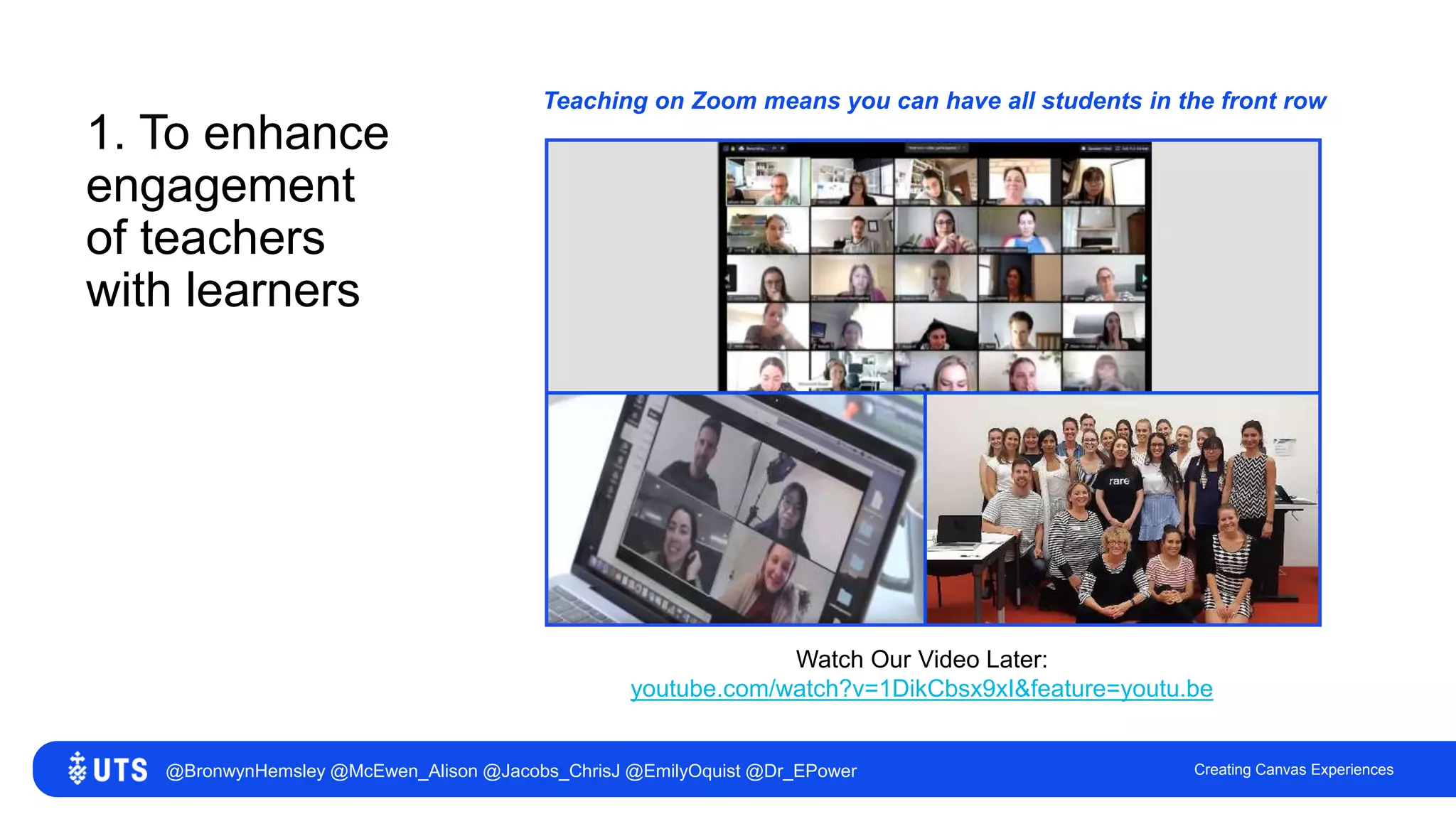
Teaching on Zoom means you can have all students in the front row
@BronwynHemsley @McEwen_Alison @Jacobs_ChrisJ @EmilyOquist @Dr_EPower
1. To enhance
engagement
of teachers
with learners
Creating Canvas Experiences@BronwynHemsley @McEwen_Alison @Jacobs_ChrisJ @EmilyOquist @Dr_EPower
1. To enhance
engagement
of teachers
with learners
Creating Canvas Experiences@BronwynHemsley @McEwen_Alison @Jacobs_ChrisJ @EmilyOquist @Dr_EPower
2. Active,
collaborative,
and authentic
learning and
assessment
Creating Canvas Experiences
2. Active,
collaborative,
and authentic
learning and
assessment
Creating Canvas Experiences
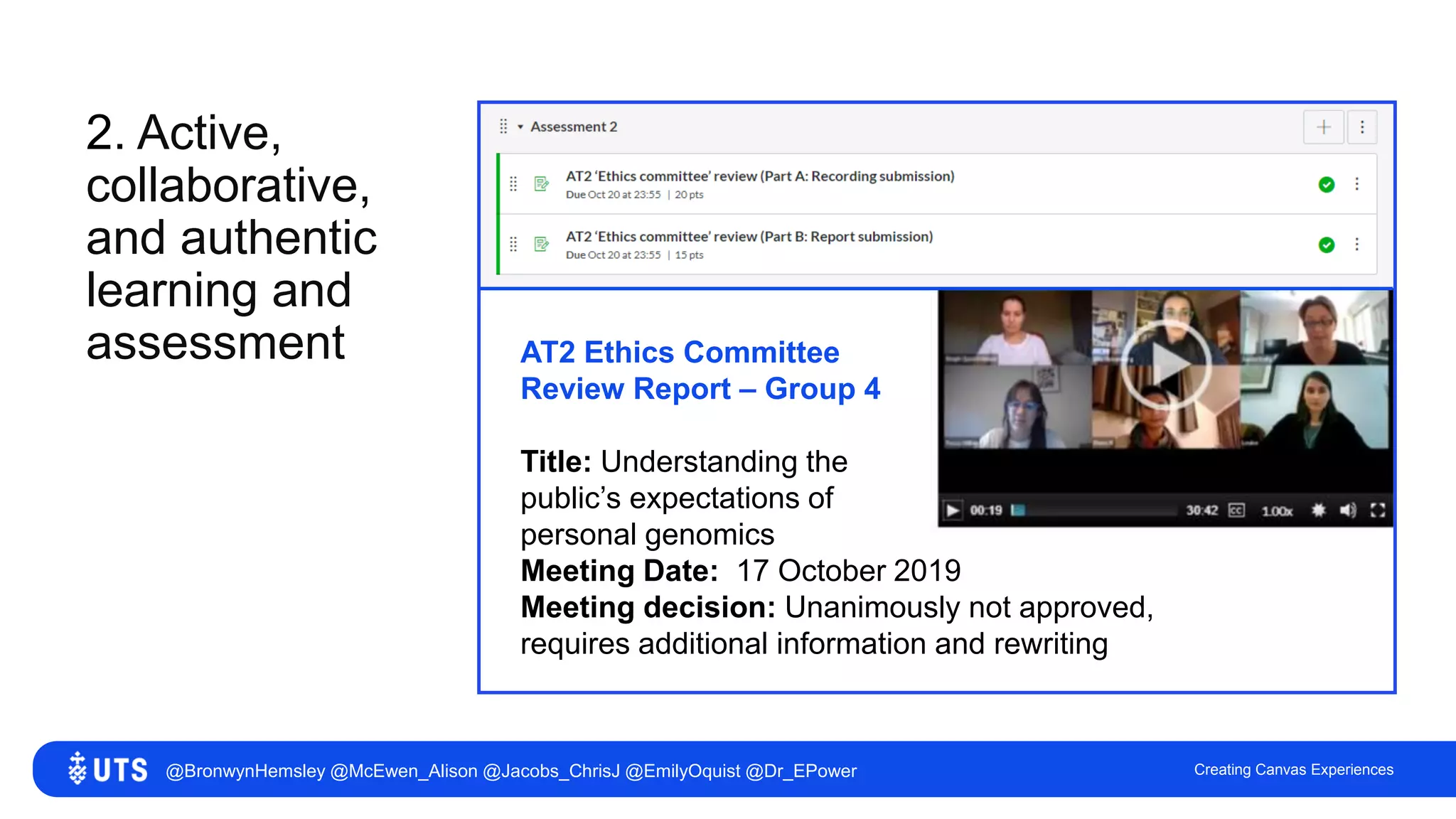
AT2 Ethics Committee
Review Report – Group 4
Title: Understanding the
public’s expectations of
personal genomics
Meeting Date: 17 October 2019
Meeting decision: Unanimously not approved,
requires additional information and rewriting
@BronwynHemsley @McEwen_Alison @Jacobs_ChrisJ @EmilyOquist @Dr_EPower
2. Active,
collaborative,
and authentic
learning and
assessment
Creating Canvas Experiences@BronwynHemsley @McEwen_Alison @Jacobs_ChrisJ @EmilyOquist @Dr_EPower
UTS CRICOS 00099F
Community connection:
Party shirts and a
cultural meal
Final day of classes, 2019
2. Active,
collaborative,
and authentic
learning and
assessment
Creating Canvas Experiences
The role of gesture in multimodal communication and AAC
@BronwynHemsley @McEwen_Alison @Jacobs_ChrisJ @EmilyOquist @Dr_EPower
2. Active,
collaborative,
and authentic
learning and
assessment
Creating Canvas Experiences
2. Active,
collaborative,
and authentic
learning and
assessment
Creating Canvas Experiences
2. Active,
collaborative,
and authentic
learning and
assessment
Creating Canvas Experiences@BronwynHemsley @McEwen_Alison @Jacobs_ChrisJ @EmilyOquist @Dr_EPower
2. Active,
collaborative,
and authentic
learning and
assessment
Creating Canvas Experiences@BronwynHemsley @McEwen_Alison @Jacobs_ChrisJ @EmilyOquist @Dr_EPower
2. Active,
collaborative,
and authentic
learning and
assessment
Creating Canvas Experiences@BronwynHemsley @McEwen_Alison @Jacobs_ChrisJ @EmilyOquist @Dr_EPower
3. Access to
internal and
external
experts and
resources
Creating Canvas Experiences
Group task: Interview a researcher in genetic counselling.
• Introduction to researcher
• Read their publications
• Interview
• Prepare presentation
• Present to class
3. Access to
internal and
external
experts and
resources
Creating Canvas Experiences
3. Access to
internal and
external
experts and
resources
Creating Canvas Experiences@BronwynHemsley @McEwen_Alison @Jacobs_ChrisJ @EmilyOquist @Dr_EPower
3. Access to
internal and
external
experts and
resources
Creating Canvas Experiences@BronwynHemsley @McEwen_Alison @Jacobs_ChrisJ @EmilyOquist @Dr_EPower
4. Encourage
students to interact
and collaborate
Creating Canvas Experiences
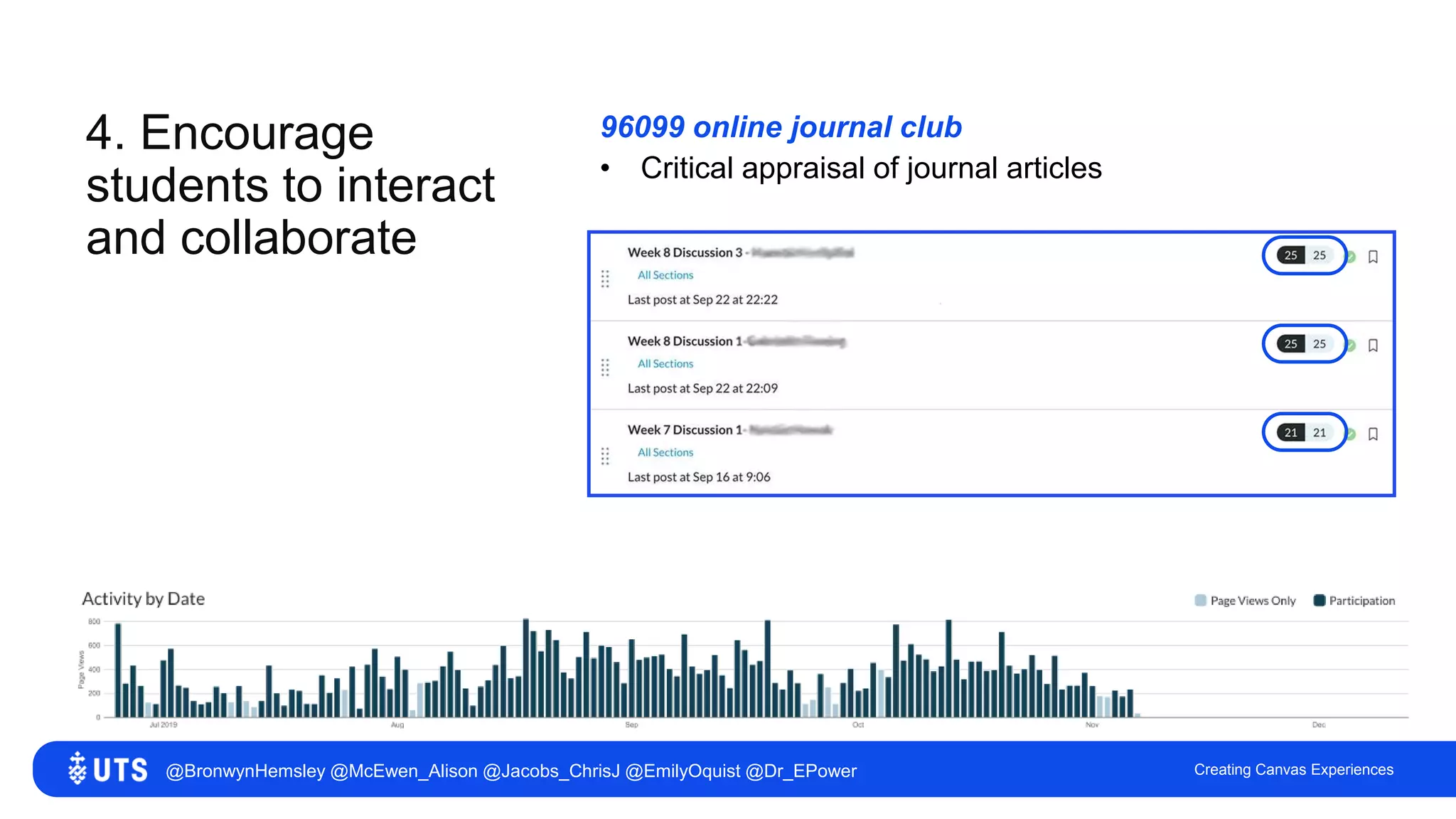
96099 online journal club
• Critical appraisal of journal articles
@BronwynHemsley @McEwen_Alison @Jacobs_ChrisJ @EmilyOquist @Dr_EPower
5. Bring industry
experts and
consumers in to
Canvas
Creating Canvas Experiences@BronwynHemsley @McEwen_Alison @Jacobs_ChrisJ @EmilyOquist @Dr_EPower
5. Bring industry
experts and
consumers in to
Canvas
Creating Canvas Experiences
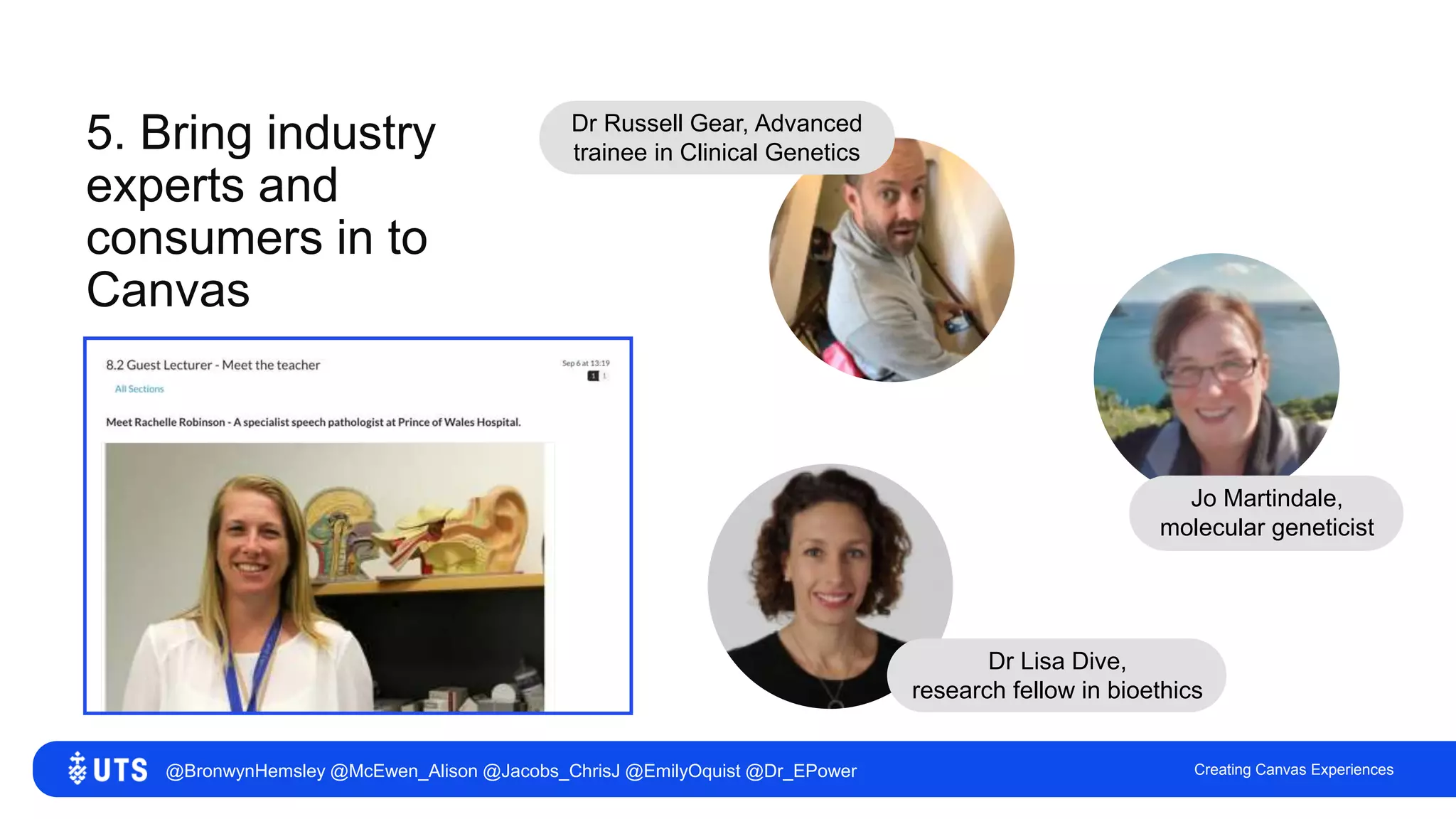
Dr Russell Gear, Advanced
trainee in Clinical Genetics
Jo Martindale,
molecular geneticist
Dr Lisa Dive,
research fellow in bioethics
@BronwynHemsley @McEwen_Alison @Jacobs_ChrisJ @EmilyOquist @Dr_EPower
Revisiting Padlet
Creating Canvas Experiences
…
bit.ly/strategiesforlearning
@BronwynHemsley @McEwen_Alison @Jacobs_ChrisJ @EmilyOquist @Dr_EPower
Key messages
Be in there! Be active in your subject.
Remember your ‘teacher voice’ in the
Canvas.
Writing and Signposting your materials on
Canvas. Make every word count.
Trust the Learning Designer’s advice and
engage
Take risks and try out ideas
Share how you went with your peers
What can
you do next?
Creating Canvas Experiences
1.
2.
3.
4.
5.
6.
@BronwynHemsley @McEwen_Alison @Jacobs_ChrisJ @EmilyOquist @Dr_EPower

#UTStlf19 Creating Canvas Experiences: ​ Strategies for Maximising New Opportunities to Increase Engagement and Authenticity

  • 1.
    Creating Canvas Experiences: Strategiesfor Maximising New Opportunities to Increase Engagement and Authenticity Bronwyn Hemsley, Alison McEwen, Chris Jacobs, Emily Oquist, Emma Power @BronwynHemsley @McEwen_Alison @Jacobs_ChrisJ @EmilyOquist @Dr_EPower #UTSltf19 Paper Presented at the UTS Teaching and Learning Forum 12th Nov 2019
  • 2.
    Acknowledgements • Subject Coordinatorsin each of the subjects providing examples • All photographs have been used with permission Creating Canvas Experiences Jan McLean, learning.futures Hana Roch, GSH Emily Oquist and Kevin Millingham, PG.f @BronwynHemsley @McEwen_Alison @Jacobs_ChrisJ @EmilyOquist @Dr_EPower
  • 3.
    Overview Our professions Padlet reviewStrategies Ouraims How we have used Canvas to achieve our aims Key Messages Creating Canvas Experiences@BronwynHemsley @McEwen_Alison @Jacobs_ChrisJ @EmilyOquist @Dr_EPower
  • 4.
    Creating Canvas Experiences Geneticcounselling is… Authentic learning • The practice of communicating with and supporting individuals and families with and at risk of hereditary disorders including: • interpreting family and medical histories, • providing education about inheritance, genetic or genomic testing, risk management, and research, and • counselling to promote informed choices and adaptation. Speech pathologists assess and treat people with communication disability or swallowing disorders, across the lifespan. @BronwynHemsley @McEwen_Alison @Jacobs_ChrisJ @EmilyOquist @Dr_EPower
  • 5.
    Mutual aims ofGenetic Counselling and Speech Pathology as GSH disciplines To produce graduates who are: • work-ready, • savvy with technology, • independent lifelong learners, and • well-equipped to embrace the opportunities of the rapidly changing health and employment landscape. Creating Canvas Experiences
  • 6.
    Student profiles forthe two disciplines Speech Pathology On Campus Genetic Counselling Blended Number of students 45 24 Location while studying Sydney, Central Coast Sydney, Brisbane, Perth, Canberra, Adelaide, Melbourne Gender 42 women, 3 men 22 women, 2 men Age 22-35 22-52 years Family 5 women with child/parent responsibilities 5 women with child responsibilities Creating Canvas Experiences@BronwynHemsley @McEwen_Alison @Jacobs_ChrisJ @EmilyOquist @Dr_EPower
  • 7.
    Our main driversfor using Canvas To work collaboratively with learning designers and students to create content that facilitates: • Connection and engagement with students • Students as active participants in learning • Student confidence and competence as peer learners Creating Canvas Experiences Collaboration & connection @BronwynHemsley @McEwen_Alison @Jacobs_ChrisJ @EmilyOquist @Dr_EPower
  • 8.
    We have used Canvasto … 1. Enhance engagement of teachers with learners; 2. Develop and deliver active, collaborative and authentic learning activities and assessments; 3. Provide students with direct access to both internal and external experts and resources; 4. Create accessible online experiences that encourage students to interact and collaborate with each other; and 5. Bring industry experts and consumers into the online learning environment. Creating Canvas Experiences@BronwynHemsley @McEwen_Alison @Jacobs_ChrisJ @EmilyOquist @Dr_EPower
  • 9.
    Your active learningusing Padlet As you listen, write down a comment to note how you would apply the strategy in your own course delivery? Creating Canvas Experiences … bit.ly/strategiesforlearning @BronwynHemsley @McEwen_Alison @Jacobs_ChrisJ @EmilyOquist @Dr_EPower
  • 10.
    1. To enhance engagement ofteachers with learners Creating Canvas Experiences Watch Our Video Later: youtube.com/watch?v=1DikCbsx9xI&feature=youtu.be Teaching on Zoom means you can have all students in the front row @BronwynHemsley @McEwen_Alison @Jacobs_ChrisJ @EmilyOquist @Dr_EPower
  • 11.
    1. To enhance engagement ofteachers with learners Creating Canvas Experiences@BronwynHemsley @McEwen_Alison @Jacobs_ChrisJ @EmilyOquist @Dr_EPower
  • 12.
    1. To enhance engagement ofteachers with learners Creating Canvas Experiences@BronwynHemsley @McEwen_Alison @Jacobs_ChrisJ @EmilyOquist @Dr_EPower
  • 13.
    2. Active, collaborative, and authentic learningand assessment Creating Canvas Experiences
  • 14.
    2. Active, collaborative, and authentic learningand assessment Creating Canvas Experiences AT2 Ethics Committee Review Report – Group 4 Title: Understanding the public’s expectations of personal genomics Meeting Date: 17 October 2019 Meeting decision: Unanimously not approved, requires additional information and rewriting @BronwynHemsley @McEwen_Alison @Jacobs_ChrisJ @EmilyOquist @Dr_EPower
  • 15.
    2. Active, collaborative, and authentic learningand assessment Creating Canvas Experiences@BronwynHemsley @McEwen_Alison @Jacobs_ChrisJ @EmilyOquist @Dr_EPower
  • 16.
    UTS CRICOS 00099F Communityconnection: Party shirts and a cultural meal Final day of classes, 2019
  • 17.
    2. Active, collaborative, and authentic learningand assessment Creating Canvas Experiences The role of gesture in multimodal communication and AAC @BronwynHemsley @McEwen_Alison @Jacobs_ChrisJ @EmilyOquist @Dr_EPower
  • 18.
    2. Active, collaborative, and authentic learningand assessment Creating Canvas Experiences
  • 19.
    2. Active, collaborative, and authentic learningand assessment Creating Canvas Experiences
  • 20.
    2. Active, collaborative, and authentic learningand assessment Creating Canvas Experiences@BronwynHemsley @McEwen_Alison @Jacobs_ChrisJ @EmilyOquist @Dr_EPower
  • 21.
    2. Active, collaborative, and authentic learningand assessment Creating Canvas Experiences@BronwynHemsley @McEwen_Alison @Jacobs_ChrisJ @EmilyOquist @Dr_EPower
  • 22.
    2. Active, collaborative, and authentic learningand assessment Creating Canvas Experiences@BronwynHemsley @McEwen_Alison @Jacobs_ChrisJ @EmilyOquist @Dr_EPower
  • 23.
    3. Access to internaland external experts and resources Creating Canvas Experiences Group task: Interview a researcher in genetic counselling. • Introduction to researcher • Read their publications • Interview • Prepare presentation • Present to class
  • 24.
    3. Access to internaland external experts and resources Creating Canvas Experiences
  • 25.
    3. Access to internaland external experts and resources Creating Canvas Experiences@BronwynHemsley @McEwen_Alison @Jacobs_ChrisJ @EmilyOquist @Dr_EPower
  • 26.
    3. Access to internaland external experts and resources Creating Canvas Experiences@BronwynHemsley @McEwen_Alison @Jacobs_ChrisJ @EmilyOquist @Dr_EPower
  • 27.
    4. Encourage students tointeract and collaborate Creating Canvas Experiences 96099 online journal club • Critical appraisal of journal articles @BronwynHemsley @McEwen_Alison @Jacobs_ChrisJ @EmilyOquist @Dr_EPower
  • 28.
    5. Bring industry expertsand consumers in to Canvas Creating Canvas Experiences@BronwynHemsley @McEwen_Alison @Jacobs_ChrisJ @EmilyOquist @Dr_EPower
  • 29.
    5. Bring industry expertsand consumers in to Canvas Creating Canvas Experiences Dr Russell Gear, Advanced trainee in Clinical Genetics Jo Martindale, molecular geneticist Dr Lisa Dive, research fellow in bioethics @BronwynHemsley @McEwen_Alison @Jacobs_ChrisJ @EmilyOquist @Dr_EPower
  • 30.
    Revisiting Padlet Creating CanvasExperiences … bit.ly/strategiesforlearning @BronwynHemsley @McEwen_Alison @Jacobs_ChrisJ @EmilyOquist @Dr_EPower
  • 31.
    Key messages Be inthere! Be active in your subject. Remember your ‘teacher voice’ in the Canvas. Writing and Signposting your materials on Canvas. Make every word count. Trust the Learning Designer’s advice and engage Take risks and try out ideas Share how you went with your peers What can you do next? Creating Canvas Experiences 1. 2. 3. 4. 5. 6. @BronwynHemsley @McEwen_Alison @Jacobs_ChrisJ @EmilyOquist @Dr_EPower

Editor's Notes

  • #3 We would like to acknowledge the Gadigal people of the Eora nation and their Elders past, present and emerging as traditional Custodians of knowledge of this land. Thank you for the opportunity to share our work today.  We would also like to thank and acknowledge people across the university who have provided guidance, enthusiasm and insight as we've developed and shaped these new programs including Emily Oquist, Kevin Millingham, Jan McLean, Hana Roch, Jim Woulfe, and all of the subject co-ordinators and academics in our two disciplines.
  • #4 We're going to briefly introduce our professions and the aims we have for our new Masters programs, invite you to engage with us by adding your ideas to a padlet during our presentation, and show you a range of ways in which we've used Canvas. We'll finish by revisiting the padlet and summarising what we've learnt this year. 
  • #5 As new programs at UTS it is important that we tell you briefly about what our professions involve, as this a central drivers for the way we are using active learning and constructive alignment in our courses.  Genetic counsellors support people with and at risk of hereditary disorders by interpreting family and medical histories, providing education, and most importantly, counselling to promote adaptation. Speech pathologists work with both children and adults in many settings who have communication or swallowing disorders. 
  • #6 Our students will graduate into a world of work more diverse and uncertain than any previous generation. Preparing them to embrace the opportunities afforded by this time of rapid technological advancement is an exciting challenge for our professions and for educators. In line with the UTS Model of Learning, our programs will produce graduates who are practice-oriented and work ready, savvy with technology, independent learners who are equipped for the rapidly changing health landscape in which they will work.
  • #7 The two disciplines differ in some respects, however both programs encourage and support students of a wide age range and with a variety of backgrounds in undergraduate health and science. Genetic Counselling is delivered in blended mode, utilising Canvas, 'live and online classes on Zoom and on-campus workshops once per Session, making it accessible to students living all over Australia. 
  • #8 The main drivers for our use of Canvas has been to (i) connect and engage with our students, (ii) foster active learning, and (ii) increase the confidence and competence of students in learning as peers, to support their lifelong learning. We achieved this through working closely with learning designers in the School, Learning.Futures, and Postgraduate Futures. We’ve also worked closely with our students to understand and enhance the way they use Canvas. 
  • #9 In this presentation we will show several examples of ways we have used Canvas to enhance engagement, foster collaborative and authentic learning activities and assessments, increase access to internal and external experts and resources, encourage students to interact and collaborate, and enable greater engagement with industry through bringing consumers and experts into the online learning environment.
  • #10 We wanted to show you the padlet, which is one of the tools that has been used in several ways across both courses. While you listen and watch our presentation, you can also go to this website (provide) and add your ideas about ways to apply what you are hearing about, in your own classes or course design. At the end of the presentation we will revisit the Padlet and show you what the audience think about applying these strategies.
  • #11 We will now provide a range of examples of ways we are using canvas in our foundation year to achieve our aims.  Genetic counselling students have timetabled classes on Zoom for 6-8 hours per week. Working with students on Zoom is like having every student in the front row. Zoom offers an engaging, flexible environment where we can do pretty much everything we would do in a physical classroom – including small group work, role plays, debates, drop in sessions, and host invited guests. The Zoom classes are set up within Canvas so students use their Canvas calendar to enter the Zoom classroom each week. 
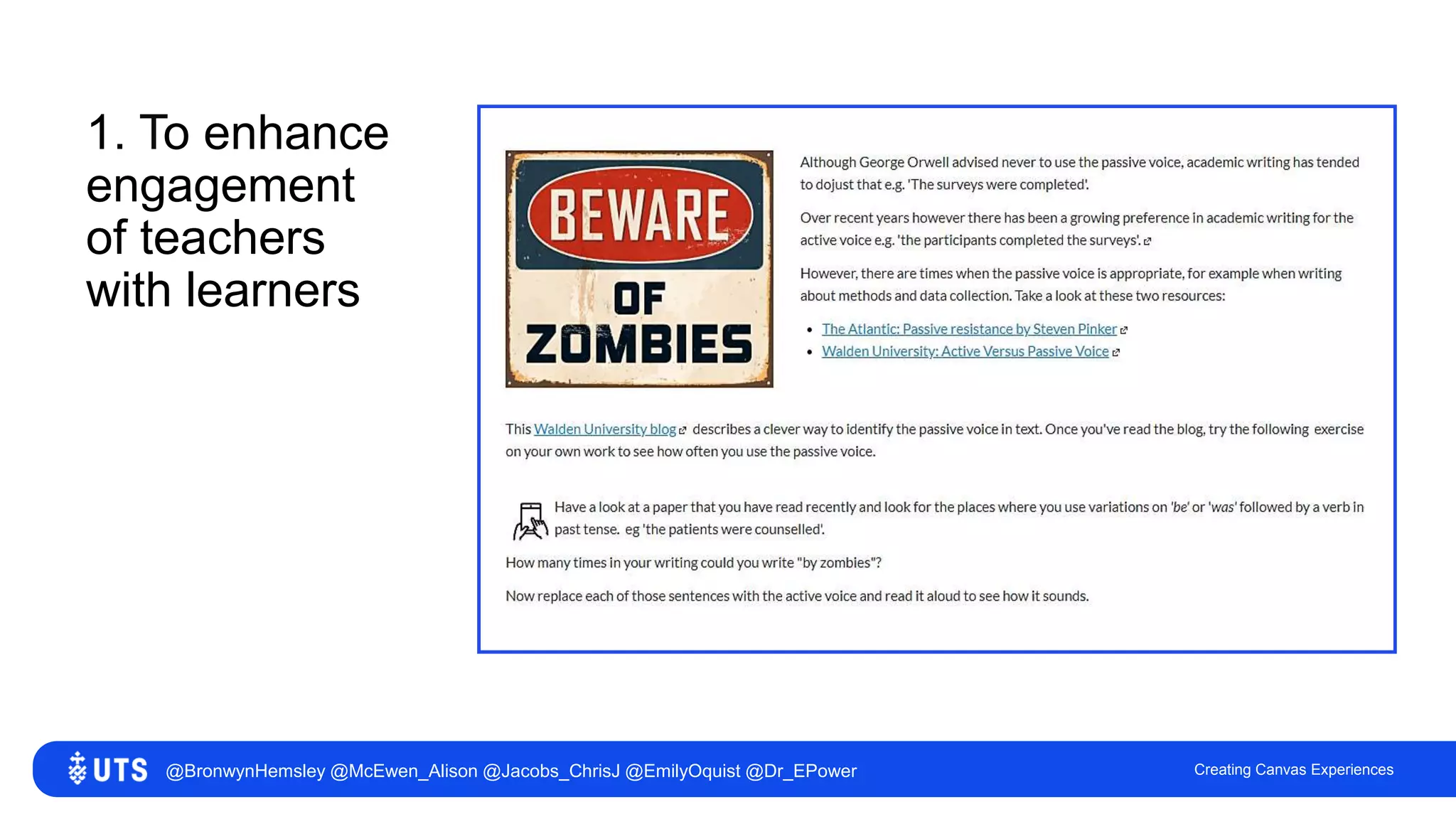
  • #12 It’s always important, perhaps even more so when students are off campus, to be very present in Canvas. One way to do this is to use your ‘teacher voice’ and presence in Canvas as a means of connecting with your students. Here are two examples of different teachers keeping their identity and voice present in the learning materials. This page is part of a module on academic writing where the teacher is using both her voice and that of George Orwell to enhance student engagement with the material.
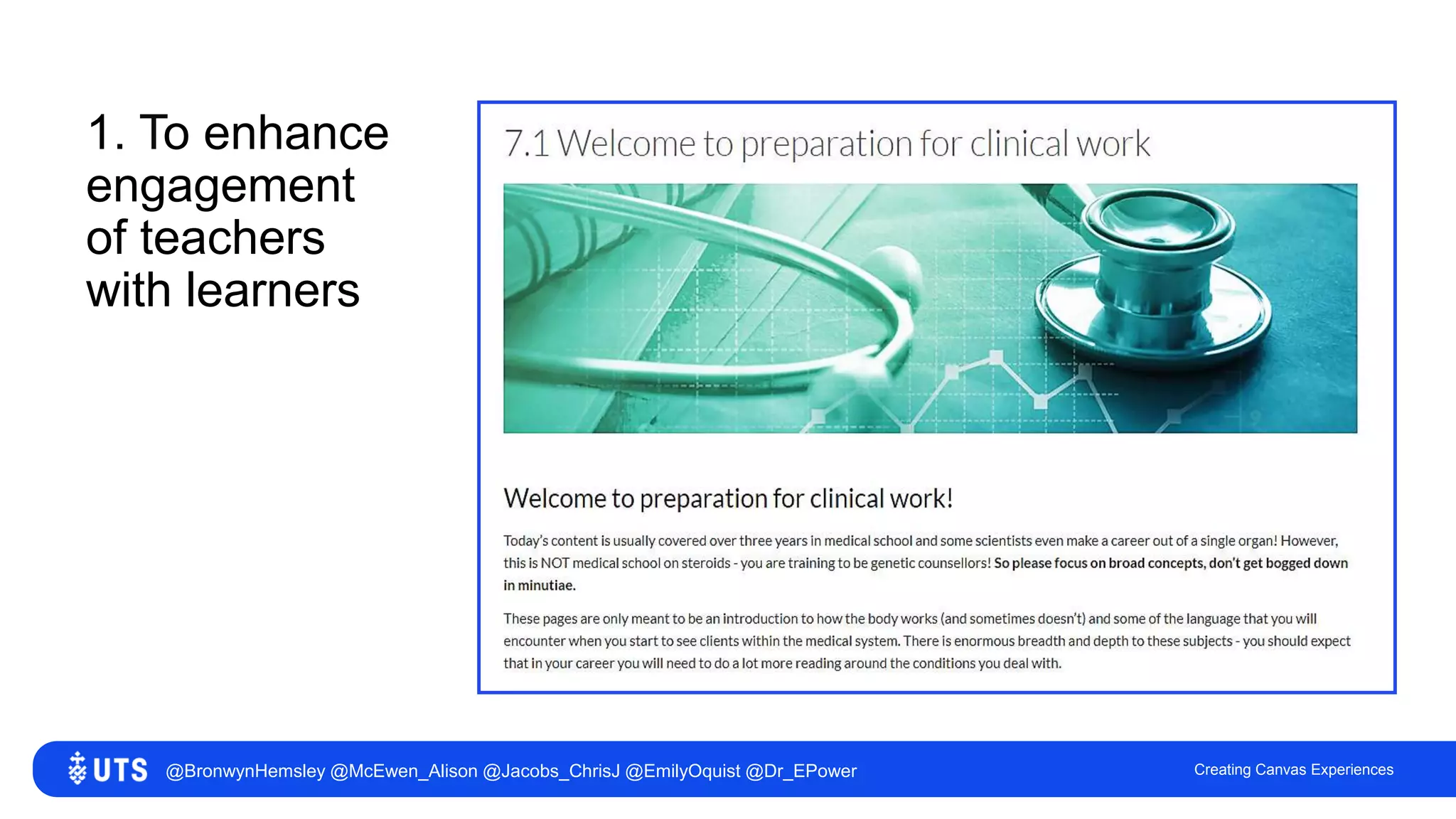
  • #13 This academic has a very conversational and humorous ‘teacher voice’, making a complex topic accessible by joking with the students that what they’ll be covering this week takes medical students 3 years.
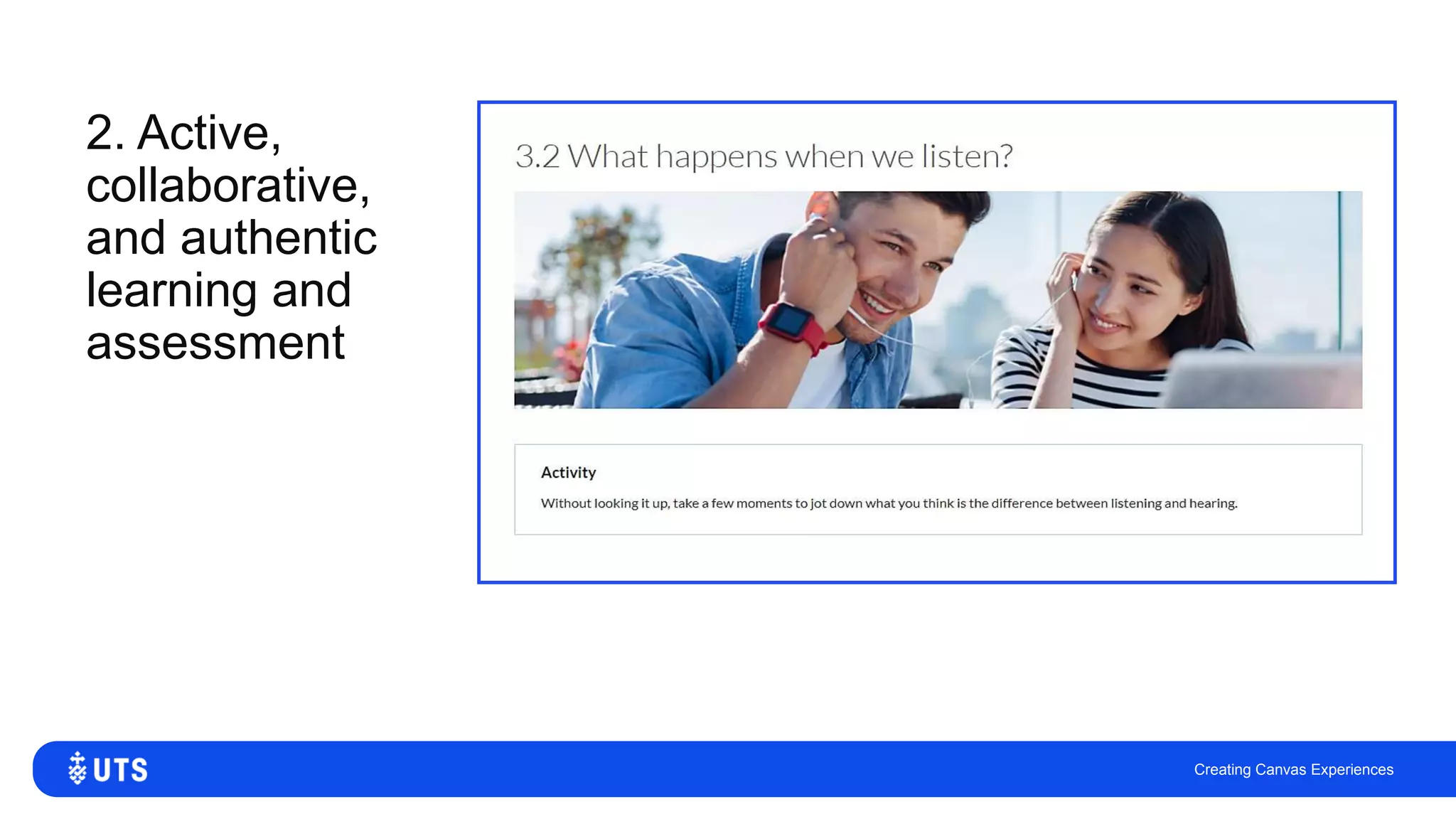
  • #14 It is easy to include regular, brief activities that invite students in and get them ready to engage intellectually and emotionally with the material presented online. Fostering student reflection on a topic prior to classes is important in priming their engagement and interest, and helps them to see the relevance of the topic materials to their professional work. This is an example of a simple interactive activity that asks students to note what they already know.
  • #15 Authentic assessments are common across both programs. This example from genetic counselling shows a group task, simulating an Ethics Committee. Students worked in small groups to review a study, and then recorded ethics committee meetings to consider the applications and reach a decision – unanimously not approved requiring further information and re-writing! In the screenshot the chair was calling the meeting to order.
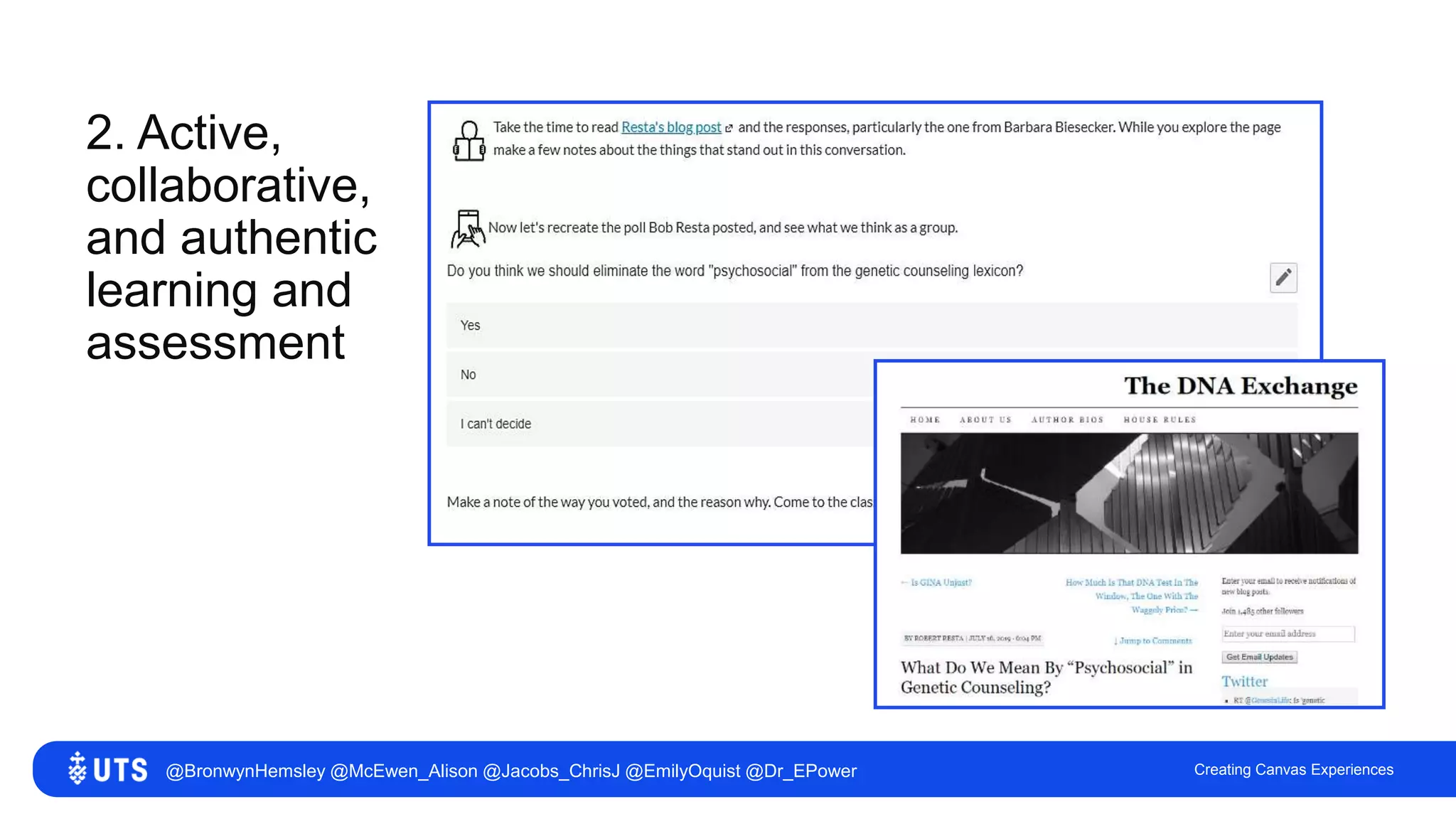
  • #16 Another simple strategy to capture student views before class was to replicate a poll provided on a blog. The whole cohort responded to the poll before class, and came ready for lively discussion.
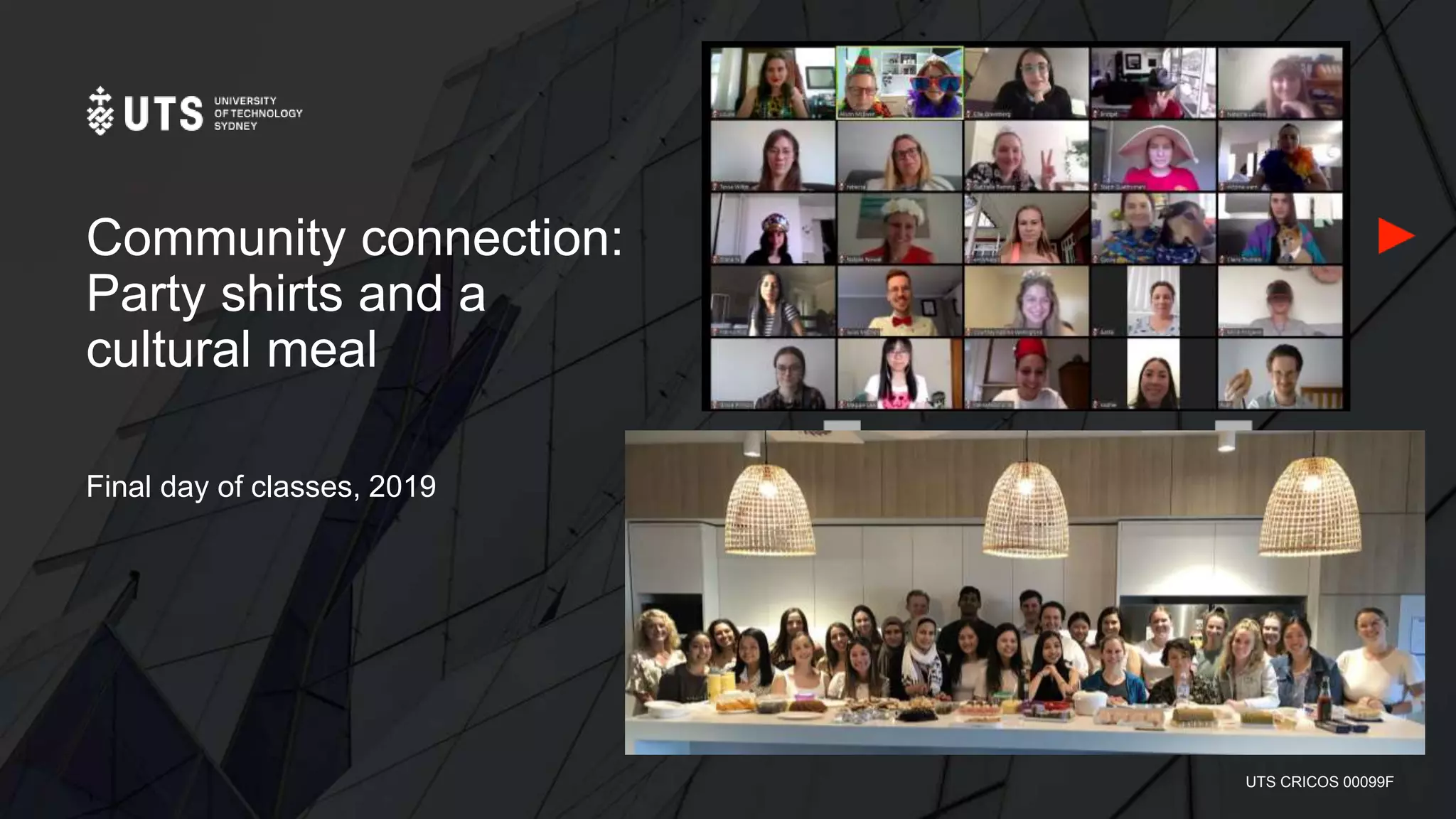
  • #17 ALISON: We’d like to introduce our students, seen here during their final classes for 2019. It is becoming a ‘tradition’ for genetic counselling students to dress up for the final class of a session, with several dogs also dressing up for the occasion. The strength of connection these students experience is very evident in this image.   BRONWYN: On the final day of classes last week, speech pathology students and staff brought in foods that were culturally important to them. This meal included both teaching and professional staff who had supported the students through the year. This will become a tradition for end of Session classes into the future.
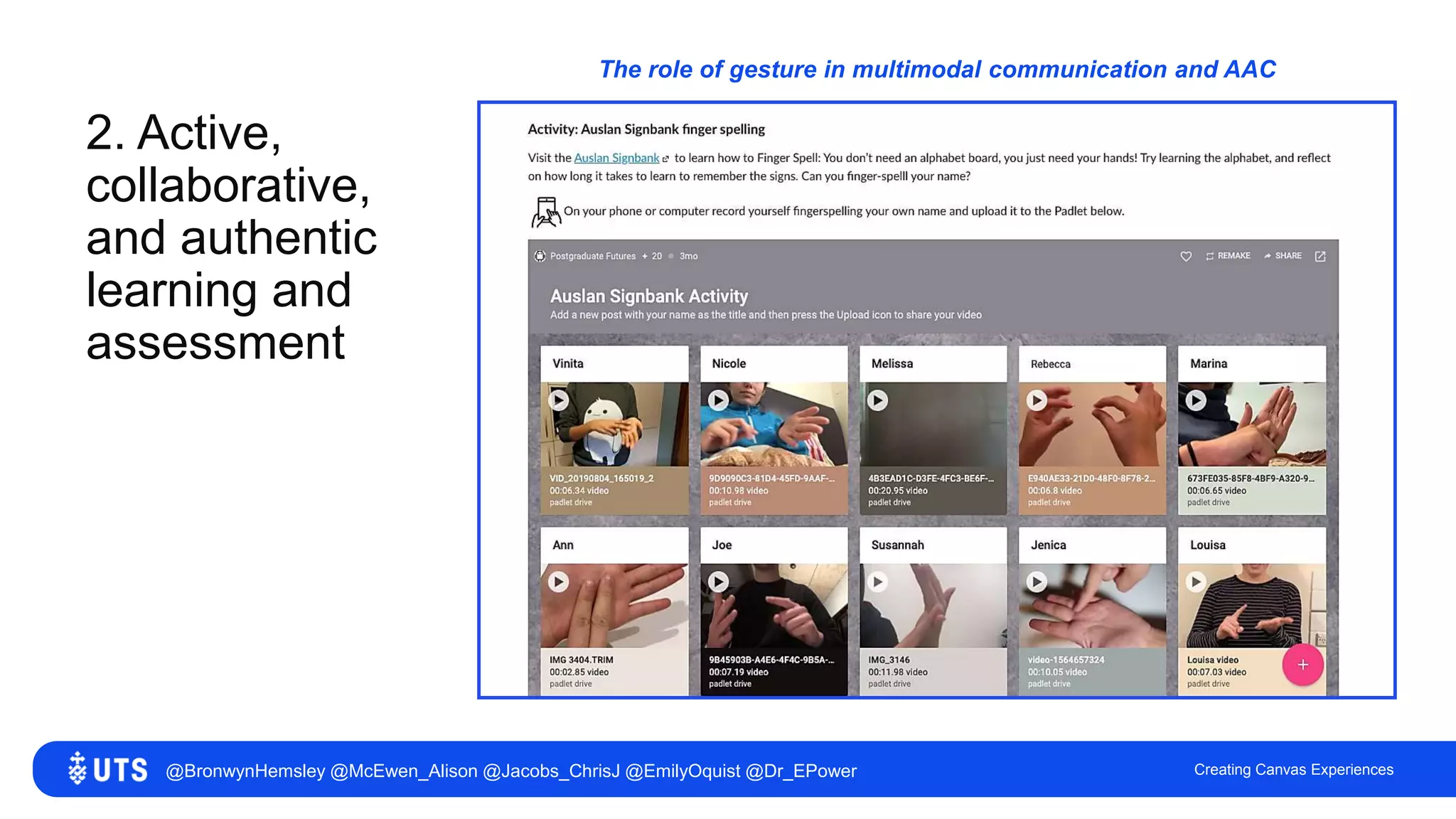
  • #18 Speech pathologists need to learn to read and produce gestures and Key Word Sign, which uses the signs from Auslan but in spoken word order. Learning the gestures and signs requires practice and watching and imitating others, it cannot be learned from a book, and videos help. In this Padlet activity between classes, students were asked to locate the finger spelling alphabet in Sign Bank (online videos of signs) and to post a video of them finger spelling their name. This was a hugely popular activity, and showed us the value of asking students to post Selfies for learning purposes, something they were quite practiced at already through their use of social media.
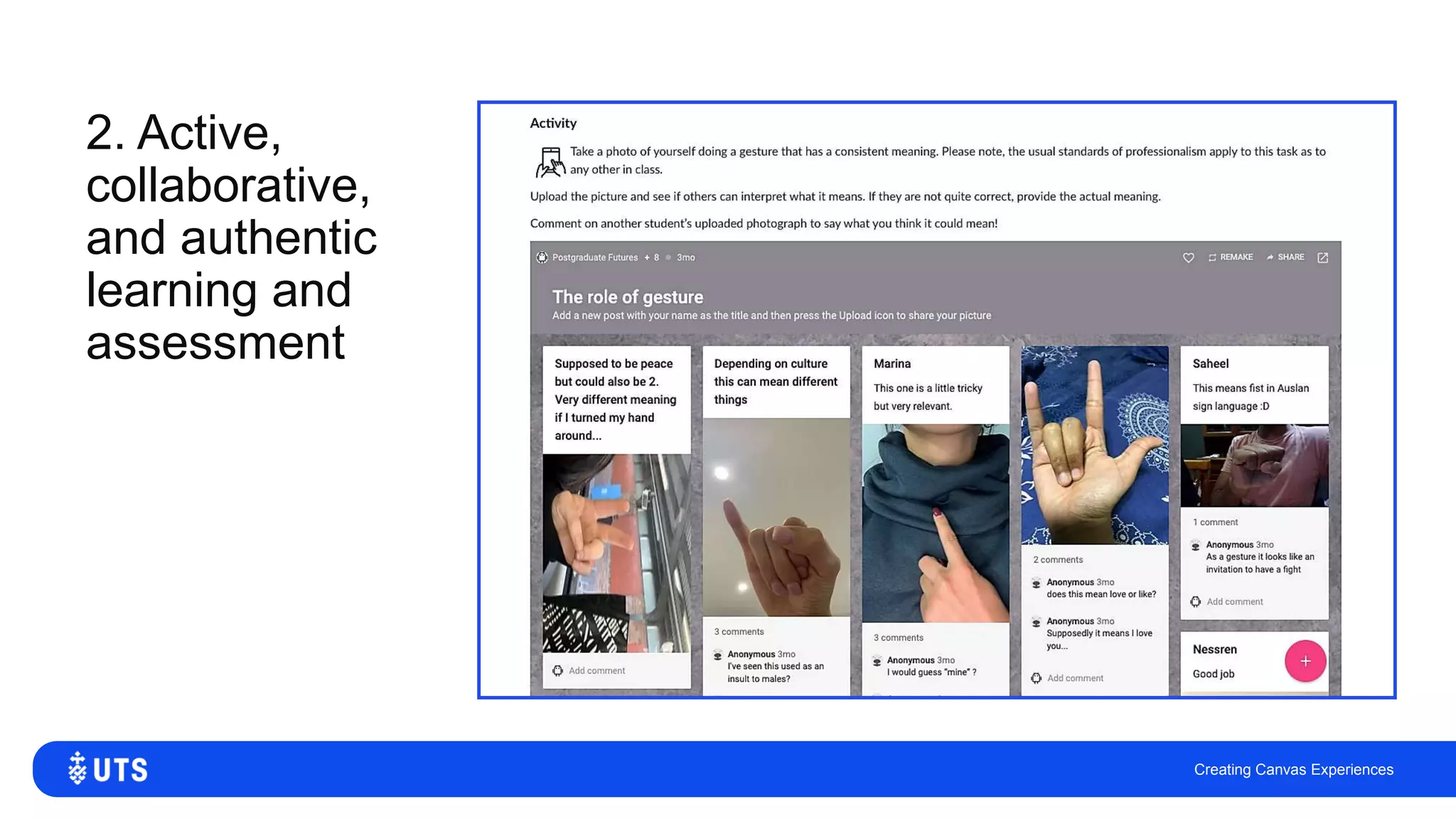
  • #19 Students could also share cultural meanings behind gestures, something which they brought to class that was not in the books – using their prior knowledge to link to the teaching in that session
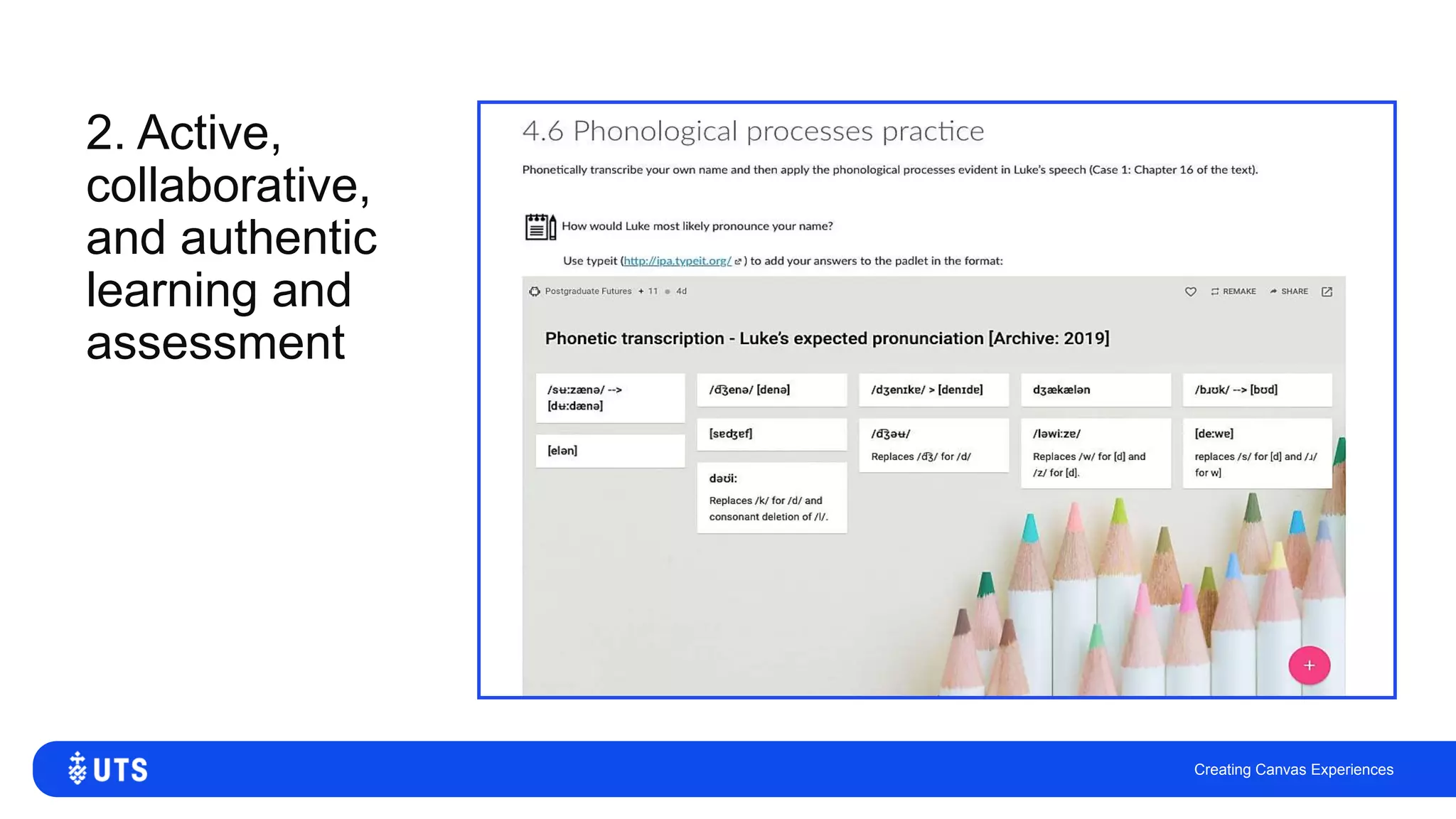
  • #20 Phonological transcription, or being able to accurately capture the sounds of a person’s speech in writing, without the conventions of spelling, is another important aspect of a speech pathologist’s work. It is often an anxiety provoking and stressful learning activity relying on rote learning and memory for the symbols. This activity made it a creative one – students had to transcribe their own name, and then transcribe how a child with a speech disorder would pronounce the student’s name. This is an authentic activity - one day students will be transcribing a child’s speech sound disorder.
  • #21 This is an example of encouraging students to engage and interact with the learning materials, individually. Listening to a podcast online, then answering 3 questions in writing, to keep as a PDF, enabled students to engage and reflect, and bring their learning to the classroom as a PDF.
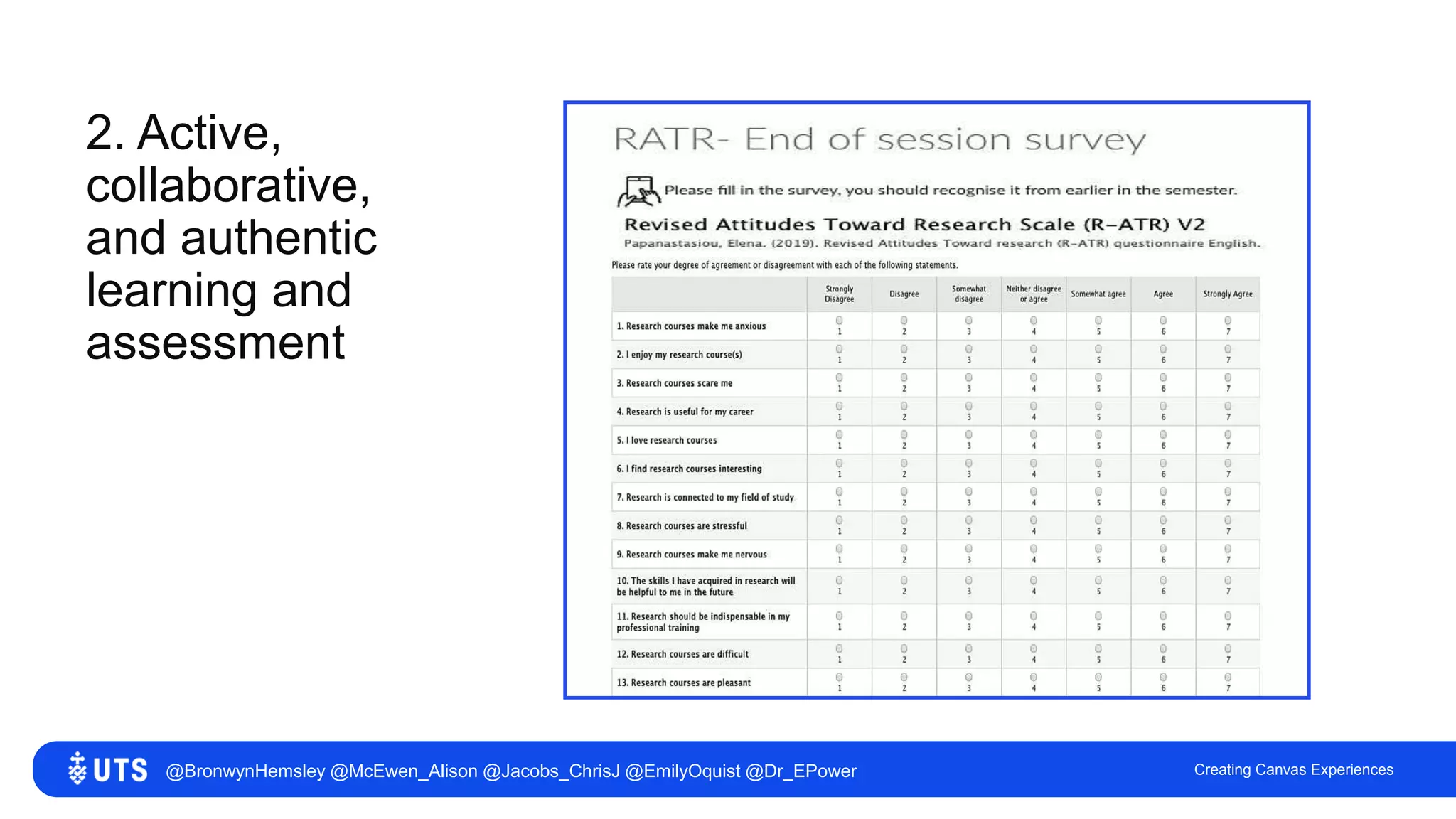
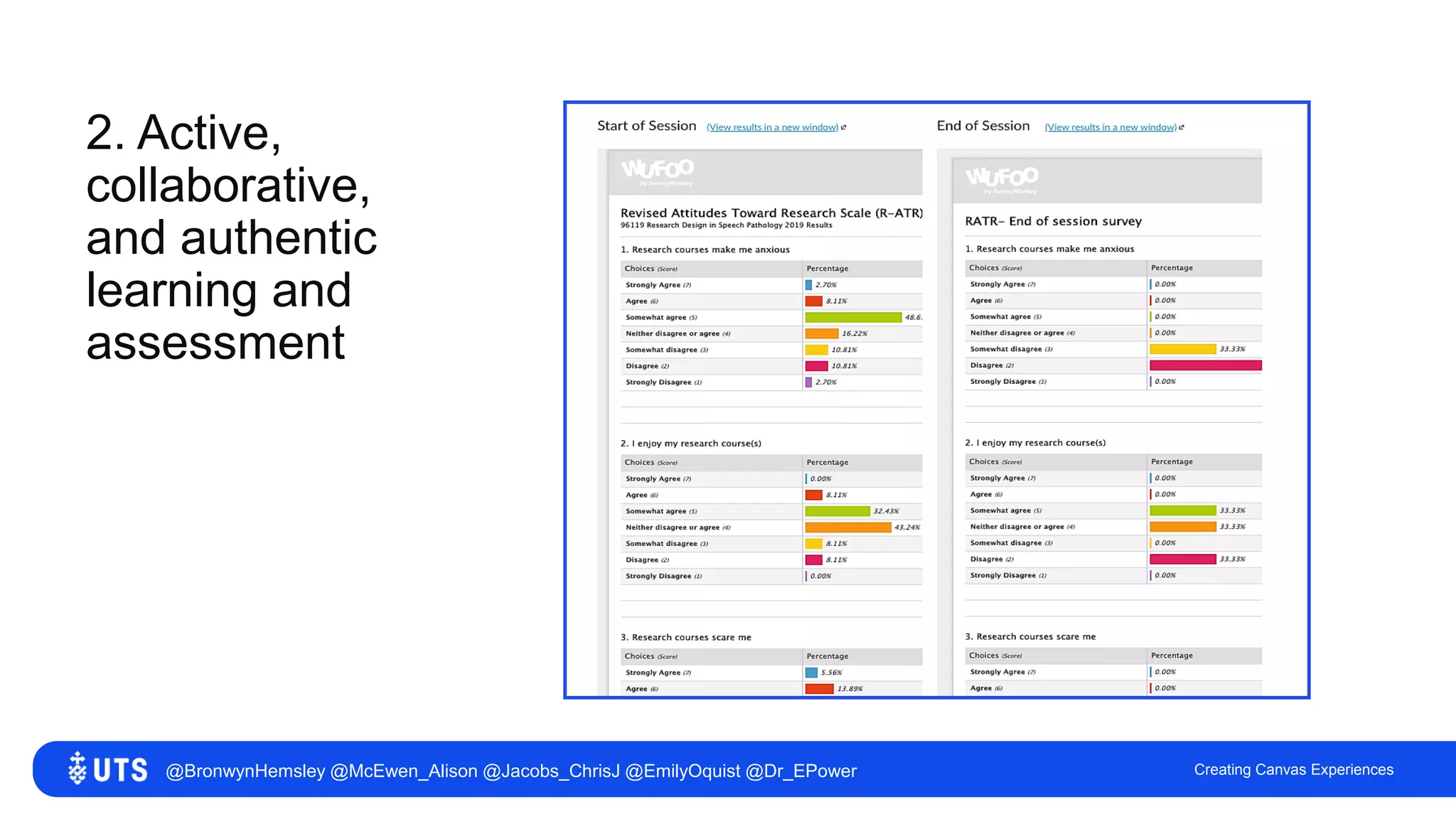
  • #22 In an active learning activity surrounding the Research Design subject in speech pathology, this activity was used on multiple levels to (i) gain the student’s perspectives research design courses as a ’participant’ in the research task to inform the subject coordinator’s approach to learning, (ii) to anchor key survey design principles to their experiential learning “if we repeat this at the end, what type of design is that?” and how to (iii) critically interpret the results “what was our response rate? …do we have a representative sample of class?”
  • #23 Students completed the survey prior to coming to class, enabling the lecturer A/Prof Emma Power to gauge where they were at with their attitudes to research design subjects. The survey was repeated at the end of class showing while enjoyment was still not a strong feature of their attitudes to research courses, their anxiety around those courses had much reduced/ Provides us with food for thought about ways to improve these type of courses next time.
  • #24 We’re using Canvas to support learning and assessment activities that create ways for students to interact with experts and resources. In this assessment students prepared for and interviewed experienced researchers in genetic counselling and delivered presentations to the class. The presentations were uploaded in Canvas and presented using screenshare in Zoom during class.
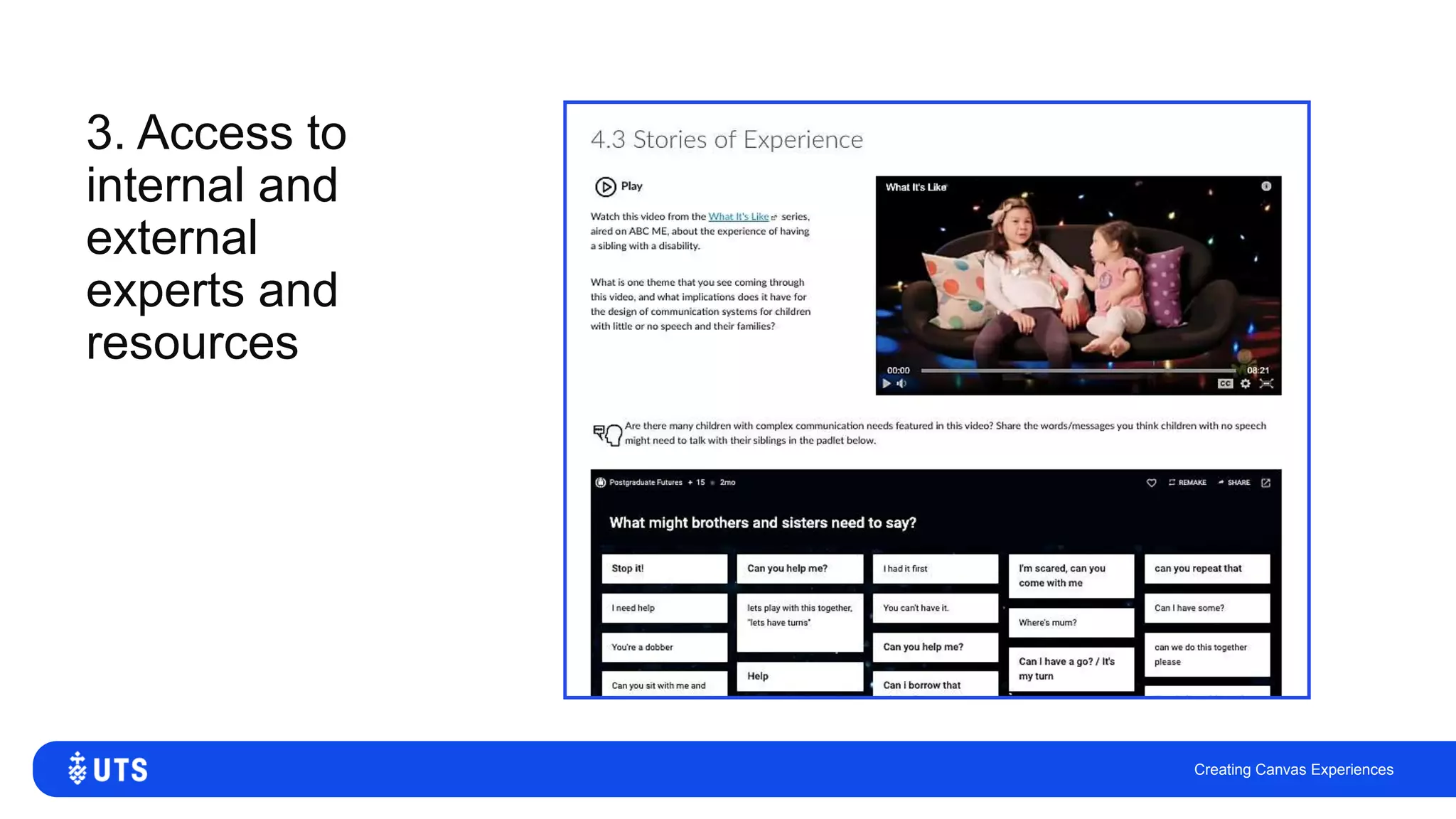
  • #25 This is an example of access to library materials in combination with interactive learning apps (Padlet in this case). Speech pathology students watched a TV show segment and then answered a question about ‘vocabulary’, this one reflects another important aspect of design of communication boards for people who cannot speak and what brothers and sisters might like to say to one another.
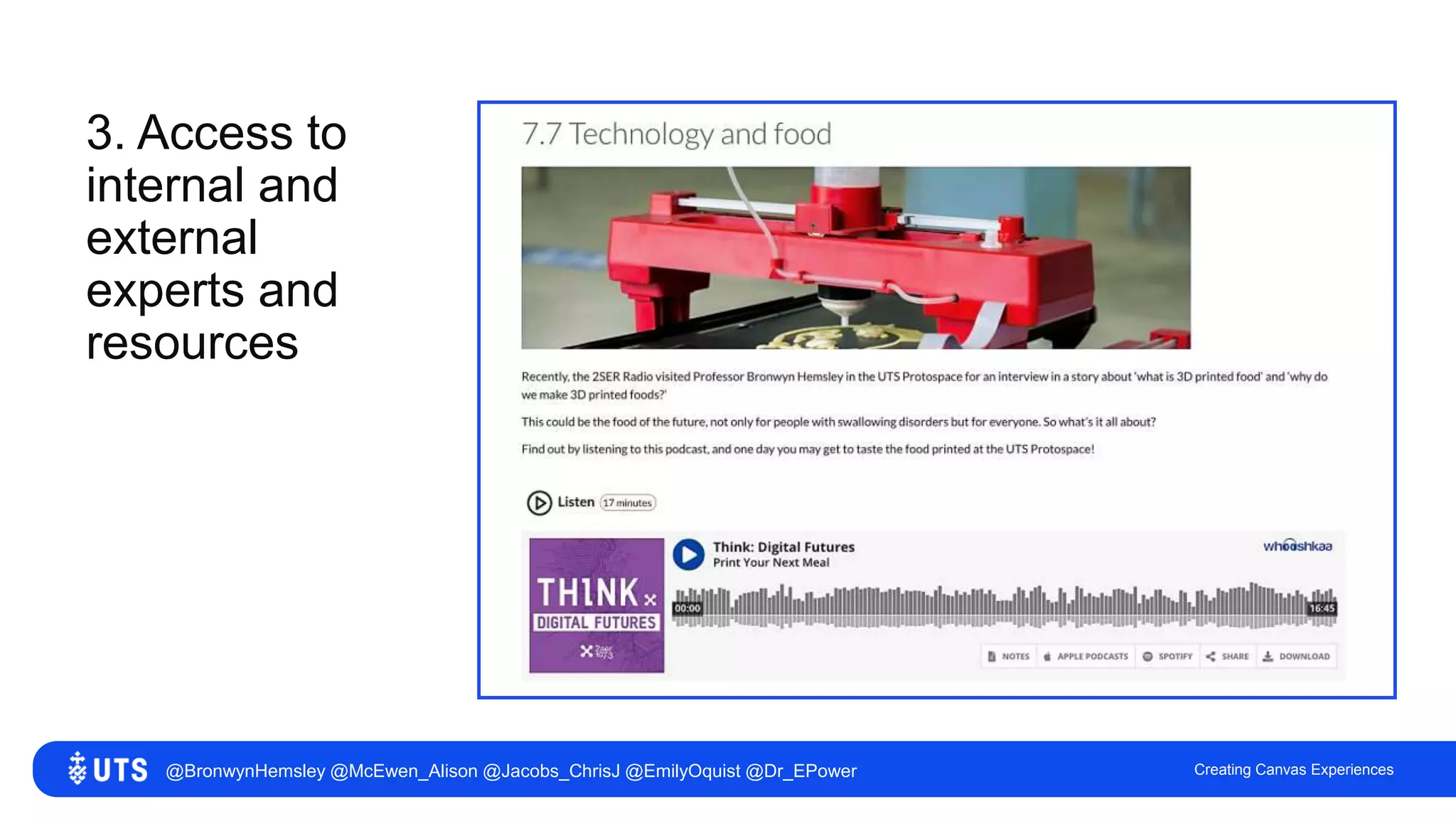
  • #26 UTS is home to many experts who are now being encouraged to write blogs, Conversation articles, and promote their work in the media. This podcast on 3D food printing was created recently by Jake Morcom at 2SER, highlighting our Protospace and GSH research on 3D food printing for people with swallowing disorders is now linked in to the Canvas site for the Swallowing Disorders subject for students to consider barriers to and enablers for this innovative tech application. I PUT THIS ON ANIMATION SO OU COULD EASILY SEE BOTH……
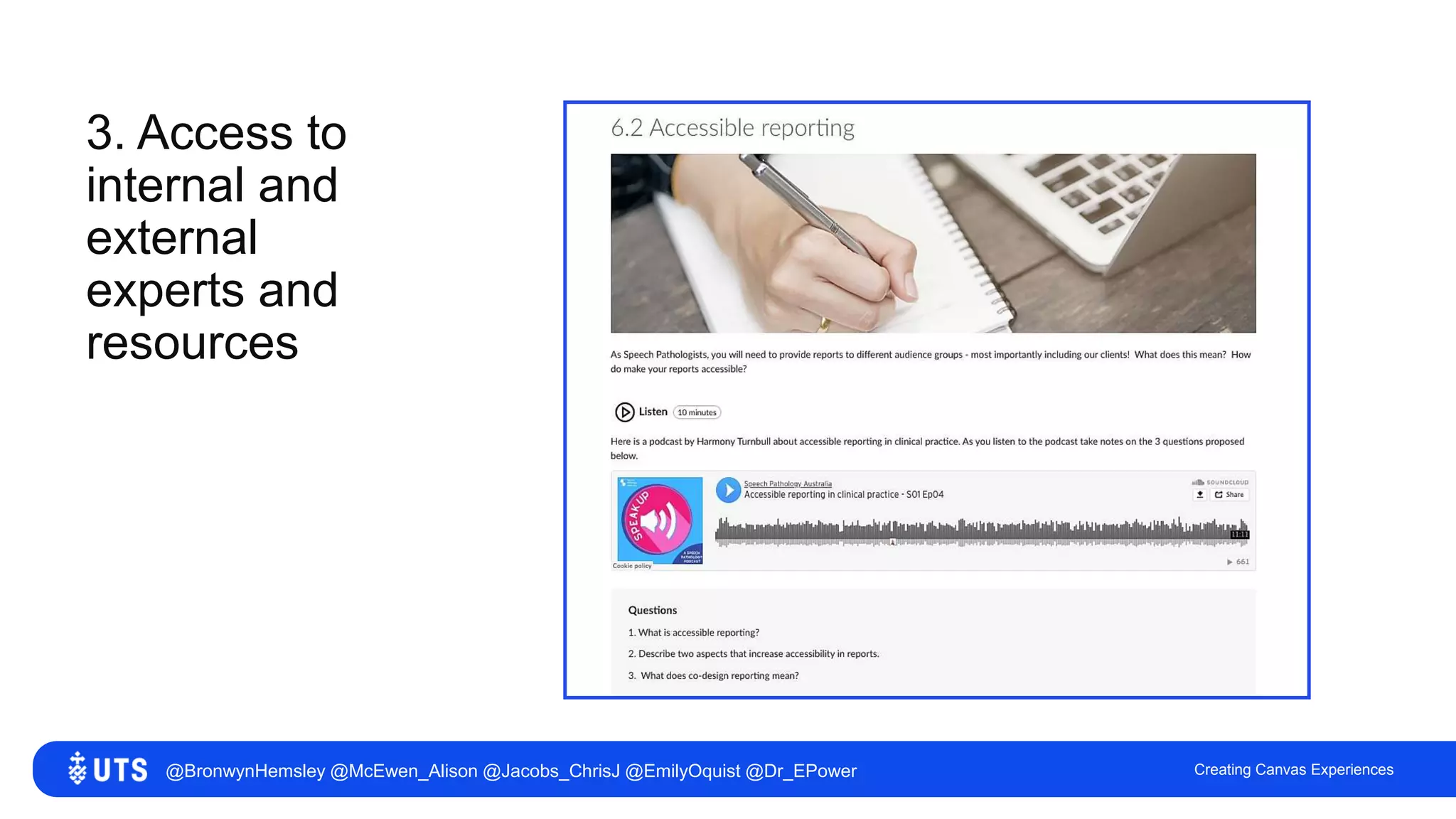
  • #27 Harmony Turnbull teaches in speech pathology and was interviewed by Speech Pathology Australia on the subject of her Higher Degree Research, writing accessible reports in allied health care. Here students were encouraged to listen to the podcast and answer three questions before class. This is an example of a podcast that is relevant across disciplines, so it is important that courses share their Canvas resources and activities that could be modified or adapted for other disciplines accordingly.
  • #28 Canvas provides a platform in which students and teachers can interact and have vigorous discussions. For this assessment task we used discussion pages for students to post a critical appraisal of a journal article and pose questions for their peers. They then moderated the discussion for the week. This activity generated 475 student interactions over a period of 8 weeks, which is close to 20 interactions by each student in the cohort.
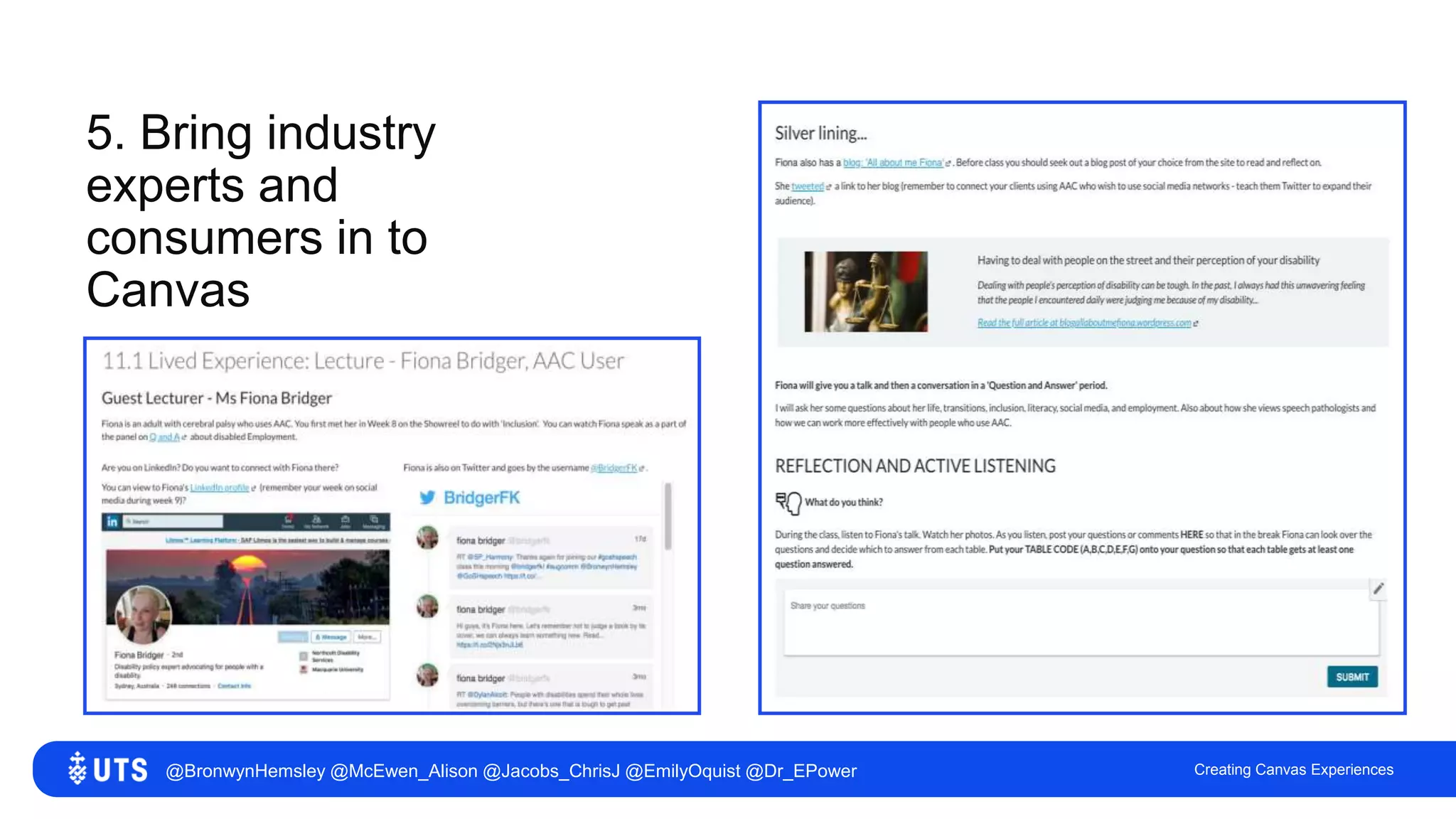
  • #29 Fiona Bridger appeared in the speech pathology course as a guest lecturer who has no functional speech and uses a speech generating device to communicate. First seeing Fiona on QandA on the Enabled episode, asking a question from the audience, Bronwyn approached her to provide a guest lecture to her class. On Canvas, Fiona’s Twitter and Linked in profiles were streamed. Having students use the Canvas during her lecture meant that she could review the questions in the break and compose her messages in reply during her second lecture. In this way, Canvas provided an accommodation that helped the guest with disability to provide interactive responses in the time available.
  • #30 We’ve used Canvas as a platform for students to learn from a range of industry experts and consumers, who the students may not otherwise have had the opportunity to interact with. Rochelle, Russell, Jo, and Lisa have all developed learning materials and interacted with the students in Canvas.
  • #31 We wanted to show you the padlet, which is one of the tools that has been used in several ways across both courses. While you listen and watch our presentation, you can also go to this website (provide) and make a note here of any ways that you could apply what you are hearing about, in your own classes or course design. At the end of the presentation we will revisit the Padlet and show you what the audience think about applying these strategies.
  • #32 I’d end on this? After the padlet to reinforce your key messages