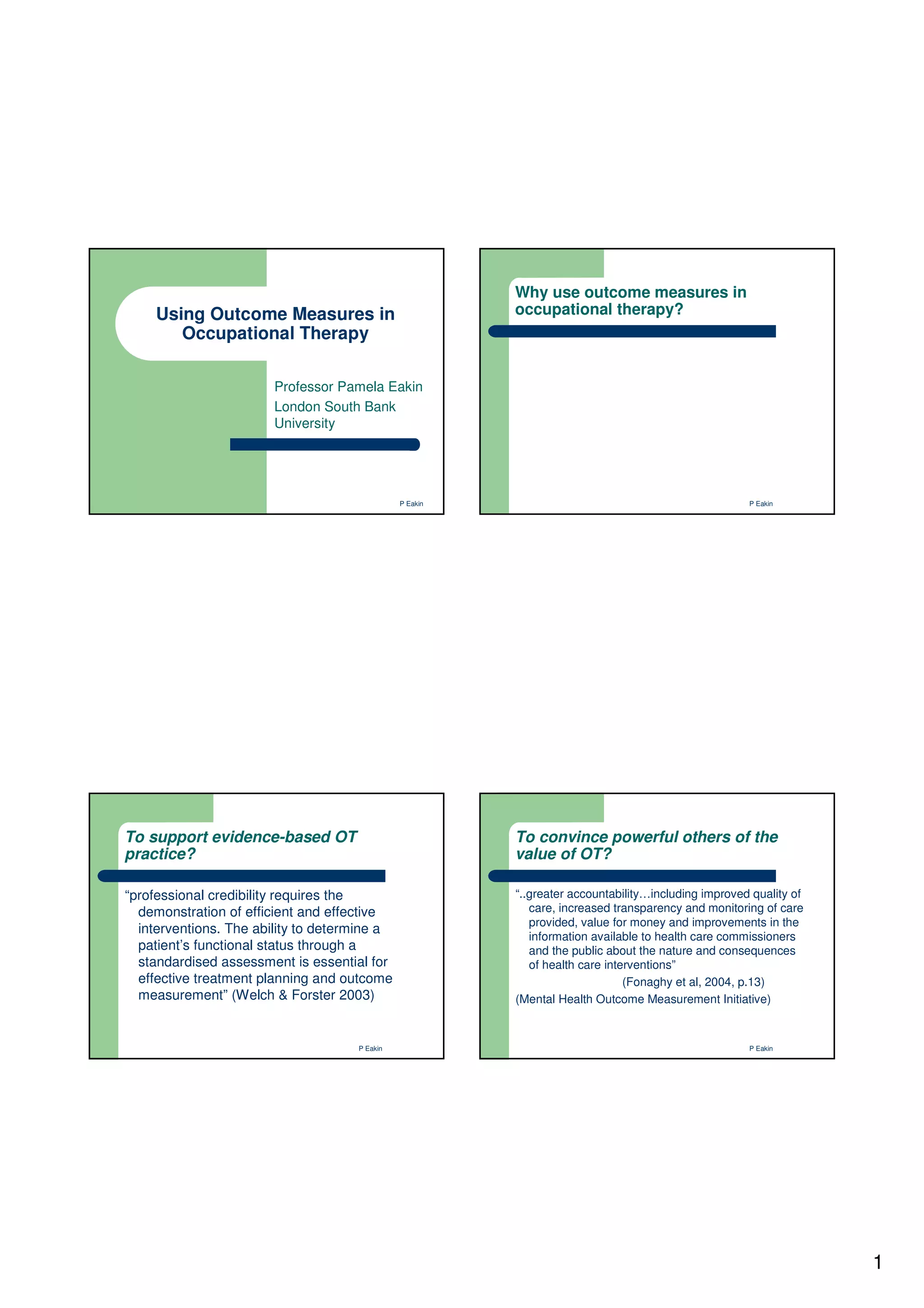
Why use outcome measures in
    Using Outcome Measures in                            occupational therapy?
       Occupational Therapy

                       Professor Pamela Eakin
                       London South Bank
                       University


                                               P Eakin                                               P Eakin


To support evidence-based OT                             To convince powerful others of the
practice?                                                value of OT?

“professional credibility requires the                   “..greater accountability…including improved quality of
  demonstration of efficient and effective                  care, increased transparency and monitoring of care
                                                            provided, value for money and improvements in the
  interventions. The ability to determine a
                                                            information available to health care commissioners
  patient’s functional status through a                     and the public about the nature and consequences
  standardised assessment is essential for                  of health care interventions”
  effective treatment planning and outcome                                     (Fonaghy et al, 2004, p.13)
  measurement” (Welch & Forster 2003)                    (Mental Health Outcome Measurement Initiative)


                                     P Eakin                                                         P Eakin


                                                                                                                   1
Drivers for the use of outcome                             Which outcome measures should we
measures                                                   use in OT?

  Government (legislation)
  The Department of Health (policy)                        Those which tell us (and others) how effective
  Commissioners of services (funding and                     our intervention is …
  priorities)
  Managers (service budgets and targets)                   What are our intended outcomes?
  Practitioners (resources, effectiveness)                 What about multiple outcomes?
  Clients/patients (treatment and care)

                                             P Eakin                                             P Eakin


                                                           Which outcomes should OTs
Complex interventions                                      measure?

Not always possible to:                                    Exactly the same intervention can be shown to
“…identify or predict which [are] the active ingredients     be either effective or ineffective depending
  that [bring] about particular outcomes. This is            upon which outcome you choose to
  because in complex interventions it is difficult to
                                                             measure.
  entangle the specific, characteristic effects of
  interventions from placebo or incidental effects such    The outcome is related to the intervention so
  as client expectations …”                                  the outcome measure must be related to the
(Patterson & Dieppe, 2005 cited in Creek, 2005)              objectives of the intervention.
                                                           ‘Cure’ versus ‘adaptation’

                                             P Eakin                                             P Eakin


                                                                                                            2
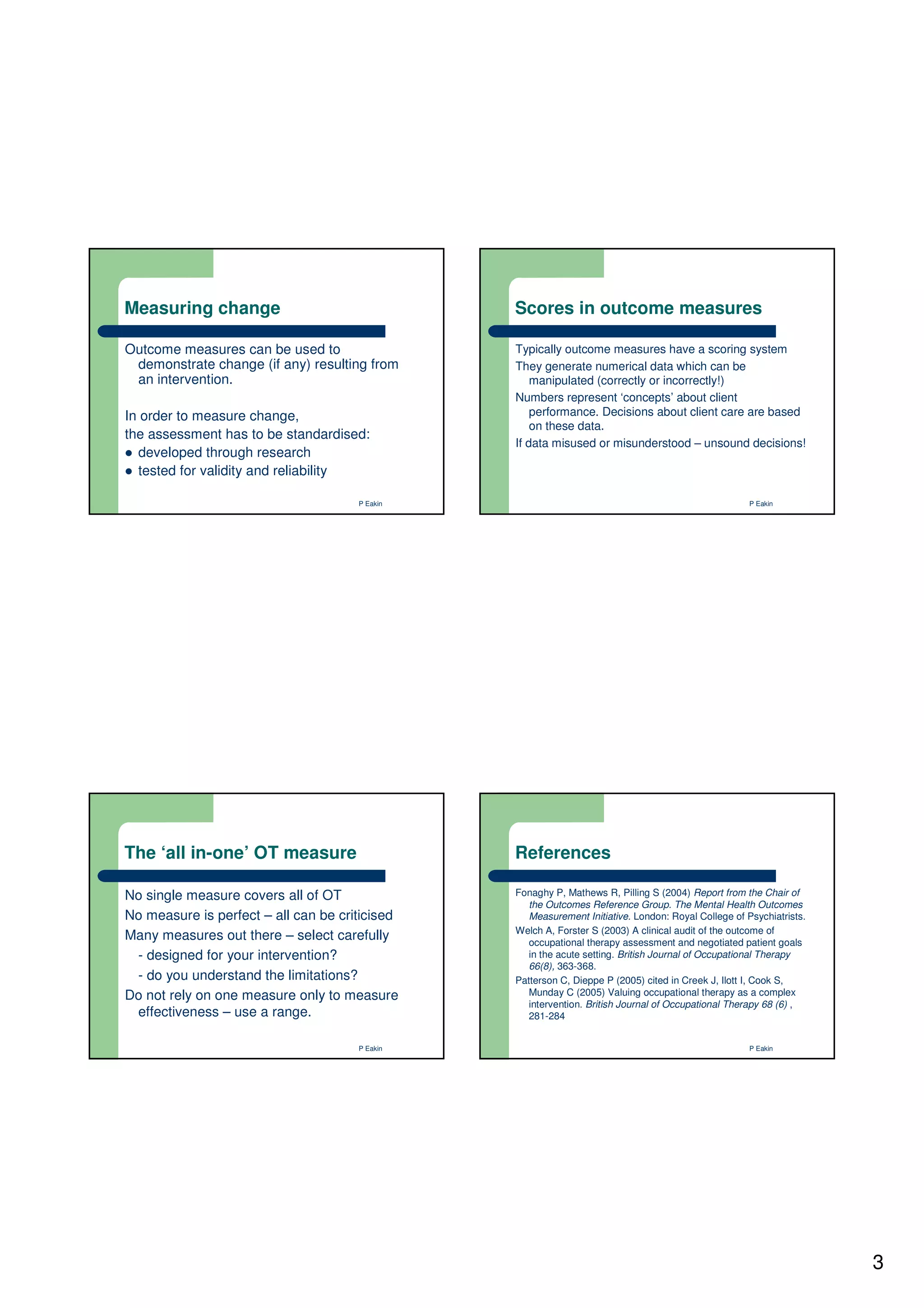
Measuring change                                Scores in outcome measures

Outcome measures can be used to                 Typically outcome measures have a scoring system
 demonstrate change (if any) resulting from     They generate numerical data which can be
 an intervention.                                   manipulated (correctly or incorrectly!)
                                                Numbers represent ‘concepts’ about client
In order to measure change,                         performance. Decisions about client care are based
                                                    on these data.
the assessment has to be standardised:
                                                If data misused or misunderstood – unsound decisions!
  developed through research
  tested for validity and reliability

                                      P Eakin                                                        P Eakin


The ‘all in-one’ OT measure                     References

No single measure covers all of OT              Fonaghy P, Mathews R, Pilling S (2004) Report from the Chair of
                                                   the Outcomes Reference Group. The Mental Health Outcomes
No measure is perfect – all can be criticised      Measurement Initiative. London: Royal College of Psychiatrists.
                                                Welch A, Forster S (2003) A clinical audit of the outcome of
Many measures out there – select carefully         occupational therapy assessment and negotiated patient goals
 - designed for your intervention?                 in the acute setting. British Journal of Occupational Therapy
                                                   66(8), 363-368.
 - do you understand the limitations?           Patterson C, Dieppe P (2005) cited in Creek J, Ilott I, Cook S,
Do not rely on one measure only to measure         Munday C (2005) Valuing occupational therapy as a complex
                                                   intervention. British Journal of Occupational Therapy 68 (6) ,
 effectiveness – use a range.                      281-284


                                      P Eakin                                                        P Eakin


                                                                                                                     3

Using-outcome-measures-in-OT-LLL event-London region-Eakin.pdf

  • 1.
    Why use outcomemeasures in Using Outcome Measures in occupational therapy? Occupational Therapy Professor Pamela Eakin London South Bank University P Eakin P Eakin To support evidence-based OT To convince powerful others of the practice? value of OT? “professional credibility requires the “..greater accountability…including improved quality of demonstration of efficient and effective care, increased transparency and monitoring of care provided, value for money and improvements in the interventions. The ability to determine a information available to health care commissioners patient’s functional status through a and the public about the nature and consequences standardised assessment is essential for of health care interventions” effective treatment planning and outcome (Fonaghy et al, 2004, p.13) measurement” (Welch & Forster 2003) (Mental Health Outcome Measurement Initiative) P Eakin P Eakin 1
  • 2.
    Drivers for theuse of outcome Which outcome measures should we measures use in OT? Government (legislation) The Department of Health (policy) Those which tell us (and others) how effective Commissioners of services (funding and our intervention is … priorities) Managers (service budgets and targets) What are our intended outcomes? Practitioners (resources, effectiveness) What about multiple outcomes? Clients/patients (treatment and care) P Eakin P Eakin Which outcomes should OTs Complex interventions measure? Not always possible to: Exactly the same intervention can be shown to “…identify or predict which [are] the active ingredients be either effective or ineffective depending that [bring] about particular outcomes. This is upon which outcome you choose to because in complex interventions it is difficult to measure. entangle the specific, characteristic effects of interventions from placebo or incidental effects such The outcome is related to the intervention so as client expectations …” the outcome measure must be related to the (Patterson & Dieppe, 2005 cited in Creek, 2005) objectives of the intervention. ‘Cure’ versus ‘adaptation’ P Eakin P Eakin 2
  • 3.
    Measuring change Scores in outcome measures Outcome measures can be used to Typically outcome measures have a scoring system demonstrate change (if any) resulting from They generate numerical data which can be an intervention. manipulated (correctly or incorrectly!) Numbers represent ‘concepts’ about client In order to measure change, performance. Decisions about client care are based on these data. the assessment has to be standardised: If data misused or misunderstood – unsound decisions! developed through research tested for validity and reliability P Eakin P Eakin The ‘all in-one’ OT measure References No single measure covers all of OT Fonaghy P, Mathews R, Pilling S (2004) Report from the Chair of the Outcomes Reference Group. The Mental Health Outcomes No measure is perfect – all can be criticised Measurement Initiative. London: Royal College of Psychiatrists. Welch A, Forster S (2003) A clinical audit of the outcome of Many measures out there – select carefully occupational therapy assessment and negotiated patient goals - designed for your intervention? in the acute setting. British Journal of Occupational Therapy 66(8), 363-368. - do you understand the limitations? Patterson C, Dieppe P (2005) cited in Creek J, Ilott I, Cook S, Do not rely on one measure only to measure Munday C (2005) Valuing occupational therapy as a complex intervention. British Journal of Occupational Therapy 68 (6) , effectiveness – use a range. 281-284 P Eakin P Eakin 3