Evaluating and Institutionalizing
OD Interventions
Unit – 08
TLEP WEEK 8
Week 8 14 to 20 October 2023 Evaluating and Institutionalizing
Organization Development
Interventions
Quadrant 1
e-Content
1. Watch the eLearning content on “L8: Evaluating and
Institutionalizing Organization Development Interventions” before
the live session.
2. Read the e-LM on “Unit 8: Evaluating and Institutionalizing
Organization Development Interventions”
Quadrant 2
e-Tutorial
1. Revise the “L7: Organizational Cycle and Organization Structure)”
recording of the live Session
2. Attend the live session #8 on “Evaluating and Institutionalizing
Organization Development Interventions”
Quadrant 3
e-Assessment
1. Take the formative assessment for “L8: Evaluating and
Institutionalizing Organization Development Interventions”
2. After the live session, repeat the formative assessment for “L8:
Financial Statement Analysis” for self-assessment
3. Attempt solving the Practice MCQs & Case Study #8 on “Evaluating
and Institutionalizing Organization Development Interventions”
Quadrant 4 1. Participate in collaborative learning by discussing the Practice
MCQs & Case Study #8
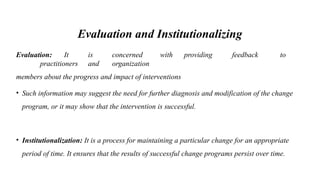
Evaluation and Institutionalizing
Evaluation: It is concerned with providing feedback to
practitioners and organization
members about the progress and impact of interventions
• Such information may suggest the need for further diagnosis and modification of the change
program, or it may show that the intervention is successful.
• Institutionalization: It is a process for maintaining a particular change for an appropriate
period of time. It ensures that the results of successful change programs persist over time.
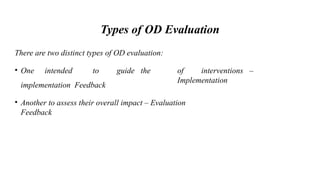
Types of OD Evaluation
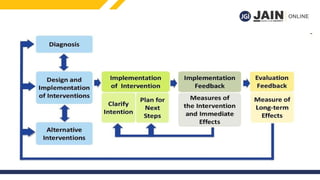
of interventions –
Implementation
There are two distinct types of OD evaluation:
• One intended to guide the
implementation Feedback
• Another to assess their overall impact – Evaluation
Feedback
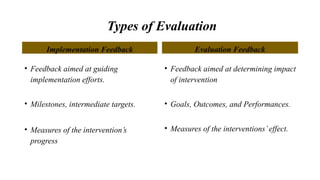
Types of Evaluation
Implementation Feedback
• Feedback aimed at guiding
implementation efforts.
• Milestones, intermediate targets.
• Measures of the intervention’s
progress
Evaluation Feedback
• Feedback aimed at determining impact
of intervention
• Goals, Outcomes, and Performances.
• Measures of the interventions’effect.
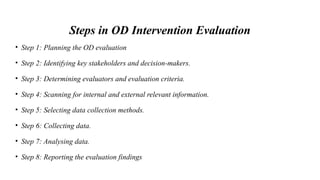
Steps in OD Intervention Evaluation
• Step 1: Planning the OD evaluation
• Step 2: Identifying key stakeholders and decision-makers.
• Step 3: Determining evaluators and evaluation criteria.
• Step 4: Scanning for internal and external relevant information.
• Step 5: Selecting data collection methods.
• Step 6: Collecting data.
• Step 7: Analysing data.
• Step 8: Reporting the evaluation findings
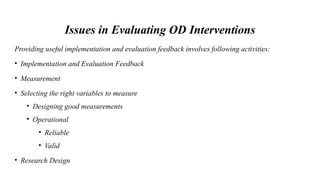
Issues in Evaluating OD Interventions
Providing useful implementation and evaluation feedback involves following activities:
• Implementation and Evaluation Feedback
• Measurement
• Selecting the right variables to measure
• Designing good measurements
• Operational
• Reliable
• Valid
• Research Design
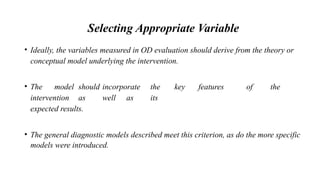
Selecting Appropriate Variable
• Ideally, the variables measured in OD evaluation should derive from the theory or
conceptual model underlying the intervention.
• The model should incorporate the key features of the
intervention as well as its
expected results.
• The general diagnostic models described meet this criterion, as do the more specific
models were introduced.
Example
• For example, the job-level diagnostic model proposes several major features of
work: task variety, feedback, and autonomy.
• The theory argues that high levels of these elements can be expected to result in
high levels of work quality and satisfaction
Designing Good Measures
• Operational definition: A good measure is operationally defined; that is, it specifies the
empirical data needed, how they will be collected and, most important, how they will be
converted from data to information.
• Operational definitions are extremely important in measurement because they pro-vide
precise guidelines about what characteristics of the situation are to be observed and how
they are to be used.
• They tell OD practitioners and the client system exactly how diagnostic, intervention, and
outcome variables will be measured.
Reliability.
• Reliability concerns the extent to which a measure
represents the “true” value of a variable—that is, how accurately the
operational definition translates data into information.
OD practitioners can improve the reliability of their measures in four ways.
• First, rigorously and operationally define the chosen variables.
• Second, use multiple methods to measure a particular variable
• Third, use multiple items to measure the same variable on a questionnaire.
• Fourth, use standardized instruments (Center for Effective Organizations at the University of
Southern California and the Institute for Social Research at the University of Michigan)
Validity
• Validity concerns the extent to which a measure actually reflects the variable it is intended to
reflect.
OD practitioners can increase the validity of their measures in several ways.
• First, ask colleagues and clients if a proposed measure actually represents a particular variable.
This is called face validity or content validity.
• Second, use multiple measures of the same variable, as described in the section about reliability, to
make preliminary assessments of the measure’s criterion or convergent validity.
• Finally, predictive validity is demonstrated when the variable of interest accurately forecasts
another variable over time. For example, a measure of team cohesion can be said to be valid if it
accurately predicts improvements in team performance in the future.
Research Design
• In addition to measurement, OD practitioners must make choices about how to design
the evaluation to achieve valid results.
• The key issue is how to design the assessment to show whether the intervention did in
fact produce the observed results. This is called internal validity.
• The secondary question of whether the intervention would
work similarly in other situations is referred to as external validity.
• The longer the time period of the change program, the greater are the chances that other factors,
such as technology improvements, will emerge to affect the results
Quasi Research Design
• These designs are not as rigorous and controlled as are randomized experimental designs, but they allow
evaluators to rule out many rival explanations for OD results other than the intervention itself.
Although several quasi-experimental designs are available, those with
the following three features are
particularly powerful for assessing changes:
• Longitudinal measurement. This involves measuring results repeatedly over relatively long time periods.
• Comparison unit. It is always desirable to compare results in the intervention situation with those in
another situation where no such change has taken place.
• Statistical analysis. Whenever possible, statistical methods should be used to rule out the possibility that
the results are caused by random error or chance
Multiple Measures
• The use of multiple measures also is important in assessing perceptual changes resulting from
interventions.
• Considerable research has identified three types of change—alpha, beta, and gamma—that
occur when using self-report, perceptual measures.
• Alpha change refers to movement along a measure that reflects stable dimensions of reality.
• Beta change involves the recalibration of the intervals along some constant measure of reality
• Gamma change involves fundamentally redefining the measure
as a result of an OD
intervention
Alpha Change - Example
• Comparative measures of perceived employee discretion might show an increase
after a job enrichment program. If this increase represents alpha change, it can be
assumed that the job enrichment program actually increased employee
perceptions of discretion.
Beta Change - Example
• Before-and-after measures of perceived employee discretion can decrease after a job enrichment
program. If beta change is involved, it can explain this apparent failure of the intervention to
increase discretion.
• The first measure of discretion may accurately reflect the individual’s belief about the ability to
move around and talk to fellow workers in the immediate work area.
• During implementation of the job enrichment intervention, however, the employee may learn that
the ability to move around is not limited to the immediate work area.
• At a second measurement of discretion, the employee, using
this new and recalibrated
understanding, may rate the current level of discretion as lower than before.
Gamma Change - Example
• Gamma change would make it difficult to com-pare measures of employee discretion taken before and after a
job enrichment program.
• The measure taken after the intervention might use the same words, but they represent an entirely different
concept
• As described above, the term “discretion” may originally refer to the ability to move about the department
and interact with other workers.
• After the intervention, discretion might be defined in terms of the ability to make decisions about work rules,
work schedules, and productivity levels.
• In sum, the job enrichment intervention changed the way discretion is perceived and how it is evaluated.
Institutionalizing Change
• Once it is determined that changes have been implemented and are effective, attention is
directed at institutionalizing the changes—maintaining them as a normal part of the
organization’s functioning for an appropriate period of time.
• Institutionalizing an OD intervention concerns refreezing.
• It involves the long-term persistence of organizational changes: To the extent that changes
persist, they can be said to be institutionalized.
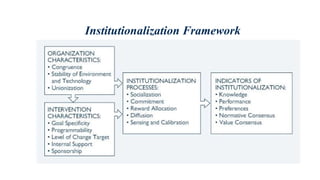
Institutionalization Framework
Organization Characteristics
1. Congruence - This is the degree to which an intervention is perceived as being in harmony
with the organization’s managerial philosophy, strategy, and structure; its current environment;
and other changes taking place.
• Congruence can facilitate persistence by making it easier to gain member commitment to the
intervention and to diffuse it to wider segments of the organization.
• The converse also is true: Many OD interventions promote employee participation and
growth. When applied in highly bureaucratic organizations with formalized structures and
autocratic managerial styles, participative interventions are not perceived as congruent with
the organization’s managerial philosophy.
2. Stability of Environment and Technology
• This involves the degree to which the organization’s environment and technology are
changing. The persistence of change is favoured when environments are stable.
• Under these conditions, it makes sense to embed the change in an organization’s culture
and organization design processes.
• On the other hand, volatile demand for the firm’s products or services can lead to
reductions in personnel that may change the composition of the groups involved in the
intervention or bring new members on board at a rate faster than they can be socialized
effectively.
3. Unionization.
• Diffusion of interventions may be more difficult in unionized settings, especially if
the changes affect union contract issues, such as salary and fringe benefits, job
design, and employee flexibility.
• For example, a rigid union contract can make it difficult to merge several
job classifications into one, as might be required to increase task variety in a job
enrichment program.
• It is important to emphasize, however, that unions can be a powerful force for
promoting change, particularly when a good relationship exists between union
and management
Intervention Characteristics
1. Goal specificity - This involves the extent to which intervention goals are specific
rather than broad. Specificity of goals helps direct socializing activities (for
example, training and orienting new members) to particular behaviours required to
implement the intervention.
• It also helps operationalize the new behaviours so that rewards can be
linked clearly to them.
• For example, an intervention aimed only at increasing product quality is likely to
be more focused and readily put into operation than a change program intended to
improve quality, quantity, safety, absenteeism, and employee development.
2. Programmability.
• This involves the degree to which the changes can be programmed or the extent to which
the different intervention characteristics can be specified clearly in advance to enable
socialization, commitment, and reward allocation.
• For example, job enrichment specifies three targets of change: employee discretion, task
variety, and feedback.
• The change program can be planned and designed to promote those specific features.
3. Level of change target
• This concerns the extent to which the change target is the total organization, rather
than a department or small work group. Each level of organization has facilitators
and inhibitors of persistence.
• Departmental and group change are susceptible to countervailing forces from others
in the organization.
• These can reduce the diffusion of the intervention and lower its ability to impact
organization effectiveness.
• However, this does not preclude institutionalizing the change within a department that
successfully insulates itself from the rest of the organization.
• Such insulation often manifests itself as a subculture within the organization
4. Internal Support
• This refers to the degree to which there is an internal support system to guide the change
process.
• Internal support, typically provided by an internal consultant, can gain commitment for the
changes and help organization members implement them.
• External consultants also can provide support, especially on a temporary basis during the
early stages of implementation.
• The external consultant typically brings expertise on
organizational design and trains
members to implement the design.
• The internal consultant generally helps members relate to other organizational units, resolve
conflicts, and legitimize the change activities within the organization
5. Sponsorship
• This concerns the presence of a powerful sponsor
who can initiate, allocate, and legitimize resources for the
intervention.
• Sponsors must come from levels in the organization high enough to control
appropriate resources, and they must have the visibility and power to nurture the
intervention and see that it remains viable.
• There are many examples of OD interventions that persisted for several years and then
collapsed abruptly when the sponsor, usually a top administrator, left the
organization.
• There also are numerous examples of middle managers
withdrawing support for interventions because top management did not
Institutionalization Processes
1.
Socialization -
This concerns the transmission of information
about beliefs,
preferences, norms, and values with respect to the intervention.
• Because implementation of OD interventions generally involves considerable learning
and experimentation, a continual process of socialization is necessary to promote
persistence of the change program.
• Transmission of information about the intervention helps bring new members onboard
and allows participants to reaffirm the beliefs, norms, and values underlying the
intervention.
• https://www.studocu.com/en-us/document/university-of-oregon/organizational-
development-and-change-management/chapter-11-evaluating-and-
institutionalizing- organization-development-interventions/4298618
Commitment.
• This binds people to behaviours associated with the intervention.
• It includes initial commitment to the program, as well as recommitment over time.
• Commitment should derive from several organizational levels, including the employees
directly involved and the middle and upper managers who can support or thwart the
intervention.
• In many early employee involvement programs, for example, attention was directed at
gaining workers’commitment to such programs.
• Unfortunately, middle managers were often ignored and considerable
management resistance to the interventions resulted.
Reward allocation.
required by
an
• This involves linking rewards to the
new behaviours intervention.
• Organizational rewards can enhance the persistence of changes in at least two
ways.
• First, a combination of intrinsic and extrinsic rewards
can reinforce new
behaviours. Intrinsic rewards are internal and derive from the opportunities for
challenge, development, and accomplishment found in the work.
• When interventions provide these opportunities, motivation to perform should
persist.
• This behaviour can be further reinforced by providing extrinsic rewards, such
as money, for increased contributions.
• Because the value of extrinsic rewards tends to diminish over time, it may be
necessary to revise the reward systemto maintain
high levels of desired behaviours.
Diffusion.
• This refers to the process of transferring changes from one system to another.
• Many interventions fail to persist because they run counter to the values, purpose, or
identity of the larger organization.
• Diffusion of a changeto other organizationalunits reduces
this counter- implementation force.
• Moreover, the act of transmitting institutionalized behaviours
to other systems reinforces commitment to the changes.
Sensing and calibration.
• This involves detecting deviations from desired intervention behaviours and taking
corrective action.
• To detect this variation and take corrective actions, organizations must
have some
sensing mechanism.
• Sensing mechanisms, such as implementation feedback, provide information about the
occurrence of deviations.
• For example, if a high level of job discretion associated with a job enrichment
intervention does not persist, information about this problem might initiate corrective
actions, such as renewed attempts to socialize people or to gain commitment to the
Indicators of Institutionalization
members have
1. Knowledge - This involves the extent to
which organization knowledge of the behaviours associated
with an intervention.
• It is concerned with whether members know enough to perform the behaviours and to
recognize the consequences of that performance.
• For example, job enrichment includes a number of new behaviours, such as
performing a greater variety of tasks, analysing information about task performance,
and making decisions about work methods and plans.
Indicators of Institutionalization
2.Performance - This is concerned with the degree to which intervention behaviours are actually
performed. It may be measured by counting the proportion of relevant people performing the
behaviours.
3.Preferences - This involves the degree to which organization members privately accept the
organizational changes. This contrasts with acceptance based primarily on organizational sanctions
or group pressures.
4.Normative Consensus - This focuses on the extent to which people agree about the appropriateness
of the organizational changes. This indicator of institutionalization reflects how fully changes have
become part of the normative structure of the organization.
5. Value Consensus - This is concerned with social consensus on values relevant to the organizational
changes.
Recap – Evaluation Feedback
• Evaluation was discussed in terms of two kinds of necessary feedback:
implementation feedback, concerned with whether the intervention is being
implemented as intended, and evaluation feedback, indicating whether the
intervention is producing expected results.
• The former comprises collected data about features of the intervention, perceptions
of the people involved, and its immediate effects, which are fed back repeatedly and
at short intervals.
• The latter comprises data about the long-term effects of the intervention, which are
fed back at long intervals.
Measurements
• Evaluation of interventions also involves decisions about measurement and
research design.
• Measurement issues focus on selecting variables and designing good measures.
Ideally, measurement decisions should derive from the theory underlying the
intervention and should include measures of the features of the intervention and
its immediate and long-term consequences.
• Further, these measures should be operationally defined, reliable, and valid and
should involve multiple methods, such as a combination of questionnaires,
interviews, and company records
Research Design
• Research design focuses on setting up the conditions for making valid assessments of
an intervention’s effects.
• This involves ruling out explanations for the observed
results other than the
intervention.
• Although randomized experimental designs are rarely feasible
in OD, quasi- experimental designs exist for eliminating alternative
explanations.
Institutionalization
• A framework for understanding and improving the institutionalization of
interventions identified organization characteristics (congruence, stability of
environment and technology, and unionization) and
• intervention characteristics (goal specificity, programmability, level of change
target, internal support, and sponsorship) that affect institutionalization
processes.
• The framework also described specific institutionalization processes
(socialization, commitment, reward allocation, diffusion, and sensing and
calibration) that directly affect indicators of intervention persistence (knowledge,
performance, preferences, normative consensus, and value consensus)
TLEP Week 9
Week 9 21 to 27 October 2023 The Future of OD The changing
environment
Quadrant 1
e-Content
1. Watch the eLearning content on “L9: The Future of OD The changing
environment” before the live session.
2. Read the e-LM on “The Future of OD The changing environment”
Quadrant 2
e-Tutorial
1. Revise the “L8: Evaluating and Institutionalizing Organization Development
Interventions” recording of the live Session
2. Attend live session #9 on “The Future of OD The changing environment”
Quadrant 3
e-Assessment
1. Take the formative assessment for “L9: The Future of OD The changing
environment”
2. After the live session, repeat the formative assessment for “L9: The Future of
OD The changing environment” for self-assessment
3. Attempt solving the Practice MCQs & Case Study #9 on “The Future of OD
The changing environment”
4. Attempt Continuous Assessment - 2
Quadrant 4
Discussions
1. Participate in collaborative learning by discussing the Practice MCQs &
Case Study #9
organisational development and change management 2

organisational development and change management 2

  • 1.
    Evaluating and Institutionalizing ODInterventions Unit – 08
  • 2.
    TLEP WEEK 8 Week8 14 to 20 October 2023 Evaluating and Institutionalizing Organization Development Interventions Quadrant 1 e-Content 1. Watch the eLearning content on “L8: Evaluating and Institutionalizing Organization Development Interventions” before the live session. 2. Read the e-LM on “Unit 8: Evaluating and Institutionalizing Organization Development Interventions” Quadrant 2 e-Tutorial 1. Revise the “L7: Organizational Cycle and Organization Structure)” recording of the live Session 2. Attend the live session #8 on “Evaluating and Institutionalizing Organization Development Interventions” Quadrant 3 e-Assessment 1. Take the formative assessment for “L8: Evaluating and Institutionalizing Organization Development Interventions” 2. After the live session, repeat the formative assessment for “L8: Financial Statement Analysis” for self-assessment 3. Attempt solving the Practice MCQs & Case Study #8 on “Evaluating and Institutionalizing Organization Development Interventions” Quadrant 4 1. Participate in collaborative learning by discussing the Practice MCQs & Case Study #8
  • 3.
    Evaluation and Institutionalizing Evaluation:It is concerned with providing feedback to practitioners and organization members about the progress and impact of interventions • Such information may suggest the need for further diagnosis and modification of the change program, or it may show that the intervention is successful. • Institutionalization: It is a process for maintaining a particular change for an appropriate period of time. It ensures that the results of successful change programs persist over time.
  • 4.
    Types of ODEvaluation of interventions – Implementation There are two distinct types of OD evaluation: • One intended to guide the implementation Feedback • Another to assess their overall impact – Evaluation Feedback
  • 5.
    Types of Evaluation ImplementationFeedback • Feedback aimed at guiding implementation efforts. • Milestones, intermediate targets. • Measures of the intervention’s progress Evaluation Feedback • Feedback aimed at determining impact of intervention • Goals, Outcomes, and Performances. • Measures of the interventions’effect.
  • 7.
    Steps in ODIntervention Evaluation • Step 1: Planning the OD evaluation • Step 2: Identifying key stakeholders and decision-makers. • Step 3: Determining evaluators and evaluation criteria. • Step 4: Scanning for internal and external relevant information. • Step 5: Selecting data collection methods. • Step 6: Collecting data. • Step 7: Analysing data. • Step 8: Reporting the evaluation findings
  • 8.
    Issues in EvaluatingOD Interventions Providing useful implementation and evaluation feedback involves following activities: • Implementation and Evaluation Feedback • Measurement • Selecting the right variables to measure • Designing good measurements • Operational • Reliable • Valid • Research Design
  • 9.
    Selecting Appropriate Variable •Ideally, the variables measured in OD evaluation should derive from the theory or conceptual model underlying the intervention. • The model should incorporate the key features of the intervention as well as its expected results. • The general diagnostic models described meet this criterion, as do the more specific models were introduced.
  • 10.
    Example • For example,the job-level diagnostic model proposes several major features of work: task variety, feedback, and autonomy. • The theory argues that high levels of these elements can be expected to result in high levels of work quality and satisfaction
  • 11.
    Designing Good Measures •Operational definition: A good measure is operationally defined; that is, it specifies the empirical data needed, how they will be collected and, most important, how they will be converted from data to information. • Operational definitions are extremely important in measurement because they pro-vide precise guidelines about what characteristics of the situation are to be observed and how they are to be used. • They tell OD practitioners and the client system exactly how diagnostic, intervention, and outcome variables will be measured.
  • 12.
    Reliability. • Reliability concernsthe extent to which a measure represents the “true” value of a variable—that is, how accurately the operational definition translates data into information. OD practitioners can improve the reliability of their measures in four ways. • First, rigorously and operationally define the chosen variables. • Second, use multiple methods to measure a particular variable • Third, use multiple items to measure the same variable on a questionnaire. • Fourth, use standardized instruments (Center for Effective Organizations at the University of Southern California and the Institute for Social Research at the University of Michigan)
  • 13.
    Validity • Validity concernsthe extent to which a measure actually reflects the variable it is intended to reflect. OD practitioners can increase the validity of their measures in several ways. • First, ask colleagues and clients if a proposed measure actually represents a particular variable. This is called face validity or content validity. • Second, use multiple measures of the same variable, as described in the section about reliability, to make preliminary assessments of the measure’s criterion or convergent validity. • Finally, predictive validity is demonstrated when the variable of interest accurately forecasts another variable over time. For example, a measure of team cohesion can be said to be valid if it accurately predicts improvements in team performance in the future.
  • 14.
    Research Design • Inaddition to measurement, OD practitioners must make choices about how to design the evaluation to achieve valid results. • The key issue is how to design the assessment to show whether the intervention did in fact produce the observed results. This is called internal validity. • The secondary question of whether the intervention would work similarly in other situations is referred to as external validity. • The longer the time period of the change program, the greater are the chances that other factors, such as technology improvements, will emerge to affect the results
  • 15.
    Quasi Research Design •These designs are not as rigorous and controlled as are randomized experimental designs, but they allow evaluators to rule out many rival explanations for OD results other than the intervention itself. Although several quasi-experimental designs are available, those with the following three features are particularly powerful for assessing changes: • Longitudinal measurement. This involves measuring results repeatedly over relatively long time periods. • Comparison unit. It is always desirable to compare results in the intervention situation with those in another situation where no such change has taken place. • Statistical analysis. Whenever possible, statistical methods should be used to rule out the possibility that the results are caused by random error or chance
  • 16.
    Multiple Measures • Theuse of multiple measures also is important in assessing perceptual changes resulting from interventions. • Considerable research has identified three types of change—alpha, beta, and gamma—that occur when using self-report, perceptual measures. • Alpha change refers to movement along a measure that reflects stable dimensions of reality. • Beta change involves the recalibration of the intervals along some constant measure of reality • Gamma change involves fundamentally redefining the measure as a result of an OD intervention
  • 17.
    Alpha Change -Example • Comparative measures of perceived employee discretion might show an increase after a job enrichment program. If this increase represents alpha change, it can be assumed that the job enrichment program actually increased employee perceptions of discretion.
  • 18.
    Beta Change -Example • Before-and-after measures of perceived employee discretion can decrease after a job enrichment program. If beta change is involved, it can explain this apparent failure of the intervention to increase discretion. • The first measure of discretion may accurately reflect the individual’s belief about the ability to move around and talk to fellow workers in the immediate work area. • During implementation of the job enrichment intervention, however, the employee may learn that the ability to move around is not limited to the immediate work area. • At a second measurement of discretion, the employee, using this new and recalibrated understanding, may rate the current level of discretion as lower than before.
  • 19.
    Gamma Change -Example • Gamma change would make it difficult to com-pare measures of employee discretion taken before and after a job enrichment program. • The measure taken after the intervention might use the same words, but they represent an entirely different concept • As described above, the term “discretion” may originally refer to the ability to move about the department and interact with other workers. • After the intervention, discretion might be defined in terms of the ability to make decisions about work rules, work schedules, and productivity levels. • In sum, the job enrichment intervention changed the way discretion is perceived and how it is evaluated.
  • 20.
    Institutionalizing Change • Onceit is determined that changes have been implemented and are effective, attention is directed at institutionalizing the changes—maintaining them as a normal part of the organization’s functioning for an appropriate period of time. • Institutionalizing an OD intervention concerns refreezing. • It involves the long-term persistence of organizational changes: To the extent that changes persist, they can be said to be institutionalized.
  • 21.
  • 22.
    Organization Characteristics 1. Congruence- This is the degree to which an intervention is perceived as being in harmony with the organization’s managerial philosophy, strategy, and structure; its current environment; and other changes taking place. • Congruence can facilitate persistence by making it easier to gain member commitment to the intervention and to diffuse it to wider segments of the organization. • The converse also is true: Many OD interventions promote employee participation and growth. When applied in highly bureaucratic organizations with formalized structures and autocratic managerial styles, participative interventions are not perceived as congruent with the organization’s managerial philosophy.
  • 23.
    2. Stability ofEnvironment and Technology • This involves the degree to which the organization’s environment and technology are changing. The persistence of change is favoured when environments are stable. • Under these conditions, it makes sense to embed the change in an organization’s culture and organization design processes. • On the other hand, volatile demand for the firm’s products or services can lead to reductions in personnel that may change the composition of the groups involved in the intervention or bring new members on board at a rate faster than they can be socialized effectively.
  • 24.
    3. Unionization. • Diffusionof interventions may be more difficult in unionized settings, especially if the changes affect union contract issues, such as salary and fringe benefits, job design, and employee flexibility. • For example, a rigid union contract can make it difficult to merge several job classifications into one, as might be required to increase task variety in a job enrichment program. • It is important to emphasize, however, that unions can be a powerful force for promoting change, particularly when a good relationship exists between union and management
  • 25.
    Intervention Characteristics 1. Goalspecificity - This involves the extent to which intervention goals are specific rather than broad. Specificity of goals helps direct socializing activities (for example, training and orienting new members) to particular behaviours required to implement the intervention. • It also helps operationalize the new behaviours so that rewards can be linked clearly to them. • For example, an intervention aimed only at increasing product quality is likely to be more focused and readily put into operation than a change program intended to improve quality, quantity, safety, absenteeism, and employee development.
  • 26.
    2. Programmability. • Thisinvolves the degree to which the changes can be programmed or the extent to which the different intervention characteristics can be specified clearly in advance to enable socialization, commitment, and reward allocation. • For example, job enrichment specifies three targets of change: employee discretion, task variety, and feedback. • The change program can be planned and designed to promote those specific features.
  • 27.
    3. Level ofchange target • This concerns the extent to which the change target is the total organization, rather than a department or small work group. Each level of organization has facilitators and inhibitors of persistence. • Departmental and group change are susceptible to countervailing forces from others in the organization. • These can reduce the diffusion of the intervention and lower its ability to impact organization effectiveness. • However, this does not preclude institutionalizing the change within a department that successfully insulates itself from the rest of the organization. • Such insulation often manifests itself as a subculture within the organization
  • 28.
    4. Internal Support •This refers to the degree to which there is an internal support system to guide the change process. • Internal support, typically provided by an internal consultant, can gain commitment for the changes and help organization members implement them. • External consultants also can provide support, especially on a temporary basis during the early stages of implementation. • The external consultant typically brings expertise on organizational design and trains members to implement the design. • The internal consultant generally helps members relate to other organizational units, resolve conflicts, and legitimize the change activities within the organization
  • 29.
    5. Sponsorship • Thisconcerns the presence of a powerful sponsor who can initiate, allocate, and legitimize resources for the intervention. • Sponsors must come from levels in the organization high enough to control appropriate resources, and they must have the visibility and power to nurture the intervention and see that it remains viable. • There are many examples of OD interventions that persisted for several years and then collapsed abruptly when the sponsor, usually a top administrator, left the organization. • There also are numerous examples of middle managers withdrawing support for interventions because top management did not
  • 30.
    Institutionalization Processes 1. Socialization - Thisconcerns the transmission of information about beliefs, preferences, norms, and values with respect to the intervention. • Because implementation of OD interventions generally involves considerable learning and experimentation, a continual process of socialization is necessary to promote persistence of the change program. • Transmission of information about the intervention helps bring new members onboard and allows participants to reaffirm the beliefs, norms, and values underlying the intervention. • https://www.studocu.com/en-us/document/university-of-oregon/organizational- development-and-change-management/chapter-11-evaluating-and- institutionalizing- organization-development-interventions/4298618
  • 31.
    Commitment. • This bindspeople to behaviours associated with the intervention. • It includes initial commitment to the program, as well as recommitment over time. • Commitment should derive from several organizational levels, including the employees directly involved and the middle and upper managers who can support or thwart the intervention. • In many early employee involvement programs, for example, attention was directed at gaining workers’commitment to such programs. • Unfortunately, middle managers were often ignored and considerable management resistance to the interventions resulted.
  • 32.
    Reward allocation. required by an •This involves linking rewards to the new behaviours intervention. • Organizational rewards can enhance the persistence of changes in at least two ways. • First, a combination of intrinsic and extrinsic rewards can reinforce new behaviours. Intrinsic rewards are internal and derive from the opportunities for challenge, development, and accomplishment found in the work. • When interventions provide these opportunities, motivation to perform should persist. • This behaviour can be further reinforced by providing extrinsic rewards, such as money, for increased contributions. • Because the value of extrinsic rewards tends to diminish over time, it may be necessary to revise the reward systemto maintain high levels of desired behaviours.
  • 33.
    Diffusion. • This refersto the process of transferring changes from one system to another. • Many interventions fail to persist because they run counter to the values, purpose, or identity of the larger organization. • Diffusion of a changeto other organizationalunits reduces this counter- implementation force. • Moreover, the act of transmitting institutionalized behaviours to other systems reinforces commitment to the changes.
  • 34.
    Sensing and calibration. •This involves detecting deviations from desired intervention behaviours and taking corrective action. • To detect this variation and take corrective actions, organizations must have some sensing mechanism. • Sensing mechanisms, such as implementation feedback, provide information about the occurrence of deviations. • For example, if a high level of job discretion associated with a job enrichment intervention does not persist, information about this problem might initiate corrective actions, such as renewed attempts to socialize people or to gain commitment to the
  • 35.
    Indicators of Institutionalization membershave 1. Knowledge - This involves the extent to which organization knowledge of the behaviours associated with an intervention. • It is concerned with whether members know enough to perform the behaviours and to recognize the consequences of that performance. • For example, job enrichment includes a number of new behaviours, such as performing a greater variety of tasks, analysing information about task performance, and making decisions about work methods and plans.
  • 36.
    Indicators of Institutionalization 2.Performance- This is concerned with the degree to which intervention behaviours are actually performed. It may be measured by counting the proportion of relevant people performing the behaviours. 3.Preferences - This involves the degree to which organization members privately accept the organizational changes. This contrasts with acceptance based primarily on organizational sanctions or group pressures. 4.Normative Consensus - This focuses on the extent to which people agree about the appropriateness of the organizational changes. This indicator of institutionalization reflects how fully changes have become part of the normative structure of the organization. 5. Value Consensus - This is concerned with social consensus on values relevant to the organizational changes.
  • 37.
    Recap – EvaluationFeedback • Evaluation was discussed in terms of two kinds of necessary feedback: implementation feedback, concerned with whether the intervention is being implemented as intended, and evaluation feedback, indicating whether the intervention is producing expected results. • The former comprises collected data about features of the intervention, perceptions of the people involved, and its immediate effects, which are fed back repeatedly and at short intervals. • The latter comprises data about the long-term effects of the intervention, which are fed back at long intervals.
  • 38.
    Measurements • Evaluation ofinterventions also involves decisions about measurement and research design. • Measurement issues focus on selecting variables and designing good measures. Ideally, measurement decisions should derive from the theory underlying the intervention and should include measures of the features of the intervention and its immediate and long-term consequences. • Further, these measures should be operationally defined, reliable, and valid and should involve multiple methods, such as a combination of questionnaires, interviews, and company records
  • 39.
    Research Design • Researchdesign focuses on setting up the conditions for making valid assessments of an intervention’s effects. • This involves ruling out explanations for the observed results other than the intervention. • Although randomized experimental designs are rarely feasible in OD, quasi- experimental designs exist for eliminating alternative explanations.
  • 40.
    Institutionalization • A frameworkfor understanding and improving the institutionalization of interventions identified organization characteristics (congruence, stability of environment and technology, and unionization) and • intervention characteristics (goal specificity, programmability, level of change target, internal support, and sponsorship) that affect institutionalization processes. • The framework also described specific institutionalization processes (socialization, commitment, reward allocation, diffusion, and sensing and calibration) that directly affect indicators of intervention persistence (knowledge, performance, preferences, normative consensus, and value consensus)
  • 41.
    TLEP Week 9 Week9 21 to 27 October 2023 The Future of OD The changing environment Quadrant 1 e-Content 1. Watch the eLearning content on “L9: The Future of OD The changing environment” before the live session. 2. Read the e-LM on “The Future of OD The changing environment” Quadrant 2 e-Tutorial 1. Revise the “L8: Evaluating and Institutionalizing Organization Development Interventions” recording of the live Session 2. Attend live session #9 on “The Future of OD The changing environment” Quadrant 3 e-Assessment 1. Take the formative assessment for “L9: The Future of OD The changing environment” 2. After the live session, repeat the formative assessment for “L9: The Future of OD The changing environment” for self-assessment 3. Attempt solving the Practice MCQs & Case Study #9 on “The Future of OD The changing environment” 4. Attempt Continuous Assessment - 2 Quadrant 4 Discussions 1. Participate in collaborative learning by discussing the Practice MCQs & Case Study #9