AN EVIDENCE-BASED SYNTHESIS OF DEMENTIA CAREGIVER INTERVENTIONS JOSEPH E. GAUGLER, PH.D. ASSOCIATE PROFESSOR MCKNIGHT PRESIDENTIAL FELLOW SCHOOL OF NURSING UNIVERSITY OF MINNESOTA
SPECIFIC AIMS Who am I? Conduct an evidence-based synthesis of dementia caregiving interventions Provide resources and a brief overview of some of my work in dementia caregiving intervention
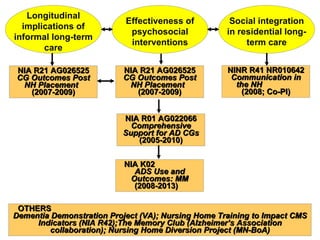
Longitudinal implications of informal long-term care Effectiveness of psychosocial interventions Social integration in residential long-term care OTHERS  Dementia Demonstration Project (VA); Nursing Home Training to Impact CMS Indicators (NIA R42);The Memory Club (Alzheimer’s Association collaboration); Nursing Home Diversion Project (MN-BoA) NIA R01 AG022066  Comprehensive Support for AD CGs  (2005-2010) NIA R21 AG026525  CG Outcomes Post NH Placement  (2007-2009) NIA K02  ADS Use and Outcomes: MM  (2008-2013)   NINR R41 NR010642  Communication in the NH  (2008; Co-PI) NIA R21 AG026525  CG Outcomes Post NH Placement  (2007-2009)
STATE OF THE ART (IN MY OPINION) Early cross-sectional work (Zarit et al., 1980) Conceptual models designed to guide research on the impact of family caregiving The stress process model, Pearlin et al., 1990 Longitudinal analyses of the caregiving “career” and long-term outcomes Interventions designed to alleviate some of the negative outcomes related to informal care Outcomes include caregiver stress, caregiver depression, and care recipient nursing home admission Support groups, respite, to more complex interventions
EVIDENCE-BASED REVIEW Goal: Use evidence-based methods to efficiently identify effective caregiving interventions “ Evidence-based medicine is the integration of best research evidence with clinical expertise and patient values” (Sackett et al., 2000;  http:// www.ebmpyramid.org/samples/complicated.html ) Methods: PICO: Problem, intervention, comparison, outcome Identifying “pre-processed” evidence: the 5S approach Appraising evidence Synthesizing evidence
PICO Population: Family caregivers of persons suffering from Alzheimer’s disease or a related dementia Intervention: Psychosocial (e.g., education, support groups, training, therapy/counseling, etc.) or community-based (e.g., respite services) programs Comparison: Those receiving “usual” care Outcomes: Caregiver stress, caregiver depression, care recipient nursing home admission PICO question:  Do family caregivers of persons with dementia who receive psychosocial or community-based intervention experience improved well-being and delay nursing home admission when compared to those who receive “usual care?”
From Haynes, 2006, p. A-8; Haynes, R. B.  (2006). Of studies, syntheses, synopses, summaries, and systems: the “5S” evolution of information services for evidence-based health care decisions.  ACP Journal Club, 145(3), A8-A9.
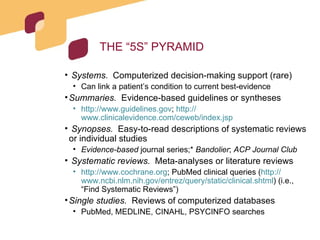
THE “5S” PYRAMID Systems.  Computerized decision-making support (rare) Can link a patient’s condition to current best-evidence Summaries.   Evidence-based guidelines or syntheses http:// www.guidelines.gov ;  http:// www.clinicalevidence.com/ceweb/index.jsp Synopses.   Easy-to-read descriptions of systematic reviews or individual studies Evidence-based  journal series;*  Bandolier ;  ACP Journal Club Systematic reviews.   Meta-analyses or literature reviews http:// www.cochrane.org ; PubMed clinical queries ( http:// www.ncbi.nlm.nih.gov/entrez/query/static/clinical.shtml ) (i.e., “Find Systematic Reviews”)  Single studies.   Reviews of computerized databases PubMed, MEDLINE, CINAHL, PSYCINFO searches
APPRAISING EVIDENCE From http://library.downstate.edu/EBM2/2100.htm
APPRAISING EVIDENCE Our evidence model (from Ackley et al., 2008): I:  Systematic review or meta-analysis of all relevant RCTs (randomized controlled trials) or evidence-based guidelines based on systematic reviews of RCTs We will be mostly at Level 1 for this synthesis II: Evidence from at least one RCT III: Evidence from controlled trials without randomization IV: Evidence from well-designed case-control or cohort studies V: Evidence from systematic reviews of descriptive studies VI: Evidence from a single descriptive/qualitative study VII: Expert opinion
RESULTS Systems Not applicable Summaries http://guidelines.gov , using the term “caregiving” and “dementia/Alzheimer’s disease caregiver” “ Caregiving” yielded 18 results Primarily focused on assessment, lack of evidence appraisal/nursing-specific;  1 guideline selected (Singapore Ministry of Health, 2007) “ Dementia/AD Caregiver” yielded 29 and 16 results, respectively 1 guideline selected (AAN, 2001/Doody et al., 2001)
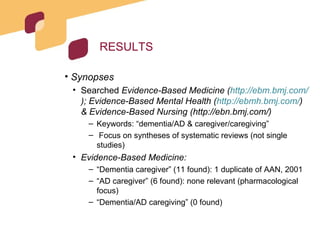
RESULTS Synopses Searched  Evidence-Based Medicine ( http:// ebm.bmj.com / ); Evidence-Based Mental Health ( http://ebmh.bmj.com/ ) & Evidence-Based Nursing (http://ebn.bmj.com/) Keywords: “dementia/AD & caregiver/caregiving” Focus on syntheses of systematic reviews (not single studies) Evidence-Based Medicine: “ Dementia caregiver” (11 found): 1 duplicate of AAN, 2001 “ AD caregiver” (6 found): none relevant (pharmacological focus) “ Dementia/AD caregiving” (0 found)
RESULTS Synopses Evidence-Based Mental Health “ Dementia caregiver” (30 found): 1 duplicate of AAN, 2001, 5 single studies, which were saved but not included  “ AD caregiver” (23 found): 1 found (Linger et al., 2005); others were duplicates “ Dementia/AD caregiving” (5 & 5 found, respectively); duplicates only Evidence-Based Nursing “ Dementia caregiver” (31 found): 4 single studies, 1 duplicate of AAN, 2001 “ AD caregiver” (15 found): All duplicates “ Dementia/AD caregiving” (19 & 8 found, respectively); duplicates only
RESULTS Syntheses The Cochrane Library ( http:// www.cochrane.org ) (focused on Cochrane reviews only) “ Dementia caregiver” (11 found): 2 selected (Lee & Cameron, 2004; Thompson & Spilsbury, 1998); others focused on patient-specific interventions “ AD caregiver” (4 found): duplicates only “ Dementia/AD caregiving” (0 found, respectively) PubMed special query for systematic reviews “ Dementia caregiver intervention” (35 found): 11 selected “ AD caregiver intervention” (16 found): 1 selected “ Dementia/AD caregiving” (4 & 0 found, respectively) “ Respite” (26 found): 7 selected
OVERALL IMPRESSIONS Lack of high quality evidence (e.g., randomized controlled trials, blinding, etc.) Difficult to classify “type” of intervention Variations in study design and sampling Variations in outcome measurement Statistical power/size of studies included Poor quality was particularly apparent in earlier evaluations Questionable inclusion/exclusion in some syntheses Do we still need more research in this area? Overall effectiveness: Moderate at best (e.g., Brodaty et al., 2003)
EVIDENCE-BASED SYNTHESIS All of these findings are based on “Level I” level of evidence Where possible, I have ranked the findings according to what I consider are the strongest  Organized into intervention type and findings (effective, possibly effective, not effective)
PSYCHOEDUCATIONAL INTERVENTIONS Involves a structured program that offers information about the disease, resources, and services.  May also include training caregivers to manage problems (Sörensen et al., 2002, p. 357) Effective In a meta-analysis, group-based supportive interventions based on a psycho-educational framework were effective in reducing psychological morbidity (Thompson et al., 2007) In a meta-analysis, psychoeducational interventions had consistent short-term benefits across outcomes (Sörensen et al., 2002) In a systematic review, Individual strategies were more effective than group or education-based approaches, although teaching coping strategies in group or individual settings seemed to provide short-term psychological benefits (Selwood et al., 2007) In a systematic review, combining social support and problem-solving approaches appeared effective (Cooke et al., 2001) In a systematic review, a brief education intervention appeared to reduce caregiver depression (Peacock & Forbes , 2003)
PSYCHOEDUCATIONAL INTERVENTIONS Possibly Effective An evidence-based guideline suggests that education may be helpful for dementia caregivers (AAN, 2001) Not Effective A meta-analysis found that only multi-component interventions were effective (Acton & Kang, 2001)
SUPPORTIVE INTERVENTIONS Includes professional or peer-led support groups that focus on exchange of feelings, ideas, and problems/successes (Sörensen et al., 2002, p. 357) Possibly Effective In a systematic review, combining social support and problem-solving approaches appeared effective (Cooke et al., 2001) In a meta-analysis, supportive interventions had some effect on burden and ability/knowledge but not on other outcomes (Sörensen et al., 2002)
SUPPORTIVE INTERVENTIONS Not Effective A meta-analysis found that only multi-component interventions were effective (Acton & Kang, 2001) In a systematic review, individual strategies were more effective than group or education-based approaches (Selwood et al., 2007)
RESPITE Service designed to give caregiver “time off” from responsibilities; either at-home or site-specific (Sörensen et al., 2002, p. 358) Possibly Effective In a meta-analysis, respite had some effect on burden, depression, and well-being of caregivers (Sörensen et al., 2002)
RESPITE Not Effective In a meta-analysis of all controlled trials, respite showed modest benefits for subgroups only and no benefit for nursing home admission; caregiver satisfaction was high (Mason et al., 2007) In a systematic review of respite interventions for caregivers, no consistent or enduring effects were found (McNally et al., 1999) A meta-analysis found that only multi-component interventions were effective (Acton & Kang, 2001) In a systematic review, respite appeared ineffective in reducing caregiver anxiety (Cooper et al., 2007) In a Cochrane meta-analysis, there were no benefits or risks associated with respite (Lee & Cameron, 2004)
PSYCHOTHERAPY “ Involves a therapeutic relationship between the caregiver and a professional” (Sörensen et al., 2002, p. 358) Effective In a meta-analysis, psychotherapy had an effect on all outcome variables (Sörensen et al., 2002) In a systematic review, CBT (along with relaxtion-based therapy) appeared effective in reducing caregiver anxiety (Cooper et al., 2007) In a systematic review, individual strategies such as multi-session behavior management therapy were found to be effective (Selwood et al., 2007) Possibly Effective In a systematic review, a psychotherapy study appeared to delay nursing home admission (Peacock & Forbes, 2003)
PSYCHOTHERAPY Not Effective In a meta-analysis, “individual-based” interventions were not effective when compared to group-based approaches (Thompson et al., 2007) A meta-analysis found that only multi-component interventions were effective (Acton & Kang, 2001)
MULTI-COMPONENT Various combinations of education, therapy, suppport, and respite (Sörensen et al., 2002, p. 358) Effective An evidence-based guideline found that multi-faceted caregivers interventions are important in dementia treatment (Singapore Ministry of Health, 2007) A meta-analysis found that only multi-component interventions were effective (Acton & Kang, 2001)
MULTI-COMPONENT Effective (cont.) While a meta-analysis found moderate benefits for all psychosocial interventions considered, multi-component, continuous, flexible support appeared linked to delayed institutionalization (Brodaty et al., 2003) A systematic review of “combined” interventions for dementia caregivers found that these approaches were most effective in improving caregiver mental health and delaying nursing home admission (Smits et al., 2007) Possibly Effective In a meta-analysis, intervention effects for multi-component strategies were powerful for select outcomes (e.g., caregiver burden, well-being, ability/knowledge), but few studies exist (Sörensen et al., 2002; see also Pinquart & Sörensen, 2006)
OTHER FINDINGS OF NOTE A meta-analysis found that Acetylcholinesterase inhibitors (ACEs) had moderate effects in reducing time spent on caregiving and burden (Lingler et al., 2005) A meta-analysis (Lee et al., 2007) of 4 studies found that interventions for stroke caregivers had moderate effects, but more research in this area is needed (Lui et al., 2005) Lower level evidence suggests that exercise is not effective, whereas there is very preliminary evidence supporting the use of yoga and relaxation techniques (systematic review of Cooper et al., 2007)
CONCLUSIONS The quality of evidence is still questionable (see above), but more recent evaluations appear stronger Psychosocial interventions that are more intensive, flexible, and individualized appear most effective at meeting the multi-faceted needs of caregivers Respite? As with all evidence-based approaches, clinical expertise along with patient values must be considered when implementing a caregiving intervention
EXAMPLES Multi-component New York University Caregiver Intervention (see http:// www.aoa.gov/alz/prof/ADDGS/programs/docs/Mary Mittelman Summary.doc for replication information) Resources for Enhancing Alzheimer’s Caregiver Health II (for more information, see http://www.edc.gsph.pitt.edu/reach2/) Psychoeducational/Training The Saavy Caregiver (for replication information and resources see http://www.raisingbar.eventwebsitebuilder.com/f/Savvy_Caregiver.pdf) Psychotherapy Refer to individual studies cited in Sörensen et al., 2002; Cooper et al., 2007; and Selwood et al., 2007 For an interesting take on caregiving intervention  translation, see www.rosalynncarter.org/UserFiles/Stevens Presentation.ppt
TRANSLATION RESOURCES For an interesting take on caregiving intervention  translation, see  www.rosalynncarter.org/UserFiles/Stevens Presentation.ppt For a discussion of the RE-AIM framework for caregiving interventions (reach, effectiveness, adoption, implementation, and maintenance), see: http://www.cdc.gov/Aging/pdf/caregiving_monograph.pdf
MY RESEARCH PROGRAM Comprehensive Support for Alzheimer's Disease Caregivers (R01 AG 022066) Caregiver Outcomes Post NH Placement of a Family Member (R21 AG 026525)  Communication in Nursing Home (R43NR010642-01) The Memory Club: Providing Support to Persons with Early-Stage Alzheimer’s Disease and their Care Partners  Early Dementia Identification Project  (pending) Adult Day Service Utilization and Outcomes: A Mixed Methods Approach (K02AG029480-01)
WHERE DO WE GO FROM HERE? Implementing the NYUCI for adult child caregivers in Minnesota, USA R01 AG022066 Developing a psychosocial intervention for families to navigate the NH transition R21 AG026525 Enhancing family involvement and interaction in the NH R41 NR010642 Focusing on other transitions in dementia care: Onset and the early-stage of AD The Memory Club, Dementia Demonstration Project,  Early Memory Care Initiative
CITATION LIST Acton GJ, Kang J.  Interventions to reduce the burden of caregiving for an adult with dementia: a meta-analysis. Res Nurs Health. 2001 Oct;24(5):349-60. Brodaty H, Green A, Koschera A. Meta-analysis of psychosocial interventions for caregivers of people with dementia. J Am Geriatr Soc. 2003 May;51(5):657-64. Cooke DD, McNally L, Mulligan KT, Harrison MJ, Newman SP.  Psychosocial interventions for caregivers of people with dementia: a systematic review. Aging Ment Health. 2001 May;5(2):120-35.  Cooper C, Balamurali TB, Selwood A, Livingston G. A systematic review of intervention studies about anxiety in caregivers of people with dementia. Int J Geriatr Psychiatry. 2007 Mar;22(3):181-8. Flint AJ. Effects of respite care on patients with dementia and their caregivers. Int Psychogeriatr. 1995 Winter;7(4):505-17.*
CITATION LIST Knight BG, Lutzky SM, Macofsky-Urban F. A meta-analytic review of interventions for caregiver distress: recommendations for future research. Gerontologist. 1993 Apr;33(2):240-8.* Lee J, Soeken K, Picot SJ. A meta-analysis of interventions for informal stroke caregivers. West J Nurs Res. 2007 Apr;29(3):344-56; discussion 357-364 Lui MH, Ross FM, Thompson DR. Supporting family caregivers in stroke care: a review of the evidence for problem solving. Stroke. 2005 Nov;36(11):2514-22.  Mason A, Weatherly H, Spilsbury K, Arksey H, Golder S, Adamson J, Drummond M, Glendinning C. A systematic review of the effectiveness and cost-effectiveness of different models of community-based respite care for frail older people and their carers. Health Technol Assess. 2007 Apr;11(15):1-157, iii.*
CITATION LIST Mason A, Weatherly H, Spilsbury K, Golder S, Arksey H, Adamson J, Drummond M. The effectiveness and cost-effectiveness of respite for caregivers of frail older people. J Am Geriatr Soc. 2007 Feb;55(2):290-9.  McNally S, Ben-Shlomo Y, Newman S. The effects of respite care on informal carers' well-being: a systematic review. Disabil Rehabil. 1999 Jan;21(1):1-14. Peacock SC, Forbes DA.  Interventions for caregivers of persons with dementia: a systematic review. Can J Nurs Res. 2003 Dec;35(4):88-107.  Pinquart M, Sörensen S. Helping caregivers of persons with dementia: which interventions work and how large are their effects?  Int Psychogeriatr. 2006 Dec;18(4):577-95. Selwood A, Johnston K, Katona C, Lyketsos C, Livingston G. Systematic review of the effect of psychological interventions on family caregivers of people with dementia. J Affect Disord. 2007 Aug;101(1-3):75-89.
CITATION LIST Smits CH, de Lange J, Dröes RM, Meiland F, Vernooij-Dassen M, Pot AM. Effects of combined intervention programmes for people with dementia living at home and their caregivers: a systematic review. Int J Geriatr Psychiatry. 2007 Dec;22(12):1181-93. Sörensen S, Pinquart M, Duberstein P.  How effective are interventions with caregivers? An updated meta-analysis. Gerontologist. 2002 Jun;42(3):356-72. Stoltz P, Udén G, Willman A. Support for family carers who care for an elderly person at home - a systematic literature review. Scand J Caring Sci. 2004 Jun;18(2):111-9.  Thompson CA, Spilsbury K, Hall J, Birks Y, Barnes C, Adamson J.  Systematic review of information and support interventions for caregivers of people with dementia. BMC Geriatr. 2007 Jul 27;7:18.* *Article not retrieved for this synthesis
CITATION LIST Lingler JH, Martire LM, Schulz R.  Caregiver-specific outcomes in antidementia clinical drug trials: A systematic review and meta-analuysis.  J Am Geriatr Soc  2005;53:983-990. (synopsis available in Gilley DW.  (2006).  Review: Cholinesterase inhibitors reduce burden and care time for informal carers of people with Alzheimer’s disease.  Evidence-Based Mental Health, 9,  19.) Doody RS, Stevens JC, Beck C, et al.  Practice parameter: Management of dementia (an evidence-based review).  Report of the Quality Standards Subcommittee of the American Academy of Neurology.  Neurology 2001 May 8;56: 1154-1166.  (For .pdf and other information, click  here .  Synopsis available in Clarfield, A. M.  (2001).  Review: Pharmacological and non-pharmacological interventions improve outcomes in patients with dementia and their caregivers.  Evidence-Based Medicine, 6,  183.) Singapore Ministry of Health (2007).  Dementia.  For more information and .pdf, click  here .
CONTACT INFORMATION Joseph E. Gaugler, Ph.D. University of Minnesota 6-153 Weaver-Densford Hall, 1331 308 Harvard Street S.E. Minneapolis, MN  55455 Telephone: 612-626-2485 Email:  [email_address] Fax: 612-625-7180

An Evidence-Based Synthesis of Dementia Caregiver Interventions

  • 1.
    AN EVIDENCE-BASED SYNTHESISOF DEMENTIA CAREGIVER INTERVENTIONS JOSEPH E. GAUGLER, PH.D. ASSOCIATE PROFESSOR MCKNIGHT PRESIDENTIAL FELLOW SCHOOL OF NURSING UNIVERSITY OF MINNESOTA
  • 2.
    SPECIFIC AIMS Whoam I? Conduct an evidence-based synthesis of dementia caregiving interventions Provide resources and a brief overview of some of my work in dementia caregiving intervention
  • 3.
    Longitudinal implications ofinformal long-term care Effectiveness of psychosocial interventions Social integration in residential long-term care OTHERS Dementia Demonstration Project (VA); Nursing Home Training to Impact CMS Indicators (NIA R42);The Memory Club (Alzheimer’s Association collaboration); Nursing Home Diversion Project (MN-BoA) NIA R01 AG022066 Comprehensive Support for AD CGs (2005-2010) NIA R21 AG026525 CG Outcomes Post NH Placement (2007-2009) NIA K02 ADS Use and Outcomes: MM (2008-2013) NINR R41 NR010642 Communication in the NH (2008; Co-PI) NIA R21 AG026525 CG Outcomes Post NH Placement (2007-2009)
  • 4.
    STATE OF THEART (IN MY OPINION) Early cross-sectional work (Zarit et al., 1980) Conceptual models designed to guide research on the impact of family caregiving The stress process model, Pearlin et al., 1990 Longitudinal analyses of the caregiving “career” and long-term outcomes Interventions designed to alleviate some of the negative outcomes related to informal care Outcomes include caregiver stress, caregiver depression, and care recipient nursing home admission Support groups, respite, to more complex interventions
  • 5.
    EVIDENCE-BASED REVIEW Goal:Use evidence-based methods to efficiently identify effective caregiving interventions “ Evidence-based medicine is the integration of best research evidence with clinical expertise and patient values” (Sackett et al., 2000; http:// www.ebmpyramid.org/samples/complicated.html ) Methods: PICO: Problem, intervention, comparison, outcome Identifying “pre-processed” evidence: the 5S approach Appraising evidence Synthesizing evidence
  • 6.
    PICO Population: Familycaregivers of persons suffering from Alzheimer’s disease or a related dementia Intervention: Psychosocial (e.g., education, support groups, training, therapy/counseling, etc.) or community-based (e.g., respite services) programs Comparison: Those receiving “usual” care Outcomes: Caregiver stress, caregiver depression, care recipient nursing home admission PICO question: Do family caregivers of persons with dementia who receive psychosocial or community-based intervention experience improved well-being and delay nursing home admission when compared to those who receive “usual care?”
  • 7.
    From Haynes, 2006,p. A-8; Haynes, R. B. (2006). Of studies, syntheses, synopses, summaries, and systems: the “5S” evolution of information services for evidence-based health care decisions. ACP Journal Club, 145(3), A8-A9.
  • 8.
    THE “5S” PYRAMIDSystems. Computerized decision-making support (rare) Can link a patient’s condition to current best-evidence Summaries. Evidence-based guidelines or syntheses http:// www.guidelines.gov ; http:// www.clinicalevidence.com/ceweb/index.jsp Synopses. Easy-to-read descriptions of systematic reviews or individual studies Evidence-based journal series;* Bandolier ; ACP Journal Club Systematic reviews. Meta-analyses or literature reviews http:// www.cochrane.org ; PubMed clinical queries ( http:// www.ncbi.nlm.nih.gov/entrez/query/static/clinical.shtml ) (i.e., “Find Systematic Reviews”) Single studies. Reviews of computerized databases PubMed, MEDLINE, CINAHL, PSYCINFO searches
  • 9.
    APPRAISING EVIDENCE Fromhttp://library.downstate.edu/EBM2/2100.htm
  • 10.
    APPRAISING EVIDENCE Ourevidence model (from Ackley et al., 2008): I: Systematic review or meta-analysis of all relevant RCTs (randomized controlled trials) or evidence-based guidelines based on systematic reviews of RCTs We will be mostly at Level 1 for this synthesis II: Evidence from at least one RCT III: Evidence from controlled trials without randomization IV: Evidence from well-designed case-control or cohort studies V: Evidence from systematic reviews of descriptive studies VI: Evidence from a single descriptive/qualitative study VII: Expert opinion
  • 11.
    RESULTS Systems Notapplicable Summaries http://guidelines.gov , using the term “caregiving” and “dementia/Alzheimer’s disease caregiver” “ Caregiving” yielded 18 results Primarily focused on assessment, lack of evidence appraisal/nursing-specific; 1 guideline selected (Singapore Ministry of Health, 2007) “ Dementia/AD Caregiver” yielded 29 and 16 results, respectively 1 guideline selected (AAN, 2001/Doody et al., 2001)
  • 12.
    RESULTS Synopses Searched Evidence-Based Medicine ( http:// ebm.bmj.com / ); Evidence-Based Mental Health ( http://ebmh.bmj.com/ ) & Evidence-Based Nursing (http://ebn.bmj.com/) Keywords: “dementia/AD & caregiver/caregiving” Focus on syntheses of systematic reviews (not single studies) Evidence-Based Medicine: “ Dementia caregiver” (11 found): 1 duplicate of AAN, 2001 “ AD caregiver” (6 found): none relevant (pharmacological focus) “ Dementia/AD caregiving” (0 found)
  • 13.
    RESULTS Synopses Evidence-BasedMental Health “ Dementia caregiver” (30 found): 1 duplicate of AAN, 2001, 5 single studies, which were saved but not included “ AD caregiver” (23 found): 1 found (Linger et al., 2005); others were duplicates “ Dementia/AD caregiving” (5 & 5 found, respectively); duplicates only Evidence-Based Nursing “ Dementia caregiver” (31 found): 4 single studies, 1 duplicate of AAN, 2001 “ AD caregiver” (15 found): All duplicates “ Dementia/AD caregiving” (19 & 8 found, respectively); duplicates only
  • 14.
    RESULTS Syntheses TheCochrane Library ( http:// www.cochrane.org ) (focused on Cochrane reviews only) “ Dementia caregiver” (11 found): 2 selected (Lee & Cameron, 2004; Thompson & Spilsbury, 1998); others focused on patient-specific interventions “ AD caregiver” (4 found): duplicates only “ Dementia/AD caregiving” (0 found, respectively) PubMed special query for systematic reviews “ Dementia caregiver intervention” (35 found): 11 selected “ AD caregiver intervention” (16 found): 1 selected “ Dementia/AD caregiving” (4 & 0 found, respectively) “ Respite” (26 found): 7 selected
  • 15.
    OVERALL IMPRESSIONS Lackof high quality evidence (e.g., randomized controlled trials, blinding, etc.) Difficult to classify “type” of intervention Variations in study design and sampling Variations in outcome measurement Statistical power/size of studies included Poor quality was particularly apparent in earlier evaluations Questionable inclusion/exclusion in some syntheses Do we still need more research in this area? Overall effectiveness: Moderate at best (e.g., Brodaty et al., 2003)
  • 16.
    EVIDENCE-BASED SYNTHESIS Allof these findings are based on “Level I” level of evidence Where possible, I have ranked the findings according to what I consider are the strongest Organized into intervention type and findings (effective, possibly effective, not effective)
  • 17.
    PSYCHOEDUCATIONAL INTERVENTIONS Involvesa structured program that offers information about the disease, resources, and services. May also include training caregivers to manage problems (Sörensen et al., 2002, p. 357) Effective In a meta-analysis, group-based supportive interventions based on a psycho-educational framework were effective in reducing psychological morbidity (Thompson et al., 2007) In a meta-analysis, psychoeducational interventions had consistent short-term benefits across outcomes (Sörensen et al., 2002) In a systematic review, Individual strategies were more effective than group or education-based approaches, although teaching coping strategies in group or individual settings seemed to provide short-term psychological benefits (Selwood et al., 2007) In a systematic review, combining social support and problem-solving approaches appeared effective (Cooke et al., 2001) In a systematic review, a brief education intervention appeared to reduce caregiver depression (Peacock & Forbes , 2003)
  • 18.
    PSYCHOEDUCATIONAL INTERVENTIONS PossiblyEffective An evidence-based guideline suggests that education may be helpful for dementia caregivers (AAN, 2001) Not Effective A meta-analysis found that only multi-component interventions were effective (Acton & Kang, 2001)
  • 19.
    SUPPORTIVE INTERVENTIONS Includesprofessional or peer-led support groups that focus on exchange of feelings, ideas, and problems/successes (Sörensen et al., 2002, p. 357) Possibly Effective In a systematic review, combining social support and problem-solving approaches appeared effective (Cooke et al., 2001) In a meta-analysis, supportive interventions had some effect on burden and ability/knowledge but not on other outcomes (Sörensen et al., 2002)
  • 20.
    SUPPORTIVE INTERVENTIONS NotEffective A meta-analysis found that only multi-component interventions were effective (Acton & Kang, 2001) In a systematic review, individual strategies were more effective than group or education-based approaches (Selwood et al., 2007)
  • 21.
    RESPITE Service designedto give caregiver “time off” from responsibilities; either at-home or site-specific (Sörensen et al., 2002, p. 358) Possibly Effective In a meta-analysis, respite had some effect on burden, depression, and well-being of caregivers (Sörensen et al., 2002)
  • 22.
    RESPITE Not EffectiveIn a meta-analysis of all controlled trials, respite showed modest benefits for subgroups only and no benefit for nursing home admission; caregiver satisfaction was high (Mason et al., 2007) In a systematic review of respite interventions for caregivers, no consistent or enduring effects were found (McNally et al., 1999) A meta-analysis found that only multi-component interventions were effective (Acton & Kang, 2001) In a systematic review, respite appeared ineffective in reducing caregiver anxiety (Cooper et al., 2007) In a Cochrane meta-analysis, there were no benefits or risks associated with respite (Lee & Cameron, 2004)
  • 23.
    PSYCHOTHERAPY “ Involvesa therapeutic relationship between the caregiver and a professional” (Sörensen et al., 2002, p. 358) Effective In a meta-analysis, psychotherapy had an effect on all outcome variables (Sörensen et al., 2002) In a systematic review, CBT (along with relaxtion-based therapy) appeared effective in reducing caregiver anxiety (Cooper et al., 2007) In a systematic review, individual strategies such as multi-session behavior management therapy were found to be effective (Selwood et al., 2007) Possibly Effective In a systematic review, a psychotherapy study appeared to delay nursing home admission (Peacock & Forbes, 2003)
  • 24.
    PSYCHOTHERAPY Not EffectiveIn a meta-analysis, “individual-based” interventions were not effective when compared to group-based approaches (Thompson et al., 2007) A meta-analysis found that only multi-component interventions were effective (Acton & Kang, 2001)
  • 25.
    MULTI-COMPONENT Various combinationsof education, therapy, suppport, and respite (Sörensen et al., 2002, p. 358) Effective An evidence-based guideline found that multi-faceted caregivers interventions are important in dementia treatment (Singapore Ministry of Health, 2007) A meta-analysis found that only multi-component interventions were effective (Acton & Kang, 2001)
  • 26.
    MULTI-COMPONENT Effective (cont.)While a meta-analysis found moderate benefits for all psychosocial interventions considered, multi-component, continuous, flexible support appeared linked to delayed institutionalization (Brodaty et al., 2003) A systematic review of “combined” interventions for dementia caregivers found that these approaches were most effective in improving caregiver mental health and delaying nursing home admission (Smits et al., 2007) Possibly Effective In a meta-analysis, intervention effects for multi-component strategies were powerful for select outcomes (e.g., caregiver burden, well-being, ability/knowledge), but few studies exist (Sörensen et al., 2002; see also Pinquart & Sörensen, 2006)
  • 27.
    OTHER FINDINGS OFNOTE A meta-analysis found that Acetylcholinesterase inhibitors (ACEs) had moderate effects in reducing time spent on caregiving and burden (Lingler et al., 2005) A meta-analysis (Lee et al., 2007) of 4 studies found that interventions for stroke caregivers had moderate effects, but more research in this area is needed (Lui et al., 2005) Lower level evidence suggests that exercise is not effective, whereas there is very preliminary evidence supporting the use of yoga and relaxation techniques (systematic review of Cooper et al., 2007)
  • 28.
    CONCLUSIONS The qualityof evidence is still questionable (see above), but more recent evaluations appear stronger Psychosocial interventions that are more intensive, flexible, and individualized appear most effective at meeting the multi-faceted needs of caregivers Respite? As with all evidence-based approaches, clinical expertise along with patient values must be considered when implementing a caregiving intervention
  • 29.
    EXAMPLES Multi-component NewYork University Caregiver Intervention (see http:// www.aoa.gov/alz/prof/ADDGS/programs/docs/Mary Mittelman Summary.doc for replication information) Resources for Enhancing Alzheimer’s Caregiver Health II (for more information, see http://www.edc.gsph.pitt.edu/reach2/) Psychoeducational/Training The Saavy Caregiver (for replication information and resources see http://www.raisingbar.eventwebsitebuilder.com/f/Savvy_Caregiver.pdf) Psychotherapy Refer to individual studies cited in Sörensen et al., 2002; Cooper et al., 2007; and Selwood et al., 2007 For an interesting take on caregiving intervention translation, see www.rosalynncarter.org/UserFiles/Stevens Presentation.ppt
  • 30.
    TRANSLATION RESOURCES Foran interesting take on caregiving intervention translation, see www.rosalynncarter.org/UserFiles/Stevens Presentation.ppt For a discussion of the RE-AIM framework for caregiving interventions (reach, effectiveness, adoption, implementation, and maintenance), see: http://www.cdc.gov/Aging/pdf/caregiving_monograph.pdf
  • 31.
    MY RESEARCH PROGRAMComprehensive Support for Alzheimer's Disease Caregivers (R01 AG 022066) Caregiver Outcomes Post NH Placement of a Family Member (R21 AG 026525) Communication in Nursing Home (R43NR010642-01) The Memory Club: Providing Support to Persons with Early-Stage Alzheimer’s Disease and their Care Partners Early Dementia Identification Project (pending) Adult Day Service Utilization and Outcomes: A Mixed Methods Approach (K02AG029480-01)
  • 32.
    WHERE DO WEGO FROM HERE? Implementing the NYUCI for adult child caregivers in Minnesota, USA R01 AG022066 Developing a psychosocial intervention for families to navigate the NH transition R21 AG026525 Enhancing family involvement and interaction in the NH R41 NR010642 Focusing on other transitions in dementia care: Onset and the early-stage of AD The Memory Club, Dementia Demonstration Project, Early Memory Care Initiative
  • 33.
    CITATION LIST ActonGJ, Kang J. Interventions to reduce the burden of caregiving for an adult with dementia: a meta-analysis. Res Nurs Health. 2001 Oct;24(5):349-60. Brodaty H, Green A, Koschera A. Meta-analysis of psychosocial interventions for caregivers of people with dementia. J Am Geriatr Soc. 2003 May;51(5):657-64. Cooke DD, McNally L, Mulligan KT, Harrison MJ, Newman SP. Psychosocial interventions for caregivers of people with dementia: a systematic review. Aging Ment Health. 2001 May;5(2):120-35. Cooper C, Balamurali TB, Selwood A, Livingston G. A systematic review of intervention studies about anxiety in caregivers of people with dementia. Int J Geriatr Psychiatry. 2007 Mar;22(3):181-8. Flint AJ. Effects of respite care on patients with dementia and their caregivers. Int Psychogeriatr. 1995 Winter;7(4):505-17.*
  • 34.
    CITATION LIST KnightBG, Lutzky SM, Macofsky-Urban F. A meta-analytic review of interventions for caregiver distress: recommendations for future research. Gerontologist. 1993 Apr;33(2):240-8.* Lee J, Soeken K, Picot SJ. A meta-analysis of interventions for informal stroke caregivers. West J Nurs Res. 2007 Apr;29(3):344-56; discussion 357-364 Lui MH, Ross FM, Thompson DR. Supporting family caregivers in stroke care: a review of the evidence for problem solving. Stroke. 2005 Nov;36(11):2514-22. Mason A, Weatherly H, Spilsbury K, Arksey H, Golder S, Adamson J, Drummond M, Glendinning C. A systematic review of the effectiveness and cost-effectiveness of different models of community-based respite care for frail older people and their carers. Health Technol Assess. 2007 Apr;11(15):1-157, iii.*
  • 35.
    CITATION LIST MasonA, Weatherly H, Spilsbury K, Golder S, Arksey H, Adamson J, Drummond M. The effectiveness and cost-effectiveness of respite for caregivers of frail older people. J Am Geriatr Soc. 2007 Feb;55(2):290-9. McNally S, Ben-Shlomo Y, Newman S. The effects of respite care on informal carers' well-being: a systematic review. Disabil Rehabil. 1999 Jan;21(1):1-14. Peacock SC, Forbes DA. Interventions for caregivers of persons with dementia: a systematic review. Can J Nurs Res. 2003 Dec;35(4):88-107. Pinquart M, Sörensen S. Helping caregivers of persons with dementia: which interventions work and how large are their effects? Int Psychogeriatr. 2006 Dec;18(4):577-95. Selwood A, Johnston K, Katona C, Lyketsos C, Livingston G. Systematic review of the effect of psychological interventions on family caregivers of people with dementia. J Affect Disord. 2007 Aug;101(1-3):75-89.
  • 36.
    CITATION LIST SmitsCH, de Lange J, Dröes RM, Meiland F, Vernooij-Dassen M, Pot AM. Effects of combined intervention programmes for people with dementia living at home and their caregivers: a systematic review. Int J Geriatr Psychiatry. 2007 Dec;22(12):1181-93. Sörensen S, Pinquart M, Duberstein P. How effective are interventions with caregivers? An updated meta-analysis. Gerontologist. 2002 Jun;42(3):356-72. Stoltz P, Udén G, Willman A. Support for family carers who care for an elderly person at home - a systematic literature review. Scand J Caring Sci. 2004 Jun;18(2):111-9. Thompson CA, Spilsbury K, Hall J, Birks Y, Barnes C, Adamson J. Systematic review of information and support interventions for caregivers of people with dementia. BMC Geriatr. 2007 Jul 27;7:18.* *Article not retrieved for this synthesis
  • 37.
    CITATION LIST LinglerJH, Martire LM, Schulz R. Caregiver-specific outcomes in antidementia clinical drug trials: A systematic review and meta-analuysis. J Am Geriatr Soc 2005;53:983-990. (synopsis available in Gilley DW. (2006). Review: Cholinesterase inhibitors reduce burden and care time for informal carers of people with Alzheimer’s disease. Evidence-Based Mental Health, 9, 19.) Doody RS, Stevens JC, Beck C, et al. Practice parameter: Management of dementia (an evidence-based review). Report of the Quality Standards Subcommittee of the American Academy of Neurology. Neurology 2001 May 8;56: 1154-1166. (For .pdf and other information, click here . Synopsis available in Clarfield, A. M. (2001). Review: Pharmacological and non-pharmacological interventions improve outcomes in patients with dementia and their caregivers. Evidence-Based Medicine, 6, 183.) Singapore Ministry of Health (2007). Dementia. For more information and .pdf, click here .
  • 38.
    CONTACT INFORMATION JosephE. Gaugler, Ph.D. University of Minnesota 6-153 Weaver-Densford Hall, 1331 308 Harvard Street S.E. Minneapolis, MN 55455 Telephone: 612-626-2485 Email: [email_address] Fax: 612-625-7180