© Rich Gordon 2013
What Gets Measured Gets Done:
Web and Social Analytics for Publishers
Local Media Association – May 15, 2013
Rich Gordon
@richgor
© Rich Gordon 2013
The problem for publishers
• The Web: “the most measurable medium ever”
• We are awash in measurement data
• What should we keep track of?
• Publishers have unique measurement needs
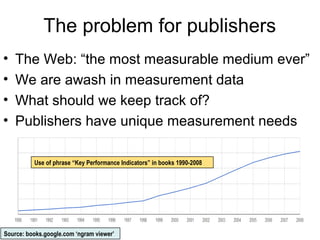
Use of phrase “Key Performance Indicators” in books 1990-2008
Source: books.google.com ‘ngram viewer’
© Rich Gordon 2013
Key Performance Indicators
for publishers
• Based on three years of classes in which I
had Medill students examine “networked
audience development practices” – and
metrics – for locally focused websites:
– Links & content referrals
– SEO
– Social media
• Based mostly on Google Analytics
• A work in progress – I welcome your
feedback
© Rich Gordon 2013
Propositions for today
• Every publisher should have a set of KPI’s
that are tracked consistently and regularly
• These KPI’s should be shared throughout the
organization
• Performance on KPI’s should be factored into
personnel decisions
• KPI’s should align to business goals – they
will be different for every publisher
© Rich Gordon 2013
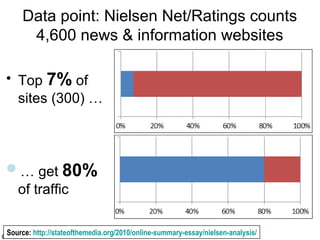
Data point: Nielsen Net/Ratings counts
4,600 news & information websites
• Top 7% of
sites (300) …
… get 80%
of traffic
Source: http://stateofthemedia.org/2010/online-summary-essay/nielsen-analysis/
© Rich Gordon 2013
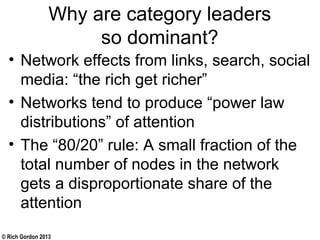
Why are category leaders
so dominant?
• Network effects from links, search, social
media: “the rich get richer”
• Networks tend to produce “power law
distributions” of attention
• The “80/20” rule: A small fraction of the
total number of nodes in the network
gets a disproportionate share of the
attention
© Rich Gordon 2013
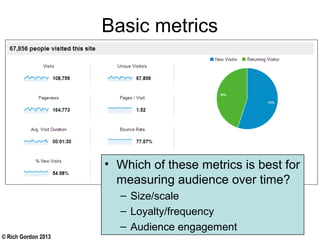
Basic metrics
• Which of these metrics is best for
measuring audience over time?
– Size/scale
– Loyalty/frequency
– Audience engagement
© Rich Gordon 2013
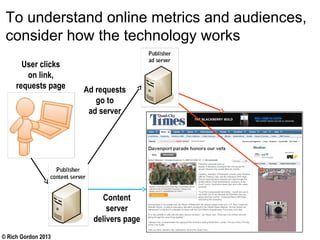
User clicks
on link,
requests page
Content
server
delivers page
Ad requests
go to
ad server
To understand online metrics and audiences,
consider how the technology works
© Rich Gordon 2013
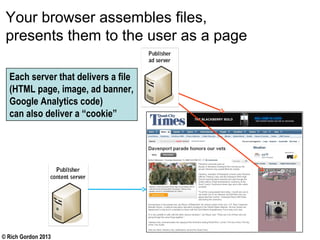
Your browser assembles files,
presents them to the user as a page
Each server that delivers a file
(HTML page, image, ad banner,
Google Analytics code)
can also deliver a “cookie”
© Rich Gordon 2013
Audience vocabulary,
for starters
• Unique Visitors (Unique Audience): The total number of
unique persons visiting a Web site at least once in a
time period (usually one month). Persons visiting the
same site more than one time in the reporting period are
counted only once.
• Visit (Session): A continuous series of URL/page
requests. A gap of 30 minutes between URL requests
ends a session/visit.
• Page views: The total number of times a Web page is
requested by a user. Counted only when page fully loads
in browser window.
• Bounce Rate: Portion of visits that are exactly one page
view.
computers visiting
© Rich Gordon 2013
Unique visitors vs. visits
• Remember that what’s really being counted here
is cookies
• A visit happens any time the server delivers a
new cookie or reads an existing cookie on the
user’s computer.
• Unique visitors are counted each time a cookie
to a new user/computer (or a user/computer the
server believes is new)
• A new visitor is a computer/browser that has not
been seen before in the given time period
(typically a month)
© Rich Gordon 2013
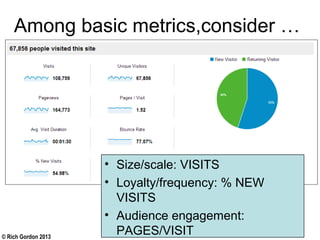
Among basic metrics,consider …
• Size/scale: VISITS
• Loyalty/frequency: % NEW
VISITS
• Audience engagement:
PAGES/VISIT
© Rich Gordon 2013
Problems with other metrics
• Unique visitors: Each browser has its own
cookies!
– Users with four browsers on one computer – or a
work PC, home PC, tablet and smartphone – are
counted as four separate visitors.
• Pageviews: Easily manipulated – can reward
site practices that users hate
• Bounce rate: More appropriate for direct
marketing campaigns ... but strive for
improvement over time
© Rich Gordon 2013
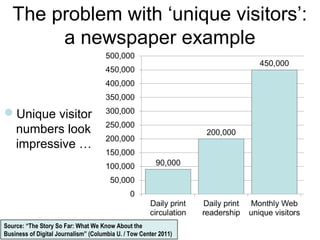
The problem with ‘unique visitors’:
a newspaper example
Unique visitor
numbers look
impressive …
Source: “The Story So Far: What We Know About the
Business of Digital Journalism” (Columbia U. / Tow Center 2011)
© Rich Gordon 2013
… but most users
don’t visit very often
Number of visits per month
1 2 3-6 7-9 10+
Source: Nielsen Company and PEJ Research
© Rich Gordon 2013
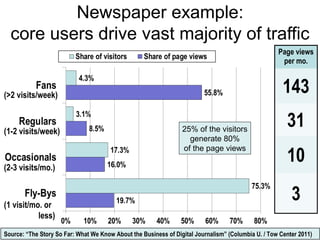
Newspaper example:
core users drive vast majority of traffic
Source: “The Story So Far: What We Know About the Business of Digital Journalism” (Columbia U. / Tow Center 2011)
(>2 visits/week)
(1-2 visits/week)
(2-3 visits/mo.)
(1 visit/mo. or
less)
25% of the visitors
generate 80%
of the page views
Page views
per mo.
143
31
10
3
© Rich Gordon 2013
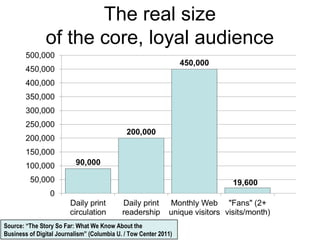
The real size
of the core, loyal audience
Source: “The Story So Far: What We Know About the
Business of Digital Journalism” (Columbia U. / Tow Center 2011)
© Rich Gordon 2013
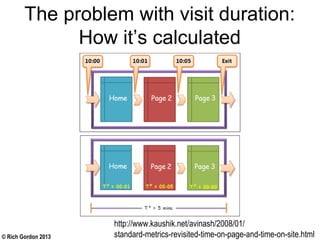
http://www.kaushik.net/avinash/2008/01/
standard-metrics-revisited-time-on-page-and-time-on-site.html
The problem with visit duration:
How it’s calculated
© Rich Gordon 2013
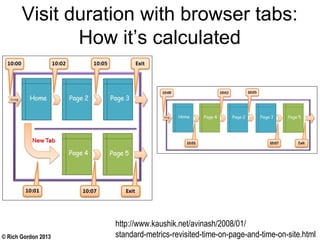
Visit duration with browser tabs:
How it’s calculated
http://www.kaushik.net/avinash/2008/01/
standard-metrics-revisited-time-on-page-and-time-on-site.html
© Rich Gordon 2013
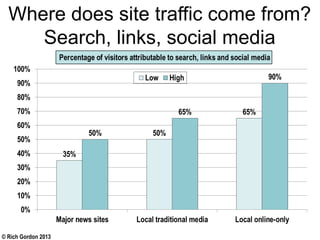
Where does site traffic come from?
Search, links, social media
© Rich Gordon 2013
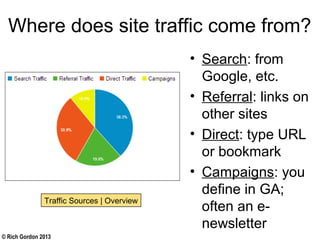
Where does site traffic come from?
• Search: from
Google, etc.
• Referral: links on
other sites
• Direct: type URL
or bookmark
• Campaigns: you
define in GA;
often an e-
newsletter
Traffic Sources | Overview
© Rich Gordon 2013
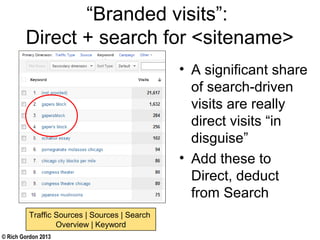
“Branded visits”:
Direct + search for <sitename>
• A significant share
of search-driven
visits are really
direct visits “in
disguise”
• Add these to
Direct, deduct
from Search
Traffic Sources | Sources | Search
Overview | Keyword
© Rich Gordon 2013
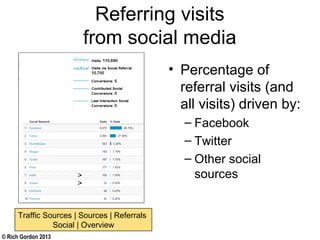
Referring visits
from social media
• Percentage of
referral visits (and
all visits) driven by:
– Facebook
– Twitter
– Other social
sources
Traffic Sources | Sources | Referrals
Social | Overview
© Rich Gordon 2013
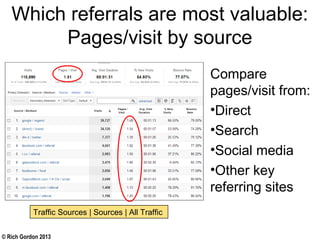
Which referrals are most valuable:
Pages/visit by source
Traffic Sources | Sources | All Traffic
Compare
pages/visit from:
•Direct
•Search
•Social media
•Other key
referring sites
© Rich Gordon 2013
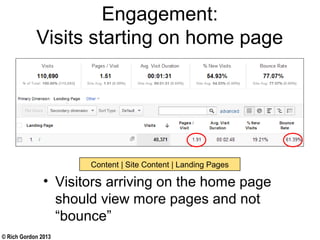
Engagement:
Visits starting on home page
• Visitors arriving on the home page
should view more pages and not
“bounce”
Content | Site Content | Landing Pages
© Rich Gordon 2013
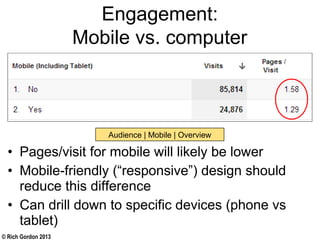
Engagement:
Mobile vs. computer
• Pages/visit for mobile will likely be lower
• Mobile-friendly (“responsive”) design should
reduce this difference
• Can drill down to specific devices (phone vs
tablet)
Audience | Mobile | Overview
© Rich Gordon 2013
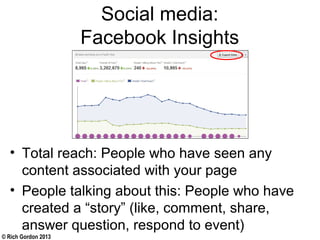
Social media:
Facebook Insights
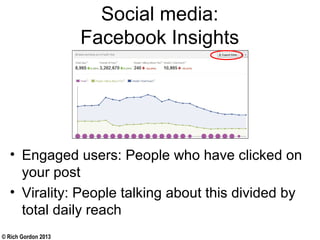
• Total reach: People who have seen any
content associated with your page
• People talking about this: People who have
created a “story” (like, comment, share,
answer question, respond to event)
© Rich Gordon 2013
Social media:
Facebook Insights
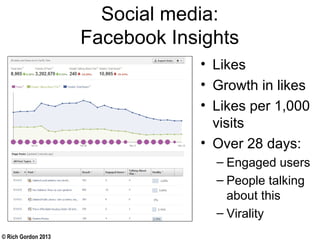
• Engaged users: People who have clicked on
your post
• Virality: People talking about this divided by
total daily reach
© Rich Gordon 2013
Social media:
Facebook Insights
• Likes
• Growth in likes
• Likes per 1,000
visits
• Over 28 days:
– Engaged users
– People talking
about this
– Virality
© Rich Gordon 2013
Social media:
Twitter
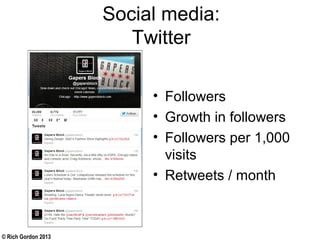
• Followers
• Growth in followers
• Followers per 1,000
visits
• Retweets / month
© Rich Gordon 2013
Social media:
Twitter
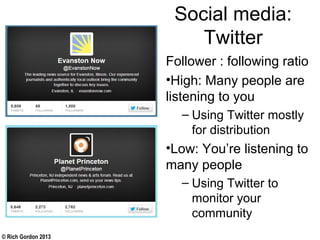
Follower : following ratio
•High: Many people are
listening to you
– Using Twitter mostly
for distribution
•Low: You’re listening to
many people
– Using Twitter to
monitor your
community
© Rich Gordon 2013
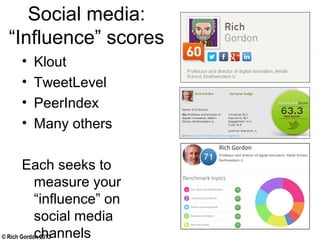
Social media:
“Influence” scores
• Klout
• TweetLevel
• PeerIndex
• Many others
Each seeks to
measure your
“influence” on
social media
channels
© Rich Gordon 2013
Thank you!
richgor@northwestern.edu
@richgor

Measuring digital success with web and social analytics (Local Media Assn., May 2013)

  • 1.
    © Rich Gordon2013 What Gets Measured Gets Done: Web and Social Analytics for Publishers Local Media Association – May 15, 2013 Rich Gordon @richgor
  • 2.
    © Rich Gordon2013 The problem for publishers • The Web: “the most measurable medium ever” • We are awash in measurement data • What should we keep track of? • Publishers have unique measurement needs Use of phrase “Key Performance Indicators” in books 1990-2008 Source: books.google.com ‘ngram viewer’
  • 3.
    © Rich Gordon2013 Key Performance Indicators for publishers • Based on three years of classes in which I had Medill students examine “networked audience development practices” – and metrics – for locally focused websites: – Links & content referrals – SEO – Social media • Based mostly on Google Analytics • A work in progress – I welcome your feedback
  • 4.
    © Rich Gordon2013 Propositions for today • Every publisher should have a set of KPI’s that are tracked consistently and regularly • These KPI’s should be shared throughout the organization • Performance on KPI’s should be factored into personnel decisions • KPI’s should align to business goals – they will be different for every publisher
  • 5.
    © Rich Gordon2013 Data point: Nielsen Net/Ratings counts 4,600 news & information websites • Top 7% of sites (300) … … get 80% of traffic Source: http://stateofthemedia.org/2010/online-summary-essay/nielsen-analysis/
  • 6.
    © Rich Gordon2013 Why are category leaders so dominant? • Network effects from links, search, social media: “the rich get richer” • Networks tend to produce “power law distributions” of attention • The “80/20” rule: A small fraction of the total number of nodes in the network gets a disproportionate share of the attention
  • 7.
    © Rich Gordon2013 Basic metrics • Which of these metrics is best for measuring audience over time? – Size/scale – Loyalty/frequency – Audience engagement
  • 8.
    © Rich Gordon2013 User clicks on link, requests page Content server delivers page Ad requests go to ad server To understand online metrics and audiences, consider how the technology works
  • 9.
    © Rich Gordon2013 Your browser assembles files, presents them to the user as a page Each server that delivers a file (HTML page, image, ad banner, Google Analytics code) can also deliver a “cookie”
  • 10.
    © Rich Gordon2013 Audience vocabulary, for starters • Unique Visitors (Unique Audience): The total number of unique persons visiting a Web site at least once in a time period (usually one month). Persons visiting the same site more than one time in the reporting period are counted only once. • Visit (Session): A continuous series of URL/page requests. A gap of 30 minutes between URL requests ends a session/visit. • Page views: The total number of times a Web page is requested by a user. Counted only when page fully loads in browser window. • Bounce Rate: Portion of visits that are exactly one page view. computers visiting
  • 11.
    © Rich Gordon2013 Unique visitors vs. visits • Remember that what’s really being counted here is cookies • A visit happens any time the server delivers a new cookie or reads an existing cookie on the user’s computer. • Unique visitors are counted each time a cookie to a new user/computer (or a user/computer the server believes is new) • A new visitor is a computer/browser that has not been seen before in the given time period (typically a month)
  • 12.
    © Rich Gordon2013 Among basic metrics,consider … • Size/scale: VISITS • Loyalty/frequency: % NEW VISITS • Audience engagement: PAGES/VISIT
  • 13.
    © Rich Gordon2013 Problems with other metrics • Unique visitors: Each browser has its own cookies! – Users with four browsers on one computer – or a work PC, home PC, tablet and smartphone – are counted as four separate visitors. • Pageviews: Easily manipulated – can reward site practices that users hate • Bounce rate: More appropriate for direct marketing campaigns ... but strive for improvement over time
  • 14.
    © Rich Gordon2013 The problem with ‘unique visitors’: a newspaper example Unique visitor numbers look impressive … Source: “The Story So Far: What We Know About the Business of Digital Journalism” (Columbia U. / Tow Center 2011)
  • 15.
    © Rich Gordon2013 … but most users don’t visit very often Number of visits per month 1 2 3-6 7-9 10+ Source: Nielsen Company and PEJ Research
  • 16.
    © Rich Gordon2013 Newspaper example: core users drive vast majority of traffic Source: “The Story So Far: What We Know About the Business of Digital Journalism” (Columbia U. / Tow Center 2011) (>2 visits/week) (1-2 visits/week) (2-3 visits/mo.) (1 visit/mo. or less) 25% of the visitors generate 80% of the page views Page views per mo. 143 31 10 3
  • 17.
    © Rich Gordon2013 The real size of the core, loyal audience Source: “The Story So Far: What We Know About the Business of Digital Journalism” (Columbia U. / Tow Center 2011)
  • 18.
    © Rich Gordon2013 http://www.kaushik.net/avinash/2008/01/ standard-metrics-revisited-time-on-page-and-time-on-site.html The problem with visit duration: How it’s calculated
  • 19.
    © Rich Gordon2013 Visit duration with browser tabs: How it’s calculated http://www.kaushik.net/avinash/2008/01/ standard-metrics-revisited-time-on-page-and-time-on-site.html
  • 20.
    © Rich Gordon2013 Where does site traffic come from? Search, links, social media
  • 21.
    © Rich Gordon2013 Where does site traffic come from? • Search: from Google, etc. • Referral: links on other sites • Direct: type URL or bookmark • Campaigns: you define in GA; often an e- newsletter Traffic Sources | Overview
  • 22.
    © Rich Gordon2013 “Branded visits”: Direct + search for <sitename> • A significant share of search-driven visits are really direct visits “in disguise” • Add these to Direct, deduct from Search Traffic Sources | Sources | Search Overview | Keyword
  • 23.
    © Rich Gordon2013 Referring visits from social media • Percentage of referral visits (and all visits) driven by: – Facebook – Twitter – Other social sources Traffic Sources | Sources | Referrals Social | Overview
  • 24.
    © Rich Gordon2013 Which referrals are most valuable: Pages/visit by source Traffic Sources | Sources | All Traffic Compare pages/visit from: •Direct •Search •Social media •Other key referring sites
  • 25.
    © Rich Gordon2013 Engagement: Visits starting on home page • Visitors arriving on the home page should view more pages and not “bounce” Content | Site Content | Landing Pages
  • 26.
    © Rich Gordon2013 Engagement: Mobile vs. computer • Pages/visit for mobile will likely be lower • Mobile-friendly (“responsive”) design should reduce this difference • Can drill down to specific devices (phone vs tablet) Audience | Mobile | Overview
  • 27.
    © Rich Gordon2013 Social media: Facebook Insights • Total reach: People who have seen any content associated with your page • People talking about this: People who have created a “story” (like, comment, share, answer question, respond to event)
  • 28.
    © Rich Gordon2013 Social media: Facebook Insights • Engaged users: People who have clicked on your post • Virality: People talking about this divided by total daily reach
  • 29.
    © Rich Gordon2013 Social media: Facebook Insights • Likes • Growth in likes • Likes per 1,000 visits • Over 28 days: – Engaged users – People talking about this – Virality
  • 30.
    © Rich Gordon2013 Social media: Twitter • Followers • Growth in followers • Followers per 1,000 visits • Retweets / month
  • 31.
    © Rich Gordon2013 Social media: Twitter Follower : following ratio •High: Many people are listening to you – Using Twitter mostly for distribution •Low: You’re listening to many people – Using Twitter to monitor your community
  • 32.
    © Rich Gordon2013 Social media: “Influence” scores • Klout • TweetLevel • PeerIndex • Many others Each seeks to measure your “influence” on social media channels
  • 33.
    © Rich Gordon2013 Thank you! richgor@northwestern.edu @richgor

Editor's Notes

  • #22 This is based on 2010 Pew/Nielsen study plus a review of 20 news/information sites in the Chicago market