Using ROI to Build Trust
and Differentiate in
Today’s Healthcare Marketplace
Presenters
Cynthia Porter
President, Porter Research
Healthcare Go-to-Market Research
Brian Bogie
Vice President of Marketing, HealthEdge
Healthcare Business Strategy
Susan Irby
Business Intelligence Practice Leader,
Maestro Strategies
Healthcare Business Strategy
Value Beyond Traditional ROI
ROI Formula…
Graphic depiction:
What’s beyond ^ $$ investment vs
Operational savings and/or financial
gains…
Intangible side of solution value
Degree of Change in the Business
Total Investment
ROI =
Full Solution Value > Traditional ROI
Solution components may have a huge
impact on a healthcare organization
without the benefit of being quantified
financially.
• Improved customer relationships
• Streamlined internal processes
• Long-term cost/benefit considerations
ROI Impact on Go-to-Market Strategy
Market Needs & Opportunities
Lead Generation & Profiling
Messaging
Brand Awareness
Customer Experience
Win-Loss
Competitive Analysis
ROI
Demonstrating ROI: The HealthEdge Story
Brian Bogie | VP of Marketing, HealthEdge
Marketing professional with a proven track record of creating
and executing comprehensive programs that enhance visibility,
drive sales, build brands, engender customer loyalty and
increase valuation. His unique experience spans biotech,
medical device, and diagnostic and health care technology.
Brian’s Challenges:
• Differentiate in increasingly competitive healthcare markets
• Establish trust with a variety of payer/provider stakeholders
• Quantify full solution value beyond transactional ROI
Being a Thought Leader
Everyone Says the Same Thing
How Do You Differentiate In A Crowded Market?
Look
at me!
• What are the “only’s” about your company/product?
• How do you put a value on them?
• How do you communicate them to the market?
How Do You Differentiate In A Crowded Market?
ROI as a Differentiator
BENEFITS
1 Increased Percent of Claims Auto Adjudicated (%)
2 Reduced Overall System Support Cost $ (Ease of Configuration & Maintenance)
3 Increased First Pass Paid Correctly (%)
4 New Insurance Products Can Be Built and Launched Faster (Increased Revenue)
Total Benefits
Positive Benefits
Category Your Product Competitors
License Cost $1,000,000 $500,000
Implementation Cost $3,000,000 $2,000,000
Upgrade Cost $150,000 $5,000,000
Total Cost of Ownership $4,150,000 $7,500,000
Total Cost of Ownership
Introduction – Susan Irby
• Thirty years serving healthcare in the provider arena
as well as consultant to the industry
• ROI and Business Intelligence Practice Leader for
Maestro, working with clients to develop and
execute strategies around value realization and
strategic decision making
• Industry pioneer in Decision Support at Alta Bates
(Sutter Health)
• Contributor to HIT Return on Investment series and
developer of Maestro’s ROI Toolkit©
• Frequent speaker on the topics of Value Realization,
Business Intelligence, Analytics and Information
Driven Decision Making
• Former adjunct faculty member at UAB Healthcare
IT, lecturing in Decision Support
Susan Irby
Business Intelligence
Practice Leader
sirby@maestrostrategies.com
Topics
12
Massive disruption of traditional healthcare product and service
sales opportunities
Changing decision making and purchasing processes within most
healthcare organizations
Why ROI is the starting point, but not nearly enough for sales success
“Our careers, dreams and strategic
plans are pinned to this graph…
The next era will be a messy
transitional phase that will kill
any organization whose leaders
get the mix wrong…
As reimbursement changes (and
this is happening very quickly),
we are all beginners again. This
will require different skill sets,
different mind sets and different
business models”
Source: Joe Flower, Healthcare Futurist, May 2013
Transformation of the Business Model
13
Care delivery is fragmented,
enabled by “bricks & mortar”
and paper, and focused on
volume and the needs of the
provider
Today
Today
1 2 3 4 5
6 7 8 9 10 11 12
13 14 15 16 17 18 19
20 21 22 23 24 25 26
27 28 29 30 31
Tomorrow
Care will be coordinated
through a patient centric,
connected care management
platform. Value will be
measured and rewarded
Transformation of the Business Model
14
Key Considerations for the Transition
• Customers are no longer just hospitals, just physicians,
just patients, or just payers
• Feature and functionality demos will rarely get you on
their radar, much less close the sale
• Delivery and/or implementation of a product focused
on traditional hospital/physician segments is not
sufficient
• Incremental upgrades are not longer sustainable
• Every dollar spent will be scrutinized
ROI is essential, but NOT enough
15
ROI - Traditional Approaches
• Case studies
• Cost benefit analyses
• ROI sales calculators
• Customer testimonials
• Detailed data collection
during discovery
• Business cases
• Customer tracking tools
16
Understand the Definition of ROI & Value
17
Value
Value – Reducing unnecessary costs (waste) while maintaining or
improving healthcare quality
Source: Agency for Healthcare Research & Quality, 2010
Source: “Rethinking ROI: The Challenge of Accountable Meaningful Use”, Arlotto & Irby, 2012
18
A square is a rectangle,
but a rectangle is
not necessarily a
square
19
ROI is a form of value,
but not all value takes
the form of ROI
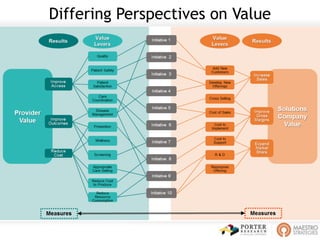
Differing Perspectives on Value
20
Validate Key Metrics with Current Customers
21
Strategic Transformation
$$$
Cross Venue Process
Redesign
$$
Tactical
$
Business Model Redesign/Innovation (e.g., PCMH)
 Systemic, Holistic, Breakthrough Change
 New Care Delivery Models
 New Reimbursement Methods
Continuum Based Lean Value Mapping
(e.g., Service Lines, Orders Management)
 Standardization
 Analytics
 Data Exchange
Benefits through Automation
 Optimization of the EHR
 Silo based Quality Initiatives
 Incremental Performance Improvement (e.g.
EHR optimization)
21
Traditional
View
Validate Key Metrics with Current Customers
• Identify potential benefits –
both “hard” and “soft”
• Evaluate benefits for impact
and measurability
• Objectively validate benefits
at multiple customer sites
• Collect data from credible
sources
• Apply conservative benefits
scenarios
• Consider impact over
offering life cycle
• Use multiple estimation
techniques
• Eliminate outliers
• Normalize across clients
22
Model ROI & Value Realization for Future Customers
• Narrow key metrics down
to 5-10 key tangible &
intangible benefits
• Fully load costs
• Risk adjust key metrics
• Define the ramp up period
• Understand barriers and
key value levers
• Define governance process
and assign accountability
23
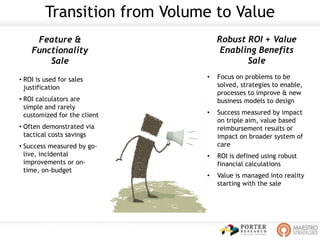
Packaging of the ROI & Value Enabled
Benefits must be clear, concise & easily
understood by Board members
• ROI is used for sales
justification
• ROI calculators are
simple and rarely
customized for the client
• Often demonstrated via
tactical costs savings
• Success measured by go-
live, incidental
improvements or on-
time, on-budget
• Focus on problems to be
solved, strategies to enable,
processes to improve & new
business models to design
• Success measured by impact
on triple aim, value based
reimbursement results or
impact on broader system of
care
• ROI is defined using robust
financial calculations
• Value is managed into reality
starting with the sale
24
Transition from Volume to Value
Feature &
Functionality
Sale
Robust ROI + Value
Enabling Benefits
Sale
Acquire New Capabilities for High Value Healthcare
25
• Educate sales teams on ROI & Value
Realization methods
• Conduct discovery to understand
unique characteristics at the
tactical, programmatic and
strategic level
• Customize model/tools based on
unique customer characteristics
• Develop clear vocabulary,
explanations and concepts for
varying stakeholder groups
• Incorporate customer
accountability and value
governance into contracting
process
Next Steps
26
• Challenge your current thinking
• Validate key measures with
market research
• Develop ROI & Value Realization
models & tracking tools
• Help clients realize value
• Build and deploy competencies for
high value healthcare
Q A
Please feel free to submit questions
to the presenters via chat.
Follow up after the webinar:
PorterResearch.com
678-282-1188
info@porterresearch.com
MaestroStrategies.com
770-587-3309 x 105
insights@maestrostrategies.com

Using ROI to Build Trust and Differentiate in Today's Healthcare Market

  • 1.
    Using ROI toBuild Trust and Differentiate in Today’s Healthcare Marketplace
  • 2.
    Presenters Cynthia Porter President, PorterResearch Healthcare Go-to-Market Research Brian Bogie Vice President of Marketing, HealthEdge Healthcare Business Strategy Susan Irby Business Intelligence Practice Leader, Maestro Strategies Healthcare Business Strategy
  • 3.
    Value Beyond TraditionalROI ROI Formula… Graphic depiction: What’s beyond ^ $$ investment vs Operational savings and/or financial gains… Intangible side of solution value Degree of Change in the Business Total Investment ROI = Full Solution Value > Traditional ROI Solution components may have a huge impact on a healthcare organization without the benefit of being quantified financially. • Improved customer relationships • Streamlined internal processes • Long-term cost/benefit considerations
  • 4.
    ROI Impact onGo-to-Market Strategy Market Needs & Opportunities Lead Generation & Profiling Messaging Brand Awareness Customer Experience Win-Loss Competitive Analysis ROI
  • 5.
    Demonstrating ROI: TheHealthEdge Story Brian Bogie | VP of Marketing, HealthEdge Marketing professional with a proven track record of creating and executing comprehensive programs that enhance visibility, drive sales, build brands, engender customer loyalty and increase valuation. His unique experience spans biotech, medical device, and diagnostic and health care technology. Brian’s Challenges: • Differentiate in increasingly competitive healthcare markets • Establish trust with a variety of payer/provider stakeholders • Quantify full solution value beyond transactional ROI
  • 6.
  • 7.
  • 8.
    How Do YouDifferentiate In A Crowded Market? Look at me!
  • 9.
    • What arethe “only’s” about your company/product? • How do you put a value on them? • How do you communicate them to the market? How Do You Differentiate In A Crowded Market?
  • 10.
    ROI as aDifferentiator BENEFITS 1 Increased Percent of Claims Auto Adjudicated (%) 2 Reduced Overall System Support Cost $ (Ease of Configuration & Maintenance) 3 Increased First Pass Paid Correctly (%) 4 New Insurance Products Can Be Built and Launched Faster (Increased Revenue) Total Benefits Positive Benefits Category Your Product Competitors License Cost $1,000,000 $500,000 Implementation Cost $3,000,000 $2,000,000 Upgrade Cost $150,000 $5,000,000 Total Cost of Ownership $4,150,000 $7,500,000 Total Cost of Ownership
  • 11.
    Introduction – SusanIrby • Thirty years serving healthcare in the provider arena as well as consultant to the industry • ROI and Business Intelligence Practice Leader for Maestro, working with clients to develop and execute strategies around value realization and strategic decision making • Industry pioneer in Decision Support at Alta Bates (Sutter Health) • Contributor to HIT Return on Investment series and developer of Maestro’s ROI Toolkit© • Frequent speaker on the topics of Value Realization, Business Intelligence, Analytics and Information Driven Decision Making • Former adjunct faculty member at UAB Healthcare IT, lecturing in Decision Support Susan Irby Business Intelligence Practice Leader sirby@maestrostrategies.com
  • 12.
    Topics 12 Massive disruption oftraditional healthcare product and service sales opportunities Changing decision making and purchasing processes within most healthcare organizations Why ROI is the starting point, but not nearly enough for sales success
  • 13.
    “Our careers, dreamsand strategic plans are pinned to this graph… The next era will be a messy transitional phase that will kill any organization whose leaders get the mix wrong… As reimbursement changes (and this is happening very quickly), we are all beginners again. This will require different skill sets, different mind sets and different business models” Source: Joe Flower, Healthcare Futurist, May 2013 Transformation of the Business Model 13
  • 14.
    Care delivery isfragmented, enabled by “bricks & mortar” and paper, and focused on volume and the needs of the provider Today Today 1 2 3 4 5 6 7 8 9 10 11 12 13 14 15 16 17 18 19 20 21 22 23 24 25 26 27 28 29 30 31 Tomorrow Care will be coordinated through a patient centric, connected care management platform. Value will be measured and rewarded Transformation of the Business Model 14
  • 15.
    Key Considerations forthe Transition • Customers are no longer just hospitals, just physicians, just patients, or just payers • Feature and functionality demos will rarely get you on their radar, much less close the sale • Delivery and/or implementation of a product focused on traditional hospital/physician segments is not sufficient • Incremental upgrades are not longer sustainable • Every dollar spent will be scrutinized ROI is essential, but NOT enough 15
  • 16.
    ROI - TraditionalApproaches • Case studies • Cost benefit analyses • ROI sales calculators • Customer testimonials • Detailed data collection during discovery • Business cases • Customer tracking tools 16
  • 17.
    Understand the Definitionof ROI & Value 17 Value Value – Reducing unnecessary costs (waste) while maintaining or improving healthcare quality Source: Agency for Healthcare Research & Quality, 2010 Source: “Rethinking ROI: The Challenge of Accountable Meaningful Use”, Arlotto & Irby, 2012
  • 18.
    18 A square isa rectangle, but a rectangle is not necessarily a square
  • 19.
    19 ROI is aform of value, but not all value takes the form of ROI
  • 20.
  • 21.
    Validate Key Metricswith Current Customers 21 Strategic Transformation $$$ Cross Venue Process Redesign $$ Tactical $ Business Model Redesign/Innovation (e.g., PCMH)  Systemic, Holistic, Breakthrough Change  New Care Delivery Models  New Reimbursement Methods Continuum Based Lean Value Mapping (e.g., Service Lines, Orders Management)  Standardization  Analytics  Data Exchange Benefits through Automation  Optimization of the EHR  Silo based Quality Initiatives  Incremental Performance Improvement (e.g. EHR optimization) 21 Traditional View
  • 22.
    Validate Key Metricswith Current Customers • Identify potential benefits – both “hard” and “soft” • Evaluate benefits for impact and measurability • Objectively validate benefits at multiple customer sites • Collect data from credible sources • Apply conservative benefits scenarios • Consider impact over offering life cycle • Use multiple estimation techniques • Eliminate outliers • Normalize across clients 22
  • 23.
    Model ROI &Value Realization for Future Customers • Narrow key metrics down to 5-10 key tangible & intangible benefits • Fully load costs • Risk adjust key metrics • Define the ramp up period • Understand barriers and key value levers • Define governance process and assign accountability 23 Packaging of the ROI & Value Enabled Benefits must be clear, concise & easily understood by Board members
  • 24.
    • ROI isused for sales justification • ROI calculators are simple and rarely customized for the client • Often demonstrated via tactical costs savings • Success measured by go- live, incidental improvements or on- time, on-budget • Focus on problems to be solved, strategies to enable, processes to improve & new business models to design • Success measured by impact on triple aim, value based reimbursement results or impact on broader system of care • ROI is defined using robust financial calculations • Value is managed into reality starting with the sale 24 Transition from Volume to Value Feature & Functionality Sale Robust ROI + Value Enabling Benefits Sale
  • 25.
    Acquire New Capabilitiesfor High Value Healthcare 25 • Educate sales teams on ROI & Value Realization methods • Conduct discovery to understand unique characteristics at the tactical, programmatic and strategic level • Customize model/tools based on unique customer characteristics • Develop clear vocabulary, explanations and concepts for varying stakeholder groups • Incorporate customer accountability and value governance into contracting process
  • 26.
    Next Steps 26 • Challengeyour current thinking • Validate key measures with market research • Develop ROI & Value Realization models & tracking tools • Help clients realize value • Build and deploy competencies for high value healthcare
  • 27.
    Q A Please feelfree to submit questions to the presenters via chat. Follow up after the webinar: PorterResearch.com 678-282-1188 info@porterresearch.com MaestroStrategies.com 770-587-3309 x 105 insights@maestrostrategies.com