Using New Tools to Analyze and
Plan Your Urban Forest
November 1, 2016
OpenTreeMap Team
Deborah Boyer - dboyer@azavea.com
Joe Morrison - jmorrison@azavea.com
Hadley Stein - hstein@azavea.com
Background
• Azavea is a civic technology firm
that uses geospatial data to build
software and data analytics
including OpenTreeMap
• We’re a B Corporation and
committed to open source
software
• OpenTreeMap partially funded
through Small Business Innovation
and Research Grants from the
USDA
• Tree maps used by municipalities,
non-profit organizations, and
consulting arborists worldwide
Forest modeling
Community engagement
Green infrastructure mapping
Customization
Inventory mapping and management
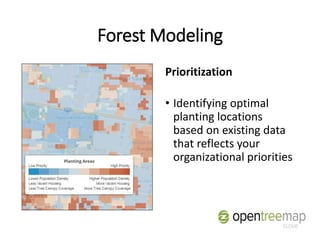
Forest Modeling
Prioritization
• Identifying optimal
planting locations
based on existing data
that reflects your
organizational priorities
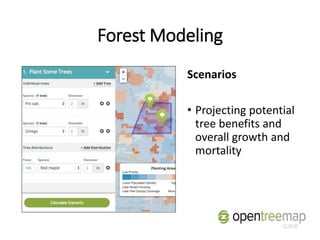
Forest Modeling
Scenarios
• Projecting potential
tree benefits and
overall growth and
mortality
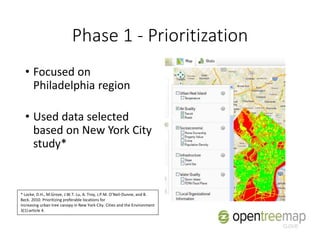
Phase 1 - Prioritization
• Focused on
Philadelphia region
• Used data selected
based on New York City
study*
* Locke, D.H., M.Grove, J.W.T. Lu, A. Troy, J.P.M. O’Neil-Dunne, and B.
Beck. 2010. Prioritizing preferable locations for
increasing urban tree canopy in New York City. Cities and the Environment
3(1):article 4.
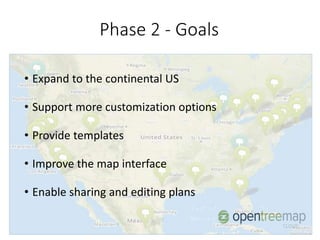
Phase 2 - Goals
• Expand to the continental US
• Support more customization options
• Provide templates
• Improve the map interface
• Enable sharing and editing plans
Phase 2:
What data to use?
Requirements:
• Available nationwide
• No usage restrictions
• Geographically specific
• Connected to tree planting priorities
Selected:
• Tree canopy – National Land Cover Database
• Impervious surface – National Land Cover Database
• Population density
• Economic data
• Housing data*
* Roman, Lara A., J. Battles, and J. McBride. 2014. Determinants of
Establishment Survival for Residential Trees in Sacramento County, CA.
Landscape and Urban Planning 129(2014): 22-31.
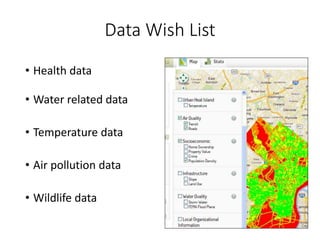
Data Wish List
• Health data
• Water related data
• Temperature data
• Air pollution data
• Wildlife data
Data as Filters
• Soil types
• Transit information
• Location within flood plain
• Localized public works or zoning maps
• Neighborhoods and other geographic boundaries
What data is important to your
organization’s planting priorities?
Exploring the Software
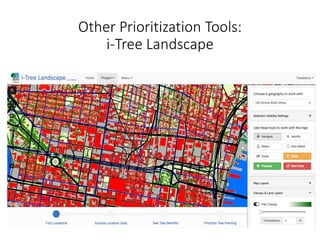
Other Prioritization Tools:
i-Tree Landscape
• Includes land cover and census demographics
• Web-based with a geospatial interface
• Explore existing canopy and ecosystem benefits
• Create Priority Planting Index and view report
• More info at https://landscape.itreetools.org/
Other Prioritization Tools:
i-Tree Landscape
Other Prioritization Tools:
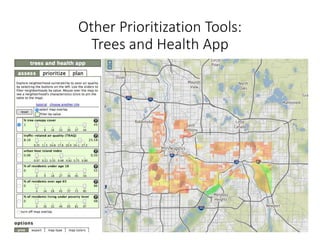
Trees and Health App
Other Prioritization Tools:
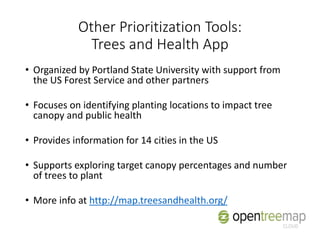
Trees and Health App
• Organized by Portland State University with support from
the US Forest Service and other partners
• Focuses on identifying planting locations to impact tree
canopy and public health
• Provides information for 14 cities in the US
• Supports exploring target canopy percentages and number
of trees to plant
• More info at http://map.treesandhealth.org/
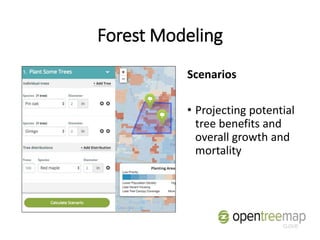
Forest Modeling
Scenarios
• Projecting potential
tree benefits and
overall growth and
mortality
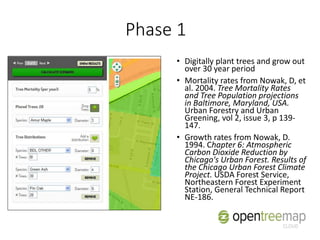
Phase 1
• Digitally plant trees and grow out
over 30 year period
• Mortality rates from Nowak, D, et
al. 2004. Tree Mortality Rates
and Tree Population projections
in Baltimore, Maryland, USA.
Urban Forestry and Urban
Greening, vol 2, issue 3, p 139-
147.
• Growth rates from Nowak, D.
1994. Chapter 6: Atmospheric
Carbon Dioxide Reduction by
Chicago's Urban Forest. Results of
the Chicago Urban Forest Climate
Project. USDA Forest Service,
Northeastern Forest Experiment
Station, General Technical Report
NE-186.
Phase 2 - Goals
• Support more customization options
• Update growth rates
• Refine mortality rates
• Implement replanting option
• Enable sharing and editing plans
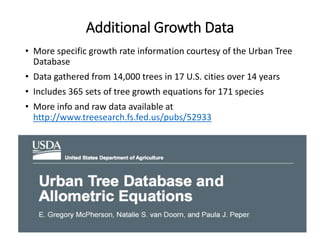
Additional Growth Data
• More specific growth rate information courtesy of the Urban Tree
Database
• Data gathered from 14,000 trees in 17 U.S. cities over 14 years
• Includes 365 sets of tree growth equations for 171 species
• More info and raw data available at
http://www.treesearch.fs.fed.us/pubs/52933
Revising Mortality Process
• Keep a default of 5% annual mortality*
• Support customization of mortality for species and diameter
and remove land use as a mortality factor
• Editing species and diameter mortality rates can impact
overall mortality rate
• Does not include an option for factoring in management,
construction, storm, or pests
*Roman, L. 2006. Trends in Street Tree Survival, Philadelphia, PA.
ScholarlyCommons, University of Pennsylvania.
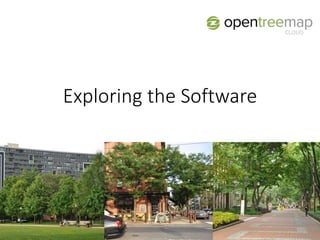
Exploring the Software
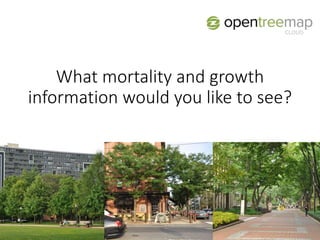
What mortality and growth
information would you like to see?
Other Scenario Tools:
i-Tree Forecast
• Part of i-Tree Eco and uses the results from running an Eco model
• Includes default values and options for customizing the duration
of the forecast, days without frost, mortality rates, pest
outbreaks, weather, and more
• View forecast reports related to urban forest composition and
structure and ecosystem benefits
• More info at
https://www.itreetools.org/resources/manuals/Ecov6_ManualsG
uides/Ecov6Guide_UsingForecast.pdf
Future Updates
• Support customization of growth rates
• Include upload of local data
• Expand to project canopy growth
• Support bulk upload of data
• Share data back to an OpenTreeMap site
OpenTreeMap Team
Deborah Boyer - dboyer@azavea.com
Joe Morrison - jmorrison@azavea.com
Hadley Stein - hstein@azavea.com

Using New Tools to Analyze and Plan Your Urban Forest

  • 1.
    Using New Toolsto Analyze and Plan Your Urban Forest November 1, 2016
  • 2.
    OpenTreeMap Team Deborah Boyer- dboyer@azavea.com Joe Morrison - jmorrison@azavea.com Hadley Stein - hstein@azavea.com
  • 3.
    Background • Azavea isa civic technology firm that uses geospatial data to build software and data analytics including OpenTreeMap • We’re a B Corporation and committed to open source software • OpenTreeMap partially funded through Small Business Innovation and Research Grants from the USDA • Tree maps used by municipalities, non-profit organizations, and consulting arborists worldwide
  • 4.
    Forest modeling Community engagement Greeninfrastructure mapping Customization Inventory mapping and management
  • 5.
    Forest Modeling Prioritization • Identifyingoptimal planting locations based on existing data that reflects your organizational priorities
  • 6.
    Forest Modeling Scenarios • Projectingpotential tree benefits and overall growth and mortality
  • 7.
    Phase 1 -Prioritization • Focused on Philadelphia region • Used data selected based on New York City study* * Locke, D.H., M.Grove, J.W.T. Lu, A. Troy, J.P.M. O’Neil-Dunne, and B. Beck. 2010. Prioritizing preferable locations for increasing urban tree canopy in New York City. Cities and the Environment 3(1):article 4.
  • 8.
    Phase 2 -Goals • Expand to the continental US • Support more customization options • Provide templates • Improve the map interface • Enable sharing and editing plans
  • 9.
    Phase 2: What datato use? Requirements: • Available nationwide • No usage restrictions • Geographically specific • Connected to tree planting priorities Selected: • Tree canopy – National Land Cover Database • Impervious surface – National Land Cover Database • Population density • Economic data • Housing data* * Roman, Lara A., J. Battles, and J. McBride. 2014. Determinants of Establishment Survival for Residential Trees in Sacramento County, CA. Landscape and Urban Planning 129(2014): 22-31.
  • 10.
    Data Wish List •Health data • Water related data • Temperature data • Air pollution data • Wildlife data
  • 11.
    Data as Filters •Soil types • Transit information • Location within flood plain • Localized public works or zoning maps • Neighborhoods and other geographic boundaries
  • 12.
    What data isimportant to your organization’s planting priorities?
  • 13.
  • 14.
  • 15.
    • Includes landcover and census demographics • Web-based with a geospatial interface • Explore existing canopy and ecosystem benefits • Create Priority Planting Index and view report • More info at https://landscape.itreetools.org/ Other Prioritization Tools: i-Tree Landscape
  • 16.
  • 17.
    Other Prioritization Tools: Treesand Health App • Organized by Portland State University with support from the US Forest Service and other partners • Focuses on identifying planting locations to impact tree canopy and public health • Provides information for 14 cities in the US • Supports exploring target canopy percentages and number of trees to plant • More info at http://map.treesandhealth.org/
  • 18.
    Forest Modeling Scenarios • Projectingpotential tree benefits and overall growth and mortality
  • 19.
    Phase 1 • Digitallyplant trees and grow out over 30 year period • Mortality rates from Nowak, D, et al. 2004. Tree Mortality Rates and Tree Population projections in Baltimore, Maryland, USA. Urban Forestry and Urban Greening, vol 2, issue 3, p 139- 147. • Growth rates from Nowak, D. 1994. Chapter 6: Atmospheric Carbon Dioxide Reduction by Chicago's Urban Forest. Results of the Chicago Urban Forest Climate Project. USDA Forest Service, Northeastern Forest Experiment Station, General Technical Report NE-186.
  • 20.
    Phase 2 -Goals • Support more customization options • Update growth rates • Refine mortality rates • Implement replanting option • Enable sharing and editing plans
  • 21.
    Additional Growth Data •More specific growth rate information courtesy of the Urban Tree Database • Data gathered from 14,000 trees in 17 U.S. cities over 14 years • Includes 365 sets of tree growth equations for 171 species • More info and raw data available at http://www.treesearch.fs.fed.us/pubs/52933
  • 22.
    Revising Mortality Process •Keep a default of 5% annual mortality* • Support customization of mortality for species and diameter and remove land use as a mortality factor • Editing species and diameter mortality rates can impact overall mortality rate • Does not include an option for factoring in management, construction, storm, or pests *Roman, L. 2006. Trends in Street Tree Survival, Philadelphia, PA. ScholarlyCommons, University of Pennsylvania.
  • 23.
  • 24.
    What mortality andgrowth information would you like to see?
  • 25.
    Other Scenario Tools: i-TreeForecast • Part of i-Tree Eco and uses the results from running an Eco model • Includes default values and options for customizing the duration of the forecast, days without frost, mortality rates, pest outbreaks, weather, and more • View forecast reports related to urban forest composition and structure and ecosystem benefits • More info at https://www.itreetools.org/resources/manuals/Ecov6_ManualsG uides/Ecov6Guide_UsingForecast.pdf
  • 26.
    Future Updates • Supportcustomization of growth rates • Include upload of local data • Expand to project canopy growth • Support bulk upload of data • Share data back to an OpenTreeMap site
  • 27.
    OpenTreeMap Team Deborah Boyer- dboyer@azavea.com Joe Morrison - jmorrison@azavea.com Hadley Stein - hstein@azavea.com