i-Tree Introduction
Georgia Urban Forestry Council
June 27, 2018
www.itreetools.org
i-Tree is a
Cooperative
Initiative
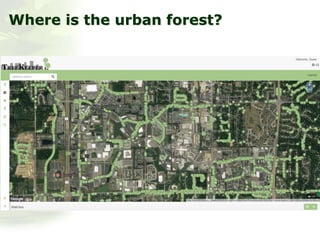
Where is the urban forest?
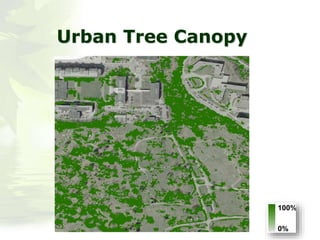
Urban Tree Canopy
100%
0%
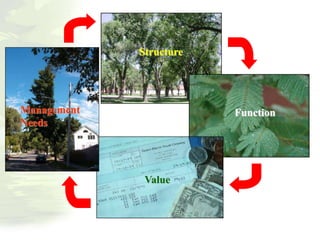
Structure
Function
Value
Management
Needs
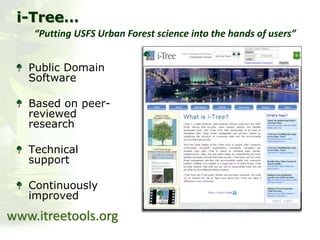
Public Domain
Software
Based on peer-
reviewed
research
Technical
support
Continuously
improved
i-Tree…
“Putting USFS Urban Forest science into the hands of users”
www.itreetools.org
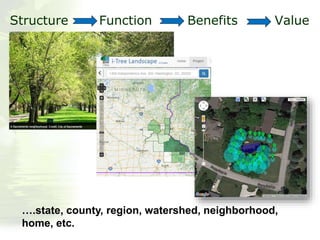
Structure Function Benefits Value
….state, county, region, watershed, neighborhood,
home, etc.
Landscape
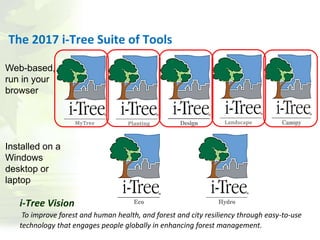
The 2017 i-Tree Suite of Tools
Web-based,
run in your
browser
Installed on a
Windows
desktop or
laptop
MyTree Planting
i-Tree Vision
To improve forest and human health, and forest and city resiliency through easy-to-use
technology that engages people globally in enhancing forest management.
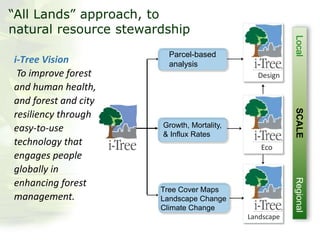
Growth, Mortality,
& Influx Rates
Tree Cover Maps
Landscape Change
Climate Change
Parcel-based
analysis
LocalSCALERegional
Design
Landscape
Eco
“All Lands” approach, to
natural resource stewardship
i-Tree Vision
To improve forest
and human health,
and forest and city
resiliency through
easy-to-use
technology that
engages people
globally in
enhancing forest
management.
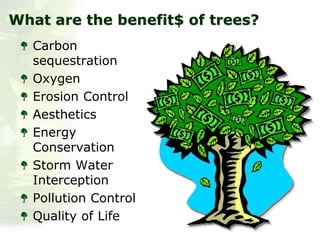
What are the benefit$ of trees?
Carbon
sequestration
Oxygen
Erosion Control
Aesthetics
Energy
Conservation
Storm Water
Interception
Pollution Control
Quality of Life
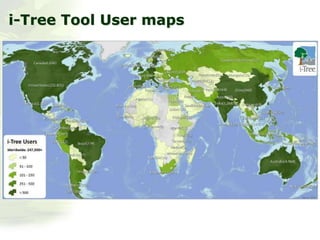
i-Tree Tool User maps
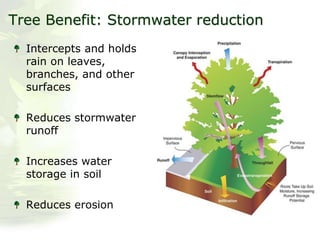
Tree Benefit: Stormwater reduction
Intercepts and holds
rain on leaves,
branches, and other
surfaces
Reduces stormwater
runoff
Increases water
storage in soil
Reduces erosion
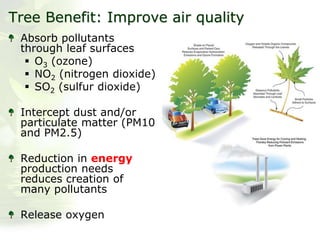
Tree Benefit: Improve air quality
Absorb pollutants
through leaf surfaces
 O3 (ozone)
 NO2 (nitrogen dioxide)
 SO2 (sulfur dioxide)
Intercept dust and/or
particulate matter (PM10
and PM2.5)
Reduction in energy
production needs
reduces creation of
many pollutants
Release oxygen
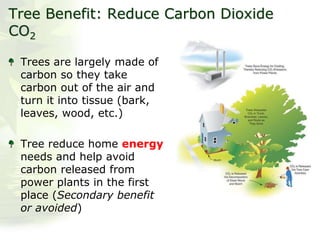
Tree Benefit: Reduce Carbon Dioxide
CO2
Trees are largely made of
carbon so they take
carbon out of the air and
turn it into tissue (bark,
leaves, wood, etc.)
Tree reduce home energy
needs and help avoid
carbon released from
power plants in the first
place (Secondary benefit
or avoided)
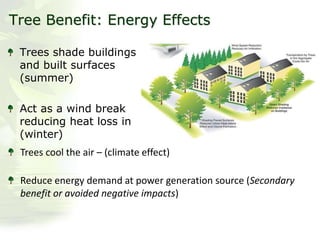
Tree Benefit: Energy Effects
Trees shade buildings
and built surfaces
(summer)
Act as a wind break
reducing heat loss in
(winter)
Trees cool the air – (climate effect)
Reduce energy demand at power generation source (Secondary
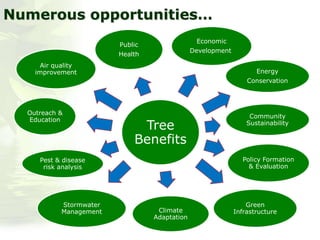
benefit or avoided negative impacts)
Tree
Benefits
Public
Health
Energy
Conservation
Outreach &
Education
Pest & disease
risk analysis
Community
Sustainability
Policy Formation
& Evaluation
Economic
Development
Stormwater
Management Climate
Adaptation
Green
Infrastructure
Air quality
improvement
Numerous opportunities…
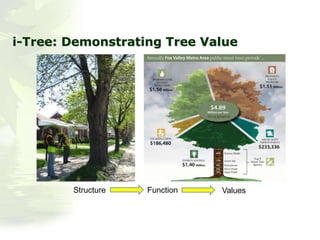
i-Tree: Demonstrating Tree Value
Structure Function Values
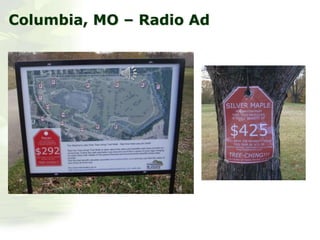
Columbia, MO – Radio Ad
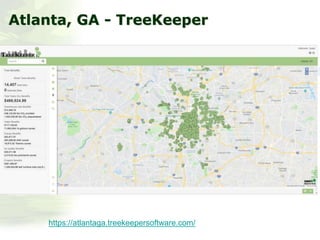
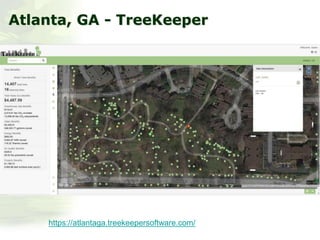
Atlanta, GA - TreeKeeper
https://atlantaga.treekeepersoftware.com/
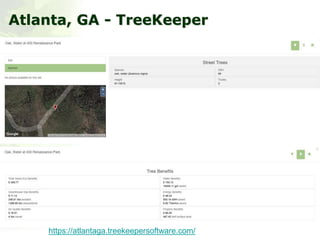
Atlanta, GA - TreeKeeper
https://atlantaga.treekeepersoftware.com/
Atlanta, GA - TreeKeeper
https://atlantaga.treekeepersoftware.com/
Future Program Integration
i-Tree will provide management guides
that:
Detail local risks to forests and humans (air
and water quality, UV radiation, insects and
diseases, air temperatures, climate change...)
Determine best locations to plant or protect
trees
Provide species and location recommendations
to improve forest and human health
Recommend planting rates to sustain forest
cover at desired level
Thanks
Josh Behounek
Josh.Behounek@davey.com
573-673-7530
@treesrtheanswr
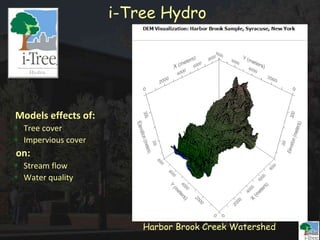
Harbor Brook Creek Watershed
Models effects of:
Tree cover
Impervious cover
on:
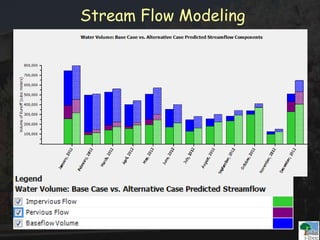
Stream flow
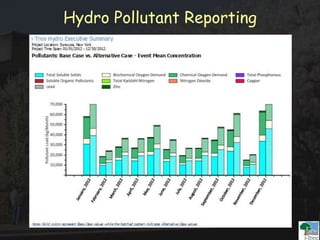
Water quality
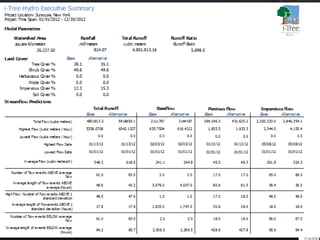
i-Tree Hydro
Stream Flow Modeling
Hydro Pollutant Reporting
i-Tree Eco
i-Tree is a
Cooperative
Initiative among
these partners
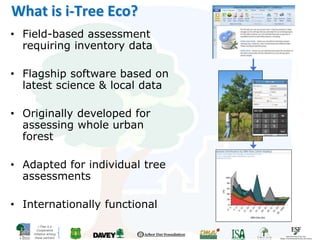
What is i-Tree Eco?
• Field-based assessment
requiring inventory data
• Flagship software based on
latest science & local data
• Originally developed for
assessing whole urban
forest
• Adapted for individual tree
assessments
• Internationally functional
i-Tree is a
Cooperative
Initiative among
these partners
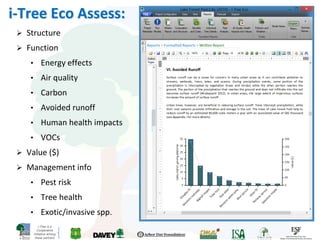
i-Tree Eco Assess:
 Structure
 Function
• Energy effects
• Air quality
• Carbon
• Avoided runoff
• Human health impacts
• VOCs
 Value ($)
 Management info
• Pest risk
• Tree health
• Exotic/invasive spp.
i-Tree is a
Cooperative
Initiative among
these partners
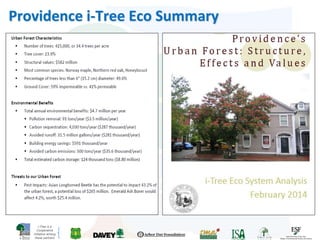
Providence i-Tree Eco Summary
i-Tree is a
Cooperative
Initiative among
these partners
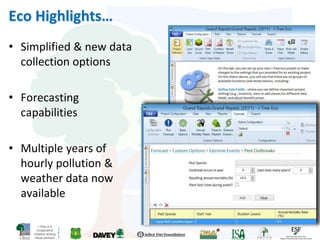
Eco Highlights…
• Simplified & new data
collection options
• Forecasting
capabilities
• Multiple years of
hourly pollution &
weather data now
available
i-Tree is a
Cooperative
Initiative among
these partners
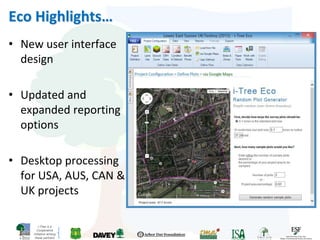
Eco Highlights…
• New user interface
design
• Updated and
expanded reporting
options
• Desktop processing
for USA, AUS, CAN &
UK projects
i-Tree is a
Cooperative
Initiative among
these partners
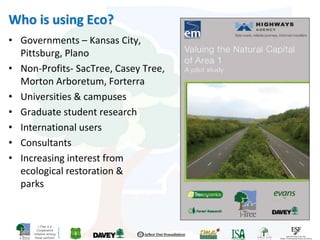
Who is using Eco?
• Governments – Kansas City,
Pittsburg, Plano
• Non-Profits- SacTree, Casey Tree,
Morton Arboretum, Forterra
• Universities & campuses
• Graduate student research
• International users
• Consultants
• Increasing interest from
ecological restoration &
parks
i-Tree is a
Cooperative
Initiative among
these partners
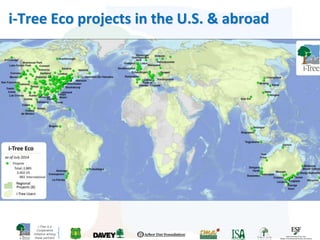
i-Tree Eco projects in the U.S. & abroad
i-Tree is a
Cooperative
Initiative among
these partners
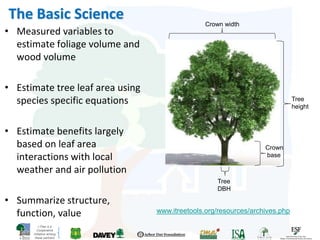
The Basic Science
• Measured variables to
estimate foliage volume and
wood volume
• Estimate tree leaf area using
species specific equations
• Estimate benefits largely
based on leaf area
interactions with local
weather and air pollution
• Summarize structure,
function, value
Tree
height
Crown width
Crown
base
Tree
DBH
www.itreetools.org/resources/archives.php
i-Tree is a
Cooperative
Initiative among
these partners
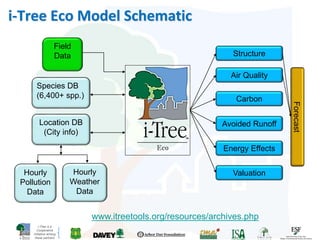
i-Tree Eco Model Schematic
Field
Data
Location DB
(City info)
Species DB
(6,400+ spp.)
Hourly
Pollution
Data
Hourly
Weather
Data
Air Quality
www.itreetools.org/resources/archives.php
Carbon
Avoided Runoff
Energy Effects
Valuation
Structure
Forecast
i-Tree is a
Cooperative
Initiative among
these partners
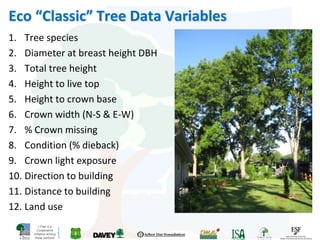
Eco “Classic” Tree Data Variables
1. Tree species
2. Diameter at breast height DBH
3. Total tree height
4. Height to live top
5. Height to crown base
6. Crown width (N-S & E-W)
7. % Crown missing
8. Condition (% dieback)
9. Crown light exposure
10. Direction to building
11. Distance to building
12. Land use
i-Tree is a
Cooperative
Initiative among
these partners
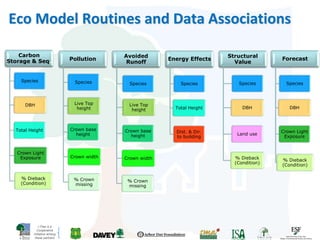
Carbon
Storage & Seq.
Species
DBH
Total Height
Crown Light
Exposure
% Dieback
(Condition)
Pollution
Species
Live Top
height
Crown base
height
Crown width
% Crown
missing
Avoided
Runoff
Species
Live Top
height
Crown base
height
Crown width
% Crown
missing
Energy Effects
Species
Total Height
Dist. & Dir.
to building
Structural
Value
Species
DBH
Land use
% Dieback
(Condition)
Forecast
Species
DBH
Crown Light
Exposure
% Dieback
(Condition)
Eco Model Routines and Data Associations
i-Tree is a
Cooperative
Initiative among
these partners
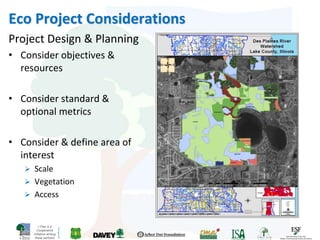
Eco Project Considerations
Project Design & Planning
• Consider objectives &
resources
• Consider standard &
optional metrics
• Consider & define area of
interest
 Scale
 Vegetation
 Access
i-Tree is a
Cooperative
Initiative among
these partners
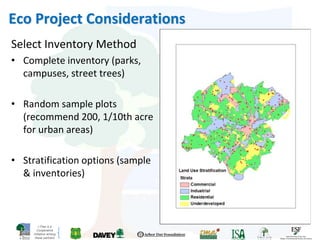
Select Inventory Method
• Complete inventory (parks,
campuses, street trees)
• Random sample plots
(recommend 200, 1/10th acre
for urban areas)
• Stratification options (sample
& inventories)
Eco Project Considerations
i-Tree is a
Cooperative
Initiative among
these partners
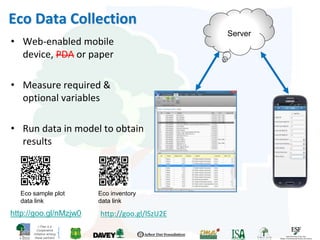
Eco Data Collection
• Web-enabled mobile
device, PDA or paper
• Measure required &
optional variables
• Run data in model to obtain
results
Eco sample plot
data link
Eco inventory
data link
Server
http://goo.gl/nMzjw0 http://goo.gl/lSzU2E
i-Tree is a
Cooperative
Initiative among
these partners
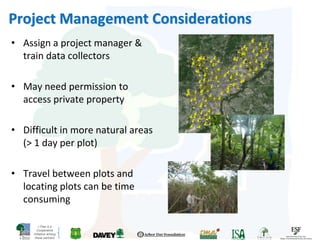
Project Management Considerations
• Assign a project manager &
train data collectors
• May need permission to
access private property
• Difficult in more natural areas
(> 1 day per plot)
• Travel between plots and
locating plots can be time
consuming
i-Tree is a
Cooperative
Initiative among
these partners
i-Tree Eco Interface
i-Tree is a
Cooperative
Initiative among
these partners
i-Tree Eco: Reports
What’s new?
• All results available for complete inventories
• Including “written report”
• New reports including the best outputs from
i-Tree streets
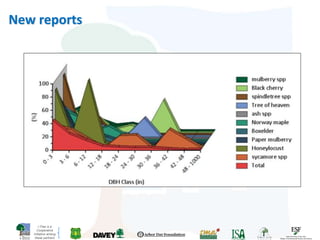
• Size class distribution graphs
• Cost benefit analysis
• Maintenance and user defined data categories
• Enhanced individual tree reporting
i-Tree is a
Cooperative
Initiative among
these partners
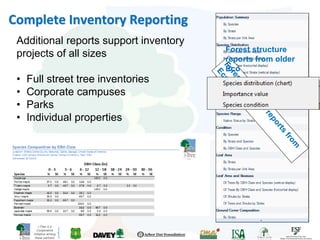
Complete Inventory Reporting
Additional reports support inventory
projects of all sizes
• Full street tree inventories
• Corporate campuses
• Parks
• Individual properties
Forest structure
reports from older
Eco
i-Tree is a
Cooperative
Initiative among
these partners
New reports
i-Tree is a
Cooperative
Initiative among
these partners
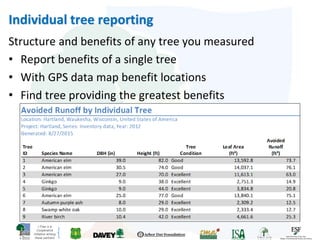
Individual tree reporting
Structure and benefits of any tree you measured
• Report benefits of a single tree
• With GPS data map benefit locations
• Find tree providing the greatest benefits
i-Tree is a
Cooperative
Initiative among
these partners
i-Tree Forecast - What is it?
• A new module within i-Tree Eco
• Project tree growth over time
• Include population modeling
• User guided planting and mortality
• Projects changes in selected tree benefits
i-Tree is a
Cooperative
Initiative among
these partners
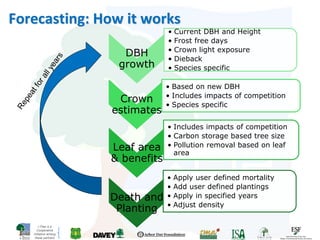
Forecasting: How it works
DBH
growth
• Current DBH and Height
• Frost free days
• Crown light exposure
• Dieback
• Species specific
Crown
estimates
• Based on new DBH
• Includes impacts of competition
• Species specific
Leaf area
& benefits
• Includes impacts of competition
• Carbon storage based tree size
• Pollution removal based on leaf
area
Death and
Planting
• Apply user defined mortality
• Add user defined plantings
• Apply in specified years
• Adjust density
i-Tree is a
Cooperative
Initiative among
these partners
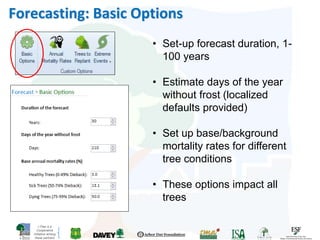
Forecasting: Basic Options
• Set-up forecast duration, 1-
100 years
• Estimate days of the year
without frost (localized
defaults provided)
• Set up base/background
mortality rates for different
tree conditions
• These options impact all
trees
i-Tree is a
Cooperative
Initiative among
these partners
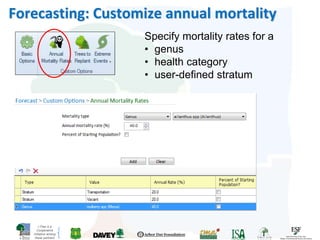
Forecasting: Customize annual mortality
Specify mortality rates for a
• genus
• health category
• user-defined stratum
i-Tree is a
Cooperative
Initiative among
these partners
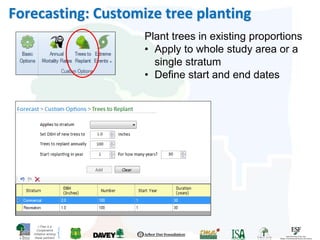
Forecasting: Customize tree planting
Plant trees in existing proportions
• Apply to whole study area or a
single stratum
• Define start and end dates
i-Tree is a
Cooperative
Initiative among
these partners
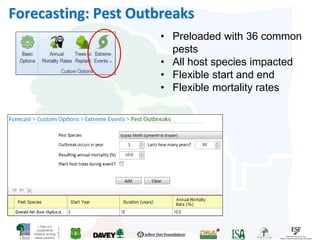
Forecasting: Pest Outbreaks
• Preloaded with 36 common
pests
• All host species impacted
• Flexible start and end
• Flexible mortality rates
i-Tree is a
Cooperative
Initiative among
these partners
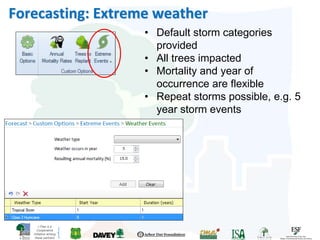
Forecasting: Extreme weather
• Default storm categories
provided
• All trees impacted
• Mortality and year of
occurrence are flexible
• Repeat storms possible, e.g. 5
year storm events
i-Tree is a
Cooperative
Initiative among
these partners
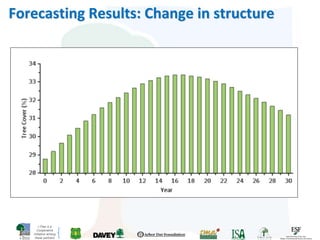
Forecasting Results: Change in structure
i-Tree is a
Cooperative
Initiative among
these partners
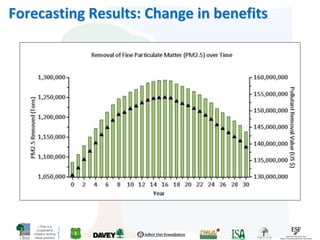
Forecasting Results: Change in benefits
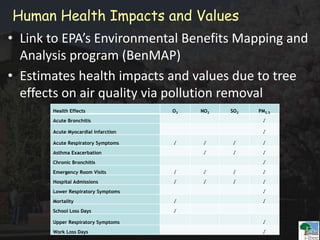
Health Effects O3 NO2 SO2 PM2.5
Acute Bronchitis √
Acute Myocardial Infarction √
Acute Respiratory Symptoms √ √ √ √
Asthma Exacerbation √ √ √
Chronic Bronchitis √
Emergency Room Visits √ √ √ √
Hospital Admissions √ √ √ √
Lower Respiratory Symptoms √
Mortality √ √
School Loss Days √
Upper Respiratory Symptoms √
Work Loss Days √
Human Health Impacts and Values
• Link to EPA’s Environmental Benefits Mapping and
Analysis program (BenMAP)
• Estimates health impacts and values due to tree
effects on air quality via pollution removal
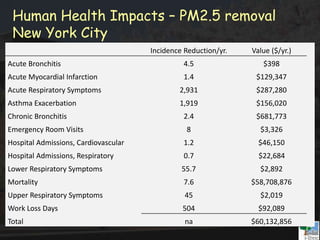
Incidence Reduction/yr. Value ($/yr.)
Acute Bronchitis 4.5 $398
Acute Myocardial Infarction 1.4 $129,347
Acute Respiratory Symptoms 2,931 $287,280
Asthma Exacerbation 1,919 $156,020
Chronic Bronchitis 2.4 $681,773
Emergency Room Visits 8 $3,326
Hospital Admissions, Cardiovascular 1.2 $46,150
Hospital Admissions, Respiratory 0.7 $22,684
Lower Respiratory Symptoms 55.7 $2,892
Mortality 7.6 $58,708,876
Upper Respiratory Symptoms 45 $2,019
Work Loss Days 504 $92,089
Total na $60,132,856
Human Health Impacts – PM2.5 removal
New York City
i-Tree is a
Cooperative
Initiative among
these partners
Potential Applications
 Model different scenarios
• Species mixes
• Climate change impacts
• Size/type of planting stock
 Planting
• How many trees will you need to plant to maintain current
stocking, offset known losses, achieve canopy goals
 Maintenance
• What benefits will be lost if lack of maintenance leads to
higher mortality
 Lots of flexibility
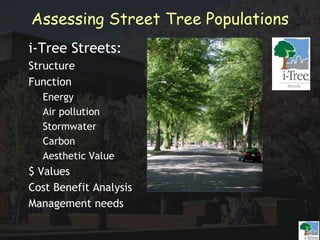
Assessing Street Tree Populations
i-Tree Streets:
Structure
Function
Energy
Air pollution
Stormwater
Carbon
Aesthetic Value
$ Values
Cost Benefit Analysis
Management needs
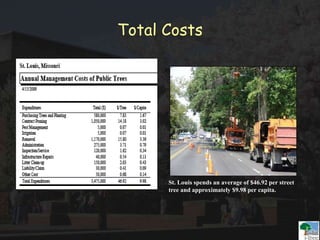
Total Costs
St. Louis spends an average of $46.92 per street
tree and approximately $9.98 per capita.
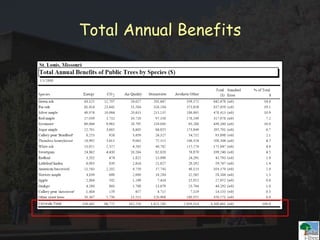
Total Annual Benefits
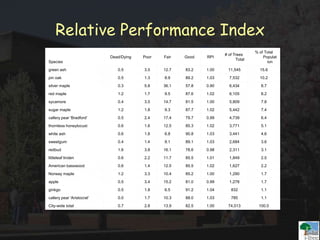
Relative Performance Index
Species
Dead/Dying Poor Fair Good RPI
# of Trees
Total
% of Total
Populat
ion
green ash 0.5 3.5 12.7 83.2 1.00 11,545 15.6
pin oak 0.5 1.3 8.9 89.2 1.03 7,532 10.2
silver maple 0.3 5.8 36.1 57.8 0.90 6,434 8.7
red maple 1.2 1.7 9.5 87.6 1.02 6,105 8.2
sycamore 0.4 3.5 14.7 81.5 1.00 5,809 7.8
sugar maple 1.2 1.8 9.3 87.7 1.02 5,442 7.4
callery pear 'Bradford' 0.5 2.4 17.4 79.7 0.99 4,739 6.4
thornless honeylocust 0.6 1.6 12.5 85.3 1.02 3,771 5.1
white ash 0.6 1.8 6.8 90.8 1.03 3,441 4.6
sweetgum 0.4 1.4 9.1 89.1 1.03 2,684 3.6
redbud 1.6 3.8 16.1 78.6 0.98 2,311 3.1
littleleaf linden 0.6 2.2 11.7 85.5 1.01 1,849 2.5
American basswood 0.6 1.4 12.5 85.5 1.02 1,627 2.2
Norway maple 1.2 3.3 10.4 85.2 1.00 1,290 1.7
apple 0.5 3.4 15.2 81.0 0.99 1,278 1.7
ginkgo 0.5 1.8 6.5 91.2 1.04 832 1.1
callery pear 'Aristocrat' 0.0 1.7 10.3 88.0 1.03 785 1.1
City-wide total 0.7 2.8 13.9 82.5 1.00 74,013 100.0
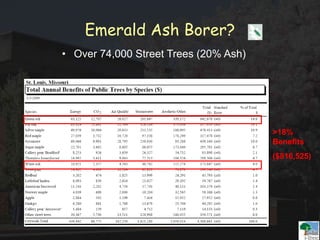
Emerald Ash Borer?
>18%
Benefits
($816,525)
• Over 74,000 Street Trees (20% Ash)
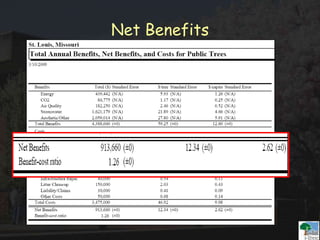
Net Benefits

i-Tree Introduction

  • 1.
    i-Tree Introduction Georgia UrbanForestry Council June 27, 2018 www.itreetools.org i-Tree is a Cooperative Initiative
  • 2.
    Where is theurban forest?
  • 3.
  • 4.
  • 5.
    Public Domain Software Based onpeer- reviewed research Technical support Continuously improved i-Tree… “Putting USFS Urban Forest science into the hands of users” www.itreetools.org
  • 6.
    Structure Function BenefitsValue ….state, county, region, watershed, neighborhood, home, etc.
  • 7.
    Landscape The 2017 i-TreeSuite of Tools Web-based, run in your browser Installed on a Windows desktop or laptop MyTree Planting i-Tree Vision To improve forest and human health, and forest and city resiliency through easy-to-use technology that engages people globally in enhancing forest management.
  • 8.
    Growth, Mortality, & InfluxRates Tree Cover Maps Landscape Change Climate Change Parcel-based analysis LocalSCALERegional Design Landscape Eco “All Lands” approach, to natural resource stewardship i-Tree Vision To improve forest and human health, and forest and city resiliency through easy-to-use technology that engages people globally in enhancing forest management.
  • 10.
    What are thebenefit$ of trees? Carbon sequestration Oxygen Erosion Control Aesthetics Energy Conservation Storm Water Interception Pollution Control Quality of Life
  • 12.
  • 13.
    Tree Benefit: Stormwaterreduction Intercepts and holds rain on leaves, branches, and other surfaces Reduces stormwater runoff Increases water storage in soil Reduces erosion
  • 14.
    Tree Benefit: Improveair quality Absorb pollutants through leaf surfaces  O3 (ozone)  NO2 (nitrogen dioxide)  SO2 (sulfur dioxide) Intercept dust and/or particulate matter (PM10 and PM2.5) Reduction in energy production needs reduces creation of many pollutants Release oxygen
  • 15.
    Tree Benefit: ReduceCarbon Dioxide CO2 Trees are largely made of carbon so they take carbon out of the air and turn it into tissue (bark, leaves, wood, etc.) Tree reduce home energy needs and help avoid carbon released from power plants in the first place (Secondary benefit or avoided)
  • 16.
    Tree Benefit: EnergyEffects Trees shade buildings and built surfaces (summer) Act as a wind break reducing heat loss in (winter) Trees cool the air – (climate effect) Reduce energy demand at power generation source (Secondary benefit or avoided negative impacts)
  • 17.
    Tree Benefits Public Health Energy Conservation Outreach & Education Pest &disease risk analysis Community Sustainability Policy Formation & Evaluation Economic Development Stormwater Management Climate Adaptation Green Infrastructure Air quality improvement Numerous opportunities…
  • 18.
    i-Tree: Demonstrating TreeValue Structure Function Values
  • 19.
  • 20.
    Atlanta, GA -TreeKeeper https://atlantaga.treekeepersoftware.com/
  • 21.
    Atlanta, GA -TreeKeeper https://atlantaga.treekeepersoftware.com/
  • 22.
    Atlanta, GA -TreeKeeper https://atlantaga.treekeepersoftware.com/
  • 23.
    Future Program Integration i-Treewill provide management guides that: Detail local risks to forests and humans (air and water quality, UV radiation, insects and diseases, air temperatures, climate change...) Determine best locations to plant or protect trees Provide species and location recommendations to improve forest and human health Recommend planting rates to sustain forest cover at desired level
  • 24.
  • 25.
    Harbor Brook CreekWatershed Models effects of: Tree cover Impervious cover on: Stream flow Water quality i-Tree Hydro
  • 27.
  • 28.
  • 29.
  • 30.
    i-Tree is a Cooperative Initiativeamong these partners What is i-Tree Eco? • Field-based assessment requiring inventory data • Flagship software based on latest science & local data • Originally developed for assessing whole urban forest • Adapted for individual tree assessments • Internationally functional
  • 31.
    i-Tree is a Cooperative Initiativeamong these partners i-Tree Eco Assess:  Structure  Function • Energy effects • Air quality • Carbon • Avoided runoff • Human health impacts • VOCs  Value ($)  Management info • Pest risk • Tree health • Exotic/invasive spp.
  • 32.
    i-Tree is a Cooperative Initiativeamong these partners Providence i-Tree Eco Summary
  • 33.
    i-Tree is a Cooperative Initiativeamong these partners Eco Highlights… • Simplified & new data collection options • Forecasting capabilities • Multiple years of hourly pollution & weather data now available
  • 34.
    i-Tree is a Cooperative Initiativeamong these partners Eco Highlights… • New user interface design • Updated and expanded reporting options • Desktop processing for USA, AUS, CAN & UK projects
  • 35.
    i-Tree is a Cooperative Initiativeamong these partners Who is using Eco? • Governments – Kansas City, Pittsburg, Plano • Non-Profits- SacTree, Casey Tree, Morton Arboretum, Forterra • Universities & campuses • Graduate student research • International users • Consultants • Increasing interest from ecological restoration & parks
  • 36.
    i-Tree is a Cooperative Initiativeamong these partners i-Tree Eco projects in the U.S. & abroad
  • 37.
    i-Tree is a Cooperative Initiativeamong these partners The Basic Science • Measured variables to estimate foliage volume and wood volume • Estimate tree leaf area using species specific equations • Estimate benefits largely based on leaf area interactions with local weather and air pollution • Summarize structure, function, value Tree height Crown width Crown base Tree DBH www.itreetools.org/resources/archives.php
  • 38.
    i-Tree is a Cooperative Initiativeamong these partners i-Tree Eco Model Schematic Field Data Location DB (City info) Species DB (6,400+ spp.) Hourly Pollution Data Hourly Weather Data Air Quality www.itreetools.org/resources/archives.php Carbon Avoided Runoff Energy Effects Valuation Structure Forecast
  • 39.
    i-Tree is a Cooperative Initiativeamong these partners Eco “Classic” Tree Data Variables 1. Tree species 2. Diameter at breast height DBH 3. Total tree height 4. Height to live top 5. Height to crown base 6. Crown width (N-S & E-W) 7. % Crown missing 8. Condition (% dieback) 9. Crown light exposure 10. Direction to building 11. Distance to building 12. Land use
  • 40.
    i-Tree is a Cooperative Initiativeamong these partners Carbon Storage & Seq. Species DBH Total Height Crown Light Exposure % Dieback (Condition) Pollution Species Live Top height Crown base height Crown width % Crown missing Avoided Runoff Species Live Top height Crown base height Crown width % Crown missing Energy Effects Species Total Height Dist. & Dir. to building Structural Value Species DBH Land use % Dieback (Condition) Forecast Species DBH Crown Light Exposure % Dieback (Condition) Eco Model Routines and Data Associations
  • 41.
    i-Tree is a Cooperative Initiativeamong these partners Eco Project Considerations Project Design & Planning • Consider objectives & resources • Consider standard & optional metrics • Consider & define area of interest  Scale  Vegetation  Access
  • 42.
    i-Tree is a Cooperative Initiativeamong these partners Select Inventory Method • Complete inventory (parks, campuses, street trees) • Random sample plots (recommend 200, 1/10th acre for urban areas) • Stratification options (sample & inventories) Eco Project Considerations
  • 43.
    i-Tree is a Cooperative Initiativeamong these partners Eco Data Collection • Web-enabled mobile device, PDA or paper • Measure required & optional variables • Run data in model to obtain results Eco sample plot data link Eco inventory data link Server http://goo.gl/nMzjw0 http://goo.gl/lSzU2E
  • 44.
    i-Tree is a Cooperative Initiativeamong these partners Project Management Considerations • Assign a project manager & train data collectors • May need permission to access private property • Difficult in more natural areas (> 1 day per plot) • Travel between plots and locating plots can be time consuming
  • 45.
    i-Tree is a Cooperative Initiativeamong these partners i-Tree Eco Interface
  • 46.
    i-Tree is a Cooperative Initiativeamong these partners i-Tree Eco: Reports What’s new? • All results available for complete inventories • Including “written report” • New reports including the best outputs from i-Tree streets • Size class distribution graphs • Cost benefit analysis • Maintenance and user defined data categories • Enhanced individual tree reporting
  • 47.
    i-Tree is a Cooperative Initiativeamong these partners Complete Inventory Reporting Additional reports support inventory projects of all sizes • Full street tree inventories • Corporate campuses • Parks • Individual properties Forest structure reports from older Eco
  • 48.
    i-Tree is a Cooperative Initiativeamong these partners New reports
  • 49.
    i-Tree is a Cooperative Initiativeamong these partners Individual tree reporting Structure and benefits of any tree you measured • Report benefits of a single tree • With GPS data map benefit locations • Find tree providing the greatest benefits
  • 50.
    i-Tree is a Cooperative Initiativeamong these partners i-Tree Forecast - What is it? • A new module within i-Tree Eco • Project tree growth over time • Include population modeling • User guided planting and mortality • Projects changes in selected tree benefits
  • 51.
    i-Tree is a Cooperative Initiativeamong these partners Forecasting: How it works DBH growth • Current DBH and Height • Frost free days • Crown light exposure • Dieback • Species specific Crown estimates • Based on new DBH • Includes impacts of competition • Species specific Leaf area & benefits • Includes impacts of competition • Carbon storage based tree size • Pollution removal based on leaf area Death and Planting • Apply user defined mortality • Add user defined plantings • Apply in specified years • Adjust density
  • 52.
    i-Tree is a Cooperative Initiativeamong these partners Forecasting: Basic Options • Set-up forecast duration, 1- 100 years • Estimate days of the year without frost (localized defaults provided) • Set up base/background mortality rates for different tree conditions • These options impact all trees
  • 53.
    i-Tree is a Cooperative Initiativeamong these partners Forecasting: Customize annual mortality Specify mortality rates for a • genus • health category • user-defined stratum
  • 54.
    i-Tree is a Cooperative Initiativeamong these partners Forecasting: Customize tree planting Plant trees in existing proportions • Apply to whole study area or a single stratum • Define start and end dates
  • 55.
    i-Tree is a Cooperative Initiativeamong these partners Forecasting: Pest Outbreaks • Preloaded with 36 common pests • All host species impacted • Flexible start and end • Flexible mortality rates
  • 56.
    i-Tree is a Cooperative Initiativeamong these partners Forecasting: Extreme weather • Default storm categories provided • All trees impacted • Mortality and year of occurrence are flexible • Repeat storms possible, e.g. 5 year storm events
  • 57.
    i-Tree is a Cooperative Initiativeamong these partners Forecasting Results: Change in structure
  • 58.
    i-Tree is a Cooperative Initiativeamong these partners Forecasting Results: Change in benefits
  • 59.
    Health Effects O3NO2 SO2 PM2.5 Acute Bronchitis √ Acute Myocardial Infarction √ Acute Respiratory Symptoms √ √ √ √ Asthma Exacerbation √ √ √ Chronic Bronchitis √ Emergency Room Visits √ √ √ √ Hospital Admissions √ √ √ √ Lower Respiratory Symptoms √ Mortality √ √ School Loss Days √ Upper Respiratory Symptoms √ Work Loss Days √ Human Health Impacts and Values • Link to EPA’s Environmental Benefits Mapping and Analysis program (BenMAP) • Estimates health impacts and values due to tree effects on air quality via pollution removal
  • 60.
    Incidence Reduction/yr. Value($/yr.) Acute Bronchitis 4.5 $398 Acute Myocardial Infarction 1.4 $129,347 Acute Respiratory Symptoms 2,931 $287,280 Asthma Exacerbation 1,919 $156,020 Chronic Bronchitis 2.4 $681,773 Emergency Room Visits 8 $3,326 Hospital Admissions, Cardiovascular 1.2 $46,150 Hospital Admissions, Respiratory 0.7 $22,684 Lower Respiratory Symptoms 55.7 $2,892 Mortality 7.6 $58,708,876 Upper Respiratory Symptoms 45 $2,019 Work Loss Days 504 $92,089 Total na $60,132,856 Human Health Impacts – PM2.5 removal New York City
  • 61.
    i-Tree is a Cooperative Initiativeamong these partners Potential Applications  Model different scenarios • Species mixes • Climate change impacts • Size/type of planting stock  Planting • How many trees will you need to plant to maintain current stocking, offset known losses, achieve canopy goals  Maintenance • What benefits will be lost if lack of maintenance leads to higher mortality  Lots of flexibility
  • 62.
    Assessing Street TreePopulations i-Tree Streets: Structure Function Energy Air pollution Stormwater Carbon Aesthetic Value $ Values Cost Benefit Analysis Management needs
  • 64.
    Total Costs St. Louisspends an average of $46.92 per street tree and approximately $9.98 per capita.
  • 65.
  • 66.
    Relative Performance Index Species Dead/DyingPoor Fair Good RPI # of Trees Total % of Total Populat ion green ash 0.5 3.5 12.7 83.2 1.00 11,545 15.6 pin oak 0.5 1.3 8.9 89.2 1.03 7,532 10.2 silver maple 0.3 5.8 36.1 57.8 0.90 6,434 8.7 red maple 1.2 1.7 9.5 87.6 1.02 6,105 8.2 sycamore 0.4 3.5 14.7 81.5 1.00 5,809 7.8 sugar maple 1.2 1.8 9.3 87.7 1.02 5,442 7.4 callery pear 'Bradford' 0.5 2.4 17.4 79.7 0.99 4,739 6.4 thornless honeylocust 0.6 1.6 12.5 85.3 1.02 3,771 5.1 white ash 0.6 1.8 6.8 90.8 1.03 3,441 4.6 sweetgum 0.4 1.4 9.1 89.1 1.03 2,684 3.6 redbud 1.6 3.8 16.1 78.6 0.98 2,311 3.1 littleleaf linden 0.6 2.2 11.7 85.5 1.01 1,849 2.5 American basswood 0.6 1.4 12.5 85.5 1.02 1,627 2.2 Norway maple 1.2 3.3 10.4 85.2 1.00 1,290 1.7 apple 0.5 3.4 15.2 81.0 0.99 1,278 1.7 ginkgo 0.5 1.8 6.5 91.2 1.04 832 1.1 callery pear 'Aristocrat' 0.0 1.7 10.3 88.0 1.03 785 1.1 City-wide total 0.7 2.8 13.9 82.5 1.00 74,013 100.0
  • 67.
    Emerald Ash Borer? >18% Benefits ($816,525) •Over 74,000 Street Trees (20% Ash)
  • 68.