Continued inequity for urban
ecosystem services
What will it take
to achieve
equitable tree
canopy
distribution in
the City of
Boston?
Rachel Danford
University of Massachusetts, Amherst
May 30th
2013
Urban Greening
Agenda
• Urban trees
• Current urban tree distribution
• Methods
• Five potential scenarios
• Conclusions
Urban trees - ecosystem services
Soil Conservation
Wildlife Habitat
Health Benefits
Community Enrichment
Energy Conservation
Carbon Sequestration
Water Conservation
Beauty
Urban canopy
Environmental Justice
Study Area
Traffic Analysis Zone (TAZ)
•Commonly used for
assessing traffic related data
•Can be variable in size
Urban tree distribution
Scenarios
• Population projections
• Tree planting potential
– On impervious surface
– On pervious surface
– Street trees
• Projected canopy loss
• Equity (Gini Indices)
Scenarios – “Current Trends”
• Canopy Cover – 28%
• Equity ranking – 4
• Projected canopy
loss - 20,361 trees
• No investment in canopy
• 7% population increase
• 1% canopy loss
OUTCOMES
INPUTS
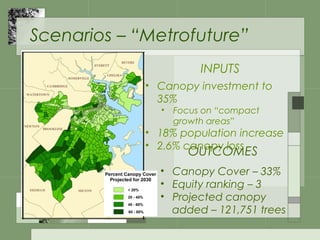
Scenarios – “Metrofuture”
• Canopy Cover – 33%
• Equity ranking – 3
• Projected canopy
added – 121,751 trees
• Canopy investment to
35%
• Focus on “compact
growth areas”
• 18% population increase
• 2.6% canopy loss
OUTCOMES
INPUTS
Scenarios – “Grow Boston Greener”
• Canopy Cover – 32%
• Equity ranking – 3
• Projected canopy
added – 102,285 trees
• Canopy investment to
35%
• Add 100,000 trees to
“underserved” areas
• 18% population increase
• 2.6% canopy loss
OUTCOMES
INPUTS
Scenarios – “Green Equity”
• Canopy Cover – 39%
• Equity ranking – 1
• Projected canopy
added – 365,076 trees
• Canopy investment to
40%
• Focus on EJ communities
• 13% population increase
• 1.58% canopy loss
OUTCOMES
INPUTS
Scenarios – “All Trees”
• Canopy Cover – 40%
• Equity ranking – 2
• Projected canopy
added – 420,392 trees
• Ecological availability
• Plant trees in any available
planting site
• 18% population increase
• 2.6% canopy loss
OUTCOMES
INPUTS
Conclusions
Equity can be improved!
•Even Green Equity doesn’t
approach true equity for EJ
communities
•Any scenario will improve equity
over the status quo (Current Trends)
Conclusions
There’s room for more!
•Green Equity requires planting over
3x more trees than the current GBG
initiative calls for
•There’s potential to increase the
overall canopy cover in Boston to
40%
Conclusions
Trees aren’t the only answer
– Green roofs/walls
– Rain gardens
– Native landscaping
– Permeable paving
What does it take to
achieve equitable
urban tree canopy
distribution? A
Boston case study.
Rachel Danford,
Chingwen Cheng,
Michael Strohbach,
Robert Ryan, Craig
Nicolson, Paige Warren
NSF # BCS-0948984
Thank you!

Tree equity rsd_edra

  • 1.
    Continued inequity forurban ecosystem services What will it take to achieve equitable tree canopy distribution in the City of Boston? Rachel Danford University of Massachusetts, Amherst May 30th 2013
  • 2.
  • 3.
    Agenda • Urban trees •Current urban tree distribution • Methods • Five potential scenarios • Conclusions
  • 4.
    Urban trees -ecosystem services Soil Conservation Wildlife Habitat Health Benefits Community Enrichment Energy Conservation Carbon Sequestration Water Conservation Beauty Urban canopy Environmental Justice
  • 5.
    Study Area Traffic AnalysisZone (TAZ) •Commonly used for assessing traffic related data •Can be variable in size
  • 6.
  • 7.
    Scenarios • Population projections •Tree planting potential – On impervious surface – On pervious surface – Street trees • Projected canopy loss • Equity (Gini Indices)
  • 8.
    Scenarios – “CurrentTrends” • Canopy Cover – 28% • Equity ranking – 4 • Projected canopy loss - 20,361 trees • No investment in canopy • 7% population increase • 1% canopy loss OUTCOMES INPUTS
  • 9.
    Scenarios – “Metrofuture” •Canopy Cover – 33% • Equity ranking – 3 • Projected canopy added – 121,751 trees • Canopy investment to 35% • Focus on “compact growth areas” • 18% population increase • 2.6% canopy loss OUTCOMES INPUTS
  • 10.
    Scenarios – “GrowBoston Greener” • Canopy Cover – 32% • Equity ranking – 3 • Projected canopy added – 102,285 trees • Canopy investment to 35% • Add 100,000 trees to “underserved” areas • 18% population increase • 2.6% canopy loss OUTCOMES INPUTS
  • 11.
    Scenarios – “GreenEquity” • Canopy Cover – 39% • Equity ranking – 1 • Projected canopy added – 365,076 trees • Canopy investment to 40% • Focus on EJ communities • 13% population increase • 1.58% canopy loss OUTCOMES INPUTS
  • 12.
    Scenarios – “AllTrees” • Canopy Cover – 40% • Equity ranking – 2 • Projected canopy added – 420,392 trees • Ecological availability • Plant trees in any available planting site • 18% population increase • 2.6% canopy loss OUTCOMES INPUTS
  • 13.
    Conclusions Equity can beimproved! •Even Green Equity doesn’t approach true equity for EJ communities •Any scenario will improve equity over the status quo (Current Trends)
  • 14.
    Conclusions There’s room formore! •Green Equity requires planting over 3x more trees than the current GBG initiative calls for •There’s potential to increase the overall canopy cover in Boston to 40%
  • 15.
    Conclusions Trees aren’t theonly answer – Green roofs/walls – Rain gardens – Native landscaping – Permeable paving
  • 16.
    What does ittake to achieve equitable urban tree canopy distribution? A Boston case study. Rachel Danford, Chingwen Cheng, Michael Strohbach, Robert Ryan, Craig Nicolson, Paige Warren NSF # BCS-0948984 Thank you!