Using Incentives
Effectively – the
National Perspective
DARRENE HACKLER, ADVISOR, SMART INCENTIVES
CALIFORNIA ASSOCIATION FOR
LOCAL ECONOMIC DEVELOPMENT (CALED)
AUGUST 2016
About us
	 Business Development Advisors

is an economic development

consulting firm
	 Smart Incentives helps communities

make sound decisions 

throughout the incentives process
2	©	2016	SMART	INCENTIVES
Why do we use incentives?
	 To achieve our community’s economic development goals

◦  Jobs
◦  Business Development
◦  Investment
◦  Downtown revitalization
◦  Brownfield redevelopment
◦  Quality of life and quality of place
◦  Strengthen tax base
	 Incentives are not just about winning a deal. Smart incentive use is
always connected to a larger economic development strategy.
3	©	2016	SMART	INCENTIVES
Today’s environment
requires better analytics
	 Reduce risk
	 Quantify net benefits
	 Refine incentive strategies
	 Explain and build support for decisions
	 Achieve better outcomes
4	©	2016	SMART	INCENTIVES
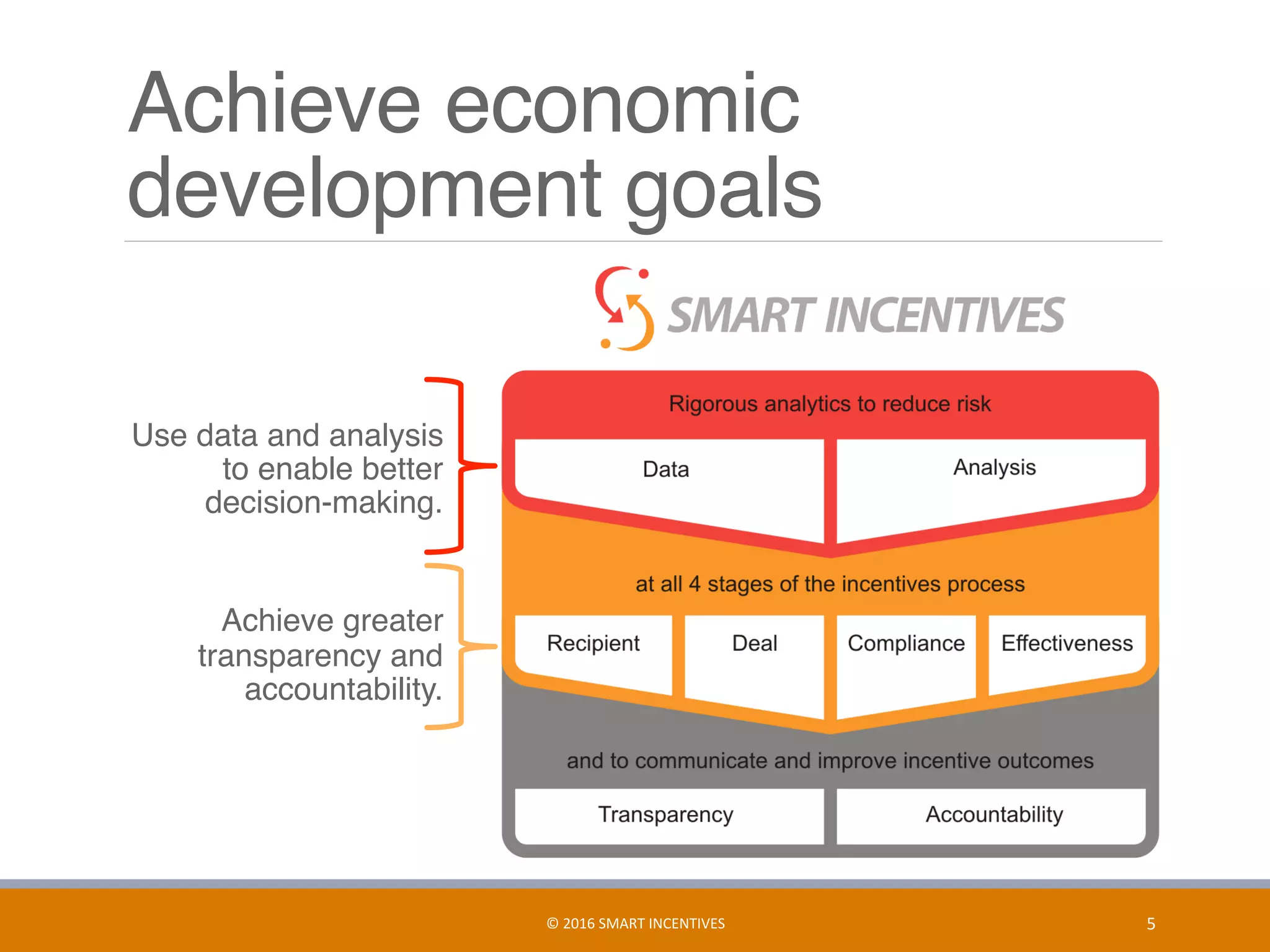
Achieve economic
development goals
©	2016	SMART	INCENTIVES	 5	
	 Use data and analysis
to enable better
decision-making.
	 Achieve greater
transparency and
accountability.
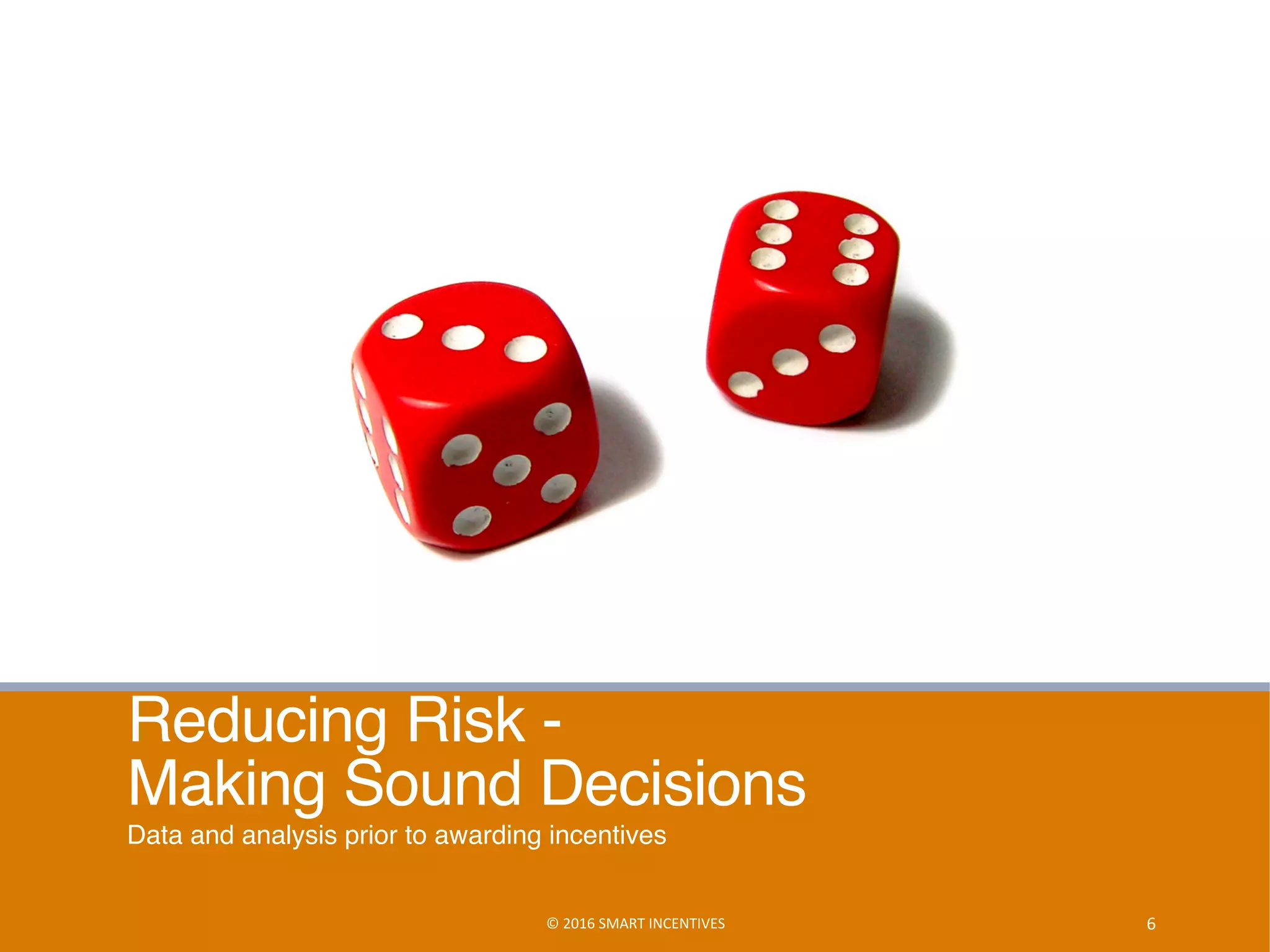
Reducing Risk - 

Making Sound Decisions
Data and analysis prior to awarding incentives
6	©	2016	SMART	INCENTIVES
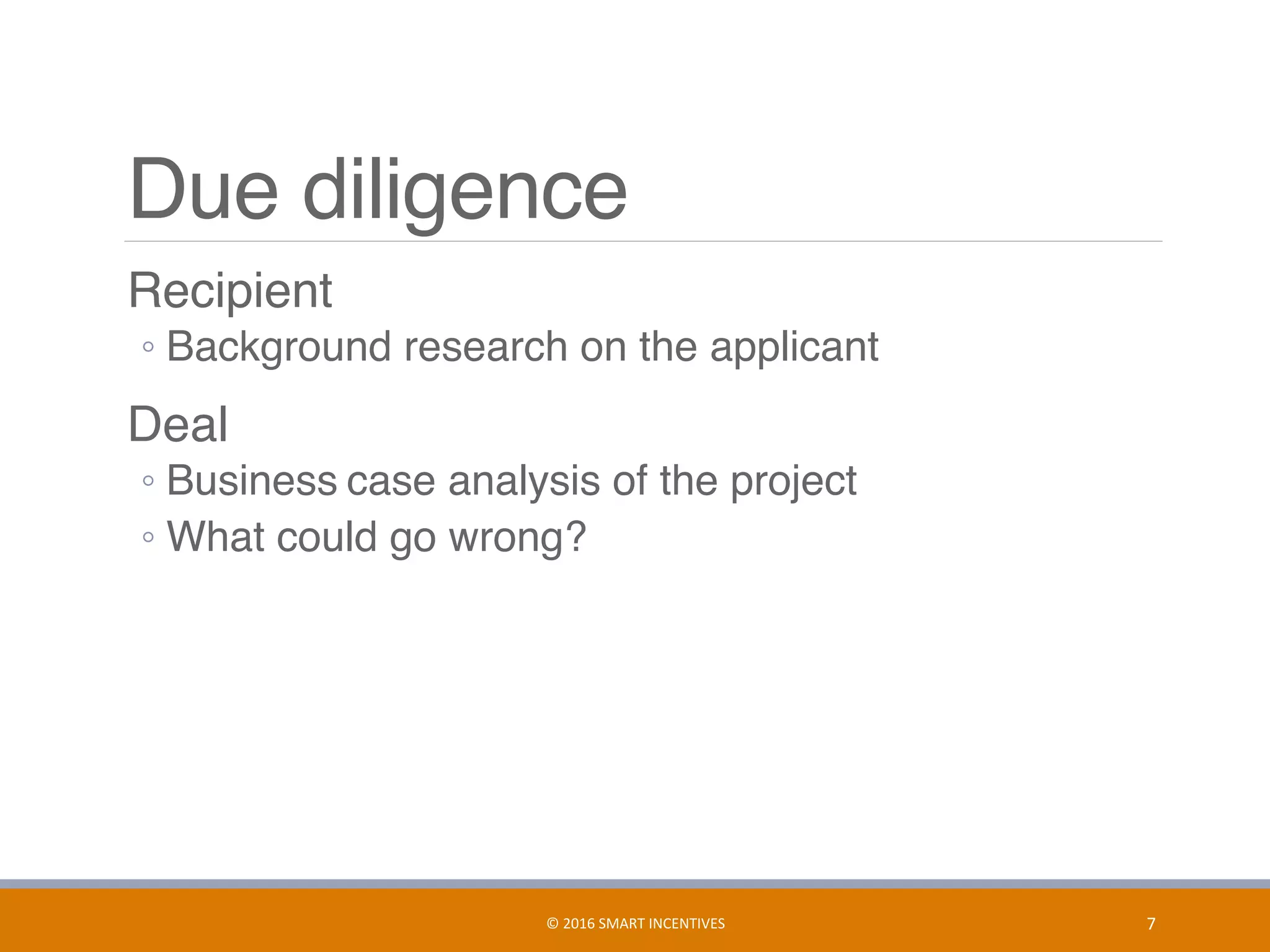
Due diligence
	 Recipient
◦ Background research on the applicant
	 Deal
◦ Business case analysis of the project
◦ What could go wrong?
7	©	2016	SMART	INCENTIVES
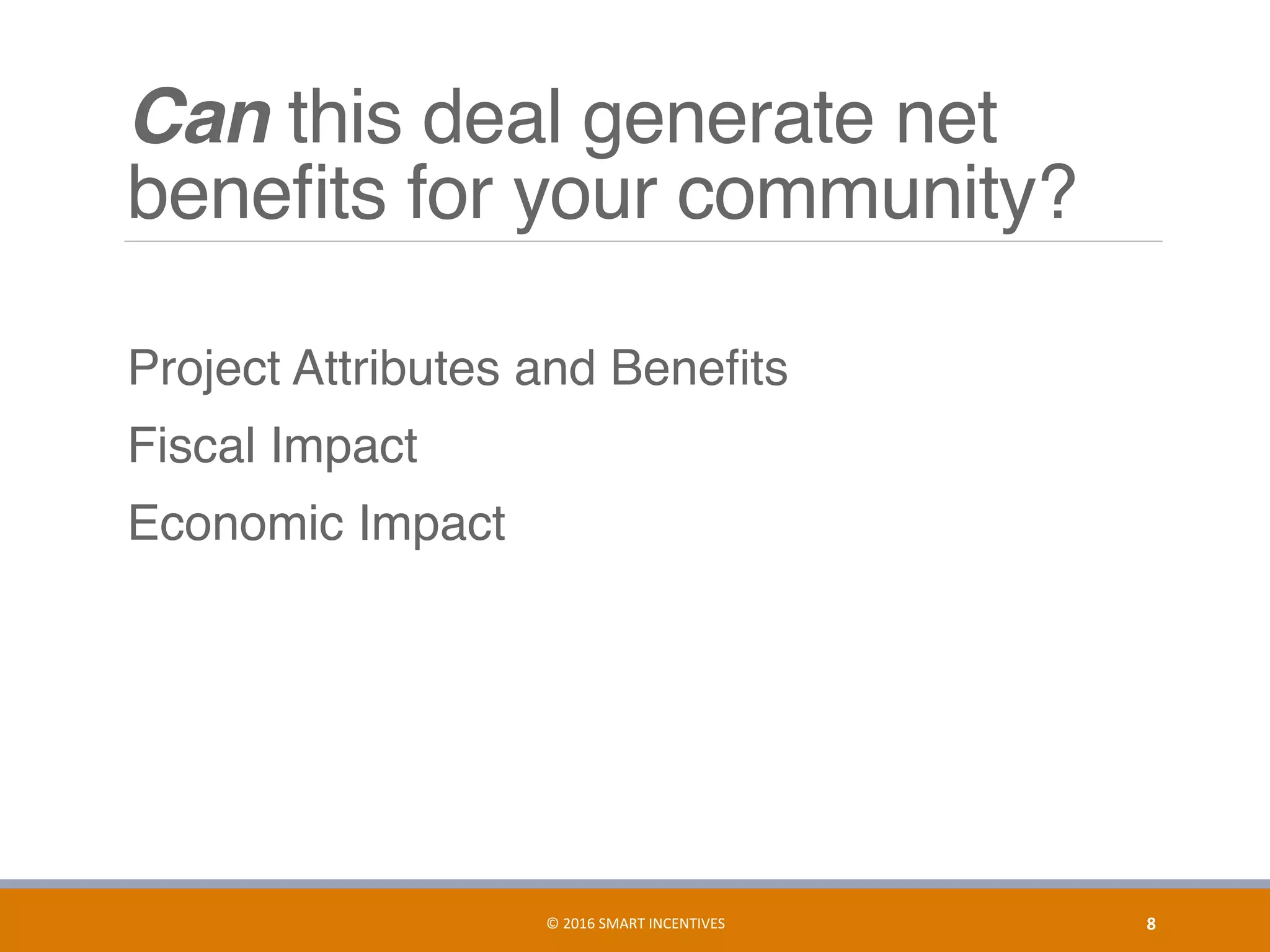
Can this deal generate net
benefits for your community?
	 Project Attributes and Benefits
	 Fiscal Impact
	 Economic Impact
8	©	2016	SMART	INCENTIVES
Project attributes & benefits
	 Project characteristics
	 Fit with economic development strategy
	 Effect on existing businesses
	 Timeframe
	 Likelihood of success
9	©	2016	SMART	INCENTIVES
Fiscal impact
	 Tax and budgetary implications of incentive decisions for state and
local government
	 Cost of the incentive
	 Tax revenue the project may generate
	 Additional expenditures that might be required
	 Challenges:
◦  Jurisdictions affected
◦  Fiscal impact of indirect and induced jobs
◦  New jobs and new residents
◦  Timing
10	©	2016	SMART	INCENTIVES
Economic impact
	 Traces the flow of money after an initial investment to estimate the
contribution to the regional or state economy
	 Economic impact depends on industrial structure and size of your
region
	 Components:
◦  Direct
◦  Indirect
◦  Induced
	 Data needs
	 Judgment and interpretation
11	©	2016	SMART	INCENTIVES
Takeaways
	 Devote resources to the analysis
◦  IEDC, CDFA can help make the case
◦  Band together with others in your community and region
	 Strike a balance between detail and reasonableness
◦  You’ll never be “right” – need order of magnitude estimate
◦  Judgment still needed
	 Be prepared to communicate your process, decision
and rationale
12	©	2016	SMART	INCENTIVES
Compliance and Effectiveness
Evaluating incentives outcomes
13	©	2016	SMART	INCENTIVES
Did this deal generate net
benefits for your community?
	 Project performance
	 Achieving economic development goals
14	©	2016	SMART	INCENTIVES
Compliance – performance
agreements
	 Define performance requirements
	 Prepare an agreement
◦  Only 56% of local governments report that a performance agreement
is required when providing business incentives
	 Tie the project timeframe to the fiscal break-even point
	 Require progress reports
	 Are policies in place to protect the community in the
case of non-performance?
15	©	2016	SMART	INCENTIVES
Compliance monitoring
	 Whose job is it?
	 Can information be verified?
◦  Require reporting as part of agreement
◦  Data sharing among agencies to verify key reporting variables
	 How is data tracked?
	 Timeframe?
	 Site visits and closeout interview
Collect the data to see what is working and what is not.
16	©	2016	SMART	INCENTIVES
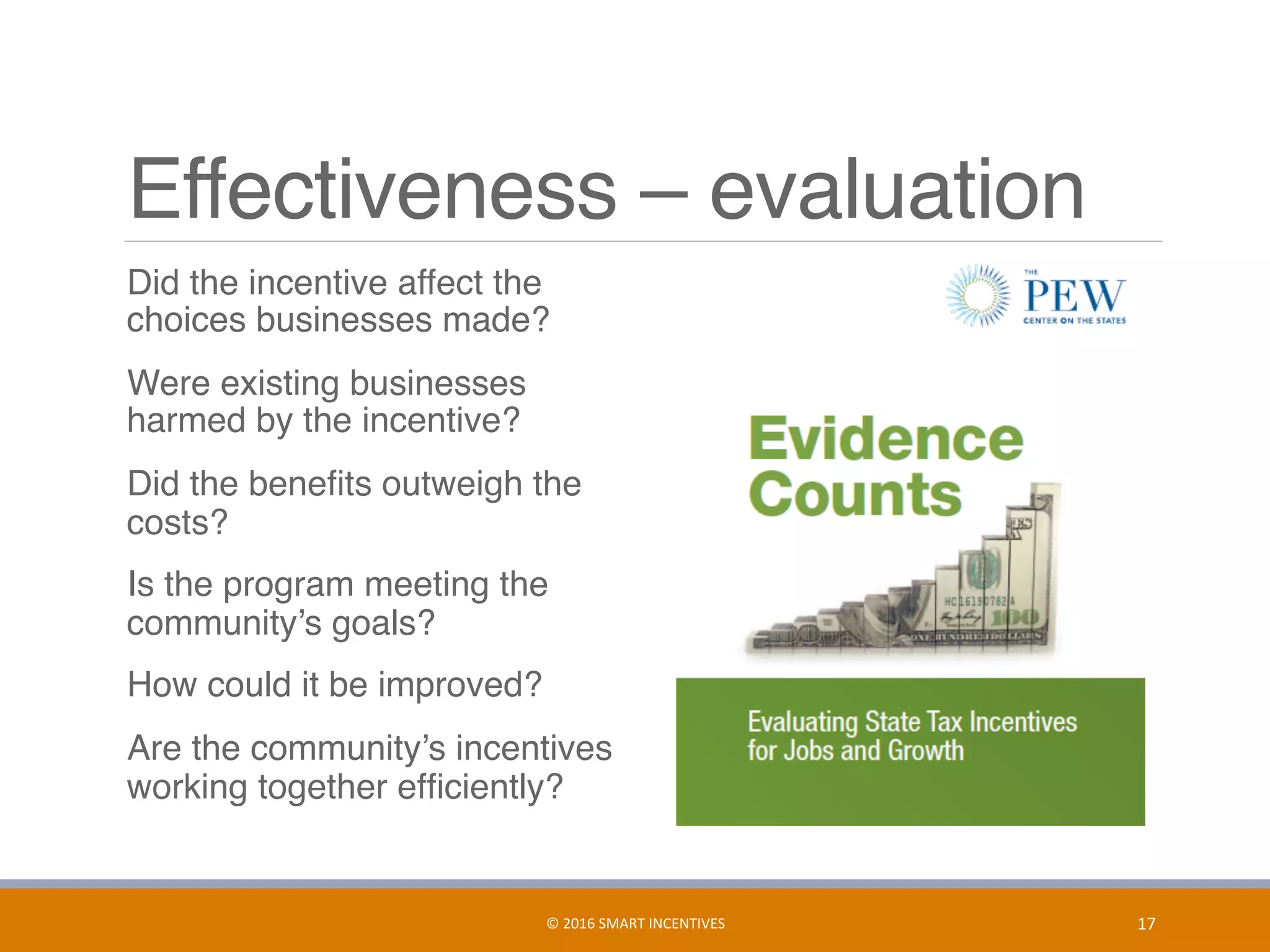
Effectiveness – evaluation
	 Did the incentive affect the
choices businesses made?
	 Were existing businesses
harmed by the incentive?
	 Did the benefits outweigh the
costs?
	 Is the program meeting the
community’s goals?
	 How could it be improved?
	 Are the community’s incentives
working together efficiently?
17	©	2016	SMART	INCENTIVES
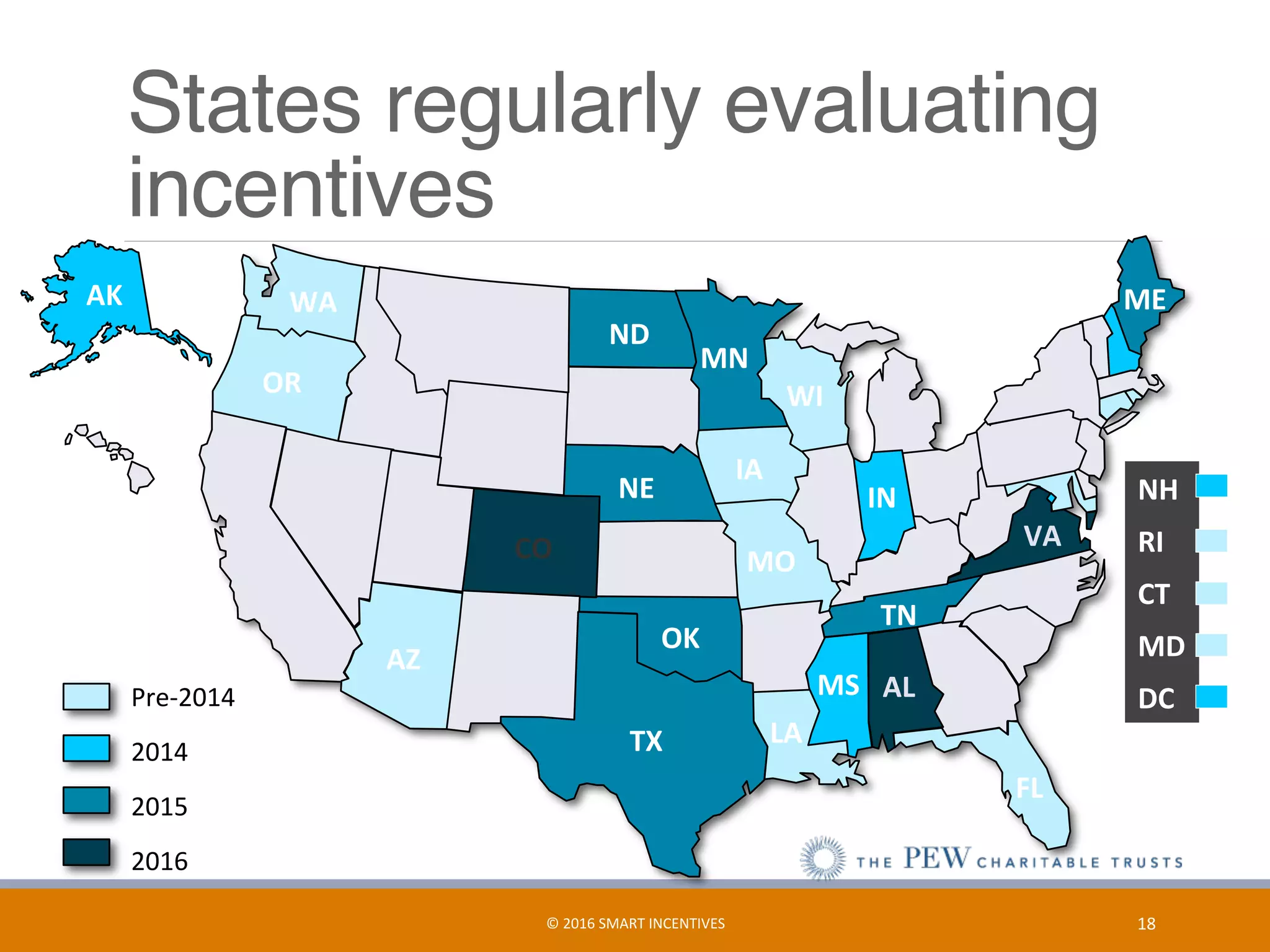
States regularly evaluating
incentives
18	©	2016	SMART	INCENTIVES	
Pre-2014	
2014	
2015	
2016	
WA	
OR	
AZ	
IA	
MO	
LA	
FL	
AK	
TX	
OK	
NE	
ND	
MN	
MS	
TN	
IN	
ME	
NH	
RI	
CT	
MD	
DC	
WI	
AL	
VA	CO
Business Incentives Initiative
	 Identify effective ways to manage and assess incentive policies and
practices
	 Improve data collection and analysis
	 Develop national standards and best practices that states can use to
report on economic development incentives
	 Participating states: IN, MD, MI, OK, TN, VA
19	
©	2016	SMART	INCENTIVES
Evaluating to inform policy
choices
	 Review your portfolio of incentive offerings
	 Define the goal of each incentive program clearly
	 Consider building reviews into the budget process (RI)
or legislative calendar (IN, MS)
	 Create a team with agency experience, analytical skills
and subject-matter expertise
	 Collaborate with other agencies to collect data and
share analytics expertise
	 Leadership is critical
20	©	2016	SMART	INCENTIVES
Improving communication
Preparing for greater transparency and accountability
21	©	2016	SMART	INCENTIVES
Reporting & communication
Elected officials and community groups are demanding
better data from EDOs on incentive use.
Many organizations still struggle to report basic project
information . . .
. . . And aren’t prepared to answer questions on
outcomes and effectiveness
22	©	2016	SMART	INCENTIVES
Transparency
	 Lawmakers/the media/the public generally want to
know:
◦  How much are we spending?
◦  Who is receiving incentives?
	 Reporting considerations
◦  Individual recipient versus aggregate reporting
◦  Just the facts or analysis?
◦  Need to provide context
	 Usable/user-friendly information
23	©	2016	SMART	INCENTIVES
GASB Statement 77 State & Local 

Tax Abatement Disclosure
	 Disclose agreements between individual taxpayers and the
government that might diminish the tax base
	 Includes:
◦  General descriptive information (tax being abated, authority, eligibility,
mechanism by which taxes are abated, provisions for recapture)
◦  Commitments made by the recipient
◦  Other commitments made by a government (such as infrastructure)
◦  Number of tax abatement agreements entered into and in effect during
the reporting period
◦  Dollar amount of taxes abated during the reporting period
	 Substance of the transaction rather than the name or description
determines whether the abatement must be disclosed.
24	©	2016	SMART	INCENTIVES
Some GASB guidelines
	 Now is the time to determine which tax incentive programs
fit the definition.
	 Communicate with government finance staff
	 Transparency
◦  Share process and rationale for decisions
◦  Release basic deal information
	 Accountability
◦  Annual report – what we did and what we hope to achieve
◦  Evaluations every 3-5 years – what worked, how can we
improve
	 Context
25	©	2016	SMART	INCENTIVES
Accountability
What are we getting out of our incentives
spending?
Reporting the results of the evaluations
Collaborative approach to evaluation – and
reporting
Using reporting to improve not punish/get punished
26	©	2016	SMART	INCENTIVES
Concluding thoughts
	 Incentives should be used to accomplish community
goals – not just win a deal
◦  The problem is we haven’t known which incentives
actually help our communities
	 Economic developers need better data and analytics to
identify what works and enable sound decisions when
awarding incentives
	 The next few years will see tremendous improvements
in the way we talk about and evaluate incentives
©	2016	SMART	INCENTIVES	 27
Contact us
	 Darrene Hackler

Advisor
darrene@smartincentives.org
http://www.smartincentives.org 

@dhackler, @SmartIncentives
28	©	2016	SMART	INCENTIVES

Using Incentives Effectively - The National Perspective

  • 1.
    Using Incentives Effectively –the National Perspective DARRENE HACKLER, ADVISOR, SMART INCENTIVES CALIFORNIA ASSOCIATION FOR LOCAL ECONOMIC DEVELOPMENT (CALED) AUGUST 2016
  • 2.
    About us  Business DevelopmentAdvisors
 is an economic development
 consulting firm  Smart Incentives helps communities
 make sound decisions 
 throughout the incentives process 2 © 2016 SMART INCENTIVES
  • 3.
    Why do weuse incentives?  To achieve our community’s economic development goals
 ◦  Jobs ◦  Business Development ◦  Investment ◦  Downtown revitalization ◦  Brownfield redevelopment ◦  Quality of life and quality of place ◦  Strengthen tax base  Incentives are not just about winning a deal. Smart incentive use is always connected to a larger economic development strategy. 3 © 2016 SMART INCENTIVES
  • 4.
    Today’s environment requires betteranalytics  Reduce risk  Quantify net benefits  Refine incentive strategies  Explain and build support for decisions  Achieve better outcomes 4 © 2016 SMART INCENTIVES
  • 5.
    Achieve economic development goals © 2016 SMART INCENTIVES 5  Use data and analysis to enable better decision-making.  Achieve greater transparency and accountability.
  • 6.
    Reducing Risk -
 Making Sound Decisions Data and analysis prior to awarding incentives 6 © 2016 SMART INCENTIVES
  • 7.
    Due diligence  Recipient ◦ Background researchon the applicant  Deal ◦ Business case analysis of the project ◦ What could go wrong? 7 © 2016 SMART INCENTIVES
  • 8.
    Can this dealgenerate net benefits for your community?  Project Attributes and Benefits  Fiscal Impact  Economic Impact 8 © 2016 SMART INCENTIVES
  • 9.
    Project attributes &benefits  Project characteristics  Fit with economic development strategy  Effect on existing businesses  Timeframe  Likelihood of success 9 © 2016 SMART INCENTIVES
  • 10.
    Fiscal impact  Tax andbudgetary implications of incentive decisions for state and local government  Cost of the incentive  Tax revenue the project may generate  Additional expenditures that might be required  Challenges: ◦  Jurisdictions affected ◦  Fiscal impact of indirect and induced jobs ◦  New jobs and new residents ◦  Timing 10 © 2016 SMART INCENTIVES
  • 11.
    Economic impact  Traces theflow of money after an initial investment to estimate the contribution to the regional or state economy  Economic impact depends on industrial structure and size of your region  Components: ◦  Direct ◦  Indirect ◦  Induced  Data needs  Judgment and interpretation 11 © 2016 SMART INCENTIVES
  • 12.
    Takeaways  Devote resources tothe analysis ◦  IEDC, CDFA can help make the case ◦  Band together with others in your community and region  Strike a balance between detail and reasonableness ◦  You’ll never be “right” – need order of magnitude estimate ◦  Judgment still needed  Be prepared to communicate your process, decision and rationale 12 © 2016 SMART INCENTIVES
  • 13.
    Compliance and Effectiveness Evaluatingincentives outcomes 13 © 2016 SMART INCENTIVES
  • 14.
    Did this dealgenerate net benefits for your community?  Project performance  Achieving economic development goals 14 © 2016 SMART INCENTIVES
  • 15.
    Compliance – performance agreements  Defineperformance requirements  Prepare an agreement ◦  Only 56% of local governments report that a performance agreement is required when providing business incentives  Tie the project timeframe to the fiscal break-even point  Require progress reports  Are policies in place to protect the community in the case of non-performance? 15 © 2016 SMART INCENTIVES
  • 16.
    Compliance monitoring  Whose jobis it?  Can information be verified? ◦  Require reporting as part of agreement ◦  Data sharing among agencies to verify key reporting variables  How is data tracked?  Timeframe?  Site visits and closeout interview Collect the data to see what is working and what is not. 16 © 2016 SMART INCENTIVES
  • 17.
    Effectiveness – evaluation  Didthe incentive affect the choices businesses made?  Were existing businesses harmed by the incentive?  Did the benefits outweigh the costs?  Is the program meeting the community’s goals?  How could it be improved?  Are the community’s incentives working together efficiently? 17 © 2016 SMART INCENTIVES
  • 18.
  • 19.
    Business Incentives Initiative  Identifyeffective ways to manage and assess incentive policies and practices  Improve data collection and analysis  Develop national standards and best practices that states can use to report on economic development incentives  Participating states: IN, MD, MI, OK, TN, VA 19 © 2016 SMART INCENTIVES
  • 20.
    Evaluating to informpolicy choices  Review your portfolio of incentive offerings  Define the goal of each incentive program clearly  Consider building reviews into the budget process (RI) or legislative calendar (IN, MS)  Create a team with agency experience, analytical skills and subject-matter expertise  Collaborate with other agencies to collect data and share analytics expertise  Leadership is critical 20 © 2016 SMART INCENTIVES
  • 21.
    Improving communication Preparing forgreater transparency and accountability 21 © 2016 SMART INCENTIVES
  • 22.
    Reporting & communication Electedofficials and community groups are demanding better data from EDOs on incentive use. Many organizations still struggle to report basic project information . . . . . . And aren’t prepared to answer questions on outcomes and effectiveness 22 © 2016 SMART INCENTIVES
  • 23.
    Transparency  Lawmakers/the media/the publicgenerally want to know: ◦  How much are we spending? ◦  Who is receiving incentives?  Reporting considerations ◦  Individual recipient versus aggregate reporting ◦  Just the facts or analysis? ◦  Need to provide context  Usable/user-friendly information 23 © 2016 SMART INCENTIVES
  • 24.
    GASB Statement 77State & Local 
 Tax Abatement Disclosure  Disclose agreements between individual taxpayers and the government that might diminish the tax base  Includes: ◦  General descriptive information (tax being abated, authority, eligibility, mechanism by which taxes are abated, provisions for recapture) ◦  Commitments made by the recipient ◦  Other commitments made by a government (such as infrastructure) ◦  Number of tax abatement agreements entered into and in effect during the reporting period ◦  Dollar amount of taxes abated during the reporting period  Substance of the transaction rather than the name or description determines whether the abatement must be disclosed. 24 © 2016 SMART INCENTIVES
  • 25.
    Some GASB guidelines  Nowis the time to determine which tax incentive programs fit the definition.  Communicate with government finance staff  Transparency ◦  Share process and rationale for decisions ◦  Release basic deal information  Accountability ◦  Annual report – what we did and what we hope to achieve ◦  Evaluations every 3-5 years – what worked, how can we improve  Context 25 © 2016 SMART INCENTIVES
  • 26.
    Accountability What are wegetting out of our incentives spending? Reporting the results of the evaluations Collaborative approach to evaluation – and reporting Using reporting to improve not punish/get punished 26 © 2016 SMART INCENTIVES
  • 27.
    Concluding thoughts  Incentives shouldbe used to accomplish community goals – not just win a deal ◦  The problem is we haven’t known which incentives actually help our communities  Economic developers need better data and analytics to identify what works and enable sound decisions when awarding incentives  The next few years will see tremendous improvements in the way we talk about and evaluate incentives © 2016 SMART INCENTIVES 27
  • 28.