
Evaluate and
Maximize Your Return
on Incentives
IEDC WEBINAR, JANUARY 2016
ELLEN HARPEL, SMART INCENTIVES
About us
	 Business Development Advisors

is an economic development

consulting firm
	 Smart Incentives helps communities

make sound decisions 

throughout the incentives process
2	©	2016	SMART	INCENTIVES
Why do we use incentives?
	 To achieve our community’s economic development goals

◦  Jobs
◦  Business development
◦  Investment
◦  Downtown revitalization
◦  Brownfield redevelopment
◦  Quality of life and quality of place
◦  Strengthen tax base
	 Incentives are not just about winning a deal. Smart incentive use is
always connected to a larger economic development strategy.
3	©	2016	SMART	INCENTIVES
Today’s environment
requires better analytics
	 Reduce risk
	 Quantify net benefits
	 Refine incentive strategies
	 Explain and build support for decisions
	 Achieve better outcomes
4	©	2016	SMART	INCENTIVES
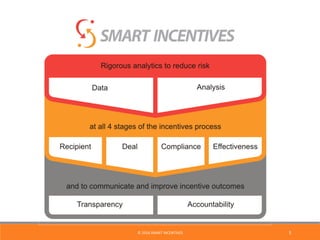
©	2016	SMART	INCENTIVES	 5
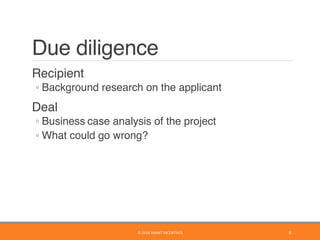
Due diligence
	 Recipient
◦ Background research on the applicant
	 Deal
◦ Business case analysis of the project
◦ What could go wrong?
6	©	2016	SMART	INCENTIVES
Can this deal generate net
benefits for your community?
	 3 steps to assess return on incentives
	 

Project Attributes
	 Fiscal Impact
	 Economic Impact
7	©	2016	SMART	INCENTIVES
Project attributes
	 Project characteristics
	 Fit with economic development strategy
	 Effect on existing businesses
	 Location
	 Timeframe
	 Likelihood of success
8	©	2016	SMART	INCENTIVES
Fiscal impact
	 Tax and budgetary implications of incentive decisions for state and
local government
	 Cost of the incentive
	 Tax revenue the project may generate
	 Additional expenditures that might be required
	 Challenges:
◦  Jurisdictions affected
◦  Fiscal impact of indirect and induced jobs
◦  New jobs and new residents
◦  Timing
9	©	2016	SMART	INCENTIVES
Economic Impact
	 Traces the flow of money after an initial investment to estimate the
contribution to the regional or state economy
	 Economic impact depends on industrial structure and size of your
region
	 Components:
◦  Direct
◦  Indirect
◦  Induced
	 Data needs
	 Judgment and interpretation
10	©	2016	SMART	INCENTIVES
Takeaways
	 Devote resources to the analysis
◦  Organizations like IEDC can help make the case
◦  Band together with others in your community and region
	 Strike a balance between detail and reasonableness
◦  You’ll never be “right” – need order of magnitude estimate
◦  Judgment still needed
	 Be prepared to communicate your process, decision
and rationale
11	©	2016	SMART	INCENTIVES
Did this deal generate net
benefits for your community?
	 “Monitor, measure and report”

	 Project performance
	 Achieving economic development goals
©	2016	SMART	INCENTIVES	 12
Compliance monitoring
	 What is required in the performance agreement?
	 How is data obtained and tracked?
	 Whose job is it?
	 Can information be verified?
	 What do you do with the information?
	 Is there a closeout process?
Collect the data to see what is working and what is not
13	©	2016	SMART	INCENTIVES
Program evaluation
	 Define program goals clearly
	 Align metrics with program goals
	 Consider data sources when choosing metrics
	 Go beyond job counts
	 Use consistent definitions and reporting mechanisms
	 Communicate findings
©	2016	SMART	INCENTIVES	 14
Reporting & communication
	 Elected officials and community groups are demanding
better data from EDOs on incentive use.

	 Transparency
◦  How much are we spending?
◦  Who is receiving incentives?
	 Accountability
◦  What are we getting out of our incentives spending?
◦  Reporting the results of the evaluations
15	©	2016	SMART	INCENTIVES
GASB: State & Local 

Tax Abatement Disclosure
	 Requires disclosure of financial information about tax abatement
agreements between individual taxpayers and the government
	 Why? To make transparent the financial impact of transactions that
can limit a government’s revenue-raising ability
	 Includes:
◦  General descriptive information (tax being abated, authority, eligibility,
mechanism by which taxes are abated, provisions for recapture)
◦  Commitments made by the recipient
◦  Other commitments made by a government (such as infrastructure)
◦  Dollar amount of taxes abated during the reporting period
◦  Tax abatements entered into by other governments that reduce the
reporting entity’s tax revenues
	 In effect for financial statements for periods beginning after Dec. 15,
2015
16	©	2016	SMART	INCENTIVES
GASB (2)
	 Individual agreements do not need to be disclosed.
	 The guidance for disclosure is limited to tax abatements. It does
not include all tax expenditures and it does not include other forms
of assistance to businesses.
	 The disclosure rules are not limited to tax abatements for
business attraction.
	 Disclosure does not depend on the existence of a written
agreement.
©	2016	SMART	INCENTIVES	 17
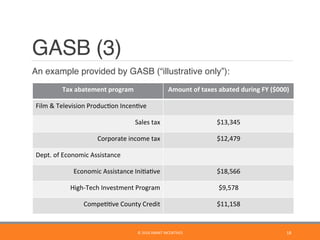
GASB (3)
	 An example provided by GASB (“illustrative only”):
©	2016	SMART	INCENTIVES	 18	
Tax	abatement	program	 Amount	of	taxes	abated	during	FY	($000)	
Film	&	Television	ProducGon	IncenGve	
Sales	tax	 $13,345	
Corporate	income	tax	 $12,479	
Dept.	of	Economic	Assistance	
Economic	Assistance	IniGaGve	 $18,566	
High-Tech	Investment	Program	 $9,578	
CompeGGve	County	Credit	 $11,158
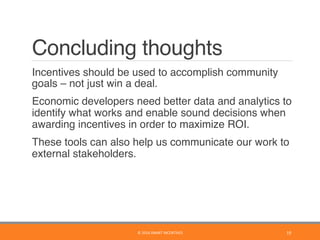
Concluding thoughts
	 Incentives should be used to accomplish community
goals – not just win a deal.
	 Economic developers need better data and analytics to
identify what works and enable sound decisions when
awarding incentives in order to maximize ROI.
	 These tools can also help us communicate our work to
external stakeholders.
©	2016	SMART	INCENTIVES	 19
Contact us
	 Ellen Harpel

President
	 571/212.3397
eharpel@businessdevelopmentadvisors.com
www.businessdevelopmentadvisors.com


ellen@smartincentives.org
http://www.smartincentives.org/

@SmartIncentives
20	©	2016	SMART	INCENTIVES

Evaluate and maximize return on incentives

  • 1.
    Evaluate and Maximize YourReturn on Incentives IEDC WEBINAR, JANUARY 2016 ELLEN HARPEL, SMART INCENTIVES
  • 2.
    About us  Business DevelopmentAdvisors
 is an economic development
 consulting firm  Smart Incentives helps communities
 make sound decisions 
 throughout the incentives process 2 © 2016 SMART INCENTIVES
  • 3.
    Why do weuse incentives?  To achieve our community’s economic development goals
 ◦  Jobs ◦  Business development ◦  Investment ◦  Downtown revitalization ◦  Brownfield redevelopment ◦  Quality of life and quality of place ◦  Strengthen tax base  Incentives are not just about winning a deal. Smart incentive use is always connected to a larger economic development strategy. 3 © 2016 SMART INCENTIVES
  • 4.
    Today’s environment requires betteranalytics  Reduce risk  Quantify net benefits  Refine incentive strategies  Explain and build support for decisions  Achieve better outcomes 4 © 2016 SMART INCENTIVES
  • 5.
  • 6.
    Due diligence  Recipient ◦ Background researchon the applicant  Deal ◦ Business case analysis of the project ◦ What could go wrong? 6 © 2016 SMART INCENTIVES
  • 7.
    Can this dealgenerate net benefits for your community?  3 steps to assess return on incentives  
 Project Attributes  Fiscal Impact  Economic Impact 7 © 2016 SMART INCENTIVES
  • 8.
    Project attributes  Project characteristics  Fitwith economic development strategy  Effect on existing businesses  Location  Timeframe  Likelihood of success 8 © 2016 SMART INCENTIVES
  • 9.
    Fiscal impact  Tax andbudgetary implications of incentive decisions for state and local government  Cost of the incentive  Tax revenue the project may generate  Additional expenditures that might be required  Challenges: ◦  Jurisdictions affected ◦  Fiscal impact of indirect and induced jobs ◦  New jobs and new residents ◦  Timing 9 © 2016 SMART INCENTIVES
  • 10.
    Economic Impact  Traces theflow of money after an initial investment to estimate the contribution to the regional or state economy  Economic impact depends on industrial structure and size of your region  Components: ◦  Direct ◦  Indirect ◦  Induced  Data needs  Judgment and interpretation 10 © 2016 SMART INCENTIVES
  • 11.
    Takeaways  Devote resources tothe analysis ◦  Organizations like IEDC can help make the case ◦  Band together with others in your community and region  Strike a balance between detail and reasonableness ◦  You’ll never be “right” – need order of magnitude estimate ◦  Judgment still needed  Be prepared to communicate your process, decision and rationale 11 © 2016 SMART INCENTIVES
  • 12.
    Did this dealgenerate net benefits for your community?  “Monitor, measure and report”
  Project performance  Achieving economic development goals © 2016 SMART INCENTIVES 12
  • 13.
    Compliance monitoring  What isrequired in the performance agreement?  How is data obtained and tracked?  Whose job is it?  Can information be verified?  What do you do with the information?  Is there a closeout process? Collect the data to see what is working and what is not 13 © 2016 SMART INCENTIVES
  • 14.
    Program evaluation  Define programgoals clearly  Align metrics with program goals  Consider data sources when choosing metrics  Go beyond job counts  Use consistent definitions and reporting mechanisms  Communicate findings © 2016 SMART INCENTIVES 14
  • 15.
    Reporting & communication  Electedofficials and community groups are demanding better data from EDOs on incentive use.
  Transparency ◦  How much are we spending? ◦  Who is receiving incentives?  Accountability ◦  What are we getting out of our incentives spending? ◦  Reporting the results of the evaluations 15 © 2016 SMART INCENTIVES
  • 16.
    GASB: State &Local 
 Tax Abatement Disclosure  Requires disclosure of financial information about tax abatement agreements between individual taxpayers and the government  Why? To make transparent the financial impact of transactions that can limit a government’s revenue-raising ability  Includes: ◦  General descriptive information (tax being abated, authority, eligibility, mechanism by which taxes are abated, provisions for recapture) ◦  Commitments made by the recipient ◦  Other commitments made by a government (such as infrastructure) ◦  Dollar amount of taxes abated during the reporting period ◦  Tax abatements entered into by other governments that reduce the reporting entity’s tax revenues  In effect for financial statements for periods beginning after Dec. 15, 2015 16 © 2016 SMART INCENTIVES
  • 17.
    GASB (2)  Individual agreementsdo not need to be disclosed.  The guidance for disclosure is limited to tax abatements. It does not include all tax expenditures and it does not include other forms of assistance to businesses.  The disclosure rules are not limited to tax abatements for business attraction.  Disclosure does not depend on the existence of a written agreement. © 2016 SMART INCENTIVES 17
  • 18.
    GASB (3)  An exampleprovided by GASB (“illustrative only”): © 2016 SMART INCENTIVES 18 Tax abatement program Amount of taxes abated during FY ($000) Film & Television ProducGon IncenGve Sales tax $13,345 Corporate income tax $12,479 Dept. of Economic Assistance Economic Assistance IniGaGve $18,566 High-Tech Investment Program $9,578 CompeGGve County Credit $11,158
  • 19.
    Concluding thoughts  Incentives shouldbe used to accomplish community goals – not just win a deal.  Economic developers need better data and analytics to identify what works and enable sound decisions when awarding incentives in order to maximize ROI.  These tools can also help us communicate our work to external stakeholders. © 2016 SMART INCENTIVES 19
  • 20.