Using Data Science for
Behavioural Game Design
Rudradeb Mitra
The Me,
The Game Design,
The Machine Learning
• Three months ago Google
Launchpad Mentoring

• 7 startups

• 12+ years in AI, published 10
research papers, 80+ events/
28 countries invited speaker,
Author of ‘Creating Value with
AI’
My Goal
• Coming from non-Gaming background, Give an
alternative perspective and Give new ideas
My ‘humble’ Observations
• Collecting Data to perform Low-level optimizations 

• Listen to your users vs Understand your users

• In ‘silo’ optimizations without connecting all the other
stages of the players journey
Lack of the full picture
Why Data Unification is Critical for Gaming Companies to Understand Their
Customers and Overall Level of content by Dan Schoenbaum

“Very few gaming companies have a clear understanding
of the player journey and corresponding insights into
player retention. Just take one of the the most popular and
successful online games, Star Wars Galaxy of Heroes,
which only has a 4.5% user retention rate after 30 days.”
An Unified Approach to
Game Design
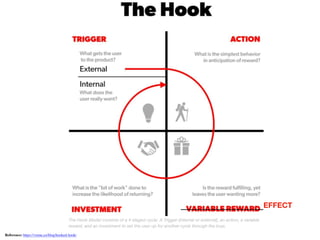
• Understand motivation of players and their actions

• Build the retention model with an unified approach
EFFECT
Reference: https://visme.co/blog/hooked-book/
Moving from External to
Internal Triggers
Reference: https://visme.co/blog/hooked-book/
How do you feel?
Answer: Good
https://www.researchgate.net/figure/First-two-layers-of-Parrots-emotion-classification_fig3_258240889
Actions
• Playing your game (levels/types)

• Trigger (Boredom) -> Casual easy going level

• Trigger (Joy/Pride) -> Win and hard levels
Variable Reward/Effect
(Emotional)
• Joy / Optimism

• Joy / Contentment

• Anger / Envy
Investment
• In-app purchase (Joy/Optimism)

• Recommending a friend (Love/Longing)

• Watching an advertisement (Joy/Contentment)

• Giving a positive review (Love/Affection)
Leader board game
Easier Level
Investment: InApp purchase
An Unified Approach to
Game Design
• Behavioral Segmentation model: Understand each
segments motivation
User Segmentation and
Mapping Motivations
https://www.slideshare.net/PREVEproject/preve-task2-3summaryshort
The Ugly: Where does
Machine Learning fits in here?
• Test the Hypothesis

• Incentive structure

• Prediction
https://www.facebook.com/English-Thinking-Cap-1772343609669343/
Hypothesis testing:
Segmentation through clustering
K-Meanshttps://towardsdatascience.com/k-means-data-clustering-bce3335d2203
Incentives: Goals and
Rewards
Incentives: Network Analysis
https://medium.com/omdena/network-analysis-to-find-out-the-context-of-a-tweet-a-community-detection-based-approach-299918d964f1
2-day Shift
Same day
1-day Shift
Crimes and mention of ‘Gun’ in a threatning tweet
Hypothesis testing:
Corelation between Actions
Hypothesis testing: Corelation
between actions (ROI of an adv)
Prediction: Use Cases
• Churn

• Customer Life Time Value

• Next Purchase Day
Extracted
Features
Q 1
Q 2
Q 3
Q 4
h1
h2
h3
h4
h5
High
Medi
um
Low
INPUT LAYER OUTPUT LAYER
Prediction: Supervised
Learning (feature extraction)
Age, Location, Behavior
Long Short Term Memory
Picture taken from http://colah.github.io/posts/2015-08-
Understanding-LSTMs/
Prediction: Time Series
Sentiment Analysis: Review
and incentive structure
https://monkeylearn.com/sentiment-analysis/
Incentivize based on sentiment!
Conclusion
• Understand the motivation of players

• Build a mental map

• Start with hypothesis and gather data to test

• Build your game to segment the users, and give the right
incentivize at the right moment.
Thank You
Rudradeb Mitra

https://www.linkedin.com/in/mitrar/
A Few Fun Facts about me and Games:

• Last time I played an online (or mobile) game was 1999 

• I do not have a phone for 2 years

Using Data Science for Behavioural Game Design