For Simple Past
• Use simple past to refer to an action that ocurred in an
specific moment in the past:
• “ in 1995; Emma Watson moved to England”
• To change a regular verb into simple past just add an –ed at the end:
• Audition: auditioned
• When a verb ends in –e (for example move), just add –d: moved
• When a verbs ends in consonant+ y (for example study), change the y for
i+ed: studied.
• When a verb ends in a consonant after a vowel, it double the consonant
(for example travel – travelled.)
1995 1999
NOW
“In 1999, Emma Watson auditined for the role Hermaione”
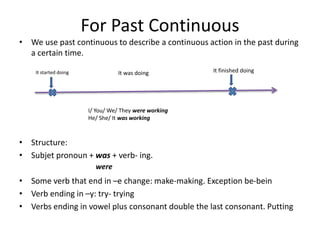
For Past Continuous
• We use past continuous to describe a continuous action in the past during
a certain time.
• Structure:
• Subjet pronoun + was + verb- ing.
• Some verb that end in –e change: make-making. Exception be-bein
• Verb ending in –y: try- trying
• Verbs ending in vowel plus consonant double the last consonant. Putting
It started doing It was doing It finished doing
I/ You/ We/ They were working
He/ She/ It was working
were
Comparative adjetives
• Rules
a) One syllable adjetives generally form its comparative by adding –er to the adjetive:
e.g.soft-softer, cheap-cheaper, sweet-sweeter
b) If one syllable is followed by a single consonant-vowel-consonant, the last
consonant is doubld. e.g. hot-hotter, thin-thinner, big-bigger.
c) If the adjetive ends ind e, simply add r, e.g. nice-nicer, wide-wider
d) If one or two adjetive ends with a y, replace the –y by –i, when adding er e.g.
e) Two Syllable adjetives ending with –ed, -ing, - ful- or less, for its comparative by
adding more + adjetive e.g. tired - mored tired- helpful - more helpful, useless-
more useless, boring-more boring.
f) Irregular adjetives are: good- better, bad- worse, far-farther/ further.
g) Adjectives that have more than three of fourse syllables always form the adjetive
with more e.g. dangerous- more dangerous, intelligent - more intelligent.

Uses Grammatical

  • 2.
    For Simple Past •Use simple past to refer to an action that ocurred in an specific moment in the past: • “ in 1995; Emma Watson moved to England” • To change a regular verb into simple past just add an –ed at the end: • Audition: auditioned • When a verb ends in –e (for example move), just add –d: moved • When a verbs ends in consonant+ y (for example study), change the y for i+ed: studied. • When a verb ends in a consonant after a vowel, it double the consonant (for example travel – travelled.) 1995 1999 NOW “In 1999, Emma Watson auditined for the role Hermaione”
  • 3.
    For Past Continuous •We use past continuous to describe a continuous action in the past during a certain time. • Structure: • Subjet pronoun + was + verb- ing. • Some verb that end in –e change: make-making. Exception be-bein • Verb ending in –y: try- trying • Verbs ending in vowel plus consonant double the last consonant. Putting It started doing It was doing It finished doing I/ You/ We/ They were working He/ She/ It was working were
  • 4.
    Comparative adjetives • Rules a)One syllable adjetives generally form its comparative by adding –er to the adjetive: e.g.soft-softer, cheap-cheaper, sweet-sweeter b) If one syllable is followed by a single consonant-vowel-consonant, the last consonant is doubld. e.g. hot-hotter, thin-thinner, big-bigger. c) If the adjetive ends ind e, simply add r, e.g. nice-nicer, wide-wider d) If one or two adjetive ends with a y, replace the –y by –i, when adding er e.g. e) Two Syllable adjetives ending with –ed, -ing, - ful- or less, for its comparative by adding more + adjetive e.g. tired - mored tired- helpful - more helpful, useless- more useless, boring-more boring. f) Irregular adjetives are: good- better, bad- worse, far-farther/ further. g) Adjectives that have more than three of fourse syllables always form the adjetive with more e.g. dangerous- more dangerous, intelligent - more intelligent.