User Management with LastUser
         Kiran Jonnalagadda, HasGeek
       PyCon India, Pune, September 2011
                                           flickr.com/exfordy/128576390/
The What & The Why
LastUser is an identity
aggregating web service


                LastUser


   Your App 1   Your App 2   Your App 3
A simple goal

                     Login identifier that
 Login
                     users can remember

                     Relief from password
 Password
                     management
            Submit
                     No user registration.
                     Just login and use
OpenID:
URLs as Identity
OpenID in theory:

http://jace.livejournal.com/
URLs in the browser:


www.github.com
URLs in the browser:


      github.com
URLs in the browser:


http://github.com/
URLs in the browser:


https://github.com/
URLs as Identifiers
1. github.com
2. github.com/
3. www.github.com
4. www.github.com/
5. http://github.com
6. http://github.com/
7. http://www.github.com
8. http://www.github.com/
9. https://github.com
10. https://github.com/
11. https://www.github.com
12. https://www.github.com/
   Multiple strings; same final URL

                                     flickr.com/mynameisharsha/5157965638/
Contrast with email Addresses:
      kiran@hasgeek.in
 Change one character and it’s no longer
valid. Users are conditioned to type them
          in exactly every time
URL Ambiguity:
https://www.google.com/accounts/o8/id

One OpenID URL for all Google accounts
URL Ambiguity:
https://www.google.com/accounts/o8/id?id=AItOawnGAN1Swp5zAJn9UYCw0jivCRXg8qIe_9c
https://www.google.com/accounts/o8/id?id=AItOawm3y2JBSnIo0ZdNwtIa487VpQXtpbXNmU4


 Both are the same Google id, on different domains,
using directed identity. If you move to a new domain,
              all your users’ ids change
URLs are not reliable
identifiers for users
OpenID in practice
OAuth:
Delegated Identity
The delegated id model


         Your Application
The delegated id model
    Synchronizing identity across services?


               Your Application
Need a common identifier
across services. It’s usually
    an email address
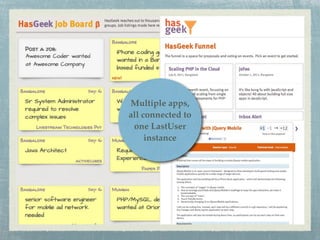
LastUser as abstraction layer


     LastUser — OAuth Server


      Your App 1   Your App 2   Your App 3
Multiple apps,
all connected to
 one LastUser
     instance
1. Login screen provider
Connecting identities
Users sometimes login with
a different service provider

Accounts can be connected
if there is a common id

Twitter does not provide an
email address

GitHub provides only
md5sum of email via
Gravatar. Can be connected
if email is already known
Supported id providers

Twitter

Google

GitHub

OpenID (but not delegation)

Upcoming: LinkedIn, Facebook
OAuth: There is no single
standard called OAuth. Every
 implementation is different
There is no up-to-date Python
library for OAuth2. Every service
  provider has their own library.
    Contrast: Ruby has OmniAuth
LastUser implements
 OAuth 2.0 draft 16
   (with gaps filled in)
OAuth 2.0 has two parts

      OAuth                         OAuth
   Authorization                   Resource
      Server                        Server


 1. Request an     OAuth Client   2. Use token to
 access token                     access resource
OAuth 2.0 has two parts
                   OAuth 2.0 doesn’t
                    specify how this
      OAuth                              OAuth
                       bit works
   Authorization                        Resource
      Server                             Server

                    LastUser does


 1. Request an       OAuth Client      2. Use token to
 access token                          access resource
2. Resource providers
    (work in progress)
3. Central access control
Pending work

Seamless login UI and pure client-side JS login API

Non-web login flow

Authorization to resource server communication protocol

Support for token types other than bearer tokens
LastUser is BSD-licensed
https://github.com/hasgeek/lastuser

User Management with LastUser