User Interview Workshop
With
Scot Przybylski and Zoe T Do
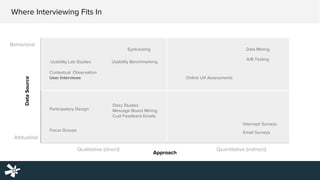
Where Interviewing Fits In
DataSource
Approach
Attitudinal
Behavioral
Qualitative (direct) Quantitative (indirect)
Eyetracking
Usability Lab Studies
Online UX Assessments
Contextual Observation
User Interviews
Participatory Design
Focus Groups
Diary Studies
Message Board Mining
Cust Feedback Emails
Data Mining
A/B Testing
Intercept Surveys
Email Surveys
Usability Benchmarking
The Value of Interviewing People
Gain insight into your users and
understand our goals
Know Your Goals
Knowing your goals informs expectations and priorities and
provides focus.
Talking to stakeholders will help define your goals
Know Your Goals
Images of RPW photos
Know Your Goals
Research Planning Workshop
The goals of a Research Planning Workshop are to define
1. What We Already Know (Think We Know)
2. Who our Audience is
3. What questions we want to answer. E.G. what do we want to know about our
audience?
4. Why - how will knowing the answers to these questions help the business.
What value will asking these questions provide.
Know Your Goals
Assumption and Experiments Workshop.
The goals of an Assumptions and Experiments workshop are to:
1. Extract all the information within the domain
2. Organize the information
3. Focus on the bits that matter
4. Prompt incremental decision making
5. Decide what the nature of the outcome you’re looking for, is not for details
6. To not create the answers yourself
Know Your Goals
Creating A Research Brief
A good research brief has a well structured outline
1. Purpose: a document to serve as an outline for our research
2. Value Proposition
3. Goals
4. Audience/Participants
5. Methodology
6. Schedule
7. Associated Research Costs
1 Your Protocol or Script
Your Interview Script
Things to consider when creating your interview script.
1. 8 main questions and or topics in a 1 hour interview (practice makes perfect)
2. Ice-breaker questions or observations help set the mood and build rapport
3. Keeping it short allows time for follow-up and probing deeper
4. Limiting questions provides focus and prioritization
5. Number the questions - this will help set pace and make sure you covered
everything
6. Craft your question to get people to tell a story. E.G. “tell me about…”
Your Interview Script
Things to avoid when creating your interview script.
1. Too many question for the time available
2. Questions not related to reaching goals, no focus
3. Don’t talk too much about yourself
4. Be aware of your body language
5. Problems with how questions are phrased
Your Interview Script
This list represents specific types questions to avoid when creating your script.
1. Leading
2. Double-Barreled
3. Too broad or vague
4. Mutually exclusive options
5. Limited response options
6. Caution with predictions
Your Interview Script
Other important considerations when creating the questions in your script.
1. Avoid polarized words like always and never.
2. Use of adjectives.
3. “Likert” scales. EX: 1-5, 1 is best, 5 is worst
Your Interview Script
Proof (catch spelling and grammar
errors)
Preflight (practice, practice, practice)
2 Recruiting & Scheduling
Recruiting & Scheduling
Ethn.io
Google Forms
Survey Monkey
Type Form
Surveygizmo
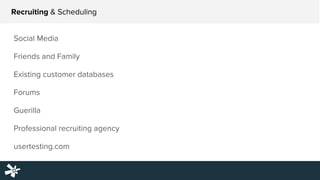
Recruiting & Scheduling
Social Media
Friends and Family
Existing customer databases
Forums
Guerilla
Professional recruiting agency
usertesting.com
Recruiting & Scheduling
Ethni.io
Pow Wow
Google Cal
3 Preparation
Preparation
Team Roles
No. of people
Streaming
NDAs and informed consent
Preparation
Hardware
Software
Hard copies
Paper and Pens
Preparation
Confirm interviews
Social Graces
Don’t forget to hit record
Don’t be afraid to leave
Travel as a team to arrive on time and leave on time
4 Let’s Practice
Let’s Practice
There is a dot on your name tag. They indicate what role you will be playing in this exercise. You should be in a group with
different colors than your own.
Participant Moderator Note Taker
Writing Questions
6 Minutes
As a team, create 4 questions that will validate or challenge the goals of this project.
The Interview
8 Minutes
5 Sharing is Caring and Q&A
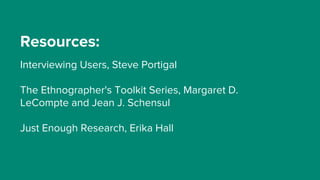
Resources:
Interviewing Users, Steve Portigal
The Ethnographer's Toolkit Series, Margaret D.
LeCompte and Jean J. Schensul
Just Enough Research, Erika Hall
Thank You
@scotprzybylski, @TDcreate

User interview workshop

  • 1.
    User Interview Workshop With ScotPrzybylski and Zoe T Do
  • 2.
    Where Interviewing FitsIn DataSource Approach Attitudinal Behavioral Qualitative (direct) Quantitative (indirect) Eyetracking Usability Lab Studies Online UX Assessments Contextual Observation User Interviews Participatory Design Focus Groups Diary Studies Message Board Mining Cust Feedback Emails Data Mining A/B Testing Intercept Surveys Email Surveys Usability Benchmarking
  • 3.
    The Value ofInterviewing People Gain insight into your users and understand our goals
  • 4.
    Know Your Goals Knowingyour goals informs expectations and priorities and provides focus. Talking to stakeholders will help define your goals
  • 5.
  • 6.
    Know Your Goals ResearchPlanning Workshop The goals of a Research Planning Workshop are to define 1. What We Already Know (Think We Know) 2. Who our Audience is 3. What questions we want to answer. E.G. what do we want to know about our audience? 4. Why - how will knowing the answers to these questions help the business. What value will asking these questions provide.
  • 7.
    Know Your Goals Assumptionand Experiments Workshop. The goals of an Assumptions and Experiments workshop are to: 1. Extract all the information within the domain 2. Organize the information 3. Focus on the bits that matter 4. Prompt incremental decision making 5. Decide what the nature of the outcome you’re looking for, is not for details 6. To not create the answers yourself
  • 8.
  • 9.
    Creating A ResearchBrief A good research brief has a well structured outline 1. Purpose: a document to serve as an outline for our research 2. Value Proposition 3. Goals 4. Audience/Participants 5. Methodology 6. Schedule 7. Associated Research Costs
  • 10.
    1 Your Protocolor Script
  • 11.
    Your Interview Script Thingsto consider when creating your interview script. 1. 8 main questions and or topics in a 1 hour interview (practice makes perfect) 2. Ice-breaker questions or observations help set the mood and build rapport 3. Keeping it short allows time for follow-up and probing deeper 4. Limiting questions provides focus and prioritization 5. Number the questions - this will help set pace and make sure you covered everything 6. Craft your question to get people to tell a story. E.G. “tell me about…”
  • 12.
    Your Interview Script Thingsto avoid when creating your interview script. 1. Too many question for the time available 2. Questions not related to reaching goals, no focus 3. Don’t talk too much about yourself 4. Be aware of your body language 5. Problems with how questions are phrased
  • 13.
    Your Interview Script Thislist represents specific types questions to avoid when creating your script. 1. Leading 2. Double-Barreled 3. Too broad or vague 4. Mutually exclusive options 5. Limited response options 6. Caution with predictions
  • 14.
    Your Interview Script Otherimportant considerations when creating the questions in your script. 1. Avoid polarized words like always and never. 2. Use of adjectives. 3. “Likert” scales. EX: 1-5, 1 is best, 5 is worst
  • 15.
    Your Interview Script Proof(catch spelling and grammar errors) Preflight (practice, practice, practice)
  • 16.
    2 Recruiting &Scheduling
  • 17.
  • 18.
    Recruiting & Scheduling Ethn.io GoogleForms Survey Monkey Type Form Surveygizmo
  • 19.
    Recruiting & Scheduling SocialMedia Friends and Family Existing customer databases Forums Guerilla Professional recruiting agency usertesting.com
  • 20.
  • 21.
  • 22.
    Preparation Team Roles No. ofpeople Streaming NDAs and informed consent
  • 23.
  • 24.
    Preparation Confirm interviews Social Graces Don’tforget to hit record Don’t be afraid to leave Travel as a team to arrive on time and leave on time
  • 25.
  • 26.
    Let’s Practice There isa dot on your name tag. They indicate what role you will be playing in this exercise. You should be in a group with different colors than your own. Participant Moderator Note Taker
  • 27.
    Writing Questions 6 Minutes Asa team, create 4 questions that will validate or challenge the goals of this project.
  • 28.
  • 29.
    5 Sharing isCaring and Q&A
  • 30.
    Resources: Interviewing Users, StevePortigal The Ethnographer's Toolkit Series, Margaret D. LeCompte and Jean J. Schensul Just Enough Research, Erika Hall
  • 31.