Some notes on the nature of
      game design

 Jussi Kuittinen (University of Jyväskylä)
 Jussi Holopainen (Nokia Research Center)


                               © Annakaisa Kultima
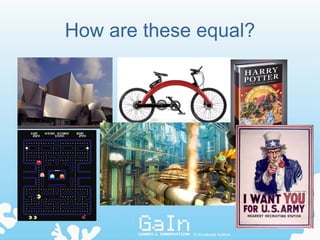
How are these equal?


             © Annakaisa Kultima
They are all designed for a
     certain purpose


                 © Annakaisa Kultima
•   Game design literature concentrates on
    the content of the design i.e. games and
    features of games
•   Game design is an activity like all forms
    of design and should be studied as such.


                            © Annakaisa Kultima
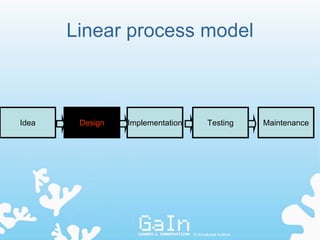
Linear process model


Idea    Design   Implementation          Testing        Maintenance


                                  © Annakaisa Kultima
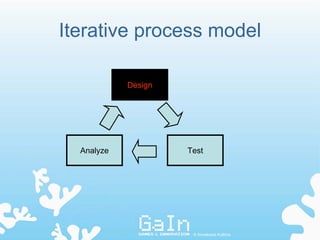
Iterative process model

            Design


  Analyze            Test


                      © Annakaisa Kultima
The black box of design needs
        to be opened


                  © Annakaisa Kultima
Two complementary models
•   Löwgren and Stolterman’s (2007)
    abstraction layers
•   Lawson’s model of design thinking
    (2005)


                           © Annakaisa Kultima
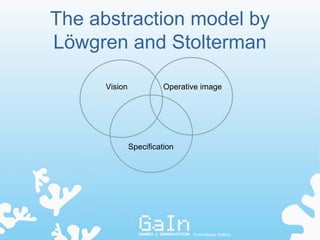
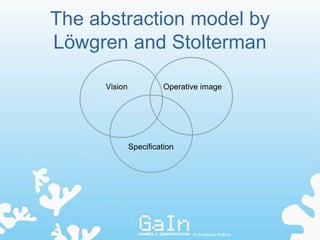
The abstraction model by
Löwgren and Stolterman

      Vision             Operative image


               Specification


                                © Annakaisa Kultima
Vision
•   The first guiding principles or ideas
    “A STYLIZED HORROR SHOOTER. THE FRENETIC gameplay of
    DEVIL MAY CRY meets the horror setting of RESIDENT EVIL and the
    immersive game-world of HALF-LIFE.” The Suffering
    “There were various issues of this nature, but when questions came up,
    we could always turn to our vision statement for guidance and
    inspiration.” Titan Quest
    “We wanted a bright friendly world set in a historical but mythological time
    frame. We wanted to offer unique gameplay features that would appeal to
    hardcore gamers yet always be accessible to the casual audience. Fun
    and commonsensical approaches [..] which helped to keep the focus on
    player enjoyment. Moving forward, we made all our decisions in light of
    this overarching vision [..]” Titan Quest


                                                © Annakaisa Kultima
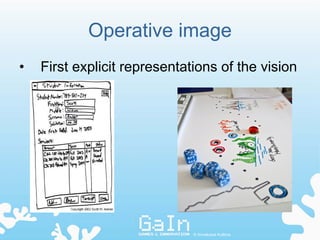
Operative image
•   First explicit representations of the vision


                              © Annakaisa Kultima
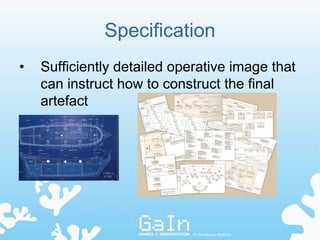
Specification
•   Sufficiently detailed operative image that
    can instruct how to construct the final
    artefact


                             © Annakaisa Kultima
[Implementation]
•   Construction and delivery of the final
    artefact


                             © Annakaisa Kultima
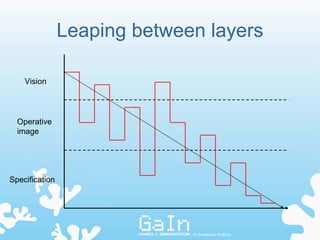
Leaping between layers

    Vision


  Operative
  image


Specification


                              © Annakaisa Kultima
The abstraction model by
Löwgren and Stolterman

      Vision             Operative image


               Specification


                                © Annakaisa Kultima
Lawson’s model of designing
•   Formulating
•   Representing
•   Moving
•   Bringing problems and solutions together
•   Evaluating
•   Reflecting


                           © Annakaisa Kultima
Formulating
•   Identifying the elements of the design situation
•   Framing the design situation in a way that allows an
    experimental design move to be made.
    “[..]THE SUFFERING was to be an action horror game, instead of a
    survival horror game. This meant we were going to focus more on
    combat and avoid the long cut-scenes, frail central characters, clumsy
    controls, fixed camera angles, and sparse ammo of many console horror
    games.“ The Suffering
    “With each of the basic punches, jabs, hooks, and uppercuts, you could
    see basic motions that your fist made with each punch. It finally dawned
    on us that you could [..] let [the gamers] make the same motions with the
    analog sticks that boxers make in real life with their fists.” EA Sports
    Fight Night 2004
    “We tried to ask ourselves the same questions about each scene, page,
    and individual line of dialogue. Why does this exist? What information or
    emotion does this bring to the story?” Gun
                                               © Annakaisa Kultima
Representing
•   Creating representations of the design
    situation to make possible design
    choices more concrete
    “To start, we decided to visualize the RATCHET & CLANK universe PS3-
    style by recreating Metropolis, one of the iconic locations from our PS2
    series. We did this by building a “diorama” of the city, adding vehicles,
    and sending a camera through it. We built our test city using the
    RESISTANCE engine, stitched together a frame by frame camera fly
    through, and added audio effects to simulate the experience of being in
    Metropolis” Ratchet & Clank: Tools of Destruction
    “our game and level design work had much more in common with HALF-
    LIFE than with DMC [Devil May Cry], except for our controls. [..] What we
    had originally implemented was a target-lock system inspired by
    SYPHON FILTER [..] and DMC” The Suffering

                                               © Annakaisa Kultima
Moving
•   Creating new or modifying existing design
    solutions

      “Once we recalibrated the game to be more like a shooter, we
      simplified many of the deeper systems tremendously so that
      the user would be able to understand them. [..] We ended up
      with fewer choices overall, but each one of those choices was
      infinitely more functional, understandable, and fun than the
      previous ones.“ BioShock


                                        © Annakaisa Kultima
Bringing problems and solutions
            together

•   Solutions and problems are two aspects of the
    design situation and may be hard to discern
    from each other
    “We asked for the tilt sensor and whammy bar well before we had
    any clear idea of how they would be used in the game” Guitar
    Hero


                                         © Annakaisa Kultima
Evaluating
•   Making judgements concerning the design
    situation
    “When confronted with any art or design question, it was great to
    be able to ask, “Does this rock?” and proceed accordingly.”
    Guitar Hero
    “[..] the entire design team [..] headed off to see how a group that
    knew nothing about our company or BIO SHOCK would react to
    the first level. It was brutal. The first level, they said, was overly
    dense, confusing, and not particularly engaging. Players would
    acquire new powers but not know how to use them, so they stuck
    to using more traditional weapons and became frustrated.”
    BioShock


                                             © Annakaisa Kultima
Reflecting
•   Reflection-in-action is the designer’s continual
    thinking about the design situation
•   Reflection-on-action is a high-level activity of
    monitoring the design process
    Postmortems themselves

    ” The questions we constantly asked were: Does it feel like you’re going
    fast? Does it feel good to punch the other skaters (and pedestrians)?
    Does it feel like gravity is pulling you downhill? Does it feel good to
    power-slide around a corner?” Tony Hawk's Downhill Jam for Wii


                                               © Annakaisa Kultima
Why are we doing this?


               © Annakaisa Kultima
Impact and future work
•       Understanding design activity allows us
        to
    –     Develop and refine methods
    –     Raise critical awareness of game design
    –     Better situate game design into a larger
          cultural context


                                  © Annakaisa Kultima
Thank you!


Questions?

                 jussi.kuittinen@jyu.fi
        jussi.holopainen@nokia.com

      http://gamesandinnovation.com


          © Annakaisa Kultima

Kuittinen&Holopainen @ DIGRA 2009

  • 1.
    Some notes onthe nature of game design Jussi Kuittinen (University of Jyväskylä) Jussi Holopainen (Nokia Research Center) © Annakaisa Kultima
  • 2.
    How are theseequal? © Annakaisa Kultima
  • 3.
    They are alldesigned for a certain purpose © Annakaisa Kultima
  • 4.
    Game design literature concentrates on the content of the design i.e. games and features of games • Game design is an activity like all forms of design and should be studied as such. © Annakaisa Kultima
  • 5.
    Linear process model Idea Design Implementation Testing Maintenance © Annakaisa Kultima
  • 6.
    Iterative process model Design Analyze Test © Annakaisa Kultima
  • 7.
    The black boxof design needs to be opened © Annakaisa Kultima
  • 8.
    Two complementary models • Löwgren and Stolterman’s (2007) abstraction layers • Lawson’s model of design thinking (2005) © Annakaisa Kultima
  • 9.
    The abstraction modelby Löwgren and Stolterman Vision Operative image Specification © Annakaisa Kultima
  • 10.
    Vision • The first guiding principles or ideas “A STYLIZED HORROR SHOOTER. THE FRENETIC gameplay of DEVIL MAY CRY meets the horror setting of RESIDENT EVIL and the immersive game-world of HALF-LIFE.” The Suffering “There were various issues of this nature, but when questions came up, we could always turn to our vision statement for guidance and inspiration.” Titan Quest “We wanted a bright friendly world set in a historical but mythological time frame. We wanted to offer unique gameplay features that would appeal to hardcore gamers yet always be accessible to the casual audience. Fun and commonsensical approaches [..] which helped to keep the focus on player enjoyment. Moving forward, we made all our decisions in light of this overarching vision [..]” Titan Quest © Annakaisa Kultima
  • 11.
    Operative image • First explicit representations of the vision © Annakaisa Kultima
  • 12.
    Specification • Sufficiently detailed operative image that can instruct how to construct the final artefact © Annakaisa Kultima
  • 13.
    [Implementation] • Construction and delivery of the final artefact © Annakaisa Kultima
  • 14.
    Leaping between layers Vision Operative image Specification © Annakaisa Kultima
  • 15.
    The abstraction modelby Löwgren and Stolterman Vision Operative image Specification © Annakaisa Kultima
  • 16.
    Lawson’s model ofdesigning • Formulating • Representing • Moving • Bringing problems and solutions together • Evaluating • Reflecting © Annakaisa Kultima
  • 17.
    Formulating • Identifying the elements of the design situation • Framing the design situation in a way that allows an experimental design move to be made. “[..]THE SUFFERING was to be an action horror game, instead of a survival horror game. This meant we were going to focus more on combat and avoid the long cut-scenes, frail central characters, clumsy controls, fixed camera angles, and sparse ammo of many console horror games.“ The Suffering “With each of the basic punches, jabs, hooks, and uppercuts, you could see basic motions that your fist made with each punch. It finally dawned on us that you could [..] let [the gamers] make the same motions with the analog sticks that boxers make in real life with their fists.” EA Sports Fight Night 2004 “We tried to ask ourselves the same questions about each scene, page, and individual line of dialogue. Why does this exist? What information or emotion does this bring to the story?” Gun © Annakaisa Kultima
  • 18.
    Representing • Creating representations of the design situation to make possible design choices more concrete “To start, we decided to visualize the RATCHET & CLANK universe PS3- style by recreating Metropolis, one of the iconic locations from our PS2 series. We did this by building a “diorama” of the city, adding vehicles, and sending a camera through it. We built our test city using the RESISTANCE engine, stitched together a frame by frame camera fly through, and added audio effects to simulate the experience of being in Metropolis” Ratchet & Clank: Tools of Destruction “our game and level design work had much more in common with HALF- LIFE than with DMC [Devil May Cry], except for our controls. [..] What we had originally implemented was a target-lock system inspired by SYPHON FILTER [..] and DMC” The Suffering © Annakaisa Kultima
  • 19.
    Moving • Creating new or modifying existing design solutions “Once we recalibrated the game to be more like a shooter, we simplified many of the deeper systems tremendously so that the user would be able to understand them. [..] We ended up with fewer choices overall, but each one of those choices was infinitely more functional, understandable, and fun than the previous ones.“ BioShock © Annakaisa Kultima
  • 20.
    Bringing problems andsolutions together • Solutions and problems are two aspects of the design situation and may be hard to discern from each other “We asked for the tilt sensor and whammy bar well before we had any clear idea of how they would be used in the game” Guitar Hero © Annakaisa Kultima
  • 21.
    Evaluating • Making judgements concerning the design situation “When confronted with any art or design question, it was great to be able to ask, “Does this rock?” and proceed accordingly.” Guitar Hero “[..] the entire design team [..] headed off to see how a group that knew nothing about our company or BIO SHOCK would react to the first level. It was brutal. The first level, they said, was overly dense, confusing, and not particularly engaging. Players would acquire new powers but not know how to use them, so they stuck to using more traditional weapons and became frustrated.” BioShock © Annakaisa Kultima
  • 22.
    Reflecting • Reflection-in-action is the designer’s continual thinking about the design situation • Reflection-on-action is a high-level activity of monitoring the design process Postmortems themselves ” The questions we constantly asked were: Does it feel like you’re going fast? Does it feel good to punch the other skaters (and pedestrians)? Does it feel like gravity is pulling you downhill? Does it feel good to power-slide around a corner?” Tony Hawk's Downhill Jam for Wii © Annakaisa Kultima
  • 23.
    Why are wedoing this? © Annakaisa Kultima
  • 24.
    Impact and futurework • Understanding design activity allows us to – Develop and refine methods – Raise critical awareness of game design – Better situate game design into a larger cultural context © Annakaisa Kultima
  • 25.
    Thank you! Questions? jussi.kuittinen@jyu.fi jussi.holopainen@nokia.com http://gamesandinnovation.com © Annakaisa Kultima