
การนาระบบเทคโนโลยีสารสนเทศ
มาใช้ในงานให้บริการทางการแพทย์
บรรยาย ณ กฟผ.
นพ.นวนรรน ธีระอัมพรพันธุ์
17 มีนาคม 2560
2
2546 แพทยศาสตรบัณฑิต
2554 Ph.D. (Health Informatics), Univ. of Minnesota
ผู้ช่วยคณบดีฝ่ายนโยบายและสารสนเทศ
อาจารย์ ภาควิชาเวชศาสตร์ชุมชน
คณะแพทยศาสตร์โรงพยาบาลรามาธิบดี มหาวิทยาลัยมหิดล
ความสนใจ: Health IT for Quality of Care,
IT Management, Security & Privacy
nawanan.the@mahidol.ac.th
SlideShare.net/Nawanan
แนะนาตัว
3
 The Road to Digitizing Healthcare
 What is a “Smart Hospital”?
 Toward a “Smart” Hospital
Outline
4
Health &
Health Information
5
Let’s take a look at
these pictures...
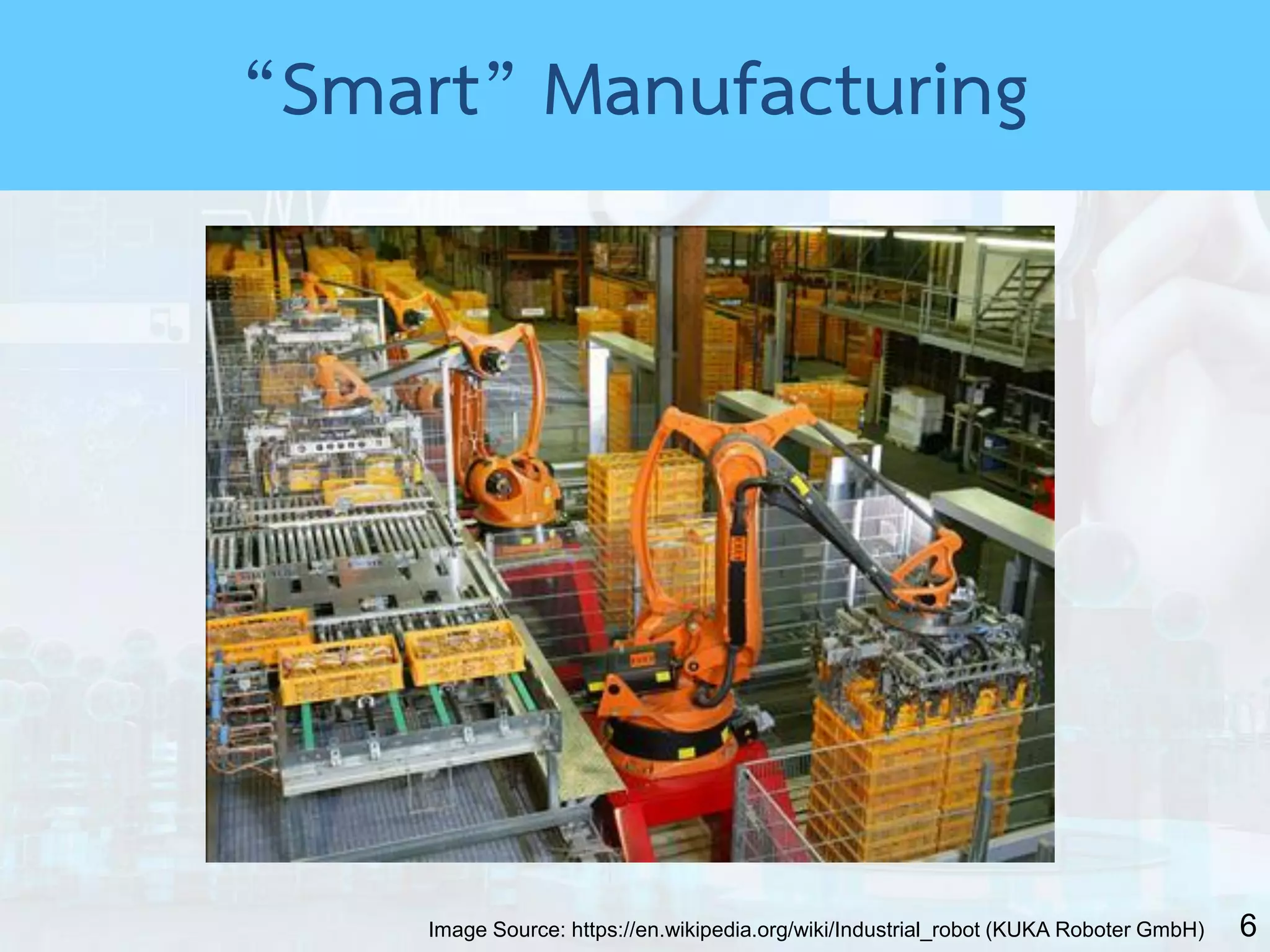
6Image Source: https://en.wikipedia.org/wiki/Industrial_robot (KUKA Roboter GmbH)
“Smart” Manufacturing
7
Image Sources: http://isarapost.net/home/?p=17760
http://www.telecomjournalthailand.com/ตอบโจทย์โมเดลทางธุรกิจ/
“Smart” Banking
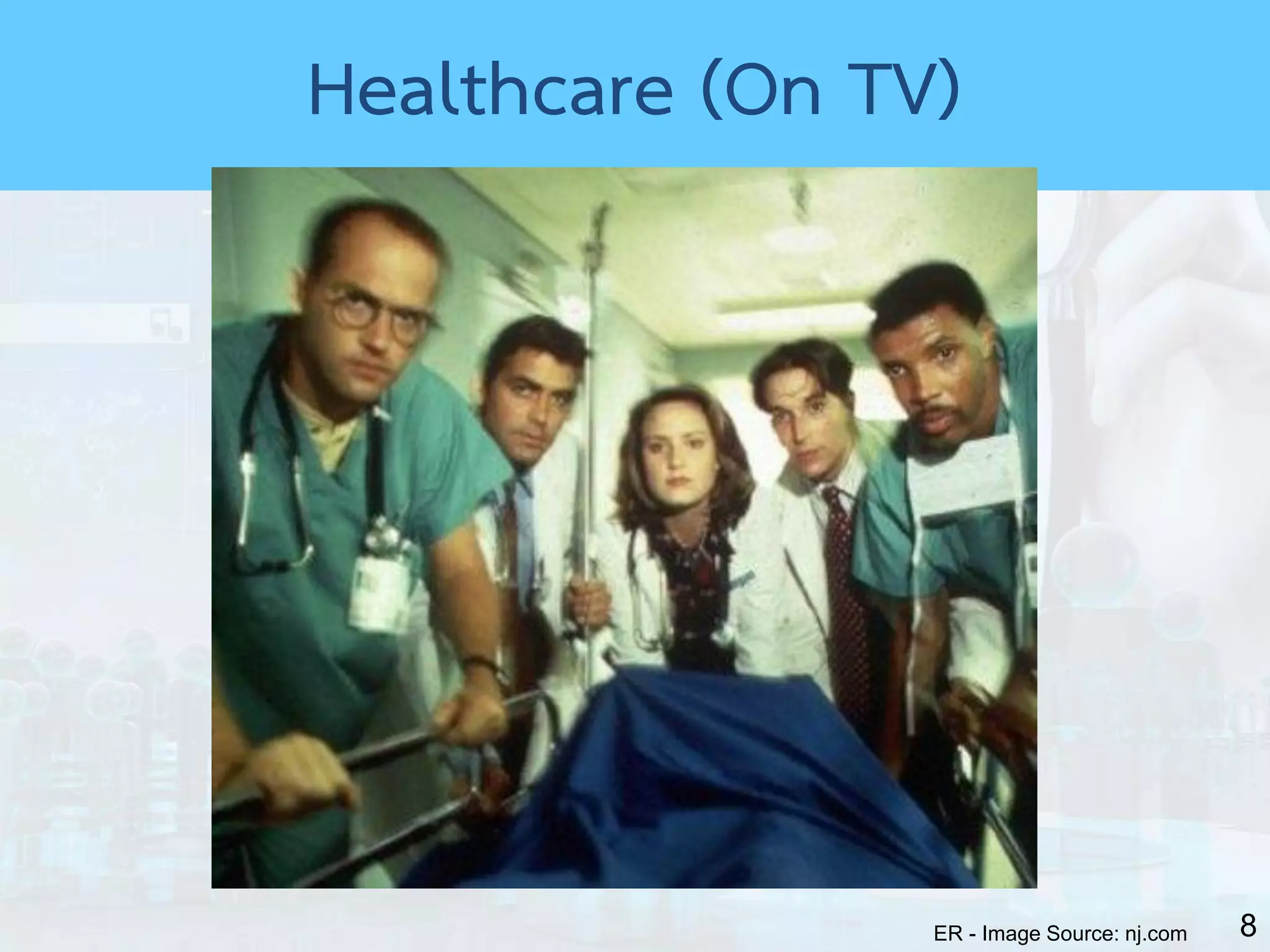
8ER - Image Source: nj.com
Healthcare (On TV)
9
(At an undisclosed hospital)
Healthcare (Reality)
10
• Life-or-Death
• Difficult to automate human decisions
– Nature of business
– Many & varied stakeholders
– Evolving standards of care
• Fragmented, poorly-coordinated systems
• Large, ever-growing & changing body of
knowledge
• High volume, low resources, little time
Why Healthcare Isn’t (Yet) “Smart”?
11
But...Are We That Different?
Input
Proces
s
Output
Transfer
Banking
Value-Add
- Security
- Convenience
- Customer Service
Location A Location B
12
Input
Proces
s
Output
Assembling
Manufacturing
Raw Materials Finished
Goods
Value-Add
- Innovation
- Design
- QC
But...Are We That Different?
13
Input
Proces
s
Output
Patient Care
Health care
Sick Patient Well Patient
Value-Add
- Technology & medications
- Clinical knowledge & skilled providers
- Quality of care; process improvement
- Customer service
- Information
But...Are We That Different?
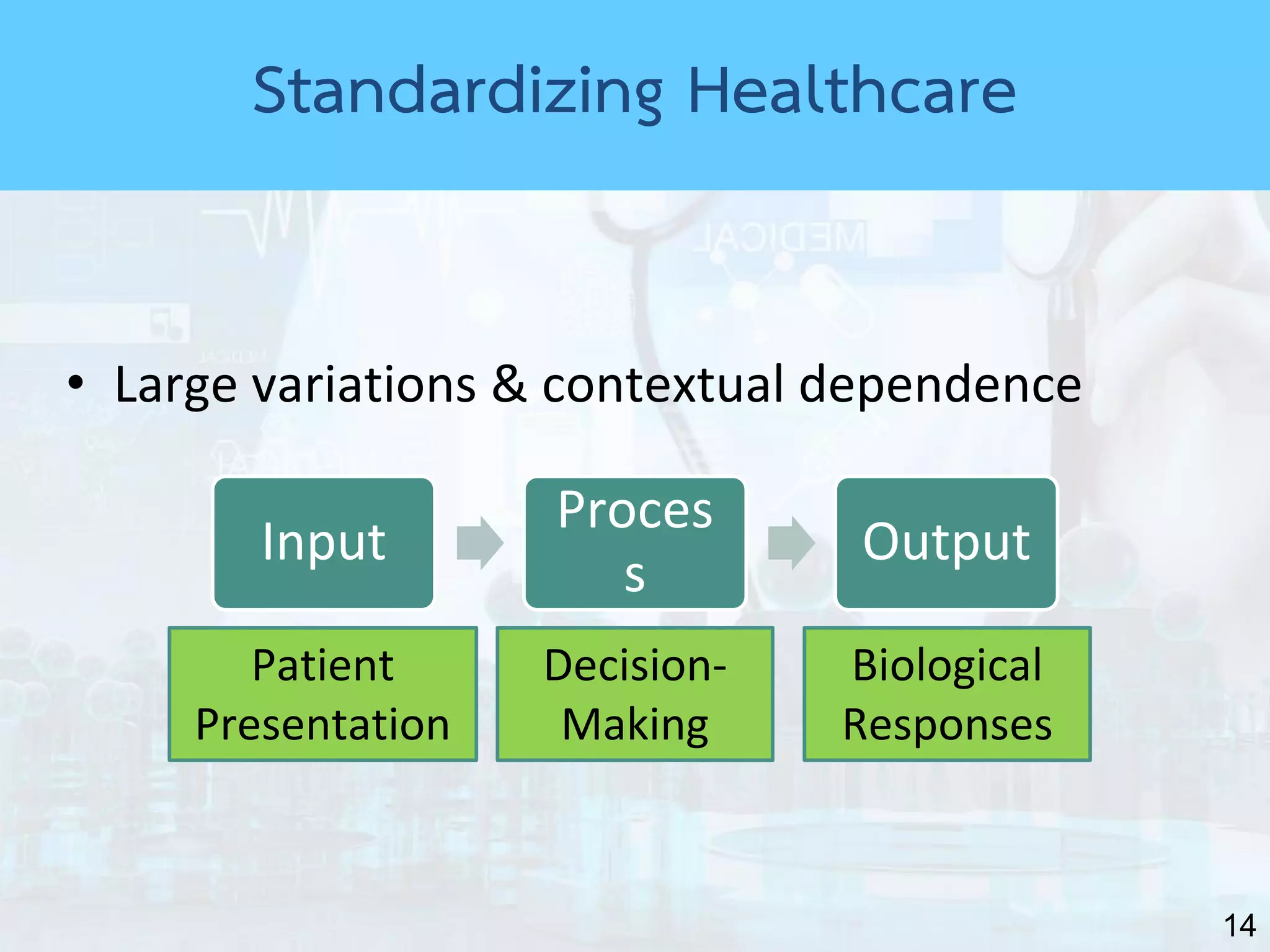
14
• Large variations & contextual dependence
Input
Proces
s
Output
Patient
Presentation
Decision-
Making
Biological
Responses
Standardizing Healthcare
15
The World of Smart Machines
Image Sources: http://www.ibtimes.com/google-deepminds-alphago-
program-defeats-human-go-champion-first-time-ever-2283700
http://deepmind.com/
16
Digitizing Healthcare
Image Source: http://www.bloomberg.com/bw/stories/2005-03-27/cover-image-the-digital-hospital
17
“To computerize
the hospital”
“To go paperless”
“To become a
Digital Hospital”
“To Have
EHRs”
Why Adopting Health IT?
18
• “Don’t implement technology just for
technology’s sake.”
• “Don’t make use of excellent technology.
Make excellent use of technology.”
(Tangwongsan, Supachai. Personal communication, 2005.)
• “Health care IT is not a panacea for all that ails
medicine.” (Hersh, 2004)
Some “Smart” Quotes
19
Being Smart #1:
Stop Your
“Drooling Reflex”!!
20
Being Smart #2:
Focus on Information &
Process Improvement,
Not Technology
21
ถ้าไม่เป็น “Digital Hospital”
หรือ “Paperless Hospital”
แล้วจะให้เราเป็นอะไร?
“Smart Hospital”
23
แล้ว “Smart Hospital”
ต่างจาก Digital หรือ
Paperless Hospital ตรงไหน?
24
The Road to Digitizing Healthcare
 What is a “Smart Hospital”?
 Toward a “Smart” Hospital
Outline
25
Microsoft Health Future Vision
26
Connecting People to a Healthy Future With
Personalized Care – Kaiser Permanente
https://www.youtube.com/watch?v=gxz9ZVvduGc
27
Back to
something simple...
28
To treat & to care
for their patients
to their best
abilities, given
limited time &
resources
Image Source: http://en.wikipedia.org/wiki/File:Newborn_Examination_1967.jpg (Nevit Dilmen)
What Clinicians Want?
29
• Safe
• Timely
• Effective
• Patient-Centered
• Efficient
• Equitable
Institute of Medicine, Committee on Quality of Health Care in America. Crossing the quality
chasm: a new health system for the 21st century. Washington, DC: National Academy
Press; 2001. 337 p.
High Quality Care
30
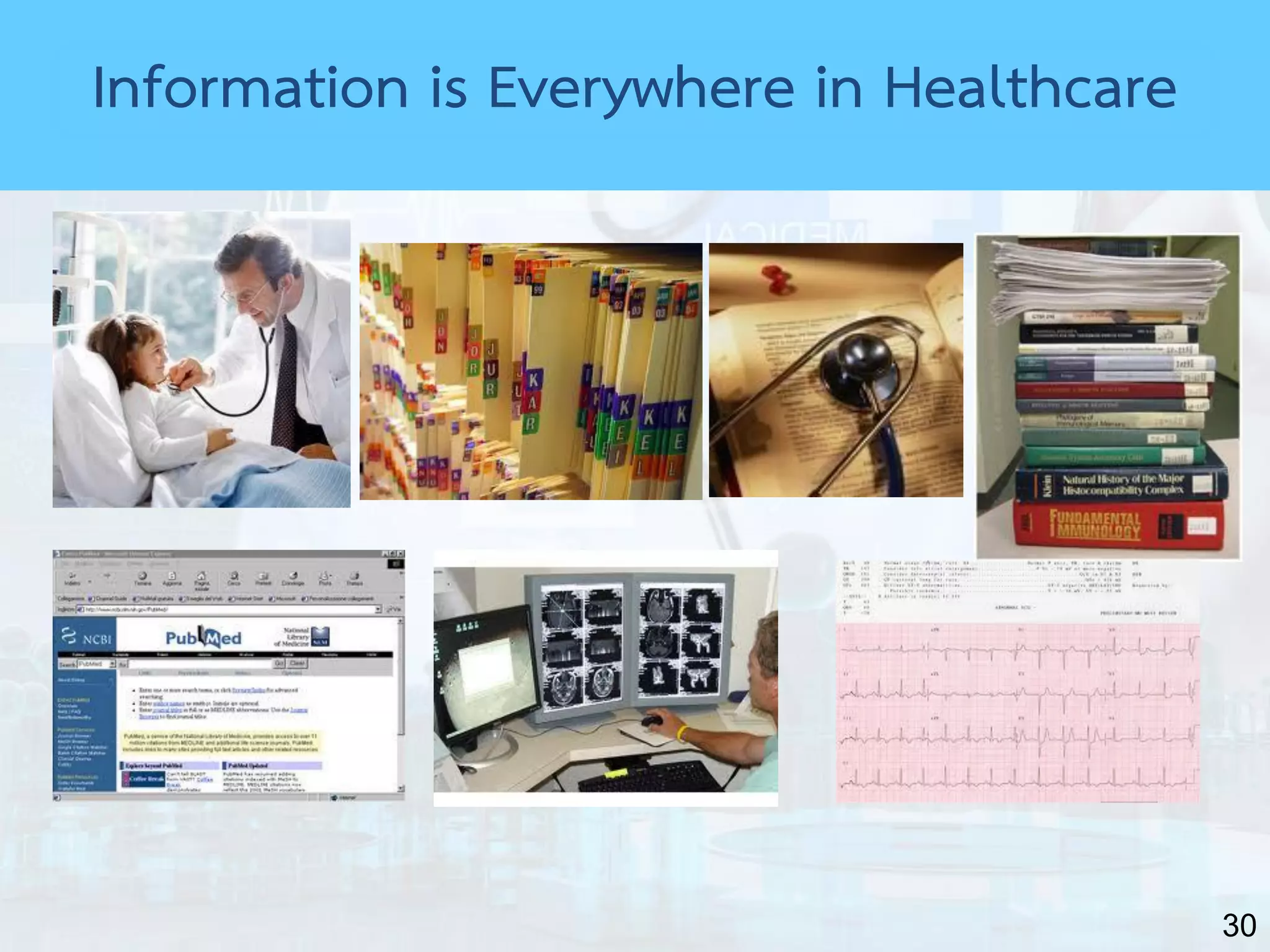
Information is Everywhere in Healthcare
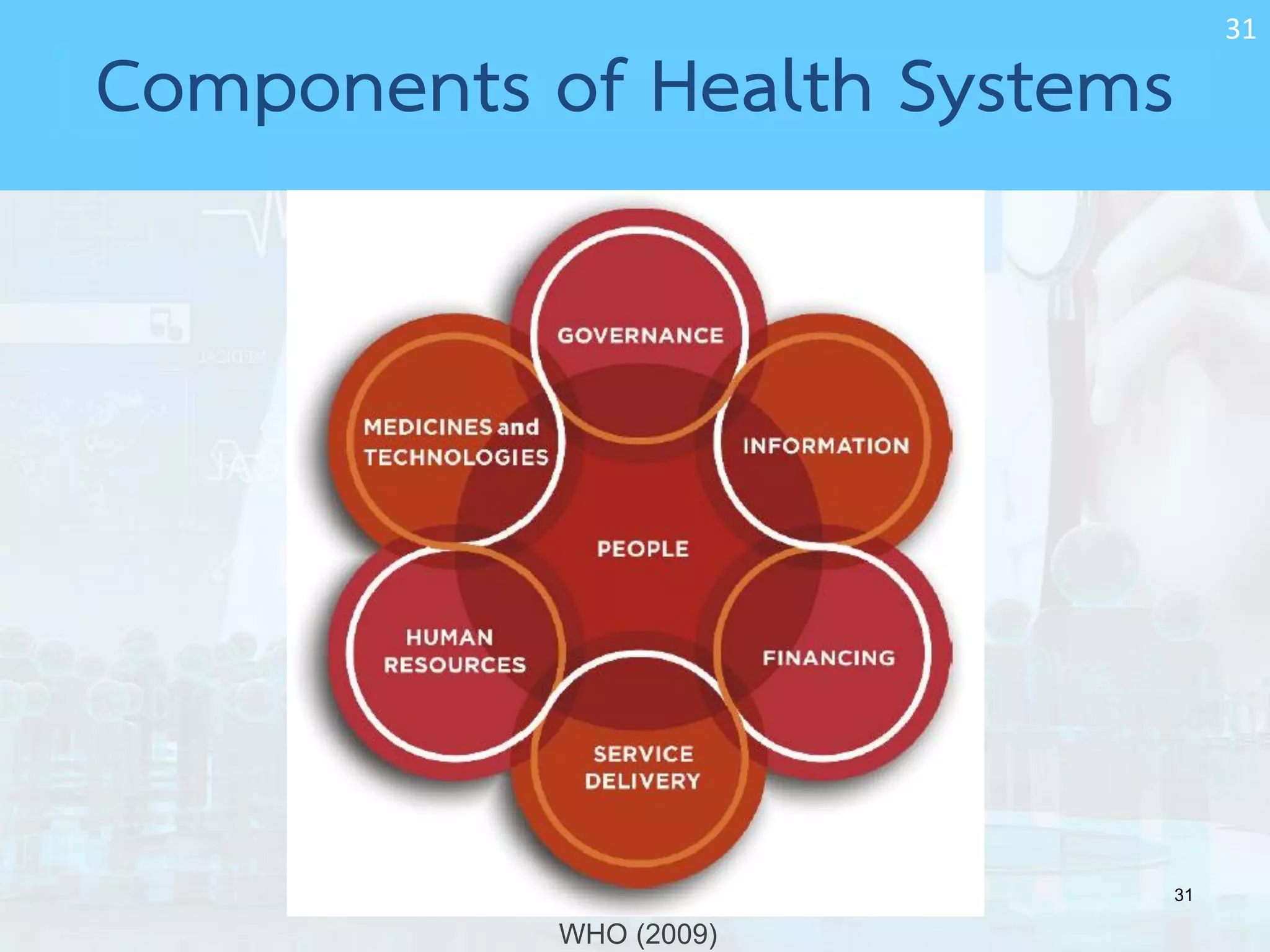
31
31
WHO (2009)
Components of Health Systems
32
32
WHO (2009)
WHO Health System Framework
33
• Safe
–Drug allergies
–Medication Reconciliation
• Timely
–Complete information at point of
care
• Effective
–Better clinical decision-making
Image Source: http://www.flickr.com/photos/childrensalliance/3191862260/
Being “Smart” in Healthcare
34
• Efficient
–Faster care
–Time & cost savings
–Reducing unnecessary tests
• Equitable
–Access to providers & knowledge
• Patient-Centered
–Empowerment & better self-care
Being “Smart” in Healthcare
35
(IOM, 2001)(IOM, 2000) (IOM, 2011)
Landmark Institute of Medicine Reports
36
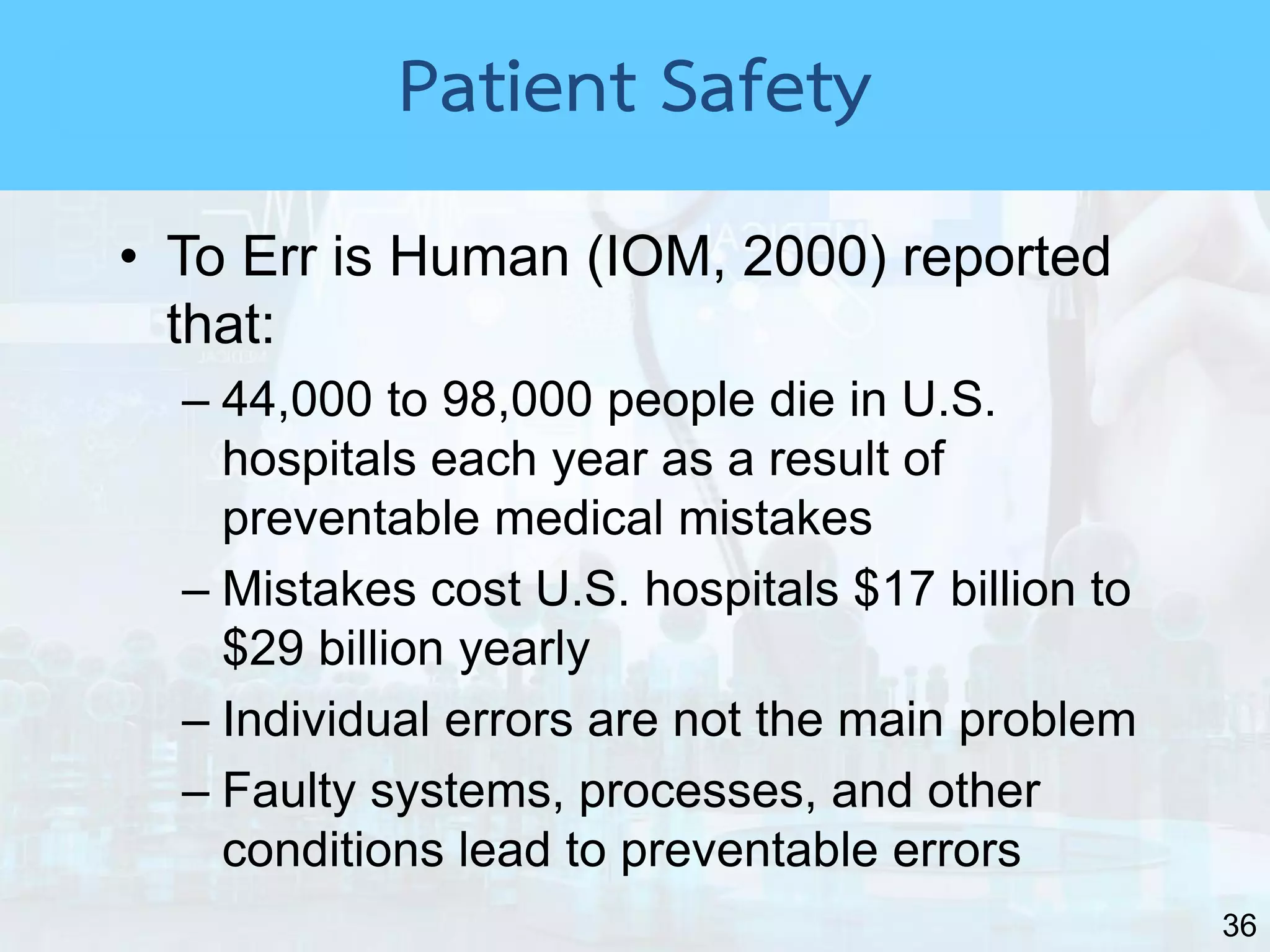
• To Err is Human (IOM, 2000) reported
that:
– 44,000 to 98,000 people die in U.S.
hospitals each year as a result of
preventable medical mistakes
– Mistakes cost U.S. hospitals $17 billion to
$29 billion yearly
– Individual errors are not the main problem
– Faulty systems, processes, and other
conditions lead to preventable errors
Patient Safety
37
Summary of These Reports
• Humans are not perfect and are bound to
make errors
• Highlight problems in U.S. health care
system that systematically contributes to
medical errors and poor quality
• Recommends reform
• Health IT plays a role in improving patient
safety
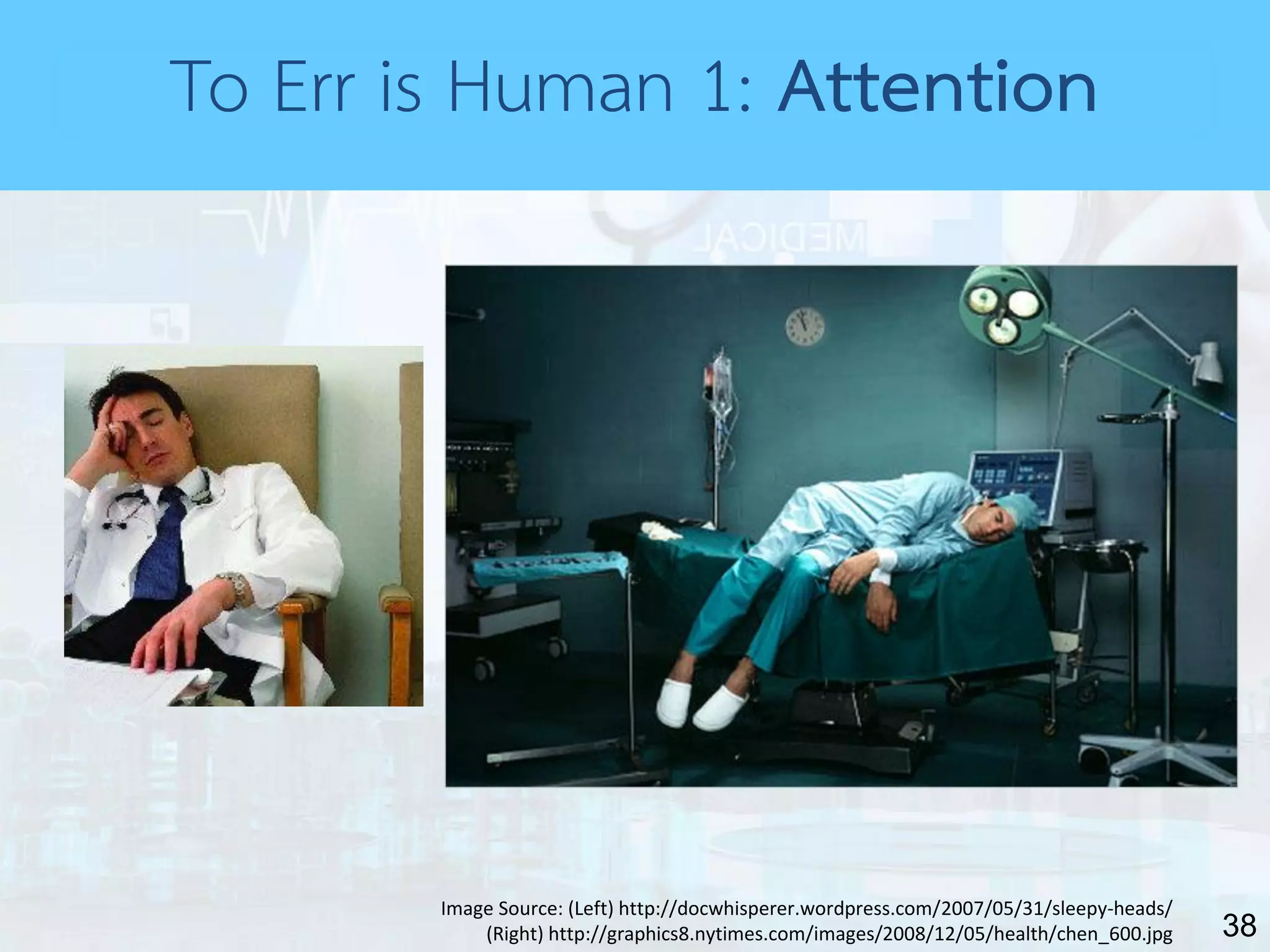
38
Image Source: (Left) http://docwhisperer.wordpress.com/2007/05/31/sleepy-heads/
(Right) http://graphics8.nytimes.com/images/2008/12/05/health/chen_600.jpg
To Err is Human 1: Attention
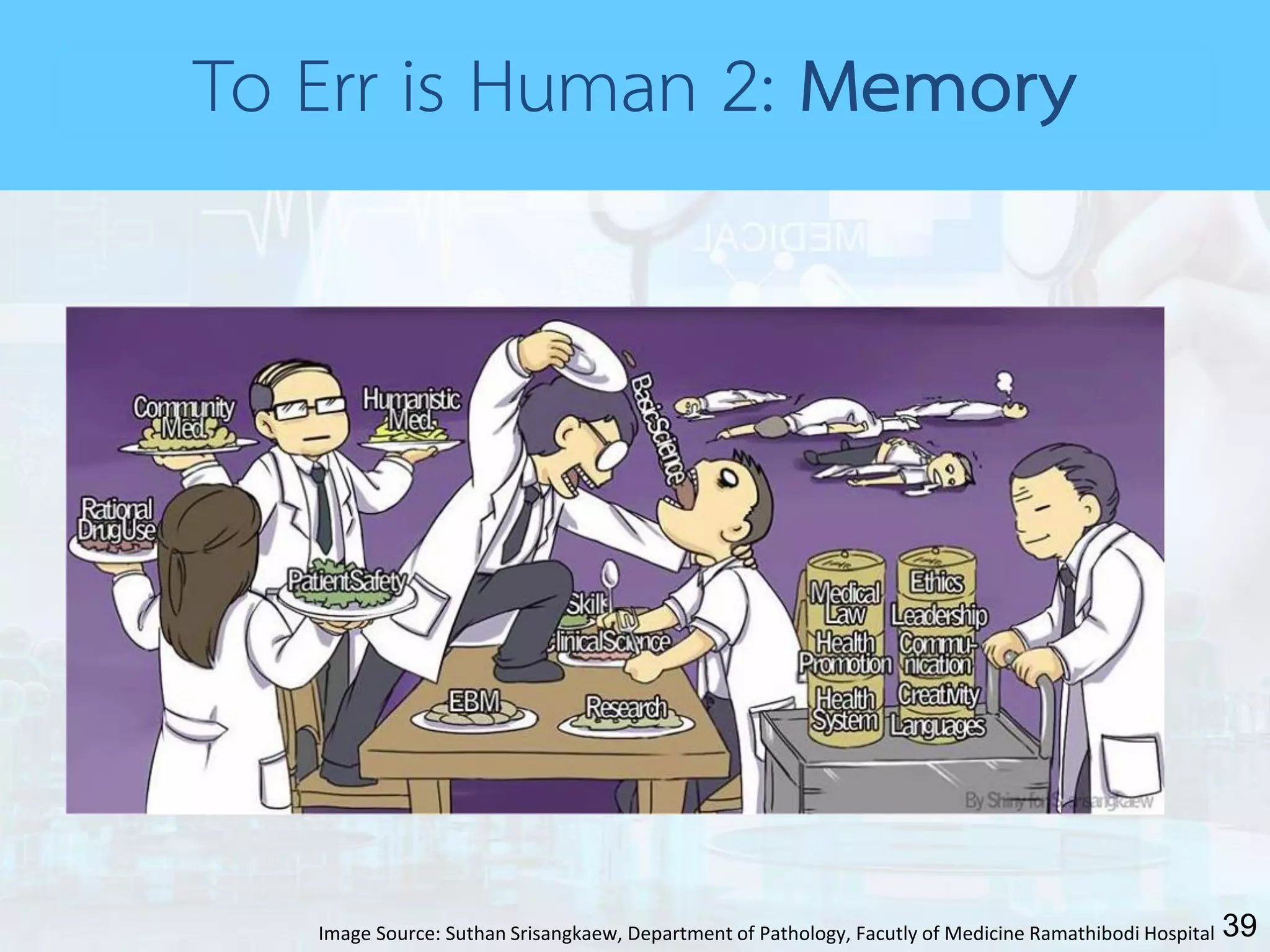
39Image Source: Suthan Srisangkaew, Department of Pathology, Facutly of Medicine Ramathibodi Hospital
To Err is Human 2: Memory
40
• Cognitive Errors - Example: Decoy Pricing
The Economist Purchase Options
• Economist.com subscription $59
• Print subscription $125
• Print & web subscription $125
Ariely (2008)
16
0
84
The Economist Purchase Options
• Economist.com subscription $59
• Print & web subscription $125
68
32
# of
People
# of
People
To Err is Human 3: Cognition
41
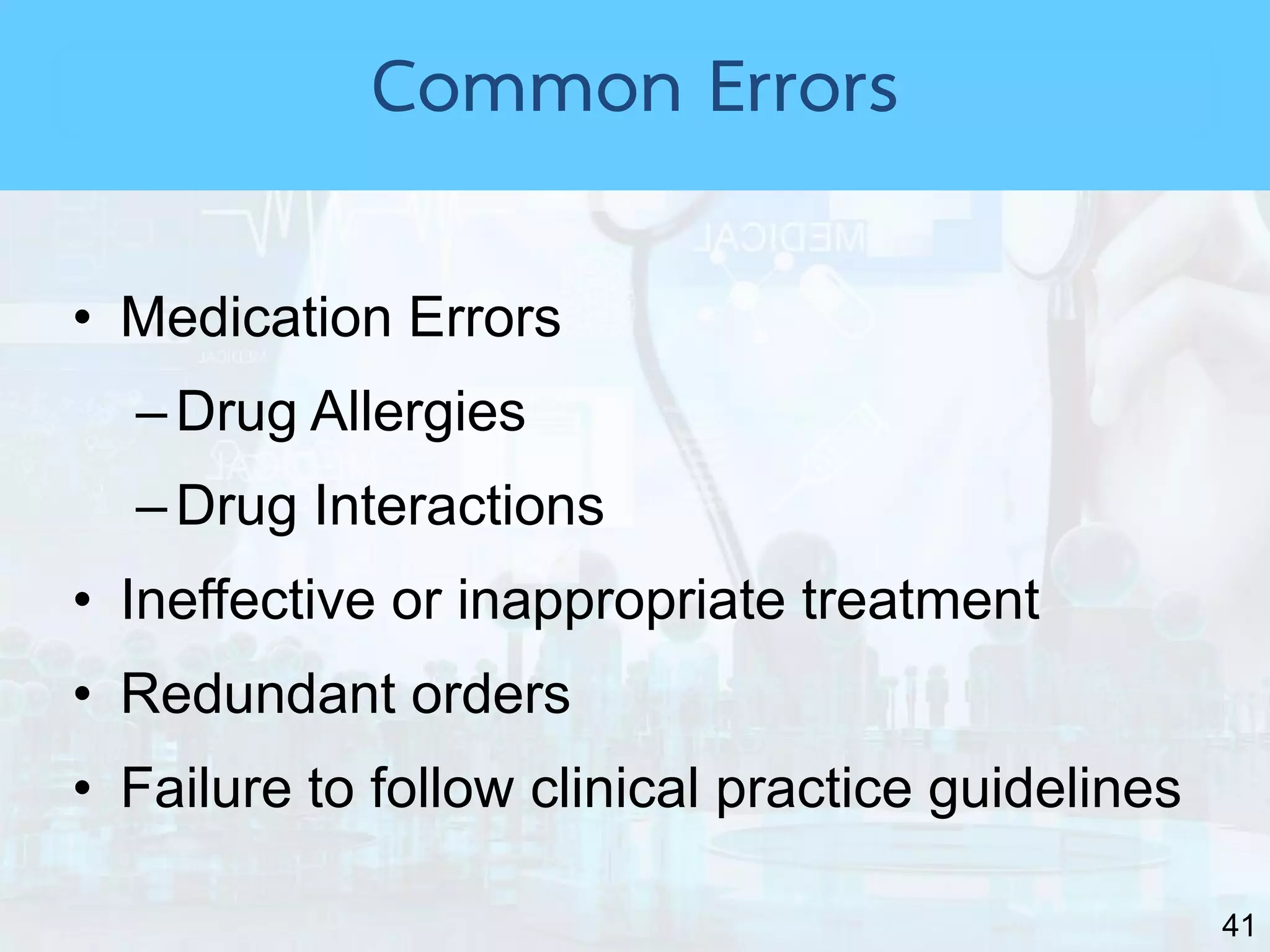
• Medication Errors
–Drug Allergies
–Drug Interactions
• Ineffective or inappropriate treatment
• Redundant orders
• Failure to follow clinical practice guidelines
Common Errors
42
Being Smart #3:
“To Err is Human”
43
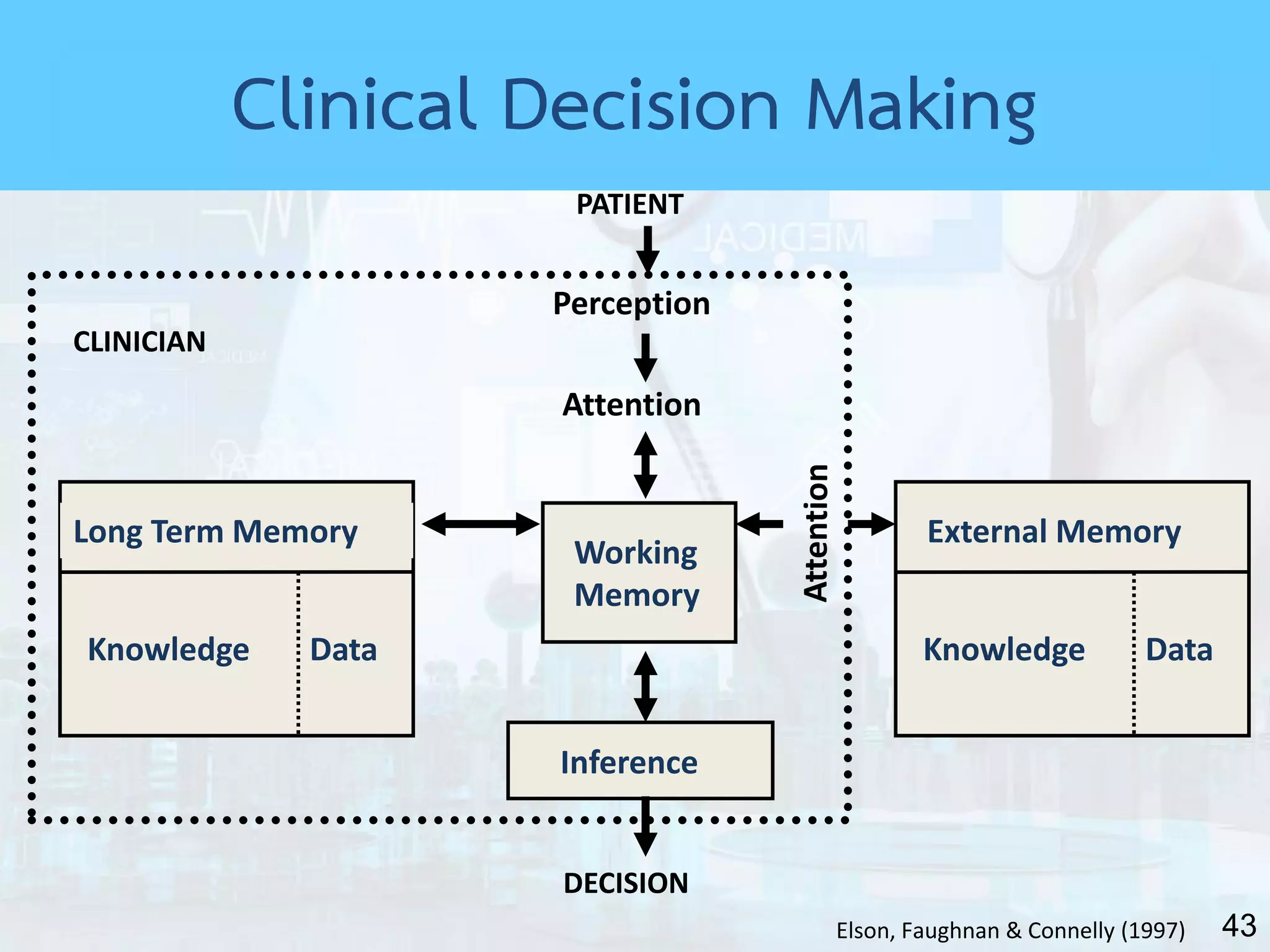
External Memory
Knowledge Data
Long Term Memory
Knowledge Data
Inference
DECISION
PATIENT
Perception
Attention
Working
Memory
CLINICIAN
Elson, Faughnan & Connelly (1997)
Clinical Decision Making
44
Example of “Alerts & Reminders”
Reducing Errors through “Alerts & Reminders”
45
Documented Values of Health IT
• Guideline adherence
• Better documentation
• Practitioner decision making or
process of care
• Medication safety
• Patient surveillance &
monitoring
• Patient education/reminder
46
Being Smart #4:
Link IT Values to
Quality (Including Safety)
47
Health
Information
Technology
Goal
Value-Add
Tools
Health IT: What’s in a Word?
48
Hospital Information System (HIS) Computerized Physician Order Entry (CPOE)
Electronic
Health
Records
(EHRs)
Picture Archiving and
Communication System
(PACS)
Various Forms of Health IT
49
m-Health
Health Information
Exchange (HIE)
Biosurveillance
Telemedicine &
Telehealth
Images from Apple Inc., Geekzone.co.nz, Google, PubMed.gov, and American Telecare, Inc.
Personal Health Records
(PHRs)
Health IT Beyond Hospitals
50
Health IT for Medication Safety
Ordering Transcription Dispensing Administration
CPOE
Automatic
Medication
Dispensing
Electronic
Medication
Administration
Records
(e-MAR)
Barcoded
Medication
Administration
Barcoded
Medication
Dispensing
51
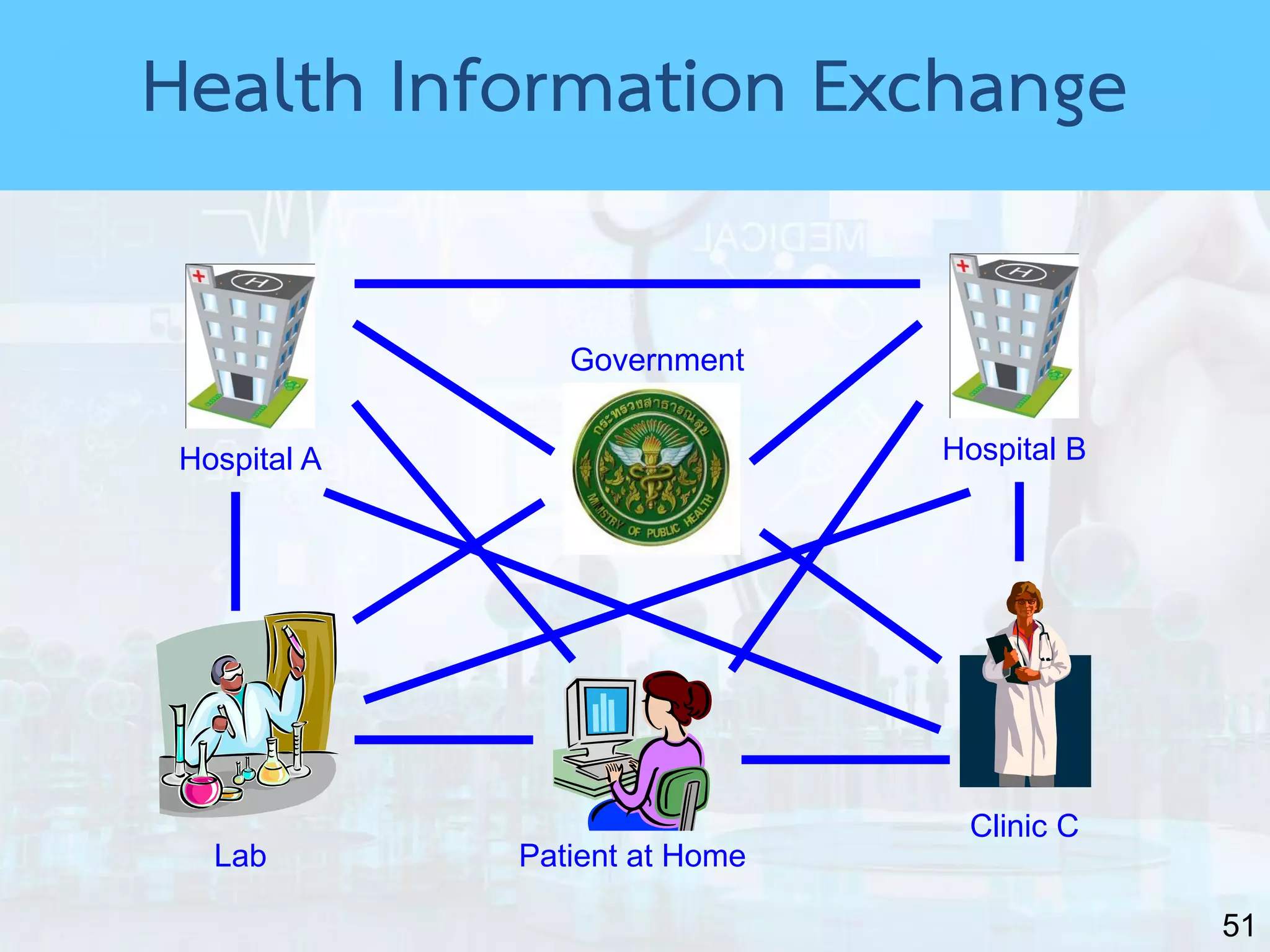
Hospital A Hospital B
Clinic C
Government
Lab Patient at Home
Health Information Exchange
52
ความฝันอันสูงสุด...
My Life-Long Dream...
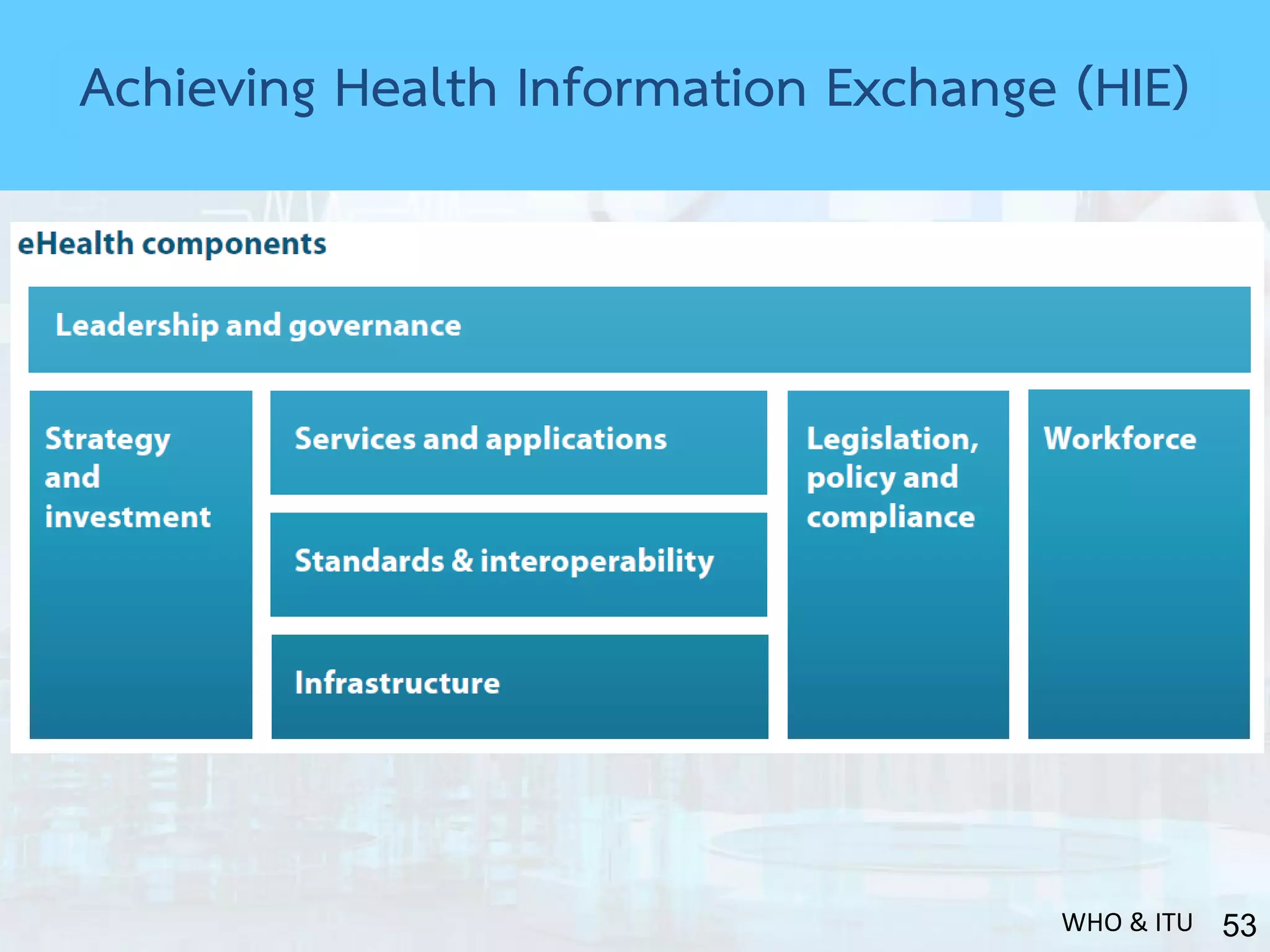
53WHO & ITU
Achieving Health Information Exchange (HIE)
54
The Road to Digitizing Healthcare
What is a “Smart Hospital”?
 Toward a “Smart” Hospital
Outline
55
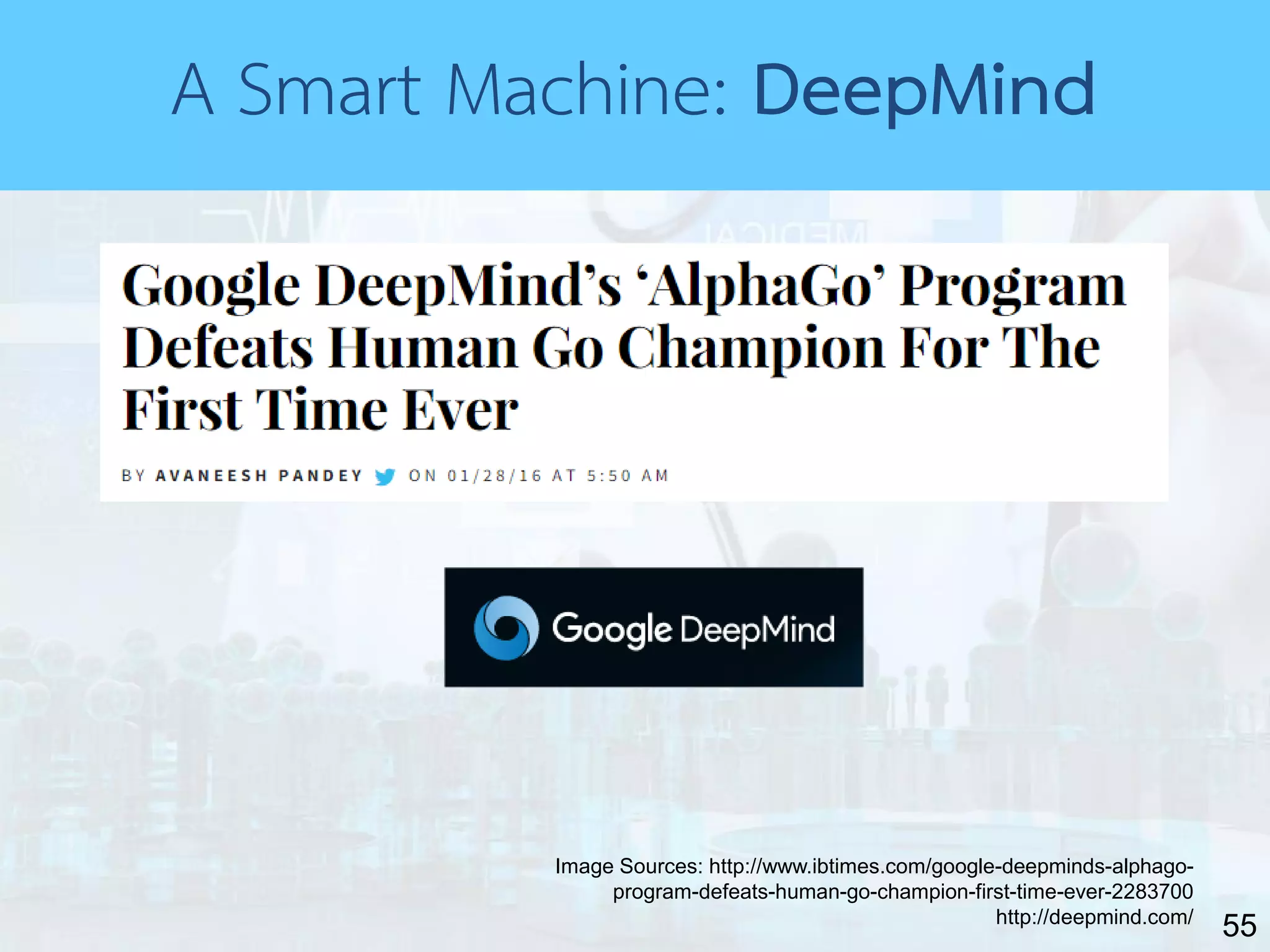
A Smart Machine: DeepMind
Image Sources: http://www.ibtimes.com/google-deepminds-alphago-
program-defeats-human-go-champion-first-time-ever-2283700
http://deepmind.com/
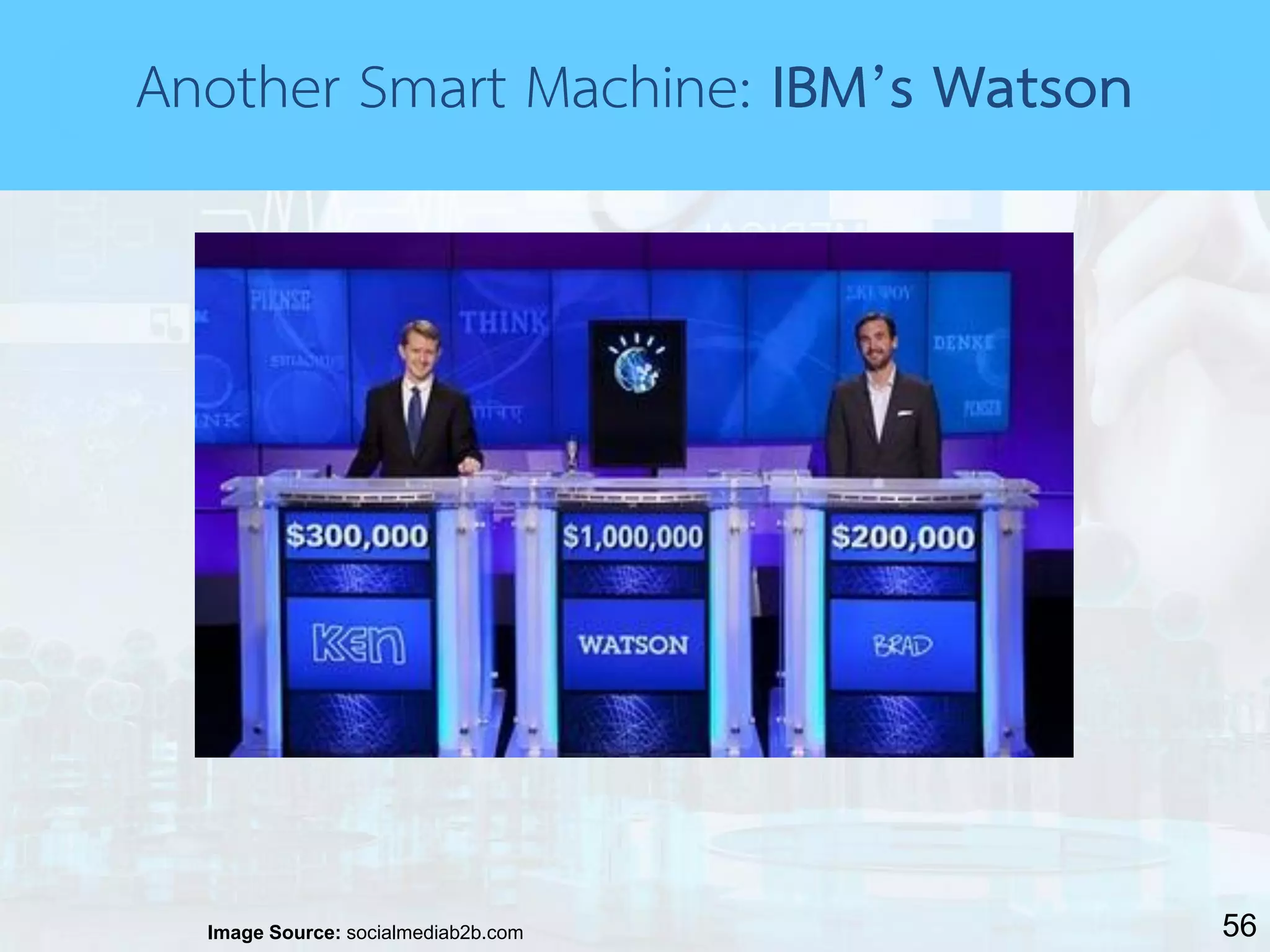
56Image Source: socialmediab2b.com
Another Smart Machine: IBM’s Watson
57Image Source: englishmoviez.com
Rise of the Machines?
58
Clinical Decision Support Systems
• CDSS as a replacement or supplement of
clinicians?
– The demise of the “Greek Oracle” model (Miller & Masarie, 1990)
The “Greek Oracle” Model
The “Fundamental Theorem” Model
Friedman (2009)
Wrong Assumption
Correct Assumption
59
Being Smart #5:
Don’t Replace
Human Users.
Use ICT to Help Them
Perform Smarter & Better.
60
Some Risks of Clinical Decision Support Systems
• Alert Fatigue
Unintended Consequences of Health IT
61
Workarounds
Unintended Consequences of Health IT
62
Being Smart #6:
Health IT Also Have
Risks &
Unintended Consequences
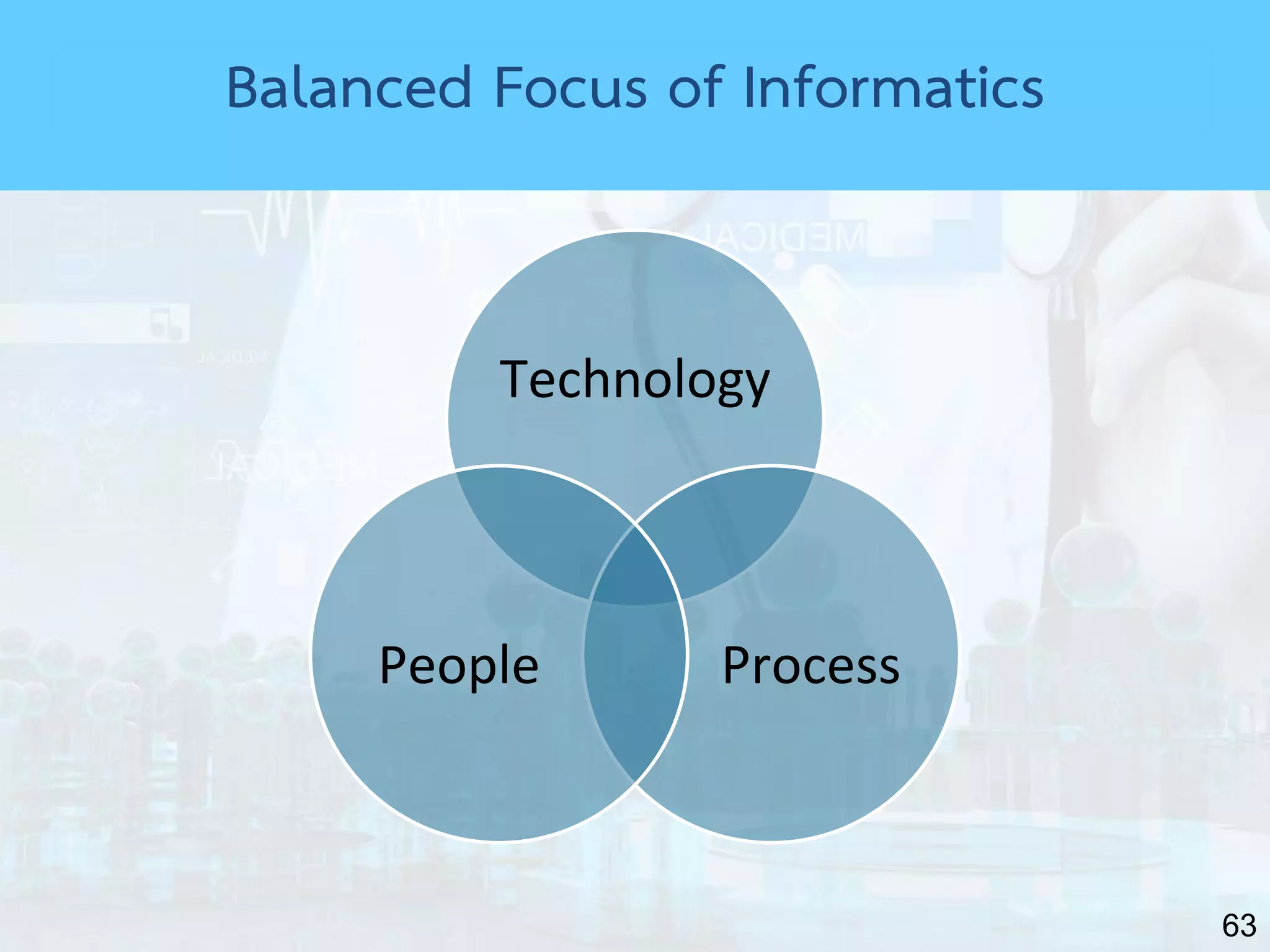
63
Balanced Focus of Informatics
Technology
ProcessPeople
64
Being Smart #7:
Balance Your Focus
(People, Process, Technology)
65The sailboat image source: Uwe Kils via http://en.wikipedia.org/wiki/Sailing
The destination
The boat
The sailor(s) &
people on board
The tailwind The headwind
The direction
The speed
The past journey
The sea
The sail
The current location
IT & Organizational Context
66
Being Smart #8:
Know Your Context &
Align IT with that Context
67
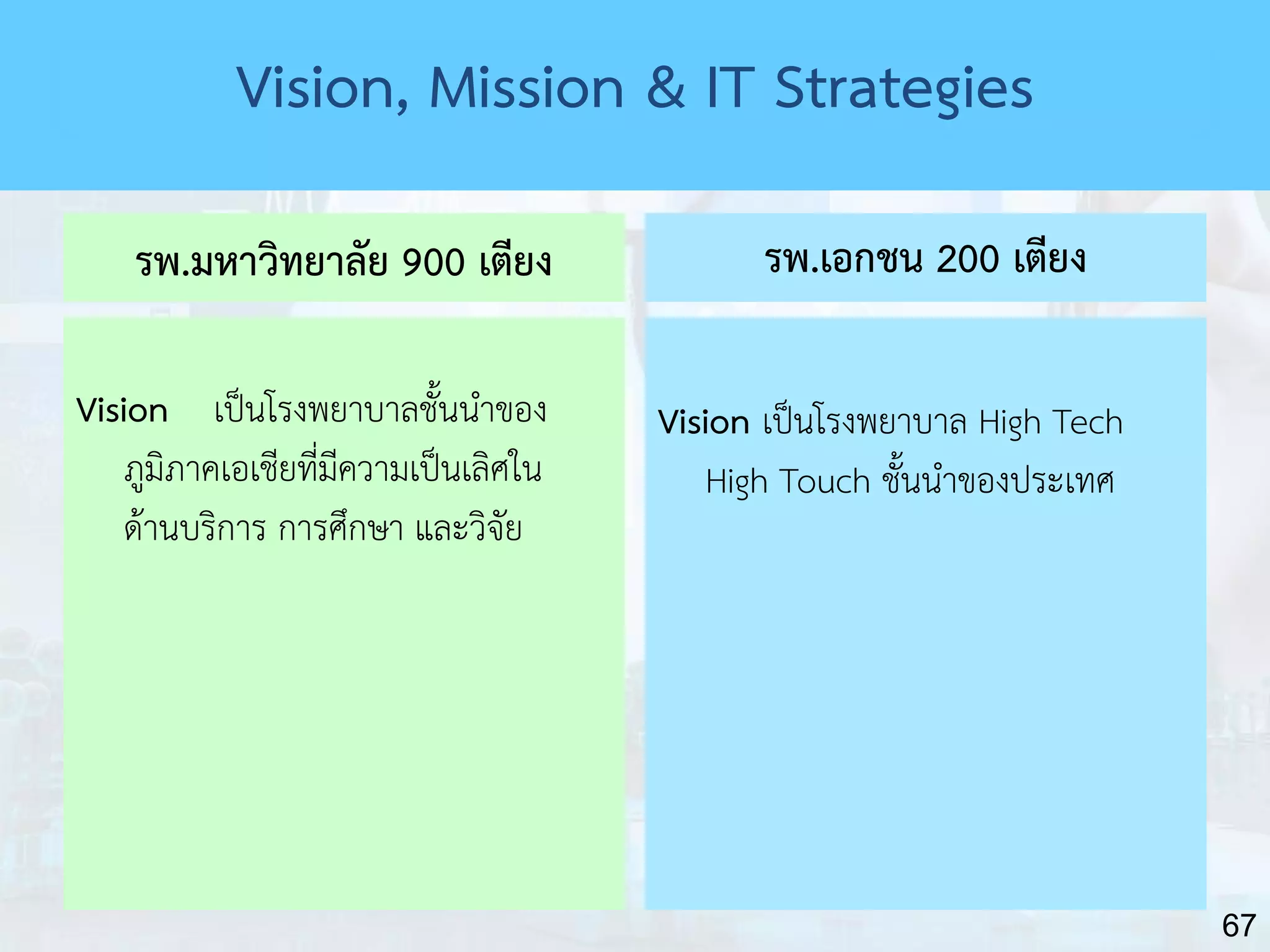
รพ.มหาวิทยาลัย 900 เตียง
Vision เป็นโรงพยาบาลชั้นนาของ
ภูมิภาคเอเชียที่มีความเป็นเลิศใน
ด้านบริการ การศึกษา และวิจัย
รพ.เอกชน 200 เตียง
Vision เป็นโรงพยาบาล High Tech
High Touch ชั้นนาของประเทศ
Vision, Mission & IT Strategies
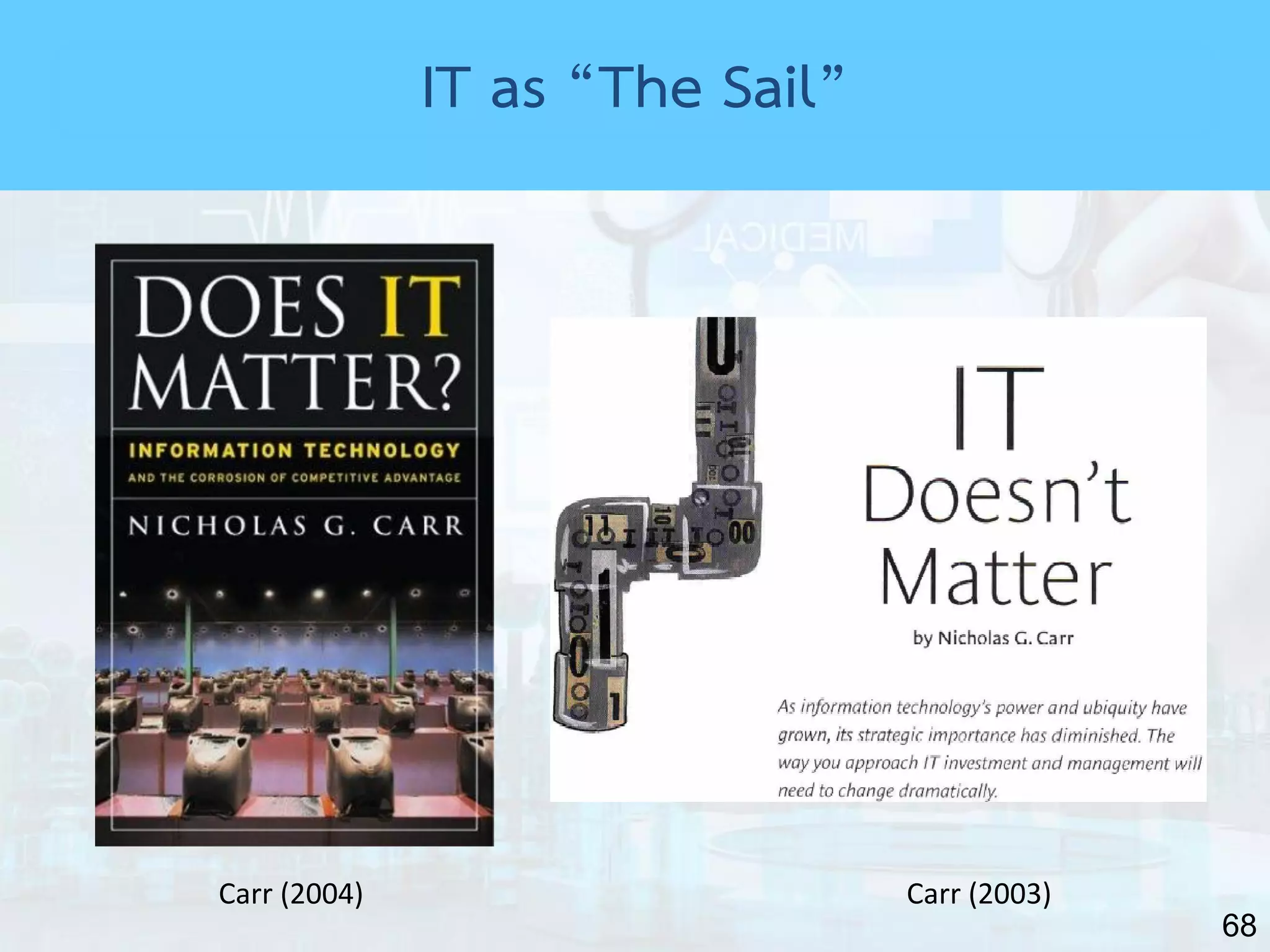
68
Carr (2004) Carr (2003)
IT as “The Sail”
69
Strategic
Operational
ClinicalAdministrative
LIS
Health Information ExchangeBusiness
Intelligence
Word
Processor
Social
Media
PACS
4 Quadrants of Hospital IT
Personal Health Records
Clinical Decision Support Systems
Computerized Physician Order Entry
Electronic Health Records
Admission-Discharge-Transfer
Master Patient Index
Enterprise Resource Planning
Vendor-Managed Inventory
Customer Relationship Management
70
Being Smart #9:
Identify Your
Strategic IT Assets
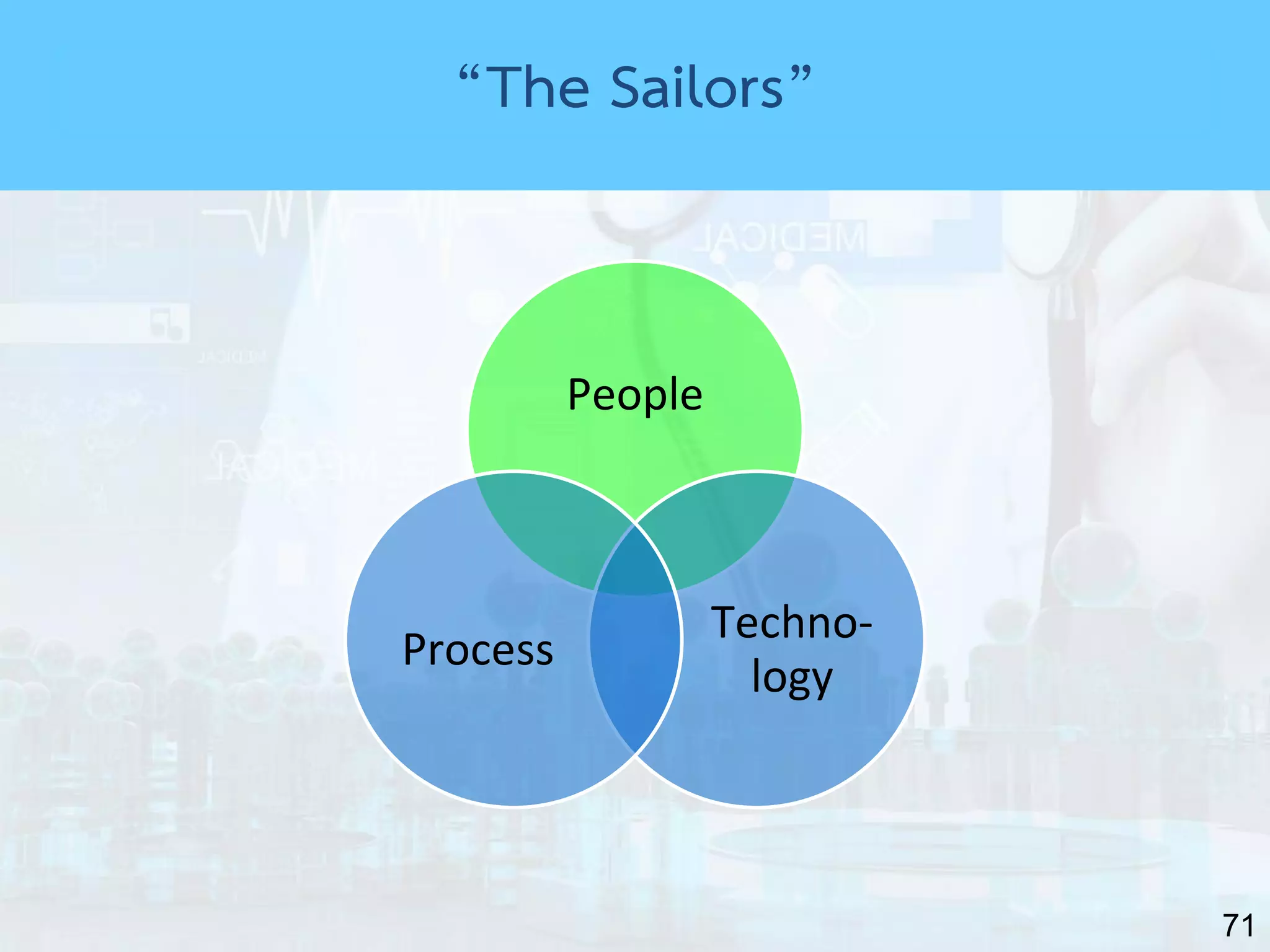
71
People
Techno-
logy
Process
“The Sailors”
72
รพ.มหาวิทยาลัย 900 เตียง
• บุคลากรมีอายุเฉลี่ย 42 ปี
(range 20-65)
• แผนก IT มีทั้งบุคลากรใหม่และที่เคย
พัฒนาระบบ HIS ตั้งแต่แรกเริ่ม
• แพทย์มีความเป็นตัวของตัวเองสูง,
มักทางานเอกชนด้วย, มี turn-over
rate สูง
• พยาบาลและวิชาชีพอื่นมักมองว่า
แพทย์คืออภิสิทธิ์ชน และมีเรื่อง
ถกเถียงกันบ่อยๆ
รพ.เอกชน 200 เตียง
• บุคลากรมีอายุเฉลี่ย 32 ปี
(range 20-57)
• แผนก IT เข้มแข็ง
• แพทย์ไม่ค่อยมี interaction กับ
บุคลากรอื่น, รายได้เป็นแรงดึงดูดหลัก
• ผู้บริหารได้รับการยอมรับจากบุคลากร
ทุกวิชาชีพว่ามีวิสัยทัศน์และ
บริหารงานได้ดี
“The Sailors”
73Ash et al. (2003)
The “Special People”
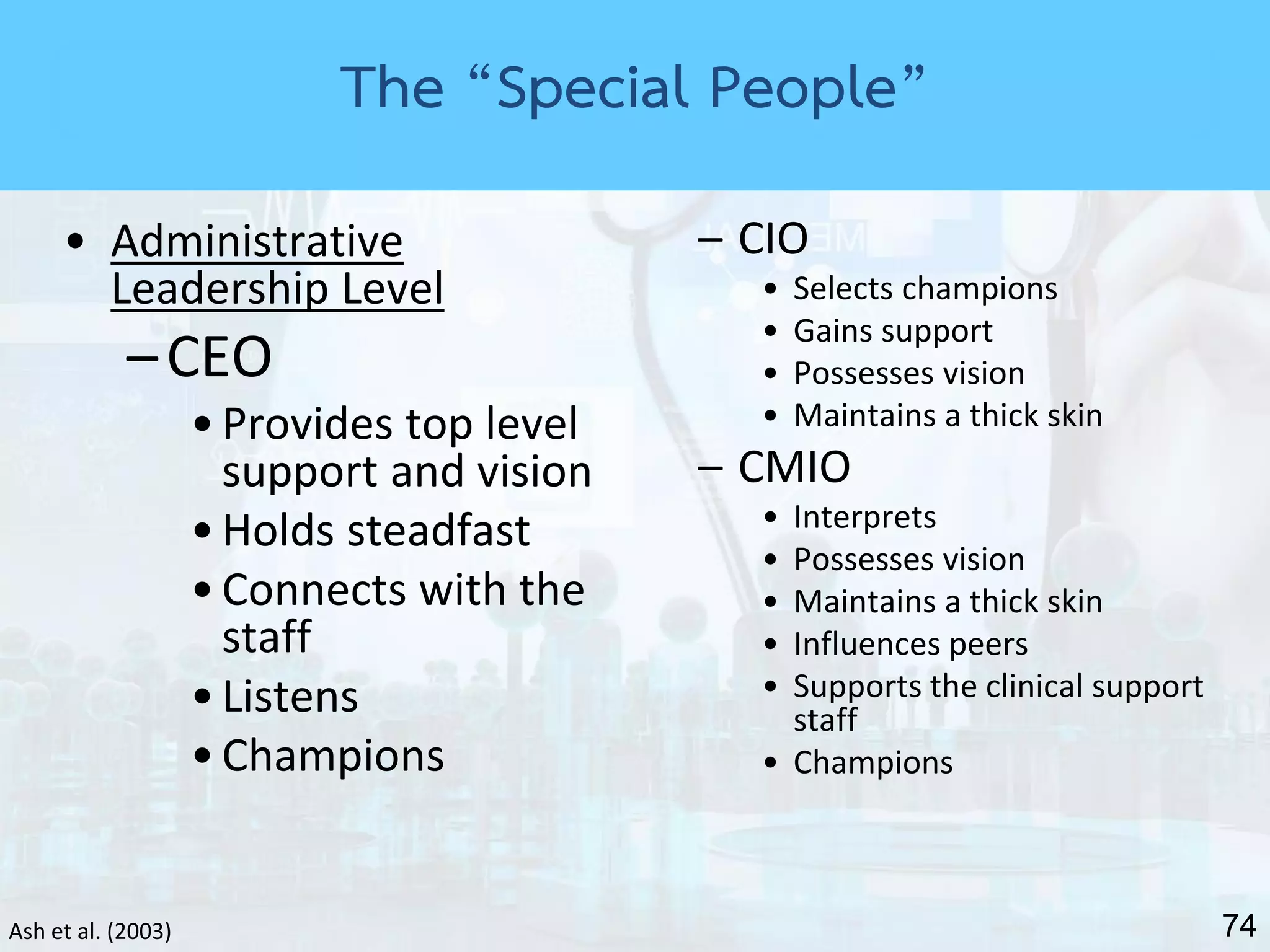
74Ash et al. (2003)
• Administrative
Leadership Level
–CEO
•Provides top level
support and vision
•Holds steadfast
•Connects with the
staff
•Listens
•Champions
– CIO
• Selects champions
• Gains support
• Possesses vision
• Maintains a thick skin
– CMIO
• Interprets
• Possesses vision
• Maintains a thick skin
• Influences peers
• Supports the clinical support
staff
• Champions
The “Special People”
75Ash et al. (2003)
• Clinical Leadership
Level
– Champions
• Necessary
• Hold steadfast
• Influence peers
• Understand other
physicians
– Opinion leaders
• Provide a balanced
view
• Influence peers
– Curmudgeons
• “Skeptic who is
usually quite vocal in
his or her disdain of
the system”
• Provide feedback
• Furnish leadership
– Clinical advisory
committees
• Solve problems
• Connect units
The “Special People”
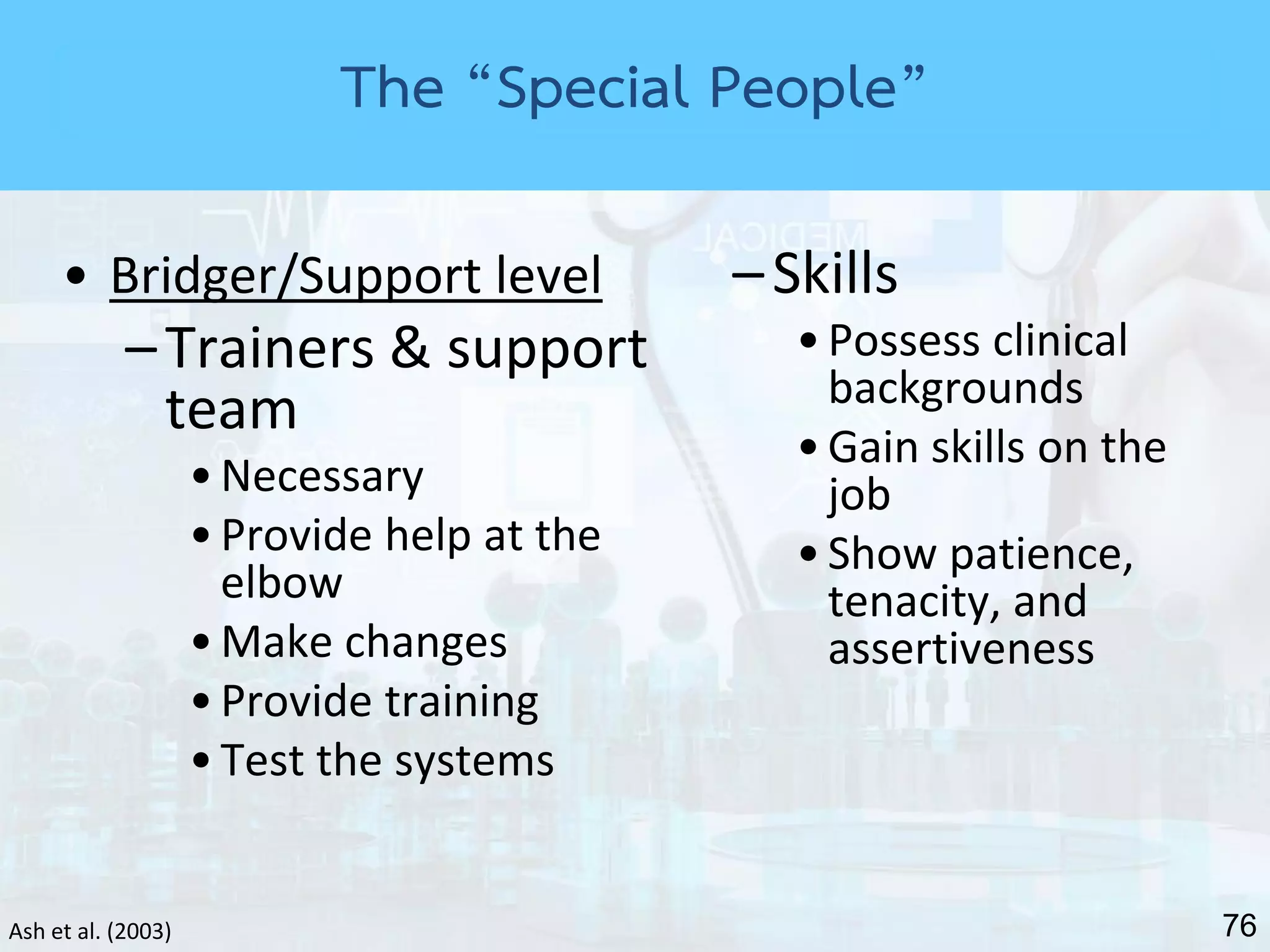
76Ash et al. (2003)
• Bridger/Support level
–Trainers & support
team
•Necessary
•Provide help at the
elbow
•Make changes
•Provide training
•Test the systems
–Skills
•Possess clinical
backgrounds
•Gain skills on the
job
•Show patience,
tenacity, and
assertiveness
The “Special People”
77
Being Smart #10:
Manage Your
“Special People” Well
78
A True Story of Failure to
Involve Users in Hospital IT
Implementation
79
Being Smart #11:
Involve Users Early &
Intensively in Your Process
80
Image source: Jeremy Kemp via http://en.wikipedia.org/wiki/Hype_cycle
http://www.gartner.com/technology/research/methodologies/hype-cycle.jsp
Gartner Hype Cycle
81
Rogers (2003)
Rogers’ Diffusion of Innovations:
Adoption Curve
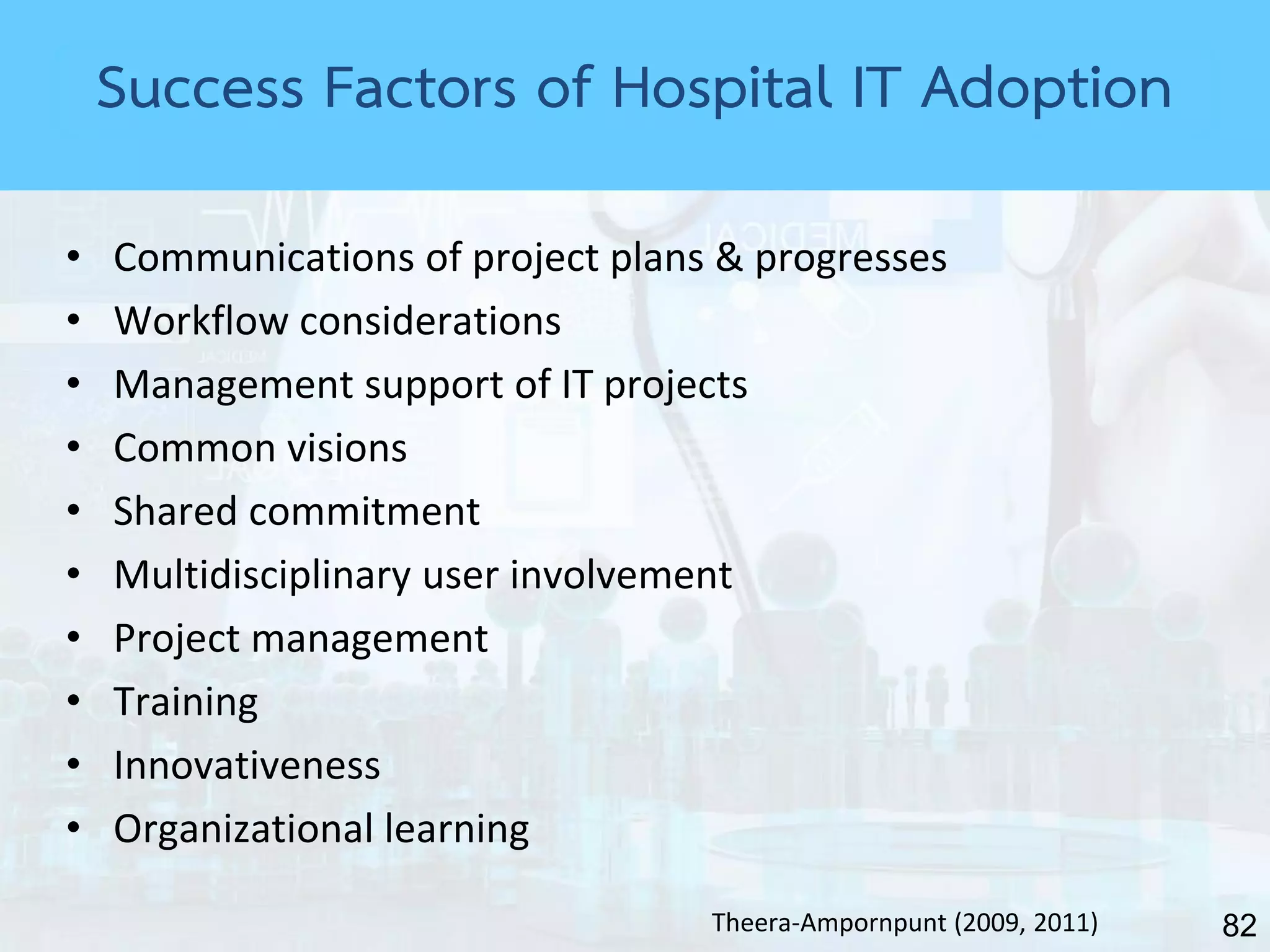
82
• Communications of project plans & progresses
• Workflow considerations
• Management support of IT projects
• Common visions
• Shared commitment
• Multidisciplinary user involvement
• Project management
• Training
• Innovativeness
• Organizational learning
Theera-Ampornpunt (2009, 2011)
Success Factors of Hospital IT Adoption
83
Being Smart #12:
Work Smartly with
Smart People
84
To become a smart hospital, you must
• Know what is “smart” all about
• Know how to use smart machines
together with smart people
• Manage both of them smartly
Summary
85
2546 แพทยศาสตรบัณฑิต
2554 Ph.D. (Health Informatics), Univ. of Minnesota
ผู้ช่วยคณบดีฝ่ายนโยบายและสารสนเทศ
อาจารย์ ภาควิชาเวชศาสตร์ชุมชน
คณะแพทยศาสตร์โรงพยาบาลรามาธิบดี มหาวิทยาลัยมหิดล
ความสนใจ: Health IT for Quality of Care,
IT Management, Security & Privacy
nawanan.the@mahidol.ac.th
SlideShare.net/Nawanan
Q&A

Use of ICT in Healthcare