
AYUSHMAN
BHARAT-PMJAY
Mr.Ramaprabhu.Z
Asst.Professor,
Background
◦ Statistics show that over 20 percent of India’s population still lives under $1.9 per day (2011 PPP). According
to a World Bank projection, by 2021 over 34% of India’s population will be in the age group of 15-35 years.
◦ Over the last two decades, the Government of India’s overall expenditure on health has remained stagnant
at about 1.2% of its GDP (Source: National Health Accounts, 2015). Of its total expenditure on health,
India spends only 21% from the Government revenue and as high as 62% from out-of-pocket expenses
(Source: National Health Accounts, 2015).
◦ The Rashtriya Swasthya Bima Yojana (RSBY) was launched with an annual cover of INR30,000 per family
at the central level which catered mostly to secondary care hospitalisation while many State schemes
catered to tertiary care conditions.
◦ To address these challenges, the Government of India took a two-pronged approach under the umbrella of
Ayushman Bharat.
cont…...
◦ The first component of this strategy was disease prevention and health promotion to curb the increasing
epidemic of non-communicable diseases. This was to be ensured through up-gradation of the existing
network of Sub-centres and Primary Health Centres to Health and Wellness Centres (HWC).
◦ The second component was the launch of the Pradhan Mantri-Jan Arogya Yojana (PM-JAY) which aims to
create a system of demand-led health care reforms that meet the immediate hospitalisation needs of the
eligible beneficiary family in a cashless manner thus insulating the family from catastrophic financial shock.
◦ PM-JAY is the world’s largest health insurance/assurance scheme that offers a health cover to nearly 10.74
crore poor families which come to a staggering 50 crore Indians that form 40% of its bottom population. It is
fully funded by the Government and provides financial protection for a wide variety of secondary and tertiary
care hospitalisations.
◦ The prime aim of PM-JAY is to reduce catastrophic out-of-pocket health expenditure by improving access to
quality health care for its underprivileged population.
Implementation model
◦ They can implement scheme through assurance/trust model, insurance model or mixed model.
◦ A. Assurance Model/Trust Model
◦ the scheme is directly implemented by the SHA without the intermediation of the insurance company. The
financial risk of implementing the scheme is borne by the Government in this model. SHA reimburses health
care providers directly.
◦ the SHA also has to carry out specialised tasks such as hospital empanelment, beneficiary identification,
claims management and audits and other related tasks.
◦ B. Insurance Model
◦ the SHA competitively selects an insurance company through a tendering process to manage PM-JAY in the
State.
◦ SHA pays premium to the insurance company per eligible family for the policy period and insurance
company, in turn, does the claims settlement and payments to the service provider.
cont……
◦ The financial risk for implementing the scheme is also borne by the insurance company in this model.
◦ The percentage that will need to be refunded will be as per the following:
◦ a. In Category A States (administrative cost cannot exceed 20%)
 i. Administrative cost allowed 10% if claim ratio less than 60%.
 ii. Administrative cost allowed 15% if claim ratio between 60 to less than 70%.
 iii. Administrative cost allowed 20% if claim ratio between 70 to less than 80%.
◦ In Category B States (administrative cost cannot exceed 15%)
 i. Administrative cost allowed 10% if claim ratio less than 60%.
 ii. Administrative cost allowed 12% if claim ratio between 60 to less than 70%.
 iii. Administrative cost allowed 15% if claim ratio between 70 to less than 85%.
◦ C. Mixed Model
◦ the SHA engages both the assurance/ trust and insurance models mentioned above in various capacities with
the aim of being more economic, efficient, providing flexibility and allowing convergence with the State
scheme. This model is usually employed by brownfield States which had existing schemes covering a larger
group of beneficiaries.
Category
A States/
UTs
Arunachal Pradesh, Goa, Himachal Pradesh, Jammu and Kashmir, Manipur, Meghalaya,
Mizoram, Nagaland, NCT Delhi, Sikkim, Tripura, Uttarakhand and 6 Union Territories
(Andaman and Nicobar Islands, Chandigarh, Dadra and Nagar Haveli, Daman and Diu,
Lakshadweep and Puducherry)
Category
B States
Andhra Pradesh, Assam, Bihar, Chhattisgarh, Gujarat, Haryana, Jharkhand, Karnataka, Kerala,
Madhya Pradesh, Maharashtra, Odisha, Punjab, Rajasthan, Tamil Nadu, Telangana, Uttar Pradesh
and West Bengal
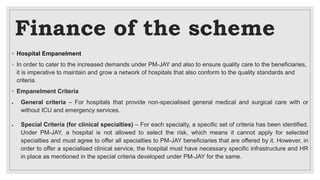
Finance of the scheme
◦ Hospital Empanelment
◦ In order to cater to the increased demands under PM-JAY and also to ensure quality care to the beneficiaries,
it is imperative to maintain and grow a network of hospitals that also conform to the quality standards and
criteria.
◦ Empanelment Criteria
 General criteria – For hospitals that provide non-specialised general medical and surgical care with or
without ICU and emergency services.
 Special Criteria (for clinical specialties) – For each specialty, a specific set of criteria has been identified.
Under PM-JAY, a hospital is not allowed to select the risk, which means it cannot apply for selected
specialties and must agree to offer all specialties to PM-JAY beneficiaries that are offered by it. However, in
order to offer a specialised clinical service, the hospital must have necessary specific infrastructure and HR
in place as mentioned in the special criteria developed under PM-JAY for the same.
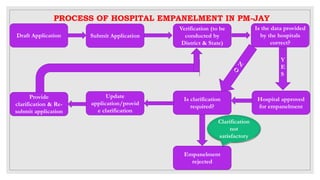
PROCESS OF HOSPITAL EMPANELMENT IN PM-JAY
Draft Application
Update
application/provid
e clarification
Submit Application
Is clarification
required?
Is the data provided
by the hospitals
correct?
Verification (to be
conducted by
District & State)
Hospital approved
for empanelment
Empanelment
rejected
Provide
clarification & Re-
submit application
Y
E
S
Clarification
not
satisfactory
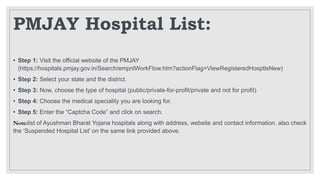
PMJAY Hospital List:
• Step 1: Visit the official website of the PMJAY
(https://hospitals.pmjay.gov.in/Search/empnlWorkFlow.htm?actionFlag=ViewRegisteredHosptlsNew)
• Step 2: Select your state and the district.
• Step 3: Now, choose the type of hospital (public/private-for-profit/private and not for profit)
• Step 4: Choose the medical speciality you are looking for.
• Step 5: Enter the “Captcha Code” and click on search.
Note:list of Ayushman Bharat Yojana hospitals along with address, website and contact information. also check
the ‘Suspended Hospital List’ on the same link provided above.
National Health Care Providers (NHCP)
◦ . Most popular examples of such hospitals are AIIMS, Safdarjung Hospital, JIPMER, PGI Chandigarh, etc.
The National Health Authority (NHA) has empanelled these hospitals directly by signing an MoU with each of
the facility.
◦ Also, all NABH accredited private hospitals in the National Capital Region (NCR) are directly empanelled by
NHA to widen the network of service providers.
◦ Empanelment of Government hospitals other than those managed by MoHFW is also a major step towards
widening the network of hospitals.
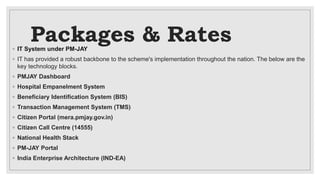
Packages & Rates◦ IT System under PM-JAY
◦ IT has provided a robust backbone to the scheme's implementation throughout the nation. The below are the
key technology blocks.
◦ PMJAY Dashboard
◦ Hospital Empanelment System
◦ Beneficiary Identification System (BIS)
◦ Transaction Management System (TMS)
◦ Citizen Portal (mera.pmjay.gov.in)
◦ Citizen Call Centre (14555)
◦ National Health Stack
◦ PM-JAY Portal
◦ India Enterprise Architecture (IND-EA)
◦ Information Security & Data Privacy Policies
◦ National Portability
◦ Grievance Management System
◦ Anti-Fraud Measures
◦ Citizen Mobile App
◦ Common Service Centre (CSC)
◦ B. PM-JAY IT Ecosystem
◦ Support Systems
Capacity Development : Capacity building activities under PM-JAY attempt to address more than just training
and cover all aspects of building and developing sustainable and robust institutions and human resource.
Capacity building in PM-JAY has three components
 Setting up sustainable institutional structures,
 Building and strengthening the human resource and institutional capacity, and
◦ Sustaining knowledge and skill through knowledge management and use of appropriate tools.
◦ Monitoring and Evaluation
◦ Monitoring and Evaluation under PM-JAY Monitoring and Evaluation (M&E) is key for successful
implementation and ensuring the intended results of such a large insurance scheme. keeping track on
periodic basis on these UHC dimensions (coverage, benefits and financial protection) through the following
functional domains
 Beneficiary management
 Transaction management
 Provider management
 Support function management (comprising functions such as capacity development, grievances, frauds and
abuse, call centre, etc.)
Convergence
◦ Convergence between National Health Authority (NHA) and Employee’s State Insurance Corporation
(ESIC)
◦ This will leverage the presence of an established network of quality services providers under PM-JAY
alongside fixed health benefit packages, thereby standardising services across schemes.
◦ Further, it will create higher demand for health services at ESIC empanelled hospitals that may be currently
underutilised.
◦ In the initial phase, a pilot is being conducted in Ahmednagar, Maharashtra and Bidar, Karnataka wherein
ESIC beneficiaries of these districts will be able to access PM-JAY services in PM-JAY empanelled hospitals.
The beneficiaries will be eligible for all 1,393 secondary and tertiary packages under the scheme and the
initiative will be scaled up to 102 districts with a plan of eventually extending coverage across the country.
◦ Key Benefits of AB PM-JAY and ESIS convergence:
 ESIC beneficiaries will get access to healthcare providers under AB PM-JAY
 AB PM-JAY beneficiaries will be able to avail services in ESIC empanelled hospitals.
 Beneficiaries of ESIC can use their ESIS card to access free treatment at AB PM-JAY empanelled hospitals.
 Similarly, beneficiaries of AB PM-JAY can use their PM-JAY card to access free treatment at ESIC
empanelled hospitals.
 For more information beneficiaries can call ESIC tollfree number: 1800 112 526/ 1800 113 839
What is Covered Under Ayushman
Bharat Yojana Scheme?
◦ The health insurance under AB-PMJAY includes hospitalization costs of beneficiaries and includes the
below components:
• Medical examination, consultation and treatment.
• Pre-hospitalisation.
• Non-intensive and intensive care services.
• Medicine and medical consumables.
• Diagnostic and laboratory services.
• Accommodation.
• Medical implant services, wherever possible.
• Food services.
• Complication arising during treatment.
• Post-hospitalisation expenses for up to 15 days.
• COVID-19 (Coronavirus) treatment.
What is Not Covered Under
Ayushman Bharat Yojana Scheme?
◦ Ayushman Bharat Yojana Scheme has some exclusions. Below components are not covered under the
scheme:
• Out-Patient Department (OPD) expenses.
• Drug rehabilitation.
• Cosmetic surgeries.
• Fertility treatments.
• Individual diagnostics.
• Organ transplant.
List of Critical Diseases or Illnesses Covered
Under Ayushman Bharat Yojana Scheme:
◦ The medical care scheme extended coverage for more than 1300 medical packages at
empanelled public and private hospitals in the country. Below are some of the critical illnesses
covered under the Ayushman Bharat Yojana:
• Prostate cancer.
• Double valve replacement.
• Coronary artery bypass graft.
• COVID-19.
• Pulmonary valve replacement.
• Skull base surgery.
• Anterior spine fixation.
• Laryngopharyngectomy with gastric pull-up
• Tissue expander for disfigurement following burns.
• Carotid angioplasty with stent.
Features of Ayushman Bharat
Yojana Scheme:
• It is one of the world’s largest health insurance schemes financed by the government of India.
• Coverage of Rs.5 lakh per family per annum for secondary and tertiary care across public and private
hospitals.
• Approximately 50 crore beneficiaries (over 10 crore poor and vulnerable entitled families) are eligible
for the scheme.
• Cashless hospitalisation.
• Covers up to 3 days of pre-hospitalisation expenses such as medicines and diagnostics.
• Covers up to 15 days of post-hospitalisation expenses which include medicines and diagnostics.
• No restriction on the family size, gender or age.
• Can avail services across the country at any of the empanelled public and private hospitals.
• All pre-existing conditions covered from day one.
• The scheme includes 1,393 medical procedures.
• Includes costs for diagnostic services, drugs, room charges, physician’s fees, surgeon charges, supplies,
ICU and OT charges.
• Public hospitals are reimbursed at par with private hospitals.
Benefits of Ayushman Bharat Yojana Scheme:
The scheme is targeted at the vulnerable and underprivileged sections of the society.
• It covers all hospitalisation expenses with cashless transactions to beneficiaries.
• Accommodation during hospitalisation.
• Pre and post-hospitalisation costs.
• Any complications arising during the treatment.
• Can be used by all family members.
• No cap on family size, age or gender.
• Pre-existing conditions are included from day one.
Ayushman Bharat Yojana Scheme Eligibility
Criteria for Rural and Urban Population:
◦ This was based on the deprivation and occupational criteria of the Socio-Economic Caste Census 2011 for
rural and urban areas.
◦ PMJAY Rural: The Socio-Economic Caste Census 2011 (SECC 2011) involves the ranking of households
based on their socio-economic status. The rural households are ranked based on their status of seven
deprivation criteria. Of these, the scheme covers all beneficiaries who fall under at least one of below six
deprivation categories and automatically includes destitute, manual scavenger families, living through alms,
primitive tribal group, bonded labourers:
• Households with only one room with Kucha walls and roof.
• No adult member in the age group between 16 and 59 years.
• No adult male member in the age group between 16 and 59 years.
• Disabled member and no-abled bodied member in the household.
• SC and ST
• Landless households and major sources of income are through manual casual labour.
◦ PMJAY Urban: urban households are categorised based on occupation. Below are 11 occupational
categories of workers who are eligible for the Ayushman Bharat Yojana Scheme:
• Beggar
• Domestic worker
• Ragpicker
• Cobbler/Street Vendor/Hawker/Other service providers on the street.
• Plumber/Construction Worker/Mason/Painter/Labour/Welder/Security Guard/Coolie
• Sweeper/Mali/Sanitation Worker
• Artisan/Handicrafts Worker/Tailor/Home-based Worker
• Driver/Transport Worker/Conductor/Cart or Rickshaw Pullers/Helper to Drivers or Conductors
• Shop Workers/Peon in Small Establishment/Assistant/Helper/Attendant/Delivery Assistant/Waiter
• Mechanic/Electrician/Repair Worker/Assembler
• Chowkidar/Washer-man
Who Is Not Entitled To Avail The
Ayushman Bharat Yojana Scheme?
• Those who have mechanised farming equipment.
• Who owns a two, three or four-wheeler.
• Those who hold a Kisan card.
• Government employees.
• Those who own a motorised fishing boat.
• Those who are earning more than Rs.10,000 per month.
• Those who are working in government-run non-agricultural enterprises.
• Those who own more than 5 acres of agricultural land.
• Those who own landline phones or refrigerators.
• Those who live in decently built houses.
PMJAY – Enrolment process
◦ Beneficiaries are selected based on the SECC 2011 and who are part of the RSBY plan.
• Step 1: Visit the government website exclusive for PMJAY scheme (https://pmjay.gov.in/) and click on “Am I
Eligible” icon.
• Step 2: Enter your contact details and generate OTP.
• Step 3: Choose your state.
• Step 4: Now, search either by your name, mobile number, HHD number or your ration card number.
• Step 5: The result will let you know if you are eligible for the PMJAY scheme.
◦ Also, contact the Ayushman Bharat Yojana customer care at 1800-111-565 or 14555 or you can reach out to
any of the Empaneled Health Care Providers (EHCP).
Documents required to apply for Ayushman
Bharat Yojana Scheme
• dentity and Age Proof (Aadhaar Card/PAN Card)
• Details of your mobile number, email address and residential address.
• Caste certificate
• Income certificate
• Documents stating your current family status.
How to apply Online for Ayushman
Bharat Yojana?
• Step 1: Visit the exclusive website for PMJAY (https://pmjay.gov.in/) and click on the “Am I Eligible” icon.
• Step 2: Input your contact details and click on “Generate OTP”.
• Step 3: Now, select your state and search by your name, mobile number, HHD number or your ration card
number.
• Step 4: You can view if you are eligible for the government healthcare scheme.
How To Download Ayushman Bharat
Yojana Card Online?
◦ Ayushman Bharat Yojana Golden Card will be issued to beneficiaries. The PMJAY e-card contains all
required information of the patient. It is mandatory to present this card at the time of availing the treatment at
the empaneled hospital.
◦ To get this PMJAY Golden Card, follow the process below:
• Step 1: Visit the PMJAY website (https://mera.pmjay.gov.in/search/login) and log in with your registered
mobile number.
• Step 2: Enter the ‘Captcha Code’ to generate the OTP.
• Step 3: Opt for the HHD code.
• Step 4: Provide the HHD code to the Common Service Centre (CSC), where they would check the HHD
code and other details.
• Step 5: The CSC representatives who are known as Ayushman Mitra will complete the rest of the process.
• Step 6: You will have to pay Rs.30 to get the Ayushman Bharat card.
PMJAY Scheme: COVID-19 Coverage
◦ To enable beneficiaries to avail the COVID-19 coverage, the Insurance Regulatory and Development
Authority (IRDAI) has issued an advisory to all health and general insurance companies to cover COVID-19
(Coronavirus) hospitalization and treatment costs. The PMJAY or the Ayushman Bharat Yojana Scheme
covers COVID-19 treatment and hospitalization.
◦ COVID-19 patients can avail free treatment at empaneled hospitals through the PMJAY scheme.
How To Check The Name in the PMJAY
List 2020?
1.Common Service Centre (CSC): Visit the nearest CSCs or you can visit any of the empaneled hospitals to
check if you are eligible for the healthcare scheme.
2.Helpline Numbers: PMJAY helpline numbers are available to get information about your eligibility for the
scheme. You can contact 14555 or 1800-111-565.
3.Online: Visit the official website of the scheme (https://www.pmjay.gov.in/) and check if you are eligible for
the scheme.
THANK YOU

Ayushman Bharat - PMJAY

  • 1.
  • 2.
    Background ◦ Statistics showthat over 20 percent of India’s population still lives under $1.9 per day (2011 PPP). According to a World Bank projection, by 2021 over 34% of India’s population will be in the age group of 15-35 years. ◦ Over the last two decades, the Government of India’s overall expenditure on health has remained stagnant at about 1.2% of its GDP (Source: National Health Accounts, 2015). Of its total expenditure on health, India spends only 21% from the Government revenue and as high as 62% from out-of-pocket expenses (Source: National Health Accounts, 2015). ◦ The Rashtriya Swasthya Bima Yojana (RSBY) was launched with an annual cover of INR30,000 per family at the central level which catered mostly to secondary care hospitalisation while many State schemes catered to tertiary care conditions. ◦ To address these challenges, the Government of India took a two-pronged approach under the umbrella of Ayushman Bharat. cont…...
  • 3.
    ◦ The firstcomponent of this strategy was disease prevention and health promotion to curb the increasing epidemic of non-communicable diseases. This was to be ensured through up-gradation of the existing network of Sub-centres and Primary Health Centres to Health and Wellness Centres (HWC). ◦ The second component was the launch of the Pradhan Mantri-Jan Arogya Yojana (PM-JAY) which aims to create a system of demand-led health care reforms that meet the immediate hospitalisation needs of the eligible beneficiary family in a cashless manner thus insulating the family from catastrophic financial shock. ◦ PM-JAY is the world’s largest health insurance/assurance scheme that offers a health cover to nearly 10.74 crore poor families which come to a staggering 50 crore Indians that form 40% of its bottom population. It is fully funded by the Government and provides financial protection for a wide variety of secondary and tertiary care hospitalisations. ◦ The prime aim of PM-JAY is to reduce catastrophic out-of-pocket health expenditure by improving access to quality health care for its underprivileged population.
  • 4.
    Implementation model ◦ Theycan implement scheme through assurance/trust model, insurance model or mixed model. ◦ A. Assurance Model/Trust Model ◦ the scheme is directly implemented by the SHA without the intermediation of the insurance company. The financial risk of implementing the scheme is borne by the Government in this model. SHA reimburses health care providers directly. ◦ the SHA also has to carry out specialised tasks such as hospital empanelment, beneficiary identification, claims management and audits and other related tasks. ◦ B. Insurance Model ◦ the SHA competitively selects an insurance company through a tendering process to manage PM-JAY in the State. ◦ SHA pays premium to the insurance company per eligible family for the policy period and insurance company, in turn, does the claims settlement and payments to the service provider. cont……
  • 5.
    ◦ The financialrisk for implementing the scheme is also borne by the insurance company in this model. ◦ The percentage that will need to be refunded will be as per the following: ◦ a. In Category A States (administrative cost cannot exceed 20%)  i. Administrative cost allowed 10% if claim ratio less than 60%.  ii. Administrative cost allowed 15% if claim ratio between 60 to less than 70%.  iii. Administrative cost allowed 20% if claim ratio between 70 to less than 80%. ◦ In Category B States (administrative cost cannot exceed 15%)  i. Administrative cost allowed 10% if claim ratio less than 60%.  ii. Administrative cost allowed 12% if claim ratio between 60 to less than 70%.  iii. Administrative cost allowed 15% if claim ratio between 70 to less than 85%.
  • 6.
    ◦ C. MixedModel ◦ the SHA engages both the assurance/ trust and insurance models mentioned above in various capacities with the aim of being more economic, efficient, providing flexibility and allowing convergence with the State scheme. This model is usually employed by brownfield States which had existing schemes covering a larger group of beneficiaries. Category A States/ UTs Arunachal Pradesh, Goa, Himachal Pradesh, Jammu and Kashmir, Manipur, Meghalaya, Mizoram, Nagaland, NCT Delhi, Sikkim, Tripura, Uttarakhand and 6 Union Territories (Andaman and Nicobar Islands, Chandigarh, Dadra and Nagar Haveli, Daman and Diu, Lakshadweep and Puducherry) Category B States Andhra Pradesh, Assam, Bihar, Chhattisgarh, Gujarat, Haryana, Jharkhand, Karnataka, Kerala, Madhya Pradesh, Maharashtra, Odisha, Punjab, Rajasthan, Tamil Nadu, Telangana, Uttar Pradesh and West Bengal
  • 7.
    Finance of thescheme ◦ Hospital Empanelment ◦ In order to cater to the increased demands under PM-JAY and also to ensure quality care to the beneficiaries, it is imperative to maintain and grow a network of hospitals that also conform to the quality standards and criteria. ◦ Empanelment Criteria  General criteria – For hospitals that provide non-specialised general medical and surgical care with or without ICU and emergency services.  Special Criteria (for clinical specialties) – For each specialty, a specific set of criteria has been identified. Under PM-JAY, a hospital is not allowed to select the risk, which means it cannot apply for selected specialties and must agree to offer all specialties to PM-JAY beneficiaries that are offered by it. However, in order to offer a specialised clinical service, the hospital must have necessary specific infrastructure and HR in place as mentioned in the special criteria developed under PM-JAY for the same.
  • 8.
    PROCESS OF HOSPITALEMPANELMENT IN PM-JAY Draft Application Update application/provid e clarification Submit Application Is clarification required? Is the data provided by the hospitals correct? Verification (to be conducted by District & State) Hospital approved for empanelment Empanelment rejected Provide clarification & Re- submit application Y E S Clarification not satisfactory
  • 9.
    PMJAY Hospital List: •Step 1: Visit the official website of the PMJAY (https://hospitals.pmjay.gov.in/Search/empnlWorkFlow.htm?actionFlag=ViewRegisteredHosptlsNew) • Step 2: Select your state and the district. • Step 3: Now, choose the type of hospital (public/private-for-profit/private and not for profit) • Step 4: Choose the medical speciality you are looking for. • Step 5: Enter the “Captcha Code” and click on search. Note:list of Ayushman Bharat Yojana hospitals along with address, website and contact information. also check the ‘Suspended Hospital List’ on the same link provided above.
  • 10.
    National Health CareProviders (NHCP) ◦ . Most popular examples of such hospitals are AIIMS, Safdarjung Hospital, JIPMER, PGI Chandigarh, etc. The National Health Authority (NHA) has empanelled these hospitals directly by signing an MoU with each of the facility. ◦ Also, all NABH accredited private hospitals in the National Capital Region (NCR) are directly empanelled by NHA to widen the network of service providers. ◦ Empanelment of Government hospitals other than those managed by MoHFW is also a major step towards widening the network of hospitals.
  • 11.
    Packages & Rates◦IT System under PM-JAY ◦ IT has provided a robust backbone to the scheme's implementation throughout the nation. The below are the key technology blocks. ◦ PMJAY Dashboard ◦ Hospital Empanelment System ◦ Beneficiary Identification System (BIS) ◦ Transaction Management System (TMS) ◦ Citizen Portal (mera.pmjay.gov.in) ◦ Citizen Call Centre (14555) ◦ National Health Stack ◦ PM-JAY Portal ◦ India Enterprise Architecture (IND-EA)
  • 12.
    ◦ Information Security& Data Privacy Policies ◦ National Portability ◦ Grievance Management System ◦ Anti-Fraud Measures ◦ Citizen Mobile App ◦ Common Service Centre (CSC) ◦ B. PM-JAY IT Ecosystem ◦ Support Systems Capacity Development : Capacity building activities under PM-JAY attempt to address more than just training and cover all aspects of building and developing sustainable and robust institutions and human resource. Capacity building in PM-JAY has three components  Setting up sustainable institutional structures,  Building and strengthening the human resource and institutional capacity, and ◦ Sustaining knowledge and skill through knowledge management and use of appropriate tools.
  • 13.
    ◦ Monitoring andEvaluation ◦ Monitoring and Evaluation under PM-JAY Monitoring and Evaluation (M&E) is key for successful implementation and ensuring the intended results of such a large insurance scheme. keeping track on periodic basis on these UHC dimensions (coverage, benefits and financial protection) through the following functional domains  Beneficiary management  Transaction management  Provider management  Support function management (comprising functions such as capacity development, grievances, frauds and abuse, call centre, etc.)
  • 14.
    Convergence ◦ Convergence betweenNational Health Authority (NHA) and Employee’s State Insurance Corporation (ESIC) ◦ This will leverage the presence of an established network of quality services providers under PM-JAY alongside fixed health benefit packages, thereby standardising services across schemes. ◦ Further, it will create higher demand for health services at ESIC empanelled hospitals that may be currently underutilised. ◦ In the initial phase, a pilot is being conducted in Ahmednagar, Maharashtra and Bidar, Karnataka wherein ESIC beneficiaries of these districts will be able to access PM-JAY services in PM-JAY empanelled hospitals. The beneficiaries will be eligible for all 1,393 secondary and tertiary packages under the scheme and the initiative will be scaled up to 102 districts with a plan of eventually extending coverage across the country.
  • 15.
    ◦ Key Benefitsof AB PM-JAY and ESIS convergence:  ESIC beneficiaries will get access to healthcare providers under AB PM-JAY  AB PM-JAY beneficiaries will be able to avail services in ESIC empanelled hospitals.  Beneficiaries of ESIC can use their ESIS card to access free treatment at AB PM-JAY empanelled hospitals.  Similarly, beneficiaries of AB PM-JAY can use their PM-JAY card to access free treatment at ESIC empanelled hospitals.  For more information beneficiaries can call ESIC tollfree number: 1800 112 526/ 1800 113 839
  • 16.
    What is CoveredUnder Ayushman Bharat Yojana Scheme? ◦ The health insurance under AB-PMJAY includes hospitalization costs of beneficiaries and includes the below components: • Medical examination, consultation and treatment. • Pre-hospitalisation. • Non-intensive and intensive care services. • Medicine and medical consumables. • Diagnostic and laboratory services. • Accommodation. • Medical implant services, wherever possible. • Food services. • Complication arising during treatment. • Post-hospitalisation expenses for up to 15 days. • COVID-19 (Coronavirus) treatment.
  • 17.
    What is NotCovered Under Ayushman Bharat Yojana Scheme? ◦ Ayushman Bharat Yojana Scheme has some exclusions. Below components are not covered under the scheme: • Out-Patient Department (OPD) expenses. • Drug rehabilitation. • Cosmetic surgeries. • Fertility treatments. • Individual diagnostics. • Organ transplant.
  • 18.
    List of CriticalDiseases or Illnesses Covered Under Ayushman Bharat Yojana Scheme: ◦ The medical care scheme extended coverage for more than 1300 medical packages at empanelled public and private hospitals in the country. Below are some of the critical illnesses covered under the Ayushman Bharat Yojana: • Prostate cancer. • Double valve replacement. • Coronary artery bypass graft. • COVID-19. • Pulmonary valve replacement. • Skull base surgery. • Anterior spine fixation. • Laryngopharyngectomy with gastric pull-up • Tissue expander for disfigurement following burns. • Carotid angioplasty with stent.
  • 19.
    Features of AyushmanBharat Yojana Scheme: • It is one of the world’s largest health insurance schemes financed by the government of India. • Coverage of Rs.5 lakh per family per annum for secondary and tertiary care across public and private hospitals. • Approximately 50 crore beneficiaries (over 10 crore poor and vulnerable entitled families) are eligible for the scheme. • Cashless hospitalisation. • Covers up to 3 days of pre-hospitalisation expenses such as medicines and diagnostics. • Covers up to 15 days of post-hospitalisation expenses which include medicines and diagnostics. • No restriction on the family size, gender or age.
  • 20.
    • Can availservices across the country at any of the empanelled public and private hospitals. • All pre-existing conditions covered from day one. • The scheme includes 1,393 medical procedures. • Includes costs for diagnostic services, drugs, room charges, physician’s fees, surgeon charges, supplies, ICU and OT charges. • Public hospitals are reimbursed at par with private hospitals. Benefits of Ayushman Bharat Yojana Scheme: The scheme is targeted at the vulnerable and underprivileged sections of the society. • It covers all hospitalisation expenses with cashless transactions to beneficiaries. • Accommodation during hospitalisation. • Pre and post-hospitalisation costs. • Any complications arising during the treatment. • Can be used by all family members. • No cap on family size, age or gender. • Pre-existing conditions are included from day one.
  • 21.
    Ayushman Bharat YojanaScheme Eligibility Criteria for Rural and Urban Population: ◦ This was based on the deprivation and occupational criteria of the Socio-Economic Caste Census 2011 for rural and urban areas. ◦ PMJAY Rural: The Socio-Economic Caste Census 2011 (SECC 2011) involves the ranking of households based on their socio-economic status. The rural households are ranked based on their status of seven deprivation criteria. Of these, the scheme covers all beneficiaries who fall under at least one of below six deprivation categories and automatically includes destitute, manual scavenger families, living through alms, primitive tribal group, bonded labourers: • Households with only one room with Kucha walls and roof. • No adult member in the age group between 16 and 59 years. • No adult male member in the age group between 16 and 59 years. • Disabled member and no-abled bodied member in the household. • SC and ST • Landless households and major sources of income are through manual casual labour.
  • 22.
    ◦ PMJAY Urban:urban households are categorised based on occupation. Below are 11 occupational categories of workers who are eligible for the Ayushman Bharat Yojana Scheme: • Beggar • Domestic worker • Ragpicker • Cobbler/Street Vendor/Hawker/Other service providers on the street. • Plumber/Construction Worker/Mason/Painter/Labour/Welder/Security Guard/Coolie • Sweeper/Mali/Sanitation Worker • Artisan/Handicrafts Worker/Tailor/Home-based Worker • Driver/Transport Worker/Conductor/Cart or Rickshaw Pullers/Helper to Drivers or Conductors • Shop Workers/Peon in Small Establishment/Assistant/Helper/Attendant/Delivery Assistant/Waiter • Mechanic/Electrician/Repair Worker/Assembler • Chowkidar/Washer-man
  • 23.
    Who Is NotEntitled To Avail The Ayushman Bharat Yojana Scheme? • Those who have mechanised farming equipment. • Who owns a two, three or four-wheeler. • Those who hold a Kisan card. • Government employees. • Those who own a motorised fishing boat. • Those who are earning more than Rs.10,000 per month. • Those who are working in government-run non-agricultural enterprises. • Those who own more than 5 acres of agricultural land. • Those who own landline phones or refrigerators. • Those who live in decently built houses.
  • 24.
    PMJAY – Enrolmentprocess ◦ Beneficiaries are selected based on the SECC 2011 and who are part of the RSBY plan. • Step 1: Visit the government website exclusive for PMJAY scheme (https://pmjay.gov.in/) and click on “Am I Eligible” icon. • Step 2: Enter your contact details and generate OTP. • Step 3: Choose your state. • Step 4: Now, search either by your name, mobile number, HHD number or your ration card number. • Step 5: The result will let you know if you are eligible for the PMJAY scheme. ◦ Also, contact the Ayushman Bharat Yojana customer care at 1800-111-565 or 14555 or you can reach out to any of the Empaneled Health Care Providers (EHCP).
  • 25.
    Documents required toapply for Ayushman Bharat Yojana Scheme • dentity and Age Proof (Aadhaar Card/PAN Card) • Details of your mobile number, email address and residential address. • Caste certificate • Income certificate • Documents stating your current family status.
  • 26.
    How to applyOnline for Ayushman Bharat Yojana? • Step 1: Visit the exclusive website for PMJAY (https://pmjay.gov.in/) and click on the “Am I Eligible” icon. • Step 2: Input your contact details and click on “Generate OTP”. • Step 3: Now, select your state and search by your name, mobile number, HHD number or your ration card number. • Step 4: You can view if you are eligible for the government healthcare scheme.
  • 27.
    How To DownloadAyushman Bharat Yojana Card Online? ◦ Ayushman Bharat Yojana Golden Card will be issued to beneficiaries. The PMJAY e-card contains all required information of the patient. It is mandatory to present this card at the time of availing the treatment at the empaneled hospital. ◦ To get this PMJAY Golden Card, follow the process below: • Step 1: Visit the PMJAY website (https://mera.pmjay.gov.in/search/login) and log in with your registered mobile number. • Step 2: Enter the ‘Captcha Code’ to generate the OTP. • Step 3: Opt for the HHD code. • Step 4: Provide the HHD code to the Common Service Centre (CSC), where they would check the HHD code and other details. • Step 5: The CSC representatives who are known as Ayushman Mitra will complete the rest of the process. • Step 6: You will have to pay Rs.30 to get the Ayushman Bharat card.
  • 28.
    PMJAY Scheme: COVID-19Coverage ◦ To enable beneficiaries to avail the COVID-19 coverage, the Insurance Regulatory and Development Authority (IRDAI) has issued an advisory to all health and general insurance companies to cover COVID-19 (Coronavirus) hospitalization and treatment costs. The PMJAY or the Ayushman Bharat Yojana Scheme covers COVID-19 treatment and hospitalization. ◦ COVID-19 patients can avail free treatment at empaneled hospitals through the PMJAY scheme.
  • 29.
    How To CheckThe Name in the PMJAY List 2020? 1.Common Service Centre (CSC): Visit the nearest CSCs or you can visit any of the empaneled hospitals to check if you are eligible for the healthcare scheme. 2.Helpline Numbers: PMJAY helpline numbers are available to get information about your eligibility for the scheme. You can contact 14555 or 1800-111-565. 3.Online: Visit the official website of the scheme (https://www.pmjay.gov.in/) and check if you are eligible for the scheme.
  • 30.