E-Mentoring
(Telementoring, Cybermentoring,
      Virtual Mentoring)
          DANIELLE MIHRAM, DIRECTOR
          CENTER FOR EXCELLENCE IN TEACHING
          OFFICE OF THE PROVOST
          UNIVERSITY OF SOUTHERN CALIFORNIA
What is E-mentoring?
• The merger of mentoring with electronic
  communications to develop and sustain mentoring
  relationships linking a senior individual (mentor) and and
  a lesser skilled or experienced individual (protégé)
  independent of geography or scheduling constraints.
• Intellectual partnerships: In the field of education, E-
  Mentoring often involves linking students up with
  knowledgeable experts who have an interest in
  developing the skills, knowledge, confidence and
  culturing understanding of the protégé to help him or her
  succeed
• E-mentoring is a relatively young area of research
  (Bennett, 1997)
E-mentoring as a preferred
  communication medium
– Made possible by the increased availability of
  electronic communications on college campuses
  (Guernsey, 1997, Oct. 17), in the workplace, in
  homes, schools, and libraries
– Provides a flexible communication environment
  independent of time and space; allows for
  asynchronous exchanges (ideal medium for
  mentoring) (Steinberg, 1992)
– Unique qualities of electronic communications
  (attenuation of status differences and ease of
  thoughtful responses) make it especially promising
  as a medium for developing mentoring relationships.
A Medium for Open and Supportive
         Relationships
– In a networked academic environment
  students have more interactions with faculty
  (Hartman et al. 1991) and with each other
  (Althaus, 1997)
– Students who participate in online group
  discussions report greater cohesiveness
  within a learning group (Windschitl & Lesehm-
  Ackerman, 1997), learn more, and achieve
  higher grades than students taking part in
  face-to-face discussion groups (Althaus,
  1997)
Potential Drawbacks
• Deceptively simple in concept and unexpectedly
  difficult to do well for an extended amount of
  time
• Requires careful, realistic thinking and planning:
  needs to be carefully planned, well staffed, and
  sufficiently funded (planning, prompting,
  supporting, consulting, suggesting, formative
  evaluations, troubleshooting)

  See below: MentorNet Program,
             International Telementor Program,
Why E-mentoring?
• If it is an essential part of the institutional
  mission it brings together mentors and protégés
  for positive relationships
• It supports academic and curricular goals
• It is most successful if it is used to leverage an
  existing program by supporting the program’s
  objectives and learning outcomes.
• It is not synonymous with “tutoring”: the primary
  goals of these programs are different (for
  tutoring the primary goal is to boost grades and
  standardized test scores)
• It is not a “pen-pal” relationship.
Characteristics of a Structured
        E-mentoring Program
• Viewed as an ongoing (powerful) learning
  process which assures the intergenerational
  transfer of knowledge and “know-how”
  throughout a lifetime (Zachary, 2000;
  Clutterbuck, 2001)
• Includes learning objectives, measures, as well
  as administrative and technological support
  – Training of mentors and protégés, facilitation or
    “coaching” of the relationships
Characteristics of a Structured
     E-mentoring Program (Cont’d)
• Occurs within a formalized program environment
• Provides training, coaching, and structure to
  increase the likelihood of engagement in the E-
  mentoring process
• Includes regular (annual) program assessment
Benefits from E-mentoring
1. An excellent enhancement to offline (face-to-
   face) programs: it connects people and ideas
2. It is not necessarily better than face-to-face
   programs: Brings mentors and protégés
   together for long, in-depth, productive, and
   mutually benefiting interactions when the same
   could not happen for logistical reasons
3. Can enhance values related to field of enquiry
   or to program of study
4. An excellent way to enhance students’ writing,
   reading, and online researching skills
Benefits from E-mentoring (Cont’d)

5. A “safe” learning environment: Many online
   mentoring programs report that students will
   discuss subjects online that they are not
   always comfortable talking about face-to-face
6. Addresses the needs of the affective domain
   (Emotional intelligence) through multi-media
   and networking
      http://www.eiconsortium.org/about_us.htm
and
      http://www.eiconsortium.org/members/kram.htm
Benefits from E-mentoring (Cont’d)
7.   Minimizes the scheduling and geographic concerns
     associated with face-to-face mentoring programs:
     mentor and protégé can benefit from asynchronous
     communication while still maintaining a focus on the
     dialogue
8.   For women of color, it is the only significant predictor
     of success (Faison, 1995)
9.   Helps expose students to the opportunities in their
     fields, offers guidance and advice based on
     experience, and provides support, encouragement,
     and access to professional networks for further career
     development
Examples

• International Telementor Program
  http://www.telementor.org/

• MentorNet
  http://www.mentorNet.net/
International Telementor Program (ITP)

http://www.telementor.org/
• Facilitates electronic mentoring relationships
  between professional adults and students
  worldwide
• Since 1995 over 15,000 students throughout
  nine countries have received support,
  encouragement, and professional guidance. ITP
  serves students in K-12 and home school
  environments as well as college and university
  settings.
International Telementor Program
                  (Cont’d)
A study of teacher survey data from September, 1999 to
  March, 2002 indicates E-mentoring is making a
  measurable difference for students. A high percentage
  of teachers witnessed significant improvement in
• Writing skills (95%),
• Self-directed learning (88%),
• Critical thinking skills (75%),
• Career and workplace knowledge (57%),
• Desire to go to college (46%),
• Subject grades (45%), and
• Science comprehension and ability (44%).
International Telementor Program
                 (Cont’d)
A primary goal of the ITP program is to help
  students adopt a proactive learning position and
  begin creating their own independent learning
  plans by taking more responsibility in their
  learning (“Intentional Learning”).
   – The findings report that 81% of the teachers
     witnessed improvement in this area.
International Telementor Program
       Technological Challenges

• Many teachers indicated many problems
  with computer equipment in the school
  site.
• Teachers reported that the technology
  was unreliable and out-of-date.
MentorNet
http://www.mentorNet.net
Founded in 1997: is a nonprofit E-mentoring network
  that addresses the retention and success of
  women in engineering, science and mathematics.

Large scope of the program -- In 2002-2003:
2,800 undergraduate and graduate women studying
   engineering and related sciences at more than 80
   colleges and universities across the U.S. and in several
   other nations, were matched in structured, one-on-one,
   email-based relationships with male and female
   scientific and technical professionals working in industry
MentorNet (Cont’d)
Mission
• To further women’s progress in scientific
  and technical fields through a dynamic,
  technology-supported mentoring program,
  and,
• To advance women in society in
  developing a diversified, expanded, and
  talented workforce
MentorNet (Cont’d)
Vision is Threefold:
• To establish excellence in large-scale E-
  mentoring
• To create the community of choice for
  women in engineering and science
  through online mentoring and networking;
  and,
• To leverage that community for positive
  social change
MentorNet 2001-2002 Survey


2973 students - 1101 responded
2749 mentors - 1424 responded
    Response rate: 37% and 52% respectively
MentorNet 2001-2002 Survey
               (Cont’d)
Student Outcomes (5 general categories):
1. Ongoing encouragement, reassurance, and moral
    support - boosting confidence
2. Career information, alternatives and inspiration;
    learning about mentor’s workplace
3. Academic Advice and support; relating academic work
    to the workplace
4. Advice for women; female role models in engineering
    and science
5. Options for balancing family and work
MentorNet 2001-2002 Survey
              (Cont’d)

Mentor Outcomes
1. Personal satisfaction of helping another
   person (74%)
2. Appreciated the opportunity to pass
   along what they have learned to the next
   generation (81%)
MentorNet 2001-2002 Survey
               (Cont’d)
Mentors’ ratings of their own outcomes varied by
 racial/ethnic groups:

African American (n=64)
• Experience as mentors improved their skills for
  recruiting new talent (40% as compared to 22%
  of all other mentors)
• Renewed commitment to their field (48% as
  compared to 33% of all other mentors)
MentorNet 2001-2002 Survey
               (Cont’d)
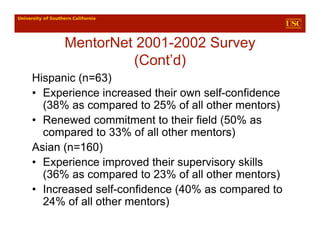
Hispanic (n=63)
• Experience increased their own self-confidence
  (38% as compared to 25% of all other mentors)
• Renewed commitment to their field (50% as
  compared to 33% of all other mentors)
Asian (n=160)
• Experience improved their supervisory skills
  (36% as compared to 23% of all other mentors)
• Increased self-confidence (40% as compared to
  24% of all other mentors)
MentorNet (Cont’d)
• Participating Colleges and universities
http://www.mentorNet.net/Documents/Partners/Campuses/
   CurrentCampuses.aspx

• Corporations and Corporate Foundations
http://www.mentorNet.net/Partners/Corporations/

• Government Agencies and National Labs
http://www.mentorNet.net/Partners/Government/
MentorNet (Cont’d)
Program Evaluation and Research
http://www.mentorNet.net/Documents/About/result
  s/evaluation/

Research and Publications
http://www.mentorNet.net/Documents/About/Media
  /papers.aspx
Bibliography
Althaus, S. L. (1997). “Computer-mediated communication
   in the university classroom: An experiment with on-line
   discussions,” Communication Education, 46, 158-174.
Bennett, D. T. (1997, March). “Telementoring young
   women in science, engineering, and computing,” pp.
   271-276 in S. S. Metz (Ed.) Proceedings of the Women
   in Engineering Conference: Capitalizing on Today's
   Challenges. Hoboken, NJ: Stevens Institute of
   Technology.
Clutterbuck, D. (2001). Everyone Needs a Mentor.
   Chartered Institute of Personnel and development.
Bibliography (Cont’d)
Faison, J.J. (1995). The Next generation: African-
  American Graduate Students in Predominently White
  University Campuses. Atlanta, GA: Emory University

Guernsey, L. (1997, Oct. 17). “E-mail is now used in a third
  of college courses, survey finds,” The Chronicle of
  Higher Education, 44, p. A30.

Steinberg, E. R. (1992). “The potential of computer-based
  telecommunications for instruction.” Journal of
  Computer-Based Instruction, 19, 42-46.
Bibliography (Cont’d)
Windschitl, M. and Lesehm-Ackerman, A. (1997).
  “Learning teams, students, and the college email
  culture,” Journal of the Freshman Year Experience &
  Students in Transition, 9, 53-82.
Zachary, L. (2000). The Mentor’s Guide. San Francisco:
  Jossey-Bass.

Usc e mentoringsep04

  • 1.
    E-Mentoring (Telementoring, Cybermentoring, Virtual Mentoring) DANIELLE MIHRAM, DIRECTOR CENTER FOR EXCELLENCE IN TEACHING OFFICE OF THE PROVOST UNIVERSITY OF SOUTHERN CALIFORNIA
  • 2.
    What is E-mentoring? •The merger of mentoring with electronic communications to develop and sustain mentoring relationships linking a senior individual (mentor) and and a lesser skilled or experienced individual (protégé) independent of geography or scheduling constraints. • Intellectual partnerships: In the field of education, E- Mentoring often involves linking students up with knowledgeable experts who have an interest in developing the skills, knowledge, confidence and culturing understanding of the protégé to help him or her succeed • E-mentoring is a relatively young area of research (Bennett, 1997)
  • 3.
    E-mentoring as apreferred communication medium – Made possible by the increased availability of electronic communications on college campuses (Guernsey, 1997, Oct. 17), in the workplace, in homes, schools, and libraries – Provides a flexible communication environment independent of time and space; allows for asynchronous exchanges (ideal medium for mentoring) (Steinberg, 1992) – Unique qualities of electronic communications (attenuation of status differences and ease of thoughtful responses) make it especially promising as a medium for developing mentoring relationships.
  • 4.
    A Medium forOpen and Supportive Relationships – In a networked academic environment students have more interactions with faculty (Hartman et al. 1991) and with each other (Althaus, 1997) – Students who participate in online group discussions report greater cohesiveness within a learning group (Windschitl & Lesehm- Ackerman, 1997), learn more, and achieve higher grades than students taking part in face-to-face discussion groups (Althaus, 1997)
  • 5.
    Potential Drawbacks • Deceptivelysimple in concept and unexpectedly difficult to do well for an extended amount of time • Requires careful, realistic thinking and planning: needs to be carefully planned, well staffed, and sufficiently funded (planning, prompting, supporting, consulting, suggesting, formative evaluations, troubleshooting) See below: MentorNet Program, International Telementor Program,
  • 6.
    Why E-mentoring? • Ifit is an essential part of the institutional mission it brings together mentors and protégés for positive relationships • It supports academic and curricular goals • It is most successful if it is used to leverage an existing program by supporting the program’s objectives and learning outcomes. • It is not synonymous with “tutoring”: the primary goals of these programs are different (for tutoring the primary goal is to boost grades and standardized test scores) • It is not a “pen-pal” relationship.
  • 7.
    Characteristics of aStructured E-mentoring Program • Viewed as an ongoing (powerful) learning process which assures the intergenerational transfer of knowledge and “know-how” throughout a lifetime (Zachary, 2000; Clutterbuck, 2001) • Includes learning objectives, measures, as well as administrative and technological support – Training of mentors and protégés, facilitation or “coaching” of the relationships
  • 8.
    Characteristics of aStructured E-mentoring Program (Cont’d) • Occurs within a formalized program environment • Provides training, coaching, and structure to increase the likelihood of engagement in the E- mentoring process • Includes regular (annual) program assessment
  • 9.
    Benefits from E-mentoring 1.An excellent enhancement to offline (face-to- face) programs: it connects people and ideas 2. It is not necessarily better than face-to-face programs: Brings mentors and protégés together for long, in-depth, productive, and mutually benefiting interactions when the same could not happen for logistical reasons 3. Can enhance values related to field of enquiry or to program of study 4. An excellent way to enhance students’ writing, reading, and online researching skills
  • 10.
    Benefits from E-mentoring(Cont’d) 5. A “safe” learning environment: Many online mentoring programs report that students will discuss subjects online that they are not always comfortable talking about face-to-face 6. Addresses the needs of the affective domain (Emotional intelligence) through multi-media and networking http://www.eiconsortium.org/about_us.htm and http://www.eiconsortium.org/members/kram.htm
  • 11.
    Benefits from E-mentoring(Cont’d) 7. Minimizes the scheduling and geographic concerns associated with face-to-face mentoring programs: mentor and protégé can benefit from asynchronous communication while still maintaining a focus on the dialogue 8. For women of color, it is the only significant predictor of success (Faison, 1995) 9. Helps expose students to the opportunities in their fields, offers guidance and advice based on experience, and provides support, encouragement, and access to professional networks for further career development
  • 12.
    Examples • International TelementorProgram http://www.telementor.org/ • MentorNet http://www.mentorNet.net/
  • 13.
    International Telementor Program(ITP) http://www.telementor.org/ • Facilitates electronic mentoring relationships between professional adults and students worldwide • Since 1995 over 15,000 students throughout nine countries have received support, encouragement, and professional guidance. ITP serves students in K-12 and home school environments as well as college and university settings.
  • 14.
    International Telementor Program (Cont’d) A study of teacher survey data from September, 1999 to March, 2002 indicates E-mentoring is making a measurable difference for students. A high percentage of teachers witnessed significant improvement in • Writing skills (95%), • Self-directed learning (88%), • Critical thinking skills (75%), • Career and workplace knowledge (57%), • Desire to go to college (46%), • Subject grades (45%), and • Science comprehension and ability (44%).
  • 15.
    International Telementor Program (Cont’d) A primary goal of the ITP program is to help students adopt a proactive learning position and begin creating their own independent learning plans by taking more responsibility in their learning (“Intentional Learning”). – The findings report that 81% of the teachers witnessed improvement in this area.
  • 16.
    International Telementor Program Technological Challenges • Many teachers indicated many problems with computer equipment in the school site. • Teachers reported that the technology was unreliable and out-of-date.
  • 17.
    MentorNet http://www.mentorNet.net Founded in 1997:is a nonprofit E-mentoring network that addresses the retention and success of women in engineering, science and mathematics. Large scope of the program -- In 2002-2003: 2,800 undergraduate and graduate women studying engineering and related sciences at more than 80 colleges and universities across the U.S. and in several other nations, were matched in structured, one-on-one, email-based relationships with male and female scientific and technical professionals working in industry
  • 18.
    MentorNet (Cont’d) Mission • Tofurther women’s progress in scientific and technical fields through a dynamic, technology-supported mentoring program, and, • To advance women in society in developing a diversified, expanded, and talented workforce
  • 19.
    MentorNet (Cont’d) Vision isThreefold: • To establish excellence in large-scale E- mentoring • To create the community of choice for women in engineering and science through online mentoring and networking; and, • To leverage that community for positive social change
  • 20.
    MentorNet 2001-2002 Survey 2973students - 1101 responded 2749 mentors - 1424 responded Response rate: 37% and 52% respectively
  • 21.
    MentorNet 2001-2002 Survey (Cont’d) Student Outcomes (5 general categories): 1. Ongoing encouragement, reassurance, and moral support - boosting confidence 2. Career information, alternatives and inspiration; learning about mentor’s workplace 3. Academic Advice and support; relating academic work to the workplace 4. Advice for women; female role models in engineering and science 5. Options for balancing family and work
  • 22.
    MentorNet 2001-2002 Survey (Cont’d) Mentor Outcomes 1. Personal satisfaction of helping another person (74%) 2. Appreciated the opportunity to pass along what they have learned to the next generation (81%)
  • 23.
    MentorNet 2001-2002 Survey (Cont’d) Mentors’ ratings of their own outcomes varied by racial/ethnic groups: African American (n=64) • Experience as mentors improved their skills for recruiting new talent (40% as compared to 22% of all other mentors) • Renewed commitment to their field (48% as compared to 33% of all other mentors)
  • 24.
    MentorNet 2001-2002 Survey (Cont’d) Hispanic (n=63) • Experience increased their own self-confidence (38% as compared to 25% of all other mentors) • Renewed commitment to their field (50% as compared to 33% of all other mentors) Asian (n=160) • Experience improved their supervisory skills (36% as compared to 23% of all other mentors) • Increased self-confidence (40% as compared to 24% of all other mentors)
  • 25.
    MentorNet (Cont’d) • ParticipatingColleges and universities http://www.mentorNet.net/Documents/Partners/Campuses/ CurrentCampuses.aspx • Corporations and Corporate Foundations http://www.mentorNet.net/Partners/Corporations/ • Government Agencies and National Labs http://www.mentorNet.net/Partners/Government/
  • 26.
    MentorNet (Cont’d) Program Evaluationand Research http://www.mentorNet.net/Documents/About/result s/evaluation/ Research and Publications http://www.mentorNet.net/Documents/About/Media /papers.aspx
  • 27.
    Bibliography Althaus, S. L.(1997). “Computer-mediated communication in the university classroom: An experiment with on-line discussions,” Communication Education, 46, 158-174. Bennett, D. T. (1997, March). “Telementoring young women in science, engineering, and computing,” pp. 271-276 in S. S. Metz (Ed.) Proceedings of the Women in Engineering Conference: Capitalizing on Today's Challenges. Hoboken, NJ: Stevens Institute of Technology. Clutterbuck, D. (2001). Everyone Needs a Mentor. Chartered Institute of Personnel and development.
  • 28.
    Bibliography (Cont’d) Faison, J.J.(1995). The Next generation: African- American Graduate Students in Predominently White University Campuses. Atlanta, GA: Emory University Guernsey, L. (1997, Oct. 17). “E-mail is now used in a third of college courses, survey finds,” The Chronicle of Higher Education, 44, p. A30. Steinberg, E. R. (1992). “The potential of computer-based telecommunications for instruction.” Journal of Computer-Based Instruction, 19, 42-46.
  • 29.
    Bibliography (Cont’d) Windschitl, M.and Lesehm-Ackerman, A. (1997). “Learning teams, students, and the college email culture,” Journal of the Freshman Year Experience & Students in Transition, 9, 53-82. Zachary, L. (2000). The Mentor’s Guide. San Francisco: Jossey-Bass.