Urbanization
Cause and effects
Made BY: Muhammad Furqan Rafique
Batch: 2015-2019
Pakistan Institute of Engineering and Applied Sciences( PIEAS )
Urbanization
 Urbanization refers to a process in which an increasing proportion of a society live in cities and
the district of cities. Historically, it has been closely connected with industrialization.
Industrialization is a process that extensively uses lifeless sources of energy to enhance human
productivity.
 Following industrialization, overabundance increased in both agriculture and industry. Larger and
larger proportions of a population could live in cities. Economic forces were such that cities
became the ideal places to locate factories and their workers.
City or Urban Settlement
 A "city" refers to a place of relatively dense settlement -- dense enough so that city residents can
not grow their own food resources. A city population, therefore, is always dependent upon its
"hinterlands" to provide it with food resources.
Causes of Urbanization
 Industrial Revolution
 Emergence of large manufacturing
 centers
 Job Opportunities
 Availability of easy transportation
 Migration
Effects of Urbanization
 Positive
 Negative
Positive ones…
 Benefits include reduced transport costs, exchange of ideas, and sharing of natural resources.
 Cities act as beacons for the rural population because they represent a higher standard of living
 Cities offer opportunities to people not available in the countryside
 Social & Religious taboos/ sanctions disappearing
 Education is a tool to eradicate social evils
 Industrialization, Urbanization, Education, Legislation, Secularization-sequence of development
 Diffusion of urban culture to rural areas
Negative ones…
 Industrial cities were difficult places to live in due to:
 Public health issues resulting from contaminated water and air and the spread communicable
diseases due to overcrowding.
 Unemployment and under employment
 Severe shortage of housing
 Transportation-commuting issues, lack of public transport, no adequate investment
 Social effects - poverty, lack of opportunities, psychological problems, alcoholism, drugs, crime,
violence and other deviant behaviors
Public health
 Sanitation - the settlements were ill equipped to handle large populations and their sanitation
needs
 Pollution – Caused by effluents, smoke and smog
 Fire hazards – due to use of flammable materials and proximity/ congestion
 Epidemics - due to spread of communicable diseases caused by contaminated water & air
Unemployment
 Unemployment is the condition of willing workers lacking jobs or "gainful employment". Before
industrialization unemployment has been said not to have been recognized as an issue in rural
areas, despite the "disguised unemployment" of rural laborers having little to do, especially in
conditions of overpopulation
Impact of unemployment on
society
 Individual – failure to meet financial obligations such as purchasing food to feed oneself and
one's family, and paying one's bills, failure to make mortgage payments or to pay rent may lead
to homelessness.
 Societal - rising unemployment increases the crime rate
Transportation
 Transport or transportation is the movement of people and goods from one place to another.
 Because of the much higher densities of people and activities in cities, transportation is a key
issue.
 Inadequate/ lack of public transport creates commuting problems leading to loss of efficiency.
Crime
 Financial insecurity
 No welfare systems in place
 Lack of meaningful work (Low importance to meaningful work and high importance to higher
profits and greater efficiency)
 Anonymity -direct correlation between higher crime rate and higher rootlessness
CASE STUDY
(Pakistan)
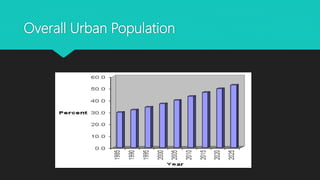
Overall Urban Population
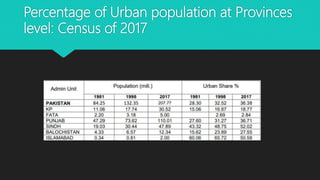
Percentage of Urban population at Provinces
level: Census of 2017
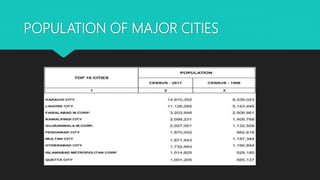
POPULATION OF MAJOR CITIES
Major Causes of Urbanization
 Natural increase in population
- High Birth rate
 Migration toward urban centers
- Livelihoods and better basic services.
- escape from war
- Insecurity
- Natural disasters
Economic Opportunities
 Urbanization come up with a number of economic opportunities. Urban centers motivated the
mass movement of people away from the countryside in search of livelihoods and jobs. Small
and medium-sized enterprises (SMEs), which generate 85% of the country’s non-agricultural jobs,
are urban based in Pakistan.
Educational opportunities
 Urbanization brings a lot of educational opportunities. Lahore and Islamabad is the crown jewels
of Pakistan’s educational system. It has a number of urban institution like Pakistan Institute
of engineering and applied sciences (PIEAS) etc.
Modernization
 Pakistani urban centers enjoy considerable interconnectivity. There are hubs of innovation,
technology and communication in urban centers, in Pakistan.
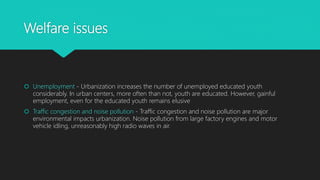
Welfare issues
 Unemployment - Urbanization increases the number of unemployed educated youth
considerably. In urban centers, more often than not, youth are educated. However, gainful
employment, even for the educated youth remains elusive
 Traffic congestion and noise pollution - Traffic congestion and noise pollution are major
environmental impacts urbanization. Noise pollution from large factory engines and motor
vehicle idling, unreasonably high radio waves in air.
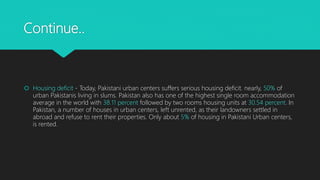
Continue..
 Housing deficit - Today, Pakistani urban centers suffers serious housing deficit. nearly, 50% of
urban Pakistanis living in slums. Pakistan also has one of the highest single room accommodation
average in the world with 38.11 percent followed by two rooms housing units at 30.54 percent. In
Pakistan, a number of houses in urban centers, left unrented, as their landowners settled in
abroad and refuse to rent their properties. Only about 5% of housing in Pakistani Urban centers,
is rented.
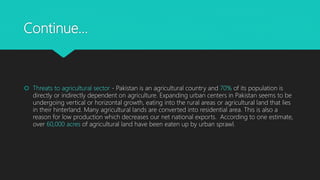
Continue…
 Threats to agricultural sector - Pakistan is an agricultural country and 70% of its population is
directly or indirectly dependent on agriculture. Expanding urban centers in Pakistan seems to be
undergoing vertical or horizontal growth, eating into the rural areas or agricultural land that lies
in their hinterland. Many agricultural lands are converted into residential area. This is also a
reason for low production which decreases our net national exports. According to one estimate,
over 60,000 acres of agricultural land have been eaten up by urban sprawl.
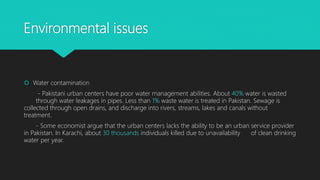
Environmental issues
 Water contamination
- Pakistani urban centers have poor water management abilities. About 40% water is wasted
through water leakages in pipes. Less than 1% waste water is treated in Pakistan. Sewage is
collected through open drains, and discharge into rivers, streams, lakes and canals without
treatment.
- Some economist argue that the urban centers lacks the ability to be an urban service provider
in Pakistan. In Karachi, about 30 thousands individuals killed due to unavailability of clean drinking
water per year.
Continue…
 Solid waste generation - Poorly developed urban centers in Pakistan, experiencing poor sanitary
conditions. In urban centers, in Pakistan; less than 50% of solid waste is collected by government
while the rest is left to root on the streets. There are heaps of garbage, in poorly developed
urban centers in Pakistan increases the disease prevalence rate
Continue…
 Industrial Pollution - In urban centers, open burning of waste causes air pollution problems. In
addition to this, untreated air from industrial sector directly release into the air, causes respiratory
illness in urban settlers. Factories emit untreated effluents into freshwater bodies causes water
pollution problem.
Spread of Diseases
 Urban centers make it easier for the diseases to be transmitted in the poorly developed urban
centers in Pakistan.
 Unhealthy environments & overcrowded housing exposes the ‘urban poor’ to high rates of
infectious diseases e.g. pneumonia, T.B, diarrhea, Cholera.
Continue….
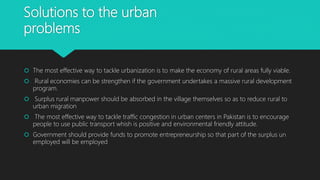
Solutions to the urban
problems
 The most effective way to tackle urbanization is to make the economy of rural areas fully viable.
 Rural economies can be strengthen if the government undertakes a massive rural development
program.
 Surplus rural manpower should be absorbed in the village themselves so as to reduce rural to
urban migration
 The most effective way to tackle traffic congestion in urban centers in Pakistan is to encourage
people to use public transport whish is positive and environmental friendly attitude.
 Government should provide funds to promote entrepreneurship so that part of the surplus un
employed will be employed
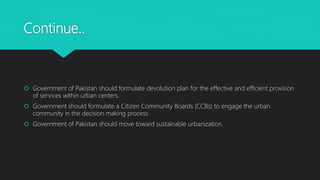
Continue..
 Government of Pakistan should formulate devolution plan for the effective and efficient provision
of services within urban centers.
 Government should formulate a Citizen Community Boards (CCBs) to engage the urban
community in the decision making process.
 Government of Pakistan should move toward sustainable urbanization.
THANK
YOU

Urbanization in PAKISTAN

  • 1.
    Urbanization Cause and effects MadeBY: Muhammad Furqan Rafique Batch: 2015-2019 Pakistan Institute of Engineering and Applied Sciences( PIEAS )
  • 2.
    Urbanization  Urbanization refersto a process in which an increasing proportion of a society live in cities and the district of cities. Historically, it has been closely connected with industrialization. Industrialization is a process that extensively uses lifeless sources of energy to enhance human productivity.  Following industrialization, overabundance increased in both agriculture and industry. Larger and larger proportions of a population could live in cities. Economic forces were such that cities became the ideal places to locate factories and their workers.
  • 3.
    City or UrbanSettlement  A "city" refers to a place of relatively dense settlement -- dense enough so that city residents can not grow their own food resources. A city population, therefore, is always dependent upon its "hinterlands" to provide it with food resources.
  • 4.
    Causes of Urbanization Industrial Revolution  Emergence of large manufacturing  centers  Job Opportunities  Availability of easy transportation  Migration
  • 5.
    Effects of Urbanization Positive  Negative
  • 6.
    Positive ones…  Benefitsinclude reduced transport costs, exchange of ideas, and sharing of natural resources.  Cities act as beacons for the rural population because they represent a higher standard of living  Cities offer opportunities to people not available in the countryside  Social & Religious taboos/ sanctions disappearing  Education is a tool to eradicate social evils  Industrialization, Urbanization, Education, Legislation, Secularization-sequence of development  Diffusion of urban culture to rural areas
  • 7.
    Negative ones…  Industrialcities were difficult places to live in due to:  Public health issues resulting from contaminated water and air and the spread communicable diseases due to overcrowding.  Unemployment and under employment  Severe shortage of housing  Transportation-commuting issues, lack of public transport, no adequate investment  Social effects - poverty, lack of opportunities, psychological problems, alcoholism, drugs, crime, violence and other deviant behaviors
  • 8.
    Public health  Sanitation- the settlements were ill equipped to handle large populations and their sanitation needs  Pollution – Caused by effluents, smoke and smog  Fire hazards – due to use of flammable materials and proximity/ congestion  Epidemics - due to spread of communicable diseases caused by contaminated water & air
  • 9.
    Unemployment  Unemployment isthe condition of willing workers lacking jobs or "gainful employment". Before industrialization unemployment has been said not to have been recognized as an issue in rural areas, despite the "disguised unemployment" of rural laborers having little to do, especially in conditions of overpopulation
  • 10.
    Impact of unemploymenton society  Individual – failure to meet financial obligations such as purchasing food to feed oneself and one's family, and paying one's bills, failure to make mortgage payments or to pay rent may lead to homelessness.  Societal - rising unemployment increases the crime rate
  • 11.
    Transportation  Transport ortransportation is the movement of people and goods from one place to another.  Because of the much higher densities of people and activities in cities, transportation is a key issue.  Inadequate/ lack of public transport creates commuting problems leading to loss of efficiency.
  • 12.
    Crime  Financial insecurity No welfare systems in place  Lack of meaningful work (Low importance to meaningful work and high importance to higher profits and greater efficiency)  Anonymity -direct correlation between higher crime rate and higher rootlessness
  • 13.
  • 14.
  • 15.
    Percentage of Urbanpopulation at Provinces level: Census of 2017
  • 16.
  • 17.
    Major Causes ofUrbanization  Natural increase in population - High Birth rate  Migration toward urban centers - Livelihoods and better basic services. - escape from war - Insecurity - Natural disasters
  • 18.
    Economic Opportunities  Urbanizationcome up with a number of economic opportunities. Urban centers motivated the mass movement of people away from the countryside in search of livelihoods and jobs. Small and medium-sized enterprises (SMEs), which generate 85% of the country’s non-agricultural jobs, are urban based in Pakistan.
  • 19.
    Educational opportunities  Urbanizationbrings a lot of educational opportunities. Lahore and Islamabad is the crown jewels of Pakistan’s educational system. It has a number of urban institution like Pakistan Institute of engineering and applied sciences (PIEAS) etc.
  • 20.
    Modernization  Pakistani urbancenters enjoy considerable interconnectivity. There are hubs of innovation, technology and communication in urban centers, in Pakistan.
  • 21.
    Welfare issues  Unemployment- Urbanization increases the number of unemployed educated youth considerably. In urban centers, more often than not, youth are educated. However, gainful employment, even for the educated youth remains elusive  Traffic congestion and noise pollution - Traffic congestion and noise pollution are major environmental impacts urbanization. Noise pollution from large factory engines and motor vehicle idling, unreasonably high radio waves in air.
  • 22.
    Continue..  Housing deficit- Today, Pakistani urban centers suffers serious housing deficit. nearly, 50% of urban Pakistanis living in slums. Pakistan also has one of the highest single room accommodation average in the world with 38.11 percent followed by two rooms housing units at 30.54 percent. In Pakistan, a number of houses in urban centers, left unrented, as their landowners settled in abroad and refuse to rent their properties. Only about 5% of housing in Pakistani Urban centers, is rented.
  • 23.
    Continue…  Threats toagricultural sector - Pakistan is an agricultural country and 70% of its population is directly or indirectly dependent on agriculture. Expanding urban centers in Pakistan seems to be undergoing vertical or horizontal growth, eating into the rural areas or agricultural land that lies in their hinterland. Many agricultural lands are converted into residential area. This is also a reason for low production which decreases our net national exports. According to one estimate, over 60,000 acres of agricultural land have been eaten up by urban sprawl.
  • 24.
    Environmental issues  Watercontamination - Pakistani urban centers have poor water management abilities. About 40% water is wasted through water leakages in pipes. Less than 1% waste water is treated in Pakistan. Sewage is collected through open drains, and discharge into rivers, streams, lakes and canals without treatment. - Some economist argue that the urban centers lacks the ability to be an urban service provider in Pakistan. In Karachi, about 30 thousands individuals killed due to unavailability of clean drinking water per year.
  • 25.
    Continue…  Solid wastegeneration - Poorly developed urban centers in Pakistan, experiencing poor sanitary conditions. In urban centers, in Pakistan; less than 50% of solid waste is collected by government while the rest is left to root on the streets. There are heaps of garbage, in poorly developed urban centers in Pakistan increases the disease prevalence rate
  • 26.
    Continue…  Industrial Pollution- In urban centers, open burning of waste causes air pollution problems. In addition to this, untreated air from industrial sector directly release into the air, causes respiratory illness in urban settlers. Factories emit untreated effluents into freshwater bodies causes water pollution problem.
  • 27.
    Spread of Diseases Urban centers make it easier for the diseases to be transmitted in the poorly developed urban centers in Pakistan.  Unhealthy environments & overcrowded housing exposes the ‘urban poor’ to high rates of infectious diseases e.g. pneumonia, T.B, diarrhea, Cholera.
  • 28.
  • 29.
    Solutions to theurban problems  The most effective way to tackle urbanization is to make the economy of rural areas fully viable.  Rural economies can be strengthen if the government undertakes a massive rural development program.  Surplus rural manpower should be absorbed in the village themselves so as to reduce rural to urban migration  The most effective way to tackle traffic congestion in urban centers in Pakistan is to encourage people to use public transport whish is positive and environmental friendly attitude.  Government should provide funds to promote entrepreneurship so that part of the surplus un employed will be employed
  • 30.
    Continue..  Government ofPakistan should formulate devolution plan for the effective and efficient provision of services within urban centers.  Government should formulate a Citizen Community Boards (CCBs) to engage the urban community in the decision making process.  Government of Pakistan should move toward sustainable urbanization.
  • 31.