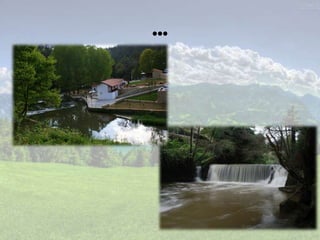
Urban Parks and
Gardens
Botanical Gardens
A botanical garden is usually an area inserted in the urban space, devoted to
the cultivation, preservation and dissemination of vegetation (native and
exotic).
In these spaces, the many species and varieties of wild plants and horticultural
cultivated are properly identified and cataloged.
Botanical Garden of Porto
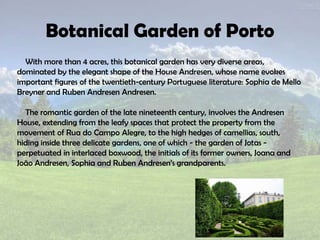
With more than 4 acres, this botanical garden has very diverse areas,
dominated by the elegant shape of the House Andresen, whose name evokes
important figures of the twentieth-century Portuguese literature: Sophia de Mello
Breyner and Ruben Andresen Andresen.
The romantic garden of the late nineteenth century, involves the Andresen
House, extending from the leafy spaces that protect the property from the
movement of Rua do Campo Alegre, to the high hedges of camellias, south,
hiding inside three delicate gardens, one of which - the garden of Jotas -
perpetuated in interlaced boxwood, the initials of its former owners, Joana and
João Andresen, Sophia and Ruben Andresen’s grandparents.
…
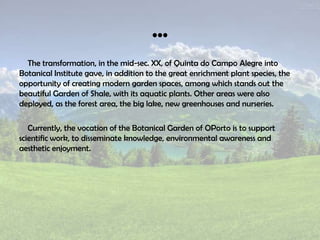
The transformation, in the mid-sec. XX, of Quinta do Campo Alegre into
Botanical Institute gave, in addition to the great enrichment plant species, the
opportunity of creating modern garden spaces, among which stands out the
beautiful Garden of Shale, with its aquatic plants. Other areas were also
deployed, as the forest area, the big lake, new greenhouses and nurseries.
Currently, the vocation of the Botanical Garden of OPorto is to support
scientific work, to disseminate knowledge, environmental awareness and
aesthetic enjoyment.
Urban Parks
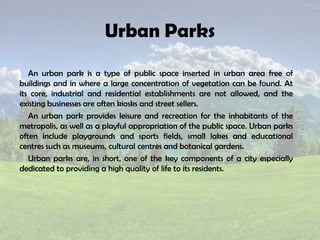
An urban park is a type of public space inserted in urban area free of
buildings and in where a large concentration of vegetation can be found. At
its core, industrial and residential establishments are not allowed, and the
existing businesses are often kiosks and street sellers.
An urban park provides leisure and recreation for the inhabitants of the
metropolis, as well as a playful appropriation of the public space. Urban parks
often include playgrounds and sports fields, small lakes and educational
centres such as museums, cultural centres and botanical gardens.
Urban parks are, in short, one of the key components of a city especially
dedicated to providing a high quality of life to its residents.
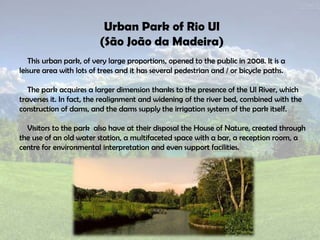
This urban park, of very large proportions, opened to the public in 2008. It is a
leisure area with lots of trees and it has several pedestrian and / or bicycle paths.
The park acquires a larger dimension thanks to the presence of the Ul River, which
traverses it. In fact, the realignment and widening of the river bed, combined with the
construction of dams, and the dams supply the irrigation system of the park itself.
Visitors to the park also have at their disposal the House of Nature, created through
the use of an old water station, a multifaceted space with a bar, a reception room, a
centre for environmental interpretation and even support facilities.
Urban Park of Rio Ul
(São João da Madeira)
Nª Sra. dos Milagres Park
(São João da Madeira)
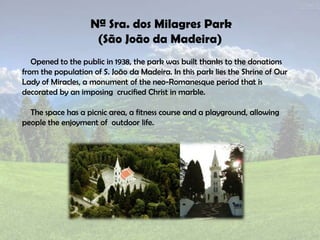
Opened to the public in 1938, the park was built thanks to the donations
from the population of S. João da Madeira. In this park lies the Shrine of Our
Lady of Miracles, a monument of the neo-Romanesque period that is
decorated by an imposing crucified Christ in marble.
The space has a picnic area, a fitness course and a playground, allowing
people the enjoyment of outdoor life.
Ferreira de Castro Park
(Oliveira de Azeméis)
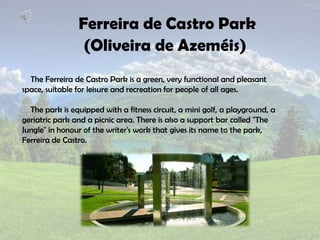
The Ferreira de Castro Park is a green, very functional and pleasant
space, suitable for leisure and recreation for people of all ages.
The park is equipped with a fitness circuit, a mini golf, a playground, a
geriatric park and a picnic area. There is also a support bar called "The
Jungle" in honour of the writer's work that gives its name to the park,
Ferreira de Castro.
La Salette Park
(Oliveira de Azeméis)
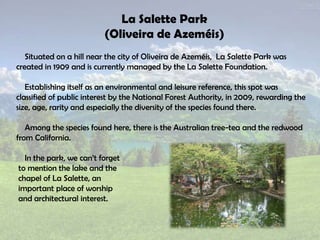
Situated on a hill near the city of Oliveira de Azeméis, La Salette Park was
created in 1909 and is currently managed by the La Salette Foundation.
Establishing itself as an environmental and leisure reference, this spot was
classified of public interest by the National Forest Authority, in 2009, rewarding the
size, age, rarity and especially the diversity of the species found there.
Among the species found here, there is the Australian tree-tea and the redwood
from California.
In the park, we can’t forget
to mention the lake and the
chapel of La Salette, an
important place of worship
and architectural interest.
Theme Parks
These are spaces intended for families and they are not inserted into the urban
area. In these places people seek to explore emotions and experiences related to
particular social, cultural, anthropological
aspects, fun, adventure, walking, water, etc..
Ul Watermill Park
(Oliveira de Azeméis)
The Watermill Theme Park is a space that takes advantage of the existing
watermills in this region for over two centuries.
The abundant water of the rivers was omnipresent in the economic life of
Oliveira de Azeméis. With it the fields were watered and thanks to its strength,
numerous mills milled flour which, on the other hand, “fed” another
complementary activity - the making of the famous Ul bread.
Later on, taking advantage of the existing watermills another activity was
born- shelling rice.
Nowadays, throughout the county, the grinding sector, although it has not
the strength of old times, continues to hold great vitality. The bread of Ul
continues to fill people’s mouth with flavour. As for the rice husking, here are
implanted the major national industries in its gender.
The planning and management of the Windmill Theme Park, which includes
the Museum Centre of the Mill and Bread, belong to the municipality.
…
The end
Work made by:
Maria Soares
Débora Cabral
Joana Freitas
From Portugal

Urban parks and gardens

  • 1.
  • 2.
    Botanical Gardens A botanicalgarden is usually an area inserted in the urban space, devoted to the cultivation, preservation and dissemination of vegetation (native and exotic). In these spaces, the many species and varieties of wild plants and horticultural cultivated are properly identified and cataloged.
  • 3.
    Botanical Garden ofPorto With more than 4 acres, this botanical garden has very diverse areas, dominated by the elegant shape of the House Andresen, whose name evokes important figures of the twentieth-century Portuguese literature: Sophia de Mello Breyner and Ruben Andresen Andresen. The romantic garden of the late nineteenth century, involves the Andresen House, extending from the leafy spaces that protect the property from the movement of Rua do Campo Alegre, to the high hedges of camellias, south, hiding inside three delicate gardens, one of which - the garden of Jotas - perpetuated in interlaced boxwood, the initials of its former owners, Joana and João Andresen, Sophia and Ruben Andresen’s grandparents.
  • 4.
    … The transformation, inthe mid-sec. XX, of Quinta do Campo Alegre into Botanical Institute gave, in addition to the great enrichment plant species, the opportunity of creating modern garden spaces, among which stands out the beautiful Garden of Shale, with its aquatic plants. Other areas were also deployed, as the forest area, the big lake, new greenhouses and nurseries. Currently, the vocation of the Botanical Garden of OPorto is to support scientific work, to disseminate knowledge, environmental awareness and aesthetic enjoyment.
  • 5.
    Urban Parks An urbanpark is a type of public space inserted in urban area free of buildings and in where a large concentration of vegetation can be found. At its core, industrial and residential establishments are not allowed, and the existing businesses are often kiosks and street sellers. An urban park provides leisure and recreation for the inhabitants of the metropolis, as well as a playful appropriation of the public space. Urban parks often include playgrounds and sports fields, small lakes and educational centres such as museums, cultural centres and botanical gardens. Urban parks are, in short, one of the key components of a city especially dedicated to providing a high quality of life to its residents.
  • 6.
    This urban park,of very large proportions, opened to the public in 2008. It is a leisure area with lots of trees and it has several pedestrian and / or bicycle paths. The park acquires a larger dimension thanks to the presence of the Ul River, which traverses it. In fact, the realignment and widening of the river bed, combined with the construction of dams, and the dams supply the irrigation system of the park itself. Visitors to the park also have at their disposal the House of Nature, created through the use of an old water station, a multifaceted space with a bar, a reception room, a centre for environmental interpretation and even support facilities. Urban Park of Rio Ul (São João da Madeira)
  • 7.
    Nª Sra. dosMilagres Park (São João da Madeira) Opened to the public in 1938, the park was built thanks to the donations from the population of S. João da Madeira. In this park lies the Shrine of Our Lady of Miracles, a monument of the neo-Romanesque period that is decorated by an imposing crucified Christ in marble. The space has a picnic area, a fitness course and a playground, allowing people the enjoyment of outdoor life.
  • 8.
    Ferreira de CastroPark (Oliveira de Azeméis) The Ferreira de Castro Park is a green, very functional and pleasant space, suitable for leisure and recreation for people of all ages. The park is equipped with a fitness circuit, a mini golf, a playground, a geriatric park and a picnic area. There is also a support bar called "The Jungle" in honour of the writer's work that gives its name to the park, Ferreira de Castro.
  • 9.
    La Salette Park (Oliveirade Azeméis) Situated on a hill near the city of Oliveira de Azeméis, La Salette Park was created in 1909 and is currently managed by the La Salette Foundation. Establishing itself as an environmental and leisure reference, this spot was classified of public interest by the National Forest Authority, in 2009, rewarding the size, age, rarity and especially the diversity of the species found there. Among the species found here, there is the Australian tree-tea and the redwood from California. In the park, we can’t forget to mention the lake and the chapel of La Salette, an important place of worship and architectural interest.
  • 10.
    Theme Parks These arespaces intended for families and they are not inserted into the urban area. In these places people seek to explore emotions and experiences related to particular social, cultural, anthropological aspects, fun, adventure, walking, water, etc..
  • 11.
    Ul Watermill Park (Oliveirade Azeméis) The Watermill Theme Park is a space that takes advantage of the existing watermills in this region for over two centuries. The abundant water of the rivers was omnipresent in the economic life of Oliveira de Azeméis. With it the fields were watered and thanks to its strength, numerous mills milled flour which, on the other hand, “fed” another complementary activity - the making of the famous Ul bread. Later on, taking advantage of the existing watermills another activity was born- shelling rice. Nowadays, throughout the county, the grinding sector, although it has not the strength of old times, continues to hold great vitality. The bread of Ul continues to fill people’s mouth with flavour. As for the rice husking, here are implanted the major national industries in its gender. The planning and management of the Windmill Theme Park, which includes the Museum Centre of the Mill and Bread, belong to the municipality.
  • 12.
  • 13.
    The end Work madeby: Maria Soares Débora Cabral Joana Freitas From Portugal