History
    Urban Outfitters is an apparel company that was incorporated in 1976.
    The company originated as “The Free People’s Store” in Philadelphia in
     1970, with a concentration on “funky” household items and clothing.
    The founders were two Philadelphians, Scott Hayne and Scott Belair.
Mission
    Urban’s mission statement: “Lifestyle merchandising is our business and
     our passion. The goal for our brands is to build a strong emotional bond
     with the customer. To do this we must build lifestyle environments that
     appeal emotionally, and offer fashion correct products on a timely basis.
     Our customers are the reason and the inspiration for everything we do.”
Ownership
    Urban Outfitters is a publicly traded company, owned and chaired by
     Robert Hayne. He holds the greatest amount of shares in the company, at
     27.85 million shares. The company is also held by several large investors,
     such as Fidelity Management & Research Company, Maverick Capital Ltd,
     Vanguard Group, and Capital Guardian Trust Company.
Philosophy
    Urban Outfitter’s philosophy is: “Our established ability to understand our
     customers and connect with them on an emotional level is the reason for our
     success. The reason for this success is that our brands … are both compelling
     and distinct… Our goal is to offer a product assortment and an environment
     so compelling and distinctive that the customer feels an empathetic
     connection to the brand and is persuaded to buy.”
Products & Services
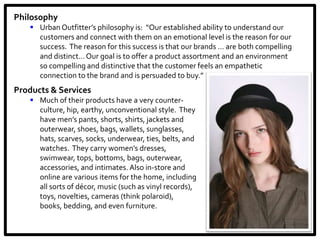
    Much of their products have a very counter-
     culture, hip, earthy, unconventional style. They
     have men’s pants, shorts, shirts, jackets and
     outerwear, shoes, bags, wallets, sunglasses,
     hats, scarves, socks, underwear, ties, belts, and
     watches. They carry women’s dresses,
     swimwear, tops, bottoms, bags, outerwear,
     accessories, and intimates. Also in-store and
     online are various items for the home, including
     all sorts of décor, music (such as vinyl records),
     toys, novelties, cameras (think polaroid),
     books, bedding, and even furniture.
Scope of Operations
    20% annual growth rate goal
    Stores average around 9,500 sq. feet, and carry 35,000 – 40,000 products
    Takes full advantage of e-commerce, sells all products on its site at
     www.urbanoutfitters.com
    At the end of fiscal year 2010, Urban Outfitters had 155 locations across the
     United States, Ireland, Canada, Denmark, Germany, Belgium, Sweden, and
     the United Kingdom.
Consumer Base
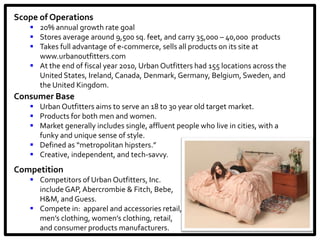
    Urban Outfitters aims to serve an 18 to 30 year old target market.
    Products for both men and women.
    Market generally includes single, affluent people who live in cities, with a
     funky and unique sense of style.
    Defined as “metropolitan hipsters.”
    Creative, independent, and tech-savvy.
Competition
    Competitors of Urban Outfitters, Inc.
     include GAP, Abercrombie & Fitch, Bebe,
     H&M, and Guess.
    Compete in: apparel and accessories retail,
     men’s clothing, women’s clothing, retail,
     and consumer products manufacturers.
External Market Factors
    One of the major external market
     factors that Urban has faced time
     and again is controversies and even
     lawsuits over questionable products.
     The products have sometimes been
     of questionable taste and have been
     the source of multiple points of
     contention over ethics and religious
     issues in particular.
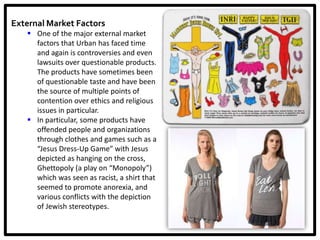
    In particular, some products have
     offended people and organizations
     through clothes and games such as a
     “Jesus Dress-Up Game” with Jesus
     depicted as hanging on the cross,
     Ghettopoly (a play on “Monopoly”)
     which was seen as racist, a shirt that
     seemed to promote anorexia, and
     various conflicts with the depiction
     of Jewish stereotypes.
External Market Factors, cont.
     Urban purportedly “engaged in a
      scheme to deceive the market and a
      course of conduct that artificially
      inflated Urban Outfitter stock price
      ... by misrepresenting the company's
      operating condition and future
      business prospects. Defendants
      achieved this by making positive
      statements about Urban Outfitters'
      business and projecting strong
      earnings for the company while they
      knew that the company was
      suffering.” On March 7th, 2011,
      Urban disclosed financial results for
      the quarter ending on January 31st,
      2011, and the truth came out. Stock
      price plunged 17 percent the next
      day.
Proposed Marketing Strategy
    Every step should always be a step forward, so Urban outfitters needs to
     continue to utilize current trends and technology, and aim to make a smooth and
     easy shopping experience for their customers.
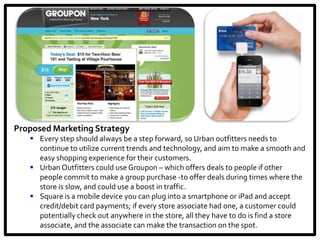
    Urban Outfitters could use Groupon – which offers deals to people if other
     people commit to make a group purchase -to offer deals during times where the
     store is slow, and could use a boost in traffic.
    Square is a mobile device you can plug into a smartphone or iPad and accept
     credit/debit card payments; if every store associate had one, a customer could
     potentially check out anywhere in the store, all they have to do is find a store
     associate, and the associate can make the transaction on the spot.
Proposed Marketing Strategy, cont.
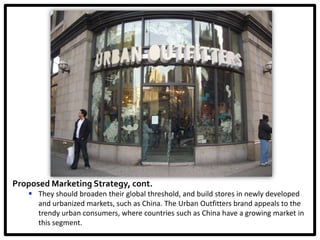
    They should broaden their global threshold, and build stores in newly developed
     and urbanized markets, such as China. The Urban Outfitters brand appeals to the
     trendy urban consumers, where countries such as China have a growing market in
     this segment.
Proposed Marketing Strategy, cont.
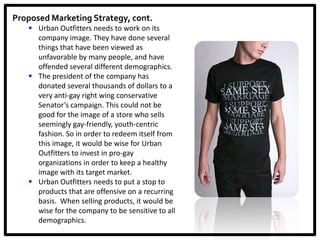
    Urban Outfitters needs to work on its
     company image. They have done several
     things that have been viewed as
     unfavorable by many people, and have
     offended several different demographics.
    The president of the company has
     donated several thousands of dollars to a
     very anti-gay right wing conservative
     Senator’s campaign. This could not be
     good for the image of a store who sells
     seemingly gay-friendly, youth-centric
     fashion. So in order to redeem itself from
     this image, it would be wise for Urban
     Outfitters to invest in pro-gay
     organizations in order to keep a healthy
     image with its target market.
    Urban Outfitters needs to put a stop to
     products that are offensive on a recurring
     basis. When selling products, it would be
     wise for the company to be sensitive to all
     demographics.
•   In order for Urban Outfitters to continue being a successful company, they need to
    adapt to current trends, continuously use new technologies to make more
    enjoyable experiences for their customers, and maintain their brand image in all
    aspects.

Urban outfitters

  • 1.
    History  Urban Outfitters is an apparel company that was incorporated in 1976.  The company originated as “The Free People’s Store” in Philadelphia in 1970, with a concentration on “funky” household items and clothing.  The founders were two Philadelphians, Scott Hayne and Scott Belair. Mission  Urban’s mission statement: “Lifestyle merchandising is our business and our passion. The goal for our brands is to build a strong emotional bond with the customer. To do this we must build lifestyle environments that appeal emotionally, and offer fashion correct products on a timely basis. Our customers are the reason and the inspiration for everything we do.” Ownership  Urban Outfitters is a publicly traded company, owned and chaired by Robert Hayne. He holds the greatest amount of shares in the company, at 27.85 million shares. The company is also held by several large investors, such as Fidelity Management & Research Company, Maverick Capital Ltd, Vanguard Group, and Capital Guardian Trust Company.
  • 2.
    Philosophy  Urban Outfitter’s philosophy is: “Our established ability to understand our customers and connect with them on an emotional level is the reason for our success. The reason for this success is that our brands … are both compelling and distinct… Our goal is to offer a product assortment and an environment so compelling and distinctive that the customer feels an empathetic connection to the brand and is persuaded to buy.” Products & Services  Much of their products have a very counter- culture, hip, earthy, unconventional style. They have men’s pants, shorts, shirts, jackets and outerwear, shoes, bags, wallets, sunglasses, hats, scarves, socks, underwear, ties, belts, and watches. They carry women’s dresses, swimwear, tops, bottoms, bags, outerwear, accessories, and intimates. Also in-store and online are various items for the home, including all sorts of décor, music (such as vinyl records), toys, novelties, cameras (think polaroid), books, bedding, and even furniture.
  • 3.
    Scope of Operations  20% annual growth rate goal  Stores average around 9,500 sq. feet, and carry 35,000 – 40,000 products  Takes full advantage of e-commerce, sells all products on its site at www.urbanoutfitters.com  At the end of fiscal year 2010, Urban Outfitters had 155 locations across the United States, Ireland, Canada, Denmark, Germany, Belgium, Sweden, and the United Kingdom. Consumer Base  Urban Outfitters aims to serve an 18 to 30 year old target market.  Products for both men and women.  Market generally includes single, affluent people who live in cities, with a funky and unique sense of style.  Defined as “metropolitan hipsters.”  Creative, independent, and tech-savvy. Competition  Competitors of Urban Outfitters, Inc. include GAP, Abercrombie & Fitch, Bebe, H&M, and Guess.  Compete in: apparel and accessories retail, men’s clothing, women’s clothing, retail, and consumer products manufacturers.
  • 4.
    External Market Factors  One of the major external market factors that Urban has faced time and again is controversies and even lawsuits over questionable products. The products have sometimes been of questionable taste and have been the source of multiple points of contention over ethics and religious issues in particular.  In particular, some products have offended people and organizations through clothes and games such as a “Jesus Dress-Up Game” with Jesus depicted as hanging on the cross, Ghettopoly (a play on “Monopoly”) which was seen as racist, a shirt that seemed to promote anorexia, and various conflicts with the depiction of Jewish stereotypes.
  • 5.
    External Market Factors,cont.  Urban purportedly “engaged in a scheme to deceive the market and a course of conduct that artificially inflated Urban Outfitter stock price ... by misrepresenting the company's operating condition and future business prospects. Defendants achieved this by making positive statements about Urban Outfitters' business and projecting strong earnings for the company while they knew that the company was suffering.” On March 7th, 2011, Urban disclosed financial results for the quarter ending on January 31st, 2011, and the truth came out. Stock price plunged 17 percent the next day.
  • 6.
    Proposed Marketing Strategy  Every step should always be a step forward, so Urban outfitters needs to continue to utilize current trends and technology, and aim to make a smooth and easy shopping experience for their customers.  Urban Outfitters could use Groupon – which offers deals to people if other people commit to make a group purchase -to offer deals during times where the store is slow, and could use a boost in traffic.  Square is a mobile device you can plug into a smartphone or iPad and accept credit/debit card payments; if every store associate had one, a customer could potentially check out anywhere in the store, all they have to do is find a store associate, and the associate can make the transaction on the spot.
  • 7.
    Proposed Marketing Strategy,cont.  They should broaden their global threshold, and build stores in newly developed and urbanized markets, such as China. The Urban Outfitters brand appeals to the trendy urban consumers, where countries such as China have a growing market in this segment.
  • 8.
    Proposed Marketing Strategy,cont.  Urban Outfitters needs to work on its company image. They have done several things that have been viewed as unfavorable by many people, and have offended several different demographics.  The president of the company has donated several thousands of dollars to a very anti-gay right wing conservative Senator’s campaign. This could not be good for the image of a store who sells seemingly gay-friendly, youth-centric fashion. So in order to redeem itself from this image, it would be wise for Urban Outfitters to invest in pro-gay organizations in order to keep a healthy image with its target market.  Urban Outfitters needs to put a stop to products that are offensive on a recurring basis. When selling products, it would be wise for the company to be sensitive to all demographics.
  • 10.
    In order for Urban Outfitters to continue being a successful company, they need to adapt to current trends, continuously use new technologies to make more enjoyable experiences for their customers, and maintain their brand image in all aspects.