The Marketing
In UNIQLO
Definition of
Marketing
 Marketing refers to the evaluation and organization of
exchange relationships.
 This is a business process that builds the relationship with
customers through value exchanges and satisfies them.
That is because marketing is used to draw in customers.
 This means that marketing is the process of planning and
executing ideas, concepts of goods, services, pricing,
promotion and distribution to create communications that
meet individual and business goals.
Definition of
Micro
Environment
 Micro environment refers to the close relationship with the
enterprise, affecting the enterprise’s ability to serve
customers.
 It directly affects the organization.
 It includes the company itself, suppliers, marketing
agencies, customer markets, competitors and the public..
Definition of
Macro
Environment
 Macro environment is the major external and
uncontrollable factors.
 It influences the decision making of an organization, and
affect its performance and strategies.
 It affects the success, strategy and decision of an
enterprise.
 These factors include technological, demographics,
economic, cultural, political, legal and natural
environments.
Micro-Environment
Factors in UNIQLO
Company
 Uniqlo, a mordern Japanese company that encourage
casual dress around the world.
 Makes for all brand concept takes its clothes beyond the
ways of defining people.
 Focus on the unique functional performance of the brand
Focus on the desigh and innovation of clothing.
 Differentiate from competitor.
 Communication strategy uses digital marketing.
 a strategy that helps marketing in Uniqlo.
Competitors
 The main competitors of Uniqlo are Zara, H&M an Gap.
 Uniqlo has positioned itself in technology rather than “fast-
fashion” in Japan.
 Uniqlo stands out from Zara, H&M and Gap because Uniqlo
has been keeping a mass number of loyal customers.
 For the direct competitors, Giordano is popular and well-
known casual clothing retailer in the Asia Pacific.
 Giordano is one of the most successful local retail stories in
Hong Kong, which has made groundbreaking achievements
in marketing, branding, retail and service.
 For the indirect competitors, F.O.S. (Factory Outlet Store)
is a clothing retail chain established in the local fashion
industry.
 The inaugural opening of its outlet in Sunway Pyramid back
in 1997 marked the birth of F.O.S
Suppliers
 As for UNIQLO Malaysia, it is a joint venture between the
Fast Retailing Co. Ltd and Wing Tai Clothing Sdn Bhd.
 Fast Retailing has maintained a good competitive edge by
providing durable and highly functional clothing.
 UNIQLO hopes to fully advance into Western markets,
according to President Yasuharu Ishikawa.
Public
 Uniqlo has become another contender in the global fast
fashion retail market despite competing against other
bigger players - ZARA (Inditex), H&M, Gap and
Forever21.
 Key brand success factors include its strong commitment
to innovation and corporate culture.
 Their Japanese founder, Tadashi Yanai is quite popular
for his quote “Without a soul, a company is nothing”.
 Tadashi Yanai has created 23 management principles and
its includes customer first, giving back to society and
self-sabotage.
Customers
 Basic strategy of Uniqlo is appeal to the public.
 The customers range from any economic background,
demographics and ages such as 18-30.
 There are just a few pattern and the sizes range from 3XL
for men to XXL for women.
 The brand does not encourage customers to just look at
it. UNIQLO had problems expanding in Europe and the
US due to different needs and lifestyles of the
international customers.
Macro-Environment
Factors in UNIQLO
Technological
Environment
 E-commerce ( online shopping ).
 HEATTECH Line – specially designed to make the wearer
warm in the cold using hollow fibers that capture air and
prevent heat from escaping.
 AIRism Line – specially designed to make you cooler in
the summer using a fabric called “cupro” which is
breathable by absorbing water.
Demographic
Environment
 Trends – use to understand what customers are looking
for.
 Main targets
Male and female adults ages ranging from 18 – 40.
People who are looking for trendy clothes which are
casual and laidback.
Not only limited to high income people.
Economic
Environment
 Online shopping vs. In-store shopping – trying to cater to
people that like shopping efficiently and people whom
enjoy traditional shopping.
 Foreign European Market – overcame the economic
inflation in the UK and are able to satisfy the consumers
in the UK.
 Foreign Asian Market – able to satisfy the taste of
consumers in China and is now a well know brand there.
Cultural
Environment
 Symbol
 UNIQLO store shows the design of the space as a neat and
tidy sales floor
 Making the clothes to be the central attraction.
 Element of Effort
 Supplies comfortable clothing line which has universal
design, durable, accessible and affordable
 Bright clothes and smaller sizes are preferred by Asians, but
Europeans prefer plain colour and bigger than XL sizes.
Political
Environment
 Taxation
 UNIQLO will be demotivated by a high level of taxation
from increasing their profits.
 Especially meaningless to do business in the United
States.
 It has higher tax; it is impossible to make quality and
affordable products; it lacks of specialised labour.
 Intellectual Property (IP) Protection
 Trademarks of Fast Retailing Co Ltd (Trade Marks) are
Uniqlo and the Uniqlo Logo.
 Everything on this website, including these is licensed to
Fast Retailing Co Ltd.
 the information, text, logos, graphics, layout,
design, pricing, services and products (Content)
 No changes and copies of the Trade Marks should be
made unless the permission is given.
Legal
Environment
 IP Laws and Other Data Protection Laws
 The copy right in UNIQLO.
 Selling the products, such as the following for women and kids.
 UT Collection, accessories, pants, parkas, coats
 With Disney Love Minnie Mouse Collection by Ambush.
 Specially created by AMBUSH designer YOON.
 Health and Safety Laws
 Has engaged in Corporate Social Responsibility (CSR)
activities.
 To ensure the workers safety, controlling the whole production
processes and cooperating with communities.
 Consumer Protection Laws
 Setting the reasonable price, ensuring certain quality standard
products, defending consumers from fake marketing claims.
 To identity the number of customers at the location of the
retailer stores and their preference of UNIQLO products.
Natural
Environment
 Climate change
 Textiles like in countries where the winter has become very
mild, warm winter clothes will have much less of a market
due to global warming.
 Recycling and Waste Management
 UNIQLO started working with the UN Refugee Agency
(UNHCR) through their All-Product Recycling initiative in
2006.
 Under this program, which is the UNIQLO Sustainability,
clothing no longer needed by customers are still in good
condition will be collected from the Recycle Box in every
store - will be giving to refugees and underprivileged
people.
Natural
Environment
 Attitude towards Eco-Friendly Products
 UNIQLO has replaced the plastic bags to recycled
paper or new paper from sources
 Certified by the Forest Stewardship Council in 2019.
 Cool Biz Campaign in Japan
 An energy-saving campaign, known as “Cool-Biz” was
started by the Japanese Ministry of the Environment in
2005.
 Setting the air conditioner temperature at 28 degrees -
Workers can wear short sleeved shirts to remain cool.
 To allow more casual styles at work the campaign was
extended to “Super Cool Biz”.
 A further line of innovative summer clothing made from
materials “Silky Dry” is provided by UNIQLO Japan.
They absorb moisture and prevent body odors.
 July 2011 sales have been increased to 11.2%
consequently.
UNIQLO
MARKETING MIX
PRODUCT
PRODUCT
ITEM
SHIRTS
 UNIQLO sells shirts from both women and men
 Made from different kind of materials
 Comes with different colors, design and size
 To satisfy the consumer’s want and need
 Suitable for everyone
specific version of a product that can be
designated as a distinct offering among an
organization’s products.
PRODUCT
LINE
OUTERWEAR
 Jackets
 Coats
 Cardigan
 Parkas
TOPS
 Dresses
 One-piece
 Blouses
 Knitwear
 Hoodies
 Sweatshirt
 Shirts
 T-shirts
 Polo Shirts
Products that are closely related functioning in a similar manner, are sold to the same customer
groups, are marketed through the same types of outlets, or fall within the given price range
PRODUCT
MIX
ALL PRODUCTS
 Outerwear
 Tops
 Bottoms [Jeans, Long Pants. Short Pants, Legging, Skirts]
 Innerwear [ Bra(Women), Inner Tops, Underwear, Socks,
Legwear]
 Swimwear (Women)
 Kids and Babies (Clothes and Accessories)
 Maternity Clothes
 Sportwear
 Pajamas
All the product lines and items that
a certain company sells
PROMOTION
ADVERTISING
 Originally relied on traditional advertising like flyers and
TV commercials.
 Now advertise digitally.
 Billboard
Ads video
on YouTube
Email
Blogs
Websites
SALES
PROMOTION
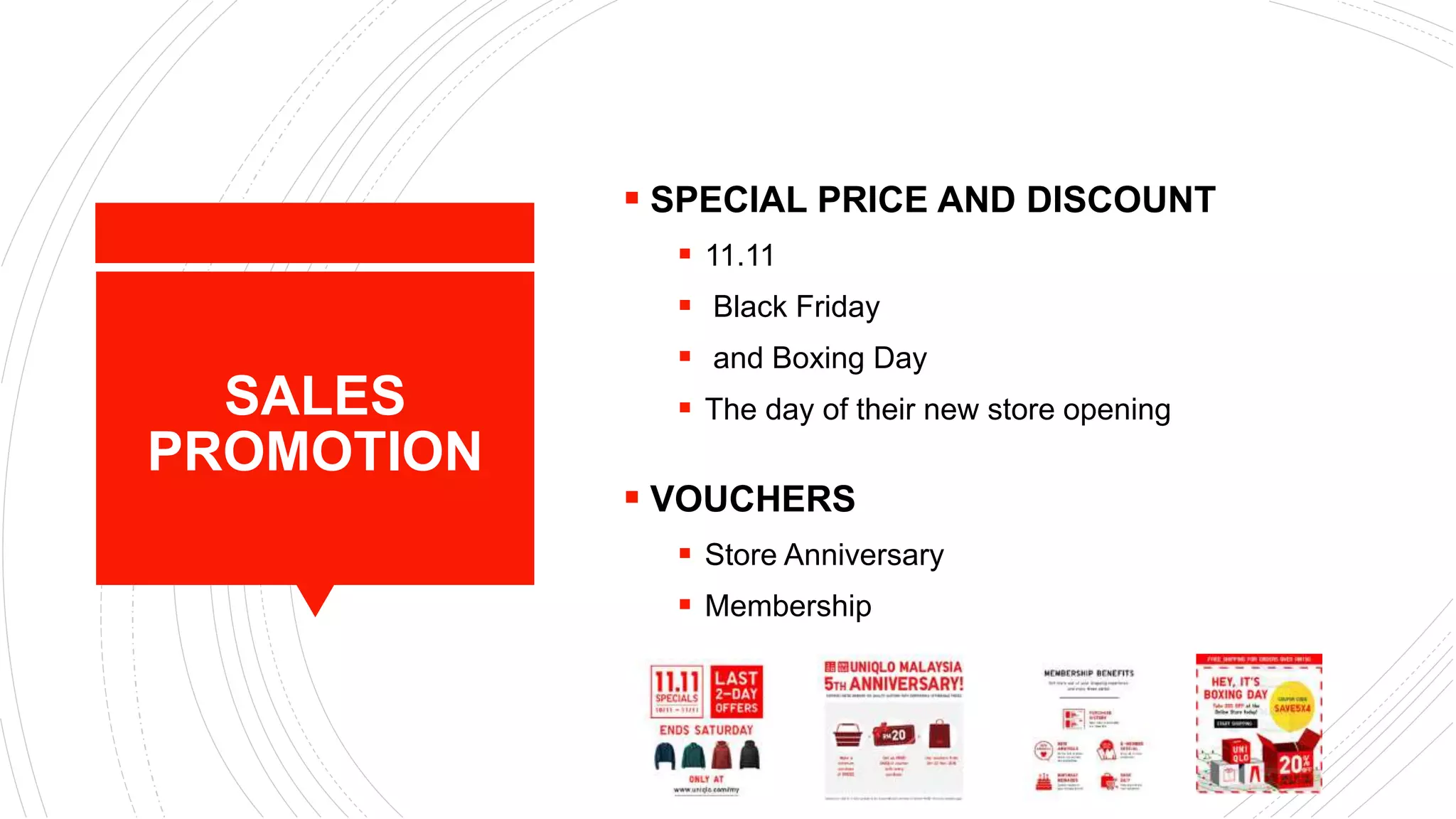
 SPECIAL PRICE AND DISCOUNT
 11.11
 Black Friday
 and Boxing Day
 The day of their new store opening
 VOUCHERS
 Store Anniversary
 Membership
PUBLIC
RELATION
ALL-PRODUCT RECYCLING INITIATIVE
 Since 2014
 Encourage customers to donate unwanted clothes
 Sorted out and distributed to deserving people
 Collaborate with UNCHR (YN Refugee Agency)
 Use their business as a force to do good and create an impact to
the society
PUBLIC
RELATION
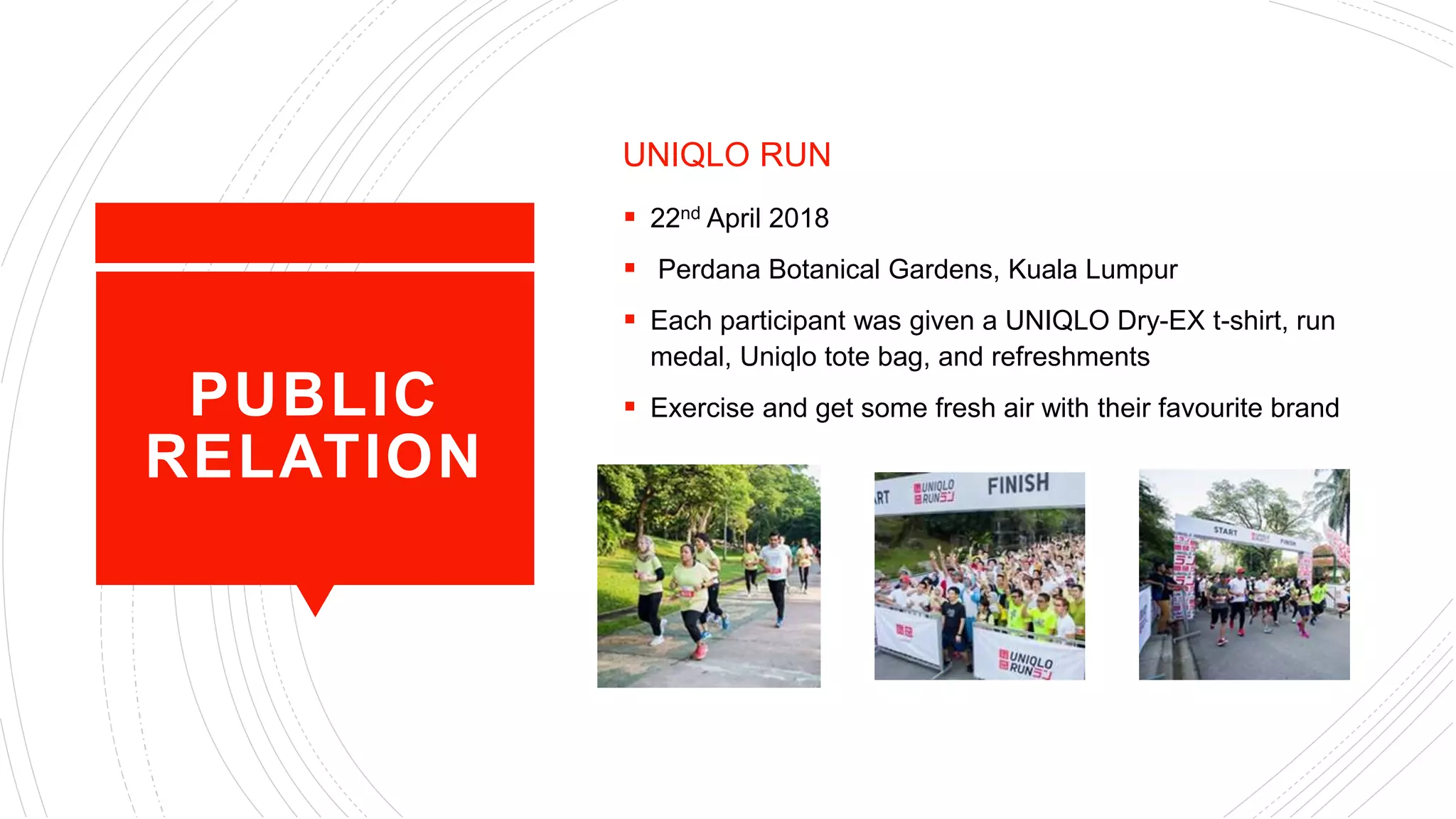
UNIQLO RUN
 22nd April 2018
 Perdana Botanical Gardens, Kuala Lumpur
 Each participant was given a UNIQLO Dry-EX t-shirt, run
medal, Uniqlo tote bag, and refreshments
 Exercise and get some fresh air with their favourite brand
PERSONAL
SELLING
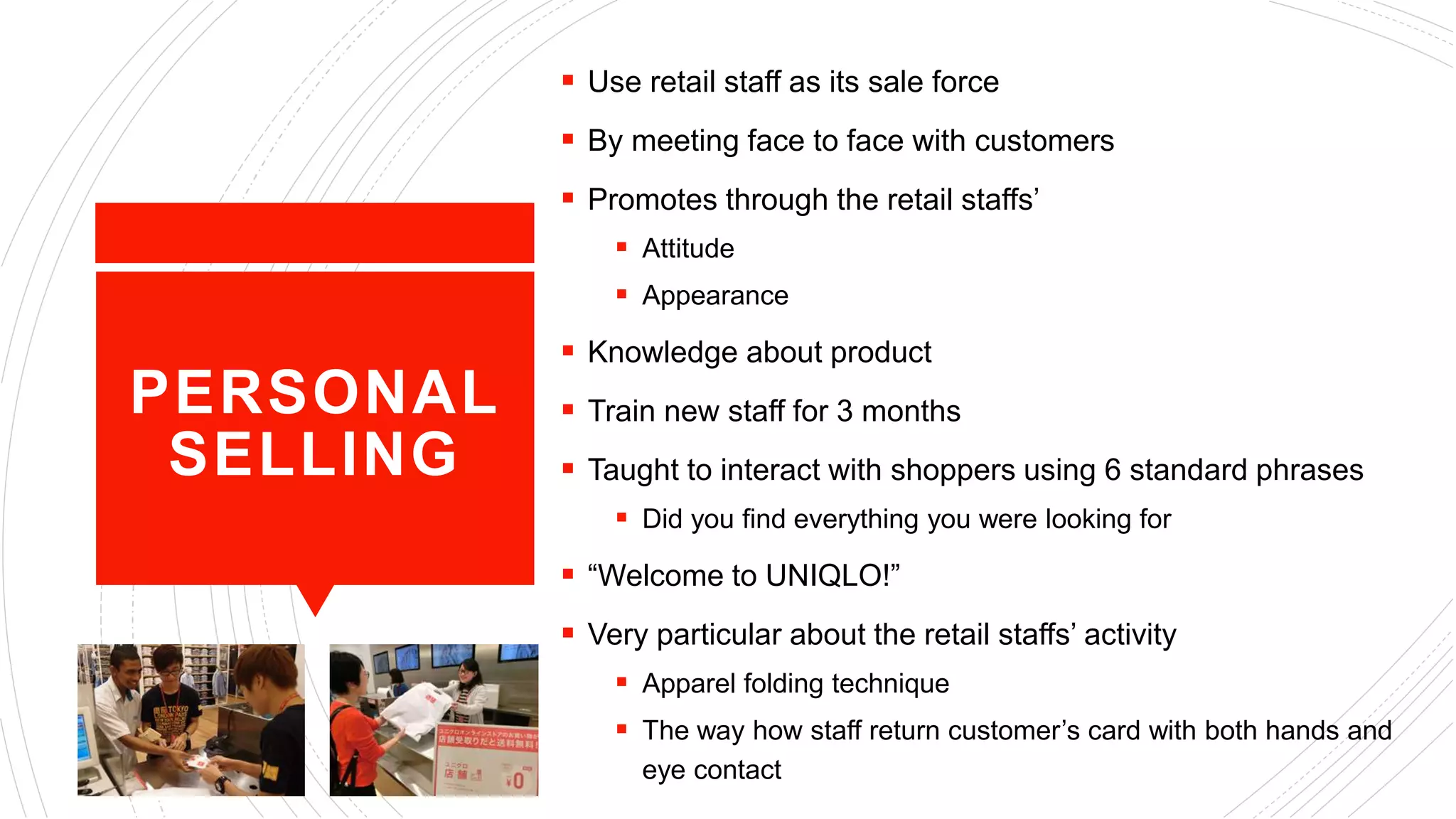
 Use retail staff as its sale force
 By meeting face to face with customers
 Promotes through the retail staffs’
 Attitude
 Appearance
 Knowledge about product
 Train new staff for 3 months
 Taught to interact with shoppers using 6 standard phrases
 Did you find everything you were looking for
 “Welcome to UNIQLO!”
 Very particular about the retail staffs’ activity
 Apparel folding technique
 The way how staff return customer’s card with both hands and
eye contact
PLACE
DIRECT CHANNEL
• Produces its own product and sells them directly
to consumers in its own retail.
• Does not employ any marketing intermediaries
• Sells product to straight to UNIQLO retail outlets
(own-store outlet)
PHYSICAL
STORES
 1,379 UNIQLO Stores operating worldwide
 50 Stores all over Malaysia
All of UNIQLO Stores housed in commercial shopping centres in
major cities
For example
All UNIQLO in Malaysia located in well-known shopping mall
Kuala Lumpur (11 Stores)
 Suria KLCC
 Fahrenheit 88
 Mid Valley Mega Mall
 Sogo KL
 Berjaya Time Square
Selangor (12 Stores)
 The Curve
 Sunway Pyramid
 One Utama
 Paradigm Mall
ONLINE
UNIQLO
Official
Website
UNIQLO
Application
Online Stores offers
 Entire product range
Original products designed exclusively for online sale
Inquiries
 Customer can reach out to “Chatbot” on the
website
 Customers also can email them or call if urgent
PRICE
COMPETITION-
BASED
PRICING
Influenced primarily by competitors' prices
Competitors
COMPETITION-
BASED
PRICING
RM99.00
100% Cotton
RM199.00
100% Cotton
RM39.90
100% Cotton
RM129.00
100% Cotton
Conclusion
 In conclusion, all these components are important to a
company to have a good strategy and program to run
their company smoothly.
 It is because the economy in the whole world has become
stronger and growing faster if compared with the past.
 It is important understand this field more in depth to
become a successful company like UNIQLO.

The Marketing in UNIQLO

  • 1.
  • 2.
    Definition of Marketing  Marketingrefers to the evaluation and organization of exchange relationships.  This is a business process that builds the relationship with customers through value exchanges and satisfies them. That is because marketing is used to draw in customers.  This means that marketing is the process of planning and executing ideas, concepts of goods, services, pricing, promotion and distribution to create communications that meet individual and business goals.
  • 3.
    Definition of Micro Environment  Microenvironment refers to the close relationship with the enterprise, affecting the enterprise’s ability to serve customers.  It directly affects the organization.  It includes the company itself, suppliers, marketing agencies, customer markets, competitors and the public..
  • 4.
    Definition of Macro Environment  Macroenvironment is the major external and uncontrollable factors.  It influences the decision making of an organization, and affect its performance and strategies.  It affects the success, strategy and decision of an enterprise.  These factors include technological, demographics, economic, cultural, political, legal and natural environments.
  • 5.
  • 6.
    Company  Uniqlo, amordern Japanese company that encourage casual dress around the world.  Makes for all brand concept takes its clothes beyond the ways of defining people.  Focus on the unique functional performance of the brand Focus on the desigh and innovation of clothing.  Differentiate from competitor.  Communication strategy uses digital marketing.  a strategy that helps marketing in Uniqlo.
  • 7.
    Competitors  The maincompetitors of Uniqlo are Zara, H&M an Gap.  Uniqlo has positioned itself in technology rather than “fast- fashion” in Japan.  Uniqlo stands out from Zara, H&M and Gap because Uniqlo has been keeping a mass number of loyal customers.  For the direct competitors, Giordano is popular and well- known casual clothing retailer in the Asia Pacific.  Giordano is one of the most successful local retail stories in Hong Kong, which has made groundbreaking achievements in marketing, branding, retail and service.  For the indirect competitors, F.O.S. (Factory Outlet Store) is a clothing retail chain established in the local fashion industry.  The inaugural opening of its outlet in Sunway Pyramid back in 1997 marked the birth of F.O.S
  • 8.
    Suppliers  As forUNIQLO Malaysia, it is a joint venture between the Fast Retailing Co. Ltd and Wing Tai Clothing Sdn Bhd.  Fast Retailing has maintained a good competitive edge by providing durable and highly functional clothing.  UNIQLO hopes to fully advance into Western markets, according to President Yasuharu Ishikawa.
  • 9.
    Public  Uniqlo hasbecome another contender in the global fast fashion retail market despite competing against other bigger players - ZARA (Inditex), H&M, Gap and Forever21.  Key brand success factors include its strong commitment to innovation and corporate culture.  Their Japanese founder, Tadashi Yanai is quite popular for his quote “Without a soul, a company is nothing”.  Tadashi Yanai has created 23 management principles and its includes customer first, giving back to society and self-sabotage.
  • 10.
    Customers  Basic strategyof Uniqlo is appeal to the public.  The customers range from any economic background, demographics and ages such as 18-30.  There are just a few pattern and the sizes range from 3XL for men to XXL for women.  The brand does not encourage customers to just look at it. UNIQLO had problems expanding in Europe and the US due to different needs and lifestyles of the international customers.
  • 11.
  • 12.
    Technological Environment  E-commerce (online shopping ).  HEATTECH Line – specially designed to make the wearer warm in the cold using hollow fibers that capture air and prevent heat from escaping.  AIRism Line – specially designed to make you cooler in the summer using a fabric called “cupro” which is breathable by absorbing water.
  • 13.
    Demographic Environment  Trends –use to understand what customers are looking for.  Main targets Male and female adults ages ranging from 18 – 40. People who are looking for trendy clothes which are casual and laidback. Not only limited to high income people.
  • 14.
    Economic Environment  Online shoppingvs. In-store shopping – trying to cater to people that like shopping efficiently and people whom enjoy traditional shopping.  Foreign European Market – overcame the economic inflation in the UK and are able to satisfy the consumers in the UK.  Foreign Asian Market – able to satisfy the taste of consumers in China and is now a well know brand there.
  • 15.
    Cultural Environment  Symbol  UNIQLOstore shows the design of the space as a neat and tidy sales floor  Making the clothes to be the central attraction.  Element of Effort  Supplies comfortable clothing line which has universal design, durable, accessible and affordable  Bright clothes and smaller sizes are preferred by Asians, but Europeans prefer plain colour and bigger than XL sizes.
  • 16.
    Political Environment  Taxation  UNIQLOwill be demotivated by a high level of taxation from increasing their profits.  Especially meaningless to do business in the United States.  It has higher tax; it is impossible to make quality and affordable products; it lacks of specialised labour.  Intellectual Property (IP) Protection  Trademarks of Fast Retailing Co Ltd (Trade Marks) are Uniqlo and the Uniqlo Logo.  Everything on this website, including these is licensed to Fast Retailing Co Ltd.  the information, text, logos, graphics, layout, design, pricing, services and products (Content)  No changes and copies of the Trade Marks should be made unless the permission is given.
  • 17.
    Legal Environment  IP Lawsand Other Data Protection Laws  The copy right in UNIQLO.  Selling the products, such as the following for women and kids.  UT Collection, accessories, pants, parkas, coats  With Disney Love Minnie Mouse Collection by Ambush.  Specially created by AMBUSH designer YOON.  Health and Safety Laws  Has engaged in Corporate Social Responsibility (CSR) activities.  To ensure the workers safety, controlling the whole production processes and cooperating with communities.  Consumer Protection Laws  Setting the reasonable price, ensuring certain quality standard products, defending consumers from fake marketing claims.  To identity the number of customers at the location of the retailer stores and their preference of UNIQLO products.
  • 18.
    Natural Environment  Climate change Textiles like in countries where the winter has become very mild, warm winter clothes will have much less of a market due to global warming.  Recycling and Waste Management  UNIQLO started working with the UN Refugee Agency (UNHCR) through their All-Product Recycling initiative in 2006.  Under this program, which is the UNIQLO Sustainability, clothing no longer needed by customers are still in good condition will be collected from the Recycle Box in every store - will be giving to refugees and underprivileged people.
  • 19.
    Natural Environment  Attitude towardsEco-Friendly Products  UNIQLO has replaced the plastic bags to recycled paper or new paper from sources  Certified by the Forest Stewardship Council in 2019.  Cool Biz Campaign in Japan  An energy-saving campaign, known as “Cool-Biz” was started by the Japanese Ministry of the Environment in 2005.  Setting the air conditioner temperature at 28 degrees - Workers can wear short sleeved shirts to remain cool.  To allow more casual styles at work the campaign was extended to “Super Cool Biz”.  A further line of innovative summer clothing made from materials “Silky Dry” is provided by UNIQLO Japan. They absorb moisture and prevent body odors.  July 2011 sales have been increased to 11.2% consequently.
  • 20.
  • 21.
  • 22.
    PRODUCT ITEM SHIRTS  UNIQLO sellsshirts from both women and men  Made from different kind of materials  Comes with different colors, design and size  To satisfy the consumer’s want and need  Suitable for everyone specific version of a product that can be designated as a distinct offering among an organization’s products.
  • 23.
    PRODUCT LINE OUTERWEAR  Jackets  Coats Cardigan  Parkas TOPS  Dresses  One-piece  Blouses  Knitwear  Hoodies  Sweatshirt  Shirts  T-shirts  Polo Shirts Products that are closely related functioning in a similar manner, are sold to the same customer groups, are marketed through the same types of outlets, or fall within the given price range
  • 24.
    PRODUCT MIX ALL PRODUCTS  Outerwear Tops  Bottoms [Jeans, Long Pants. Short Pants, Legging, Skirts]  Innerwear [ Bra(Women), Inner Tops, Underwear, Socks, Legwear]  Swimwear (Women)  Kids and Babies (Clothes and Accessories)  Maternity Clothes  Sportwear  Pajamas All the product lines and items that a certain company sells
  • 25.
  • 26.
    ADVERTISING  Originally reliedon traditional advertising like flyers and TV commercials.  Now advertise digitally.  Billboard Ads video on YouTube Email Blogs Websites
  • 28.
    SALES PROMOTION  SPECIAL PRICEAND DISCOUNT  11.11  Black Friday  and Boxing Day  The day of their new store opening  VOUCHERS  Store Anniversary  Membership
  • 29.
    PUBLIC RELATION ALL-PRODUCT RECYCLING INITIATIVE Since 2014  Encourage customers to donate unwanted clothes  Sorted out and distributed to deserving people  Collaborate with UNCHR (YN Refugee Agency)  Use their business as a force to do good and create an impact to the society
  • 30.
    PUBLIC RELATION UNIQLO RUN  22ndApril 2018  Perdana Botanical Gardens, Kuala Lumpur  Each participant was given a UNIQLO Dry-EX t-shirt, run medal, Uniqlo tote bag, and refreshments  Exercise and get some fresh air with their favourite brand
  • 31.
    PERSONAL SELLING  Use retailstaff as its sale force  By meeting face to face with customers  Promotes through the retail staffs’  Attitude  Appearance  Knowledge about product  Train new staff for 3 months  Taught to interact with shoppers using 6 standard phrases  Did you find everything you were looking for  “Welcome to UNIQLO!”  Very particular about the retail staffs’ activity  Apparel folding technique  The way how staff return customer’s card with both hands and eye contact
  • 32.
  • 33.
    DIRECT CHANNEL • Producesits own product and sells them directly to consumers in its own retail. • Does not employ any marketing intermediaries • Sells product to straight to UNIQLO retail outlets (own-store outlet)
  • 34.
    PHYSICAL STORES  1,379 UNIQLOStores operating worldwide  50 Stores all over Malaysia All of UNIQLO Stores housed in commercial shopping centres in major cities For example All UNIQLO in Malaysia located in well-known shopping mall Kuala Lumpur (11 Stores)  Suria KLCC  Fahrenheit 88  Mid Valley Mega Mall  Sogo KL  Berjaya Time Square Selangor (12 Stores)  The Curve  Sunway Pyramid  One Utama  Paradigm Mall
  • 35.
    ONLINE UNIQLO Official Website UNIQLO Application Online Stores offers Entire product range Original products designed exclusively for online sale Inquiries  Customer can reach out to “Chatbot” on the website  Customers also can email them or call if urgent
  • 36.
  • 37.
  • 38.
  • 39.
  • 40.
    Conclusion  In conclusion,all these components are important to a company to have a good strategy and program to run their company smoothly.  It is because the economy in the whole world has become stronger and growing faster if compared with the past.  It is important understand this field more in depth to become a successful company like UNIQLO.