Status
USI businesscase out-of-session to Senior
Officials in October 2011
Pending approval, business case to COAG
later in the year
4.
Expert input
Data& Performance Measurement Principal
Committee
Expert Advisory Panel
Information Integrity Solutions (privacy, legal,
governance)
3 Pillars Asia Pacific (technological solution)
Nous Consulting (Stakeholder consultation)
5.
Rationale
“Improving datacollections for all education
sectors is of critical importance to Australia. A
national student identifier could track students as
they progress through education and training
and would further support a seamless schooling,
VET and higher education experience for
students. It would also provide valuable data to
facilitate a VET system that is more responsive
and flexible.” – COAG, Dec 09
6.
Purpose
The uniquestudent identifier (USI) is
designed to achieve two primary purposes:
► To enable governments to support national
student-centred training models by providing
a single source of information on an
individual’s vocational education and training
(VET) history
► To provide individuals with a composite and
authenticated personal record of their national
vocational education and training history.
7.
Scope
A uniquenumber which will be required for all
VET students
► Applies across all accredited VET programs
under the Australian Qualifications
Framework (AQF)
► Is of national scope and operation, covering
all registered training organisations
► Applies to all international and VET in schools
students enrolled in AQF qualifications with
an Australian provider
8.
Underlying principles
Student-centredapproach
► Students know and own their USI, but can
disclose it to their training provider
Builds on existing systems, for example the
Learner Unique Identifier (LUI) could be
supplied instead of the USI, with linking via
the USI register
9.
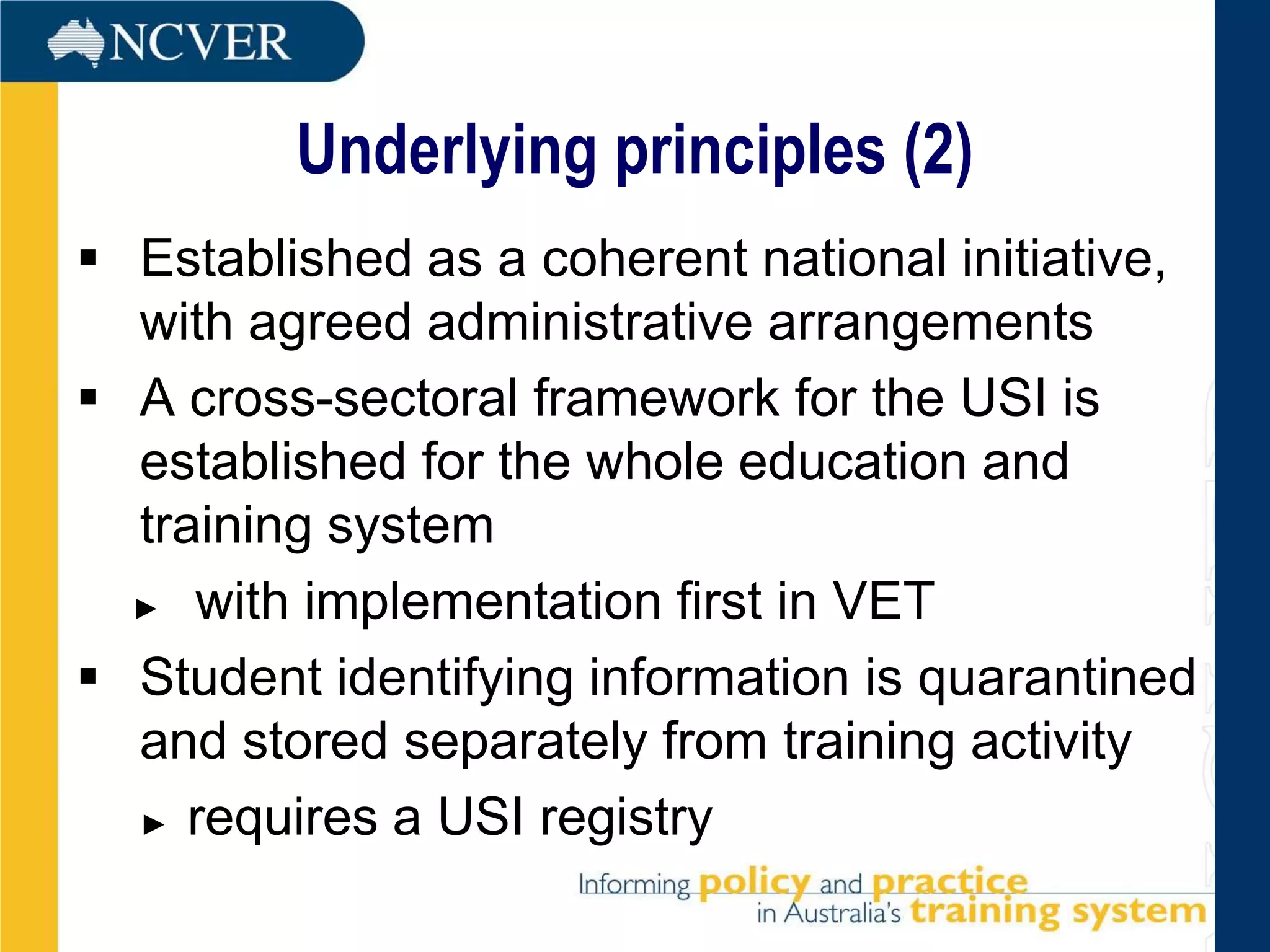
Underlying principles (2)
Established as a coherent national initiative,
with agreed administrative arrangements
A cross-sectoral framework for the USI is
established for the whole education and
training system
► with implementation first in VET
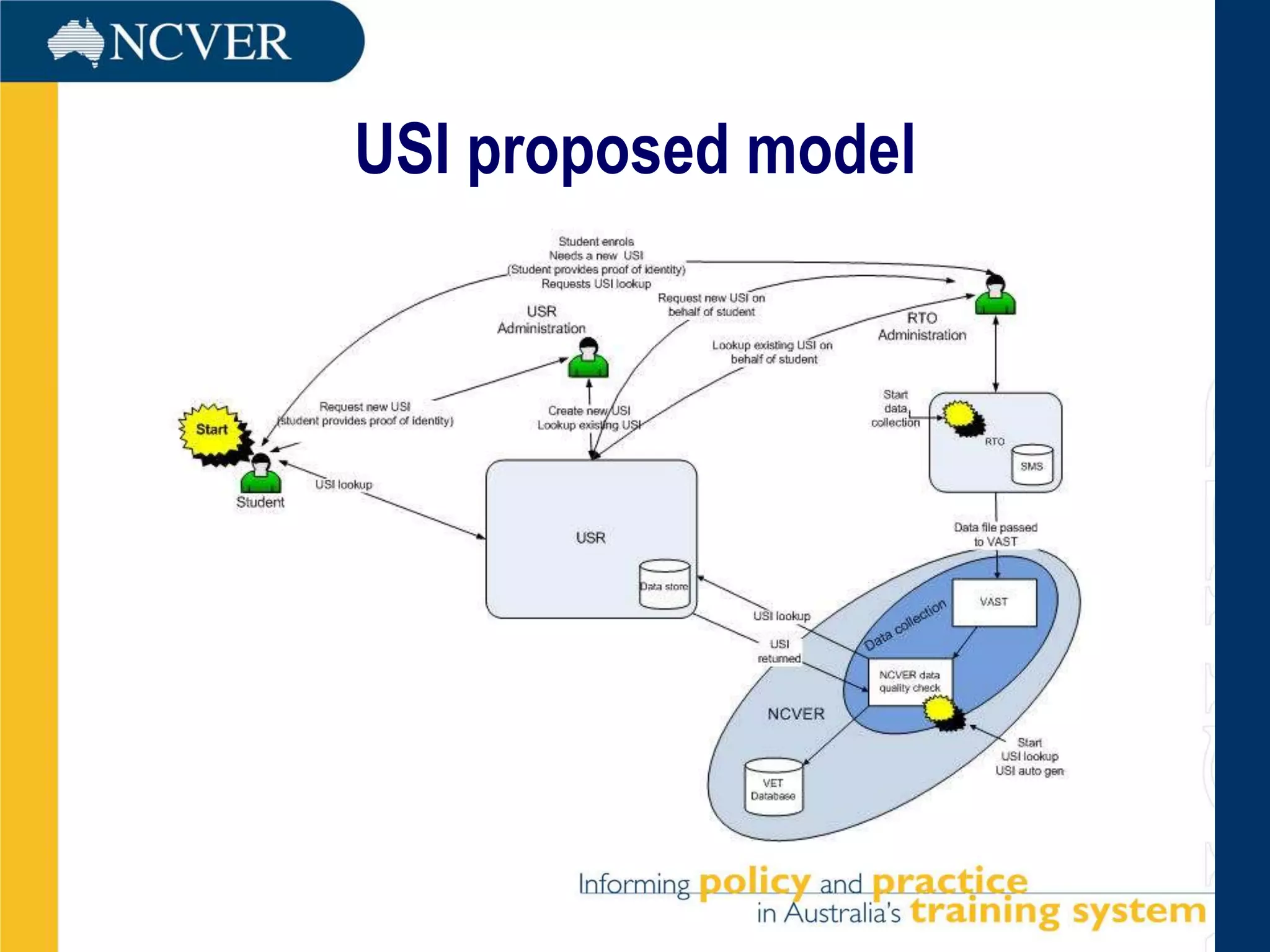
Student identifying information is quarantined
and stored separately from training activity
► requires a USI registry
10.
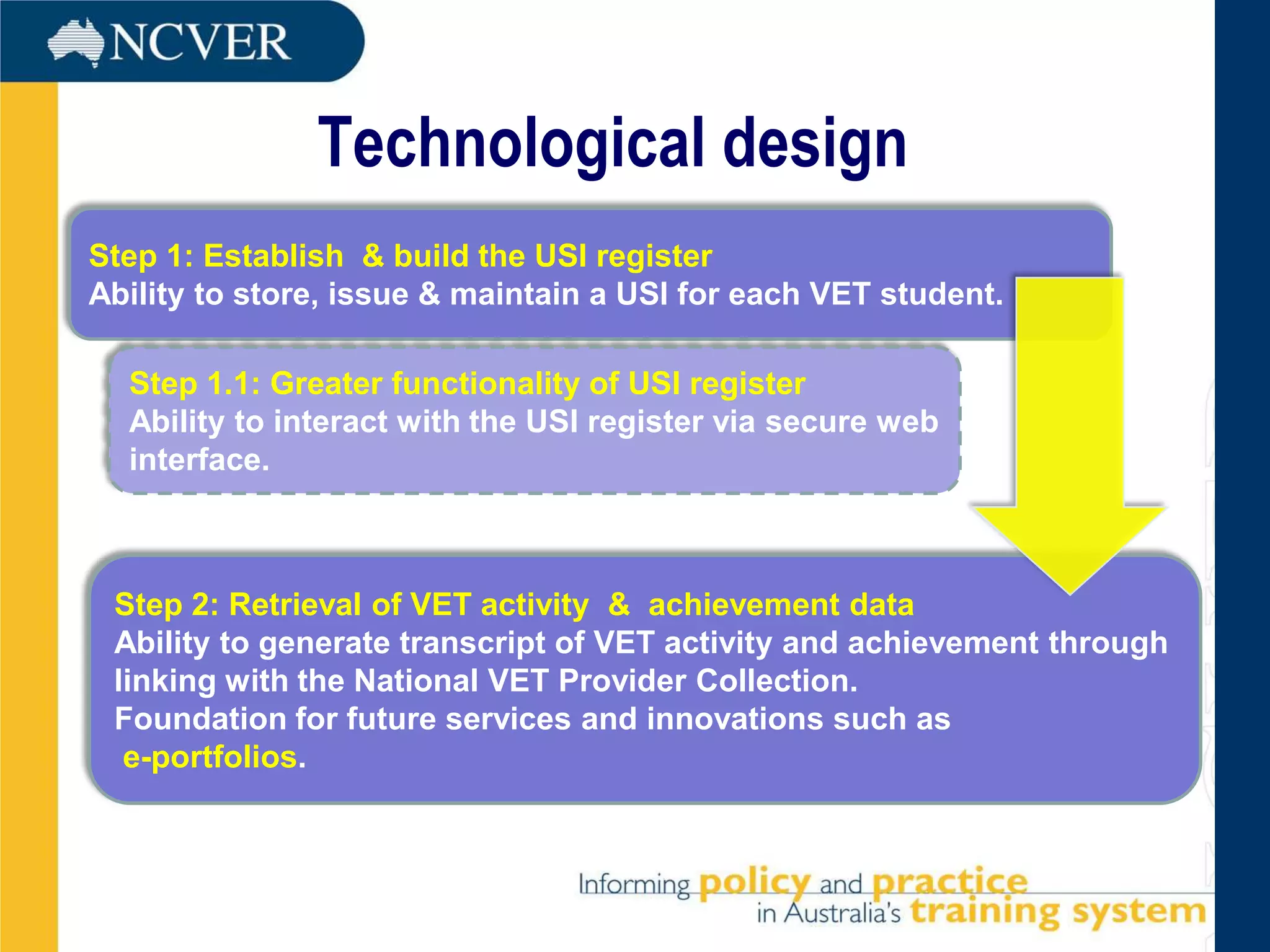
Technological design
Step 1:Establish & build the USI register
Ability to store, issue & maintain a USI for each VET student.
Step 1.1: Greater functionality of USI register
Ability to interact with the USI register via secure web
interface.
Step 2: Retrieval of VET activity & achievement data
Ability to generate transcript of VET activity and achievement through
linking with the National VET Provider Collection.
Foundation for future services and innovations such as
e-portfolios.
Consultation to date
‘Green paper’ on www.training.com.au in
August 2010
Nous Consulting Group consultations in May
2011 available on www.ncver.edu.au
► face to face and telephone interviews
► student on-line survey
14.
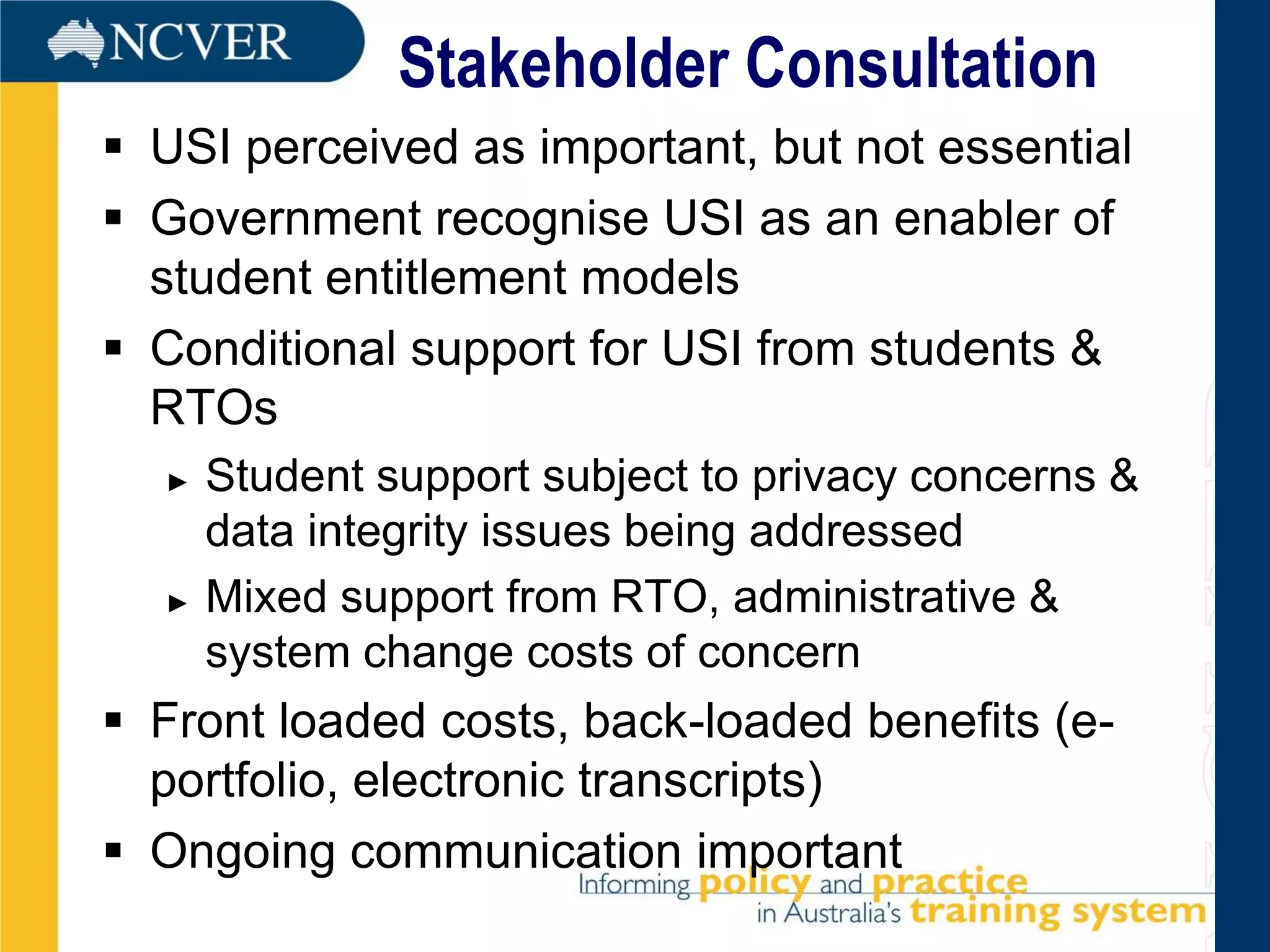
Stakeholder Consultation
USIperceived as important, but not essential
Government recognise USI as an enabler of
student entitlement models
Conditional support for USI from students &
RTOs
► Student support subject to privacy concerns &
data integrity issues being addressed
► Mixed support from RTO, administrative &
system change costs of concern
Front loaded costs, back-loaded benefits (e-
portfolio, electronic transcripts)
Ongoing communication important
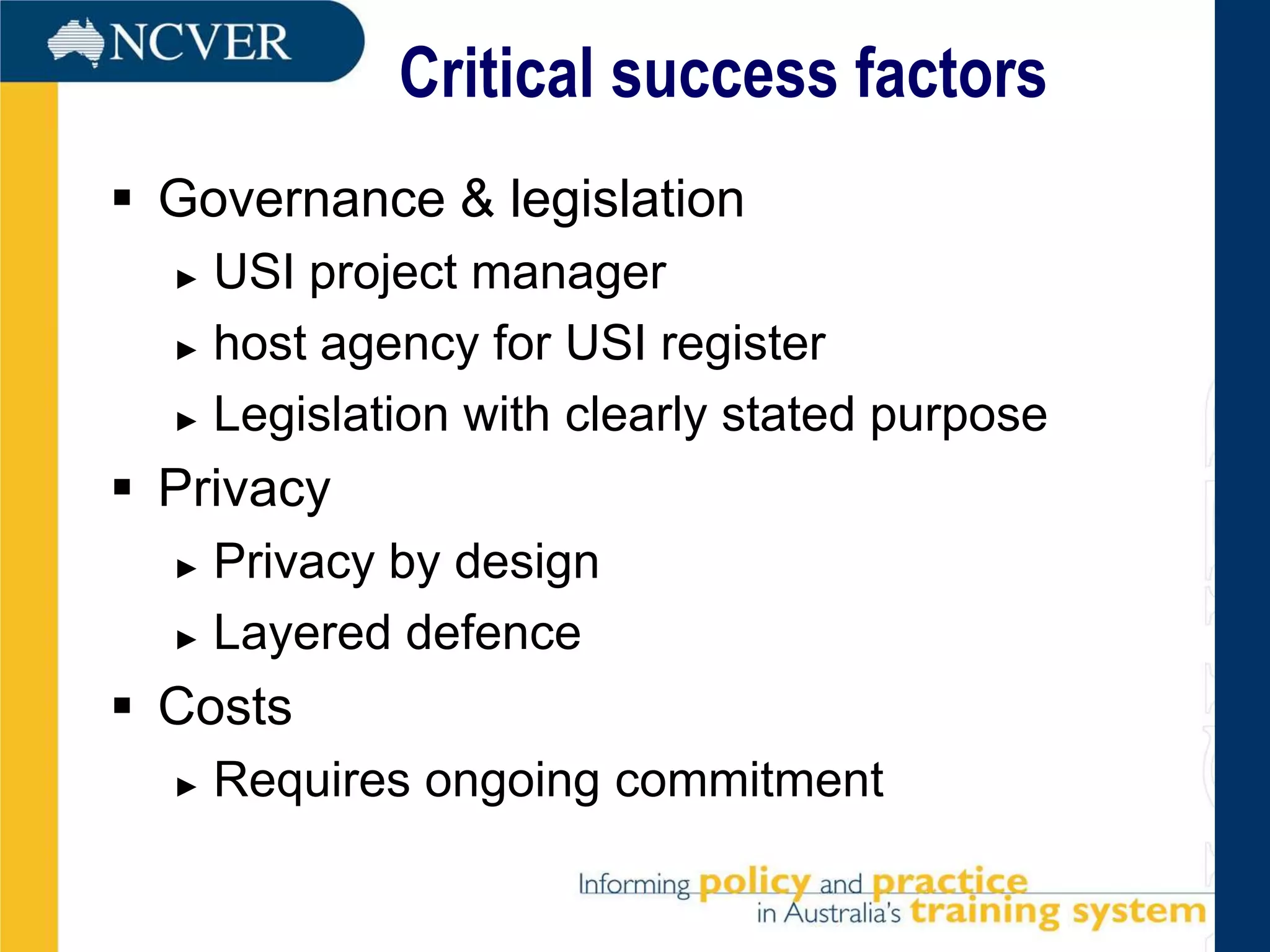
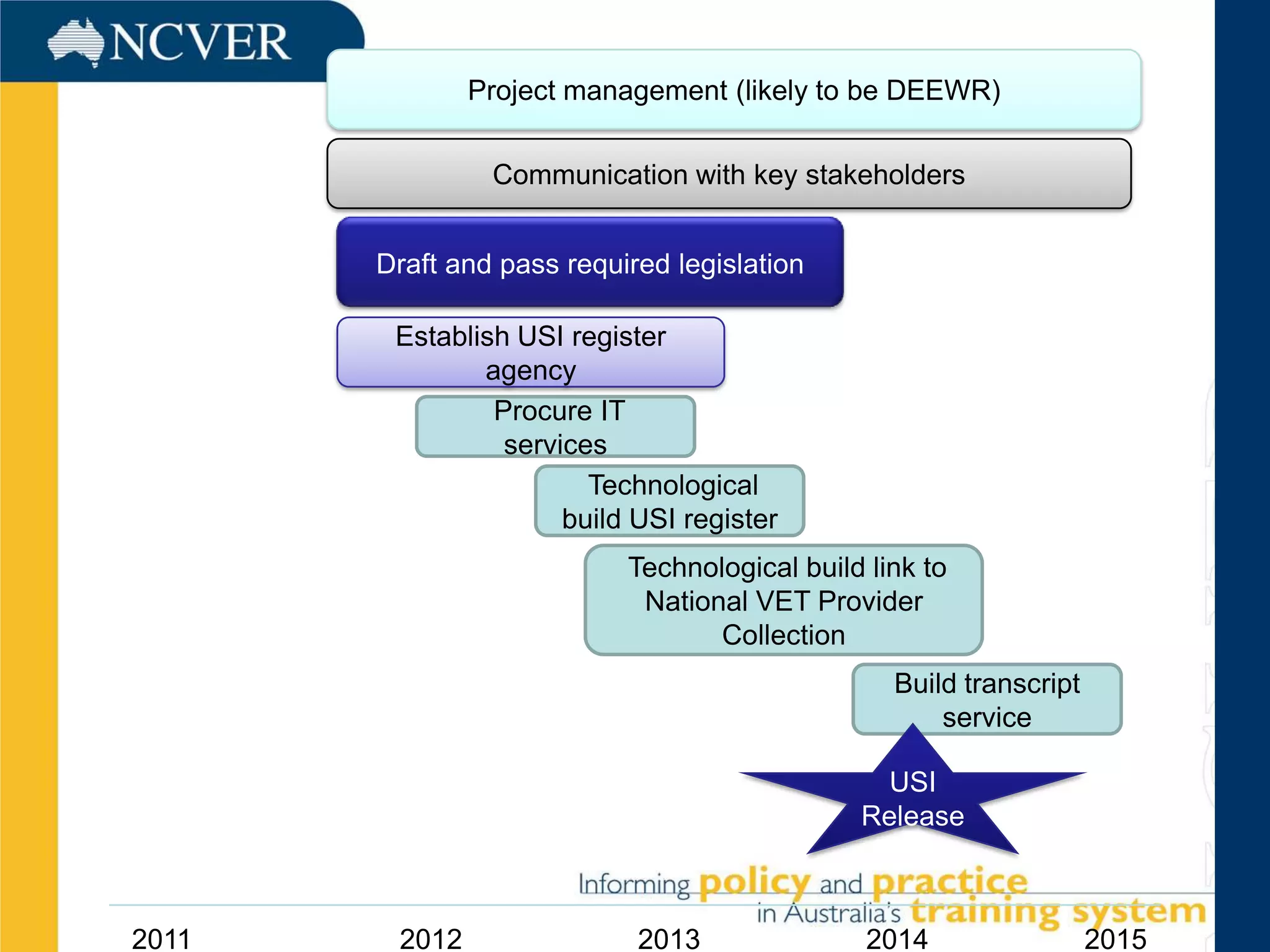
Project management (likelyto be DEEWR)
Communication with key stakeholders
Draft and pass required legislation
Establish USI register
agency
Procure IT
services
Technological
build USI register
Technological build link to
National VET Provider
Collection
Build transcript
service
USI
Release
2011 2012 2013 2014 2015
17.
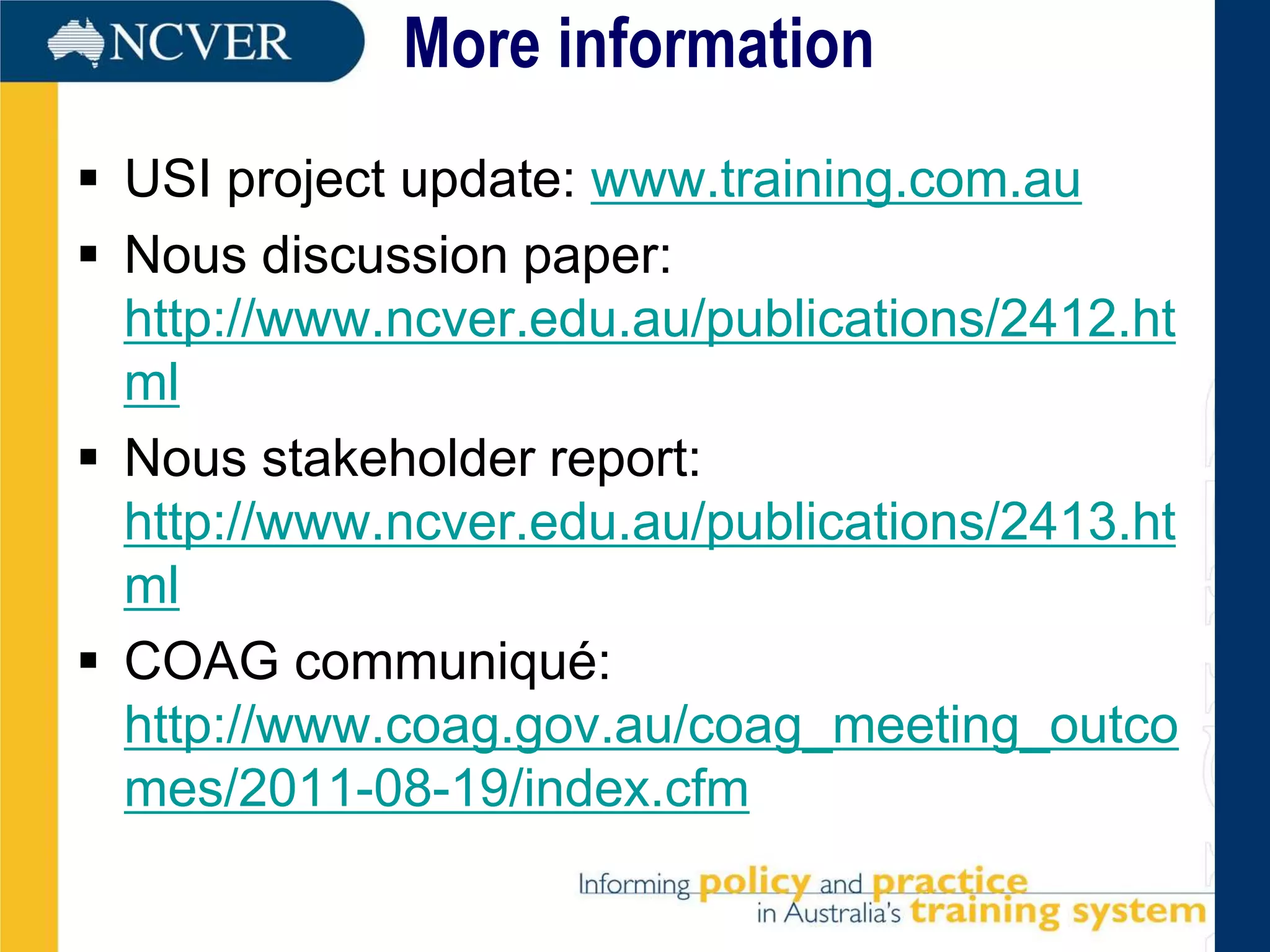
More information
USIproject update: www.training.com.au
Nous discussion paper:
http://www.ncver.edu.au/publications/2412.ht
ml
Nous stakeholder report:
http://www.ncver.edu.au/publications/2413.ht
ml
COAG communiqué:
http://www.coag.gov.au/coag_meeting_outco
mes/2011-08-19/index.cfm


![[EADTU-EU Online Summit] 5. Making Blended Education Work](https://cdn.slidesharecdn.com/ss_thumbnails/5-200430123901-thumbnail.jpg?width=640&height=640&fit=bounds)


