







Disruption in TEL
the way of the future
and the way to go
Professor Michael Sankey
Learning Futures
michael_sankey
Disruption is not limited to the music, newspaper, taxi and food delivery
industry, or to the provision of movies.
New models of educational delivery have also been emerging, thanks
largely to the affordance of new generational technologies and a willingness
to break with traditional forms of supply, to a more demand driven model.
These new business models, coupled with a slowness of the national
regulators, has caught some tertiary institutions on the back foot, but
some are now awakening from their slumber.
With the bolder ones not being afraid to mix their metaphors
Portland
Rio
Budapest
Melbourne
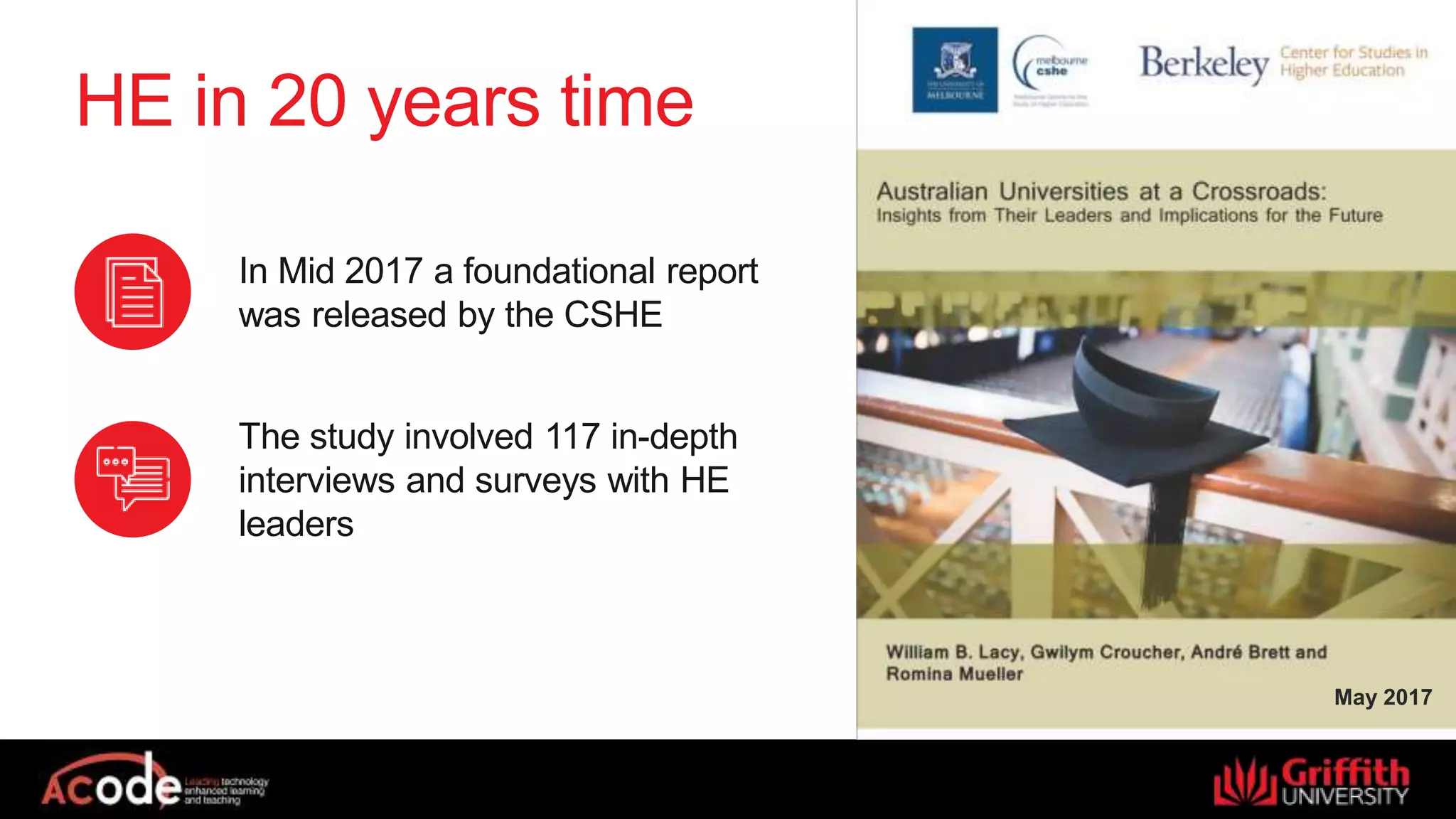
HE in 20 years time
May 2017
In Mid 2017 a foundational report
was released by the CSHE
The study involved 117 in-depth
interviews and surveys with HE
leaders
 All agreed that major
changes are coming.
As one leader remarked:
“I’m not at all confident that
the university or anything
like its current form will be
here for even 20 years.”
 Leaders commented on
the dynamic impact that
technology will have on
HE
 A Go8 VC framed it concisely:
“The digital realm penetrates
everything: how people access
information; how people see the
many different ways they can
interact with one another; how
they receive services; how they
can themselves interact with
services.”
 Another VC observed:
“Technology is going to change
the nature of both our interaction
with students and the nature of
the higher education system.”
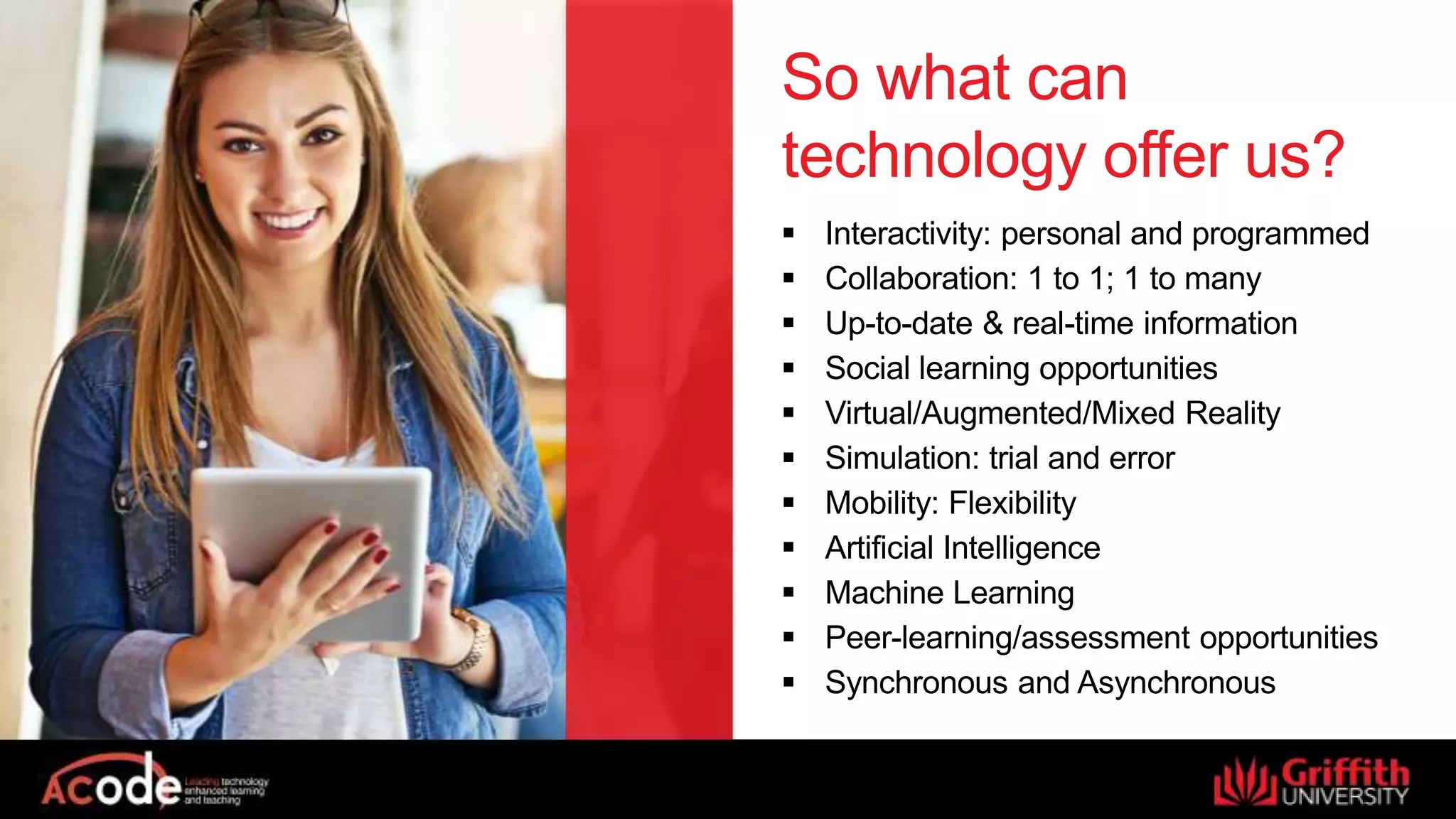
So what can
technology offer us?
 Interactivity: personal and programmed
 Collaboration: 1 to 1; 1 to many
 Up-to-date & real-time information
 Social learning opportunities
 Virtual/Augmented/Mixed Reality
 Simulation: trial and error
 Mobility: Flexibility
 Artificial Intelligence
 Machine Learning
 Peer-learning/assessment opportunities
 Synchronous and Asynchronous
Significant Challenges for
Technology Adoption in HE
Solvable
 Improving Digital Fluency
 Increasing Demand for Digital Learning Experience
and Instructional Design Expertise
Difficult
 The Evolving Roles of Faculty with Edtech Strategies
 Bridging the Achievement Gap
Wicked
 Advancing Digital Equity
 Rethinking the Practice of Teaching
KPMG – July 2018
 A national tertiary education and training system
 A tertiary education system with a revised Australian
Qualifications Framework at its centre
 A unified funding framework
 Greater funding transparency and accountability
 Independent tertiary education pricing authority
 A unified tertiary education loan scheme
 Regulatory arrangements
 Valuing teaching excellence
 Improving information on tertiary education outcomes
 Removing higher education provider categories
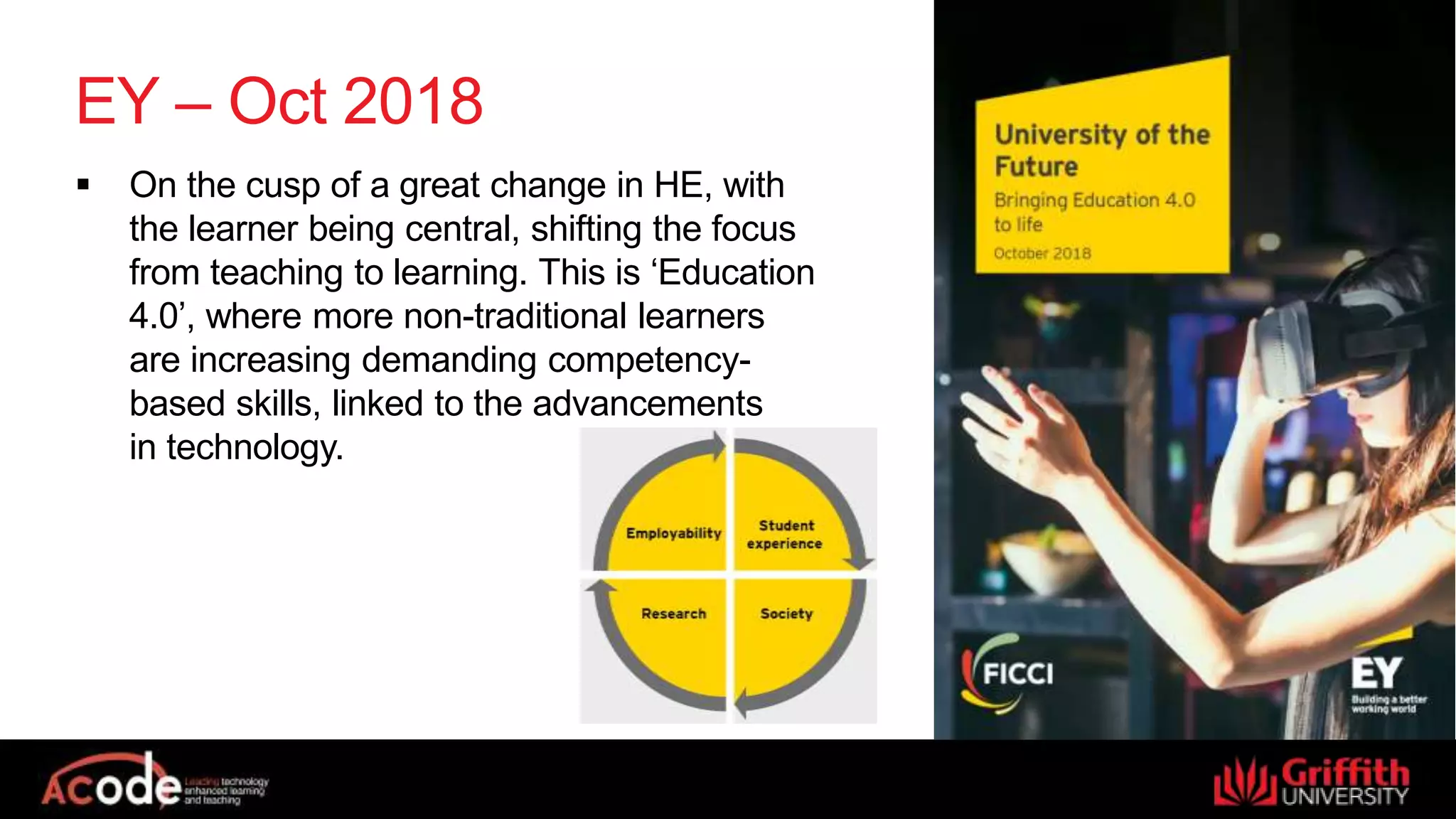
EY – Oct 2018
 On the cusp of a great change in HE, with
the learner being central, shifting the focus
from teaching to learning. This is ‘Education
4.0’, where more non-traditional learners
are increasing demanding competency-
based skills, linked to the advancements
in technology.
EY - 2018
 50+ uni leaders, government policy makers & industry
observers.
 Surveys & focus groups with 3,000+ students &
employers.
 Embark on double transformation to optimise & grow
 Make the shift from being faculty-focused to learner-
centric
 Integrate with industry to co-create & collaborate
 Re-imagine the physical campus for the digital world
 Unbundle degree programs & the university value chain
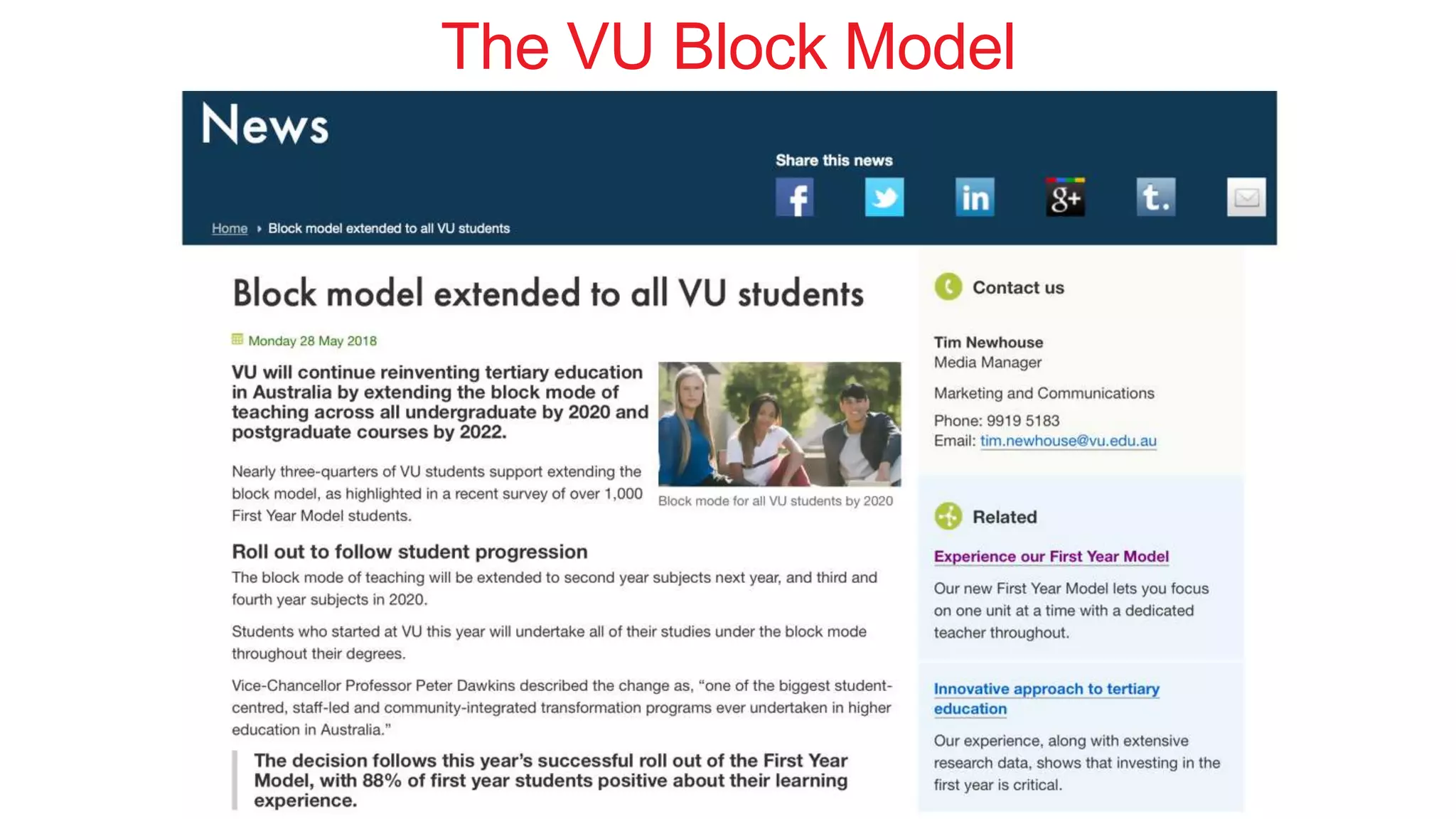
The VU Block Model
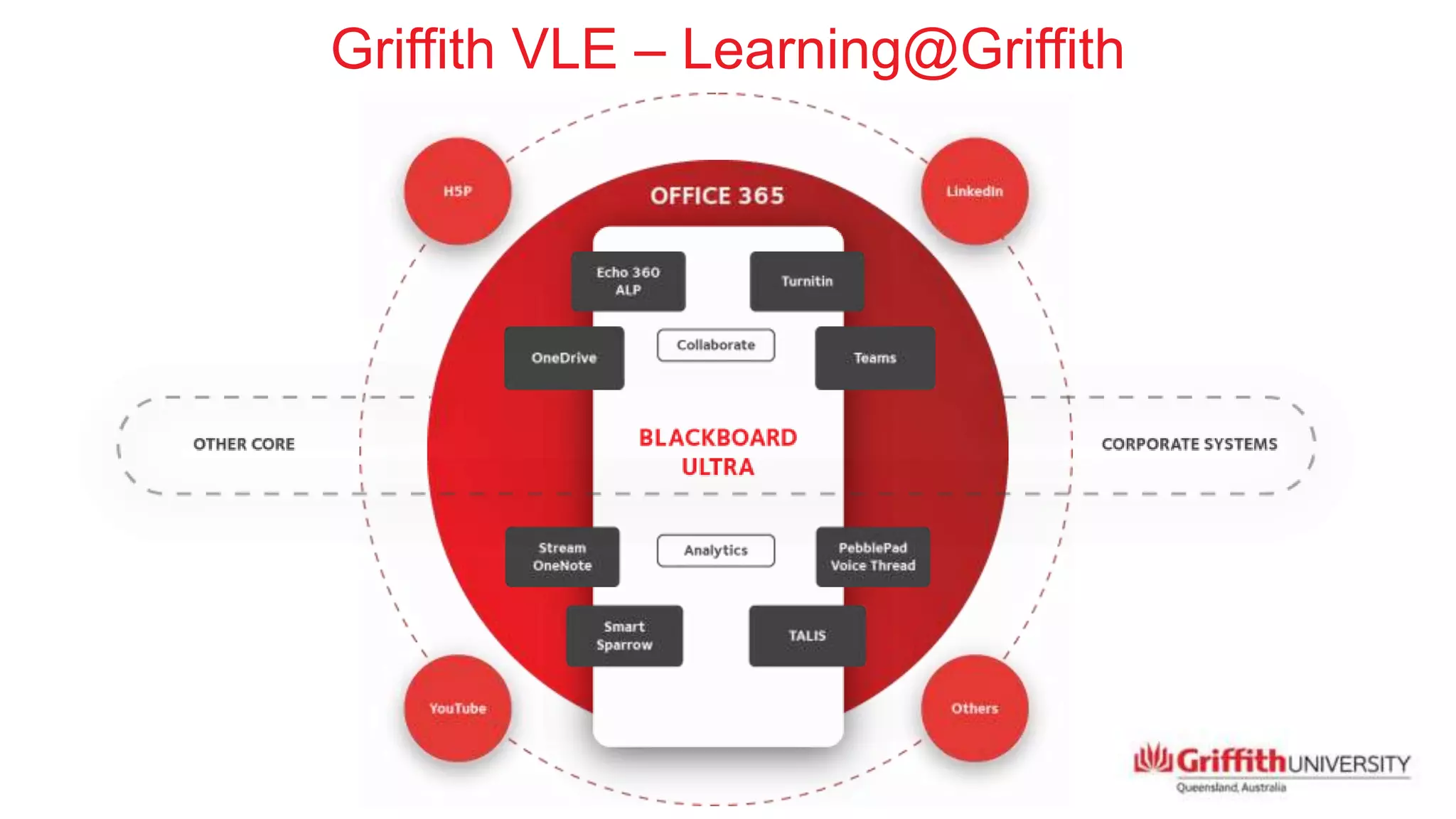
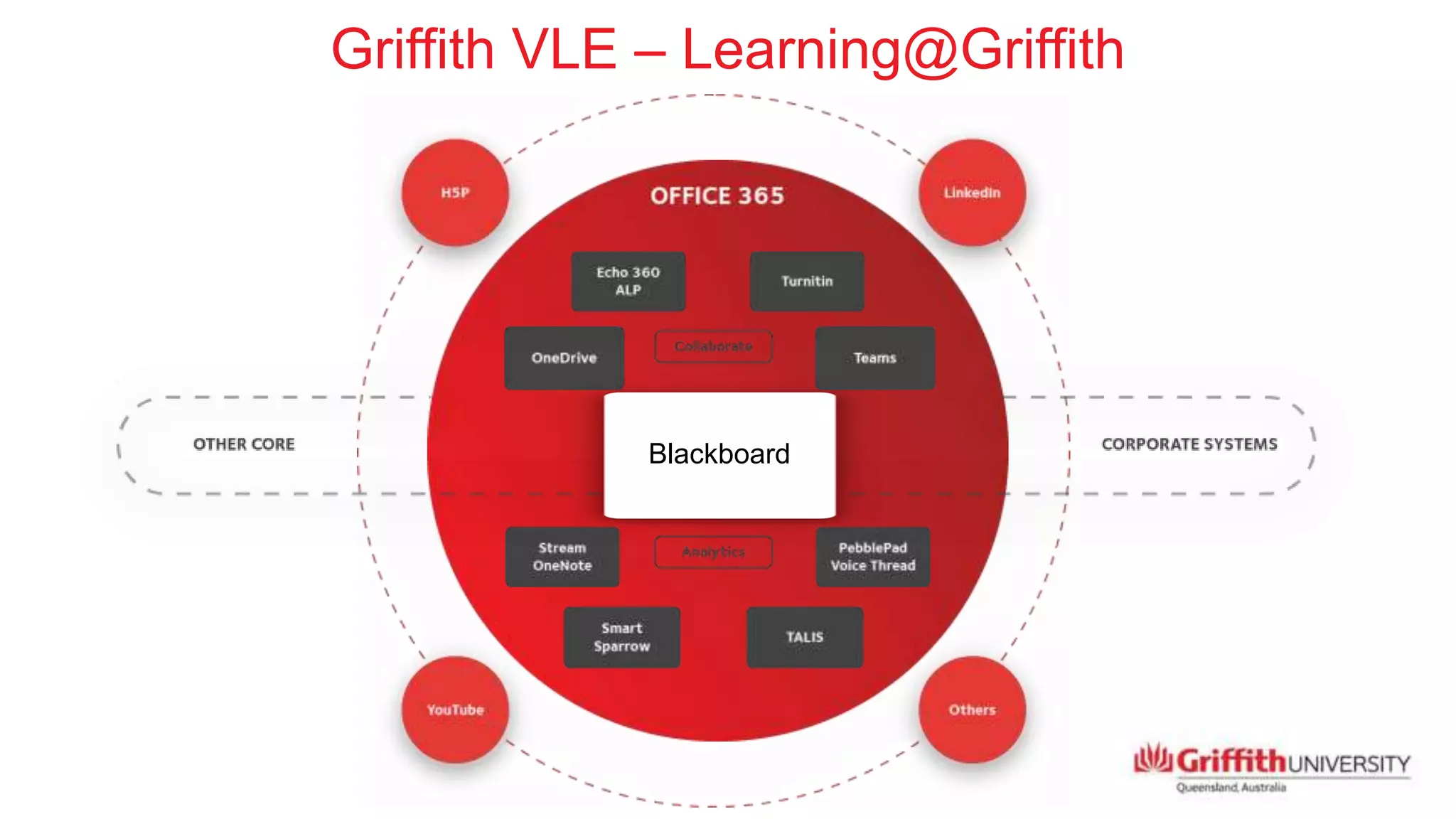
Griffith VLE – Learning@Griffith
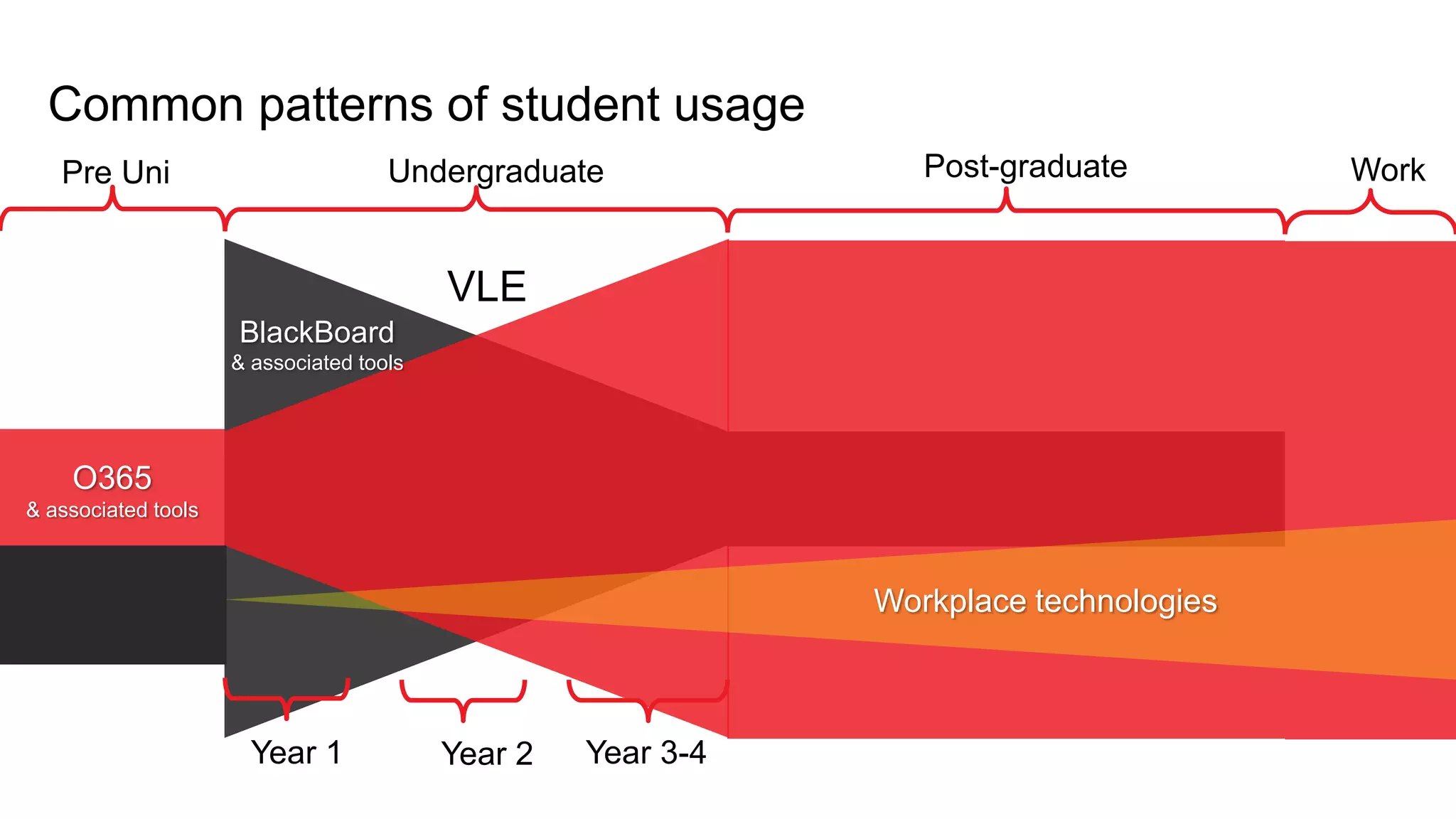
BlackBoard
& associated tools
O365
& associated tools
Pre Uni Undergraduate Post-graduate Work
Year 1 Year 2 Year 3-4
Common patterns of student usage
VLE
Workplace technologies
Griffith VLE – Learning@Griffith
Blackboard
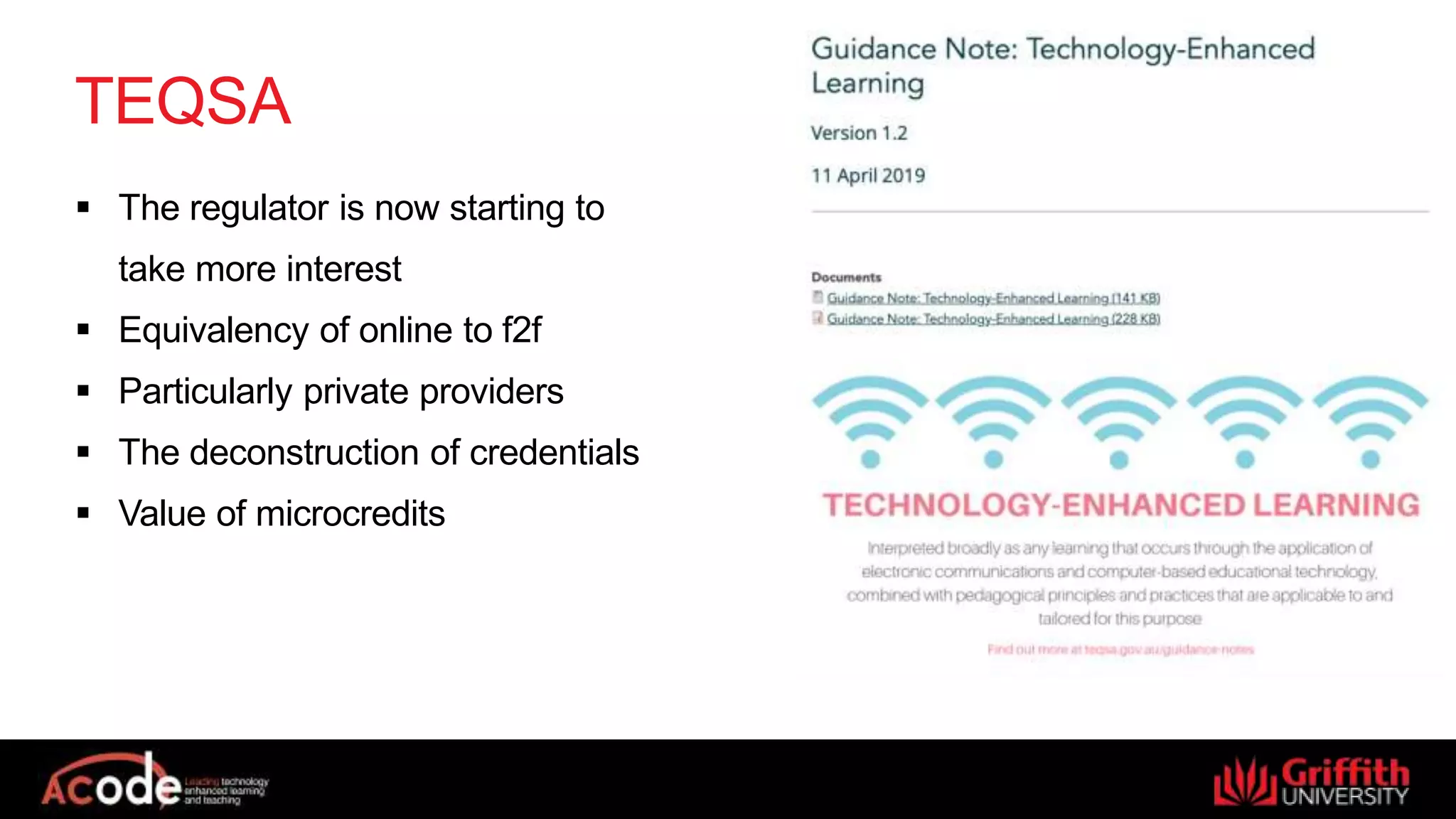
TEQSA
 The regulator is now starting to
take more interest
 Equivalency of online to f2f
 Particularly private providers
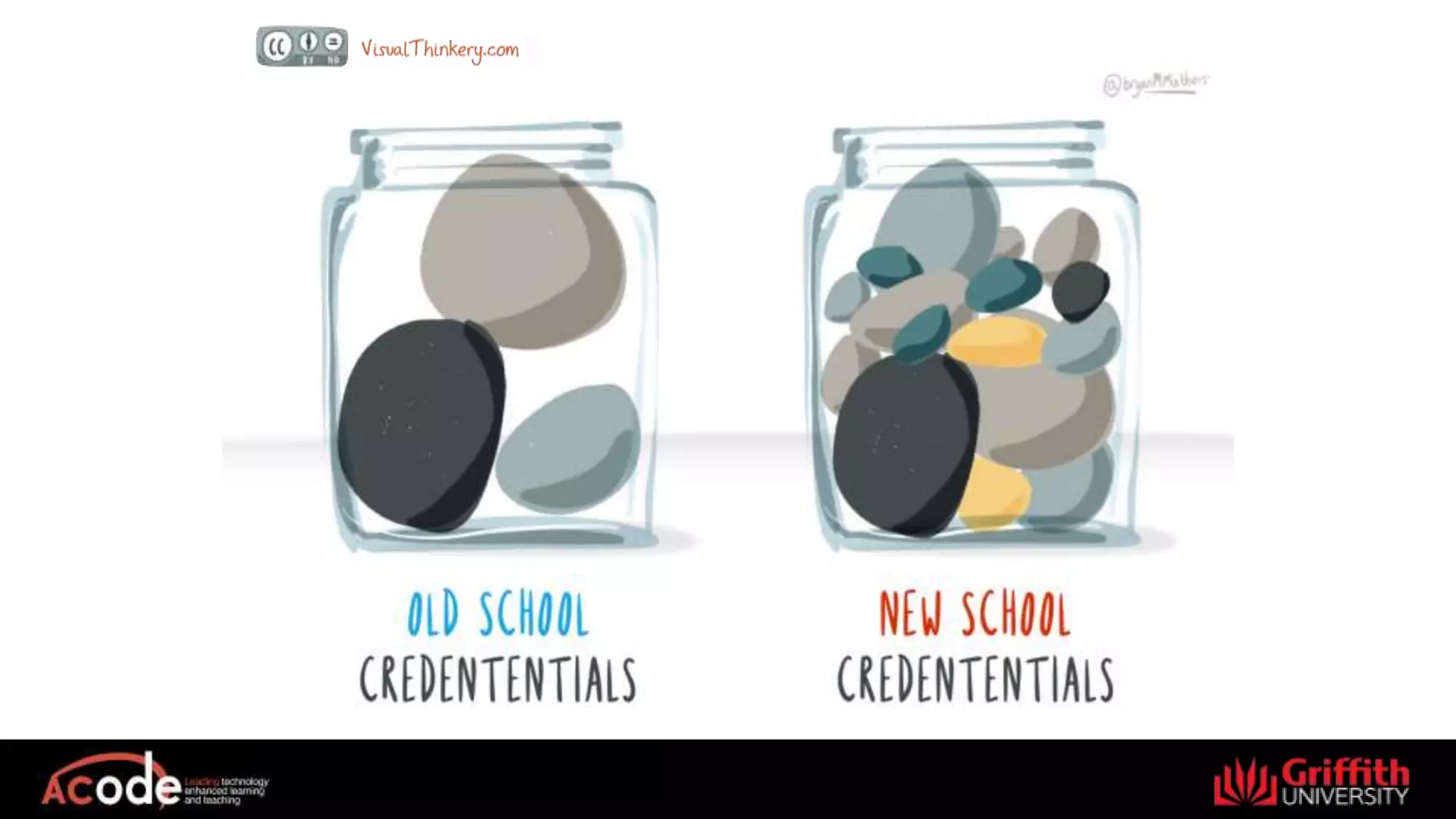
 The deconstruction of credentials
 Value of microcredits
Quality in TEL
 We know students are seeking consistency
within their courses/units in the online
learning environment
 Institutions also want a level of consistency
for the learning outcomes between f2f and
online courses
 This means institutions need to have
frameworks and quality processes in place
to ensure both course quality and process
quality
 Over the last few year as more institutions
have turned to online a focus on the quality
of these offerings at the course/unit quality
 But It takes a village to raise a child
4 main forms currently
seen in the sector
1. Post-grad courses and programs based
on credentialing/selling RPL
2. Post-grad courses built-up by
undertaking many shorter courses
(usually grad-cert)
3. Under-grad: series of short accredited
courses to augment a fuller program
(typically x4 = 1)
4. Under-grad: non-accredited, or
co-curricular courses to demonstrate
experience and enhance portfolio
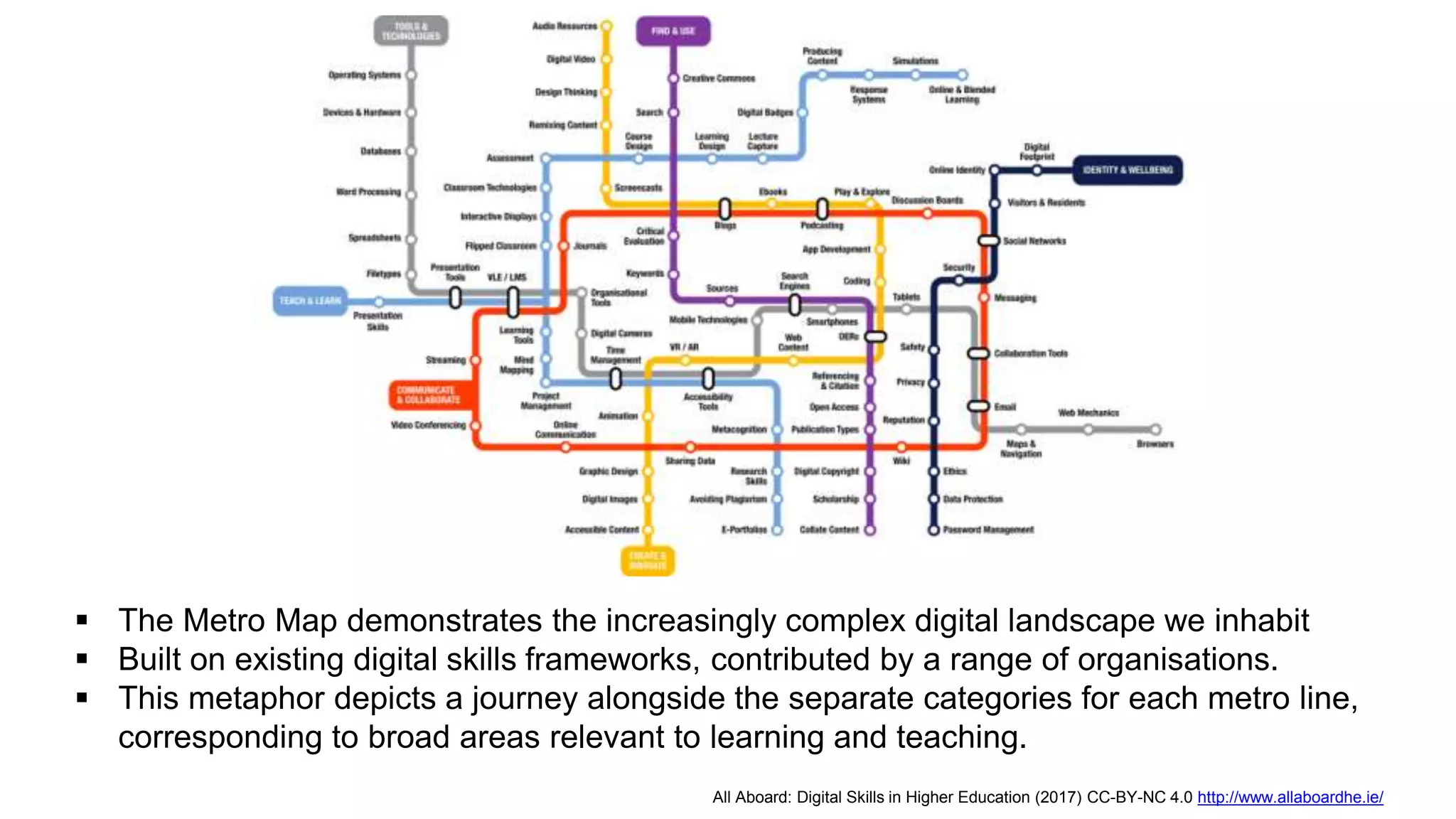
 The Metro Map demonstrates the increasingly complex digital landscape we inhabit
 Built on existing digital skills frameworks, contributed by a range of organisations.
 This metaphor depicts a journey alongside the separate categories for each metro line,
corresponding to broad areas relevant to learning and teaching.
All Aboard: Digital Skills in Higher Education (2017) CC-BY-NC 4.0 http://www.allaboardhe.ie/
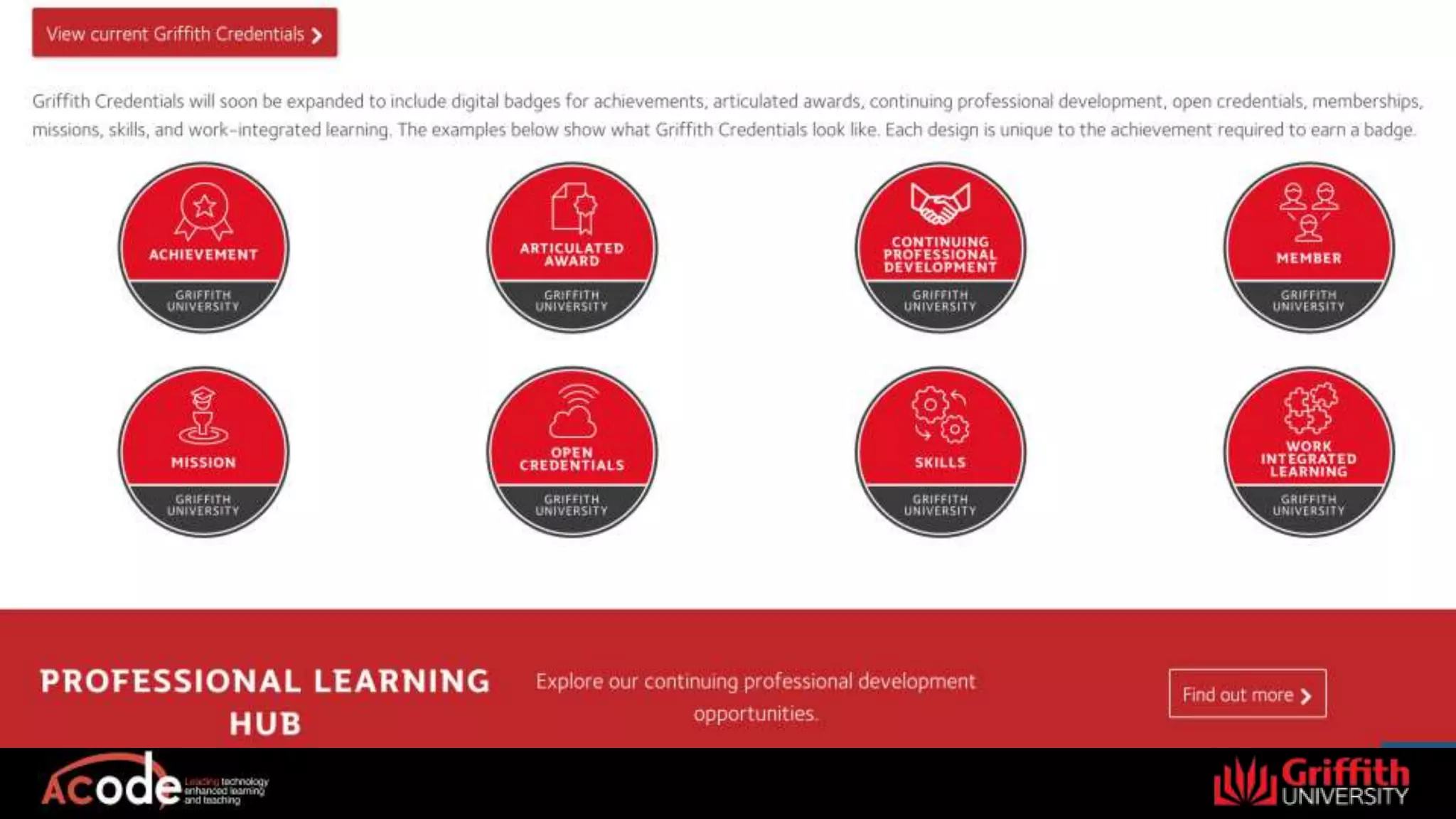
Micro-Credentials
 Learning doesn't have to be packaged into
multi-year chunks
 It can be broken up into less than 30-hour
chunks and priced/awarded accordingly
 Short, low-cost online courses that result
in a digital badge or credential when
learners complete one of them and
certified when a series is completed
 "For higher ed, that's an opportunity to
really provide those services to students
so they can continue to build their
professional portfolios"
 Offers Universities an opportunity to bridge
skill gaps
http://www.centerdigitaled.com/higher-ed/Why-Micro-Credentials-Universities.html
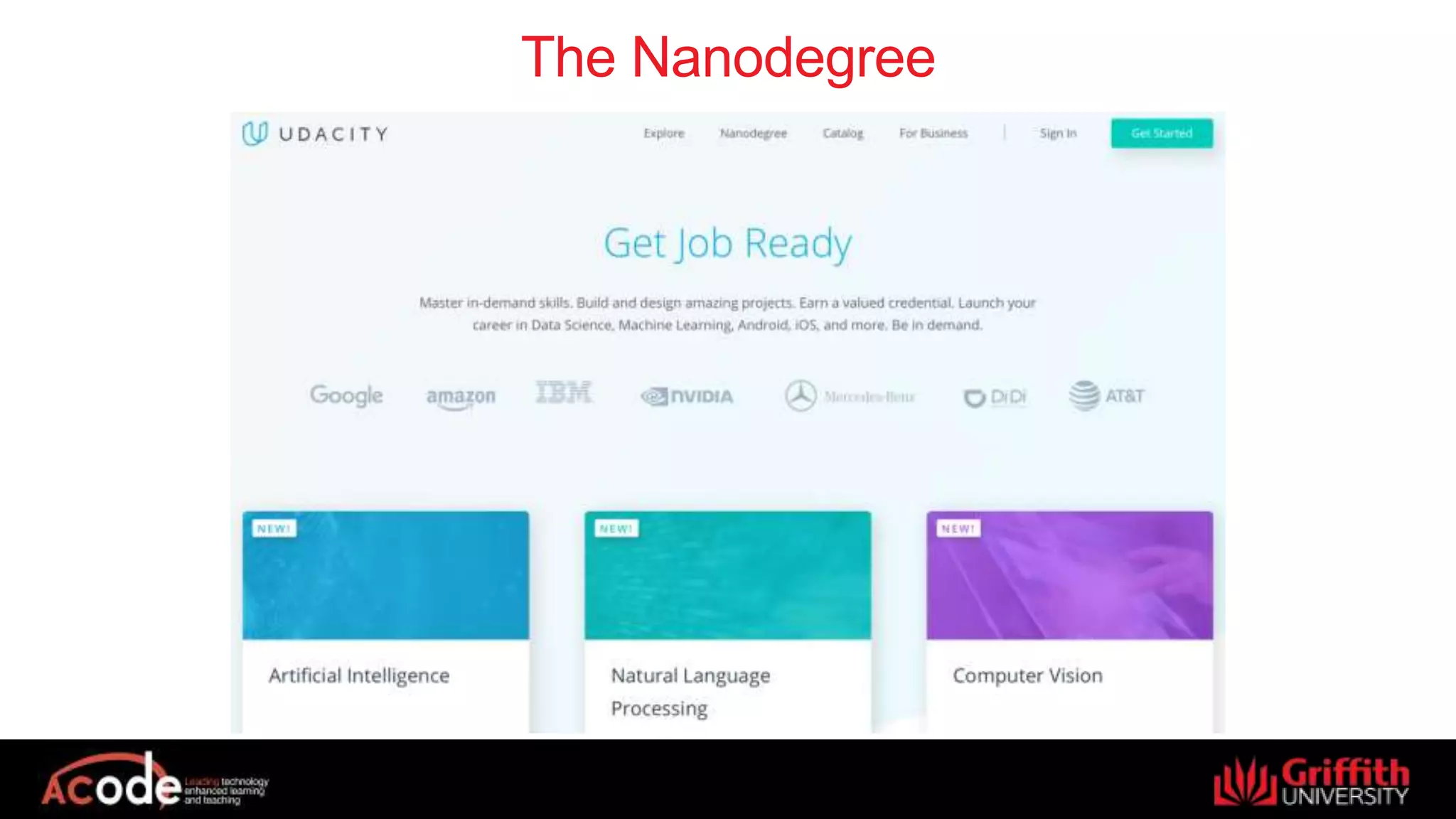
The Nanodegree
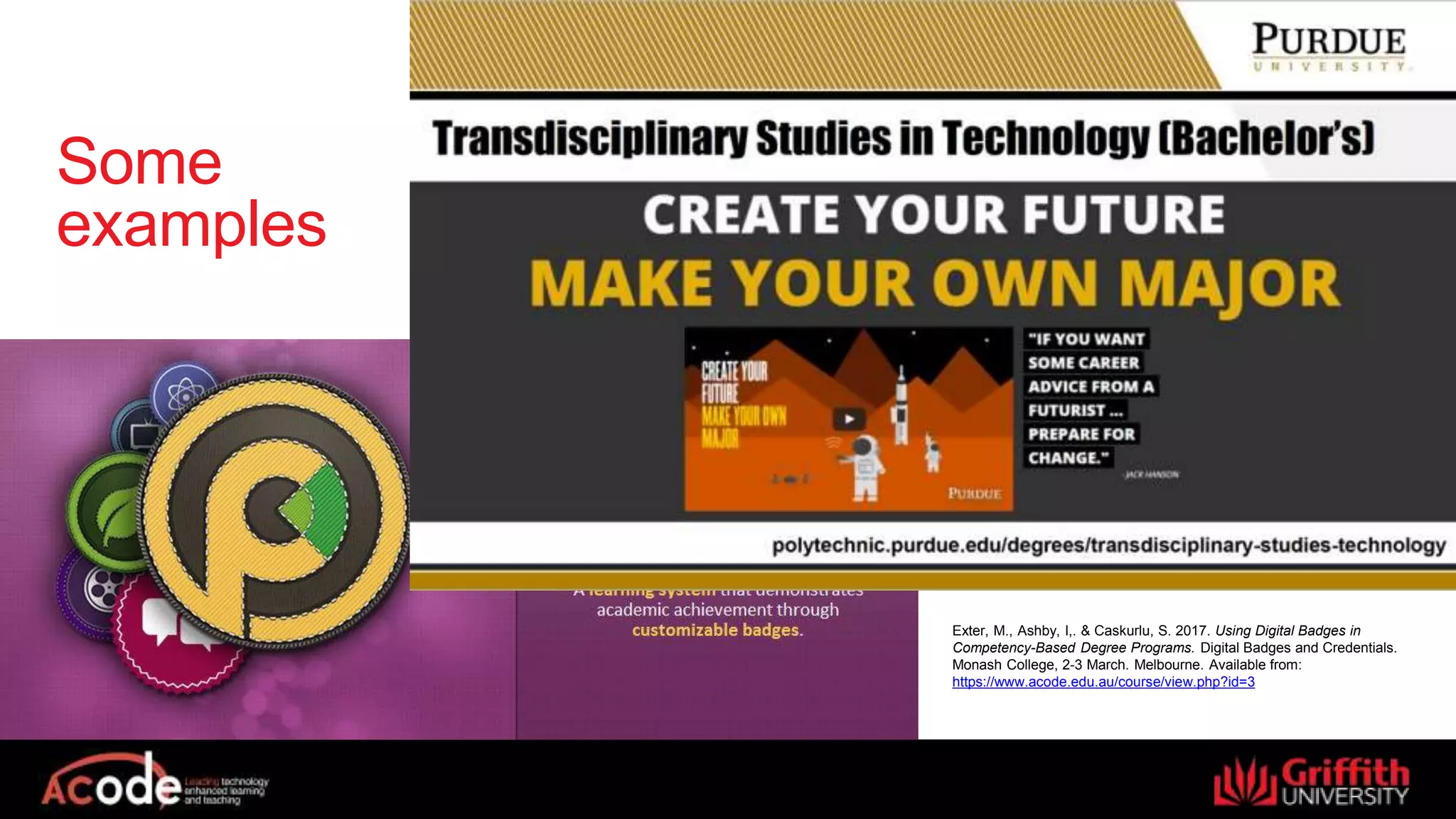
Some
examples
Exter, M., Ashby, I,. & Caskurlu, S. 2017. Using Digital Badges in
Competency-Based Degree Programs. Digital Badges and Credentials.
Monash College, 2-3 March. Melbourne. Available from:
https://www.acode.edu.au/course/view.php?id=3
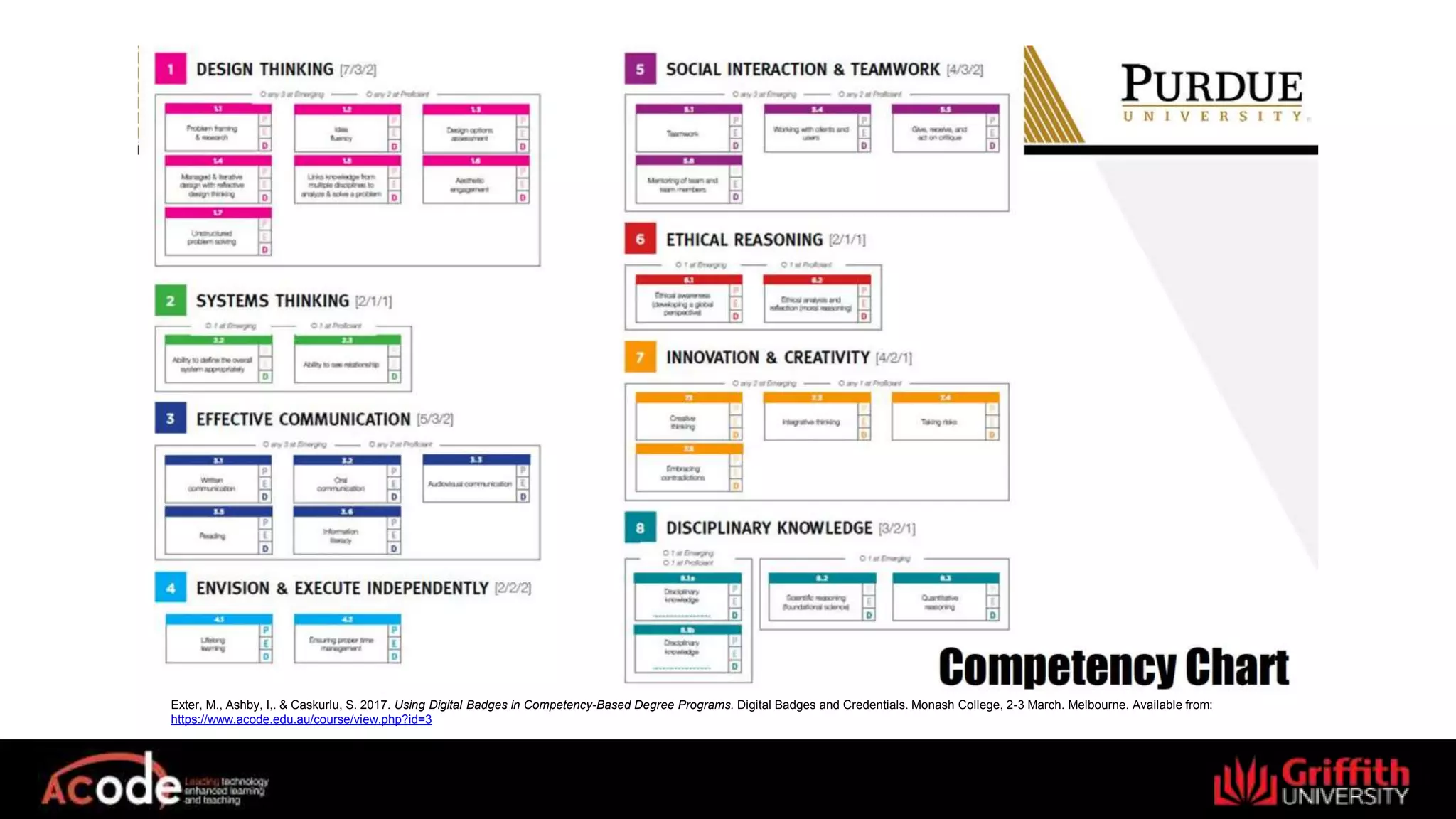
Exter, M., Ashby, I,. & Caskurlu, S. 2017. Using Digital Badges in Competency-Based Degree Programs. Digital Badges and Credentials. Monash College, 2-3 March. Melbourne. Available from:
https://www.acode.edu.au/course/view.php?id=3
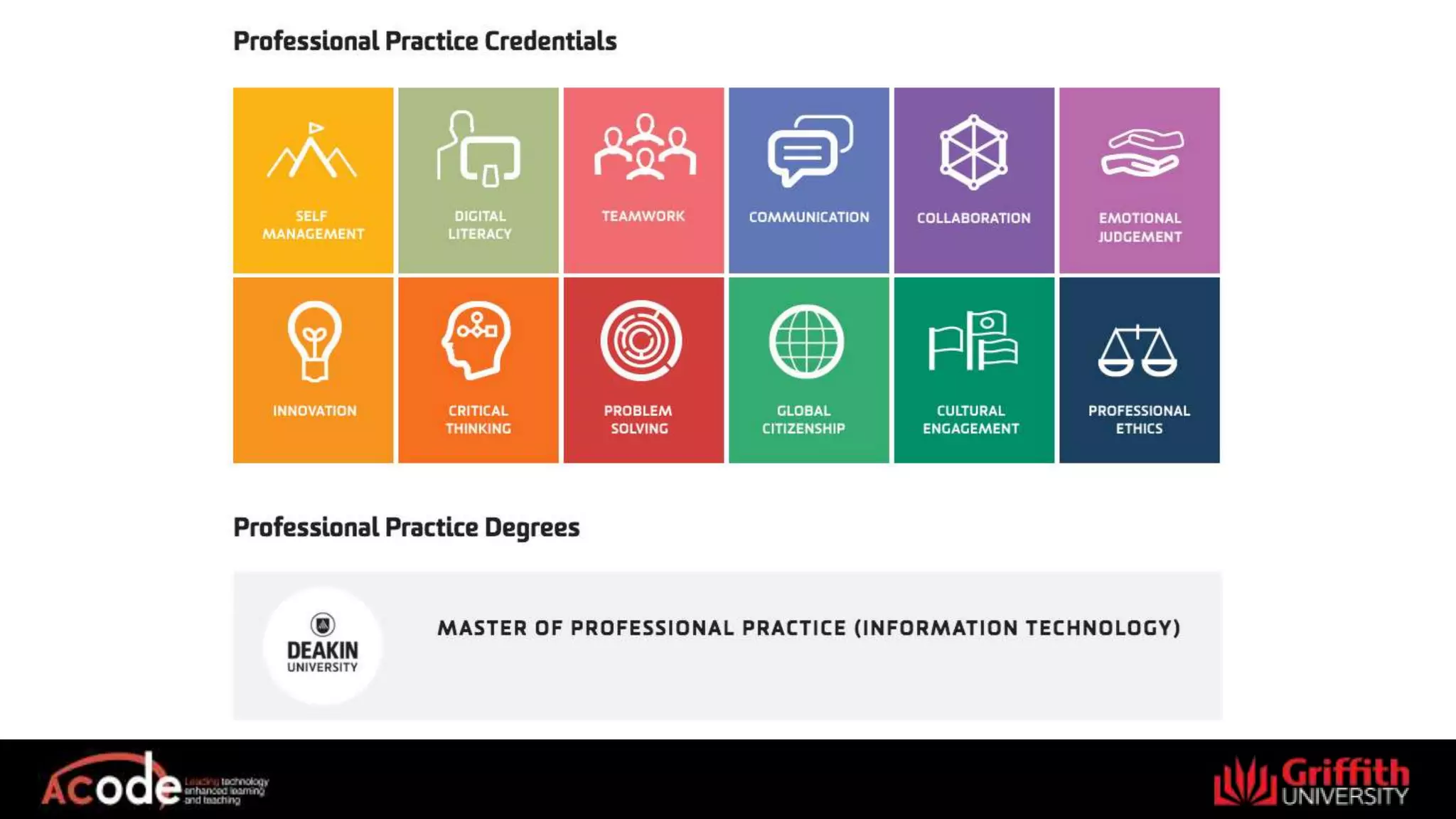
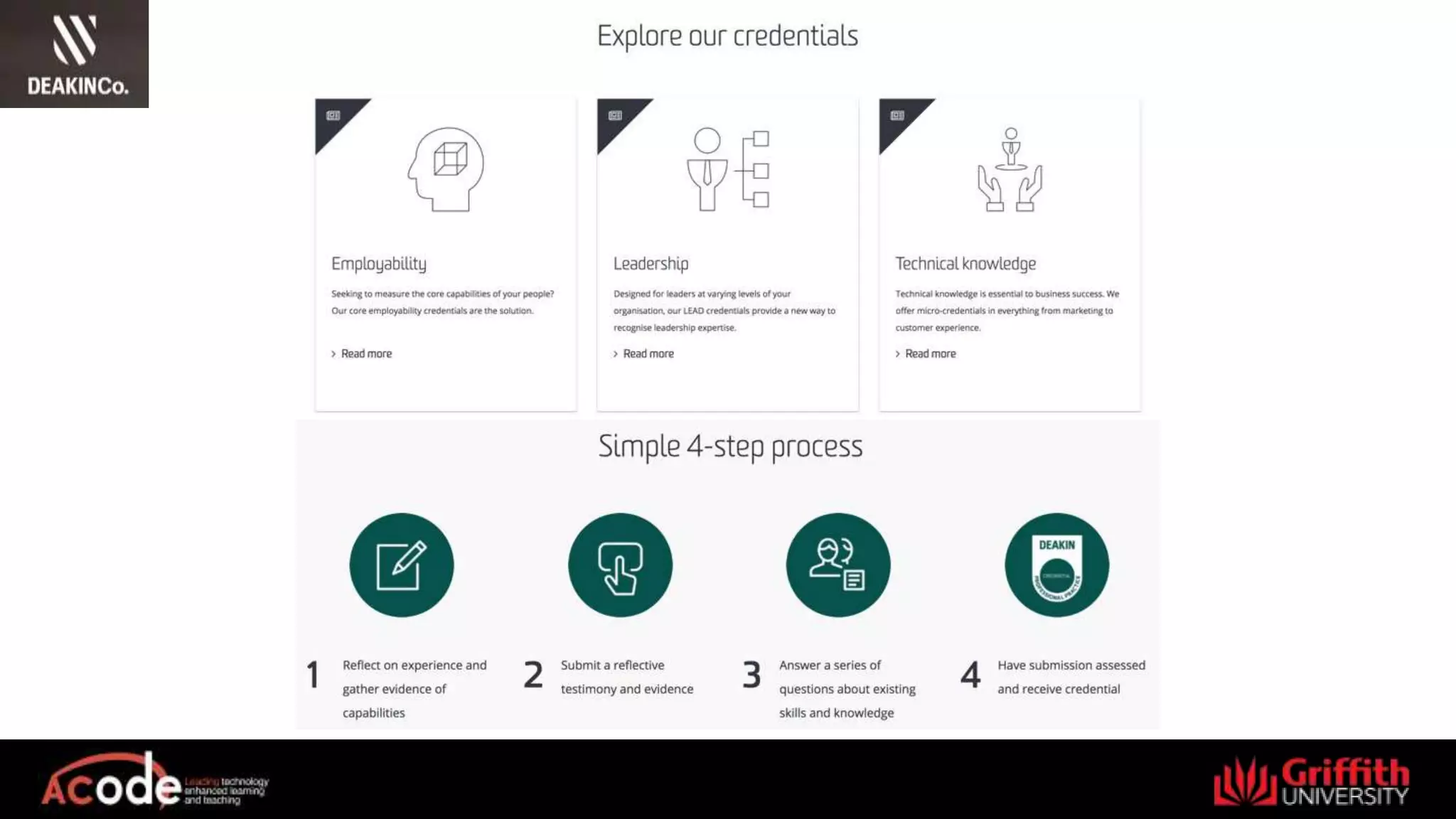
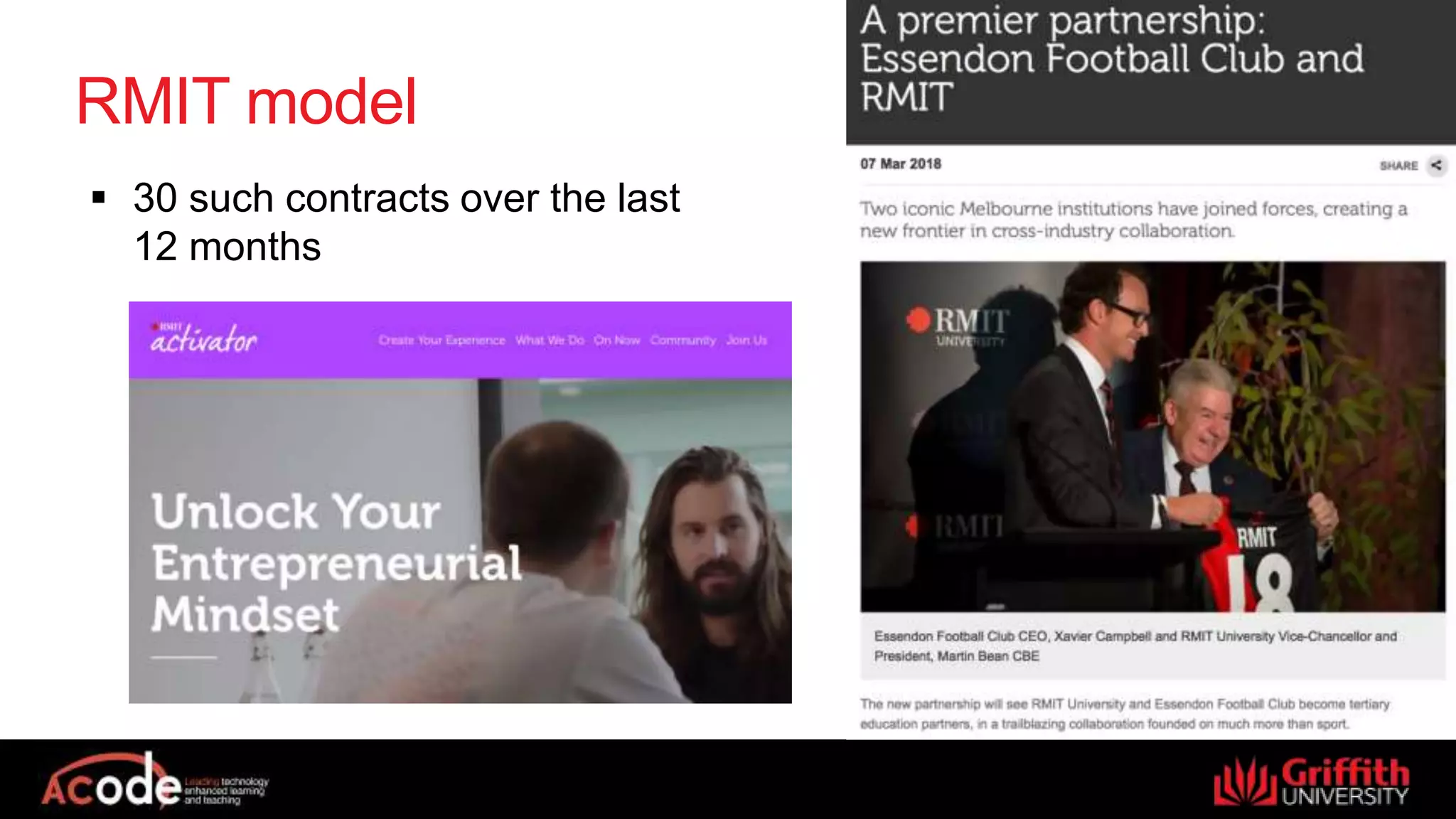
RMIT model
 30 such contracts over the last
12 months
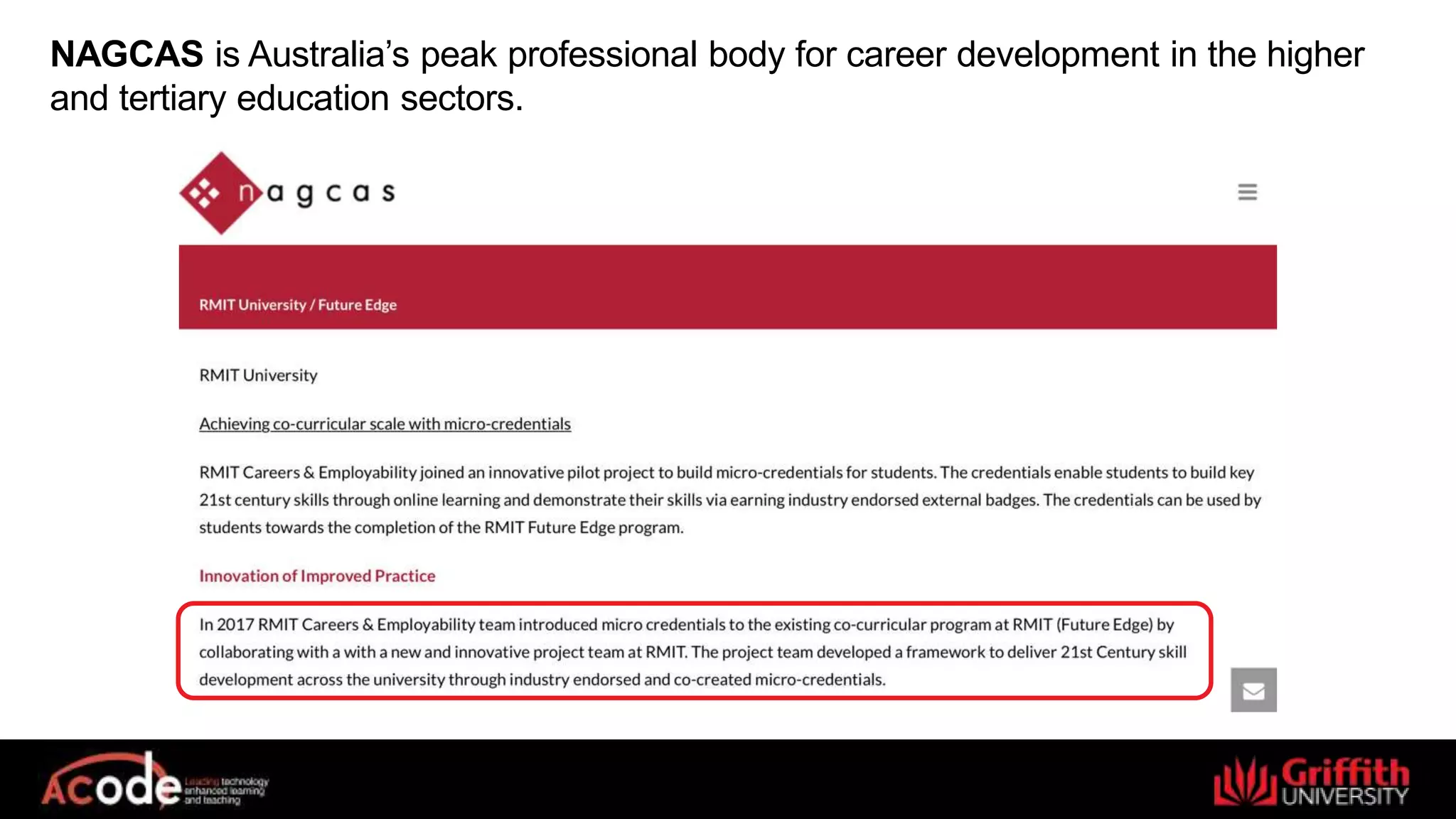
NAGCAS is Australia’s peak professional body for career development in the higher
and tertiary education sectors.
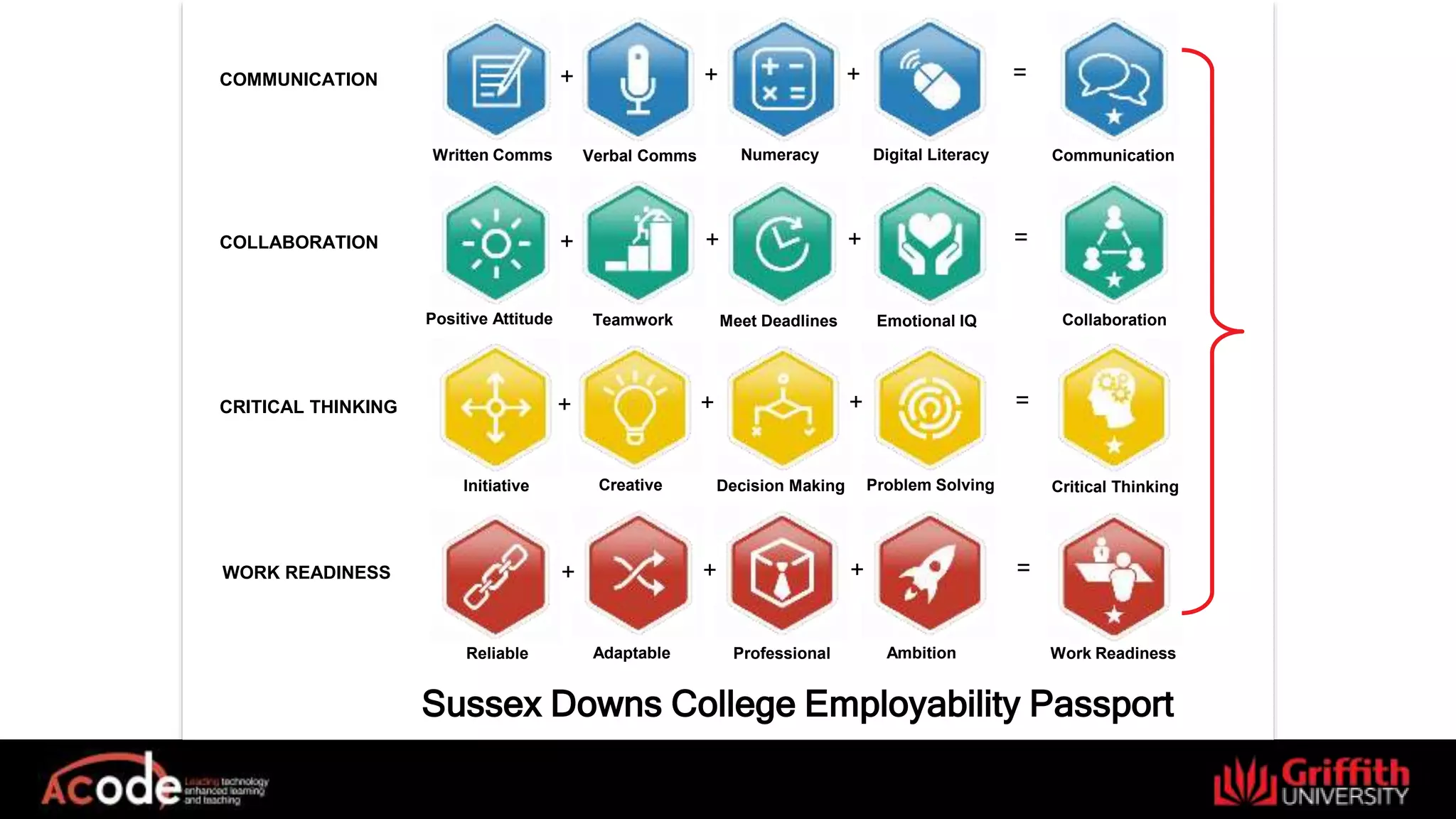
Digital Literacy
COMMUNICATION
COLLABORATION
CRITICAL THINKING
WORK READINESS
NumeracyVerbal CommsWritten Comms
Sussex Downs College Employability Passport
Positive Attitude Teamwork Meet Deadlines Emotional IQ
Initiative Creative Decision Making Problem Solving
Reliable Adaptable Professional Ambition
Communication
Collaboration
Critical Thinking
Work Readiness
+ + + =
+ + + =
+ + + =
+ + + =
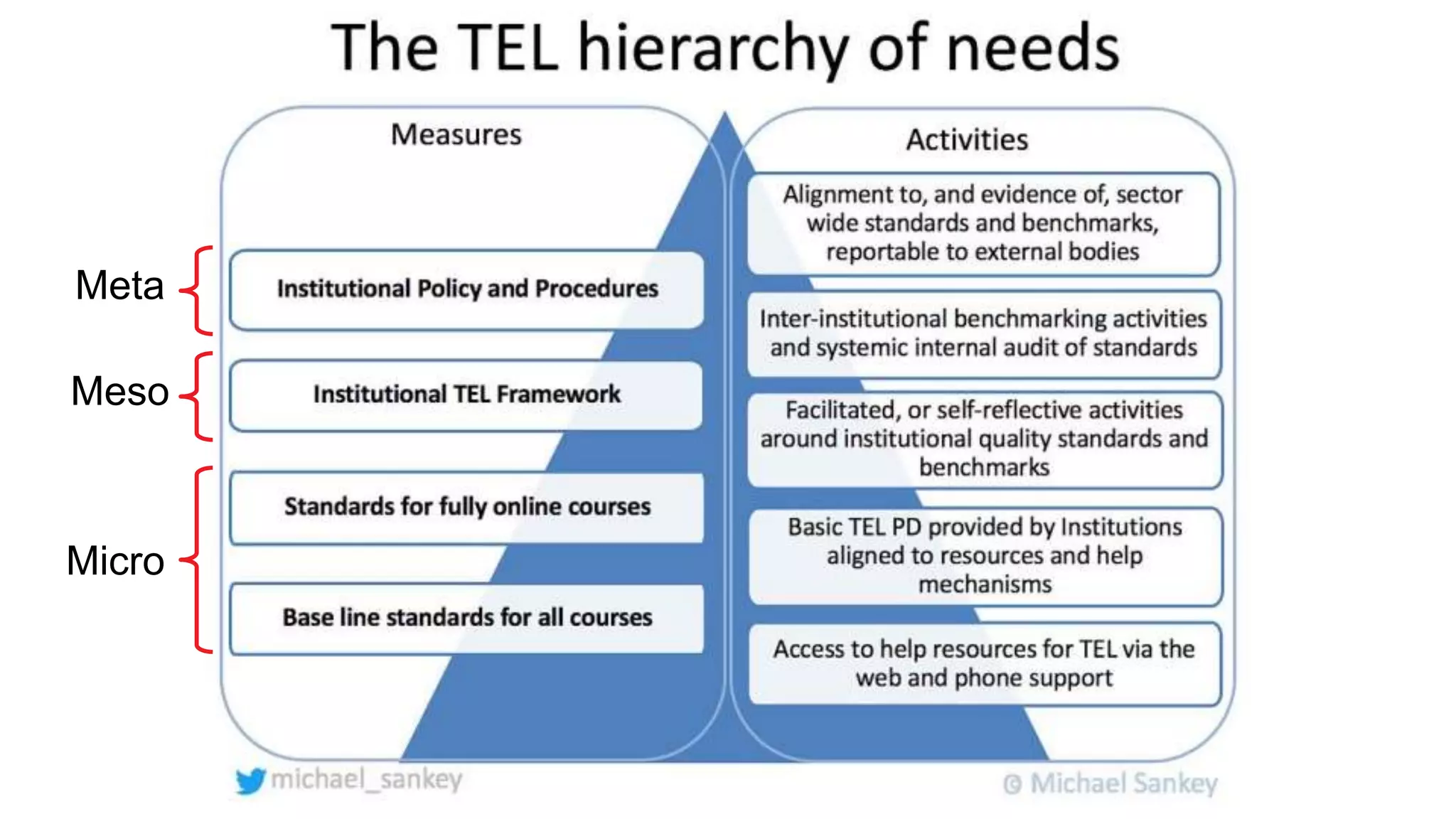
Meta
Meso
Micro
michael_sankey
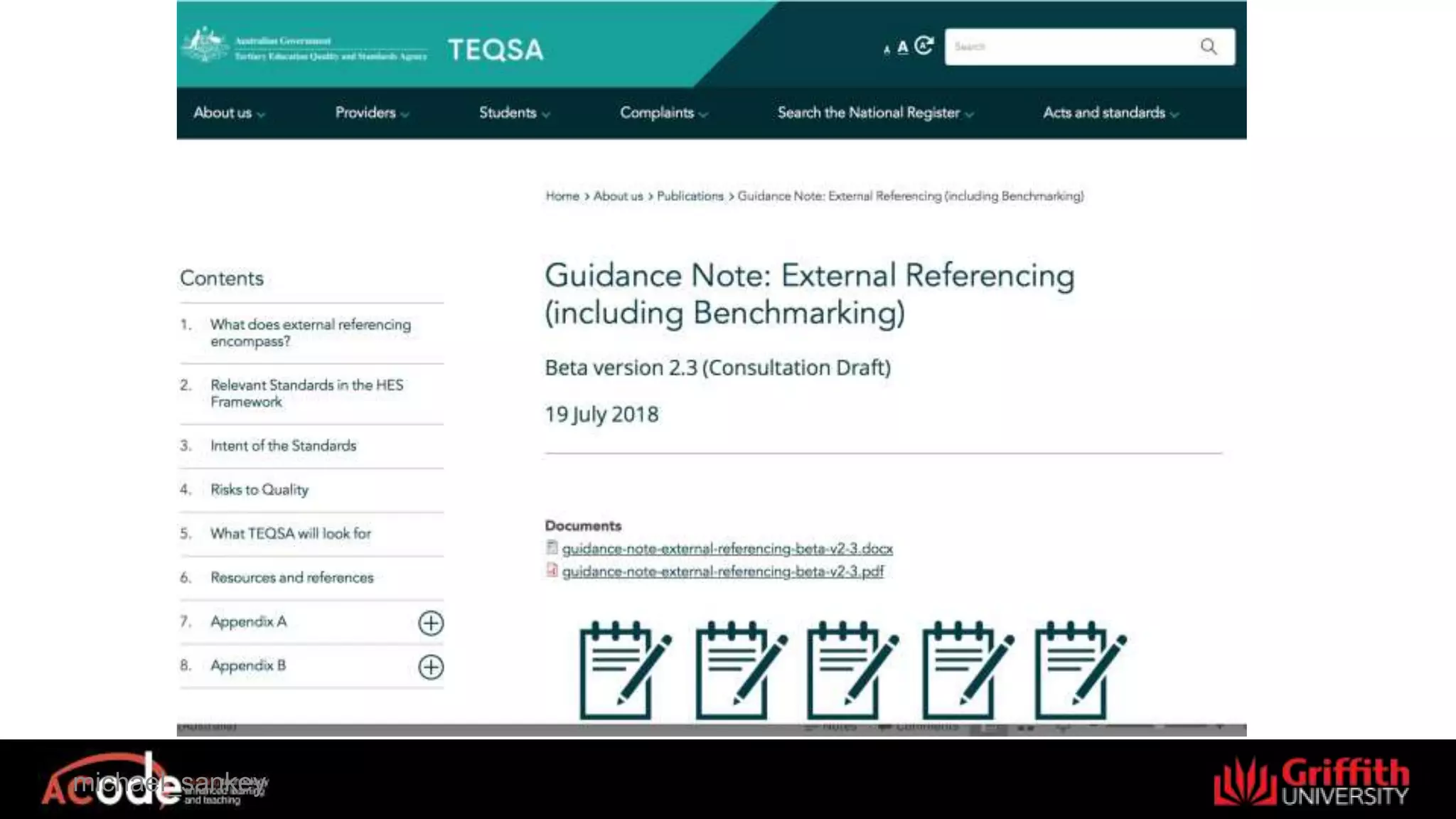
Monitoring, review and improvement processes can and should encompass review
against comparators, both internal to the provider and external.
A number of approaches and techniques can be used for external referencing,
such as benchmarking, peer review and moderation. Benchmarking is perhaps the
most elaborate form of external referencing and typically consists of focused
improvement through relationships with a benchmarking partner or partners, but
can also include comparing course design against publicly-available information
and market intelligence. Further detail on benchmarking practice is given in the
Appendices A and B below.
michael_sankey
michael_sankey
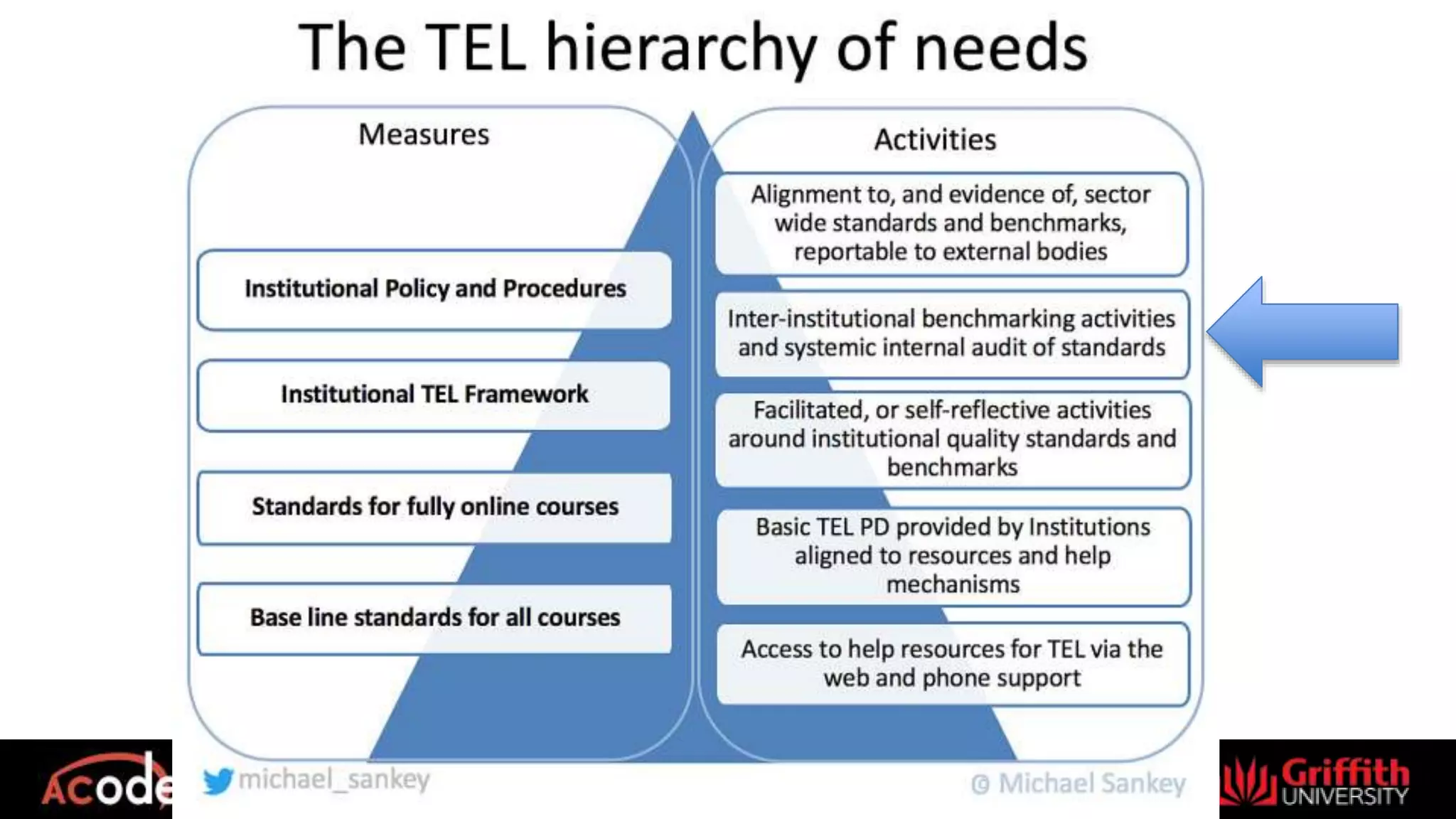
A few ways to do this at the institution level
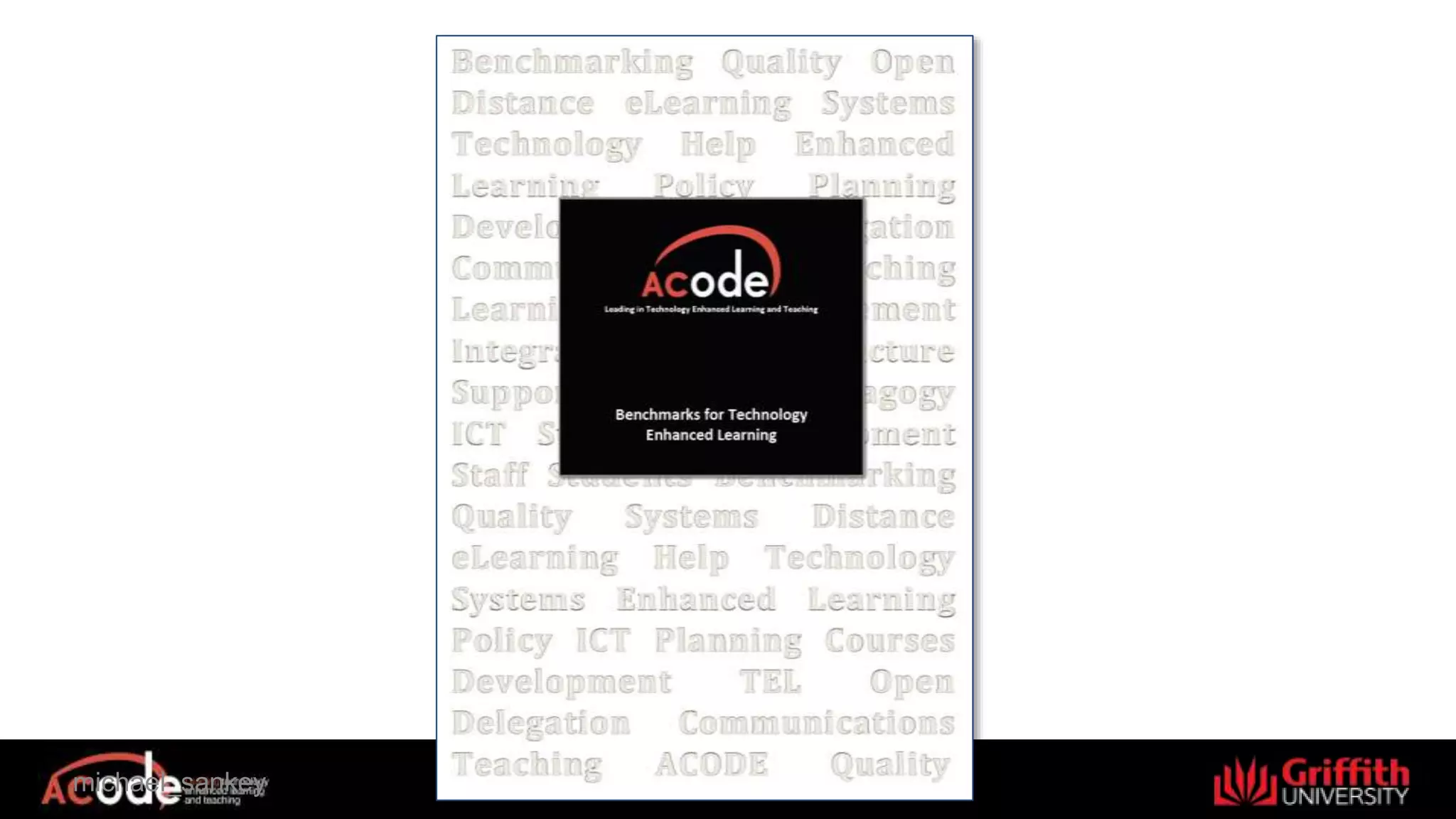
 ACODE Benchmarks
 E-Learning Maturity Model (EMM)
 European set associated with eExcellence
 OLC Quality Score Card and Toolkit
 ICDE
 COL
michael_sankey
michael_sankey
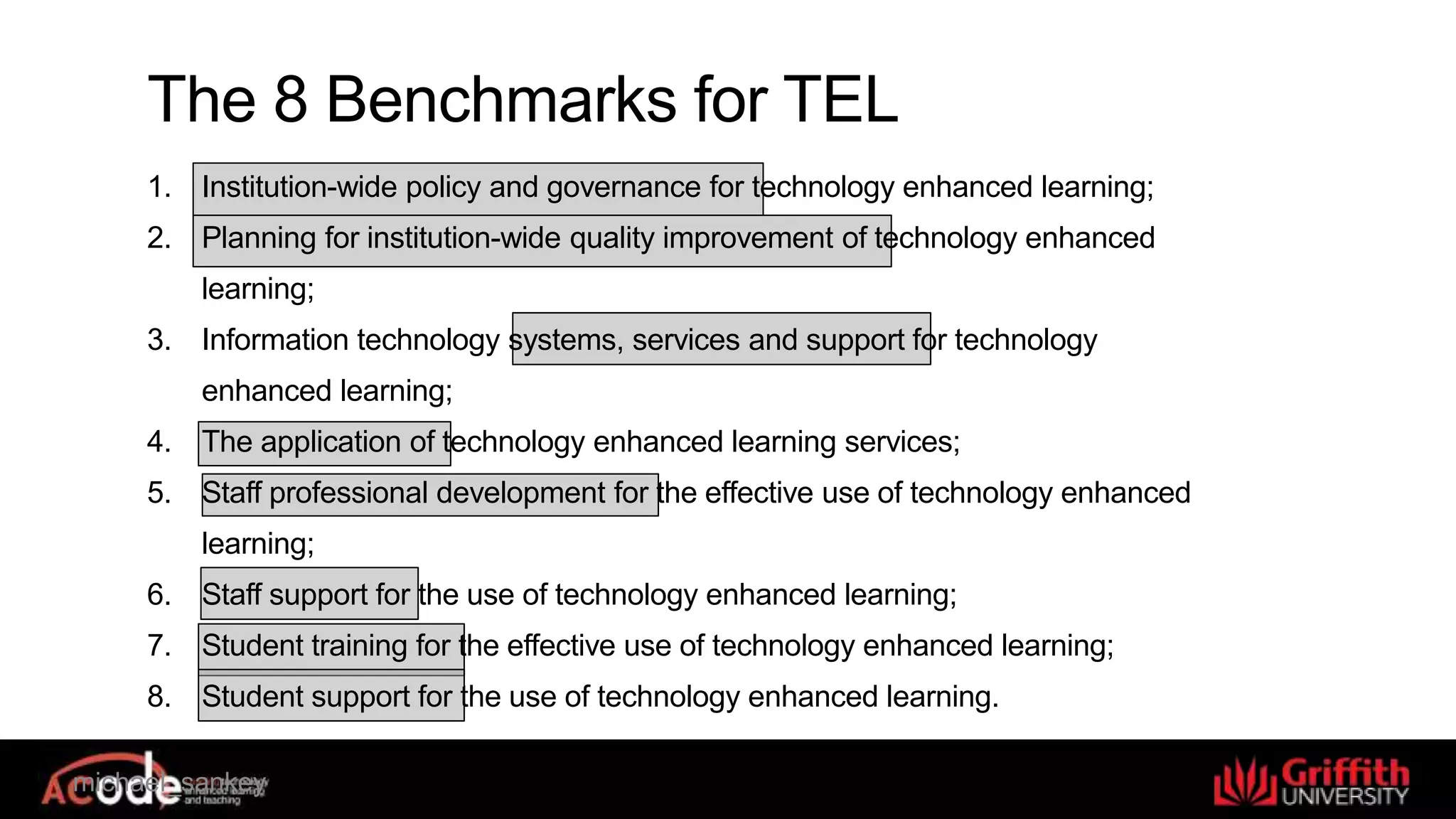
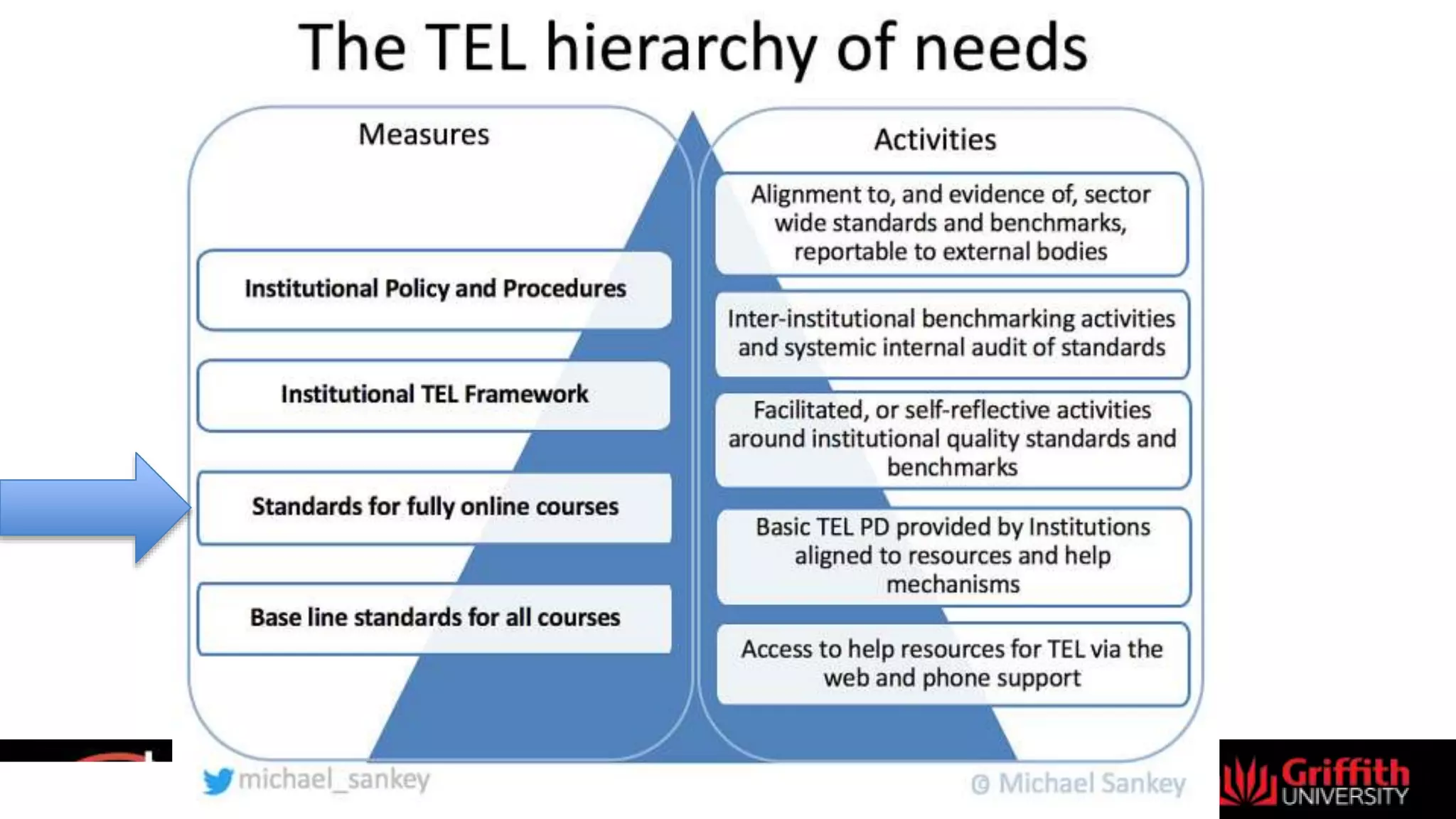
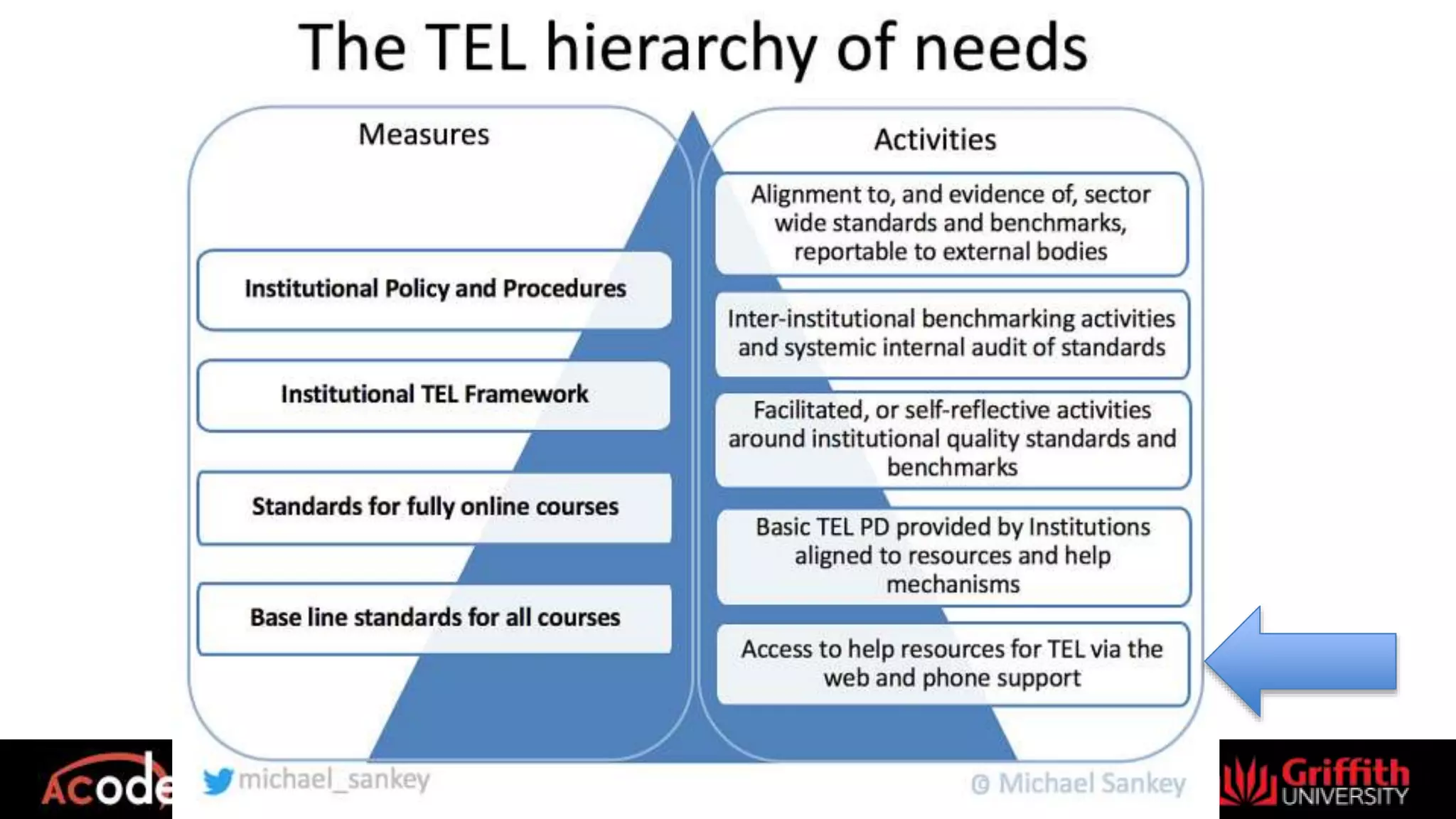
The 8 Benchmarks for TEL
1. Institution-wide policy and governance for technology enhanced learning;
2. Planning for institution-wide quality improvement of technology enhanced
learning;
3. Information technology systems, services and support for technology
enhanced learning;
4. The application of technology enhanced learning services;
5. Staff professional development for the effective use of technology enhanced
learning;
6. Staff support for the use of technology enhanced learning;
7. Student training for the effective use of technology enhanced learning;
8. Student support for the use of technology enhanced learning.
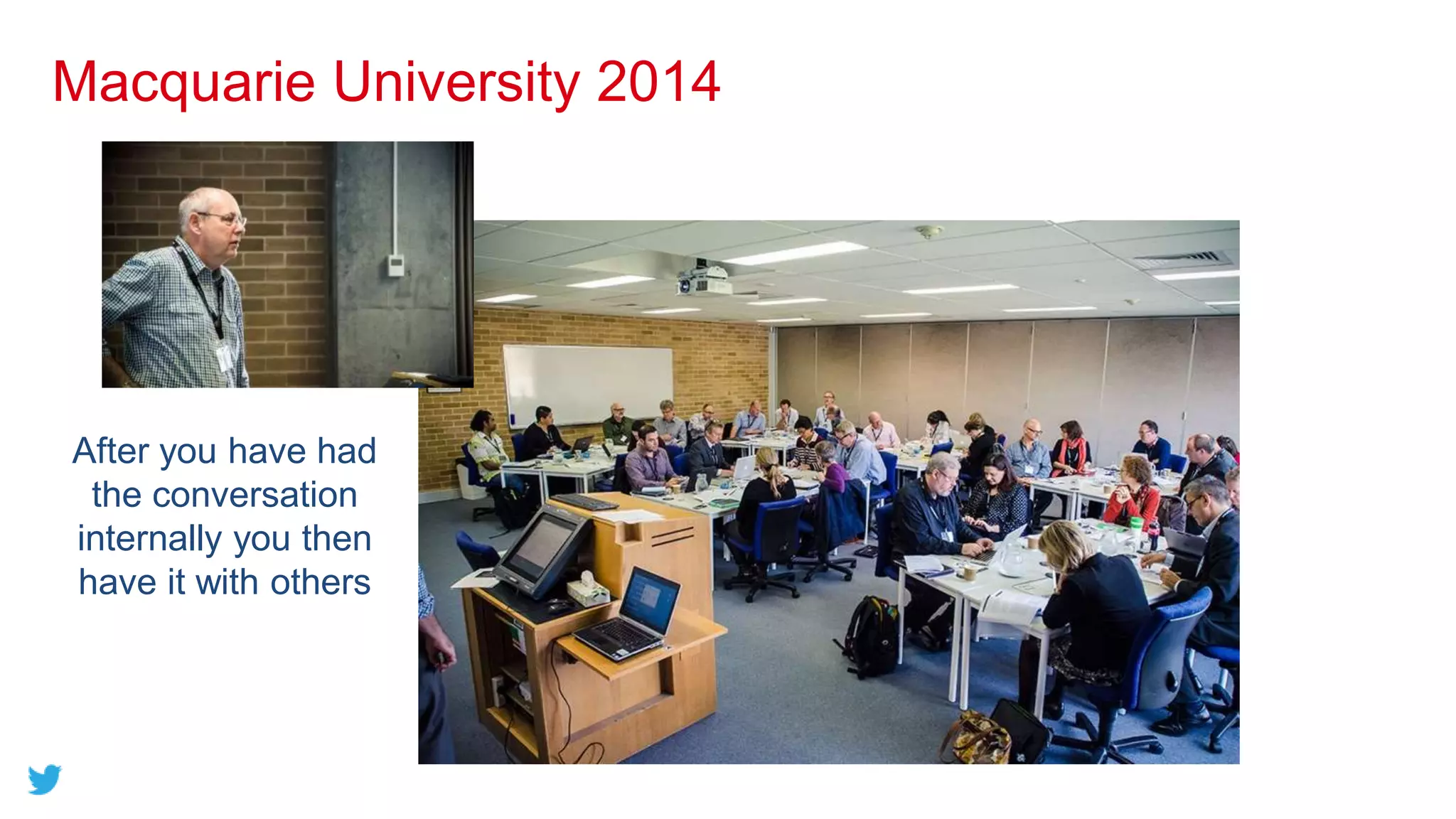
Macquarie University 2014
After you have had
the conversation
internally you then
have it with others
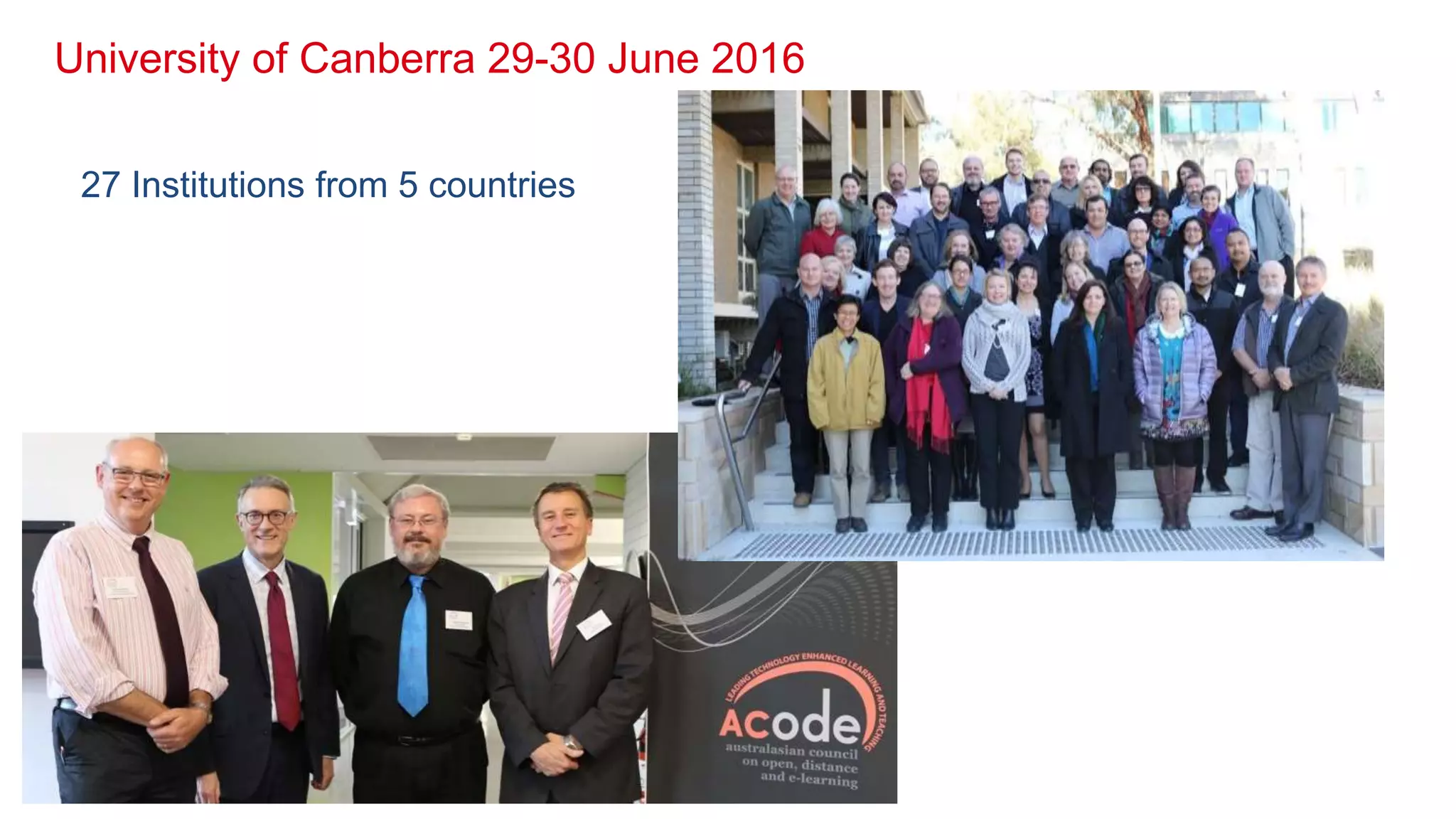
University of Canberra 29-30 June 2016
27 Institutions from 5 countries
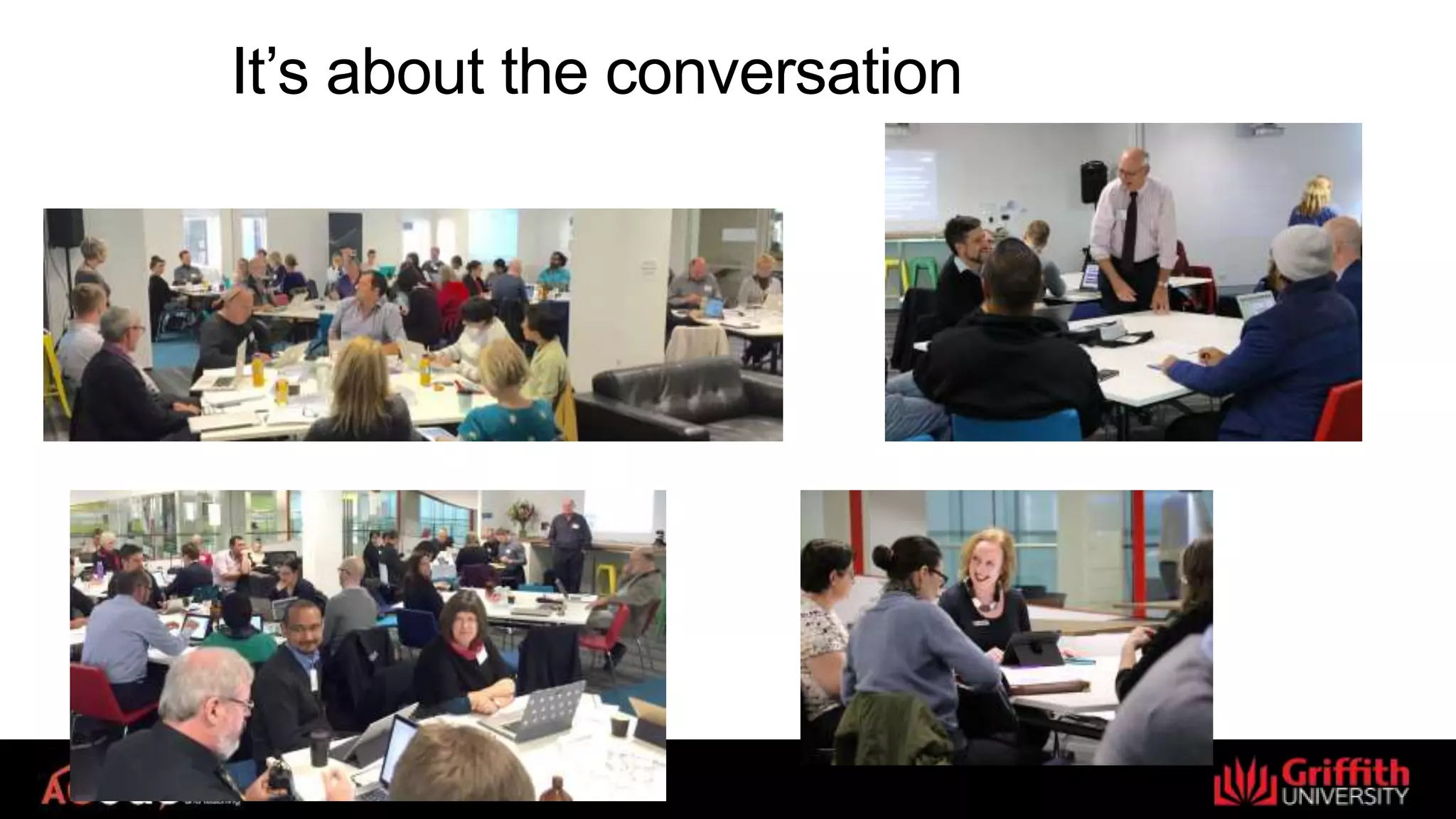
It’s about the conversation
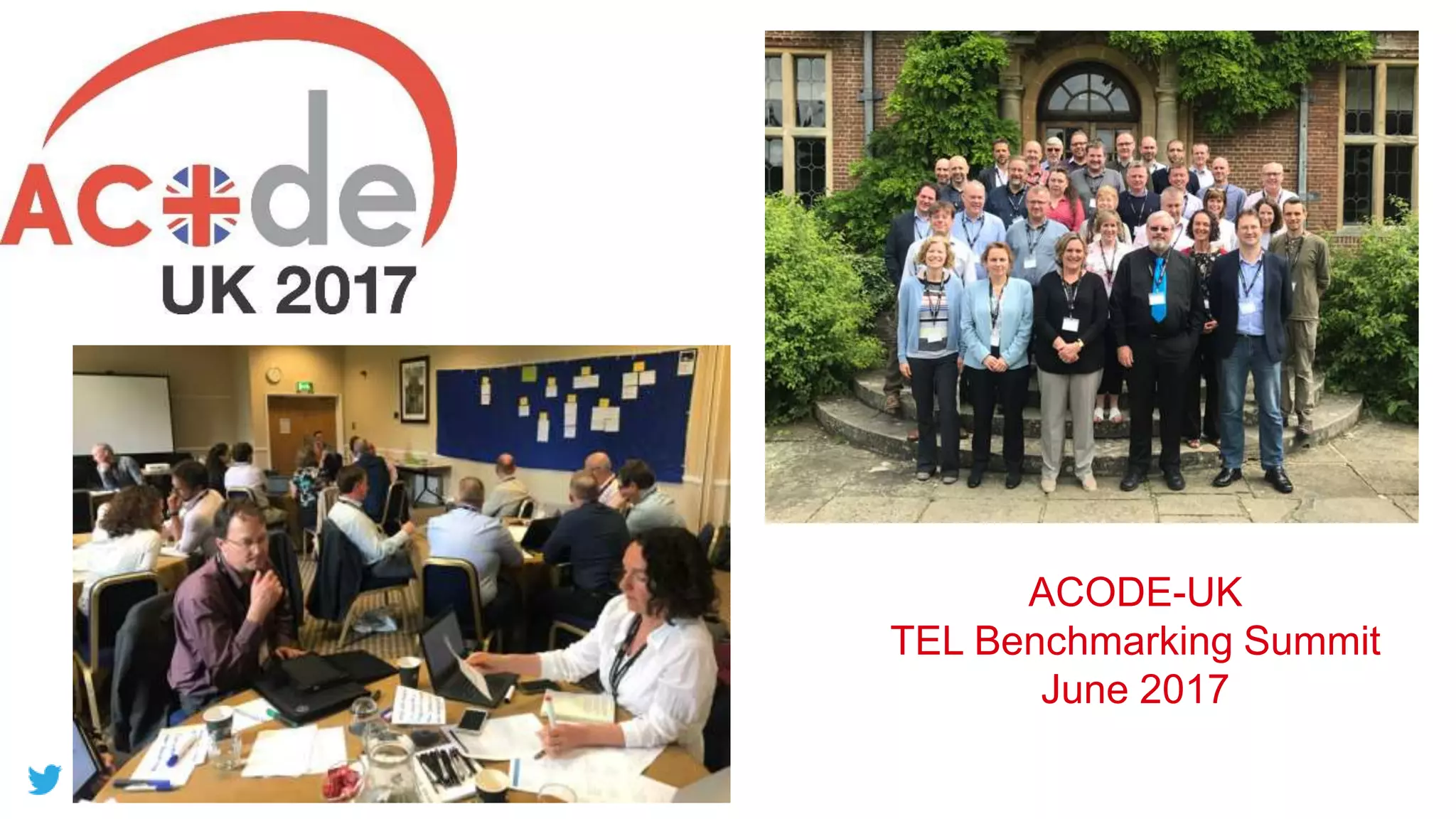
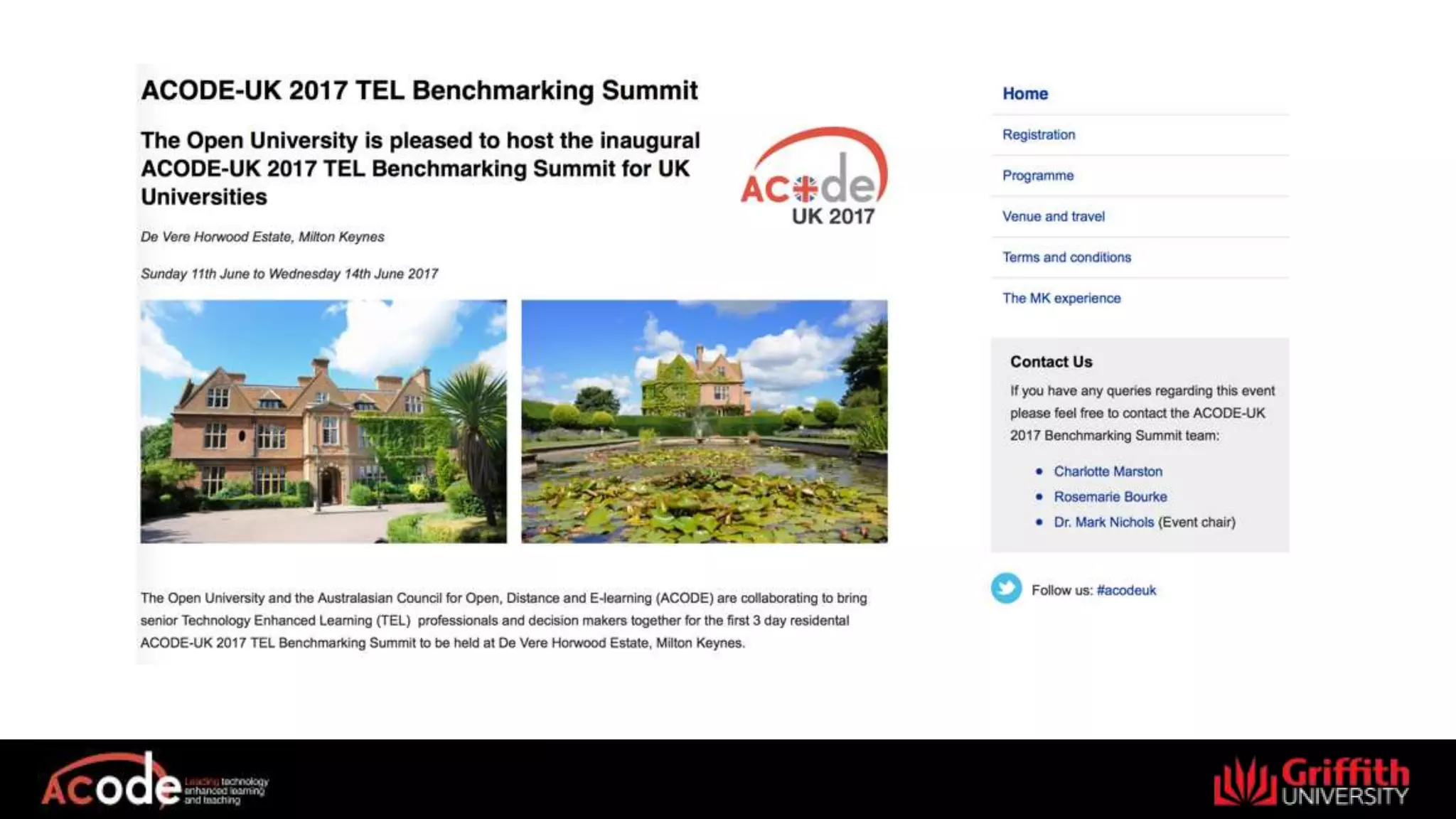
ACODE-UK
TEL Benchmarking Summit
June 2017
This June
http://www.open.ac.uk/acode-uk/
michael_sankey
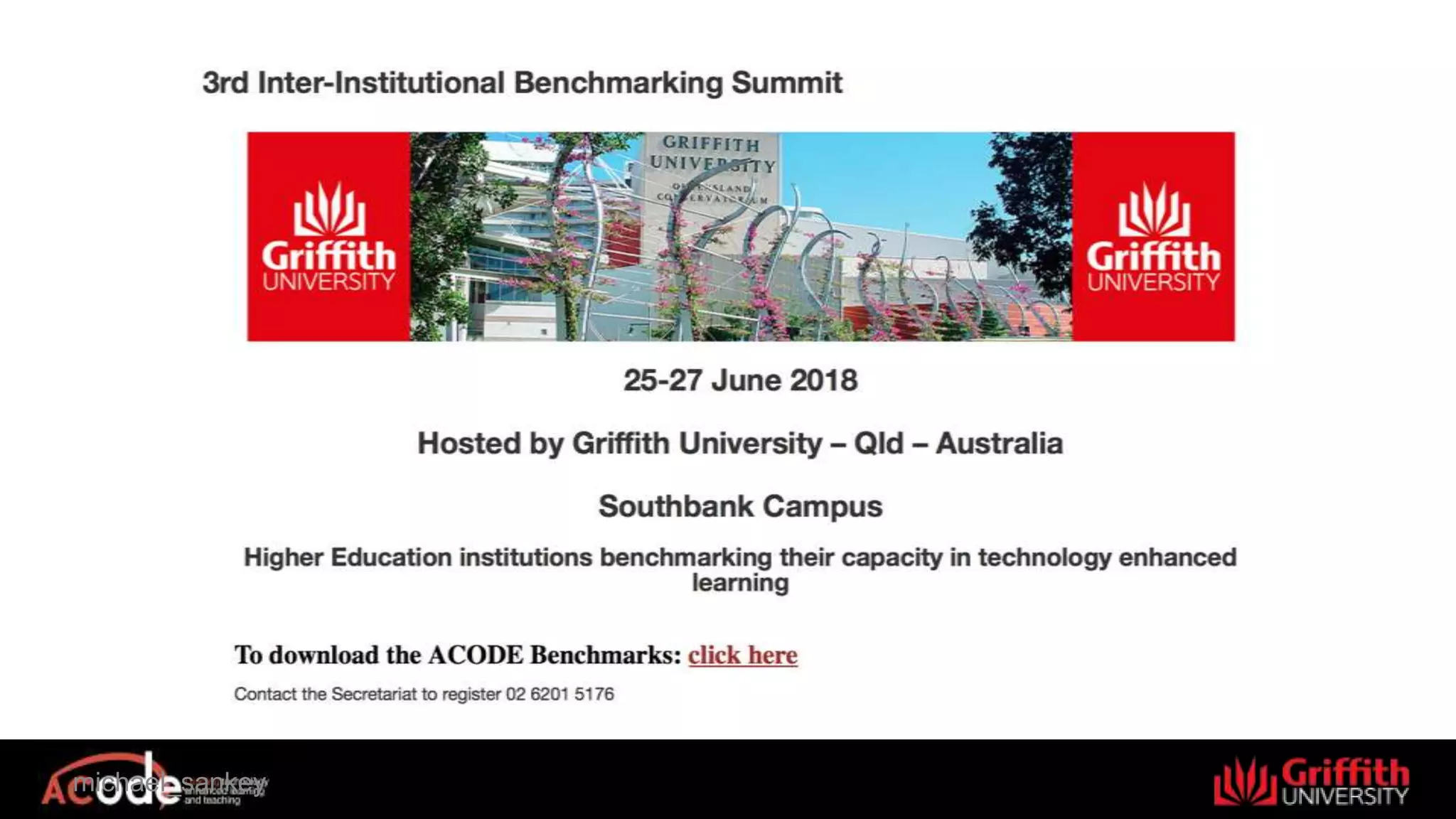
Griffith University 2018
michael_sankey
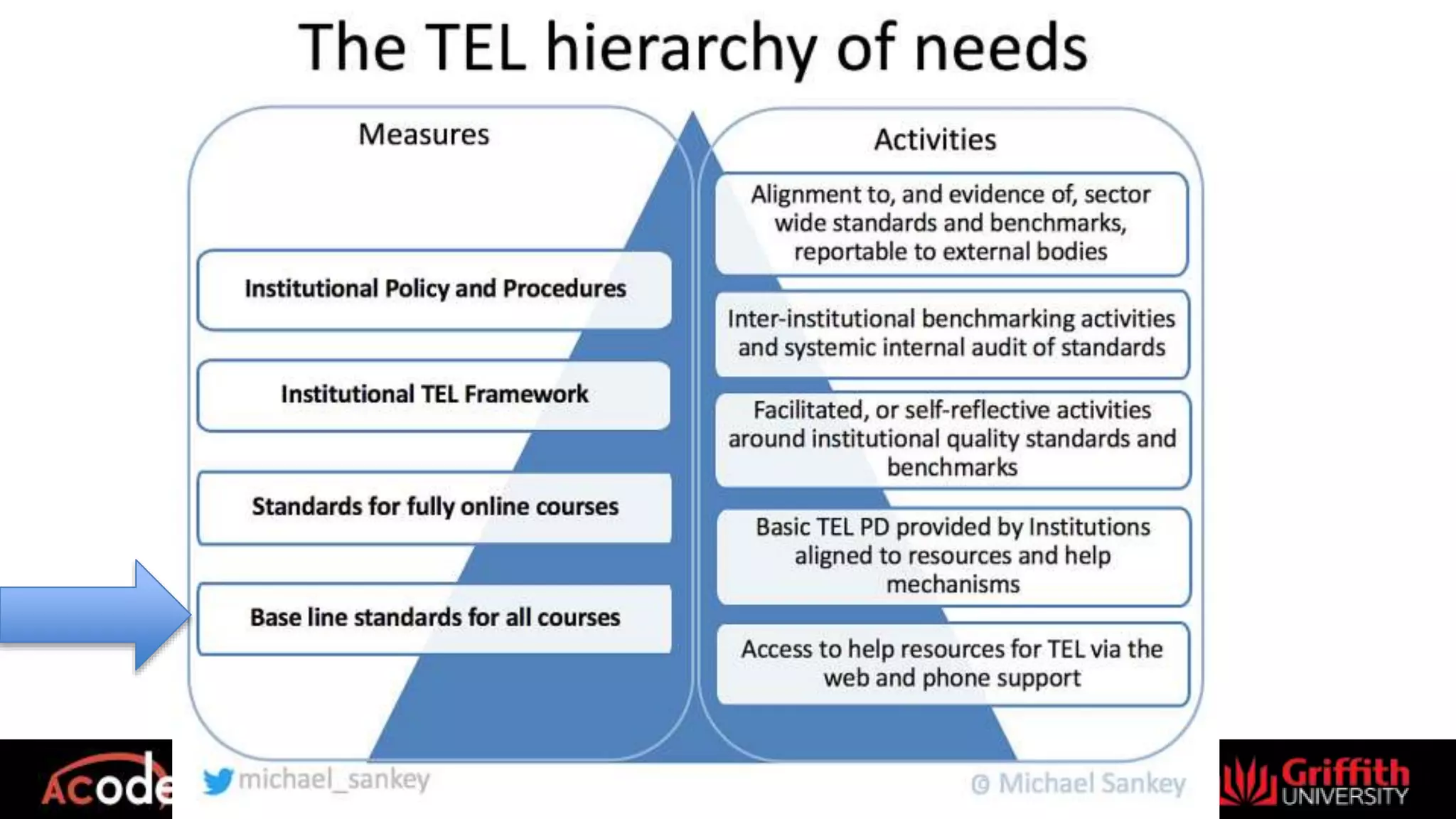
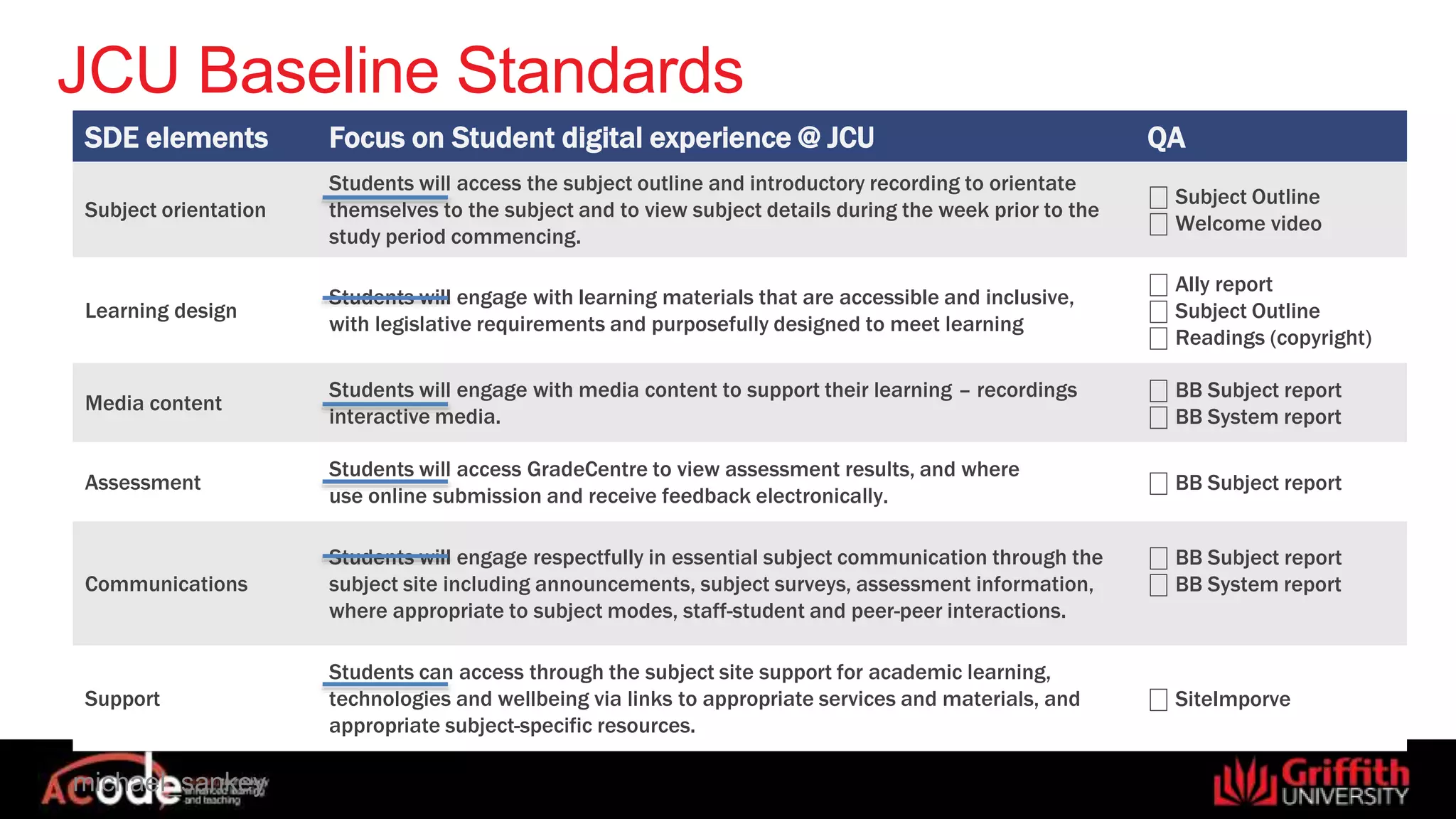
JCU Baseline Standards
michael_sankey
SDE elements Focus on Student digital experience @ JCU QA
Subject orientation
Students will access the subject outline and introductory recording to orientate
themselves to the subject and to view subject details during the week prior to the
study period commencing.
⎕ Subject Outline
⎕ Welcome video
Learning design
Students will engage with learning materials that are accessible and inclusive,
with legislative requirements and purposefully designed to meet learning
⎕ Ally report
⎕ Subject Outline
⎕ Readings (copyright)
Media content
Students will engage with media content to support their learning – recordings
interactive media.
⎕ BB Subject report
⎕ BB System report
Assessment
Students will access GradeCentre to view assessment results, and where
use online submission and receive feedback electronically.
⎕ BB Subject report
Communications
Students will engage respectfully in essential subject communication through the
subject site including announcements, subject surveys, assessment information,
where appropriate to subject modes, staff-student and peer-peer interactions.
⎕ BB Subject report
⎕ BB System report
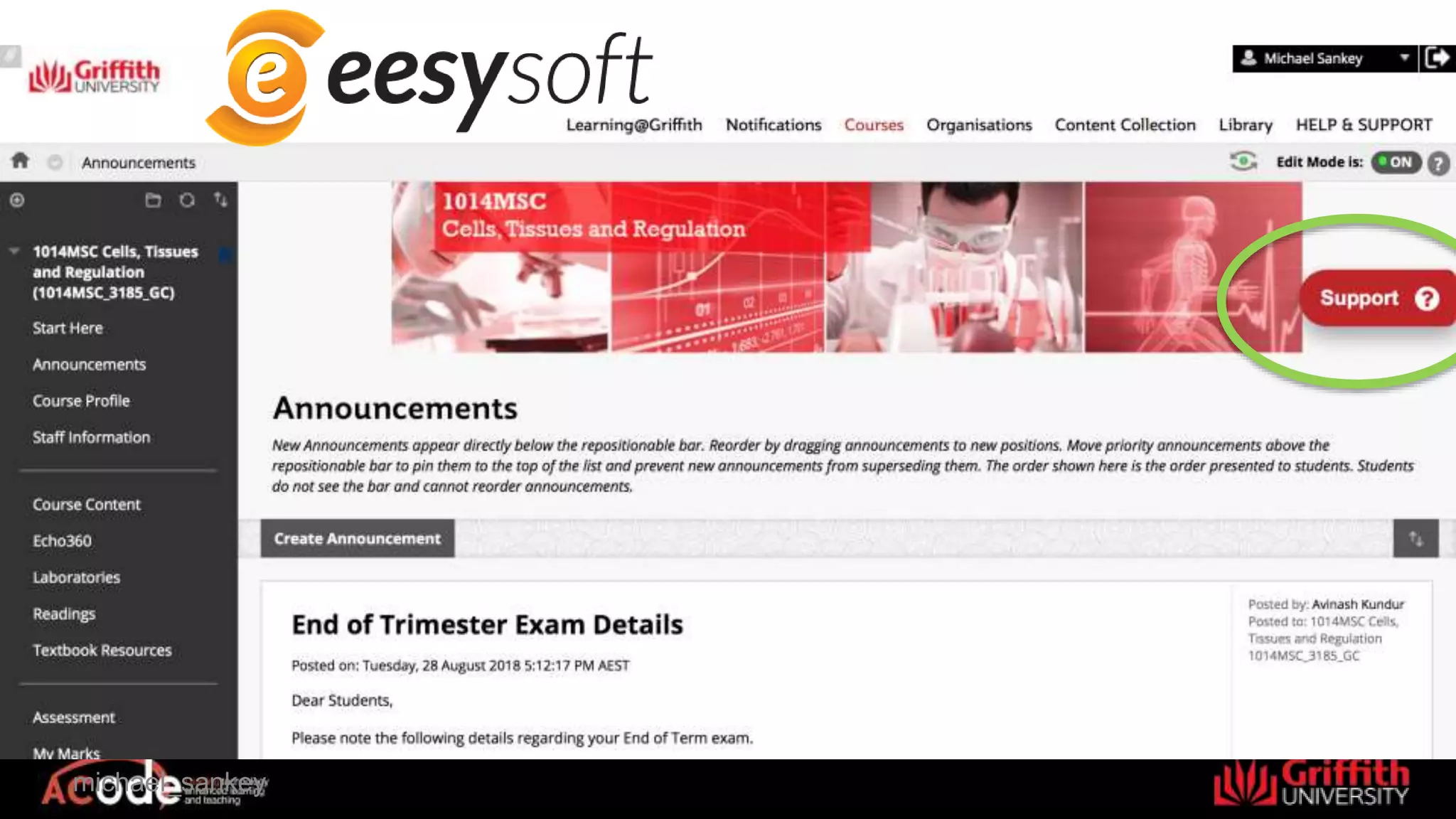
Support
Students can access through the subject site support for academic learning,
technologies and wellbeing via links to appropriate services and materials, and
appropriate subject-specific resources.
⎕ SiteImporve
michael_sankey
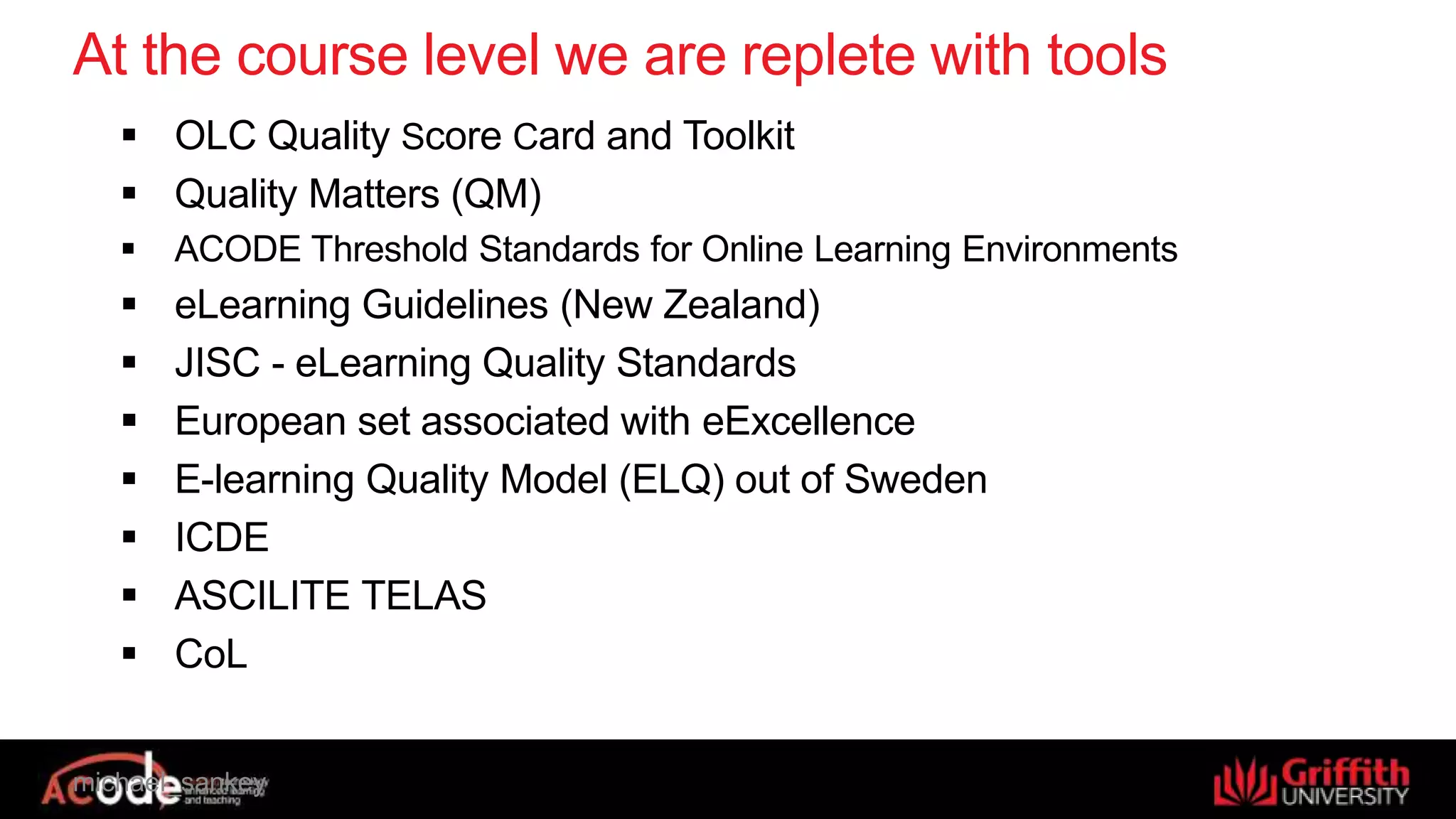
At the course level we are replete with tools
 OLC Quality Score Card and Toolkit
 Quality Matters (QM)
 ACODE Threshold Standards for Online Learning Environments
 eLearning Guidelines (New Zealand)
 JISC - eLearning Quality Standards
 European set associated with eExcellence
 E-learning Quality Model (ELQ) out of Sweden
 ICDE
 ASCILITE TELAS
 CoL
What’s happening in your neck of the woods
michael_sankey
michael_sankey
michael_sankey
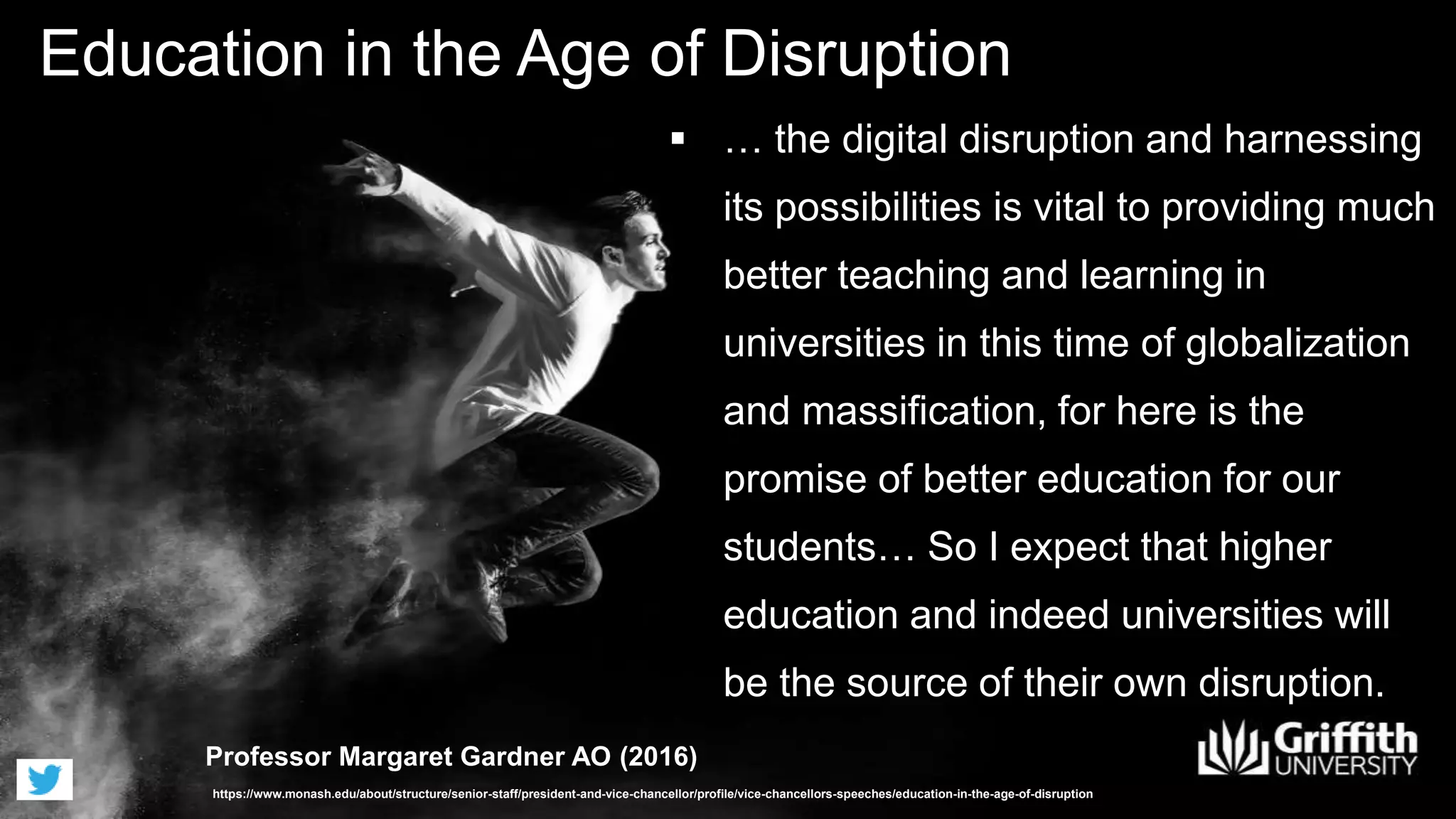
Education in the Age of Disruption
Professor Margaret Gardner AO (2016)
https://www.monash.edu/about/structure/senior-staff/president-and-vice-chancellor/profile/vice-chancellors-speeches/education-in-the-age-of-disruption
 … the digital disruption and harnessing
its possibilities is vital to providing much
better teaching and learning in
universities in this time of globalization
and massification, for here is the
promise of better education for our
students… So I expect that higher
education and indeed universities will
be the source of their own disruption.

Disruption in TEL the way of the future and the way to go

  • 1.
    Disruption in TEL theway of the future and the way to go Professor Michael Sankey Learning Futures michael_sankey
  • 2.
    Disruption is notlimited to the music, newspaper, taxi and food delivery industry, or to the provision of movies. New models of educational delivery have also been emerging, thanks largely to the affordance of new generational technologies and a willingness to break with traditional forms of supply, to a more demand driven model. These new business models, coupled with a slowness of the national regulators, has caught some tertiary institutions on the back foot, but some are now awakening from their slumber. With the bolder ones not being afraid to mix their metaphors
  • 3.
  • 5.
    HE in 20years time May 2017 In Mid 2017 a foundational report was released by the CSHE The study involved 117 in-depth interviews and surveys with HE leaders
  • 6.
     All agreedthat major changes are coming. As one leader remarked: “I’m not at all confident that the university or anything like its current form will be here for even 20 years.”  Leaders commented on the dynamic impact that technology will have on HE  A Go8 VC framed it concisely: “The digital realm penetrates everything: how people access information; how people see the many different ways they can interact with one another; how they receive services; how they can themselves interact with services.”  Another VC observed: “Technology is going to change the nature of both our interaction with students and the nature of the higher education system.”
  • 7.
    So what can technologyoffer us?  Interactivity: personal and programmed  Collaboration: 1 to 1; 1 to many  Up-to-date & real-time information  Social learning opportunities  Virtual/Augmented/Mixed Reality  Simulation: trial and error  Mobility: Flexibility  Artificial Intelligence  Machine Learning  Peer-learning/assessment opportunities  Synchronous and Asynchronous
  • 8.
    Significant Challenges for TechnologyAdoption in HE Solvable  Improving Digital Fluency  Increasing Demand for Digital Learning Experience and Instructional Design Expertise Difficult  The Evolving Roles of Faculty with Edtech Strategies  Bridging the Achievement Gap Wicked  Advancing Digital Equity  Rethinking the Practice of Teaching
  • 9.
    KPMG – July2018  A national tertiary education and training system  A tertiary education system with a revised Australian Qualifications Framework at its centre  A unified funding framework  Greater funding transparency and accountability  Independent tertiary education pricing authority  A unified tertiary education loan scheme  Regulatory arrangements  Valuing teaching excellence  Improving information on tertiary education outcomes  Removing higher education provider categories
  • 10.
    EY – Oct2018  On the cusp of a great change in HE, with the learner being central, shifting the focus from teaching to learning. This is ‘Education 4.0’, where more non-traditional learners are increasing demanding competency- based skills, linked to the advancements in technology.
  • 11.
    EY - 2018 50+ uni leaders, government policy makers & industry observers.  Surveys & focus groups with 3,000+ students & employers.  Embark on double transformation to optimise & grow  Make the shift from being faculty-focused to learner- centric  Integrate with industry to co-create & collaborate  Re-imagine the physical campus for the digital world  Unbundle degree programs & the university value chain
  • 20.
  • 22.
    Griffith VLE –Learning@Griffith
  • 23.
    BlackBoard & associated tools O365 &associated tools Pre Uni Undergraduate Post-graduate Work Year 1 Year 2 Year 3-4 Common patterns of student usage VLE Workplace technologies
  • 24.
    Griffith VLE –Learning@Griffith Blackboard
  • 26.
    TEQSA  The regulatoris now starting to take more interest  Equivalency of online to f2f  Particularly private providers  The deconstruction of credentials  Value of microcredits
  • 27.
    Quality in TEL We know students are seeking consistency within their courses/units in the online learning environment  Institutions also want a level of consistency for the learning outcomes between f2f and online courses  This means institutions need to have frameworks and quality processes in place to ensure both course quality and process quality  Over the last few year as more institutions have turned to online a focus on the quality of these offerings at the course/unit quality  But It takes a village to raise a child
  • 29.
    4 main formscurrently seen in the sector 1. Post-grad courses and programs based on credentialing/selling RPL 2. Post-grad courses built-up by undertaking many shorter courses (usually grad-cert) 3. Under-grad: series of short accredited courses to augment a fuller program (typically x4 = 1) 4. Under-grad: non-accredited, or co-curricular courses to demonstrate experience and enhance portfolio
  • 30.
     The MetroMap demonstrates the increasingly complex digital landscape we inhabit  Built on existing digital skills frameworks, contributed by a range of organisations.  This metaphor depicts a journey alongside the separate categories for each metro line, corresponding to broad areas relevant to learning and teaching. All Aboard: Digital Skills in Higher Education (2017) CC-BY-NC 4.0 http://www.allaboardhe.ie/
  • 31.
    Micro-Credentials  Learning doesn'thave to be packaged into multi-year chunks  It can be broken up into less than 30-hour chunks and priced/awarded accordingly  Short, low-cost online courses that result in a digital badge or credential when learners complete one of them and certified when a series is completed  "For higher ed, that's an opportunity to really provide those services to students so they can continue to build their professional portfolios"  Offers Universities an opportunity to bridge skill gaps http://www.centerdigitaled.com/higher-ed/Why-Micro-Credentials-Universities.html
  • 32.
  • 33.
    Some examples Exter, M., Ashby,I,. & Caskurlu, S. 2017. Using Digital Badges in Competency-Based Degree Programs. Digital Badges and Credentials. Monash College, 2-3 March. Melbourne. Available from: https://www.acode.edu.au/course/view.php?id=3
  • 34.
    Exter, M., Ashby,I,. & Caskurlu, S. 2017. Using Digital Badges in Competency-Based Degree Programs. Digital Badges and Credentials. Monash College, 2-3 March. Melbourne. Available from: https://www.acode.edu.au/course/view.php?id=3
  • 37.
    RMIT model  30such contracts over the last 12 months
  • 38.
    NAGCAS is Australia’speak professional body for career development in the higher and tertiary education sectors.
  • 40.
    Digital Literacy COMMUNICATION COLLABORATION CRITICAL THINKING WORKREADINESS NumeracyVerbal CommsWritten Comms Sussex Downs College Employability Passport Positive Attitude Teamwork Meet Deadlines Emotional IQ Initiative Creative Decision Making Problem Solving Reliable Adaptable Professional Ambition Communication Collaboration Critical Thinking Work Readiness + + + = + + + = + + + = + + + =
  • 42.
  • 44.
  • 45.
    Monitoring, review andimprovement processes can and should encompass review against comparators, both internal to the provider and external. A number of approaches and techniques can be used for external referencing, such as benchmarking, peer review and moderation. Benchmarking is perhaps the most elaborate form of external referencing and typically consists of focused improvement through relationships with a benchmarking partner or partners, but can also include comparing course design against publicly-available information and market intelligence. Further detail on benchmarking practice is given in the Appendices A and B below. michael_sankey
  • 46.
    michael_sankey A few waysto do this at the institution level  ACODE Benchmarks  E-Learning Maturity Model (EMM)  European set associated with eExcellence  OLC Quality Score Card and Toolkit  ICDE  COL
  • 47.
  • 48.
    michael_sankey The 8 Benchmarksfor TEL 1. Institution-wide policy and governance for technology enhanced learning; 2. Planning for institution-wide quality improvement of technology enhanced learning; 3. Information technology systems, services and support for technology enhanced learning; 4. The application of technology enhanced learning services; 5. Staff professional development for the effective use of technology enhanced learning; 6. Staff support for the use of technology enhanced learning; 7. Student training for the effective use of technology enhanced learning; 8. Student support for the use of technology enhanced learning.
  • 49.
    Macquarie University 2014 Afteryou have had the conversation internally you then have it with others
  • 50.
    University of Canberra29-30 June 2016 27 Institutions from 5 countries
  • 51.
    It’s about theconversation
  • 52.
  • 53.
  • 54.
  • 55.
  • 57.
    JCU Baseline Standards michael_sankey SDEelements Focus on Student digital experience @ JCU QA Subject orientation Students will access the subject outline and introductory recording to orientate themselves to the subject and to view subject details during the week prior to the study period commencing. ⎕ Subject Outline ⎕ Welcome video Learning design Students will engage with learning materials that are accessible and inclusive, with legislative requirements and purposefully designed to meet learning ⎕ Ally report ⎕ Subject Outline ⎕ Readings (copyright) Media content Students will engage with media content to support their learning – recordings interactive media. ⎕ BB Subject report ⎕ BB System report Assessment Students will access GradeCentre to view assessment results, and where use online submission and receive feedback electronically. ⎕ BB Subject report Communications Students will engage respectfully in essential subject communication through the subject site including announcements, subject surveys, assessment information, where appropriate to subject modes, staff-student and peer-peer interactions. ⎕ BB Subject report ⎕ BB System report Support Students can access through the subject site support for academic learning, technologies and wellbeing via links to appropriate services and materials, and appropriate subject-specific resources. ⎕ SiteImporve
  • 59.
    michael_sankey At the courselevel we are replete with tools  OLC Quality Score Card and Toolkit  Quality Matters (QM)  ACODE Threshold Standards for Online Learning Environments  eLearning Guidelines (New Zealand)  JISC - eLearning Quality Standards  European set associated with eExcellence  E-learning Quality Model (ELQ) out of Sweden  ICDE  ASCILITE TELAS  CoL
  • 61.
    What’s happening inyour neck of the woods michael_sankey
  • 63.
  • 64.
  • 65.
    Education in theAge of Disruption Professor Margaret Gardner AO (2016) https://www.monash.edu/about/structure/senior-staff/president-and-vice-chancellor/profile/vice-chancellors-speeches/education-in-the-age-of-disruption  … the digital disruption and harnessing its possibilities is vital to providing much better teaching and learning in universities in this time of globalization and massification, for here is the promise of better education for our students… So I expect that higher education and indeed universities will be the source of their own disruption.