Universitat Politècnica de Catalunya Libraries: an overview http://bibliotecnica.upc.edu 17 April 2008
Contents UPC  Libraries locations Main indicators Strategic programs Staff organisation Library services  Current projects: Institutional repository Information literacy Questions / comments
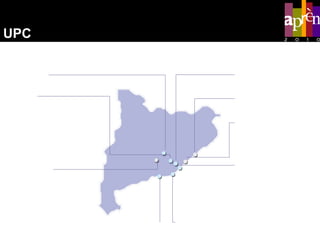
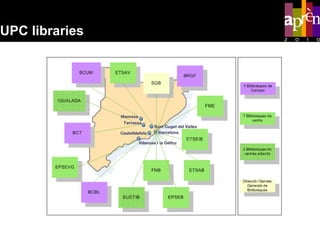
MANRESA TERRASSA IGUALADA VILANOVA I LA GELTRÚ CASTELLDEFELS BARCELONA MATARÓ CANET DE MAR SANT CUGAT DEL VALLÈS UPC
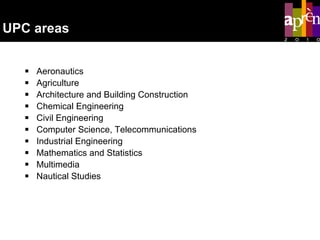
UPC areas Aeronautics Agriculture Architecture and Building Construction Chemical Engineering Civil Engineering Computer Science, Telecommunications Industrial Engineering Mathematics and Statistics Multimedia  Nautical Studies
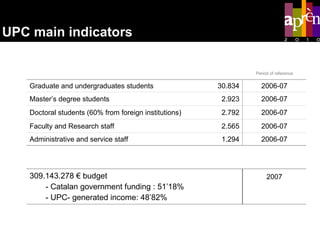
UPC main indicators Period of reference Graduate and undergraduates students 30.834 2006-07 Master’s degree students 2.923 2006-07 Doctoral students (60% from foreign institutions) 2.792 2006-07 Faculty and Research staff 2.565 2006-07 Administrative and service staff 1.294 2006-07 309.143.278 € budget - Catalan government funding : 51’18% - UPC- generated income: 48’82% 2007
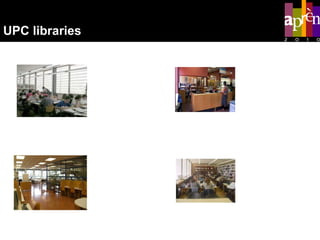
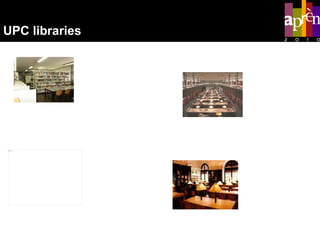
UPC libraries
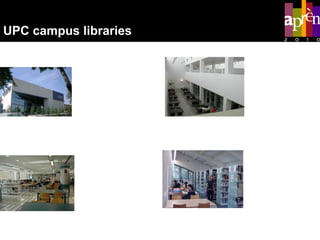
School of Telecommunications Engineering of Barcelona ,  School of Civil Engineering of Barcelona,  Barcelona School of Computer Science School of Industrial Engineering of Terrassa,  College of Industrial Engineering of Terrassa College of Optics and Optometry of Terrassa UPC campus libraries School of Engineering  of Manresa Castelldefels School  of Technology
School of Architecture  of Barcelona School of Industrial Engineering  of Barcelona UPC libraries School of Architecture  of the Vallès School of Building Construction of Barcelona
College of Industrial Engineering of Barcelona School of Engineering of Vilanova i la Geltrú UPC libraries Faculty of Mathematics and Statistics Faculty of Nautical Studies of Barcelona
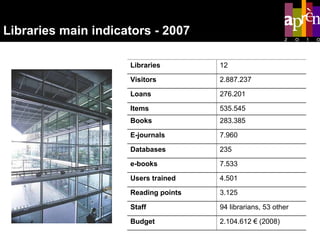
Libraries main indicators - 2007 Libraries 12 Visitors 2.887.237 Loans 276.201 Items 535.545 Books 283.385 E-journals 7.960 Databases 235 e-books 7.533 Users trained 4.501 Reading points 3.125 Staff 94 librarians, 53 other Budget  2.104.612 € (2008)
12 libraries… but single entity Long tradition of user orientation  Service Quality: Intranet, library charter of services, performance indicators, surveys, annual reports, evaluation, etc. Library evaluation/certification processes: 1998:  I Plan Nacional de Evaluación de la Calidad de las Universidades – Ministerio / Consejo de Universidades 2001:  AQU (Agencia para la Calidad del Sistema Universitario de Catalunya) 2003:  ANECA (Agencia Nacional de Evaluación y Acreditación)  2006-2007:  AQU (Agencia para la Calidad del Sistema Universitario de Catalunya) Our Strengths
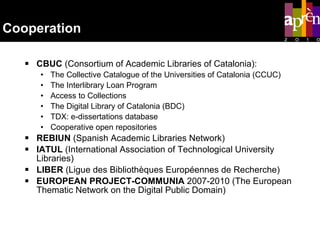
Cooperation CBUC  ( Consortium of Academic Libraries of Catalonia): The Collective Catalogue of the Universities of Catalonia (CCUC) The Interlibrary Loan Program Access to Collections The Digital Library of Catalonia (BDC) TDX: e-dissertations database Cooperative open repositories REBIUN  (Spanish Academic Libraries Network) IATUL  (International Association of Technological University Libraries) LIBER  (Ligue des Bibliothèques Européennes de Recherche) EUROPEAN PROJECT-COMMUNIA  2007-2010 (The European Thematic Network on the Digital Public Domain)
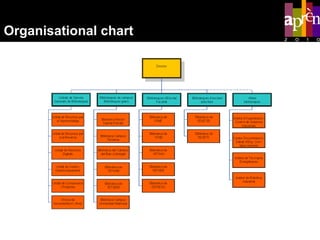
Organisational chart
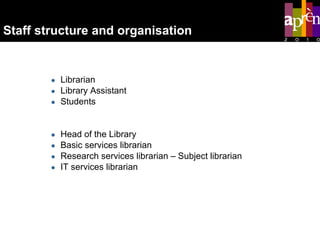
Staff structure and organisation  Libraries staff: Librarian Library Assistant Students  Librarian profiles: Head of the Library Basic services librarian Research services librarian – Subject librarian IT services librarian
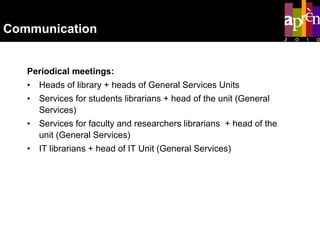
Communication   Periodical meetings: Heads of library + heads of General Services Units Services for students librarians + head of the unit (General Services) Services for faculty and researchers librarians  + head of the unit (General Services) IT librarians  + head of IT Unit (General Services)
Current challenges A new model for the University library: Learning and Research Resource Centre  Bologna Declaration: Adapting libraries to the New European Higher Education Area
Libraries strategic planning Leibniz  1991-1993 Escher  1995 1999 Paideia  2000-2005  Aprèn  2007-2010
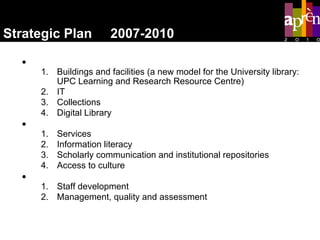
Strategic Plan  2007-2010 Resources Buildings and facilities (a new model for the University library: UPC Learning and Research Resource Centre) IT Collections Digital Library Services Services Information literacy Scholarly communication and institutional repositories Access to culture People Staff development Management, quality and assessment
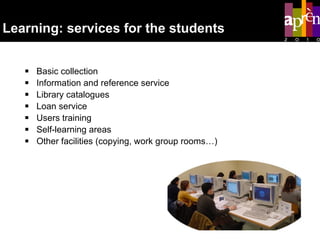
Learning: services for the students Basic collection Information and reference service Library catalogues Loan service Users training Self-learning areas Other facilities (copying, work group rooms…)
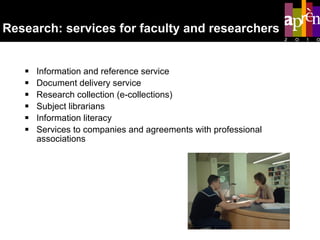
Research: services for faculty and researchers Information and reference service Document delivery service Research collection (e-collections) Subject librarians Information literacy  Services to companies and agreements with professional associations
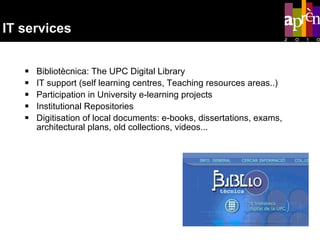
IT services Bibliotècnica: The UPC Digital Library  IT support (self learning centres, Teaching resources areas..) Participation in University e-learning projects Institutional Repositories Digitisation of local documents: e-books, dissertations, exams, architectural plans, old collections, videos...
To offer a tool for publishing academic works in electronic format To organize and preserve UPC’s intellectual heritage  To greatly increase UPC’s visibility in the world UPCommons: objectives
Strategy: repositories  Separate repositories: E-prints: https://upcommons.upc.edu/e-prints/ University journals and congresses: https://upcommons.upc.edu/revistes/ Students’ work: https://upcommons.upc.edu/pfc/ Learning materials: http://e-md.upc.edu/home/ Videos: http://bibliotecnica.upc.edu/video/ Theses: http://www.tesisenxarxa.net/ Why did we decide to create different repositories? To facilitate organization (one librarian is responsible for each repository)  To be able to fit different document data into metadata  To fully integrate with other university platforms (such as Virtual Campus, based on Moodle and the Electronic Information Services for Academic Activity) However The cost of supporting repositories is higher Content is dispersed
Strategy: access to all repositories https://upcommons.upc.edu/ Global access to UPC knowledge Metasearch in all UPC repositories Electronic documents and information about support services (how to digitize a thesis, how to submit documents, etc.)
Strategy: human resources One computer technician for designing repositories and improving software. One librarian responsible for content control and management of each repository.  In every UPC campus, there are librarians who: control and extend metadata  feed-back between users and general services
Strategy: repository support services SEPI: Intellectual Property Service  Author rights  Copyright policies (including e-journals and Creative Commons) Factories: teaching resource facilities  Convert traditional formats into digital formats (print journals, theses, etc.) Video digitization Subject librarian: Liaison with university departments for diffusion of the project and training
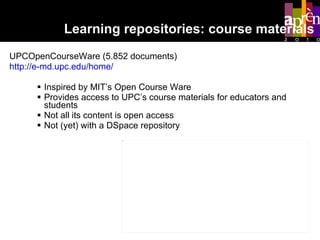
UPCOpenCourseWare (5.852 documents) http://e-md.upc.edu/home/ Inspired by MIT’s Open Course Ware Provides access to UPC’s course materials for educators and students Not all its content is open access Not (yet) with a DSpace repository Learning repositories: course materials
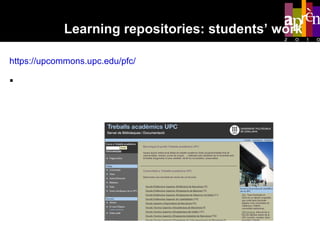
Learning repositories: students’ work Students’ work (2.051 documents) https://upcommons.upc.edu/pfc/ Students’ work (final degree projects, minor theses, recognition of foreign diplomas/theses, etc.) presented by university students at UPC.
Learning repositories: videos UPC Digital Library (226 videos) http://bibliotecnica.upc.edu/video/ Institutional activities or learning activities Migration to a DSpace application
Research repositories: E-prints E-prints UPC (1199 pre-prints or post-prints) https://upcommons.upc.edu/e-prints/ The E-prints repository collects documents generated by academics in their research activities.  Communities: schools, departments, laboratories or research groups.  Workflow: Selfarchive (authors) Peer review (optional) Protect and extend metadatas (subject librarians)
Research repositories: Journals and  Congresses UPC Journals and Congresses (3.419 articles) https://upcommons.upc.edu/revistes/ This repository compiles the full texts of e-journal articles and proceedings published by any scholar or research department of the university.  Workflow:  Archive (journal support personnel or auxilliar librarians)  Control and extend metadatas (subject librarians) Electronic submission using DSpace
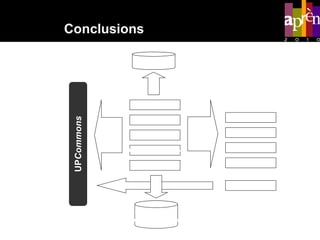
Conclusions  OAI-MHP UP Commons Course materials  Students’ work .... E-prints  Journals and congresses  OAI-MHP Campus digital SOAP Scientific Output  Information System   OAI-MHP RECERCAT RACO TDX OAISter ... OAI-MHP
Good acceptance, Good strategy,  Collections are growing but… there’s still a lot of work to do Conclusions
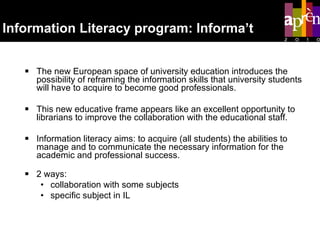
Information Literacy program: Informa’t The new European space of university education introduces the possibility of reframing the information skills that university students will have to acquire to become good professionals. This new educative frame appears like an excellent opportunity to librarians to improve the collaboration with the educational staff.  Information literacy aims: to acquire (all students) the abilities to manage and to communicate the necessary information for the academic and professional success. 2 ways:  collaboration with some subjects  specific subject in IL
 
Marta López  [email_address] Anna Rovira [email_address] Thanks for your attention questions, comments…

Upclibraries 2008 Marta

  • 1.
    Universitat Politècnica deCatalunya Libraries: an overview http://bibliotecnica.upc.edu 17 April 2008
  • 2.
    Contents UPC Libraries locations Main indicators Strategic programs Staff organisation Library services Current projects: Institutional repository Information literacy Questions / comments
  • 3.
    MANRESA TERRASSA IGUALADAVILANOVA I LA GELTRÚ CASTELLDEFELS BARCELONA MATARÓ CANET DE MAR SANT CUGAT DEL VALLÈS UPC
  • 4.
    UPC areas AeronauticsAgriculture Architecture and Building Construction Chemical Engineering Civil Engineering Computer Science, Telecommunications Industrial Engineering Mathematics and Statistics Multimedia Nautical Studies
  • 5.
    UPC main indicatorsPeriod of reference Graduate and undergraduates students 30.834 2006-07 Master’s degree students 2.923 2006-07 Doctoral students (60% from foreign institutions) 2.792 2006-07 Faculty and Research staff 2.565 2006-07 Administrative and service staff 1.294 2006-07 309.143.278 € budget - Catalan government funding : 51’18% - UPC- generated income: 48’82% 2007
  • 6.
  • 7.
    School of TelecommunicationsEngineering of Barcelona , School of Civil Engineering of Barcelona, Barcelona School of Computer Science School of Industrial Engineering of Terrassa, College of Industrial Engineering of Terrassa College of Optics and Optometry of Terrassa UPC campus libraries School of Engineering of Manresa Castelldefels School of Technology
  • 8.
    School of Architecture of Barcelona School of Industrial Engineering of Barcelona UPC libraries School of Architecture of the Vallès School of Building Construction of Barcelona
  • 9.
    College of IndustrialEngineering of Barcelona School of Engineering of Vilanova i la Geltrú UPC libraries Faculty of Mathematics and Statistics Faculty of Nautical Studies of Barcelona
  • 10.
    Libraries main indicators- 2007 Libraries 12 Visitors 2.887.237 Loans 276.201 Items 535.545 Books 283.385 E-journals 7.960 Databases 235 e-books 7.533 Users trained 4.501 Reading points 3.125 Staff 94 librarians, 53 other Budget 2.104.612 € (2008)
  • 11.
    12 libraries… butsingle entity Long tradition of user orientation Service Quality: Intranet, library charter of services, performance indicators, surveys, annual reports, evaluation, etc. Library evaluation/certification processes: 1998: I Plan Nacional de Evaluación de la Calidad de las Universidades – Ministerio / Consejo de Universidades 2001: AQU (Agencia para la Calidad del Sistema Universitario de Catalunya) 2003: ANECA (Agencia Nacional de Evaluación y Acreditación) 2006-2007: AQU (Agencia para la Calidad del Sistema Universitario de Catalunya) Our Strengths
  • 12.
    Cooperation CBUC ( Consortium of Academic Libraries of Catalonia): The Collective Catalogue of the Universities of Catalonia (CCUC) The Interlibrary Loan Program Access to Collections The Digital Library of Catalonia (BDC) TDX: e-dissertations database Cooperative open repositories REBIUN (Spanish Academic Libraries Network) IATUL (International Association of Technological University Libraries) LIBER (Ligue des Bibliothèques Européennes de Recherche) EUROPEAN PROJECT-COMMUNIA 2007-2010 (The European Thematic Network on the Digital Public Domain)
  • 13.
  • 14.
    Staff structure andorganisation Libraries staff: Librarian Library Assistant Students Librarian profiles: Head of the Library Basic services librarian Research services librarian – Subject librarian IT services librarian
  • 15.
    Communication Periodical meetings: Heads of library + heads of General Services Units Services for students librarians + head of the unit (General Services) Services for faculty and researchers librarians + head of the unit (General Services) IT librarians + head of IT Unit (General Services)
  • 16.
    Current challenges Anew model for the University library: Learning and Research Resource Centre Bologna Declaration: Adapting libraries to the New European Higher Education Area
  • 17.
    Libraries strategic planningLeibniz 1991-1993 Escher 1995 1999 Paideia 2000-2005 Aprèn 2007-2010
  • 18.
    Strategic Plan 2007-2010 Resources Buildings and facilities (a new model for the University library: UPC Learning and Research Resource Centre) IT Collections Digital Library Services Services Information literacy Scholarly communication and institutional repositories Access to culture People Staff development Management, quality and assessment
  • 19.
    Learning: services forthe students Basic collection Information and reference service Library catalogues Loan service Users training Self-learning areas Other facilities (copying, work group rooms…)
  • 20.
    Research: services forfaculty and researchers Information and reference service Document delivery service Research collection (e-collections) Subject librarians Information literacy Services to companies and agreements with professional associations
  • 21.
    IT services Bibliotècnica:The UPC Digital Library IT support (self learning centres, Teaching resources areas..) Participation in University e-learning projects Institutional Repositories Digitisation of local documents: e-books, dissertations, exams, architectural plans, old collections, videos...
  • 22.
    To offer atool for publishing academic works in electronic format To organize and preserve UPC’s intellectual heritage To greatly increase UPC’s visibility in the world UPCommons: objectives
  • 23.
    Strategy: repositories Separate repositories: E-prints: https://upcommons.upc.edu/e-prints/ University journals and congresses: https://upcommons.upc.edu/revistes/ Students’ work: https://upcommons.upc.edu/pfc/ Learning materials: http://e-md.upc.edu/home/ Videos: http://bibliotecnica.upc.edu/video/ Theses: http://www.tesisenxarxa.net/ Why did we decide to create different repositories? To facilitate organization (one librarian is responsible for each repository) To be able to fit different document data into metadata To fully integrate with other university platforms (such as Virtual Campus, based on Moodle and the Electronic Information Services for Academic Activity) However The cost of supporting repositories is higher Content is dispersed
  • 24.
    Strategy: access toall repositories https://upcommons.upc.edu/ Global access to UPC knowledge Metasearch in all UPC repositories Electronic documents and information about support services (how to digitize a thesis, how to submit documents, etc.)
  • 25.
    Strategy: human resourcesOne computer technician for designing repositories and improving software. One librarian responsible for content control and management of each repository. In every UPC campus, there are librarians who: control and extend metadata feed-back between users and general services
  • 26.
    Strategy: repository supportservices SEPI: Intellectual Property Service Author rights Copyright policies (including e-journals and Creative Commons) Factories: teaching resource facilities Convert traditional formats into digital formats (print journals, theses, etc.) Video digitization Subject librarian: Liaison with university departments for diffusion of the project and training
  • 27.
    UPCOpenCourseWare (5.852 documents)http://e-md.upc.edu/home/ Inspired by MIT’s Open Course Ware Provides access to UPC’s course materials for educators and students Not all its content is open access Not (yet) with a DSpace repository Learning repositories: course materials
  • 28.
    Learning repositories: students’work Students’ work (2.051 documents) https://upcommons.upc.edu/pfc/ Students’ work (final degree projects, minor theses, recognition of foreign diplomas/theses, etc.) presented by university students at UPC.
  • 29.
    Learning repositories: videosUPC Digital Library (226 videos) http://bibliotecnica.upc.edu/video/ Institutional activities or learning activities Migration to a DSpace application
  • 30.
    Research repositories: E-printsE-prints UPC (1199 pre-prints or post-prints) https://upcommons.upc.edu/e-prints/ The E-prints repository collects documents generated by academics in their research activities. Communities: schools, departments, laboratories or research groups. Workflow: Selfarchive (authors) Peer review (optional) Protect and extend metadatas (subject librarians)
  • 31.
    Research repositories: Journalsand Congresses UPC Journals and Congresses (3.419 articles) https://upcommons.upc.edu/revistes/ This repository compiles the full texts of e-journal articles and proceedings published by any scholar or research department of the university. Workflow: Archive (journal support personnel or auxilliar librarians) Control and extend metadatas (subject librarians) Electronic submission using DSpace
  • 32.
    Conclusions OAI-MHPUP Commons Course materials Students’ work .... E-prints Journals and congresses OAI-MHP Campus digital SOAP Scientific Output Information System OAI-MHP RECERCAT RACO TDX OAISter ... OAI-MHP
  • 33.
    Good acceptance, Goodstrategy, Collections are growing but… there’s still a lot of work to do Conclusions
  • 34.
    Information Literacy program:Informa’t The new European space of university education introduces the possibility of reframing the information skills that university students will have to acquire to become good professionals. This new educative frame appears like an excellent opportunity to librarians to improve the collaboration with the educational staff. Information literacy aims: to acquire (all students) the abilities to manage and to communicate the necessary information for the academic and professional success. 2 ways: collaboration with some subjects specific subject in IL
  • 35.
  • 36.
    Marta López [email_address] Anna Rovira [email_address] Thanks for your attention questions, comments…

Editor's Notes

  • #2 Hello, We are Anna Rovira and Marta López, we are librarians in this University. We don’t work in a library we are members of the direction staff in the General Services Unit