Unsupervised Neural Machine Translation
for Low-Resource Domains via Meta-Learning
Cheonbok Park, Yunwon Tae, Taehee Kim, Soyoung Yang, Mohammad Azam Khan, Lucy Park, and Jaegul Choo, 2020
Experiments
Conclusions
Approach
Introduction
01
02
03
04
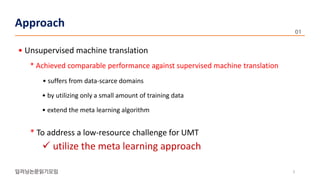
• Unsupervised machine translation
* Achieved comparable performance against supervised machine translation
• suffers from data-scarce domains
• by utilizing only a small amount of training data
• extend the meta learning algorithm
* To address a low-resource challenge for UMT
 utilize the meta learning approach
3
Approach
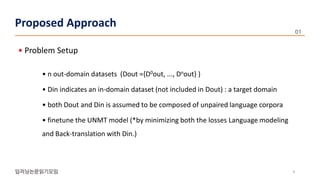
• Problem Setup
• n out-domain datasets (Dout ={D0out, ..., Dnout} )
• Din indicates an in-domain dataset (not included in Dout) : a target domain
• both Dout and Din is assumed to be composed of unpaired language corpora
• finetune the UNMT model (*by minimizing both the losses Language modeling
and Back-translation with Din.)
4
Proposed Approach
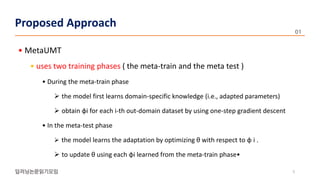
• MetaUMT
• uses two training phases ( the meta-train and the meta test )
• During the meta-train phase
 the model first learns domain-specific knowledge (i.e., adapted parameters)
 obtain φi for each i-th out-domain dataset by using one-step gradient descent
• In the meta-test phase
 the model learns the adaptation by optimizing θ with respect to φ i .
 to update θ using each φi learned from the meta-train phase•
5
Proposed Approach
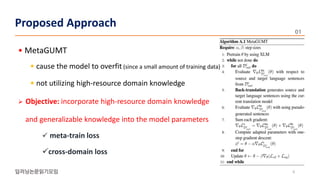
• MetaGUMT
• cause the model to overfit (since a small amount of training data)
• not utilizing high-resource domain knowledge
 Objective: incorporate high-resource domain knowledge
and generalizable knowledge into the model parameters
 meta-train loss
cross-domain loss
6
Proposed Approach
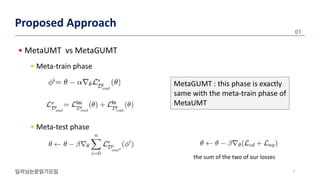
• MetaUMT vs MetaGUMT
• Meta-train phase
• Meta-test phase
7
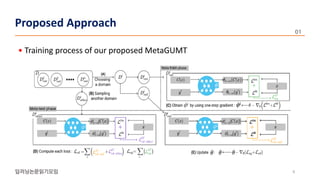
Proposed Approach
the sum of the two of our losses
MetaGUMT : this phase is exactly
same with the meta-train phase of
MetaUMT
• Training process of our proposed MetaGUMT
8
Proposed Approach
• UNMT
• Unsupervised neural machine translation ( ref. https://arxiv.org/abs/1710.11041)
• Instead of not using parallel corpus, a significant number of monolingual sentences (1M-3M sentences)
• the prerequisite limits : low-resource domains
• Meta learning
• Model-Agnostic Meta-Learning for Fast Adaptation of Deep Networks( ref. https://arxiv.org/abs/1703.03400)
• for handling a small amount of training data
• the previous studies : on a supervised model that requires labeled corpora
9
Introduction
• MetaUMT
• a new meta-learning approach for UNMT
• to find the optimal initialization for the model parameters that can adapt to a new domain
• even with only a small amount of monolingual data
1. the meta-train phase : adapts model parameters to a domain
2. the meta-test phase: optimizes the parameters obtained from the meta-train phase
3. After obtaining optimally initialized parameters : fine-tune the model using a target domain
(i.e., a low-resource domain)
10
Introduction
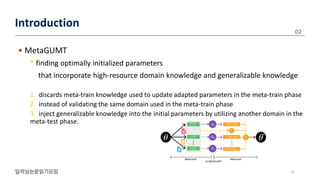
• MetaGUMT
* finding optimally initialized parameters
that incorporate high-resource domain knowledge and generalizable knowledge
1. discards meta-train knowledge used to update adapted parameters in the meta-train phase
2. instead of validating the same domain used in the meta-train phase
3. inject generalizable knowledge into the initial parameters by utilizing another domain in the
meta-test phase.
11
Introduction
• Low-Resource Neural Machine Translation (1)
• the performance of NMT models depends on the size of the parallel dataset
• To address this problem, utilizing monolingual datasets.
 apply dual learning, back-translation
 pretraining the model with bilingual corpora
 the UNMT methods without using any parallel corpora
• incorporating methods such as BPE and cross-lingual representations
(following those of the supervised NMT)
* require plenty of monolingual datasets
12
Introduction Related Work
• Low-Resource Neural Machine Translation (2)
• Transferring the knowledge from high-resource domains to a low-resource domain
 applicable in specific scenarios
* To address the issues
 define a new task as the unsupervised domain adaptation
on the low resource dataset
13
Introduction Related Work
• Meta Learning
• Given a small amount of training data
 prone to overfitting
 failing to find a generalizable solution
• To find the optimal initialization of the model parameters to a low-resource dataset
• To address the low-resource UNMT by exploiting meta-learning approaches
14
Introduction Related Work
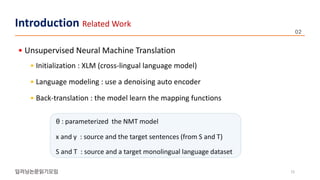
• Unsupervised Neural Machine Translation
• Initialization : XLM (cross-lingual language model)
• Language modeling : use a denoising auto encoder
• Back-translation : the model learn the mapping functions
θ : parameterized the NMT model
x and y : source and the target sentences (from S and T)
S and T : source and a target monolingual language dataset
15
Introduction Related Work
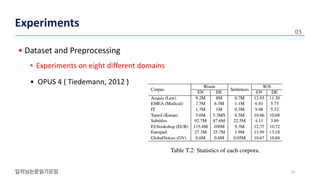
• Dataset and Preprocessing
• Experiments on eight different domains
• OPUS 4 ( Tiedemann, 2012 )
16
Experiments
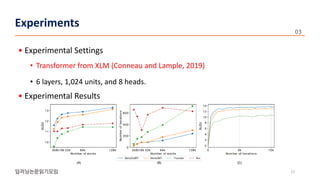
• Experimental Settings
• Transformer from XLM (Conneau and Lample, 2019)
• 6 layers, 1,024 units, and 8 heads.
• Experimental Results
17
Experiments
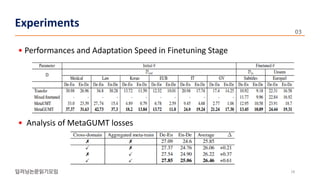
• Performances and Adaptation Speed in Finetuning Stage
• Analysis of MetaGUMT losses
18
Experiments
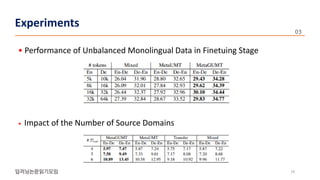
• Performance of Unbalanced Monolingual Data in Finetuing Stage
• Impact of the Number of Source Domains
19
Experiments
• Moses (Koehn et al., 2007) to tokenize the sentences
• use byte-pair encoding (BPE)
• sub-word vocabulary using fastBPE7 with 60,000 BPE codes
• using PyTorch library 8 | four nvidia V100 gpus
• on the BLEU script 9 | on the best validation epoch + 10 more epochs
• The learning rate = 10−4 | optimized within the range of 10−2 to 10−5
• number of tokens per batch = 1,120 | dropout rate = 0.1
20
Implementation Details Implementation Details
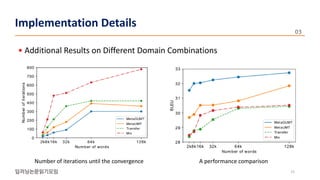
• Additional Results on Different Domain Combinations
Number of iterations until the convergence A performance comparison
21
Implementation Details Implementation Details
• proposes a novel meta-learning approach for low-resource UNMT, called
MetaUMT
• MetaGUMT : enhances cross-domain generalization and maintains high-
resource domain knowledge
• can be extended to semi-supervised machine translation
22
Conclusions
• 적은 도메인 자원을 해결하기 위한 새로운 제안으로 주목할 만 함.
• 기대했던 semi-supervised machine translation의 확장된 후속 제안이
아직은 활발하지 않은 것이 아쉬웠다.
• 기존의 전이 학습과 제안된 Meta-learning 방법 간의 비교 실험이
없었던 것이 아쉬웠다.
23
NLP Team Review Opinion
Unsupervised Neural Machine Translation for Low-Resource Domains

Unsupervised Neural Machine Translation for Low-Resource Domains

  • 1.
    Unsupervised Neural MachineTranslation for Low-Resource Domains via Meta-Learning Cheonbok Park, Yunwon Tae, Taehee Kim, Soyoung Yang, Mohammad Azam Khan, Lucy Park, and Jaegul Choo, 2020
  • 2.
  • 3.
    • Unsupervised machinetranslation * Achieved comparable performance against supervised machine translation • suffers from data-scarce domains • by utilizing only a small amount of training data • extend the meta learning algorithm * To address a low-resource challenge for UMT  utilize the meta learning approach 3 Approach
  • 4.
    • Problem Setup •n out-domain datasets (Dout ={D0out, ..., Dnout} ) • Din indicates an in-domain dataset (not included in Dout) : a target domain • both Dout and Din is assumed to be composed of unpaired language corpora • finetune the UNMT model (*by minimizing both the losses Language modeling and Back-translation with Din.) 4 Proposed Approach
  • 5.
    • MetaUMT • usestwo training phases ( the meta-train and the meta test ) • During the meta-train phase  the model first learns domain-specific knowledge (i.e., adapted parameters)  obtain φi for each i-th out-domain dataset by using one-step gradient descent • In the meta-test phase  the model learns the adaptation by optimizing θ with respect to φ i .  to update θ using each φi learned from the meta-train phase• 5 Proposed Approach
  • 6.
    • MetaGUMT • causethe model to overfit (since a small amount of training data) • not utilizing high-resource domain knowledge  Objective: incorporate high-resource domain knowledge and generalizable knowledge into the model parameters  meta-train loss cross-domain loss 6 Proposed Approach
  • 7.
    • MetaUMT vsMetaGUMT • Meta-train phase • Meta-test phase 7 Proposed Approach the sum of the two of our losses MetaGUMT : this phase is exactly same with the meta-train phase of MetaUMT
  • 8.
    • Training processof our proposed MetaGUMT 8 Proposed Approach
  • 9.
    • UNMT • Unsupervisedneural machine translation ( ref. https://arxiv.org/abs/1710.11041) • Instead of not using parallel corpus, a significant number of monolingual sentences (1M-3M sentences) • the prerequisite limits : low-resource domains • Meta learning • Model-Agnostic Meta-Learning for Fast Adaptation of Deep Networks( ref. https://arxiv.org/abs/1703.03400) • for handling a small amount of training data • the previous studies : on a supervised model that requires labeled corpora 9 Introduction
  • 10.
    • MetaUMT • anew meta-learning approach for UNMT • to find the optimal initialization for the model parameters that can adapt to a new domain • even with only a small amount of monolingual data 1. the meta-train phase : adapts model parameters to a domain 2. the meta-test phase: optimizes the parameters obtained from the meta-train phase 3. After obtaining optimally initialized parameters : fine-tune the model using a target domain (i.e., a low-resource domain) 10 Introduction
  • 11.
    • MetaGUMT * findingoptimally initialized parameters that incorporate high-resource domain knowledge and generalizable knowledge 1. discards meta-train knowledge used to update adapted parameters in the meta-train phase 2. instead of validating the same domain used in the meta-train phase 3. inject generalizable knowledge into the initial parameters by utilizing another domain in the meta-test phase. 11 Introduction
  • 12.
    • Low-Resource NeuralMachine Translation (1) • the performance of NMT models depends on the size of the parallel dataset • To address this problem, utilizing monolingual datasets.  apply dual learning, back-translation  pretraining the model with bilingual corpora  the UNMT methods without using any parallel corpora • incorporating methods such as BPE and cross-lingual representations (following those of the supervised NMT) * require plenty of monolingual datasets 12 Introduction Related Work
  • 13.
    • Low-Resource NeuralMachine Translation (2) • Transferring the knowledge from high-resource domains to a low-resource domain  applicable in specific scenarios * To address the issues  define a new task as the unsupervised domain adaptation on the low resource dataset 13 Introduction Related Work
  • 14.
    • Meta Learning •Given a small amount of training data  prone to overfitting  failing to find a generalizable solution • To find the optimal initialization of the model parameters to a low-resource dataset • To address the low-resource UNMT by exploiting meta-learning approaches 14 Introduction Related Work
  • 15.
    • Unsupervised NeuralMachine Translation • Initialization : XLM (cross-lingual language model) • Language modeling : use a denoising auto encoder • Back-translation : the model learn the mapping functions θ : parameterized the NMT model x and y : source and the target sentences (from S and T) S and T : source and a target monolingual language dataset 15 Introduction Related Work
  • 16.
    • Dataset andPreprocessing • Experiments on eight different domains • OPUS 4 ( Tiedemann, 2012 ) 16 Experiments
  • 17.
    • Experimental Settings •Transformer from XLM (Conneau and Lample, 2019) • 6 layers, 1,024 units, and 8 heads. • Experimental Results 17 Experiments
  • 18.
    • Performances andAdaptation Speed in Finetuning Stage • Analysis of MetaGUMT losses 18 Experiments
  • 19.
    • Performance ofUnbalanced Monolingual Data in Finetuing Stage • Impact of the Number of Source Domains 19 Experiments
  • 20.
    • Moses (Koehnet al., 2007) to tokenize the sentences • use byte-pair encoding (BPE) • sub-word vocabulary using fastBPE7 with 60,000 BPE codes • using PyTorch library 8 | four nvidia V100 gpus • on the BLEU script 9 | on the best validation epoch + 10 more epochs • The learning rate = 10−4 | optimized within the range of 10−2 to 10−5 • number of tokens per batch = 1,120 | dropout rate = 0.1 20 Implementation Details Implementation Details
  • 21.
    • Additional Resultson Different Domain Combinations Number of iterations until the convergence A performance comparison 21 Implementation Details Implementation Details
  • 22.
    • proposes anovel meta-learning approach for low-resource UNMT, called MetaUMT • MetaGUMT : enhances cross-domain generalization and maintains high- resource domain knowledge • can be extended to semi-supervised machine translation 22 Conclusions
  • 23.
    • 적은 도메인자원을 해결하기 위한 새로운 제안으로 주목할 만 함. • 기대했던 semi-supervised machine translation의 확장된 후속 제안이 아직은 활발하지 않은 것이 아쉬웠다. • 기존의 전이 학습과 제안된 Meta-learning 방법 간의 비교 실험이 없었던 것이 아쉬웠다. 23 NLP Team Review Opinion