Download as PDF, PPTX
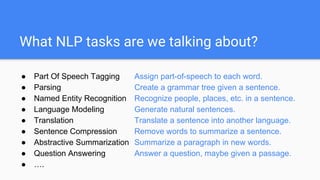
![Can deep learning solve these tasks?
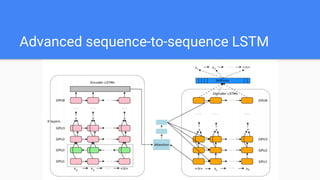
● Inputs and outputs have variable size, how can neural networks handle it?
● Recurrent Neural Networks can do it, but how do we train them?
● Long Short-Term Memory [Hochreiter et al., 1997], but how to compose it?
● Encoder-Decoder (sequence-to-sequence) architectures
[Sutskever et al., 2014; Bahdanau et al., 2014; Cho et al., 2014]](https://image.slidesharecdn.com/lukaszkaiser-howdeeplearningquietlyrevolutionizednlp-170114081548/85/Lukasz-Kaiser-at-AI-Frontiers-How-Deep-Learning-Quietly-Revolutionized-NLP-3-320.jpg)
![Parsing with sequence-to-sequence LSTMs
(1) Represent the tree as a sequence.
(2) Generate data and train a sequence-to-sequence LSTM model.
(3) Results: 92.8 F1 score vs 92.4 previous best [Vinyals & Kaiser et al., 2014]](https://image.slidesharecdn.com/lukaszkaiser-howdeeplearningquietlyrevolutionizednlp-170114081548/85/Lukasz-Kaiser-at-AI-Frontiers-How-Deep-Learning-Quietly-Revolutionized-NLP-5-320.jpg)
![Language modeling with LSTMs
Language model performance is measured in perplexity (lower is better).
● Kneser-Ney 5-gram: 67.6 [Chelba et al.,
2013]
● RNN-1024 + 9-gram: 51.3 [Chelba et al.,
2013]
● LSTM-512-512: 54.1
[Józefowicz et al., 2016]
● 2-layer LSTM-8192-1024: 30.6 [Józefowicz et al.,
2016]](https://image.slidesharecdn.com/lukaszkaiser-howdeeplearningquietlyrevolutionizednlp-170114081548/85/Lukasz-Kaiser-at-AI-Frontiers-How-Deep-Learning-Quietly-Revolutionized-NLP-6-320.jpg)
![Language modeling with LSTMs: Examples
Raw (not hand-selected) sampled sentences: [Józefowicz et al.,
2016]
About 800 people gathered at Hever Castle on Long Beach from noon to 2pm ,
three to four times that of the funeral cortege .
It is now known that coffee and cacao products can do no harm on the body .
Yuri Zhirkov was in attendance at the Stamford Bridge at the start of the second
half but neither Drogba nor Malouda was able to push on through the Barcelona](https://image.slidesharecdn.com/lukaszkaiser-howdeeplearningquietlyrevolutionizednlp-170114081548/85/Lukasz-Kaiser-at-AI-Frontiers-How-Deep-Learning-Quietly-Revolutionized-NLP-7-320.jpg)
![Sentence compression with LSTMs
Example:
Input: State Sen. Stewart Greenleaf discusses his proposed human
trafficking bill at Calvery Baptist Church in Willow Grove Thursday night.
Output: Stewart Greenleaf discusses his human trafficking bill.
Results: readability
informativeness
MIRA (previous best): 4.31 3.55
LSTM [Filippova et al., 2015]: 4.51 3.78](https://image.slidesharecdn.com/lukaszkaiser-howdeeplearningquietlyrevolutionizednlp-170114081548/85/Lukasz-Kaiser-at-AI-Frontiers-How-Deep-Learning-Quietly-Revolutionized-NLP-8-320.jpg)
![Translation with LSTMs
Translation performance is measured in BLEU scores (higher is better, EnDe):
● Phrase-Based MT: 20.7 [Durrani et al., 2014]
● Early LSTM model: 19.4 [Sébastien et al., 2015]
● DeepAtt (large LSTM): 20.6 [Zhou et al., 2016]
● GNMT (large LSTM): 24.9 [Wu et al., 2016]
● GNMT+MoE: 26.0 [Shazeer &
Mirhoseini et al., 2016]
Again, model size and tuning seem to be the decisive factor.](https://image.slidesharecdn.com/lukaszkaiser-howdeeplearningquietlyrevolutionizednlp-170114081548/85/Lukasz-Kaiser-at-AI-Frontiers-How-Deep-Learning-Quietly-Revolutionized-NLP-9-320.jpg)
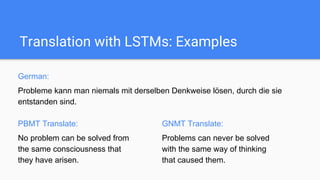
![Translation with LSTMs: How good is it?
PBMT GNMT Human Relative improvement
English → Spanish 4.885 5.428 5.504 87%
English → French 4.932 5.295 5.496 64%
English → Chinese 4.035 4.594 4.987 58%
Spanish → English 4.872 5.187 5.372 63%
French → English 5.046 5.343 5.404 83%
Chinese → English 3.694 4.263 4.636 60%
Google Translate production data, median score by human evaluation on the scale 0-6. [Wu et al.,
‘16]](https://image.slidesharecdn.com/lukaszkaiser-howdeeplearningquietlyrevolutionizednlp-170114081548/85/Lukasz-Kaiser-at-AI-Frontiers-How-Deep-Learning-Quietly-Revolutionized-NLP-11-320.jpg)
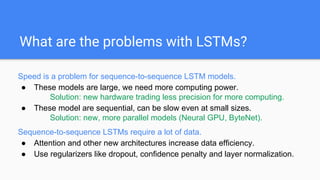
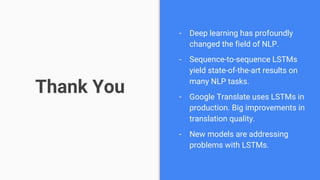

The document discusses how deep learning, particularly sequence-to-sequence LSTMs, has revolutionized natural language processing (NLP) tasks such as parsing, language modeling, translation, and summarization. It highlights the effectiveness of LSTMs in achieving state-of-the-art results and their application in Google Translate, while also addressing challenges related to speed and data requirements. The document concludes that deep learning has significantly advanced the field of NLP and that new models are continuously being developed to mitigate existing issues with LSTMs.


![240311_JW_labseminar[Sequence to Sequence Learning with Neural Networks].pptx](https://cdn.slidesharecdn.com/ss_thumbnails/240311jwlabseminar-240409105539-309b3319-thumbnail.jpg?width=640&height=640&fit=bounds)


![Getting Started with Apache Spark: Big Data Made Simple [Free Meetup]](https://cdn.slidesharecdn.com/ss_thumbnails/apachesparkgettingstarted-260203175547-8361bcc3-thumbnail.jpg?width=640&height=640&fit=bounds)


