Rabi Maharjan
Nabin Dahal
K.U.
Outline
 Back ground
 Rational for culture-inclusive Mathematics course
 Definition of and ethnomathematis
 Basic principles of development of mathematical
course
 Components of Ethnomathematics course
Background
 Mathematics in particular is the subject, more than
any other, that was considered to be value- and
culture-free; hence the view of many educators was
that mathematics education had no need to take the
growing diversity of student populations into account
 Educators have called for the recognition not only that
mathematics is a cultural product, but that the
ethnicity of students can be used in powerful ways in
the learning of school mathematics.
Background (Contd.)
 Connections are advocated between mathematical
content and the home cultures of learners, as well as
between different branches of mathematics, various
disciplines in which mathematics is used, historical
roots of mathematical content, and connections with
the real world and the world of work (Civil, 1995;
Powell & Frankenstein, 1997)
Basic Principles of development
of Mathematics course
1. Each student is considered as having a unique
sociocultural history; each student has ethnicity.
2. This ethnicity is a mathematical resource; mathematics
may be developed from associated cultural practices.
3. Students can use their ethnicity in developing
mathematical activities for sharing with peers.
4. Since the sharing of elements of one’s cultural or ethnic
practices may be a sensitive issue, those who belong to a
culture should be involved in making decisions about
who should share the mathematics of its practices, and
which practices should be shared.
Definition of ethnomathematics
 Ethno-mathema-tics is then a systemization of this
reflection, which is passed on from generation to
generation (D’ Ambrosio, 1991)
 The study and presentation of the mathematical
ideas of traditional peoples. (Ascher, 1991, p. 188)
 The mathematics of cultural practice. (Presmeg,
1996a, p. 3).
 Ethnomathematics refers to any form of cultural
knowledge or social activity characteristic of a
social and/or cultural group, that can be recognized
by other groups such as ‘Western’ anthropologists,
but not necessarily by the group of origin, as
mathematical knowledge or mathematical activity.
(Pompeu, 1994, p. 3).
Components of the Course
 Overview & sharing of cultures of participants
 Influence of language in learning mathematics
 Initial examples from anthropological studies
 Mathematics “frozen” in cultural practices
 Mathematical enculturation
 Curriculum development based on cultural practices
of students.
Curriculum development based on
cultural practices of students.
 Facilitating students’ personal choices of topics.
 Instructional modes.
 Student ownership
 Students’ own ethnomathematics
 Traditional north pacific navigation
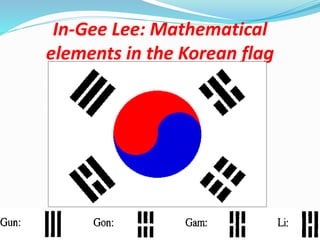
In-Gee Lee: Mathematical
elements in the Korean flag
How to draw Korean Flag
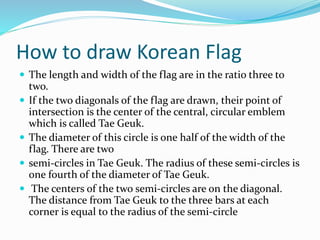
 The length and width of the flag are in the ratio three to
two.
 If the two diagonals of the flag are drawn, their point of
intersection is the center of the central, circular emblem
which is called Tae Geuk.
 The diameter of this circle is one half of the width of the
flag. There are two
 semi-circles in Tae Geuk. The radius of these semi-circles is
one fourth of the diameter of Tae Geuk.
 The centers of the two semi-circles are on the diagonal.
The distance from Tae Geuk to the three bars at each
corner is equal to the radius of the semi-circle
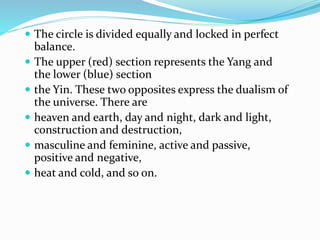
 The circle is divided equally and locked in perfect
balance.
 The upper (red) section represents the Yang and
the lower (blue) section
 the Yin. These two opposites express the dualism of
the universe. There are
 heaven and earth, day and night, dark and light,
construction and destruction,
 masculine and feminine, active and passive,
positive and negative,
 heat and cold, and so on.
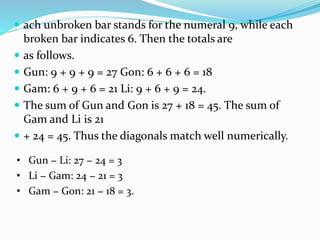
 ach unbroken bar stands for the numeral 9, while each
broken bar indicates 6. Then the totals are
 as follows.
 Gun: 9 + 9 + 9 = 27 Gon: 6 + 6 + 6 = 18
 Gam: 6 + 9 + 6 = 21 Li: 9 + 6 + 9 = 24.
 The sum of Gun and Gon is 27 + 18 = 45. The sum of
Gam and Li is 21
 + 24 = 45. Thus the diagonals match well numerically.
• Gun − Li: 27 − 24 = 3
• Li − Gam: 24 − 21 = 3
• Gam − Gon: 21 − 18 = 3.
Conclusion
- Mathematical ideas and principles are connected
with lived experiences of individual students in a way
that resonates with the goals of mathematics
education reform movements in many countries.
- important step in using cultural practices in the
affirmation of diversity in mathematics classrooms is
that teachers and prospective teachers become aware
of these issues through courses, such as the one
described, in teacher education programs.
Thank You
any comments?

Ethnomathematics in Teacher Education

  • 1.
  • 2.
    Outline  Back ground Rational for culture-inclusive Mathematics course  Definition of and ethnomathematis  Basic principles of development of mathematical course  Components of Ethnomathematics course
  • 3.
    Background  Mathematics inparticular is the subject, more than any other, that was considered to be value- and culture-free; hence the view of many educators was that mathematics education had no need to take the growing diversity of student populations into account  Educators have called for the recognition not only that mathematics is a cultural product, but that the ethnicity of students can be used in powerful ways in the learning of school mathematics.
  • 4.
    Background (Contd.)  Connectionsare advocated between mathematical content and the home cultures of learners, as well as between different branches of mathematics, various disciplines in which mathematics is used, historical roots of mathematical content, and connections with the real world and the world of work (Civil, 1995; Powell & Frankenstein, 1997)
  • 5.
    Basic Principles ofdevelopment of Mathematics course 1. Each student is considered as having a unique sociocultural history; each student has ethnicity. 2. This ethnicity is a mathematical resource; mathematics may be developed from associated cultural practices. 3. Students can use their ethnicity in developing mathematical activities for sharing with peers. 4. Since the sharing of elements of one’s cultural or ethnic practices may be a sensitive issue, those who belong to a culture should be involved in making decisions about who should share the mathematics of its practices, and which practices should be shared.
  • 6.
    Definition of ethnomathematics Ethno-mathema-tics is then a systemization of this reflection, which is passed on from generation to generation (D’ Ambrosio, 1991)  The study and presentation of the mathematical ideas of traditional peoples. (Ascher, 1991, p. 188)  The mathematics of cultural practice. (Presmeg, 1996a, p. 3).  Ethnomathematics refers to any form of cultural knowledge or social activity characteristic of a social and/or cultural group, that can be recognized by other groups such as ‘Western’ anthropologists, but not necessarily by the group of origin, as mathematical knowledge or mathematical activity. (Pompeu, 1994, p. 3).
  • 7.
    Components of theCourse  Overview & sharing of cultures of participants  Influence of language in learning mathematics  Initial examples from anthropological studies  Mathematics “frozen” in cultural practices  Mathematical enculturation  Curriculum development based on cultural practices of students.
  • 8.
    Curriculum development basedon cultural practices of students.  Facilitating students’ personal choices of topics.  Instructional modes.  Student ownership  Students’ own ethnomathematics  Traditional north pacific navigation
  • 9.
  • 10.
    How to drawKorean Flag  The length and width of the flag are in the ratio three to two.  If the two diagonals of the flag are drawn, their point of intersection is the center of the central, circular emblem which is called Tae Geuk.  The diameter of this circle is one half of the width of the flag. There are two  semi-circles in Tae Geuk. The radius of these semi-circles is one fourth of the diameter of Tae Geuk.  The centers of the two semi-circles are on the diagonal. The distance from Tae Geuk to the three bars at each corner is equal to the radius of the semi-circle
  • 11.
     The circleis divided equally and locked in perfect balance.  The upper (red) section represents the Yang and the lower (blue) section  the Yin. These two opposites express the dualism of the universe. There are  heaven and earth, day and night, dark and light, construction and destruction,  masculine and feminine, active and passive, positive and negative,  heat and cold, and so on.
  • 12.
     ach unbrokenbar stands for the numeral 9, while each broken bar indicates 6. Then the totals are  as follows.  Gun: 9 + 9 + 9 = 27 Gon: 6 + 6 + 6 = 18  Gam: 6 + 9 + 6 = 21 Li: 9 + 6 + 9 = 24.  The sum of Gun and Gon is 27 + 18 = 45. The sum of Gam and Li is 21  + 24 = 45. Thus the diagonals match well numerically. • Gun − Li: 27 − 24 = 3 • Li − Gam: 24 − 21 = 3 • Gam − Gon: 21 − 18 = 3.
  • 13.
    Conclusion - Mathematical ideasand principles are connected with lived experiences of individual students in a way that resonates with the goals of mathematics education reform movements in many countries. - important step in using cultural practices in the affirmation of diversity in mathematics classrooms is that teachers and prospective teachers become aware of these issues through courses, such as the one described, in teacher education programs.
  • 14.