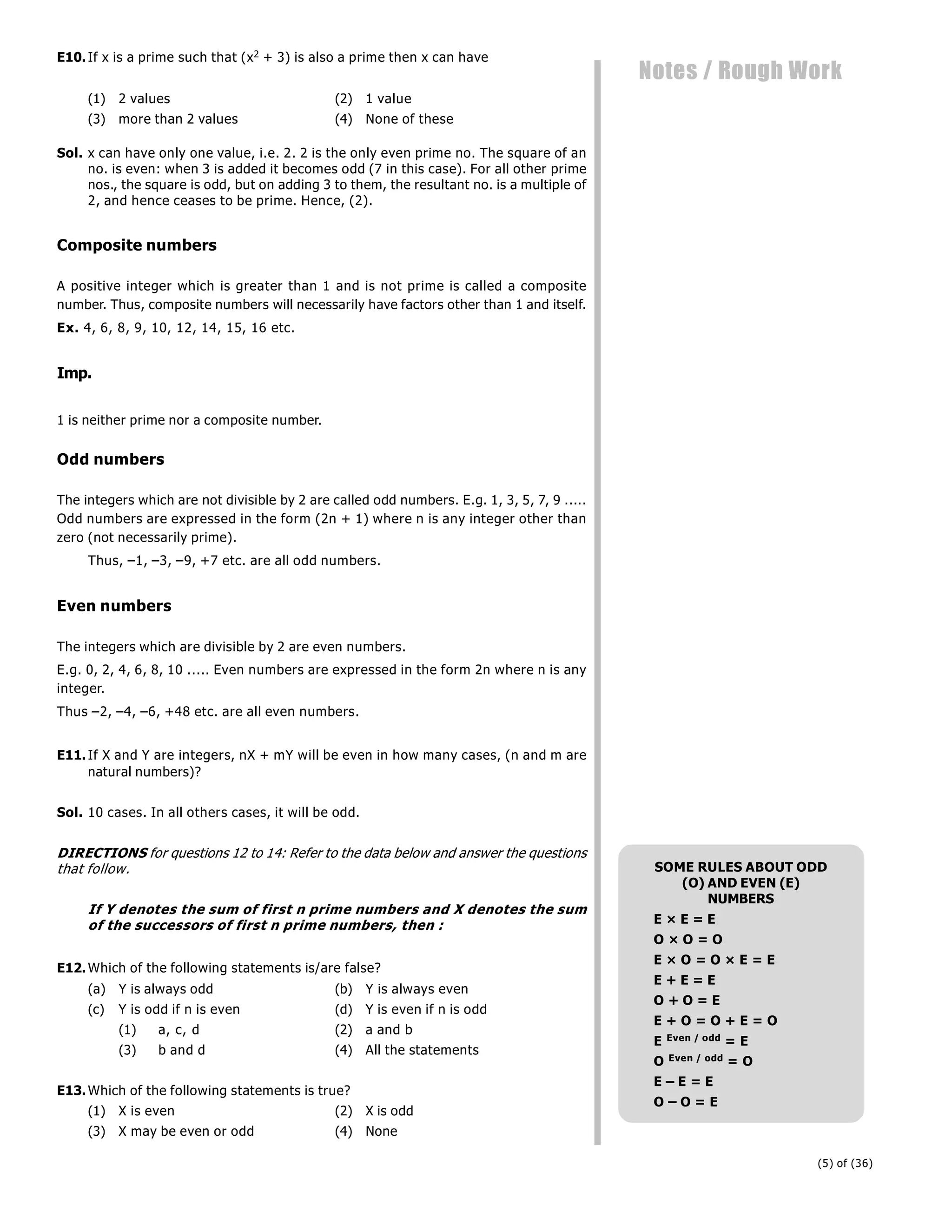
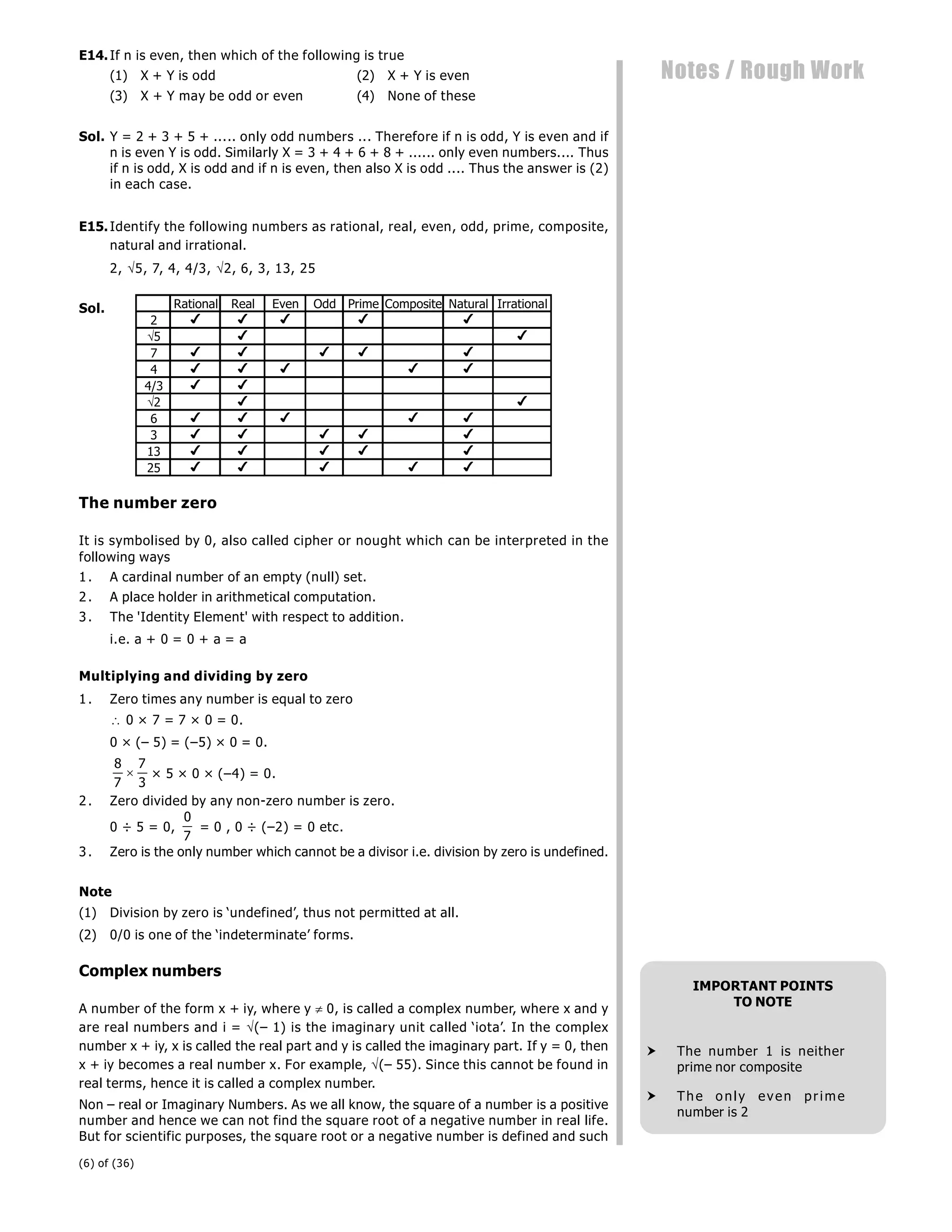
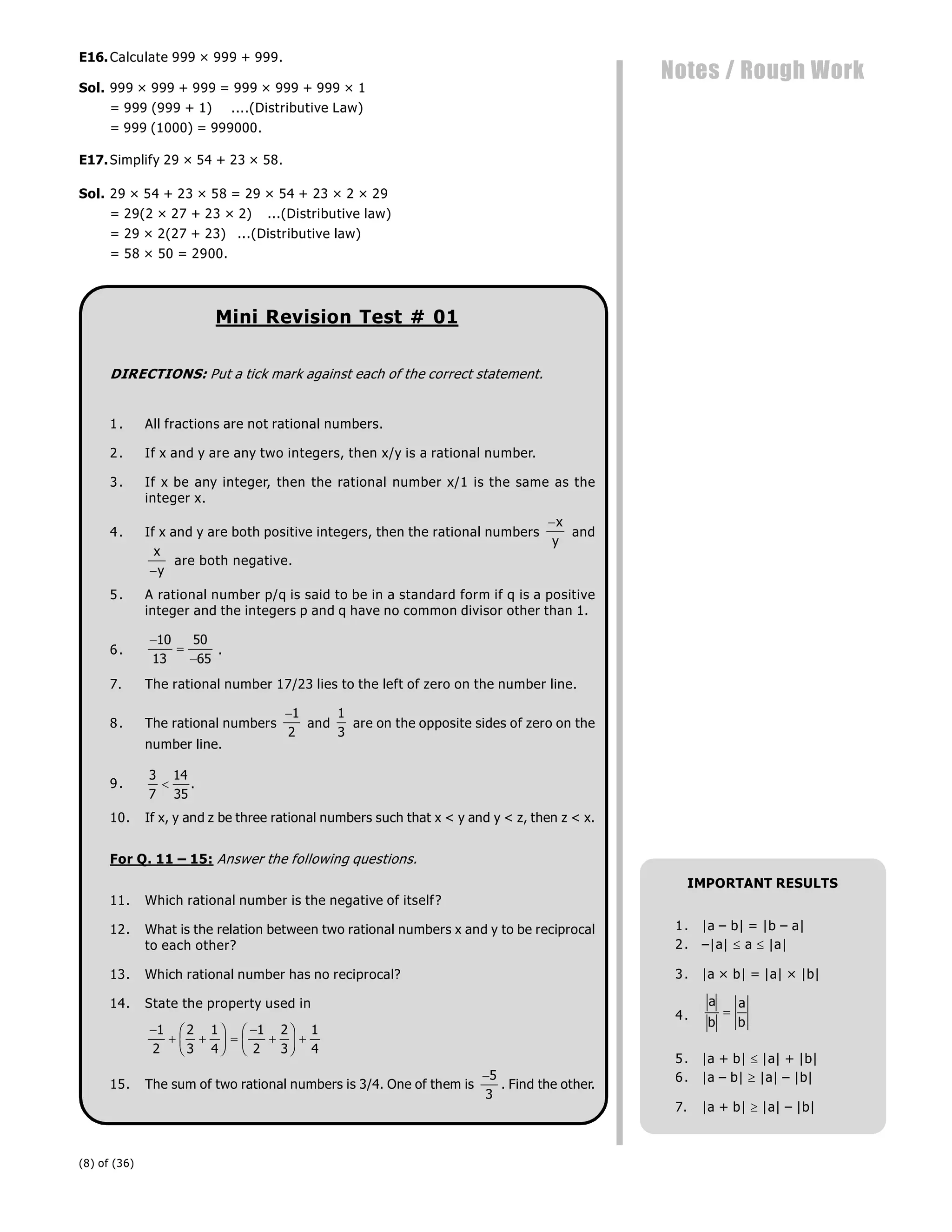
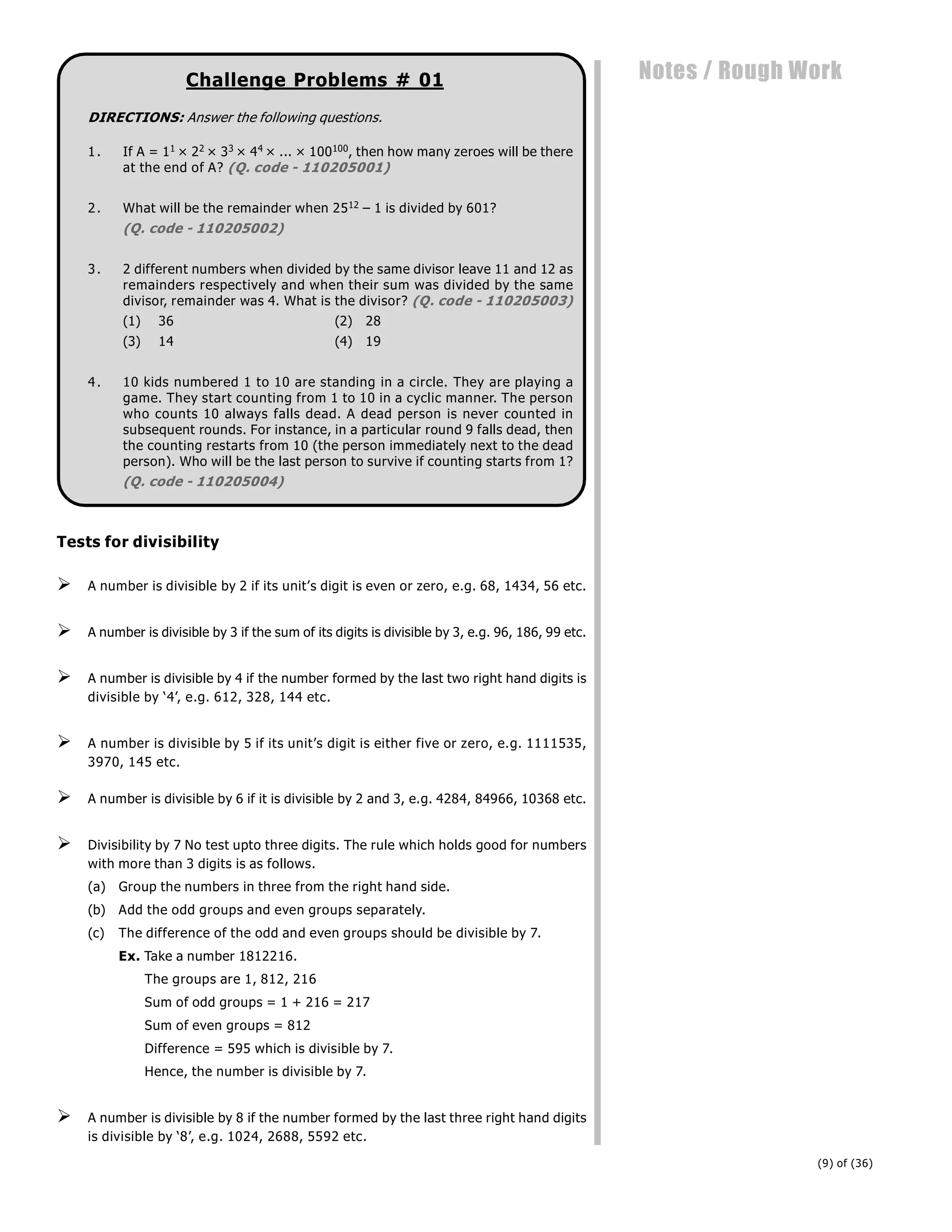
(1) of (36)
Notes / Rough Work
0
-1
-2
-3 1 2 3
2 
-2.3 0.6
System of numbers
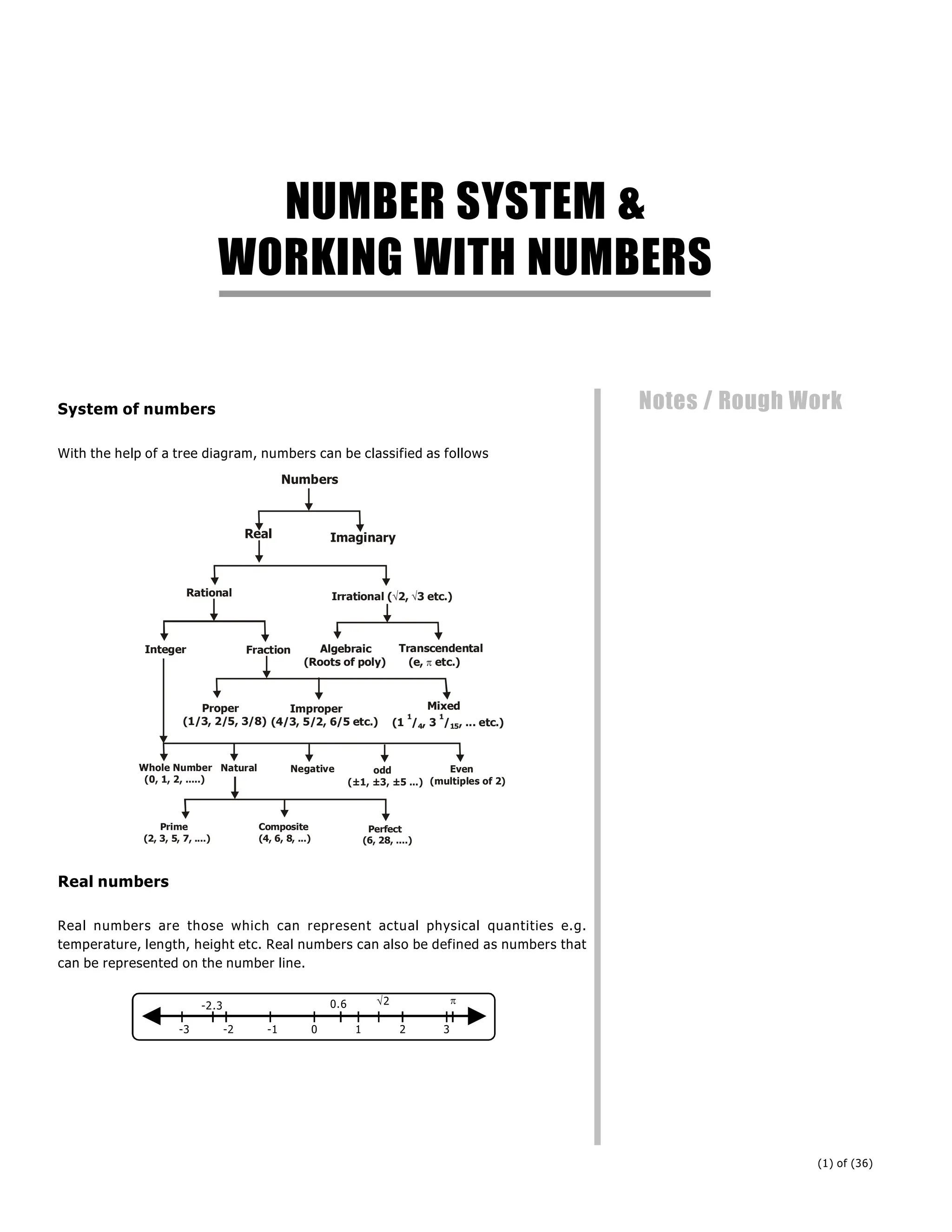
With the help of a tree diagram, numbers can be classified as follows
Numbers
Real Imaginary
Rational Irrational ( 2, 3 etc.)
 
Algebraic
(Roots of poly)
Transcendental
(e, etc.)

Integer Fraction
Proper
(1/3, 2/5, 3/8)
Improper
(4/3, 5/2, 6/5 etc.)
Whole Number
(0, 1, 2, .....)
Natural Negative odd
(±1, ±3, ±5 ...)
Even
(multiples of 2)
Prime
(2, 3, 5, 7, ....)
Composite
(4, 6, 8, ...)
Perfect
(6, 28, ....)
Mixed
(1 / , 3 / , ... etc.)
1 1
4 15
Real numbers
Real numbers are those which can represent actual physical quantities e.g.
temperature, length, height etc. Real numbers can also be defined as numbers that
can be represented on the number line.
NUMBER SYSTEM &
WORKING WITH NUMBERS
Notes / Rough Work
(2) of (36)
Notes / Rough Work
Natural numbers (positive integers)
These are the counting numbers used to count physical quantities. e.g. 1, 2, 3, ...,
105, ..., 326, 15957, ..., 37950046, ... . The set of natural numbers is denoted by
N = {1, 2, 3, 4, 5, 6, 7 ..... }
E1. S and L are the smallest and the largest n–digit natural numbers respectively. L – S
is always divisible by
(1) 9 (2) 10
(3) 9 and 10 (4) None of these
Sol. When n = 1, L – S = 8, when n = 2, L – S = 89 etc. Thus we see that L – S is never
divisible by 9 or 10.
E2. If ab is two digit number and 7b + a = 23k, where k is a natural number. The
largest number that always divides the product of ab and twice of ab is
(1) 1058 (2) 46
(3) 92 (4) None of these
Sol. We have 7b + a = 23k or, a = 23k – 7b. Now the value of the number ab is
10a + b = 10(23k – 7b) + b= 230k – 69b = 23(10k – 3b) ab is a multiple of 23.
Product of ab and 2ab will always be divisible by 23 × 23 × 2 = 1058
Whole numbers
The numbers 0, 1, 2, 3, 4, ... are whole numbers.
The set of all non-negative integers (i.e. zero + natural numbers) is said to be the set
of Whole Numbers and is denoted as W = {0, 1, 2, 3, ... }.
E3. abc is a three digit whole number so that abc = a3 + b3 + c3. 300  abc 400.
What is the value of a + b + c?
(1) 10 (2) 11
(3) 12 (4) Data insufficient
Sol. There are two such numbers in the given range viz 370 and 371. Hence, (4).
E4. If 17 is added to product of two consecutive whole numbers we always get a /an
(1) Prime number (2) Even number
(3) Odd number (4) None of these
Sol. You must have answered (1) thinking
1 × 2 + 17 = 19, 2 × 3 + 17 = 23, 3 × 4 + 17 = 37 etc.
but if we take 16 × 17 + 17 = 289. It is a composite number. Out of two consecutive
whole numbers one will always be even number and so their product will be even.
When an odd number 17 is added to an even number we always get an odd
number. Hence, (3).
Integers
The set of all natural numbers (positive, zero, negative) are together known as integers.
The set of integers is denoted as I where I = {0, ±1, ±2, ±3, ... }.
Zero and positive integers are called as non-negative integers.
E5. A is the smallest integer that when multiplied with 3 gives a number made of
5’s only. Sum of the digits of A is B. Sum of the digits of B is C. What is the
value of C3?
(1) 125 (2) 64
(3) 216 (4) None of these
Sol. A = 185, B = 14, C = 5. Hence, (1).
(3) of (36)
Notes / Rough Work
E6. P is integer. P > 883. If P > 883. If P – 7 is a multiple of 11 then the largest
number that will always divide (P + 4) (P + 15) is
(1) 11 (2) 121
(3) 242 (4) None of these
Sol. If (P – 7) is a multiple of 11, (P + 4) and (P + 15) must be multiple of 11 as well
because P + 4 = (P – 7) + 11 and P + 15 = (P – 7) + 22. Since (P + 4) and (p + 15)
are consecutive multiples of 11, so one of them must be an even number.
Hence, (P + 4) (P + 15) will always be divisible by 11 × 11 × 2 = 242. Hence, (3).
E7. Vijay writes all the numbers from 100 to 999. The number of zeroes that he uses
is m, the number of fives that he uses is n and the number of 8’s that he uses is
p. What is the value of n + p – m?
(1) 280 (2) 380
(3) 180 (4) None of these
Sol. m = 180, n =280, p = 280, Hence, (2).
Rational numbers
p and q (q  0) are integers. Then
p
q
is known as a rational number. Thus the set Q of
the rational numbers is given by
Q
p
q
p q I and q
  
R
S
T
U
V
W
: , 0
Naturally, fractions such as
7
9
,
23
16
, 
2
5
are called rational numbers. This definition
also emphasises that any integer can also be a rational number since p = p/1, p  I.
Any positive rational number p/q, after actual division, if necessary can be expressed
as,
p
q
m
r
q
  where m is non-negative integer and 0  r < q
For example,
41
5
8
1
5
3
5
0
3
5
10
10
1
10
0
1
      
; ; .
For the decimal representation of a fraction p/q, we have merely to consider the
decimal form of fraction r/q which we usually write to the right of the decimal point.
Consider some fractions given below.
(1) 1/2 = 0.5 (2) 3/5 = 0.6
(3) 1/4 = 0.25 (4) 1/5 = 0.2
(5) 1/8 = 0.125 (6) 1/6 = 0.1666...
(7) 5/11 = 0.4545... (8) 1/3 = 0.33...
(9) 7/12 = 0.583333...
Note that the dots ........ represent endless recurrence of digits.
Examples (1), (2), (3), (4) and (5) suggest that we have decimal form of the
‘terminating type’. While examples (6), (7), (8) and (9) tell us that we have decimal
form of the ‘non-terminating type’.
(4) of (36)
Notes / Rough Work
In case of ‘non-terminating type’ we have decimal fractions having an infinite number
of digits. Some decimal fractions from this group have digits repeating infinitely. They
are called ‘repeating or recurring’ decimals.
In ‘endless recurring or infinite repeating’ decimal fractions we can see that when p is
actually divided by q the possible remainders are 1, 2, 3, ..... , q - 1. So one of them
has to repeat itself in q steps. Thereafter the earlier numeral or group of numerals
must repeat itself.
Note
(1) All the rational numbers thus can be represented as a finite decimal (terminating
type) or as a recurring decimal.
(2) The recurring digits from the recurring group are indicated by putting a dot above
the first and last of them or a bar above the recurring group.
For example
(i) 0.333 ....... as 0. 3 or 0 3
.  (ii) 1.2555 .... as 1.2 5 or 1 25
. 
(iii) 3.142142142 ..... as 3. 142 or 3 142
.  
 Every infinite repeating decimal can be expressed as a fraction.
Irrational numbers
Each non-terminating recurring decimal is a rational number. Thus the number which is
a non-terminating non recurring decimal or more simply the number which can not be
written as fraction (i.e. in the form p/q), is called an irrational number.
E.g. 2 = 1.414213562373095.....
= 3.141592653589793.....
log 2= 0.301029995663981..... etc.
Prime numbers
A positive integer which is not equal to 1 and is divisible by itself and 1 only is called a
prime number.
Ex. 2, 3, 5, 7, 11, 13, 17, 19 etc.
Thus, for the prime number 131 there are no factors besides 131 and 1.
E8. P is a prime number greater than 5. What is the remainder when P is divided by 6?
(1) 5 (2) 1
(3) 1 or 5 (4) None of these
Sol. Any prime number greater than 3 is of the form 6k 1 so when it is divided by 6
the remainder will obviously be 1 or 5.
E9. The average of three prime no’s is 223/3. What is the difference between the
greatest and the smallest number?
(1) 8 (2) 16
(3) Data inadequate (4) None of these
Sol. We can have at least two such sets of prime numbers 71, 73, 79 and 67, 73, 83.
Hence, (3).
IDENTIFYING A PRIME
NUMBER
If a number has no prime
factor upto its square root,
it is prime. For example, let’s
check 257. Now 257 16
 ,
so we check all prime
numbers upto 16, i.e., 2, 3,
7, 11, 13. As no number
divides 257, it is prime.
(5) of (36)
Notes / Rough Work
E10.If x is a prime such that (x2 + 3) is also a prime then x can have
(1) 2 values (2) 1 value
(3) more than 2 values (4) None of these
Sol. x can have only one value, i.e. 2. 2 is the only even prime no. The square of an
no. is even: when 3 is added it becomes odd (7 in this case). For all other prime
nos., the square is odd, but on adding 3 to them, the resultant no. is a multiple of
2, and hence ceases to be prime. Hence, (2).
Composite numbers
A positive integer which is greater than 1 and is not prime is called a composite
number. Thus, composite numbers will necessarily have factors other than 1 and itself.
Ex. 4, 6, 8, 9, 10, 12, 14, 15, 16 etc.
Imp.
1 is neither prime nor a composite number.
Odd numbers
The integers which are not divisible by 2 are called odd numbers. E.g. 1, 3, 5, 7, 9 .....
Odd numbers are expressed in the form (2n + 1) where n is any integer other than
zero (not necessarily prime).
Thus, –1, –3, –9, +7 etc. are all odd numbers.
Even numbers
The integers which are divisible by 2 are even numbers.
E.g. 0, 2, 4, 6, 8, 10 ..... Even numbers are expressed in the form 2n where n is any
integer.
Thus –2, –4, –6, +48 etc. are all even numbers.
E11.If X and Y are integers, nX + mY will be even in how many cases, (n and m are
natural numbers)?
Sol. 10 cases. In all others cases, it will be odd.
DIRECTIONS for questions 12 to 14: Refer to the data below and answer the questions
that follow.
If Y denotes the sum of first n prime numbers and X denotes the sum
of the successors of first n prime numbers, then :
E12.Which of the following statements is/are false?
(a) Y is always odd (b) Y is always even
(c) Y is odd if n is even (d) Y is even if n is odd
(1) a, c, d (2) a and b
(3) b and d (4) All the statements
E13.Which of the following statements is true?
(1) X is even (2) X is odd
(3) X may be even or odd (4) None
SOME RULES ABOUT ODD
(O) AND EVEN (E)
NUMBERS
E × E = E
O × O = O
E × O = O × E = E
E + E = E
O + O = E
E + O = O + E = O
E Even / odd = E
O Even / odd = O
E – E = E
O – O = E
(6) of (36)
Notes / Rough Work
E14.If n is even, then which of the following is true
(1) X + Y is odd (2) X + Y is even
(3) X + Y may be odd or even (4) None of these
Sol. Y = 2 + 3 + 5 + ..... only odd numbers ... Therefore if n is odd, Y is even and if
n is even Y is odd. Similarly X = 3 + 4 + 6 + 8 + ...... only even numbers.... Thus
if n is odd, X is odd and if n is even, then also X is odd .... Thus the answer is (2)
in each case.
E15.Identify the following numbers as rational, real, even, odd, prime, composite,
natural and irrational.
2, 5, 7, 4, 4/3, 2, 6, 3, 13, 25
Sol. Rational Real Even Odd Prime Composite Natural Irrational
2     
5  
7     
4     
4/3  
2  
6     
3     
13     
25     
The number zero
It is symbolised by 0, also called cipher or nought which can be interpreted in the
following ways
1. A cardinal number of an empty (null) set.
2. A place holder in arithmetical computation.
3. The 'Identity Element' with respect to addition.
i.e. a + 0 = 0 + a = a
Multiplying and dividing by zero
1. Zero times any number is equal to zero
 0 × 7 = 7 × 0 = 0.
0 × (– 5) = (–5) × 0 = 0.
8
7
7
3
 × 5 × 0 × (–4) = 0.
2. Zero divided by any non-zero number is zero.
0 ÷ 5 = 0,
0
7
= 0 , 0 ÷ (–2) = 0 etc.
3. Zero is the only number which cannot be a divisor i.e. division by zero is undefined.
Note
(1) Division by zero is ‘undefined’, thus not permitted at all.
(2) 0/0 is one of the ‘indeterminate’ forms.
Complex numbers
A number of the form x + iy, where y  0, is called a complex number, where x and y
are real numbers and i = (– 1) is the imaginary unit called ‘iota’. In the complex
number x + iy, x is called the real part and y is called the imaginary part. If y = 0, then
x + iy becomes a real number x. For example, (– 55). Since this cannot be found in
real terms, hence it is called a complex number.
Non – real or Imaginary Numbers. As we all know, the square of a number is a positive
number and hence we can not find the square root of a negative number in real life.
But for scientific purposes, the square root or a negative number is defined and such
IMPORTANT POINTS
TO NOTE
 The number 1 is neither
prime nor composite
 The only even prime
number is 2
(7) of (36)
Notes / Rough Work
numbers are called non-real or imaginary numbers. The square root – 1, is denoted by
i (iota). So to calculate any power of i, all you have to do is to remove all those powers
which are perfect multiples of 4 and then it’s simple.
e.g., i97. i = (i4)24. i = 1 i = i; i98 = i96 . i2 = (i4)24. i2 = 1. i2 = – 1 etc.
Operation on complex numbers are similar to those on real numbers.
Let a + bi and c + di two complex numbers. Then the various arithmetic operations are
Addition : (a + bi) + (c + di) = [(a + c) + (b + d)i]
e.g.,: (3 + 4i) + (4 – 3i) = 7 + i
Subtraction: (a + bi) – (c + di) = [(a – c) + (b – d)i]
e.g.,: (3 + 4i) – (4 – 3i) = – 1 + 7i
Multiplications: (a + bi) × (c + di) = [(ac – bd) + (ad + bc)i]
e.g.,: (3 + 4i) × (4 – 3i) = 24 + 7i
Division :This is done using rationalization
e.g.,:
2 3
4 3
2 3
4 3
4 3
4 3
1 18
25
1
25
18
25









 



i
i
i
i
i
i
i
i
Let us recall some notations which are used for certain specific sets. We list them
below as
N: The set of all natural numbers (i.e. positive integers). This is the set. {1, 2, 3,
....., n, ......}
I : The set of all integers i.e. {......, -3, -2, -1, 0, 1, 2, 3.....}
W : The set of all whole numbers i.e. {0, 1, 2, 3, ......}
Q : The set of rational numbers.
R : The set of real numbers.
C : The set of all complex numbers.
Properties of real numbers
It must be noted that all the properties of rational numbers are true for real numbers
also.
(i) Commutative property of addition – If ‘a’ and ‘b’ are real numbers, then
a + b = b + a.
(ii) Associative property of addition – If a, b, c are real numbers, then
(a + b) + c = a + (b + c).
(iii) Commutative property of multiplication – If ‘a’ and ‘b’ are two real numbers,
then a × b = b × a.
(iv) Associative property of multiplication – If a, b, c are real numbers, then
(a × b) × c = a × (b × c).
(v) Distributive law – If a, b, c are real numbers, then a × (b + c) = a × b + a × c.
Absolute value or modulus of a real number
The absolute value of any number 'a' is denoted by |a|.
Definition –
i.e. |a| =
a a
a
a a
,
,
,


 
R
S
|
T
|
0
0 0
0
e.g. |2| = 2 since a = 2 > 0
|0| = 0 since a = 0 and |–2| = –(–2) = 2, since a = –2 < 0.
The absolute value |a| of a  R is defined to be equal to a2 . Thus a2 = |a|.
For example
(1) If a = –2, then ( )
2 2 = |–2| = 2. (2) If a = 0, then ( )
0 2 = |0| = 0.
(8) of (36)
Notes / Rough Work
E16.Calculate 999 × 999 + 999.
Sol. 999 × 999 + 999 = 999 × 999 + 999 × 1
= 999 (999 + 1) ....(Distributive Law)
= 999 (1000) = 999000.
E17.Simplify 29 × 54 + 23 × 58.
Sol. 29 × 54 + 23 × 58 = 29 × 54 + 23 × 2 × 29
= 29(2 × 27 + 23 × 2) ...(Distributive law)
= 29 × 2(27 + 23) ...(Distributive law)
= 58 × 50 = 2900.
Mini Revision Test # 01
DIRECTIONS: Put a tick mark against each of the correct statement.
1. All fractions are not rational numbers.
2. If x and y are any two integers, then x/y is a rational number.
3. If x be any integer, then the rational number x/1 is the same as the
integer x.
4. If x and y are both positive integers, then the rational numbers
x
y
and
x
y

are both negative.
5. A rational number p/q is said to be in a standard form if q is a positive
integer and the integers p and q have no common divisor other than 1.
6.



10
13
50
65
.
7. The rational number 17/23 lies to the left of zero on the number line.
8. The rational numbers
1
2
and
1
3
are on the opposite sides of zero on the
number line.
9.
3
7
14
35
 .
10. If x, y and z be three rational numbers such that x < y and y < z, then z < x.
For Q. 11 – 15: Answer the following questions.
11. Which rational number is the negative of itself?
12. What is the relation between two rational numbers x and y to be reciprocal
to each other?
13. Which rational number has no reciprocal?
14. State the property used in

 
F
HG I
KJ 


F
HG I
KJ 
1
2
2
3
1
4
1
2
2
3
1
4
15. The sum of two rational numbers is 3/4. One of them is
5
3
. Find the other.
.
IMPORTANT RESULTS
1. |a – b| = |b – a|
2. –|a|  a  |a|
3. |a × b| = |a| × |b|
4.
a
b
a
b

5. |a + b|  |a| + |b|
6. |a – b|  |a| – |b|
7. |a + b|  |a| – |b|
(9) of (36)
Notes / Rough Work
Challenge Problems # 01
DIRECTIONS: Answer the following questions.
1. If A = 11 × 22 × 33 × 44 × ... × 100100, then how many zeroes will be there
at the end of A? (Q. code - 110205001)
2. What will be the remainder when 2512 – 1 is divided by 601?
(Q. code - 110205002)
3. 2 different numbers when divided by the same divisor leave 11 and 12 as
remainders respectively and when their sum was divided by the same
divisor, remainder was 4. What is the divisor? (Q. code - 110205003)
(1) 36 (2) 28
(3) 14 (4) 19
4. 10 kids numbered 1 to 10 are standing in a circle. They are playing a
game. They start counting from 1 to 10 in a cyclic manner. The person
who counts 10 always falls dead. A dead person is never counted in
subsequent rounds. For instance, in a particular round 9 falls dead, then
the counting restarts from 10 (the person immediately next to the dead
person). Who will be the last person to survive if counting starts from 1?
(Q. code - 110205004)
Tests for divisibility
 A number is divisible by 2 if its unit’s digit is even or zero, e.g. 68, 1434, 56 etc.
 A number is divisible by 3 if the sum of its digits is divisible by 3, e.g. 96, 186, 99 etc.
 A number is divisible by 4 if the number formed by the last two right hand digits is
divisible by ‘4’, e.g. 612, 328, 144 etc.
 A number is divisible by 5 if its unit’s digit is either five or zero, e.g. 1111535,
3970, 145 etc.
 A number is divisible by 6 if it is divisible by 2 and 3, e.g. 4284, 84966, 10368 etc.
 Divisibility by 7 No test upto three digits. The rule which holds good for numbers
with more than 3 digits is as follows.
(a) Group the numbers in three from the right hand side.
(b) Add the odd groups and even groups separately.
(c) The difference of the odd and even groups should be divisible by 7.
Ex. Take a number 1812216.
The groups are 1, 812, 216
Sum of odd groups = 1 + 216 = 217
Sum of even groups = 812
Difference = 595 which is divisible by 7.
Hence, the number is divisible by 7.
 A number is divisible by 8 if the number formed by the last three right hand digits
is divisible by ‘8’, e.g. 1024, 2688, 5592 etc.
(10) of (36)
Notes / Rough Work
 A number is divisible by 9 if the sum of its digits is divisible by 9, e.g. 891, 5922,
888993 etc.
 A number is divisible by 10 if its unit’s digit is zero, e.g. 200, 580, 99990 etc.
 A number is divisible by 11 when the difference between the sums of digits in the
odd and even places is either zero or a multiple of 11.
Ex. 6159989, 1099989, 7645 etc.
For the number 6159989 –
Sum of the digits at even places = 1 + 9 + 8 = 18.
Sum of the digits at odd places = 6 + 5 + 9 + 9 = 29.
Hence 29 – 18 = 11.
 A number is divisible by 12 if it is divisible by 3 and 4
e.g. 1740, 7068 etc.
 Divisibility by 13 – The rule is same as that of 7 with 13 replacing 7 in the divisibility
check.
Ex. Test the divisibility of the following numbers by 13.
(i) 909987 Ans. (i) divisible.
(ii) 4766983 Ans. (ii) divisible.
 A number is divisible by 14 if it is divisible by 2 and 7
e.g. 5166, 13524 etc.
 A number is divisible by 15 if it is divisible by 3 and 5
e.g. 14745, 8970 etc.
 A number is divisible by 16 if the number formed by the last four right hand digits
is divisible by 16.
e.g. 15792, 1579568 etc.
 A number is divisible by 18 if it is divisible by 9 and has its last digit even.
e.g. 125982, 173556 etc.
 A number is divisible by 25 if the number formed by the last two right hand digits
is divisible by 25.
e.g. 1025, 3475, 55550 etc.
 A number is divisible by 125, if the number formed by the last three right hand
digits is divisible by 125.
e.g. 2125, 4250, 6375 etc.
Tip : All these rules must be memorised and practised by the students on a regular
basis. A sincere student can reduce calculation time by 50%, if all these rules are
put in practice.
E18.How many numbers between 1 and 500, both included are divisible by 3 or 7?
Ans. 214
(11) of (36)
Notes / Rough Work
Rule of Divisibility
Dividend = Divisor × Quotient + Remainder.
For example, if 9 (dividend) is divided by 4 (divisor) and remainder is 1.
9 = 4 × 2 + 1
E19.On dividing a number by 9, the remainder is 8. The quotient so obtained when
divided by 11, leaves the remainder 9. Now the quotient so obtained when divided
by 13, leaves the remainder 8. Find the remainder when then given number is
divided by 1287.
(1) 879 (2) 881
(3) 883 (4) 885
Sol. Suppose the given number is N. We have N = 9Q1 + 8, Q1 = 11Q2 + 8,
Q2 = 13Q3 + 8. Here Q1, Q2 and Q3 are first, second and 3rd quotient.
Now N = 9 [11 (13Q3 + 8) + 9] + 8 = 1287Q3 + 881. Hence, (2).
E20.If ‘n’ is a positive integer (> 1), then prove that
n3 – n is divisible by 6.
Sol. n3 – n = n(n2 – 1) = n(n – 1)(n + 1).
As (n – 1), n, (n + 1) are three consecutive integers with n greater than 1, then
it should contain a factor of 2 and 3. Hence, it is always divisible by 6.
E21.Find P & Q if it is known that the number 28563P45Q is divisible by 88.
Sol. 28563P45Q is divisible by 88 and 88 = 8 x 11. Therefore the number should be
divisible by 8 and 11 both. For 8, the last three digits should be divisible by 8. The
only possible 3 digit number having 4 and 5 at the hundred's and the ten's place
is 456. Hence, Q can have 6 as the only possible value.
For 11  (2 + 5 + 3 + 4 + 6) – (8 + 6 + P + 5) = 0 20 – 19 – P = 0  P = 1.
E22. A number 344ab5, is divisible by both 9 and 25. Find the number? (Given a + b < 8)
Sol. If the number has to be divisible by 9, then a + b + 16, has to be divisible by 9.
Hence a + b can be either 2 or 11. It cannot be 11 because a + b < 8. So the
possible values of (a, b) are (0, 2) or (1, 1) or (2, 0) ..... (1)
If a number has to be divisible by 25 the last 2 digits have to be divisible by 25.
So b is equal to 2 or 7. ..... (2)
Combining (1) and (2) we get a = 0 and b = 2. So the number is 344025.
E23.A seven–digit number is such that both its end digits are 1 and the rest of the
digits are 0 except the middle digit, Also it is known that the number is divisible by
13. What is the middle digit of the number?
(1) 3 (2) 2
(3) 7 (4) 6
Sol. We know that 1001 is divisible by 13, hence the 7 digit number can written as
(100x001) = (100y) + 1000 + 1001, where y = x – 1. The second term is divisible
by 13, for the first term to be divisible by 13 we need x – 1 = 1 or x = 2. Hence,
(2).
E24.What will be remainder when 86 × 293 × 4919 is divided by 17?
Sol. 86 × 293 × 4919 = (17 × 5 + 1) (17 × 17 + 4) (173 + 6). When we do the
multiplication all the terms except 1 × 4 × 6 will be divisible by 17. Hence the
remainder will be 24 – 17 = 7.
IMPORTANT TIP
If in a question, it is stated
that, “A number when divide
by 35 leaves 18 as
remainder”, then the number
can be taken as 35k + 18,
where k (the quotient) is a
whole number, i.e., k can be
0 also.
(12) of (36)
Notes / Rough Work
Mini Revision Test # 02
DIRECTIONS: Answer the following questions.
1. If 34y5 is divisible by 3, then the least value of y is .......
2. If 34ab2 is divisible by 3 and 4 both, then, the least value of a + b is ......
3. If 85y4 is divisible by 6, then, the least value of y is ......
4. If 3424x is divisible by 8, then, the greatest value of x is .......
5. If 5g22 is divisible by 9, then, the least value of g is ......
Mark True/False for each of these statements
6. 4765683 is divisible by 13.
7. 1579548 is divisible by 16.
8. 174474 is divisible by 18.
9. 23ab + ba32 is divisible by 11 for all the positive values of a and b.
10. If p is a prime number, then for any whole number ‘a’, (ap– a) is divisible
by ‘a’.
Challenge Problems # 02
DIRECTIONS: Answer the following questions.
1. A number is formed by writing the first 24 natural numbers
consecutively. What will be the remainder if this number is divided by
9? (Q. code - 110206001)
2. If a1, a2, a3, ..... represents an arbitrary arrangement of 1, 2, 3, .... n
(n is odd), then |(a1 – 1) (a2 – 2) (.....) (an – n)| is always
(Q. code - 110206002)
(1) odd (2) even
(3) prime (4) Cannot be determined
3. The number of values of n for which n2 + n + 1 is divisible by 35 is
(Q. code - 110206003)
(1) 1 (2) 2
(3) Infinite (4) None of these
Imp.
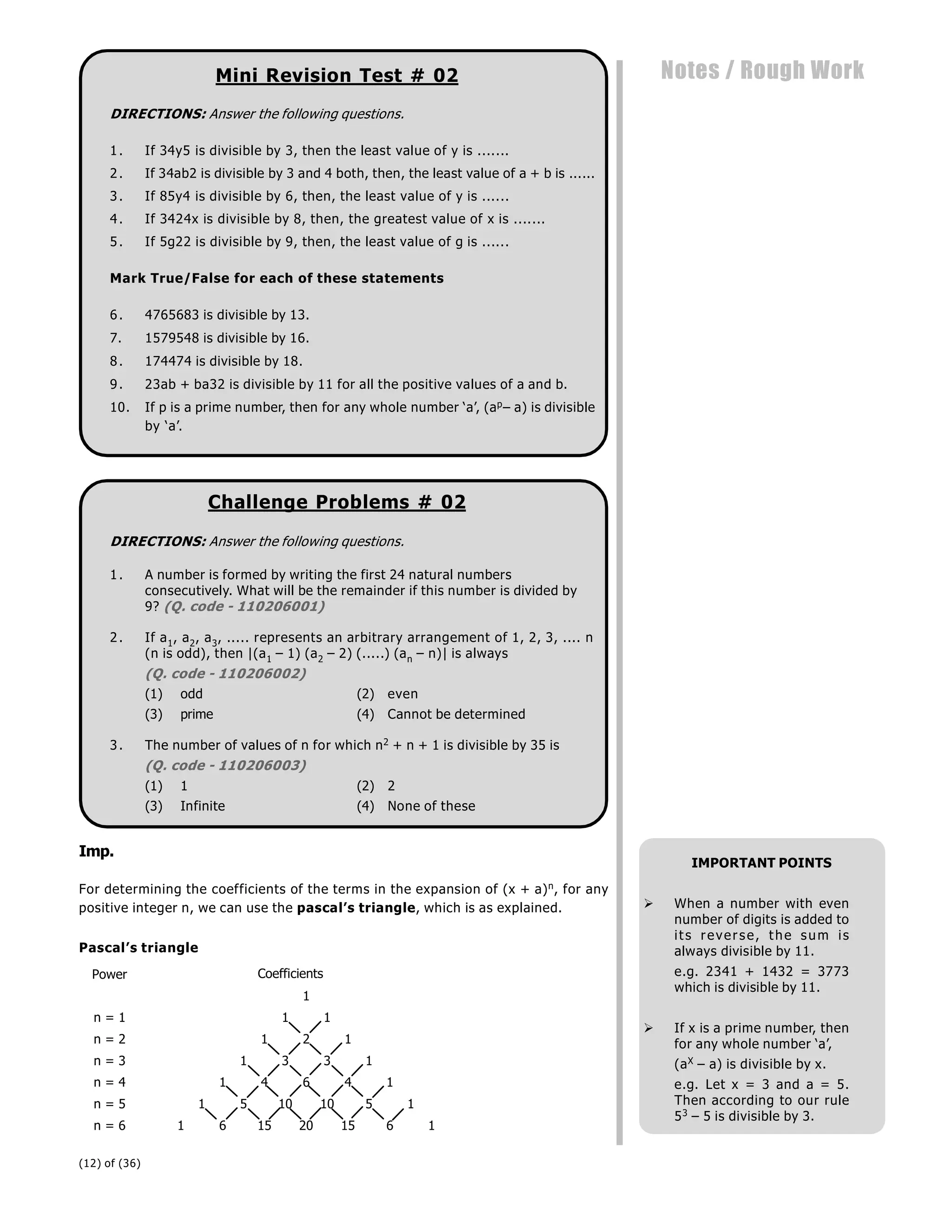
For determining the coefficients of the terms in the expansion of (x + a)n, for any
positive integer n, we can use the pascal’s triangle, which is as explained.
Pascal’s triangle
Power
1
n = 1 1 1
n = 2 1 2 1
n = 3 1 3 3 1
n = 4 1 4 6 4 1
n = 5 1 5 10 10 5 1
n = 6 1 6 15 20 15 6 1
Coefficients
IMPORTANT POINTS
 When a number with even
number of digits is added to
its reverse, the sum is
always divisible by 11.
e.g. 2341 + 1432 = 3773
which is divisible by 11.
 If x is a prime number, then
for any whole number ‘a’,
(aX – a) is divisible by x.
e.g. Let x = 3 and a = 5.
Then according to our rule
53 – 5 is divisible by 3.
(13) of (36)
Notes / Rough Work
The triangle is built as shown.
e.g. For n = 4,
coefficient 6 = 3 + 3,
coefficient 4 = 1 + 3.
For n = 6,
coefficient 6 = 1 + 5,
coefficient 15 = 5 + 10,
coefficient 20 = 10 + 10.
Imp.
1. For the expansion of (x + a)n, the coefficients are positive all through.
2. For the expansion of (x – a)n, the coefficients of the terms are alternatively
positive and negative with the first term positive while the numerical values of
the coefficients are the same as that of (x + a)n.
Squares
The second power of a number is called the square of that number. In other words the
square of a number is the product of the number with the number itself.
A given number is a perfect square, if it is expressed as a product of pairs of equal
factors.
1. A natural number having 2, 3, 7 or 8 in the unit’s place is never a perfect square
(or squared number).
17, 23, 118, 222 are not perfect squares.
2. The square of an even number is always an even number.
22 = 4, 62 = 36, 102 = 100, 122 = 144.
3. The square of an odd number is always an odd number.
32 = 9, 72 = 49, 132 = 169, 152 = 225.
4. The number of zeroes at the end of a perfect square is never odd.
100, 400, 3600, 640000 are perfect squares and 1000, 4000, 6400000 are not
perfect squares.
5. The square of a natural number n is equal to the sum of the first n odd numbers.
12 = 1 = sum of the first 1 odd number.
22 = 1 + 3 = sum of the first 2 odd numbers.
32 = 1 + 3 + 5 = sum of the first 3 odd numbers.
6. For every natural number n,
(n + 1)2 – n2 = (n + 1 + n) (n + 1 – n) = (n + 1) + n
42 – 32 = (3 + 1) + 3 = 7.
162 – 152 = (15 + 1) + 15 = 31.
SOME FUNDAMENTAL
RULES
 +(+a) = +a
 +(–a) = –a
 –(+a) = –a
 –(–a) = +a
 a + b – c = a + (b – c)
 a – b – c = a – (b + c)
 a – b + c = a – (b – c)
 (+a) × (+b) = +ab
 (–a) × (–b) = +ab
 (–a) × (+b) = –ab
 (+a) × (–b) = –ab
 ab a
ab
a
b
  
   

 
ab a
ab
a
b
 ab a
ab
a
b
  

 
b g
    



ab a
ab
a
b
b g



 
a
b
a
b


 
a
b
a
b

a
b
a
b

 
 (a – b) = –(b – a)
 (–a + b) = –(a – b)
 (– a – b) = –(a + b)
 (b – a)(c – b) = (a – b)(b – c)
(14) of (36)
Notes / Rough Work
7. A perfect square (other than 1) is either a multiple of 3 or exceeds a multiple of
3 by 1.
49 = (7)2 = 3 × 16 + 1, 169 = (13)2 = 3 × 56 + 1.
8. A perfect square (other than 1) is either a multiple of 4 or exceeds a multiple of
4 by 1.
81 = (9)2 = 4 × 20 + 1.
441 = (21)2 = 4 × 110 + 1.
Square roots
We know that 16 is the square of 4. It can also be stated in other words that 4 is the
square root of 16. Similarly, 5 is the square root of 25 and 6 is the square root of 36
etc.
We use the radical sign ‘’ for the ‘positive square root’. Thus 16 = 4, 25 = 5,
81 = 9 etc.
We also know that
–4 × –4 = 16, –9 × –9 = 81, –15 × –15 = 225.
i.e. –4 is also a square root of 16, –9 is also a square root of 81 and –15 is also a
square root of 225.
It shows that every number has two square roots, one positive and the other negative.
Thus,
Square root of 16 = ±4.
Square root of 25 = ±5.
Square root of 81 = ±9.
Note
The symbol ‘’ stands for ‘positive square root’ as stated earlier. When we want
to know both the square roots, we put ± sign before the symbol .
Thus ±16 = ±4 but 16 = 4.
Methods of finding square root
There are two methods for calculating the square root of numbers
(i) Prime factorisation method
(ii) Long division method
The first method is used only when the given number is a small whole number
whereas the second method can be used for any number.
By Factorisation
In this method, we (i) break up the number into its prime factors, (ii) make the pairs of
similar factors and (iii) take one number from each pair and then multiply them.
EXPANSION OF (x + a)n
for any positive integer n.
The following formulae will prove
to be handy while solving typical
maths problems. Memorise each
of these by heart.
 (a + b)2 = a2 + 2ab + b2
 (a – b)2 = a2 – 2ab + b2
 (a + b)2 + (a – b)2 = 2(a2 + b2)
 (a + b)2 – (a – b)2 = 4ab
 a2 – b2 = (a + b)(a – b)
 a2 + b2 = (a + b)2 – 2ab
 (a + b)3 = a3 + 3a2b + 3ab2 + b3
 (a – b)3 = a3 – 3a2b + 3ab2 – b3
 (a + b)3 + (a – b)3 = 2(a3 + 3ab2)
 (a + b)3 – (a – b)3 = 2(3a2b + b3)
 a3 + b3 = (a + b)(a2 – ab + b2)
 a3 – b3 = (a – b)(a2 + ab + b2)
 a
a
a
a

F
HG I
KJ   
1 1
2
2
2
2
 a
a
a
a

F
HG I
KJ   
1 1
2
2
2
2
 a
a
a
a

F
HG I
KJ  
F
HG I
KJ 
1 1
4
2 2
(15) of (36)
Notes / Rough Work
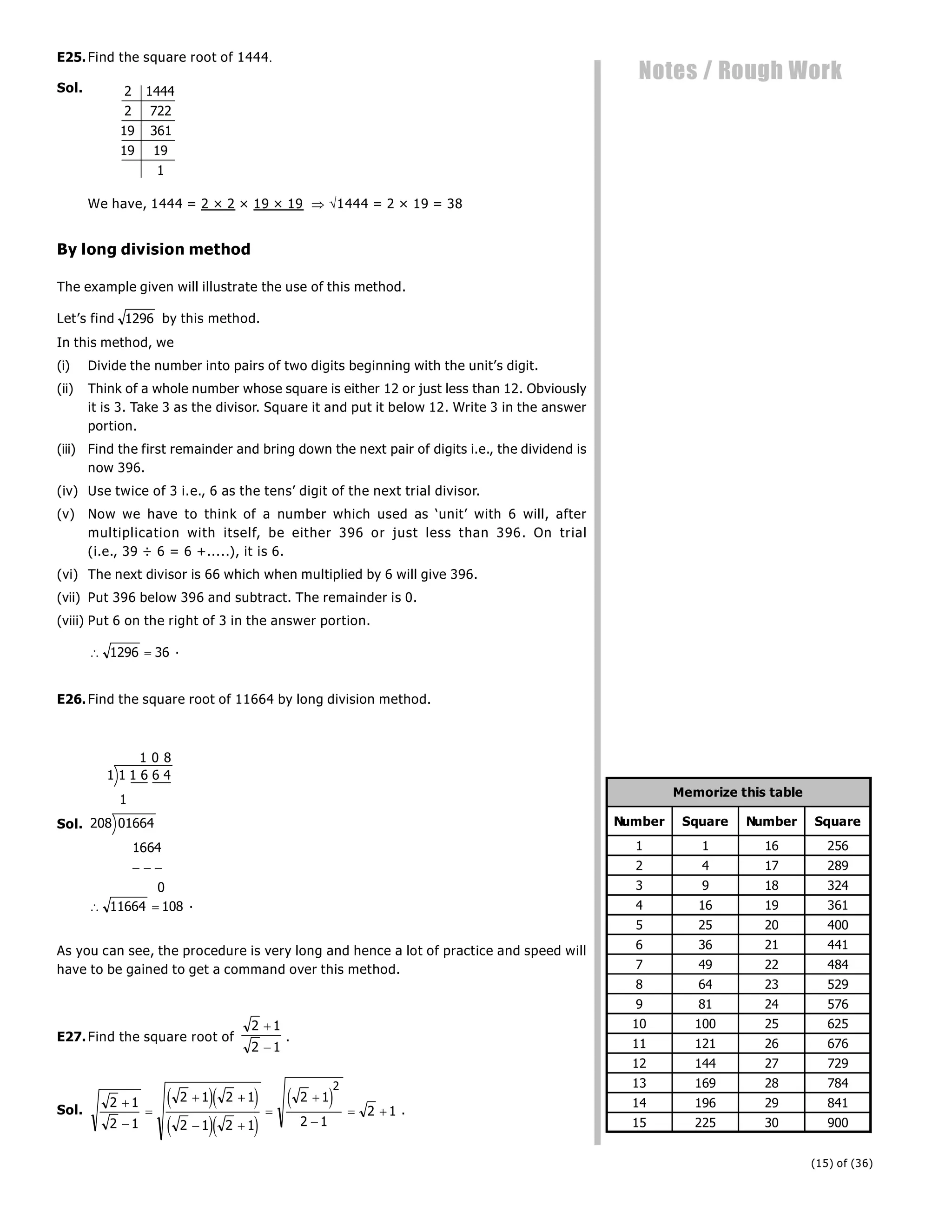
E25.Find the square root of 1444
Sol. 2 1444
2 722
19 361
19 19
1
We have, 1444 = 2 × 2 × 19 × 19  1444 = 2 × 19 = 38
By long division method
The example given will illustrate the use of this method.
Let’s find 1296 by this method.
In this method, we
(i) Divide the number into pairs of two digits beginning with the unit’s digit.
(ii) Think of a whole number whose square is either 12 or just less than 12. Obviously
it is 3. Take 3 as the divisor. Square it and put it below 12. Write 3 in the answer
portion.
(iii) Find the first remainder and bring down the next pair of digits i.e., the dividend is
now 396.
(iv) Use twice of 3 i.e., 6 as the tens’ digit of the next trial divisor.
(v) Now we have to think of a number which used as ‘unit’ with 6 will, after
multiplication with itself, be either 396 or just less than 396. On trial
(i.e., 39 ÷ 6 = 6 +.....), it is 6.
(vi) The next divisor is 66 which when multiplied by 6 will give 396.
(vii) Put 396 below 396 and subtract. The remainder is 0.
(viii) Put 6 on the right of 3 in the answer portion.
 
1296 36 .
E26.Find the square root of 11664 by long division method.
Sol.
1 6 6 4
1664
0
1 1
1 0 8
1
208 01664
  
 
11664 108 .
As you can see, the procedure is very long and hence a lot of practice and speed will
have to be gained to get a command over this method.
E27.Find the square root of
2 1
2 1


.
Sol.
2 1
2 1
2 1 2 1
2 1 2 1
2 1
2 1
2 1
2



 
 



 
e je j
e je j
e j .
Number Square Number Square
1 1 16 256
2 4 17 289
3 9 18 324
4 16 19 361
5 25 20 400
6 36 21 441
7 49 22 484
8 64 23 529
9 81 24 576
10 100 25 625
11 121 26 676
12 144 27 729
13 169 28 784
14 196 29 841
15 225 30 900
Memorize this table
(16) of (36)
Notes / Rough Work
E28.Find the square root of the following and leave it in the product
form – 210 × 36 × 52 × 78 × 1112.
Sol. ( )
2 3 5 7 11
10 6 2 8 12
   
= ( ) ( ) ( ) ( )
2 3 5 7 11
5 2 3 2 2 4 2 6 2
    = 25 × 33 × 5 × 74 × 116.
E29.Find the square root of (1/4) × (1/49)  (25/121).
Sol.
1
4
1
49
25
121
1
2
1
7
11
5
1
2
1
7
11
5
11
70
2 2
2
2
         .
E30.Find the square root of 62500.
Sol. ( )
62500 2 5
2 6
  = 2 × 53 = 2 × 5 × 5 × 5 = 250.
Application of Squares and Square roots
We shall now take up some problems wherein we need to find the squares and the
square roots of numbers.
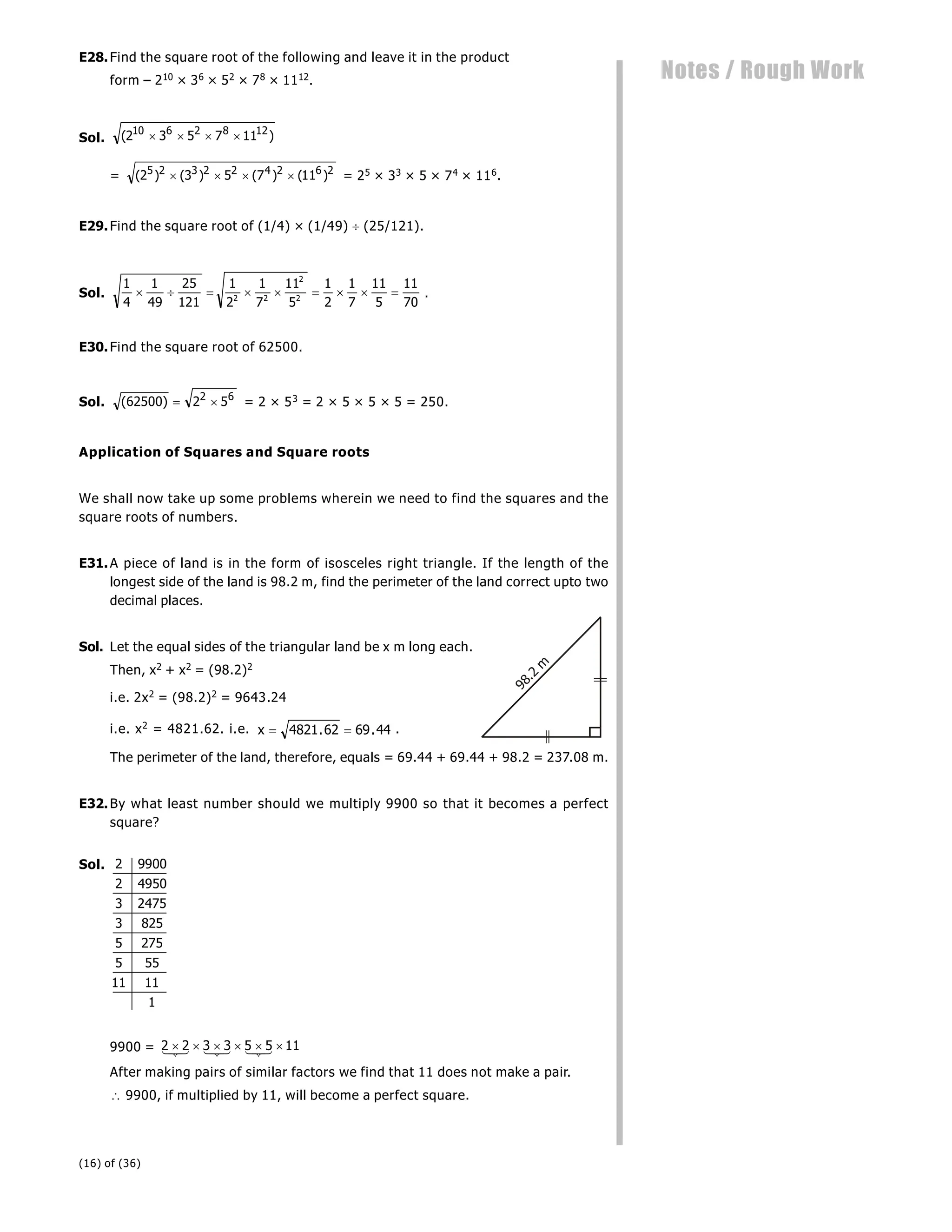
E31.A piece of land is in the form of isosceles right triangle. If the length of the
longest side of the land is 98.2 m, find the perimeter of the land correct upto two
decimal places.
Sol. Let the equal sides of the triangular land be x m long each.
Then, x2 + x2 = (98.2)2
9
8
.
2
m
i.e. 2x2 = (98.2)2 = 9643.24
i.e. x2 = 4821.62. i.e. x  
4821 62 69 44
. . .
The perimeter of the land, therefore, equals = 69.44 + 69.44 + 98.2 = 237.08 m.
E32.By what least number should we multiply 9900 so that it becomes a perfect
square?
Sol. 2 9900
2 4950
3 2475
3 825
5 275
5 55
11 11
1
9900 = 2 2 3 3 5 5 11
     


 

 


After making pairs of similar factors we find that 11 does not make a pair.
 9900, if multiplied by 11, will become a perfect square.
(17) of (36)
Notes / Rough Work
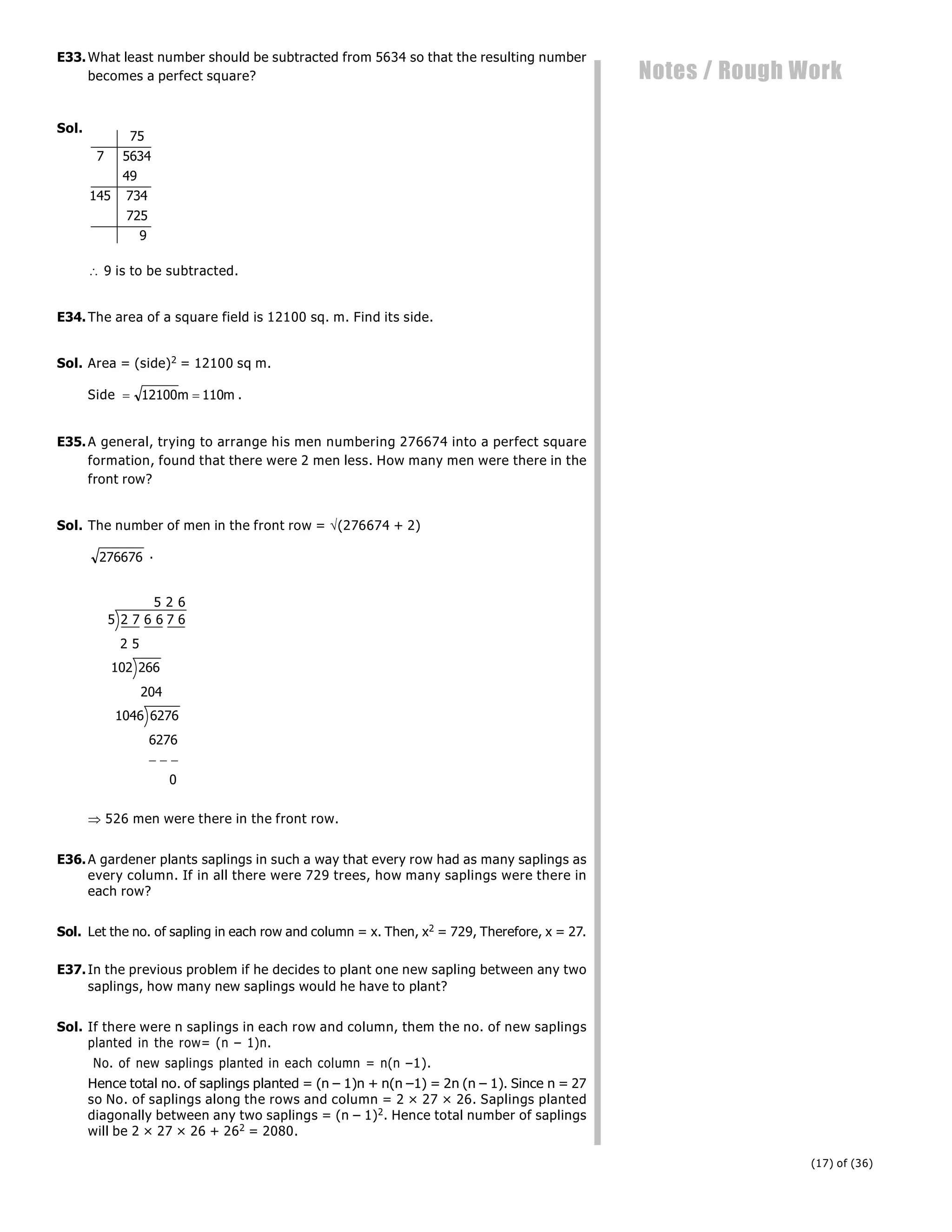
E33.What least number should be subtracted from 5634 so that the resulting number
becomes a perfect square?
Sol.
75
7 5634
49
145 734
725
9
 9 is to be subtracted.
E34.The area of a square field is 12100 sq. m. Find its side.
Sol. Area = (side)2 = 12100 sq m.
Side  
12100 110
m m .
E35.A general, trying to arrange his men numbering 276674 into a perfect square
formation, found that there were 2 men less. How many men were there in the
front row?
Sol. The number of men in the front row = (276674 + 2)
276676 .
7 6 7 6
5
204
6276
0
5 2 6
5 2 6
2
102 266
1046 6276
  
 526 men were there in the front row.
E36.A gardener plants saplings in such a way that every row had as many saplings as
every column. If in all there were 729 trees, how many saplings were there in
each row?
Sol. Let the no. of sapling in each row and column = x. Then, x2 = 729, Therefore, x = 27.
E37.In the previous problem if he decides to plant one new sapling between any two
saplings, how many new saplings would he have to plant?
Sol. If there were n saplings in each row and column, them the no. of new saplings
planted in the row= (n – 1)n.
No. of new saplings planted in each column = n(n –1).
Hence total no. of saplings planted = (n – 1)n + n(n –1) = 2n (n – 1). Since n = 27
so No. of saplings along the rows and column = 2 × 27 × 26. Saplings planted
diagonally between any two saplings = (n – 1)2. Hence total number of saplings
will be 2 × 27 × 26 + 262 = 2080.
(18) of (36)
Notes / Rough Work
Cubes
We know that 33 = 3 × 3 × 3, 53 = 5 × 5 × 5,
73 = 7 × 7 × 7, a3 = a × a × a.
Here, a3 is called the third power of ‘a’. The third power of ‘a’ is also called the cube of ‘a’.
The following are some important properties related to cubes of numbers.
(i) Cubes of all odd natural numbers are odd.
(ii) Cubes of all even natural numbers are even.
(iii) The cube of a natural number which is a multiple of 3 is a multiple of 27.
(iv) The cube of a natural number which is of the form 3n + 1 (e.g., 4, 7,
10,......) is also a number of the form 3n + 1.
(v) The cube of natural number which is of the form 3n + 2 (e.g., 5, 8, 11,....)
is also a number of the form 3n + 2.
Cube roots
We have seen above that 125 is the cube of 5. It can be stated in other words that 5
is the cube root of 125. Similarly, from the table given above we can say that 8 is the
cube root of 512 and 10 is the cube root of 1000.
The symbol used for cube root is 3
. Thus 729
3
means ‘cube root of 729’ and 64
3
means ‘cube root of 64’. 3
is called radical, 729 is called radicand and 3 is called
index.
Rule for finding cube root
We resolve the given number into prime factors and take the product of prime factors
choosing one out of three of the each type of prime factors.
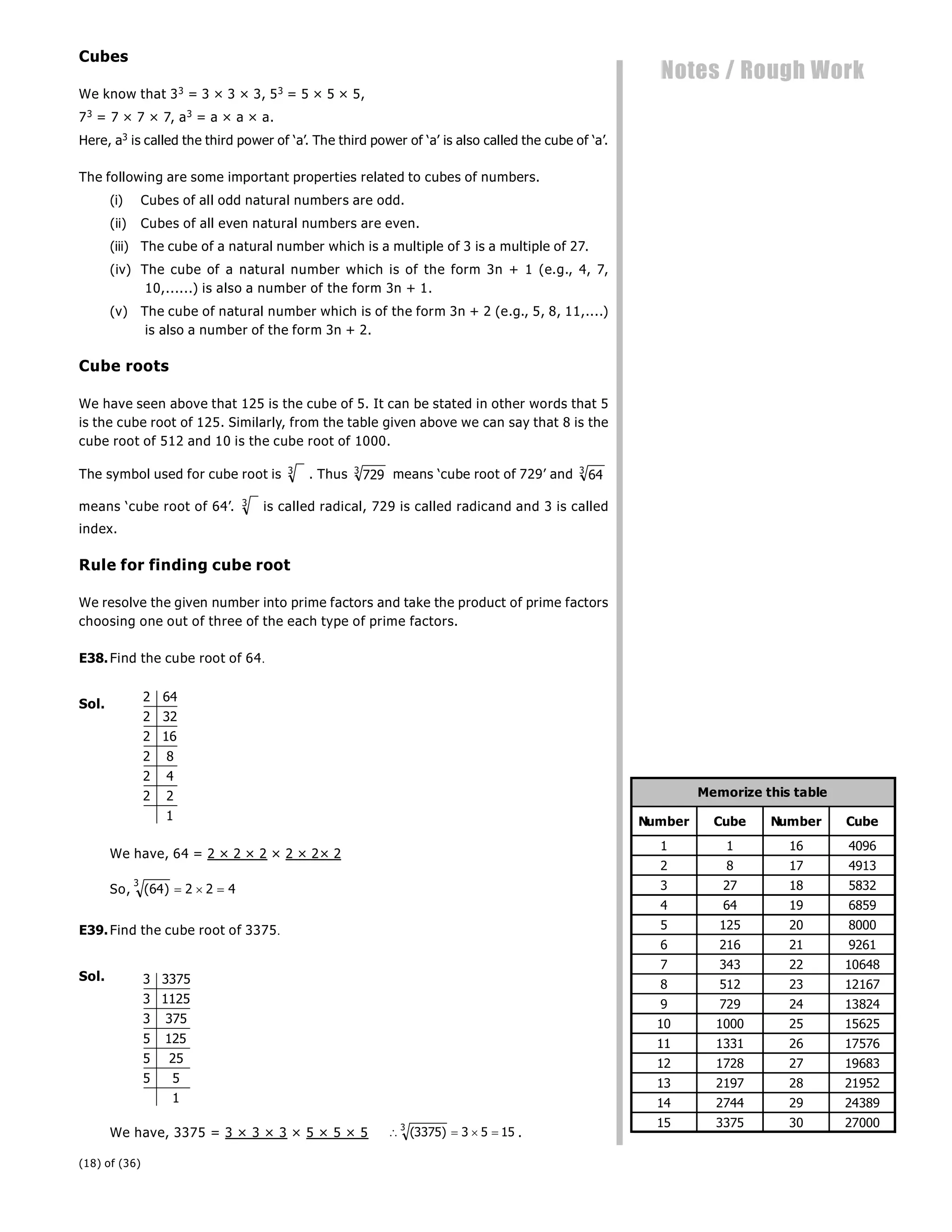
E38.Find the cube root of 64
Sol.
2 64
2 32
2 16
2 8
2 4
2 2
1
We have, 64 = 2 × 2 × 2 × 2 × 2× 2
So, ( )
64 2 2 4
3
  
E39.Find the cube root of 3375
Sol. 3 3375
3 1125
3 375
5 125
5 25
5 5
1
We have, 3375 = 3 × 3 × 3 × 5 × 5 × 5    
( )
3375 3 5 15
3
.
Number Cube Number Cube
1 1 16 4096
2 8 17 4913
3 27 18 5832
4 64 19 6859
5 125 20 8000
6 216 21 9261
7 343 22 10648
8 512 23 12167
9 729 24 13824
10 1000 25 15625
11 1331 26 17576
12 1728 27 19683
13 2197 28 21952
14 2744 29 24389
15 3375 30 27000
Memorize this table
(19) of (36)
Notes / Rough Work
E40.By what least number should we multiply 500 so that it becomes a perfect cube?
Sol. 2 500
2 250
5 125
5 25
5 5
1
500 = 2 × 2× 5 × 5 × 5
After making pairs of similar factors we find that 2 does not make a group of 3.
 500, if multiplied by 2, will become a perfect cube.
E41.By what least number should we divide 500 so that it becomes a perfect cube?
Sol. 2 500
2 250
5 125
5 25
5 5
1
500 = 2 × 2 × 5 × 5 × 5
After making pairs of similar factors we find that 2 does not make a group of 3.
 500 should be divided by 2 × 2 i.e. by 4, to make it a perfect cube.
E42.If pq is perfect square as well as a perfect cube, where p and q are natural
numbers then q must be a multiple of
(1) 2 (2) 3
(3) 6 (4) None of these
Sol. (4)
Many of you must have answered (3) but that will be the case if p is a prime
number. Hence, from given information we can not say anything about sq may be
the case that p = 64 and q = 1.
Power cycles
2, 4, 8, 16, 32, 64, 128, 256, 512, .... The series is nothing but powers of 2 in
ascending order. If you see it carefully we see that there is repetition of the unit digit
after regular intervals or unit digits always have definite pattern. The unit digit always
follows a cycle which is termed as power cycle. For example, power cycle of 2 has
frequency of 4 where as 5 has a frequency of 1.
Let us say if question is asked what is the digit at units place in 771. As 7 has power
cycle with frequency 4, when we divide 71 by 4, the remainder is 3 and the third power
of 7 has unit digit as 3, which is the answer.
(20) of (36)
Notes / Rough Work
Mini Revision Test # 03
DIRECTIONS: Answer the following questions.
1. Without actual squaring, find the value of 5892 – 5882.
2. Without actual adding, find the sum of
1+3+5+7+9+11+13+15+17+19+21+23.
3. Is the number 4096 a perfect square?
4. Find the positive square root of 4225.
5. Find the positive square root of 32/98.
6. Simplify :
5625 441
5625 441


.
7. By what smallest number 1600 should be multiplied so that the product
becomes a perfect cube?
8. By what smallest number 2048 should be divided so that the quotient
becomes a perfect cube?
9. Find the cube root of 15.625.
10. Find the cube root of 2
10
27
.
Challenge Problems # 03
DIRECTIONS: Answer the following questions.
1. An arbitrary natural number ‘a’ and its nth power ‘an’ can be written in
the form 6k1 + s and 6k2 + s respectively, where k1, k2 and s are whole
numbers and n is a natural number less than 50. How many values can n
take? (Q. code - 110207001)
(1) 15 (2) 24
(3) 25 (4) 26
2. On dividing a number successively by 5, 7, and 8, the remainders obtained
are 2, 3, and 4 respectively. If the order of division is reversed, then
what will be the remainders? (Q. code - 110207002)
3. If (a2 + b2)3 = (a3 + b3)2 and ab  0, then
a
b
b
a
  ? (Q. code - 110207003)
(1) 0 (2) 7/3
(3) 2/3 (4) None of these
Place Value and Face Value
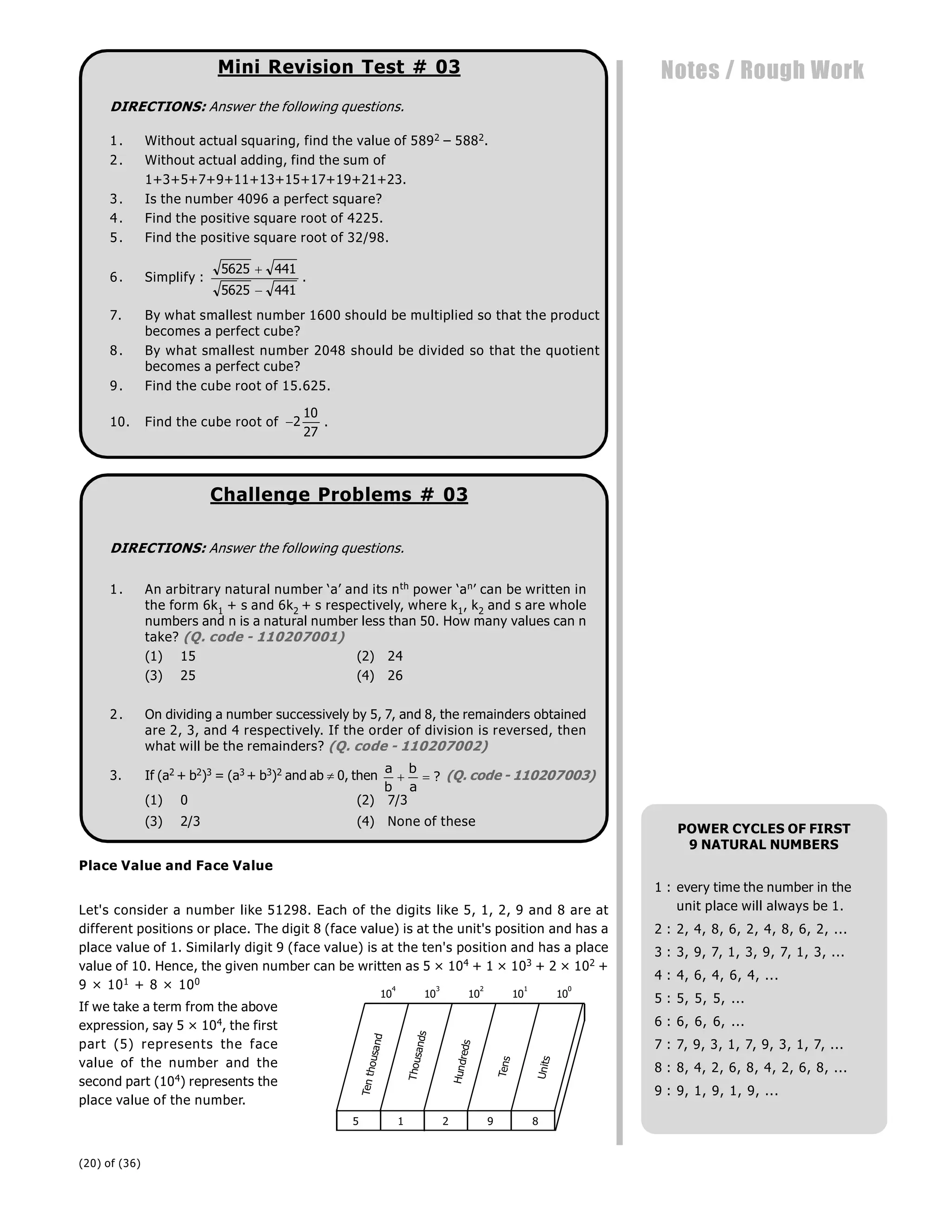
Let's consider a number like 51298. Each of the digits like 5, 1, 2, 9 and 8 are at
different positions or place. The digit 8 (face value) is at the unit's position and has a
place value of 1. Similarly digit 9 (face value) is at the ten's position and has a place
value of 10. Hence, the given number can be written as 5 × 10⁴ + 1 × 10³ + 2 × 10² +
9 × 101 + 8 × 100
5 1 2 9 8
U
n
it
s
T
e
n
s
H
u
n
d
re
d
s
T
h
o
u
s
a
n
d
s
Te
n
t
h
o
u
s
a
n
d
10
4
10
3
10
2
10
1
10
0
If we take a term from the above
expression, say 5 × 10⁴, the first
part (5) represents the face
value of the number and the
second part (104) represents the
place value of the number.
POWER CYCLES OF FIRST
9 NATURAL NUMBERS
1 : every time the number in the
unit place will always be 1.
2 : 2, 4, 8, 6, 2, 4, 8, 6, 2, ...
3 : 3, 9, 7, 1, 3, 9, 7, 1, 3, ...
4 : 4, 6, 4, 6, 4, ...
5 : 5, 5, 5, ...
6 : 6, 6, 6, ...
7 : 7, 9, 3, 1, 7, 9, 3, 1, 7, ...
8 : 8, 4, 2, 6, 8, 4, 2, 6, 8, ...
9 : 9, 1, 9, 1, 9, ...
(1) of (36)
Notes / Rough Work
The concept of multiples and factors
If X, Y and Z are three natural numbers and X × Y = Z, then
 X and Y are called the factors of Z.
 Z is said to be divisible by X and Y.
 Z is said to be a multiple of X and Y.
Example: The set of positive integers which are factors of 18 is {1, 2, 3, 6, 9, 18}.
Proper factors
A factor of a number other than 1 and the number itself is called a proper factor.
Taking the previous example, the set of proper factors of 18 is {2, 3, 6, 9}.
H.C.F. and L.C.M. of numbers
Consider a number A which is exactly divisible by B. That is,
B) A ( C
0
Then, A = B × C, where B is the divisor and also a factor of A and A is the dividend and
also the multiple of B.
Thus, 4 is a factor of 20 and 20 is a multiple of 4.
Indirect questions are normally asked in various competitive exams based on HCF and
LCM.
H.C.F.
It is the highest factor common to two or more numbers under consideration. It is also
called GCF or GCD (Greatest Common Factor or Greatest Common Divisor).
e.g. HCF of 4 and 8 = 4, HCF of 125 and 200 = 25.
To find the HCF of the given numbers
1. Break the given numbers into their prime factors.
MORE WITH
NUMBERS
Notes / Rough Work
POINT TO REMEMBER
Any factor of the given
number is also the factor of
all the multiples of the
number and multiple of any
number is also the multiple of
all the factors of the number.
(2) of (36)
Notes / Rough Work
2. The HCF will be the product of all the prime factors common to all the numbers.
Important
HCF of two prime numbers is always 1.
HCF of co-prime numbers is always 1.
E1. Find the HCF of 96, 36 and 18.
Sol. 96 = 2 × 3 × 2 × 2 × 2 × 2
36 = 2 × 3 × 2 × 3
18 = 2 × 3 × 3
Therefore, the HCF of 96, 36 and 18 is the product of the highest number of
common factors in the given numbers, i.e., 2 × 3 = 6. In other words, 6 is the
largest possible integer, which can divide 96, 36 and 18 without leaving any
remainder.
E2. Find the HCF of 42 and 70.
Sol. 42 = 3 × 2 × 7
70 = 5 × 2 × 7
Hence, HCF is 2 × 7 = 14.
E3. Find the HCF of numbers 144, 630 and 756.
Sol. 144 = 24 × 32
630 = 2 × 32 × 5 × 7
756 = 22 × 33 × 7
Hence, HCF of 144, 630, 756 = 2 × 32 = 18.
E4. Find the HCF of 7007 and 2145.
Sol. 7007 = 72 × 11 × 13
2145 = 3 × 5 × 11 × 13
Hence, HCF of 7007, 2145 = 11 × 13 = 143.
L.C.M
The Least Common Multiple of two or more numbers is the smallest number which is
exactly divisible by all of them. It can also be defined as the product of the highest
powers of all the prime factors of the given numbers.
To find the LCM of given numbers:
1. Break the given numbers into their prime factors.
2. The LCM will be the product of the highest power of all the factors that occur in
the given numbers.
E5. Find the LCM of 96, 36 and 18.
Sol. 96 = 2 × 2 × 2 × 2 × 2 × 3 = 25 × 31
36 = 2 × 2 × 3 × 3 = 22 × 32
18 = 2 × 3 × 3 = 21 × 32
Therefore, LCM of 96, 36 and 18 is the product of the highest powers of all the
prime factors, i.e. 25 × 32 = 32 × 9 = 288. That is, 288 is the smallest integer
which is divisible by 96, 36 and 18 without leaving any remainder.
E6. Find the LCM of 42 and 70.
Sol. 42 = 3 × 2 × 7
70 = 5 × 2 × 7
Hence, LCM is 2 × 3 × 5 × 7 = 210.
POINT TO REMEMBER
Every natural number has
even number of factors
except for perfect square
numbers which have odd
number of factors. e.g.
(a) 18’s factors are 1, 2, 3,
6, 9, 18.
(b) 36’s factors are 1, 2, 3,
4, 6, 9, 12, 18, 36.
(3) of (36)
Notes / Rough Work
LCM by division method
Write the numbers, separated by commas. Then divide them by prime factors in
ascending order (e.g., 2, 3, 5, 7, etc.) one at a time. Then, after each division, write
the quotient of each number that gets completely divided by the divisor (the prime
number) below it. Leave the undivided numbers as they are. Continue doing this till
you get prime factors as quotients in each column. The product of all the prime factors
(divisors and quotients) will be the LCM.
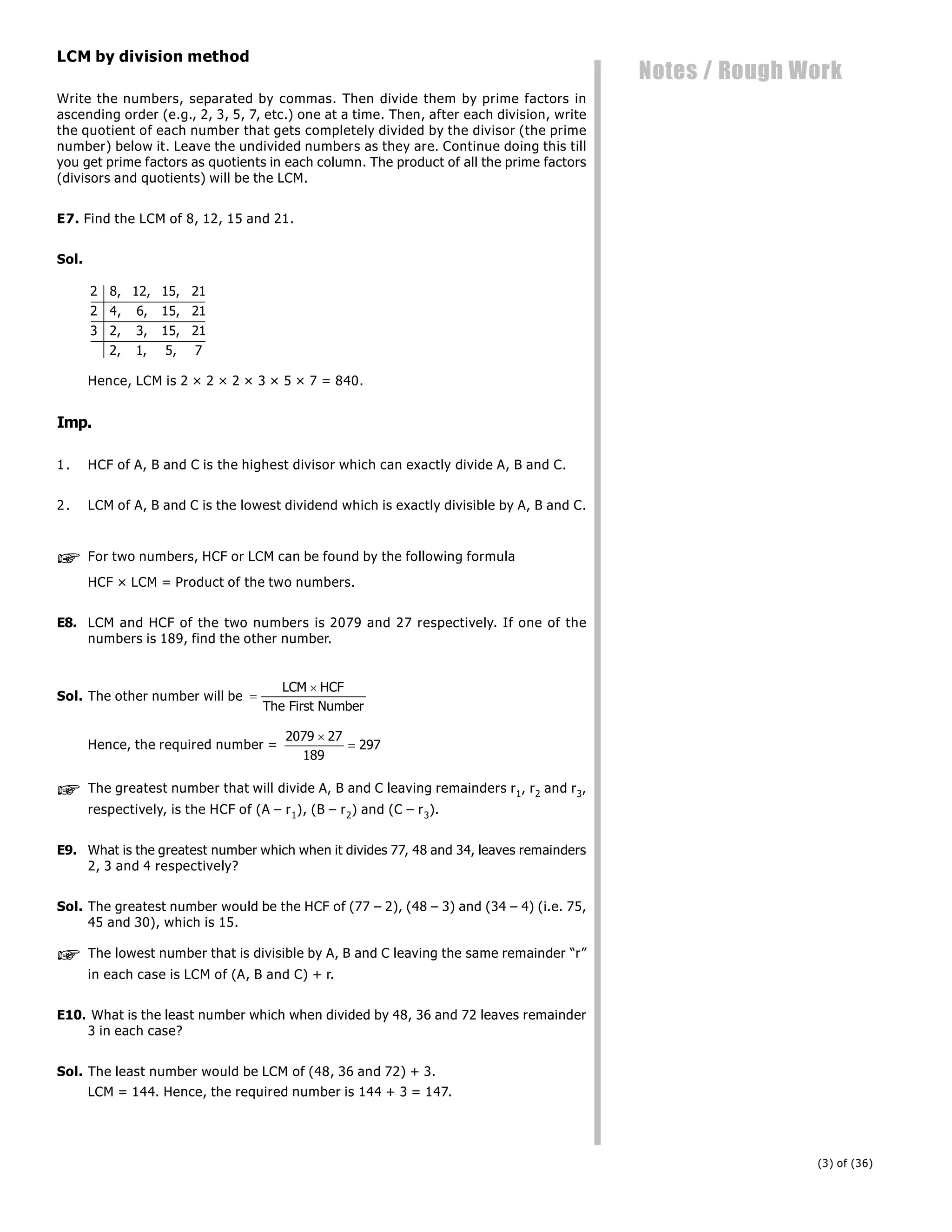
E7. Find the LCM of 8, 12, 15 and 21.
Sol.
2 8 12 15 21
2 4 6 15 21
3 2 3 15 21
2 1 5 7
, , ,
, , ,
, , ,
, , ,
Hence, LCM is 2 × 2 × 2 × 3 × 5 × 7 = 840.
Imp.
1. HCF of A, B and C is the highest divisor which can exactly divide A, B and C.
2. LCM of A, B and C is the lowest dividend which is exactly divisible by A, B and C.
 For two numbers, HCF or LCM can be found by the following formula
HCF × LCM = Product of the two numbers.
E8. LCM and HCF of the two numbers is 2079 and 27 respectively. If one of the
numbers is 189, find the other number.
Sol. The other number will be 

LCM HCF
The First Number
Hence, the required number =
2079 27
189
297


 The greatest number that will divide A, B and C leaving remainders r1, r2 and r3,
respectively, is the HCF of (A – r1), (B – r2) and (C – r3).
E9. What is the greatest number which when it divides 77, 48 and 34, leaves remainders
2, 3 and 4 respectively?
Sol. The greatest number would be the HCF of (77 – 2), (48 – 3) and (34 – 4) (i.e. 75,
45 and 30), which is 15.
 The lowest number that is divisible by A, B and C leaving the same remainder “r”
in each case is LCM of (A, B and C) + r.
E10. What is the least number which when divided by 48, 36 and 72 leaves remainder
3 in each case?
Sol. The least number would be LCM of (48, 36 and 72) + 3.
LCM = 144. Hence, the required number is 144 + 3 = 147.
(4) of (36)
Notes / Rough Work
E11.Find HCF of 88, 24 and 124
Sol. 88 = 2 × 44 = 2 × 2 × 22 = 2 × 2 × 2 × 11 = 23 × 111
24= 2 × 12 = 2 × 2 × 6 = 2 × 2 × 2 × 3 = 23 x 31
124= 2 × 62 = 2 × 21 × 311 = 2² × 311
 HCF = 22 = 4.
E12.There are two clocks, one beats 96 times in 5 min. and the other beats 48 times
in 7 min. If they beat together exactly at 10 am, when do they next beat together?
Sol. The times for each beat are 5/96 min and 7/48 min, or 5/96 min and 14/96 min.
The LCM of the numerators = 70.
The HCF of the denominators = 96.
 The LCM of the fraction = 70/96 = 35/48.
 They will next beat together at 35/48 min past 10 am.
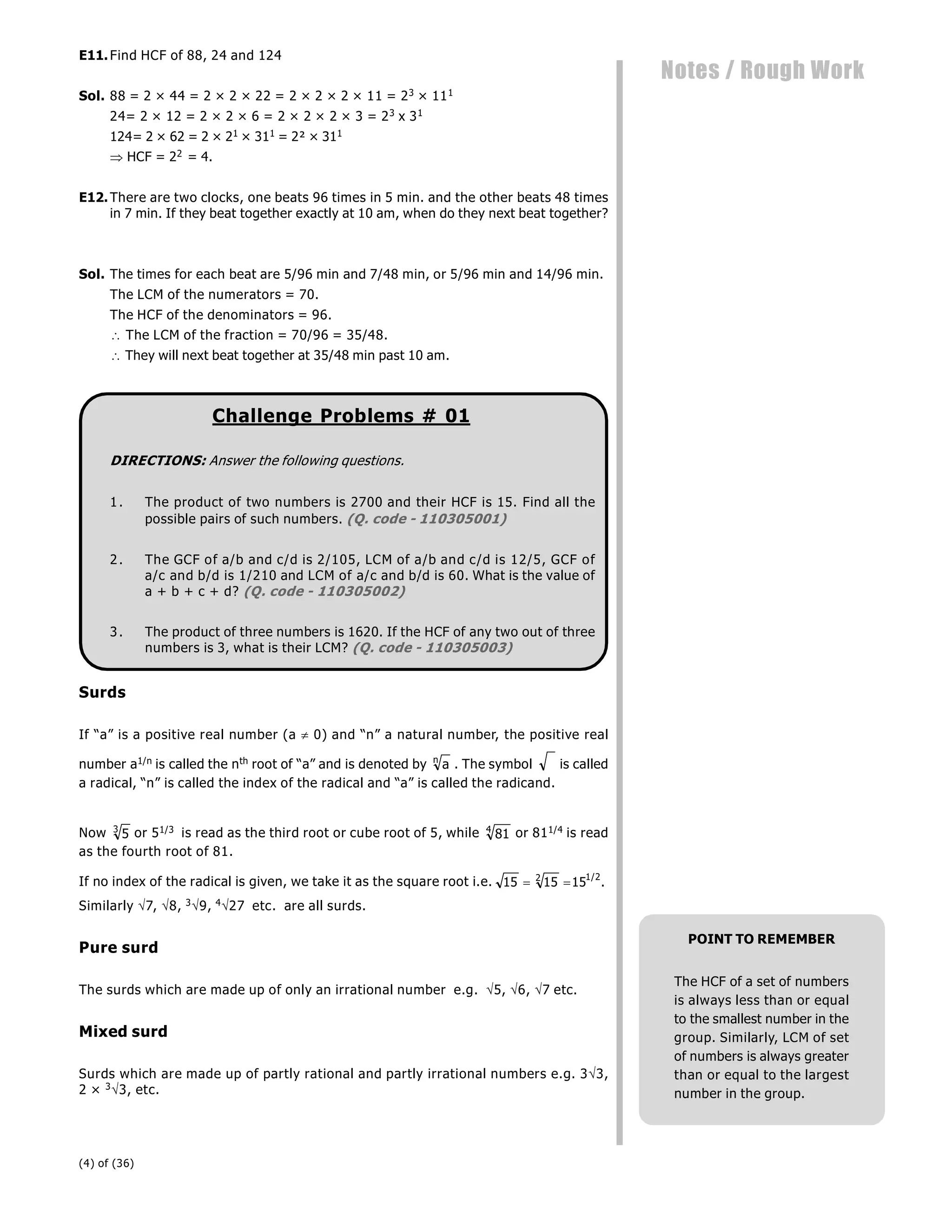
Challenge Problems # 01
DIRECTIONS: Answer the following questions.
1. The product of two numbers is 2700 and their HCF is 15. Find all the
possible pairs of such numbers. (Q. code - 110305001)
2. The GCF of a/b and c/d is 2/105, LCM of a/b and c/d is 12/5, GCF of
a/c and b/d is 1/210 and LCM of a/c and b/d is 60. What is the value of
a + b + c + d? (Q. code - 110305002)
3. The product of three numbers is 1620. If the HCF of any two out of three
numbers is 3, what is their LCM? (Q. code - 110305003)
Surds
If “a” is a positive real number (a  0) and “n” a natural number, the positive real
number a1/n is called the nth root of “a” and is denoted by a
n
. The symbol is called
a radical, “n” is called the index of the radical and “a” is called the radicand.
Now 5
3
or 51/3 is read as the third root or cube root of 5, while 81
4
or 811/4 is read
as the fourth root of 81.
If no index of the radical is given, we take it as the square root i.e. 15 15 15
2 1 2
 
/
.
Similarly 7, 8, 39, 427 etc. are all surds.
Pure surd
The surds which are made up of only an irrational number e.g. 5, 6, 7 etc.
Mixed surd
Surds which are made up of partly rational and partly irrational numbers e.g. 33,
2 × 33, etc.
POINT TO REMEMBER
The HCF of a set of numbers
is always less than or equal
to the smallest number in the
group. Similarly, LCM of set
of numbers is always greater
than or equal to the largest
number in the group.
(5) of (36)
Notes / Rough Work
Conversion of a mixed surd into a pure surd
E13.Reduce 2 3 to a pure surd.
Sol. 2 3 2 3
2
  [Since the index of the radical = 2]
  
4 3 12
E14.Reduce the following to pure surds.
(i) 5 2 (ii) 4 5
(iii) 2 4
3
Sol. (i) 5 2 5 2 25 2 50
2
     (ii) 4 5 4 5 16 5 80
2
    
(iii) 2 4 2 4 8 4 32
3 3
3 3 3
    
E15.Convert 36 to a pure surd.
Sol. 3 6 3 3 6 54
   
( )
Conversion of a pure surd into a mixed surd
E16.Reduce the following to mixed surds
(i) 50 (ii) 84
(iii) 72
3
Sol.
(i) 50 5 5 2 5 2 5 2
2
     
(ii) 84 2 2 3 7 2 3 7 2 3 7 2 21
2
         
(iii) 72 2 2 2 3 3 2 3 3 2 3 3 2 9
3 3 3
3 3 3
          
E17.Convert 343 to a mixed surd.
Sol. 343 7 7 7 7 7
   
( )
Like surds
Surds of the same index are called like surds. For example, 5 15 30 90
, , , ,... are
like surds with index 2. Similarly, 20 30 15
3 3 3
, , ,... are like surds with index 3.
Unlike surds
Surds with different indices are called unlike surds. For example, 5 20 15
3 4
, , are
unlike surds as they have different indices, 2, 3 and 4 respectively.
(6) of (36)
Notes / Rough Work
Similar surds
Surds are said to be similar when the irrational part is the same, e.g. surds
2 7 5 7
, , 4 7 15 7
and are similar surds.
Dissimilar surds
Surds which are not similar are called dissimilar surds. For example, 2 7 3 11
and
are dissimilar surds.
Addition and subtraction of surds
(i) Reduce each surd to its simplest form.
(ii) Express the sum or difference of similar surds as one term.
(iii) Connect the dissimilar surds with their proper signs.
E18. Simplify 27 12

Sol. 27 12
  
3 3 2 3
[We have simplified 27 12
and and expressed them as mixed surds.]
]
= (3 + 2) 3 5 3
 .
E19.Simplify 320 125

Sol. 320 125 8 5 5 5 8 5 5 3 5
     
( ) .
E20.Simplify 20 180 80
 
Sol. 20 180 80 2 5 6 5 4 5
    
   
( )
2 6 4 5 4 5
Multiplication and division of surds
In multiplication and division of surds, you have to see that they are like surds, i.e.
they must have the same indices.
E21.Simplify 3 2

Sol. 3 2 6
 
[Both surds have the same index]
E22.Simplify 12 3

Sol. 12 3
12
3
4 2
    
(7) of (36)
Notes / Rough Work
E23.Simplify 3 15 2 5 5 3
   
Sol. 3 15 2 5 5 3
3 2
5
15 5
3
    
 
    
6
5
5 5
6
5
5 6
Rationalisation of surds
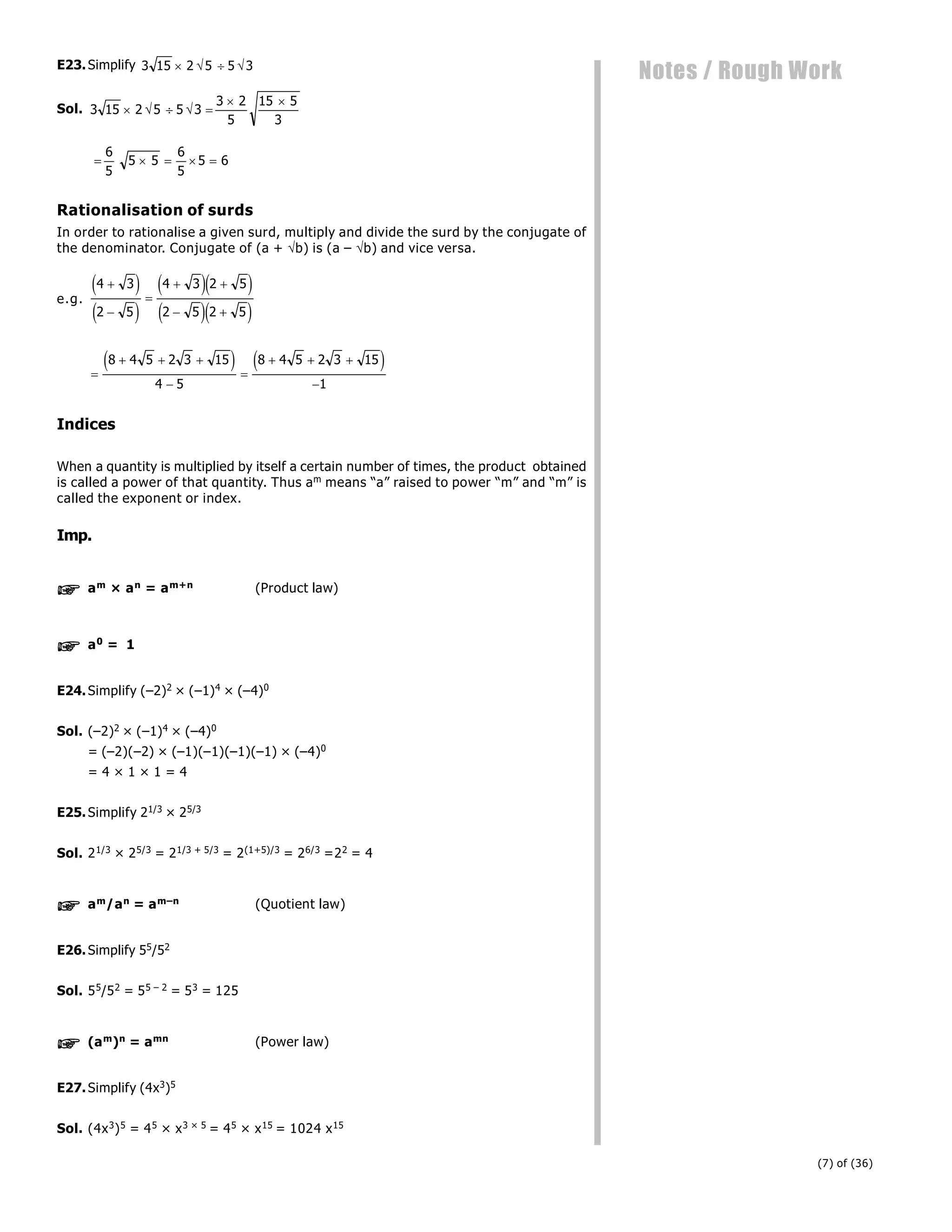
In order to rationalise a given surd, multiply and divide the surd by the conjugate of
the denominator. Conjugate of (a + b) is (a – b) and vice versa.
e.g.
4 3
2 5
4 3 2 5
2 5 2 5



 
 
e j
e j
e je j
e je j

  


  

8 4 5 2 3 15
4 5
8 4 5 2 3 15
1
e j e j
Indices
When a quantity is multiplied by itself a certain number of times, the product obtained
is called a power of that quantity. Thus am means “a” raised to power “m” and “m” is
called the exponent or index.
Imp.
 am × an = am+n (Product law)
 a0 = 1
E24.Simplify (–2)2 × (–1)4 × (–4)0
Sol. (–2)2 × (–1)4 × (–4)0
= (–2)(–2) × (–1)(–1)(–1)(–1) × (–4)0
= 4 × 1 × 1 = 4
E25.Simplify 21/3 × 25/3
Sol. 21/3 × 25/3 = 21/3 + 5/3 = 2(1+5)/3 = 26/3 =22 = 4
 am/an = am–n (Quotient law)
E26.Simplify 55/52
Sol. 55/52 = 55 – 2 = 53 = 125
 (am)n = amn (Power law)
E27.Simplify (4x3)5
Sol. (4x3)5 = 45 × x3 × 5 = 45 × x15 = 1024 x15
(8) of (36)
Notes / Rough Work
 a–m = 1/am
 (ab)m = am bm
E28.Simplify (2 × 5)3
Sol. (2 × 5)3 = 23 × 53 = 8 × 125 = 1000
 a a
m m
 1/
 ap/q = ap
q
 am
n
= m raised to power n and a raised to that value.
e.g. 2 2
3 81
4

Exponential equations
An equation having an unknown quantity as an exponent is called an exponential
equation. Thus, 3x = 81, 4x = 64, 52x–3 =
1
125
are examples of exponential equations.
E29.Solve each of the following exponential equations
(i) 5x = 125 (ii) 6
1
216
x

(iii) 2x = 42x + 1
Sol. (i) 5x = 125. We have 5x = 53
Since the bases are equal, the corresponding exponents must be equal.
 x = 3
(ii) 6
1
216
x

We have 6
1
6
6 3
3
3
x
x

F
HG I
KJ    

.
[ Bases are equal, the corresponding exponents must be equal.]
(iii) 2x = 42x + 1 or 2x = (22)2x + 1
 x = (4x + 2) or (x – 4x) = 2 or –3x = 2
 x 
2
3
.
E30.If 42n – 1= 1024, find the value of n.
Sol. 42n – 1= 45.
Since the bases are equal, the powers must be equal.
Hence, 2n – 1 = 5, 2n = 6, n = 3.
(9) of (36)
Notes / Rough Work
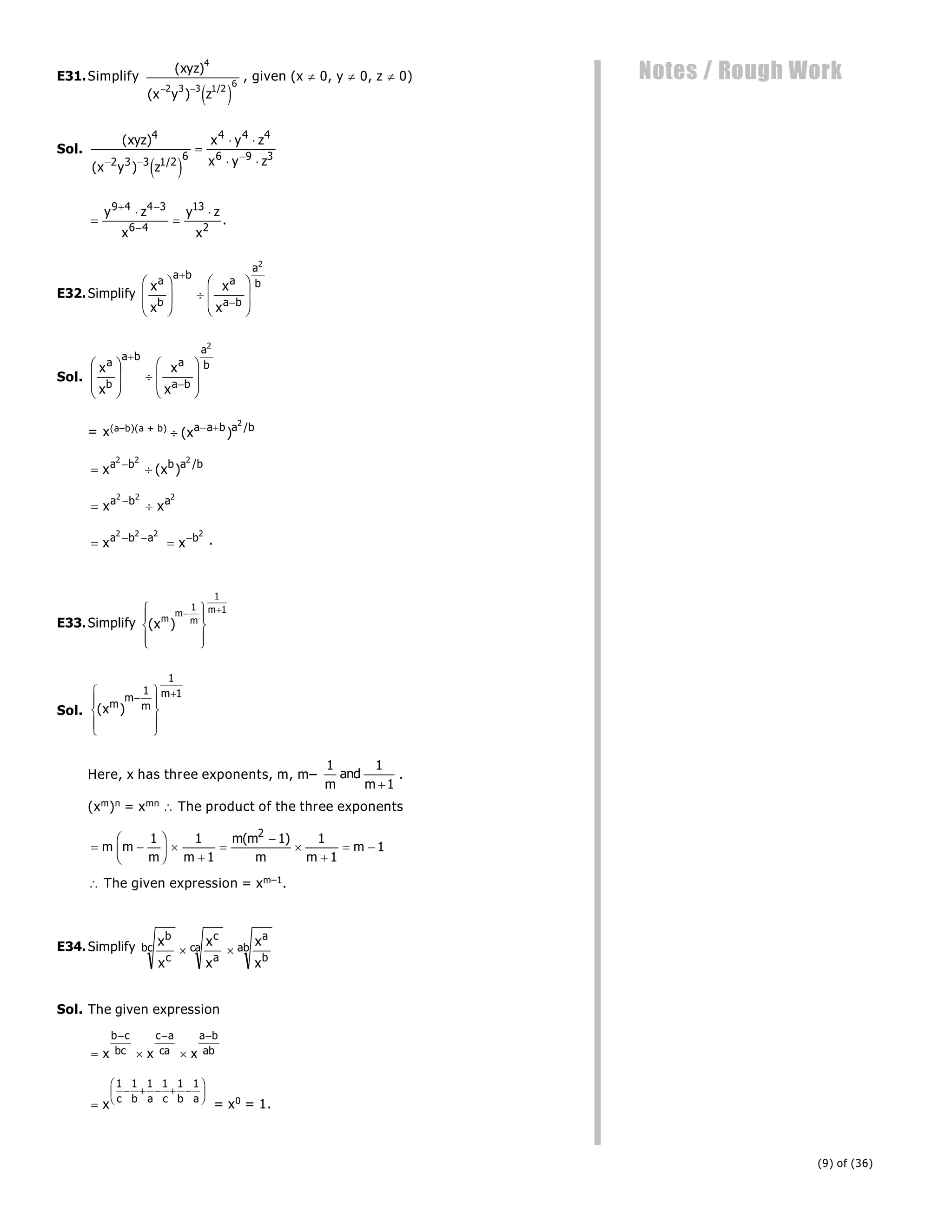
E31.Simplify
( )
( )
/
xyz
x y z
4
2 3 3 1 2
6
 
e j
, given (x  0, y  0, z  0)
Sol.
( )
( ) /
xyz
x y z
x y z
x y z
4
2 3 3 1 2
6
4 4 4
6 9 3
 


 
 
e j




 

y z
x
y z
x
9 4 4 3
6 4
13
2
.
E32.Simplify
x
x
x
x
a
b
a b
a
a b
a
b
F
HG
I
KJ 
F
HG
I
KJ


2
Sol.
x
x
x
x
a
b
a b
a
a b
a
b
F
HG
I
KJ 
F
HG
I
KJ


2
= x(a–b)(a + b)
  
( ) /
xa a b a b
2
 

x x
a b b a b
2 2 2
( ) /
 

x x
a b a
2 2 2
  
xa b a
2 2 2
 
x b2
.
E33.Simplify ( )
xm
m
m
m
 
R
S
|
T
|
U
V
|
W
|
1
1
1
Sol. ( )
xm
m
m
m
 
R
S
|
T
|
U
V
|
W
|
1
1
1
Here, x has three exponents, m, m–
1 1
1
m
and
m 
.
(xm)n = xmn  The product of the three exponents
 
F
HG I
KJ 





 
m m
m m
m m
m m
m
1 1
1
1 1
1
1
2
( )
 The given expression = xm–1.
E34.Simplify x
x
x
x
x
x
b
c
bc
c
a
ca
a
b
ab
 
Sol. The given expression
  
  
x x x
b c
bc
c a
ca
a b
ab

    
F
HG I
KJ
x c b a c b a
1 1 1 1 1 1
= x0 = 1.
(10) of (36)
Notes / Rough Work
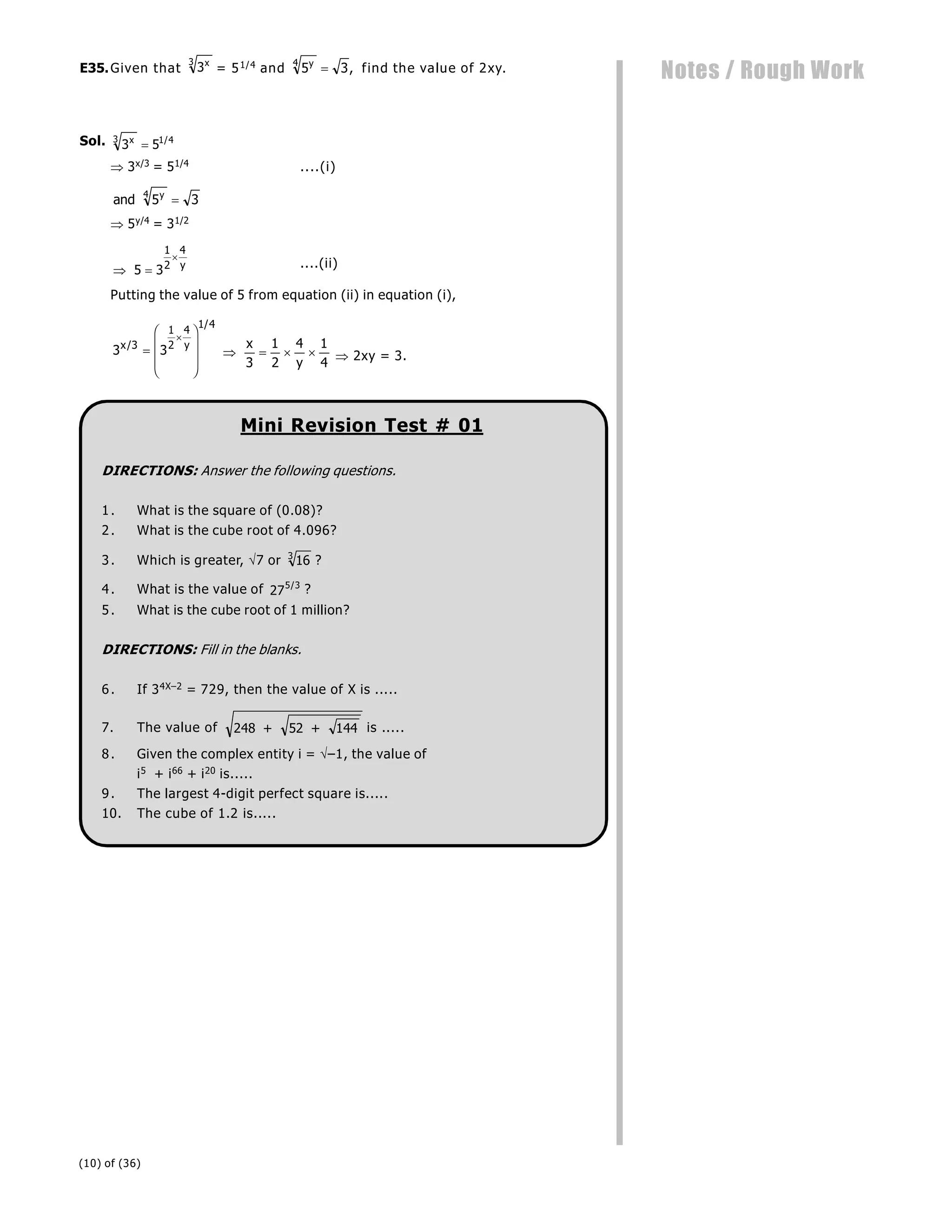
E35.Given that 3
3 x
= 51/4 and 5 3
4 y
 , find the value of 2xy.
.
Sol. 3 5
3 1 4
x
 /
 3x/3 = 51/4 ....(i)
and y
5 3
4

 5y/4 = 31/2
 

5 3
1
2
4
y ....(ii)
Putting the value of 5 from equation (ii) in equation (i),
3 3
3
1
2
4
1 4
x y
/
/

F
H
GG
I
K
JJ

   
x
y
3
1
2
4 1
4
 2xy = 3.
Mini Revision Test # 01
DIRECTIONS: Answer the following questions.
1. What is the square of (0.08)?
2. What is the cube root of 4.096?
3. Which is greater, 7 or 16
3
?
4. What is the value of 27
5 3
/
?
5. What is the cube root of 1 million?
DIRECTIONS: Fill in the blanks.
6. If 34X–2 = 729, then the value of X is .....
7. The value of 248 + 52 + 144 is .....
8. Given the complex entity i = –1, the value of
i5 + i66 + i20 is.....
9. The largest 4-digit perfect square is.....
10. The cube of 1.2 is.....
(11) of (36)
Notes / Rough Work
Challenge Problems # 02
DIRECTIONS: Answer the following questions.
1. There is a number which when divided by 4, 5 and 6 always leaves the
same remainder 3. Find such numbers which also satisfy the following
conditions. (Q. code - 110306001)
(1) Its smallest such number (2) Its largest number < 1000
2. V is a factor of 720. V itself has exactly 3 factors. How many values of V
are possible? (Q. code - 110306002)
(1) 0 (2) 2
(3) 6 (4) 3
3. What is the least number which when divided by 6, 7 and 9 leaves remainder
4 in each case but is exactly divisible by 11? (Q. code - 110306003)
Binary operations
Operations other than the four fundamental operations are called binary operations.
Such operations don’t precisely exist in mathematics but one can define these by
assuming something.
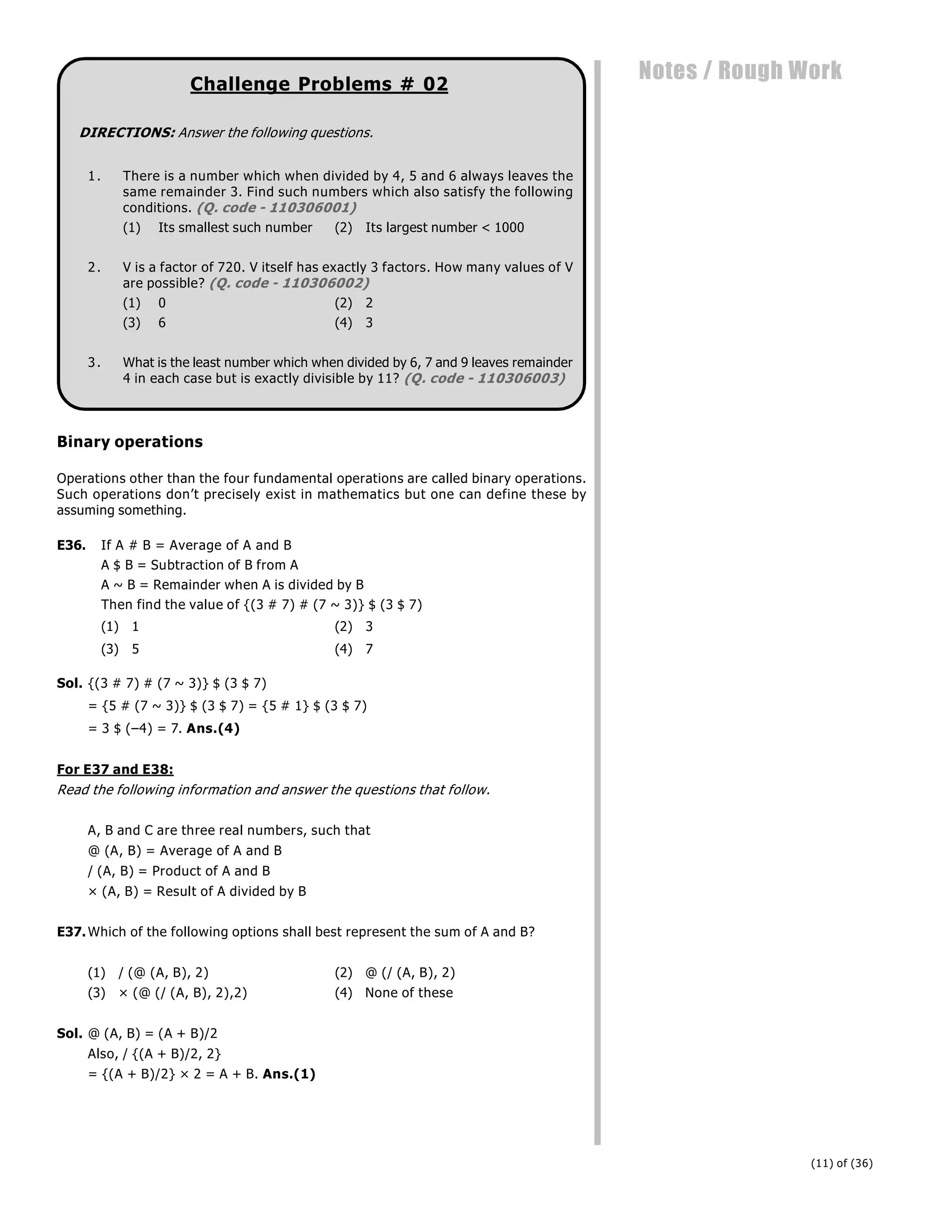
E36. If A # B = Average of A and B
A $ B = Subtraction of B from A
A ~ B = Remainder when A is divided by B
Then find the value of {(3 # 7) # (7 ~ 3)} $ (3 $ 7)
(1) 1 (2) 3
(3) 5 (4) 7
Sol. {(3 # 7) # (7 ~ 3)} $ (3 $ 7)
= {5 # (7 ~ 3)} $ (3 $ 7) = {5 # 1} $ (3 $ 7)
= 3 $ (–4) = 7. Ans.(4)
For E37 and E38:
Read the following information and answer the questions that follow.
A, B and C are three real numbers, such that
@ (A, B) = Average of A and B
/ (A, B) = Product of A and B
× (A, B) = Result of A divided by B
E37.Which of the following options shall best represent the sum of A and B?
(1) / (@ (A, B), 2) (2) @ (/ (A, B), 2)
(3) × (@ (/ (A, B), 2),2) (4) None of these
Sol. @ (A, B) = (A + B)/2
Also, / {(A + B)/2, 2}
= {(A + B)/2} × 2 = A + B. Ans.(1)
(12) of (36)
Notes / Rough Work
E38.Which of the following shall represent the average of A, B and C?
(1) @(/ (@ (/ (B, A), 2,), C), 3) (2) × (/ (@ (/ (@ (B, A), 3), C), 2))
(3) / ((× (@ (B, A), 2), C), 3) (4) / (× (@ (/ (@ (B, A), 2,), C), 3), 2)
Sol. The question asked is (A + B + C) / 3. Ans.(4)
DIRECTIONS: Read the information given below, and answer the questions that follow.
Aj(p, q, r) = HCF of (p, q, r)
Hk(p, q, r) = LCM of (p, q, r)
Lg(p, q, r) = Average of (p, q, r)
Mn(p, q, r) = Square root of (p × q × r)
E39.Lg(4, 8, Hk(6, 8, Aj(8, 2, 6))) = ?
(1) 8 (2) 6
(3) 12 (4) 4
Sol. Lg(4, 8, Hk(6, 8, 2))
= Lg(4, 8, 24) = 12. Ans.(3)
E40. What is the value of Mn[5, 6, Hk(30, 40, (Lg(13, 15, 17)))]?
(1) 60 (2) 20
(3) 45 (4) 15
Sol. Mn[5, 6, Hk(30, 40, 15))]
=Mn[5, 6, 120] = 60. Ans.(1)
E41.Find the value of Aj[20, 40, (Hk(60, 15, (Mn(8, 9, 8))))].
(1) 10 (2) 20
(3) 25 (4) 40
Sol. Aj[20, 40, (Hk(60, 15, 24))]
= Aj[20, 40, 120] = 20. Ans.(2)
Fractions
A number of the type
p
q
, where p
represents the number of parts out of
q number of equal parts of an object is
called a fraction.
Therefore, fraction
3
8
represents 3 parts being taken out of 8 equal parts of an
object.
A fraction denotes a part or parts of a unit. The various types of fractions are:
(13) of (36)
Notes / Rough Work
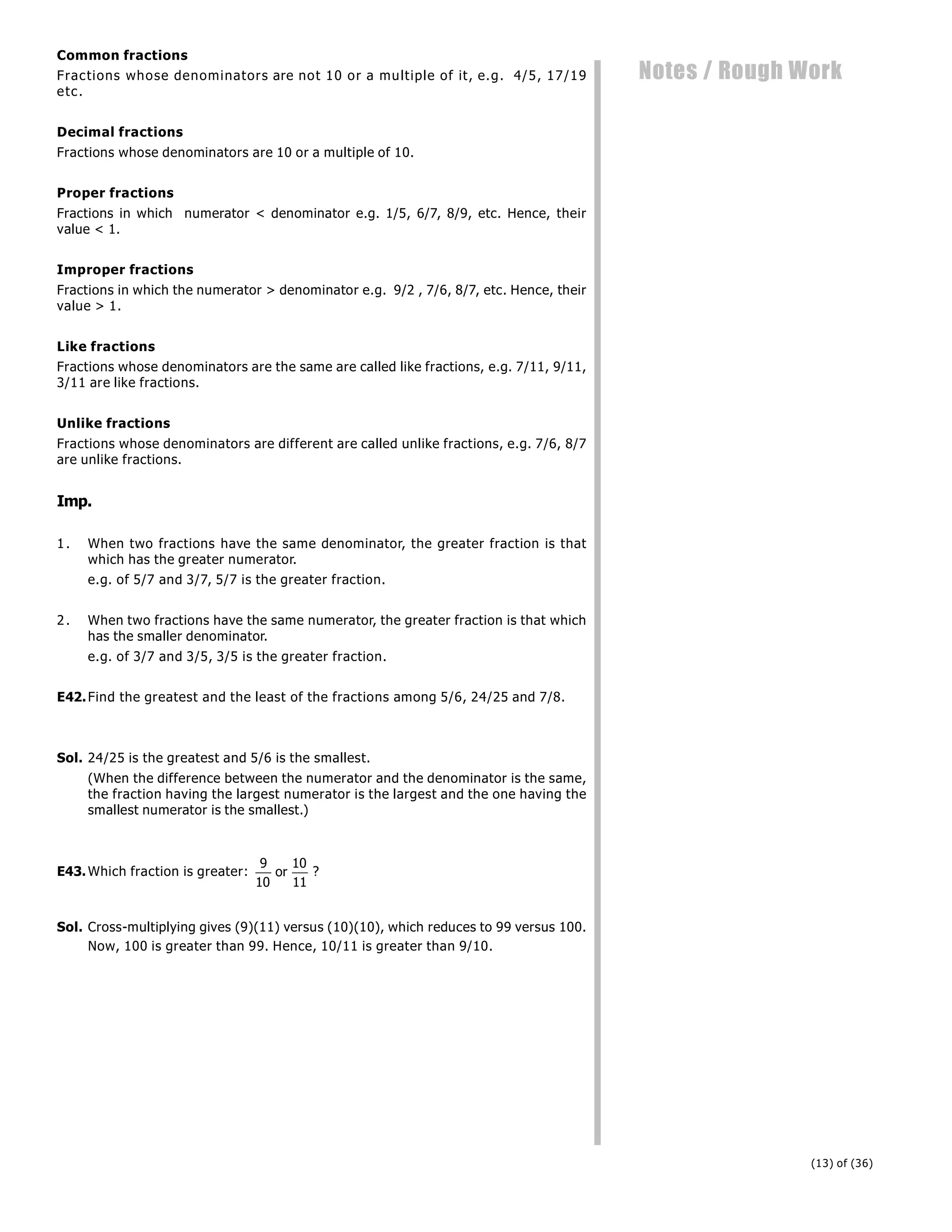
Common fractions
Fractions whose denominators are not 10 or a multiple of it, e.g. 4/5, 17/19
etc.
Decimal fractions
Fractions whose denominators are 10 or a multiple of 10.
Proper fractions
Fractions in which numerator < denominator e.g. 1/5, 6/7, 8/9, etc. Hence, their
value < 1.
Improper fractions
Fractions in which the numerator > denominator e.g. 9/2 , 7/6, 8/7, etc. Hence, their
value > 1.
Like fractions
Fractions whose denominators are the same are called like fractions, e.g. 7/11, 9/11,
3/11 are like fractions.
Unlike fractions
Fractions whose denominators are different are called unlike fractions, e.g. 7/6, 8/7
are unlike fractions.
Imp.
1. When two fractions have the same denominator, the greater fraction is that
which has the greater numerator.
e.g. of 5/7 and 3/7, 5/7 is the greater fraction.
2. When two fractions have the same numerator, the greater fraction is that which
has the smaller denominator.
e.g. of 3/7 and 3/5, 3/5 is the greater fraction.
E42.Find the greatest and the least of the fractions among 5/6, 24/25 and 7/8.
Sol. 24/25 is the greatest and 5/6 is the smallest.
(When the difference between the numerator and the denominator is the same,
the fraction having the largest numerator is the largest and the one having the
smallest numerator is the smallest.)
E43.Which fraction is greater:
9
10
or
10
11
?
Sol. Cross-multiplying gives (9)(11) versus (10)(10), which reduces to 99 versus 100.
Now, 100 is greater than 99. Hence, 10/11 is greater than 9/10.
(14) of (36)
Notes / Rough Work
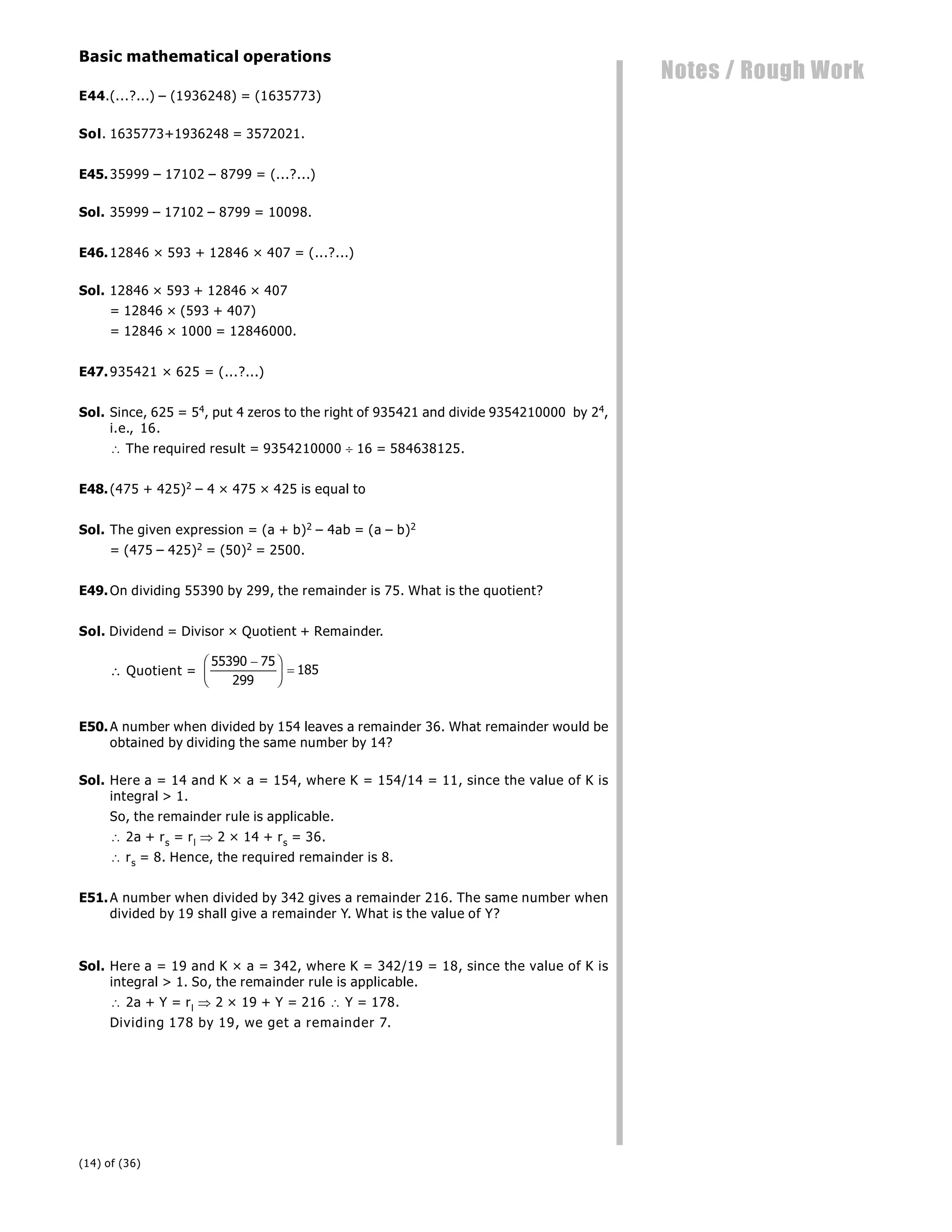
Basic mathematical operations
E44.(...?...) – (1936248) = (1635773)
Sol. 1635773+1936248 = 3572021.
E45.35999 – 17102 – 8799 = (...?...)
Sol. 35999 – 17102 – 8799 = 10098.
E46.12846 × 593 + 12846 × 407 = (...?...)
Sol. 12846 × 593 + 12846 × 407
= 12846 × (593 + 407)
= 12846 × 1000 = 12846000.
E47.935421 × 625 = (...?...)
Sol. Since, 625 = 54, put 4 zeros to the right of 935421 and divide 9354210000 by 24,
i.e., 16.
 The required result = 9354210000  16 = 584638125.
E48.(475 + 425)2 – 4 × 475 × 425 is equal to
Sol. The given expression = (a + b)2 – 4ab = (a – b)2
= (475 – 425)2 = (50)2 = 2500.
E49.On dividing 55390 by 299, the remainder is 75. What is the quotient?
Sol. Dividend = Divisor × Quotient + Remainder.
 Quotient =
55390 75
299
185

F
HG I
KJ 
E50.A number when divided by 154 leaves a remainder 36. What remainder would be
obtained by dividing the same number by 14?
Sol. Here a = 14 and K × a = 154, where K = 154/14 = 11, since the value of K is
integral > 1.
So, the remainder rule is applicable.
 2a + rs = rl  2 × 14 + rs = 36.
 rs = 8. Hence, the required remainder is 8.
E51.A number when divided by 342 gives a remainder 216. The same number when
divided by 19 shall give a remainder Y. What is the value of Y?
Sol. Here a = 19 and K × a = 342, where K = 342/19 = 18, since the value of K is
integral > 1. So, the remainder rule is applicable.
 2a + Y = rl  2 × 19 + Y = 216  Y = 178.
Dividing 178 by 19, we get a remainder 7.
(15) of (36)
Notes / Rough Work
Order of simplification
The order says VBODMAS. First, the Bar (Vinculum) is removed, then Brackets are
opened, then Of (taking a small part from a bigger one) then Division, then
Multiplication, then Addition and, finally, Subtraction is carried out.
( ), { }, [ ] are called brackets. They signify that all quantities enclosed within them
are to be treated as one quantity. Sometimes, a line is placed above the terms as in
7 1 2
  . It is called vinculum. It also has the force of a bracket. Hence 7 1 2
 
means 8 × 2 and not 7 × 2.
Imp.
When a pair of brackets are used within another pair of brackets, the expression
within the innermost bracket is simplified first and then the expression of the next
bracket and so on.
E52.Simplify 1
3
7
6 8 3 2
1
5
7
25
3
7
8
14
       
R
S
T
U
V
W
L
NM O
QP
of e j
Sol. 1
3
7
6 8 1
1
5
7
25
14
14
     
L
NM O
QP
of b g
     
L
NM O
QP    
L
NM O
QP
1
3
7
6 8
1
5
25
7
1 1
3
7
14
5
7
1
of of
b g
   
L
NM O
QP   

 
1 6
2
7
1
6
2
7
7 12
42
5
42
E53.Solve the following
(i) 60 × 3 ÷ 6 + 2 × 5 – 5 = ?
(ii) (4 + 5) × 3 ÷ 9 = ?
(iii)
2
9
1
2
3
3
8
1
4
9
4
17
3
4
1
4
7
1
1
2
11
28
3
4
2
3
3
4
2
3
21
 
F
HG I
KJ 
  




Sol. (i) 60 × 3 ÷ 6 + 2 × 5 – 5  60 ÷ 2 + 10 – 5
 30 + 10 – 5  40 – 5 = 35
(ii) (4 + 5) × 3 ÷ 9 = 9 × 3 ÷ 9 = 3
(iii)
2
9
1
2
3
3
8
1
4
9
4
17
3
4
1
4
7
1
1
2
11
28
3
4
2
3
3
4
2
3
21
 
F
HG I
KJ 
  




=
2
9
5
3
3
8
13
9
4
17
3
4
11
7
3
2
11
28
3
4
2
3
3
4
2
3
21
 
F
HG I
KJ 
  



 =
2
9
5
3
13
24
4
17
3
4
11
7
2
3
11
18
17
12
1
12
21

F
HG I
KJ 
  
 
=
2
9
27
24
4
17
11
14
11
28
17
12
12
1
21
F
HG I
KJ 

   =
1
4
4
17
11
28
17
1
21

 
=
33
68
28
11
17
1
21
   = 21 – 21 = 0
(16) of (36)
Notes / Rough Work
E54.Simplify 1 + [1 + 1 ÷ {1 + 1 ÷ (1 + 1 ÷ 3)}]
Sol. The given expression is
= 1 1 1 1 1 1
1
3
     
F
HG I
KJ
R
S
T
U
V
W
L
N
MM
O
Q
PP
= 1 1 1 1 1
4
3
1 1 1 1 1
3
4
    
R
S
T
U
V
W
L
NM O
QP      
R
S
T
U
V
W
L
NM O
QP
= 1 1 1 1
3
4
   
R
S
T
U
V
W
L
NM O
QP
= 1 1 1
7
4
  
L
NM O
QP
= 1 1
4
7
 
L
NM O
QP = 1
11
7
18
7
 
E55.Find the given expression
1
2
1
2
1
2
1
2



Sol. The given expression
1
2
1
2
1
3
2
1
2
1
2
2
3
1
2
1
8
3


F
HG I
KJ





F
HG I
KJ
=
1
2
3
8
1
19
8
8
19

 
E56.
5 5 5
5 5 5
1
5
1
5
1
5
1
5
1
5
1
5
5
1
5
1
46
5
3
1
2
3
 
 



 
F
HG I
KJ 


F
HG I
KJ
R
S
|
|
T
|
|
U
V
|
|
W
|
|
of
of
Sol. From the given expression

30
30
1
5
1
25
1
25
1
5
25 1
5
1
46
5
3
3 2
3





F
HG I
KJ 


F
HG I
KJ
R
S
|
|
T
|
|
U
V
|
|
W
|
|

1
5
25
1
25
5
24
5
1
46
5
9


 

R
S
T
U
V
W
 25 ×
24
5
5
46 45


b g = 25 × 24 = 600.
E57.171 ÷ 19 × 9 = ?
(17) of (36)
Notes / Rough Work
Sol. 171 ÷ 19 × 9 = 171 ×
1
19
× 9 = 81
E58.
10
3
12
5 4
16
  
?
Sol.
10
3
12
5 4
 
x
= 16 x =
16 3 5 4
10 12
  

= 8
E59.
1
2
4 20
1
2
4 20
 
 
 ?
Sol. The given expression =
1
8
20
2 20
161
8
1
22
161
176


  
E60.
16 6 2 3
23 3 2
  
 
 ?
Sol. The given expression =
16 12 3
23 6
7
17
 


E61.
3
4
2
1
4
2
3
1
2
1
3
1
2
1
3
3
1
3
5
6
 


  
of ?
Sol. The given expression =
3
4
9
4
2
3
1
2
1
3
1
2
1
3
10
3
5
6
 


 
of
=
3
4
3
2
1
6
6
5
10
3
5
6
  
F
HG I
KJ   =
3
4
2
3
1
5
10
3
5
6
   
=
1
2
2
3
5
6
3 4 5
6
4
6
2
3
  
 
 
(18) of (36)
Notes / Rough Work
Mini Revision Test # 02
DIRECTIONS: Answer the following questions.
1. How many 1/8’s are there in 47.75?
2. What is the value of 53 if x y =
x y
x y


?
3. Which is greater, 5/6 or 6/7?
4. What is the value of 21 – [8 + {2 × (5 + 4)}]?
5. If the sum of two positive numbers is 24, then what will be their greatest
product?
DIRECTIONS: Fill in the blanks.
6. If * be an operation such that for any two rational numbers a and b,
a * b =a + b – a × b, then
1
2
1
3
* is...........
7. In a proper fraction, the denominator is .....than the numerator.
8. On simplification, 14 6 11 9 4 3
    
L
NM O
QP
e j
{ } is equal to...........
9. ..... should be subtracted from 1/5 to get 3/4.
10. ..... should be added to 11/5 to get 13/4.
Challenge Problems # 03
DIRECTIONS: Answer the following questions.
1. 4(17 + 12 2) = (Q. code - 110307001)
2. What is the remainder when (x + 2)5 + (x + 3)4 + (x + 4)3 + (x + 5)2
+ (x + 6) is divided by (x + 3)? (Q. code - 110307002)
3. f(x) is a polynomial in x. It leaves a remainder of 2 when divided by x – 1
and remainder 1 when divided by x - 2. What remainder would it give
when divided by (x - 1) (x - 2)? (Q. code - 110307003)
(1) 2 (2) 3
(3) 3 – x (4) 0
4. How many numbers are there below 2100 such that the HCF of 2100 and
the number is not greater than 1? (Q. code - 110307004)
(1) 480 (2) 729
(3) 512 (4) 360

number-system-final for aptitude tests and competitive exams.

  • 1.
    (1) of (36) Notes/ Rough Work 0 -1 -2 -3 1 2 3 2  -2.3 0.6 System of numbers With the help of a tree diagram, numbers can be classified as follows Numbers Real Imaginary Rational Irrational ( 2, 3 etc.)   Algebraic (Roots of poly) Transcendental (e, etc.)  Integer Fraction Proper (1/3, 2/5, 3/8) Improper (4/3, 5/2, 6/5 etc.) Whole Number (0, 1, 2, .....) Natural Negative odd (±1, ±3, ±5 ...) Even (multiples of 2) Prime (2, 3, 5, 7, ....) Composite (4, 6, 8, ...) Perfect (6, 28, ....) Mixed (1 / , 3 / , ... etc.) 1 1 4 15 Real numbers Real numbers are those which can represent actual physical quantities e.g. temperature, length, height etc. Real numbers can also be defined as numbers that can be represented on the number line. NUMBER SYSTEM & WORKING WITH NUMBERS Notes / Rough Work
  • 2.
    (2) of (36) Notes/ Rough Work Natural numbers (positive integers) These are the counting numbers used to count physical quantities. e.g. 1, 2, 3, ..., 105, ..., 326, 15957, ..., 37950046, ... . The set of natural numbers is denoted by N = {1, 2, 3, 4, 5, 6, 7 ..... } E1. S and L are the smallest and the largest n–digit natural numbers respectively. L – S is always divisible by (1) 9 (2) 10 (3) 9 and 10 (4) None of these Sol. When n = 1, L – S = 8, when n = 2, L – S = 89 etc. Thus we see that L – S is never divisible by 9 or 10. E2. If ab is two digit number and 7b + a = 23k, where k is a natural number. The largest number that always divides the product of ab and twice of ab is (1) 1058 (2) 46 (3) 92 (4) None of these Sol. We have 7b + a = 23k or, a = 23k – 7b. Now the value of the number ab is 10a + b = 10(23k – 7b) + b= 230k – 69b = 23(10k – 3b) ab is a multiple of 23. Product of ab and 2ab will always be divisible by 23 × 23 × 2 = 1058 Whole numbers The numbers 0, 1, 2, 3, 4, ... are whole numbers. The set of all non-negative integers (i.e. zero + natural numbers) is said to be the set of Whole Numbers and is denoted as W = {0, 1, 2, 3, ... }. E3. abc is a three digit whole number so that abc = a3 + b3 + c3. 300  abc 400. What is the value of a + b + c? (1) 10 (2) 11 (3) 12 (4) Data insufficient Sol. There are two such numbers in the given range viz 370 and 371. Hence, (4). E4. If 17 is added to product of two consecutive whole numbers we always get a /an (1) Prime number (2) Even number (3) Odd number (4) None of these Sol. You must have answered (1) thinking 1 × 2 + 17 = 19, 2 × 3 + 17 = 23, 3 × 4 + 17 = 37 etc. but if we take 16 × 17 + 17 = 289. It is a composite number. Out of two consecutive whole numbers one will always be even number and so their product will be even. When an odd number 17 is added to an even number we always get an odd number. Hence, (3). Integers The set of all natural numbers (positive, zero, negative) are together known as integers. The set of integers is denoted as I where I = {0, ±1, ±2, ±3, ... }. Zero and positive integers are called as non-negative integers. E5. A is the smallest integer that when multiplied with 3 gives a number made of 5’s only. Sum of the digits of A is B. Sum of the digits of B is C. What is the value of C3? (1) 125 (2) 64 (3) 216 (4) None of these Sol. A = 185, B = 14, C = 5. Hence, (1).
  • 3.
    (3) of (36) Notes/ Rough Work E6. P is integer. P > 883. If P > 883. If P – 7 is a multiple of 11 then the largest number that will always divide (P + 4) (P + 15) is (1) 11 (2) 121 (3) 242 (4) None of these Sol. If (P – 7) is a multiple of 11, (P + 4) and (P + 15) must be multiple of 11 as well because P + 4 = (P – 7) + 11 and P + 15 = (P – 7) + 22. Since (P + 4) and (p + 15) are consecutive multiples of 11, so one of them must be an even number. Hence, (P + 4) (P + 15) will always be divisible by 11 × 11 × 2 = 242. Hence, (3). E7. Vijay writes all the numbers from 100 to 999. The number of zeroes that he uses is m, the number of fives that he uses is n and the number of 8’s that he uses is p. What is the value of n + p – m? (1) 280 (2) 380 (3) 180 (4) None of these Sol. m = 180, n =280, p = 280, Hence, (2). Rational numbers p and q (q  0) are integers. Then p q is known as a rational number. Thus the set Q of the rational numbers is given by Q p q p q I and q    R S T U V W : , 0 Naturally, fractions such as 7 9 , 23 16 ,  2 5 are called rational numbers. This definition also emphasises that any integer can also be a rational number since p = p/1, p  I. Any positive rational number p/q, after actual division, if necessary can be expressed as, p q m r q   where m is non-negative integer and 0  r < q For example, 41 5 8 1 5 3 5 0 3 5 10 10 1 10 0 1        ; ; . For the decimal representation of a fraction p/q, we have merely to consider the decimal form of fraction r/q which we usually write to the right of the decimal point. Consider some fractions given below. (1) 1/2 = 0.5 (2) 3/5 = 0.6 (3) 1/4 = 0.25 (4) 1/5 = 0.2 (5) 1/8 = 0.125 (6) 1/6 = 0.1666... (7) 5/11 = 0.4545... (8) 1/3 = 0.33... (9) 7/12 = 0.583333... Note that the dots ........ represent endless recurrence of digits. Examples (1), (2), (3), (4) and (5) suggest that we have decimal form of the ‘terminating type’. While examples (6), (7), (8) and (9) tell us that we have decimal form of the ‘non-terminating type’.
  • 4.
    (4) of (36) Notes/ Rough Work In case of ‘non-terminating type’ we have decimal fractions having an infinite number of digits. Some decimal fractions from this group have digits repeating infinitely. They are called ‘repeating or recurring’ decimals. In ‘endless recurring or infinite repeating’ decimal fractions we can see that when p is actually divided by q the possible remainders are 1, 2, 3, ..... , q - 1. So one of them has to repeat itself in q steps. Thereafter the earlier numeral or group of numerals must repeat itself. Note (1) All the rational numbers thus can be represented as a finite decimal (terminating type) or as a recurring decimal. (2) The recurring digits from the recurring group are indicated by putting a dot above the first and last of them or a bar above the recurring group. For example (i) 0.333 ....... as 0. 3 or 0 3 .  (ii) 1.2555 .... as 1.2 5 or 1 25 .  (iii) 3.142142142 ..... as 3. 142 or 3 142 .    Every infinite repeating decimal can be expressed as a fraction. Irrational numbers Each non-terminating recurring decimal is a rational number. Thus the number which is a non-terminating non recurring decimal or more simply the number which can not be written as fraction (i.e. in the form p/q), is called an irrational number. E.g. 2 = 1.414213562373095..... = 3.141592653589793..... log 2= 0.301029995663981..... etc. Prime numbers A positive integer which is not equal to 1 and is divisible by itself and 1 only is called a prime number. Ex. 2, 3, 5, 7, 11, 13, 17, 19 etc. Thus, for the prime number 131 there are no factors besides 131 and 1. E8. P is a prime number greater than 5. What is the remainder when P is divided by 6? (1) 5 (2) 1 (3) 1 or 5 (4) None of these Sol. Any prime number greater than 3 is of the form 6k 1 so when it is divided by 6 the remainder will obviously be 1 or 5. E9. The average of three prime no’s is 223/3. What is the difference between the greatest and the smallest number? (1) 8 (2) 16 (3) Data inadequate (4) None of these Sol. We can have at least two such sets of prime numbers 71, 73, 79 and 67, 73, 83. Hence, (3). IDENTIFYING A PRIME NUMBER If a number has no prime factor upto its square root, it is prime. For example, let’s check 257. Now 257 16  , so we check all prime numbers upto 16, i.e., 2, 3, 7, 11, 13. As no number divides 257, it is prime.
  • 5.
    (5) of (36) Notes/ Rough Work E10.If x is a prime such that (x2 + 3) is also a prime then x can have (1) 2 values (2) 1 value (3) more than 2 values (4) None of these Sol. x can have only one value, i.e. 2. 2 is the only even prime no. The square of an no. is even: when 3 is added it becomes odd (7 in this case). For all other prime nos., the square is odd, but on adding 3 to them, the resultant no. is a multiple of 2, and hence ceases to be prime. Hence, (2). Composite numbers A positive integer which is greater than 1 and is not prime is called a composite number. Thus, composite numbers will necessarily have factors other than 1 and itself. Ex. 4, 6, 8, 9, 10, 12, 14, 15, 16 etc. Imp. 1 is neither prime nor a composite number. Odd numbers The integers which are not divisible by 2 are called odd numbers. E.g. 1, 3, 5, 7, 9 ..... Odd numbers are expressed in the form (2n + 1) where n is any integer other than zero (not necessarily prime). Thus, –1, –3, –9, +7 etc. are all odd numbers. Even numbers The integers which are divisible by 2 are even numbers. E.g. 0, 2, 4, 6, 8, 10 ..... Even numbers are expressed in the form 2n where n is any integer. Thus –2, –4, –6, +48 etc. are all even numbers. E11.If X and Y are integers, nX + mY will be even in how many cases, (n and m are natural numbers)? Sol. 10 cases. In all others cases, it will be odd. DIRECTIONS for questions 12 to 14: Refer to the data below and answer the questions that follow. If Y denotes the sum of first n prime numbers and X denotes the sum of the successors of first n prime numbers, then : E12.Which of the following statements is/are false? (a) Y is always odd (b) Y is always even (c) Y is odd if n is even (d) Y is even if n is odd (1) a, c, d (2) a and b (3) b and d (4) All the statements E13.Which of the following statements is true? (1) X is even (2) X is odd (3) X may be even or odd (4) None SOME RULES ABOUT ODD (O) AND EVEN (E) NUMBERS E × E = E O × O = O E × O = O × E = E E + E = E O + O = E E + O = O + E = O E Even / odd = E O Even / odd = O E – E = E O – O = E
  • 6.
    (6) of (36) Notes/ Rough Work E14.If n is even, then which of the following is true (1) X + Y is odd (2) X + Y is even (3) X + Y may be odd or even (4) None of these Sol. Y = 2 + 3 + 5 + ..... only odd numbers ... Therefore if n is odd, Y is even and if n is even Y is odd. Similarly X = 3 + 4 + 6 + 8 + ...... only even numbers.... Thus if n is odd, X is odd and if n is even, then also X is odd .... Thus the answer is (2) in each case. E15.Identify the following numbers as rational, real, even, odd, prime, composite, natural and irrational. 2, 5, 7, 4, 4/3, 2, 6, 3, 13, 25 Sol. Rational Real Even Odd Prime Composite Natural Irrational 2      5   7      4      4/3   2   6      3      13      25      The number zero It is symbolised by 0, also called cipher or nought which can be interpreted in the following ways 1. A cardinal number of an empty (null) set. 2. A place holder in arithmetical computation. 3. The 'Identity Element' with respect to addition. i.e. a + 0 = 0 + a = a Multiplying and dividing by zero 1. Zero times any number is equal to zero  0 × 7 = 7 × 0 = 0. 0 × (– 5) = (–5) × 0 = 0. 8 7 7 3  × 5 × 0 × (–4) = 0. 2. Zero divided by any non-zero number is zero. 0 ÷ 5 = 0, 0 7 = 0 , 0 ÷ (–2) = 0 etc. 3. Zero is the only number which cannot be a divisor i.e. division by zero is undefined. Note (1) Division by zero is ‘undefined’, thus not permitted at all. (2) 0/0 is one of the ‘indeterminate’ forms. Complex numbers A number of the form x + iy, where y  0, is called a complex number, where x and y are real numbers and i = (– 1) is the imaginary unit called ‘iota’. In the complex number x + iy, x is called the real part and y is called the imaginary part. If y = 0, then x + iy becomes a real number x. For example, (– 55). Since this cannot be found in real terms, hence it is called a complex number. Non – real or Imaginary Numbers. As we all know, the square of a number is a positive number and hence we can not find the square root of a negative number in real life. But for scientific purposes, the square root or a negative number is defined and such IMPORTANT POINTS TO NOTE  The number 1 is neither prime nor composite  The only even prime number is 2
  • 7.
    (7) of (36) Notes/ Rough Work numbers are called non-real or imaginary numbers. The square root – 1, is denoted by i (iota). So to calculate any power of i, all you have to do is to remove all those powers which are perfect multiples of 4 and then it’s simple. e.g., i97. i = (i4)24. i = 1 i = i; i98 = i96 . i2 = (i4)24. i2 = 1. i2 = – 1 etc. Operation on complex numbers are similar to those on real numbers. Let a + bi and c + di two complex numbers. Then the various arithmetic operations are Addition : (a + bi) + (c + di) = [(a + c) + (b + d)i] e.g.,: (3 + 4i) + (4 – 3i) = 7 + i Subtraction: (a + bi) – (c + di) = [(a – c) + (b – d)i] e.g.,: (3 + 4i) – (4 – 3i) = – 1 + 7i Multiplications: (a + bi) × (c + di) = [(ac – bd) + (ad + bc)i] e.g.,: (3 + 4i) × (4 – 3i) = 24 + 7i Division :This is done using rationalization e.g.,: 2 3 4 3 2 3 4 3 4 3 4 3 1 18 25 1 25 18 25               i i i i i i i i Let us recall some notations which are used for certain specific sets. We list them below as N: The set of all natural numbers (i.e. positive integers). This is the set. {1, 2, 3, ....., n, ......} I : The set of all integers i.e. {......, -3, -2, -1, 0, 1, 2, 3.....} W : The set of all whole numbers i.e. {0, 1, 2, 3, ......} Q : The set of rational numbers. R : The set of real numbers. C : The set of all complex numbers. Properties of real numbers It must be noted that all the properties of rational numbers are true for real numbers also. (i) Commutative property of addition – If ‘a’ and ‘b’ are real numbers, then a + b = b + a. (ii) Associative property of addition – If a, b, c are real numbers, then (a + b) + c = a + (b + c). (iii) Commutative property of multiplication – If ‘a’ and ‘b’ are two real numbers, then a × b = b × a. (iv) Associative property of multiplication – If a, b, c are real numbers, then (a × b) × c = a × (b × c). (v) Distributive law – If a, b, c are real numbers, then a × (b + c) = a × b + a × c. Absolute value or modulus of a real number The absolute value of any number 'a' is denoted by |a|. Definition – i.e. |a| = a a a a a , , ,     R S | T | 0 0 0 0 e.g. |2| = 2 since a = 2 > 0 |0| = 0 since a = 0 and |–2| = –(–2) = 2, since a = –2 < 0. The absolute value |a| of a  R is defined to be equal to a2 . Thus a2 = |a|. For example (1) If a = –2, then ( ) 2 2 = |–2| = 2. (2) If a = 0, then ( ) 0 2 = |0| = 0.
  • 8.
    (8) of (36) Notes/ Rough Work E16.Calculate 999 × 999 + 999. Sol. 999 × 999 + 999 = 999 × 999 + 999 × 1 = 999 (999 + 1) ....(Distributive Law) = 999 (1000) = 999000. E17.Simplify 29 × 54 + 23 × 58. Sol. 29 × 54 + 23 × 58 = 29 × 54 + 23 × 2 × 29 = 29(2 × 27 + 23 × 2) ...(Distributive law) = 29 × 2(27 + 23) ...(Distributive law) = 58 × 50 = 2900. Mini Revision Test # 01 DIRECTIONS: Put a tick mark against each of the correct statement. 1. All fractions are not rational numbers. 2. If x and y are any two integers, then x/y is a rational number. 3. If x be any integer, then the rational number x/1 is the same as the integer x. 4. If x and y are both positive integers, then the rational numbers x y and x y  are both negative. 5. A rational number p/q is said to be in a standard form if q is a positive integer and the integers p and q have no common divisor other than 1. 6.    10 13 50 65 . 7. The rational number 17/23 lies to the left of zero on the number line. 8. The rational numbers 1 2 and 1 3 are on the opposite sides of zero on the number line. 9. 3 7 14 35  . 10. If x, y and z be three rational numbers such that x < y and y < z, then z < x. For Q. 11 – 15: Answer the following questions. 11. Which rational number is the negative of itself? 12. What is the relation between two rational numbers x and y to be reciprocal to each other? 13. Which rational number has no reciprocal? 14. State the property used in    F HG I KJ    F HG I KJ  1 2 2 3 1 4 1 2 2 3 1 4 15. The sum of two rational numbers is 3/4. One of them is 5 3 . Find the other. . IMPORTANT RESULTS 1. |a – b| = |b – a| 2. –|a|  a  |a| 3. |a × b| = |a| × |b| 4. a b a b  5. |a + b|  |a| + |b| 6. |a – b|  |a| – |b| 7. |a + b|  |a| – |b|
  • 9.
    (9) of (36) Notes/ Rough Work Challenge Problems # 01 DIRECTIONS: Answer the following questions. 1. If A = 11 × 22 × 33 × 44 × ... × 100100, then how many zeroes will be there at the end of A? (Q. code - 110205001) 2. What will be the remainder when 2512 – 1 is divided by 601? (Q. code - 110205002) 3. 2 different numbers when divided by the same divisor leave 11 and 12 as remainders respectively and when their sum was divided by the same divisor, remainder was 4. What is the divisor? (Q. code - 110205003) (1) 36 (2) 28 (3) 14 (4) 19 4. 10 kids numbered 1 to 10 are standing in a circle. They are playing a game. They start counting from 1 to 10 in a cyclic manner. The person who counts 10 always falls dead. A dead person is never counted in subsequent rounds. For instance, in a particular round 9 falls dead, then the counting restarts from 10 (the person immediately next to the dead person). Who will be the last person to survive if counting starts from 1? (Q. code - 110205004) Tests for divisibility  A number is divisible by 2 if its unit’s digit is even or zero, e.g. 68, 1434, 56 etc.  A number is divisible by 3 if the sum of its digits is divisible by 3, e.g. 96, 186, 99 etc.  A number is divisible by 4 if the number formed by the last two right hand digits is divisible by ‘4’, e.g. 612, 328, 144 etc.  A number is divisible by 5 if its unit’s digit is either five or zero, e.g. 1111535, 3970, 145 etc.  A number is divisible by 6 if it is divisible by 2 and 3, e.g. 4284, 84966, 10368 etc.  Divisibility by 7 No test upto three digits. The rule which holds good for numbers with more than 3 digits is as follows. (a) Group the numbers in three from the right hand side. (b) Add the odd groups and even groups separately. (c) The difference of the odd and even groups should be divisible by 7. Ex. Take a number 1812216. The groups are 1, 812, 216 Sum of odd groups = 1 + 216 = 217 Sum of even groups = 812 Difference = 595 which is divisible by 7. Hence, the number is divisible by 7.  A number is divisible by 8 if the number formed by the last three right hand digits is divisible by ‘8’, e.g. 1024, 2688, 5592 etc.
  • 10.
    (10) of (36) Notes/ Rough Work  A number is divisible by 9 if the sum of its digits is divisible by 9, e.g. 891, 5922, 888993 etc.  A number is divisible by 10 if its unit’s digit is zero, e.g. 200, 580, 99990 etc.  A number is divisible by 11 when the difference between the sums of digits in the odd and even places is either zero or a multiple of 11. Ex. 6159989, 1099989, 7645 etc. For the number 6159989 – Sum of the digits at even places = 1 + 9 + 8 = 18. Sum of the digits at odd places = 6 + 5 + 9 + 9 = 29. Hence 29 – 18 = 11.  A number is divisible by 12 if it is divisible by 3 and 4 e.g. 1740, 7068 etc.  Divisibility by 13 – The rule is same as that of 7 with 13 replacing 7 in the divisibility check. Ex. Test the divisibility of the following numbers by 13. (i) 909987 Ans. (i) divisible. (ii) 4766983 Ans. (ii) divisible.  A number is divisible by 14 if it is divisible by 2 and 7 e.g. 5166, 13524 etc.  A number is divisible by 15 if it is divisible by 3 and 5 e.g. 14745, 8970 etc.  A number is divisible by 16 if the number formed by the last four right hand digits is divisible by 16. e.g. 15792, 1579568 etc.  A number is divisible by 18 if it is divisible by 9 and has its last digit even. e.g. 125982, 173556 etc.  A number is divisible by 25 if the number formed by the last two right hand digits is divisible by 25. e.g. 1025, 3475, 55550 etc.  A number is divisible by 125, if the number formed by the last three right hand digits is divisible by 125. e.g. 2125, 4250, 6375 etc. Tip : All these rules must be memorised and practised by the students on a regular basis. A sincere student can reduce calculation time by 50%, if all these rules are put in practice. E18.How many numbers between 1 and 500, both included are divisible by 3 or 7? Ans. 214
  • 11.
    (11) of (36) Notes/ Rough Work Rule of Divisibility Dividend = Divisor × Quotient + Remainder. For example, if 9 (dividend) is divided by 4 (divisor) and remainder is 1. 9 = 4 × 2 + 1 E19.On dividing a number by 9, the remainder is 8. The quotient so obtained when divided by 11, leaves the remainder 9. Now the quotient so obtained when divided by 13, leaves the remainder 8. Find the remainder when then given number is divided by 1287. (1) 879 (2) 881 (3) 883 (4) 885 Sol. Suppose the given number is N. We have N = 9Q1 + 8, Q1 = 11Q2 + 8, Q2 = 13Q3 + 8. Here Q1, Q2 and Q3 are first, second and 3rd quotient. Now N = 9 [11 (13Q3 + 8) + 9] + 8 = 1287Q3 + 881. Hence, (2). E20.If ‘n’ is a positive integer (> 1), then prove that n3 – n is divisible by 6. Sol. n3 – n = n(n2 – 1) = n(n – 1)(n + 1). As (n – 1), n, (n + 1) are three consecutive integers with n greater than 1, then it should contain a factor of 2 and 3. Hence, it is always divisible by 6. E21.Find P & Q if it is known that the number 28563P45Q is divisible by 88. Sol. 28563P45Q is divisible by 88 and 88 = 8 x 11. Therefore the number should be divisible by 8 and 11 both. For 8, the last three digits should be divisible by 8. The only possible 3 digit number having 4 and 5 at the hundred's and the ten's place is 456. Hence, Q can have 6 as the only possible value. For 11  (2 + 5 + 3 + 4 + 6) – (8 + 6 + P + 5) = 0 20 – 19 – P = 0  P = 1. E22. A number 344ab5, is divisible by both 9 and 25. Find the number? (Given a + b < 8) Sol. If the number has to be divisible by 9, then a + b + 16, has to be divisible by 9. Hence a + b can be either 2 or 11. It cannot be 11 because a + b < 8. So the possible values of (a, b) are (0, 2) or (1, 1) or (2, 0) ..... (1) If a number has to be divisible by 25 the last 2 digits have to be divisible by 25. So b is equal to 2 or 7. ..... (2) Combining (1) and (2) we get a = 0 and b = 2. So the number is 344025. E23.A seven–digit number is such that both its end digits are 1 and the rest of the digits are 0 except the middle digit, Also it is known that the number is divisible by 13. What is the middle digit of the number? (1) 3 (2) 2 (3) 7 (4) 6 Sol. We know that 1001 is divisible by 13, hence the 7 digit number can written as (100x001) = (100y) + 1000 + 1001, where y = x – 1. The second term is divisible by 13, for the first term to be divisible by 13 we need x – 1 = 1 or x = 2. Hence, (2). E24.What will be remainder when 86 × 293 × 4919 is divided by 17? Sol. 86 × 293 × 4919 = (17 × 5 + 1) (17 × 17 + 4) (173 + 6). When we do the multiplication all the terms except 1 × 4 × 6 will be divisible by 17. Hence the remainder will be 24 – 17 = 7. IMPORTANT TIP If in a question, it is stated that, “A number when divide by 35 leaves 18 as remainder”, then the number can be taken as 35k + 18, where k (the quotient) is a whole number, i.e., k can be 0 also.
  • 12.
    (12) of (36) Notes/ Rough Work Mini Revision Test # 02 DIRECTIONS: Answer the following questions. 1. If 34y5 is divisible by 3, then the least value of y is ....... 2. If 34ab2 is divisible by 3 and 4 both, then, the least value of a + b is ...... 3. If 85y4 is divisible by 6, then, the least value of y is ...... 4. If 3424x is divisible by 8, then, the greatest value of x is ....... 5. If 5g22 is divisible by 9, then, the least value of g is ...... Mark True/False for each of these statements 6. 4765683 is divisible by 13. 7. 1579548 is divisible by 16. 8. 174474 is divisible by 18. 9. 23ab + ba32 is divisible by 11 for all the positive values of a and b. 10. If p is a prime number, then for any whole number ‘a’, (ap– a) is divisible by ‘a’. Challenge Problems # 02 DIRECTIONS: Answer the following questions. 1. A number is formed by writing the first 24 natural numbers consecutively. What will be the remainder if this number is divided by 9? (Q. code - 110206001) 2. If a1, a2, a3, ..... represents an arbitrary arrangement of 1, 2, 3, .... n (n is odd), then |(a1 – 1) (a2 – 2) (.....) (an – n)| is always (Q. code - 110206002) (1) odd (2) even (3) prime (4) Cannot be determined 3. The number of values of n for which n2 + n + 1 is divisible by 35 is (Q. code - 110206003) (1) 1 (2) 2 (3) Infinite (4) None of these Imp. For determining the coefficients of the terms in the expansion of (x + a)n, for any positive integer n, we can use the pascal’s triangle, which is as explained. Pascal’s triangle Power 1 n = 1 1 1 n = 2 1 2 1 n = 3 1 3 3 1 n = 4 1 4 6 4 1 n = 5 1 5 10 10 5 1 n = 6 1 6 15 20 15 6 1 Coefficients IMPORTANT POINTS  When a number with even number of digits is added to its reverse, the sum is always divisible by 11. e.g. 2341 + 1432 = 3773 which is divisible by 11.  If x is a prime number, then for any whole number ‘a’, (aX – a) is divisible by x. e.g. Let x = 3 and a = 5. Then according to our rule 53 – 5 is divisible by 3.
  • 13.
    (13) of (36) Notes/ Rough Work The triangle is built as shown. e.g. For n = 4, coefficient 6 = 3 + 3, coefficient 4 = 1 + 3. For n = 6, coefficient 6 = 1 + 5, coefficient 15 = 5 + 10, coefficient 20 = 10 + 10. Imp. 1. For the expansion of (x + a)n, the coefficients are positive all through. 2. For the expansion of (x – a)n, the coefficients of the terms are alternatively positive and negative with the first term positive while the numerical values of the coefficients are the same as that of (x + a)n. Squares The second power of a number is called the square of that number. In other words the square of a number is the product of the number with the number itself. A given number is a perfect square, if it is expressed as a product of pairs of equal factors. 1. A natural number having 2, 3, 7 or 8 in the unit’s place is never a perfect square (or squared number). 17, 23, 118, 222 are not perfect squares. 2. The square of an even number is always an even number. 22 = 4, 62 = 36, 102 = 100, 122 = 144. 3. The square of an odd number is always an odd number. 32 = 9, 72 = 49, 132 = 169, 152 = 225. 4. The number of zeroes at the end of a perfect square is never odd. 100, 400, 3600, 640000 are perfect squares and 1000, 4000, 6400000 are not perfect squares. 5. The square of a natural number n is equal to the sum of the first n odd numbers. 12 = 1 = sum of the first 1 odd number. 22 = 1 + 3 = sum of the first 2 odd numbers. 32 = 1 + 3 + 5 = sum of the first 3 odd numbers. 6. For every natural number n, (n + 1)2 – n2 = (n + 1 + n) (n + 1 – n) = (n + 1) + n 42 – 32 = (3 + 1) + 3 = 7. 162 – 152 = (15 + 1) + 15 = 31. SOME FUNDAMENTAL RULES  +(+a) = +a  +(–a) = –a  –(+a) = –a  –(–a) = +a  a + b – c = a + (b – c)  a – b – c = a – (b + c)  a – b + c = a – (b – c)  (+a) × (+b) = +ab  (–a) × (–b) = +ab  (–a) × (+b) = –ab  (+a) × (–b) = –ab  ab a ab a b           ab a ab a b  ab a ab a b       b g         ab a ab a b b g      a b a b     a b a b  a b a b     (a – b) = –(b – a)  (–a + b) = –(a – b)  (– a – b) = –(a + b)  (b – a)(c – b) = (a – b)(b – c)
  • 14.
    (14) of (36) Notes/ Rough Work 7. A perfect square (other than 1) is either a multiple of 3 or exceeds a multiple of 3 by 1. 49 = (7)2 = 3 × 16 + 1, 169 = (13)2 = 3 × 56 + 1. 8. A perfect square (other than 1) is either a multiple of 4 or exceeds a multiple of 4 by 1. 81 = (9)2 = 4 × 20 + 1. 441 = (21)2 = 4 × 110 + 1. Square roots We know that 16 is the square of 4. It can also be stated in other words that 4 is the square root of 16. Similarly, 5 is the square root of 25 and 6 is the square root of 36 etc. We use the radical sign ‘’ for the ‘positive square root’. Thus 16 = 4, 25 = 5, 81 = 9 etc. We also know that –4 × –4 = 16, –9 × –9 = 81, –15 × –15 = 225. i.e. –4 is also a square root of 16, –9 is also a square root of 81 and –15 is also a square root of 225. It shows that every number has two square roots, one positive and the other negative. Thus, Square root of 16 = ±4. Square root of 25 = ±5. Square root of 81 = ±9. Note The symbol ‘’ stands for ‘positive square root’ as stated earlier. When we want to know both the square roots, we put ± sign before the symbol . Thus ±16 = ±4 but 16 = 4. Methods of finding square root There are two methods for calculating the square root of numbers (i) Prime factorisation method (ii) Long division method The first method is used only when the given number is a small whole number whereas the second method can be used for any number. By Factorisation In this method, we (i) break up the number into its prime factors, (ii) make the pairs of similar factors and (iii) take one number from each pair and then multiply them. EXPANSION OF (x + a)n for any positive integer n. The following formulae will prove to be handy while solving typical maths problems. Memorise each of these by heart.  (a + b)2 = a2 + 2ab + b2  (a – b)2 = a2 – 2ab + b2  (a + b)2 + (a – b)2 = 2(a2 + b2)  (a + b)2 – (a – b)2 = 4ab  a2 – b2 = (a + b)(a – b)  a2 + b2 = (a + b)2 – 2ab  (a + b)3 = a3 + 3a2b + 3ab2 + b3  (a – b)3 = a3 – 3a2b + 3ab2 – b3  (a + b)3 + (a – b)3 = 2(a3 + 3ab2)  (a + b)3 – (a – b)3 = 2(3a2b + b3)  a3 + b3 = (a + b)(a2 – ab + b2)  a3 – b3 = (a – b)(a2 + ab + b2)  a a a a  F HG I KJ    1 1 2 2 2 2  a a a a  F HG I KJ    1 1 2 2 2 2  a a a a  F HG I KJ   F HG I KJ  1 1 4 2 2
  • 15.
    (15) of (36) Notes/ Rough Work E25.Find the square root of 1444 Sol. 2 1444 2 722 19 361 19 19 1 We have, 1444 = 2 × 2 × 19 × 19  1444 = 2 × 19 = 38 By long division method The example given will illustrate the use of this method. Let’s find 1296 by this method. In this method, we (i) Divide the number into pairs of two digits beginning with the unit’s digit. (ii) Think of a whole number whose square is either 12 or just less than 12. Obviously it is 3. Take 3 as the divisor. Square it and put it below 12. Write 3 in the answer portion. (iii) Find the first remainder and bring down the next pair of digits i.e., the dividend is now 396. (iv) Use twice of 3 i.e., 6 as the tens’ digit of the next trial divisor. (v) Now we have to think of a number which used as ‘unit’ with 6 will, after multiplication with itself, be either 396 or just less than 396. On trial (i.e., 39 ÷ 6 = 6 +.....), it is 6. (vi) The next divisor is 66 which when multiplied by 6 will give 396. (vii) Put 396 below 396 and subtract. The remainder is 0. (viii) Put 6 on the right of 3 in the answer portion.   1296 36 . E26.Find the square root of 11664 by long division method. Sol. 1 6 6 4 1664 0 1 1 1 0 8 1 208 01664      11664 108 . As you can see, the procedure is very long and hence a lot of practice and speed will have to be gained to get a command over this method. E27.Find the square root of 2 1 2 1   . Sol. 2 1 2 1 2 1 2 1 2 1 2 1 2 1 2 1 2 1 2             e je j e je j e j . Number Square Number Square 1 1 16 256 2 4 17 289 3 9 18 324 4 16 19 361 5 25 20 400 6 36 21 441 7 49 22 484 8 64 23 529 9 81 24 576 10 100 25 625 11 121 26 676 12 144 27 729 13 169 28 784 14 196 29 841 15 225 30 900 Memorize this table
  • 16.
    (16) of (36) Notes/ Rough Work E28.Find the square root of the following and leave it in the product form – 210 × 36 × 52 × 78 × 1112. Sol. ( ) 2 3 5 7 11 10 6 2 8 12     = ( ) ( ) ( ) ( ) 2 3 5 7 11 5 2 3 2 2 4 2 6 2     = 25 × 33 × 5 × 74 × 116. E29.Find the square root of (1/4) × (1/49)  (25/121). Sol. 1 4 1 49 25 121 1 2 1 7 11 5 1 2 1 7 11 5 11 70 2 2 2 2          . E30.Find the square root of 62500. Sol. ( ) 62500 2 5 2 6   = 2 × 53 = 2 × 5 × 5 × 5 = 250. Application of Squares and Square roots We shall now take up some problems wherein we need to find the squares and the square roots of numbers. E31.A piece of land is in the form of isosceles right triangle. If the length of the longest side of the land is 98.2 m, find the perimeter of the land correct upto two decimal places. Sol. Let the equal sides of the triangular land be x m long each. Then, x2 + x2 = (98.2)2 9 8 . 2 m i.e. 2x2 = (98.2)2 = 9643.24 i.e. x2 = 4821.62. i.e. x   4821 62 69 44 . . . The perimeter of the land, therefore, equals = 69.44 + 69.44 + 98.2 = 237.08 m. E32.By what least number should we multiply 9900 so that it becomes a perfect square? Sol. 2 9900 2 4950 3 2475 3 825 5 275 5 55 11 11 1 9900 = 2 2 3 3 5 5 11                After making pairs of similar factors we find that 11 does not make a pair.  9900, if multiplied by 11, will become a perfect square.
  • 17.
    (17) of (36) Notes/ Rough Work E33.What least number should be subtracted from 5634 so that the resulting number becomes a perfect square? Sol. 75 7 5634 49 145 734 725 9  9 is to be subtracted. E34.The area of a square field is 12100 sq. m. Find its side. Sol. Area = (side)2 = 12100 sq m. Side   12100 110 m m . E35.A general, trying to arrange his men numbering 276674 into a perfect square formation, found that there were 2 men less. How many men were there in the front row? Sol. The number of men in the front row = (276674 + 2) 276676 . 7 6 7 6 5 204 6276 0 5 2 6 5 2 6 2 102 266 1046 6276     526 men were there in the front row. E36.A gardener plants saplings in such a way that every row had as many saplings as every column. If in all there were 729 trees, how many saplings were there in each row? Sol. Let the no. of sapling in each row and column = x. Then, x2 = 729, Therefore, x = 27. E37.In the previous problem if he decides to plant one new sapling between any two saplings, how many new saplings would he have to plant? Sol. If there were n saplings in each row and column, them the no. of new saplings planted in the row= (n – 1)n. No. of new saplings planted in each column = n(n –1). Hence total no. of saplings planted = (n – 1)n + n(n –1) = 2n (n – 1). Since n = 27 so No. of saplings along the rows and column = 2 × 27 × 26. Saplings planted diagonally between any two saplings = (n – 1)2. Hence total number of saplings will be 2 × 27 × 26 + 262 = 2080.
  • 18.
    (18) of (36) Notes/ Rough Work Cubes We know that 33 = 3 × 3 × 3, 53 = 5 × 5 × 5, 73 = 7 × 7 × 7, a3 = a × a × a. Here, a3 is called the third power of ‘a’. The third power of ‘a’ is also called the cube of ‘a’. The following are some important properties related to cubes of numbers. (i) Cubes of all odd natural numbers are odd. (ii) Cubes of all even natural numbers are even. (iii) The cube of a natural number which is a multiple of 3 is a multiple of 27. (iv) The cube of a natural number which is of the form 3n + 1 (e.g., 4, 7, 10,......) is also a number of the form 3n + 1. (v) The cube of natural number which is of the form 3n + 2 (e.g., 5, 8, 11,....) is also a number of the form 3n + 2. Cube roots We have seen above that 125 is the cube of 5. It can be stated in other words that 5 is the cube root of 125. Similarly, from the table given above we can say that 8 is the cube root of 512 and 10 is the cube root of 1000. The symbol used for cube root is 3 . Thus 729 3 means ‘cube root of 729’ and 64 3 means ‘cube root of 64’. 3 is called radical, 729 is called radicand and 3 is called index. Rule for finding cube root We resolve the given number into prime factors and take the product of prime factors choosing one out of three of the each type of prime factors. E38.Find the cube root of 64 Sol. 2 64 2 32 2 16 2 8 2 4 2 2 1 We have, 64 = 2 × 2 × 2 × 2 × 2× 2 So, ( ) 64 2 2 4 3    E39.Find the cube root of 3375 Sol. 3 3375 3 1125 3 375 5 125 5 25 5 5 1 We have, 3375 = 3 × 3 × 3 × 5 × 5 × 5     ( ) 3375 3 5 15 3 . Number Cube Number Cube 1 1 16 4096 2 8 17 4913 3 27 18 5832 4 64 19 6859 5 125 20 8000 6 216 21 9261 7 343 22 10648 8 512 23 12167 9 729 24 13824 10 1000 25 15625 11 1331 26 17576 12 1728 27 19683 13 2197 28 21952 14 2744 29 24389 15 3375 30 27000 Memorize this table
  • 19.
    (19) of (36) Notes/ Rough Work E40.By what least number should we multiply 500 so that it becomes a perfect cube? Sol. 2 500 2 250 5 125 5 25 5 5 1 500 = 2 × 2× 5 × 5 × 5 After making pairs of similar factors we find that 2 does not make a group of 3.  500, if multiplied by 2, will become a perfect cube. E41.By what least number should we divide 500 so that it becomes a perfect cube? Sol. 2 500 2 250 5 125 5 25 5 5 1 500 = 2 × 2 × 5 × 5 × 5 After making pairs of similar factors we find that 2 does not make a group of 3.  500 should be divided by 2 × 2 i.e. by 4, to make it a perfect cube. E42.If pq is perfect square as well as a perfect cube, where p and q are natural numbers then q must be a multiple of (1) 2 (2) 3 (3) 6 (4) None of these Sol. (4) Many of you must have answered (3) but that will be the case if p is a prime number. Hence, from given information we can not say anything about sq may be the case that p = 64 and q = 1. Power cycles 2, 4, 8, 16, 32, 64, 128, 256, 512, .... The series is nothing but powers of 2 in ascending order. If you see it carefully we see that there is repetition of the unit digit after regular intervals or unit digits always have definite pattern. The unit digit always follows a cycle which is termed as power cycle. For example, power cycle of 2 has frequency of 4 where as 5 has a frequency of 1. Let us say if question is asked what is the digit at units place in 771. As 7 has power cycle with frequency 4, when we divide 71 by 4, the remainder is 3 and the third power of 7 has unit digit as 3, which is the answer.
  • 20.
    (20) of (36) Notes/ Rough Work Mini Revision Test # 03 DIRECTIONS: Answer the following questions. 1. Without actual squaring, find the value of 5892 – 5882. 2. Without actual adding, find the sum of 1+3+5+7+9+11+13+15+17+19+21+23. 3. Is the number 4096 a perfect square? 4. Find the positive square root of 4225. 5. Find the positive square root of 32/98. 6. Simplify : 5625 441 5625 441   . 7. By what smallest number 1600 should be multiplied so that the product becomes a perfect cube? 8. By what smallest number 2048 should be divided so that the quotient becomes a perfect cube? 9. Find the cube root of 15.625. 10. Find the cube root of 2 10 27 . Challenge Problems # 03 DIRECTIONS: Answer the following questions. 1. An arbitrary natural number ‘a’ and its nth power ‘an’ can be written in the form 6k1 + s and 6k2 + s respectively, where k1, k2 and s are whole numbers and n is a natural number less than 50. How many values can n take? (Q. code - 110207001) (1) 15 (2) 24 (3) 25 (4) 26 2. On dividing a number successively by 5, 7, and 8, the remainders obtained are 2, 3, and 4 respectively. If the order of division is reversed, then what will be the remainders? (Q. code - 110207002) 3. If (a2 + b2)3 = (a3 + b3)2 and ab  0, then a b b a   ? (Q. code - 110207003) (1) 0 (2) 7/3 (3) 2/3 (4) None of these Place Value and Face Value Let's consider a number like 51298. Each of the digits like 5, 1, 2, 9 and 8 are at different positions or place. The digit 8 (face value) is at the unit's position and has a place value of 1. Similarly digit 9 (face value) is at the ten's position and has a place value of 10. Hence, the given number can be written as 5 × 10⁴ + 1 × 10³ + 2 × 10² + 9 × 101 + 8 × 100 5 1 2 9 8 U n it s T e n s H u n d re d s T h o u s a n d s Te n t h o u s a n d 10 4 10 3 10 2 10 1 10 0 If we take a term from the above expression, say 5 × 10⁴, the first part (5) represents the face value of the number and the second part (104) represents the place value of the number. POWER CYCLES OF FIRST 9 NATURAL NUMBERS 1 : every time the number in the unit place will always be 1. 2 : 2, 4, 8, 6, 2, 4, 8, 6, 2, ... 3 : 3, 9, 7, 1, 3, 9, 7, 1, 3, ... 4 : 4, 6, 4, 6, 4, ... 5 : 5, 5, 5, ... 6 : 6, 6, 6, ... 7 : 7, 9, 3, 1, 7, 9, 3, 1, 7, ... 8 : 8, 4, 2, 6, 8, 4, 2, 6, 8, ... 9 : 9, 1, 9, 1, 9, ...
  • 21.
    (1) of (36) Notes/ Rough Work The concept of multiples and factors If X, Y and Z are three natural numbers and X × Y = Z, then  X and Y are called the factors of Z.  Z is said to be divisible by X and Y.  Z is said to be a multiple of X and Y. Example: The set of positive integers which are factors of 18 is {1, 2, 3, 6, 9, 18}. Proper factors A factor of a number other than 1 and the number itself is called a proper factor. Taking the previous example, the set of proper factors of 18 is {2, 3, 6, 9}. H.C.F. and L.C.M. of numbers Consider a number A which is exactly divisible by B. That is, B) A ( C 0 Then, A = B × C, where B is the divisor and also a factor of A and A is the dividend and also the multiple of B. Thus, 4 is a factor of 20 and 20 is a multiple of 4. Indirect questions are normally asked in various competitive exams based on HCF and LCM. H.C.F. It is the highest factor common to two or more numbers under consideration. It is also called GCF or GCD (Greatest Common Factor or Greatest Common Divisor). e.g. HCF of 4 and 8 = 4, HCF of 125 and 200 = 25. To find the HCF of the given numbers 1. Break the given numbers into their prime factors. MORE WITH NUMBERS Notes / Rough Work POINT TO REMEMBER Any factor of the given number is also the factor of all the multiples of the number and multiple of any number is also the multiple of all the factors of the number.
  • 22.
    (2) of (36) Notes/ Rough Work 2. The HCF will be the product of all the prime factors common to all the numbers. Important HCF of two prime numbers is always 1. HCF of co-prime numbers is always 1. E1. Find the HCF of 96, 36 and 18. Sol. 96 = 2 × 3 × 2 × 2 × 2 × 2 36 = 2 × 3 × 2 × 3 18 = 2 × 3 × 3 Therefore, the HCF of 96, 36 and 18 is the product of the highest number of common factors in the given numbers, i.e., 2 × 3 = 6. In other words, 6 is the largest possible integer, which can divide 96, 36 and 18 without leaving any remainder. E2. Find the HCF of 42 and 70. Sol. 42 = 3 × 2 × 7 70 = 5 × 2 × 7 Hence, HCF is 2 × 7 = 14. E3. Find the HCF of numbers 144, 630 and 756. Sol. 144 = 24 × 32 630 = 2 × 32 × 5 × 7 756 = 22 × 33 × 7 Hence, HCF of 144, 630, 756 = 2 × 32 = 18. E4. Find the HCF of 7007 and 2145. Sol. 7007 = 72 × 11 × 13 2145 = 3 × 5 × 11 × 13 Hence, HCF of 7007, 2145 = 11 × 13 = 143. L.C.M The Least Common Multiple of two or more numbers is the smallest number which is exactly divisible by all of them. It can also be defined as the product of the highest powers of all the prime factors of the given numbers. To find the LCM of given numbers: 1. Break the given numbers into their prime factors. 2. The LCM will be the product of the highest power of all the factors that occur in the given numbers. E5. Find the LCM of 96, 36 and 18. Sol. 96 = 2 × 2 × 2 × 2 × 2 × 3 = 25 × 31 36 = 2 × 2 × 3 × 3 = 22 × 32 18 = 2 × 3 × 3 = 21 × 32 Therefore, LCM of 96, 36 and 18 is the product of the highest powers of all the prime factors, i.e. 25 × 32 = 32 × 9 = 288. That is, 288 is the smallest integer which is divisible by 96, 36 and 18 without leaving any remainder. E6. Find the LCM of 42 and 70. Sol. 42 = 3 × 2 × 7 70 = 5 × 2 × 7 Hence, LCM is 2 × 3 × 5 × 7 = 210. POINT TO REMEMBER Every natural number has even number of factors except for perfect square numbers which have odd number of factors. e.g. (a) 18’s factors are 1, 2, 3, 6, 9, 18. (b) 36’s factors are 1, 2, 3, 4, 6, 9, 12, 18, 36.
  • 23.
    (3) of (36) Notes/ Rough Work LCM by division method Write the numbers, separated by commas. Then divide them by prime factors in ascending order (e.g., 2, 3, 5, 7, etc.) one at a time. Then, after each division, write the quotient of each number that gets completely divided by the divisor (the prime number) below it. Leave the undivided numbers as they are. Continue doing this till you get prime factors as quotients in each column. The product of all the prime factors (divisors and quotients) will be the LCM. E7. Find the LCM of 8, 12, 15 and 21. Sol. 2 8 12 15 21 2 4 6 15 21 3 2 3 15 21 2 1 5 7 , , , , , , , , , , , , Hence, LCM is 2 × 2 × 2 × 3 × 5 × 7 = 840. Imp. 1. HCF of A, B and C is the highest divisor which can exactly divide A, B and C. 2. LCM of A, B and C is the lowest dividend which is exactly divisible by A, B and C.  For two numbers, HCF or LCM can be found by the following formula HCF × LCM = Product of the two numbers. E8. LCM and HCF of the two numbers is 2079 and 27 respectively. If one of the numbers is 189, find the other number. Sol. The other number will be   LCM HCF The First Number Hence, the required number = 2079 27 189 297    The greatest number that will divide A, B and C leaving remainders r1, r2 and r3, respectively, is the HCF of (A – r1), (B – r2) and (C – r3). E9. What is the greatest number which when it divides 77, 48 and 34, leaves remainders 2, 3 and 4 respectively? Sol. The greatest number would be the HCF of (77 – 2), (48 – 3) and (34 – 4) (i.e. 75, 45 and 30), which is 15.  The lowest number that is divisible by A, B and C leaving the same remainder “r” in each case is LCM of (A, B and C) + r. E10. What is the least number which when divided by 48, 36 and 72 leaves remainder 3 in each case? Sol. The least number would be LCM of (48, 36 and 72) + 3. LCM = 144. Hence, the required number is 144 + 3 = 147.
  • 24.
    (4) of (36) Notes/ Rough Work E11.Find HCF of 88, 24 and 124 Sol. 88 = 2 × 44 = 2 × 2 × 22 = 2 × 2 × 2 × 11 = 23 × 111 24= 2 × 12 = 2 × 2 × 6 = 2 × 2 × 2 × 3 = 23 x 31 124= 2 × 62 = 2 × 21 × 311 = 2² × 311  HCF = 22 = 4. E12.There are two clocks, one beats 96 times in 5 min. and the other beats 48 times in 7 min. If they beat together exactly at 10 am, when do they next beat together? Sol. The times for each beat are 5/96 min and 7/48 min, or 5/96 min and 14/96 min. The LCM of the numerators = 70. The HCF of the denominators = 96.  The LCM of the fraction = 70/96 = 35/48.  They will next beat together at 35/48 min past 10 am. Challenge Problems # 01 DIRECTIONS: Answer the following questions. 1. The product of two numbers is 2700 and their HCF is 15. Find all the possible pairs of such numbers. (Q. code - 110305001) 2. The GCF of a/b and c/d is 2/105, LCM of a/b and c/d is 12/5, GCF of a/c and b/d is 1/210 and LCM of a/c and b/d is 60. What is the value of a + b + c + d? (Q. code - 110305002) 3. The product of three numbers is 1620. If the HCF of any two out of three numbers is 3, what is their LCM? (Q. code - 110305003) Surds If “a” is a positive real number (a  0) and “n” a natural number, the positive real number a1/n is called the nth root of “a” and is denoted by a n . The symbol is called a radical, “n” is called the index of the radical and “a” is called the radicand. Now 5 3 or 51/3 is read as the third root or cube root of 5, while 81 4 or 811/4 is read as the fourth root of 81. If no index of the radical is given, we take it as the square root i.e. 15 15 15 2 1 2   / . Similarly 7, 8, 39, 427 etc. are all surds. Pure surd The surds which are made up of only an irrational number e.g. 5, 6, 7 etc. Mixed surd Surds which are made up of partly rational and partly irrational numbers e.g. 33, 2 × 33, etc. POINT TO REMEMBER The HCF of a set of numbers is always less than or equal to the smallest number in the group. Similarly, LCM of set of numbers is always greater than or equal to the largest number in the group.
  • 25.
    (5) of (36) Notes/ Rough Work Conversion of a mixed surd into a pure surd E13.Reduce 2 3 to a pure surd. Sol. 2 3 2 3 2   [Since the index of the radical = 2]    4 3 12 E14.Reduce the following to pure surds. (i) 5 2 (ii) 4 5 (iii) 2 4 3 Sol. (i) 5 2 5 2 25 2 50 2      (ii) 4 5 4 5 16 5 80 2      (iii) 2 4 2 4 8 4 32 3 3 3 3 3      E15.Convert 36 to a pure surd. Sol. 3 6 3 3 6 54     ( ) Conversion of a pure surd into a mixed surd E16.Reduce the following to mixed surds (i) 50 (ii) 84 (iii) 72 3 Sol. (i) 50 5 5 2 5 2 5 2 2       (ii) 84 2 2 3 7 2 3 7 2 3 7 2 21 2           (iii) 72 2 2 2 3 3 2 3 3 2 3 3 2 9 3 3 3 3 3 3            E17.Convert 343 to a mixed surd. Sol. 343 7 7 7 7 7     ( ) Like surds Surds of the same index are called like surds. For example, 5 15 30 90 , , , ,... are like surds with index 2. Similarly, 20 30 15 3 3 3 , , ,... are like surds with index 3. Unlike surds Surds with different indices are called unlike surds. For example, 5 20 15 3 4 , , are unlike surds as they have different indices, 2, 3 and 4 respectively.
  • 26.
    (6) of (36) Notes/ Rough Work Similar surds Surds are said to be similar when the irrational part is the same, e.g. surds 2 7 5 7 , , 4 7 15 7 and are similar surds. Dissimilar surds Surds which are not similar are called dissimilar surds. For example, 2 7 3 11 and are dissimilar surds. Addition and subtraction of surds (i) Reduce each surd to its simplest form. (ii) Express the sum or difference of similar surds as one term. (iii) Connect the dissimilar surds with their proper signs. E18. Simplify 27 12  Sol. 27 12    3 3 2 3 [We have simplified 27 12 and and expressed them as mixed surds.] ] = (3 + 2) 3 5 3  . E19.Simplify 320 125  Sol. 320 125 8 5 5 5 8 5 5 3 5       ( ) . E20.Simplify 20 180 80   Sol. 20 180 80 2 5 6 5 4 5          ( ) 2 6 4 5 4 5 Multiplication and division of surds In multiplication and division of surds, you have to see that they are like surds, i.e. they must have the same indices. E21.Simplify 3 2  Sol. 3 2 6   [Both surds have the same index] E22.Simplify 12 3  Sol. 12 3 12 3 4 2     
  • 27.
    (7) of (36) Notes/ Rough Work E23.Simplify 3 15 2 5 5 3     Sol. 3 15 2 5 5 3 3 2 5 15 5 3             6 5 5 5 6 5 5 6 Rationalisation of surds In order to rationalise a given surd, multiply and divide the surd by the conjugate of the denominator. Conjugate of (a + b) is (a – b) and vice versa. e.g. 4 3 2 5 4 3 2 5 2 5 2 5        e j e j e je j e je j           8 4 5 2 3 15 4 5 8 4 5 2 3 15 1 e j e j Indices When a quantity is multiplied by itself a certain number of times, the product obtained is called a power of that quantity. Thus am means “a” raised to power “m” and “m” is called the exponent or index. Imp.  am × an = am+n (Product law)  a0 = 1 E24.Simplify (–2)2 × (–1)4 × (–4)0 Sol. (–2)2 × (–1)4 × (–4)0 = (–2)(–2) × (–1)(–1)(–1)(–1) × (–4)0 = 4 × 1 × 1 = 4 E25.Simplify 21/3 × 25/3 Sol. 21/3 × 25/3 = 21/3 + 5/3 = 2(1+5)/3 = 26/3 =22 = 4  am/an = am–n (Quotient law) E26.Simplify 55/52 Sol. 55/52 = 55 – 2 = 53 = 125  (am)n = amn (Power law) E27.Simplify (4x3)5 Sol. (4x3)5 = 45 × x3 × 5 = 45 × x15 = 1024 x15
  • 28.
    (8) of (36) Notes/ Rough Work  a–m = 1/am  (ab)m = am bm E28.Simplify (2 × 5)3 Sol. (2 × 5)3 = 23 × 53 = 8 × 125 = 1000  a a m m  1/  ap/q = ap q  am n = m raised to power n and a raised to that value. e.g. 2 2 3 81 4  Exponential equations An equation having an unknown quantity as an exponent is called an exponential equation. Thus, 3x = 81, 4x = 64, 52x–3 = 1 125 are examples of exponential equations. E29.Solve each of the following exponential equations (i) 5x = 125 (ii) 6 1 216 x  (iii) 2x = 42x + 1 Sol. (i) 5x = 125. We have 5x = 53 Since the bases are equal, the corresponding exponents must be equal.  x = 3 (ii) 6 1 216 x  We have 6 1 6 6 3 3 3 x x  F HG I KJ      . [ Bases are equal, the corresponding exponents must be equal.] (iii) 2x = 42x + 1 or 2x = (22)2x + 1  x = (4x + 2) or (x – 4x) = 2 or –3x = 2  x  2 3 . E30.If 42n – 1= 1024, find the value of n. Sol. 42n – 1= 45. Since the bases are equal, the powers must be equal. Hence, 2n – 1 = 5, 2n = 6, n = 3.
  • 29.
    (9) of (36) Notes/ Rough Work E31.Simplify ( ) ( ) / xyz x y z 4 2 3 3 1 2 6   e j , given (x  0, y  0, z  0) Sol. ( ) ( ) / xyz x y z x y z x y z 4 2 3 3 1 2 6 4 4 4 6 9 3         e j        y z x y z x 9 4 4 3 6 4 13 2 . E32.Simplify x x x x a b a b a a b a b F HG I KJ  F HG I KJ   2 Sol. x x x x a b a b a a b a b F HG I KJ  F HG I KJ   2 = x(a–b)(a + b)    ( ) / xa a b a b 2    x x a b b a b 2 2 2 ( ) /    x x a b a 2 2 2    xa b a 2 2 2   x b2 . E33.Simplify ( ) xm m m m   R S | T | U V | W | 1 1 1 Sol. ( ) xm m m m   R S | T | U V | W | 1 1 1 Here, x has three exponents, m, m– 1 1 1 m and m  . (xm)n = xmn  The product of the three exponents   F HG I KJ         m m m m m m m m m 1 1 1 1 1 1 1 2 ( )  The given expression = xm–1. E34.Simplify x x x x x x b c bc c a ca a b ab   Sol. The given expression       x x x b c bc c a ca a b ab       F HG I KJ x c b a c b a 1 1 1 1 1 1 = x0 = 1.
  • 30.
    (10) of (36) Notes/ Rough Work E35.Given that 3 3 x = 51/4 and 5 3 4 y  , find the value of 2xy. . Sol. 3 5 3 1 4 x  /  3x/3 = 51/4 ....(i) and y 5 3 4   5y/4 = 31/2    5 3 1 2 4 y ....(ii) Putting the value of 5 from equation (ii) in equation (i), 3 3 3 1 2 4 1 4 x y / /  F H GG I K JJ      x y 3 1 2 4 1 4  2xy = 3. Mini Revision Test # 01 DIRECTIONS: Answer the following questions. 1. What is the square of (0.08)? 2. What is the cube root of 4.096? 3. Which is greater, 7 or 16 3 ? 4. What is the value of 27 5 3 / ? 5. What is the cube root of 1 million? DIRECTIONS: Fill in the blanks. 6. If 34X–2 = 729, then the value of X is ..... 7. The value of 248 + 52 + 144 is ..... 8. Given the complex entity i = –1, the value of i5 + i66 + i20 is..... 9. The largest 4-digit perfect square is..... 10. The cube of 1.2 is.....
  • 31.
    (11) of (36) Notes/ Rough Work Challenge Problems # 02 DIRECTIONS: Answer the following questions. 1. There is a number which when divided by 4, 5 and 6 always leaves the same remainder 3. Find such numbers which also satisfy the following conditions. (Q. code - 110306001) (1) Its smallest such number (2) Its largest number < 1000 2. V is a factor of 720. V itself has exactly 3 factors. How many values of V are possible? (Q. code - 110306002) (1) 0 (2) 2 (3) 6 (4) 3 3. What is the least number which when divided by 6, 7 and 9 leaves remainder 4 in each case but is exactly divisible by 11? (Q. code - 110306003) Binary operations Operations other than the four fundamental operations are called binary operations. Such operations don’t precisely exist in mathematics but one can define these by assuming something. E36. If A # B = Average of A and B A $ B = Subtraction of B from A A ~ B = Remainder when A is divided by B Then find the value of {(3 # 7) # (7 ~ 3)} $ (3 $ 7) (1) 1 (2) 3 (3) 5 (4) 7 Sol. {(3 # 7) # (7 ~ 3)} $ (3 $ 7) = {5 # (7 ~ 3)} $ (3 $ 7) = {5 # 1} $ (3 $ 7) = 3 $ (–4) = 7. Ans.(4) For E37 and E38: Read the following information and answer the questions that follow. A, B and C are three real numbers, such that @ (A, B) = Average of A and B / (A, B) = Product of A and B × (A, B) = Result of A divided by B E37.Which of the following options shall best represent the sum of A and B? (1) / (@ (A, B), 2) (2) @ (/ (A, B), 2) (3) × (@ (/ (A, B), 2),2) (4) None of these Sol. @ (A, B) = (A + B)/2 Also, / {(A + B)/2, 2} = {(A + B)/2} × 2 = A + B. Ans.(1)
  • 32.
    (12) of (36) Notes/ Rough Work E38.Which of the following shall represent the average of A, B and C? (1) @(/ (@ (/ (B, A), 2,), C), 3) (2) × (/ (@ (/ (@ (B, A), 3), C), 2)) (3) / ((× (@ (B, A), 2), C), 3) (4) / (× (@ (/ (@ (B, A), 2,), C), 3), 2) Sol. The question asked is (A + B + C) / 3. Ans.(4) DIRECTIONS: Read the information given below, and answer the questions that follow. Aj(p, q, r) = HCF of (p, q, r) Hk(p, q, r) = LCM of (p, q, r) Lg(p, q, r) = Average of (p, q, r) Mn(p, q, r) = Square root of (p × q × r) E39.Lg(4, 8, Hk(6, 8, Aj(8, 2, 6))) = ? (1) 8 (2) 6 (3) 12 (4) 4 Sol. Lg(4, 8, Hk(6, 8, 2)) = Lg(4, 8, 24) = 12. Ans.(3) E40. What is the value of Mn[5, 6, Hk(30, 40, (Lg(13, 15, 17)))]? (1) 60 (2) 20 (3) 45 (4) 15 Sol. Mn[5, 6, Hk(30, 40, 15))] =Mn[5, 6, 120] = 60. Ans.(1) E41.Find the value of Aj[20, 40, (Hk(60, 15, (Mn(8, 9, 8))))]. (1) 10 (2) 20 (3) 25 (4) 40 Sol. Aj[20, 40, (Hk(60, 15, 24))] = Aj[20, 40, 120] = 20. Ans.(2) Fractions A number of the type p q , where p represents the number of parts out of q number of equal parts of an object is called a fraction. Therefore, fraction 3 8 represents 3 parts being taken out of 8 equal parts of an object. A fraction denotes a part or parts of a unit. The various types of fractions are:
  • 33.
    (13) of (36) Notes/ Rough Work Common fractions Fractions whose denominators are not 10 or a multiple of it, e.g. 4/5, 17/19 etc. Decimal fractions Fractions whose denominators are 10 or a multiple of 10. Proper fractions Fractions in which numerator < denominator e.g. 1/5, 6/7, 8/9, etc. Hence, their value < 1. Improper fractions Fractions in which the numerator > denominator e.g. 9/2 , 7/6, 8/7, etc. Hence, their value > 1. Like fractions Fractions whose denominators are the same are called like fractions, e.g. 7/11, 9/11, 3/11 are like fractions. Unlike fractions Fractions whose denominators are different are called unlike fractions, e.g. 7/6, 8/7 are unlike fractions. Imp. 1. When two fractions have the same denominator, the greater fraction is that which has the greater numerator. e.g. of 5/7 and 3/7, 5/7 is the greater fraction. 2. When two fractions have the same numerator, the greater fraction is that which has the smaller denominator. e.g. of 3/7 and 3/5, 3/5 is the greater fraction. E42.Find the greatest and the least of the fractions among 5/6, 24/25 and 7/8. Sol. 24/25 is the greatest and 5/6 is the smallest. (When the difference between the numerator and the denominator is the same, the fraction having the largest numerator is the largest and the one having the smallest numerator is the smallest.) E43.Which fraction is greater: 9 10 or 10 11 ? Sol. Cross-multiplying gives (9)(11) versus (10)(10), which reduces to 99 versus 100. Now, 100 is greater than 99. Hence, 10/11 is greater than 9/10.
  • 34.
    (14) of (36) Notes/ Rough Work Basic mathematical operations E44.(...?...) – (1936248) = (1635773) Sol. 1635773+1936248 = 3572021. E45.35999 – 17102 – 8799 = (...?...) Sol. 35999 – 17102 – 8799 = 10098. E46.12846 × 593 + 12846 × 407 = (...?...) Sol. 12846 × 593 + 12846 × 407 = 12846 × (593 + 407) = 12846 × 1000 = 12846000. E47.935421 × 625 = (...?...) Sol. Since, 625 = 54, put 4 zeros to the right of 935421 and divide 9354210000 by 24, i.e., 16.  The required result = 9354210000  16 = 584638125. E48.(475 + 425)2 – 4 × 475 × 425 is equal to Sol. The given expression = (a + b)2 – 4ab = (a – b)2 = (475 – 425)2 = (50)2 = 2500. E49.On dividing 55390 by 299, the remainder is 75. What is the quotient? Sol. Dividend = Divisor × Quotient + Remainder.  Quotient = 55390 75 299 185  F HG I KJ  E50.A number when divided by 154 leaves a remainder 36. What remainder would be obtained by dividing the same number by 14? Sol. Here a = 14 and K × a = 154, where K = 154/14 = 11, since the value of K is integral > 1. So, the remainder rule is applicable.  2a + rs = rl  2 × 14 + rs = 36.  rs = 8. Hence, the required remainder is 8. E51.A number when divided by 342 gives a remainder 216. The same number when divided by 19 shall give a remainder Y. What is the value of Y? Sol. Here a = 19 and K × a = 342, where K = 342/19 = 18, since the value of K is integral > 1. So, the remainder rule is applicable.  2a + Y = rl  2 × 19 + Y = 216  Y = 178. Dividing 178 by 19, we get a remainder 7.
  • 35.
    (15) of (36) Notes/ Rough Work Order of simplification The order says VBODMAS. First, the Bar (Vinculum) is removed, then Brackets are opened, then Of (taking a small part from a bigger one) then Division, then Multiplication, then Addition and, finally, Subtraction is carried out. ( ), { }, [ ] are called brackets. They signify that all quantities enclosed within them are to be treated as one quantity. Sometimes, a line is placed above the terms as in 7 1 2   . It is called vinculum. It also has the force of a bracket. Hence 7 1 2   means 8 × 2 and not 7 × 2. Imp. When a pair of brackets are used within another pair of brackets, the expression within the innermost bracket is simplified first and then the expression of the next bracket and so on. E52.Simplify 1 3 7 6 8 3 2 1 5 7 25 3 7 8 14         R S T U V W L NM O QP of e j Sol. 1 3 7 6 8 1 1 5 7 25 14 14       L NM O QP of b g       L NM O QP     L NM O QP 1 3 7 6 8 1 5 25 7 1 1 3 7 14 5 7 1 of of b g     L NM O QP       1 6 2 7 1 6 2 7 7 12 42 5 42 E53.Solve the following (i) 60 × 3 ÷ 6 + 2 × 5 – 5 = ? (ii) (4 + 5) × 3 ÷ 9 = ? (iii) 2 9 1 2 3 3 8 1 4 9 4 17 3 4 1 4 7 1 1 2 11 28 3 4 2 3 3 4 2 3 21   F HG I KJ         Sol. (i) 60 × 3 ÷ 6 + 2 × 5 – 5  60 ÷ 2 + 10 – 5  30 + 10 – 5  40 – 5 = 35 (ii) (4 + 5) × 3 ÷ 9 = 9 × 3 ÷ 9 = 3 (iii) 2 9 1 2 3 3 8 1 4 9 4 17 3 4 1 4 7 1 1 2 11 28 3 4 2 3 3 4 2 3 21   F HG I KJ         = 2 9 5 3 3 8 13 9 4 17 3 4 11 7 3 2 11 28 3 4 2 3 3 4 2 3 21   F HG I KJ         = 2 9 5 3 13 24 4 17 3 4 11 7 2 3 11 18 17 12 1 12 21  F HG I KJ       = 2 9 27 24 4 17 11 14 11 28 17 12 12 1 21 F HG I KJ      = 1 4 4 17 11 28 17 1 21    = 33 68 28 11 17 1 21    = 21 – 21 = 0
  • 36.
    (16) of (36) Notes/ Rough Work E54.Simplify 1 + [1 + 1 ÷ {1 + 1 ÷ (1 + 1 ÷ 3)}] Sol. The given expression is = 1 1 1 1 1 1 1 3       F HG I KJ R S T U V W L N MM O Q PP = 1 1 1 1 1 4 3 1 1 1 1 1 3 4      R S T U V W L NM O QP       R S T U V W L NM O QP = 1 1 1 1 3 4     R S T U V W L NM O QP = 1 1 1 7 4    L NM O QP = 1 1 4 7   L NM O QP = 1 11 7 18 7   E55.Find the given expression 1 2 1 2 1 2 1 2    Sol. The given expression 1 2 1 2 1 3 2 1 2 1 2 2 3 1 2 1 8 3   F HG I KJ      F HG I KJ = 1 2 3 8 1 19 8 8 19    E56. 5 5 5 5 5 5 1 5 1 5 1 5 1 5 1 5 1 5 5 1 5 1 46 5 3 1 2 3          F HG I KJ    F HG I KJ R S | | T | | U V | | W | | of of Sol. From the given expression  30 30 1 5 1 25 1 25 1 5 25 1 5 1 46 5 3 3 2 3      F HG I KJ    F HG I KJ R S | | T | | U V | | W | |  1 5 25 1 25 5 24 5 1 46 5 9      R S T U V W  25 × 24 5 5 46 45   b g = 25 × 24 = 600. E57.171 ÷ 19 × 9 = ?
  • 37.
    (17) of (36) Notes/ Rough Work Sol. 171 ÷ 19 × 9 = 171 × 1 19 × 9 = 81 E58. 10 3 12 5 4 16    ? Sol. 10 3 12 5 4   x = 16 x = 16 3 5 4 10 12     = 8 E59. 1 2 4 20 1 2 4 20      ? Sol. The given expression = 1 8 20 2 20 161 8 1 22 161 176      E60. 16 6 2 3 23 3 2       ? Sol. The given expression = 16 12 3 23 6 7 17     E61. 3 4 2 1 4 2 3 1 2 1 3 1 2 1 3 3 1 3 5 6        of ? Sol. The given expression = 3 4 9 4 2 3 1 2 1 3 1 2 1 3 10 3 5 6       of = 3 4 3 2 1 6 6 5 10 3 5 6    F HG I KJ   = 3 4 2 3 1 5 10 3 5 6     = 1 2 2 3 5 6 3 4 5 6 4 6 2 3       
  • 38.
    (18) of (36) Notes/ Rough Work Mini Revision Test # 02 DIRECTIONS: Answer the following questions. 1. How many 1/8’s are there in 47.75? 2. What is the value of 53 if x y = x y x y   ? 3. Which is greater, 5/6 or 6/7? 4. What is the value of 21 – [8 + {2 × (5 + 4)}]? 5. If the sum of two positive numbers is 24, then what will be their greatest product? DIRECTIONS: Fill in the blanks. 6. If * be an operation such that for any two rational numbers a and b, a * b =a + b – a × b, then 1 2 1 3 * is........... 7. In a proper fraction, the denominator is .....than the numerator. 8. On simplification, 14 6 11 9 4 3      L NM O QP e j { } is equal to........... 9. ..... should be subtracted from 1/5 to get 3/4. 10. ..... should be added to 11/5 to get 13/4. Challenge Problems # 03 DIRECTIONS: Answer the following questions. 1. 4(17 + 12 2) = (Q. code - 110307001) 2. What is the remainder when (x + 2)5 + (x + 3)4 + (x + 4)3 + (x + 5)2 + (x + 6) is divided by (x + 3)? (Q. code - 110307002) 3. f(x) is a polynomial in x. It leaves a remainder of 2 when divided by x – 1 and remainder 1 when divided by x - 2. What remainder would it give when divided by (x - 1) (x - 2)? (Q. code - 110307003) (1) 2 (2) 3 (3) 3 – x (4) 0 4. How many numbers are there below 2100 such that the HCF of 2100 and the number is not greater than 1? (Q. code - 110307004) (1) 480 (2) 729 (3) 512 (4) 360