Ilse Dubois Unlocking demand flexibility for cheaper electricity 12th November 2015
 Inefficient electricity systems and inflexible demand result in higher electricity bills
 Demand flexibility offers opportunities for improved, efficient electricity systems and cost savings
 Unlocking demand flexibility for cheaper electricity
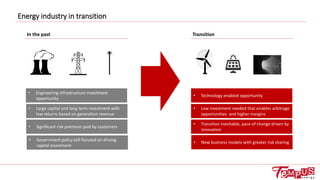
Energy industry in transition
In the past Transition
• Engineering infrastructure investment
opportunity
• Large capital and long term investment with
low returns based on generation revenue
• Significant risk premium paid by customers
• Technology enabled opportunity
• Low investment needed that enables arbitrage
opportunities and higher margins
• Transition inevitable, pace of change driven by
innovation
• Government policy still focused on driving
capital investment
• New business models with greater risk sharing
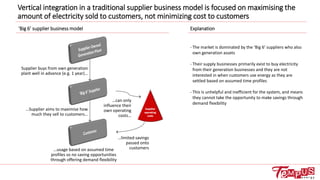
Vertical integration in a traditional supplier business model is focused on maximising the
amount of electricity sold to customers, not minimizing cost to customers
‘Big 6’ supplier business model
- The market is dominated by the ‘Big 6’ suppliers who also
own generation assets
- Their supply businesses primarily exist to buy electricity
from their generation businesses and they are not
interested in when customers use energy as they are
settled based on assumed time profiles
- This is unhelpful and inefficient for the system, and means
they cannot take the opportunity to make savings through
demand flexibility
Explanation
Supplier buys from own generation
plant well in advance (e.g. 1 year)…
…Supplier aims to maximise how
much they sell to customers…
…usage based on assumed time
profiles so no saving opportunities
through offering demand flexibility
…can only
influence their
own operating
costs…
…limited savings
passed onto
customers
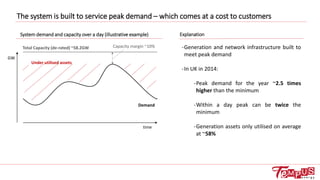
The system is built to service peak demand – which comes at a cost to customers
-Generation and network infrastructure built to
meet peak demand
-In UK in 2014:
-Peak demand for the year ~2.5 times
higher than the minimum
-Within a day peak can be twice the
minimum
-Generation assets only utilised on average
at ~58%
Demand
Capacity margin ~10%
Under utilised assets
Total Capacity (de-rated) ~58.2GW
time
GW
System demand and capacity over a day (illustrative example) Explanation
A day in the UK market - Fluctuations in electricity prices
Impact of demand and generation fluctuations on price
[UK half hourly spot prices, 27th Oct 2014, £/MWh]
66
225
69
2
3
0 50 100 150 200 250
£8-20
£20-50
£50-100
£100-200
Over £200
0
10
20
30
40
50
60
70
80
90
100
time
(half hourly
periods)
£MWh
£86/MWh
£17/MWh
Number of days
Difference between max and min prices in a day
[£, number of days, 2014]
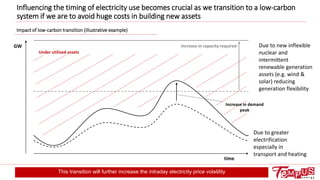
Influencing the timing of electricity use becomes crucial as we transition to a low-carbon
system if we are to avoid huge costs in building new assets
This transition will further increase the intraday electricity price volatility
Due to greater
electrification
especially in
transport and heating
Impact of low-carbon transition (illustrative example)
GW
Under utilised assets
time
Increase in capacity required
Increase in demand
peak
Due to new inflexible
nuclear and
intermittent
renewable generation
assets (e.g. wind &
solar) reducing
generation flexibility
 Inefficient electricity systems and inflexible demand result in higher electricity bills
 Demand flexibility offers opportunities for improved, efficient electricity systems and cost reductions
 Unlocking demand flexibility for cheaper electricity
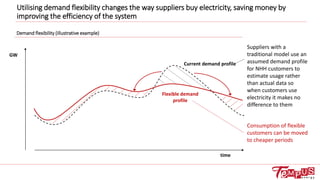
Utilising demand flexibility changes the way suppliers buy electricity, saving money by
improving the efficiency of the system
Suppliers with a
traditional model use an
assumed demand profile
for NHH customers to
estimate usage rather
than actual data so
when customers use
electricity it makes no
difference to them
Demand flexibility (illustrative example)
Flexible demand
profile
time
GW
Current demand profile
Consumption of flexible
customers can be moved
to cheaper periods
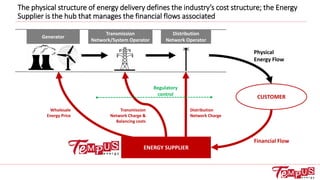
The physical structure of energy delivery defines the industry’s cost structure; the Energy
Supplier is the hub that manages the financial flows associated
ENERGY SUPPLIER
Distribution
Network Operator
Transmission
Network/System Operator
CUSTOMER
Physical
Energy Flow
Financial Flow
Wholesale
Energy Price
Transmission
Network Charge &
Balancing costs
Distribution
Network Charge
Generator
Regulatory
control
Wholesale costs
Supplier operating costs
Supplier
profit
Environmental & Social
costs
VAT
Network costs
Demand flexibility can be used to optimise most elements that make up the bill
Minimised by
shifting flexible
demand to off-
peak periods
Reduced by
actively trading
and varying
demand to
match low price
periods
Household Bill Savings with demand flexibility
Balancing charges
also minimised by
managing usage in
real time
Wholesale costs, 39%
Supplier operating
costs, 13%
Supplier profit, 6%
Environmental & Social
costs, 11%
VAT, 5%
Network costs, 26%
Household Electricity Bill Breakdown (Ofgem 2015)
Government taxes,
regulations and
legislations Costs of running a supply business
[the only costs that traditional
suppliers can effectively control]
Transmission and
distribution costs
Cost of
electricity
trading
11Further opportunities can arise from raising revenue from participating in balancing services and capacity market
 Inefficient electricity systems and inflexible demand result in higher electricity bills
 Demand flexibility offers opportunities for improved, efficient electricity systems and cost reductions
 Unlocking demand flexibility for cheaper electricity
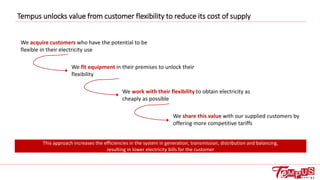
Tempus unlocks value from customer flexibility to reduce its cost of supply
This approach increases the efficiencies in the system in generation, transmission, distribution and balancing,
resulting in lower electricity bills for the customer
We acquire customers who have the potential to be
flexible in their electricity use
We fit equipment in their premises to unlock their
flexibility
We work with their flexibility to obtain electricity as
cheaply as possible
We share this value with our supplied customers by
offering more competitive tariffs
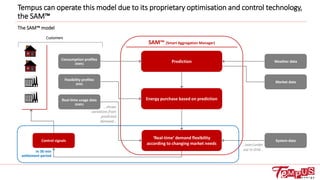
Tempus can operate this model due to its proprietary optimisation and control technology,
the SAM™
SAM™ (Smart Aggregation Manager)
Customers
Energy purchase based on prediction
‘Real-time’ demand flexibility
according to changing market needs
Control signals
Real-time usage data
(KWh)
Flexibility profiles
(KW)
Consumption profiles
(KWh)
Weather data
Market data
System data
…shows
variations from
predicted
demand…
…over/under
use in Grid…In 30 min
settlement period
Prediction
The SAM™ model
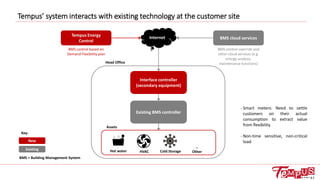
Tempus’ system interacts with existing technology at the customer site
Existing
New
Interface controller
(secondary equipment)
Tempus Energy
Control
BMS control based on
Demand Flexibility plan
Existing BMS controller
BMS cloud services
BMS control override and
other cloud services (e.g.
energy analysis,
maintenance functions)
Internet
…
Other
Key:
Assets
Head Office
Cold StorageHVACHot water
BMS = Building Management System
- Smart meters: Need to settle
customers on their actual
consumption to extract value
from flexibility
- Non-time sensitive, non-critical
load
Ilse.dubois@tempusenergy.com
Thank you!

Unlocking demand flexibility for lower electricity bills

  • 1.
    Ilse Dubois Unlockingdemand flexibility for cheaper electricity 12th November 2015
  • 2.
     Inefficient electricitysystems and inflexible demand result in higher electricity bills  Demand flexibility offers opportunities for improved, efficient electricity systems and cost savings  Unlocking demand flexibility for cheaper electricity
  • 3.
    Energy industry intransition In the past Transition • Engineering infrastructure investment opportunity • Large capital and long term investment with low returns based on generation revenue • Significant risk premium paid by customers • Technology enabled opportunity • Low investment needed that enables arbitrage opportunities and higher margins • Transition inevitable, pace of change driven by innovation • Government policy still focused on driving capital investment • New business models with greater risk sharing
  • 4.
    Vertical integration ina traditional supplier business model is focused on maximising the amount of electricity sold to customers, not minimizing cost to customers ‘Big 6’ supplier business model - The market is dominated by the ‘Big 6’ suppliers who also own generation assets - Their supply businesses primarily exist to buy electricity from their generation businesses and they are not interested in when customers use energy as they are settled based on assumed time profiles - This is unhelpful and inefficient for the system, and means they cannot take the opportunity to make savings through demand flexibility Explanation Supplier buys from own generation plant well in advance (e.g. 1 year)… …Supplier aims to maximise how much they sell to customers… …usage based on assumed time profiles so no saving opportunities through offering demand flexibility …can only influence their own operating costs… …limited savings passed onto customers
  • 5.
    The system isbuilt to service peak demand – which comes at a cost to customers -Generation and network infrastructure built to meet peak demand -In UK in 2014: -Peak demand for the year ~2.5 times higher than the minimum -Within a day peak can be twice the minimum -Generation assets only utilised on average at ~58% Demand Capacity margin ~10% Under utilised assets Total Capacity (de-rated) ~58.2GW time GW System demand and capacity over a day (illustrative example) Explanation
  • 6.
    A day inthe UK market - Fluctuations in electricity prices Impact of demand and generation fluctuations on price [UK half hourly spot prices, 27th Oct 2014, £/MWh] 66 225 69 2 3 0 50 100 150 200 250 £8-20 £20-50 £50-100 £100-200 Over £200 0 10 20 30 40 50 60 70 80 90 100 time (half hourly periods) £MWh £86/MWh £17/MWh Number of days Difference between max and min prices in a day [£, number of days, 2014]
  • 7.
    Influencing the timingof electricity use becomes crucial as we transition to a low-carbon system if we are to avoid huge costs in building new assets This transition will further increase the intraday electricity price volatility Due to greater electrification especially in transport and heating Impact of low-carbon transition (illustrative example) GW Under utilised assets time Increase in capacity required Increase in demand peak Due to new inflexible nuclear and intermittent renewable generation assets (e.g. wind & solar) reducing generation flexibility
  • 8.
     Inefficient electricitysystems and inflexible demand result in higher electricity bills  Demand flexibility offers opportunities for improved, efficient electricity systems and cost reductions  Unlocking demand flexibility for cheaper electricity
  • 9.
    Utilising demand flexibilitychanges the way suppliers buy electricity, saving money by improving the efficiency of the system Suppliers with a traditional model use an assumed demand profile for NHH customers to estimate usage rather than actual data so when customers use electricity it makes no difference to them Demand flexibility (illustrative example) Flexible demand profile time GW Current demand profile Consumption of flexible customers can be moved to cheaper periods
  • 10.
    The physical structureof energy delivery defines the industry’s cost structure; the Energy Supplier is the hub that manages the financial flows associated ENERGY SUPPLIER Distribution Network Operator Transmission Network/System Operator CUSTOMER Physical Energy Flow Financial Flow Wholesale Energy Price Transmission Network Charge & Balancing costs Distribution Network Charge Generator Regulatory control
  • 11.
    Wholesale costs Supplier operatingcosts Supplier profit Environmental & Social costs VAT Network costs Demand flexibility can be used to optimise most elements that make up the bill Minimised by shifting flexible demand to off- peak periods Reduced by actively trading and varying demand to match low price periods Household Bill Savings with demand flexibility Balancing charges also minimised by managing usage in real time Wholesale costs, 39% Supplier operating costs, 13% Supplier profit, 6% Environmental & Social costs, 11% VAT, 5% Network costs, 26% Household Electricity Bill Breakdown (Ofgem 2015) Government taxes, regulations and legislations Costs of running a supply business [the only costs that traditional suppliers can effectively control] Transmission and distribution costs Cost of electricity trading 11Further opportunities can arise from raising revenue from participating in balancing services and capacity market
  • 12.
     Inefficient electricitysystems and inflexible demand result in higher electricity bills  Demand flexibility offers opportunities for improved, efficient electricity systems and cost reductions  Unlocking demand flexibility for cheaper electricity
  • 13.
    Tempus unlocks valuefrom customer flexibility to reduce its cost of supply This approach increases the efficiencies in the system in generation, transmission, distribution and balancing, resulting in lower electricity bills for the customer We acquire customers who have the potential to be flexible in their electricity use We fit equipment in their premises to unlock their flexibility We work with their flexibility to obtain electricity as cheaply as possible We share this value with our supplied customers by offering more competitive tariffs
  • 14.
    Tempus can operatethis model due to its proprietary optimisation and control technology, the SAM™ SAM™ (Smart Aggregation Manager) Customers Energy purchase based on prediction ‘Real-time’ demand flexibility according to changing market needs Control signals Real-time usage data (KWh) Flexibility profiles (KW) Consumption profiles (KWh) Weather data Market data System data …shows variations from predicted demand… …over/under use in Grid…In 30 min settlement period Prediction The SAM™ model
  • 15.
    Tempus’ system interactswith existing technology at the customer site Existing New Interface controller (secondary equipment) Tempus Energy Control BMS control based on Demand Flexibility plan Existing BMS controller BMS cloud services BMS control override and other cloud services (e.g. energy analysis, maintenance functions) Internet … Other Key: Assets Head Office Cold StorageHVACHot water BMS = Building Management System - Smart meters: Need to settle customers on their actual consumption to extract value from flexibility - Non-time sensitive, non-critical load
  • 16.