AMI & SMART METERING


SMART METERS ENABLE
NEW BUSINESS MODELS
IN ELECTRICITY RETAIL
By Paul A. Hendriks and Bart Laurense

The electricity industry is in flux: today few things are as they          Change 3: Transactional data enables customer segmentation
used to be and for those things that are, changes are on the               Most energy supply companies lack insight into customer demand
horizon in the near future. However, there seems to be one                 and behaviour. The introduction of smart meters provides an
exception: the business model for electricity supply to domestic           opportunity as energy supply companies can potentially acquire
customers, which has not changed since the early days of the               more detailed information on the consumption of individual
industry. In the article, we will argue that the mandatory rollout         customers. Moreover, in some cases the consumption of individual
of smart meters in the European Union provides opportunities               appliances in the home can be registered too. This data can
for new business models and gives rise to a particular approach            be provided to consumers and prompt them to become more
that can be applied in these markets.                                      energy efficient or change consumption patterns. It also enables
                                                                           segmentation of the consumer market and development of proposals
The traditional business model has its roots in an electricity market      for individual segments.
dominated by vertically integrated electricity companies. These
companies were large because most sections of the industry were            Change 4: Ubiquitous communication enables information
capital intensive and in line with the typical characteristics of a        symmetry
natural monopoly, economies of scale applied. A large proportion of        In most consumer markets, the price of electricity is fixed and
the current electricity companies are still associated with companies      consumers are not aware that the cost of electricity varies over
from this previous era. Even though liberalization and restructuring       the day. Today, communication technologies can overcome the
has changed the characteristics of companies and enabled new               problem by providing price signals to consumers, which can
entrants to enter the market, some consumers still associate today’s       influence their attitude towards electricity and can change their
electricity companies with the monopolies of the past. As a result,        consumption patterns. The internet and other communication
the relationship between consumers and energy companies is very            tools enable energy companies to disseminate information on the
different from those in traditionally competitive markets and this         electricity provided but can also provide feedback to consumers
is especially true for today’s monopolies – the transmission and           with respect to their consumption.
distribution network operators.
                                                                           Change 5: Distributed generation transforms consumers to
A CHANGING INDUSTRY                                                        market participants
The perception of energy companies as “autocratic” entities,               Traditionally the indivisibility of capital combined with economies
combined with the fact that the business models applied in                 of scale resulted in ever increasing power plants. However,
the market resemble the models from the past, is considered a              the advent of small scale generation assets that are becoming
barrier for the development of the electricity market into a truly         competitive with traditional power plants changes the role of
competitive market. Today people expect suppliers to provide               domestic consumers. Once these consumers deploy equipment
products and services that meet their individual preferences.              for generation like photovoltaic systems, small scale CHP or small
However, a number of recent developments in the industry                   wind turbines they become prosumers and their relationships with
are starting to allow energy supply companies to change their              energy supply companies change.
traditional approach and transform into “democratic” entities.
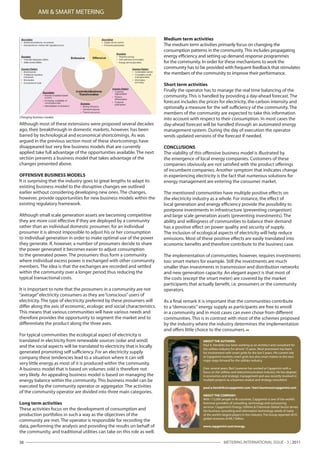
                                                                           These changes enable a transformation from defensive business
Change 1: Contestable market facilitates new entries                       models utilized in traditional markets to offensive business models.
The market for energy supply has made strides towards becoming             Each of the changes contributes to the business transformation
a contestable market as there are few barriers to entry and exit. In       as depicted in the diagram. Although liberalized markets already
spite of this, however, it is surprising to see that new entrants are in   provide ample opportunities for business transformation, the
most cases “price fighters”, while a growing portion of consumers do       current business models still display the characteristics of the
not indicate that price is the most important factor in their choice of    regulated markets, i.e. a defensive market approach.
energy provider.
                                                                           INTERMEDIATE BUSINESS MODELS
Change 2: Customer awareness enables product differentiation               The changes outlined above provide opportunities to extend
Electricity is traditionally traded as a commodity which means             existing business models that contribute to the controlled business
that no qualitative differentiation is used and price is the               transformation, including:
only characteristic assigned. With a growing concern for the               • Remuneration for energy efficiency (selling negawatts);
environment, however, the carbon intensity of electricity is rapidly       • Energy services (selling end-use like heating and cooling instead
becoming another important qualitative characteristic. Also a                 of kilowatts);
growing number of consumers care about the social aspects of               • Demand response programmes (remunerate behavioural
electricity provision. Given these characteristics, the opportunity           change);
to differentiate electricity across three key variables – economical,      • Demand side management (remunerate demand reduction);
ecological and social – is potentially immense.                            • Price differentiation (apply time-of-use tariffs).

36                                                                                                       METERING INTERNATIONAL ISSUE - 3 | 2011
AMI & SMART METERING


                                                                           Medium term activities
                                                                           The medium term activities primarily focus on changing the
                                                                           consumption patterns in the community. This includes propagating
                                                                           energy efficiency and setting up demand response programmes
                                                                           for the community. In order for these mechanisms to work the
                                                                           community has to be provided with frequent feedback that stimulates
                                                                           the members of the community to improve their performance.

                                                                           Short term activities
                                                                           Finally the operator has to manage the real time balancing of the
                                                                           community. This is handled by providing a day-ahead forecast. The
                                                                           forecast includes the prices for electricity, the carbon intensity and
                                                                           optionally a measure for the self sufficiency of the community. The
                                                                           members of the community are expected to take this information
Changing business models
                                                                           into account with respect to their consumption. In most cases the
Although most of these extensions were proposed several decades            day-ahead forecast will be handled through an automated energy
ago, their breakthrough in domestic markets, however, has been             management system. During the day of execution the operator
barred by technological and economical shortcomings. As was                sends updated versions of the forecast if needed.
argued in the previous section most of these shortcomings have
disappeared but very few business models that are currently                CONCLUSIONS
applied take full advantage of the opportunities available. The next       The viability of this offensive business model is illustrated by
section presents a business model that takes advantage of the              the emergence of local energy companies. Customers of these
changes presented above.                                                   companies obviously are not satisfied with the product offerings
                                                                           of incumbent companies. Another symptom that indicates change
OFFENSIVE BUSINESS MODELS                                                  in experiencing electricity is the fact that numerous solutions for
It is surprising that the industry goes to great lengths to adapt its      energy management are entering the consumer market.
existing business model to the disruptive changes we outlined
earlier without considering developing new ones. The changes,              The mentioned communities have multiple positive effects on
however, provide opportunities for new business models within the          the electricity industry as a whole. For instance, the effect of
existing regulatory framework.                                             local generation and energy efficiency provide the possibility to
                                                                           postpone investments in infrastructure (preventing congestion)
Although small scale generation assets are becoming competitive            and large scale generation assets (preventing investments). The
they are more cost effective if they are deployed by a community           ability and willingness of communities to balance their demand
rather than an individual domestic prosumer; for an individual             has a positive effect on power quality and security of supply.
prosumer it is almost impossible to adjust his or her consumption          The inclusion of ecological aspects of electricity will help reduce
to individual generation in order to make optimal use of the power         emissions. Most of these positive effects are easily translated into
they generate. If, however, a number of prosumers decide to share          economic benefits and therefore contribute to the business case.
the power generated it becomes easier to adjust consumption
to the generated power. The prosumers thus form a community                The implementation of communities, however, requires investments
where individual excess power is exchanged with other community            too: smart meters for example. Still the investments are much
members. The idea is that the exchanges are recorded and settled           smaller than investments in transmission and distribution networks
within the community over a longer period thus reducing the                and new generation capacity. An elegant aspect is that most of
typical transactional costs.                                               the costs (except the smart meter) are covered by the market
                                                                           participants that actually benefit, i.e. prosumers or the community
It is important to note that the prosumers in a community are not          operators.
“average” electricity consumers as they are “conscious” users of
electricity. The type of electricity preferred by these prosumers will     As a final remark it is important that the communities contribute
differ along the axis of economic, ecologic and social characteristics.    to a “democratic” energy supply as participants are free to enroll
This means that various communities will have various needs and            in a community and in most cases can even chose from different
therefore provides the opportunity to segment the market and to            communities. This is in contrast with most of the schemes proposed
differentiate the product along the three axes.                            by the industry where the industry determines the implementation
                                                                           and offers little choice to the consumers. MI
For typical communities the ecological aspect of electricity is
translated in electricity from renewable sources (solar and wind)                              ABOUT THE AUTHORS:
and the social aspects will be translated to electricity that is locally                       Paul A. Hendriks has been working as an architect and consultant for
                                                                                               the utilities industry for almost 15 years. Most prominent has been
generated promoting self sufficiency. For an electricity supply                                his involvement with smart grids for the last 5 years. His current role
company these tendencies lead to a situation where it can sell                                 at Capgemini involves smart grids but also smart meters as the next
                                                                                               major steps forward for the utilities industry.
very little energy as most of it is produced within the community.
A business model that is based on volumes sold is therefore not                                Over several years, Bart Laurense has worked at Capgemini with a
                                                                                               focus on the utilities and telecommunication industry. He has degrees
very likely. An appealing business model is based on managing the                              in economics and strategic management and was recently involved in
energy balance within the community. This business model can be                                multiple projects as a business analyst and strategy consultant.

executed by the community operator or aggregator. The activities                               paul.a.hendriks@capgemini.com / bart.laurense@capgemini.com
of the community operator are divided into three main categories.
                                                                                               ABOUT THE COMPANY:
                                                                                               With 112,000 people in 40 countries, Capgemini is one of the world’s
Long term activities                                                                           foremost providers of consulting, technology and outsourcing
                                                                                               services. Capgemini’s Energy, Utilities & Chemicals Global Sector serves
These activities focus on the development of consumption and                                   the business consulting and information technology needs of many
production portfolios in such a way as the objectives of the                                   of the world’s largest players in this industry. The Group reported 2010
                                                                                               global revenues of €8.7 billion.
community are met. The operator is responsible for recording the
data, performing the analysis and providing the results on behalf of                           www.capgemini.com/energy.
the community, and traditional utilities can take on this role as well.

38                                                                                                            METERING INTERNATIONAL ISSUE - 3 | 2011

Mi 3 2011_pg_36

  • 1.
    AMI & SMARTMETERING SMART METERS ENABLE NEW BUSINESS MODELS IN ELECTRICITY RETAIL By Paul A. Hendriks and Bart Laurense The electricity industry is in flux: today few things are as they Change 3: Transactional data enables customer segmentation used to be and for those things that are, changes are on the Most energy supply companies lack insight into customer demand horizon in the near future. However, there seems to be one and behaviour. The introduction of smart meters provides an exception: the business model for electricity supply to domestic opportunity as energy supply companies can potentially acquire customers, which has not changed since the early days of the more detailed information on the consumption of individual industry. In the article, we will argue that the mandatory rollout customers. Moreover, in some cases the consumption of individual of smart meters in the European Union provides opportunities appliances in the home can be registered too. This data can for new business models and gives rise to a particular approach be provided to consumers and prompt them to become more that can be applied in these markets. energy efficient or change consumption patterns. It also enables segmentation of the consumer market and development of proposals The traditional business model has its roots in an electricity market for individual segments. dominated by vertically integrated electricity companies. These companies were large because most sections of the industry were Change 4: Ubiquitous communication enables information capital intensive and in line with the typical characteristics of a symmetry natural monopoly, economies of scale applied. A large proportion of In most consumer markets, the price of electricity is fixed and the current electricity companies are still associated with companies consumers are not aware that the cost of electricity varies over from this previous era. Even though liberalization and restructuring the day. Today, communication technologies can overcome the has changed the characteristics of companies and enabled new problem by providing price signals to consumers, which can entrants to enter the market, some consumers still associate today’s influence their attitude towards electricity and can change their electricity companies with the monopolies of the past. As a result, consumption patterns. The internet and other communication the relationship between consumers and energy companies is very tools enable energy companies to disseminate information on the different from those in traditionally competitive markets and this electricity provided but can also provide feedback to consumers is especially true for today’s monopolies – the transmission and with respect to their consumption. distribution network operators. Change 5: Distributed generation transforms consumers to A CHANGING INDUSTRY market participants The perception of energy companies as “autocratic” entities, Traditionally the indivisibility of capital combined with economies combined with the fact that the business models applied in of scale resulted in ever increasing power plants. However, the market resemble the models from the past, is considered a the advent of small scale generation assets that are becoming barrier for the development of the electricity market into a truly competitive with traditional power plants changes the role of competitive market. Today people expect suppliers to provide domestic consumers. Once these consumers deploy equipment products and services that meet their individual preferences. for generation like photovoltaic systems, small scale CHP or small However, a number of recent developments in the industry wind turbines they become prosumers and their relationships with are starting to allow energy supply companies to change their energy supply companies change. traditional approach and transform into “democratic” entities. These changes enable a transformation from defensive business Change 1: Contestable market facilitates new entries models utilized in traditional markets to offensive business models. The market for energy supply has made strides towards becoming Each of the changes contributes to the business transformation a contestable market as there are few barriers to entry and exit. In as depicted in the diagram. Although liberalized markets already spite of this, however, it is surprising to see that new entrants are in provide ample opportunities for business transformation, the most cases “price fighters”, while a growing portion of consumers do current business models still display the characteristics of the not indicate that price is the most important factor in their choice of regulated markets, i.e. a defensive market approach. energy provider. INTERMEDIATE BUSINESS MODELS Change 2: Customer awareness enables product differentiation The changes outlined above provide opportunities to extend Electricity is traditionally traded as a commodity which means existing business models that contribute to the controlled business that no qualitative differentiation is used and price is the transformation, including: only characteristic assigned. With a growing concern for the • Remuneration for energy efficiency (selling negawatts); environment, however, the carbon intensity of electricity is rapidly • Energy services (selling end-use like heating and cooling instead becoming another important qualitative characteristic. Also a of kilowatts); growing number of consumers care about the social aspects of • Demand response programmes (remunerate behavioural electricity provision. Given these characteristics, the opportunity change); to differentiate electricity across three key variables – economical, • Demand side management (remunerate demand reduction); ecological and social – is potentially immense. • Price differentiation (apply time-of-use tariffs). 36 METERING INTERNATIONAL ISSUE - 3 | 2011
  • 2.
    AMI & SMARTMETERING Medium term activities The medium term activities primarily focus on changing the consumption patterns in the community. This includes propagating energy efficiency and setting up demand response programmes for the community. In order for these mechanisms to work the community has to be provided with frequent feedback that stimulates the members of the community to improve their performance. Short term activities Finally the operator has to manage the real time balancing of the community. This is handled by providing a day-ahead forecast. The forecast includes the prices for electricity, the carbon intensity and optionally a measure for the self sufficiency of the community. The members of the community are expected to take this information Changing business models into account with respect to their consumption. In most cases the Although most of these extensions were proposed several decades day-ahead forecast will be handled through an automated energy ago, their breakthrough in domestic markets, however, has been management system. During the day of execution the operator barred by technological and economical shortcomings. As was sends updated versions of the forecast if needed. argued in the previous section most of these shortcomings have disappeared but very few business models that are currently CONCLUSIONS applied take full advantage of the opportunities available. The next The viability of this offensive business model is illustrated by section presents a business model that takes advantage of the the emergence of local energy companies. Customers of these changes presented above. companies obviously are not satisfied with the product offerings of incumbent companies. Another symptom that indicates change OFFENSIVE BUSINESS MODELS in experiencing electricity is the fact that numerous solutions for It is surprising that the industry goes to great lengths to adapt its energy management are entering the consumer market. existing business model to the disruptive changes we outlined earlier without considering developing new ones. The changes, The mentioned communities have multiple positive effects on however, provide opportunities for new business models within the the electricity industry as a whole. For instance, the effect of existing regulatory framework. local generation and energy efficiency provide the possibility to postpone investments in infrastructure (preventing congestion) Although small scale generation assets are becoming competitive and large scale generation assets (preventing investments). The they are more cost effective if they are deployed by a community ability and willingness of communities to balance their demand rather than an individual domestic prosumer; for an individual has a positive effect on power quality and security of supply. prosumer it is almost impossible to adjust his or her consumption The inclusion of ecological aspects of electricity will help reduce to individual generation in order to make optimal use of the power emissions. Most of these positive effects are easily translated into they generate. If, however, a number of prosumers decide to share economic benefits and therefore contribute to the business case. the power generated it becomes easier to adjust consumption to the generated power. The prosumers thus form a community The implementation of communities, however, requires investments where individual excess power is exchanged with other community too: smart meters for example. Still the investments are much members. The idea is that the exchanges are recorded and settled smaller than investments in transmission and distribution networks within the community over a longer period thus reducing the and new generation capacity. An elegant aspect is that most of typical transactional costs. the costs (except the smart meter) are covered by the market participants that actually benefit, i.e. prosumers or the community It is important to note that the prosumers in a community are not operators. “average” electricity consumers as they are “conscious” users of electricity. The type of electricity preferred by these prosumers will As a final remark it is important that the communities contribute differ along the axis of economic, ecologic and social characteristics. to a “democratic” energy supply as participants are free to enroll This means that various communities will have various needs and in a community and in most cases can even chose from different therefore provides the opportunity to segment the market and to communities. This is in contrast with most of the schemes proposed differentiate the product along the three axes. by the industry where the industry determines the implementation and offers little choice to the consumers. MI For typical communities the ecological aspect of electricity is translated in electricity from renewable sources (solar and wind) ABOUT THE AUTHORS: and the social aspects will be translated to electricity that is locally Paul A. Hendriks has been working as an architect and consultant for the utilities industry for almost 15 years. Most prominent has been generated promoting self sufficiency. For an electricity supply his involvement with smart grids for the last 5 years. His current role company these tendencies lead to a situation where it can sell at Capgemini involves smart grids but also smart meters as the next major steps forward for the utilities industry. very little energy as most of it is produced within the community. A business model that is based on volumes sold is therefore not Over several years, Bart Laurense has worked at Capgemini with a focus on the utilities and telecommunication industry. He has degrees very likely. An appealing business model is based on managing the in economics and strategic management and was recently involved in energy balance within the community. This business model can be multiple projects as a business analyst and strategy consultant. executed by the community operator or aggregator. The activities paul.a.hendriks@capgemini.com / bart.laurense@capgemini.com of the community operator are divided into three main categories. ABOUT THE COMPANY: With 112,000 people in 40 countries, Capgemini is one of the world’s Long term activities foremost providers of consulting, technology and outsourcing services. Capgemini’s Energy, Utilities & Chemicals Global Sector serves These activities focus on the development of consumption and the business consulting and information technology needs of many production portfolios in such a way as the objectives of the of the world’s largest players in this industry. The Group reported 2010 global revenues of €8.7 billion. community are met. The operator is responsible for recording the data, performing the analysis and providing the results on behalf of www.capgemini.com/energy. the community, and traditional utilities can take on this role as well. 38 METERING INTERNATIONAL ISSUE - 3 | 2011