Plan 9
from Bell Labs

“UNIX++ Anyone?”
Anant Narayanan
Malaviya National Institute of Technology
FOSS.IN 2007
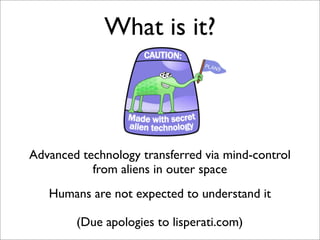
What is it?

Advanced technology transferred via mind-control
from aliens in outer space
Humans are not expected to understand it
(Due apologies to lisperati.com)
Yeah Right
• More realistically, a distributed operating
system

• Designed by the creators of C, UNIX, AWK,
UTF-8, TROFF etc. etc.

• Widely acknowledged as UNIX’s true
successor

• Distributed under terms of the Lucent

Public License, which appears on the OSI’s
list of approved licenses, also considered free
software by the FSF
What For?
“Not only is UNIX dead, it’s starting to smell really bad.”
-- Rob Pike (circa 1991)

• UNIX was a fantastic idea...
• ...in it’s time - 1970’s
• Designed primarily as a “time-sharing”
system, before the PC era
A closer look at Unix
TODAY
It Works!
But that doesn’t mean we don’t develop superior alternates
GNU/Linux
• GNU’s not UNIX, but it is!
• Linux was inspired by Minix, which was in
turn inspired by UNIX

• GNU/Linux (mostly) conforms to ANSI and
POSIX requirements

• GNU/Linux, on the desktop, is playing

“catch-up” with Windows or Mac OS X,
offering little in terms of technological
innovation
Ok, and...
• Most of the “modern ideas” we use today
were “bolted” on an ancient underlying
system

• Don’t believe me?
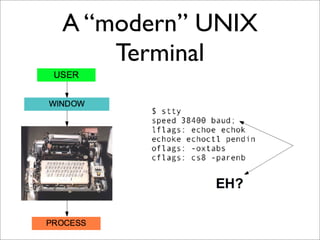
A “modern” UNIX
Terminal
Where did it go wrong?
• Early UNIX, “everything is a file”
• Brilliant!
• Only until people started adding “features”
to the system...
Why you shouldn’t be
working with GNU/Linux
• The Socket API
• POSIX
• X11
• The Bindings “rat-race”
• 300 system calls and counting...
• Why isn’t everything a file all of a sudden?
What’s the solution?
• Take a step back and think about the
“everything is a file” approach

• Throw the POSIX specification into the
dustbin
Welcome Plan 9!
• Uniform interface to all resources
• Why should I care if a device is a ‘char’ or a
‘block’?

• No files are more “special” than others
9P
• One protocol to bind them all
• 9P is Plan 9’s “VFS”
• 13 basic operations including read, write, stat
et. al.

• All resources are required to implement
them

• Minimalist and Lightweight, can work over

any reliable transport: TCP, Shared Memory,
Serial Ports, PCI Bus etc.
The File Server
• Unlike what you may expect, a file server in
Plan 9 is just something that “serves”
resources in the form of files

• Hence, the kernel is often called a “server
multiplexer”, not an “I/O multiplexer” like
UNIX was

• Thanks to 9P, it doesn’t matter whether

resources are local or remote, applications
use them transparently without even
knowing
Example “Servers”
• Networking: /net
• Email: /mail/fs
• Graphics: /dev/draw
• Window System: /dev/wsys
• Process Control: /proc
• cdfs, webfs, tarfs, ftpfs, wikifs
Namespaces
• Per-process namespaces
• A process’ own “view” of the filesystem
• Can be used to implement some neat stuff!
• Start a window manager inside another

transparently, because /dev/draw for the
one inside is different that the one for the
parent!
No bindings!
• Since everything is file-based, you don’t need
to:

• Use C all the time
• Write bindings for every new feature-set

• As long as your language can read and write
files, you’re good to go
Trivia
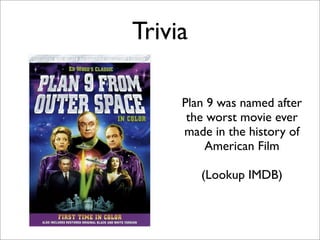
Plan 9 was named after
the worst movie ever
made in the history of
American Film
(Lookup IMDB)
Ok, I’m convinced
How can I help?
Learn the “Plan 9 Way”
Tools at your disposal
Rio
• Plan 9’s Window Manager
• A window in Rio is a real window, not a

“terminal emulator” because we don’t use
terminal anymore

• Everything is just text - cut / copy / paste at
will!

• And yes, you need a (3-button) mouse :)
Acme
• The programmer’s editor
• Again, all text is editable
• Can also be used as a file manager
• No, there’s no syntax coloring (yet!)
Compiler Suite
• One compiler and linker per architecture

(MC68000/020, ARM, Alpha, x86, AMD64,
SPARC, SPARC64, PowerPC, MIPS and more
on the way)

• A new “Makefile” style system for
maintaining code - mk

• Very fast - No dynamic libraries
• Robust debugging system acid
Fossil and Venti
• Venti - block storage indexed by hash;
duplicated blocks stored only once

• Fossil: Uses Venti for storing snapshots of
files

• Try the history and yesterday commands
• Mac OS X comes up with this idea for

Leopard in 2007, was in Plan 9 since before I
was born!
Factotum
• Much like a “keyring”, does authentication on
your behalf

• Speaks a variety of protocols
• All your keys are stored in secstore
encrypted in a “master” key
Security
• There is no root user
• Everyone has the same privileges (i.e.
nothing)

• Namespaces provide isolation by default
• The file-server has a “sys” group, add

yourself to it if you want to, for example,
install a new kernel for everyone to use
Concurrency
• Did you also remember to throw pthreads
into the dustbin?

• “Communicating Sequential Processes”
introduced by Hoare in 1978 based on
Dijkstra’s work

• OS handled processes, co-routines within a
process are called threads

• C/libthread, Limbo, Occam, Erlang
Native UTF-8
• UTF-8 was invented by Ken Thomson and
Rob Pike for Plan 9

• All text in Plan 9 is UTF-8 (which is why it is
backward-compatible with ASCII)

• Internationalization was added to Linux as
an afterthought

• This is especially relevant in countries like
India
What Plan 9 Doesn’t
Have
• root, suid, tty, curses
• ioctl, sockets, select, poll, symlinks
• pthreads, mmap
• locales
• gcc, C++, emacs, vi
• X11, XML, “Web 2.0”
• ... and that’s a good thing (TM)
But we also don’t have
• Good video players
• A 3D graphics system
• Eye-candy
• Javascript-enabled web browser
• Most people have been managing by vnc’ing
into other machines, so far

• That’s where YOU, as a developer, come in
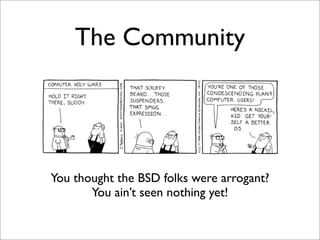
The Community

You thought the BSD folks were arrogant?
You ain’t seen nothing yet!
Contributing
• Be prepared to unlearn what you have learnt
so far

• Plan 9 has an in-built patch and update

system, any user can submit patches straight
from the OS

• Not a conventional FOSS project, there’s no
“version control” or “ticketing system” as
such

• The mailing list and IRC channels are usually
active
Getting Involved
• Subscribe to the 9fans list (you get to
interact with legends as a side-effect)

• Hang out in our IRC Channels
• Install Plan 9 (on your VM?)
• Get Hacking!
• Encounter a problem? Post...
• Rinse and Repeat
• Announce your creation proudly (but be
prepared for the bashing!)
What you can do
• Develop applications for Plan 9
• Port applications to Plan 9 (not fun and
definitely not recommended, but...)

• Improve Plan 9 itself
• Fix Bugs
• Port Plan 9 applications to other OSes
(plan9port)

• Frequent contributors get their very own
‘contrib’ directory
The Rewards
• The warm fuzzy feeling of contributing to
FOSS

• You learn a lot more than you would

contributing to your run-of-the-mill FOSS
project

• You work with the tools of the future, not
the present

• You change the way you look at
computer science. No kidding.
Not Ready for it yet?
• Smooth your transition with:
• “Plan 9 From User Space” - A port of the
most common Plan 9 utilities to POSIX
systems

• Inferno - A operating system inspired by

Plan 9, can be run in “hosted mode” which
essentially means the OS in your current
OS (runs on POSIX systems and
Windows)

• Standalone versions of Acme
Any Questions?
Any Rants?
Thank You!
anant@kix.in
http://www.kix.in/plan9/
http://plan9.bell-labs.com/plan9/
http://swtch.com/plan9port/
http://www.vitanuova.com/inferno/
#plan9 on irc.freenode.net

Unix++: Plan 9 from Bell Labs

  • 1.
    Plan 9 from BellLabs “UNIX++ Anyone?” Anant Narayanan Malaviya National Institute of Technology FOSS.IN 2007
  • 2.
    What is it? Advancedtechnology transferred via mind-control from aliens in outer space Humans are not expected to understand it (Due apologies to lisperati.com)
  • 3.
    Yeah Right • Morerealistically, a distributed operating system • Designed by the creators of C, UNIX, AWK, UTF-8, TROFF etc. etc. • Widely acknowledged as UNIX’s true successor • Distributed under terms of the Lucent Public License, which appears on the OSI’s list of approved licenses, also considered free software by the FSF
  • 4.
    What For? “Not onlyis UNIX dead, it’s starting to smell really bad.” -- Rob Pike (circa 1991) • UNIX was a fantastic idea... • ...in it’s time - 1970’s • Designed primarily as a “time-sharing” system, before the PC era
  • 5.
    A closer lookat Unix TODAY It Works! But that doesn’t mean we don’t develop superior alternates
  • 6.
    GNU/Linux • GNU’s notUNIX, but it is! • Linux was inspired by Minix, which was in turn inspired by UNIX • GNU/Linux (mostly) conforms to ANSI and POSIX requirements • GNU/Linux, on the desktop, is playing “catch-up” with Windows or Mac OS X, offering little in terms of technological innovation
  • 7.
    Ok, and... • Mostof the “modern ideas” we use today were “bolted” on an ancient underlying system • Don’t believe me?
  • 8.
  • 9.
    Where did itgo wrong? • Early UNIX, “everything is a file” • Brilliant! • Only until people started adding “features” to the system...
  • 10.
    Why you shouldn’tbe working with GNU/Linux • The Socket API • POSIX • X11 • The Bindings “rat-race” • 300 system calls and counting... • Why isn’t everything a file all of a sudden?
  • 11.
  • 12.
    • Take astep back and think about the “everything is a file” approach • Throw the POSIX specification into the dustbin
  • 13.
    Welcome Plan 9! •Uniform interface to all resources • Why should I care if a device is a ‘char’ or a ‘block’? • No files are more “special” than others
  • 14.
    9P • One protocolto bind them all • 9P is Plan 9’s “VFS” • 13 basic operations including read, write, stat et. al. • All resources are required to implement them • Minimalist and Lightweight, can work over any reliable transport: TCP, Shared Memory, Serial Ports, PCI Bus etc.
  • 15.
    The File Server •Unlike what you may expect, a file server in Plan 9 is just something that “serves” resources in the form of files • Hence, the kernel is often called a “server multiplexer”, not an “I/O multiplexer” like UNIX was • Thanks to 9P, it doesn’t matter whether resources are local or remote, applications use them transparently without even knowing
  • 16.
    Example “Servers” • Networking:/net • Email: /mail/fs • Graphics: /dev/draw • Window System: /dev/wsys • Process Control: /proc • cdfs, webfs, tarfs, ftpfs, wikifs
  • 17.
    Namespaces • Per-process namespaces •A process’ own “view” of the filesystem • Can be used to implement some neat stuff! • Start a window manager inside another transparently, because /dev/draw for the one inside is different that the one for the parent!
  • 18.
    No bindings! • Sinceeverything is file-based, you don’t need to: • Use C all the time • Write bindings for every new feature-set • As long as your language can read and write files, you’re good to go
  • 19.
    Trivia Plan 9 wasnamed after the worst movie ever made in the history of American Film (Lookup IMDB)
  • 20.
    Ok, I’m convinced Howcan I help? Learn the “Plan 9 Way”
  • 21.
    Tools at yourdisposal
  • 22.
    Rio • Plan 9’sWindow Manager • A window in Rio is a real window, not a “terminal emulator” because we don’t use terminal anymore • Everything is just text - cut / copy / paste at will! • And yes, you need a (3-button) mouse :)
  • 23.
    Acme • The programmer’seditor • Again, all text is editable • Can also be used as a file manager • No, there’s no syntax coloring (yet!)
  • 24.
    Compiler Suite • Onecompiler and linker per architecture (MC68000/020, ARM, Alpha, x86, AMD64, SPARC, SPARC64, PowerPC, MIPS and more on the way) • A new “Makefile” style system for maintaining code - mk • Very fast - No dynamic libraries • Robust debugging system acid
  • 25.
    Fossil and Venti •Venti - block storage indexed by hash; duplicated blocks stored only once • Fossil: Uses Venti for storing snapshots of files • Try the history and yesterday commands • Mac OS X comes up with this idea for Leopard in 2007, was in Plan 9 since before I was born!
  • 26.
    Factotum • Much likea “keyring”, does authentication on your behalf • Speaks a variety of protocols • All your keys are stored in secstore encrypted in a “master” key
  • 27.
    Security • There isno root user • Everyone has the same privileges (i.e. nothing) • Namespaces provide isolation by default • The file-server has a “sys” group, add yourself to it if you want to, for example, install a new kernel for everyone to use
  • 28.
    Concurrency • Did youalso remember to throw pthreads into the dustbin? • “Communicating Sequential Processes” introduced by Hoare in 1978 based on Dijkstra’s work • OS handled processes, co-routines within a process are called threads • C/libthread, Limbo, Occam, Erlang
  • 29.
    Native UTF-8 • UTF-8was invented by Ken Thomson and Rob Pike for Plan 9 • All text in Plan 9 is UTF-8 (which is why it is backward-compatible with ASCII) • Internationalization was added to Linux as an afterthought • This is especially relevant in countries like India
  • 30.
    What Plan 9Doesn’t Have
  • 31.
    • root, suid,tty, curses • ioctl, sockets, select, poll, symlinks • pthreads, mmap • locales • gcc, C++, emacs, vi • X11, XML, “Web 2.0” • ... and that’s a good thing (TM)
  • 32.
    But we alsodon’t have • Good video players • A 3D graphics system • Eye-candy • Javascript-enabled web browser • Most people have been managing by vnc’ing into other machines, so far • That’s where YOU, as a developer, come in
  • 33.
    The Community You thoughtthe BSD folks were arrogant? You ain’t seen nothing yet!
  • 34.
    Contributing • Be preparedto unlearn what you have learnt so far • Plan 9 has an in-built patch and update system, any user can submit patches straight from the OS • Not a conventional FOSS project, there’s no “version control” or “ticketing system” as such • The mailing list and IRC channels are usually active
  • 35.
    Getting Involved • Subscribeto the 9fans list (you get to interact with legends as a side-effect) • Hang out in our IRC Channels • Install Plan 9 (on your VM?) • Get Hacking! • Encounter a problem? Post... • Rinse and Repeat • Announce your creation proudly (but be prepared for the bashing!)
  • 36.
    What you cando • Develop applications for Plan 9 • Port applications to Plan 9 (not fun and definitely not recommended, but...) • Improve Plan 9 itself • Fix Bugs • Port Plan 9 applications to other OSes (plan9port) • Frequent contributors get their very own ‘contrib’ directory
  • 37.
    The Rewards • Thewarm fuzzy feeling of contributing to FOSS • You learn a lot more than you would contributing to your run-of-the-mill FOSS project • You work with the tools of the future, not the present • You change the way you look at computer science. No kidding.
  • 38.
    Not Ready forit yet? • Smooth your transition with: • “Plan 9 From User Space” - A port of the most common Plan 9 utilities to POSIX systems • Inferno - A operating system inspired by Plan 9, can be run in “hosted mode” which essentially means the OS in your current OS (runs on POSIX systems and Windows) • Standalone versions of Acme
  • 39.
    Any Questions? Any Rants? ThankYou! anant@kix.in http://www.kix.in/plan9/ http://plan9.bell-labs.com/plan9/ http://swtch.com/plan9port/ http://www.vitanuova.com/inferno/ #plan9 on irc.freenode.net