πp

Anant Narayanan
August 23, 2010
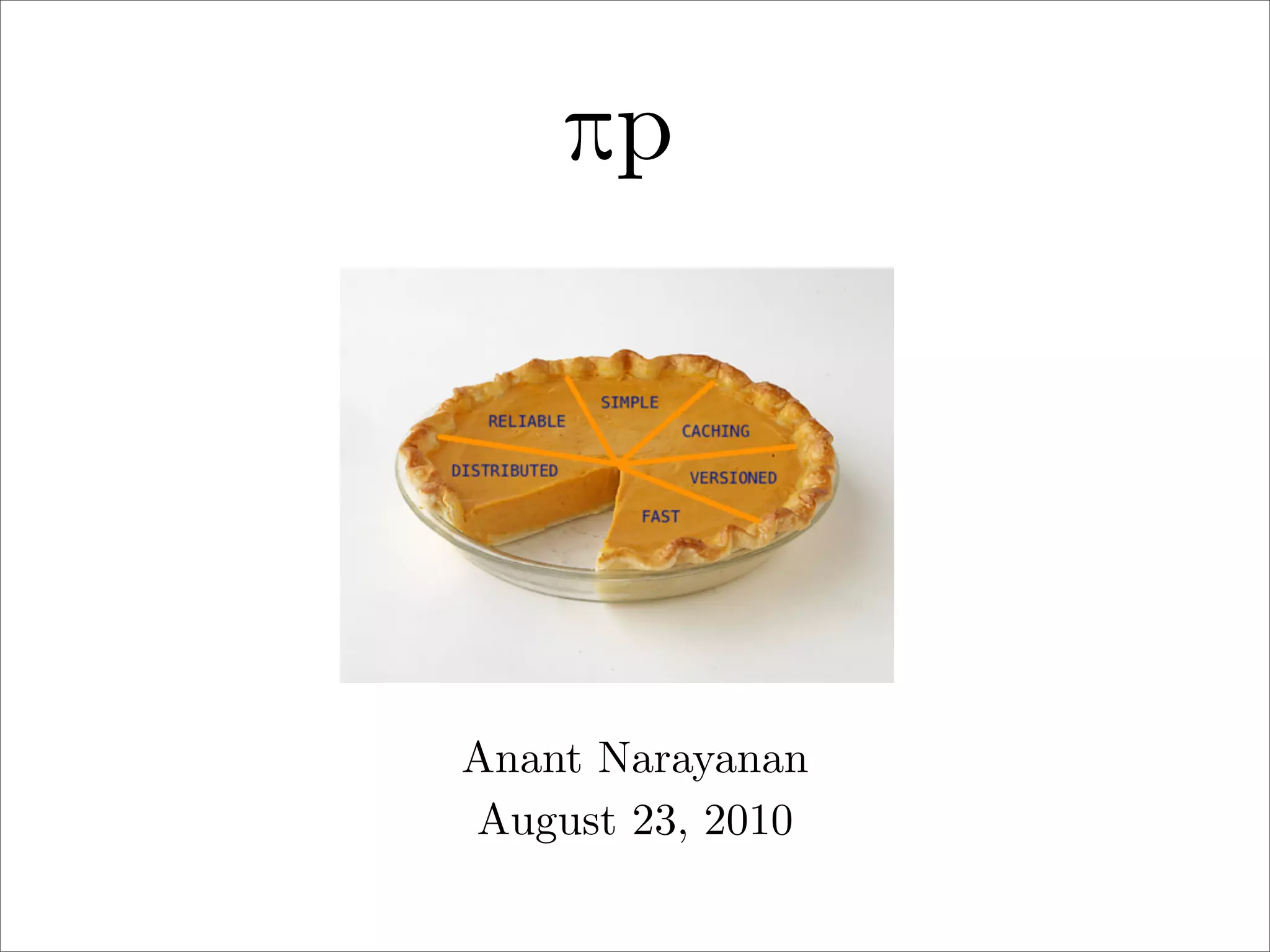
What is πp?
• A fast, simple, distributed, reliable,

versioned, caching network file protocol
Another Protocol?
• The current design of the internet is
based on communicating peers

• Every time content is accessed, clients
are individually handed data from the
server

• Can this approach really scale?
Data Has Changed

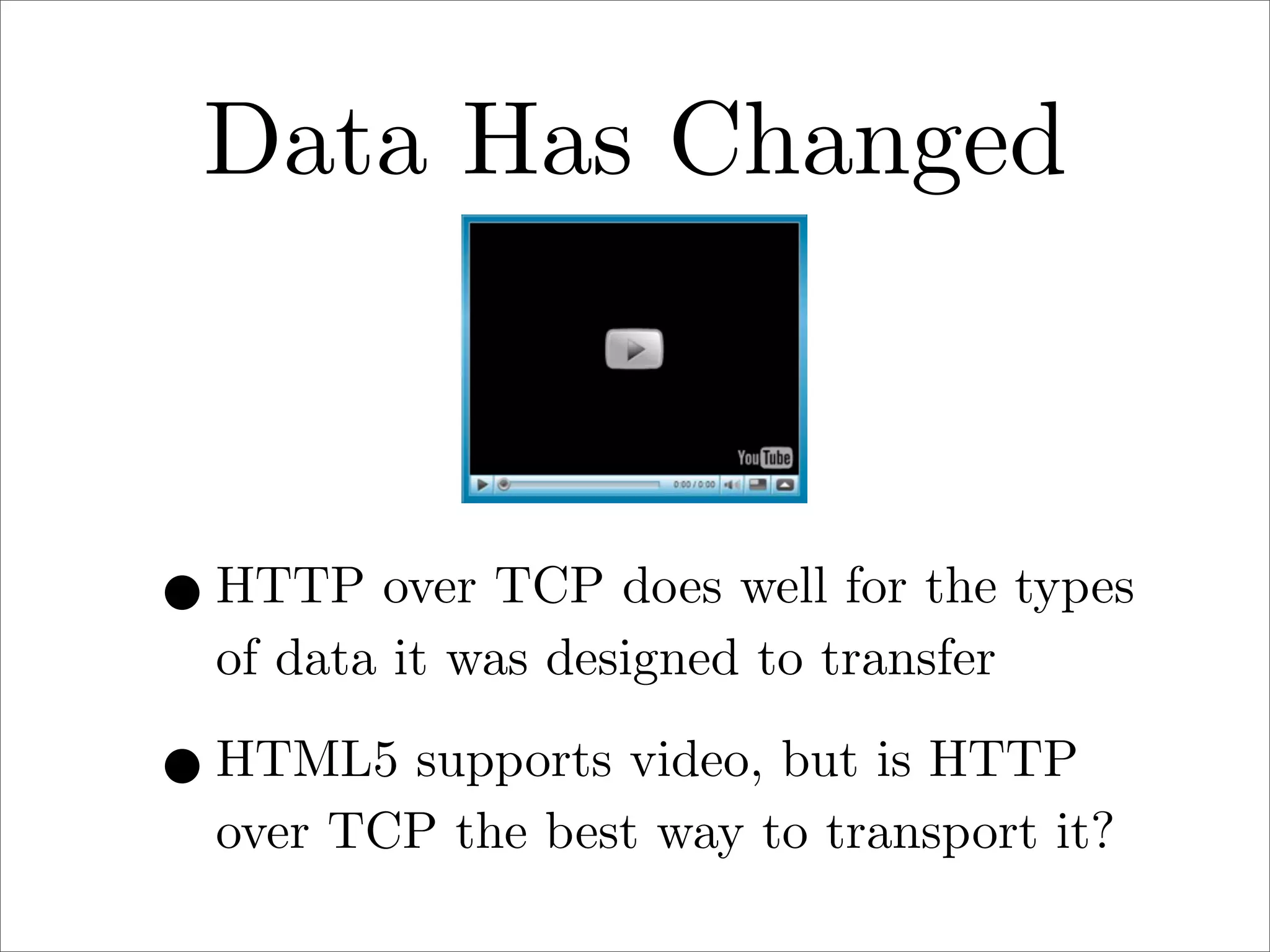
• HTTP over TCP does well for the types
of data it was designed to transfer

• HTML5 supports video, but is HTTP

over TCP the best way to transport it?
Authentication
• Access control in any modern web
application is ad hoc and relies on
methods like browser cookies

• HTTP does support basic forms of

authentication (of both client & server)
but nobody seems to be using it!
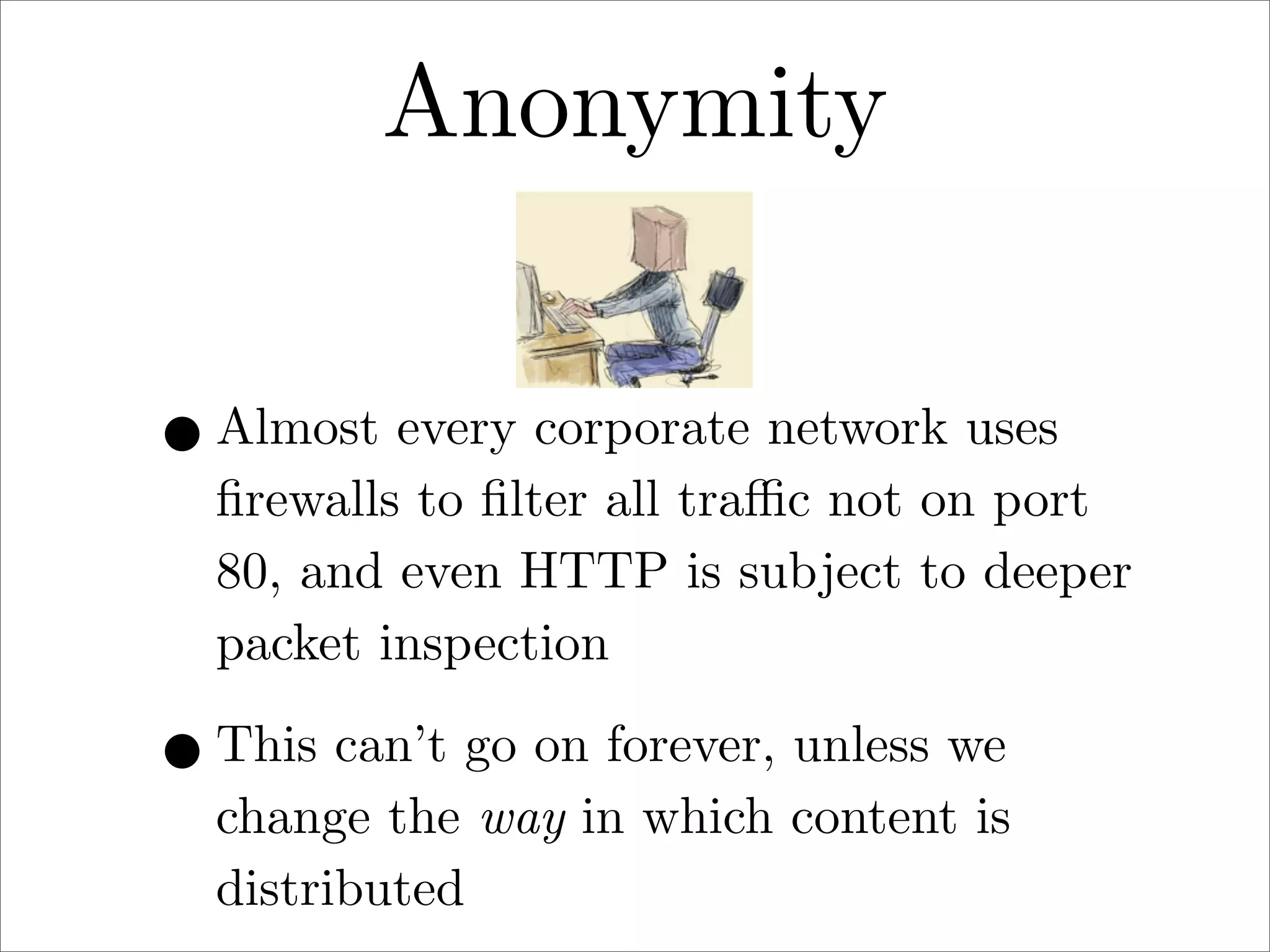
Anonymity
• Almost every corporate network uses

firewalls to filter all traffic not on port
80, and even HTTP is subject to deeper
packet inspection

• This can’t go on forever, unless we

change the way in which content is
distributed
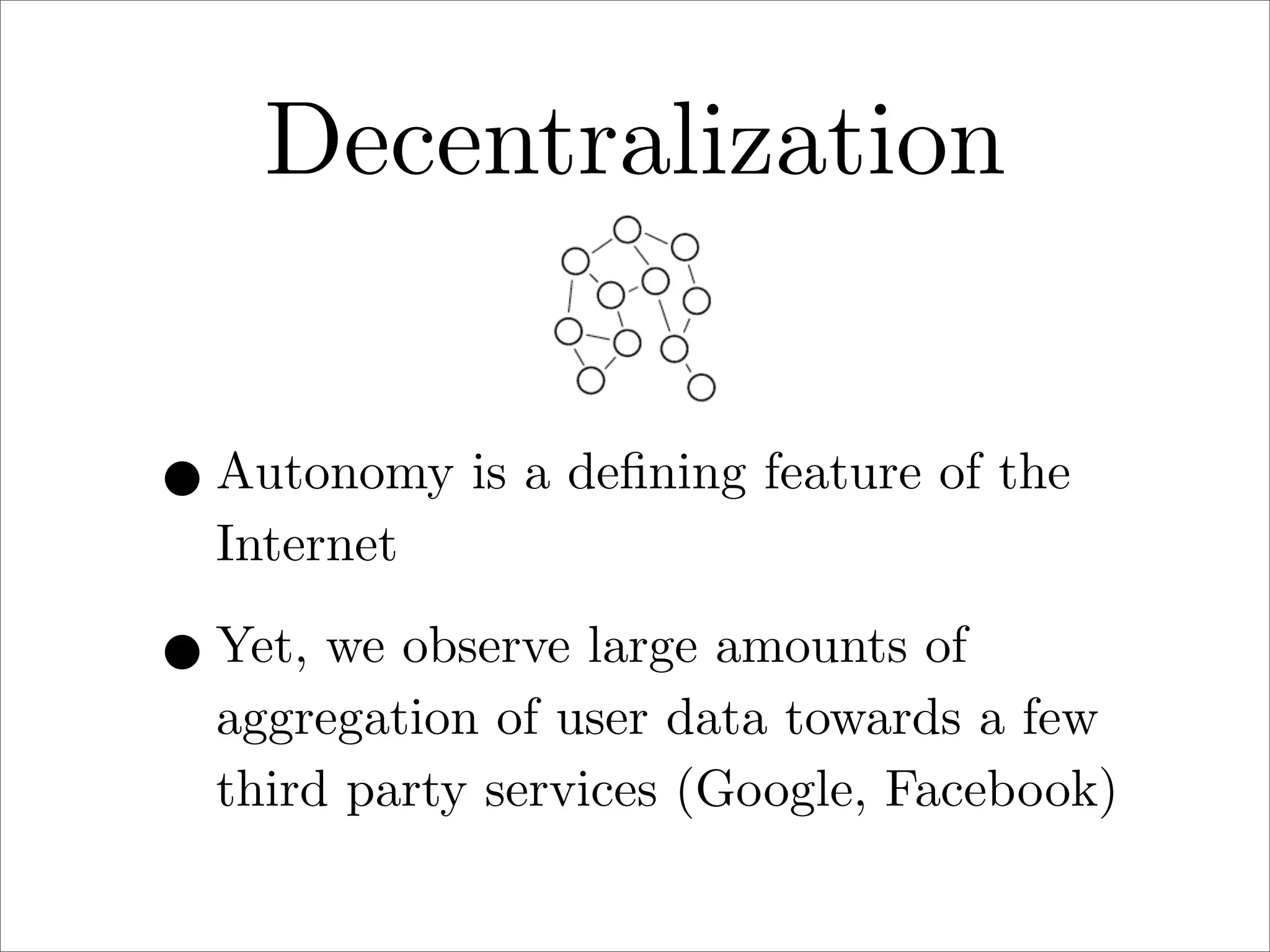
Decentralization
• Autonomy is a defining feature of the
Internet

• Yet, we observe large amounts of

aggregation of user data towards a few
third party services (Google, Facebook)
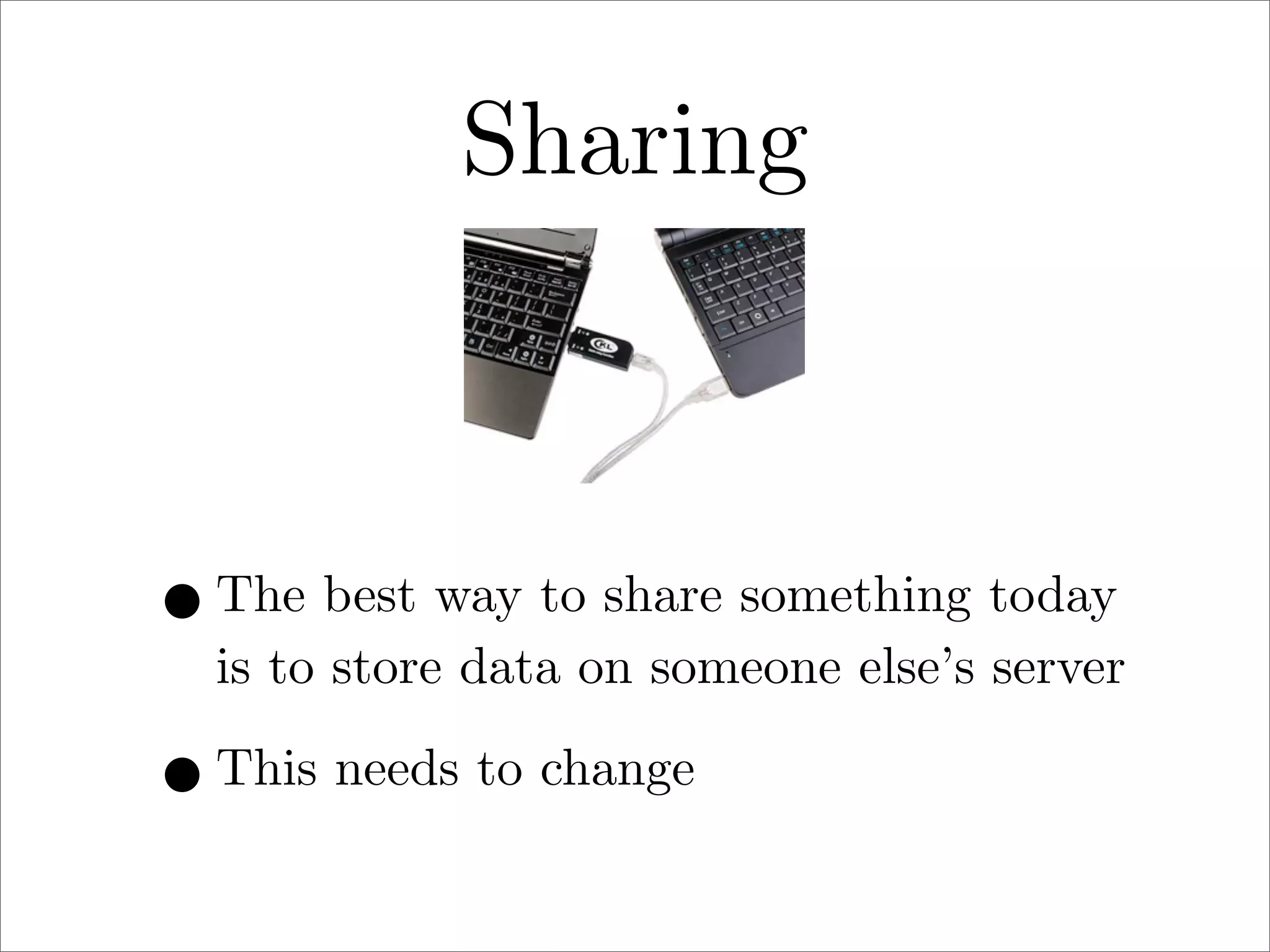
Sharing

• The best way to share something today

is to store data on someone else’s server

• This needs to change
Synchronization
• We’re moving away from the paradigm
of several people sharing a single
computer towards several devices
serving a single person

• It’s just a better user experience to
“carry your data with you”
Existing Technology
FTP
• Very limited in use, no versioning or file
metadata support

• Prone to bounce attacks
• Little scope for caching
Coda
• Complex (~90k lines of C++ code)
• Dynamic files unsupported
• No support for versioning despite strong
file sharing semantics
NFS
• Also complex in implementation though
there are several interoperable choices

• No support for dynamic or device files
• Concurrent access for shared files is
disallowed
SMB/CIFS
• Proprietary
• No versioning support
• Single reference implementation
• Only works over reliable transport
(NetBIOS and TCP)
9P2000/Styx
• No support for pipelining requests
• No support for rich file metadata
• Only works over reliable transport
How?
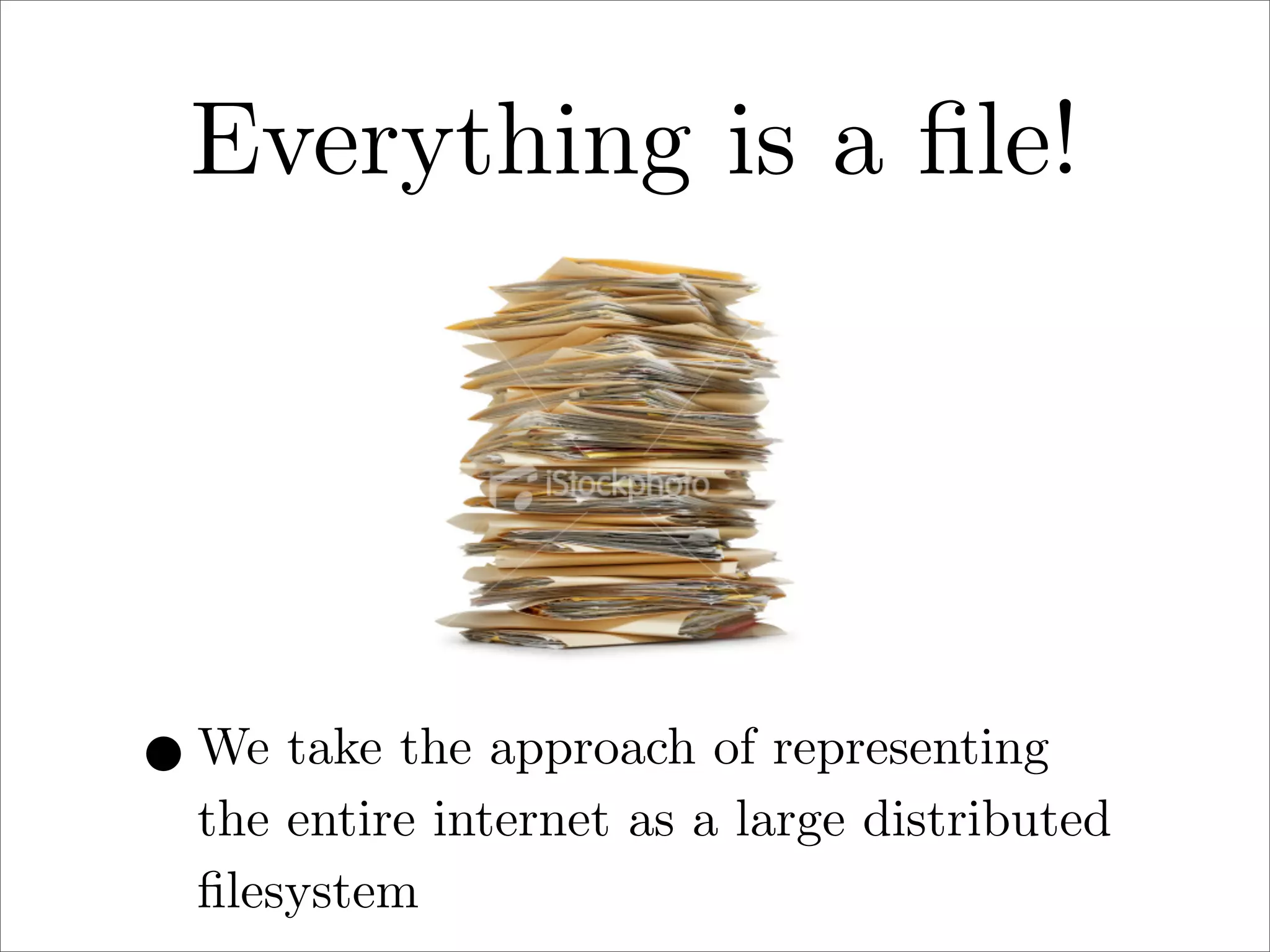
Everything is a file!

• We take the approach of representing

the entire internet as a large distributed
filesystem
Goals
Simplicity
• Both in specification and in
implementation

• Limit feature set to cover 90% of
current use-cases
Flexibility
• This can mean many things, but a few
of them are:

• Don’t limit ourselves to a username/
password authentication paradigm

• Extensible file open modes
• Client endpoint portability
Reliability
• Be only as reliable as is needed
• This means not relying on TCP for
everything

• Data types likes video work much better
when the client has more control over
what pieces (frames) it needs and when
Metadata
• Almost every operating system

implements arbitrary metadata

• Enables a large set of applications:
• Better search and indexing
• Eliminates the need for ctl files
• Wacky: Facebook-esque comments!
Versioning
• Simple form of backup
• Automatically provides an audit trail
• Greatly simplifies caching content
• The problem is reduced to knowing
what the latest version of a file is
Distributed-ness
• Simple form of backup
• Automatically provides an audit trail
• Greatly simplifies caching content
• The problem is reduced to knowing
what the latest version of a file is
Design
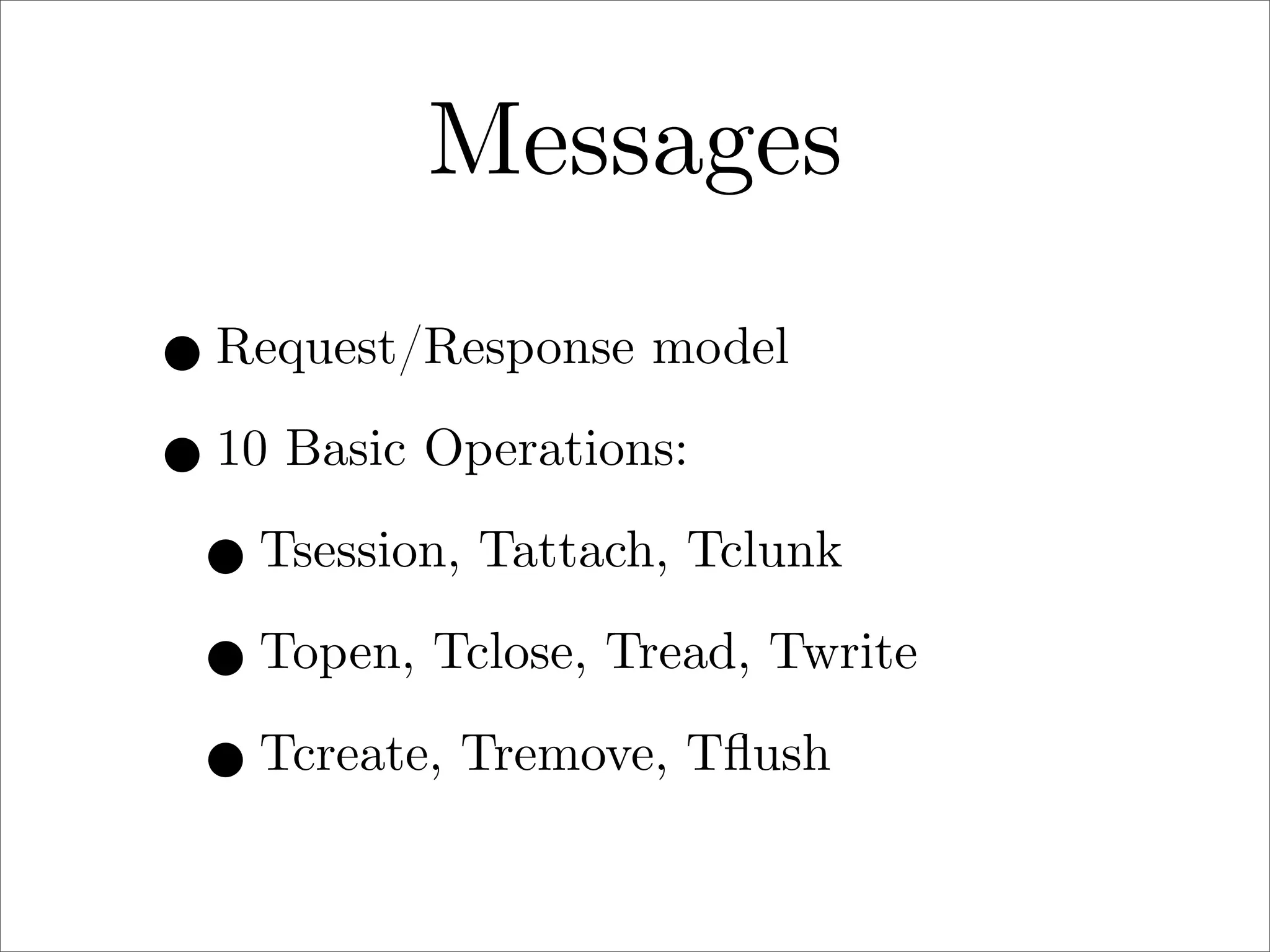
Messages
• Request/Response model
• 10 Basic Operations:
• Tsession, Tattach, Tclunk
• Topen, Tclose, Tread, Twrite
• Tcreate, Tremove, Tflush
Messages
• Responses are prefixed with R instead,
with the exception of Rerror

• A single message may contain multiple
requests or responses

• Responses are always in the order of
the requests
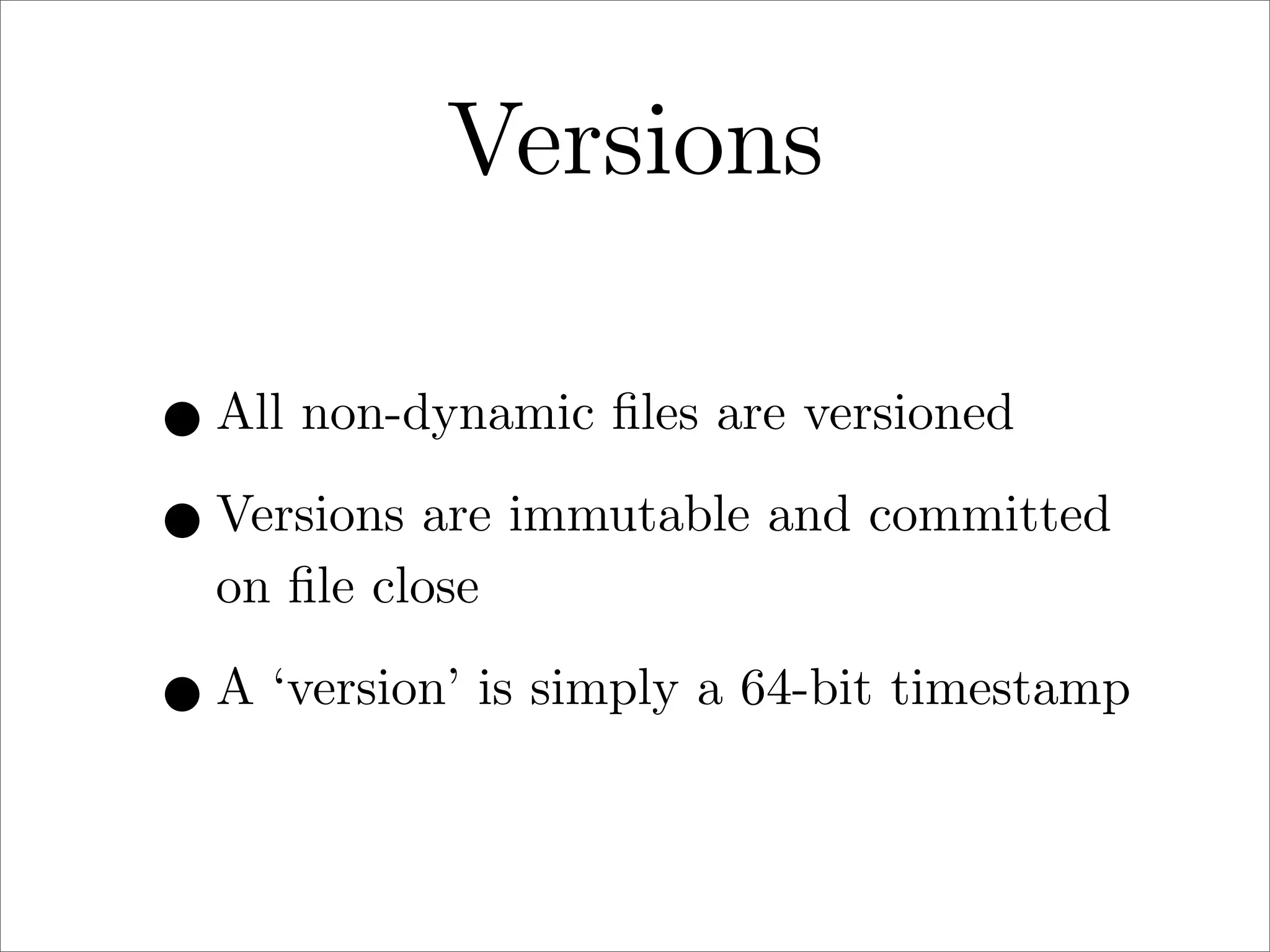
Versions
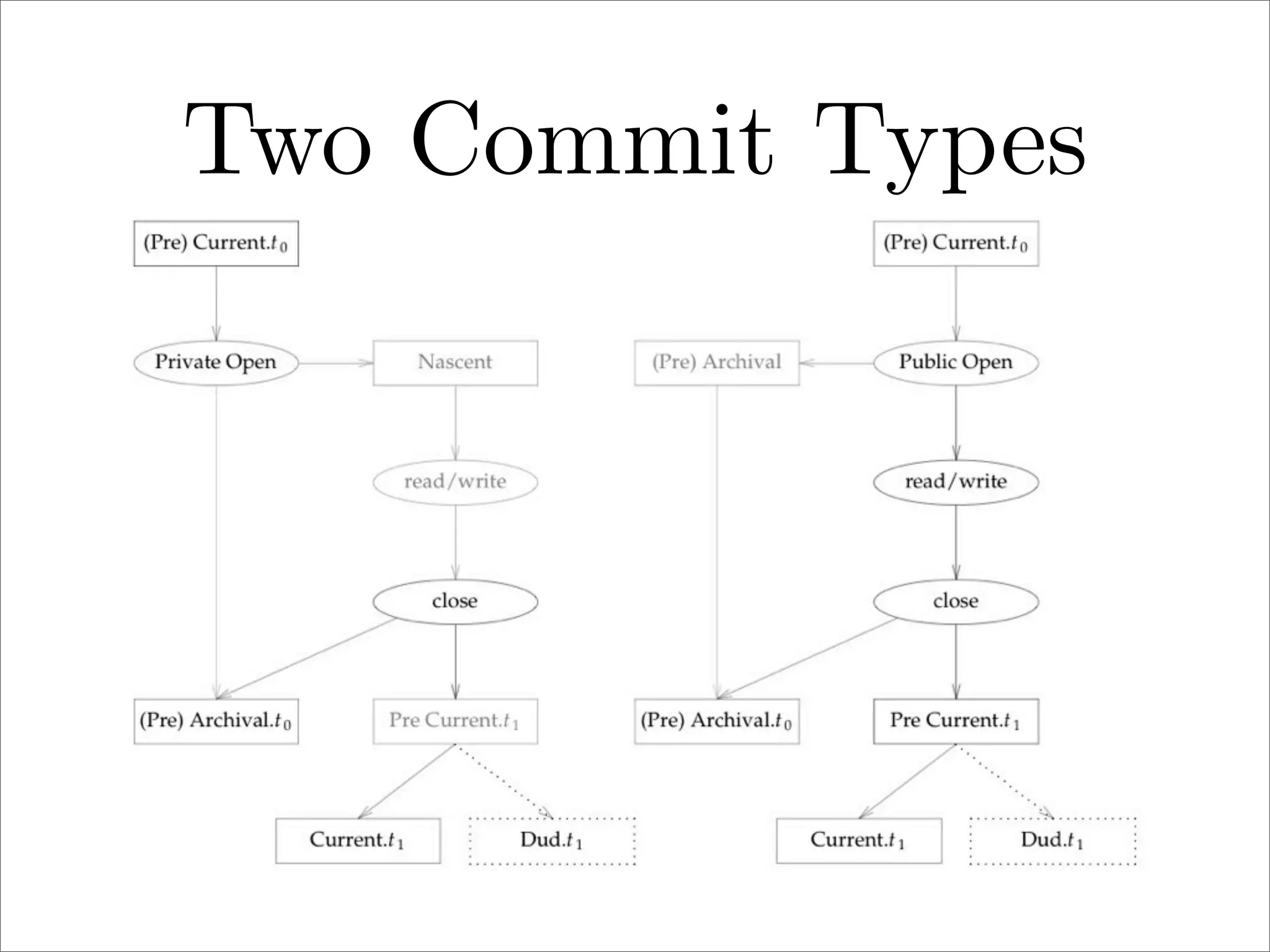
• All non-dynamic files are versioned
• Versions are immutable and committed
on file close

• A ‘version’ is simply a 64-bit timestamp
Two Commit Types
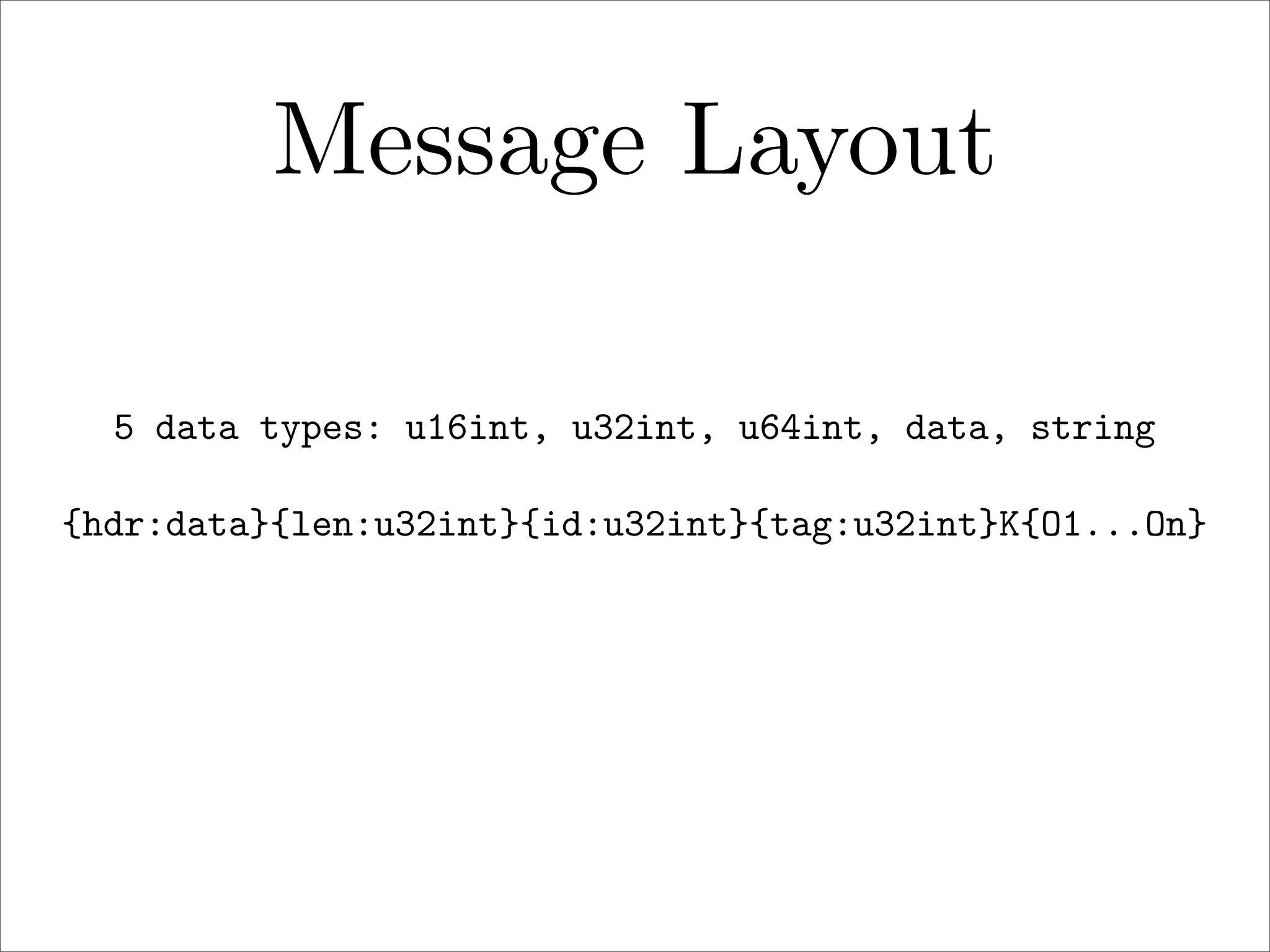
Message Layout
5 data types: u16int, u32int, u64int, data, string
{hdr:data}{len:u32int}{id:u32int}{tag:u32int}K{O1...On}
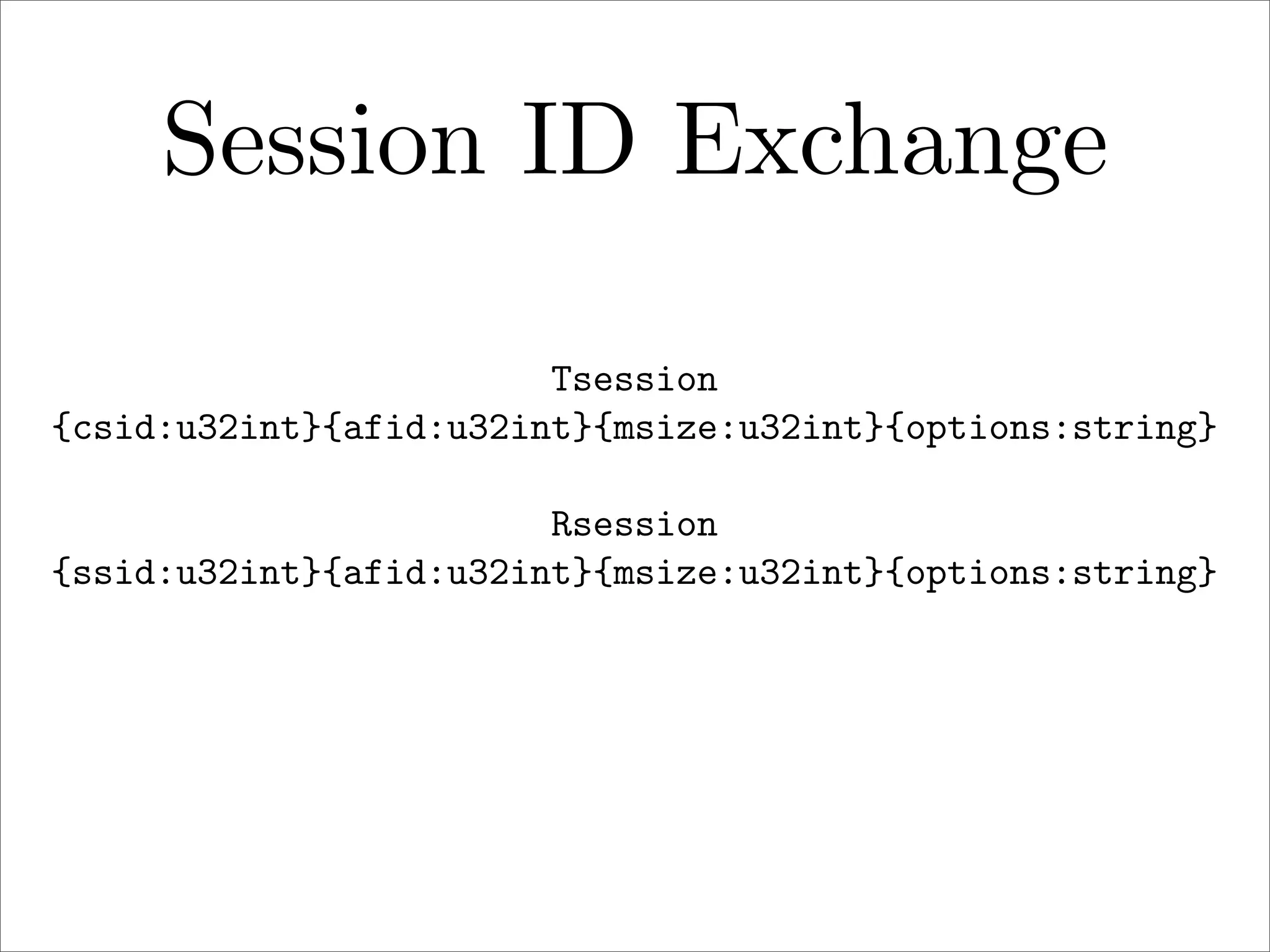
Session ID Exchange
Tsession
{csid:u32int}{afid:u32int}{msize:u32int}{options:string}
Rsession
{ssid:u32int}{afid:u32int}{msize:u32int}{options:string}
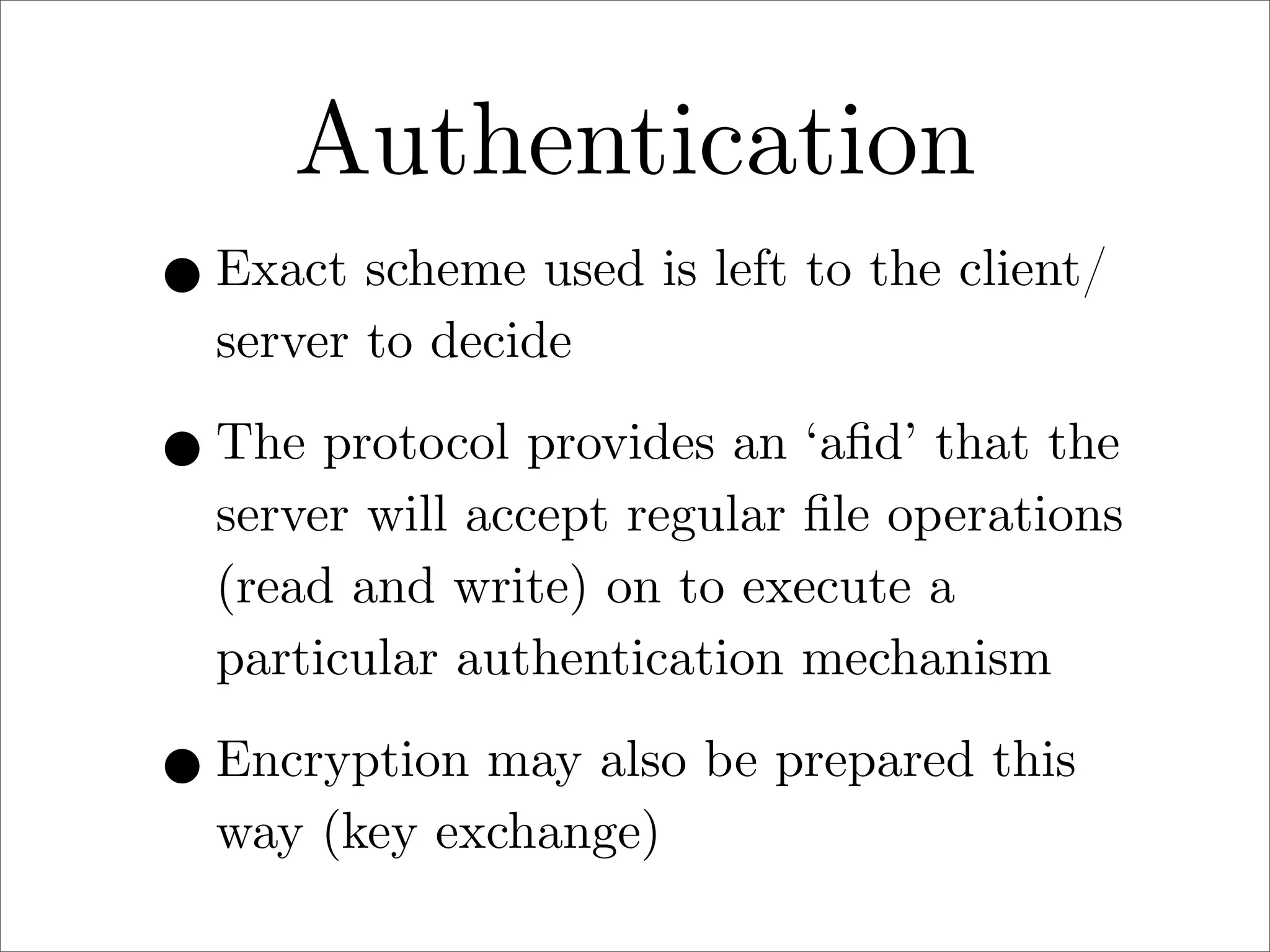
Authentication
• Exact scheme used is left to the client/
server to decide

• The protocol provides an ‘afid’ that the

server will accept regular file operations
(read and write) on to execute a
particular authentication mechanism

• Encryption may also be prepared this
way (key exchange)
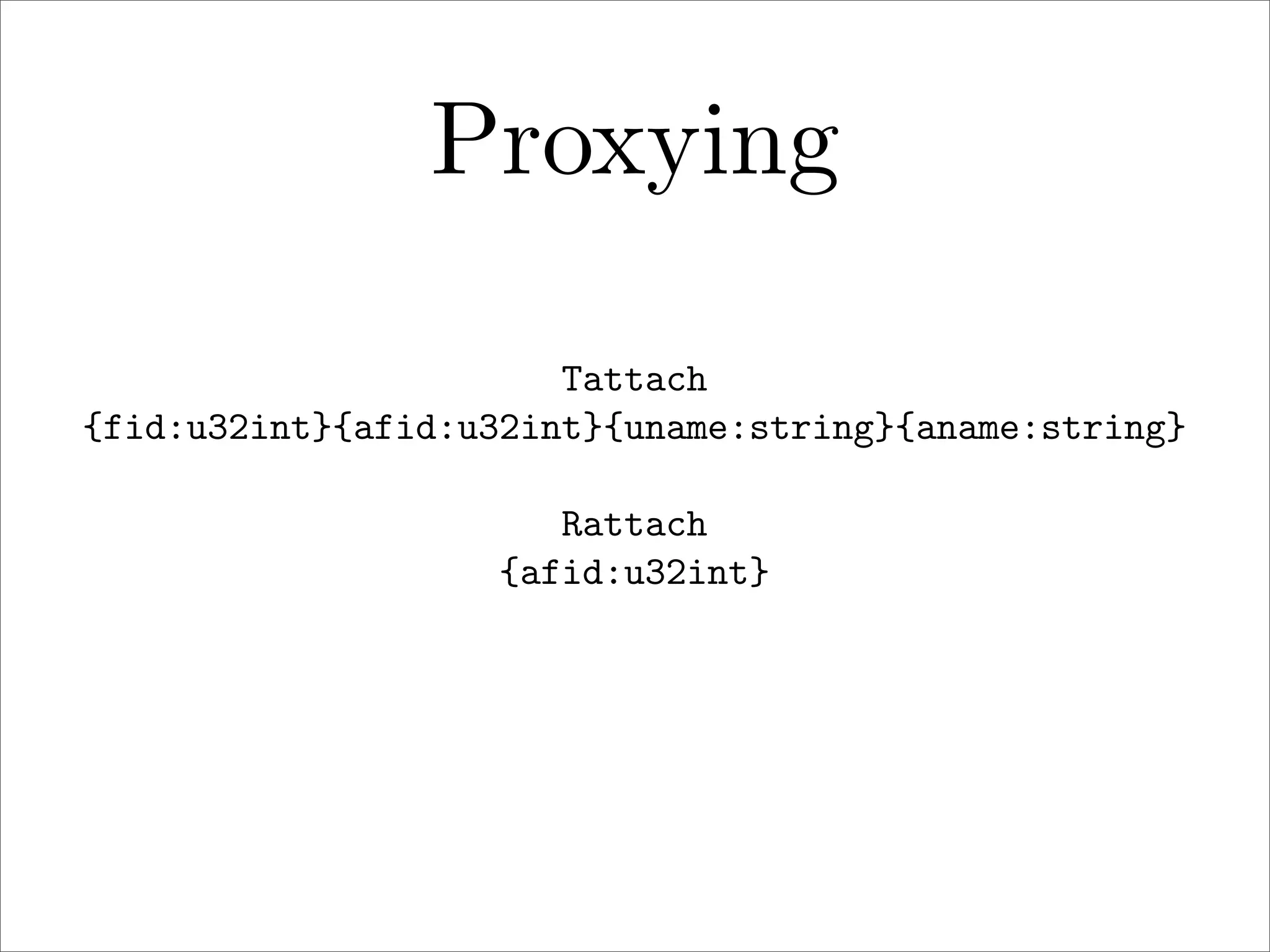
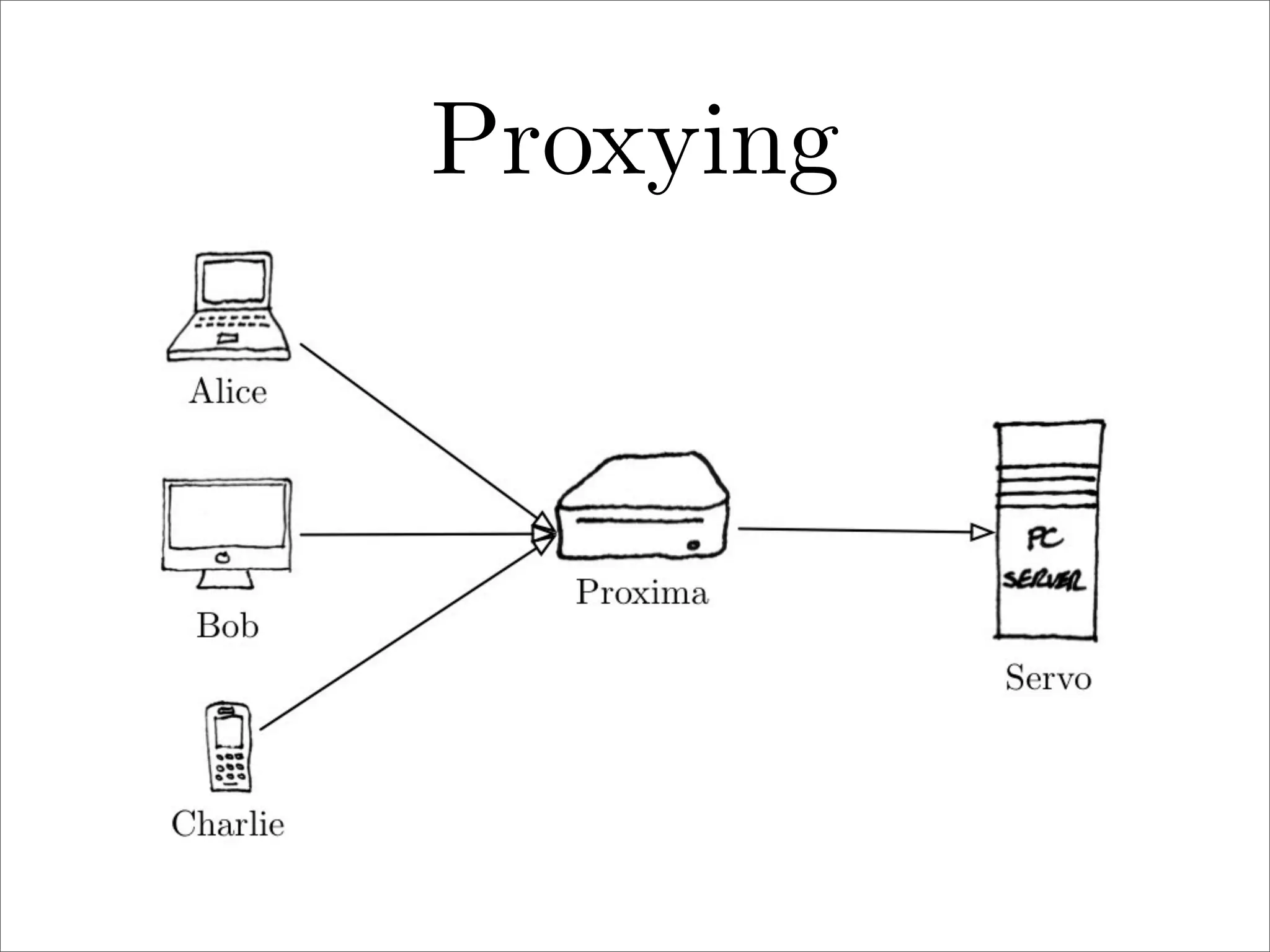
Proxying
Tattach
{fid:u32int}{afid:u32int}{uname:string}{aname:string}
Rattach
{afid:u32int}
Proxying
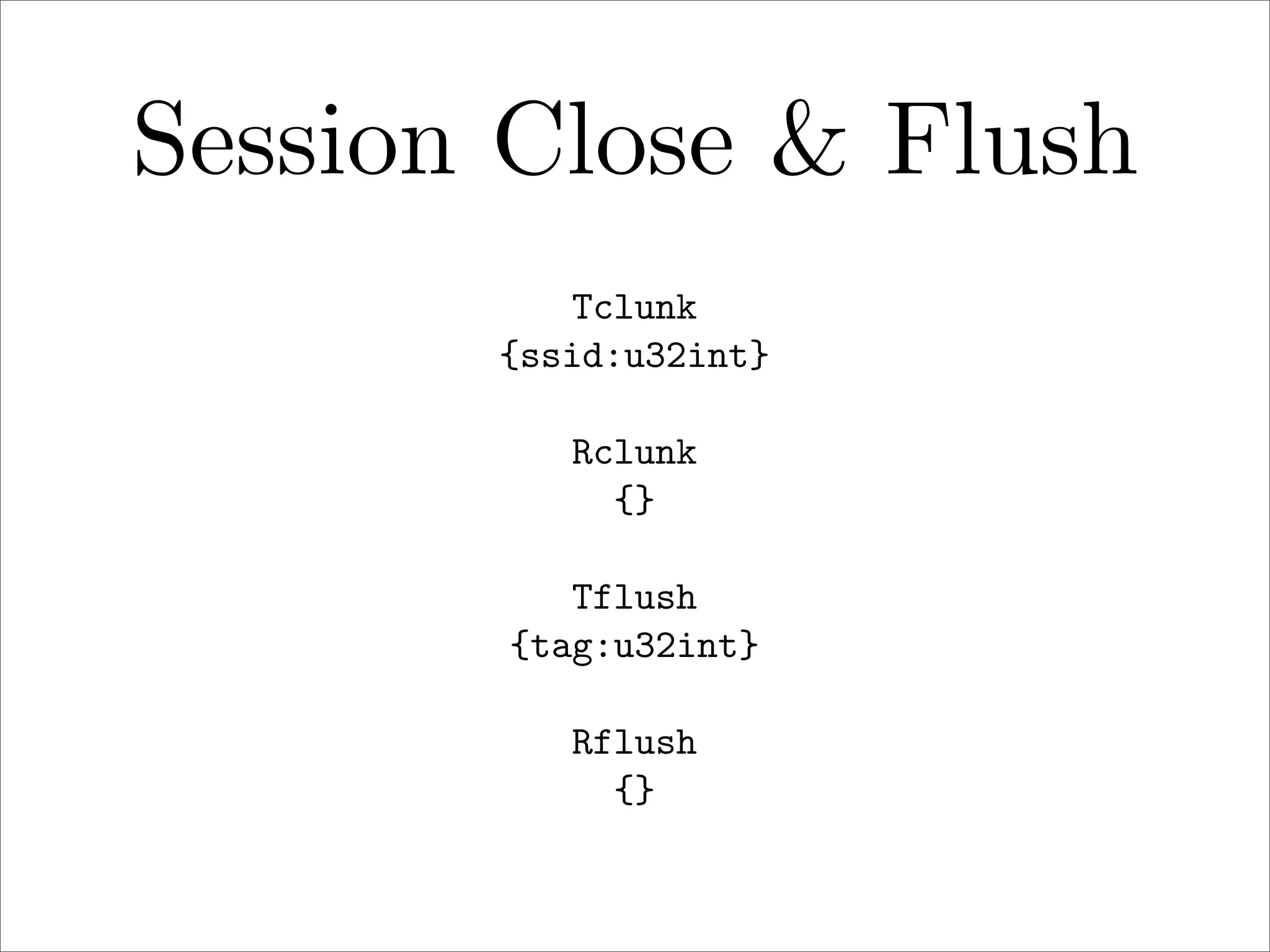
Session Close & Flush
Tclunk
{ssid:u32int}
Rclunk
{}
Tflush
{tag:u32int}
Rflush
{}
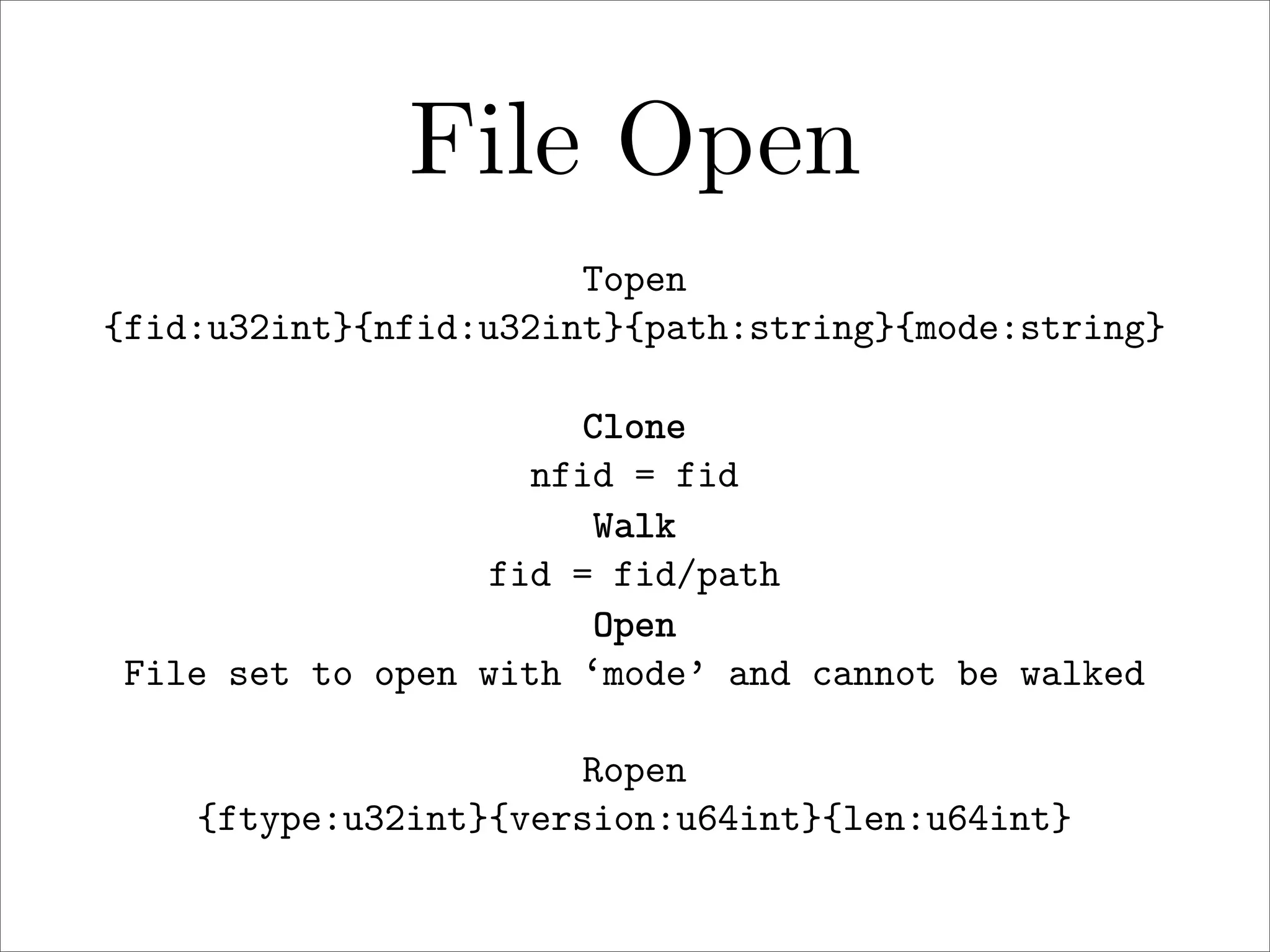
File Open
Topen
{fid:u32int}{nfid:u32int}{path:string}{mode:string}
Clone
nfid = fid
Walk
fid = fid/path
Open
File set to open with ‘mode’ and cannot be walked
Ropen
{ftype:u32int}{version:u64int}{len:u64int}
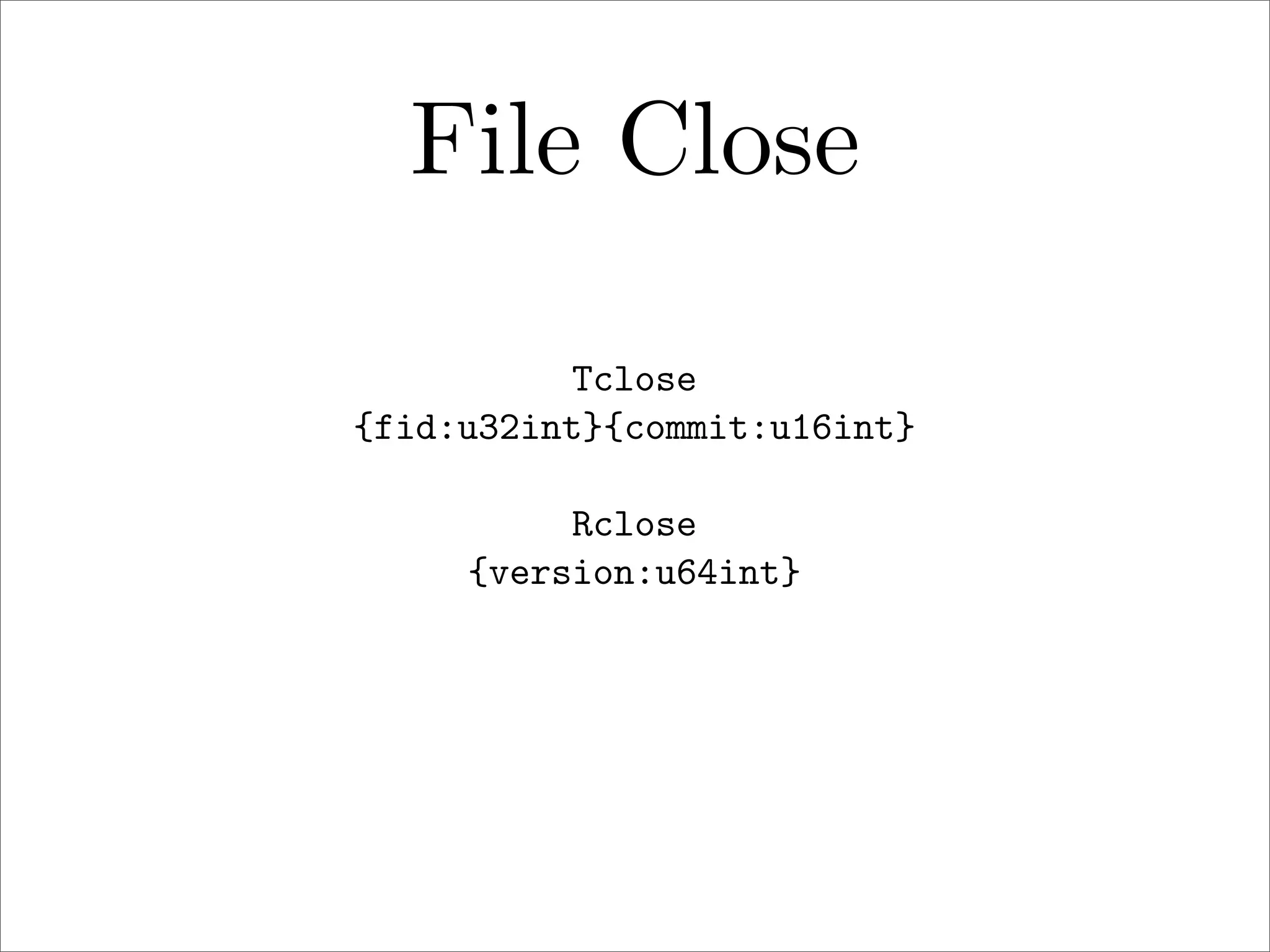
File Close
Tclose
{fid:u32int}{commit:u16int}
Rclose
{version:u64int}
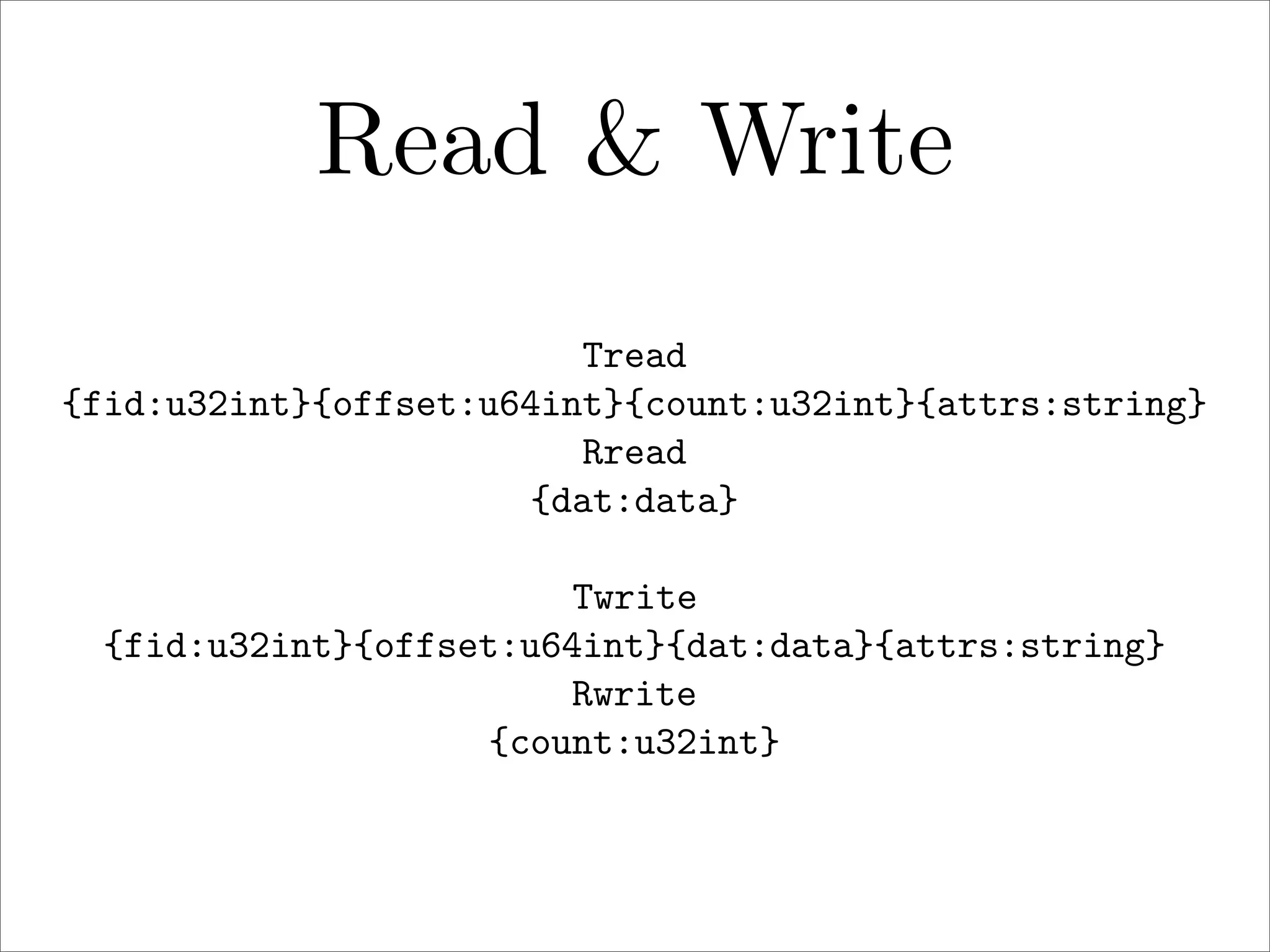
Read & Write
Tread
{fid:u32int}{offset:u64int}{count:u32int}{attrs:string}
Rread
{dat:data}
Twrite
{fid:u32int}{offset:u64int}{dat:data}{attrs:string}
Rwrite
{count:u32int}
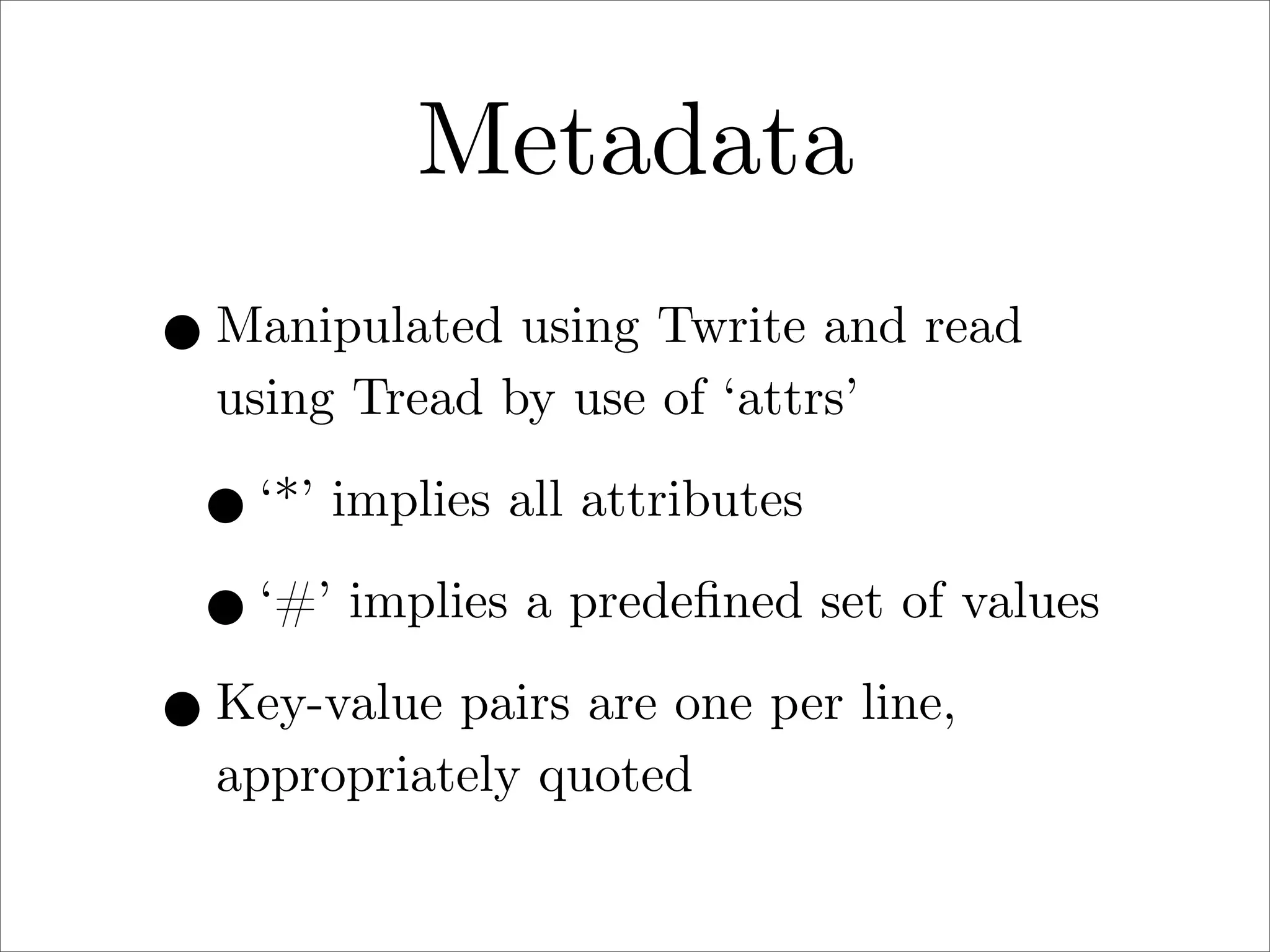
Metadata
• Manipulated using Twrite and read
using Tread by use of ‘attrs’

• ‘*’ implies all attributes
• ‘#’ implies a predefined set of values
• Key-value pairs are one per line,
appropriately quoted
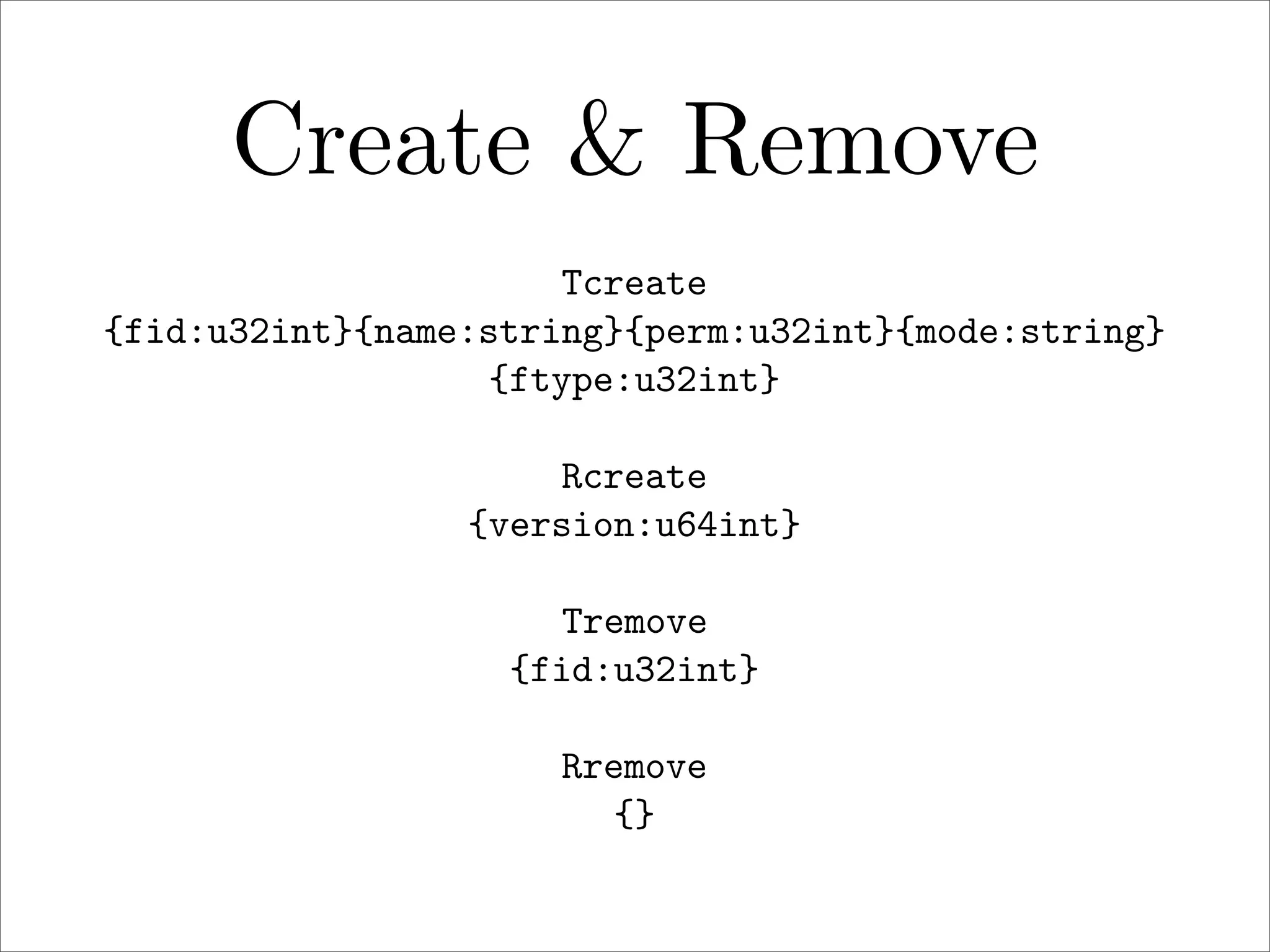
Create & Remove
Tcreate
{fid:u32int}{name:string}{perm:u32int}{mode:string}
{ftype:u32int}
Rcreate
{version:u64int}
Tremove
{fid:u32int}
Rremove
{}
Did It Work?
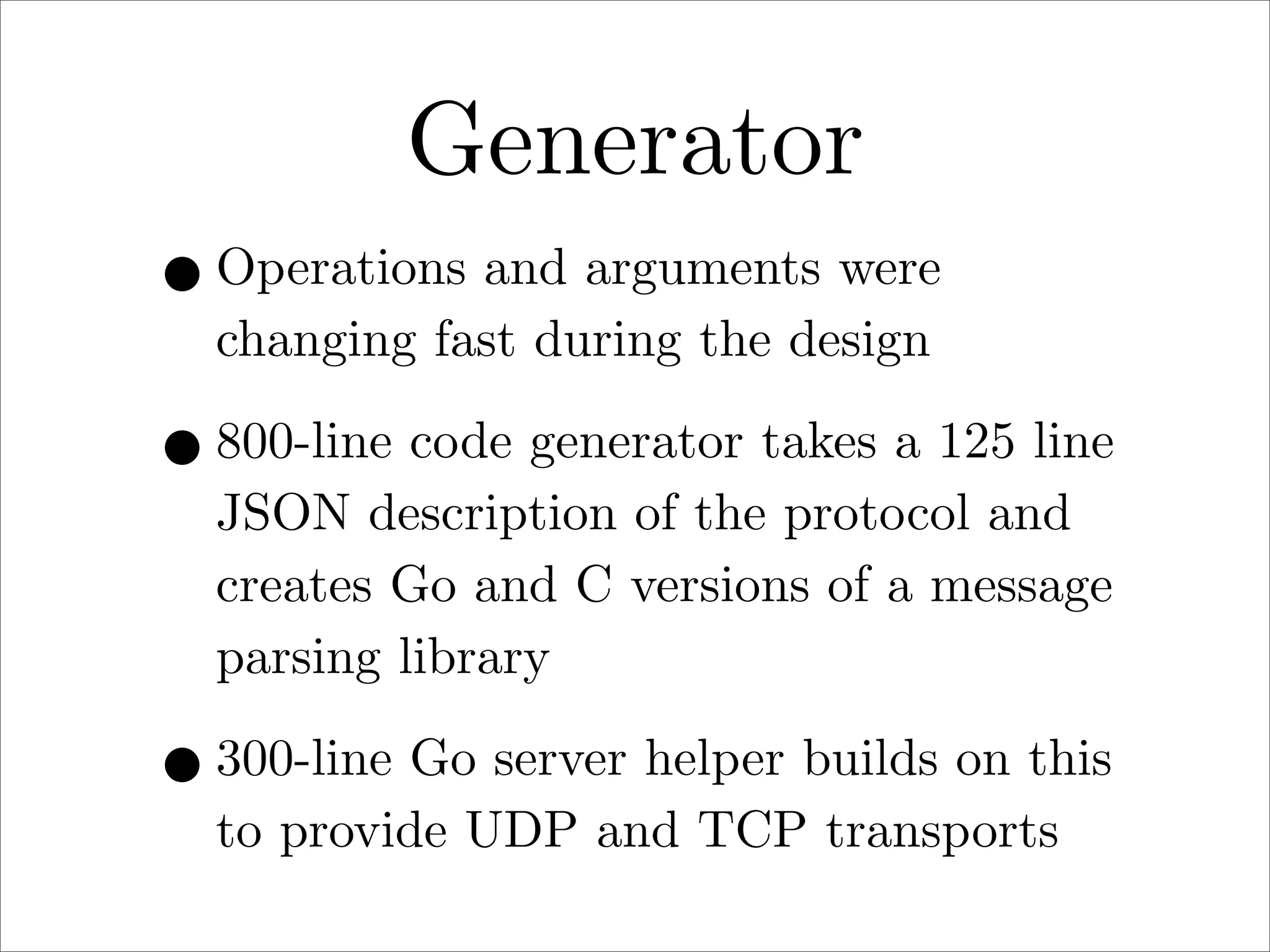
Generator
• Operations and arguments were
changing fast during the design

• 800-line code generator takes a 125 line
JSON description of the protocol and
creates Go and C versions of a message
parsing library

• 300-line Go server helper builds on this
to provide UDP and TCP transports
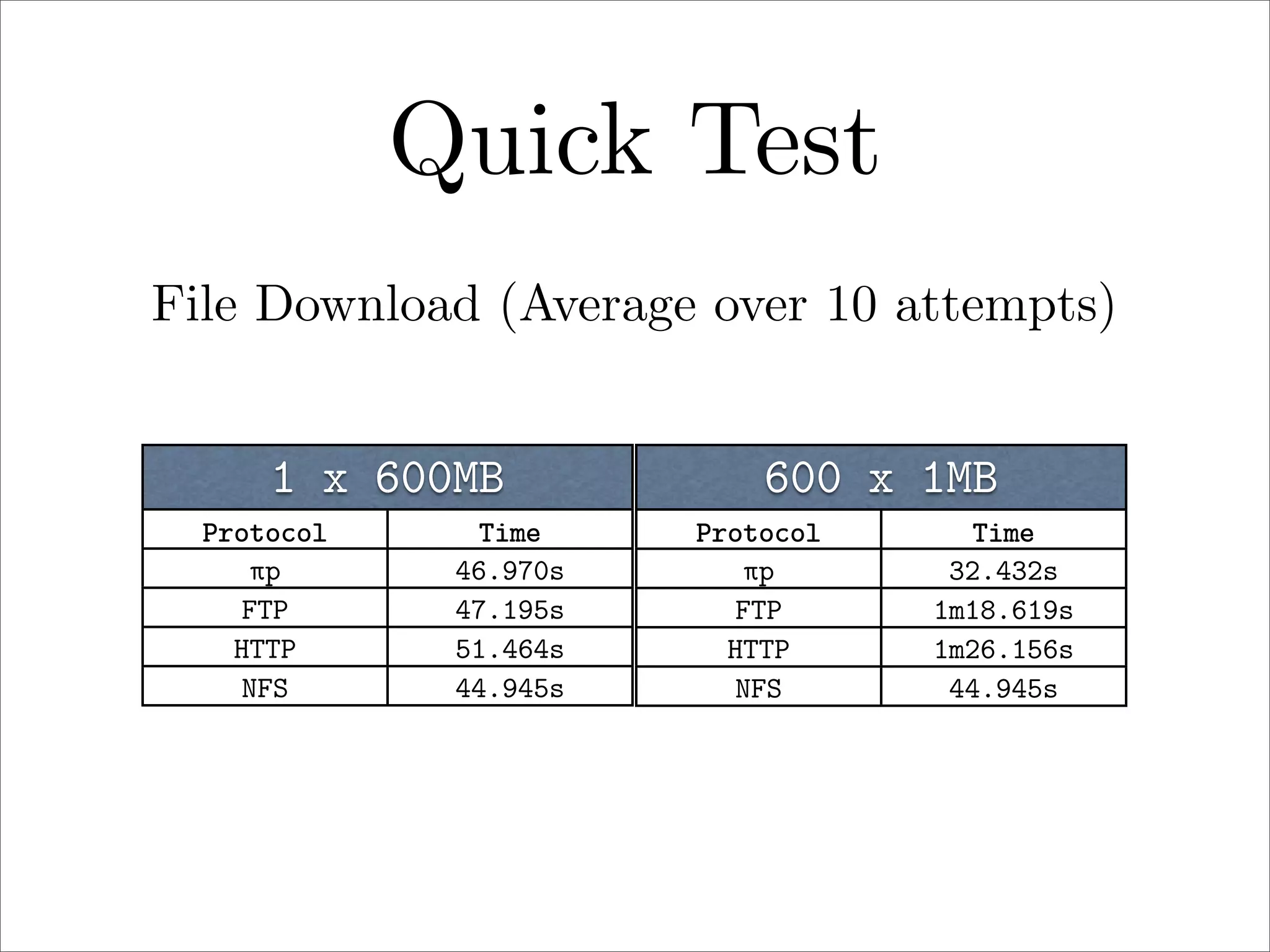
Quick Test
File Download (Average over 10 attempts)
1 x 600MB
Protocol
πp
FTP
HTTP
NFS

Time
46.970s
47.195s
51.464s
44.945s

600 x 1MB
Protocol
πp
FTP
HTTP
NFS

Time
32.432s
1m18.619s
1m26.156s
44.945s
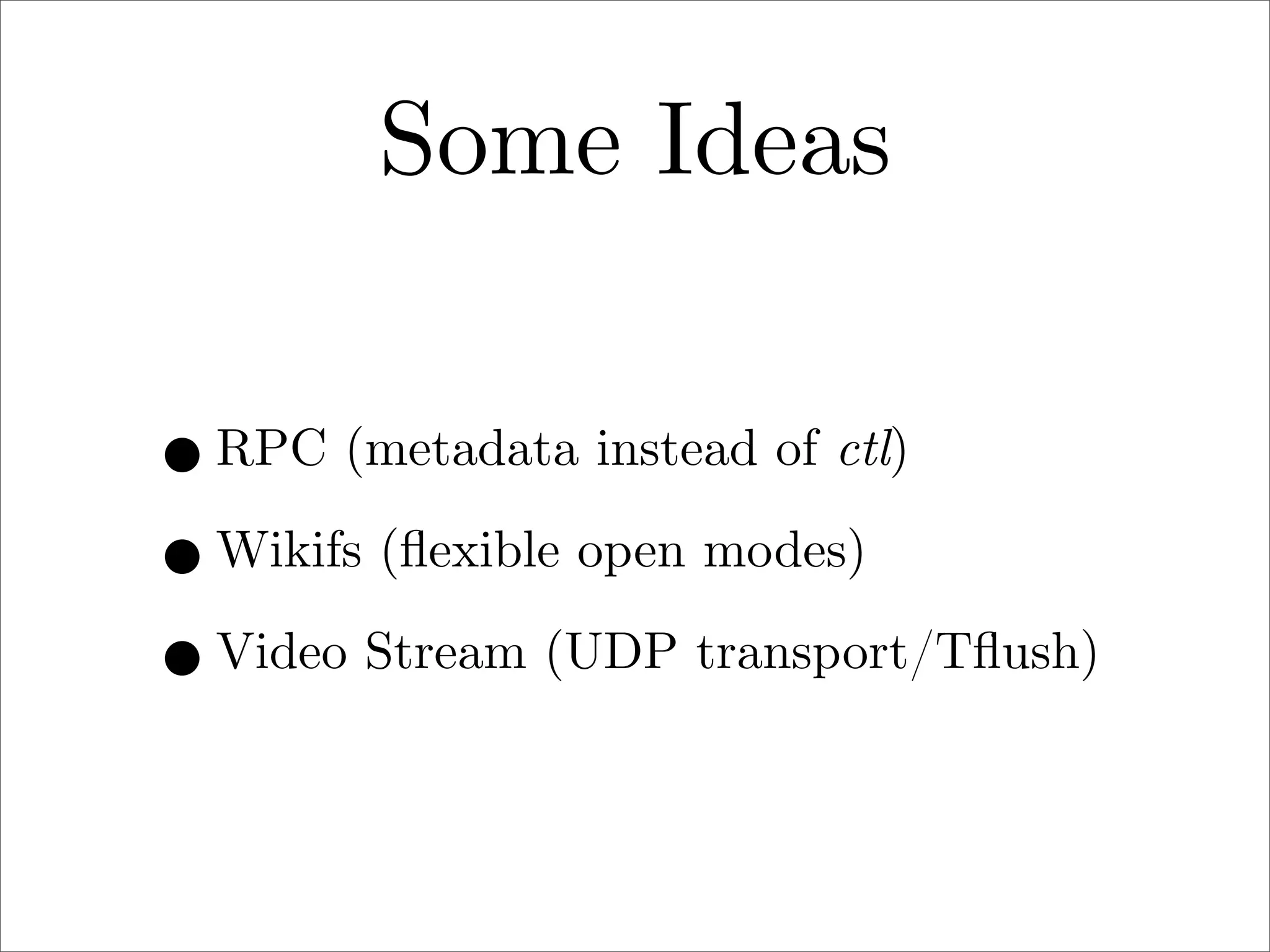
Some Ideas
• RPC (metadata instead of ctl)
• Wikifs (flexible open modes)
• Video Stream (UDP transport/Tflush)
Thank You!
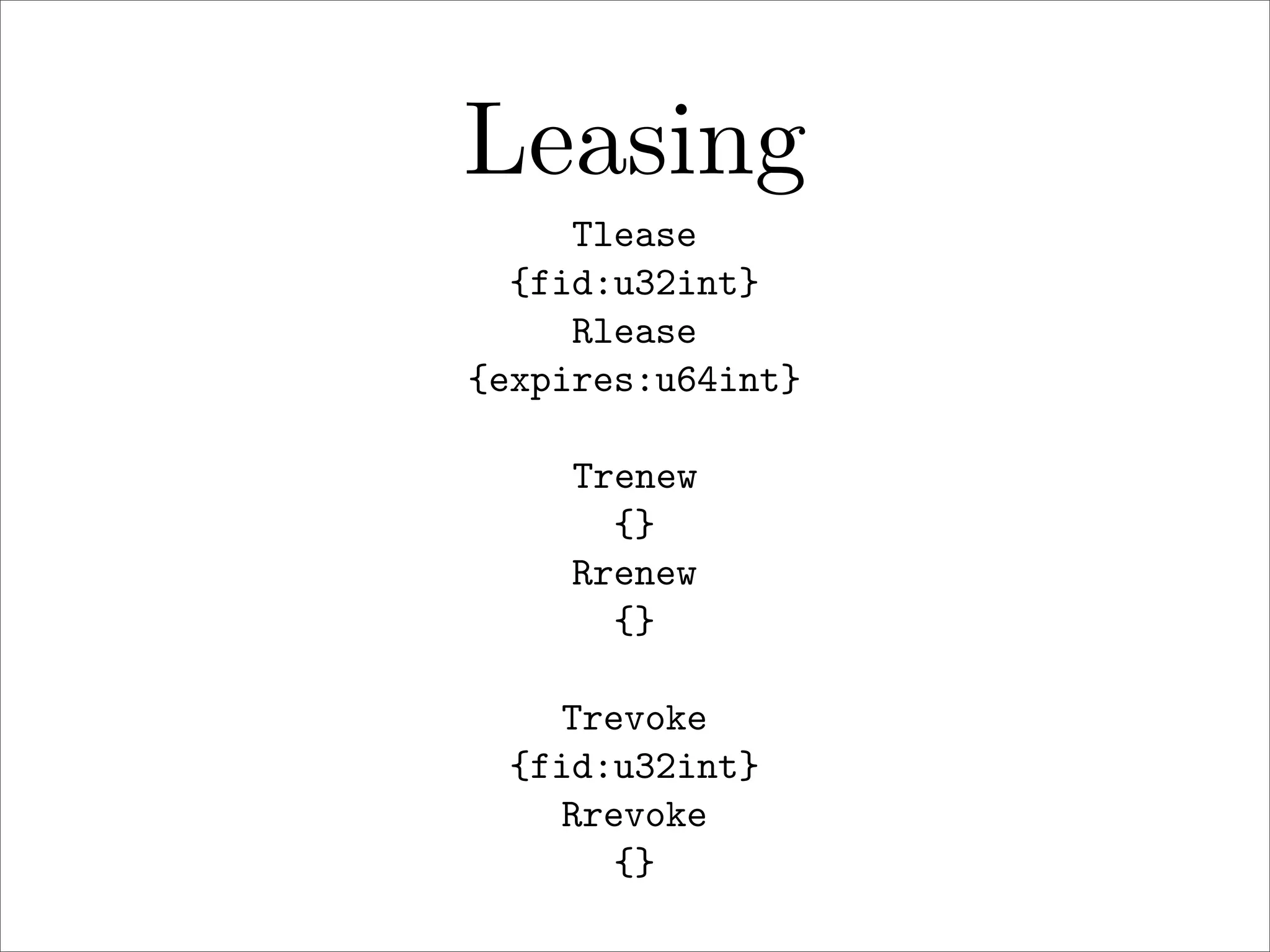
Leasing
Tlease
{fid:u32int}
Rlease
{expires:u64int}
Trenew
{}
Rrenew
{}
Trevoke
{fid:u32int}
Rrevoke
{}
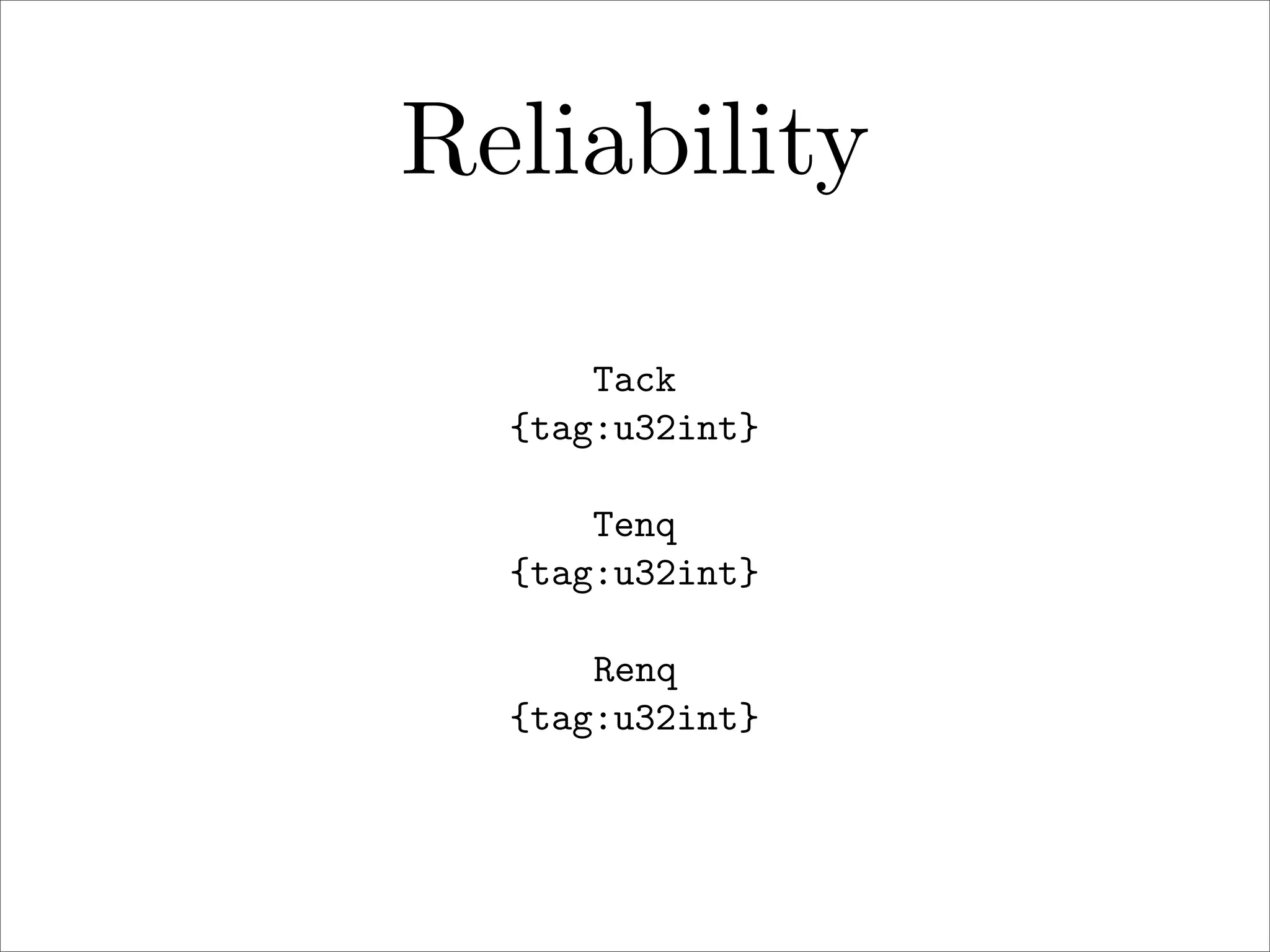
Reliability
Tack
{tag:u32int}
Tenq
{tag:u32int}
Renq
{tag:u32int}

πP