Understanding the EngD Impact –
A Pilot study
Dr. Fumi Kitagawa
University of Manchester
26 November 2013
The AEngD Annual Conference, London
The Study contexts
• A pilot study aiming to understand the nature of the
EngD impact and to identify how it can be best
evidenced
• March-October 2013
• Sponsored and supported by the Association of the
Engineering Doctorates (AEngD) and the Engineering
and Physical Sciences Research Council (EPSRC).
• The final report will be available shortly.
Acknowledgements
• The study has been commissioned and supported by
the AEngD and the EPSRC
• I would like to acknowledge the support from the
following individuals for comments and inputs –
Prof P. Jeffrey, Dr O Kasyutich, Dr D. Stanley,
Dr S. Yeomans, Dr C Bachelor and Dr M. Wilson
• I would like to thank the following MBS students who
worked on the data collection between June-August
2013 - Syahirah Abdul Rahman, Tzu-Miao Lin,
Teimuraz Mamatsashvili, Meng Qiang, Ran Cai
(MBS, M.Bus Global Business Analysis students)
The Study focus
The primary target of the study is to understand the
impact of the EngD with specific focus on:
1) impact on industry partners - providing
evidence of the value of EngD project to industry
2) career pathways of REs- identifying how the
EngD experience shapes the career paths of EngD
graduates (EngD Alumni)
The Study - Research Design
• Desk top research
• The 2009 IDCs mid-term review (May 2011) –
18 IDCs (the AEngD member centres)
• Semi-structured interviews (June-August 2013)
- 20 EngD alumni (from IDCs/EngD centre)
- 15 Industry partners (10 types/sectors)
• HESA Destinations of Leavers of Higher Education
(DLHE) survey 2008/9-2010/2011
125 EngD; 201 Industrial CASE PhD graduates [initial
analysis]
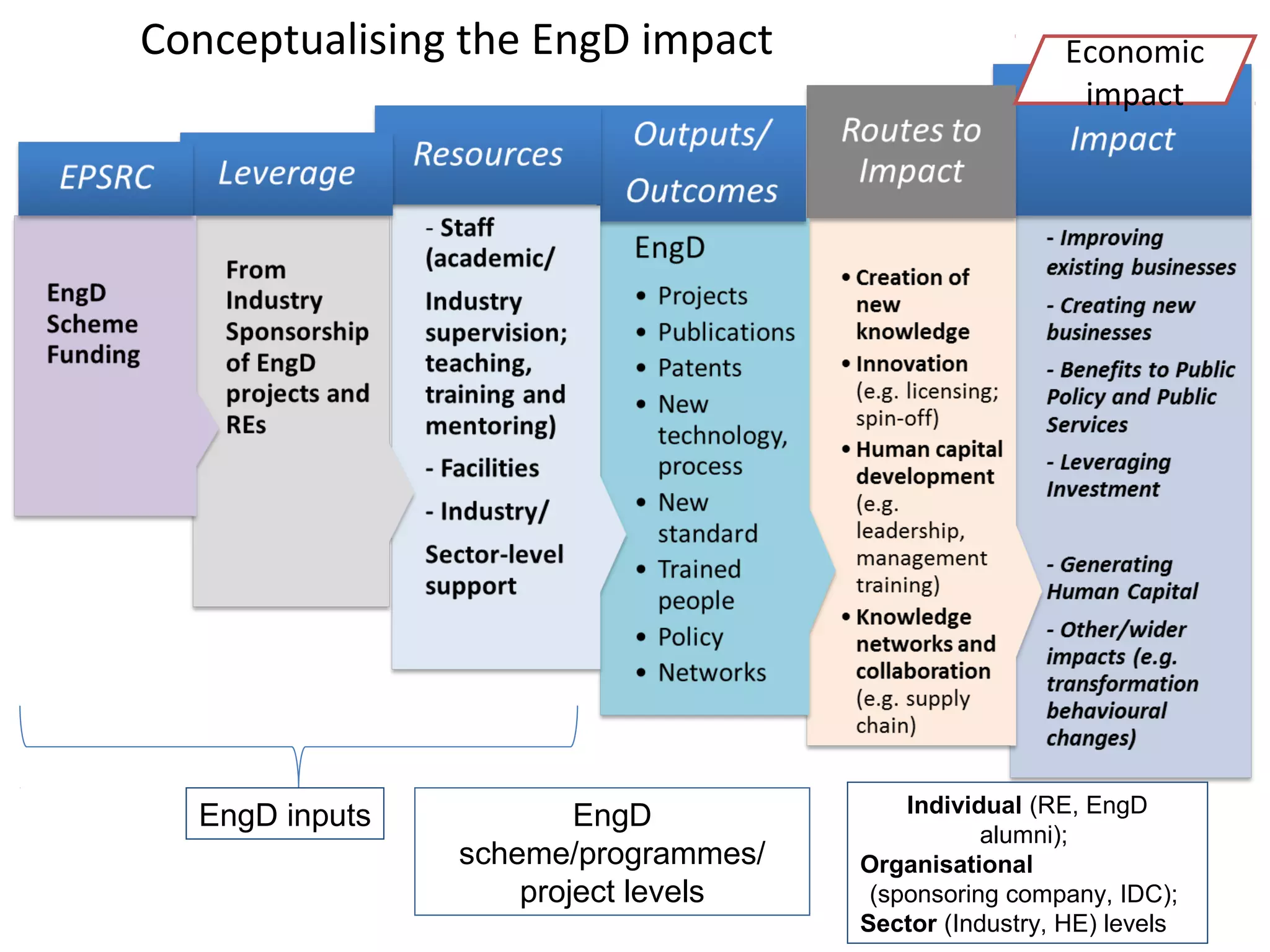
Conceptualising the EngD impact

EngD inputs

EngD
scheme/programmes/
project levels

Economic
impact

Individual (RE, EngD
alumni);
Organisational
(sponsoring company, IDC);
Sector (Industry, HE) levels
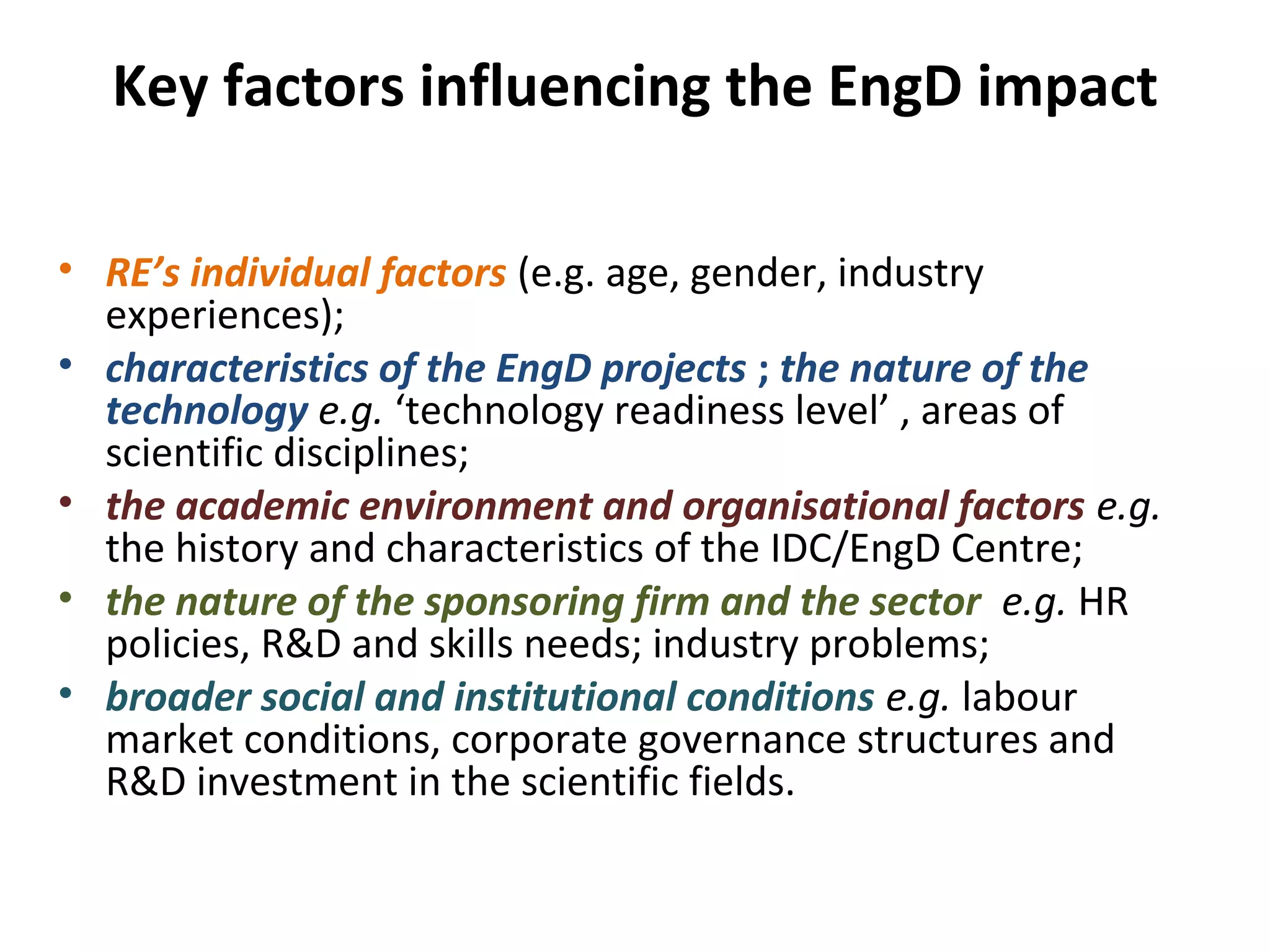
Key factors influencing the EngD impact
• RE’s individual factors (e.g. age, gender, industry
experiences);
• characteristics of the EngD projects ; the nature of the
technology e.g. ‘technology readiness level’ , areas of
scientific disciplines;
• the academic environment and organisational factors e.g.
the history and characteristics of the IDC/EngD Centre;
• the nature of the sponsoring firm and the sector e.g. HR
policies, R&D and skills needs; industry problems;
• broader social and institutional conditions e.g. labour
market conditions, corporate governance structures and
R&D investment in the scientific fields.
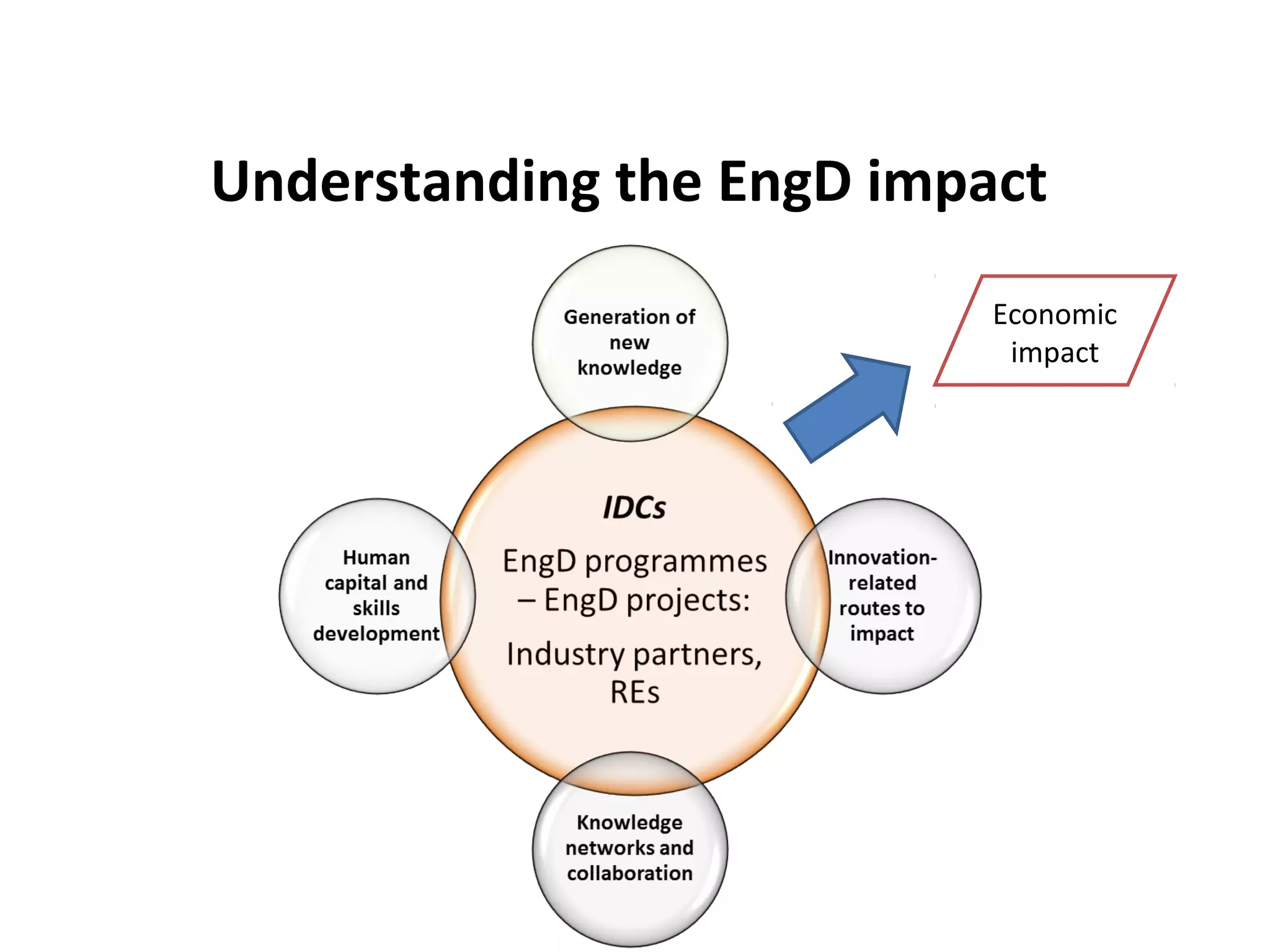
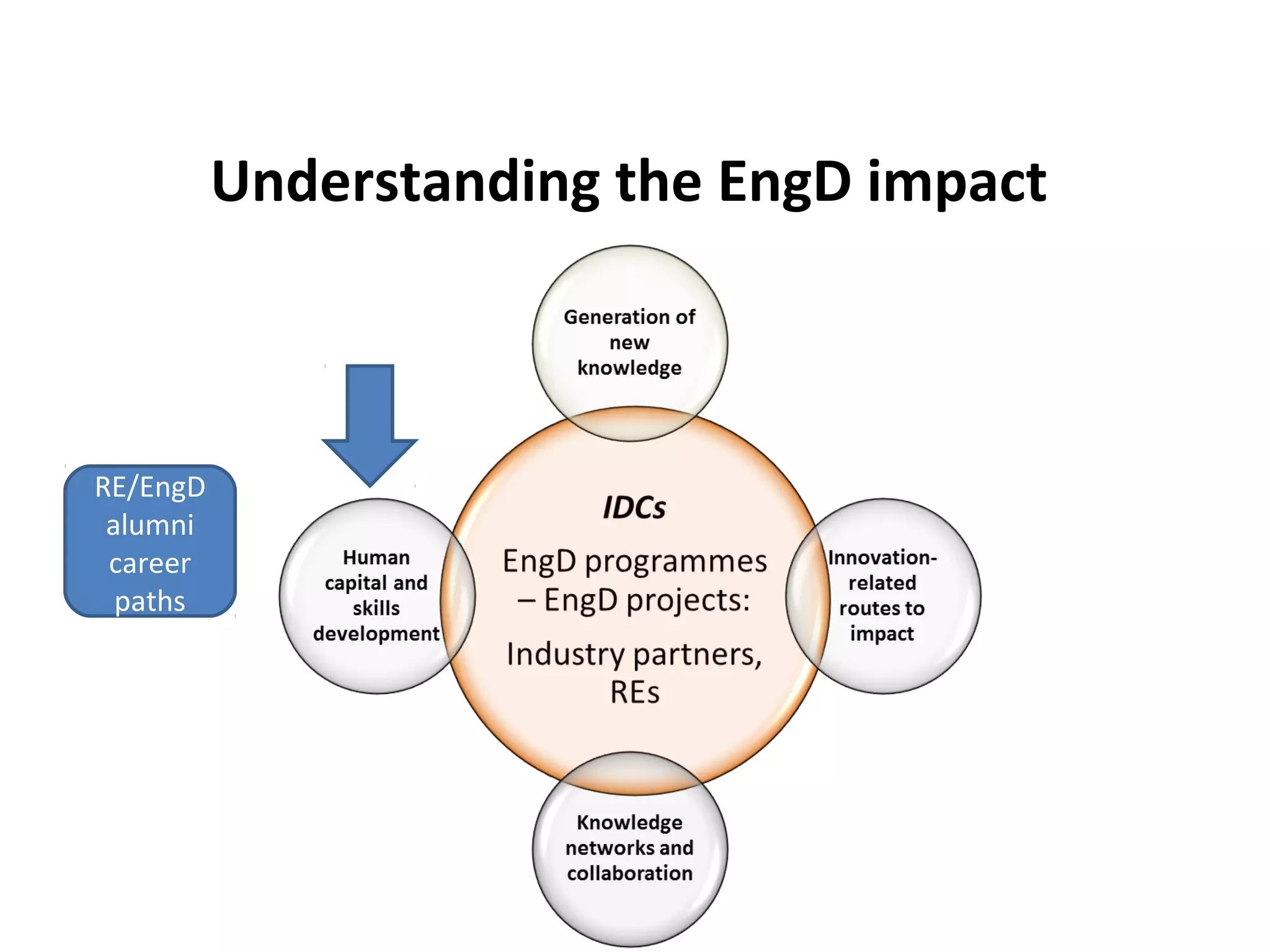
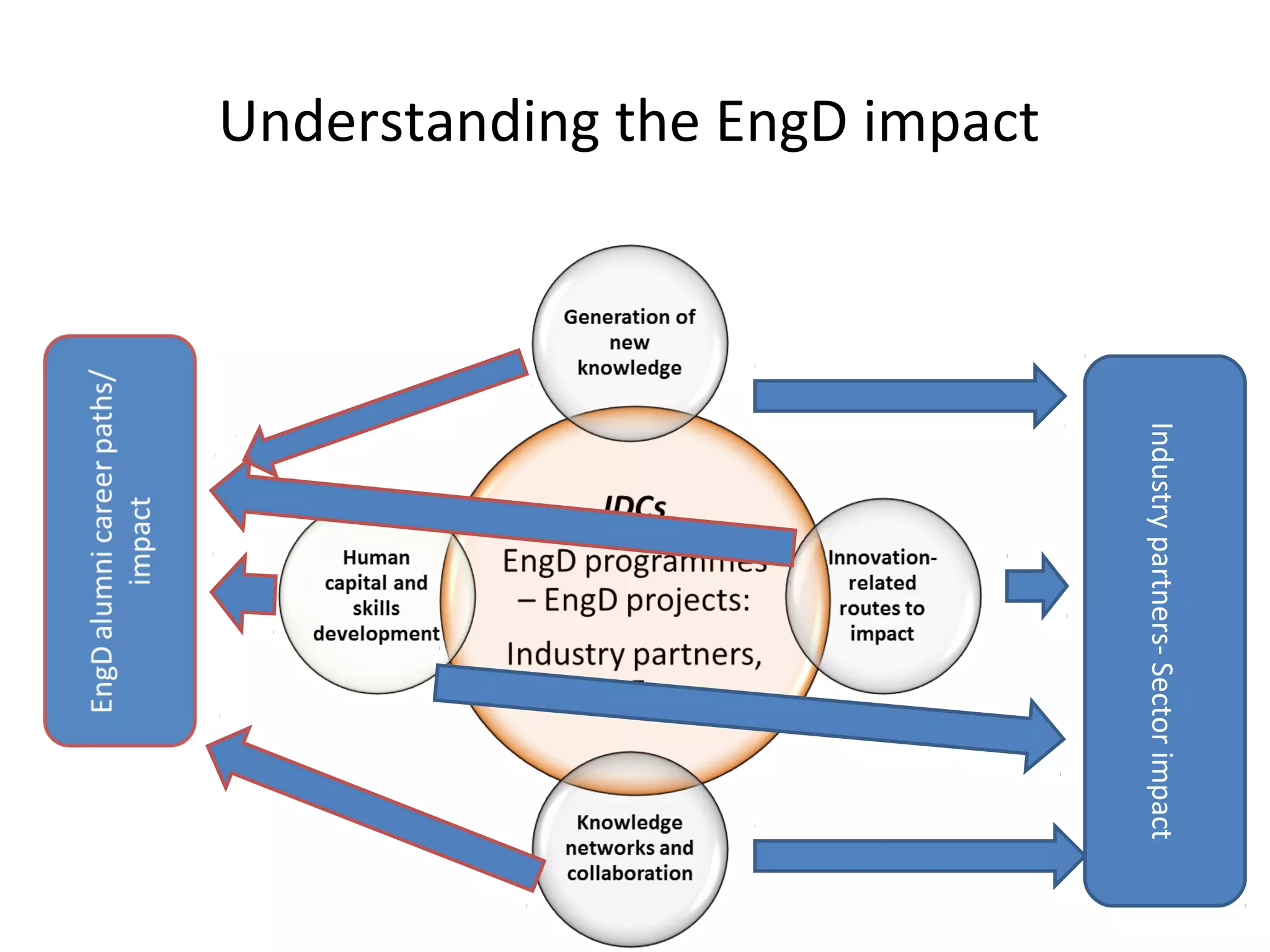
Understanding the EngD impact
Economic
impact
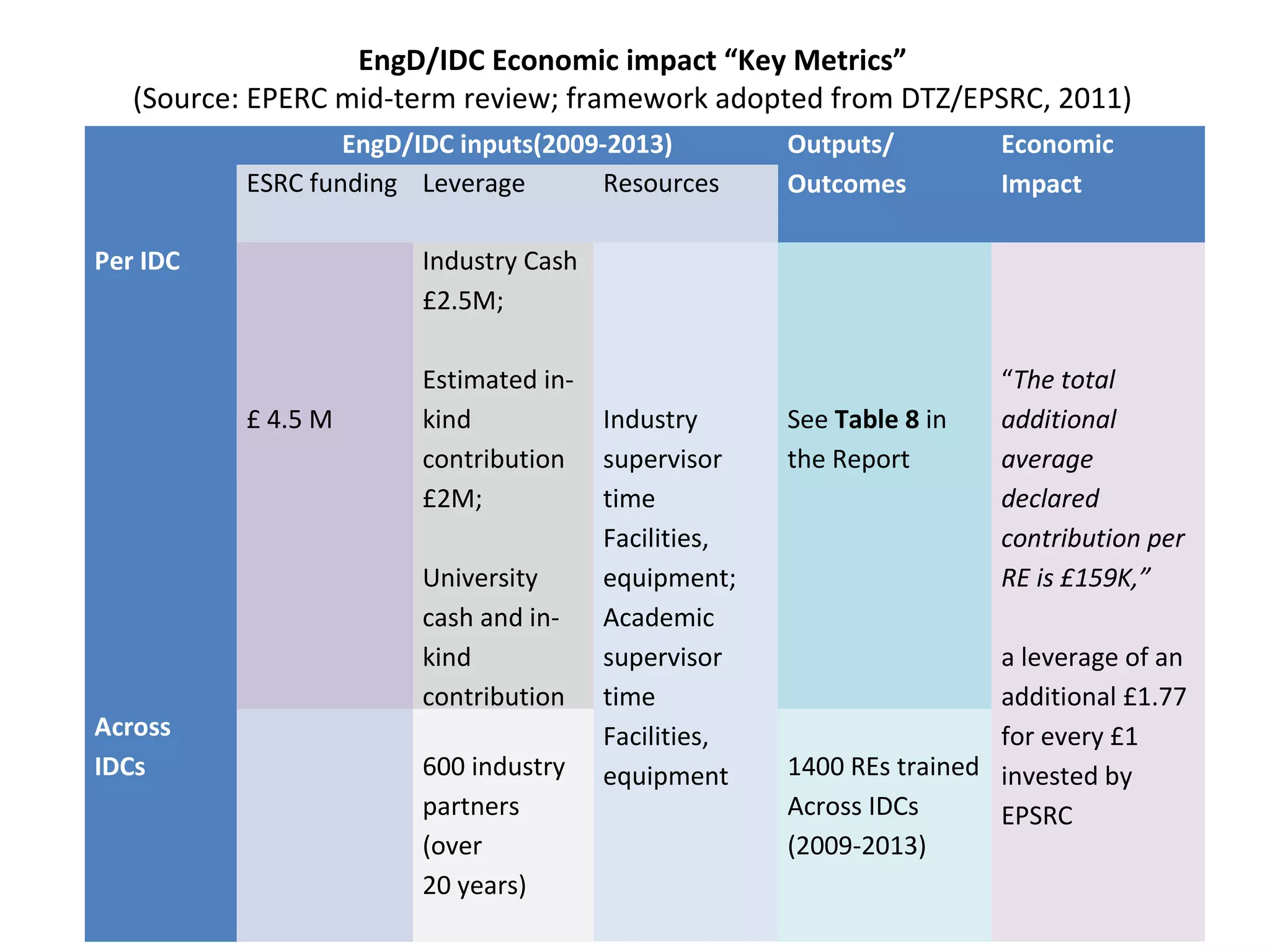
EngD/IDC Economic impact “Key Metrics”
(Source: EPERC mid-term review; framework adopted from DTZ/EPSRC, 2011)
EngD/IDC inputs(2009-2013)
ESRC funding Leverage
Resources
Per IDC

Economic
Impact

Industry Cash
£2.5M;

£ 4.5 M

Across
IDCs

Outputs/
Outcomes

Estimated inkind
contribution
£2M;
University
cash and inkind
contribution
600 industry
partners
(over
20 years)

Industry
supervisor
time
Facilities,
equipment;
Academic
supervisor
time
Facilities,
equipment

See Table 8 in
the Report

“The total
additional
average
declared
contribution per
RE is £159K,”

a leverage of an
additional £1.77
for every £1
1400 REs trained invested by
Across IDCs
EPSRC
(2009-2013)
Understanding the EngD impact

RE/EngD
alumni
career
paths
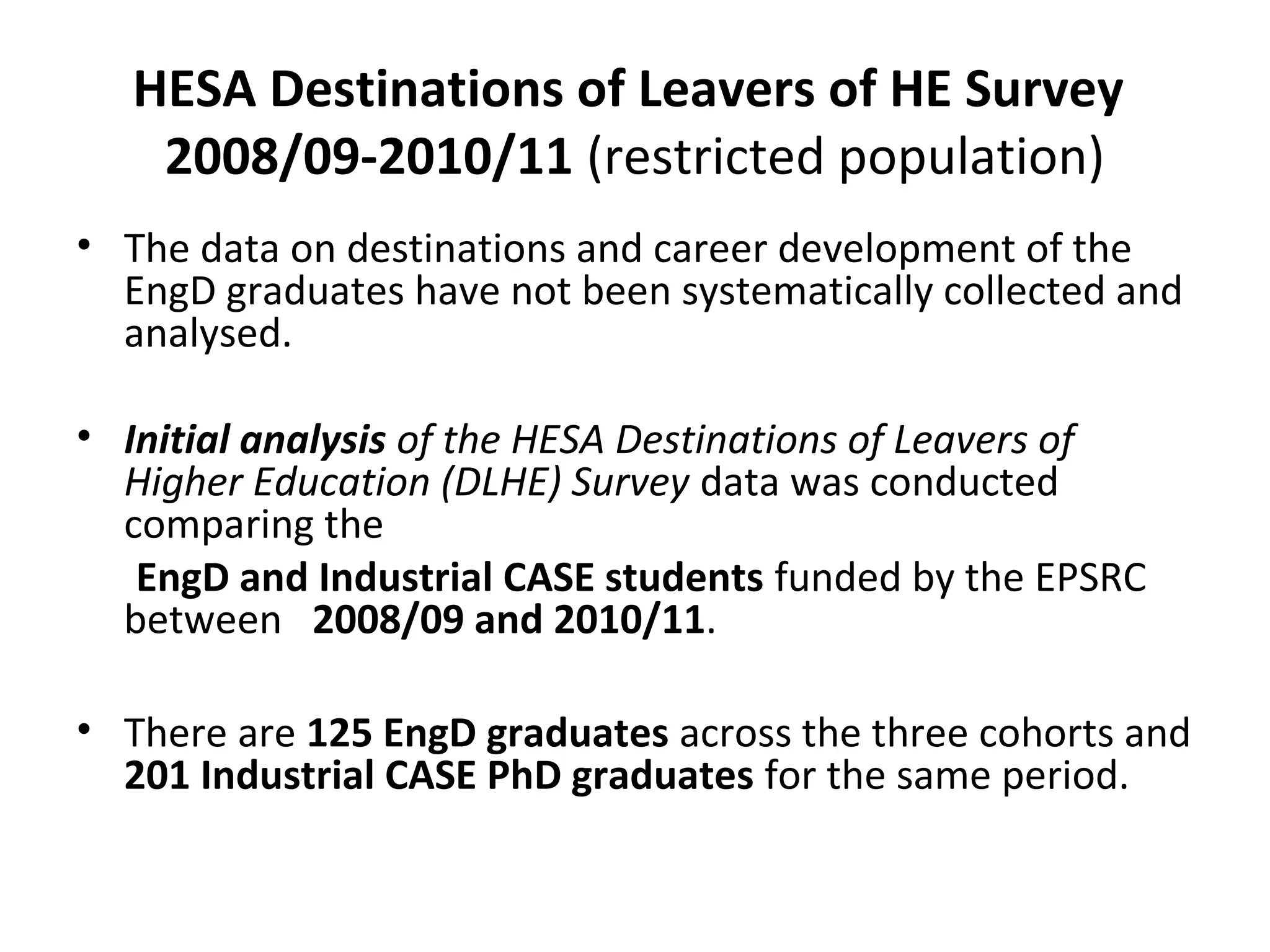
HESA Destinations of Leavers of HE Survey
2008/09-2010/11 (restricted population)
• The data on destinations and career development of the
EngD graduates have not been systematically collected and
analysed.
• Initial analysis of the HESA Destinations of Leavers of
Higher Education (DLHE) Survey data was conducted
comparing the
EngD and Industrial CASE students funded by the EPSRC
between 2008/09 and 2010/11.
• There are 125 EngD graduates across the three cohorts and
201 Industrial CASE PhD graduates for the same period.
HESA Destinations of Leavers of HE Survey
2008/09-2010/11 (restricted population) – Initial analysis

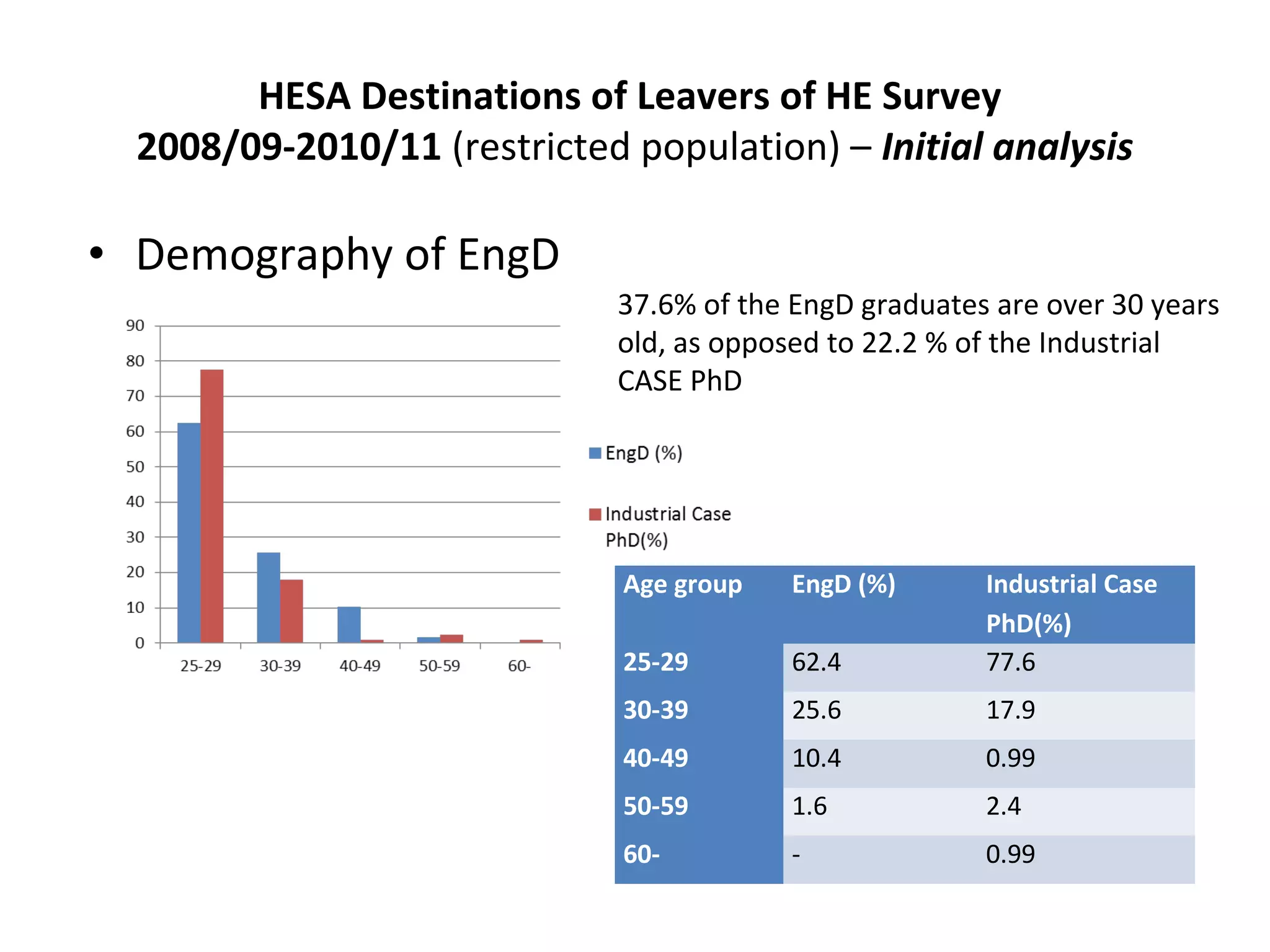
• Demography of EngD
37.6% of the EngD graduates are over 30 years
old, as opposed to 22.2 % of the Industrial
CASE PhD

Age group

EngD (%)

25-29

62.4

Industrial Case
PhD(%)
77.6

30-39

25.6

17.9

40-49

10.4

0.99

50-59

1.6

2.4

60-

-

0.99
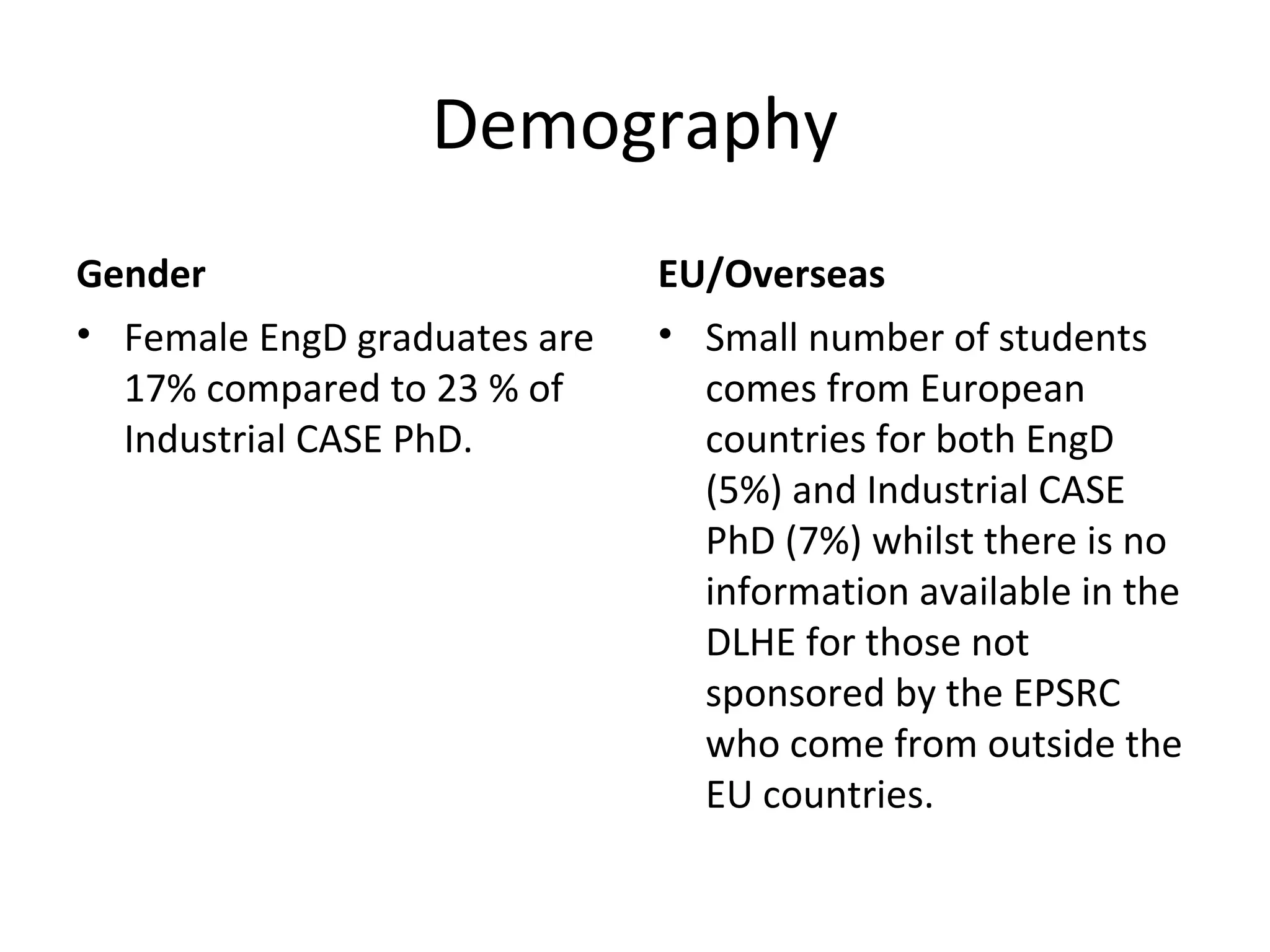
Demography
Gender
• Female EngD graduates are
17% compared to 23 % of
Industrial CASE PhD.

EU/Overseas
• Small number of students
comes from European
countries for both EngD
(5%) and Industrial CASE
PhD (7%) whilst there is no
information available in the
DLHE for those not
sponsored by the EPSRC
who come from outside the
EU countries.
HESA Destinations of Leavers of HE Survey
2008/09-2010/11 (restricted population) – Initial analysis

• How they found
employment
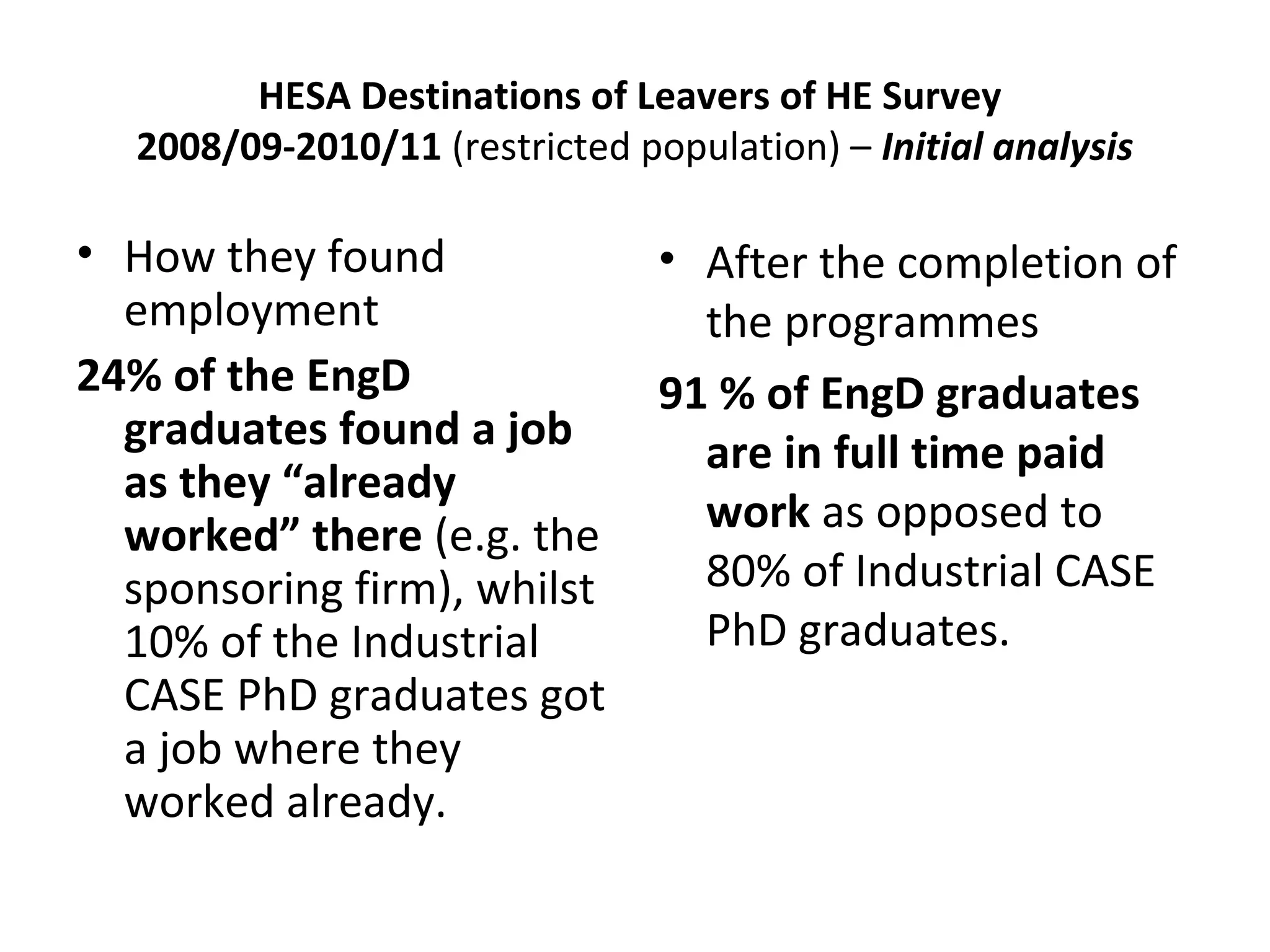
24% of the EngD
graduates found a job
as they “already
worked” there (e.g. the
sponsoring firm), whilst
10% of the Industrial
CASE PhD graduates got
a job where they
worked already.

• After the completion of
the programmes
91 % of EngD graduates
are in full time paid
work as opposed to
80% of Industrial CASE
PhD graduates.
HESA Destinations of Leavers of HE Survey
2008/09-2010/11 (restricted population) – Initial analysis
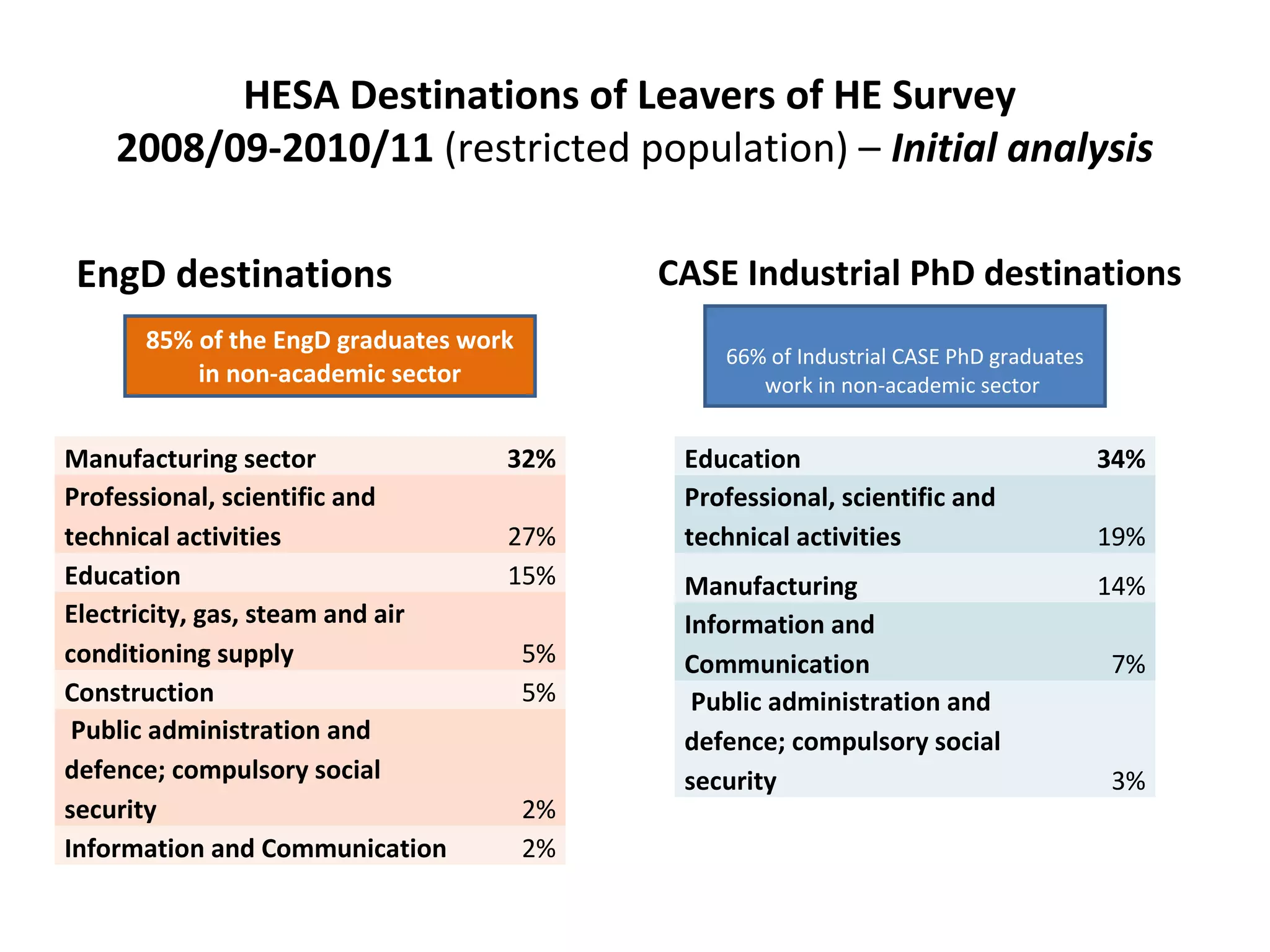
EngD destinations

CASE Industrial PhD destinations

85% of the EngD graduates work
in non-academic sector

Manufacturing sector
Professional, scientific and
technical activities
Education
Electricity, gas, steam and air
conditioning supply
Construction
Public administration and
defence; compulsory social
security
Information and Communication

66% of Industrial CASE PhD graduates
work in non-academic sector

32%
27%
15%
5%
5%

2%
2%

Education
Professional, scientific and
technical activities

34%

Manufacturing
Information and
Communication
Public administration and
defence; compulsory social
security

14%

19%

7%

3%
HESA Destinations of Leavers of HE Survey
2008/09-2010/11 (restricted population) – Initial analysis
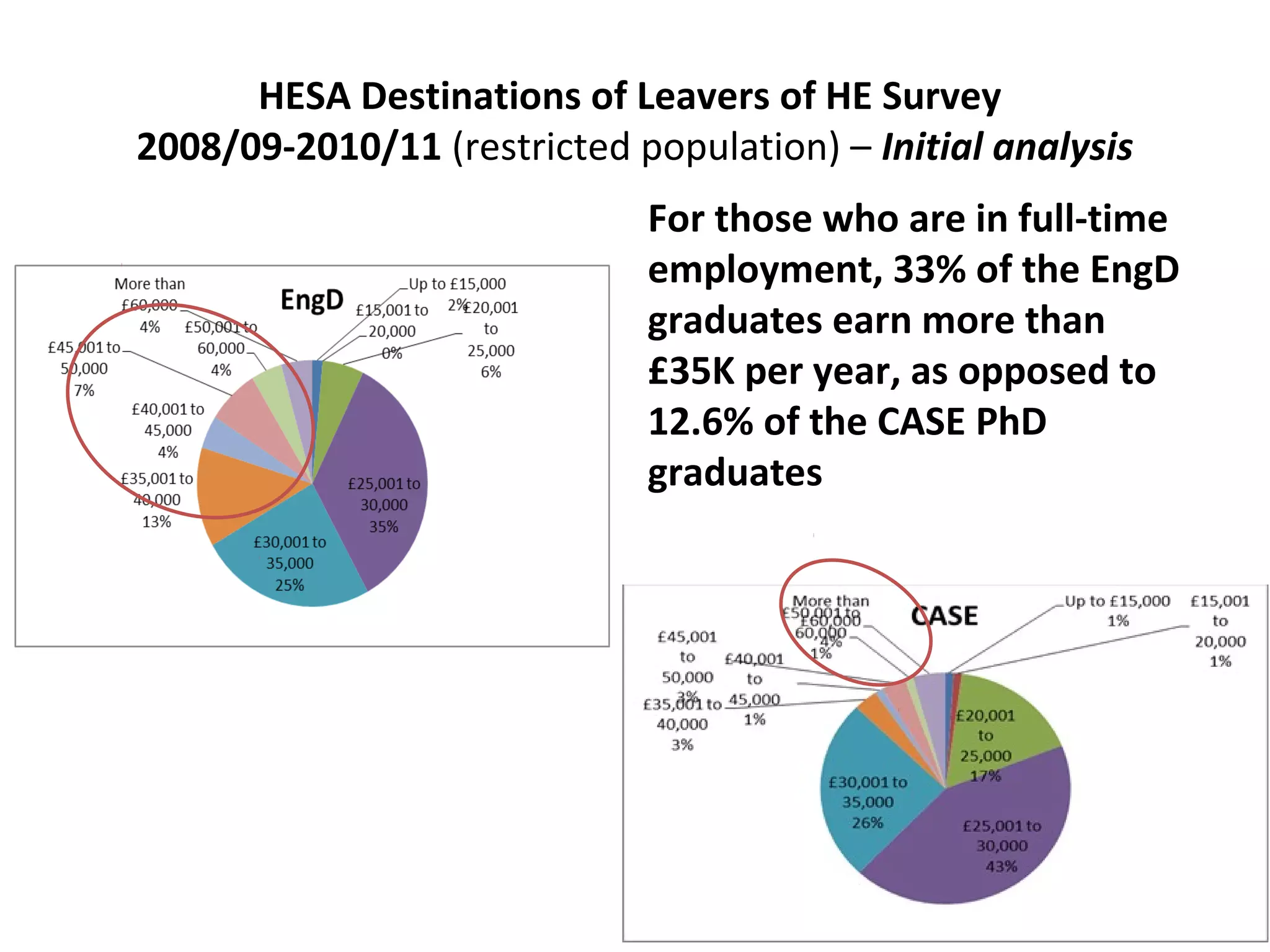
For those who are in full-time
employment, 33% of the EngD
graduates earn more than
£35K per year, as opposed to
12.6% of the CASE PhD
graduates
HESA Destinations of Leavers of HE Survey
2008/09-2010/11 (restricted population) – Initial analysis
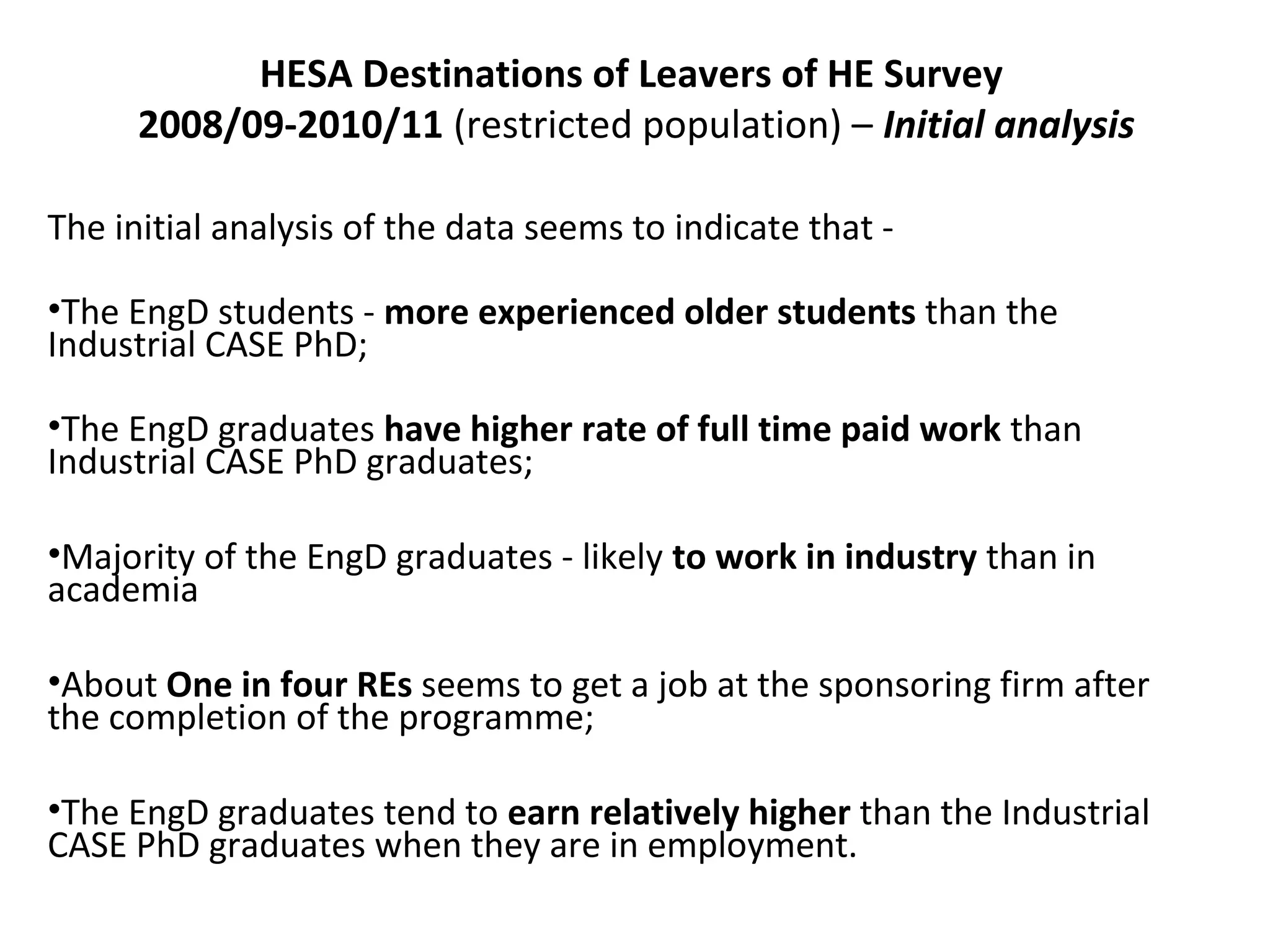
The initial analysis of the data seems to indicate that •The EngD students - more experienced older students than the
Industrial CASE PhD;
•The EngD graduates have higher rate of full time paid work than
Industrial CASE PhD graduates;
•Majority of the EngD graduates - likely to work in industry than in
academia
•About One in four REs seems to get a job at the sponsoring firm after
the completion of the programme;
•The EngD graduates tend to earn relatively higher than the Industrial
CASE PhD graduates when they are in employment.
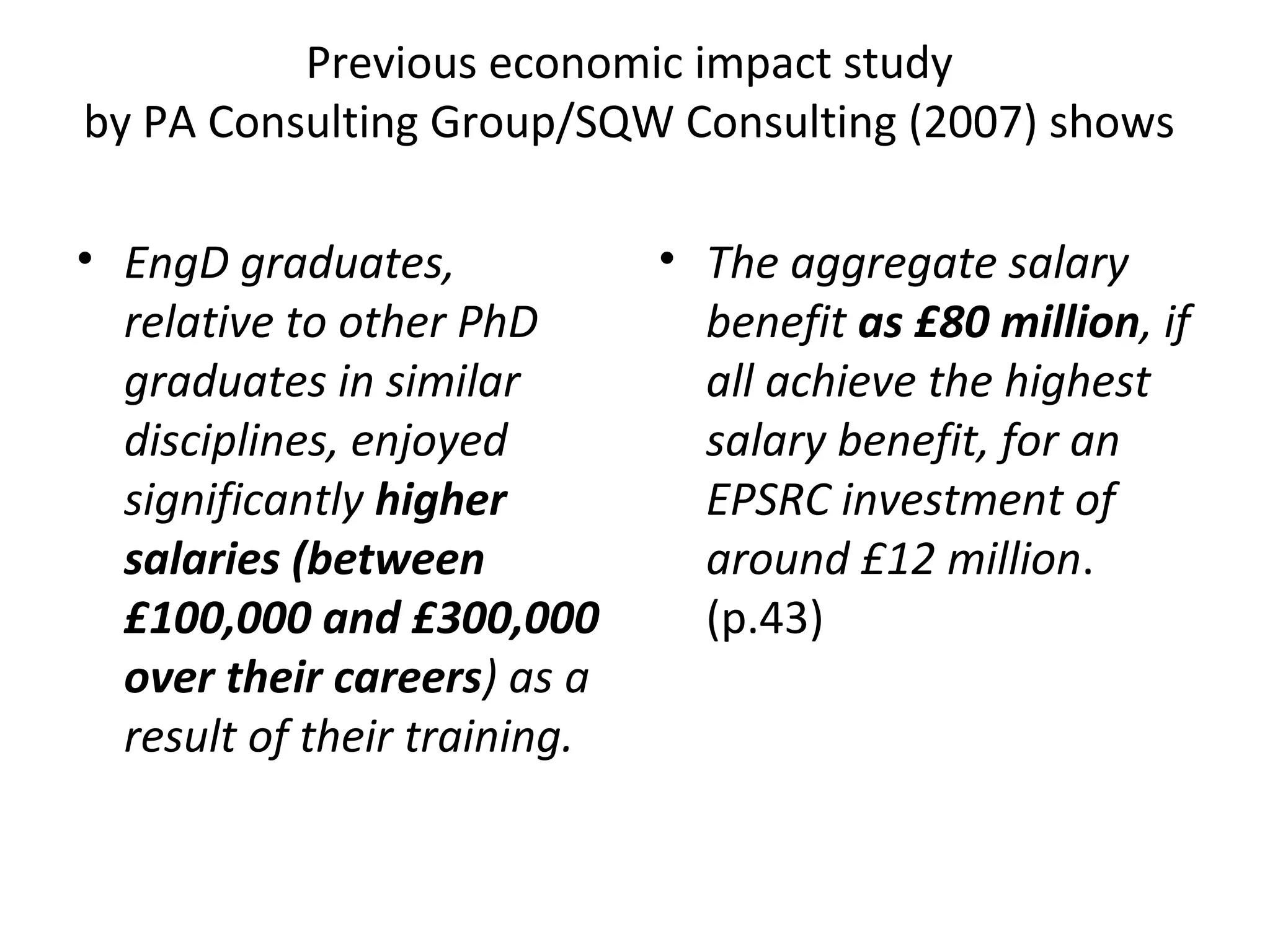
Previous economic impact study
by PA Consulting Group/SQW Consulting (2007) shows
• EngD graduates,
relative to other PhD
graduates in similar
disciplines, enjoyed
significantly higher
salaries (between
£100,000 and £300,000
over their careers) as a
result of their training.

• The aggregate salary
benefit as £80 million, if
all achieve the highest
salary benefit, for an
EPSRC investment of
around £12 million.
(p.43)
Understanding the EngD impact

Industry partners- Sector impact
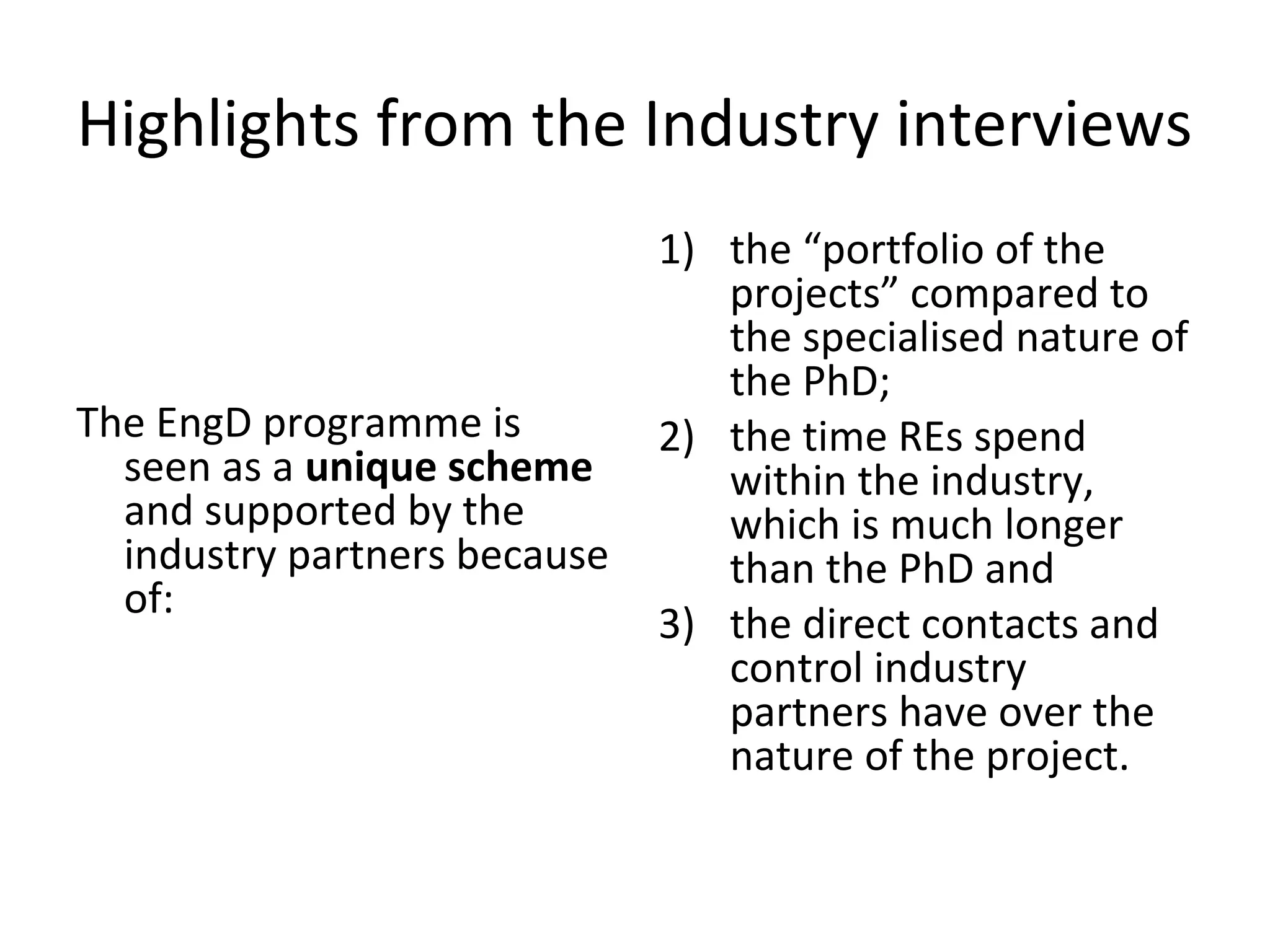
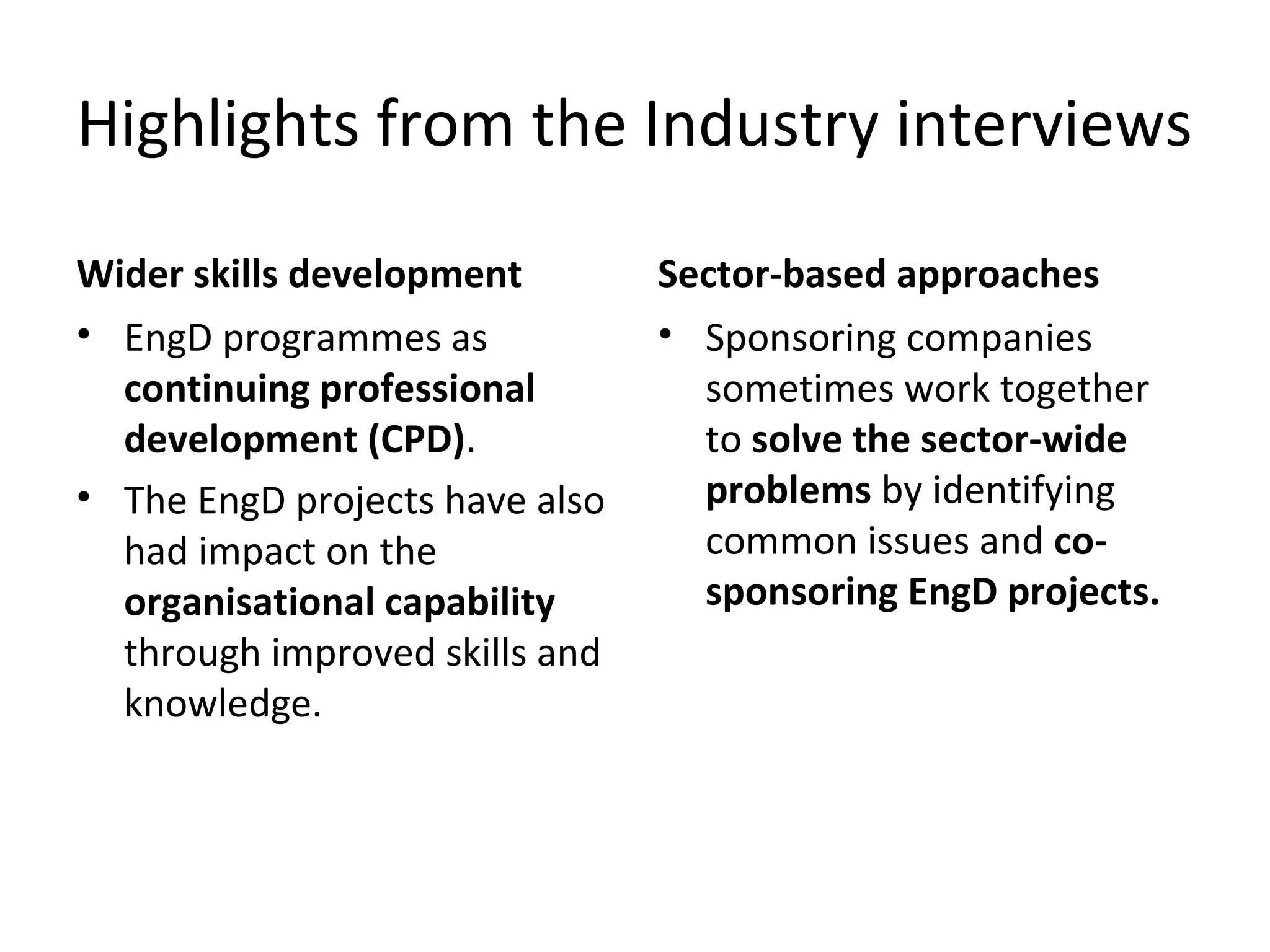
Highlights from the Industry interviews

The EngD programme is
seen as a unique scheme
and supported by the
industry partners because
of:

1) the “portfolio of the
projects” compared to
the specialised nature of
the PhD;
2) the time REs spend
within the industry,
which is much longer
than the PhD and
3) the direct contacts and
control industry
partners have over the
nature of the project.
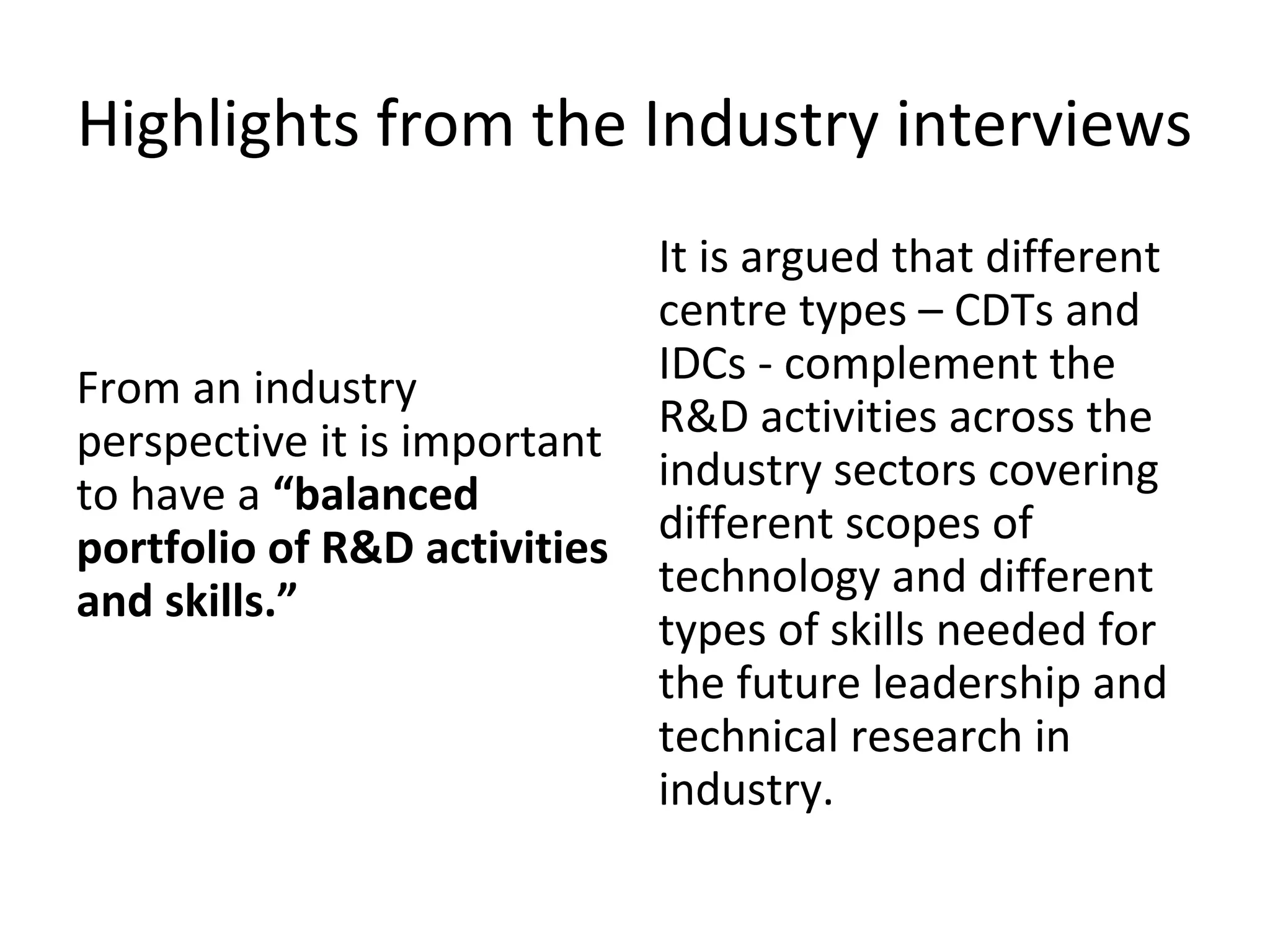
Highlights from the Industry interviews

From an industry
perspective it is important
to have a “balanced
portfolio of R&D activities
and skills.”

It is argued that different
centre types – CDTs and
IDCs - complement the
R&D activities across the
industry sectors covering
different scopes of
technology and different
types of skills needed for
the future leadership and
technical research in
industry.
Highlights from the Industry interviews
Monitoring and rewarding

Rolling out impact

• Some industry partners have
more regular and rigorous
approaches of monitoring the
progress of the EngD projects,
including short-term impacts
• Embedding the REs as part of
their organisational
mechanisms; for example,
through reward and
recognition mechanisms[e.g.
energy, water management].

• According to one industry
partner [Retail], the
environmental technology
developed through an EngD
project has led to £5 million
cost saving.
Highlights from the Industry interviews
Wider skills development
• EngD programmes as
continuing professional
development (CPD).
• The EngD projects have also
had impact on the
organisational capability
through improved skills and
knowledge.

Sector-based approaches
• Sponsoring companies
sometimes work together
to solve the sector-wide
problems by identifying
common issues and cosponsoring EngD projects.
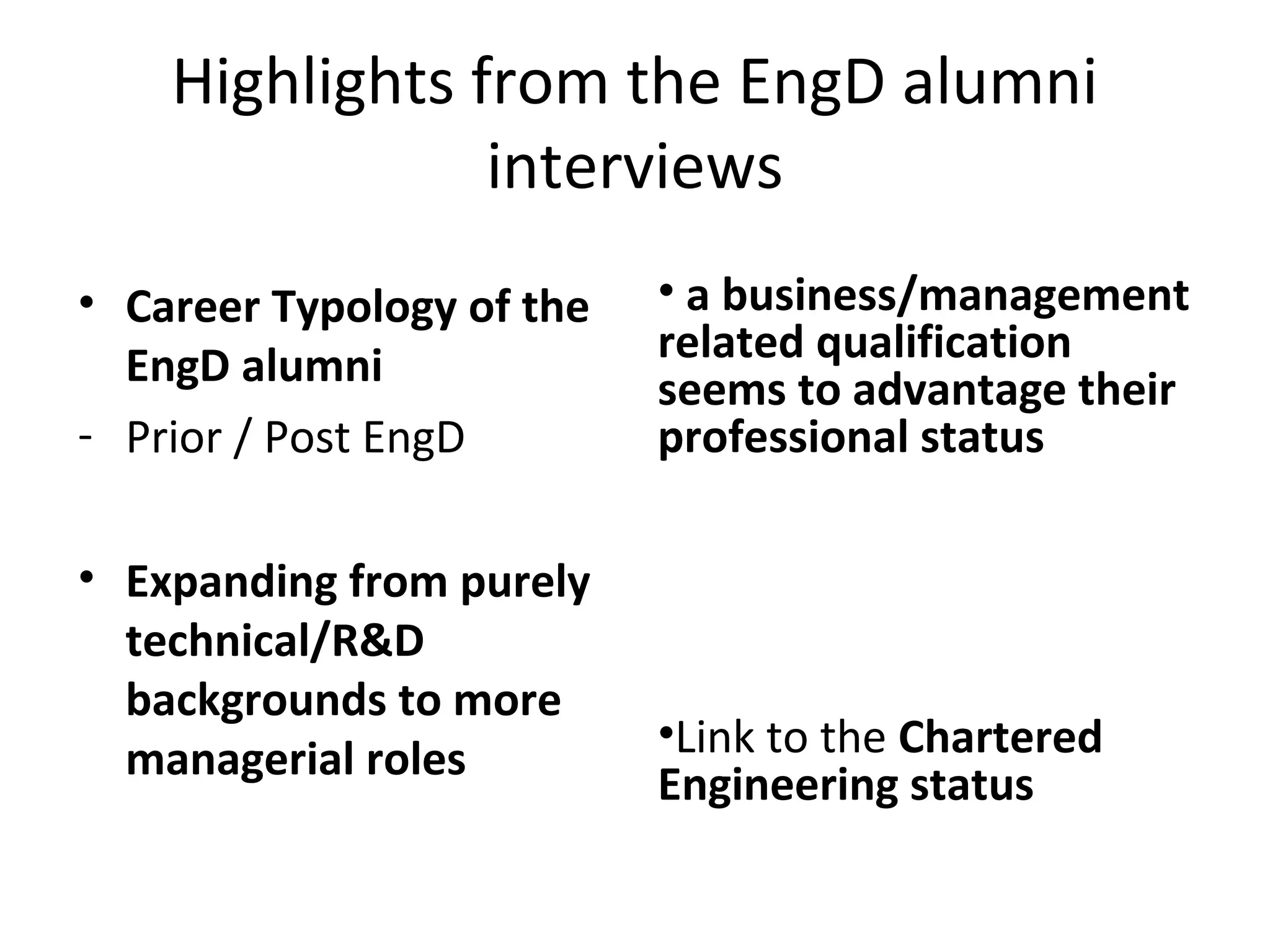
Highlights from the EngD alumni
interviews
• Career Typology of the
EngD alumni
- Prior / Post EngD
• Expanding from purely
technical/R&D
backgrounds to more
managerial roles

• a business/management
related qualification
seems to advantage their
professional status

•Link to the Chartered
Engineering status
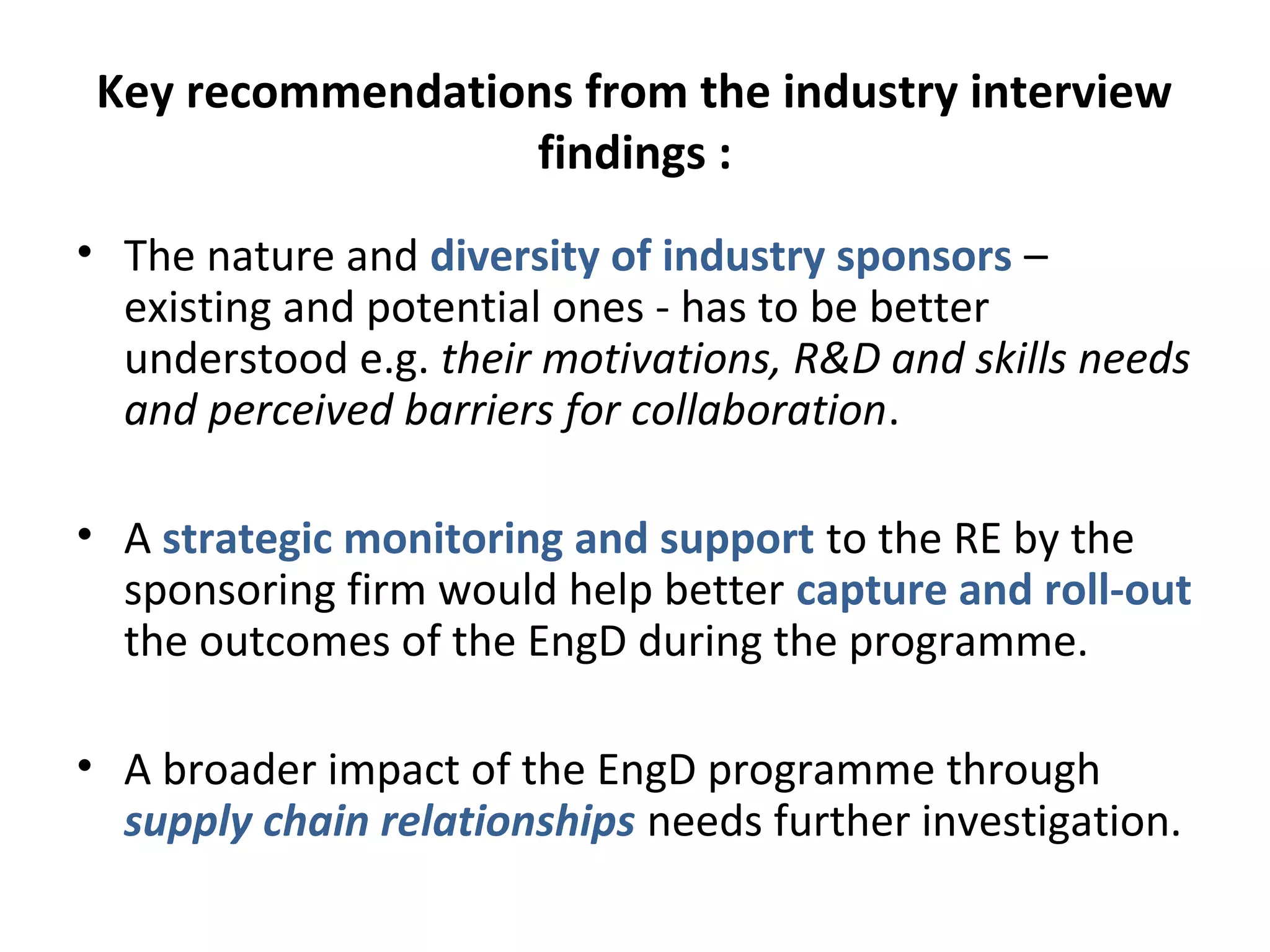
Key recommendations from the industry interview
findings :
• The nature and diversity of industry sponsors –
existing and potential ones - has to be better
understood e.g. their motivations, R&D and skills needs
and perceived barriers for collaboration.
• A strategic monitoring and support to the RE by the
sponsoring firm would help better capture and roll-out
the outcomes of the EngD during the programme.
• A broader impact of the EngD programme through
supply chain relationships needs further investigation.
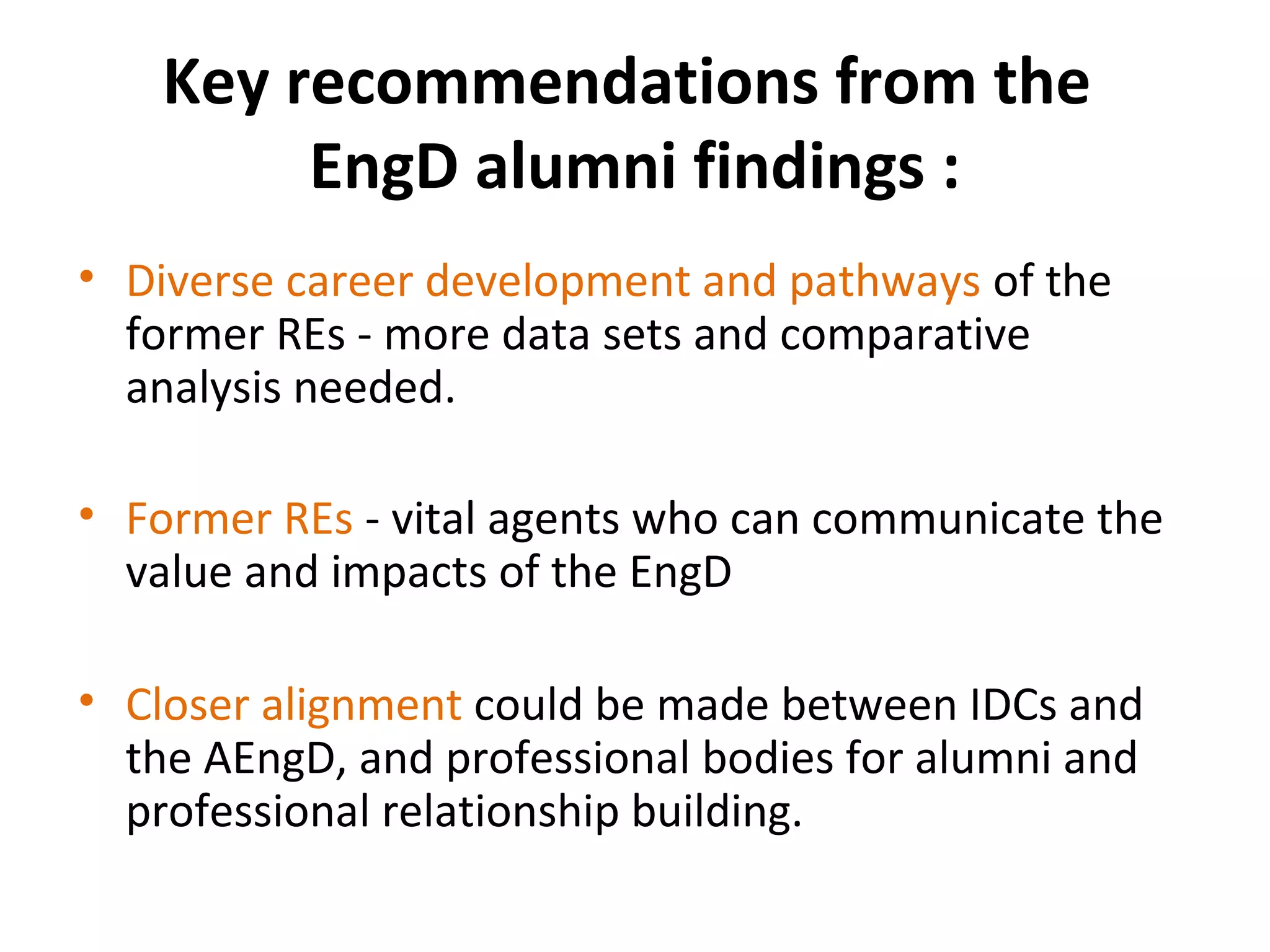
Key recommendations from the
EngD alumni findings :
• Diverse career development and pathways of the
former REs - more data sets and comparative
analysis needed.
• Former REs - vital agents who can communicate the
value and impacts of the EngD
• Closer alignment could be made between IDCs and
the AEngD, and professional bodies for alumni and
professional relationship building.
Thank you for listening• This is a ‘snapshot’ of the findings.
• Please see the report for the details when
available.

EngD research impacts - summary of key findings

  • 1.
    Understanding the EngDImpact – A Pilot study Dr. Fumi Kitagawa University of Manchester 26 November 2013 The AEngD Annual Conference, London
  • 2.
    The Study contexts •A pilot study aiming to understand the nature of the EngD impact and to identify how it can be best evidenced • March-October 2013 • Sponsored and supported by the Association of the Engineering Doctorates (AEngD) and the Engineering and Physical Sciences Research Council (EPSRC). • The final report will be available shortly.
  • 3.
    Acknowledgements • The studyhas been commissioned and supported by the AEngD and the EPSRC • I would like to acknowledge the support from the following individuals for comments and inputs – Prof P. Jeffrey, Dr O Kasyutich, Dr D. Stanley, Dr S. Yeomans, Dr C Bachelor and Dr M. Wilson • I would like to thank the following MBS students who worked on the data collection between June-August 2013 - Syahirah Abdul Rahman, Tzu-Miao Lin, Teimuraz Mamatsashvili, Meng Qiang, Ran Cai (MBS, M.Bus Global Business Analysis students)
  • 4.
    The Study focus Theprimary target of the study is to understand the impact of the EngD with specific focus on: 1) impact on industry partners - providing evidence of the value of EngD project to industry 2) career pathways of REs- identifying how the EngD experience shapes the career paths of EngD graduates (EngD Alumni)
  • 5.
    The Study -Research Design • Desk top research • The 2009 IDCs mid-term review (May 2011) – 18 IDCs (the AEngD member centres) • Semi-structured interviews (June-August 2013) - 20 EngD alumni (from IDCs/EngD centre) - 15 Industry partners (10 types/sectors) • HESA Destinations of Leavers of Higher Education (DLHE) survey 2008/9-2010/2011 125 EngD; 201 Industrial CASE PhD graduates [initial analysis]
  • 6.
    Conceptualising the EngDimpact EngD inputs EngD scheme/programmes/ project levels Economic impact Individual (RE, EngD alumni); Organisational (sponsoring company, IDC); Sector (Industry, HE) levels
  • 7.
    Key factors influencingthe EngD impact • RE’s individual factors (e.g. age, gender, industry experiences); • characteristics of the EngD projects ; the nature of the technology e.g. ‘technology readiness level’ , areas of scientific disciplines; • the academic environment and organisational factors e.g. the history and characteristics of the IDC/EngD Centre; • the nature of the sponsoring firm and the sector e.g. HR policies, R&D and skills needs; industry problems; • broader social and institutional conditions e.g. labour market conditions, corporate governance structures and R&D investment in the scientific fields.
  • 8.
    Understanding the EngDimpact Economic impact
  • 9.
    EngD/IDC Economic impact“Key Metrics” (Source: EPERC mid-term review; framework adopted from DTZ/EPSRC, 2011) EngD/IDC inputs(2009-2013) ESRC funding Leverage Resources Per IDC Economic Impact Industry Cash £2.5M; £ 4.5 M Across IDCs Outputs/ Outcomes Estimated inkind contribution £2M; University cash and inkind contribution 600 industry partners (over 20 years) Industry supervisor time Facilities, equipment; Academic supervisor time Facilities, equipment See Table 8 in the Report “The total additional average declared contribution per RE is £159K,” a leverage of an additional £1.77 for every £1 1400 REs trained invested by Across IDCs EPSRC (2009-2013)
  • 10.
    Understanding the EngDimpact RE/EngD alumni career paths
  • 11.
    HESA Destinations ofLeavers of HE Survey 2008/09-2010/11 (restricted population) • The data on destinations and career development of the EngD graduates have not been systematically collected and analysed. • Initial analysis of the HESA Destinations of Leavers of Higher Education (DLHE) Survey data was conducted comparing the EngD and Industrial CASE students funded by the EPSRC between 2008/09 and 2010/11. • There are 125 EngD graduates across the three cohorts and 201 Industrial CASE PhD graduates for the same period.
  • 12.
    HESA Destinations ofLeavers of HE Survey 2008/09-2010/11 (restricted population) – Initial analysis • Demography of EngD 37.6% of the EngD graduates are over 30 years old, as opposed to 22.2 % of the Industrial CASE PhD Age group EngD (%) 25-29 62.4 Industrial Case PhD(%) 77.6 30-39 25.6 17.9 40-49 10.4 0.99 50-59 1.6 2.4 60- - 0.99
  • 13.
    Demography Gender • Female EngDgraduates are 17% compared to 23 % of Industrial CASE PhD. EU/Overseas • Small number of students comes from European countries for both EngD (5%) and Industrial CASE PhD (7%) whilst there is no information available in the DLHE for those not sponsored by the EPSRC who come from outside the EU countries.
  • 14.
    HESA Destinations ofLeavers of HE Survey 2008/09-2010/11 (restricted population) – Initial analysis • How they found employment 24% of the EngD graduates found a job as they “already worked” there (e.g. the sponsoring firm), whilst 10% of the Industrial CASE PhD graduates got a job where they worked already. • After the completion of the programmes 91 % of EngD graduates are in full time paid work as opposed to 80% of Industrial CASE PhD graduates.
  • 15.
    HESA Destinations ofLeavers of HE Survey 2008/09-2010/11 (restricted population) – Initial analysis EngD destinations CASE Industrial PhD destinations 85% of the EngD graduates work in non-academic sector Manufacturing sector Professional, scientific and technical activities Education Electricity, gas, steam and air conditioning supply Construction Public administration and defence; compulsory social security Information and Communication 66% of Industrial CASE PhD graduates work in non-academic sector 32% 27% 15% 5% 5% 2% 2% Education Professional, scientific and technical activities 34% Manufacturing Information and Communication Public administration and defence; compulsory social security 14% 19% 7% 3%
  • 16.
    HESA Destinations ofLeavers of HE Survey 2008/09-2010/11 (restricted population) – Initial analysis For those who are in full-time employment, 33% of the EngD graduates earn more than £35K per year, as opposed to 12.6% of the CASE PhD graduates
  • 17.
    HESA Destinations ofLeavers of HE Survey 2008/09-2010/11 (restricted population) – Initial analysis The initial analysis of the data seems to indicate that •The EngD students - more experienced older students than the Industrial CASE PhD; •The EngD graduates have higher rate of full time paid work than Industrial CASE PhD graduates; •Majority of the EngD graduates - likely to work in industry than in academia •About One in four REs seems to get a job at the sponsoring firm after the completion of the programme; •The EngD graduates tend to earn relatively higher than the Industrial CASE PhD graduates when they are in employment.
  • 18.
    Previous economic impactstudy by PA Consulting Group/SQW Consulting (2007) shows • EngD graduates, relative to other PhD graduates in similar disciplines, enjoyed significantly higher salaries (between £100,000 and £300,000 over their careers) as a result of their training. • The aggregate salary benefit as £80 million, if all achieve the highest salary benefit, for an EPSRC investment of around £12 million. (p.43)
  • 19.
    Understanding the EngDimpact Industry partners- Sector impact
  • 20.
    Highlights from theIndustry interviews The EngD programme is seen as a unique scheme and supported by the industry partners because of: 1) the “portfolio of the projects” compared to the specialised nature of the PhD; 2) the time REs spend within the industry, which is much longer than the PhD and 3) the direct contacts and control industry partners have over the nature of the project.
  • 21.
    Highlights from theIndustry interviews From an industry perspective it is important to have a “balanced portfolio of R&D activities and skills.” It is argued that different centre types – CDTs and IDCs - complement the R&D activities across the industry sectors covering different scopes of technology and different types of skills needed for the future leadership and technical research in industry.
  • 22.
    Highlights from theIndustry interviews Monitoring and rewarding Rolling out impact • Some industry partners have more regular and rigorous approaches of monitoring the progress of the EngD projects, including short-term impacts • Embedding the REs as part of their organisational mechanisms; for example, through reward and recognition mechanisms[e.g. energy, water management]. • According to one industry partner [Retail], the environmental technology developed through an EngD project has led to £5 million cost saving.
  • 23.
    Highlights from theIndustry interviews Wider skills development • EngD programmes as continuing professional development (CPD). • The EngD projects have also had impact on the organisational capability through improved skills and knowledge. Sector-based approaches • Sponsoring companies sometimes work together to solve the sector-wide problems by identifying common issues and cosponsoring EngD projects.
  • 24.
    Highlights from theEngD alumni interviews • Career Typology of the EngD alumni - Prior / Post EngD • Expanding from purely technical/R&D backgrounds to more managerial roles • a business/management related qualification seems to advantage their professional status •Link to the Chartered Engineering status
  • 25.
    Key recommendations fromthe industry interview findings : • The nature and diversity of industry sponsors – existing and potential ones - has to be better understood e.g. their motivations, R&D and skills needs and perceived barriers for collaboration. • A strategic monitoring and support to the RE by the sponsoring firm would help better capture and roll-out the outcomes of the EngD during the programme. • A broader impact of the EngD programme through supply chain relationships needs further investigation.
  • 26.
    Key recommendations fromthe EngD alumni findings : • Diverse career development and pathways of the former REs - more data sets and comparative analysis needed. • Former REs - vital agents who can communicate the value and impacts of the EngD • Closer alignment could be made between IDCs and the AEngD, and professional bodies for alumni and professional relationship building.
  • 27.
    Thank you forlistening• This is a ‘snapshot’ of the findings. • Please see the report for the details when available.

Editor's Notes

  • #2 This presentation and the flyer circulated today are “hot off the press” outcomes from the study –prepared for the AEngD annual conference – the contents in the final report still need to be approved by the relevant bodies, which would be available in due course.
  • #4 The AEngD Steering Committee Sub-group of the EngD Impact study was formed in January 2013. Comments from EPSRC
  • #7 Impact of the EngD is found at individual, organisational and sector levels, brought by the multiple levels of inputs and activities through the EngD programmes at IDCs and through individual EngD projects. The IDCs act as a hub for these impact routes, some of them are leading to direct economic benefits.
  • #10 Innovative Manufacturing Research Centres (IMRCs) Impact report (2011)
  • #12 The data on destinations and career development of the EngD graduates have not been systematically collected and analysed. As a quantitative background to the main qualitative evidence provided in the study, the initial analysis of the HESA Destinations of Leavers of Higher Education (DLHE) Survey data was conducted comparing the EngD, Industrial CASE students funded by the EPSRC between 2008/09 and 2010/11. The data on EngD graduates was initially obtained from the EPSRC, which was then matched and integrated into the HESA DLHE. Data on three cohorts of students (2008/09-2010/11) was provided. There are 125 EngD graduates across the three cohorts and 201 Industrial CASE PhD graduates for the same period.
  • #19 The impact of the Research Councils shows the effects of the “development of human capital as a major impact channel from investment in research.” The study shows economic impacts of the EngD scheme as follows:
  • #21 Some industry interviewees expressed preference of the EngDs to the PhDs - because of the applied and interactive nature.
  • #23 The project outcome had been immediately rolled out within the organisation both nationally and internationally. The impact has been reported through different media.