Activity Book
About EU-Universe Awareness


 EU-Universe Awareness (EU-UNAWE) uses the beauty and grandeur of the Universe to
 encourage young children, particularly those from underprivileged communities, to take
 an interest in science and technology and to foster their sense of global citizenship from
 an early age. In its few years of existence, the entire UNAWE network is already active in
 over 54 countries and cconsists of more than 500 astronomers, teachers and educators.

 EU-UNAWE, 2012

 This handbook is licensed under a Creative Commons Attribution-Non-Commercial-Share
 Alike 3.0 Unported License. It was produced by funding from the European Community’s
 Seventh Framework Programme (FP7/2007-2013) under the grant agreement number
 263325.
Introductory Note

In all cultures of the world, tales and myths familiarise young children with the Sun,
Moon, planets and stars. Through these stories, children develop concepts of our Earth,
concepts which have a formative influence. These tales are often a child’s first experience
with science and our Universe. Recognising the educational potential of astronomy, we at
Haus der Astronomie (House of Astronomy) in Heidelberg, Germany, in collaboration with
the EU-UNAWE programme, have been developing suitable materials to inspire young
children to take an interest in science and technology and to foster their sense of global
citizenship from an early age.

Universe in a Box is an educational activity kit originally developed under the MINT Box
program for science education in Germany. It explains the difficult and sometimes abstract
concepts of astronomy to young children (4 to 10 years) by providing practical activities
as well as the materials and models required to do them. Based upon the experiences
gained during seven pilot projects in the past seven years, we are positive that many
children, primary school teachers, educators and families across the world will be happy
to use Universe in a Box.

Universe in a Box provides different fascinating learning contexts, because astronomy
is interdisciplinary in nature. The fact that all of us share the same (small) Earth is
central throughout the activities. As a result, the child’s world view is extended and
cultural borders are opened. From our experience, children are naturally fascinated by
astronomical phenomena and don’t need much incentive to learn from participation in
activities around them. In order to explain the Universe to the open mind of a child, it is
very important not to get ‘lost in space’, but to emphasise the context and thus convey
a coherent picture. Where is what in the Universe? How do we recognise the different
objects?

In this handbook, we discuss questions about the Moon, Earth, Sun, planets and
constellations. While teaching astronomy we continuously pay attention to formulating
the right questions clearly and articulately. This will motivate children to think
independently and scientifically, and encourage them to formulate questions themselves.
We also invite you to add your own favourite activities to the handbook and materials to
the box when using it.

Now, let us guide you through a discovery of the fascinating Universe with your students!
About Universe in a Box


 Objectives & Goals

   Universe in a Box is a low-cost educational resource designed to explain the difficult and
   sometimes abstract concepts of astronomy to young children through inquiry-based and
   fun learning methods. The educational goals of Universe in a Box are:

   •	 Support elementary school curriculum with a didactic tool for teachers to help
      them overcome the hurdle of initial preparation of an astronomy class, by selecting
      appropriate focus areas and providing appropriate learning content and materials.
   •	 Encourage inquiry-based learning among children, involving discussing, drawing
      conclusions and presenting. Based on their own ‘horizon’ system (Earth), children
      discover the celestial phenomena in a step-by-step manner and are capable, because of
      their own observation, of adapting their world view to the true nature of things (e.g.,
      the sphericity of the Earth).
   •	 Link astronomical topics to other subjects such as mathematics, art, religion, etc. to
      support the interdisciplinary learning and present a more holistic view of our universe.
   •	 Raise children’s awareness of and respect for cultures, the miracle of life and protection
      of the Earth through the realization that we are all inhabitants of a small blue planet.


     Audience

   Universe in a Box is meant for use in primary schools (children 4 to 10 years of age) as
   well as extracurricular activity centres, observatories, planetariums, museums, outreach
   programs and amateur astronomy centres. The materials in the box are low cost and the
   pieces from the appendix are easy to hand-make, thus increasing their reach to both urban
   and rural areas across the world.


    Approach

   Universe in a Box has been designed as a didactic tool with inquiry-based learning methods
   for students. The materials offer the opportunity for students to work out the answers
   to questions on astronomy on their own. It encourages hands-on learning, discussing,
   drawing conclusions and presenting.

   In space, the astronomical objects are not isolated from each other but are interdependent.
   As the Moon revolves around the Earth, the Earth, together with the other seven planets,
   revolves around the Sun, and the Sun, in turn, revolves around the centre of our galaxy,
the Milky Way. The latter, again, is located within a group of further galaxies, attracts
them and is attracted by them.

Through Universe in a Box, based on their own ‘horizon’ system (Earth), children discover
the celestial phenomena in a step-by-step manner and are capable of adapting their world
view to incorporate the true nature of things. The resource has a modular design and comes
with five chapters: Moon, Earth, Sun, Planets and Constellations. The modules for Moon,
Earth and Sun explain that these three celestial bodies form an integrated system, with
eclipses, tides, seasons and day/night resulting from the interactions between these bodies.
The topics proceed with an order of familiarity. This way, children learn about the universe
gradually, moving from their world of experience to the unknown.

We start with the Moon, which is clearly visible in the sky and which gives students a
clear idea of an object in space. They answer questions like: What is a month? How long is
a lunar day? The round Moon makes the concept of the Earth as a spherical planet easier
to grasp. From the Earth, we move on to the Sun. When the students have familiarised
themselves with the Sun as a large body, around which the Earth orbits, they are ready
to understand the concept of planets orbiting the Sun as well. They also answer questions
like, why do planets move around the Sun in an elliptical orbit? Finally, after getting a
grip on the planets, we travel outwards to the stars. How do stars in constellations relate
to each other? How old are stars? The most accessible way to handle this final topic for
children is to discuss the constellations, which are part of a child’s world of experience.

The activities are designed not only to promote self-discovery through the appropriate
extension of perception and the development of spatial orientation, but also to highlight
the human and cultural components of life and to promote environmental awareness. For
example, in one activity, children are asked to think about the children on the other side
of the world: how they live, what their environment is like, what they’re doing while we
are sleeping and how they see the sky. As a result, they establish the idea that we are all
inhabitants of Earth, a small blue planet.

As astronomy is filled with many amazing topics and viewpoints, you are also encouraged
to customise the box with additional activities and material of your own. Therefore, some
free space is left in the box, and activity sheets can easily be added into the handbook.


 Handbook

This handbook provides over thirty activities, which together make up a complete starting
guide to the universe for children 4 to 10 years old. Either individual activities or entire
modules can be used in the classroom, with both large and small groups.

Each module starts with an introduction to the topic, followed by related activities. The
activity descriptions present the time required for a particular activity, target age, materials
required, learning objectives, background science, activity instructions, connection to the
local curriculum and other details.

Reading the background science and recommended resource list should give you the
necessary knowledge to introduce the topic to the children and to answer any questions
they might have. The description provides instructions on how to lead the activity and
some example questions you could ask. Apart from the relevant background and activity
descriptions, the activity handbook also offers ideas for teaching integrated astronomy
with other disciplines, guidance on further experimentation to extend and apply the
newly learned knowledge.

The appendix at the end of the handbook has craft templates for photocopying and using
in various activities. The handbook is in a loose-leaf-folder format for customisation and
easy updating. New activities can also be found on EU-UNAWE’s educational repository
http://www.unawe.org/resources/


 Materials

The list of materials in Universe in a Box is given below. Some of the materials used in the
activities (for example, a torch), may not be present in the box because of their common
availability. This is also indicated on the activity sheet.


                     Item                                     Activity

    Globe                                        1.2, 1.6, 2.1, 2.2, 2.4, 2.5, 2.6, 2.7, 3.5
    Earth mask / moon mask                      1.3
    Styrofoam moon and wooden spit              1.2, 1.5, 1.6, 2.6, 2.7
    Light stand and bulb                        1.6, 2.4, 2.5, 3.5
    Images of phases of the moon                1.8
    Phases of the moon flipbook                 1.8
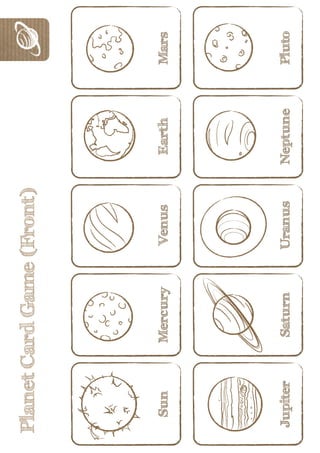
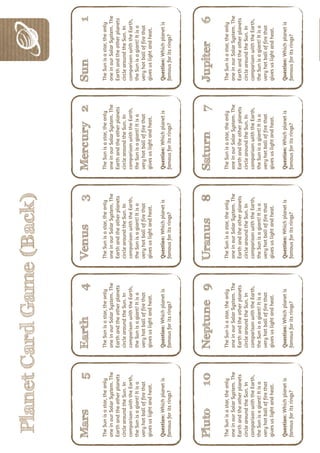
    Planet card game                            4.1
    Images of planets and sun (9)               4.1, 4.2
    Blue cloth                                  4.3, 5.2
    Planetary system (wooden spheres) (8)       4.2. 4.3, 4.5, 5.1, 5.2
    Paint set                                   4.2
    Yellow string                               4.5
    Banderol of zodiac signs                    4.3, 5.1, 5.2
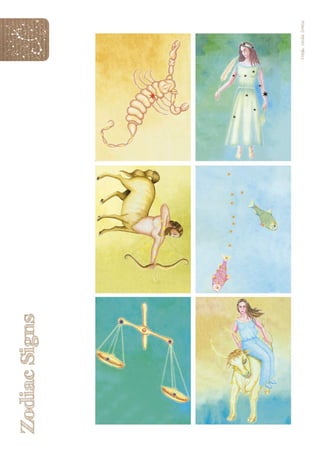
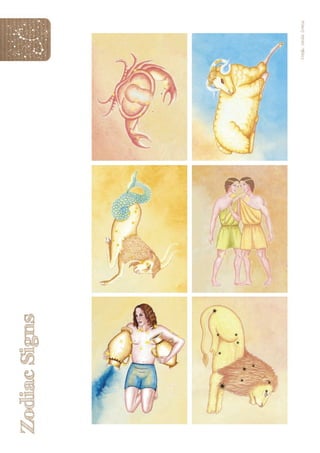
    Images of the zodiac (12)                   5.1, 5.2
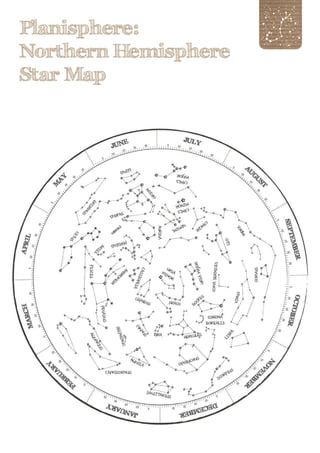
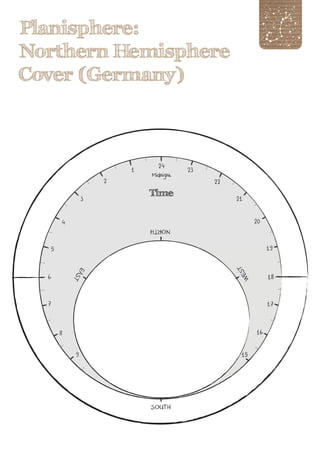
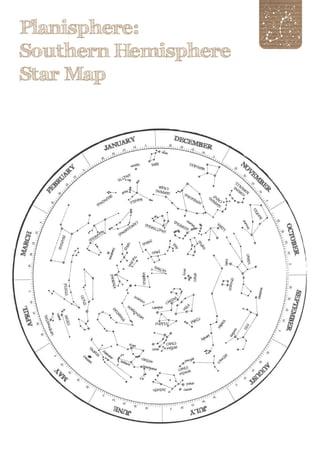
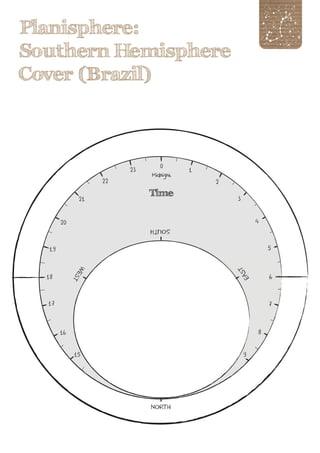
    Planisphere                                 5.3
    Little stars (5)                            5.4
    Constellation viewer and cards (20)         5.5
    Book on zodiac stories                      5.5
Training

Teachers with no experience in astronomy may benefit from a teacher training workshop.
Please contact your closest UNAWE National Program manager: http://www.unawe.org/
network/national/


    Credit


           Concept                    Cecilia Scorza (EU-UNAWE Germany/House of
                                      Astronomy)

           Project Management         Pedro Russo (EU-UNAWE/Leiden University)
           Educational                Jaya Ramchandani (UNAWE/Sirius Interactive)

           Development                Cecilia Scorza and Natalie Fischer (EU-UNAWE
                                      Germany/House of Astronomy)

           Educational Support        Sara Khalafinejad (UNAWE/Leiden University) and
                                      Jos van den Broek (Leiden University)

           Business Development       Jaya Ramchandani (UNAWE/Leiden University)

           Editorial Support          Erik Arends (UNAWE/Leiden University)
                                      Jaya Ramchandani (UNAWE/Sirius Interactive)

           Activity Contribution      Angela Perez (UNAWE Colombia/Astronomy Kids
                                      Club)
                                      Curion Education Pvt. Ltd. (India)

           Prototype Production       Curion Education Pvt. Ltd. (India)

           Images                     Image Editing
                                      Charlotte Provot (EU-UNAWE/Leiden University)

                                      Disclaimer
                                      We have taken care to credit all pictures.
                                      Unfortunately, this has not been possible in all cases.
                                      Should you be aware of the authorship of these
                                      uncredited pictures, please let us know!

           Logo                       Nikki Hartomo (Design); David Kerkhoff (Font);

           Design / Illustrations     Charlotte Provot (EU-UNAWE/Leiden University)
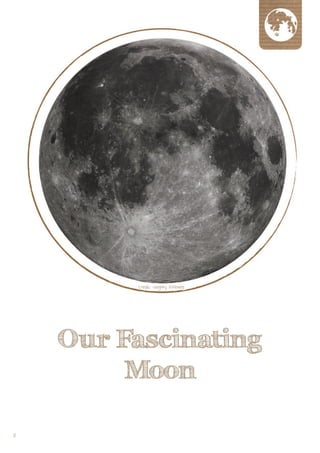
Credit: Gragory H.Revera


    Our Fascinating
         Moon

8
Introduction


Our Earth has a moon, as do many other planets in the Solar System. But this has not always
been the case. Our moon came into existence billions of years ago, when the Earth collided with
a meteorite the size of Mars. Astronomers think that before that event, the Earth rotated very
fast around its axis and tumbled back and forth. The weather changed chaotically, and day
and night were very short. The attraction between the Moon and the Earth slowed each of their
spins down over time. The Earth’s axis became more stable, and day and night grew longer. The
Earth evolved into a more hospitable place for life due to the Moon!

Because of its regular and reviewable monthly movement, the Moon is especially suited as
an introductory subject into astronomy. With their bare eyes or a simple pair of binoculars,
children can discover a new world for themselves.

The Moon has several more advantages as an introduction to astronomy:

•	 It can be seen from anywhere, be it from a city or the countryside.
•	 The Moon has a spherical shape, just like the Earth. Whoever has familiarised themselves
   with the shape of the Moon will more easily get used to the idea of the Earth’s spherical
   shape. This is especially important for children of the first elementary grade.
•	 The Moon continuously changes shape, which makes observing it more interesting.
   Observing is possible even during the day.
•	 With the Moon as an observational target, children can more easily understand what a big
   step the development of the telescope has been for astronomy.
•	 In all cultures, the Moon has played a very important role in dividing the time into months.
   Each lunar cycle takes about one month.
•	 The (manned) lunar missions of the 1960s and 1970s fascinate children.
•	 The Moon is multicultural: on and around the Moon, all people of Earth have immortalised
   characters of their culture through fairy tales and myths.


Moon Phases


Unlike stars, the Moon doesn’t shine by itself. It
merely reflects the light it receives from our Sun.
And like on Earth, only one half of the sphere
can bathe in daylight: on the other half it’s night
time. As the Moon revolves around the Earth, each
day we see different parts of the ‘day side’ of the
Moon. During full moon, the Moon faces us with its
                                                           Credit: UNAWE / C.Provot               9
complete day side. During new moon, it’s the other way around: we see the Moon’s full night
     side. In between these situations, we see different lunar phases, where parts of the day side
     and night side are visible at the same time, in changing proportions.


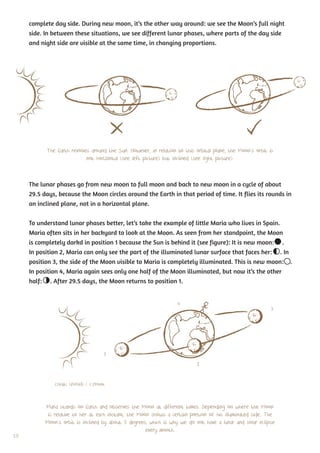
           The Earth revolves around the Sun. However, in relation to this orbital plane, the Moon’s orbit is
                            not horizontal (see left picture) but inclined (see right picture).


     The lunar phases go from new moon to full moon and back to new moon in a cycle of about
     29.5 days, because the Moon circles around the Earth in that period of time. It flies its rounds in
     an inclined plane, not in a horizontal plane.


     To understand lunar phases better, let’s take the example of little Maria who lives in Spain.
     Maria often sits in her backyard to look at the Moon. As seen from her standpoint, the Moon
     is completely darkd in position 1 because the Sun is behind it (see figure): It is new moon: .
     In position 2, Maria can only see the part of the illuminated lunar surface that faces her: . In
     position 3, the side of the Moon visible to Maria is completely illuminated. This is new moon: .
     In position 4, Maria again sees only one half of the Moon illuminated, but now it’s the other
     half: . After 29.5 days, the Moon returns to position 1.


                                                                   4
                                                                                                            3


                                      1
                                                                           2


               Credit: UNAWE / C.Provot


           Maria stands on Earth and observes the Moon at different times. Depending on where the Moon
            is relative to her at each instant, the Moon shows a certain portion of his illuminated side. The
           Moon’s orbit is inclined by about 5 degrees, which is why we do not have a lunar and solar eclipse
                                                       every month.
10
Facts about the Moon


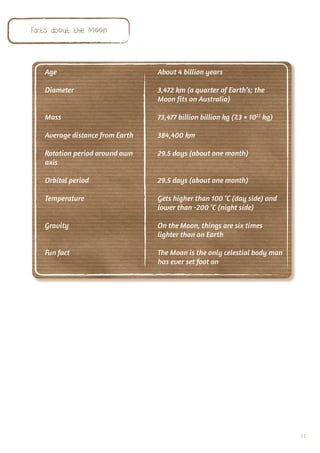
   Age                           About 4 billion years

   Diameter                      3,472 km (a quarter of Earth’s; the
                                 Moon fits on Australia)

   Mass                          73,477 billion billion kg (7.3 × 10²² kg)

   Average distance from Earth   384,400 km

   Rotation period around own    29.5 days (about one month)
   axis

   Orbital period                29.5 days (about one month)

   Temperature                   Gets higher than 100 °C (day side) and
                                 lower than -200 °C (night side)

   Gravity                       On the Moon, things are six times
                                 lighter than on Earth

   Fun fact                      The Moon is the only celestial body man
                                 has ever set foot on


                                                                             11
1.1 Fact File on
                              the Moon
                                                        Brief Description

                                                            Make a fact file of the Moon
                                                            by looking up fascinating
                                                            astronomical information
                                                            about it.


     Credit: UNAWE C.Provot


       Keywords

              •	 Moon
              •	 Fact file


       Materials

              •	 Image of the moon (Appendix)
              •	 Pen
              •	 Paper


       Learning Objectives

              Learn about the properties of the Moon, in comparison to Earth.


12
Background Science


    The Moon is about 4 billion years old. Its diameter is 3,476 kilometres,
    corresponding to one-fourth of the Earth’s diameter, which is about the size
    of Australia. The mass of the Moon is about one ninetieth of the Earth’s
    mass, or 7.3 × 10²² kilograms (that is, a seven with 22 zeros!). It is made up
    of ferrous rock.

    The Moon revolves once around the Earth in 29.5 days (about one month),
    which is exactly the duration of one lunar day. That is why we always see
    the same side of the Moon. On the day side of the Moon, temperatures can
    reach up to 100° Celsius, while on the night side they can drop below –200°
    Celsius.

    The distance between the Moon and the Earth (i.e. 384,400 kilometres)
    could contain the Earth 30 times. It is the farthest humans have ever
    traveled: the Moon is the only celestial body that man has ever set foot on.
    On 21 June 1969, American astronaut Neil Armstrong stepped on the lunar
    surface as the first human being. On the Moon, you can jump especially
    high and far: your weight is only one sixth of your weight on Earth.

    Other sources: Get more information on our Moon through NASA’s website:
    http://goo.gl/6H9sK


 Full description


 •	 Ask children to search for information about the Moon from the fact
    sheet and books or websites.

 •	 Let them compare the obtained values to familiar things or other
    celestial objects and write them down in a fact file.

 •	 Encourage the children to use orders of magnitude (e.g. the Moon is 19
    times lighter than the Earth) instead of absolute numbers.


 Tip: The same exercise can be done for other celestial bodies, to get an
 understanding of the relative sizes in the universe.


                                                                                     13
1.2 Distance to
                      the Moon
     Brief Description

        Use a to-scale model of the Earth and Moon. Learn to understand the
        relative distances between them.


     Keywords

        •	 Moon
        •	 Earth
        •	 Distance


     Materials

        •	 Globe (Box)
        •	 Moon sphere (Box)
        •	 Folding rule


     Learning Objectives

        Learn about the relative distances of the Earth-Moon system.


     Background Science

         The Moon and the Earth circle around each other at an average distance of
         384,400 kilometres. In many artist’s impressions, this length is pictured as
         much too small in relation to the sizes of both bodies. In reality, there is a
         lot of space between them: about 30 times the size of the Earth.


14
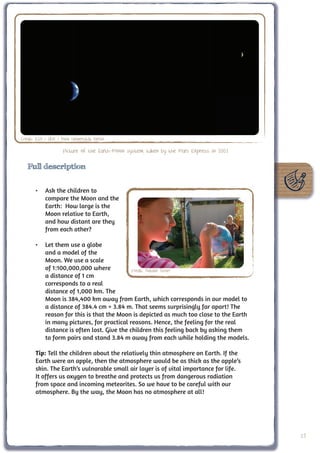
Credit: ESA / DLR / Freie Universität Berlin

                      Picture of the Earth-Moon system, taken by the Mars Express in 2003

   Full description


       •	 Ask the children to
          compare the Moon and the
          Earth: How large is the
          Moon relative to Earth,
          and how distant are they
          from each other?

       •	 Let them use a globe
          and a model of the
          Moon. We use a scale
          of 1:100,000,000 where            Credit: Natalie Fisher
          a distance of 1 cm
          corresponds to a real
          distance of 1,000 km. The
          Moon is 384,400 km away from Earth, which corresponds in our model to
          a distance of 384.4 cm = 3.84 m. That seems surprisingly far apart! The
          reason for this is that the Moon is depicted as much too close to the Earth
          in many pictures, for practical reasons. Hence, the feeling for the real
          distance is often lost. Give the children this feeling back by asking them
          to form pairs and stand 3.84 m away from each while holding the models.

       Tip: Tell the children about the relatively thin atmosphere on Earth. If the
       Earth were an apple, then the atmosphere would be as thick as the apple’s
       skin. The Earth’s vulnarable small air layer is of vital importance for life.
       It offers us oxygen to breathe and protects us from dangerous radiation
       from space and incoming meteorites. So we have to be careful with our
       atmosphere. By the way, the Moon has no atmosphere at all!


                                                                                            15
1.3 Lunar day

                                          Brief Description

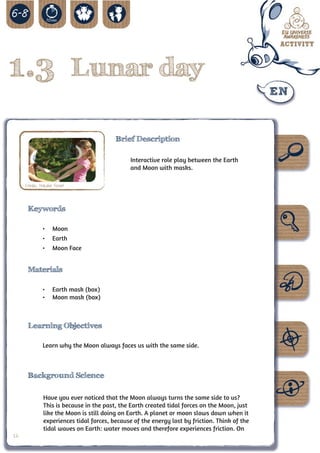
                                                Interactive role play between the Earth
                                                and Moon with masks.

     Credit: Natalie Fisher


      Keywords

              •	 Moon
              •	 Earth
              •	 Moon Face


      Materials

              •	 Earth mask (box)
              •	 Moon mask (box)


      Learning Objectives

              Learn why the Moon always faces us with the same side.


      Background Science

               Have you ever noticed that the Moon always turns the same side to us?
               This is because in the past, the Earth created tidal forces on the Moon, just
               like the Moon is still doing on Earth. A planet or moon slows down when it
               experiences tidal forces, because of the energy lost by friction. Think of the
               tidal waves on Earth: water moves and therefore experiences friction. On
16
Earth, the effects are clearly visible in the oceans. However, the rotation of
   our planet isn’t affected as much as that of the Moon, because it’s heavier.
   In fact, the Moon even stopped rotating at all from our point of view. We
   always see the same side of the Moon, because the Moon’s rotation slowed
   down until it reached the point where it completes one rotation in exactly
   the same time the Moon circles around the Earth. This phenomenon (the
   Moon is said to be tidally locked) can be observed in other planet-moon
   systems as well.

   Other sources: Short movie about the Moon in tidal locking:
   http://goo.gl/qZSI8


Full description


  •	 Ask two children to put on an earth and moon mask, thus playing the
     part of the Earth and the Moon.

  •	 Let them stand opposite to each other, take each other’s hands and
     slowly turn around each other. The earth child should try to keep stand
     in one spot as much as possible.

  •	 He/she clearly recognises that the moon child always turns the same
     side to her/him. From her/his point of view, the Moon does not rotate!

  •	 But what do those children see who observe the activity from outside?
     If they watch closely, they will realise that the moon child continuously
     changes her/his direction of view. So the Moon does in fact rotate
     around herself/himself. One revolution around the Earth takes the Moon
     just as long as one rotation around itself! Thus, a lunar day lasts 29.5
     days (it takes the Moon 29.5 days to orbit around the Earth).

  Tip: You should realise that the Earth isn’t depicted in the correct way in
  this activity. The earth child should actually spin around its axis much
  faster. However, this is not possible when the children are holding hands. In
  reality, the Earth doens’t always have the same side directed at the Moon.
  Every person on earth has seen the Moon!


                                                                                    17
1.4                            Lunar
                             Landscape
                                                         Brief Description

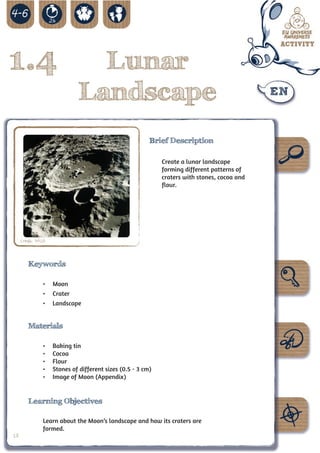
                                                             Create a lunar landscape
                                                             forming different patterns of
                                                             craters with stones, cocoa and
                                                             flour.


     Credit: NASA


        Keywords

               •	 Moon
               •	 Crater
               •	 Landscape


        Materials

               •	   Baking tin
               •	   Cocoa
               •	   Flour
               •	   Stones of different sizes (0.5 - 3 cm)
               •	   Image of Moon (Appendix)


        Learning Objectives

               Learn about the Moon’s landscape and how its craters are
               formed.
18
Background Science

   Galileo Galilei, an Italian astronomer and mathematician from the
   16th century, was the first man to take a close look at the Moon with a
   telescope. As he stared through the telescope for the first time, he couldn’t
   believe what he saw. Huge mountains, craters, highlands and valleys made
   up the breathtakingly beautiful lunar landscape.

   Several years after Galilei’s discovery, another Italian astronomer named
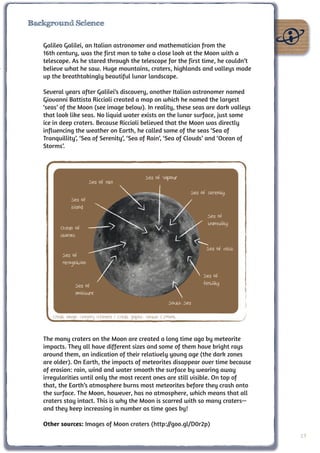
   Giovanni Battista Riccioli created a map on which he named the largest
   ‘seas’ of the Moon (see image below). In reality, these seas are dark valleys
   that look like seas. No liquid water exists on the lunar surface, just some
   ice in deep craters. Because Riccioli believed that the Moon was directly
   influencing the weather on Earth, he called some of the seas ‘Sea of
   Tranquillity’, ‘Sea of Serenity’, ‘Sea of Rain’, ‘Sea of Clouds’ and ‘Ocean of
   Storms’.


      Credit image: Gregory H.Revera / Credit graphic: Unawe C.Provot


   The many craters on the Moon are created a long time ago by meteorite
   impacts. They all have different sizes and some of them have bright rays
   around them, an indication of their relatively young age (the dark zones
   are older). On Earth, the impacts of meteorites disappear over time because
   of erosion: rain, wind and water smooth the surface by wearing away
   irregularities until only the most recent ones are still visible. On top of
   that, the Earth’s atmosphere burns most meteorites before they crash onto
   the surface. The Moon, however, has no atmosphere, which means that all
   craters stay intact. This is why the Moon is scarred with so many craters—
   and they keep increasing in number as time goes by!

   Other sources: Images of Moon craters (http://goo.gl/D0r2p)
                                                                                    19
Full description


           •	 Spread out a thick layer of flour on a baking tin, followed by a thin
              layer of cocoa on top of it, using a sieve.

           •	 Ask the children to collect stones of different sizes and throw them on
              the tin at different speeds and from different angles. In this way, many
              different craters will appear.


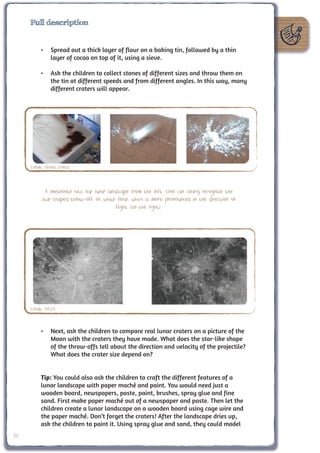
     Credit: Cecilia Scorza


            A meteorite hits our lunar landscape from the left. One can clearly recognise the
           star-shaped throw-off of white flour, which is more pronounced in the direction of
                                           flight (to the right).


     Credit: NASA


           •	 Next, ask the children to compare real lunar craters on a picture of the
              Moon with the craters they have made. What does the star-like shape
              of the throw-offs tell about the direction and velocity of the projectile?
              What does the crater size depend on?


           Tip: You could also ask the children to craft the different features of a
           lunar landscape with paper maché and paint. You would need just a
           wooden board, newspapers, paste, paint, brushes, spray glue and fine
           sand. First make paper maché out of a newspaper and paste. Then let the
           children create a lunar landscape on a wooden board using cage wire and
           the paper maché. Don’t forget the craters! After the landscape dries up,
           ask the children to paint it. Using spray glue and sand, they could model
20
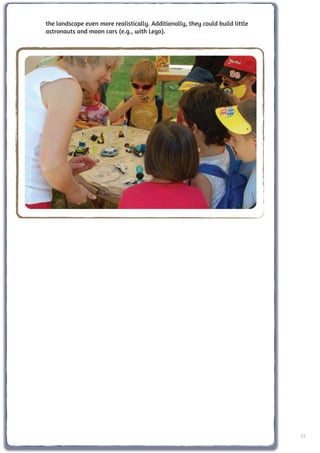
the landscape even more realistically. Additionally, they could build little
astronauts and moon cars (e.g., with Lego).


                                                                               21
1.5 Reflecting
                              Moon
     Brief Description

        Shine a flashlight on a white sphere from different directions to create
        different lunar phases.


     Keywords

        •	 Moon
        •	 Reflected light
        •	 Lunar phases


     Materials

        •	 Moon sphere (Box)
        •	 Wooden spit (Box)
        •	 Flash light


     Learning Objectives

        Learn why the Moon shines in different lunar phases.


     Background Science


          See introduction


22
Full description


         •	 Show the children the moon sphere attached to the wooden spit.

         •	 Now turn off the light: the children will realise that they cannot see the
            sphere in the dark because it doesn’t shine by itself.

         •	 Light up the sphere with a flash light (representing the Sun): it will look
            very bright on the side that is lit.

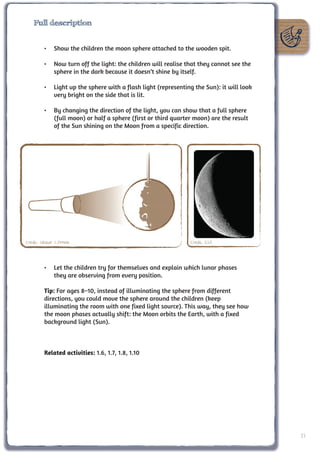
         •	 By changing the direction of the light, you can show that a full sphere
            (full moon) or half a sphere (first or third quarter moon) are the result
            of the Sun shining on the Moon from a specific direction.


Credit: Unawe C.Provot                                         Credit: ESA


         •	 Let the children try for themselves and explain which lunar phases
            they are observing from every position.

         Tip: For ages 8–10, instead of illuminating the sphere from different
         directions, you could move the sphere around the children (keep
         illuminating the room with one fixed light source). This way, they see how
         the moon phases actually shift: the Moon orbits the Earth, with a fixed
         background light (Sun).


         Related activities: 1.6, 1.7, 1.8, 1.10


                                                                                          23
1.6              Lunar Phases
                  Visualised

     Brief Description

        Watch the Moon shift phases by revolving an artificial moon around a
        globe with a fixed light source shining from one direction.


     Keywords

        •	 Moon
        •	 Lunar phases


     Materials

        •	   Light stand (Box)
        •	   Light bulb (Box)
        •	   Earth model (Box)
        •	   Moon sphere (Box)
        •	   Wooden spit (Box)


     Learning Objectives

        Visualise how the Moon shifts phases in the Earth-Moon-Sun
        system


     Background Science


          See introduction


24
Full description


  •	 The best way for children to visualise lunar phases is to play the role of
     the Earth, the Moon and the Sun themselves. For this, you need a light
     source (e.g. a light stand with a bulb, or an overhead projector) as the
     Sun, a globe and a suitable moon model fixed to a wooden spit.

  •	 Darken the room and make sure the fixed light source is pointed
     towards the centre of the classroom.

  •	 Now ask one volunteer to stand in the middle holding the Earth, and
     another child to hold the Moon at the edge of the room.

  •	 Let the rest of the class stand around the Earth to observe the Moon
     from there. Ask the moon child to revolve around the Earth. What do the
     children say about the shape of the Moon (lunar phase)? What happens?


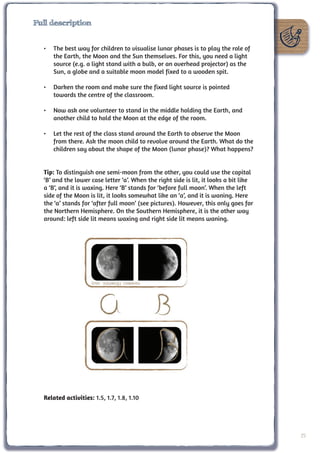
  Tip: To distinguish one semi-moon from the other, you could use the capital
  ‘B’ and the lower case letter ‘a’. When the right side is lit, it looks a bit like
  a ‘B’, and it is waxing. Here ‘B’ stands for ‘before full moon’. When the left
  side of the Moon is lit, it looks somewhat like an ‘a’, and it is waning. Here
  the ‘a’ stands for ‘after full moon’ (see pictures). However, this only goes for
  the Northern Hemisphere. On the Southern Hemisphere, it is the other way
  around: left side lit means waxing and right side lit means waning.


                     Bron: Wikimedia Commons


  Related activities: 1.5, 1.7, 1.8, 1.10


                                                                                       25
1.7                       Lunar Phases
                           Box Model
                                                               Brief Description

                                                                Build a simple shoe box model
                                                                with spyholes to see the four
                                                                main phases of the moon.


     Credit: UNAWE C.Provot


        Keywords

               •	 Moon
               •	 Lunar phases


        Materials

               •	   One shoe box per pair
               •	   Cotton ball (30 mm in diameter)
               •	   Black paint, wooden spit (Box)
               •	   Glue, brush
               •	   Small flash light
               •	   Scissors


        Learning Objectives

               Learn about the four main phases of the moon.


26
Background Science


   See introduction


Full description


   •	 Divide the class up into pairs and ask them to paint the inside of a shoe
      box black.

   •	 Let them cut a spyhole in the centre of each of the four sides. In one of
      the two narrow sides, they drill another hole, which is just big enough
      for a flash light to be inserted from the inside out.

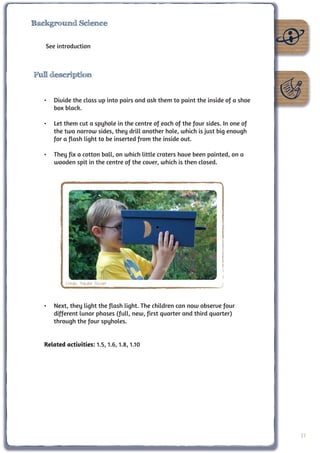
   •	 They fix a cotton ball, on which little craters have been painted, on a
      wooden spit in the centre of the cover, which is then closed.


           Credit: Natalie Fischer


   •	 Next, they light the flash light. The children can now observe four
      different lunar phases (full, new, first quarter and third quarter)
      through the four spyholes.


   Related activities: 1.5, 1.6, 1.8, 1.10


                                                                                  27
1.8 Lunar Phases
                             in Action
     Brief Description

        Arrange pictures of the lunar phases in the right order to see the
        progression from new moon to full moon and back.


     Keywords

         •	   Moon
         •	   Lunar phases
         •	   New moon
         •	   Full moon


     Materials

         •	 Set of lunar phases images (Appendix)


     Learning Objectives

         Learn about the progression of lunar phases through the month.


     Background Science

          It depends on the angle from where the Sun shines on the Moon in
          which phases it is in. Because the Moon rotates around the Earth
          counterclockwise, with the Sun as a relatively fixed background light,
          the boundary between day and night on the Moon shifts from right to
          left from the perspective of the Northern Hemisphere. This goes for both
28
waxing and waning moon. As viewed from the Southern Hemisphere,
                 the boundary shifts from left to right.


       Full description


            •	 Cut out the picture cards with the different lunar phases, shuffle them
               en distribute them. Each group of four children needs a set of cards.

            •	 Ask the children to place them in the right order (see bottom series for
               the correct order). Because the cards were cut out, it’s not clear anymore
               what is up and down. This makes it harder to determine which quarter
               moon is waxing and which is waning. On the Northern hemisphere, a
               lit right half means a waxing moon. On the Southern it’s the other way
               around.
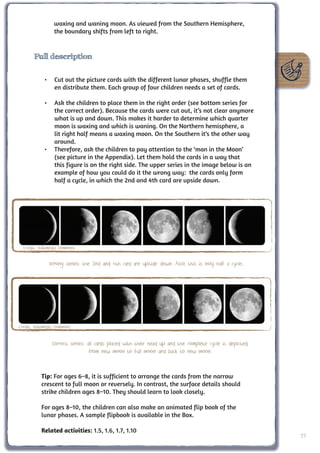
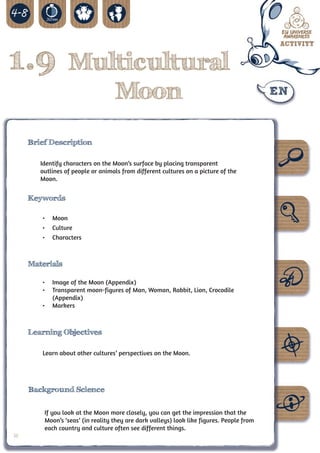
            •	 Therefore, ask the children to pay attention to the ‘man in the Moon’
               (see picture in the Appendix). Let them hold the cards in a way that
               this figure is on the right side. The upper series in the image below is an
               example of how you could do it the wrong way: the cards only form
               half a cycle, in which the 2nd and 4th card are upside down.


  Credit: Wikimedia Commons


              Wrong series: the 2nd and 4th card are upside down. Also, this is noly half a cycle..


Credit: Wikimedia Commons


                Correct series: all cards placed with their head up and the complete cycle is depicted,
                                 from new moon to full moon and back to new moon.


          Tip: For ages 6–8, it is sufficient to arrange the cards from the narrow
          crescent to full moon or reversely. In contrast, the surface details should
          strike children ages 8–10. They should learn to look closely.

          For ages 8–10, the children can also make an animated flip book of the
          lunar phases. A sample flipbook is available in the Box.

          Related activities: 1.5, 1.6, 1.7, 1.10
                                                                                                          29
1.9               Multicultural
                     Moon
     Brief Description

        Identify characters on the Moon’s surface by placing transparent
        outlines of people or animals from different cultures on a picture of the
        Moon.


     Keywords

        •	 Moon
        •	 Culture
        •	 Characters


     Materials

        •	 Image of the Moon (Appendix)
        •	 Transparent moon-figures of Man, Woman, Rabbit, Lion, Crocodile
           (Appendix)
        •	 Markers


     Learning Objectives

        Learn about other cultures’ perspectives on the Moon.


     Background Science


         If you look at the Moon more closely, you can get the impression that the
         Moon’s ‘seas’ (in reality they are dark valleys) look like figures. People from
         each country and culture often see different things.
30
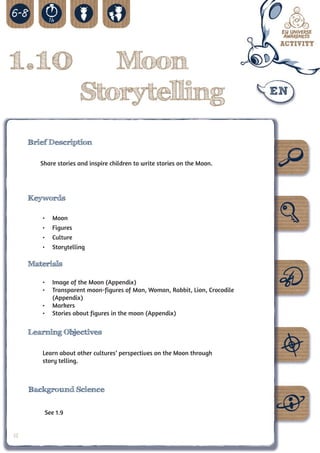
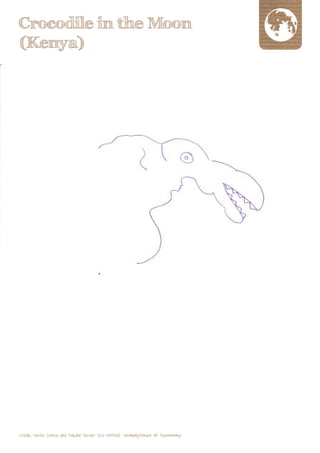
The figures usually correspond to the culture and
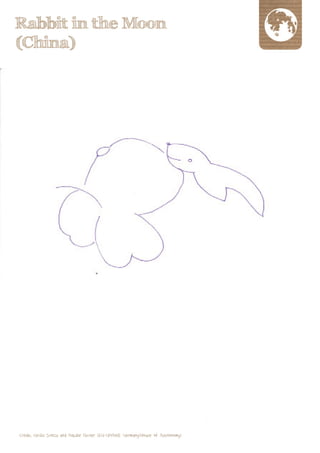
            environment. For example, why do the Chinese
            see a rabbit and no crocodile? Because there
            are no crocodiles in China, but many rabbits. In
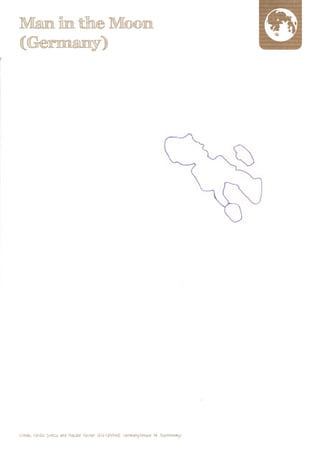
            Germany, people see a ‘Man in the Moon’.


                                                                              Germany


Credit: Cecilia Scorza

             Kenya                  China                Congo                Universal


      Full description

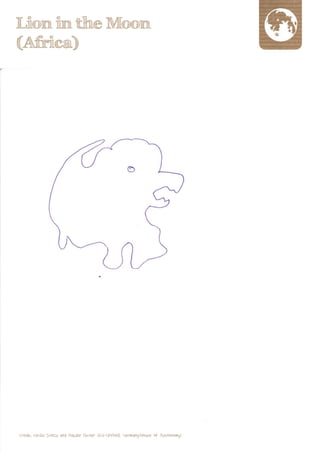
            •	 Show the children the figures in the Moon from different countries
               simply by putting one Moon-figure transparency after the other on the
               picture of the Moon.

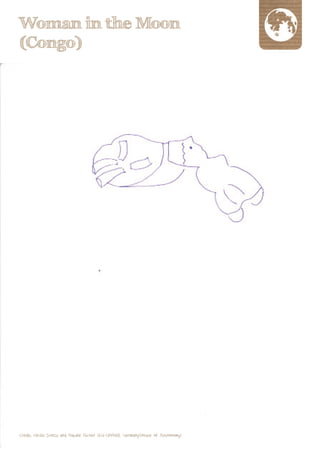
            •	 Now you can ask the children: Why don’t people in Congo see any
               rabbits? And why don’t the Chinese see a crocodile?

            Tip: If you have children in the class who originate from different countries,
            let them ask at home which characters their relatives see, based on their
            culture. The stories about the moon figures are also very suitable for
            theatre plays!

            Related activities: 1.10, 2.3


                                                                                             31
1.10                      Moon
                       Storytelling
     Brief Description

        Share stories and inspire children to write stories on the Moon.


     Keywords

        •	   Moon
        •	   Figures
        •	   Culture
        •	   Storytelling

     Materials

        •	 Image of the Moon (Appendix)
        •	 Transparent moon-figures of Man, Woman, Rabbit, Lion, Crocodile
           (Appendix)
        •	 Markers
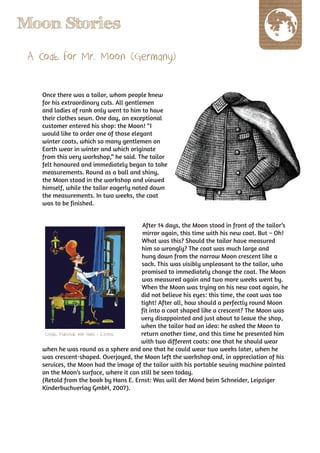
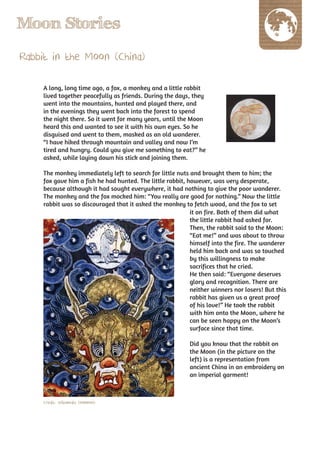
        •	 Stories about figures in the moon (Appendix)

     Learning Objectives

        Learn about other cultures’ perspectives on the Moon through
        story telling.


     Background Science


         See 1.9


32
Full description

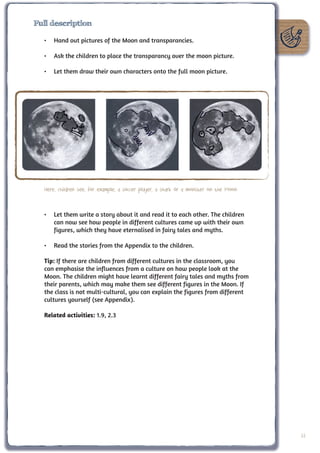
  •	 Hand out pictures of the Moon and transparancies.

  •	 Ask the children to place the transparancy over the moon picture.

  •	 Let them draw their own characters onto the full moon picture.


  Here, children see, for example, a soccer player, a shark or a monster on the Moon


  •	 Let them write a story about it and read it to each other. The children
     can now see how people in different cultures came up with their own
     figures, which they have eternalised in fairy tales and myths.

  •	 Read the stories from the Appendix to the children.

  Tip: If there are children from different cultures in the classroom, you
  can emphasise the influences from a culture on how people look at the
  Moon. The children might have learnt different fairy tales and myths from
  their parents, which may make them see different figures in the Moon. If
  the class is not multi-cultural, you can explain the figures from different
  cultures yourself (see Appendix).

  Related activities: 1.9, 2.3


                                                                                       33
1.11              Mini Research Project:
                  Revolution of the Moon and Lunar Phases


     Brief Description

        Explore how the Moon shifts phases and revolves around the Earth by
        drawing the Moon every night for five weeks in a row.


     Keywords

        •	 Moon
        •	 Lunar phases
        •	 Revolution


     Materials

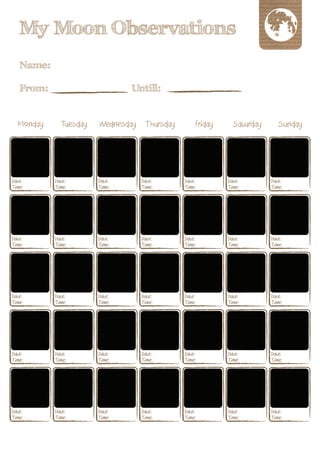
        •	 Moon observation form (Appendix)
        •	 White marker


     Learning Objectives

        Learn about the revolution of the moon by observing its phases.


     Background Science


         The Moon continuously changes shape: sometimes it looks like a banana-
         shaped crescent, sometimes it looks round as a ball. All these different faces
         of the Moon are called moon phases. The Moon is clearest visible during the
         night, but you can also watch it during the day!

34
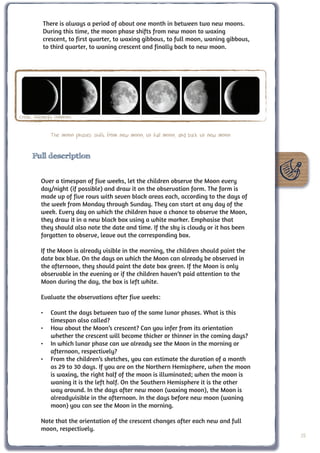
There is always a period of about one month in between two new moons.
           During this time, the moon phase shifts from new moon to waxing
           crescent, to first quarter, to waxing gibbous, to full moon, waning gibbous,
           to third quarter, to waning crescent and finally back to new moon.


Credit: Wikimedia Commons


               The moon phases shift from new moon, to full moon, and back to new moon


      Full description


          Over a timespan of five weeks, let the children observe the Moon every
          day/night (if possible) and draw it on the observation form. The form is
          made up of five rows with seven black areas each, according to the days of
          the week from Monday through Sunday. They can start at any day of the
          week. Every day on which the children have a chance to observe the Moon,
          they draw it in a new black box using a white marker. Emphasise that
          they should also note the date and time. If the sky is cloudy or it has been
          forgotten to observe, leave out the corresponding box.

          If the Moon is already visible in the morning, the children should paint the
          date box blue. On the days on which the Moon can already be observed in
          the afternoon, they should paint the date box green. If the Moon is only
          observable in the evening or if the children haven’t paid attention to the
          Moon during the day, the box is left white.

          Evaluate the observations after five weeks:

          •	 Count the days between two of the same lunar phases. What is this
             timespan also called?
          •	 How about the Moon’s crescent? Can you infer from its orientation
             whether the crescent will become thicker or thinner in the coming days?
          •	 In which lunar phase can we already see the Moon in the morning or
             afternoon, respectively?
          •	 From the children’s sketches, you can estimate the duration of a month
             as 29 to 30 days. If you are on the Northern Hemisphere, when the moon
             is waxing, the right half of the moon is illuminated; when the moon is
             waning it is the left half. On the Southern Hemisphere it is the other
             way around. In the days after new moon (waxing moon), the Moon is
             alreadyvisible in the afternoon. In the days before new moon (waning
             moon) you can see the Moon in the morning.

          Note that the orientation of the crescent changes after each new and full
          moon, respectively.
                                                                                          35
Tip:

     Astronomically, the most interesting phase of the moon is the first or third
     quarter moon, or when its crescent is still small. Then, using binoculars or a
     small telescope, the craters at the transition boundary from the illuminated
     to the unlighted side of the Moon can be observed best. This is because
     the light falls in from one side and the higher areas of the Moon cast long
     shadows over the valleys. When Galileo Galilei did the same about 400
     years ago, he and the world were surprised that there are such beautiful
     landscapes on the Moon.

     The full moon is a beautiful object rather for its overall appearance: during
     that time the bright and dark areas on the Moon are completely visible and
     reveal funny characters like the “Man in the Moon”.

     Some activities during an observation:

     •	 drawing the lunar craters (after
        having a look through a telescope)
     •	 drawing the Moon with its dark and
        bright areas
     •	 photographing the Moon

     For the observation, a simple pair of
     binoculars (preferably fixed to a tripod
     so it doesn’t shake) is sufficient. As an
     introduction you might, for example,
     tell a story about the life of Galileo
     Galilei. This way, a special connection is
     established between their own actions
     and this historical person.

     Astronomical websites or lunar calendars
     help putting together the most important         Credit: Wikimedia Commons
     information beforehand for a successful
     observation:

     •	     When does it get dark?
     •	     Which lunar phase can be seen when?
     •	     When does the moon rise and set?
     •	     How high is the moon in the sky?

     Before the observation night, try out where you can best observe the Moon
     (school yard, open field, private garden).

     Related activities: 1.5, 1.6, 1.7, 1.8


36
Credit: NASA


The Earth, Our
 Home Planet

                     37
Introduction


     The Earth is a very special planet: it is our home. When astronauts first stepped on the Moon
     in 1969 and brought home a photograph of the Earth taken from space, many people realised
     that we all live together on one tiny planet. From space, no political, cultural or linguistic
     boundaries are visible: we are all inhabitants of this one blue dot in a sea of emptiness.


     About 4.5 billion years ago,
     when the Sun was born, the
     Earth formed from the dust
     circling around it. Because the
     distance from the Earth to the
     Sun is just right, life can exist on
     our home planet. We need fluid
     water to survive, and water only
     takes on a liquid form at certain
     temperatures. If the Earth were a
     little closer to the Sun, all water
     would have evaporated. If it was
     farther away, the whole planet
                                             Credit: NASA
     would be frozen over. In addition
     to the convenient temperatures,
     we can thank the Earth’s atmosphere for protecting us. It burns up dangerous meteors that
     come flying in from space, it keeps away harmful radiation, and it collects sun rays to regulate
     the temperature and to trap some of the heat at night.


     The reason why you don’t see the Sun at night, is because the Earth rotates around its axis.
     When you are on the side of the Earth facing the Sun, it’s daytime. Twelve hours later, the Earth
     has spun half a rotation, causing you to be in the Earth’s own shadow, meaning it’s night time.


38
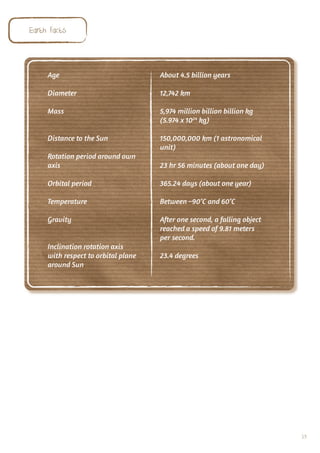
Earth Facts


     Age                             About 4.5 billion years

     Diameter                        12,742 km

     Mass                            5,974 million billion billion kg
                                     (5.974 x 1024 kg)

     Distance to the Sun             150,000,000 km (1 astronomical
                                     unit)
     Rotation period around own
     axis                            23 hr 56 minutes (about one day)

     Orbital period                  365.24 days (about one year)

     Temperature                     Between –90°C and 60°C

     Gravity                         After one second, a falling object
                                     reached a speed of 9.81 meters
                                     per second.
     Inclination rotation axis
     with respect to orbital plane   23.4 degrees
     around Sun


                                                                          39
40
2.1 Spherical
                         Earth

 Brief Description

    Watch a ship ‘sink’ down the horizon over a flat surface and a globe to
    perceive Earth’s shape.


 Keywords

    •	 Earth
    •	 Shape
    •	 Globe


 Materials

    •	 Globe (Box)
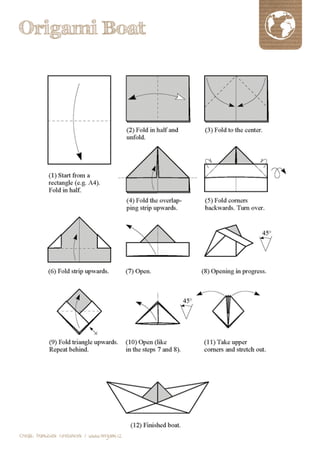
    •	 Origami ship (Appendix)
    •	 Toy figures (Appendix)


 Learning Objectives

    Perceive the spherical shape of the Earth.


                                                                              41
Background Science

        Children can make a simple observation to determine for themselves that
        the Earth is round. A captain standing on the seashore observes a ship going
        away from him. He will realise that the ship not only becomes smaller at the
        horizon (because distant objects seem smaller), but it also seems to “sink”:
        the hull is the first part to disappear, and the mast top is the last. How can all
        this be explained? Some centuries ago, people noticed ships sinking in or rising
        from the horizon, from which they concluded the Earth must be round. If the
        Earth were flat, ships wouldn’t sink while moving away, they would just keep
        getting smaller and smaller.


     Full description


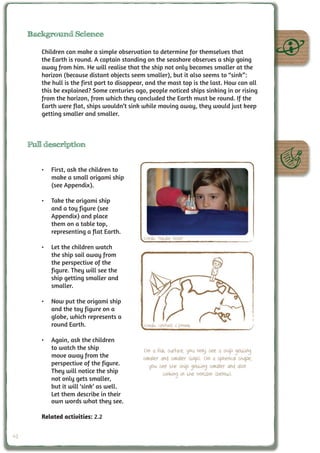
        •	 First, ask the children to
           make a small origami ship
           (see Appendix).

        •	 Take the origami ship
           and a toy figure (see
           Appendix) and place
           them on a table top,
           representing a flat Earth.
                                              Credit: Natalie Fisher
        •	 Let the children watch
           the ship sail away from
           the perspective of the
           figure. They will see the
           ship getting smaller and
           smaller.

        •	 Now put the origami ship
           and the toy figure on a
           globe, which represents a
           round Earth.                       Credit: UNAWE C.Provot

        •	 Again, ask the children
           to watch the ship                  On a flat surface, you only see a ship getting
           move away from the                 smaller and smaller (top). On a spherical shape,
           perspective of the figure.           you see the ship getting smaller and also
           They will notice the ship                   sinking in the horizon (below).
           not only gets smaller,
           but it will ‘sink’ as well.
           Let them describe in their
           own words what they see.

        Related activities: 2.2


42
2.2                          Up or
                             Down

 Brief Description

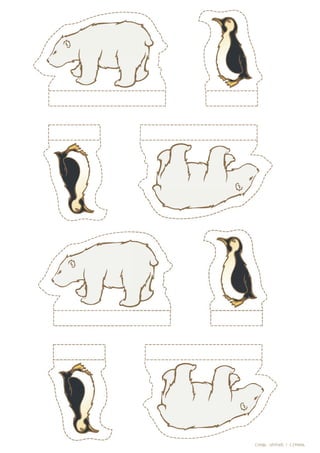
    Show the Earth has no ‘up and down’ by putting an ice bear on the North Pole
    of a globe and a penguin on the South Pole and explain the direction of Earth’s
    gravitation.


 Keywords

    •	 Earth
    •	 Gravity
    •	 Up/down


 Materials

    •	 Globe (Box)
    •	 Toy penguin (Appendix)
    •	 Toy ice bear (Appendix)


 Learning Objectives

    Obtain a feeling for the direction of the Earth’s gravitation. Learning that in
    reality, there is no ‘up’ or ‘down’. These directions just exist in one’s perception.


                                                                                            43
Background Science

        Adults consider some things trivial, with which children have some difficulties,
        for example, imagining themselves standing on the Earth’s surface. If the
        globe’s North Pole faces upwards, then people in Europe are standing on a
        slippery slope. And this is even more the case for people living on the equator,
        not to mention inhabitants of the Southern Hemisphere. Why don’t they fall
        off the planet?

        In our everyday experience, the world is limited to everything within our
        horizon. On such a small scale, the Earth’s surface is flat, and gravity seems to
        pull everything ‘down’. What is up, must come down. Children easily translate
        this local perspective onto the whole world. On a global scale, however,
        there is no force that pulls everything down. There is only a force that pulls
        everything towards the centre of the Earth. For people on the South Pole
        this means an ‘upward’ force. But from their perspective, it’s just a regular
        downward force.


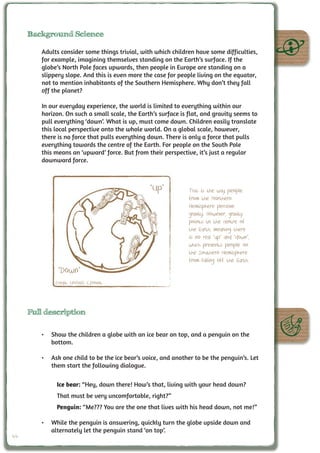
                                                “Up”           This is the way people
                                                               from the Northern
                                                               Hemisphere perceive
                                                               gravity. However, gravity
                                                               points to the centre of
                                                               the Earth, meaning there
                                                               is no real “up” and “down”,
                                                               which prevents people on
                                                               the Southern Hemisphere
                                                               from falling off the Earth.
              “Down”
             Credit: UNAWE C.Provot


     Full description

        •	 Show the children a globe with an ice bear on top, and a penguin on the
           bottom.

        •	 Ask one child to be the ice bear’s voice, and another to be the penguin’s. Let
           them start the following dialogue.

             Ice bear: “Hey, down there! How’s that, living with your head down?
             That must be very uncomfortable, right?”
             Penguin: “Me??? You are the one that lives with his head down, not me!”

        •	 While the penguin is answering, quickly turn the globe upside down and
           alternately let the penguin stand ‘on top’.
44
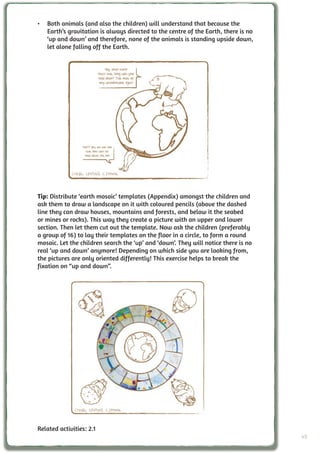
•	 Both animals (and also the children) will understand that because the
   Earth’s gravitation is always directed to the centre of the Earth, there is no
   ‘up and down’ and therefore, none of the animals is standing upside down,
   let alone falling off the Earth.


             Credit: UNAWE C.Provot


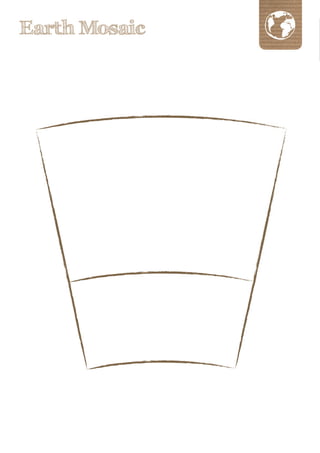
Tip: Distribute ‘earth mosaic’ templates (Appendix) amongst the children and
ask them to draw a landscape on it with coloured pencils (above the dashed
line they can draw houses, mountains and forests, and below it the seabed
or mines or rocks). This way they create a picture with an upper and lower
section. Then let them cut out the template. Now ask the children (preferably
a group of 16) to lay their templates on the floor in a circle, to form a round
mosaic. Let the children search the ‘up’ and ‘down’. They will notice there is no
real ‘up and down’ anymore! Depending on which side you are looking from,
the pictures are only oriented differently! This exercise helps to break the
fixation on “up and down”.


              Credit: UNAWE C.Provot


Related activities: 2.1
                                                                                    45
46
2.3 Our Home
                             Planet

 Brief Description

    Watch the Earth as one sphere on which all people live, by painting different
    people and animals on a paper maché globe.


 Keywords

    •	 Earth
    •	 Cultures


 Materials

    •	   Blue stability ball (120 cm in diameter)
    •	   Paper maché
    •	   Colour paint
    •	   Brushes


 Learning Objectives

    Obtain a feeling of being a ‘terrestrial’ or ‘earthling’, rather than being part of
    one culture or country.


                                                                                          47
Background Science


        The Earth is not only a natural habitat for plants, animals and human beings:
        it also offers space to many different cultures. A central experience that
        children should have in this project is to perceive themselves as terrestrials.
        The awareness of being a German, Turk, Russian, Italian or whichever
        nationality should then lead to the invitation: “Show me your world and I’ll
        show you mine.” Different cultures are like coequal windows through which
        the world can be viewed.


     Full description

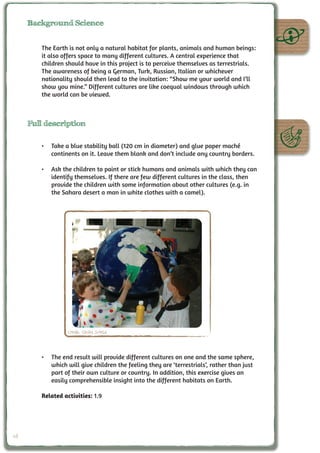
        •	 Take a blue stability ball (120 cm in diameter) and glue paper maché
           continents on it. Leave them blank and don’t include any country borders.

        •	 Ask the children to paint or stick humans and animals with which they can
           identify themselves. If there are few different cultures in the class, then
           provide the children with some information about other cultures (e.g. in
           the Sahara desert a man in white clothes with a camel).


                  Credit: Cecilia Scorza


        •	 The end result will provide different cultures on one and the same sphere,
           which will give children the feeling they are ‘terrestrials’, rather than just
           part of their own culture or country. In addition, this exercise gives an
           easily comprehensible insight into the different habitats on Earth.

        Related activities: 1.9


48
2.4                     Day and
                         Night

 Brief Description

    Perform a story about two people living on the other side of the Earth, who
    experience night and day at different moments.


 Keywords

    •	 Earth
    •	 Time
    •	 Day and night


 Materials

    •	   Globe (Box)
    •	   Light stand with bulb (Box)
    •	   Two toy figures (Appendix)
    •	   Glue pads


 Learning Objectives

    Learn what causes day and night.


                                                                                  49
Background Science


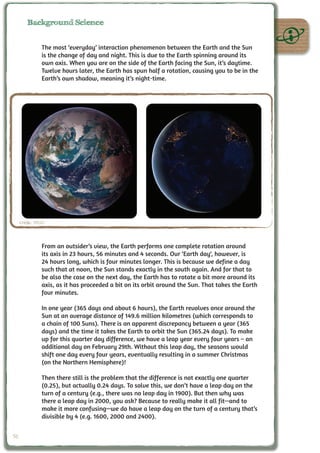
               The most ‘everyday’ interaction phenomenon between the Earth and the Sun
               is the change of day and night. This is due to the Earth spinning around its
               own axis. When you are on the side of the Earth facing the Sun, it’s daytime.
               Twelve hours later, the Earth has spun half a rotation, causing you to be in the
               Earth’s own shadow, meaning it’s night-time.


     Credit: NASA


               From an outsider’s view, the Earth performs one complete rotation around
               its axis in 23 hours, 56 minutes and 4 seconds. Our ‘Earth day‘, however, is
               24 hours long, which is four minutes longer. This is because we define a day
               such that at noon, the Sun stands exactly in the south again. And for that to
               be also the case on the next day, the Earth has to rotate a bit more around its
               axis, as it has proceeded a bit on its orbit around the Sun. That takes the Earth
               four minutes.

               In one year (365 days and about 6 hours), the Earth revolves once around the
               Sun at an average distance of 149.6 million kilometres (which corresponds to
               a chain of 100 Suns). There is an apparent discrepancy between a year (365
               days) and the time it takes the Earth to orbit the Sun (365.24 days). To make
               up for this quarter day difference, we have a leap year every four years – an
               additional day on February 29th. Without this leap day, the seasons would
               shift one day every four years, eventually resulting in a summer Christmas
               (on the Northern Hemisphere)!

               Then there still is the problem that the difference is not exactly one quarter
               (0.25), but actually 0.24 days. To solve this, we don’t have a leap day on the
               turn of a century (e.g., there was no leap day in 1900). But then why was
               there a leap day in 2000, you ask? Because to really make it all fit—and to
               make it more confusing—we do have a leap day on the turn of a century that’s
               divisible by 4 (e.g. 1600, 2000 and 2400).


50
Full description


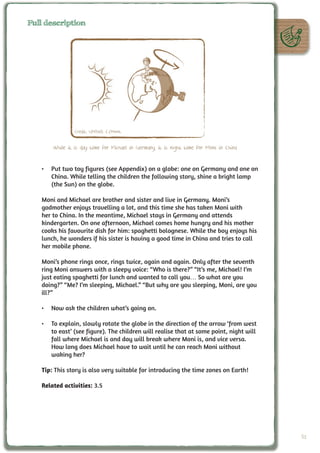
                Credit: UNAWE C.Provot


       While it is day time for Michael in Germany, it is night time for Moni in China


   •	 Put two toy figures (see Appendix) on a globe: one on Germany and one on
      China. While telling the children the following story, shine a bright lamp
      (the Sun) on the globe.

   Moni and Michael are brother and sister and live in Germany. Moni’s
   godmother enjoys travelling a lot, and this time she has taken Moni with
   her to China. In the meantime, Michael stays in Germany and attends
   kindergarten. On one afternoon, Michael comes home hungry and his mother
   cooks his favourite dish for him: spaghetti bolognese. While the boy enjoys his
   lunch, he wonders if his sister is having a good time in China and tries to call
   her mobile phone.

   Moni’s phone rings once, rings twice, again and again. Only after the seventh
   ring Moni answers with a sleepy voice: “Who is there?” “It’s me, Michael! I’m
   just eating spaghetti for lunch and wanted to call you… So what are you
   doing?” “Me? I’m sleeping, Michael.” “But why are you sleeping, Moni, are you
   ill?”

   •	 Now ask the children what’s going on.

   •	 To explain, slowly rotate the globe in the direction of the arrow ‘from west
      to east’ (see figure). The children will realise that at some point, night will
      fall where Michael is and day will break where Moni is, and vice versa.
      How long does Michael have to wait until he can reach Moni without
      waking her?

   Tip: This story is also very suitable for introducing the time zones on Earth!

   Related activities: 3.5


                                                                                         51
52
2.5                      Seasons


 Brief Description

    Tell a story about different seasons on two hemispheres, while holding a globe
    tilted towards a light bulb.


 Keywords

    •	 Earth
    •	 Seasons


 Materials

    •	   Globe (Box)
    •	   Light stand with a bulb (Box)
    •	   Two toy figures (Appendix)
    •	   Glue pads
    •	   Flashlight


 Learning Objectives

    Learn how the position of the Earth in relation to the Sun causes seasonal
    changes.


                                                                                     53
Background Science

        The Earth is not isolated in space: the Sun and the Moon create exciting
        phenomena on Earth like day and night, the seasons and eclipses.
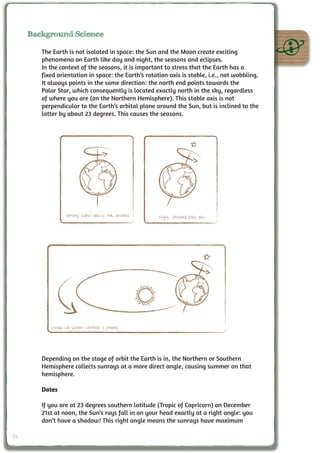
        In the context of the seasons, it is important to stress that the Earth has a
        fixed orientation in space: the Earth’s rotation axis is stable, i.e., not wobbling.
        It always points in the same direction: the north end points towards the
        Polar Star, which consequently is located exactly north in the sky, regardless
        of where you are (on the Northern Hemisphere). This stable axis is not
        perpendicular to the Earth’s orbital plane around the Sun, but is inclined to the
        latter by about 23 degrees. This causes the seasons.


                  Wrong: Earth axis is not inclined   Right: Inclined Erth axis


           Credit (all three): UNAWE C.Provot


        Depending on the stage of orbit the Earth is in, the Northern or Southern
        Hemisphere collects sunrays at a more direct angle, causing summer on that
        hemisphere.

        Dates

        If you are at 23 degrees southern latitude (Tropic of Capricorn) on December
        21st at noon, the Sun’s rays fall in on your head exactly at a right angle: you
        don’t have a shadow! This right angle means the sunrays have maximum

54
impact, making it summer on the Southern Hemisphere. At the same time,
children are having snowball fights on the Northern Hemisphere. It’s winter
there, because the sunrays are falling in at a wide angle, having minimum
impact.

On March 21st, the sunrays are impacting the equator at a right angle. Now
the Northern and Southern Hemisphere share the same temperature: on the
former it’s spring, on the latter it’s autumn. Three months later, on June 21st,
the Sun’s rays fall in at a right angle on Tropic of Cancer (an imaginary ring
at 23 degrees northern latitude). Now they have maximum impact on the
Northern Hemisphere: it’s summer in Europe. Again three months later, on
September 21st, the equator gets sunrays from a right angle once again. The
Northern and Southern hemisphere once again have the same temperatures,
only this time it’s autumn on the former, and spring on the latter.

Misconceptions

As you see, all that matters is the angle in which the sunrays fall in. As the
Earth orbits the Sun, both hemispheres take turns facing the Sun at a right
angle, because the Earth’s axis is tilted. This eliminates two misconceptions
about what causes the seasons. Some people think the seasons change
because the Earth’s distance to the Sun varies. It actually does, but this has
very little effect, and is not what causes seasonal changes. (Besides, this
wouldn’t distinguish both hemispheres from each other: it would be summer
on all places at the same time.) Furthermore, it is sometimes wrongly assumed
that due to the Earth’s tilted
axis, each hemisphere is at turns
closer to the Sun, causing it to be
summer there. The hemispheres
indeed are closer to the Sun at
turns, but this is such a minor
difference that it has no effect.
The real cause is the angle of the
incident sunrays!

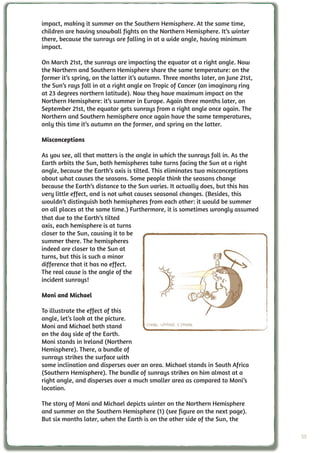
Moni and Michael

To illustrate the effect of this
angle, let’s look at the picture.
Moni and Michael both stand           Credit: UNAWE C.Provot
on the day side of the Earth.
Moni stands in Ireland (Northern
Hemisphere). There, a bundle of
sunrays strikes the surface with
some inclination and disperses over an area. Michael stands in South Africa
(Southern Hemisphere). The bundle of sunrays strikes on him almost at a
right angle, and disperses over a much smaller area as compared to Moni’s
location.

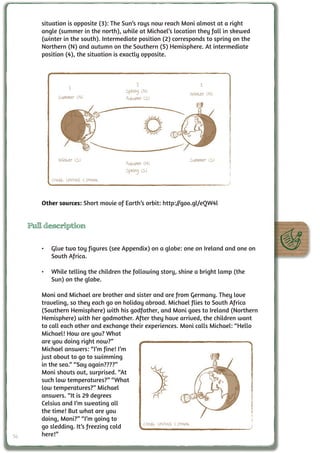
The story of Moni and Michael depicts winter on the Northern Hemisphere
and summer on the Southern Hemisphere (1) (see figure on the next page).
But six months later, when the Earth is on the other side of the Sun, the

                                                                                   55
situation is opposite (3): The Sun’s rays now reach Moni almost at a right
        angle (summer in the north), while at Michael’s location they fall in skewed
        (winter in the south). Intermediate position (2) corresponds to spring on the
        Northern (N) and autumn on the Southern (S) Hemisphere. At intermediate
        position (4), the situation is exactly opposite.


                                           2                      1
                  3                    Spring (N)             Winter (N)
              Summer (N)               Autumn (S)


              Winter (S)                                      Summer (S)
                                       Autumn (N)
                                       Spring (S)
           Credit: UNAWE C.Provot


        Other sources: Short movie of Earth’s orbit: http://goo.gl/eQW4l


     Full description

        •	 Glue two toy figures (see Appendix) on a globe: one on Ireland and one on
           South Africa.

        •	 While telling the children the following story, shine a bright lamp (the
           Sun) on the globe.

        Moni and Michael are brother and sister and are from Germany. They love
        traveling, so they each go on holiday abroad. Michael flies to South Africa
        (Southern Hemisphere) with his godfather, and Moni goes to Ireland (Northern
        Hemisphere) with her godmother. After they have arrived, the children want
        to call each other and exchange their experiences. Moni calls Michael: “Hello
        Michael! How are you? What
        are you doing right now?”
        Michael answers: “I’m fine! I’m
        just about to go to swimming
        in the sea.” “Say again????”
        Moni shouts out, surprised. “At
        such low temperatures?” “What
        low temperatures?” Michael
        answers. “It is 29 degrees
        Celsius and I’m sweating all
        the time! But what are you
        doing, Moni?” “I’m going to
                                             Credit: UNAWE C.Provot
        go sledding. It’s freezing cold
56      here!”
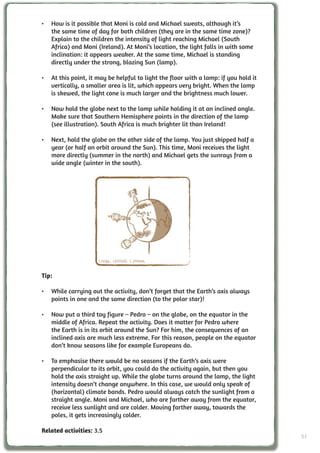
•	 How is it possible that Moni is cold and Michael sweats, although it’s
   the same time of day for both children (they are in the same time zone)?
   Explain to the children the intensity of light reaching Michael (South
   Africa) and Moni (Ireland). At Moni’s location, the light falls in with some
   inclination: it appears weaker. At the same time, Michael is standing
   directly under the strong, blazing Sun (lamp).

•	 At this point, it may be helpful to light the floor with a lamp: if you hold it
   vertically, a smaller area is lit, which appears very bright. When the lamp
   is skewed, the light cone is much larger and the brightness much lower.

•	 Now hold the globe next to the lamp while holding it at an inclined angle.
   Make sure that Southern Hemisphere points in the direction of the lamp
   (see illustration). South Africa is much brighter lit than Ireland!

•	 Next, hold the globe on the other side of the lamp. You just skipped half a
   year (or half an orbit around the Sun). This time, Moni receives the light
   more directly (summer in the north) and Michael gets the sunrays from a
   wide angle (winter in the south).


                     Credit: UNAWE C.Provot

Tip:

•	 While carrying out the activity, don’t forget that the Earth’s axis always
   points in one and the same direction (to the polar star)!

•	 Now put a third toy figure – Pedro – on the globe, on the equator in the
   middle of Africa. Repeat the activity. Does it matter for Pedro where
   the Earth is in its orbit around the Sun? For him, the consequences of an
   inclined axis are much less extreme. For this reason, people on the equator
   don’t know seasons like for example Europeans do.

•	 To emphasise there would be no seasons if the Earth’s axis were
   perpendicular to its orbit, you could do the activity again, but then you
   hold the axis straight up. While the globe turns around the lamp, the light
   intensity doesn’t change anywhere. In this case, we would only speak of
   (horizontal) climate bands. Pedro would always catch the sunlight from a
   straight angle. Moni and Michael, who are farther away from the equator,
   receive less sunlight and are colder. Moving farther away, towards the
   poles, it gets increasingly colder.

Related activities: 3.5
                                                                                     57
58
2.6                         Solar
                           Eclipse

 Brief Description

    Visualise a solar eclipse by creating a shadow on a globe with a small ball.


 Keywords

    •	   Earth
    •	   Sun
    •	   Moon
    •	   Eclipse


 Materials

    •	 Globe (Box)
    •	 Moon sphere (Box)
    •	 Flash light


 Learning Objectives

    Learn the mechanisms behind a solar eclipse.


                                                                                   59
Background Science


          By sheer coincidence, the apparent sizes of the Moon and the Sun in the sky
          are equal. The Moon is many times smaller than the Sun, but it is also closer
          to Earth, in the right proportion. As a consequence, when the Moon is exactly
          between the Sun and the Earth, the solar disk on the sky is exactly covered by
          the Moon. This makes a solar eclipse extra special!

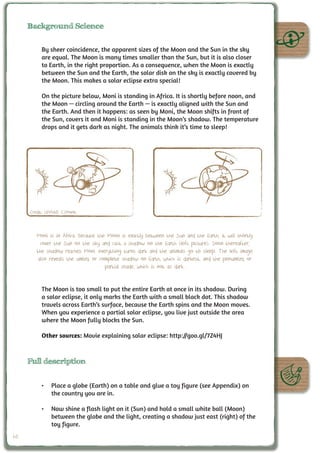
          On the picture below, Moni is standing in Africa. It is shortly before noon, and
          the Moon — circling around the Earth — is exactly aligned with the Sun and
          the Earth. And then it happens: as seen by Moni, the Moon shifts in front of
          the Sun, covers it and Moni is standing in the Moon’s shadow. The temperature
          drops and it gets dark as night. The animals think it’s time to sleep!


     Credit: UNAWE C.Provot


        Moni is in Africa. Because the Moon is exactly between the Sun and the Earth, it will shortly
          cover the Sun on the sky and cast a shadow on the Earth (left picture). Soon thereafter,
        the shadow reaches Moni: everything turns dark and the animals go to sleep. The left image
         also reveals the umbra, or complete shadow on Earth, which is darkest, and the penumbra, or
                                      partial shade, which is not as dark.


          The Moon is too small to put the entire Earth at once in its shadow. During
          a solar eclipse, it only marks the Earth with a small black dot. This shadow
          travels across Earth’s surface, because the Earth spins and the Moon moves.
          When you experience a partial solar eclipse, you live just outside the area
          where the Moon fully blocks the Sun.

          Other sources: Movie explaining solar eclipse: http://goo.gl/7Z4HJ


     Full description


          •	 Place a globe (Earth) on a table and glue a toy figure (see Appendix) on
             the country you are in.

          •	 Now shine a flash light on it (Sun) and hold a small white ball (Moon)
             between the globe and the light, creating a shadow just east (right) of the
             toy figure.
60
Credit: ESO


•	 Then slowly spin the Earth from west to east (left to right), eventually
   covering the figure with the shadow.

•	 Explain to the children this is what happens during a solar eclipse.

Tip: To make the story more vivid, tell a short introduction in which the figure
is doing something fun, and then suddenly it gets dark.

Related activities: 2.8, 3.2


                                                                                   61
62
2.7                        Lunar
                           Eclipse

 Brief Description

    Visualise a lunar eclipse by creating a shadow on a small ball with a globe.


 Keywords

    •	   Earth
    •	   Sun
    •	   Moon
    •	   Eclipse


 Materials

    •	 Globe (Box)
    •	 Moon sphere (Box)
    •	 Flash light


 Learning Objectives

    Learn the mechanisms behind a lunar eclipse.


                                                                                   63
Background Science


            The Moon not only causes solar eclipses, it can also get dark itself. How does
            that happen? As the Earth is illuminated on one side by the Sun, it casts a
            shadow behind it at the same time. So when the Earth gets in between the Sun
            and the Moon, a lunar eclipse occurs. In this situation, the Earth covers the
            Moon with its shadow. If there were people living on the Moon, they would
            see this as a solar eclipse! However, instead of getting completely dark, the
            lunar surface glows reddish. The Sun’s light is refracted into the shadowed
            area by the Earth’s atmosphere. Because the light has traveled a long distance
            through our Earth’s atmosphere, it is reddish as in a sunset. Thus, the Moon
            looks rather coppery than black during a lunar eclipse. It is interesting to note
            that the redder the Moon, the dustier our atmosphere!

            In ancient Greece, philosopher and scientist Aristotle closely observed lunar
            eclipses and concluded from it that the Earth must be round. How? If you look
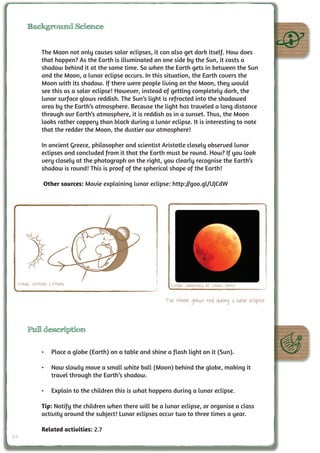
            very closely at the photograph on the right, you clearly recognise the Earth’s
            shadow is round! This is proof of the spherical shape of the Earth!

             Other sources: Movie explaining lunar eclipse: http://goo.gl/UJCdW


 Credit: UNAWE C.Provot                                     Credit: University of South Africa

                                                          The Moon glows red during a lunar eclipse.


     Full description

            •	 Place a globe (Earth) on a table and shine a flash light on it (Sun).

            •	 Now slowly move a small white ball (Moon) behind the globe, making it
               travel through the Earth’s shadow.

            •	 Explain to the children this is what happens during a lunar eclipse.

            Tip: Notify the children when there will be a lunar eclipse, or organise a class
            activity around the subject! Lunar eclipses occur two to three times a year.

            Related activities: 2.7
64
Credit: NASA


The Sun, Our
 Home Star

                    65
Introduction


     As seen from Earth, the Sun is the brightest and most noticeable celestial body — much brighter
     than the Moon and, above all, much brighter than the little stars in the night sky. However,
     the Sun actually is just a regular star: it is just as big as most stars. The reason why it seems
     so much brighter to us, is that the Sun is by far the closest star. Much of what we know about
     stars, we have learnt from closely observing our Sun.

     The Sun is about 4.6 billion years old and has a diameter of 1.39 million km. This corresponds
     to a chain of 109 Earths or 400 Moons! That is so immensely huge that our Earth alone would
     fit one million times into the volume of the Sun. Its distance to the Earth is about 100 times the
     Sun’s diameter: 149.6 million km. Within a little over 25 days it rotates once around its axis,
     even a bit faster on its equator than near the poles.

     On the outside, the Sun’s temperature is about 5700° Celsius, and deep within the core it’s about
     15 million degrees Celsius. Such high temperatures are caused by a process called nuclear fusion,
     which runs in the core. The Sun, like most stars, is a hot ball of gas, composed of about 73%
     hydrogen and 25% helium. The rest are heavier elements like iron, oxygen and carbon. The Sun’s
     outer layers push so hard on the inside with their weight, that enough pressure builds up in the
     core to make atoms crash into each other. Atoms are tiny particles that make up any substance.
     While crashing into each other, atoms fuse, thereby forming a new type of atom. For example,
     four hydrogen atoms can fuse into one helium atom. During this process, energy is released in
     the form of heat!


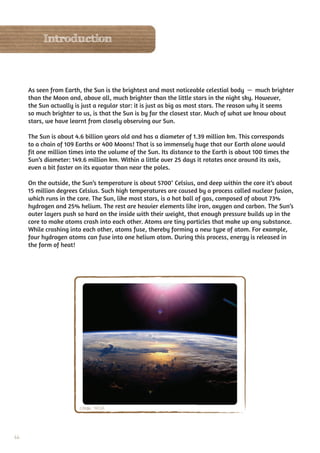
                        Credit: NASA


66
Solar Facts


   Age                          About 4.6 billion years

   Diameter                     1,392,684 km (109 Earths in a row)

   Mass                         2 thousand billion billion billion kg
                                (2 x 1030 kg)

   Distance to the Earth        150,000,000 km (1 astronomical unit)

   Rotation period around own   About 25 earth days
   axis

   Temperature                  5,700 °C on the surface and 15 million °C
                                in the centre

   Gravity                      If you could stand on the surface, you
                                would be 28 times as heavy compared
                                to on Earth

   Composition                  73% hydrogen, 25% helium, 2% other
                                elements, like iron, oxygen and carbon

   Fun fact                     Although the Sun is just a normal star,
                                compared to a planet it is still huge.
                                The Earth would fit over one million
                                times into the volume of the Sun!


                                                                            67
68
3.1 Apparent
                            Size
 Brief Description

    Look at the size of spheres on a floor or table top at different distances to
    understand why some look bigger than others, extending this to how eclipses
    occur.


 Keywords

    •	 Sun
    •	 Size


 Materials

    •	 3 balls of equal size
    •	 One large ball (about double the size)


 Learning Objectives

    Learn why the Moon looks as big as the Sun and why the Sun looks bigger
    than other stars.


                                                                                    69
Background Science

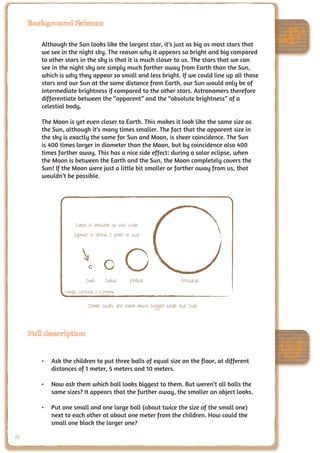
        Although the Sun looks like the largest star, it’s just as big as most stars that
        we see in the night sky. The reason why it appears so bright and big compared
        to other stars in the sky is that it is much closer to us. The stars that we can
        see in the night sky are simply much farther away from Earth than the Sun,
        which is why they appear so small and less bright. If we could line up all those
        stars and our Sun at the same distance from Earth, our Sun would only be of
        intermediate brightness if compared to the other stars. Astronomers therefore
        differentiate between the “apparent” and the “absolute brightness” of a
        celestial body.

        The Moon is yet even closer to Earth. This makes it look like the same size as
        the Sun, although it’s many times smaller. The fact that the apparent size in
        the sky is exactly the same for Sun and Moon, is sheer coincidence. The Sun
        is 400 times larger in diameter than the Moon, but by coincidence also 400
        times farther away. This has a nice side effect: during a solar eclipse, when
        the Moon is between the Earth and the Sun, the Moon completely covers the
        Sun! If the Moon were just a little bit smaller or farther away from us, that
        wouldn’t be possible.


                     Earth is invisible at this scale
                    Jupiter is about 1 pixel in size


                          Sun       Sirius      Pollux          Arcturus
                Credit: UNAWE / C.Provot

                           Some stars are even much bigger than our Sun


     Full description


        •	 Ask the children to put three balls of equal size on the floor, at different
           distances of 1 meter, 5 meters and 10 meters.

        •	 Now ask them which ball looks biggest to them. But weren’t all balls the
           same sizes? It appears that the further away, the smaller an object looks.

        •	 Put one small and one large ball (about twice the size of the small one)
           next to each other at about one meter from the children. How could the
           small one block the larger one?

70
•	 Place the large ball one meter farther away, behind the small ball. At this
   particular distance, the small ball (Moon) completely covers the large ball
   (Sun). Because the balls’ diameters differ by a factor of two, they look the
   same size if their distance also differs by a factor of two!


Related activities: 2.7


                                                                                  71
72
3.2                      Invisible
                           Light
 Brief Description

    Make infrared radiation visible by looking at a remote control
    through the camera of a mobile phone to discover invisible light.


 Keywords

    •	 Sun
    •	 Light
    •	 Infrared


 Materials

    •	 Infrared remote control
    •	 Mobile phone with camera


 Learning Objectives

    Learn about the special, invisible light which the Sun shines
    with, like infrared.


                                                                        73
Background Science

        The Sun provides us with light and heat. Without this source, life could not
        have developed on Earth. The indispensable sunlight looks white to us.
        White seems to be one specific colour, but actually is a composition of many
        colours. In the same way orange is a composition of red and yellow, white is a
        composition of all colours. So sunlight consists of all colours we can see, and
        a rainbow clearly shows this. When the Sun shows its face on a rainy day, its
        light is refracted in the water drops and split into its components. All visible
        colours can be seen in a rainbow. We call this the ‘visible’ light because our
        eyes can see it. Above the red line and below the blue line, however, there are
        two additional colours, respectively infrared and ultraviolet (UV). It’s just that
        our eyes are not made to see those. Above and below these ‘special’ colours,
        there are even more weird sorts of light. These invisible types either have very
        high energy, like for example X-rays, which we use in hospitals to see through
        our bodies, or low energy, like infrared radiation, whose properties are used
        in TV remote controls. In order to be able to see this special light, we need
        appropriate instruments.


                                                        Credit: UNAWE / C.Provot


        But why exactly does the Sun shine with all this light? In its interior, the
        Sun transforms hydrogen into helium. This process – called nuclear fusion –
        releases lots of energy. This energy keeps the Sun as hot as it is. And like a
        light bulb in a lamp the Sun glows because of its high temperature. If you look
        inside a toaster, you can also see it glow. Because it’s not as hot as the Sun, it
        only shines with red light. The Sun, however, is so hot that it shines with all
        possible kinds of light, including X-rays, infrared and UV!

        Other sources: Electromagnetic spectrum: http://goo.gl/NS21B


     Full description

        •	 Ask the children to take a remote control and press a button. An infrared
           signal should be coming out of the remote, but why can’t you see it? Is it
           broken?

        •	 Now let them do the same thing again, but this time make a movie of it
74
with their mobile phone instead of looking at it with their bare eyes.

•	 Ask them to look at the screen: a light signal does appear, the remote still
   works! The reason they can now see the signal is that the camera of their
   phone can see infrared light
   and projects it on the screen
   as visible light. Human eyes
   cannot see infrared.

Tip: You can also ask the children
to perform the activity themselves
at home. Let them surprise their
parents!

                                       Credit: Cecilia Scorza


                                                                                  75
76
3.3                 Sun’s
                   Shadow
 Brief Description

    Watch shadows during the course of day to explore the influence of the sun’s
    position in the sky.


 Keywords

    •	 Sun
    •	 Shadow


 Materials

    •	   Nice weather


 Learning Objectives

    Discover the influence of the Sun’s position on shadows, and learn about the
    solar path in the sky.


                                                                                   77
Background Science

        If the Sun’s rays are incident on an object, it will cast a shadow oriented away
        from the Sun. Our experience shows that the shadow always moves clockwise
        around the object casting it and its length continuously diminishes between
        sunrise and noon and, afterwards, prolongs again correspondingly.

        However, the shadow length does not only change in the course of a day
        but also during a year: for example, the length of the noon shadow is much
        smaller in summer than in winter!

        For more background science, see activity 3.4.


     Full description


        •	 Ask the children to explore everything in their school related to the solar
           shadow. For example, how do the shadows of the trees in the schoolyard
           change during a day? Which parts of the classroom does the Sun shine
           into in the morning or at noon? What direction does the shadow point to
           relative to the Sun? When is the shadow smallest, and when is it largest? Is
           there a practical application for our observation?

        Tip: Repeat the exercise in the next season. Did the shadows at noon get
        bigger? This will be the case if the season got colder (e.g., from autumn to
        winter). Did the shadows at noon get smaller? This will be the case if the
        season got warmer (e.g., from winter to spring).

        The cardinal directions can be memorised by means of a mnemonic (in
        clockwise direction): “Never Eat Soggy Waffles!”

        Related activities: 3.4


78
3.4 Sun’s Path
             and a sundial
 Brief Description

    Build a sundial and a horizon model to analyse the sun’s path across the sky.


 Keywords

    •	   Sun
    •	   Sundial
    •	   Solar path
    •	   Time


 Materials

    •	   Wooden plate with landscape motives
    •	   Toy figures (Appendix)
    •	   Transparent acrylic half-sphere (sky sphere)
    •	   Circular stickers of different colours for three solar paths (summer, spring/
         autumn and winter)
    •	   Copy of the sundial on stiff cardboard (Appendix)
    •	   Colour pencils
    •	   Scissors
    •	   Glue


 Learning Objectives

    Learn about the path of the sun during the day at different times of the year.


                                                                                         79
Background Science

        Depending on whether we can see the sun in the sky or not, we call it “day”
        or “night”. Our day begins with sunrise and ends with sunset; accordingly,
        the night begins with sunset and ends with sunrise. Thereby, the sun always
        rises in the east, reaches its highest point in the south and sets in the west. At
        least on the Northern Hemisphere. On the southern, the sun moves from east
        to west through the north. These observations are easily reconstructed using a
        horizon model:
                     With this self-made model, students can easily reconstruct the sun’s
                    path on the sky, as in the Explore Science exhibition in the Luisenpark
                                              Mannheim in 2011.


       Credit: Nathalie Fischer


        The model consists of a white wooden plate with landscape motives. In
        the middle, little child figure Oscar is standing. Over the plate there is a
        transparent acrylic half-sphere (sky sphere), on which the three solar paths
        (summer, spring/autumn and winter) are glued. In the picture, the paths
        represent the situation in Germany. The horizon is where the landscape disk
        and the sky sphere touch. The Sun is represented by a strong torch, which
        the children can move across the sphere.

                                                                Atmosphere


                                                         W


                                  S                                          N


                                                         E        Horizon
                              Credit: UNAWE / C.Provot
80
On March 21st, the sun moves along the middle path on the sky. Oscar’s
shadow is longer when the Sun is at a low point. At noon, when the Sun is
at its highest point, Oscar’s shadow is as short as it gets during that day.


Summer path (upper path)

The sun’s path rises more and more during spring, until it reaches its
highest level on June 21st. That day, the sun follows the summer path. The
children will notice that the sun has to travel a longer path across the sky
than in spring: the days last longer. The sun does not rise exactly in the
east anymore, nor does it set exactly in the west, as both points are shifted
northwards along the horizon. As compared to the situation on March 21st,
Oscar’s shadow is smaller at noon. Still, his shadow length changes during
the day.

Autumn path (middle path)

On September 21st, the sun’s path has reached the same level it has on
March 21st; the autumn path is the same as the spring path. The shadows
at noon are the same, just like the length of a day.

Winter path (lower path)

On December 21st, the sun’s path reaches its lowest point: the winter path.
Again, the sun does not rise exactly in the east or set exactly in the west.
Only this time, both points are shifted southwards along the horizon,
instead of northwards. December 21st is the shortest day of the year, and
the shadows at noon are the longest compared to the noon shadows during
the rest of the year. Still, the shadow lengths change during the day.

Other parts of the world

The above descriptions of the solar paths during the year only account
for the Northern Hemisphere. On the other half of the world, summer and
winter are exactly the other way around.

At the equator and the poles, the extreme regions on Earth, it is a different
story.

At the North or South Pole, the sun’s path is parallel to the horizon. It has a
height of 23.4 degrees above the horizon in summer at the North Pole. This
corresponds to the inclination of the Earth’s axis. A horizontal path means:
there is no night. During the year, the path sinks down and vanishes below
the horizon on September 21st. From then on, it stays dark for half a year,
until the sun’s path peaks above the horizon again on March 21st. On the
South Pole, the opposite happens. During the eternal night on the North
Pole, penguins at the South Pole enjoy daylight that lasts for six months. If
Oscar stands on one of the poles, his shadow length doesn’t change during
the day.

At the equator, the sun’s path is vertical to the horizon.

                                                                                  81
On March 21st and September           Equator
         21st, the sun moves across the sky                                 Atmosphere
         from east, through the zenith, to
         the west. If Oscar would stand
         on the equator on March 21st at
         noon, he would have no shadow
         at all!

                                                                              Horizon


         On June 21st and December 21st,                 Pole
         the paths are shifted by 23.4
         degrees to the north or south,
         respectively. It is noticeable on                              Atmosphere
         the equator that the twilight is
         very short, because the sun sets
         and rises at a right angle with the                    W
         horizon. The sun doesn’t slowly
                                                     S                               N
         slope down sideways, like in e.g.
         Europe, but goes straight down.
                                                                    E      Horizon


     Full description


        Because we know all about the different paths the Sun travels across the sky
        at different locations and different dates, we can use a sundial to measure
        time!

        •	 Ask the children to cut out and paint all three parts of the sundial from the
           Appendix.

        •	 Then let them fold them according to the instruction on the copies (see
           picture): the big clock-face is folded by 90 degrees with the coloured
           surface to the inside, and so are the two small quarter circles at the two
           triangles.

        •	 Next, they glue both triangles to each other such that a pair of quarter
           circles form one half circle.

        •	 Finally, they glue these half circles on the top and bottom of the big clock-
           face.

        •	 Let the children place the finished sundial on a sunlit place (e.g., the
           windowsill) and rotate it until the edge of the shadow casts onto the clock-
           face. Now the triangle indicates the time like a clock-hand. Around noon,
           the triangle casts no shadow (it points south).
82
Credit: Nathalie Fisher


Tip: With a wooden plate, toy figures (see Appendix), round stickers and
a glass sphere you can build a horizon model. With this, the children can
discover themselves how the sun’s path influences Oscar’s shadow, in relation
to both the time of the day and the year.


Related activities: 3.3


                                                                                83
84
3.5 Varying day
                          lengths
 Brief Description

    Watching different places on Earth having different day lengths, by placing a
    globe next to a light bulb at different sides of the lamp and spinning it


 Keywords

    •	 Earth
    •	 Time
    •	 Day length


 Materials

    •	 Globe (box)
    •	 Light bulb on a stand (box)


 Learning Objectives

    Understanding the cause of variation in day lengths: why winter days are
    shorter than summer days.


                                                                                    85
Background Science

        Day and night are caused by the spinning of the Earth around its own axis.
        If that axis were perpendicular to the Earth’s orbit around the Sun, every
        day would last exactly twelve hours on any location, just like every night. In
        reality, the Earth’s axis is tilted causing day lengths to vary. During winter,
        days are short and the cold nights seem to last forever, while the sultry
        summer days are seemingly endless, merely interrupted by short nights.

        Dates

        In December, the Earth has its Southern Hemisphere slightly turned to the
        Sun (see figure). This causes the South Pole to receive sunlight 24 hours per
        day. During the Christmas period, there are literally days with no end on
        Antarctica! At the same time, people in the Arctic circle (around the North
        Pole) live in eternal darkness: the sun doesn’t rise for days on end! (On the
        exact geographic North Pole, it is dark continuously for six months straight
        between September and March.) In June, the situation is the other way
        around: it’s summer on the Northern Hemisphere and around the North Pole
        days do not end.

        On September 21st and March 21st, the Earth has its equator turned at a right
        angle to the Sun. These are the only days when day and night each last 12
        hours on any location. On the Northern hemisphere, daytime lasts less than
        12 hours between September and March, with a minimum on December 21st
        (shortest day). However, between March and September days last longer than
        12 hours, with a peak on June 21st (longest day).


                                                2                 1
                          3                  Spring (N)        Winter (N)
                      Summer (N)             Autumn (S)


                      Winter (S)             Autumn (N)        Summer (S)
                                             Spring (S)
                    Credit: UNAWE C.Provot


        Locations

        The farther away from the equator you go, the more extreme variations in day
        lengths get. We already discussed the extremes of the North Pole above, where
        the Sun doesn’t set or rise for months on end. In less extreme regions, for
        example in Europe, the sun rises and sets every day. In for example Denmark,
        winter days get as short as 7 hours, while summer days get as long as 18
        hours. Further south, in Switzerland, the variation is not so extreme: winter
        days last a minimum of 8 hours, while summer days don’t get longer than
        16 hours. And at the most southern place of the Northern Hemisphere – the
        equator – the variation in day lengths is it an absolute minimum: zero. For
        example, Quito (Ecuador) lies on the equator, and there days always last 12
86
hours, regardless of the season.


Full description


   •	 Take a globe (on a tilted axis) and hold it next to a bright light bulb (at
      the same height). The room should be dim, so you can clearly see the light
      bulb shining on the globe.

   •	 To start, put the light bulb on a spot where most of its light will shine
      on the Southern Hemisphere (see figure). This represents winter on the
      Northern Hemisphere.

   •	 Now slowly spin the globe around its axis. Focus on the country you are in.
      As an example, we will use Germany. Why does Germany spend more time
      in the dark than in daylight?

   •	 Move the globe to the other side of the lamp. You just skipped half a year
      (half an orbit of the Earth around the Sun). Now the Northern Hemisphere
      is more directed towards the light bulb: it’s summer in Germany.

   •	 Spin the globe again. The children will notice that this time, Germany
      spends more time in daylight than in the dark. They will understand that
      the position of the Earth in relation to the Sun, together with Earth’s tilted
      axis, cause day lengths to shift.

   •	 Now spin the globe again, and this time ask the children to focus on the
      North Pole. Why does it stay lit all the time? The Sun doesn’t set there in
      summer! Also watch the South Pole: it stays dark, even though you are
      spinning the globe!

   •	 Place the globe to the other side of the lamp again, where you started the
      activity. Look at the poles again: why is the light distribution the other
      way around now?

   •	 Continue with the activity by watching Ecuador – on the equator – while
      the globe is spinning. Notice that it is lit equally as long as it stands in
      the dark, no matter how you hold the globe. Apparently, countries on the
      equator are not affected by summer or winter. Place the globe wherever
      you want: a day in Ecuador always lasts 12 hours. The children will notice
      that the further you move away from the equator, towards the poles, the
      variations in day lengths get more extreme.

   •	 To end with, place the globe in a position where it’s spring on one
      hemisphere and autumn on the other (a quarter orbit around the light
      bulb from where you started). Again, spin the globe. Any place on Earth
      receives 12 hours of daylight. March 21st and September 21st really are the
      switching points between summer and winter.

   Tip: While carrying out the activity, don’t forget that the Earth’s axis always
   points in one and the same direction (to the polar star)!

   Related activities:   2.4, 2.5, 3.4
                                                                                       87
88
3.6                   Solar
                     Surface
 Brief Description

    Imitate the solar surface by boiling water with herbs.


 Keywords

    •	 Sun
    •	 Granulation


 Materials

    •	   Cooking plate
    •	   Pan
    •	   Water
    •	   Dried herbs (2 table spoons)
    •	   Oil
    •	   Beaker


 Learning Objectives

    Learn about the texture of the Sun, what its surface looks like, and the
    convection of gases within it.


                                                                               89
Background Science


             With the naked eye, the Sun looks like a yellow disk without any surface
             features. In reality, however, it is more like a pot of bubbling soup, which
             sometimes splashes enormously and whose surface sometimes changes
             from minute to minute. We don’t notice that since the Sun is so bright that it
             overshines all surface details. This is also the reason that it is very dangerous
             to observe the Sun without any suitable equipment: if we would look at it
             directly, the Sun would blind our naked eyes!

             Astronomers do not only observe the Sun in the “visible” light. They take
             pictures in for example ultraviolet light, which look very uncommon and often
             reveal things that we cannot see with the naked eye.


     Credit: NASA / SOHO


                 Various pictures of the Sun photographed at the same time but with different sorts
                       of light. The right picture was taken in visible light. (Source: NASA/SOHO)


             Protuberances

             If all of the solar disk is covered, like during a solar eclipse, we recognise
             arcs of light at the edge of the Sun, so-called protuberances. By the way,
             some of these arcs are so large that the Earth would fit into them several
             times!


                           Credit: NASA


90
Granulation

   If we looked at the Sun through a larger, sufficiently protected telescope, we
   could see a honeycomb-like structure, so-called granulation. It covers the
   whole Sun like a net. Here, again, the comparison with a pot of bubbling soup
   is in place: the soup heated at the bottom of the pot rises up in many places,
   cools down a bit at the top and sinks down again. In this way, a continual
   motion is created. Because the cooled and sinking matter on the Sun appears
   less bright than the rising, hot matter, we get the impression of seeing a net of
   cells. These cells are called convection cells.


               Credit: NASA


    Other sources: Short movie of solar granulation: http://goo.gl/339lN


Full description


   •	 Pour a 2 cm layer of water in a pan with 2 tablespoons of dried herbs.

   •	 Now turn on the cooking plate. After a while, convection cells will begin to
      form. Inside, water rises up, and at the edges, it sinks back down. There,
      the herbs concentrate. The whole scene will look like granulation at the
      Sun’s surface (see figure).


       Credit: NASA                          Credit: Nathalie Fisher


      Sun granulation in the cooking pot: the situation on the solar surface (left picture)
                        is like the one in our experiment (right picture).
                                                                                              91
Next let’s look at convection more closely. Fill a beaker with oil and herbs and
     put it on the lit warmer. Observe the experiment. Above the warmer, the fluid
     moves into gear. You will recognise this by observing the herbs carried along
     by the fluid. The herbs rise up. After several minutes, you can observe the
     herbs sinking down at the rim. A circulating convection movement develops.


92
3.7 Mini Research Project:
                        Sun’s Rotation

  Brief Description

     Determine the rotation of the Sun, by observing sunspots during a
     few weeks


  Keywords

     •	 Sun
     •	 Sunspots


  Materials

     •	   1 SolarScope, several sheets of ISO A5 transparencies


  Learning Objectives

     Learning about the Sun’s rotation about its own axis.


                                                                         93
Background Science

        The Sun needs about 25 days for one rotation around itself. In order to
        measure this ourselves, we need to look out for an object on the solar surface
        that shares this motion. For this, so-called sunspots are suitable.
        If we look at the darkened Sun, e.g., through eclipse glasses filtering out
        99.999% of the light, we can sometimes recognise sunspots on the solar
        disk. They look like black spots with a somewhat brighter seam around
        them. In reality, they are also very bright, they just look darker as compared
        to the surrounding glistening surface of the Sun. The reason for that is
        the temperature difference of several hundred degrees between the cooler
        sunspots and their hotter surroundings.

        The look of the sunspots
        continuously changes. Some
        spots get bigger and bigger, and
        additional spots often form in
        the immediate vicinity. This is
        called sunspot groupings. The
        lifetime of a sunspot or sunspot
        grouping is several days as a
        rule, but it can sometimes reach
        several weeks. Every 11 years,
        the number of sunspots strongly
        increases. Astronomers call
        this an 11-year sunspot cycle.
        With an increasing number of            Credit: NASA
        sunspots, the general activity
        of the Sun also increases. As the Sun rotates around itself, the sunspots also
        change their position: they rotate with the Sun. If we observe a sunspot over
        a longer time span, we can assess the Sun’s rotation period on the basis of its
        movement.


     Full description

                                              •	     Ask the children to observe the Sun
                                                   every two to three days through a
                                                   SolarScope.

                                              •	      Let them stick one ISO A5
                                                   transparency to the projection side.
                                                   The SolarScope projects the image
                                                   of the Sun, which enters the interior
                                                   of the SolarScope through the small
                                                   telescope, onto the opposite side of the
                                                   projector, by means of a small mirror.

         Credit: Nathalie Fisher
                                              •	     Then they draw the visible edge of
                                                   the Sun on the sheet with a pen.

        •	 Subsequently, they draw all projected sunspots onto the sheet (little
           dots are sufficient). But beware: as the Earth is rotating, the solar disk is
94
always moving away from the sheet. The children therefore should work
     expeditiously and re-adjust the SolarScope from time to time by rotating
     it.

 •	 Finally, they label the transparency with the location, date, time and
    observers’ names.

 •	 Already a few days later, the children will notice all sunspots have
    changed their positions. They have moved on as the Sun rotates around
    its axis. In the course of the next few weeks, some spots appear for the
    first time at the edge, move across the solar surface and disappear again
    at the other edge. Other spots suddenly appear in the midst of the solar
    surface and/or disappear again.


           Credit: Nathalie Fisher


Evaluation

•	 After several observations, the children can analyse their drawings.

•	 First, the spots are identified. Thereafter, they are numbered beginning
   with the first sheet. If a spot appears again in a successive observation,
   it keeps its number. If the spot has disappeared, its number is not further
   used. If a new spot appears, it is assigned a new number.

•	 If we now stack the transparencies on an overhead projector, we see that
   all sunspots traverse the Sun. In doing so, they travel a certain distance
   on the sheet. The spots need half a Sun rotation to get from one solar edge
   to the other. Hence, we are able to determine the duration of one solar
   rotation: pick a sunspot that could be observed as long as possible, and
   measure its distance on the transparency in centimetres. Then compare
   this with the distance it would
   have travelled if one had
   observed it from one solar edge
   to the other. The ratio of these        West
   two numbers equals that of
   the observation time span and
                                                                            East
   half(!) a solar rotation period
   (as we cannot observe the path
   of the sunspot on the backside
   of the Sun). We can do this
   calculation with several spots
   and then average the results.
                                                                                   95
Example

     Sunspot F1 has travelled 7.7 cm (red line) in 8 days of maximum possible 12.3
     cm (blue and red lines), which corresponds to a ratio of 7.7 cm / 12.3 cm =
     0.63. Traveling the complete distance (from edge to edge) would have taken
     the spot 8 days / 0.63 = 12.7 days. This corresponds to a rotation period of 2 ×
     12.7 days = 25.4 days. You have measured the Sun’s spin!

     Tip: Watch out: observing the
     Sun is a dangerous exercise!
     The Sun is the most school-
     friendly observational object
     in astronomy, as it can be
     observed during school time.
     Also, it changes its appearance
     in reasonable time spans and
     is always easy to find. BUT �
     looking at the Sun directly, i.e.
     without protection, will severely
     damage your eyes! A careless
     look at the Sun through an
     optical device (e.g., a telescope)
     is enough to be blinded forever.      Credit: Nathalie Fisher
     The Sun burns into the retina
     and irreparably destroys the
     optic nerve.

     There are, however, good measures for not having to abandon the topic
     of observing the Sun. One possibility is to buy eclipse glasses. These have
     ‘glasses’ made of a special foil which filters out 99.999% of the light. Such
     foils are also available for telescopes and binoculars.


96
Ideas for incorporating the Sun
into other subjects


   Arts

    Children are fascinated and inspired by the enormous power of the Sun and its
    continuously changing surface. Look at different (real) pictures of the Sun with the
    class. Just search online for the keywords “Sun”, “sunspots” or “protuberances” and
    look at the pictures. Let the children draw the Sun, if possible on a large sheet of
    paper. It is also nice to draw on black coloured cards with bright chalk.


Mathematics


    The Sun is huge. A pearl chain with 109 Earth-sized pearls would correspond to
    its diameter, and 1 million of these pearls would fit into its interior. Such mental
    exercises can be reconstructed with suitable vessels and little spheres (marbles,
    pearls, cubes, etc.). By the way, if we used pearls of the Moon’s size, we would
    already need 400 of them in a row to get from one solar edge to the other.


Environment


     The heat of the Sun is essential to us. Some things on earth, however, get warmer
     than others if they are lit by the Sun. For example, most children have once burnt
     their feet on the hot beach and jumped onto the cooler towel. Ask the children
     to re-enact different situations on earth, e.g. the sea, desert, forest, etc. For this,
     let them select different materials that are lit by the Sun. They should feel the
     temperature with their hands and/or measure it with a thermometer. Suitable
     materials include two tubs of water (one with much water, one with little water),
     one tub of water with a black bottom, one tub of sand, another tub of flower soil
     (a part shaded by plants, another not), concrete stones, etc.

     Another possible question could be: Couldn’t one utilise this heat? A visit from an
     energy representative or a visit to a solar park are always enriching.
                                                                                               97
Humanities

        The Sun was adored as a deity in many cultures. Ask the children to research this
        topic.


98
Credit: NASA / JPL


Our Solar System


                           99
Introduction


      The Solar System, in which we live, consists of the Sun as its central star, eight planets
      with their moons and several dwarf planets. Together with hundreds of thousands of
      asteroids (boulders) and comets, these celestial bodies orbit the Sun.

      The Earth is a very special planet among these celestial bodies. It is our home! In order
      to understand the uniqueness, children need to compare the Earth to the other planets in
      the Solar System. As the Earth is located about 150 million kilometres from the Sun, the
      temperature is exactly right for liquid water to be present on the surface, unlike at most
      other planets. This proved crucial for the development of life!

      The Solar System as a whole is part of the Milky Way system, a collection of about 200
      million stars that are arranged in a spiral, along with gas and dust. Billions of these stars
      have planets and these, in turn, have moons. This suggests that we are probably not alone
      in the Milky Way, but the distances between the stars are so big that a visit to another
      world would be very difficult.


                Credit: Wikimedia Common / Nick Risinger


100                                                        Credit: NASA / JPL
Even the star nearest to us, Proxima Centauri, is 4.22 light years (i.e. over 40 trillion km)
away from us. This is so distant that a journey there would take generations of human
lives.


           Mercury    Venus Earth   Mars


                                           Jupiter        Saturn        Uranus       Neptune   Pluto


                     Rocky Planets                       Gas Giants
                                                                            Credit: UNAWE / C.Provot


Planets that orbit other stars than our Sun are called extrasolar planets or exoplanets for
short. Astronomers have already discovered more than 900 of these exoplanets.

We can categorise the planets of our Solar System into two types: the rocky planets,
which are nearest to the Sun and have a solid surface, and the gas giants, which are
farther from the Sun and are more massive and mainly composed of gas. Mercury,
Venus, Earth and Mars appear in the former category, and Jupiter, Saturn, Uranus and
Neptune make up the latter. Pluto, our formerly outermost planets, has been considered
one of the dwarf planets since 2006. Between Mars and Jupiter is a so-called asteroid
belt, which circles the Sun like a ring. It consists of thousands of smaller and larger
boulders. The largest of these have their own names, just like the planets. One of them,
Vesta, is so large that it is considered a dwarf planet.


                                                                                                       101
102
4.1 Know Your
                           Planets
 Brief Description

    Play a card game with the Sun and its planets. Questions are asked and
    answers are read from the cards.


 Keywords

    •	   Sun
    •	   Planets
    •	   Solar System
    •	   Cards


 Materials

    •	   Card game (Box),
    •	   Planets and Sun (flat) (Box),
    •	   Coloured pencils
    •	   Scissors


 Learning Objectives

    Learn about the properties of the different planets.


                                                                             103
Background Science

         Planets are spherical bodies orbiting a star and have, due to their sufficiently
         high masses, purged their orbits of all larger and smaller boulders by means
         of their gravitation. Dwarf planets are also spherical and orbit a star, but
         they have small masses and therefore such a weak gravitation that they are
         not capable of attracting smaller boulders in their vicinity. Moons are often
         spherical as well, depending on their size, but they orbit planets.
         Each of the planets in our Solar System has very specific features. We have
         summarised them in the fact files below. The following rule of thumb is valid
         in the Solar System: small planets lie close to the Sun and are made of solid
         material, while large planets are farther away from the Sun and are mainly
         composed of gas.

         Rocky Planets

         The four rocky planets (Mercury, Venus, Earth and Mars) are very dense
         (solid) and comparatively small. Their atmospheres are very thin, with the
         exception of Venus’.

         Mercury

         Mercury is the planet nearest to the
         Sun. It has no atmosphere and its
         solid surface, like that of our Moon, is
         covered with many craters. Mercury
         orbits the Sun once in just 88 days
         and has no moons. There are severe
         temperature differences on its surface:
         380° C on the side facing the Sun,
         and -180 ° C on the night side! This
         is because day and night shift very
         slowly on Mercury, because of its slow             Credit: NASA
         spin. Also, there is no atmosphere to
         trap the heat at night.

                                                    Venus

                                                    Venus is about as large as the Earth.
                                                    Carbon dioxide (a greenhouse gas)
                                                    makes up 99% of its atmosphere,
                                                    which causes sunlight to get trapped
                                                    in this mega greenhouse. Regardless of
                                                    day and night, it is always very hot on
                                                    Venus: almost 500° C! When compared
                                                    to the other planets, Venus’ spin
                                                    around its own axis is inverted.


          Credit: NASA


104
Earth

 Earth is the only planet in the Solar
 System that has liquid water on its
 surface, significant amounts of oxygen
 in the air and moderate temperatures.
 It orbits the Sun once in one year.
 Its stable inclined axis (23 degrees)
 leads to the development of seasons.
 Furthermore, it is the only celestial
 body on which we have found life so
 far.
                                                  Credit: NASA


                                          Mars

                                          Mars is half the size of the Earth. Its
                                          reddish colour is caused by iron oxide
                                          (rust). It has a very thin atmosphere
                                          which mainly consists of carbon
                                          dioxide. One of its special features is its
                                          many volcanoes, which reach heights
                                          of up to 23,000 metres! Mars has two
                                          moons and needs about twice as much
                                          time as the Earth to orbit the Sun. It
                                          also has seasons, as its rotation axis is
Credit: NASA                              inclined.


 Gas Giants

 The gas giants consist mainly of a mighty atmosphere and a relatively small
 solid core, and are comparatively large.


 Jupiter

 Jupiter is the largest planet in our
 Solar System. Like all giant planets,
 it mainly consists of gas and has a
 solid core. It has a remarkable red
 spot on its surface, which is two
 times the size of the Earth! This spot
 is a huge cyclone which has been
 raging for more than 400 years. By
 means of its gravity, Jupiter attracts
 many asteroids and thus protects us
 from their impacts. It has around 50
 moons and is composed mainly of                 Credit: NASA
 hydrogen and helium.


                                                                                        105
Saturn

                                                             Saturn is surrounded by large rings
                                                             and therefore earns its nickname
                                                             ‘Lord of the rings’. These rings
                                                             consist of numerous small ice
                                                             grains. Saturn’s atmosphere has
                                                             a fairly low density: Saturn is the
                                                             only planet in the Solar System
      Credit: NASA                                           that could float on water. It has
                                                             many moons: more than 60!


               Uranus

               Uranus has a few thin rings. It
               rotates around the Sun ‘on its
               belly’, which is probably due to the
               fact that it has been overturned
               by a collision. Its surface looks
               very smooth and barely shows any
               structure. It has 15 moons.


                                                                Credit: NASA


                                                            Neptune

                                                            Neptune’s surface has a blue
                                                            colour, like that of Uranus.
                                                            White clouds fly over its surface
                                                            at speeds of over 1000 km/hr.
                                                            Neptune’s path sometimes crosses
                                                            the orbit of dwarf planet Pluto.


                 Credit: NASA


               Dwarf Planet

               Pluto

               Pluto is composed of ice and rock. In 2006, astronomers decided that Pluto
               is no longer a planet but only a dwarf planet, although it is spherical. Due
               to its low mass, it cannot attract smaller boulders in its vicinity, as the ‘real’
               planets do. Pluto has one larger and two smaller moons. It is so small and far
               away that astronomers haven’t been able to take a nice picture of it!


106
Full description

   •	 First, ask the children to identify the pictures of the planets: which planet
      is seen on which photo?

   •	 Let them arrange the photographs of the Sun and its planets in the ‘right’
      order.

   •	 Next, the children paint the pictures of the card game: which peculiarities
      have to be taken into account?

   •	 They cut the ten cards along the lines. On the backside of each card, there
      is a summary of the most important features of the individual planets. At
      the bottom, there is a question, whose answer leads to another member of
      the Solar System. You need ten children to play the game.

   •	 Shuffle the cards and hand every child one card.

   •	 Ask the children to memorise the exact properties of ‘their’ celestial body.

   •	 The child with the sun card reads out loud the question on the bottom of
      the backside of its card. The answer should be called out only by that child
      whose celestial body was sought. Then, this child can read out loud the
      question on his/her card.

   •	 The game ends when it’s the turn again of the child with the sun card.

   Tip: In order to better memorise the order of the eight planets in our Solar
   System, one can use the following mnemonic: My Very Eager Mother Just
   Served Us Nachos.


                                                                                      107
108
4.2              Solar System
                    Model

 Brief Description

    Paint and arrange spheres to form a model of the Solar System.


 Keywords

    •	 Sun
    •	 Planets
    •	 Solar System


 Materials

    •	   Wooden spheres (Box)
    •	   Transparent strong foil (ca. 10 cm × 10 cm)
    •	   Paint and brush (Box)
    •	   Plasticine, permanent markers (black, thin, waterproof)
    •	   Planets and Sun (flat) (box)


 Learning Objectives

    Learn about the sizes, distances and order of the planets in the Solar System.


                                                                                     109
Background Science

         See introduction and activity 4.1


      Full description

         •	 Paint, together with the
            children, wooden spheres
            according to the pictures
            of the planets: Mercury
            (3.5 mm), Venus (11 mm),
            Earth (11 mm), Mars (6
            mm), Jupiter (80 mm),
            Saturn (60 mm), Uranus
            (35 mm) and Neptune (35
            mm). Also paint the Sun
            (100 mm).                         Credit: Nathalie Fischer

         •	 Let all spheres dry.

         •	 Next, draw concentric circles at the outer edge of Saturn’s plastic ring. Pull
            the ring over Saturn and fix it at its equator.

         •	 Place all planets on the table at suitable distances from each other.

         •	 The sizes of the planetary spheres are not all to scale, such that they can be
            handled better by the students. You can find an activity using models true to
            scale in activity 4.6.

         Related activities: 4.3, 4.6


110
4.3                      Seeing
                         Planets
 Brief Description

    Place the model of our solar
    system on a cloth against a
    banderol of stars to analyse
    when the planets of the Solar
    System are visible.

                                          Credit: Nathalie Fischer

 Keywords

    •	 Sun
    •	 Planets
    •	 Solar System


 Materials

    •	 Wooden planets and Sun (Box)
    •	 Blue cloth (Box)
    •	 Banderol of Zodiac (Box)


 Learning Objectives

    Learn about the locations of planets in our Solar System, and when we can see
    them from Earth.


                                                                                    111
Background Science

          See introduction and activity 4.1


      Full description

          •	 Spread a blue cloth on the floor.

          •	 Put a big yellow sphere - representing the Sun - in the centre, with the
             planets around it in the right order. Two of the planets (Mercury and
             Venus) should be located between the Sun and the Earth, with the others
             behind the Earth.

          •	 First, remove all planets except Venus, Mercury and Earth. Where is the
             day and night side of the Earth? When is the only time we can see Venus


                                                                                Mercury
              Venus


                             Mercury
                                                                        Venus


                               Earth                                Earth
         Credit: UNAWE / C.Provot


               and/or Mercury? Venus and Mercury are only visible on the day side
               of the Earth. Therefore, they can only be observed during the day
               (especially during twilight, when the sunlight is not so bright anymore).
               They can be observed in the western direction in the late evening
               (after the Sun has set just there) or in the eastern direction in the early
               morning (just before the Sun rises). In everyday language, Venus is
               called an evening or morning star, because of its apparent brightness
               during those parts of the day. However, Venus merely reflects sunlight,
               instead of producing light itself, like stars. In contrast, Mercury is
               difficult to see because it’s even closer to the Sun, giving us a narrower
               time span to observe it. Furthermore, it’s smaller and farther away.


112
•	 For simplicity, we now
   only leave the Earth
   and Jupiter on the cloth,
   besides the Sun. When
   can we see Jupiter (and
   the other outer planets)?
   This depends on where it
   is in its orbit. Sometimes
   this is at night, which
   makes it much easier
   to spot. Also, Jupiter is       Credit: Nathalie Fischer
   – just like the other gas
   giants – much bigger
   than Mercury and Venus. The only disadvantage is that the gas giants are
   farther away from us.


Related activities: 4.2, 4.6


                                                                              113
114
4.4 Asteriods

 Brief Description

    Make models of asteroids with clay and paint.


 Keywords

    •	 Asteroids
    •	 Planet formation


 Materials

    •	 Clay
    •	 Brushes
    •	 Paint


 Learning Objectives

    Learn about the characteristics and location of asteroids, and how planets and
    asteroids form.


                                                                                     115
Background Science


         Asteroids are boulders with sizes ranging between some hundred metres and
         several kilometres that orbit the Sun.


            Credit: NASA / JAXA / Arecibo / NSF / ESA


         An asteroid is called a meteorite if it accidentally hits the Earth. If it
         completely evaporates in the Earth’s atmosphere before crashing on the
         surface, it’s called a meteor. People usually refer to meteors as ‘shooting
         stars’. Most meteorites are predominantly composed of silicates or a mixture
         of iron and nickel. In the past, some huge meteorites have struck the Earth.
         Sixty-five million years ago, almost 90% of animal species were eradicated
         (among them the dinosaurs) when a meteorite hit Yucatan (Mexico).
         Luckily, this happens very rarely! We owe this to Jupiter, which attracts
         many asteroids with its gravitation.

         Many asteroids form large rings or
         belts around the Sun. There are two
         asteroid belts in our Solar System:                               Jupiter
         the main belt (or simply called
         asteroid belt) between Mars and                                   Mars
         Jupiter, with thousands of asteroids
         (see picture below), and the Kuiper
         belt, named after its discoverer, a                            Earth
         disk-shaped region that extends
         outside of Neptune’s orbit and
         contains countless asteroids and                               Asteriods
         many dwarf planets, of which Pluto             Credit: UNAWE / C.Provot
         is the most famous.


116
Full description

    •	 Ask the children to take a piece of clay the size of their fist.

    •	 Let them divide this into small pieces and place these fragments on a table.

    •	 Now ask them to squeeze all the pieces together to form one large
       asteroid, without kneading it.

    •	 Let them hit the clay chunk with the knuckle of a finger a few times.

    •	 After washing their hands, they can paint the asteroid.


    Credit: S.Deiries / ESO


  •	 Explain to the children that asteroids really form this way: little pieces
     clump together to form one giant rock. Also planets form this way. Around
     every young star is a disc of little pieces of dust, out of which planets and
     asteroids form.

  Tip: You could also tell the children about comets. Comets can be thought of
  as dirty snowballs or icy lumps of mud. They consist of a mixture of ice (from
  water as well as from frozen gases) and dust. Like asteroids, comets revolve
  around the Sun. However, their orbits are strongly elongated compared to
  planets, meaning they occasionally get very close to the Sun, and at times
  they get very far away. When they cross a planet’s orbit, they could collide
  with it. This happened, for example, in 1994, when the comet Shoemaker-Levy
  collided with planet Jupiter and broke into pieces. When comets come close to
  the Sun in their orbit, the ice in their core melts and evaporates. This causes a
  beautiful tail, which can be clearly seen in the night sky if the comet passes by
  the Earth closely enough.

  In 2061, Halley’s Comet will once again come close to the Earth! It orbits our
  Sun once every 76 years. Remember to mark its arrival on your calendar!
                                                                                      117
118
4.5 Planetary
                             Orbits
 Brief Description

    Create the elliptic orbit of the Earth around the Sun by drawing orbits with a
    large scaled compass.


 Keywords

    •	   Sun
    •	   Planets
    •	   Orbit
    •	   Ellipse


 Materials

    •	   Models of the Sun and Earth (Box)
    •	   Yellow rope knotted together (Box)
    •	   Two full bottles of water
    •	   Chalk


 Learning Objectives

    Learn about the elliptical orbits of planets.


                                                                                     119
Background Science

         Planets do not exactly orbit the Sun in perfect circles, but in ellipses. The
         definition of a circle is: every point on the circle has the same distance to the
         centre. For an ellipse, the definition is: every point on the ellipse has the same
         combined distance to both focal points. In a planet’s orbit, the Sun acts as one
         of the focal points. The other (imaginary) focal point is very close to the Sun
         (compared to the large scales in question), making the ellipse almost a circle.


                          Credit: Nathalie Fisher


         Why are planetary orbits elliptical? There are three possible shapes of an
         object’s path (apart from a straight line, which isn’t realistic since there are
         always gravitational forces around): a parabola, a circle and an ellipse.
         In the case of a parabola, a planet would fly in from outer space, its orbit
         would be bent by the Sun, and it would fly off again to infinity. Of course,
         the Solar System would run quickly out of planets if the orbits were shaped
         like this. That leaves circular and elliptical orbits. Circular orbits are simply
         too perfectly round to occur in nature. It would be infinitely coincidental if a
         planet were to fly in a perfect circle. Hence, planets have elliptical orbits.


      Full description

         •	 In order to graphically represent a circular orbit, knot two ropes together
            and lay them around a water-filled bottle and a chalk. Make sure the
            distance between the chalk and the bottle is such that the rope is tensed.


           Credit: Nathalie Fisher

120
•	 Now move the chalk around the bottle, while keeping the rope tensed,
   like a compass. This way, a circle forms on the floor with the bottle in the
   centre.

•	 Next, remove the bottle and put the Sun’s model in its place. Put the model
   of the Earth into the orbit. This completes the circular orbit. We now have
   an approximation of Earth’s orbit, but not an exact model: the orbit should
   be elliptical!

•	 To construct an ellipse, we need two bottles filled with water, and a piece
   of chalk.


           Credit: Nathalie Fisher


•	 Lay the rope around both bottles and the piece of chalk, and tense it again.
   This time, the rope is shaped in a triangular form.

•	 If the chalk now goes around both bottles with the rope tensed, an ellipse
   arises. In this model, the position of one of the bottles would represent the
   Sun and the piece of chalk would be the planet.

•	 Now replace one bottle and the chalk with the models of the Sun and the
   Earth, and remove the other bottle. We have a realistic (although probably
   exaggerated) model of Earth’s elliptical orbit around the Sun!

With the help of this method, very different ellipses can be constructed.
How does the shape of the ellipse change if we diminish the distance between
the bottles?

•	 How does the shape of the ellipse change if we increase the distance
   between the bottles?

In reality, the two focal points (bottles) are very close to each other, making
Earth’s orbit almost circular. Think about it: we don’t even notice the varying
distance in temperature!

Mathematically, the weights or nails in our construction mark the so-called
“foci” of an ellipse. The larger their distance, the more elongated the ellipse
becomes. Now, if a planet revolves on a very elliptic orbit, its distance from
the Sun will vary strongly in the course of a revolution around the Sun:
sometimes it is very large, sometimes comparatively small.

                                                                                   121
Credit: Nathalie Fisher


                  Tip: Note that the slightly varying distance of the Earth to the Sun does not
                  cause the seasonal changes, see activity 2.5.

                  The children can also build their own model: with a panel made of Styrofoam,
                  wood or cork, a sheet of paper as a drawing plane, two nails or pins, a cord
                  and a pen, every child can draw and examine different ellipses.

                  Related activities: 4.6


122
4.6 Distances
                    and Paths
 Brief Description

    Create a large model of the Solar System to scale by placing proportionately
    sized balls at right distances from each other in an open field.


 Keywords

    •	   Sun
    •	   Planets
    •	   Solar System
    •	   Scale


 Materials

    •	 Clay
    •	 Cotton
    •	 Tape measure


 Learning Objectives

    Obtain a feeling of the vast distances in the Solar System, relative to the
    planet sizes: the Solar System consists mostly of empty space. Learn to
    calculate these distances with scales.


                                                                                   123
Background Science

            The planets’ distances to the Sun and to each other are huge compared to their
            sizes. Thus, one cannot sensibly depict all planets together. Consequently,
            composite photographs are used in many textbooks. Still, one should be aware
            that this might create the false impression that the distances between all
            planets are the same!

            To provide a remedy, you can construct a model of the Solar System yourself!
            If you want to construct a model of our planetary system, you have to cast a
            glimpse of the sizes of the celestial bodies and their distances from the Sun.
            Then you will notice that you have to use a different scale for the planet sizes
            than for their mutual distances. Otherwise, either the planets’ paths will
            become several kilometres long or the planets become so small that it is hard
            to notice them.

            The following table reproduces the distances and sizes of the planets (sources
            for columns 1 and 2: dtv-Atlas Astronomie, 2005).


      Celestial        Diameter         Diameter           Distance from     Distance from
      body             in reality       scale 1:1          Sun in reality    Sun scale 1:20
                       [km]             billion [cm]       [million km]      billion [m]

      Sun              1 392 000        139.0              -                 -
      Mercury          4 878            0.5                57.9              2.8
      Venus            12 104           1.2                108.2             5.4
      Earth            12 756           1.2                149.6             7.5
      Mars             6 794            0.7                227.9             11.4
      Jupiter          142 984          14.3               778.3             38.9
      Saturn           120 536          12.1               1427.0            71.4
      Uranus           51 118           5.1                2869.6            143.5
      Neptune          49 528           5.0                4496.6            225.0
      Pluto            2 246            0.2                5900.0            295.0


            If you prefer to build a small planetary system, you can also interpret the
            distance from the Sun column as specifications in cm: the only important
            aspect is the ratios between these numbers (Pluto would then be 2.95 m from
            the Sun).


       Full description


            •	 Create models of the planets and the Sun by making balls of cotton or
               clay, or use appropriate-sized marbles or other spherical shapes objects.
               Use the table in ‘background science’ to get the right diameter.
124
•	 Now take the children outside, preferably to an open space (e.g., a lawn in
   a park).

•	 Divide the children into ten groups and assign one ball to each group.

•	 Starting from the edge of the park, ask the children to move away from
   you according to the distances in the right column of the table. Now they
   have made a (somewhat) realistic model of the Solar System.

•	 Notice the large distances: the Solar System mainly consists of vast
   emptiness! In reality, the distances should even be 20 times larger! Because
   the balls would then get too small, doing so would not be practical. Using
   a scale of 1:1 billion, all planets have acceptable sizes, but Pluto would be
   5.9 km from the Sun. On the other hand, with the use of a scale of 1:20
   billion, Pluto would be only 300 m away from the Sun, but some planet
   diameters would be less than 1 mm. Therefore, using two different scales
   is indeed practical, while still giving the children a good sense of the vast
   distances in our Solar System.

Tip: If it’s raining outside, or there is no open place nearby, you could just do
the exercise with the Sun and the Earth, which will still leave an impression,
especially if you tell the children that in reality the distance should be 20
times larger.


Related activities: 4.2, 4.3, 4.5


                                                                                    125
126
4.7 Journay to
                          planets
 Brief Description

    Use an origami paper rocket to travel through the large distances of our solar
    system.


 Keywords

    •	 Rocket
    •	 Origami


 Materials

    •	 Template for building an origami rocket (Appendix)
    •	 Coloured square papers


 Learning Objectives

    Learn about the large travel times in space.


                                                                                     127
Background Science

         We want to travel to the planets and get to know them more closely. Our
         card game and the planets’ paths already told us a lot about the planets. But
         we also need suitable rockets and surely have to think about how long our
         journey will take.


                          Escape velocity
          Celestial
                          (at the equator)
          body
                          [km/h]

           Mercury         15,480
           Venus           36,720
           Earth           40,320
           Mars            18,000
           Jupiter         214,560
                                                 Credit: NASA
           Saturn          127,800
           Uranus          76,680
           Neptune         83,880
           Pluto           3,960


         Traveling to other planets takes lots of time. It takes slightly less than one
         year to even reach our closest neighbour, Mars. Flying to Pluto would take
         almost a lifetime: about 45 years.

         To take off, we have to conquer Earth’s gravitational field. To do that, our
         rocket needs to reach the so-called escape velocity. If we want to leave the
         planet we visited and return home, we need to escape that planet’s gravity
         as well. The higher a planet’s gravitational field, the higher the escape
         velocity.

         For the Earth, this velocity is 40,320 km/h, or 40 times the speed of a
         plane! In the table above, you can see the values of all the planets. To leave
         Jupiter, for example, would take lots and lots of fuel. However, since Jupiter
         is a gas planet, you cannot land on it, so we’ll never encounter this problem.
         The four terrestrial planets have comparatively low escape velocities.

         The direct flight times to individual planets are in the table below.

128
Destination                     Distance               Diameter                 Flight time at    Flight time at
                                      from Earth             scale 1:1                1000 km/h         40,300 km/h
                                      [million km]           billion [cm]             [years]           [years]

      Sun                             0                      149.6                    17.08             0.42
      Mercury                         57.9                   91.7                     10.47             0.26
      Venus                           108.2                  41.4                     4.73              0.12
      Earth                           149.6                  0                        0.00              0.00
      Mars                            227.9                  78.3                     8.94              0.22
      Jupiter                         778.3                  628.7                    71.77             1.78
      Saturn                          1,427                  12,77.4                  145.82            3.62
      Uranus                          2,869.6                2,720                    310.50            7.70
      Neptune                         4,496.6                4,347                    496.23            12.31
      Pluto                           5,900                  5,750.4                  656.44            16.29


                      However, things are not that simple in practise. The flight paths to the
                      planets are much more complicated. Planets, the Earth and the Sun keep
                      pulling on the spacecraft during the whole journey. The following flight
                      times are more realistic:


                                                  n 6.05 years
                                             Satur

                 Venus
                                       er 2.73 years
                9 years           Jupit
             0.2 3.5 mon
                        t
                 a.
                        hs)
            (c


                              Mars
                                   months)


  Mercury
                              3.5 years


   0.4 years
(ca. 5 months)                0.7 .
                                 1


                                (ca


                                                                                 rs
                                                                            1 yea
                                                                 Uranus 16.


                                                                                           years
                                                                                    30.6
                                                                                                                   ars


                                                                            Neptune
                                                                                                                 ye


                                                                                                                  .5
                                                                                                                45
                                                                                                           to
                                                                                                       Plu


  Credit: UNAWE / C.Provot


                                                                                                                         129
Full description

         •	 Build an origami paper rocket with the children from the instructions found
            in the Appendix.

         •	 Now hold a discussion with the children on what would be the
            requirements for the rockets to travel to each planet, and how much time
            each journey would take. Consider not only the distance to a planet, but
            also its surface conditions. Which planets can we land on (see activity
            4.1)? How do we get through the asteroid belt that lies between Mars and
            Jupiter? What happens if we change the speed of the rocket?

         Tip: This activity can also be combined with 4.6.


         Credit: Nathalie Fisher


         Credit: Nathalie Fisher


130
4.8 Lighter or
                          Heavier
 Brief Description

    Calculate how much children would weigh on other planets


 Keywords

    •	   Gravity
    •	   Mass
    •	   Weigh
    •	   Planets


 Materials

    •	 Paper
    •	 Pen


 Learning Objectives

    Learn about the influence of gravity on the weight of objects on different
    planets.


                                                                                 131
Background Science


             There is one very special experiment that an astronaut carried out during a
             moon landing more than 40 years ago. He held a feather in one hand and a
             hammer in the other, and then released both objects simultaneously. Which
             one reached the ground first? They both hit the floor at the same time! If
             there’s no atmosphere, the feather doesn’t experience any air friction, just like
             the hammer would barely feel any on earth. In a vacuum, all objects fall at
             the same speed, regardless of their mass.

             When astronauts landed on the Moon, they had a lot of fun jumping on the
             lunar surface. Due to the weak gravitation, they could effortlessly jump very
             far and high. They felt extremely light.

             How much an object weighs on another celestial body depends on the so-
             called gravity acceleration. The higher this value, the stronger the celestial
             body attracts this object, i.e. the more it weighs. Note that the ‘mass’ of an
             object is always the same anywhere in the universe. One kilogram of sugar
             remains one kilogram of sugar. It just appears as if it had less mass on the
             Moon, because it weighs less there. The Moon attracts one kilogram of sugar
             with less force than the Earth does.

             To see how much one kilogram of sugar and a child of 30 kilograms weigh on
             the surface of each planet, see the table below.


                        Gravity                             Example 1 kg      Example 30 kg
      Celestial         acceleration         Multiplier     sugar             child
      body              at the equator                      [apparent kg]     [apparent kg]
                        [m/s2]

      Sun                273.7                27.9           27.9                837
      Mercury            3.7                  0.38           0.38                11.4
      Venus              8.87                 0.9            0.9                 27
      Earth              9.81                 1              1                   30
      Moon               1.62                 0.17           0.17                5.1
      Mars               3.71                 0.38           0.38                11.4
      Jupiter            24.79                2.53           2.53                75.9
      Saturn             10.44                1.06           1.06                31.8
      Uranus             8.69                 0.89           0.89                26.7
      Neptune            11.15                1.14           1.14                34.2
      Pluto              0.7                  0.07           0.07                2.1


             On the Moon, a child with a mass of 30 kg would weigh only 0.17 x 30 kg = 5.1
             kg, while on Jupiter it would weigh as much as an adult weighs on Earth: 2.36
             x 30 kg = 70.8 kg.

             Other sources: An astronaut carries out a famous experiment on the Moon
             with a feather and a hammer: http://goo.gl/TIvEI

132
Full description

   •	 Hand out the left two columns of the table from the background science,
      with the gravity acceleration for each planet and the multiplier.

   •	 Ask the children to write down how much a child would weigh on each
      planet, given that it weighs 30 kg on Earth.

   Tip: Note that the surface gravity not only depends on the mass of a planet,
   but also on its size. The bigger a planet is, the farther away you are from
   the centre when you stand on its surface. Distance decreases the amount of
   gravity you feel.


                                                                                  133
134
Related Subject Ideas


  Arts
Searching for extra-terrestrials is exciting. What could they look like? You could ask the
children to draw their own versions of extra-terrestrials, or make clay models of them.


   Credit: Nathalie Fisher        Credit: Nathalie Fisher                     Credit: Nathalie Fisher


 Baking

 You could also incorporate stories of the planets and other celestial objects with
 astro-art on cookies.


      Credit: Nathalie Fisher                           Credit: Nathalie Fisher

                                                                                                        135
Credit: ESA/ A.Fujii


      The World of
      Constellations

136
Introduction


 On a clear, moonless night, we can see many
 stars in a softly gleaming band in the sky. This
 is the Milky Way. In fact, we are in the Milky
 Way, and this band is a side view of other stars
 in the same galaxy. Especially from September
 until December, we can go searching for
 wonderful phenomena in the sky, because
 then Earth’s night side is turned to the Milky
 Way’s centre, where the largest concentration
 of stars is. Except for the Mily Way as a whole,
 we can recognise individual constellations
 across the sky. These are groups of stars that         Credit: Cecilia Scorza


                                                      astronomically speaking have nothing
                                                      to do with each other, but where
                                                      certain figures have been assigned to
                                                      during human history. People saw a
                                                      lion (Leo, left picture) or a balance
                                                      (Libra, upper picture) for example.

                                                      Officially, astronomers (represented by
                                                      the International Astronomical Union
                                                      (IAU)) divided the starry sky into 88
                                                      constellations.

Credit: Cecilia Scorza                                Besides these official constellations,


 each culture has its own constellations that                                       Polar Star
 exist alongside the others. In Europe, for
 example, the most famous constellation is the
 Plough. It is not an ‘official’ constellation, but
                                                         The Little Bear
 part of Ursa Major (the Great Bear). Depending
 on which country one is in, the name can
 always be different.
                                                           Plough
 If we look at the stars at night, we will notice
 that the constellations are not fixed on the sky.
 They seem to move, like the Sun, from east to                                   The Great Bear
 west. For the Sun, we know that this effect is
 caused by the Earth’s rotation around its own
 axis. Exactly the same is true for stars.
 To see where the cardinal directions are, we can     Credit: UNAWE / C.Provot
                                                                                                  137
use a trick: the Polar Star is always exactly in the north!

              We know that the Earth’s axis is inclined by about 23 degrees with respect to its orbital
              plane and exactly points north, to the Polar Star. Unfortunately, the polar star is a
              rather weak star in the constellation Ursa Minor (also called Little Dipper). But there
              is a trick to find it: we first have to find the constellation Plough, which is one of the
              most widely known constellations of the Northern Hemisphere (see picture at previous
              page). The Plough (yellow dots) is part of the constellation Great Bear. Now, if we
              conceptually connect the two back stars of the Great Bear (marked red) and extend this
              line five times upward, we arrive at the Polar Star in the constellation Little Bear! As all
              stars of the Little Bear are weaker than the Polar Star itself, we can easily recognise the
              latter.

              Since ancient times, sailors have benefited from the Polar Star and the other
              constellations in order to orientate themselves at sea and find their way back home.
              The height of the Polar Star above horizon corresponds to the geographical latitude of
              the observational location. Actually, the Polar Star is the only star standing still on
              sky, since it is located in extension of the Earth’s axis. This is purely by chance! On the
              Southern Hemisphere, there is no polar star.


      Credit: F. Char/ESO


             Multiple-exposure picture taken from the top of the 3060-metre-high Cerro Armazones, the selected site
              for the European Extremely Large Telescope (E-ELT) in Chile. Because of the rotation of the Earth, the
                                night sky is seen as it rotates around the southern celestial pole.
138
139
5.1               Visibiltity of the
                   Constellations

      Brief Description

         Determine which constellations are visible at night during different times of
         the year by placing a banderol with constellations around the Sun and Earth.


      Keywords

         •	 Constellations
         •	 Sun


      Materials

         •	 Banderol of Signs of the Zodiac (Box)
         •	 Model of the Sun and the Earth (Box)
         •	 Paperclip


      Learning Objectives

         Learn how the constellations move across the sky during the year.


140
Background Science

   In order to find constellations and other noticeable objects in the sky, we now
   imagine — as astronomers have been used to doing for hundreds of years — a
   transparent celestial sphere around our Solar System, on which we can find all
   the stars and objects of the universe, no matter how far they are from us. Note
   that in reality all these stars are at different distances from us. The stars in a
   constellation seem to belong together, but most of them are actually hundreds
   of light years apart from each other: they have a somewhat similar location
   on the sky, but their distance to Earth can be totally different. However, for
   orientation purposes, we depict them on one sphere.


                                                                         Polar star
           Celestial Shpehe


         Earth’s                                               Scorpio
         axis

                                       Earth


                         Gemini       Gemini             Leo


           Credit: UNAWE / C.Provot


     The celestial sphere has two halves: a northern and a southern one. In order to
    keep the picture easily understandable, we have only depicted Sun, Earth and Mars.


   Not all constellations can be observed in one night. Some, like for example the
   Small Dipper and Cassiopeia, are located near the Polar Star. They can be seen
   (in Europe) during the whole year and are called circumpolar constellations.
   Other constellations are only visible in certain seasons. For example, Orion
   is a typical winter constellation in Europe, but in Venezuela it is a typical
   summer constellation, where it is, however, more reminiscent of a butterfly
   than a celestial hunter due to its rotated orientation! Which constellations are
   currently visible depends very much on the observational location and time.
   Of course, stars are also in the sky during the day. We just cannot see them
   because the Sun is too bright. Only during a solar eclipse, when the Sun is
   covered by the Moon, one could actually see stars during the day.


                                                                                         141
Full description

         •	 Put the banderol of Signs of the
            Zodiac in a circle on the blue cloth
            and close it with a paperclip.

         •	 Put the Sun in the centre, with the
            Earth next to it.

         •	 Now ask the children which
            constellations they can see from
            Earth.

         •	 For this, they first have to
            recognise where on earth it’s day
            and where it’s night. Why can’t
            all constellations be observed
            on one night? The Sun always
            stands in front of a constellation,
            so you can’t see that one and its
            neighbours. After half a year the
            Earth has traveled half a round         Credit: Nathalie Fischer
            further along its orbit around
            the Sun. Then the opposite signs
            of the Zodiac get blocked by the
            sunlight.

         In the situation sketched in the image above, the constellations Scorpio,
         Sagittarius and Libra are visible in the night sky. The constellations located in
         the directions of the Sun, i.e. Gemini, Taurus and Aries, are not. For those to
         be visible, the Earth first has to proceed on its orbit for several months.

         Tip: Of course, there are more constellations that you can observe than
         just the Signs of the Zodiac. There are several methods to find out which
         constellations are visible at a given time, e.g., star maps in astronomical
         almanacs, turnable star maps or the internet.

         On the internet, a free programme (www.stellarium.org) shows the sky at
         any time of the day or night and from any location in the world. Projected
         with a beamer onto a wall, the experience comes close to a real observation!
         You could also use this programme for orientation on an observation night.

         Related activities: 5.2


142
143
5.2                        The Zodiac
                          and Planetary
                           Movements

      Brief Description

         Study the positions of the constellations with respect to the planets and the
         Sun by placing a banderol with constellations around the Solar System.


      Keywords

         •	 Constellations
         •	 Planetary movement


      Materials

         •	   Banderol of Signs of the Zodiac (Box)
         •	   Wooden spheres (Box)
         •	   Blue cloth (Box)
         •	   Paperclip


      Learning Objectives

         Learn how the planets move through the constellations during the year.


144
Background Science

   Everywhere on the celestial sphere, stars and constellations can be seen.
   On the orbital plane of the planets, there are 12 special constellations on
   the celestial sphere, which we call “Signs of the Zodiac.” Actually, this
   area comprises 13 signs: the constellation “Ophiuchus” is located above
   the constellations Scorpio and Sagittarius. For historical reasons, it does
   not belong to the zodiac. These constellations help us to find the planets
   in the sky. Seen from Earth, planet Mars stands for example in front of the
   constellation Cancer. But since Mars rotates around the Sun, two months
   later we find it in front of the constellation Leo. So it “wanders”, as seen from
   Earth, through the signs of the zodiac. Actually, all planets do that. We would
   therefore never find a planet in the constellation “Plough”, because it doesn’t
   lie in the orbital plane of the planets around the Sun, like the signs of the
   Zodiac.

   Exactly the same phenomenon can
   be observed with the Sun: seen
   from Earth, it is located in front
   of the constellation Virgo in the
   picture. But as the Earth moves
   around the Sun, the Sun seems to
   stand in front of the constellation
   Libra one month later. This means
   that the Sun also seems to go
   along the signs of the zodiac. It
   takes exactly one year to complete
   one round.

   These motions of the Sun and
   the planets in relation to the
   constellations are called positional
   astronomy.
                                               Credit: Natalie Fischer


Full description

   •	 Put the banderol of Signs of the Zodiac in a circle on the blue cloth and
      close it with a paperclip.

   •	 Place the Sun and its planets in the right order within the banderol. Note
      that the planets move counter-clockwise around the Sun.

   •	 Ask the children to describe the positions of the planets with respect to
      the constellations behind them. The constellation being blocked by the
      Sun is the one ascribed to a child whose birthday it was some weeks
      before.

   •	 Ask each child to place the Earth and the Sun in the positions they are on
      their birthday.

   Related activities: 5.1
                                                                                       145
5.3                 Planisphere: A
                  Turnable Star Map


      Brief Description

         Make a rotating map or a planisphere showing the features of the sky at any
         time or date.


      Keywords

         •	   constellations
         •	   sky
         •	   map
         •	   stars
         •	   planisphere
         •	   orientation


      Materials

         •	   Planisphere – Northern/Southern Hemisphere Star Map (Appendix)
         •	   Transparent sheet
         •	   Round split pin
         •	   Scissors
         •	   Glue
         •	   Colour pencils


      Learning Objectives

         Learn to navigate through the sky and find constellations using a planisphere.


146
Background Science


   A planisphere is a circular star map of the night sky. The star map contains
   the brightest stars and constellations visible from Earth. The composition of
   the night sky depends on whether the observer is on the Northern or Southern
   Hemisphere and the latitude and longitude. A planisphere is constructed to
   freely rotate about a common pivot point at its centre. Planispheres usually
   have transparent windows designed for a particular latitude and longitude to
   show only that part of the sky visible from a given latitude; stars below the
   horizon are not included.

   A full twelve months
   of calendar dates
   are marked on the
   rim of the star map.
   A complete 24-hour
   time cycle is marked
   on the rim of the
   overlay. The window
   is marked to show
   the direction of the
   eastern and western
   horizons.


                                                  Credit: Uncle’s Al


Full description


   •	 Ask the children to make a turnable star map from the copy sheet in
      the Appendix. You can find a plastic model in the Box. To start with, the
      children should cut out the cover sheet and the star map.

   •	 Inside the cover sheet they cut out an oval shaped window. Note that the
      shape and size of the spy window changes by latitude and longitude. The
      further from the equator you go, the more circular the spy window would
      become. The plastic model is suitable for the latitude of Europe (Northern
      Hemisphere) and Australia (Southern Hemisphere). Depending on your
      latitude, the children should cut out the window in the right shape.

   •	 Now, a part of the backside of the cover sheet is carefully spread with glue
      and the overhead foil is stuck onto it. Please take care that no sticky areas
      remain!

   •	 Then, carefully cut off those parts of the foil that protrude beyond the
      edge of the cover sheet.

   •	 Both sheets are laid centred on top of each other with the script to the top
      (the star map lies below).
                                                                                      147
•	 Prick a hole just in the centre of both disks, and join them with the split
         pin.

      •	 Now our star map is ready to use.

      •	 On the lower sheet, surrounding the stars, the months and days are
         indicated, on the cover sheet you see the hours of the day (noon being
         omitted). Furthermore, the cardinal directions are indicated around the spy
         window.

      •	 Through the spy window we see that part of the sky which is visible. Each
         constellation on the star map is named, its stars joint by lines and the
         brightest star is also named.

      Where is the Zodiac located? The children can colour it. If we turn the cover
      sheet, other areas of the starry sky with different constellations become
      visible.

      Are there constellations that are always visible? Yes: for example, the Big
      Dipper, Cassiopeia and so on.

      Now, how do we correctly adjust the map? This is very simple: we need to
      rotate the observational day (outer disk) and the time (spy window) such
      that both indications exactly oppose each other. Then we have the right sky
      section.

      How do we have to hold the map? In the Northern Hemisphere, to begin with,
      we search for the Polar Star. That is where north is. We turn in this direction.
      Now we also rotate our map (without shifting the maps with respect to each
      other) in such a way that we can read the word ‘North’ the right way up. Now,
      we hold the map with our arm stretched in the direction of the Polar Star. You
      have to visualise the star map like an umbrella above our head. The split pin
      corresponds to the Polar Star on the map. All stars located below the ‘Polar
      Star’ on the map are also below the Polar Star on the sky.

      We can now turn in an arbitrary cardinal direction (think of ‘Never Eat Soggy
      Waffles!’ in a clockwise direction) — we just have to also rotate the whole star
      map such that the corresponding cardinal direction is readable on the card the
      right way up.

      Does one have to “re-rotate” the map in the course of a night? As the Earth
      rotates around it axis, the sky also seems to rotate: new constellations rise in
      the east and others set in the west. Thus, one would have to re-rotate the star
      map repeatedly. But you will see that the spy window does not significantly
      shift within one hour.

      You may have noticed:

      •	 The sky section you have selected for a given date will also be visible at
         the same time next year! The map works independently from the year.
      •	 You can also see the once selected sky section on other days, you just have
         to accept a differing time of the day (e.g. the sky section on April 5 at 10
         pm is identical with the sky section of February 4 at 2 am or December 10
148
at 5:45 am.
Tip: There are great apps for Apple, Android and Windows smartphones that
show the starry sky live. You just have to point your phone to the sky area
you are viewing and you have a star map with an indication of the planets,
stars and other objects on your display.


                                                                              149
5.4                  Constellation
                       Shapes
      Brief Description

         Make a model of a constellation and look at it from different angles.


      Keywords

         •	 Constellation
         •	 Stars
         •	 Perspective


      Materials

         •	 5 stars (Box)
         •	 5 wooden spits of different lengths
         •	 Plasticine


      Learning Objectives

         Learn how constellations form from a number of stars at different distances,
         and that their shape appears differently from different perspectives.


150
Background Science

   The constellations far away from the zodiac, in the northern or southern parts
   of the celestial sphere, can be observed at any time of the year. For example,
   in the Northern Hemisphere, one can always see the Little Bear (including the
   Polar Star) and Great Bear. These are called circumpolar constellations. Other
   constellations, closer to the zodiac, are only visible in certain seasons, just like
   the ones from the zodiac. Orion, for example, is a winter constellation on the
   Northern Hemisphere.


                                                           Lig
                                                              ht
                                                                 Ye
                                                                   ars


   In the figure above, Orion can be seen on the right. The stars in this
   constellation appear to be connected somehow, but are they really? The
   answer is given by the left part of the figure: no, they don’t belong together.
   They are just located in the same part of the sky, but if you consider the
   distance from Earth as well, thinking three-dimensionally, you will notice
   they are in fact far apart. The man in the lower left part of the picture
   is standing on Earth and looking up at the sky. He sees a constellation,
   because from his perspective all stars are projected onto the sky sphere as
   one image. He cannot see that the stars are all at varying distances.

   The stars of a constellation do not all have the same brightness. The
   brightest star of a constellation is called the alpha star, and always carries
   a special name. For example, in the constellation Leo, the alpha star is called
   Regulus, which means ‘little king‘.


                                                                                          151
Which image people see in a group of stars in the night sky, depends on the
          culture. Therefore, the names of stars and constellations reflect on the history
          of past and present cultures.

          The following table lists the names of the brightest stars of several well-
          known constellations:


                      Constellation    Abbreviation           Alpha Star


                      Bootes          Boo                   Arcturus
                      Greater Bear    UMa                   Dubhe
                      Little Bear     UMi                   Polaris
                      Virgo           Vir                   Spica
                      Leo             Leo                   Regulus
                      Aquila          Aql                   Altair
                      Lyra            Lyr                   Vega
                      Cygnus          Cyg                   Deneb


      Full description


          •	 Stick five stars on five wooden spits of different lengths and place them
             on a table using plasticine, at different distances from each other, so that
             from the front they form the shape of the constellation Cassiopeia.

          •	 Let the children have a look from different angles, from the front and
             from the side, in a darkened room. What do they see? From the front, the
             stars look like the constellation Cassiopeia, but from the side they form
             a completely different shape. Apparently, constellations only have their
             form because we look at them from Earth’s perspective. If you could get
             in your spaceship and look at them from another side, you would notice
             that the stars are all at varying distances from Earth: they don’t actually
             belong together!

          Tip: Do the same activity with other constellations.


       Credit: UNAWE / C.Provot                  Credit: ESA / A.Fujii
152
153
5.5                         Viewing
                         Constellations
                        through Stories

      Brief Description

         Read stories of the constellations and associate the stories with the seasons by
         viewing the constellations through a constellation viewer.


      Keywords

         •	   Constellations
         •	   Cards
         •	   Constellations viewer
         •	   Seasons
         •	   Stories


      Materials

         •	 Constellation stories (Appendix)
         •	 Constellation viewer (Box)
         •	 Constellation cards (Box)


      Learning Objectives

         Learn about the stories behind constellations and their link to seasons.


154
Background Science


        Which image we can see in a group of stars has been left to the humans’
        imagination for thousands of years. The same is true for the names that we
        have assigned to individual stars. They reflect the history of past cultures.

                                                        On the left picture, for
                                                        example, we see a group
                                                        of stars becoming visible in
                                                        summer. Some children see in
                                                        them a dipper, a quarter note
                                                        or a stiletto. With the aid of
                                                        the connecting lines on the
                                                        right picture, is will be easier
                                                        for us to guess what this
                                                        figure might be. Some children
                                                        imagine it as a splashing
                                                        water hose, others as a slide,
                                                        still others as a waterfall. So
                                                        which is it?


                                                  The assignment of shapes to groups
                                                  of stars depends on which things
                                                  are familiar to us. Female teachers
                                                  see the high heel more often, while
                                                  musical children are more likely to
                                                  see a note.

                                                  It is especially impressive to look
                                                  at and compare the constellation
                                                  names of different cultures.

Credit: Cecilia Scorza                            And what would a Native American
                                                  from the Amazon area see in this
                                                  group of stars in the sky? Surely
                                                  not a musical note! They would
                                                  probably see a water snake!

                                                  Natives from Venezuela see a
                                                  carrying basket for babies. And
                                                  what did the Greeks see in the
                                                  sky 3,500 years ago? They saw a
                                                  scorpion!


Credit: Cecilia Scorza


                                                                                           155
Full description

               Even during the day you can practise recognising the constellations. The
               constellation viewer is very useful for this purpose. A set of constellation cards
               can simply be put into the viewer. These cards have holes at the positions of
               the stars (lower left picture), with the diameter of the holes corresponding to
               the respective star’s brightness.

               •	 First, let the children familiarise with the stories about the constellations
                  (see Appendix). They can either read them themselves, or you can read the
                  stories to them.

               •	 Ask the children to assign the constellation cards to the corresponding
                  stories: the Andromeda saga, the story about the Greater Bear, the hunter
                  Orion, etc.

               •	 Every story contains constellations typical of a season: by partitioning the
                  cards into stories, the children also partition them into the corresponding
                  seasons!

               Tip: A child puts a card into the constellation viewer. Another child is asked,
               without having seen the motive of the card, to identify the constellation. Thus,
               the children jointly practice recognising a constellation in the darkness.


 Credit: Nathalie Fischer


156
Appendix
Image of the Moon


Credit: Gregory H.Revera
Image of Lunar Phases


                        Credit: NASA
Man in the Moon
(Germany)


Credit: Cecilia Scorza and Natalie Fischer (EU-UNAWE Germany/House of Astronomy)
Woman in the Moon
(Congo)


Credit: Cecilia Scorza and Natalie Fischer (EU-UNAWE Germany/House of Astronomy)
Lion in the Moon
(Africa)


Credit: Cecilia Scorza and Natalie Fischer (EU-UNAWE Germany/House of Astronomy)
Rabbit in the Moon
(China)


Credit: Cecilia Scorza and Natalie Fischer (EU-UNAWE Germany/House of Astronomy)
Crocodile in the Moon
(Kenya)


Credit: Cecilia Scorza and Natalie Fischer (EU-UNAWE Germany/House of Astronomy)
Moon Stories
 A Coat for Mr. Moon (Germany)

   Once there was a tailor, whom people knew
   for his extraordinary cuts. All gentlemen
   and ladies of rank only went to him to have
   their clothes sewn. One day, an exceptional
   customer entered his shop: the Moon! “I
   would like to order one of those elegant
   winter coats, which so many gentlemen on
   Earth wear in winter and which originate
   from this very workshop,” he said. The tailor
   felt honoured and immediately began to take
   measurements. Round as a ball and shiny,
   the Moon stood in the workshop and viewed
   himself, while the tailor eagerly noted down
   the measurements. In two weeks, the coat
   was to be finished.


                                        After 14 days, the Moon stood in front of the tailor’s
                                        mirror again, this time with his new coat. But – Oh!
                                        What was this? Should the tailor have measured
                                        him so wrongly? The coat was much large and
                                        hung down from the narrow Moon crescent like a
                                        sack. This was visibly unpleasant to the tailor, who
                                        promised to immediately change the coat. The Moon
                                        was measured again and two more weeks went by.
                                        When the Moon was trying on his new coat again, he
                                        did not believe his eyes: this time, the coat was too
                                        tight! After all, how should a perfectly round Moon
                                        fit into a coat shaped like a crescent? The Moon was
                                        very disappointed and just about to leave the shop,
                                        when the tailor had an idea: he asked the Moon to
    Credit: Marschak von Hans / E.Ernst return another time, and this time he presented him
                                        with two different coats: one that he should wear
   when he was round as a sphere and one that he could wear two weeks later, when he
   was crescent-shaped. Overjoyed, the Moon left the workshop and, in appreciation of his
   services, the Moon had the image of the tailor with his portable sewing machine painted
   on the Moon’s surface, where it can still be seen today.
   (Retold from the book by Hans E. Ernst: Was will der Mond beim Schneider, Leipziger
   Kinderbuchverlag GmbH, 2007).
Moon Stories
Rabbit in the Moon (China)

    A long, long time ago, a fox, a monkey and a little rabbit
    lived together peacefully as friends. During the days, they
    went into the mountains, hunted and played there, and
    in the evenings they went back into the forest to spend
    the night there. So it went for many years, until the Moon
    heard this and wanted to see it with his own eyes. So he
    disguised and went to them, masked as an old wanderer.
    “I have hiked through mountain and valley and now I’m
    tired and hungry. Could you give me something to eat?” he
    asked, while laying down his stick and joining them.

    The monkey immediately left to search for little nuts and brought them to him; the
    fox gave him a fish he had hunted. The little rabbit, however, was very desperate,
    because although it had sought everywhere, it had nothing to give the poor wanderer.
    The monkey and the fox mocked him: “You really are good for nothing.” Now the little
    rabbit was so discouraged that it asked the monkey to fetch wood, and the fox to set
                                                           it on fire. Both of them did what
                                                           the little rabbit had asked for.
                                                           Then, the rabbit said to the Moon:
                                                           “Eat me!” and was about to throw
                                                           himself into the fire. The wanderer
                                                           held him back and was so touched
                                                           by this willingness to make
                                                           sacrifices that he cried.
                                                           He then said: “Everyone deserves
                                                           glory and recognition. There are
                                                           neither winners nor losers! But this
                                                           rabbit has given us a great proof
                                                           of his love!” He took the rabbit
                                                           with him onto the Moon, where he
                                                           can be seen happy on the Moon’s
                                                           surface since that time.

                                                          Did you know that the rabbit on
                                                          the Moon (in the picture on the
                                                          left) is a representation from
                                                          ancient China in an embroidery on
                                                          an imperial garment!


    Credit: Wikimedia Commons
My Moon Observations
Name:

From:                     Untill:


Monday   Tuesday   Wednesday Thursday   Friday   Saturday   Sunday
Earth Mosaic
Sundial Part 1
Sundial Part 2
Origami Rocket
Origami Boat


Credit: Frantisiek Grebinicek / www.origami.cz
Planet Card Game (Front)
Planet Card Game (Back)
Zodiac Signs


               Credit: Cecilia Scorza
Zodiac Signs


               Credit: Cecilia Scorza
Planisphere:
Northern Hemisphere
Star Map
Planisphere:
Northern Hemisphere
Cover (Germany)
Planisphere:
Southern Hemisphere
Star Map
Planisphere:
Southern Hemisphere
Cover (Brazil)
Constellation Stories

   What the Greeks saw such a long time ago is immensely important for us, because most
   constellations used in modern astronomy for orientation in the sky are of Greek origin.


   Back then, 3,500 years ago, people sat outside in the evenings and listened to the stories
   that old men and women told about the starry sky. So, children and adults learned the
   stories of the constellations Greater Bear, Hercules, Cygnus and Aquila.

   As the Earth orbits the Sun, different constellations are visible on the Earth’s night side
   in different seasons. Thus, those ancient peoples told the stories that were appropriate to
   their current season.

   We have summarised some of these stories on the following pages (from the book C.
   Scorza: Wie der große Bär an den Himmel kam).


The Great Bear (Spring)
   Callisto was a beautiful nymph, who happily spent her
   days near a well in the forest. One day she encountered
   Artemis, the goddess of the hunt, amongst her
   companions. Callisto was so enchanted by the beauty
   of the goddess that she asked Artemis if she could
   accompany her. “You are welcome to come along with
   us. But you will have to not to talk to anyone but me
   and my friends,” Artemis answered.

   Full of joy, Callisto agreed and joined the singing
   and dancing crowd. One day, Callisto became lost
alone in the forest. When Zeus, the highest of all gods, noticed the beautiful nymph,
he immediately fell in love with her. In order to get near her, the cunning god assumed
the shape of Artemis. And indeed, the nymph initially assumed that he was the beloved
goddess and cordially greeted the alleged friend. When Zeus returned her embrace,
Callisto saw through his foul play, but the god would not be rejected. And so it went that
the nymph was expecting a child some time after.

Although Callisto had broken her promise without being guilty, she feared being rejected
by Artemis. She hid deep in the forest, where she fed on fruits and berries.
After the tenth full moon, she gave birth to a son, whom she called Arkas. Hera, the
spouse of Zeus, had observed her husband and the beautiful nymph. Full of jealousy, she
plotted revenge.


After the child’s birth, she searched Callisto out in the forest and transformed her into a
great bear. From then on, poor Callisto strayed around lonely through the forests. She did
not join the wild bears because she was frightened of them, but she was also scared of
the hunters and their dogs. Most of all, however, she was saddened by the fact that she
could no longer look after Arkas.

Two women who found the baby took him to them and raised him. Fifteen years passed
and Arkas had grown up to be a stout lad. When one day he roamed through the forest
with his hunting dogs, he met the great bear by a well. She had a cub by her side that
she had borne in the meantime. Deep in her heart Callisto recognised her son Arkas. She
slowly approached him.


But the lad, who did not sense anything
about his origin and his mother’s destiny,
feared the bear. He lunged out with his
mace and was about to hit her—when
omniscient Zeus prevented the misfortune.
Full of compassion, he raised all of
them together to the northern sky as
constellations, where they have been
seen ever after: Callisto and her cub as
the Greater and the Little Bear, and her
son Arkas, who circles the two bears as a
herdsman with his two hunting dogs.
The Lyre (Summer)
   A long time ago, there lived a famous singer named
   Arion. His chant was so magical that he was able to
   steer creeks and tame wild animals. On a long journey,
   his arts had earned him many treasures. But now he
   lingered after his home. So he boarded a ship in order
   to get back home. But once the coast was out of sight,
   the hungry and greedy seamen, who knew about the
   riches, surrounded and threatened the singer.


                                                Their leader was already lunging out with his
                                                sword. “Halt immediately,” Arion called out in
                                                fear of death. “Let me at least sing a last song.”
                                                “Yes, a song, a song,” the rogues hooted. They
                                                stepped back and Arion took his lyre. Hearing
                                                the song that he was now striking up, one felt
                                                one was hearing the valedictory chant of a
                                                dying swan. It so much fascinated the untrue
                                                seamen that they forgot their bad intentions for
                                                one moment.

                                                The singer used their heedlessness and jumped
                                                into the sea. He feared he would drown. But as
                                                if by a miracle, he did not sink in the waves but
                                                soon found himself on the back of a dolphin,
                                                who had heard his sad song. Full of gratitude,
                                                the singer played his lyre. Even the sea quietly
                                                listened to his beautiful chant until the dolphin
                                                had safely brought Arion to the shore.

                                                In memory of his arts and the miraculous
                                                salvation, the gods raised to the sky Arion’s
                                                lyre, a swan (as a symbol of his sad chant) and
                                                the dolphin, where they remained ever after.


Ophiuchus - The Serpent Bearer (Summer)

   According to Greek mythology, god Apollo once fell in love with the beautiful princess
   Koronis, who soon thereupon expected a child. When Apollo had to return to Delphi, he
   left the princess a white raven, who was to take care of her. Unluckily, Koronis fell in
   love with a stranger, which did not slip the attention of the raven. He flew to Apollo and
   brought him the bad news in hopes of a reward. Initially, Apollo was angry with the
   raven as the bringer of the bad word and turned his plumage into black. Since then, all
   ravens have black plumage and are known as hoodoos. In order to restore her brother’s
honour, Apollo’s sister Artemis killed the princess
                                         with an arrow. When Koronis’s body lay on the
                                         stake, Apollo sympathised with the princess. He
                                         wrested the child that she was still bearing from
                                         the flames and handed it to the wise centaur
                                         Chiron. Asclepius, which was the name the father
                                         gave his child, learned the art of healing from
                                         Chiron and became a famous doctor. He could
                                         not only heal the sufferers but could even recall
                                         the passed to life. This command of life and
                                         death was the fate of Asclepius: because the gods
                                         could not bear his power, Zeus slew him with a
                                         deadly flash. To conciliate Apollo, he transferred
     Asclepius, who had also prepared healing elixirs with the help of snake poison, among
     the stars as a snake bearer.


Corona Borealis - The Northern Crown (Summer)

   Once on the isle of Crete, there lived the Minotaur,
   a monster that was half human, half bull, lived in
   a maze and fed on human sacrifices. King Minos,
   the gruesome ruler of the island, had defeated
   the Athenians in a war. Thus, he demanded from
   the Athenians to deliver him seven of the most
   beautiful younglings and virgins, in order for them
   to be fed to the Minotaur.
   Theseus, the son of the king of Athens, went to
   Crete voluntarily as one of these younglings, for he
   wanted to free the people from the beast. But so
   far, no man had been able to find to exit from the
   maze. When Theseus arrived to Crete, Ariadne, the
   beautiful daughter of king Minos, beheld him and
   readily fell in love with him.
   In order to help Theseus, Ariadne secretly gave him
   a knot of golden thread. The king’s son bound fast the end of the thread to the entry of
   the maze. With the crown on his head and the sword in his hand, he faced the monster.
   The beast was so blinded by the bright gleam of the crown that Theseus could defeat it
   in a horrendous fight. Now he only had to follow the golden thread and so he found the
   way out of the maze.
   After his return, Theseus took Ariadne to his ship. In appreciation of her help, he gave her
   his crown and promised to make her his wife. But on the way back, the goddess Athena
   appeared in his dream. She revealed to him that Ariadne had already been promised in
   marriage to Dionysus, god of wine. And so, Theseus left sleeping Ariadne on the island of
   Naxos, where she was soon to be married to Dionysus.
Hercules, Aquila - the Eagle - and Sagitta - the Arrow
(Summer)

    Hercules was a human son of god Zeus, who was to accomplish heroic deeds on Earth. His
    mother was queen Alkmene from Argolis. Zeus wished for the immortality of his son and
    thus instructed god Hermes to secretly put the child to sleeping Hera’s breast: the godly milk
    would make him immortal. But the little one nursed
    so strongly that the goddess awoke of a sudden pain
    and tore him from her breast. Thereby, her breast milk
    squirted over the sky—and so, the Milky Way was
    created! Time passed and Hercules grew up to be a
    strong man. One day, he learned from an oracle that
    the gods would afford him immortality if he could
    accomplish twelve difficult tasks for the harsh king
    Eurystheus of Mycenae.

    His last task was to fetch the golden apples which grew
    in a sacred garden in the west. Four virgins, called the
    Hesperides, guarded the apples along with a terrible
    dragon who never slept. On his way there, Hercules met
    Prometheus. Zeus had caused him to be forged to a rock
    because he had once stolen the fire from the sky for
    the humans. Every day, an eagle came and picked at
    Prometheus’s liver.
    Hercules killed the eagle with an arrow and relieved the tormented of his agony. Full of
    gratitude, Prometheus advised him: “Go to my brother Atlas, who carries the sky on his
    shoulders. He will help you to obtain the apples of the Hesperides.” Soon after, Hercules
    found the giant Atlas and asked him to fetch the golden apples for him. Hercules offered
    to sustain the firmament in the meantime. Atlas agreed because he was glad to be
    relieved from the heavy burden. He euthanised the dragon by stratagem, took the apples
    from the Hesperides and returned with them to Hercules.

    But now, Atlas did not want to carry the firmament on his shoulders any more. “Just hold
    it for a moment so I can recover,” sly Hercules asked him then. The gullible giant agreed
    and Hercules could make a move with the golden apples. After having finished the last
    task, the gods admitted him in the circle of immortals.


Andromeda (Autumn)

    Once in Ethiopia, there lived a gorgeous queen
    called Cassiopeia, who was, however, very
    conceited. When she sat on the beach one day,
    she bragged of being even more beautiful than
    the mermaids. Their protector, sea god Poseidon,
    flew into such a violent rage over this that he
    threatened to flood all of Ethiopia.
Extremely concerned, Cassiopeia’s husband, king
                                            Cepheus, sent an envoy to the oracle; for he
                                            wanted to know how to propitiate the god. The
                                            oracle’s answer was gruesome: in order to evade
                                            the flood, their daughter, princess Andromeda,
                                            would have to be sacrificed to the sea monster
                                            Cetus.

                                            The parents were desperate. But the brave
                                            princess was ready to do what the oracle
                                            demanded. For her, the misfortune of her
                                            country was more terrible than her own agony.
                                            And so, on the same day she was forged to a
                                            rock by the sea in front of the people.

While the rays of the setting sun
painted the sky reddish, Perseus
appeared among the clouds on his
flying horse Pegasus. The hero was on
his way back home; he carried with
him the head of horrible Medusa, the
sight of which petrified people. As he
saw the wonderful Andromeda below
him at the cliff, he first considered her
to be a lifeless statue.


                                        But the wind ruffled through her hair and tears ran
                                        from her eyes. Mystified by her beauty, Perseus
                                        flew down and asked her: “Who are you and what
                                        fate chains you to this rock?” “I am Andromeda,”
                                        she replied through her tears, “the daughter of
                                        king Cepheus. As punishment for my mother’s
                                        pride, I am to be sacrificed to a sea monster.”
                                        The poor princess has just spoken these words
                                        when an outcry went through the people. From
                                        the depth of the sea, Cetus appeared, so suddenly
                                        that even the fish tried to flee from the water. The
                                        princess feared for her life. Desperate, the parents
                                        clung to her shackled daughter.


Determined, the hero took to the air.
The beast already wanted to devour
Andromeda, when Perseus descended
rapidly like an eagle and stabbed his
sword into the back of the monster.
Wild with pain and fury, it fought back
but Perseus did not cease until it sank
dead into the waves.
Perseus released Andromeda from her shackles and brought her to the royal palace.
    As thanks for saving his daughter, Cepheus allowed him to marry Andromeda. After
    their marriage, Perseus and Andromeda lived together happily for many years until
    their deaths. Cassiopeia, lived as a very modest woman in those years.


Orion (Winter)

    Once there lived a beautiful and fearless
    hunter named Orion. One day, when he was
    hunting in the forests on the isle of Chios,
    he met wonderful Merope. Orion fell in love
    with her and wanted to marry her. Her father
    promised to agree to the marriage, but before
    Orion was to kill all the dangerous animals of
    the island.

    Orion immediately left. His two hunting dogs,
    a greater one and a smaller one, joined him.
    But instead of helping him with the hunt, the
    cheeky dogs ran jauntily after a rabbit. All by
    himself, Orion slew bears, wolves and many
    other wild animals. Only a huge bull escaped
    and hid deep in the forest.
    After the successful hunt, he asked Merope’s
    father for the promised spouse. The father,
    however, declined because he could still hear
    the roaring of the wild bull at night. Upset,
    Orion left the island. In his boundless rage, he
    swore to kill all the animals on Earth.

    This, in turn, incensed earth goddess Gaia so
    much that she sicced a huge scorpion on Orion.
    Fearlessly, the hunter attacked the dangerous
    animal, but his furious sword thrusts recoiled:
    the scorpion’s shell was harder than iron.
Orion’s only choice was to flee. He ran as fast as he could, but the scorpion came closer
          and closer.


                                                                       The scorpion had already threatened the
                                                                       hunter with his sting when Artemis, goddess
                                                                       of hunt, transformed Orion into a constellation
                                                                       and thus saved him from the beast. Today,
                                                                       Orion is seen on the winter sky, along with
                                                                       the greater and the smaller dog, a rabbit and
                                                                       the wild bull. Even now, the terrible scorpion
                                                                       chases him, but at a safe distance as a summer
                                                                       constellation. Therefore, Orion and Scorpius are
                                                                       never visible at the same time.


Credit: All illustrations in this section are made by Cecilia Scorza
Character figures used throughout the activities


                                                  Credit: UNAWE / C.Provot
Credit: UNAWE / C.Provot

Uniwerse in a Box - Podręcznik

  • 1.
  • 2.
    About EU-Universe Awareness EU-Universe Awareness (EU-UNAWE) uses the beauty and grandeur of the Universe to encourage young children, particularly those from underprivileged communities, to take an interest in science and technology and to foster their sense of global citizenship from an early age. In its few years of existence, the entire UNAWE network is already active in over 54 countries and cconsists of more than 500 astronomers, teachers and educators. EU-UNAWE, 2012 This handbook is licensed under a Creative Commons Attribution-Non-Commercial-Share Alike 3.0 Unported License. It was produced by funding from the European Community’s Seventh Framework Programme (FP7/2007-2013) under the grant agreement number 263325.
  • 3.
    Introductory Note In allcultures of the world, tales and myths familiarise young children with the Sun, Moon, planets and stars. Through these stories, children develop concepts of our Earth, concepts which have a formative influence. These tales are often a child’s first experience with science and our Universe. Recognising the educational potential of astronomy, we at Haus der Astronomie (House of Astronomy) in Heidelberg, Germany, in collaboration with the EU-UNAWE programme, have been developing suitable materials to inspire young children to take an interest in science and technology and to foster their sense of global citizenship from an early age. Universe in a Box is an educational activity kit originally developed under the MINT Box program for science education in Germany. It explains the difficult and sometimes abstract concepts of astronomy to young children (4 to 10 years) by providing practical activities as well as the materials and models required to do them. Based upon the experiences gained during seven pilot projects in the past seven years, we are positive that many children, primary school teachers, educators and families across the world will be happy to use Universe in a Box. Universe in a Box provides different fascinating learning contexts, because astronomy is interdisciplinary in nature. The fact that all of us share the same (small) Earth is central throughout the activities. As a result, the child’s world view is extended and cultural borders are opened. From our experience, children are naturally fascinated by astronomical phenomena and don’t need much incentive to learn from participation in activities around them. In order to explain the Universe to the open mind of a child, it is very important not to get ‘lost in space’, but to emphasise the context and thus convey a coherent picture. Where is what in the Universe? How do we recognise the different objects? In this handbook, we discuss questions about the Moon, Earth, Sun, planets and constellations. While teaching astronomy we continuously pay attention to formulating the right questions clearly and articulately. This will motivate children to think independently and scientifically, and encourage them to formulate questions themselves. We also invite you to add your own favourite activities to the handbook and materials to the box when using it. Now, let us guide you through a discovery of the fascinating Universe with your students!
  • 4.
    About Universe ina Box Objectives & Goals Universe in a Box is a low-cost educational resource designed to explain the difficult and sometimes abstract concepts of astronomy to young children through inquiry-based and fun learning methods. The educational goals of Universe in a Box are: • Support elementary school curriculum with a didactic tool for teachers to help them overcome the hurdle of initial preparation of an astronomy class, by selecting appropriate focus areas and providing appropriate learning content and materials. • Encourage inquiry-based learning among children, involving discussing, drawing conclusions and presenting. Based on their own ‘horizon’ system (Earth), children discover the celestial phenomena in a step-by-step manner and are capable, because of their own observation, of adapting their world view to the true nature of things (e.g., the sphericity of the Earth). • Link astronomical topics to other subjects such as mathematics, art, religion, etc. to support the interdisciplinary learning and present a more holistic view of our universe. • Raise children’s awareness of and respect for cultures, the miracle of life and protection of the Earth through the realization that we are all inhabitants of a small blue planet. Audience Universe in a Box is meant for use in primary schools (children 4 to 10 years of age) as well as extracurricular activity centres, observatories, planetariums, museums, outreach programs and amateur astronomy centres. The materials in the box are low cost and the pieces from the appendix are easy to hand-make, thus increasing their reach to both urban and rural areas across the world. Approach Universe in a Box has been designed as a didactic tool with inquiry-based learning methods for students. The materials offer the opportunity for students to work out the answers to questions on astronomy on their own. It encourages hands-on learning, discussing, drawing conclusions and presenting. In space, the astronomical objects are not isolated from each other but are interdependent. As the Moon revolves around the Earth, the Earth, together with the other seven planets, revolves around the Sun, and the Sun, in turn, revolves around the centre of our galaxy,
  • 5.
    the Milky Way.The latter, again, is located within a group of further galaxies, attracts them and is attracted by them. Through Universe in a Box, based on their own ‘horizon’ system (Earth), children discover the celestial phenomena in a step-by-step manner and are capable of adapting their world view to incorporate the true nature of things. The resource has a modular design and comes with five chapters: Moon, Earth, Sun, Planets and Constellations. The modules for Moon, Earth and Sun explain that these three celestial bodies form an integrated system, with eclipses, tides, seasons and day/night resulting from the interactions between these bodies. The topics proceed with an order of familiarity. This way, children learn about the universe gradually, moving from their world of experience to the unknown. We start with the Moon, which is clearly visible in the sky and which gives students a clear idea of an object in space. They answer questions like: What is a month? How long is a lunar day? The round Moon makes the concept of the Earth as a spherical planet easier to grasp. From the Earth, we move on to the Sun. When the students have familiarised themselves with the Sun as a large body, around which the Earth orbits, they are ready to understand the concept of planets orbiting the Sun as well. They also answer questions like, why do planets move around the Sun in an elliptical orbit? Finally, after getting a grip on the planets, we travel outwards to the stars. How do stars in constellations relate to each other? How old are stars? The most accessible way to handle this final topic for children is to discuss the constellations, which are part of a child’s world of experience. The activities are designed not only to promote self-discovery through the appropriate extension of perception and the development of spatial orientation, but also to highlight the human and cultural components of life and to promote environmental awareness. For example, in one activity, children are asked to think about the children on the other side of the world: how they live, what their environment is like, what they’re doing while we are sleeping and how they see the sky. As a result, they establish the idea that we are all inhabitants of Earth, a small blue planet. As astronomy is filled with many amazing topics and viewpoints, you are also encouraged to customise the box with additional activities and material of your own. Therefore, some free space is left in the box, and activity sheets can easily be added into the handbook. Handbook This handbook provides over thirty activities, which together make up a complete starting guide to the universe for children 4 to 10 years old. Either individual activities or entire modules can be used in the classroom, with both large and small groups. Each module starts with an introduction to the topic, followed by related activities. The activity descriptions present the time required for a particular activity, target age, materials required, learning objectives, background science, activity instructions, connection to the local curriculum and other details. Reading the background science and recommended resource list should give you the necessary knowledge to introduce the topic to the children and to answer any questions they might have. The description provides instructions on how to lead the activity and
  • 6.
    some example questionsyou could ask. Apart from the relevant background and activity descriptions, the activity handbook also offers ideas for teaching integrated astronomy with other disciplines, guidance on further experimentation to extend and apply the newly learned knowledge. The appendix at the end of the handbook has craft templates for photocopying and using in various activities. The handbook is in a loose-leaf-folder format for customisation and easy updating. New activities can also be found on EU-UNAWE’s educational repository http://www.unawe.org/resources/ Materials The list of materials in Universe in a Box is given below. Some of the materials used in the activities (for example, a torch), may not be present in the box because of their common availability. This is also indicated on the activity sheet. Item Activity Globe 1.2, 1.6, 2.1, 2.2, 2.4, 2.5, 2.6, 2.7, 3.5 Earth mask / moon mask 1.3 Styrofoam moon and wooden spit 1.2, 1.5, 1.6, 2.6, 2.7 Light stand and bulb 1.6, 2.4, 2.5, 3.5 Images of phases of the moon 1.8 Phases of the moon flipbook 1.8 Planet card game 4.1 Images of planets and sun (9) 4.1, 4.2 Blue cloth 4.3, 5.2 Planetary system (wooden spheres) (8) 4.2. 4.3, 4.5, 5.1, 5.2 Paint set 4.2 Yellow string 4.5 Banderol of zodiac signs 4.3, 5.1, 5.2 Images of the zodiac (12) 5.1, 5.2 Planisphere 5.3 Little stars (5) 5.4 Constellation viewer and cards (20) 5.5 Book on zodiac stories 5.5
  • 7.
    Training Teachers with noexperience in astronomy may benefit from a teacher training workshop. Please contact your closest UNAWE National Program manager: http://www.unawe.org/ network/national/ Credit Concept Cecilia Scorza (EU-UNAWE Germany/House of Astronomy) Project Management Pedro Russo (EU-UNAWE/Leiden University) Educational Jaya Ramchandani (UNAWE/Sirius Interactive) Development Cecilia Scorza and Natalie Fischer (EU-UNAWE Germany/House of Astronomy) Educational Support Sara Khalafinejad (UNAWE/Leiden University) and Jos van den Broek (Leiden University) Business Development Jaya Ramchandani (UNAWE/Leiden University) Editorial Support Erik Arends (UNAWE/Leiden University) Jaya Ramchandani (UNAWE/Sirius Interactive) Activity Contribution Angela Perez (UNAWE Colombia/Astronomy Kids Club) Curion Education Pvt. Ltd. (India) Prototype Production Curion Education Pvt. Ltd. (India) Images Image Editing Charlotte Provot (EU-UNAWE/Leiden University) Disclaimer We have taken care to credit all pictures. Unfortunately, this has not been possible in all cases. Should you be aware of the authorship of these uncredited pictures, please let us know! Logo Nikki Hartomo (Design); David Kerkhoff (Font); Design / Illustrations Charlotte Provot (EU-UNAWE/Leiden University)
  • 8.
    Credit: Gragory H.Revera Our Fascinating Moon 8
  • 9.
    Introduction Our Earth hasa moon, as do many other planets in the Solar System. But this has not always been the case. Our moon came into existence billions of years ago, when the Earth collided with a meteorite the size of Mars. Astronomers think that before that event, the Earth rotated very fast around its axis and tumbled back and forth. The weather changed chaotically, and day and night were very short. The attraction between the Moon and the Earth slowed each of their spins down over time. The Earth’s axis became more stable, and day and night grew longer. The Earth evolved into a more hospitable place for life due to the Moon! Because of its regular and reviewable monthly movement, the Moon is especially suited as an introductory subject into astronomy. With their bare eyes or a simple pair of binoculars, children can discover a new world for themselves. The Moon has several more advantages as an introduction to astronomy: • It can be seen from anywhere, be it from a city or the countryside. • The Moon has a spherical shape, just like the Earth. Whoever has familiarised themselves with the shape of the Moon will more easily get used to the idea of the Earth’s spherical shape. This is especially important for children of the first elementary grade. • The Moon continuously changes shape, which makes observing it more interesting. Observing is possible even during the day. • With the Moon as an observational target, children can more easily understand what a big step the development of the telescope has been for astronomy. • In all cultures, the Moon has played a very important role in dividing the time into months. Each lunar cycle takes about one month. • The (manned) lunar missions of the 1960s and 1970s fascinate children. • The Moon is multicultural: on and around the Moon, all people of Earth have immortalised characters of their culture through fairy tales and myths. Moon Phases Unlike stars, the Moon doesn’t shine by itself. It merely reflects the light it receives from our Sun. And like on Earth, only one half of the sphere can bathe in daylight: on the other half it’s night time. As the Moon revolves around the Earth, each day we see different parts of the ‘day side’ of the Moon. During full moon, the Moon faces us with its Credit: UNAWE / C.Provot 9
  • 10.
    complete day side.During new moon, it’s the other way around: we see the Moon’s full night side. In between these situations, we see different lunar phases, where parts of the day side and night side are visible at the same time, in changing proportions. The Earth revolves around the Sun. However, in relation to this orbital plane, the Moon’s orbit is not horizontal (see left picture) but inclined (see right picture). The lunar phases go from new moon to full moon and back to new moon in a cycle of about 29.5 days, because the Moon circles around the Earth in that period of time. It flies its rounds in an inclined plane, not in a horizontal plane. To understand lunar phases better, let’s take the example of little Maria who lives in Spain. Maria often sits in her backyard to look at the Moon. As seen from her standpoint, the Moon is completely darkd in position 1 because the Sun is behind it (see figure): It is new moon: . In position 2, Maria can only see the part of the illuminated lunar surface that faces her: . In position 3, the side of the Moon visible to Maria is completely illuminated. This is new moon: . In position 4, Maria again sees only one half of the Moon illuminated, but now it’s the other half: . After 29.5 days, the Moon returns to position 1. 4 3 1 2 Credit: UNAWE / C.Provot Maria stands on Earth and observes the Moon at different times. Depending on where the Moon is relative to her at each instant, the Moon shows a certain portion of his illuminated side. The Moon’s orbit is inclined by about 5 degrees, which is why we do not have a lunar and solar eclipse every month. 10
  • 11.
    Facts about theMoon Age About 4 billion years Diameter 3,472 km (a quarter of Earth’s; the Moon fits on Australia) Mass 73,477 billion billion kg (7.3 × 10²² kg) Average distance from Earth 384,400 km Rotation period around own 29.5 days (about one month) axis Orbital period 29.5 days (about one month) Temperature Gets higher than 100 °C (day side) and lower than -200 °C (night side) Gravity On the Moon, things are six times lighter than on Earth Fun fact The Moon is the only celestial body man has ever set foot on 11
  • 12.
    1.1 Fact Fileon the Moon Brief Description Make a fact file of the Moon by looking up fascinating astronomical information about it. Credit: UNAWE C.Provot Keywords • Moon • Fact file Materials • Image of the moon (Appendix) • Pen • Paper Learning Objectives Learn about the properties of the Moon, in comparison to Earth. 12
  • 13.
    Background Science The Moon is about 4 billion years old. Its diameter is 3,476 kilometres, corresponding to one-fourth of the Earth’s diameter, which is about the size of Australia. The mass of the Moon is about one ninetieth of the Earth’s mass, or 7.3 × 10²² kilograms (that is, a seven with 22 zeros!). It is made up of ferrous rock. The Moon revolves once around the Earth in 29.5 days (about one month), which is exactly the duration of one lunar day. That is why we always see the same side of the Moon. On the day side of the Moon, temperatures can reach up to 100° Celsius, while on the night side they can drop below –200° Celsius. The distance between the Moon and the Earth (i.e. 384,400 kilometres) could contain the Earth 30 times. It is the farthest humans have ever traveled: the Moon is the only celestial body that man has ever set foot on. On 21 June 1969, American astronaut Neil Armstrong stepped on the lunar surface as the first human being. On the Moon, you can jump especially high and far: your weight is only one sixth of your weight on Earth. Other sources: Get more information on our Moon through NASA’s website: http://goo.gl/6H9sK Full description • Ask children to search for information about the Moon from the fact sheet and books or websites. • Let them compare the obtained values to familiar things or other celestial objects and write them down in a fact file. • Encourage the children to use orders of magnitude (e.g. the Moon is 19 times lighter than the Earth) instead of absolute numbers. Tip: The same exercise can be done for other celestial bodies, to get an understanding of the relative sizes in the universe. 13
  • 14.
    1.2 Distance to the Moon Brief Description Use a to-scale model of the Earth and Moon. Learn to understand the relative distances between them. Keywords • Moon • Earth • Distance Materials • Globe (Box) • Moon sphere (Box) • Folding rule Learning Objectives Learn about the relative distances of the Earth-Moon system. Background Science The Moon and the Earth circle around each other at an average distance of 384,400 kilometres. In many artist’s impressions, this length is pictured as much too small in relation to the sizes of both bodies. In reality, there is a lot of space between them: about 30 times the size of the Earth. 14
  • 15.
    Credit: ESA /DLR / Freie Universität Berlin Picture of the Earth-Moon system, taken by the Mars Express in 2003 Full description • Ask the children to compare the Moon and the Earth: How large is the Moon relative to Earth, and how distant are they from each other? • Let them use a globe and a model of the Moon. We use a scale of 1:100,000,000 where Credit: Natalie Fisher a distance of 1 cm corresponds to a real distance of 1,000 km. The Moon is 384,400 km away from Earth, which corresponds in our model to a distance of 384.4 cm = 3.84 m. That seems surprisingly far apart! The reason for this is that the Moon is depicted as much too close to the Earth in many pictures, for practical reasons. Hence, the feeling for the real distance is often lost. Give the children this feeling back by asking them to form pairs and stand 3.84 m away from each while holding the models. Tip: Tell the children about the relatively thin atmosphere on Earth. If the Earth were an apple, then the atmosphere would be as thick as the apple’s skin. The Earth’s vulnarable small air layer is of vital importance for life. It offers us oxygen to breathe and protects us from dangerous radiation from space and incoming meteorites. So we have to be careful with our atmosphere. By the way, the Moon has no atmosphere at all! 15
  • 16.
    1.3 Lunar day Brief Description Interactive role play between the Earth and Moon with masks. Credit: Natalie Fisher Keywords • Moon • Earth • Moon Face Materials • Earth mask (box) • Moon mask (box) Learning Objectives Learn why the Moon always faces us with the same side. Background Science Have you ever noticed that the Moon always turns the same side to us? This is because in the past, the Earth created tidal forces on the Moon, just like the Moon is still doing on Earth. A planet or moon slows down when it experiences tidal forces, because of the energy lost by friction. Think of the tidal waves on Earth: water moves and therefore experiences friction. On 16
  • 17.
    Earth, the effectsare clearly visible in the oceans. However, the rotation of our planet isn’t affected as much as that of the Moon, because it’s heavier. In fact, the Moon even stopped rotating at all from our point of view. We always see the same side of the Moon, because the Moon’s rotation slowed down until it reached the point where it completes one rotation in exactly the same time the Moon circles around the Earth. This phenomenon (the Moon is said to be tidally locked) can be observed in other planet-moon systems as well. Other sources: Short movie about the Moon in tidal locking: http://goo.gl/qZSI8 Full description • Ask two children to put on an earth and moon mask, thus playing the part of the Earth and the Moon. • Let them stand opposite to each other, take each other’s hands and slowly turn around each other. The earth child should try to keep stand in one spot as much as possible. • He/she clearly recognises that the moon child always turns the same side to her/him. From her/his point of view, the Moon does not rotate! • But what do those children see who observe the activity from outside? If they watch closely, they will realise that the moon child continuously changes her/his direction of view. So the Moon does in fact rotate around herself/himself. One revolution around the Earth takes the Moon just as long as one rotation around itself! Thus, a lunar day lasts 29.5 days (it takes the Moon 29.5 days to orbit around the Earth). Tip: You should realise that the Earth isn’t depicted in the correct way in this activity. The earth child should actually spin around its axis much faster. However, this is not possible when the children are holding hands. In reality, the Earth doens’t always have the same side directed at the Moon. Every person on earth has seen the Moon! 17
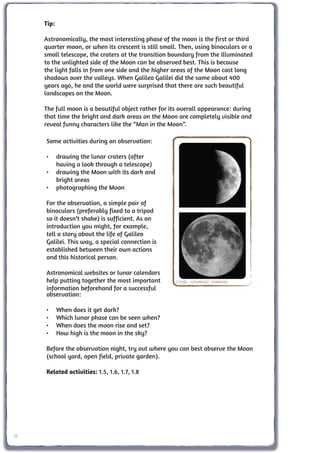
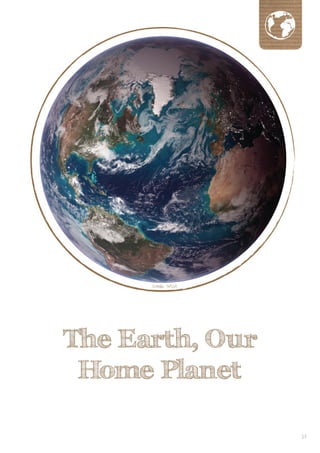
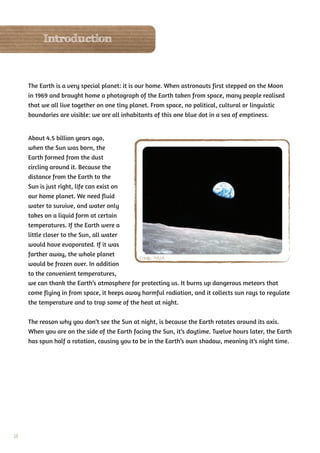
  • 18.
    1.4 Lunar Landscape Brief Description Create a lunar landscape forming different patterns of craters with stones, cocoa and flour. Credit: NASA Keywords • Moon • Crater • Landscape Materials • Baking tin • Cocoa • Flour • Stones of different sizes (0.5 - 3 cm) • Image of Moon (Appendix) Learning Objectives Learn about the Moon’s landscape and how its craters are formed. 18
  • 19.
    Background Science Galileo Galilei, an Italian astronomer and mathematician from the 16th century, was the first man to take a close look at the Moon with a telescope. As he stared through the telescope for the first time, he couldn’t believe what he saw. Huge mountains, craters, highlands and valleys made up the breathtakingly beautiful lunar landscape. Several years after Galilei’s discovery, another Italian astronomer named Giovanni Battista Riccioli created a map on which he named the largest ‘seas’ of the Moon (see image below). In reality, these seas are dark valleys that look like seas. No liquid water exists on the lunar surface, just some ice in deep craters. Because Riccioli believed that the Moon was directly influencing the weather on Earth, he called some of the seas ‘Sea of Tranquillity’, ‘Sea of Serenity’, ‘Sea of Rain’, ‘Sea of Clouds’ and ‘Ocean of Storms’. Credit image: Gregory H.Revera / Credit graphic: Unawe C.Provot The many craters on the Moon are created a long time ago by meteorite impacts. They all have different sizes and some of them have bright rays around them, an indication of their relatively young age (the dark zones are older). On Earth, the impacts of meteorites disappear over time because of erosion: rain, wind and water smooth the surface by wearing away irregularities until only the most recent ones are still visible. On top of that, the Earth’s atmosphere burns most meteorites before they crash onto the surface. The Moon, however, has no atmosphere, which means that all craters stay intact. This is why the Moon is scarred with so many craters— and they keep increasing in number as time goes by! Other sources: Images of Moon craters (http://goo.gl/D0r2p) 19

  • 20.
    Full description • Spread out a thick layer of flour on a baking tin, followed by a thin layer of cocoa on top of it, using a sieve. • Ask the children to collect stones of different sizes and throw them on the tin at different speeds and from different angles. In this way, many different craters will appear. Credit: Cecilia Scorza A meteorite hits our lunar landscape from the left. One can clearly recognise the star-shaped throw-off of white flour, which is more pronounced in the direction of flight (to the right). Credit: NASA • Next, ask the children to compare real lunar craters on a picture of the Moon with the craters they have made. What does the star-like shape of the throw-offs tell about the direction and velocity of the projectile? What does the crater size depend on? Tip: You could also ask the children to craft the different features of a lunar landscape with paper maché and paint. You would need just a wooden board, newspapers, paste, paint, brushes, spray glue and fine sand. First make paper maché out of a newspaper and paste. Then let the children create a lunar landscape on a wooden board using cage wire and the paper maché. Don’t forget the craters! After the landscape dries up, ask the children to paint it. Using spray glue and sand, they could model 20
  • 21.
    the landscape evenmore realistically. Additionally, they could build little astronauts and moon cars (e.g., with Lego). 21
  • 22.
    1.5 Reflecting Moon Brief Description Shine a flashlight on a white sphere from different directions to create different lunar phases. Keywords • Moon • Reflected light • Lunar phases Materials • Moon sphere (Box) • Wooden spit (Box) • Flash light Learning Objectives Learn why the Moon shines in different lunar phases. Background Science See introduction 22
  • 23.
    Full description • Show the children the moon sphere attached to the wooden spit. • Now turn off the light: the children will realise that they cannot see the sphere in the dark because it doesn’t shine by itself. • Light up the sphere with a flash light (representing the Sun): it will look very bright on the side that is lit. • By changing the direction of the light, you can show that a full sphere (full moon) or half a sphere (first or third quarter moon) are the result of the Sun shining on the Moon from a specific direction. Credit: Unawe C.Provot Credit: ESA • Let the children try for themselves and explain which lunar phases they are observing from every position. Tip: For ages 8–10, instead of illuminating the sphere from different directions, you could move the sphere around the children (keep illuminating the room with one fixed light source). This way, they see how the moon phases actually shift: the Moon orbits the Earth, with a fixed background light (Sun). Related activities: 1.6, 1.7, 1.8, 1.10 23
  • 24.
    1.6 Lunar Phases Visualised Brief Description Watch the Moon shift phases by revolving an artificial moon around a globe with a fixed light source shining from one direction. Keywords • Moon • Lunar phases Materials • Light stand (Box) • Light bulb (Box) • Earth model (Box) • Moon sphere (Box) • Wooden spit (Box) Learning Objectives Visualise how the Moon shifts phases in the Earth-Moon-Sun system Background Science See introduction 24
  • 25.
    Full description • The best way for children to visualise lunar phases is to play the role of the Earth, the Moon and the Sun themselves. For this, you need a light source (e.g. a light stand with a bulb, or an overhead projector) as the Sun, a globe and a suitable moon model fixed to a wooden spit. • Darken the room and make sure the fixed light source is pointed towards the centre of the classroom. • Now ask one volunteer to stand in the middle holding the Earth, and another child to hold the Moon at the edge of the room. • Let the rest of the class stand around the Earth to observe the Moon from there. Ask the moon child to revolve around the Earth. What do the children say about the shape of the Moon (lunar phase)? What happens? Tip: To distinguish one semi-moon from the other, you could use the capital ‘B’ and the lower case letter ‘a’. When the right side is lit, it looks a bit like a ‘B’, and it is waxing. Here ‘B’ stands for ‘before full moon’. When the left side of the Moon is lit, it looks somewhat like an ‘a’, and it is waning. Here the ‘a’ stands for ‘after full moon’ (see pictures). However, this only goes for the Northern Hemisphere. On the Southern Hemisphere, it is the other way around: left side lit means waxing and right side lit means waning. Bron: Wikimedia Commons Related activities: 1.5, 1.7, 1.8, 1.10 25
  • 26.
    1.7 Lunar Phases Box Model Brief Description Build a simple shoe box model with spyholes to see the four main phases of the moon. Credit: UNAWE C.Provot Keywords • Moon • Lunar phases Materials • One shoe box per pair • Cotton ball (30 mm in diameter) • Black paint, wooden spit (Box) • Glue, brush • Small flash light • Scissors Learning Objectives Learn about the four main phases of the moon. 26
  • 27.
    Background Science See introduction Full description • Divide the class up into pairs and ask them to paint the inside of a shoe box black. • Let them cut a spyhole in the centre of each of the four sides. In one of the two narrow sides, they drill another hole, which is just big enough for a flash light to be inserted from the inside out. • They fix a cotton ball, on which little craters have been painted, on a wooden spit in the centre of the cover, which is then closed. Credit: Natalie Fischer • Next, they light the flash light. The children can now observe four different lunar phases (full, new, first quarter and third quarter) through the four spyholes. Related activities: 1.5, 1.6, 1.8, 1.10 27
  • 28.
    1.8 Lunar Phases in Action Brief Description Arrange pictures of the lunar phases in the right order to see the progression from new moon to full moon and back. Keywords • Moon • Lunar phases • New moon • Full moon Materials • Set of lunar phases images (Appendix) Learning Objectives Learn about the progression of lunar phases through the month. Background Science It depends on the angle from where the Sun shines on the Moon in which phases it is in. Because the Moon rotates around the Earth counterclockwise, with the Sun as a relatively fixed background light, the boundary between day and night on the Moon shifts from right to left from the perspective of the Northern Hemisphere. This goes for both 28
  • 29.
    waxing and waningmoon. As viewed from the Southern Hemisphere, the boundary shifts from left to right. Full description • Cut out the picture cards with the different lunar phases, shuffle them en distribute them. Each group of four children needs a set of cards. • Ask the children to place them in the right order (see bottom series for the correct order). Because the cards were cut out, it’s not clear anymore what is up and down. This makes it harder to determine which quarter moon is waxing and which is waning. On the Northern hemisphere, a lit right half means a waxing moon. On the Southern it’s the other way around. • Therefore, ask the children to pay attention to the ‘man in the Moon’ (see picture in the Appendix). Let them hold the cards in a way that this figure is on the right side. The upper series in the image below is an example of how you could do it the wrong way: the cards only form half a cycle, in which the 2nd and 4th card are upside down. Credit: Wikimedia Commons Wrong series: the 2nd and 4th card are upside down. Also, this is noly half a cycle.. Credit: Wikimedia Commons Correct series: all cards placed with their head up and the complete cycle is depicted, from new moon to full moon and back to new moon. Tip: For ages 6–8, it is sufficient to arrange the cards from the narrow crescent to full moon or reversely. In contrast, the surface details should strike children ages 8–10. They should learn to look closely. For ages 8–10, the children can also make an animated flip book of the lunar phases. A sample flipbook is available in the Box. Related activities: 1.5, 1.6, 1.7, 1.10 29
  • 30.
    1.9 Multicultural Moon Brief Description Identify characters on the Moon’s surface by placing transparent outlines of people or animals from different cultures on a picture of the Moon. Keywords • Moon • Culture • Characters Materials • Image of the Moon (Appendix) • Transparent moon-figures of Man, Woman, Rabbit, Lion, Crocodile (Appendix) • Markers Learning Objectives Learn about other cultures’ perspectives on the Moon. Background Science If you look at the Moon more closely, you can get the impression that the Moon’s ‘seas’ (in reality they are dark valleys) look like figures. People from each country and culture often see different things. 30
  • 31.
    The figures usuallycorrespond to the culture and environment. For example, why do the Chinese see a rabbit and no crocodile? Because there are no crocodiles in China, but many rabbits. In Germany, people see a ‘Man in the Moon’. Germany Credit: Cecilia Scorza Kenya China Congo Universal Full description • Show the children the figures in the Moon from different countries simply by putting one Moon-figure transparency after the other on the picture of the Moon. • Now you can ask the children: Why don’t people in Congo see any rabbits? And why don’t the Chinese see a crocodile? Tip: If you have children in the class who originate from different countries, let them ask at home which characters their relatives see, based on their culture. The stories about the moon figures are also very suitable for theatre plays! Related activities: 1.10, 2.3 31
  • 32.
    1.10 Moon Storytelling Brief Description Share stories and inspire children to write stories on the Moon. Keywords • Moon • Figures • Culture • Storytelling Materials • Image of the Moon (Appendix) • Transparent moon-figures of Man, Woman, Rabbit, Lion, Crocodile (Appendix) • Markers • Stories about figures in the moon (Appendix) Learning Objectives Learn about other cultures’ perspectives on the Moon through story telling. Background Science See 1.9 32
  • 33.
    Full description • Hand out pictures of the Moon and transparancies. • Ask the children to place the transparancy over the moon picture. • Let them draw their own characters onto the full moon picture. Here, children see, for example, a soccer player, a shark or a monster on the Moon • Let them write a story about it and read it to each other. The children can now see how people in different cultures came up with their own figures, which they have eternalised in fairy tales and myths. • Read the stories from the Appendix to the children. Tip: If there are children from different cultures in the classroom, you can emphasise the influences from a culture on how people look at the Moon. The children might have learnt different fairy tales and myths from their parents, which may make them see different figures in the Moon. If the class is not multi-cultural, you can explain the figures from different cultures yourself (see Appendix). Related activities: 1.9, 2.3 33
  • 34.
    1.11 Mini Research Project: Revolution of the Moon and Lunar Phases Brief Description Explore how the Moon shifts phases and revolves around the Earth by drawing the Moon every night for five weeks in a row. Keywords • Moon • Lunar phases • Revolution Materials • Moon observation form (Appendix) • White marker Learning Objectives Learn about the revolution of the moon by observing its phases. Background Science The Moon continuously changes shape: sometimes it looks like a banana- shaped crescent, sometimes it looks round as a ball. All these different faces of the Moon are called moon phases. The Moon is clearest visible during the night, but you can also watch it during the day! 34
  • 35.
    There is alwaysa period of about one month in between two new moons. During this time, the moon phase shifts from new moon to waxing crescent, to first quarter, to waxing gibbous, to full moon, waning gibbous, to third quarter, to waning crescent and finally back to new moon. Credit: Wikimedia Commons The moon phases shift from new moon, to full moon, and back to new moon Full description Over a timespan of five weeks, let the children observe the Moon every day/night (if possible) and draw it on the observation form. The form is made up of five rows with seven black areas each, according to the days of the week from Monday through Sunday. They can start at any day of the week. Every day on which the children have a chance to observe the Moon, they draw it in a new black box using a white marker. Emphasise that they should also note the date and time. If the sky is cloudy or it has been forgotten to observe, leave out the corresponding box. If the Moon is already visible in the morning, the children should paint the date box blue. On the days on which the Moon can already be observed in the afternoon, they should paint the date box green. If the Moon is only observable in the evening or if the children haven’t paid attention to the Moon during the day, the box is left white. Evaluate the observations after five weeks: • Count the days between two of the same lunar phases. What is this timespan also called? • How about the Moon’s crescent? Can you infer from its orientation whether the crescent will become thicker or thinner in the coming days? • In which lunar phase can we already see the Moon in the morning or afternoon, respectively? • From the children’s sketches, you can estimate the duration of a month as 29 to 30 days. If you are on the Northern Hemisphere, when the moon is waxing, the right half of the moon is illuminated; when the moon is waning it is the left half. On the Southern Hemisphere it is the other way around. In the days after new moon (waxing moon), the Moon is alreadyvisible in the afternoon. In the days before new moon (waning moon) you can see the Moon in the morning. Note that the orientation of the crescent changes after each new and full moon, respectively. 35
  • 36.
    Tip: Astronomically, the most interesting phase of the moon is the first or third quarter moon, or when its crescent is still small. Then, using binoculars or a small telescope, the craters at the transition boundary from the illuminated to the unlighted side of the Moon can be observed best. This is because the light falls in from one side and the higher areas of the Moon cast long shadows over the valleys. When Galileo Galilei did the same about 400 years ago, he and the world were surprised that there are such beautiful landscapes on the Moon. The full moon is a beautiful object rather for its overall appearance: during that time the bright and dark areas on the Moon are completely visible and reveal funny characters like the “Man in the Moon”. Some activities during an observation: • drawing the lunar craters (after having a look through a telescope) • drawing the Moon with its dark and bright areas • photographing the Moon For the observation, a simple pair of binoculars (preferably fixed to a tripod so it doesn’t shake) is sufficient. As an introduction you might, for example, tell a story about the life of Galileo Galilei. This way, a special connection is established between their own actions and this historical person. Astronomical websites or lunar calendars help putting together the most important Credit: Wikimedia Commons information beforehand for a successful observation: • When does it get dark? • Which lunar phase can be seen when? • When does the moon rise and set? • How high is the moon in the sky? Before the observation night, try out where you can best observe the Moon (school yard, open field, private garden). Related activities: 1.5, 1.6, 1.7, 1.8 36
  • 37.
    Credit: NASA The Earth,Our Home Planet 37
  • 38.
    Introduction The Earth is a very special planet: it is our home. When astronauts first stepped on the Moon in 1969 and brought home a photograph of the Earth taken from space, many people realised that we all live together on one tiny planet. From space, no political, cultural or linguistic boundaries are visible: we are all inhabitants of this one blue dot in a sea of emptiness. About 4.5 billion years ago, when the Sun was born, the Earth formed from the dust circling around it. Because the distance from the Earth to the Sun is just right, life can exist on our home planet. We need fluid water to survive, and water only takes on a liquid form at certain temperatures. If the Earth were a little closer to the Sun, all water would have evaporated. If it was farther away, the whole planet Credit: NASA would be frozen over. In addition to the convenient temperatures, we can thank the Earth’s atmosphere for protecting us. It burns up dangerous meteors that come flying in from space, it keeps away harmful radiation, and it collects sun rays to regulate the temperature and to trap some of the heat at night. The reason why you don’t see the Sun at night, is because the Earth rotates around its axis. When you are on the side of the Earth facing the Sun, it’s daytime. Twelve hours later, the Earth has spun half a rotation, causing you to be in the Earth’s own shadow, meaning it’s night time. 38
  • 39.
    Earth Facts Age About 4.5 billion years Diameter 12,742 km Mass 5,974 million billion billion kg (5.974 x 1024 kg) Distance to the Sun 150,000,000 km (1 astronomical unit) Rotation period around own axis 23 hr 56 minutes (about one day) Orbital period 365.24 days (about one year) Temperature Between –90°C and 60°C Gravity After one second, a falling object reached a speed of 9.81 meters per second. Inclination rotation axis with respect to orbital plane 23.4 degrees around Sun 39
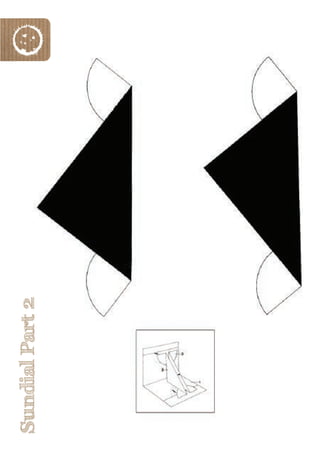
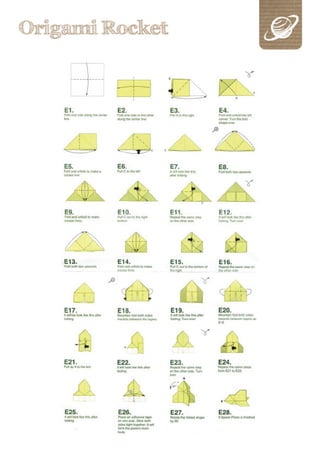
  • 40.
  • 41.
    2.1 Spherical Earth Brief Description Watch a ship ‘sink’ down the horizon over a flat surface and a globe to perceive Earth’s shape. Keywords • Earth • Shape • Globe Materials • Globe (Box) • Origami ship (Appendix) • Toy figures (Appendix) Learning Objectives Perceive the spherical shape of the Earth. 41
  • 42.
    Background Science Children can make a simple observation to determine for themselves that the Earth is round. A captain standing on the seashore observes a ship going away from him. He will realise that the ship not only becomes smaller at the horizon (because distant objects seem smaller), but it also seems to “sink”: the hull is the first part to disappear, and the mast top is the last. How can all this be explained? Some centuries ago, people noticed ships sinking in or rising from the horizon, from which they concluded the Earth must be round. If the Earth were flat, ships wouldn’t sink while moving away, they would just keep getting smaller and smaller. Full description • First, ask the children to make a small origami ship (see Appendix). • Take the origami ship and a toy figure (see Appendix) and place them on a table top, representing a flat Earth. Credit: Natalie Fisher • Let the children watch the ship sail away from the perspective of the figure. They will see the ship getting smaller and smaller. • Now put the origami ship and the toy figure on a globe, which represents a round Earth. Credit: UNAWE C.Provot • Again, ask the children to watch the ship On a flat surface, you only see a ship getting move away from the smaller and smaller (top). On a spherical shape, perspective of the figure. you see the ship getting smaller and also They will notice the ship sinking in the horizon (below). not only gets smaller, but it will ‘sink’ as well. Let them describe in their own words what they see. Related activities: 2.2 42
  • 43.
    2.2 Up or Down Brief Description Show the Earth has no ‘up and down’ by putting an ice bear on the North Pole of a globe and a penguin on the South Pole and explain the direction of Earth’s gravitation. Keywords • Earth • Gravity • Up/down Materials • Globe (Box) • Toy penguin (Appendix) • Toy ice bear (Appendix) Learning Objectives Obtain a feeling for the direction of the Earth’s gravitation. Learning that in reality, there is no ‘up’ or ‘down’. These directions just exist in one’s perception. 43
  • 44.
    Background Science Adults consider some things trivial, with which children have some difficulties, for example, imagining themselves standing on the Earth’s surface. If the globe’s North Pole faces upwards, then people in Europe are standing on a slippery slope. And this is even more the case for people living on the equator, not to mention inhabitants of the Southern Hemisphere. Why don’t they fall off the planet? In our everyday experience, the world is limited to everything within our horizon. On such a small scale, the Earth’s surface is flat, and gravity seems to pull everything ‘down’. What is up, must come down. Children easily translate this local perspective onto the whole world. On a global scale, however, there is no force that pulls everything down. There is only a force that pulls everything towards the centre of the Earth. For people on the South Pole this means an ‘upward’ force. But from their perspective, it’s just a regular downward force. “Up” This is the way people from the Northern Hemisphere perceive gravity. However, gravity points to the centre of the Earth, meaning there is no real “up” and “down”, which prevents people on the Southern Hemisphere from falling off the Earth. “Down” Credit: UNAWE C.Provot Full description • Show the children a globe with an ice bear on top, and a penguin on the bottom. • Ask one child to be the ice bear’s voice, and another to be the penguin’s. Let them start the following dialogue. Ice bear: “Hey, down there! How’s that, living with your head down? That must be very uncomfortable, right?” Penguin: “Me??? You are the one that lives with his head down, not me!” • While the penguin is answering, quickly turn the globe upside down and alternately let the penguin stand ‘on top’. 44
  • 45.
    • Both animals(and also the children) will understand that because the Earth’s gravitation is always directed to the centre of the Earth, there is no ‘up and down’ and therefore, none of the animals is standing upside down, let alone falling off the Earth. Credit: UNAWE C.Provot Tip: Distribute ‘earth mosaic’ templates (Appendix) amongst the children and ask them to draw a landscape on it with coloured pencils (above the dashed line they can draw houses, mountains and forests, and below it the seabed or mines or rocks). This way they create a picture with an upper and lower section. Then let them cut out the template. Now ask the children (preferably a group of 16) to lay their templates on the floor in a circle, to form a round mosaic. Let the children search the ‘up’ and ‘down’. They will notice there is no real ‘up and down’ anymore! Depending on which side you are looking from, the pictures are only oriented differently! This exercise helps to break the fixation on “up and down”. Credit: UNAWE C.Provot Related activities: 2.1 45
  • 46.
  • 47.
    2.3 Our Home Planet Brief Description Watch the Earth as one sphere on which all people live, by painting different people and animals on a paper maché globe. Keywords • Earth • Cultures Materials • Blue stability ball (120 cm in diameter) • Paper maché • Colour paint • Brushes Learning Objectives Obtain a feeling of being a ‘terrestrial’ or ‘earthling’, rather than being part of one culture or country. 47
  • 48.
    Background Science The Earth is not only a natural habitat for plants, animals and human beings: it also offers space to many different cultures. A central experience that children should have in this project is to perceive themselves as terrestrials. The awareness of being a German, Turk, Russian, Italian or whichever nationality should then lead to the invitation: “Show me your world and I’ll show you mine.” Different cultures are like coequal windows through which the world can be viewed. Full description • Take a blue stability ball (120 cm in diameter) and glue paper maché continents on it. Leave them blank and don’t include any country borders. • Ask the children to paint or stick humans and animals with which they can identify themselves. If there are few different cultures in the class, then provide the children with some information about other cultures (e.g. in the Sahara desert a man in white clothes with a camel). Credit: Cecilia Scorza • The end result will provide different cultures on one and the same sphere, which will give children the feeling they are ‘terrestrials’, rather than just part of their own culture or country. In addition, this exercise gives an easily comprehensible insight into the different habitats on Earth. Related activities: 1.9 48
  • 49.
    2.4 Day and Night Brief Description Perform a story about two people living on the other side of the Earth, who experience night and day at different moments. Keywords • Earth • Time • Day and night Materials • Globe (Box) • Light stand with bulb (Box) • Two toy figures (Appendix) • Glue pads Learning Objectives Learn what causes day and night. 49
  • 50.
    Background Science The most ‘everyday’ interaction phenomenon between the Earth and the Sun is the change of day and night. This is due to the Earth spinning around its own axis. When you are on the side of the Earth facing the Sun, it’s daytime. Twelve hours later, the Earth has spun half a rotation, causing you to be in the Earth’s own shadow, meaning it’s night-time. Credit: NASA From an outsider’s view, the Earth performs one complete rotation around its axis in 23 hours, 56 minutes and 4 seconds. Our ‘Earth day‘, however, is 24 hours long, which is four minutes longer. This is because we define a day such that at noon, the Sun stands exactly in the south again. And for that to be also the case on the next day, the Earth has to rotate a bit more around its axis, as it has proceeded a bit on its orbit around the Sun. That takes the Earth four minutes. In one year (365 days and about 6 hours), the Earth revolves once around the Sun at an average distance of 149.6 million kilometres (which corresponds to a chain of 100 Suns). There is an apparent discrepancy between a year (365 days) and the time it takes the Earth to orbit the Sun (365.24 days). To make up for this quarter day difference, we have a leap year every four years – an additional day on February 29th. Without this leap day, the seasons would shift one day every four years, eventually resulting in a summer Christmas (on the Northern Hemisphere)! Then there still is the problem that the difference is not exactly one quarter (0.25), but actually 0.24 days. To solve this, we don’t have a leap day on the turn of a century (e.g., there was no leap day in 1900). But then why was there a leap day in 2000, you ask? Because to really make it all fit—and to make it more confusing—we do have a leap day on the turn of a century that’s divisible by 4 (e.g. 1600, 2000 and 2400). 50
  • 51.
    Full description Credit: UNAWE C.Provot While it is day time for Michael in Germany, it is night time for Moni in China • Put two toy figures (see Appendix) on a globe: one on Germany and one on China. While telling the children the following story, shine a bright lamp (the Sun) on the globe. Moni and Michael are brother and sister and live in Germany. Moni’s godmother enjoys travelling a lot, and this time she has taken Moni with her to China. In the meantime, Michael stays in Germany and attends kindergarten. On one afternoon, Michael comes home hungry and his mother cooks his favourite dish for him: spaghetti bolognese. While the boy enjoys his lunch, he wonders if his sister is having a good time in China and tries to call her mobile phone. Moni’s phone rings once, rings twice, again and again. Only after the seventh ring Moni answers with a sleepy voice: “Who is there?” “It’s me, Michael! I’m just eating spaghetti for lunch and wanted to call you… So what are you doing?” “Me? I’m sleeping, Michael.” “But why are you sleeping, Moni, are you ill?” • Now ask the children what’s going on. • To explain, slowly rotate the globe in the direction of the arrow ‘from west to east’ (see figure). The children will realise that at some point, night will fall where Michael is and day will break where Moni is, and vice versa. How long does Michael have to wait until he can reach Moni without waking her? Tip: This story is also very suitable for introducing the time zones on Earth! Related activities: 3.5 51
  • 52.
  • 53.
    2.5 Seasons Brief Description Tell a story about different seasons on two hemispheres, while holding a globe tilted towards a light bulb. Keywords • Earth • Seasons Materials • Globe (Box) • Light stand with a bulb (Box) • Two toy figures (Appendix) • Glue pads • Flashlight Learning Objectives Learn how the position of the Earth in relation to the Sun causes seasonal changes. 53
  • 54.
    Background Science The Earth is not isolated in space: the Sun and the Moon create exciting phenomena on Earth like day and night, the seasons and eclipses. In the context of the seasons, it is important to stress that the Earth has a fixed orientation in space: the Earth’s rotation axis is stable, i.e., not wobbling. It always points in the same direction: the north end points towards the Polar Star, which consequently is located exactly north in the sky, regardless of where you are (on the Northern Hemisphere). This stable axis is not perpendicular to the Earth’s orbital plane around the Sun, but is inclined to the latter by about 23 degrees. This causes the seasons. Wrong: Earth axis is not inclined Right: Inclined Erth axis Credit (all three): UNAWE C.Provot Depending on the stage of orbit the Earth is in, the Northern or Southern Hemisphere collects sunrays at a more direct angle, causing summer on that hemisphere. Dates If you are at 23 degrees southern latitude (Tropic of Capricorn) on December 21st at noon, the Sun’s rays fall in on your head exactly at a right angle: you don’t have a shadow! This right angle means the sunrays have maximum 54
  • 55.
    impact, making itsummer on the Southern Hemisphere. At the same time, children are having snowball fights on the Northern Hemisphere. It’s winter there, because the sunrays are falling in at a wide angle, having minimum impact. On March 21st, the sunrays are impacting the equator at a right angle. Now the Northern and Southern Hemisphere share the same temperature: on the former it’s spring, on the latter it’s autumn. Three months later, on June 21st, the Sun’s rays fall in at a right angle on Tropic of Cancer (an imaginary ring at 23 degrees northern latitude). Now they have maximum impact on the Northern Hemisphere: it’s summer in Europe. Again three months later, on September 21st, the equator gets sunrays from a right angle once again. The Northern and Southern hemisphere once again have the same temperatures, only this time it’s autumn on the former, and spring on the latter. Misconceptions As you see, all that matters is the angle in which the sunrays fall in. As the Earth orbits the Sun, both hemispheres take turns facing the Sun at a right angle, because the Earth’s axis is tilted. This eliminates two misconceptions about what causes the seasons. Some people think the seasons change because the Earth’s distance to the Sun varies. It actually does, but this has very little effect, and is not what causes seasonal changes. (Besides, this wouldn’t distinguish both hemispheres from each other: it would be summer on all places at the same time.) Furthermore, it is sometimes wrongly assumed that due to the Earth’s tilted axis, each hemisphere is at turns closer to the Sun, causing it to be summer there. The hemispheres indeed are closer to the Sun at turns, but this is such a minor difference that it has no effect. The real cause is the angle of the incident sunrays! Moni and Michael To illustrate the effect of this angle, let’s look at the picture. Moni and Michael both stand Credit: UNAWE C.Provot on the day side of the Earth. Moni stands in Ireland (Northern Hemisphere). There, a bundle of sunrays strikes the surface with some inclination and disperses over an area. Michael stands in South Africa (Southern Hemisphere). The bundle of sunrays strikes on him almost at a right angle, and disperses over a much smaller area as compared to Moni’s location. The story of Moni and Michael depicts winter on the Northern Hemisphere and summer on the Southern Hemisphere (1) (see figure on the next page). But six months later, when the Earth is on the other side of the Sun, the 55
  • 56.
    situation is opposite(3): The Sun’s rays now reach Moni almost at a right angle (summer in the north), while at Michael’s location they fall in skewed (winter in the south). Intermediate position (2) corresponds to spring on the Northern (N) and autumn on the Southern (S) Hemisphere. At intermediate position (4), the situation is exactly opposite. 2 1 3 Spring (N) Winter (N) Summer (N) Autumn (S) Winter (S) Summer (S) Autumn (N) Spring (S) Credit: UNAWE C.Provot Other sources: Short movie of Earth’s orbit: http://goo.gl/eQW4l Full description • Glue two toy figures (see Appendix) on a globe: one on Ireland and one on South Africa. • While telling the children the following story, shine a bright lamp (the Sun) on the globe. Moni and Michael are brother and sister and are from Germany. They love traveling, so they each go on holiday abroad. Michael flies to South Africa (Southern Hemisphere) with his godfather, and Moni goes to Ireland (Northern Hemisphere) with her godmother. After they have arrived, the children want to call each other and exchange their experiences. Moni calls Michael: “Hello Michael! How are you? What are you doing right now?” Michael answers: “I’m fine! I’m just about to go to swimming in the sea.” “Say again????” Moni shouts out, surprised. “At such low temperatures?” “What low temperatures?” Michael answers. “It is 29 degrees Celsius and I’m sweating all the time! But what are you doing, Moni?” “I’m going to Credit: UNAWE C.Provot go sledding. It’s freezing cold 56 here!”
  • 57.
    • How isit possible that Moni is cold and Michael sweats, although it’s the same time of day for both children (they are in the same time zone)? Explain to the children the intensity of light reaching Michael (South Africa) and Moni (Ireland). At Moni’s location, the light falls in with some inclination: it appears weaker. At the same time, Michael is standing directly under the strong, blazing Sun (lamp). • At this point, it may be helpful to light the floor with a lamp: if you hold it vertically, a smaller area is lit, which appears very bright. When the lamp is skewed, the light cone is much larger and the brightness much lower. • Now hold the globe next to the lamp while holding it at an inclined angle. Make sure that Southern Hemisphere points in the direction of the lamp (see illustration). South Africa is much brighter lit than Ireland! • Next, hold the globe on the other side of the lamp. You just skipped half a year (or half an orbit around the Sun). This time, Moni receives the light more directly (summer in the north) and Michael gets the sunrays from a wide angle (winter in the south). Credit: UNAWE C.Provot Tip: • While carrying out the activity, don’t forget that the Earth’s axis always points in one and the same direction (to the polar star)! • Now put a third toy figure – Pedro – on the globe, on the equator in the middle of Africa. Repeat the activity. Does it matter for Pedro where the Earth is in its orbit around the Sun? For him, the consequences of an inclined axis are much less extreme. For this reason, people on the equator don’t know seasons like for example Europeans do. • To emphasise there would be no seasons if the Earth’s axis were perpendicular to its orbit, you could do the activity again, but then you hold the axis straight up. While the globe turns around the lamp, the light intensity doesn’t change anywhere. In this case, we would only speak of (horizontal) climate bands. Pedro would always catch the sunlight from a straight angle. Moni and Michael, who are farther away from the equator, receive less sunlight and are colder. Moving farther away, towards the poles, it gets increasingly colder. Related activities: 3.5 57
  • 58.
  • 59.
    2.6 Solar Eclipse Brief Description Visualise a solar eclipse by creating a shadow on a globe with a small ball. Keywords • Earth • Sun • Moon • Eclipse Materials • Globe (Box) • Moon sphere (Box) • Flash light Learning Objectives Learn the mechanisms behind a solar eclipse. 59
  • 60.
    Background Science By sheer coincidence, the apparent sizes of the Moon and the Sun in the sky are equal. The Moon is many times smaller than the Sun, but it is also closer to Earth, in the right proportion. As a consequence, when the Moon is exactly between the Sun and the Earth, the solar disk on the sky is exactly covered by the Moon. This makes a solar eclipse extra special! On the picture below, Moni is standing in Africa. It is shortly before noon, and the Moon — circling around the Earth — is exactly aligned with the Sun and the Earth. And then it happens: as seen by Moni, the Moon shifts in front of the Sun, covers it and Moni is standing in the Moon’s shadow. The temperature drops and it gets dark as night. The animals think it’s time to sleep! Credit: UNAWE C.Provot Moni is in Africa. Because the Moon is exactly between the Sun and the Earth, it will shortly cover the Sun on the sky and cast a shadow on the Earth (left picture). Soon thereafter, the shadow reaches Moni: everything turns dark and the animals go to sleep. The left image also reveals the umbra, or complete shadow on Earth, which is darkest, and the penumbra, or partial shade, which is not as dark. The Moon is too small to put the entire Earth at once in its shadow. During a solar eclipse, it only marks the Earth with a small black dot. This shadow travels across Earth’s surface, because the Earth spins and the Moon moves. When you experience a partial solar eclipse, you live just outside the area where the Moon fully blocks the Sun. Other sources: Movie explaining solar eclipse: http://goo.gl/7Z4HJ Full description • Place a globe (Earth) on a table and glue a toy figure (see Appendix) on the country you are in. • Now shine a flash light on it (Sun) and hold a small white ball (Moon) between the globe and the light, creating a shadow just east (right) of the toy figure. 60
  • 61.
    Credit: ESO • Thenslowly spin the Earth from west to east (left to right), eventually covering the figure with the shadow. • Explain to the children this is what happens during a solar eclipse. Tip: To make the story more vivid, tell a short introduction in which the figure is doing something fun, and then suddenly it gets dark. Related activities: 2.8, 3.2 61
  • 62.
  • 63.
    2.7 Lunar Eclipse Brief Description Visualise a lunar eclipse by creating a shadow on a small ball with a globe. Keywords • Earth • Sun • Moon • Eclipse Materials • Globe (Box) • Moon sphere (Box) • Flash light Learning Objectives Learn the mechanisms behind a lunar eclipse. 63
  • 64.
    Background Science The Moon not only causes solar eclipses, it can also get dark itself. How does that happen? As the Earth is illuminated on one side by the Sun, it casts a shadow behind it at the same time. So when the Earth gets in between the Sun and the Moon, a lunar eclipse occurs. In this situation, the Earth covers the Moon with its shadow. If there were people living on the Moon, they would see this as a solar eclipse! However, instead of getting completely dark, the lunar surface glows reddish. The Sun’s light is refracted into the shadowed area by the Earth’s atmosphere. Because the light has traveled a long distance through our Earth’s atmosphere, it is reddish as in a sunset. Thus, the Moon looks rather coppery than black during a lunar eclipse. It is interesting to note that the redder the Moon, the dustier our atmosphere! In ancient Greece, philosopher and scientist Aristotle closely observed lunar eclipses and concluded from it that the Earth must be round. How? If you look very closely at the photograph on the right, you clearly recognise the Earth’s shadow is round! This is proof of the spherical shape of the Earth! Other sources: Movie explaining lunar eclipse: http://goo.gl/UJCdW Credit: UNAWE C.Provot Credit: University of South Africa The Moon glows red during a lunar eclipse. Full description • Place a globe (Earth) on a table and shine a flash light on it (Sun). • Now slowly move a small white ball (Moon) behind the globe, making it travel through the Earth’s shadow. • Explain to the children this is what happens during a lunar eclipse. Tip: Notify the children when there will be a lunar eclipse, or organise a class activity around the subject! Lunar eclipses occur two to three times a year. Related activities: 2.7 64
  • 65.
    Credit: NASA The Sun,Our Home Star 65
  • 66.
    Introduction As seen from Earth, the Sun is the brightest and most noticeable celestial body — much brighter than the Moon and, above all, much brighter than the little stars in the night sky. However, the Sun actually is just a regular star: it is just as big as most stars. The reason why it seems so much brighter to us, is that the Sun is by far the closest star. Much of what we know about stars, we have learnt from closely observing our Sun. The Sun is about 4.6 billion years old and has a diameter of 1.39 million km. This corresponds to a chain of 109 Earths or 400 Moons! That is so immensely huge that our Earth alone would fit one million times into the volume of the Sun. Its distance to the Earth is about 100 times the Sun’s diameter: 149.6 million km. Within a little over 25 days it rotates once around its axis, even a bit faster on its equator than near the poles. On the outside, the Sun’s temperature is about 5700° Celsius, and deep within the core it’s about 15 million degrees Celsius. Such high temperatures are caused by a process called nuclear fusion, which runs in the core. The Sun, like most stars, is a hot ball of gas, composed of about 73% hydrogen and 25% helium. The rest are heavier elements like iron, oxygen and carbon. The Sun’s outer layers push so hard on the inside with their weight, that enough pressure builds up in the core to make atoms crash into each other. Atoms are tiny particles that make up any substance. While crashing into each other, atoms fuse, thereby forming a new type of atom. For example, four hydrogen atoms can fuse into one helium atom. During this process, energy is released in the form of heat! Credit: NASA 66
  • 67.
    Solar Facts Age About 4.6 billion years Diameter 1,392,684 km (109 Earths in a row) Mass 2 thousand billion billion billion kg (2 x 1030 kg) Distance to the Earth 150,000,000 km (1 astronomical unit) Rotation period around own About 25 earth days axis Temperature 5,700 °C on the surface and 15 million °C in the centre Gravity If you could stand on the surface, you would be 28 times as heavy compared to on Earth Composition 73% hydrogen, 25% helium, 2% other elements, like iron, oxygen and carbon Fun fact Although the Sun is just a normal star, compared to a planet it is still huge. The Earth would fit over one million times into the volume of the Sun! 67
  • 68.
  • 69.
    3.1 Apparent Size Brief Description Look at the size of spheres on a floor or table top at different distances to understand why some look bigger than others, extending this to how eclipses occur. Keywords • Sun • Size Materials • 3 balls of equal size • One large ball (about double the size) Learning Objectives Learn why the Moon looks as big as the Sun and why the Sun looks bigger than other stars. 69
  • 70.
    Background Science Although the Sun looks like the largest star, it’s just as big as most stars that we see in the night sky. The reason why it appears so bright and big compared to other stars in the sky is that it is much closer to us. The stars that we can see in the night sky are simply much farther away from Earth than the Sun, which is why they appear so small and less bright. If we could line up all those stars and our Sun at the same distance from Earth, our Sun would only be of intermediate brightness if compared to the other stars. Astronomers therefore differentiate between the “apparent” and the “absolute brightness” of a celestial body. The Moon is yet even closer to Earth. This makes it look like the same size as the Sun, although it’s many times smaller. The fact that the apparent size in the sky is exactly the same for Sun and Moon, is sheer coincidence. The Sun is 400 times larger in diameter than the Moon, but by coincidence also 400 times farther away. This has a nice side effect: during a solar eclipse, when the Moon is between the Earth and the Sun, the Moon completely covers the Sun! If the Moon were just a little bit smaller or farther away from us, that wouldn’t be possible. Earth is invisible at this scale Jupiter is about 1 pixel in size Sun Sirius Pollux Arcturus Credit: UNAWE / C.Provot Some stars are even much bigger than our Sun Full description • Ask the children to put three balls of equal size on the floor, at different distances of 1 meter, 5 meters and 10 meters. • Now ask them which ball looks biggest to them. But weren’t all balls the same sizes? It appears that the further away, the smaller an object looks. • Put one small and one large ball (about twice the size of the small one) next to each other at about one meter from the children. How could the small one block the larger one? 70
  • 71.
    • Place thelarge ball one meter farther away, behind the small ball. At this particular distance, the small ball (Moon) completely covers the large ball (Sun). Because the balls’ diameters differ by a factor of two, they look the same size if their distance also differs by a factor of two! Related activities: 2.7 71
  • 72.
  • 73.
    3.2 Invisible Light Brief Description Make infrared radiation visible by looking at a remote control through the camera of a mobile phone to discover invisible light. Keywords • Sun • Light • Infrared Materials • Infrared remote control • Mobile phone with camera Learning Objectives Learn about the special, invisible light which the Sun shines with, like infrared. 73
  • 74.
    Background Science The Sun provides us with light and heat. Without this source, life could not have developed on Earth. The indispensable sunlight looks white to us. White seems to be one specific colour, but actually is a composition of many colours. In the same way orange is a composition of red and yellow, white is a composition of all colours. So sunlight consists of all colours we can see, and a rainbow clearly shows this. When the Sun shows its face on a rainy day, its light is refracted in the water drops and split into its components. All visible colours can be seen in a rainbow. We call this the ‘visible’ light because our eyes can see it. Above the red line and below the blue line, however, there are two additional colours, respectively infrared and ultraviolet (UV). It’s just that our eyes are not made to see those. Above and below these ‘special’ colours, there are even more weird sorts of light. These invisible types either have very high energy, like for example X-rays, which we use in hospitals to see through our bodies, or low energy, like infrared radiation, whose properties are used in TV remote controls. In order to be able to see this special light, we need appropriate instruments. Credit: UNAWE / C.Provot But why exactly does the Sun shine with all this light? In its interior, the Sun transforms hydrogen into helium. This process – called nuclear fusion – releases lots of energy. This energy keeps the Sun as hot as it is. And like a light bulb in a lamp the Sun glows because of its high temperature. If you look inside a toaster, you can also see it glow. Because it’s not as hot as the Sun, it only shines with red light. The Sun, however, is so hot that it shines with all possible kinds of light, including X-rays, infrared and UV! Other sources: Electromagnetic spectrum: http://goo.gl/NS21B Full description • Ask the children to take a remote control and press a button. An infrared signal should be coming out of the remote, but why can’t you see it? Is it broken? • Now let them do the same thing again, but this time make a movie of it 74
  • 75.
    with their mobilephone instead of looking at it with their bare eyes. • Ask them to look at the screen: a light signal does appear, the remote still works! The reason they can now see the signal is that the camera of their phone can see infrared light and projects it on the screen as visible light. Human eyes cannot see infrared. Tip: You can also ask the children to perform the activity themselves at home. Let them surprise their parents! Credit: Cecilia Scorza 75
  • 76.
  • 77.
    3.3 Sun’s Shadow Brief Description Watch shadows during the course of day to explore the influence of the sun’s position in the sky. Keywords • Sun • Shadow Materials • Nice weather Learning Objectives Discover the influence of the Sun’s position on shadows, and learn about the solar path in the sky. 77
  • 78.
    Background Science If the Sun’s rays are incident on an object, it will cast a shadow oriented away from the Sun. Our experience shows that the shadow always moves clockwise around the object casting it and its length continuously diminishes between sunrise and noon and, afterwards, prolongs again correspondingly. However, the shadow length does not only change in the course of a day but also during a year: for example, the length of the noon shadow is much smaller in summer than in winter! For more background science, see activity 3.4. Full description • Ask the children to explore everything in their school related to the solar shadow. For example, how do the shadows of the trees in the schoolyard change during a day? Which parts of the classroom does the Sun shine into in the morning or at noon? What direction does the shadow point to relative to the Sun? When is the shadow smallest, and when is it largest? Is there a practical application for our observation? Tip: Repeat the exercise in the next season. Did the shadows at noon get bigger? This will be the case if the season got colder (e.g., from autumn to winter). Did the shadows at noon get smaller? This will be the case if the season got warmer (e.g., from winter to spring). The cardinal directions can be memorised by means of a mnemonic (in clockwise direction): “Never Eat Soggy Waffles!” Related activities: 3.4 78
  • 79.
    3.4 Sun’s Path and a sundial Brief Description Build a sundial and a horizon model to analyse the sun’s path across the sky. Keywords • Sun • Sundial • Solar path • Time Materials • Wooden plate with landscape motives • Toy figures (Appendix) • Transparent acrylic half-sphere (sky sphere) • Circular stickers of different colours for three solar paths (summer, spring/ autumn and winter) • Copy of the sundial on stiff cardboard (Appendix) • Colour pencils • Scissors • Glue Learning Objectives Learn about the path of the sun during the day at different times of the year. 79
  • 80.
    Background Science Depending on whether we can see the sun in the sky or not, we call it “day” or “night”. Our day begins with sunrise and ends with sunset; accordingly, the night begins with sunset and ends with sunrise. Thereby, the sun always rises in the east, reaches its highest point in the south and sets in the west. At least on the Northern Hemisphere. On the southern, the sun moves from east to west through the north. These observations are easily reconstructed using a horizon model: With this self-made model, students can easily reconstruct the sun’s path on the sky, as in the Explore Science exhibition in the Luisenpark Mannheim in 2011. Credit: Nathalie Fischer The model consists of a white wooden plate with landscape motives. In the middle, little child figure Oscar is standing. Over the plate there is a transparent acrylic half-sphere (sky sphere), on which the three solar paths (summer, spring/autumn and winter) are glued. In the picture, the paths represent the situation in Germany. The horizon is where the landscape disk and the sky sphere touch. The Sun is represented by a strong torch, which the children can move across the sphere. Atmosphere W S N E Horizon Credit: UNAWE / C.Provot 80
  • 81.
    On March 21st,the sun moves along the middle path on the sky. Oscar’s shadow is longer when the Sun is at a low point. At noon, when the Sun is at its highest point, Oscar’s shadow is as short as it gets during that day. Summer path (upper path) The sun’s path rises more and more during spring, until it reaches its highest level on June 21st. That day, the sun follows the summer path. The children will notice that the sun has to travel a longer path across the sky than in spring: the days last longer. The sun does not rise exactly in the east anymore, nor does it set exactly in the west, as both points are shifted northwards along the horizon. As compared to the situation on March 21st, Oscar’s shadow is smaller at noon. Still, his shadow length changes during the day. Autumn path (middle path) On September 21st, the sun’s path has reached the same level it has on March 21st; the autumn path is the same as the spring path. The shadows at noon are the same, just like the length of a day. Winter path (lower path) On December 21st, the sun’s path reaches its lowest point: the winter path. Again, the sun does not rise exactly in the east or set exactly in the west. Only this time, both points are shifted southwards along the horizon, instead of northwards. December 21st is the shortest day of the year, and the shadows at noon are the longest compared to the noon shadows during the rest of the year. Still, the shadow lengths change during the day. Other parts of the world The above descriptions of the solar paths during the year only account for the Northern Hemisphere. On the other half of the world, summer and winter are exactly the other way around. At the equator and the poles, the extreme regions on Earth, it is a different story. At the North or South Pole, the sun’s path is parallel to the horizon. It has a height of 23.4 degrees above the horizon in summer at the North Pole. This corresponds to the inclination of the Earth’s axis. A horizontal path means: there is no night. During the year, the path sinks down and vanishes below the horizon on September 21st. From then on, it stays dark for half a year, until the sun’s path peaks above the horizon again on March 21st. On the South Pole, the opposite happens. During the eternal night on the North Pole, penguins at the South Pole enjoy daylight that lasts for six months. If Oscar stands on one of the poles, his shadow length doesn’t change during the day. At the equator, the sun’s path is vertical to the horizon. 81
  • 82.
    On March 21stand September Equator 21st, the sun moves across the sky Atmosphere from east, through the zenith, to the west. If Oscar would stand on the equator on March 21st at noon, he would have no shadow at all! Horizon On June 21st and December 21st, Pole the paths are shifted by 23.4 degrees to the north or south, respectively. It is noticeable on Atmosphere the equator that the twilight is very short, because the sun sets and rises at a right angle with the W horizon. The sun doesn’t slowly S N slope down sideways, like in e.g. Europe, but goes straight down. E Horizon Full description Because we know all about the different paths the Sun travels across the sky at different locations and different dates, we can use a sundial to measure time! • Ask the children to cut out and paint all three parts of the sundial from the Appendix. • Then let them fold them according to the instruction on the copies (see picture): the big clock-face is folded by 90 degrees with the coloured surface to the inside, and so are the two small quarter circles at the two triangles. • Next, they glue both triangles to each other such that a pair of quarter circles form one half circle. • Finally, they glue these half circles on the top and bottom of the big clock- face. • Let the children place the finished sundial on a sunlit place (e.g., the windowsill) and rotate it until the edge of the shadow casts onto the clock- face. Now the triangle indicates the time like a clock-hand. Around noon, the triangle casts no shadow (it points south). 82
  • 83.
    Credit: Nathalie Fisher Tip:With a wooden plate, toy figures (see Appendix), round stickers and a glass sphere you can build a horizon model. With this, the children can discover themselves how the sun’s path influences Oscar’s shadow, in relation to both the time of the day and the year. Related activities: 3.3 83
  • 84.
  • 85.
    3.5 Varying day lengths Brief Description Watching different places on Earth having different day lengths, by placing a globe next to a light bulb at different sides of the lamp and spinning it Keywords • Earth • Time • Day length Materials • Globe (box) • Light bulb on a stand (box) Learning Objectives Understanding the cause of variation in day lengths: why winter days are shorter than summer days. 85
  • 86.
    Background Science Day and night are caused by the spinning of the Earth around its own axis. If that axis were perpendicular to the Earth’s orbit around the Sun, every day would last exactly twelve hours on any location, just like every night. In reality, the Earth’s axis is tilted causing day lengths to vary. During winter, days are short and the cold nights seem to last forever, while the sultry summer days are seemingly endless, merely interrupted by short nights. Dates In December, the Earth has its Southern Hemisphere slightly turned to the Sun (see figure). This causes the South Pole to receive sunlight 24 hours per day. During the Christmas period, there are literally days with no end on Antarctica! At the same time, people in the Arctic circle (around the North Pole) live in eternal darkness: the sun doesn’t rise for days on end! (On the exact geographic North Pole, it is dark continuously for six months straight between September and March.) In June, the situation is the other way around: it’s summer on the Northern Hemisphere and around the North Pole days do not end. On September 21st and March 21st, the Earth has its equator turned at a right angle to the Sun. These are the only days when day and night each last 12 hours on any location. On the Northern hemisphere, daytime lasts less than 12 hours between September and March, with a minimum on December 21st (shortest day). However, between March and September days last longer than 12 hours, with a peak on June 21st (longest day). 2 1 3 Spring (N) Winter (N) Summer (N) Autumn (S) Winter (S) Autumn (N) Summer (S) Spring (S) Credit: UNAWE C.Provot Locations The farther away from the equator you go, the more extreme variations in day lengths get. We already discussed the extremes of the North Pole above, where the Sun doesn’t set or rise for months on end. In less extreme regions, for example in Europe, the sun rises and sets every day. In for example Denmark, winter days get as short as 7 hours, while summer days get as long as 18 hours. Further south, in Switzerland, the variation is not so extreme: winter days last a minimum of 8 hours, while summer days don’t get longer than 16 hours. And at the most southern place of the Northern Hemisphere – the equator – the variation in day lengths is it an absolute minimum: zero. For example, Quito (Ecuador) lies on the equator, and there days always last 12 86
  • 87.
    hours, regardless ofthe season. Full description • Take a globe (on a tilted axis) and hold it next to a bright light bulb (at the same height). The room should be dim, so you can clearly see the light bulb shining on the globe. • To start, put the light bulb on a spot where most of its light will shine on the Southern Hemisphere (see figure). This represents winter on the Northern Hemisphere. • Now slowly spin the globe around its axis. Focus on the country you are in. As an example, we will use Germany. Why does Germany spend more time in the dark than in daylight? • Move the globe to the other side of the lamp. You just skipped half a year (half an orbit of the Earth around the Sun). Now the Northern Hemisphere is more directed towards the light bulb: it’s summer in Germany. • Spin the globe again. The children will notice that this time, Germany spends more time in daylight than in the dark. They will understand that the position of the Earth in relation to the Sun, together with Earth’s tilted axis, cause day lengths to shift. • Now spin the globe again, and this time ask the children to focus on the North Pole. Why does it stay lit all the time? The Sun doesn’t set there in summer! Also watch the South Pole: it stays dark, even though you are spinning the globe! • Place the globe to the other side of the lamp again, where you started the activity. Look at the poles again: why is the light distribution the other way around now? • Continue with the activity by watching Ecuador – on the equator – while the globe is spinning. Notice that it is lit equally as long as it stands in the dark, no matter how you hold the globe. Apparently, countries on the equator are not affected by summer or winter. Place the globe wherever you want: a day in Ecuador always lasts 12 hours. The children will notice that the further you move away from the equator, towards the poles, the variations in day lengths get more extreme. • To end with, place the globe in a position where it’s spring on one hemisphere and autumn on the other (a quarter orbit around the light bulb from where you started). Again, spin the globe. Any place on Earth receives 12 hours of daylight. March 21st and September 21st really are the switching points between summer and winter. Tip: While carrying out the activity, don’t forget that the Earth’s axis always points in one and the same direction (to the polar star)! Related activities: 2.4, 2.5, 3.4 87
  • 88.
  • 89.
    3.6 Solar Surface Brief Description Imitate the solar surface by boiling water with herbs. Keywords • Sun • Granulation Materials • Cooking plate • Pan • Water • Dried herbs (2 table spoons) • Oil • Beaker Learning Objectives Learn about the texture of the Sun, what its surface looks like, and the convection of gases within it. 89
  • 90.
    Background Science With the naked eye, the Sun looks like a yellow disk without any surface features. In reality, however, it is more like a pot of bubbling soup, which sometimes splashes enormously and whose surface sometimes changes from minute to minute. We don’t notice that since the Sun is so bright that it overshines all surface details. This is also the reason that it is very dangerous to observe the Sun without any suitable equipment: if we would look at it directly, the Sun would blind our naked eyes! Astronomers do not only observe the Sun in the “visible” light. They take pictures in for example ultraviolet light, which look very uncommon and often reveal things that we cannot see with the naked eye. Credit: NASA / SOHO Various pictures of the Sun photographed at the same time but with different sorts of light. The right picture was taken in visible light. (Source: NASA/SOHO) Protuberances If all of the solar disk is covered, like during a solar eclipse, we recognise arcs of light at the edge of the Sun, so-called protuberances. By the way, some of these arcs are so large that the Earth would fit into them several times! Credit: NASA 90
  • 91.
    Granulation If we looked at the Sun through a larger, sufficiently protected telescope, we could see a honeycomb-like structure, so-called granulation. It covers the whole Sun like a net. Here, again, the comparison with a pot of bubbling soup is in place: the soup heated at the bottom of the pot rises up in many places, cools down a bit at the top and sinks down again. In this way, a continual motion is created. Because the cooled and sinking matter on the Sun appears less bright than the rising, hot matter, we get the impression of seeing a net of cells. These cells are called convection cells. Credit: NASA Other sources: Short movie of solar granulation: http://goo.gl/339lN Full description • Pour a 2 cm layer of water in a pan with 2 tablespoons of dried herbs. • Now turn on the cooking plate. After a while, convection cells will begin to form. Inside, water rises up, and at the edges, it sinks back down. There, the herbs concentrate. The whole scene will look like granulation at the Sun’s surface (see figure). Credit: NASA Credit: Nathalie Fisher Sun granulation in the cooking pot: the situation on the solar surface (left picture) is like the one in our experiment (right picture). 91
  • 92.
    Next let’s lookat convection more closely. Fill a beaker with oil and herbs and put it on the lit warmer. Observe the experiment. Above the warmer, the fluid moves into gear. You will recognise this by observing the herbs carried along by the fluid. The herbs rise up. After several minutes, you can observe the herbs sinking down at the rim. A circulating convection movement develops. 92
  • 93.
    3.7 Mini ResearchProject: Sun’s Rotation Brief Description Determine the rotation of the Sun, by observing sunspots during a few weeks Keywords • Sun • Sunspots Materials • 1 SolarScope, several sheets of ISO A5 transparencies Learning Objectives Learning about the Sun’s rotation about its own axis. 93
  • 94.
    Background Science The Sun needs about 25 days for one rotation around itself. In order to measure this ourselves, we need to look out for an object on the solar surface that shares this motion. For this, so-called sunspots are suitable. If we look at the darkened Sun, e.g., through eclipse glasses filtering out 99.999% of the light, we can sometimes recognise sunspots on the solar disk. They look like black spots with a somewhat brighter seam around them. In reality, they are also very bright, they just look darker as compared to the surrounding glistening surface of the Sun. The reason for that is the temperature difference of several hundred degrees between the cooler sunspots and their hotter surroundings. The look of the sunspots continuously changes. Some spots get bigger and bigger, and additional spots often form in the immediate vicinity. This is called sunspot groupings. The lifetime of a sunspot or sunspot grouping is several days as a rule, but it can sometimes reach several weeks. Every 11 years, the number of sunspots strongly increases. Astronomers call this an 11-year sunspot cycle. With an increasing number of Credit: NASA sunspots, the general activity of the Sun also increases. As the Sun rotates around itself, the sunspots also change their position: they rotate with the Sun. If we observe a sunspot over a longer time span, we can assess the Sun’s rotation period on the basis of its movement. Full description • Ask the children to observe the Sun every two to three days through a SolarScope. • Let them stick one ISO A5 transparency to the projection side. The SolarScope projects the image of the Sun, which enters the interior of the SolarScope through the small telescope, onto the opposite side of the projector, by means of a small mirror. Credit: Nathalie Fisher • Then they draw the visible edge of the Sun on the sheet with a pen. • Subsequently, they draw all projected sunspots onto the sheet (little dots are sufficient). But beware: as the Earth is rotating, the solar disk is 94
  • 95.
    always moving awayfrom the sheet. The children therefore should work expeditiously and re-adjust the SolarScope from time to time by rotating it. • Finally, they label the transparency with the location, date, time and observers’ names. • Already a few days later, the children will notice all sunspots have changed their positions. They have moved on as the Sun rotates around its axis. In the course of the next few weeks, some spots appear for the first time at the edge, move across the solar surface and disappear again at the other edge. Other spots suddenly appear in the midst of the solar surface and/or disappear again. Credit: Nathalie Fisher Evaluation • After several observations, the children can analyse their drawings. • First, the spots are identified. Thereafter, they are numbered beginning with the first sheet. If a spot appears again in a successive observation, it keeps its number. If the spot has disappeared, its number is not further used. If a new spot appears, it is assigned a new number. • If we now stack the transparencies on an overhead projector, we see that all sunspots traverse the Sun. In doing so, they travel a certain distance on the sheet. The spots need half a Sun rotation to get from one solar edge to the other. Hence, we are able to determine the duration of one solar rotation: pick a sunspot that could be observed as long as possible, and measure its distance on the transparency in centimetres. Then compare this with the distance it would have travelled if one had observed it from one solar edge to the other. The ratio of these West two numbers equals that of the observation time span and East half(!) a solar rotation period (as we cannot observe the path of the sunspot on the backside of the Sun). We can do this calculation with several spots and then average the results. 95
  • 96.
    Example Sunspot F1 has travelled 7.7 cm (red line) in 8 days of maximum possible 12.3 cm (blue and red lines), which corresponds to a ratio of 7.7 cm / 12.3 cm = 0.63. Traveling the complete distance (from edge to edge) would have taken the spot 8 days / 0.63 = 12.7 days. This corresponds to a rotation period of 2 × 12.7 days = 25.4 days. You have measured the Sun’s spin! Tip: Watch out: observing the Sun is a dangerous exercise! The Sun is the most school- friendly observational object in astronomy, as it can be observed during school time. Also, it changes its appearance in reasonable time spans and is always easy to find. BUT � looking at the Sun directly, i.e. without protection, will severely damage your eyes! A careless look at the Sun through an optical device (e.g., a telescope) is enough to be blinded forever. Credit: Nathalie Fisher The Sun burns into the retina and irreparably destroys the optic nerve. There are, however, good measures for not having to abandon the topic of observing the Sun. One possibility is to buy eclipse glasses. These have ‘glasses’ made of a special foil which filters out 99.999% of the light. Such foils are also available for telescopes and binoculars. 96
  • 97.
    Ideas for incorporatingthe Sun into other subjects Arts Children are fascinated and inspired by the enormous power of the Sun and its continuously changing surface. Look at different (real) pictures of the Sun with the class. Just search online for the keywords “Sun”, “sunspots” or “protuberances” and look at the pictures. Let the children draw the Sun, if possible on a large sheet of paper. It is also nice to draw on black coloured cards with bright chalk. Mathematics The Sun is huge. A pearl chain with 109 Earth-sized pearls would correspond to its diameter, and 1 million of these pearls would fit into its interior. Such mental exercises can be reconstructed with suitable vessels and little spheres (marbles, pearls, cubes, etc.). By the way, if we used pearls of the Moon’s size, we would already need 400 of them in a row to get from one solar edge to the other. Environment The heat of the Sun is essential to us. Some things on earth, however, get warmer than others if they are lit by the Sun. For example, most children have once burnt their feet on the hot beach and jumped onto the cooler towel. Ask the children to re-enact different situations on earth, e.g. the sea, desert, forest, etc. For this, let them select different materials that are lit by the Sun. They should feel the temperature with their hands and/or measure it with a thermometer. Suitable materials include two tubs of water (one with much water, one with little water), one tub of water with a black bottom, one tub of sand, another tub of flower soil (a part shaded by plants, another not), concrete stones, etc. Another possible question could be: Couldn’t one utilise this heat? A visit from an energy representative or a visit to a solar park are always enriching. 97
  • 98.
    Humanities The Sun was adored as a deity in many cultures. Ask the children to research this topic. 98
  • 99.
    Credit: NASA /JPL Our Solar System 99
  • 100.
    Introduction The Solar System, in which we live, consists of the Sun as its central star, eight planets with their moons and several dwarf planets. Together with hundreds of thousands of asteroids (boulders) and comets, these celestial bodies orbit the Sun. The Earth is a very special planet among these celestial bodies. It is our home! In order to understand the uniqueness, children need to compare the Earth to the other planets in the Solar System. As the Earth is located about 150 million kilometres from the Sun, the temperature is exactly right for liquid water to be present on the surface, unlike at most other planets. This proved crucial for the development of life! The Solar System as a whole is part of the Milky Way system, a collection of about 200 million stars that are arranged in a spiral, along with gas and dust. Billions of these stars have planets and these, in turn, have moons. This suggests that we are probably not alone in the Milky Way, but the distances between the stars are so big that a visit to another world would be very difficult. Credit: Wikimedia Common / Nick Risinger 100 Credit: NASA / JPL
  • 101.
    Even the starnearest to us, Proxima Centauri, is 4.22 light years (i.e. over 40 trillion km) away from us. This is so distant that a journey there would take generations of human lives. Mercury Venus Earth Mars Jupiter Saturn Uranus Neptune Pluto Rocky Planets Gas Giants Credit: UNAWE / C.Provot Planets that orbit other stars than our Sun are called extrasolar planets or exoplanets for short. Astronomers have already discovered more than 900 of these exoplanets. We can categorise the planets of our Solar System into two types: the rocky planets, which are nearest to the Sun and have a solid surface, and the gas giants, which are farther from the Sun and are more massive and mainly composed of gas. Mercury, Venus, Earth and Mars appear in the former category, and Jupiter, Saturn, Uranus and Neptune make up the latter. Pluto, our formerly outermost planets, has been considered one of the dwarf planets since 2006. Between Mars and Jupiter is a so-called asteroid belt, which circles the Sun like a ring. It consists of thousands of smaller and larger boulders. The largest of these have their own names, just like the planets. One of them, Vesta, is so large that it is considered a dwarf planet. 101
  • 102.
  • 103.
    4.1 Know Your Planets Brief Description Play a card game with the Sun and its planets. Questions are asked and answers are read from the cards. Keywords • Sun • Planets • Solar System • Cards Materials • Card game (Box), • Planets and Sun (flat) (Box), • Coloured pencils • Scissors Learning Objectives Learn about the properties of the different planets. 103
  • 104.
    Background Science Planets are spherical bodies orbiting a star and have, due to their sufficiently high masses, purged their orbits of all larger and smaller boulders by means of their gravitation. Dwarf planets are also spherical and orbit a star, but they have small masses and therefore such a weak gravitation that they are not capable of attracting smaller boulders in their vicinity. Moons are often spherical as well, depending on their size, but they orbit planets. Each of the planets in our Solar System has very specific features. We have summarised them in the fact files below. The following rule of thumb is valid in the Solar System: small planets lie close to the Sun and are made of solid material, while large planets are farther away from the Sun and are mainly composed of gas. Rocky Planets The four rocky planets (Mercury, Venus, Earth and Mars) are very dense (solid) and comparatively small. Their atmospheres are very thin, with the exception of Venus’. Mercury Mercury is the planet nearest to the Sun. It has no atmosphere and its solid surface, like that of our Moon, is covered with many craters. Mercury orbits the Sun once in just 88 days and has no moons. There are severe temperature differences on its surface: 380° C on the side facing the Sun, and -180 ° C on the night side! This is because day and night shift very slowly on Mercury, because of its slow Credit: NASA spin. Also, there is no atmosphere to trap the heat at night. Venus Venus is about as large as the Earth. Carbon dioxide (a greenhouse gas) makes up 99% of its atmosphere, which causes sunlight to get trapped in this mega greenhouse. Regardless of day and night, it is always very hot on Venus: almost 500° C! When compared to the other planets, Venus’ spin around its own axis is inverted. Credit: NASA 104
  • 105.
    Earth Earth isthe only planet in the Solar System that has liquid water on its surface, significant amounts of oxygen in the air and moderate temperatures. It orbits the Sun once in one year. Its stable inclined axis (23 degrees) leads to the development of seasons. Furthermore, it is the only celestial body on which we have found life so far. Credit: NASA Mars Mars is half the size of the Earth. Its reddish colour is caused by iron oxide (rust). It has a very thin atmosphere which mainly consists of carbon dioxide. One of its special features is its many volcanoes, which reach heights of up to 23,000 metres! Mars has two moons and needs about twice as much time as the Earth to orbit the Sun. It also has seasons, as its rotation axis is Credit: NASA inclined. Gas Giants The gas giants consist mainly of a mighty atmosphere and a relatively small solid core, and are comparatively large. Jupiter Jupiter is the largest planet in our Solar System. Like all giant planets, it mainly consists of gas and has a solid core. It has a remarkable red spot on its surface, which is two times the size of the Earth! This spot is a huge cyclone which has been raging for more than 400 years. By means of its gravity, Jupiter attracts many asteroids and thus protects us from their impacts. It has around 50 moons and is composed mainly of Credit: NASA hydrogen and helium. 105
  • 106.
    Saturn Saturn is surrounded by large rings and therefore earns its nickname ‘Lord of the rings’. These rings consist of numerous small ice grains. Saturn’s atmosphere has a fairly low density: Saturn is the only planet in the Solar System Credit: NASA that could float on water. It has many moons: more than 60! Uranus Uranus has a few thin rings. It rotates around the Sun ‘on its belly’, which is probably due to the fact that it has been overturned by a collision. Its surface looks very smooth and barely shows any structure. It has 15 moons. Credit: NASA Neptune Neptune’s surface has a blue colour, like that of Uranus. White clouds fly over its surface at speeds of over 1000 km/hr. Neptune’s path sometimes crosses the orbit of dwarf planet Pluto. Credit: NASA Dwarf Planet Pluto Pluto is composed of ice and rock. In 2006, astronomers decided that Pluto is no longer a planet but only a dwarf planet, although it is spherical. Due to its low mass, it cannot attract smaller boulders in its vicinity, as the ‘real’ planets do. Pluto has one larger and two smaller moons. It is so small and far away that astronomers haven’t been able to take a nice picture of it! 106
  • 107.
    Full description • First, ask the children to identify the pictures of the planets: which planet is seen on which photo? • Let them arrange the photographs of the Sun and its planets in the ‘right’ order. • Next, the children paint the pictures of the card game: which peculiarities have to be taken into account? • They cut the ten cards along the lines. On the backside of each card, there is a summary of the most important features of the individual planets. At the bottom, there is a question, whose answer leads to another member of the Solar System. You need ten children to play the game. • Shuffle the cards and hand every child one card. • Ask the children to memorise the exact properties of ‘their’ celestial body. • The child with the sun card reads out loud the question on the bottom of the backside of its card. The answer should be called out only by that child whose celestial body was sought. Then, this child can read out loud the question on his/her card. • The game ends when it’s the turn again of the child with the sun card. Tip: In order to better memorise the order of the eight planets in our Solar System, one can use the following mnemonic: My Very Eager Mother Just Served Us Nachos. 107
  • 108.
  • 109.
    4.2 Solar System Model Brief Description Paint and arrange spheres to form a model of the Solar System. Keywords • Sun • Planets • Solar System Materials • Wooden spheres (Box) • Transparent strong foil (ca. 10 cm × 10 cm) • Paint and brush (Box) • Plasticine, permanent markers (black, thin, waterproof) • Planets and Sun (flat) (box) Learning Objectives Learn about the sizes, distances and order of the planets in the Solar System. 109
  • 110.
    Background Science See introduction and activity 4.1 Full description • Paint, together with the children, wooden spheres according to the pictures of the planets: Mercury (3.5 mm), Venus (11 mm), Earth (11 mm), Mars (6 mm), Jupiter (80 mm), Saturn (60 mm), Uranus (35 mm) and Neptune (35 mm). Also paint the Sun (100 mm). Credit: Nathalie Fischer • Let all spheres dry. • Next, draw concentric circles at the outer edge of Saturn’s plastic ring. Pull the ring over Saturn and fix it at its equator. • Place all planets on the table at suitable distances from each other. • The sizes of the planetary spheres are not all to scale, such that they can be handled better by the students. You can find an activity using models true to scale in activity 4.6. Related activities: 4.3, 4.6 110
  • 111.
    4.3 Seeing Planets Brief Description Place the model of our solar system on a cloth against a banderol of stars to analyse when the planets of the Solar System are visible. Credit: Nathalie Fischer Keywords • Sun • Planets • Solar System Materials • Wooden planets and Sun (Box) • Blue cloth (Box) • Banderol of Zodiac (Box) Learning Objectives Learn about the locations of planets in our Solar System, and when we can see them from Earth. 111
  • 112.
    Background Science See introduction and activity 4.1 Full description • Spread a blue cloth on the floor. • Put a big yellow sphere - representing the Sun - in the centre, with the planets around it in the right order. Two of the planets (Mercury and Venus) should be located between the Sun and the Earth, with the others behind the Earth. • First, remove all planets except Venus, Mercury and Earth. Where is the day and night side of the Earth? When is the only time we can see Venus Mercury Venus Mercury Venus Earth Earth Credit: UNAWE / C.Provot and/or Mercury? Venus and Mercury are only visible on the day side of the Earth. Therefore, they can only be observed during the day (especially during twilight, when the sunlight is not so bright anymore). They can be observed in the western direction in the late evening (after the Sun has set just there) or in the eastern direction in the early morning (just before the Sun rises). In everyday language, Venus is called an evening or morning star, because of its apparent brightness during those parts of the day. However, Venus merely reflects sunlight, instead of producing light itself, like stars. In contrast, Mercury is difficult to see because it’s even closer to the Sun, giving us a narrower time span to observe it. Furthermore, it’s smaller and farther away. 112
  • 113.
    • For simplicity,we now only leave the Earth and Jupiter on the cloth, besides the Sun. When can we see Jupiter (and the other outer planets)? This depends on where it is in its orbit. Sometimes this is at night, which makes it much easier to spot. Also, Jupiter is Credit: Nathalie Fischer – just like the other gas giants – much bigger than Mercury and Venus. The only disadvantage is that the gas giants are farther away from us. Related activities: 4.2, 4.6 113
  • 114.
  • 115.
    4.4 Asteriods BriefDescription Make models of asteroids with clay and paint. Keywords • Asteroids • Planet formation Materials • Clay • Brushes • Paint Learning Objectives Learn about the characteristics and location of asteroids, and how planets and asteroids form. 115
  • 116.
    Background Science Asteroids are boulders with sizes ranging between some hundred metres and several kilometres that orbit the Sun. Credit: NASA / JAXA / Arecibo / NSF / ESA An asteroid is called a meteorite if it accidentally hits the Earth. If it completely evaporates in the Earth’s atmosphere before crashing on the surface, it’s called a meteor. People usually refer to meteors as ‘shooting stars’. Most meteorites are predominantly composed of silicates or a mixture of iron and nickel. In the past, some huge meteorites have struck the Earth. Sixty-five million years ago, almost 90% of animal species were eradicated (among them the dinosaurs) when a meteorite hit Yucatan (Mexico). Luckily, this happens very rarely! We owe this to Jupiter, which attracts many asteroids with its gravitation. Many asteroids form large rings or belts around the Sun. There are two asteroid belts in our Solar System: Jupiter the main belt (or simply called asteroid belt) between Mars and Mars Jupiter, with thousands of asteroids (see picture below), and the Kuiper belt, named after its discoverer, a Earth disk-shaped region that extends outside of Neptune’s orbit and contains countless asteroids and Asteriods many dwarf planets, of which Pluto Credit: UNAWE / C.Provot is the most famous. 116
  • 117.
    Full description • Ask the children to take a piece of clay the size of their fist. • Let them divide this into small pieces and place these fragments on a table. • Now ask them to squeeze all the pieces together to form one large asteroid, without kneading it. • Let them hit the clay chunk with the knuckle of a finger a few times. • After washing their hands, they can paint the asteroid. Credit: S.Deiries / ESO • Explain to the children that asteroids really form this way: little pieces clump together to form one giant rock. Also planets form this way. Around every young star is a disc of little pieces of dust, out of which planets and asteroids form. Tip: You could also tell the children about comets. Comets can be thought of as dirty snowballs or icy lumps of mud. They consist of a mixture of ice (from water as well as from frozen gases) and dust. Like asteroids, comets revolve around the Sun. However, their orbits are strongly elongated compared to planets, meaning they occasionally get very close to the Sun, and at times they get very far away. When they cross a planet’s orbit, they could collide with it. This happened, for example, in 1994, when the comet Shoemaker-Levy collided with planet Jupiter and broke into pieces. When comets come close to the Sun in their orbit, the ice in their core melts and evaporates. This causes a beautiful tail, which can be clearly seen in the night sky if the comet passes by the Earth closely enough. In 2061, Halley’s Comet will once again come close to the Earth! It orbits our Sun once every 76 years. Remember to mark its arrival on your calendar! 117
  • 118.
  • 119.
    4.5 Planetary Orbits Brief Description Create the elliptic orbit of the Earth around the Sun by drawing orbits with a large scaled compass. Keywords • Sun • Planets • Orbit • Ellipse Materials • Models of the Sun and Earth (Box) • Yellow rope knotted together (Box) • Two full bottles of water • Chalk Learning Objectives Learn about the elliptical orbits of planets. 119
  • 120.
    Background Science Planets do not exactly orbit the Sun in perfect circles, but in ellipses. The definition of a circle is: every point on the circle has the same distance to the centre. For an ellipse, the definition is: every point on the ellipse has the same combined distance to both focal points. In a planet’s orbit, the Sun acts as one of the focal points. The other (imaginary) focal point is very close to the Sun (compared to the large scales in question), making the ellipse almost a circle. Credit: Nathalie Fisher Why are planetary orbits elliptical? There are three possible shapes of an object’s path (apart from a straight line, which isn’t realistic since there are always gravitational forces around): a parabola, a circle and an ellipse. In the case of a parabola, a planet would fly in from outer space, its orbit would be bent by the Sun, and it would fly off again to infinity. Of course, the Solar System would run quickly out of planets if the orbits were shaped like this. That leaves circular and elliptical orbits. Circular orbits are simply too perfectly round to occur in nature. It would be infinitely coincidental if a planet were to fly in a perfect circle. Hence, planets have elliptical orbits. Full description • In order to graphically represent a circular orbit, knot two ropes together and lay them around a water-filled bottle and a chalk. Make sure the distance between the chalk and the bottle is such that the rope is tensed. Credit: Nathalie Fisher 120
  • 121.
    • Now movethe chalk around the bottle, while keeping the rope tensed, like a compass. This way, a circle forms on the floor with the bottle in the centre. • Next, remove the bottle and put the Sun’s model in its place. Put the model of the Earth into the orbit. This completes the circular orbit. We now have an approximation of Earth’s orbit, but not an exact model: the orbit should be elliptical! • To construct an ellipse, we need two bottles filled with water, and a piece of chalk. Credit: Nathalie Fisher • Lay the rope around both bottles and the piece of chalk, and tense it again. This time, the rope is shaped in a triangular form. • If the chalk now goes around both bottles with the rope tensed, an ellipse arises. In this model, the position of one of the bottles would represent the Sun and the piece of chalk would be the planet. • Now replace one bottle and the chalk with the models of the Sun and the Earth, and remove the other bottle. We have a realistic (although probably exaggerated) model of Earth’s elliptical orbit around the Sun! With the help of this method, very different ellipses can be constructed. How does the shape of the ellipse change if we diminish the distance between the bottles? • How does the shape of the ellipse change if we increase the distance between the bottles? In reality, the two focal points (bottles) are very close to each other, making Earth’s orbit almost circular. Think about it: we don’t even notice the varying distance in temperature! Mathematically, the weights or nails in our construction mark the so-called “foci” of an ellipse. The larger their distance, the more elongated the ellipse becomes. Now, if a planet revolves on a very elliptic orbit, its distance from the Sun will vary strongly in the course of a revolution around the Sun: sometimes it is very large, sometimes comparatively small. 121
  • 122.
    Credit: Nathalie Fisher Tip: Note that the slightly varying distance of the Earth to the Sun does not cause the seasonal changes, see activity 2.5. The children can also build their own model: with a panel made of Styrofoam, wood or cork, a sheet of paper as a drawing plane, two nails or pins, a cord and a pen, every child can draw and examine different ellipses. Related activities: 4.6 122
  • 123.
    4.6 Distances and Paths Brief Description Create a large model of the Solar System to scale by placing proportionately sized balls at right distances from each other in an open field. Keywords • Sun • Planets • Solar System • Scale Materials • Clay • Cotton • Tape measure Learning Objectives Obtain a feeling of the vast distances in the Solar System, relative to the planet sizes: the Solar System consists mostly of empty space. Learn to calculate these distances with scales. 123
  • 124.
    Background Science The planets’ distances to the Sun and to each other are huge compared to their sizes. Thus, one cannot sensibly depict all planets together. Consequently, composite photographs are used in many textbooks. Still, one should be aware that this might create the false impression that the distances between all planets are the same! To provide a remedy, you can construct a model of the Solar System yourself! If you want to construct a model of our planetary system, you have to cast a glimpse of the sizes of the celestial bodies and their distances from the Sun. Then you will notice that you have to use a different scale for the planet sizes than for their mutual distances. Otherwise, either the planets’ paths will become several kilometres long or the planets become so small that it is hard to notice them. The following table reproduces the distances and sizes of the planets (sources for columns 1 and 2: dtv-Atlas Astronomie, 2005). Celestial Diameter Diameter Distance from Distance from body in reality scale 1:1 Sun in reality Sun scale 1:20 [km] billion [cm] [million km] billion [m] Sun 1 392 000 139.0 - - Mercury 4 878 0.5 57.9 2.8 Venus 12 104 1.2 108.2 5.4 Earth 12 756 1.2 149.6 7.5 Mars 6 794 0.7 227.9 11.4 Jupiter 142 984 14.3 778.3 38.9 Saturn 120 536 12.1 1427.0 71.4 Uranus 51 118 5.1 2869.6 143.5 Neptune 49 528 5.0 4496.6 225.0 Pluto 2 246 0.2 5900.0 295.0 If you prefer to build a small planetary system, you can also interpret the distance from the Sun column as specifications in cm: the only important aspect is the ratios between these numbers (Pluto would then be 2.95 m from the Sun). Full description • Create models of the planets and the Sun by making balls of cotton or clay, or use appropriate-sized marbles or other spherical shapes objects. Use the table in ‘background science’ to get the right diameter. 124
  • 125.
    • Now takethe children outside, preferably to an open space (e.g., a lawn in a park). • Divide the children into ten groups and assign one ball to each group. • Starting from the edge of the park, ask the children to move away from you according to the distances in the right column of the table. Now they have made a (somewhat) realistic model of the Solar System. • Notice the large distances: the Solar System mainly consists of vast emptiness! In reality, the distances should even be 20 times larger! Because the balls would then get too small, doing so would not be practical. Using a scale of 1:1 billion, all planets have acceptable sizes, but Pluto would be 5.9 km from the Sun. On the other hand, with the use of a scale of 1:20 billion, Pluto would be only 300 m away from the Sun, but some planet diameters would be less than 1 mm. Therefore, using two different scales is indeed practical, while still giving the children a good sense of the vast distances in our Solar System. Tip: If it’s raining outside, or there is no open place nearby, you could just do the exercise with the Sun and the Earth, which will still leave an impression, especially if you tell the children that in reality the distance should be 20 times larger. Related activities: 4.2, 4.3, 4.5 125
  • 126.
  • 127.
    4.7 Journay to planets Brief Description Use an origami paper rocket to travel through the large distances of our solar system. Keywords • Rocket • Origami Materials • Template for building an origami rocket (Appendix) • Coloured square papers Learning Objectives Learn about the large travel times in space. 127
  • 128.
    Background Science We want to travel to the planets and get to know them more closely. Our card game and the planets’ paths already told us a lot about the planets. But we also need suitable rockets and surely have to think about how long our journey will take. Escape velocity Celestial (at the equator) body [km/h] Mercury 15,480 Venus 36,720 Earth 40,320 Mars 18,000 Jupiter 214,560 Credit: NASA Saturn 127,800 Uranus 76,680 Neptune 83,880 Pluto 3,960 Traveling to other planets takes lots of time. It takes slightly less than one year to even reach our closest neighbour, Mars. Flying to Pluto would take almost a lifetime: about 45 years. To take off, we have to conquer Earth’s gravitational field. To do that, our rocket needs to reach the so-called escape velocity. If we want to leave the planet we visited and return home, we need to escape that planet’s gravity as well. The higher a planet’s gravitational field, the higher the escape velocity. For the Earth, this velocity is 40,320 km/h, or 40 times the speed of a plane! In the table above, you can see the values of all the planets. To leave Jupiter, for example, would take lots and lots of fuel. However, since Jupiter is a gas planet, you cannot land on it, so we’ll never encounter this problem. The four terrestrial planets have comparatively low escape velocities. The direct flight times to individual planets are in the table below. 128
  • 129.
    Destination Distance Diameter Flight time at Flight time at from Earth scale 1:1 1000 km/h 40,300 km/h [million km] billion [cm] [years] [years] Sun 0 149.6 17.08 0.42 Mercury 57.9 91.7 10.47 0.26 Venus 108.2 41.4 4.73 0.12 Earth 149.6 0 0.00 0.00 Mars 227.9 78.3 8.94 0.22 Jupiter 778.3 628.7 71.77 1.78 Saturn 1,427 12,77.4 145.82 3.62 Uranus 2,869.6 2,720 310.50 7.70 Neptune 4,496.6 4,347 496.23 12.31 Pluto 5,900 5,750.4 656.44 16.29 However, things are not that simple in practise. The flight paths to the planets are much more complicated. Planets, the Earth and the Sun keep pulling on the spacecraft during the whole journey. The following flight times are more realistic: n 6.05 years Satur Venus er 2.73 years 9 years Jupit 0.2 3.5 mon t a. hs) (c Mars months) Mercury 3.5 years 0.4 years (ca. 5 months) 0.7 . 1 (ca rs 1 yea Uranus 16. years 30.6 ars Neptune ye .5 45 to Plu Credit: UNAWE / C.Provot 129
  • 130.
    Full description • Build an origami paper rocket with the children from the instructions found in the Appendix. • Now hold a discussion with the children on what would be the requirements for the rockets to travel to each planet, and how much time each journey would take. Consider not only the distance to a planet, but also its surface conditions. Which planets can we land on (see activity 4.1)? How do we get through the asteroid belt that lies between Mars and Jupiter? What happens if we change the speed of the rocket? Tip: This activity can also be combined with 4.6. Credit: Nathalie Fisher Credit: Nathalie Fisher 130
  • 131.
    4.8 Lighter or Heavier Brief Description Calculate how much children would weigh on other planets Keywords • Gravity • Mass • Weigh • Planets Materials • Paper • Pen Learning Objectives Learn about the influence of gravity on the weight of objects on different planets. 131
  • 132.
    Background Science There is one very special experiment that an astronaut carried out during a moon landing more than 40 years ago. He held a feather in one hand and a hammer in the other, and then released both objects simultaneously. Which one reached the ground first? They both hit the floor at the same time! If there’s no atmosphere, the feather doesn’t experience any air friction, just like the hammer would barely feel any on earth. In a vacuum, all objects fall at the same speed, regardless of their mass. When astronauts landed on the Moon, they had a lot of fun jumping on the lunar surface. Due to the weak gravitation, they could effortlessly jump very far and high. They felt extremely light. How much an object weighs on another celestial body depends on the so- called gravity acceleration. The higher this value, the stronger the celestial body attracts this object, i.e. the more it weighs. Note that the ‘mass’ of an object is always the same anywhere in the universe. One kilogram of sugar remains one kilogram of sugar. It just appears as if it had less mass on the Moon, because it weighs less there. The Moon attracts one kilogram of sugar with less force than the Earth does. To see how much one kilogram of sugar and a child of 30 kilograms weigh on the surface of each planet, see the table below. Gravity Example 1 kg Example 30 kg Celestial acceleration Multiplier sugar child body at the equator [apparent kg] [apparent kg] [m/s2] Sun 273.7 27.9 27.9 837 Mercury 3.7 0.38 0.38 11.4 Venus 8.87 0.9 0.9 27 Earth 9.81 1 1 30 Moon 1.62 0.17 0.17 5.1 Mars 3.71 0.38 0.38 11.4 Jupiter 24.79 2.53 2.53 75.9 Saturn 10.44 1.06 1.06 31.8 Uranus 8.69 0.89 0.89 26.7 Neptune 11.15 1.14 1.14 34.2 Pluto 0.7 0.07 0.07 2.1 On the Moon, a child with a mass of 30 kg would weigh only 0.17 x 30 kg = 5.1 kg, while on Jupiter it would weigh as much as an adult weighs on Earth: 2.36 x 30 kg = 70.8 kg. Other sources: An astronaut carries out a famous experiment on the Moon with a feather and a hammer: http://goo.gl/TIvEI 132
  • 133.
    Full description • Hand out the left two columns of the table from the background science, with the gravity acceleration for each planet and the multiplier. • Ask the children to write down how much a child would weigh on each planet, given that it weighs 30 kg on Earth. Tip: Note that the surface gravity not only depends on the mass of a planet, but also on its size. The bigger a planet is, the farther away you are from the centre when you stand on its surface. Distance decreases the amount of gravity you feel. 133
  • 134.
  • 135.
    Related Subject Ideas Arts Searching for extra-terrestrials is exciting. What could they look like? You could ask the children to draw their own versions of extra-terrestrials, or make clay models of them. Credit: Nathalie Fisher Credit: Nathalie Fisher Credit: Nathalie Fisher Baking You could also incorporate stories of the planets and other celestial objects with astro-art on cookies. Credit: Nathalie Fisher Credit: Nathalie Fisher 135
  • 136.
    Credit: ESA/ A.Fujii The World of Constellations 136
  • 137.
    Introduction On aclear, moonless night, we can see many stars in a softly gleaming band in the sky. This is the Milky Way. In fact, we are in the Milky Way, and this band is a side view of other stars in the same galaxy. Especially from September until December, we can go searching for wonderful phenomena in the sky, because then Earth’s night side is turned to the Milky Way’s centre, where the largest concentration of stars is. Except for the Mily Way as a whole, we can recognise individual constellations across the sky. These are groups of stars that Credit: Cecilia Scorza astronomically speaking have nothing to do with each other, but where certain figures have been assigned to during human history. People saw a lion (Leo, left picture) or a balance (Libra, upper picture) for example. Officially, astronomers (represented by the International Astronomical Union (IAU)) divided the starry sky into 88 constellations. Credit: Cecilia Scorza Besides these official constellations, each culture has its own constellations that Polar Star exist alongside the others. In Europe, for example, the most famous constellation is the Plough. It is not an ‘official’ constellation, but The Little Bear part of Ursa Major (the Great Bear). Depending on which country one is in, the name can always be different. Plough If we look at the stars at night, we will notice that the constellations are not fixed on the sky. They seem to move, like the Sun, from east to The Great Bear west. For the Sun, we know that this effect is caused by the Earth’s rotation around its own axis. Exactly the same is true for stars. To see where the cardinal directions are, we can Credit: UNAWE / C.Provot 137
  • 138.
    use a trick:the Polar Star is always exactly in the north! We know that the Earth’s axis is inclined by about 23 degrees with respect to its orbital plane and exactly points north, to the Polar Star. Unfortunately, the polar star is a rather weak star in the constellation Ursa Minor (also called Little Dipper). But there is a trick to find it: we first have to find the constellation Plough, which is one of the most widely known constellations of the Northern Hemisphere (see picture at previous page). The Plough (yellow dots) is part of the constellation Great Bear. Now, if we conceptually connect the two back stars of the Great Bear (marked red) and extend this line five times upward, we arrive at the Polar Star in the constellation Little Bear! As all stars of the Little Bear are weaker than the Polar Star itself, we can easily recognise the latter. Since ancient times, sailors have benefited from the Polar Star and the other constellations in order to orientate themselves at sea and find their way back home. The height of the Polar Star above horizon corresponds to the geographical latitude of the observational location. Actually, the Polar Star is the only star standing still on sky, since it is located in extension of the Earth’s axis. This is purely by chance! On the Southern Hemisphere, there is no polar star. Credit: F. Char/ESO Multiple-exposure picture taken from the top of the 3060-metre-high Cerro Armazones, the selected site for the European Extremely Large Telescope (E-ELT) in Chile. Because of the rotation of the Earth, the night sky is seen as it rotates around the southern celestial pole. 138
  • 139.
  • 140.
    5.1 Visibiltity of the Constellations Brief Description Determine which constellations are visible at night during different times of the year by placing a banderol with constellations around the Sun and Earth. Keywords • Constellations • Sun Materials • Banderol of Signs of the Zodiac (Box) • Model of the Sun and the Earth (Box) • Paperclip Learning Objectives Learn how the constellations move across the sky during the year. 140
  • 141.
    Background Science In order to find constellations and other noticeable objects in the sky, we now imagine — as astronomers have been used to doing for hundreds of years — a transparent celestial sphere around our Solar System, on which we can find all the stars and objects of the universe, no matter how far they are from us. Note that in reality all these stars are at different distances from us. The stars in a constellation seem to belong together, but most of them are actually hundreds of light years apart from each other: they have a somewhat similar location on the sky, but their distance to Earth can be totally different. However, for orientation purposes, we depict them on one sphere. Polar star Celestial Shpehe Earth’s Scorpio axis Earth Gemini Gemini Leo Credit: UNAWE / C.Provot The celestial sphere has two halves: a northern and a southern one. In order to keep the picture easily understandable, we have only depicted Sun, Earth and Mars. Not all constellations can be observed in one night. Some, like for example the Small Dipper and Cassiopeia, are located near the Polar Star. They can be seen (in Europe) during the whole year and are called circumpolar constellations. Other constellations are only visible in certain seasons. For example, Orion is a typical winter constellation in Europe, but in Venezuela it is a typical summer constellation, where it is, however, more reminiscent of a butterfly than a celestial hunter due to its rotated orientation! Which constellations are currently visible depends very much on the observational location and time. Of course, stars are also in the sky during the day. We just cannot see them because the Sun is too bright. Only during a solar eclipse, when the Sun is covered by the Moon, one could actually see stars during the day. 141
  • 142.
    Full description • Put the banderol of Signs of the Zodiac in a circle on the blue cloth and close it with a paperclip. • Put the Sun in the centre, with the Earth next to it. • Now ask the children which constellations they can see from Earth. • For this, they first have to recognise where on earth it’s day and where it’s night. Why can’t all constellations be observed on one night? The Sun always stands in front of a constellation, so you can’t see that one and its neighbours. After half a year the Earth has traveled half a round Credit: Nathalie Fischer further along its orbit around the Sun. Then the opposite signs of the Zodiac get blocked by the sunlight. In the situation sketched in the image above, the constellations Scorpio, Sagittarius and Libra are visible in the night sky. The constellations located in the directions of the Sun, i.e. Gemini, Taurus and Aries, are not. For those to be visible, the Earth first has to proceed on its orbit for several months. Tip: Of course, there are more constellations that you can observe than just the Signs of the Zodiac. There are several methods to find out which constellations are visible at a given time, e.g., star maps in astronomical almanacs, turnable star maps or the internet. On the internet, a free programme (www.stellarium.org) shows the sky at any time of the day or night and from any location in the world. Projected with a beamer onto a wall, the experience comes close to a real observation! You could also use this programme for orientation on an observation night. Related activities: 5.2 142
  • 143.
  • 144.
    5.2 The Zodiac and Planetary Movements Brief Description Study the positions of the constellations with respect to the planets and the Sun by placing a banderol with constellations around the Solar System. Keywords • Constellations • Planetary movement Materials • Banderol of Signs of the Zodiac (Box) • Wooden spheres (Box) • Blue cloth (Box) • Paperclip Learning Objectives Learn how the planets move through the constellations during the year. 144
  • 145.
    Background Science Everywhere on the celestial sphere, stars and constellations can be seen. On the orbital plane of the planets, there are 12 special constellations on the celestial sphere, which we call “Signs of the Zodiac.” Actually, this area comprises 13 signs: the constellation “Ophiuchus” is located above the constellations Scorpio and Sagittarius. For historical reasons, it does not belong to the zodiac. These constellations help us to find the planets in the sky. Seen from Earth, planet Mars stands for example in front of the constellation Cancer. But since Mars rotates around the Sun, two months later we find it in front of the constellation Leo. So it “wanders”, as seen from Earth, through the signs of the zodiac. Actually, all planets do that. We would therefore never find a planet in the constellation “Plough”, because it doesn’t lie in the orbital plane of the planets around the Sun, like the signs of the Zodiac. Exactly the same phenomenon can be observed with the Sun: seen from Earth, it is located in front of the constellation Virgo in the picture. But as the Earth moves around the Sun, the Sun seems to stand in front of the constellation Libra one month later. This means that the Sun also seems to go along the signs of the zodiac. It takes exactly one year to complete one round. These motions of the Sun and the planets in relation to the constellations are called positional astronomy. Credit: Natalie Fischer Full description • Put the banderol of Signs of the Zodiac in a circle on the blue cloth and close it with a paperclip. • Place the Sun and its planets in the right order within the banderol. Note that the planets move counter-clockwise around the Sun. • Ask the children to describe the positions of the planets with respect to the constellations behind them. The constellation being blocked by the Sun is the one ascribed to a child whose birthday it was some weeks before. • Ask each child to place the Earth and the Sun in the positions they are on their birthday. Related activities: 5.1 145
  • 146.
    5.3 Planisphere: A Turnable Star Map Brief Description Make a rotating map or a planisphere showing the features of the sky at any time or date. Keywords • constellations • sky • map • stars • planisphere • orientation Materials • Planisphere – Northern/Southern Hemisphere Star Map (Appendix) • Transparent sheet • Round split pin • Scissors • Glue • Colour pencils Learning Objectives Learn to navigate through the sky and find constellations using a planisphere. 146
  • 147.
    Background Science A planisphere is a circular star map of the night sky. The star map contains the brightest stars and constellations visible from Earth. The composition of the night sky depends on whether the observer is on the Northern or Southern Hemisphere and the latitude and longitude. A planisphere is constructed to freely rotate about a common pivot point at its centre. Planispheres usually have transparent windows designed for a particular latitude and longitude to show only that part of the sky visible from a given latitude; stars below the horizon are not included. A full twelve months of calendar dates are marked on the rim of the star map. A complete 24-hour time cycle is marked on the rim of the overlay. The window is marked to show the direction of the eastern and western horizons. Credit: Uncle’s Al Full description • Ask the children to make a turnable star map from the copy sheet in the Appendix. You can find a plastic model in the Box. To start with, the children should cut out the cover sheet and the star map. • Inside the cover sheet they cut out an oval shaped window. Note that the shape and size of the spy window changes by latitude and longitude. The further from the equator you go, the more circular the spy window would become. The plastic model is suitable for the latitude of Europe (Northern Hemisphere) and Australia (Southern Hemisphere). Depending on your latitude, the children should cut out the window in the right shape. • Now, a part of the backside of the cover sheet is carefully spread with glue and the overhead foil is stuck onto it. Please take care that no sticky areas remain! • Then, carefully cut off those parts of the foil that protrude beyond the edge of the cover sheet. • Both sheets are laid centred on top of each other with the script to the top (the star map lies below). 147
  • 148.
    • Prick ahole just in the centre of both disks, and join them with the split pin. • Now our star map is ready to use. • On the lower sheet, surrounding the stars, the months and days are indicated, on the cover sheet you see the hours of the day (noon being omitted). Furthermore, the cardinal directions are indicated around the spy window. • Through the spy window we see that part of the sky which is visible. Each constellation on the star map is named, its stars joint by lines and the brightest star is also named. Where is the Zodiac located? The children can colour it. If we turn the cover sheet, other areas of the starry sky with different constellations become visible. Are there constellations that are always visible? Yes: for example, the Big Dipper, Cassiopeia and so on. Now, how do we correctly adjust the map? This is very simple: we need to rotate the observational day (outer disk) and the time (spy window) such that both indications exactly oppose each other. Then we have the right sky section. How do we have to hold the map? In the Northern Hemisphere, to begin with, we search for the Polar Star. That is where north is. We turn in this direction. Now we also rotate our map (without shifting the maps with respect to each other) in such a way that we can read the word ‘North’ the right way up. Now, we hold the map with our arm stretched in the direction of the Polar Star. You have to visualise the star map like an umbrella above our head. The split pin corresponds to the Polar Star on the map. All stars located below the ‘Polar Star’ on the map are also below the Polar Star on the sky. We can now turn in an arbitrary cardinal direction (think of ‘Never Eat Soggy Waffles!’ in a clockwise direction) — we just have to also rotate the whole star map such that the corresponding cardinal direction is readable on the card the right way up. Does one have to “re-rotate” the map in the course of a night? As the Earth rotates around it axis, the sky also seems to rotate: new constellations rise in the east and others set in the west. Thus, one would have to re-rotate the star map repeatedly. But you will see that the spy window does not significantly shift within one hour. You may have noticed: • The sky section you have selected for a given date will also be visible at the same time next year! The map works independently from the year. • You can also see the once selected sky section on other days, you just have to accept a differing time of the day (e.g. the sky section on April 5 at 10 pm is identical with the sky section of February 4 at 2 am or December 10 148
  • 149.
    at 5:45 am. Tip:There are great apps for Apple, Android and Windows smartphones that show the starry sky live. You just have to point your phone to the sky area you are viewing and you have a star map with an indication of the planets, stars and other objects on your display. 149
  • 150.
    5.4 Constellation Shapes Brief Description Make a model of a constellation and look at it from different angles. Keywords • Constellation • Stars • Perspective Materials • 5 stars (Box) • 5 wooden spits of different lengths • Plasticine Learning Objectives Learn how constellations form from a number of stars at different distances, and that their shape appears differently from different perspectives. 150
  • 151.
    Background Science The constellations far away from the zodiac, in the northern or southern parts of the celestial sphere, can be observed at any time of the year. For example, in the Northern Hemisphere, one can always see the Little Bear (including the Polar Star) and Great Bear. These are called circumpolar constellations. Other constellations, closer to the zodiac, are only visible in certain seasons, just like the ones from the zodiac. Orion, for example, is a winter constellation on the Northern Hemisphere. Lig ht Ye ars In the figure above, Orion can be seen on the right. The stars in this constellation appear to be connected somehow, but are they really? The answer is given by the left part of the figure: no, they don’t belong together. They are just located in the same part of the sky, but if you consider the distance from Earth as well, thinking three-dimensionally, you will notice they are in fact far apart. The man in the lower left part of the picture is standing on Earth and looking up at the sky. He sees a constellation, because from his perspective all stars are projected onto the sky sphere as one image. He cannot see that the stars are all at varying distances. The stars of a constellation do not all have the same brightness. The brightest star of a constellation is called the alpha star, and always carries a special name. For example, in the constellation Leo, the alpha star is called Regulus, which means ‘little king‘. 151
  • 152.
    Which image peoplesee in a group of stars in the night sky, depends on the culture. Therefore, the names of stars and constellations reflect on the history of past and present cultures. The following table lists the names of the brightest stars of several well- known constellations: Constellation Abbreviation Alpha Star Bootes Boo Arcturus Greater Bear UMa Dubhe Little Bear UMi Polaris Virgo Vir Spica Leo Leo Regulus Aquila Aql Altair Lyra Lyr Vega Cygnus Cyg Deneb Full description • Stick five stars on five wooden spits of different lengths and place them on a table using plasticine, at different distances from each other, so that from the front they form the shape of the constellation Cassiopeia. • Let the children have a look from different angles, from the front and from the side, in a darkened room. What do they see? From the front, the stars look like the constellation Cassiopeia, but from the side they form a completely different shape. Apparently, constellations only have their form because we look at them from Earth’s perspective. If you could get in your spaceship and look at them from another side, you would notice that the stars are all at varying distances from Earth: they don’t actually belong together! Tip: Do the same activity with other constellations. Credit: UNAWE / C.Provot Credit: ESA / A.Fujii 152
  • 153.
  • 154.
    5.5 Viewing Constellations through Stories Brief Description Read stories of the constellations and associate the stories with the seasons by viewing the constellations through a constellation viewer. Keywords • Constellations • Cards • Constellations viewer • Seasons • Stories Materials • Constellation stories (Appendix) • Constellation viewer (Box) • Constellation cards (Box) Learning Objectives Learn about the stories behind constellations and their link to seasons. 154
  • 155.
    Background Science Which image we can see in a group of stars has been left to the humans’ imagination for thousands of years. The same is true for the names that we have assigned to individual stars. They reflect the history of past cultures. On the left picture, for example, we see a group of stars becoming visible in summer. Some children see in them a dipper, a quarter note or a stiletto. With the aid of the connecting lines on the right picture, is will be easier for us to guess what this figure might be. Some children imagine it as a splashing water hose, others as a slide, still others as a waterfall. So which is it? The assignment of shapes to groups of stars depends on which things are familiar to us. Female teachers see the high heel more often, while musical children are more likely to see a note. It is especially impressive to look at and compare the constellation names of different cultures. Credit: Cecilia Scorza And what would a Native American from the Amazon area see in this group of stars in the sky? Surely not a musical note! They would probably see a water snake! Natives from Venezuela see a carrying basket for babies. And what did the Greeks see in the sky 3,500 years ago? They saw a scorpion! Credit: Cecilia Scorza 155
  • 156.
    Full description Even during the day you can practise recognising the constellations. The constellation viewer is very useful for this purpose. A set of constellation cards can simply be put into the viewer. These cards have holes at the positions of the stars (lower left picture), with the diameter of the holes corresponding to the respective star’s brightness. • First, let the children familiarise with the stories about the constellations (see Appendix). They can either read them themselves, or you can read the stories to them. • Ask the children to assign the constellation cards to the corresponding stories: the Andromeda saga, the story about the Greater Bear, the hunter Orion, etc. • Every story contains constellations typical of a season: by partitioning the cards into stories, the children also partition them into the corresponding seasons! Tip: A child puts a card into the constellation viewer. Another child is asked, without having seen the motive of the card, to identify the constellation. Thus, the children jointly practice recognising a constellation in the darkness. Credit: Nathalie Fischer 156
  • 157.
  • 158.
    Image of theMoon Credit: Gregory H.Revera
  • 159.
    Image of LunarPhases Credit: NASA
  • 160.
    Man in theMoon (Germany) Credit: Cecilia Scorza and Natalie Fischer (EU-UNAWE Germany/House of Astronomy)
  • 161.
    Woman in theMoon (Congo) Credit: Cecilia Scorza and Natalie Fischer (EU-UNAWE Germany/House of Astronomy)
  • 162.
    Lion in theMoon (Africa) Credit: Cecilia Scorza and Natalie Fischer (EU-UNAWE Germany/House of Astronomy)
  • 163.
    Rabbit in theMoon (China) Credit: Cecilia Scorza and Natalie Fischer (EU-UNAWE Germany/House of Astronomy)
  • 164.
    Crocodile in theMoon (Kenya) Credit: Cecilia Scorza and Natalie Fischer (EU-UNAWE Germany/House of Astronomy)
  • 165.
    Moon Stories ACoat for Mr. Moon (Germany) Once there was a tailor, whom people knew for his extraordinary cuts. All gentlemen and ladies of rank only went to him to have their clothes sewn. One day, an exceptional customer entered his shop: the Moon! “I would like to order one of those elegant winter coats, which so many gentlemen on Earth wear in winter and which originate from this very workshop,” he said. The tailor felt honoured and immediately began to take measurements. Round as a ball and shiny, the Moon stood in the workshop and viewed himself, while the tailor eagerly noted down the measurements. In two weeks, the coat was to be finished. After 14 days, the Moon stood in front of the tailor’s mirror again, this time with his new coat. But – Oh! What was this? Should the tailor have measured him so wrongly? The coat was much large and hung down from the narrow Moon crescent like a sack. This was visibly unpleasant to the tailor, who promised to immediately change the coat. The Moon was measured again and two more weeks went by. When the Moon was trying on his new coat again, he did not believe his eyes: this time, the coat was too tight! After all, how should a perfectly round Moon fit into a coat shaped like a crescent? The Moon was very disappointed and just about to leave the shop, when the tailor had an idea: he asked the Moon to Credit: Marschak von Hans / E.Ernst return another time, and this time he presented him with two different coats: one that he should wear when he was round as a sphere and one that he could wear two weeks later, when he was crescent-shaped. Overjoyed, the Moon left the workshop and, in appreciation of his services, the Moon had the image of the tailor with his portable sewing machine painted on the Moon’s surface, where it can still be seen today. (Retold from the book by Hans E. Ernst: Was will der Mond beim Schneider, Leipziger Kinderbuchverlag GmbH, 2007).
  • 166.
    Moon Stories Rabbit inthe Moon (China) A long, long time ago, a fox, a monkey and a little rabbit lived together peacefully as friends. During the days, they went into the mountains, hunted and played there, and in the evenings they went back into the forest to spend the night there. So it went for many years, until the Moon heard this and wanted to see it with his own eyes. So he disguised and went to them, masked as an old wanderer. “I have hiked through mountain and valley and now I’m tired and hungry. Could you give me something to eat?” he asked, while laying down his stick and joining them. The monkey immediately left to search for little nuts and brought them to him; the fox gave him a fish he had hunted. The little rabbit, however, was very desperate, because although it had sought everywhere, it had nothing to give the poor wanderer. The monkey and the fox mocked him: “You really are good for nothing.” Now the little rabbit was so discouraged that it asked the monkey to fetch wood, and the fox to set it on fire. Both of them did what the little rabbit had asked for. Then, the rabbit said to the Moon: “Eat me!” and was about to throw himself into the fire. The wanderer held him back and was so touched by this willingness to make sacrifices that he cried. He then said: “Everyone deserves glory and recognition. There are neither winners nor losers! But this rabbit has given us a great proof of his love!” He took the rabbit with him onto the Moon, where he can be seen happy on the Moon’s surface since that time. Did you know that the rabbit on the Moon (in the picture on the left) is a representation from ancient China in an embroidery on an imperial garment! Credit: Wikimedia Commons
  • 167.
    My Moon Observations Name: From: Untill: Monday Tuesday Wednesday Thursday Friday Saturday Sunday
  • 168.
  • 169.
  • 170.
  • 171.
  • 172.
    Origami Boat Credit: FrantisiekGrebinicek / www.origami.cz
  • 173.
  • 174.
  • 175.
    Zodiac Signs Credit: Cecilia Scorza
  • 176.
    Zodiac Signs Credit: Cecilia Scorza
  • 177.
  • 178.
  • 179.
  • 180.
  • 181.
    Constellation Stories What the Greeks saw such a long time ago is immensely important for us, because most constellations used in modern astronomy for orientation in the sky are of Greek origin. Back then, 3,500 years ago, people sat outside in the evenings and listened to the stories that old men and women told about the starry sky. So, children and adults learned the stories of the constellations Greater Bear, Hercules, Cygnus and Aquila. As the Earth orbits the Sun, different constellations are visible on the Earth’s night side in different seasons. Thus, those ancient peoples told the stories that were appropriate to their current season. We have summarised some of these stories on the following pages (from the book C. Scorza: Wie der große Bär an den Himmel kam). The Great Bear (Spring) Callisto was a beautiful nymph, who happily spent her days near a well in the forest. One day she encountered Artemis, the goddess of the hunt, amongst her companions. Callisto was so enchanted by the beauty of the goddess that she asked Artemis if she could accompany her. “You are welcome to come along with us. But you will have to not to talk to anyone but me and my friends,” Artemis answered. Full of joy, Callisto agreed and joined the singing and dancing crowd. One day, Callisto became lost
  • 182.
    alone in theforest. When Zeus, the highest of all gods, noticed the beautiful nymph, he immediately fell in love with her. In order to get near her, the cunning god assumed the shape of Artemis. And indeed, the nymph initially assumed that he was the beloved goddess and cordially greeted the alleged friend. When Zeus returned her embrace, Callisto saw through his foul play, but the god would not be rejected. And so it went that the nymph was expecting a child some time after. Although Callisto had broken her promise without being guilty, she feared being rejected by Artemis. She hid deep in the forest, where she fed on fruits and berries. After the tenth full moon, she gave birth to a son, whom she called Arkas. Hera, the spouse of Zeus, had observed her husband and the beautiful nymph. Full of jealousy, she plotted revenge. After the child’s birth, she searched Callisto out in the forest and transformed her into a great bear. From then on, poor Callisto strayed around lonely through the forests. She did not join the wild bears because she was frightened of them, but she was also scared of the hunters and their dogs. Most of all, however, she was saddened by the fact that she could no longer look after Arkas. Two women who found the baby took him to them and raised him. Fifteen years passed and Arkas had grown up to be a stout lad. When one day he roamed through the forest with his hunting dogs, he met the great bear by a well. She had a cub by her side that she had borne in the meantime. Deep in her heart Callisto recognised her son Arkas. She slowly approached him. But the lad, who did not sense anything about his origin and his mother’s destiny, feared the bear. He lunged out with his mace and was about to hit her—when omniscient Zeus prevented the misfortune. Full of compassion, he raised all of them together to the northern sky as constellations, where they have been seen ever after: Callisto and her cub as the Greater and the Little Bear, and her son Arkas, who circles the two bears as a herdsman with his two hunting dogs.
  • 183.
    The Lyre (Summer) A long time ago, there lived a famous singer named Arion. His chant was so magical that he was able to steer creeks and tame wild animals. On a long journey, his arts had earned him many treasures. But now he lingered after his home. So he boarded a ship in order to get back home. But once the coast was out of sight, the hungry and greedy seamen, who knew about the riches, surrounded and threatened the singer. Their leader was already lunging out with his sword. “Halt immediately,” Arion called out in fear of death. “Let me at least sing a last song.” “Yes, a song, a song,” the rogues hooted. They stepped back and Arion took his lyre. Hearing the song that he was now striking up, one felt one was hearing the valedictory chant of a dying swan. It so much fascinated the untrue seamen that they forgot their bad intentions for one moment. The singer used their heedlessness and jumped into the sea. He feared he would drown. But as if by a miracle, he did not sink in the waves but soon found himself on the back of a dolphin, who had heard his sad song. Full of gratitude, the singer played his lyre. Even the sea quietly listened to his beautiful chant until the dolphin had safely brought Arion to the shore. In memory of his arts and the miraculous salvation, the gods raised to the sky Arion’s lyre, a swan (as a symbol of his sad chant) and the dolphin, where they remained ever after. Ophiuchus - The Serpent Bearer (Summer) According to Greek mythology, god Apollo once fell in love with the beautiful princess Koronis, who soon thereupon expected a child. When Apollo had to return to Delphi, he left the princess a white raven, who was to take care of her. Unluckily, Koronis fell in love with a stranger, which did not slip the attention of the raven. He flew to Apollo and brought him the bad news in hopes of a reward. Initially, Apollo was angry with the raven as the bringer of the bad word and turned his plumage into black. Since then, all ravens have black plumage and are known as hoodoos. In order to restore her brother’s
  • 184.
    honour, Apollo’s sisterArtemis killed the princess with an arrow. When Koronis’s body lay on the stake, Apollo sympathised with the princess. He wrested the child that she was still bearing from the flames and handed it to the wise centaur Chiron. Asclepius, which was the name the father gave his child, learned the art of healing from Chiron and became a famous doctor. He could not only heal the sufferers but could even recall the passed to life. This command of life and death was the fate of Asclepius: because the gods could not bear his power, Zeus slew him with a deadly flash. To conciliate Apollo, he transferred Asclepius, who had also prepared healing elixirs with the help of snake poison, among the stars as a snake bearer. Corona Borealis - The Northern Crown (Summer) Once on the isle of Crete, there lived the Minotaur, a monster that was half human, half bull, lived in a maze and fed on human sacrifices. King Minos, the gruesome ruler of the island, had defeated the Athenians in a war. Thus, he demanded from the Athenians to deliver him seven of the most beautiful younglings and virgins, in order for them to be fed to the Minotaur. Theseus, the son of the king of Athens, went to Crete voluntarily as one of these younglings, for he wanted to free the people from the beast. But so far, no man had been able to find to exit from the maze. When Theseus arrived to Crete, Ariadne, the beautiful daughter of king Minos, beheld him and readily fell in love with him. In order to help Theseus, Ariadne secretly gave him a knot of golden thread. The king’s son bound fast the end of the thread to the entry of the maze. With the crown on his head and the sword in his hand, he faced the monster. The beast was so blinded by the bright gleam of the crown that Theseus could defeat it in a horrendous fight. Now he only had to follow the golden thread and so he found the way out of the maze. After his return, Theseus took Ariadne to his ship. In appreciation of her help, he gave her his crown and promised to make her his wife. But on the way back, the goddess Athena appeared in his dream. She revealed to him that Ariadne had already been promised in marriage to Dionysus, god of wine. And so, Theseus left sleeping Ariadne on the island of Naxos, where she was soon to be married to Dionysus.
  • 185.
    Hercules, Aquila -the Eagle - and Sagitta - the Arrow (Summer) Hercules was a human son of god Zeus, who was to accomplish heroic deeds on Earth. His mother was queen Alkmene from Argolis. Zeus wished for the immortality of his son and thus instructed god Hermes to secretly put the child to sleeping Hera’s breast: the godly milk would make him immortal. But the little one nursed so strongly that the goddess awoke of a sudden pain and tore him from her breast. Thereby, her breast milk squirted over the sky—and so, the Milky Way was created! Time passed and Hercules grew up to be a strong man. One day, he learned from an oracle that the gods would afford him immortality if he could accomplish twelve difficult tasks for the harsh king Eurystheus of Mycenae. His last task was to fetch the golden apples which grew in a sacred garden in the west. Four virgins, called the Hesperides, guarded the apples along with a terrible dragon who never slept. On his way there, Hercules met Prometheus. Zeus had caused him to be forged to a rock because he had once stolen the fire from the sky for the humans. Every day, an eagle came and picked at Prometheus’s liver. Hercules killed the eagle with an arrow and relieved the tormented of his agony. Full of gratitude, Prometheus advised him: “Go to my brother Atlas, who carries the sky on his shoulders. He will help you to obtain the apples of the Hesperides.” Soon after, Hercules found the giant Atlas and asked him to fetch the golden apples for him. Hercules offered to sustain the firmament in the meantime. Atlas agreed because he was glad to be relieved from the heavy burden. He euthanised the dragon by stratagem, took the apples from the Hesperides and returned with them to Hercules. But now, Atlas did not want to carry the firmament on his shoulders any more. “Just hold it for a moment so I can recover,” sly Hercules asked him then. The gullible giant agreed and Hercules could make a move with the golden apples. After having finished the last task, the gods admitted him in the circle of immortals. Andromeda (Autumn) Once in Ethiopia, there lived a gorgeous queen called Cassiopeia, who was, however, very conceited. When she sat on the beach one day, she bragged of being even more beautiful than the mermaids. Their protector, sea god Poseidon, flew into such a violent rage over this that he threatened to flood all of Ethiopia.
  • 186.
    Extremely concerned, Cassiopeia’shusband, king Cepheus, sent an envoy to the oracle; for he wanted to know how to propitiate the god. The oracle’s answer was gruesome: in order to evade the flood, their daughter, princess Andromeda, would have to be sacrificed to the sea monster Cetus. The parents were desperate. But the brave princess was ready to do what the oracle demanded. For her, the misfortune of her country was more terrible than her own agony. And so, on the same day she was forged to a rock by the sea in front of the people. While the rays of the setting sun painted the sky reddish, Perseus appeared among the clouds on his flying horse Pegasus. The hero was on his way back home; he carried with him the head of horrible Medusa, the sight of which petrified people. As he saw the wonderful Andromeda below him at the cliff, he first considered her to be a lifeless statue. But the wind ruffled through her hair and tears ran from her eyes. Mystified by her beauty, Perseus flew down and asked her: “Who are you and what fate chains you to this rock?” “I am Andromeda,” she replied through her tears, “the daughter of king Cepheus. As punishment for my mother’s pride, I am to be sacrificed to a sea monster.” The poor princess has just spoken these words when an outcry went through the people. From the depth of the sea, Cetus appeared, so suddenly that even the fish tried to flee from the water. The princess feared for her life. Desperate, the parents clung to her shackled daughter. Determined, the hero took to the air. The beast already wanted to devour Andromeda, when Perseus descended rapidly like an eagle and stabbed his sword into the back of the monster. Wild with pain and fury, it fought back but Perseus did not cease until it sank dead into the waves.
  • 187.
    Perseus released Andromedafrom her shackles and brought her to the royal palace. As thanks for saving his daughter, Cepheus allowed him to marry Andromeda. After their marriage, Perseus and Andromeda lived together happily for many years until their deaths. Cassiopeia, lived as a very modest woman in those years. Orion (Winter) Once there lived a beautiful and fearless hunter named Orion. One day, when he was hunting in the forests on the isle of Chios, he met wonderful Merope. Orion fell in love with her and wanted to marry her. Her father promised to agree to the marriage, but before Orion was to kill all the dangerous animals of the island. Orion immediately left. His two hunting dogs, a greater one and a smaller one, joined him. But instead of helping him with the hunt, the cheeky dogs ran jauntily after a rabbit. All by himself, Orion slew bears, wolves and many other wild animals. Only a huge bull escaped and hid deep in the forest. After the successful hunt, he asked Merope’s father for the promised spouse. The father, however, declined because he could still hear the roaring of the wild bull at night. Upset, Orion left the island. In his boundless rage, he swore to kill all the animals on Earth. This, in turn, incensed earth goddess Gaia so much that she sicced a huge scorpion on Orion. Fearlessly, the hunter attacked the dangerous animal, but his furious sword thrusts recoiled: the scorpion’s shell was harder than iron.
  • 188.
    Orion’s only choicewas to flee. He ran as fast as he could, but the scorpion came closer and closer. The scorpion had already threatened the hunter with his sting when Artemis, goddess of hunt, transformed Orion into a constellation and thus saved him from the beast. Today, Orion is seen on the winter sky, along with the greater and the smaller dog, a rabbit and the wild bull. Even now, the terrible scorpion chases him, but at a safe distance as a summer constellation. Therefore, Orion and Scorpius are never visible at the same time. Credit: All illustrations in this section are made by Cecilia Scorza
  • 189.
    Character figures usedthroughout the activities Credit: UNAWE / C.Provot
  • 190.