PRESENTED BY,
MR. KAILASH NAGAR
ASSIST. PROF.
DEPT. OF COMMUNITY HEALTH NSG.
DINSHA PATEL COLLEGE OF NURSING, NADIAD
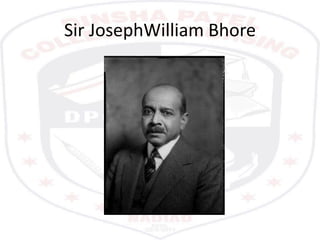
Sir JosephWilliam Bhore
Bhore Committee
- Constituted by pre independent GOI
- Under Sir Joseph William Bhore, Indian Civil
Servant
- Formed in 1943
- “Health Planning and Development
Committee”
Terms of Reference
• a survey of existing conditions and organisation
• secondly suggestions for future development
• to review primarily those activities which can
reasonably be regarded as falling within the
scope of health administration
• Consider short term objectives which might
reasonably be expected to be reached within a
period of four to five years
• objectives which will necessarily require a longer
period for attainment.
Bhore Committee Report
• Submitted in 1946
• Runs into 4 volumes
• Volume I A survey of the State of the Public
Health and the existing health organisation
• Volume II Recommendations
• Volume III Appendices
• Volume IV Summary
Observations
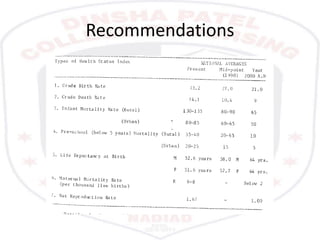
CDR 22.4/1000
IMR 162/1000 live births
MMR 20/1000 live births
Life expectancy at birth - 27 years.
Observations
Incidence of communicable disease also was
very high.
Diseases like chicken pox, cholera etc occurred
in epidemics.
Many of the health problems were
preventable.
Investment made in preventing these
problems would give high returns in the forms
of increased productivity and development.
Observations
Identified housing, communication, water
supply, sanitation improvement in nutrition,
elimination of unemployment, improvement
in agriculture and industrial production as
sectors that needed improvement for
improvement of health.
Recommendations
Short term plan:
- To be implemented within 5-10 years.
- Each primary health centre in the rural area to
cater to a population of 40,000
- Secondary health centre to serve as a
supervisory, coordinating and referral institution
- For each PHC 2 medical officers, 4 public health
nurses, one nurse, 4 midwives, 4 trained dais and
15 class IV employees
Recommendations
Long term plan (3 million plan):
Health care system in three tires.
• First tier: primary health units with 75 bedded hospital
for each 10,000 – 20,000 population with staff of 6
medical officers, 6 public health nurses, 2 sanitary
inspectors, 2 health assistants and other supportive
staff.
• Second tier: 650 bedded Regional Health Unit (RHU) to
serve as a referral centre for 30 – 40 PHUs.
• Third tier: district hospitals with 2,500 beds to serve
the needs of about 3 million.
Recommendations
• 3 months training in preventive and social
medicine to prepare ‘SOCIAL PHYSICIANS’
• Special emphasis on preventive work (Integration
of curative and preventive services)
• Village Health Committee consisting of 5 to 7
individuals for procuring the active participation
of the people in the local health programme.
• Inter-sectoral Coordination
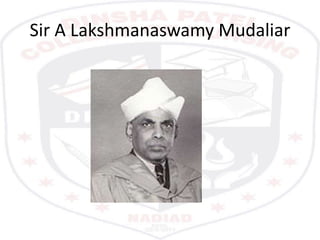
Sir A Lakshmanaswamy Mudaliar
Mudaliar Committee
• Constitued in 1959
• By GOI
• Under Dr. A Lakshmanswamy Mudaliar, Vice
Chancellor, Madras University
• “Health Survey and Planning Committee”
Terms of Reference
1. The assessment (or evaluation) in the field of
medical relief and public health since the
submission of the Health Survey and
Development Committee's Report (the Bhore
Committee)
2. Review of the First and Second Five-Year Plan
Health projects and
3. Formulation of recommendations for the future
plan of health development in the country.
Observations
• Basic health facilities had not reached at least
half the nation
• Gross mal distribution of hospitals and beds in
favour of urban areas.
• Quality of services provided by PHCs were
grossly inadequate with poor functioning, lack
of referral system, and gross under staffing
due to insufficient resources
Recommendations
• Consolidation of 1st two 5 yr plans
• Strengthening DH to serve as central base for
specialist services
• Regional organisation between headquarters and
regional DD nandAD
• PHC - 40,000 population
• 1 BHW per 10,000 population
• Improve secondary services
• Integration of Medical and Health services
• All India Health Service
Chadha Committee
• A committee of health administrators and
malariologists reviewed the National Malaria
Eradication programme and recommended that a
special Committee should study in detail the
preparations that are to be made for the entry
into the maintenance phase and formulate a
plan.
• Constitued in 1963
• By GOI
• Under Dr. MS. Chadha, Director General of Health
Services
Terms of Reference
1. The committee should go into the details of the
requirement related to the primary health centers,
their planning, the necessary priority required
according to the needs of the maintenance phase of
the Malaria Eradication progrmme.
2. The committee should also consider the Staffing
pattern required for the malaria eradication
programme but also for other health activities and
the manner in which the technical and supervisory
staff of the N.M.E.P. organization should be utilised
after malaria eradication has been achieved
Recommendations
• Maintenance to be done by general health
services (block and district level)
• Through basic health worker per 10,000
population
• Basic health workers should visit house to house
once in a month to implement malaria activities.
• BHW to serve as MPHW for family planning and
vital statistics
• FPHA to supervise 3-4 BHW
Mukerji Commitee
• Following the Central Family Planning Council
meet at Madras
• Constitued in 1965
• Headed by Shri Mukerji, Secretary, Ministry of
Health and Family Planning
Terms of Reference
• In 1965, the ICMR Director pronounced that
Lippe’s Loop was safe.
• So, IUCD was introduced into the family
planning programme and reorganisation of
the FP programme was needed.
• CBR was 41 per thousand and was aimed at
reducing to 25 per thousand in a period of 10
years.
Terms of Reference
To review what additions and changes are
necessary as a result of the greatly altered
situation due to the IUCD having come in the
forefront of the programme, in the staffing
pattern, financial provisions, etc.
Recommendations
• Target oriented programming
• Strengthening of education and publicity efforts and
involvement of other organisations
• Strong executive agency in Health Directorate of each state
government to exclusively deal with family planning
• Approved the existing Urban Family Welfare Planning
centre
• At Rural Family Planning Centre
- BHW to be utilised as MPW for general services
- FPHA to undertake only FP work without having to
supervise BHW D
• Delink malaria and FP activity
Mukerji Committee,1966
• Following 13th Meeting of the Central Council
of Health held at Bangalore in June, 1966 -
state finding it difficult to take burden of
maintenance phase of malaria and other prog.
like small pox, leprosy, FP, trachoma
• Formed in 1966
• By GOI
• Headed by Shri B. Mukerji, Union Health
Secretary
Terms of Reference
• To review the staffing pattern of the primary
health centre complex and to recommend the
minimum staff of various categories required at
different levels within the district so as to provide
an integrated health service capable of fully
catering to the needs of the vigilance services in
the maintenance phase of National Malaria
Eradication Programme, smallpox eradication,
tuberculosis, leprosy and trachoma control, etc.
• To recommend the pattern of Central assistance
for the States
Recommendations
• Basic Health Services to be provided at block
level
• Strengthening required at higher level
• Any attempt to give the basic health worker
more work under the family planning
programme would either endanger malaria
vigilance work or would need a larger number
of basic health workers per block than what
the Committee has recommended.
Recommendations
• Integrated approach in the entire health field -
Programmes of public health and medical care should
be integrated to the maximum extent possible and so
also the programmes within each field.
• Health workers at the lower levels should become
increasingly multipurpose workers. In certain phases of
any large national programme it may be necessary to
have separate staff, at the maintenance stage the
activities under the programme should get integrated
more and more with the basic health services and to
the extent possible should be taken care of through the
domiciliary services.
Recommendations
• One basic health worker for a population of
10,000
• At the District level there should be as much
integration of the general health programme
with the family planning programme as
possible, ensuring at the same time however,
that the family planning programme continues
to receive adequate attention and profits from
such integration
Recommendations
• The Committee did not attempt to work out
any details of the organisation that would be
needed above the District level, i.e. at the
Zonal, the State and the Central levels
• They also felt that the State Government
could themselves work out better the strength
and pattern and method of functioning of the
health organisation at the Zonal and State
levels.
Jungalwalla Committee
• Central Council of Health, 1964 Srinagar
• Dr. N. Jungalwalla, Addl. Director General of
Health Services
• “Committee on Integration of Health Services”
• Submitted report un 1967
Terms of Reference
• To study the problems of the health services
• Service conditions
• Elimination of Private practice
Definition of Integrated Health
Services
• Service with an unified approach for all
problems instead of segmented approach for
different problems
• Medical care of the sick and conventional
public health programmes functioning under a
single administrator and operating in unified
manner at all levels of hierarchy with due
priority for each programme obtaining at a
point of time
Observation
3 patterns were observed,
• Wholly integrated cadre
• Wholly dichotomous
• Proposed to be integrated
• In all states periphery was integrated
Recommendation
• Integration from highest to lowest level in services
• Integration of preventive and curative services
• Integration of medical services and public
health(rotation of personnel)
• Integration of Health Services has 3 main components
- Health services of functions and methods of delivery
- Their organisation
- The personnel providing these services & their
administration
Recommendation
The main steps recommended towards
integration were:
• unified cadre
• common seniority
• recognition of extra qualifications
• equal pay for equal work
• special pay for specialized work
• no private practice, and good service conditions
• Left states to work out their own strategy.
Kartar Singh Committee
Programmes are being run almost
independently of each other by staff recruited
under each programme. There is little or no
coordination between the field workers of
these programmes and even at the
supervisory level there are separate and
independent functionaries.
Kartar Singh Committee
Growing demand for increase of staff under each
programme.
Need to reduce population/area covered by each
worker.
Whether the same objective cannot be achieved
by coordinating these programmes and pooling
the personnel.
Could not such an integration reduce the
population/area of each worker, thus making his
coverage smaller and consequently more
effective?
Kartar Singh Committee
• Meeting of the Central Family Planning
Council 1972
• By GOI
• In 1972
• “The committee on Multipurpose workers
under Health and Family Planning”
• Kartar Singh, Addl. Sec., MOHFP
• Report in 1973
Terms of Reference
• Structure for integrated services the
peripherals and supervisory levels
• Feasibility of MPW
• Their training requirements
• Utilisation of mobile services for integration
Recommendations
• Multipurpose workers - feasible and desirable
• Redesignation
ANMs replaced by FHWs
BHW, Malaria surveillance workers,
vaccinators, FPHAs replaced by MHWs
LHV designated as FH supervisor
• To be first introduced in malaria maintenance
phase areas and small pox controlled areas
• Clearly spelt out the job functions of HWs and
Supervisors
Recommendations
• 1 PHC – 50,000 population
• 1 PHC –16 SHC (2000 – 3500)
• 1 SHC – 1 MHW n 1 FHW
• 1 male supervisor – 4 MHWs
• 1 female supervisor – 4 FHWs
• Doctor incharge of all supervisors
• To be impemented in 5th 5yr plan
Shrivastav Committee
GOI observed that
• urban orientation of medical education in India, which
relies heavily on curative methods and sophisticated
diagnostic aids
• the failure of the programmes of training in the fields of
nutrition, family welfare planning, and maternal and child
because of their development in isolation from medical
education,
• the deprivation of the rural communities of doctors
• the need to re-orient undergraduate medical education
with emphasis on community rather than on hospital care
• the importance of integrating teaching of various aspects of
family planning with medical education
Shrivastav Committee
• MOHFP,GOI
• In 1974
• “ Group on Medical Education and Support
Manpower”
• Submitted report in 1975
Terms of Reference
• To devise a suitable curriculum for training a
cadre of Health Assistants
• To suggest steps for improving the existing
medical educational processes as to provide
due emphasis on the problems particularly
relevant to national requirements
• To make any other suggestions to realise the
above objectives and matters incidental
thereto
Recommendations
(1) Organization of the basic health services (including
nutrition, health education and family planning) within
the community itself and training the personnel needed
for the purposes;
- Creation of Village Health Guide (VHG) or community
health volunteers from the community itself like teachers,
postmasters, gram sevaks who can provide comprehensive
health services as paraprofessionals.
- Primary health care be provided within the community
itself through specially trained workers so that the health of
the people is placed in the hands of people themselves
Recommendations
(2) Organization of an economic and efficient
programme of health services to bridge the
community with the first level referral Centre,
viz., the PHC
- Creation of MPW and Health Assistants (HA)
in between the VHG and MO i/c PHC
Recommendations
(3) The creation of a National Referral Services
Complex by the development of proper
linkages between the PHC and higher level
referral and service centres;
Recommendations
(4) To create the necessary administrative and
financial machinery for the reorganization of
the entire programme of medical and health
education from the point of view of the
objectives and needs of the proposed
programme of national health services
- Establishment of ‘The Medical and Health
Education Commission’
Rural health Scheme
Based on these recommendations “Rural Health
Scheme” was launched by the government in
1977-78. The major steps initiated were :
a) Involvement of medical colleges in health care of
selected with the objective of reorienting medical
education according to rural population called Re
Orientation of Medical education (ROME). It led
to teaching and training of undergraduate
students and Interns at PHCs.
b) Training of Village Health Guides and utilising
their services in the general health service
system.
REPORT OF THE WORKING GROUP
ON HEALTH FOR ALL BY 2000 A.D.
• As India was party to the universal
commitment of Health for All by 2000 A.D.
• By Planning Commision
• In 1980
• Kripa Narain, Sec., MOHFW & President, AIIMS
• Report submitted in 1981
Terms of Reference
• To review current health status,
implementation of programmes and measures
for rectifying them
• Evolve plan outlines for 1980 – 1986 for health
sector so that foundation for HFA can be laid
• Specific programmes for rural, tribal and
weaker sections & to review health
component on minimum needs programme
Recommendations
Revised Minimum Needs Programme:
• Each District - Health Centre with specialised curative
and Public Health experts)
• Each Sub-division (5 lakh population)- Sub divisional
Health centre with epidemiological wing
• Each block (1 lakh population) -CHC with specialist
services
• 30,000 population and 15,000 in hilly area - PHC
providing preventive, promotive and curative services
• 5,000 population and 2,500 in hilly area - Sub centre
with one MPW(F), MPW(M) and one part time
attendant
• Each village - One health volunteer
Recommendations
Other Notable Committees
Sokhey Committee (1947)
• prescribing standards of dietary and nutrition for all classes of population;
• consideration of the nature and incidence of the various epidemic which
take a heavy toll of life, and suggestion of ways and means for guarding
against theses scourges;
• investigation into the volume and causes of infant mortality, as well as
mortality among women; and suggestion of ways and means of reducing
such mortality;
• provision of the necessary health units, comprising physician, nurses,
surgeons, hospitals and dispensaries, sanatoria and nursing homes;
• health insurance;
• medical training and research;
• compilation of vital statistics, including those of birth and death rates;
• cultivation of the necessary drugs and production of medicines to
preventive or curative aid, scientific and surgical appliances and
accessories of the national Health Services
Chopra Committee (1948)
- promotion of indigenous and modern
medicine through integration in education and
multi-disciplinary research
Mehta Committee (1957)
- Balwant Rai Mehta
- To assess performance of Community
Development Programme started in 1952
- concluded programme was a failure due to
lack of local initiative
Renuka Roy Committee (1960)
- School Health committee
- recommended promotion of preventive
care through schools, provision of mid day
meals, health education as part of curricular
and integration of school health and primary
health network
Jain Committee (1966)
- to review the working of different hospitals
and central health services
Krishnan Committee (1982)
- headed by S.V. Krishnan
- to study health services in urban areas and
cities
Mehta Committee (1983)
Dr. Shantilal J. Mehta, Chairman
“Medical Education Review Committee”
Bajaj Committee (1987)
Prof. J.S. Bajaj, Professor of Medicine
HEALTH MANPOWER PLANNING, PRODUCTION AND
MANAGEMENT
• Procedures relating to admissions to under-graduate
courses
• Procedures relating to admissions to the post-graduate
course
• Duration of the under-graduate course and Internship
• Duration of the post-graduate courses and thesis
• Review of the Residency Scheme
• Measures to bring about overall improvement in the under-
graduate and post-graduate education
Report of theNational Commission on
Macroeconomics and Health (2005)
• Under chairmanship of P. Chidambaram, Finance
Minister and Dr. Anbumani Ramadoss, Health Minister
• promoting equity by reducing household expenditure
on total health spending and experimenting with
alternate models of health financing;
• restructuring the existing primary health care system to
make it more accountable;
• reducing disease burden and the level of risk;
• establishing institutional frameworks for improved
quality of governance of health;
• investing in technology and human resources for a
more professional and skilled workforce and better
monitoring.

health committees reports

  • 1.
    PRESENTED BY, MR. KAILASHNAGAR ASSIST. PROF. DEPT. OF COMMUNITY HEALTH NSG. DINSHA PATEL COLLEGE OF NURSING, NADIAD
  • 2.
  • 3.
    Bhore Committee - Constitutedby pre independent GOI - Under Sir Joseph William Bhore, Indian Civil Servant - Formed in 1943 - “Health Planning and Development Committee”
  • 4.
    Terms of Reference •a survey of existing conditions and organisation • secondly suggestions for future development • to review primarily those activities which can reasonably be regarded as falling within the scope of health administration • Consider short term objectives which might reasonably be expected to be reached within a period of four to five years • objectives which will necessarily require a longer period for attainment.
  • 5.
    Bhore Committee Report •Submitted in 1946 • Runs into 4 volumes • Volume I A survey of the State of the Public Health and the existing health organisation • Volume II Recommendations • Volume III Appendices • Volume IV Summary
  • 6.
    Observations CDR 22.4/1000 IMR 162/1000live births MMR 20/1000 live births Life expectancy at birth - 27 years.
  • 7.
    Observations Incidence of communicabledisease also was very high. Diseases like chicken pox, cholera etc occurred in epidemics. Many of the health problems were preventable. Investment made in preventing these problems would give high returns in the forms of increased productivity and development.
  • 8.
    Observations Identified housing, communication,water supply, sanitation improvement in nutrition, elimination of unemployment, improvement in agriculture and industrial production as sectors that needed improvement for improvement of health.
  • 9.
    Recommendations Short term plan: -To be implemented within 5-10 years. - Each primary health centre in the rural area to cater to a population of 40,000 - Secondary health centre to serve as a supervisory, coordinating and referral institution - For each PHC 2 medical officers, 4 public health nurses, one nurse, 4 midwives, 4 trained dais and 15 class IV employees
  • 10.
    Recommendations Long term plan(3 million plan): Health care system in three tires. • First tier: primary health units with 75 bedded hospital for each 10,000 – 20,000 population with staff of 6 medical officers, 6 public health nurses, 2 sanitary inspectors, 2 health assistants and other supportive staff. • Second tier: 650 bedded Regional Health Unit (RHU) to serve as a referral centre for 30 – 40 PHUs. • Third tier: district hospitals with 2,500 beds to serve the needs of about 3 million.
  • 11.
    Recommendations • 3 monthstraining in preventive and social medicine to prepare ‘SOCIAL PHYSICIANS’ • Special emphasis on preventive work (Integration of curative and preventive services) • Village Health Committee consisting of 5 to 7 individuals for procuring the active participation of the people in the local health programme. • Inter-sectoral Coordination
  • 12.
  • 13.
    Mudaliar Committee • Constituedin 1959 • By GOI • Under Dr. A Lakshmanswamy Mudaliar, Vice Chancellor, Madras University • “Health Survey and Planning Committee”
  • 14.
    Terms of Reference 1.The assessment (or evaluation) in the field of medical relief and public health since the submission of the Health Survey and Development Committee's Report (the Bhore Committee) 2. Review of the First and Second Five-Year Plan Health projects and 3. Formulation of recommendations for the future plan of health development in the country.
  • 15.
    Observations • Basic healthfacilities had not reached at least half the nation • Gross mal distribution of hospitals and beds in favour of urban areas. • Quality of services provided by PHCs were grossly inadequate with poor functioning, lack of referral system, and gross under staffing due to insufficient resources
  • 16.
    Recommendations • Consolidation of1st two 5 yr plans • Strengthening DH to serve as central base for specialist services • Regional organisation between headquarters and regional DD nandAD • PHC - 40,000 population • 1 BHW per 10,000 population • Improve secondary services • Integration of Medical and Health services • All India Health Service
  • 17.
    Chadha Committee • Acommittee of health administrators and malariologists reviewed the National Malaria Eradication programme and recommended that a special Committee should study in detail the preparations that are to be made for the entry into the maintenance phase and formulate a plan. • Constitued in 1963 • By GOI • Under Dr. MS. Chadha, Director General of Health Services
  • 18.
    Terms of Reference 1.The committee should go into the details of the requirement related to the primary health centers, their planning, the necessary priority required according to the needs of the maintenance phase of the Malaria Eradication progrmme. 2. The committee should also consider the Staffing pattern required for the malaria eradication programme but also for other health activities and the manner in which the technical and supervisory staff of the N.M.E.P. organization should be utilised after malaria eradication has been achieved
  • 19.
    Recommendations • Maintenance tobe done by general health services (block and district level) • Through basic health worker per 10,000 population • Basic health workers should visit house to house once in a month to implement malaria activities. • BHW to serve as MPHW for family planning and vital statistics • FPHA to supervise 3-4 BHW
  • 20.
    Mukerji Commitee • Followingthe Central Family Planning Council meet at Madras • Constitued in 1965 • Headed by Shri Mukerji, Secretary, Ministry of Health and Family Planning
  • 21.
    Terms of Reference •In 1965, the ICMR Director pronounced that Lippe’s Loop was safe. • So, IUCD was introduced into the family planning programme and reorganisation of the FP programme was needed. • CBR was 41 per thousand and was aimed at reducing to 25 per thousand in a period of 10 years.
  • 22.
    Terms of Reference Toreview what additions and changes are necessary as a result of the greatly altered situation due to the IUCD having come in the forefront of the programme, in the staffing pattern, financial provisions, etc.
  • 23.
    Recommendations • Target orientedprogramming • Strengthening of education and publicity efforts and involvement of other organisations • Strong executive agency in Health Directorate of each state government to exclusively deal with family planning • Approved the existing Urban Family Welfare Planning centre • At Rural Family Planning Centre - BHW to be utilised as MPW for general services - FPHA to undertake only FP work without having to supervise BHW D • Delink malaria and FP activity
  • 24.
    Mukerji Committee,1966 • Following13th Meeting of the Central Council of Health held at Bangalore in June, 1966 - state finding it difficult to take burden of maintenance phase of malaria and other prog. like small pox, leprosy, FP, trachoma • Formed in 1966 • By GOI • Headed by Shri B. Mukerji, Union Health Secretary
  • 25.
    Terms of Reference •To review the staffing pattern of the primary health centre complex and to recommend the minimum staff of various categories required at different levels within the district so as to provide an integrated health service capable of fully catering to the needs of the vigilance services in the maintenance phase of National Malaria Eradication Programme, smallpox eradication, tuberculosis, leprosy and trachoma control, etc. • To recommend the pattern of Central assistance for the States
  • 26.
    Recommendations • Basic HealthServices to be provided at block level • Strengthening required at higher level • Any attempt to give the basic health worker more work under the family planning programme would either endanger malaria vigilance work or would need a larger number of basic health workers per block than what the Committee has recommended.
  • 27.
    Recommendations • Integrated approachin the entire health field - Programmes of public health and medical care should be integrated to the maximum extent possible and so also the programmes within each field. • Health workers at the lower levels should become increasingly multipurpose workers. In certain phases of any large national programme it may be necessary to have separate staff, at the maintenance stage the activities under the programme should get integrated more and more with the basic health services and to the extent possible should be taken care of through the domiciliary services.
  • 28.
    Recommendations • One basichealth worker for a population of 10,000 • At the District level there should be as much integration of the general health programme with the family planning programme as possible, ensuring at the same time however, that the family planning programme continues to receive adequate attention and profits from such integration
  • 29.
    Recommendations • The Committeedid not attempt to work out any details of the organisation that would be needed above the District level, i.e. at the Zonal, the State and the Central levels • They also felt that the State Government could themselves work out better the strength and pattern and method of functioning of the health organisation at the Zonal and State levels.
  • 30.
    Jungalwalla Committee • CentralCouncil of Health, 1964 Srinagar • Dr. N. Jungalwalla, Addl. Director General of Health Services • “Committee on Integration of Health Services” • Submitted report un 1967
  • 31.
    Terms of Reference •To study the problems of the health services • Service conditions • Elimination of Private practice
  • 32.
    Definition of IntegratedHealth Services • Service with an unified approach for all problems instead of segmented approach for different problems • Medical care of the sick and conventional public health programmes functioning under a single administrator and operating in unified manner at all levels of hierarchy with due priority for each programme obtaining at a point of time
  • 33.
    Observation 3 patterns wereobserved, • Wholly integrated cadre • Wholly dichotomous • Proposed to be integrated • In all states periphery was integrated
  • 34.
    Recommendation • Integration fromhighest to lowest level in services • Integration of preventive and curative services • Integration of medical services and public health(rotation of personnel) • Integration of Health Services has 3 main components - Health services of functions and methods of delivery - Their organisation - The personnel providing these services & their administration
  • 35.
    Recommendation The main stepsrecommended towards integration were: • unified cadre • common seniority • recognition of extra qualifications • equal pay for equal work • special pay for specialized work • no private practice, and good service conditions • Left states to work out their own strategy.
  • 36.
    Kartar Singh Committee Programmesare being run almost independently of each other by staff recruited under each programme. There is little or no coordination between the field workers of these programmes and even at the supervisory level there are separate and independent functionaries.
  • 37.
    Kartar Singh Committee Growingdemand for increase of staff under each programme. Need to reduce population/area covered by each worker. Whether the same objective cannot be achieved by coordinating these programmes and pooling the personnel. Could not such an integration reduce the population/area of each worker, thus making his coverage smaller and consequently more effective?
  • 38.
    Kartar Singh Committee •Meeting of the Central Family Planning Council 1972 • By GOI • In 1972 • “The committee on Multipurpose workers under Health and Family Planning” • Kartar Singh, Addl. Sec., MOHFP • Report in 1973
  • 39.
    Terms of Reference •Structure for integrated services the peripherals and supervisory levels • Feasibility of MPW • Their training requirements • Utilisation of mobile services for integration
  • 40.
    Recommendations • Multipurpose workers- feasible and desirable • Redesignation ANMs replaced by FHWs BHW, Malaria surveillance workers, vaccinators, FPHAs replaced by MHWs LHV designated as FH supervisor • To be first introduced in malaria maintenance phase areas and small pox controlled areas • Clearly spelt out the job functions of HWs and Supervisors
  • 41.
    Recommendations • 1 PHC– 50,000 population • 1 PHC –16 SHC (2000 – 3500) • 1 SHC – 1 MHW n 1 FHW • 1 male supervisor – 4 MHWs • 1 female supervisor – 4 FHWs • Doctor incharge of all supervisors • To be impemented in 5th 5yr plan
  • 42.
    Shrivastav Committee GOI observedthat • urban orientation of medical education in India, which relies heavily on curative methods and sophisticated diagnostic aids • the failure of the programmes of training in the fields of nutrition, family welfare planning, and maternal and child because of their development in isolation from medical education, • the deprivation of the rural communities of doctors • the need to re-orient undergraduate medical education with emphasis on community rather than on hospital care • the importance of integrating teaching of various aspects of family planning with medical education
  • 43.
    Shrivastav Committee • MOHFP,GOI •In 1974 • “ Group on Medical Education and Support Manpower” • Submitted report in 1975
  • 44.
    Terms of Reference •To devise a suitable curriculum for training a cadre of Health Assistants • To suggest steps for improving the existing medical educational processes as to provide due emphasis on the problems particularly relevant to national requirements • To make any other suggestions to realise the above objectives and matters incidental thereto
  • 45.
    Recommendations (1) Organization ofthe basic health services (including nutrition, health education and family planning) within the community itself and training the personnel needed for the purposes; - Creation of Village Health Guide (VHG) or community health volunteers from the community itself like teachers, postmasters, gram sevaks who can provide comprehensive health services as paraprofessionals. - Primary health care be provided within the community itself through specially trained workers so that the health of the people is placed in the hands of people themselves
  • 46.
    Recommendations (2) Organization ofan economic and efficient programme of health services to bridge the community with the first level referral Centre, viz., the PHC - Creation of MPW and Health Assistants (HA) in between the VHG and MO i/c PHC
  • 47.
    Recommendations (3) The creationof a National Referral Services Complex by the development of proper linkages between the PHC and higher level referral and service centres;
  • 48.
    Recommendations (4) To createthe necessary administrative and financial machinery for the reorganization of the entire programme of medical and health education from the point of view of the objectives and needs of the proposed programme of national health services - Establishment of ‘The Medical and Health Education Commission’
  • 49.
    Rural health Scheme Basedon these recommendations “Rural Health Scheme” was launched by the government in 1977-78. The major steps initiated were : a) Involvement of medical colleges in health care of selected with the objective of reorienting medical education according to rural population called Re Orientation of Medical education (ROME). It led to teaching and training of undergraduate students and Interns at PHCs. b) Training of Village Health Guides and utilising their services in the general health service system.
  • 50.
    REPORT OF THEWORKING GROUP ON HEALTH FOR ALL BY 2000 A.D. • As India was party to the universal commitment of Health for All by 2000 A.D. • By Planning Commision • In 1980 • Kripa Narain, Sec., MOHFW & President, AIIMS • Report submitted in 1981
  • 51.
    Terms of Reference •To review current health status, implementation of programmes and measures for rectifying them • Evolve plan outlines for 1980 – 1986 for health sector so that foundation for HFA can be laid • Specific programmes for rural, tribal and weaker sections & to review health component on minimum needs programme
  • 52.
    Recommendations Revised Minimum NeedsProgramme: • Each District - Health Centre with specialised curative and Public Health experts) • Each Sub-division (5 lakh population)- Sub divisional Health centre with epidemiological wing • Each block (1 lakh population) -CHC with specialist services • 30,000 population and 15,000 in hilly area - PHC providing preventive, promotive and curative services • 5,000 population and 2,500 in hilly area - Sub centre with one MPW(F), MPW(M) and one part time attendant • Each village - One health volunteer
  • 53.
  • 54.
  • 55.
    Sokhey Committee (1947) •prescribing standards of dietary and nutrition for all classes of population; • consideration of the nature and incidence of the various epidemic which take a heavy toll of life, and suggestion of ways and means for guarding against theses scourges; • investigation into the volume and causes of infant mortality, as well as mortality among women; and suggestion of ways and means of reducing such mortality; • provision of the necessary health units, comprising physician, nurses, surgeons, hospitals and dispensaries, sanatoria and nursing homes; • health insurance; • medical training and research; • compilation of vital statistics, including those of birth and death rates; • cultivation of the necessary drugs and production of medicines to preventive or curative aid, scientific and surgical appliances and accessories of the national Health Services
  • 56.
    Chopra Committee (1948) -promotion of indigenous and modern medicine through integration in education and multi-disciplinary research Mehta Committee (1957) - Balwant Rai Mehta - To assess performance of Community Development Programme started in 1952 - concluded programme was a failure due to lack of local initiative
  • 57.
    Renuka Roy Committee(1960) - School Health committee - recommended promotion of preventive care through schools, provision of mid day meals, health education as part of curricular and integration of school health and primary health network Jain Committee (1966) - to review the working of different hospitals and central health services
  • 58.
    Krishnan Committee (1982) -headed by S.V. Krishnan - to study health services in urban areas and cities Mehta Committee (1983) Dr. Shantilal J. Mehta, Chairman “Medical Education Review Committee”
  • 59.
    Bajaj Committee (1987) Prof.J.S. Bajaj, Professor of Medicine HEALTH MANPOWER PLANNING, PRODUCTION AND MANAGEMENT • Procedures relating to admissions to under-graduate courses • Procedures relating to admissions to the post-graduate course • Duration of the under-graduate course and Internship • Duration of the post-graduate courses and thesis • Review of the Residency Scheme • Measures to bring about overall improvement in the under- graduate and post-graduate education
  • 60.
    Report of theNationalCommission on Macroeconomics and Health (2005) • Under chairmanship of P. Chidambaram, Finance Minister and Dr. Anbumani Ramadoss, Health Minister • promoting equity by reducing household expenditure on total health spending and experimenting with alternate models of health financing; • restructuring the existing primary health care system to make it more accountable; • reducing disease burden and the level of risk; • establishing institutional frameworks for improved quality of governance of health; • investing in technology and human resources for a more professional and skilled workforce and better monitoring.