BTT 1O8 MYP Design: Ethical Issues in Developing Technologies
Earlier for this class, you determined future technologies that fit within current trends.
Many innovations have solved a specific problem creating positive results, but in the process have created
issues for people that were unforeseen when the technology was initially launched. For example, due to the
increasing use of social media, people were able to connect all around the world, but cases of cyberbullying
have skyrocketed.
Society is then left with dealing with the issues created – laws slowly are enacted and further innovations are
developed to resolve some of these problems. It is important then to be forward-thinking when creating your
technology to envision possible uses and problems that might occur.
Problem: To create the most ethically sound and socially beneficial technology for the future. Your idea
must address a particular community issue. You must decide how you will communicate your
ideas to possible investors to obtain funding in order to produce the initial designs of your new
technology.
Design Cycle:
A. Inquiring and Analyzing:
Imagine is the dual nature of technology: Write a design brief answering the following:
1. What is your global issue and why is it important to solve?
2. Identify and prioritize your research – what do you need to find out to be able to develop an
idea for a technology?
3. Explain your technology idea and justify the need for your future technology. (What community
issue are you trying to address?)
4. Analyze existing products - What current technologies are similar to your idea? What ethical
issues do they create?
5. What are the benefits and problems that may occur when consumers use your new
technology?
6. How would you change your technology in order to prevent some of these problems?
7. What other problems are not addressed?
8. Do your changes create any ethical problems? Such as?
Note: A design brief is your response to the challenge showing how you intend to solve the problem
presented. This brief will guide your work.
Submit your design brief as a written report with a title page, table of contents, page numbers and
appropriate bibliography.
B. Developing Ideas:
1. You must outline the requirements of a presentation for financial investors. You will be presenting
to these investors in person.
Design specifications
Presentation:
• No longer than 10 minutes
• Minimum size 20 font
• Consistent backgrounds, colours, animations, designs, transitions, if applicable,
for a professional audience
• Your Company name and own created logo on every slide
• State amount of money asking for & % of company ownership offering
• Include visuals and a diagram or model of your innovation
2. Develop the design ideas – You are expected to generate several feasible designs for
representing your ideas to possible investors. How can you visually represent your ethically
sound technology to the potential designers of the technology?
1. Identify the program tested
2. Provide evidence of your use of the program.
3. Evaluate the effectiveness of using this program for your project. What are the pros and cons
of using the program? Is it a good fit for your purpose? Look at your design specification to
see how it fits with your requirements.
4. Do steps 1, 2 & 3 for all programs tested.
Note: To reach a level 5-6, at least 3 programs per person must be tested and evaluated.
3. Give an overall conclusion explaining your decision about which program(s) to use.
4. Develop planning drawings & diagrams –You need to sketch out the slides you will create for your
presentation and produce a diagram or model of all of the components of your technology.
Submit this component in your design sketchbooks.
C. Creating the Solution:
1. Construct a logical plan - You need to follow the Planning template to outline step-by-step who is
doing which part of the project, what resources are needed and the length of time each step will
take.
2. Demonstrate your technical skills - Your task is to visually diagram or model your idea and make
an effective presentation. You must create a presentation for investors that positively presents
your ideas in the hopes of generating funding for the development of your idea. Explain:
a. The community issue
b. The need for your innovation
c. What your innovation does
d. How your product is better than current solutions
e. How much money you need in order to start making your product
3. Follow the plan to make the solution & justify changes made to the design - Provide evidence of
how you followed your plan and explain any changes made to your original plans. This will be
done as an interview.
D. Evaluating:
1. Design Testing Methods – Did you get the investment you wanted? Explain why or why not.
2. Evaluate the success of the solution – critically evaluate the success of your solution against the
design specifications. Did you do what was expected? Why or why not?
3. Explain how your solution could still be improved overall.
4. Explain the impact of the solution on the target audience (those affected by your social issue).
This stage will be done as an interview.
Evaluation of Design:
For each assignment this semester, you will be assessed on 2-4 areas of the different criteria of the
assignment. By the end of the semester you will have completed a maximum of 6 evaluations in each area of
the design cycle.
All parts of the design cycle must be submitted in order for the assignment to be evaluated.
Note: The design specification is the specific requirements for the assignment.
Achievement
Level
7-8 5-6 3-4 1-2 0
Inquiring and
analyzing
The student effectively
explains and justifies
the need for a solution
to a client/target
audience.
The student conducts a
detailed research plan,
which identifies and
prioritizes the primary &
secondary research
needed to develop a
solution to the problem
independently.
The student analyzes a
range of existing
products that inspire a
solution to the problem
in detail.
The student develops a
detailed design brief
which summarizes the
analysis of the relevant
research.
The student explains
the need for a solution
to a problem for a
specified client/target
audience.
The student constructs
a research plan, which
identifies and prioritizes
the primary &
secondary research
needed to develop a
solution to the problem
with some
independence.
The student analyzes a
range of existing
products that inspire a
solution to the problem.
The student develops a
design brief which
explains the analysis of
the relevant research.
The student outlines
the need for a solution
to a problem for a
specified client/target
audience.
The student outlines a
research plan, which
identifies and
prioritizes the primary
& secondary research
needed to develop a
solution to the problem
with some guidance.
The student analyzes
one existing product
that inspires a solution
to the problem.
The student develops
a design brief which
outlines the analysis of
the relevant research.
The student
states the need
for a solution to a
problem for a
specified
client/target
audience.
The student
develops a basic
design brief
which states the
findings of
relevant
research.
The
student
does not
reach a
standard
described
by any of
the
descriptors
below.
Achievement
Level
7-8 5-6 3-4 1-2 0
Developing
ideas
Student explores a wide
variety of mediums to
deliver effective content
with appropriate
software (6 or more
types of programs per
person). Evidence of
evaluation is thorough.
The selection of
appropriate software is
strongly justified for the
intended audience.
The student presents
the chosen design and
justifies fully and
critically its selection
with detailed reference
to the design
specification.
The student develops
accurate and detailed
planning
drawings/diagrams and
outlines the
requirements for the
creation of the chosen
innovation &
presentation.
Student explores a
variety of mediums to
deliver effective content
with appropriate
software (at least 3
types of programs per
person). Evidence of
evaluation is well done.
The selection of
appropriate software is
justified well for the
intended audience.
The student presents
the chosen design and
justifies its selection
with reference to the
design specification.
The student develops
accurate planning
drawings/ diagrams and
lists requirements for
the creation of the
chosen innovation &
presentation.
Student explores some
mediums to deliver
content (more than 1
per person per
product). Evidence of
evaluation is
somewhat shown. The
selection of
appropriate software is
somewhat justified for
at least one product.
The student justifies
the selection of the
chosen design with
reference to the design
specification.
The student creates
planning
drawings/diagrams or
lists requirements for
the creation of the
chosen innovation &
presentation.
Student
minimally
explores
mediums to
deliver content.
The selection of
appropriate
software is
minimally
justified for either
product.
Evidence of
evaluation is
minimal and/or
missing.
The student
presents one
design, which
can be minimally
interpreted by
others.
The student
creates
incomplete
planning
drawings/diagra
ms.
The
student
does not
reach a
standard
described
by any of
the
descriptors.
Achievemen
t Level
7-8 5-6 3-4 1-2 0
Creating the
solution
The student constructs
a detailed and logical
plan, which describes
the efficient use of time
and resources,
sufficient for peers to be
able to follow to create
the solution.
The student
demonstrates excellent
technical skills when
making the presentation
and diagram/model.
The student follows the
plan to create the
solution, which
functions as intended
and is presented
appropriately.
The student fully
justifies changes made
to the chosen design
and plan when making
the solution.
The student constructs
a logical plan, which
considers time and
resources, sufficient for
peers to be able to
follow to create the
solution.
The student
demonstrates
competent technical
skills when making the
presentation and
diagram/model.
The student mostly
follows the plan to
create the solution,
which functions as
intended and is
presented appropriately.
The student describes
changes made to the
chosen design and plan
when making the
solution.
The student constructs
a plan that contains
some production
details, resulting in
peers having difficulty
following the plan.
The student
demonstrates
satisfactory technical
skills when making the
presentation and/or
diagram/model.
The student somewhat
follows the plan to
create the solution,
which partially
functions and is
adequately presented.
The student outlines
changes made to the
chosen design and
plan when making the
solution.
The student
demonstrates
minimal technical
skills when
making the
presentation or
diagram/model.
The student
minimally follows
the plan to create
the solution,
which minimally
functions and is
basically
presented.
The student
minimally
outlines changes
made to the
chosen design
and plan when
making the
solution.
The student
does not
reach a
standard
described
by any of
the
descriptors.
Achievement
Level
7-8 5-6 3-4 1-2 0
Evaluating The student critically
evaluates the success of
the solution against the
design specification
based on authentic
testing done in class.
The student thoroughly
explains how the solution
could be improved.
The student thoroughly
explains the impact of
the product on the target
audience.
The student explains
the success of the
solution against the
design specification
based on relevant
testing done in class.
The student describes
how the solution could
be improved.
The student explains
the impact of the
solution on the
employee, with
guidance.
The student outlines
the success of the
solution against the
design specification
based on relevant
testing done in class.
The student outlines
how the solution could
be improved.
The student outlines
the impact of the
solution on the
employee.
The student
minimally
outlines the
success of the
solution against
the design
specification
based on
relevant testing
done in class.
The student
states the
success of the
solution.
The student
does not
reach a
standard
described
by any of
the
descriptors.
Achievement
Level
7-8 5-6 3-4 1-2 0
Evaluating The student critically
evaluates the success of
the solution against the
design specification
based on authentic
testing done in class.
The student thoroughly
explains how the solution
could be improved.
The student thoroughly
explains the impact of
the product on the target
audience.
The student explains
the success of the
solution against the
design specification
based on relevant
testing done in class.
The student describes
how the solution could
be improved.
The student explains
the impact of the
solution on the
employee, with
guidance.
The student outlines
the success of the
solution against the
design specification
based on relevant
testing done in class.
The student outlines
how the solution could
be improved.
The student outlines
the impact of the
solution on the
employee.
The student
minimally
outlines the
success of the
solution against
the design
specification
based on
relevant testing
done in class.
The student
states the
success of the
solution.
The student
does not
reach a
standard
described
by any of
the
descriptors.

Btt 1 o8 ethical issues in developing technologies

  • 1.
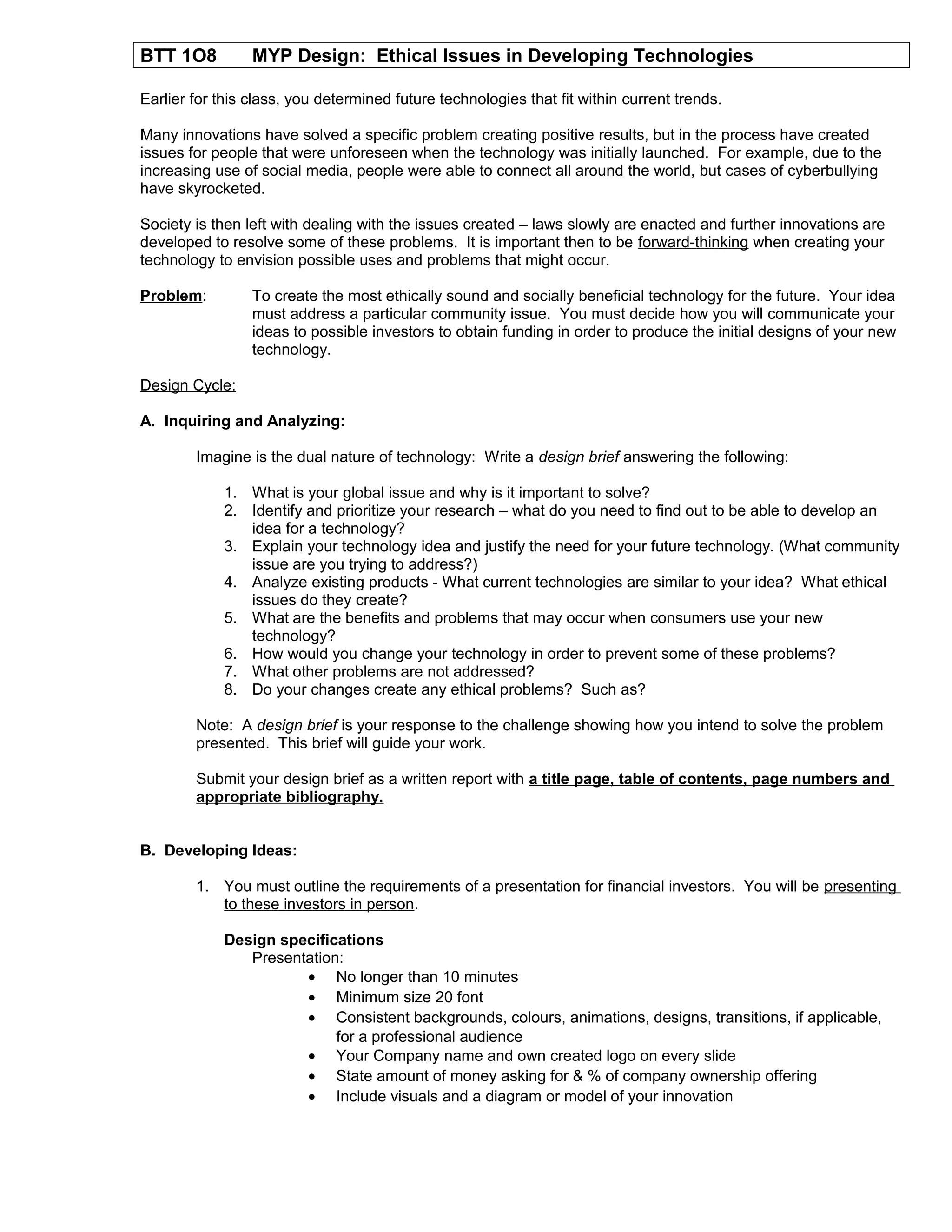
    BTT 1O8 MYPDesign: Ethical Issues in Developing Technologies Earlier for this class, you determined future technologies that fit within current trends. Many innovations have solved a specific problem creating positive results, but in the process have created issues for people that were unforeseen when the technology was initially launched. For example, due to the increasing use of social media, people were able to connect all around the world, but cases of cyberbullying have skyrocketed. Society is then left with dealing with the issues created – laws slowly are enacted and further innovations are developed to resolve some of these problems. It is important then to be forward-thinking when creating your technology to envision possible uses and problems that might occur. Problem: To create the most ethically sound and socially beneficial technology for the future. Your idea must address a particular community issue. You must decide how you will communicate your ideas to possible investors to obtain funding in order to produce the initial designs of your new technology. Design Cycle: A. Inquiring and Analyzing: Imagine is the dual nature of technology: Write a design brief answering the following: 1. What is your global issue and why is it important to solve? 2. Identify and prioritize your research – what do you need to find out to be able to develop an idea for a technology? 3. Explain your technology idea and justify the need for your future technology. (What community issue are you trying to address?) 4. Analyze existing products - What current technologies are similar to your idea? What ethical issues do they create? 5. What are the benefits and problems that may occur when consumers use your new technology? 6. How would you change your technology in order to prevent some of these problems? 7. What other problems are not addressed? 8. Do your changes create any ethical problems? Such as? Note: A design brief is your response to the challenge showing how you intend to solve the problem presented. This brief will guide your work. Submit your design brief as a written report with a title page, table of contents, page numbers and appropriate bibliography. B. Developing Ideas: 1. You must outline the requirements of a presentation for financial investors. You will be presenting to these investors in person. Design specifications Presentation: • No longer than 10 minutes • Minimum size 20 font • Consistent backgrounds, colours, animations, designs, transitions, if applicable, for a professional audience • Your Company name and own created logo on every slide • State amount of money asking for & % of company ownership offering • Include visuals and a diagram or model of your innovation
  • 2.
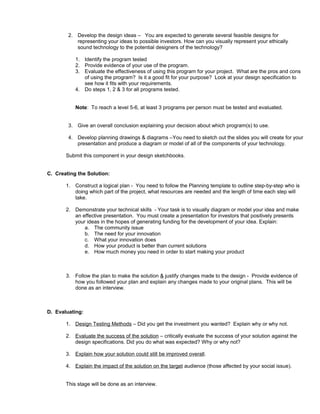
    2. Develop thedesign ideas – You are expected to generate several feasible designs for representing your ideas to possible investors. How can you visually represent your ethically sound technology to the potential designers of the technology? 1. Identify the program tested 2. Provide evidence of your use of the program. 3. Evaluate the effectiveness of using this program for your project. What are the pros and cons of using the program? Is it a good fit for your purpose? Look at your design specification to see how it fits with your requirements. 4. Do steps 1, 2 & 3 for all programs tested. Note: To reach a level 5-6, at least 3 programs per person must be tested and evaluated. 3. Give an overall conclusion explaining your decision about which program(s) to use. 4. Develop planning drawings & diagrams –You need to sketch out the slides you will create for your presentation and produce a diagram or model of all of the components of your technology. Submit this component in your design sketchbooks. C. Creating the Solution: 1. Construct a logical plan - You need to follow the Planning template to outline step-by-step who is doing which part of the project, what resources are needed and the length of time each step will take. 2. Demonstrate your technical skills - Your task is to visually diagram or model your idea and make an effective presentation. You must create a presentation for investors that positively presents your ideas in the hopes of generating funding for the development of your idea. Explain: a. The community issue b. The need for your innovation c. What your innovation does d. How your product is better than current solutions e. How much money you need in order to start making your product 3. Follow the plan to make the solution & justify changes made to the design - Provide evidence of how you followed your plan and explain any changes made to your original plans. This will be done as an interview. D. Evaluating: 1. Design Testing Methods – Did you get the investment you wanted? Explain why or why not. 2. Evaluate the success of the solution – critically evaluate the success of your solution against the design specifications. Did you do what was expected? Why or why not? 3. Explain how your solution could still be improved overall. 4. Explain the impact of the solution on the target audience (those affected by your social issue). This stage will be done as an interview.
  • 4.
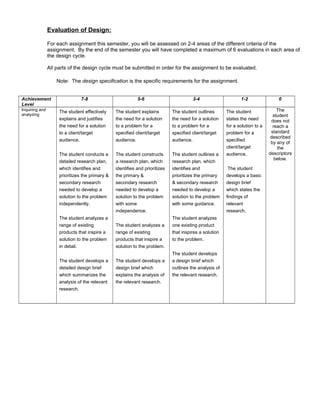
    Evaluation of Design: Foreach assignment this semester, you will be assessed on 2-4 areas of the different criteria of the assignment. By the end of the semester you will have completed a maximum of 6 evaluations in each area of the design cycle. All parts of the design cycle must be submitted in order for the assignment to be evaluated. Note: The design specification is the specific requirements for the assignment. Achievement Level 7-8 5-6 3-4 1-2 0 Inquiring and analyzing The student effectively explains and justifies the need for a solution to a client/target audience. The student conducts a detailed research plan, which identifies and prioritizes the primary & secondary research needed to develop a solution to the problem independently. The student analyzes a range of existing products that inspire a solution to the problem in detail. The student develops a detailed design brief which summarizes the analysis of the relevant research. The student explains the need for a solution to a problem for a specified client/target audience. The student constructs a research plan, which identifies and prioritizes the primary & secondary research needed to develop a solution to the problem with some independence. The student analyzes a range of existing products that inspire a solution to the problem. The student develops a design brief which explains the analysis of the relevant research. The student outlines the need for a solution to a problem for a specified client/target audience. The student outlines a research plan, which identifies and prioritizes the primary & secondary research needed to develop a solution to the problem with some guidance. The student analyzes one existing product that inspires a solution to the problem. The student develops a design brief which outlines the analysis of the relevant research. The student states the need for a solution to a problem for a specified client/target audience. The student develops a basic design brief which states the findings of relevant research. The student does not reach a standard described by any of the descriptors below.
  • 5.
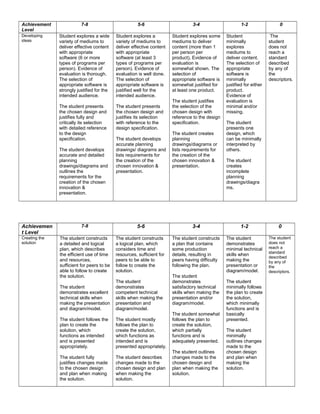
    Achievement Level 7-8 5-6 3-41-2 0 Developing ideas Student explores a wide variety of mediums to deliver effective content with appropriate software (6 or more types of programs per person). Evidence of evaluation is thorough. The selection of appropriate software is strongly justified for the intended audience. The student presents the chosen design and justifies fully and critically its selection with detailed reference to the design specification. The student develops accurate and detailed planning drawings/diagrams and outlines the requirements for the creation of the chosen innovation & presentation. Student explores a variety of mediums to deliver effective content with appropriate software (at least 3 types of programs per person). Evidence of evaluation is well done. The selection of appropriate software is justified well for the intended audience. The student presents the chosen design and justifies its selection with reference to the design specification. The student develops accurate planning drawings/ diagrams and lists requirements for the creation of the chosen innovation & presentation. Student explores some mediums to deliver content (more than 1 per person per product). Evidence of evaluation is somewhat shown. The selection of appropriate software is somewhat justified for at least one product. The student justifies the selection of the chosen design with reference to the design specification. The student creates planning drawings/diagrams or lists requirements for the creation of the chosen innovation & presentation. Student minimally explores mediums to deliver content. The selection of appropriate software is minimally justified for either product. Evidence of evaluation is minimal and/or missing. The student presents one design, which can be minimally interpreted by others. The student creates incomplete planning drawings/diagra ms. The student does not reach a standard described by any of the descriptors. Achievemen t Level 7-8 5-6 3-4 1-2 0 Creating the solution The student constructs a detailed and logical plan, which describes the efficient use of time and resources, sufficient for peers to be able to follow to create the solution. The student demonstrates excellent technical skills when making the presentation and diagram/model. The student follows the plan to create the solution, which functions as intended and is presented appropriately. The student fully justifies changes made to the chosen design and plan when making the solution. The student constructs a logical plan, which considers time and resources, sufficient for peers to be able to follow to create the solution. The student demonstrates competent technical skills when making the presentation and diagram/model. The student mostly follows the plan to create the solution, which functions as intended and is presented appropriately. The student describes changes made to the chosen design and plan when making the solution. The student constructs a plan that contains some production details, resulting in peers having difficulty following the plan. The student demonstrates satisfactory technical skills when making the presentation and/or diagram/model. The student somewhat follows the plan to create the solution, which partially functions and is adequately presented. The student outlines changes made to the chosen design and plan when making the solution. The student demonstrates minimal technical skills when making the presentation or diagram/model. The student minimally follows the plan to create the solution, which minimally functions and is basically presented. The student minimally outlines changes made to the chosen design and plan when making the solution. The student does not reach a standard described by any of the descriptors.
  • 6.
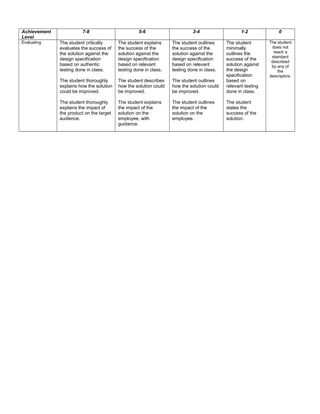
    Achievement Level 7-8 5-6 3-41-2 0 Evaluating The student critically evaluates the success of the solution against the design specification based on authentic testing done in class. The student thoroughly explains how the solution could be improved. The student thoroughly explains the impact of the product on the target audience. The student explains the success of the solution against the design specification based on relevant testing done in class. The student describes how the solution could be improved. The student explains the impact of the solution on the employee, with guidance. The student outlines the success of the solution against the design specification based on relevant testing done in class. The student outlines how the solution could be improved. The student outlines the impact of the solution on the employee. The student minimally outlines the success of the solution against the design specification based on relevant testing done in class. The student states the success of the solution. The student does not reach a standard described by any of the descriptors.
  • 7.
    Achievement Level 7-8 5-6 3-41-2 0 Evaluating The student critically evaluates the success of the solution against the design specification based on authentic testing done in class. The student thoroughly explains how the solution could be improved. The student thoroughly explains the impact of the product on the target audience. The student explains the success of the solution against the design specification based on relevant testing done in class. The student describes how the solution could be improved. The student explains the impact of the solution on the employee, with guidance. The student outlines the success of the solution against the design specification based on relevant testing done in class. The student outlines how the solution could be improved. The student outlines the impact of the solution on the employee. The student minimally outlines the success of the solution against the design specification based on relevant testing done in class. The student states the success of the solution. The student does not reach a standard described by any of the descriptors.