Department of FOT
By
Prof. Premavathi T
Unit - 6
Structure and union
01CE0101 - Computer
Programming
Structures
Structure
ļ‚–Arrays allow to define type of variables
that can hold several data items of the
same kind.
ļ‚–Similarly structure is another user
defined data type available in C that
allows to combine data items of different
kinds.
ļ‚–Structures are used to represent a record.
Defining a
Structure
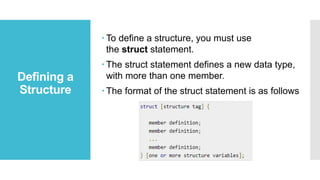
ļ‚– To define a structure, you must use
the struct statement.
ļ‚– The struct statement defines a new data type,
with more than one member.
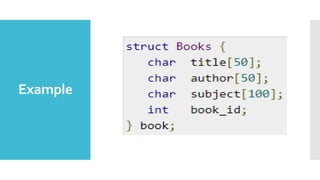
ļ‚– The format of the struct statement is as follows
Example
Accessing
Structure
Members
ļ‚–To access any member of a structure, we use
the member access operator (.)
ļ‚–The member access operator is coded as a
period between the structure variable name
and the structure member that we wish to
access.
ļ‚–You would use the keyword struct to define
variables of structure type.
Example
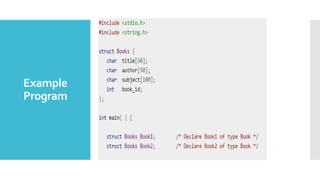
Program
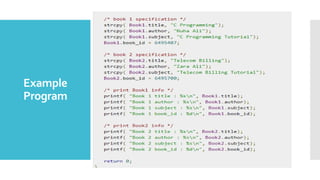
Example
Program
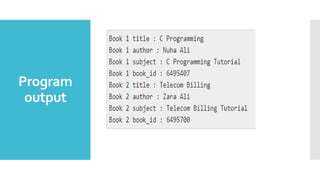
Program
output
Structures
as Function
Arguments
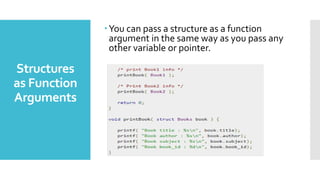
ļ‚–You can pass a structure as a function
argument in the same way as you pass any
other variable or pointer.
Union
Union
ļ‚–A union is a special data type available in
C that allows to store different data types
in the same memory location.
ļ‚– You can define a union with many
members, but only one member can
contain a value at any given time.
ļ‚– Unions provide an efficient way of using
the same memory location for multiple-
purpose.
Defining a
Union
ļ‚–To define a union, you must use
the union statement in the same way as
you did while defining a structure.
ļ‚–The union statement defines a new data
type with more than one member for
your program.
Defining a
Union
ļ‚–The format of the union statement is as
follows
ļ‚–Each member definition is a normal variable
definition, such as int i; or float f; or any
other valid variable definition.
ļ‚–At the end of the union's definition, before
the final semicolon, you can specify one or
more union variables but it is optional.
Defining a
Union
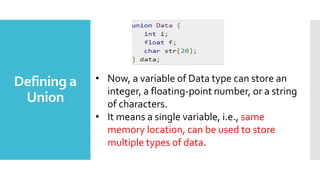
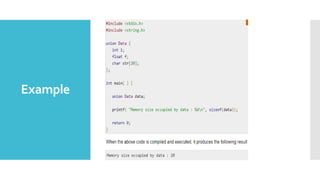
• Now, a variable of Data type can store an
integer, a floating-point number, or a string
of characters.
• It means a single variable, i.e., same
memory location, can be used to store
multiple types of data.
Example
Accessing
Union
Members
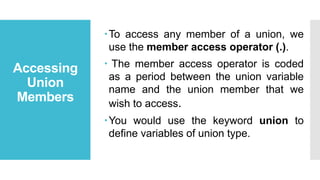
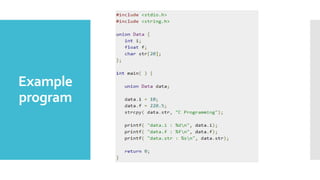
ļ‚–To access any member of a union, we
use the member access operator (.).
ļ‚– The member access operator is coded
as a period between the union variable
name and the union member that we
wish to access.
ļ‚–You would use the keyword union to
define variables of union type.
Example
program
Difference
between
structure and
union
Advantages
of structure
• Structures gather more than one piece of data
about the same subject together in the same place.
• It is helpful when you want to gather the data of
similar data types and parameters like first name,
last name, etc.
• It is very easy to maintain as we can represent the
whole record by using a single name.
• In structure, we can pass complete set of records to
any function using a single parameter.
• You can use an array of structure to store more
records with similar types.
Disadvantag
es of
structure
ļ‚– Change of one data structure in a code necessitates changes
at many other places.Therefore, the changes become hard
to track.
ļ‚– Structure is slower because it requires storage space for all
the data.
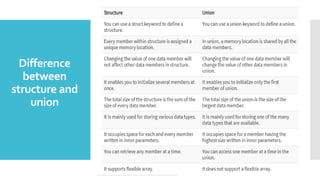
ļ‚– You can retrieve any member at a time in structure
whereas you can access one member at a time in the union.
ļ‚– Structure occupies space for each and every member
written in inner parameters while union occupies space for a
member having the highest size written in inner parameters.
ļ‚– Structure supports flexible array. Union does not support a
flexible array.
Advantages
of union
•It occupies less memory compared to
structure.
•When you use union, only the last variable
can be directly accessed.
•Union is used when you have to use the same
memory location for two or more data
members.
•It enables you to hold data of only one data
member.
•Its allocated space is equal to maximum size
of the data member.
Disadvantage
s of union
•You can use only one union
member at a time.
•All the union variables cannot
be initialized or used with
varying values at a time.
•Union assigns one common
storage space for all its
members.
That’s All….
Thank you!!!

Unit_6StructureandUnionpptx__2023_01_04_16_48_56.pptx

  • 1.
    Department of FOT By Prof.Premavathi T Unit - 6 Structure and union 01CE0101 - Computer Programming
  • 2.
  • 3.
    Structure ļ‚–Arrays allow todefine type of variables that can hold several data items of the same kind. ļ‚–Similarly structure is another user defined data type available in C that allows to combine data items of different kinds. ļ‚–Structures are used to represent a record.
  • 4.
    Defining a Structure ļ‚– Todefine a structure, you must use the struct statement. ļ‚– The struct statement defines a new data type, with more than one member. ļ‚– The format of the struct statement is as follows
  • 5.
  • 6.
    Accessing Structure Members ļ‚–To access anymember of a structure, we use the member access operator (.) ļ‚–The member access operator is coded as a period between the structure variable name and the structure member that we wish to access. ļ‚–You would use the keyword struct to define variables of structure type.
  • 7.
  • 8.
  • 9.
  • 10.
    Structures as Function Arguments ļ‚–You canpass a structure as a function argument in the same way as you pass any other variable or pointer.
  • 11.
  • 12.
    Union ļ‚–A union isa special data type available in C that allows to store different data types in the same memory location. ļ‚– You can define a union with many members, but only one member can contain a value at any given time. ļ‚– Unions provide an efficient way of using the same memory location for multiple- purpose.
  • 13.
    Defining a Union ļ‚–To definea union, you must use the union statement in the same way as you did while defining a structure. ļ‚–The union statement defines a new data type with more than one member for your program.
  • 14.
    Defining a Union ļ‚–The formatof the union statement is as follows ļ‚–Each member definition is a normal variable definition, such as int i; or float f; or any other valid variable definition. ļ‚–At the end of the union's definition, before the final semicolon, you can specify one or more union variables but it is optional.
  • 15.
    Defining a Union • Now,a variable of Data type can store an integer, a floating-point number, or a string of characters. • It means a single variable, i.e., same memory location, can be used to store multiple types of data.
  • 16.
  • 17.
    Accessing Union Members ļ‚–To access anymember of a union, we use the member access operator (.). ļ‚– The member access operator is coded as a period between the union variable name and the union member that we wish to access. ļ‚–You would use the keyword union to define variables of union type.
  • 18.
  • 19.
  • 20.
    Advantages of structure • Structuresgather more than one piece of data about the same subject together in the same place. • It is helpful when you want to gather the data of similar data types and parameters like first name, last name, etc. • It is very easy to maintain as we can represent the whole record by using a single name. • In structure, we can pass complete set of records to any function using a single parameter. • You can use an array of structure to store more records with similar types.
  • 21.
    Disadvantag es of structure ļ‚– Changeof one data structure in a code necessitates changes at many other places.Therefore, the changes become hard to track. ļ‚– Structure is slower because it requires storage space for all the data. ļ‚– You can retrieve any member at a time in structure whereas you can access one member at a time in the union. ļ‚– Structure occupies space for each and every member written in inner parameters while union occupies space for a member having the highest size written in inner parameters. ļ‚– Structure supports flexible array. Union does not support a flexible array.
  • 22.
    Advantages of union •It occupiesless memory compared to structure. •When you use union, only the last variable can be directly accessed. •Union is used when you have to use the same memory location for two or more data members. •It enables you to hold data of only one data member. •Its allocated space is equal to maximum size of the data member.
  • 23.
    Disadvantage s of union •Youcan use only one union member at a time. •All the union variables cannot be initialized or used with varying values at a time. •Union assigns one common storage space for all its members.
  • 24.