CSC 2O3: COMPUTER PROGRAMMING 1
C Unions
DR(MRS) O.E.OJO
Union in C
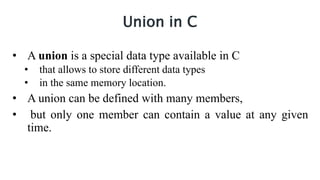
• A union is a special data type available in C
• that allows to store different data types
• in the same memory location.
• A union can be defined with many members,
• but only one member can contain a value at any given
time.
Union in C
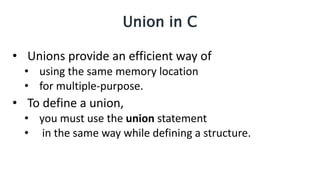
• Unions provide an efficient way of
• using the same memory location
• for multiple-purpose.
• To define a union,
• you must use the union statement
• in the same way while defining a structure.
The union statement defines a new data type with more
than one member for your program.
The format of the union statement is as follows
Defining a Union
.
union [union tag] {
member definition;
member definition;
…
member definition;
} [one or more union variables];
• The union tag is optional
• and each member definition is a normal variable
definition,
• such as int i; or float f; or any other valid variable
definition.
• At the end of the union's definition, before the final
semicolon,
• you can specify one or more union variables but it is
optional.
Here is the way to define a union type named Data having
three members i, f, and str
.
union Data {
int i;
float f;
char str[20];
} data;
• Now, a variable of Data type can store an integer, a
floating-point number, or a string of characters.
• It means a single variable, that is, same memory
location, can be used to store multiple types of data.
• You can use any built-in or user defined data types
inside a union based on your requirement.
• The memory occupied by a union will be large enough
to hold the largest member of the union.
• For example, in the above example,
• Data type will occupy 20 bytes of memory space
because this is the maximum space which can be
occupied by a character string.
Output
The following example displays the total memory size occupied:
#include <stdio.h>
#include <string.h>
union Data {
int i;
float f;
char str[20];
};
int main( ) {
union Data data;
printf( "Memory size occupied by data : %dn", sizeof(data));
return 0;
}
Accessing Union Members
To access any member of a union, we use the member access
operator (.).
The member access operator is coded as a period between the
union variable name and the union member.
The keyword union is used to define variables of union type.
//C program example on how to use Union
#include <stdio.h>
#include <string.h>
union Data {
int i;
float f;
char str[20];
};
int main( ) {
union Data data;
data.i = 10;
data.f = 220.5;
strcpy( data.str, "C Programming");
printf( "data.i : %dn", data.i);
printf( "data.f : %fn", data.f);
printf( "data.str : %sn", data.str);
return 0;
}
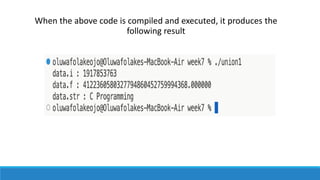
When the above code is compiled and executed, it produces the
following result
Here, we can see that the values of i and f members of
union got corrupted
because the final value assigned to the variable has
occupied the memory location
and this is the reason that the value of str member is
getting printed very well.
Now let's look into the same example once again where
we will use one variable at a time which is the main
purpose of having unions
#include <stdio.h>
#include <string.h>
union Data {
int i;
float f;
char str[20];
};
int main( ) {
union Data data;
data.i = 10;
printf( "data.i : %dn", data.i);
data.f = 220.5;
printf( "data.f : %fn", data.f);
strcpy( data.str, "C Programming");
printf( "data.str : %sn", data.str);
return 0;
}
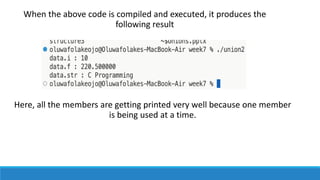
When the above code is compiled and executed, it produces the
following result
Here, all the members are getting printed very well because one member
is being used at a time.

Unions.pptx

  • 1.
    CSC 2O3: COMPUTERPROGRAMMING 1 C Unions DR(MRS) O.E.OJO
  • 2.
    Union in C •A union is a special data type available in C • that allows to store different data types • in the same memory location. • A union can be defined with many members, • but only one member can contain a value at any given time.
  • 3.
    Union in C •Unions provide an efficient way of • using the same memory location • for multiple-purpose. • To define a union, • you must use the union statement • in the same way while defining a structure.
  • 4.
    The union statementdefines a new data type with more than one member for your program. The format of the union statement is as follows Defining a Union . union [union tag] { member definition; member definition; … member definition; } [one or more union variables];
  • 5.
    • The uniontag is optional • and each member definition is a normal variable definition, • such as int i; or float f; or any other valid variable definition. • At the end of the union's definition, before the final semicolon, • you can specify one or more union variables but it is optional.
  • 6.
    Here is theway to define a union type named Data having three members i, f, and str . union Data { int i; float f; char str[20]; } data; • Now, a variable of Data type can store an integer, a floating-point number, or a string of characters. • It means a single variable, that is, same memory location, can be used to store multiple types of data.
  • 7.
    • You canuse any built-in or user defined data types inside a union based on your requirement. • The memory occupied by a union will be large enough to hold the largest member of the union. • For example, in the above example, • Data type will occupy 20 bytes of memory space because this is the maximum space which can be occupied by a character string.
  • 8.
    Output The following exampledisplays the total memory size occupied: #include <stdio.h> #include <string.h> union Data { int i; float f; char str[20]; }; int main( ) { union Data data; printf( "Memory size occupied by data : %dn", sizeof(data)); return 0; }
  • 9.
    Accessing Union Members Toaccess any member of a union, we use the member access operator (.). The member access operator is coded as a period between the union variable name and the union member. The keyword union is used to define variables of union type.
  • 10.
    //C program exampleon how to use Union #include <stdio.h> #include <string.h> union Data { int i; float f; char str[20]; }; int main( ) { union Data data; data.i = 10; data.f = 220.5; strcpy( data.str, "C Programming"); printf( "data.i : %dn", data.i); printf( "data.f : %fn", data.f); printf( "data.str : %sn", data.str); return 0; }
  • 11.
    When the abovecode is compiled and executed, it produces the following result
  • 12.
    Here, we cansee that the values of i and f members of union got corrupted because the final value assigned to the variable has occupied the memory location and this is the reason that the value of str member is getting printed very well. Now let's look into the same example once again where we will use one variable at a time which is the main purpose of having unions
  • 13.
    #include <stdio.h> #include <string.h> unionData { int i; float f; char str[20]; }; int main( ) { union Data data; data.i = 10; printf( "data.i : %dn", data.i); data.f = 220.5; printf( "data.f : %fn", data.f); strcpy( data.str, "C Programming"); printf( "data.str : %sn", data.str); return 0; }
  • 14.
    When the abovecode is compiled and executed, it produces the following result Here, all the members are getting printed very well because one member is being used at a time.