F T ra n sf o                                                                                                                F T ra n sf o
          PD                   rm                                                                                                      PD                   rm
      Y                                                                                                                            Y
 Y


                                                                                                                              Y
                                er


                                                                                                                                                             er
ABB


                                                                                                                             ABB
                          y


                                                                                                                                                       y
                       bu


                                                                                                                                                    bu
                                    2.0


                                                                                                                                                                 2.0
                     to


                                                                                                                                                  to
                  re


                                                                                                                                               re
                                                                                                                 J3103/5/1
                he


                                                                                                                                             he
           k


                                                                                                                                        k
          lic


                                                                                                                                       lic
                                          POWER PRESS MACHINE
      C


                                                                                                                                   C
      w                        om                                                                                                  w                        om
  w


                                                                                                                               w
          w.                                                                                                                           w.
               A B B Y Y.c                                                                                                                  A B B Y Y.c


                                               UNIT 5                     POWER PRESS MACHINE


                                                                         OBJECTIVES


                                          General Objective:    To understand the use of presses and press tools in cold
                                                                metal working.


                                          Specific Objectives : At the end of the unit you will be able to;


                                                                Ø    Know the types and function of presses and press
                                                                     tools.


                                                                Ø    Sketch and know the parts of presses and press tools.


                                                                Ø    Elaborate on the methods of cold working in sheet
                                                                     metal i.e. shearing, bending and drawing.
F T ra n sf o                                                                                                                   F T ra n sf o
          PD                   rm                                                                                                         PD                   rm
      Y                                                                                                                               Y
 Y


                                                                                                                                 Y
                                er


                                                                                                                                                                er
ABB


                                                                                                                                ABB
                          y


                                                                                                                                                          y
                       bu


                                                                                                                                                       bu
                                    2.0


                                                                                                                                                                    2.0
                     to


                                                                                                                                                     to
                  re


                                                                                                                                                  re
                                                                                                                    J3103/5/2
                he


                                                                                                                                                he
           k


                                                                                                                                           k
          lic


                                                                                                                                          lic
                                          POWER PRESS MACHINE
      C


                                                                                                                                      C
      w                        om                                                                                                     w                        om
  w


                                                                                                                                  w
          w.                                                                                                                              w.
               A B B Y Y.c                                                                                                                     A B B Y Y.c


                                                                             INPUT


                                          5.0. INTRODUCTION


                                                In the manufacturing section of the engineering industry, metal articles
                                          can be worked to shape either by metal cutting, or by metal forming. Metal
                                          cutting can often be wasteful because, on the average, 40% of the original
                                          component material is removed by expensive machining operations to become
                                          scrap. This scrap material will then on the average be worth 5% of its original
                                          value as raw material. In many cases machining operations can be more
                                          economically carried out by metal forming.


                                                It is interesting to carry out a break-even cost analysis upon a
                                          manufacturing operation where metal cutting or metal forming is possible
                                          alternative processes. Often the forming process requires expensive dies and
                                          fixed costs are higher; material wastage is negligible, labour costs are low and
                                          hence variable costs are lower. The metal cutting process is often lower on fixed
                                          costs, but higher on variable costs. Hence, the forming process will be more
                                          economical when quantities required are large.


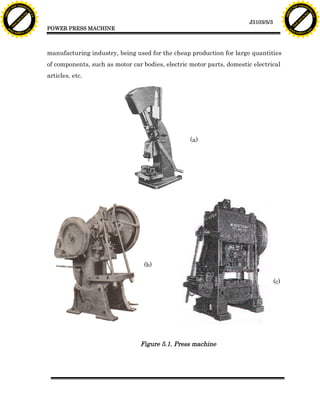
                                                In this chapter we shall be concerned solely with the use of presses and
                                          press tools ( Fig. 5.1 (a), (b) and (c) ) as a means of cold working metal objects
                                          into shape. Most of this type of work is carried out upon ductile metal in sheet
                                          or strip form of relatively thin section. It represents an important part of the
F T ra n sf o                                                                                                                      F T ra n sf o
          PD                   rm                                                                                                            PD                   rm
      Y                                                                                                                                  Y
 Y


                                                                                                                                    Y
                                er


                                                                                                                                                                   er
ABB


                                                                                                                                   ABB
                          y


                                                                                                                                                             y
                       bu


                                                                                                                                                          bu
                                    2.0


                                                                                                                                                                       2.0
                     to


                                                                                                                                                        to
                  re


                                                                                                                                                     re
                                                                                                                 J3103/5/3
                he


                                                                                                                                                   he
           k


                                                                                                                                              k
          lic


                                                                                                                                             lic
                                          POWER PRESS MACHINE
      C


                                                                                                                                         C
      w                        om                                                                                                        w                        om
  w


                                                                                                                                     w
          w.                                                                                                                                 w.
               A B B Y Y.c                                                                                                                        A B B Y Y.c


                                          manufacturing industry, being used for the cheap production for large quantities
                                          of components, such as motor car bodies, electric motor parts, domestic electrical
                                          articles, etc.


                                                                                            (a)


                                                                            (b)

                                                                                                                             (c)


                                                                          Figure 5.1. Press machine
F T ra n sf o                                                                                                                 F T ra n sf o
          PD                   rm                                                                                                       PD                   rm
      Y                                                                                                                             Y
 Y


                                                                                                                               Y
                                er


                                                                                                                                                              er
ABB


                                                                                                                              ABB
                          y


                                                                                                                                                        y
                       bu


                                                                                                                                                     bu
                                    2.0


                                                                                                                                                                  2.0
                     to


                                                                                                                                                   to
                  re


                                                                                                                                                re
                                                                                                               J3103/5/4
                he


                                                                                                                                              he
           k


                                                                                                                                         k
          lic


                                                                                                                                        lic
                                          POWER PRESS MACHINE
      C


                                                                                                                                    C
      w                        om                                                                                                   w                        om
  w


                                                                                                                                w
          w.                                                                                                                            w.
               A B B Y Y.c                                                                                                                   A B B Y Y.c


                                                The metal if in coiled strip form, may be fed automatically into the press
                                          tool by power rolls or power slide, or may be hand fed by operator. If the metal
                                          is in some other form, such as a sheet or partially formed shape, it may be
                                          located in the tool by mechanical hands which have gripping fingers or locating
                                          pans which drop the metal drop part into the correct position.        Again, an
                                          operator may hand feed the part. The mechanical feed or location devices must
                                          of course be synchronized to operate every time the press ram lifts the top tool
                                          clear of the bottom tool.    Where the press is hand fed, stringent safety
                                          precautions must be taken to ensure that the operators' hands cannot be trapped
                                          in the press tool. Efficient guards must be provided which are completely fool
                                          proof, and it should always be remembered that a press is potentially a very
                                          dangerous machine.


                                                The presses mi which press-tool work is done may be divided into (a)
                                          hand-operated presses, and (b) power-operated presses. Hand operated presses
                                          are very simple in construction and are generally used, only for small batches of
                                          simple work; an example is shown in Fig. 5.1 (a)


                                                Power presses may be subdivided into (1) Single-acting presses, (2)
                                          Double-acting presses, and (3) Triple-acting presses. Single-acting presses are
                                          essentially similar to the simple hand-operated press inn that they have only
                                          one ram; the means of operating the ram are various. These means may be a
                                          crank, an eccentric or a toggle-lever mechanism In Fig. 109 is shown a typical
                                          crank-operated single-acting press. The ram is guided in the frame and is
                                          actuated by a crankshaft through the medium of a connecting rod. The press is
                                          provided with a fly-wheel and may be driven either by a belt or by an electric
                                          motor. A clutch enables the flywheel to be coupled to the crankshaft when the
                                          press is required to work; this clutch may be arranged to disengage
                                          automatically when the crankshaft has made one complete revolution and the
F T ra n sf o                                                                                                                   F T ra n sf o
          PD                   rm                                                                                                         PD                   rm
      Y                                                                                                                               Y
 Y


                                                                                                                                 Y
                                er


                                                                                                                                                                er
ABB


                                                                                                                                ABB
                          y


                                                                                                                                                          y
                       bu


                                                                                                                                                       bu
                                    2.0


                                                                                                                                                                    2.0
                     to


                                                                                                                                                     to
                  re


                                                                                                                                                  re
                                                                                                                 J3103/5/5
                he


                                                                                                                                                he
           k


                                                                                                                                           k
          lic


                                                                                                                                          lic
                                          POWER PRESS MACHINE
      C


                                                                                                                                      C
      w                        om                                                                                                     w                        om
  w


                                                                                                                                  w
          w.                                                                                                                              w.
               A B B Y Y.c                                                                                                                     A B B Y Y.c


                                          ram has reached the top of its stroke, a brake being used to prevent overrunning
                                          or, alternatively, the crankshaft may be allowed to keep on revolving as long as
                                          may be desired. In the latter case the feed to the stock must be automatic and
                                          the press must have additional mechanism to provide this automatic feed during
                                          the time that the ram and punch are clear of the work. Blanking, piercing, and
                                          trimming operations on strip material will generally be done with a continuously
                                          running press and automatic feed, but second operation work must generally be
                                          put into the die by hand and then the clutch must be operated every time the
                                          ram is required to make a stroke.


                                                Because of the great danger to an operator's hands which arises from the
                                          starting of a press cycle before the operator's hands are clear of the dies all
                                          presses must, by law, be fitted with guards. These are arranged to push the
                                          operator's hands away (if they are not already clear) as the press ram begins to
                                          descend; the guard is clearly visible in Fig. 5.1 (c). In addition some presses are
                                          arranged so that two levers have to be moved simultaneously before the press
                                          will start and the levers are situated so that the operator must use both hands to
                                          move them. This,, however, generally slows down production.


                                                The use of an eccentric instead of a crank enables greater forces to be
                                          applied to the ram for a given diameter of shaft and is consequently found in
                                          presses for very heavy work. Very large presses, such as are used for the
                                          production of motor-car body panels, sometimes have four eccentrics, one at each
                                          corner of the "ram," so as to ensure an even pressure and to eliminate tilting.
                                          When very heavy forces must be used as, for example, in coin embossing, toggle
                                          mechanism is sometimes used, but this form of operation generally necessitates
                                          a comparatively short working stroke.
F T ra n sf o                                                                                                                 F T ra n sf o
          PD                   rm                                                                                                       PD                   rm
      Y                                                                                                                             Y
 Y


                                                                                                                               Y
                                er


                                                                                                                                                              er
ABB


                                                                                                                              ABB
                          y


                                                                                                                                                        y
                       bu


                                                                                                                                                     bu
                                    2.0


                                                                                                                                                                  2.0
                     to


                                                                                                                                                   to
                  re


                                                                                                                                                re
                                                                                                                  J3103/5/6
                he


                                                                                                                                              he
           k


                                                                                                                                         k
          lic


                                                                                                                                        lic
                                          POWER PRESS MACHINE
      C


                                                                                                                                    C
      w                        om                                                                                                   w                        om
  w


                                                                                                                                w
          w.                                                                                                                            w.
               A B B Y Y.c                                                                                                                   A B B Y Y.c


                                                Single-acting presses are made either open-fronted as Shown in Fig. 5.1
                                          (b), the frame being C-shaped, or double sided as in Fig. 5.1 (c). They are often
                                          inclinable so that gravity may be used to discharge the job clear of the dies.


                                                The double-acting press has two reciprocating parts, an inner member
                                          actuated usually by a crankshaft and connecting rod and an outer member
                                          actuated usually by cams carried by the crankshaft. Double-acting presses are
                                          used chiefly for drawing operations and the outer member is used to actuate the
                                          holder or pressure-plate, while the inner member carries the drawing punch.
                                          The use of cams makes it easy to arrange that the holder descends ahead of the
                                          punch so that the blank is gripped before the drawing starts and also to keep the
                                          holder at rest during the drawing. Double-acting presses do not usually run
                                          continuously.


                                                A triple-acting press is similar to a double-acting press but has, in
                                          addition, a third reciprocating member carried in guides in the base of the
                                          machine so that a second punch can be made to draw the blank upwards into a
                                          suitably shaped recess formed in the top punch. They are used only for large
                                          work such as motor-car body panels.


                                                In order to appreciate press tool design, it may help to briefly reconsider
                                          the elementary principles of metal plasticity. Standard tensile or compression
                                          tests which cold work the specimen being used are an ideal means of obtaining
                                          data about the plastic range of metals.
F T ra n sf o                                                                                                                    F T ra n sf o
          PD                   rm                                                                                                          PD                   rm
      Y                                                                                                                                Y
 Y


                                                                                                                                  Y
                                er


                                                                                                                                                                 er
ABB


                                                                                                                                 ABB
                          y


                                                                                                                                                           y
                       bu


                                                                                                                                                        bu
                                    2.0


                                                                                                                                                                     2.0
                     to


                                                                                                                                                      to
                  re


                                                                                                                                                   re
                                                                                                                  J3103/5/7
                he


                                                                                                                                                 he
           k


                                                                                                                                            k
          lic


                                                                                                                                           lic
                                          POWER PRESS MACHINE
      C


                                                                                                                                       C
      w                        om                                                                                                      w                        om
  w


                                                                                                                                   w
          w.                                                                                                                               w.
               A B B Y Y.c                                                                                                                      A B B Y Y.c


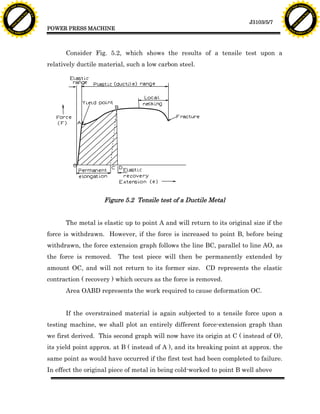
                                                Consider Fig. 5.2, which shows the results of a tensile test upon a
                                          relatively ductile material, such a low carbon steel.


                                                              Figure 5.2 Tensile test of a Ductile Metal


                                                The metal is elastic up to point A and will return to its original size if the
                                          force is withdrawn. However, if the force is increased to point B, before being
                                          withdrawn, the force extension graph follows the line BC, parallel to line AO, as
                                          the force is removed.    The test piece will then be permanently extended by
                                          amount OC, and will not return to its former size. CD represents the elastic
                                          contraction ( recovery ) which occurs as the force is removed.
                                                Area OABD represents the work required to cause deformation OC.


                                                If the overstrained material is again subjected to a tensile force upon a
                                          testing machine, we shall plot an entirely different force-extension graph than
                                          we first derived. This second graph will now have its origin at C ( instead of O),
                                          its yield point approx. at B ( instead of A ), and its breaking point at approx. the
                                          same point as would have occurred if the first test had been completed to failure.
                                          In effect the original piece of metal in being cold-worked to point B well above
F T ra n sf o                                                                                                                  F T ra n sf o
          PD                   rm                                                                                                        PD                   rm
      Y                                                                                                                              Y
 Y


                                                                                                                                Y
                                er


                                                                                                                                                               er
ABB


                                                                                                                               ABB
                          y


                                                                                                                                                         y
                       bu


                                                                                                                                                      bu
                                    2.0


                                                                                                                                                                   2.0
                     to


                                                                                                                                                    to
                  re


                                                                                                                                                 re
                                                                                                                  J3103/5/8
                he


                                                                                                                                               he
           k


                                                                                                                                          k
          lic


                                                                                                                                         lic
                                          POWER PRESS MACHINE
      C


                                                                                                                                     C
      w                        om                                                                                                    w                        om
  w


                                                                                                                                 w
          w.                                                                                                                             w.
               A B B Y Y.c                                                                                                                    A B B Y Y.c


                                          the yield point acquires a new set of properties. These new properties result in a
                                          different force-extension graph being derived if the metal is reworked. This is
                                          the most important first effect of cold working, which means that a cheaper
                                          material can be specified for a cold forming operation, the component finishing
                                          with new superior properties comparable to a more costly material.
                                                The results of cold working a metal well within the plastic range of the
                                          metal can be summarized as follows:


                                            a) The yield point, and hence the stress at yield point is raised, where
                                                                               Force at yield point
                                            stress at the yield point = sy =
                                                                               Cross sectional area


                                            b) The ductility is lowered, and hence the elongation % is reduced,
                                                                      extension
                                            where elongation % =                   x 100
                                                                   original length


                                                Should high ductility be the important property, such as in a deep
                                          drawing operation which must be carried out in several stages, then the metal
                                          must be annealed after cold working to restore it to its original state. From
                                          figure 5.2. it can be seen that no annealing takes place, then between points A
                                          and B, each successive increment of elongation will require an increasing
                                          increment of work. In other words, as cold working proceeds, the resistance to
                                          deformation rises steadily.


                                                In cold working there will be minor changes in dimensions of the work
                                          piece when the work is removed from the tool. This is the elastic -recovery of the
                                          material shown in the graph due to the release oil stresses causing the
                                          deformation. The work after removal from the press tool will spring back from
F T ra n sf o                                                                                                                        F T ra n sf o
          PD                   rm                                                                                                              PD                   rm
      Y                                                                                                                                    Y
 Y


                                                                                                                                      Y
                                er


                                                                                                                                                                     er
ABB


                                                                                                                                     ABB
                          y


                                                                                                                                                               y
                       bu


                                                                                                                                                            bu
                                    2.0


                                                                                                                                                                         2.0
                     to


                                                                                                                                                          to
                  re


                                                                                                                                                       re
                                                                                                                      J3103/5/9
                he


                                                                                                                                                     he
           k


                                                                                                                                                k
          lic


                                                                                                                                               lic
                                          POWER PRESS MACHINE
      C


                                                                                                                                           C
      w                        om                                                                                                          w                        om
  w


                                                                                                                                       w
          w.                                                                                                                                   w.
               A B B Y Y.c                                                                                                                          A B B Y Y.c


                                          the die shape to take up a different shape. This must be allowed for in the tool
                                          design.


                                                    One other factor to consider in press tool work is the direction of rolling of
                                          the strip to be worked in the press tool. Cold rolled sheet or strip is used which
                                          has been rolled in a certain direction thus giving the strip directional properties.
                                          It will be found that bending can be carried out more successfully across the
                                          grain (direction of rolling), than along the grain.           Components which are
                                          produced from tools which effect bending along the direction of rolling will
                                          almost certainly crack during the bending operation.
                                                    There are three different ways of cold working sheet metal in press tools
                                          tools. These are:
                                          1)        Shearing. In this case the required shape of work is sheared from the
                                          metal strip, the metal being deformed to shear failure.               There are three
                                          variations of shearing, viz.,
                                               a)      Blanking, in which a blank is punched from the strip, the blank
                                                       removed by the punch being the required article. The metal left is
                                                       waste. The die is made to the required shape and size, i.e., the punch
                                                       is made smaller than the die by the amount of clearance required.
                                               b)      Piercing, in which the blank punched or pierced from the metal strip is
                                                       waste, the hole left in the strip being required. The piercing punch
                                                       made to the required shape and size, the clearance being added to the
                                                       die.
                                               c)      Cropping, in which the piece blanked from the strip is waste,
                                                       left with the cropped ends being the required part. A cropping tool is
                                                       in principle, a blanking tool.
F T ra n sf o                                                                                                                                             F T ra n sf o
          PD                   rm                                                                                                                                   PD                   rm
      Y                                                                                                                                                         Y
 Y


                                                                                                                                                           Y
                                er


                                                                                                                                                                                          er
ABB


                                                                                                                                                          ABB
                          y


                                                                                                                                                                                    y
                       bu


                                                                                                                                                                                 bu
                                    2.0


                                                                                                                                                                                              2.0
                     to


                                                                                                                                                                               to
                  re


                                                                                                                                                                            re
                                                                                                                                             J3103/5/10
                he


                                                                                                                                                                          he
           k


                                                                                                                                                                     k
          lic


                                                                                                                                                                    lic
                                          POWER PRESS MACHINE
      C


                                                                                                                                                                C
      w                        om                                                                                                                               w                        om
  w


                                                                                                                                                            w
          w.                                                                                                                                                        w.
               A B B Y Y.c                                                                                                                                               A B B Y Y.c


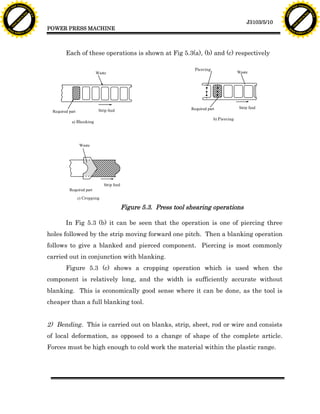
                                                  Each of these operations is shown at Fig 5.3(a), (b) and (c) respectively

                                                                                                                Piercing
                                                                    Waste                                                                Waste


                                                                                                              Required part              Strip feed
                                           Required part             Strip feed

                                                                                                                           b) Piercing
                                                     a) Blanking


                                                            Waste


                                                                         Strip feed
                                                    Required part

                                                           c) Cropping

                                                                                      Figure 5.3. Press tool shearing operations

                                                  In Fig 5.3 (b) it can be seen that the operation is one of piercing three
                                          holes followed by the strip moving forward one pitch. Then a blanking operation
                                          follows to give a blanked and pierced component. Piercing is most commonly
                                          carried out in conjunction with blanking.
                                                  Figure 5.3 (c) shows a cropping operation which is used when the
                                          component is relatively long, and the width is sufficiently accurate without
                                          blanking. This is economically good sense where it can be done, as the tool is
                                          cheaper than a full blanking tool.


                                          2) Bending. This is carried out on blanks, strip, sheet, rod or wire and consists
                                          of local deformation, as opposed to a change of shape of the complete article.
                                          Forces must be high enough to cold work the material within the plastic range.
F T ra n sf o                                                                                                                                  F T ra n sf o
          PD                   rm                                                                                                                        PD                   rm
      Y                                                                                                                                              Y
 Y


                                                                                                                                                Y
                                er


                                                                                                                                                                               er
ABB


                                                                                                                                               ABB
                          y


                                                                                                                                                                         y
                       bu


                                                                                                                                                                      bu
                                    2.0


                                                                                                                                                                                   2.0
                     to


                                                                                                                                                                    to
                  re


                                                                                                                                                                 re
                                                                                                                                  J3103/5/11
                he


                                                                                                                                                               he
           k


                                                                                                                                                          k
          lic


                                                                                                                                                         lic
                                          POWER PRESS MACHINE
      C


                                                                                                                                                     C
      w                        om                                                                                                                    w                        om
  w


                                                                                                                                                 w
          w.                                                                                                                                             w.
               A B B Y Y.c                                                                                                                                    A B B Y Y.c


                                          3) Drawing.        This is carried out on blanks, and involves considerable
                                          deformation or a complete change of shape of part. Again the deformation must
                                          be carried out in the plastic range. As stated earlier, deep drawing may require
                                          several drawing stages with interstate annealing.
                                                    In the next section we will consider each of these methods of press work,
                                          and the principles of design of a typical tool of each type.


                                          5.1.      SHEARING


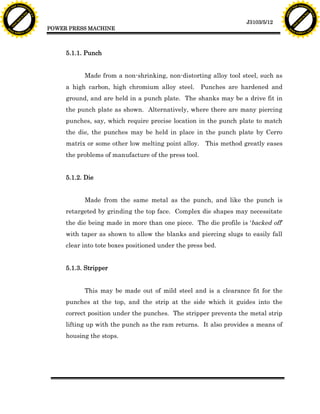
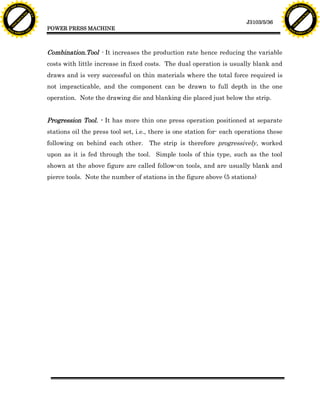
                                                    Figure 5.4 shows a blanking and piercing press tool. This is a simple
                                          shearing tool, and the punches and die can be of any required profile. The tool
                                          shown has the main features of any press tool which we will examine in more
                                          detail.


                                                                                      Shank
                                                                                                     Press ram


                                                                                                                       Top set
                                                                 Pressure plate
                                                                                                                    Punch plate


                                                                     Blanking punch                              Piercing punch

                                                                         Pilot
                                                                                                                 Stripper


                                                               Die
                                                                                                             Strip feed

                                                                                                                        Bottom set


                                                                                         Press bed


                                                                        Figure 5.4. Blank and pierce tool
F T ra n sf o                                                                                                               F T ra n sf o
          PD                   rm                                                                                                     PD                   rm
      Y                                                                                                                           Y
 Y


                                                                                                                             Y
                                er


                                                                                                                                                            er
ABB


                                                                                                                            ABB
                          y


                                                                                                                                                      y
                       bu


                                                                                                                                                   bu
                                    2.0


                                                                                                                                                                2.0
                     to


                                                                                                                                                 to
                  re


                                                                                                                                              re
                                                                                                             J3103/5/12
                he


                                                                                                                                            he
           k


                                                                                                                                       k
          lic


                                                                                                                                      lic
                                          POWER PRESS MACHINE
      C


                                                                                                                                  C
      w                        om                                                                                                 w                        om
  w


                                                                                                                              w
          w.                                                                                                                          w.
               A B B Y Y.c                                                                                                                 A B B Y Y.c


                                               5.1.1. Punch


                                                     Made from a non-shrinking, non-distorting alloy tool steel, such as
                                               a high carbon, high chromium alloy steel.        Punches are hardened and
                                               ground, and are held in a punch plate. The shanks may be a drive fit in
                                               the punch plate as shown. Alternatively, where there are many piercing
                                               punches, say, which require precise location in the punch plate to match
                                               the die, the punches may be held in place in the punch plate by Cerro
                                               matrix or some other low melting point alloy. This method greatly eases
                                               the problems of manufacture of the press tool.


                                               5.1.2. Die


                                                     Made from the same metal as the punch, and like the punch is
                                               retargeted by grinding the top face. Complex die shapes may necessitate
                                               the die being made in more than one piece. The die profile is ‘backed off’
                                               with taper as shown to allow the blanks and piercing slugs to easily fall
                                               clear into tote boxes positioned under the press bed.


                                               5.1.3. Stripper


                                                     This may be made out of mild steel and is a clearance fit for the
                                               punches at the top, and the strip at the side which it guides into the
                                               correct position under the punches. The stripper prevents the metal strip
                                               lifting up with the punch as the ram returns. It also provides a means of
                                               housing the stops.
F T ra n sf o                                                                                                                   F T ra n sf o
          PD                   rm                                                                                                         PD                   rm
      Y                                                                                                                               Y
 Y


                                                                                                                                 Y
                                er


                                                                                                                                                                er
ABB


                                                                                                                                ABB
                          y


                                                                                                                                                          y
                       bu


                                                                                                                                                       bu
                                    2.0


                                                                                                                                                                    2.0
                     to


                                                                                                                                                     to
                  re


                                                                                                                                                  re
                                                                                                                J3103/5/13
                he


                                                                                                                                                he
           k


                                                                                                                                           k
          lic


                                                                                                                                          lic
                                          POWER PRESS MACHINE
      C


                                                                                                                                      C
      w                        om                                                                                                     w                        om
  w


                                                                                                                                  w
          w.                                                                                                                              w.
               A B B Y Y.c                                                                                                                     A B B Y Y.c


                                               5.1.4. Stop


                                                      There are many forms of stops, the one shown being a simple spring
                                               loaded type. As the strip is pushed under the stop it rides up over the strip
                                               to drop into the space left by the blank. If the strip is then pulled back
                                               against the stop (against the direction of feed), the strip is correctly
                                               located for the next shearing operation, leaving the minimum of waste
                                               metal between the blanked holes. This feeding operation up to a stop can
                                               be carried out at high speed by the operator, and a well designed stop
                                               must be simple and efficient in use.
                                                      More complex tools may require more than one stop, and
                                               arrangements can be made to operate stops by the movement of the press
                                               ram if desired. Automatic feed devices do not require soon as the strip is
                                               automatically moved along the correct pitch length, between each stroke
                                               of the press.


                                               5.1.5. Pilot


                                                      These are held in the blanking punch and are a clearance fit for the
                                               pierced hole. As the ram descends, the pilot locates the previously pierced
                                               hole and positions the strip more precisely under the blanking punch.
                                               Pilots are used where the relationship of pierced holes to a blank profile
                                               must be precise; therefore a stop initially positions the strip, but the final
                                               positioning depends upon the pilot.        It can be seen then that this
                                               technique is ideal for a roll feed press which has no stops upon the too].
F T ra n sf o                                                                                                                F T ra n sf o
          PD                   rm                                                                                                      PD                   rm
      Y                                                                                                                            Y
 Y


                                                                                                                              Y
                                er


                                                                                                                                                             er
ABB


                                                                                                                             ABB
                          y


                                                                                                                                                       y
                       bu


                                                                                                                                                    bu
                                    2.0


                                                                                                                                                                 2.0
                     to


                                                                                                                                                  to
                  re


                                                                                                                                               re
                                                                                                               J3103/5/14
                he


                                                                                                                                             he
           k


                                                                                                                                        k
          lic


                                                                                                                                       lic
                                          POWER PRESS MACHINE
      C


                                                                                                                                   C
      w                        om                                                                                                  w                        om
  w


                                                                                                                               w
          w.                                                                                                                           w.
               A B B Y Y.c                                                                                                                  A B B Y Y.c


                                                5.1.6. Sets


                                                        These may be made from mild steel as they are bolsters to which
                                                the die and punch assemblies are screwed. The top set holds the shank by
                                                means of which the punch assembly is located and held in the press ram.
                                                The bottom set is bolted or clamped to the press bed in the correct
                                                relationship to the top set so that the axes of the punches tied die holes
                                                are in line.
                                                        Cast iron die sets are commercially available which are made
                                                complete with guide puts and bushes. Hence the top set can always be
                                                located in exactly the same position relative to the bottom set. The press
                                                tool maker then ensures that the punch and die are always a perfect fit
                                                when the tool is closed. This makes the setting operation on the press
                                                quick and easy, because the complete tool is simply mounted and fastened
                                                on the press, no locating between punch and die being necessary.


                                                5.1.7. Pressure Plate


                                                        This is a hardened and ground steel plate which is inserted
                                                between punch and top set, in order to take the impact on the head of the
                                                punch as it shears through the strip. Let us now consider some other
                                                important features of sheet metal shearing, which affect the design of the
                                                tool.


                                          5.2. CLEARANCE BETWEEN PUNCH AND DIE


                                                When the punch hits the work metal strip, it penetrates a certain
                                          percentage of the strip thickness before the metal shears and the whole blank
                                          ruptures. The depth of penetration depends upon the hardness of the work
F T ra n sf o                                                                                                                                   F T ra n sf o
          PD                   rm                                                                                                                         PD                   rm
      Y                                                                                                                                               Y
 Y


                                                                                                                                                 Y
                                er


                                                                                                                                                                                er
ABB


                                                                                                                                                ABB
                          y


                                                                                                                                                                          y
                       bu


                                                                                                                                                                       bu
                                    2.0


                                                                                                                                                                                    2.0
                     to


                                                                                                                                                                     to
                  re


                                                                                                                                                                  re
                                                                                                                                   J3103/5/15
                he


                                                                                                                                                                he
           k


                                                                                                                                                           k
          lic


                                                                                                                                                          lic
                                          POWER PRESS MACHINE
      C


                                                                                                                                                      C
      w                        om                                                                                                                     w                        om
  w


                                                                                                                                                  w
          w.                                                                                                                                              w.
               A B B Y Y.c                                                                                                                                     A B B Y Y.c


                                          material, being greater for a soft material, and can be seen as a polished rim
                                          around the edge of the blank.
                                                The amount of clearance allowed between the punch and die also affects
                                          the appearance of the blanked edge and the accuracy of the finished blank. The
                                          clearance varies with the thickness and the hardness of the metal being sheared
                                          and will be some value up to 10% of the strip thickness. The edge surface
                                          appearance and quality produced upon a standard tool will not be as good as a
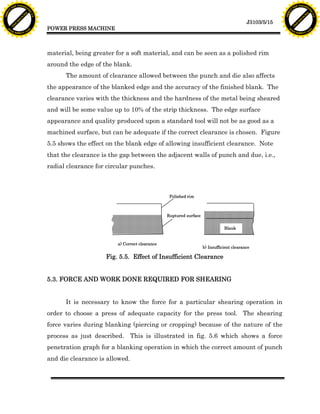
                                          machined surface, but can be adequate if the correct clearance is chosen. Figure
                                          5.5 shows the effect on the blank edge of allowing insufficient clearance. Note
                                          that the clearance is the gap between the adjacent walls of punch and due, i.e.,
                                          radial clearance for circular punches.


                                                                                          Polished rim


                                                                                         Ruptured surface


                                                                                                                       Blank


                                                                  a) Correct clearance
                                                                                                            b) Insufficient clearance

                                                              Fig. 5.5. Effect of Insufficient Clearance


                                          5.3. FORCE AND WORK DONE REQUIRED FOR SHEARING


                                                It is necessary to know the force for a particular shearing operation in
                                          order to choose a press of adequate capacity for the press tool. The shearing
                                          force varies during blanking (piercing or cropping) because of the nature of the
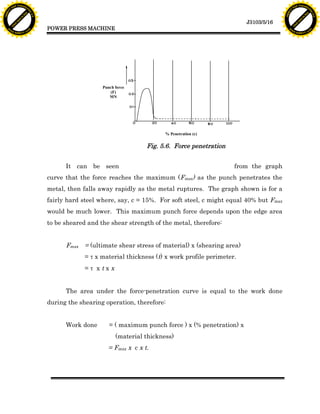
                                          process as just described. This is illustrated in fig. 5.6 which shows a force
                                          penetration graph for a blanking operation in which the correct amount of punch
                                          and die clearance is allowed.
F T ra n sf o                                                                                                                 F T ra n sf o
          PD                   rm                                                                                                       PD                   rm
      Y                                                                                                                             Y
 Y


                                                                                                                               Y
                                er


                                                                                                                                                              er
ABB


                                                                                                                              ABB
                          y


                                                                                                                                                        y
                       bu


                                                                                                                                                     bu
                                    2.0


                                                                                                                                                                  2.0
                     to


                                                                                                                                                   to
                  re


                                                                                                                                                re
                                                                                                                J3103/5/16
                he


                                                                                                                                              he
           k


                                                                                                                                         k
          lic


                                                                                                                                        lic
                                          POWER PRESS MACHINE
      C


                                                                                                                                    C
      w                        om                                                                                                   w                        om
  w


                                                                                                                                w
          w.                                                                                                                            w.
               A B B Y Y.c                                                                                                                   A B B Y Y.c


                                                             Punch force
                                                                 (F)
                                                                MN


                                                                                    % Penetration (c)


                                                                             Fig. 5.6. Force penetration


                                                It can be seen                                              from the graph
                                          curve that the force reaches the maximum (Fmax) as the punch penetrates the
                                          metal, then falls away rapidly as the metal ruptures. The graph shown is for a
                                          fairly hard steel where, say, c = 15%. For soft steel, c might equal 40% but Fmax
                                          would be much lower. This maximum punch force depends upon the edge area
                                          to be sheared and the shear strength of the metal, therefore:


                                                Fmax = (ultimate shear stress of material) x (shearing area)
                                                       = t x material thickness (t) x work profile perimeter.
                                                       =t xtxx


                                                The area under the force-penetration curve is equal to the work done
                                          during the shearing operation, therefore:


                                                Work done       = ( maximum punch force ) x (% penetration) x
                                                                   (material thickness)
                                                               = Fmax x c x t.
F T ra n sf o                                                                                                                 F T ra n sf o
          PD                   rm                                                                                                       PD                   rm
      Y                                                                                                                             Y
 Y


                                                                                                                               Y
                                er


                                                                                                                                                              er
ABB


                                                                                                                              ABB
                          y


                                                                                                                                                        y
                       bu


                                                                                                                                                     bu
                                    2.0


                                                                                                                                                                  2.0
                     to


                                                                                                                                                   to
                  re


                                                                                                                                                re
                                                                                                              J3103/5/17
                he


                                                                                                                                              he
           k


                                                                                                                                         k
          lic


                                                                                                                                        lic
                                          POWER PRESS MACHINE
      C


                                                                                                                                    C
      w                        om                                                                                                   w                        om
  w


                                                                                                                                w
          w.                                                                                                                            w.
               A B B Y Y.c                                                                                                                   A B B Y Y.c


                                                This is an estimate of course, and depends upon the assumption that
                                          maximum punch force is sustained during complete punch penetration of the
                                          work metal.


                                          Example 5.1


                                            Calculate the maximum punch force necessary to blank a steel washer 44-45
                                            mm OD x 22.23 mm ID x 1.59 mm thick, if t = 432 N/mm2. Estimate the work
                                            done if % penetration is 25


                                          Solution
                                              Work profile perimeter, x = p (44-45 + 22-23)
                                                                          = 209-5 mm.


                                                                   Fmax   = t. t . x
                                                                          = 0-432 x 1-59 x 209.5
                                                                          = 0-144 MN
                                                          Work done       =Fmax . c . t
                                                                          =144 x 0-25 x 1-59
                                                                          = 57 J.


                                          5.4. SHEAR


                                                It can be seen from the above expression for work done, that if the work is
                                          spread over a greater stroke movement of the punch, then Fmax will be reduced.
                                          Hence the tool could be used upon a smaller capacity press (assuming the press
                                          shut height and stroke are satisfactory) which could be both convenient and
F T ra n sf o                                                                                                                            F T ra n sf o
          PD                   rm                                                                                                                  PD                   rm
      Y                                                                                                                                        Y
 Y


                                                                                                                                          Y
                                er


                                                                                                                                                                         er
ABB


                                                                                                                                         ABB
                          y


                                                                                                                                                                   y
                       bu


                                                                                                                                                                bu
                                    2.0


                                                                                                                                                                             2.0
                     to


                                                                                                                                                              to
                  re


                                                                                                                                                           re
                                                                                                                            J3103/5/18
                he


                                                                                                                                                         he
           k


                                                                                                                                                    k
          lic


                                                                                                                                                   lic
                                          POWER PRESS MACHINE
      C


                                                                                                                                               C
      w                        om                                                                                                              w                        om
  w


                                                                                                                                           w
          w.                                                                                                                                       w.
               A B B Y Y.c                                                                                                                              A B B Y Y.c


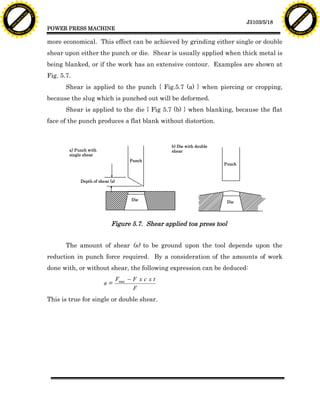
                                          more economical. This effect can be achieved by grinding either single or double
                                          shear upon either the punch or die. Shear is usually applied when thick metal is
                                          being blanked, or if the work has an extensive contour. Examples are shown at
                                          Fig. 5.7.
                                                 Shear is applied to the punch { Fig.5.7 (a) } when piercing or cropping,
                                          because the slug which is punched out will be deformed.
                                                 Shear is applied to the die { Fig 5.7 (b) } when blanking, because the flat
                                          face of the punch produces a flat blank without distortion.


                                                                                               b) Die with double
                                                  a) Punch with                                shear
                                                  single shear
                                                                                 Punch
                                                                                                                    Punch


                                                       Depth of shear (s)


                                                                                  Die
                                                                                                                     Die


                                                                       Figure 5.7. Shear applied toa press tool


                                                 The amount of shear (s) to be ground upon the tool depends upon the
                                          reduction in punch force required. By a consideration of the amounts of work
                                          done with, or without shear, the following expression can be deduced:
                                                                            Fmax - F x c x t
                                                                   s=
                                                                                   F
                                          This is true for single or double shear.
F T ra n sf o                                                                                                              F T ra n sf o
          PD                   rm                                                                                                    PD                   rm
      Y                                                                                                                          Y
 Y


                                                                                                                            Y
                                er


                                                                                                                                                           er
ABB


                                                                                                                           ABB
                          y


                                                                                                                                                     y
                       bu


                                                                                                                                                  bu
                                    2.0


                                                                                                                                                               2.0
                     to


                                                                                                                                                to
                  re


                                                                                                                                             re
                                                                                                              J3103/5/19
                he


                                                                                                                                           he
           k


                                                                                                                                      k
          lic


                                                                                                                                     lic
                                          POWER PRESS MACHINE
      C


                                                                                                                                 C
      w                        om                                                                                                w                        om
  w


                                                                                                                             w
          w.                                                                                                                         w.
               A B B Y Y.c                                                                                                                A B B Y Y.c


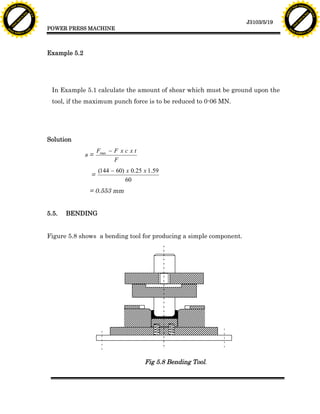
                                          Example 5.2


                                           In Example 5.1 calculate the amount of shear which must be ground upon the
                                           tool, if the maximum punch force is to be reduced to 0-06 MN.


                                          Solution
                                                             Fmax - F x c x t
                                                        s=
                                                                    F
                                                             (144 - 60) x 0.25 x 1.59
                                                         =
                                                                        60
                                                         = 0.553 mm


                                          5.5.   BENDING


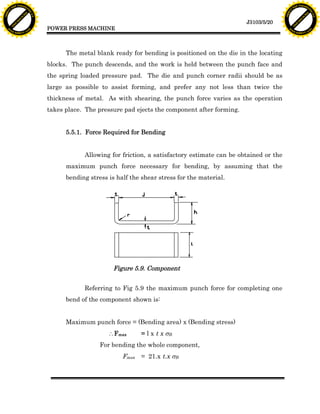
                                          Figure 5.8 shows a bending tool for producing a simple component.


                                                                                Fig 5.8 Bending Tool.
F T ra n sf o                                                                                                                 F T ra n sf o
          PD                   rm                                                                                                       PD                   rm
      Y                                                                                                                             Y
 Y


                                                                                                                               Y
                                er


                                                                                                                                                              er
ABB


                                                                                                                              ABB
                          y


                                                                                                                                                        y
                       bu


                                                                                                                                                     bu
                                    2.0


                                                                                                                                                                  2.0
                     to


                                                                                                                                                   to
                  re


                                                                                                                                                re
                                                                                                              J3103/5/20
                he


                                                                                                                                              he
           k


                                                                                                                                         k
          lic


                                                                                                                                        lic
                                          POWER PRESS MACHINE
      C


                                                                                                                                    C
      w                        om                                                                                                   w                        om
  w


                                                                                                                                w
          w.                                                                                                                            w.
               A B B Y Y.c                                                                                                                   A B B Y Y.c


                                                The metal blank ready for bending is positioned on the die in the locating
                                          blocks. The punch descends, and the work is held between the punch face and
                                          the spring loaded pressure pad. The die and punch corner radii should be as
                                          large as possible to assist forming, and prefer any not less than twice the
                                          thickness of metal. As with shearing, the punch force varies as the operation
                                          takes place. The pressure pad ejects the component after forming.


                                                5.5.1. Force Required for Bending


                                                      Allowing for friction, a satisfactory estimate can be obtained or the
                                                maximum punch force necessary for bending, by assuming that the
                                                bending stress is half the shear stress for the material.


                                                                 Figure 5.9. Component


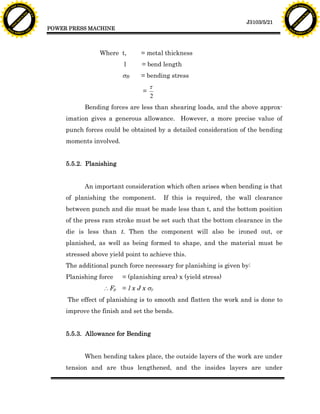
                                                      Referring to Fig 5.9 the maximum punch force for completing one
                                                bend of the component shown is:


                                                Maximum punch force = (Bending area) x (Bending stress)
                                                                Fmax      = l x t x sB
                                                            For bending the whole component,
                                                                    Fmax = 21.x t.x sB
F T ra n sf o                                                                                                                F T ra n sf o
          PD                   rm                                                                                                      PD                   rm
      Y                                                                                                                            Y
 Y


                                                                                                                              Y
                                er


                                                                                                                                                             er
ABB


                                                                                                                             ABB
                          y


                                                                                                                                                       y
                       bu


                                                                                                                                                    bu
                                    2.0


                                                                                                                                                                 2.0
                     to


                                                                                                                                                  to
                  re


                                                                                                                                               re
                                                                                                              J3103/5/21
                he


                                                                                                                                             he
           k


                                                                                                                                        k
          lic


                                                                                                                                       lic
                                          POWER PRESS MACHINE
      C


                                                                                                                                   C
      w                        om                                                                                                  w                        om
  w


                                                                                                                               w
          w.                                                                                                                           w.
               A B B Y Y.c                                                                                                                  A B B Y Y.c


                                                           Where t,       = metal thickness
                                                                   l      = bend length
                                                                   sB     = bending stress
                                                                               t
                                                                           =
                                                                               2
                                                     Bending forces are less than shearing loads, and the above approx-
                                               imation gives a generous allowance. However, a more precise value of
                                               punch forces could be obtained by a detailed consideration of the bending
                                               moments involved.


                                               5.5.2. Planishing


                                                     An important consideration which often arises when bending is that
                                               of planishing the component.        If this is required, the wall clearance
                                               between punch and die must be made less than t, and the bottom position
                                               of the press ram stroke must be set such that the bottom clearance in the
                                               die is less than t. Then the component will also be ironed out, or
                                               planished, as well as being formed to shape, and the material must be
                                               stressed above yield point to achieve this.
                                               The additional punch force necessary for planishing is given by:
                                               Planishing force    = (planishing area) x (yield stress)
                                                             Fp   = l x J x sy
                                               The effect of planishing is to smooth and flatten the work and is done to
                                               improve the finish and set the bends.


                                               5.5.3. Allowance for Bending


                                                     When bending takes place, the outside layers of the work are under
                                               tension and are thus lengthened, and the insides layers are under
F T ra n sf o                                                                                                                  F T ra n sf o
          PD                   rm                                                                                                        PD                   rm
      Y                                                                                                                              Y
 Y


                                                                                                                                Y
                                er


                                                                                                                                                               er
ABB


                                                                                                                               ABB
                          y


                                                                                                                                                         y
                       bu


                                                                                                                                                      bu
                                    2.0


                                                                                                                                                                   2.0
                     to


                                                                                                                                                    to
                  re


                                                                                                                                                 re
                                                                                                               J3103/5/22
                he


                                                                                                                                               he
           k


                                                                                                                                          k
          lic


                                                                                                                                         lic
                                          POWER PRESS MACHINE
      C


                                                                                                                                     C
      w                        om                                                                                                    w                        om
  w


                                                                                                                                 w
          w.                                                                                                                             w.
               A B B Y Y.c                                                                                                                    A B B Y Y.c


                                                compression, aid are thus shortened. As the volume of metal remains the
                                                same, the width on the compressed side of the bend increases, while that
                                                on the stretched side of the bend decreases. This gives the characteristic
                                                deformed shape on bend sides that one gets if bending a flat plate in a
                                                vice. This deformation leads to displacement of the neutral axis towards
                                                the compressed side, because the neutral axis coincides with the centre of
                                                gravity of the work.
                                                        To calculate the length of blank required for bending, we must first
                                                calculate the length of the neutral axis of the finished formed component.
                                                In practice an allowance is then added for bending to compensate for the
                                                shift in the neutral axis. These allowances will be found tabulated in tool
                                                reference and design books.


                                          Example 5.3

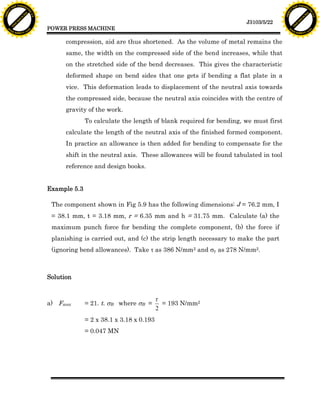
                                           The component shown in Fig 5.9 has the following dimensions: J = 76.2 mm, I
                                           = 38.1 mm, t = 3.18 mm, r = 6.35 mm and h = 31.75 mm. Calculate (a) the
                                           maximum punch force for bending the complete component, (b) the force if
                                           planishing is carried out, and (c) the strip length necessary to make the part
                                           (ignoring bend allowances). Take t as 386 N/mm2 and sy as 278 N/mm2.


                                          Solution


                                                                                    t
                                          a) Fmax       = 21. t. sB where sB =        = 193 N/mm2
                                                                                    2
                                                        = 2 x 38.1 x 3.18 x 0.193
                                                        = 0.047 MN
F T ra n sf o                                                                                                                   F T ra n sf o
          PD                   rm                                                                                                         PD                   rm
      Y                                                                                                                               Y
 Y


                                                                                                                                 Y
                                er


                                                                                                                                                                er
ABB


                                                                                                                                ABB
                          y


                                                                                                                                                          y
                       bu


                                                                                                                                                       bu
                                    2.0


                                                                                                                                                                    2.0
                     to


                                                                                                                                                     to
                  re


                                                                                                                                                  re
                                                                                                                J3103/5/23
                he


                                                                                                                                                he
           k


                                                                                                                                           k
          lic


                                                                                                                                          lic
                                          POWER PRESS MACHINE
      C


                                                                                                                                      C
      w                        om                                                                                                     w                        om
  w


                                                                                                                                  w
          w.                                                                                                                              w.
               A B B Y Y.c                                                                                                                     A B B Y Y.c


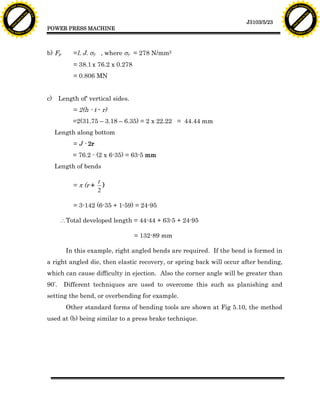
                                          b) Fp       =l. J. sy , where sy = 278 N/mm2
                                                      = 38.1 x 76.2 x 0.278
                                                      = 0.806 MN


                                          c)     Length of' vertical sides.
                                                      = 2(h - t - r)
                                                      =2(31.75 – 3.18 – 6.35) = 2 x 22.22 = 44.44 mm
                                               Length along bottom
                                                      = J - 2r
                                                      = 76.2 - (2 x 6-35) = 63-5 mm
                                               Length of bends

                                                                 t
                                                      = p (r +     )
                                                                 2

                                                      = 3-142 (6-35 + 1-59) = 24-95

                                                  Total developed length = 44-44 + 63-5 + 24-95

                                                                              = 132-89 mm

                                                   In this example, right angled bends are required. If the bend is formed in
                                          a right angled die, then elastic recovery, or spring back will occur after bending,
                                          which can cause difficulty in ejection. Also the corner angle will be greater than
                                          90º.    Different techniques are used to overcome this such as planishing and
                                          setting the bend, or overbending for example.
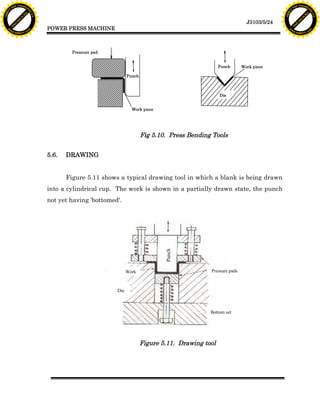
                                                   Other standard forms of bending tools are shown at Fig 5.10, the method
                                          used at (b) being similar to a press brake technique.
F T ra n sf o                                                                                                                         F T ra n sf o
          PD                   rm                                                                                                               PD                   rm
      Y                                                                                                                                     Y
 Y


                                                                                                                                       Y
                                er


                                                                                                                                                                      er
ABB


                                                                                                                                      ABB
                          y


                                                                                                                                                                y
                       bu


                                                                                                                                                             bu
                                    2.0


                                                                                                                                                                          2.0
                     to


                                                                                                                                                           to
                  re


                                                                                                                                                        re
                                                                                                                         J3103/5/24
                he


                                                                                                                                                      he
           k


                                                                                                                                                 k
          lic


                                                                                                                                                lic
                                          POWER PRESS MACHINE
      C


                                                                                                                                            C
      w                        om                                                                                                           w                        om
  w


                                                                                                                                        w
          w.                                                                                                                                    w.
               A B B Y Y.c                                                                                                                           A B B Y Y.c


                                                   Pressure pad


                                                                                                            Punch      Work piece

                                                                        Punch


                                                                                                            Die


                                                                          Work piece


                                                                                Fig 5.10. Press Bending Tools


                                          5.6.   DRAWING


                                                 Figure 5.11 shows a typical drawing tool in which a blank is being drawn
                                          into a cylindrical cup. The work is shown in a partially drawn state, the punch
                                          not yet having 'bottomed'.
                                                                                        Punch


                                                                        Work                           Pressure pads


                                                                  Die


                                                                                                       Bottom set


                                                                                Figure 5.11. Drawing tool
F T ra n sf o                                                                                                                    F T ra n sf o
          PD                   rm                                                                                                          PD                   rm
      Y                                                                                                                                Y
 Y


                                                                                                                                  Y
                                er


                                                                                                                                                                 er
ABB


                                                                                                                                 ABB
                          y


                                                                                                                                                           y
                       bu


                                                                                                                                                        bu
                                    2.0


                                                                                                                                                                     2.0
                     to


                                                                                                                                                      to
                  re


                                                                                                                                                   re
                                                                                                                 J3103/5/25
                he


                                                                                                                                                 he
           k


                                                                                                                                            k
          lic


                                                                                                                                           lic
                                          POWER PRESS MACHINE
      C


                                                                                                                                       C
      w                        om                                                                                                      w                        om
  w


                                                                                                                                   w
          w.                                                                                                                               w.
               A B B Y Y.c                                                                                                                      A B B Y Y.c


                                                   The spring (or rubber) loaded pressure pad on the punch keeps the metal
                                          tight against the die face, and the blank is ironed out as it is drawn over the
                                          radiuses edge of the die hole. This prevents wrinkling of the cup and keeps the
                                          finished edge of the rim straight. The pressure which is applied by this pad is
                                          important; no pressure gives heavy wrinkling and excessive pressure results in
                                          the bottom being pressed out of the cup. The optimum pad pressure giving, best
                                          results varies with the type of work, but will be to the order of 30 to 40% of the
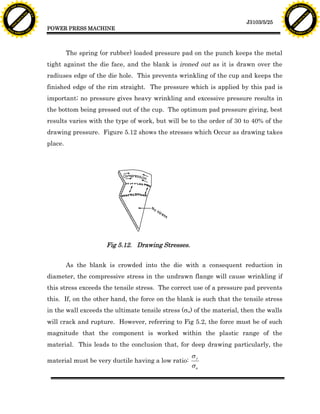
                                          drawing pressure. Figure 5.12 shows the stresses which Occur as drawing takes
                                          place.


                                                                Fig 5.12. Drawing Stresses.


                                                   As the blank is crowded into the die with a consequent reduction in
                                          diameter, the compressive stress in the undrawn flange will cause wrinkling if
                                          this stress exceeds the tensile stress. The correct use of a pressure pad prevents
                                          this. If, on the other hand, the force on the blank is such that the tensile stress
                                          in the wall exceeds the ultimate tensile stress (su) of the material, then the walls
                                          will crack and rupture. However, referring to Fig 5.2, the force must be of such
                                          magnitude that the component is worked within the plastic range of the
                                          material. This leads to the conclusion that, for deep drawing particularly, the
                                                                                              sy
                                          material must be very ductile having a low ratio:
                                                                                              su
F T ra n sf o                                                                                                                     F T ra n sf o
          PD                   rm                                                                                                           PD                   rm
      Y                                                                                                                                 Y
 Y


                                                                                                                                   Y
                                er


                                                                                                                                                                  er
ABB


                                                                                                                                  ABB
                          y


                                                                                                                                                            y
                       bu


                                                                                                                                                         bu
                                    2.0


                                                                                                                                                                      2.0
                     to


                                                                                                                                                       to
                  re


                                                                                                                                                    re
                                                                                                                   J3103/5/26
                he


                                                                                                                                                  he
           k


                                                                                                                                             k
          lic


                                                                                                                                            lic
                                          POWER PRESS MACHINE
      C


                                                                                                                                        C
      w                        om                                                                                                       w                        om
  w


                                                                                                                                    w
          w.                                                                                                                                w.
               A B B Y Y.c                                                                                                                       A B B Y Y.c


                                                The die pressure pad shown in Fig 12.11 supports the work and also acts
                                          as an ejector.
                                                The restriction mentioned above on tensile forces means that there is a
                                          limit to the amount of drawing which can be attempted in one operation. It has
                                                                                 D
                                          been found that the drawing ratio        should not exceed a value of 2 ( where D =
                                                                                 d
                                          blank diameter and d = cup diameter) for most materials, although this depends
                                          upon the value of su for the material.         A deep drawn cup may have to be
                                          completed in a series of operations.


                                                5.6.1. Blank Size


                                                       In order to calculate the blank diameter D to produce a cup of
                                                diameter d, it is necessary to equate the surface area of each. This leads
                                                to the well known expression:

                                                      D=    d 2 + 4dh         Where h = cup height


                                                       This makes no allowance for a corner radius, and in practice one
                                                may finally adopt a trial and error technique; in drawing work experience
                                                is at a premium.


                                                5.6.2. Force Required for Drawing


                                                       Again, the force will vary as the operation proceeds, but a
                                                reasonable approximation for the maximum punch force can be
                                                established using the expression:
                                                Fmax = p. d. t. su      where su = the ultimate tensile stress of the material.
F T ra n sf o                                                                                                                  F T ra n sf o
          PD                   rm                                                                                                        PD                   rm
      Y                                                                                                                              Y
 Y


                                                                                                                                Y
                                er


                                                                                                                                                               er
ABB


                                                                                                                               ABB
                          y


                                                                                                                                                         y
                       bu


                                                                                                                                                      bu
                                    2.0


                                                                                                                                                                   2.0
                     to


                                                                                                                                                    to
                  re


                                                                                                                                                 re
                                                                                                                J3103/5/27
                he


                                                                                                                                               he
           k


                                                                                                                                          k
          lic


                                                                                                                                         lic
                                          POWER PRESS MACHINE
      C


                                                                                                                                     C
      w                        om                                                                                                    w                        om
  w


                                                                                                                                 w
          w.                                                                                                                             w.
               A B B Y Y.c                                                                                                                    A B B Y Y.c


                                          Example 5.4


                                           A cup is to be drawn to a diameter of 76.2 mm x 38-0 mm deep in 0.8mm thick
                                           material. Estimate the blank diameter and the maximum drawing force if su
                                           = 432 N/mm2


                                                 Solution

                                                        D=       d 2 + 4dh

                                                          =    5800 + (4 x 76.2 x 38.0)

                                                         =    5800 + 11600

                                                         = 17400
                                                                 = 132 mm
                                                                      D   132
                                                 Drawing ratio =        =
                                                                      d   76 .2
                                                                 = 1.73
                                                  assume the cup can be drawn in one operation.
                                                 Fmax = p. d. t. su
                                                      = 3.142 x 76.2 x 0.8 x 0.432 = 0-083 MN


                                          5.7.   COMBINATION TOOLS


                                                 It is often possible where batch quantities justify it to incorporate two
                                          operations into the one too] such that the operations are carried out in
                                          combination. This increases the production rate hence reducing the variable
                                          costs with little increase in fixed costs. The dual operation is usually blank and
                                          draws and is very successful on thin materials where the total force required is
                                          not impracticable, and the component can be drawn to full depth in the one
                                          operation. Figure 5.12 shows the principle of operation of such a too].
F T ra n sf o                                                                                                                          F T ra n sf o
          PD                   rm                                                                                                                PD                   rm
      Y                                                                                                                                      Y
 Y


                                                                                                                                        Y
                                er


                                                                                                                                                                       er
ABB


                                                                                                                                       ABB
                          y


                                                                                                                                                                 y
                       bu


                                                                                                                                                              bu
                                    2.0


                                                                                                                                                                           2.0
                     to


                                                                                                                                                            to
                  re


                                                                                                                                                         re
                                                                                                                          J3103/5/28
                he


                                                                                                                                                       he
           k


                                                                                                                                                  k
          lic


                                                                                                                                                 lic
                                          POWER PRESS MACHINE
      C


                                                                                                                                             C
      w                        om                                                                                                            w                        om
  w


                                                                                                                                         w
          w.                                                                                                                                     w.
               A B B Y Y.c                                                                                                                            A B B Y Y.c


                                                 The punch blanks upon diameter D and draws on diameter d. The punch
                                          and die pressure pads are spring loaded. As the punch descends in the guide, it
                                          shears the blank from the strip, and the blank will be gripped between the
                                          punch face and the pressure pads. The punch continues to descend, and the
                                          blank is drawn over the drawing die. The drawn cup is in an inverted position to
                                          that shown in Fig 5.12.

                                                                                        D


                                                                                                        Punch (blanking
                                                    Fixed punch guide                                   & drawing)


                                                            Pressure pads
                                                                                        d       Drawing die       Strip


                                                                        Fig 5.12. Combination Too].

                                                 As the punch withdraws, the pressure pads act as ejectors so that the cup
                                          does not stick to the die or punch. The punch guide can also be arranged to act
                                          as a stripper, so that the strip is removed from the punch.


                                          5.8.   PROGRESSION TOOL


                                                 The combination tool described in the previous section combines more
                                          than one press operation at the one tool station, and the punches and dies are
                                          positioned on the same axis. A progression tool, by contrast, has more thin one
                                          press operation positioned at separate stations oil the press tool set, i.e., there is
F T ra n sf o                                                                                                                      F T ra n sf o
          PD                   rm                                                                                                            PD                   rm
      Y                                                                                                                                  Y
 Y


                                                                                                                                    Y
                                er


                                                                                                                                                                   er
ABB


                                                                                                                                   ABB
                          y


                                                                                                                                                             y
                       bu


                                                                                                                                                          bu
                                    2.0


                                                                                                                                                                       2.0
                     to


                                                                                                                                                        to
                  re


                                                                                                                                                     re
                                                                                                                 J3103/5/29
                he


                                                                                                                                                   he
           k


                                                                                                                                              k
          lic


                                                                                                                                             lic
                                          POWER PRESS MACHINE
      C


                                                                                                                                         C
      w                        om                                                                                                        w                        om
  w


                                                                                                                                     w
          w.                                                                                                                                 w.
               A B B Y Y.c                                                                                                                        A B B Y Y.c


                                          one station for- each operations these following on behind each other. The strip
                                          is therefore progressively, worked upon as it is fed through the tool. Simple tools
                                          of this type, such as the tool shown at Fig 5.10 are called follow-on tools, and are
                                          usually blank and pierce tools.


                                                Large progression tools can be very complex and expensive to make,
                                          therefore they are only suitable for high quantity production, and the strip feed
                                          will be automatic. Complex progression tools may include a combination type
                                          operation at one of the stations.
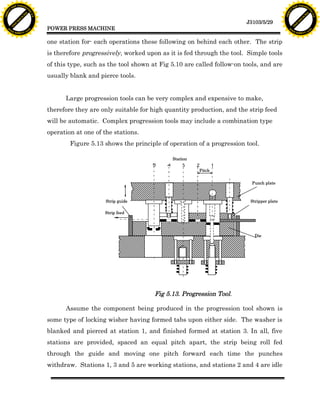
                                                  Figure 5.13 shows the principle of operation of a progression tool.

                                                                                      Station

                                                                                                Pitch


                                                                                                                   Punch plate


                                                               Strip guide                                        Stripper plate

                                                              Strip feed


                                                                                                                    Die


                                                                                Fig 5.13. Progression Tool.

                                                Assume the component being produced in the progression tool shown is
                                          some type of locking wisher having formed tabs upon either side. The washer is
                                          blanked and pierced at station 1, and finished formed at station 3. In all, five
                                          stations are provided, spaced an equal pitch apart, the strip being roll fed
                                          through the guide and moving one pitch forward each time the punches
                                          withdraw. Stations 1, 3 and 5 are working stations, and stations 2 and 4 are idle
F T ra n sf o                                                                                                                    F T ra n sf o
          PD                   rm                                                                                                          PD                   rm
      Y                                                                                                                                Y
 Y


                                                                                                                                  Y
                                er


                                                                                                                                                                 er
ABB


                                                                                                                                 ABB
                          y


                                                                                                                                                           y
                       bu


                                                                                                                                                        bu
                                    2.0


                                                                                                                                                                     2.0
                     to


                                                                                                                                                      to
                  re


                                                                                                                                                   re
                                                                                                                 J3103/5/30
                he


                                                                                                                                                 he
           k


                                                                                                                                            k
          lic


                                                                                                                                           lic
                                          POWER PRESS MACHINE
      C


                                                                                                                                       C
      w                        om                                                                                                      w                        om
  w


                                                                                                                                   w
          w.                                                                                                                               w.
               A B B Y Y.c                                                                                                                      A B B Y Y.c


                                          stations. This is done to provide room for the punches, and to strengthen the die
                                          block. The blanks and formed washers are carried in the strip from station to
                                          station before the finished washer is finally pushed out of the strip by the ejector
                                          punch at station 5. Let us examine each operation at each station in turn.


                                          Station 1
                                                Blank and pierce operation. The fixed piercing punch in the bottom tool
                                          pierces a slug as the top tool descends. The slugs are pushed up the centre of the
                                          blanking punch to finally fall out through the exit hole in the punch plate. The
                                          spring loaded pressure pad in the bottom tool supports the blank and pushes it
                                          back into the strip after blanking and piercing are complete.


                                          Station 2
                                                Idle operation. The stripper holds the blank and strip as the top tool
                                          descends.


                                          Station 3
                                                Forming operation.     Bending of tabs takes place on the washer being
                                          supported by a pressure pad. Again, the pressure pad pushes the formed washer
                                          back into the strip to allow it to be carried to the next station. A pilot in the
                                          punch locates the pierced hole ensuring the blank is accurately positioned for
                                          forming.


                                          Station 4
                                                Idle operation. The stripper plate has a clearance slot cut in it so that the
                                          washer tabs are not damaged as the stripper plate grips the strip.


                                          Station 5
                                                Ejection operation. The finished washer is pushed out of the strip to fall
                                          clear of the tool into a hopper. These tools are very fast in operation and the
F T ra n sf o                                                                                                                     F T ra n sf o
          PD                   rm                                                                                                           PD                   rm
      Y                                                                                                                                 Y
 Y


                                                                                                                                   Y
                                er


                                                                                                                                                                  er
ABB


                                                                                                                                  ABB
                          y


                                                                                                                                                            y
                       bu


                                                                                                                                                         bu
                                    2.0


                                                                                                                                                                      2.0
                     to


                                                                                                                                                       to
                  re


                                                                                                                                                    re
                                                                                                                  J3103/5/31
                he


                                                                                                                                                  he
           k


                                                                                                                                             k
          lic


                                                                                                                                            lic
                                          POWER PRESS MACHINE
      C


                                                                                                                                        C
      w                        om                                                                                                       w                        om
  w


                                                                                                                                    w
          w.                                                                                                                                w.
               A B B Y Y.c                                                                                                                       A B B Y Y.c


                                          amount of scrap strip left to deal with can create problems. On some tools the
                                          scrap strip is cut up by the tool to be ejected off the die face using compressed air
                                          for example. Sometimes a jet of compressed air is used for ejection purposes
                                          upon a press tool.
F T ra n sf o                                                                                                                       F T ra n sf o
          PD                   rm                                                                                                             PD                   rm
      Y                                                                                                                                   Y
 Y


                                                                                                                                     Y
                                er


                                                                                                                                                                    er
ABB


                                                                                                                                    ABB
                          y


                                                                                                                                                              y
                       bu


                                                                                                                                                           bu
                                    2.0


                                                                                                                                                                        2.0
                     to


                                                                                                                                                         to
                  re


                                                                                                                                                      re
                                                                                                                       J3103/5/32
                he


                                                                                                                                                    he
           k


                                                                                                                                               k
          lic


                                                                                                                                              lic
                                          POWER PRESS MACHINE
      C


                                                                                                                                          C
      w                        om                                                                                                         w                        om
  w


                                                                                                                                      w
          w.                                                                                                                                  w.
               A B B Y Y.c                                                                                                                         A B B Y Y.c


                                                                        ACTIVITY 5


                                          5.1.   By considering the costs involved, compare the cold working of a component to
                                                 shape, with machining of a component to shape.


                                          5.2.   Name and write short notes on three types of cold working sheet metal works.


                                          5.2.   What is the difference between blanking and piercing?


                                          5.3.   Draw and label a schematic diagram of a Blanking and Piercing tool.


                                          5.5.   Clearly show the difference between combination tools and progression tools, and
                                                 sketch an example of each type.
F T ra n sf o                                                                                                                 F T ra n sf o
          PD                   rm                                                                                                       PD                   rm
      Y                                                                                                                             Y
 Y


                                                                                                                               Y
                                er


                                                                                                                                                              er
ABB


                                                                                                                              ABB
                          y


                                                                                                                                                        y
                       bu


                                                                                                                                                     bu
                                    2.0


                                                                                                                                                                  2.0
                     to


                                                                                                                                                   to
                  re


                                                                                                                                                re
                                                                                                                J3103/5/33
                he


                                                                                                                                              he
           k


                                                                                                                                         k
          lic


                                                                                                                                        lic
                                          POWER PRESS MACHINE
      C


                                                                                                                                    C
      w                        om                                                                                                   w                        om
  w


                                                                                                                                w
          w.                                                                                                                            w.
               A B B Y Y.c                                                                                                                   A B B Y Y.c


                                                                        FEEDBACK ON ACTIVITY 5


                                          5.1.     Machining – wasteful, 40% of the original component material is removed
                                          by expensive machining operations to become scrap. This scrap material will
                                          only be worth 5% of its original value as raw material. It is more economical to
                                          be carried out by metal forming.
                                                   Although dies are expensive and fixed costs are higher; material wastage
                                          is negligible, labor costs are low and hence variable costs are lower. The metal
                                          cutting process is often lower on fixed costs, but higher on variable costs. More
                                          economical when quantities required are large.


                                          5.2.1 Shearing. The required shape of work is sheared from the metal strip, the
                                          metal being deformed to shear failure. There are three variations of shearing,
                                          viz., 1. Blanking 2. Piercing 3. Cropping


                                          5.2.2. Bending -This is carried out on blanks, strip, sheet, rod or wire and
                                          consists of local deformation, as opposed to a change of shape of the complete
                                          article. Forces must be high enough to cold work the material within the plastic
                                          range.


                                          5.2.3. Drawing.      This is carried out on blanks, and involves considerable
                                          deformation or a complete change of shape of part. Again the deformation must
F T ra n sf o                                                                                                                                 F T ra n sf o
          PD                   rm                                                                                                                       PD                   rm
      Y                                                                                                                                             Y
 Y


                                                                                                                                               Y
                                er


                                                                                                                                                                              er
ABB


                                                                                                                                              ABB
                          y


                                                                                                                                                                        y
                       bu


                                                                                                                                                                     bu
                                    2.0


                                                                                                                                                                                  2.0
                     to


                                                                                                                                                                   to
                  re


                                                                                                                                                                re
                                                                                                                                 J3103/5/34
                he


                                                                                                                                                              he
           k


                                                                                                                                                         k
          lic


                                                                                                                                                        lic
                                          POWER PRESS MACHINE
      C


                                                                                                                                                    C
      w                        om                                                                                                                   w                        om
  w


                                                                                                                                                w
          w.                                                                                                                                            w.
               A B B Y Y.c                                                                                                                                   A B B Y Y.c


                                          be carried out in the plastic range. Deep drawing may require several drawing
                                          stages with interstate annealing.


                                          5.2.   Blanking, in which a blank is punched from the strip, the blank removed
                                                 by the punch being the required article. The metal left is waste
                                          5.3.   Piercing, in which the blank punched or pierced from the metal strip is
                                                 waste, the hole left in the strip being required.


                                          5.4.
                                                                                  Shank
                                                                                                 Press ram


                                                                                                                   Top set
                                                             Pressure plate
                                                                                                                Punch plate


                                                                 Blanking punch                              Piercing punch

                                                                     Pilot
                                                                                                             Stripper


                                                           Die
                                                                                                         Strip feed

                                                                                                                    Bottom set


                                                                                     Press bed


                                                                              Blank and pierce tool
F T ra n sf o                                                                                                                                 F T ra n sf o
          PD                   rm                                                                                                                       PD                   rm
      Y                                                                                                                                             Y
 Y


                                                                                                                                               Y
                                er


                                                                                                                                                                              er
ABB


                                                                                                                                              ABB
                          y


                                                                                                                                                                        y
                       bu


                                                                                                                                                                     bu
                                    2.0


                                                                                                                                                                                  2.0
                     to


                                                                                                                                                                   to
                  re


                                                                                                                                                                re
                                                                                                                                 J3103/5/35
                he


                                                                                                                                                              he
           k


                                                                                                                                                         k
          lic


                                                                                                                                                        lic
                                          POWER PRESS MACHINE
      C


                                                                                                                                                    C
      w                        om                                                                                                                   w                        om
  w


                                                                                                                                                w
          w.                                                                                                                                            w.
               A B B Y Y.c                                                                                                                                   A B B Y Y.c


                                               5.5.
                                                                                               D


                                                                                                                   Punch (blanking
                                                      Fixed punch guide
                                                                                                                   & drawing)


                                                               Pressure pads
                                                                                               d           Drawing die         Strip

                                                                                                                         Blanking die


                                                                                Combination Too].


                                                                                     Station

                                                                                                   Pitch


                                                                                                                             Punch plate


                                                       Strip guide                                                           Stripper plate

                                                       Strip feed


                                                                                                                               Die


                                                                               Progression Tool.
F T ra n sf o                                                                                                                      F T ra n sf o
          PD                   rm                                                                                                            PD                   rm
      Y                                                                                                                                  Y
 Y


                                                                                                                                    Y
                                er


                                                                                                                                                                   er
ABB


                                                                                                                                   ABB
                          y


                                                                                                                                                             y
                       bu


                                                                                                                                                          bu
                                    2.0


                                                                                                                                                                       2.0
                     to


                                                                                                                                                        to
                  re


                                                                                                                                                     re
                                                                                                                  J3103/5/36
                he


                                                                                                                                                   he
           k


                                                                                                                                              k
          lic


                                                                                                                                             lic
                                          POWER PRESS MACHINE
      C


                                                                                                                                         C
      w                        om                                                                                                        w                        om
  w


                                                                                                                                     w
          w.                                                                                                                                 w.
               A B B Y Y.c                                                                                                                        A B B Y Y.c


                                          Combination.Tool - It increases the production rate hence reducing the variable
                                          costs with little increase in fixed costs. The dual operation is usually blank and
                                          draws and is very successful on thin materials where the total force required is
                                          not impracticable, and the component can be drawn to full depth in the one
                                          operation. Note the drawing die and blanking die placed just below the strip.


                                          Progression Tool. - It has more thin one press operation positioned at separate
                                          stations oil the press tool set, i.e., there is one station for- each operations these
                                          following on behind each other.      The strip is therefore progressively, worked
                                          upon as it is fed through the tool. Simple tools of this type, such as the tool
                                          shown at the above figure are called follow-on tools, and are usually blank and
                                          pierce tools. Note the number of stations in the figure above (5 stations)
F T ra n sf o                                                                                                              F T ra n sf o
          PD                   rm                                                                                                    PD                   rm
      Y                                                                                                                          Y
 Y


                                                                                                                            Y
                                er


                                                                                                                                                           er
ABB


                                                                                                                           ABB
                          y


                                                                                                                                                     y
                       bu


                                                                                                                                                  bu
                                    2.0


                                                                                                                                                               2.0
                     to


                                                                                                                                                to
                  re


                                                                                                                                             re
                                                                                                              J3103/5/37
                he


                                                                                                                                           he
           k


                                                                                                                                      k
          lic


                                                                                                                                     lic
                                          POWER PRESS MACHINE
      C


                                                                                                                                 C
      w                        om                                                                                                w                        om
  w


                                                                                                                             w
          w.                                                                                                                         w.
               A B B Y Y.c                                                                                                                A B B Y Y.c


                                                                      SELF-ASSESSMENT 5


                                          1.     A steel blank 45 mm square having a 22mm diameter hole in the centre
                                                is to be blanked from 1mm thick sheet.
                                                (a)   Calculate the maximum punch force necessary to shear the blank in
                                                      one operation if t =390 N/mm2.
                                                (b)   Calculate the work done if the % penetration is 20%
                                                (c)   What will be the % reduction in punch force if 0.5mm double shear
                                                      is ground upon the tool?

                                          2.    A component is formed on a bending tool from 6 mm x 35 mm material
                                                into a ‘U’ shape 55mm wide, having unequal arms 62 mm and 48 mm long
                                                respectively. The internal radius at each bend corner is 12 mm.
                                                Calculate:

                                                 (a) The maximum punch force for bending the part in one operation.

                                                (b) The additional force if planishing is carried out

                                                (c) The developed length of the part (ignoring bend allowances)

                                                Take t as 400 N/mm2 and sy as 350 N/mm2.


                                          3.   Estimate (a) the maximum punch force, and (b) the blank diameter, for a
                                               cup which is to be drawn to 62.3 mm dia. X 21.4 mm deep in 0.8 mm thick
                                               material. su = 325 N/mm2.
F T ra n sf o                                                                                                                F T ra n sf o
          PD                   rm                                                                                                      PD                   rm
      Y                                                                                                                            Y
 Y


                                                                                                                              Y
                                er


                                                                                                                                                             er
ABB


                                                                                                                             ABB
                          y


                                                                                                                                                       y
                       bu


                                                                                                                                                    bu
                                    2.0


                                                                                                                                                                 2.0
                     to


                                                                                                                                                  to
                  re


                                                                                                                                               re
                                                                                                              J3103/5/38
                he


                                                                                                                                             he
           k


                                                                                                                                        k
          lic


                                                                                                                                       lic
                                          POWER PRESS MACHINE
      C


                                                                                                                                   C
      w                        om                                                                                                  w                        om
  w


                                                                                                                               w
          w.                                                                                                                           w.
               A B B Y Y.c                                                                                                                  A B B Y Y.c


                                          4. Discuss the factor s involved in the cold pressworking processes and show the
                                          effect of these factors on the design of press tool.
F T ra n sf o                                                                                                                                 F T ra n sf o
          PD                   rm                                                                                                                       PD                   rm
      Y                                                                                                                                             Y
 Y


                                                                                                                                               Y
                                er


                                                                                                                                                                              er
ABB


                                                                                                                                              ABB
                          y


                                                                                                                                                                        y
                       bu


                                                                                                                                                                     bu
                                    2.0


                                                                                                                                                                                  2.0
                     to


                                                                                                                                                                   to
                  re


                                                                                                                                                                re
                                                                                                                             J3103/5/39
                he


                                                                                                                                                              he
           k


                                                                                                                                                         k
          lic


                                                                                                                                                        lic
                                          POWER PRESS MACHINE
      C


                                                                                                                                                    C
      w                        om                                                                                                                   w                        om
  w


                                                                                                                                                w
          w.                                                                                                                                            w.
               A B B Y Y.c                                                                                                                                   A B B Y Y.c


                                                              FEEDBACK OF SELF-ASSESSMENT 5


                                          1. (a) 0.097 MN, (b) 19.4 J, (c) 71.3%


                                          2. (a) 0.084 MN, (b) 0.59 MN (c) 140.2 mm


                                          3. (a) 0.051 MN, (b) 96 mm


                                          4. (i) Plasticity – high ductility material used (in deep drawing, operations done in stages) –
                                               metal must be annealed after cold working.
                                            (ii) Elasticity – elastic recovering of the material due to the release of stresses cause
                                                 by/during deformation.
                                           (iii) Direction of rolling of the strip to be worked in the press tool, e.g. bending – direction
                                               of rolling across the grain is better than along the grain.

Unit5 Power Press Machine

  • 1.
    F T ran sf o F T ra n sf o PD rm PD rm Y Y Y Y er er ABB ABB y y bu bu 2.0 2.0 to to re re J3103/5/1 he he k k lic lic POWER PRESS MACHINE C C w om w om w w w. w. A B B Y Y.c A B B Y Y.c UNIT 5 POWER PRESS MACHINE OBJECTIVES General Objective: To understand the use of presses and press tools in cold metal working. Specific Objectives : At the end of the unit you will be able to; Ø Know the types and function of presses and press tools. Ø Sketch and know the parts of presses and press tools. Ø Elaborate on the methods of cold working in sheet metal i.e. shearing, bending and drawing.
  • 2.
    F T ran sf o F T ra n sf o PD rm PD rm Y Y Y Y er er ABB ABB y y bu bu 2.0 2.0 to to re re J3103/5/2 he he k k lic lic POWER PRESS MACHINE C C w om w om w w w. w. A B B Y Y.c A B B Y Y.c INPUT 5.0. INTRODUCTION In the manufacturing section of the engineering industry, metal articles can be worked to shape either by metal cutting, or by metal forming. Metal cutting can often be wasteful because, on the average, 40% of the original component material is removed by expensive machining operations to become scrap. This scrap material will then on the average be worth 5% of its original value as raw material. In many cases machining operations can be more economically carried out by metal forming. It is interesting to carry out a break-even cost analysis upon a manufacturing operation where metal cutting or metal forming is possible alternative processes. Often the forming process requires expensive dies and fixed costs are higher; material wastage is negligible, labour costs are low and hence variable costs are lower. The metal cutting process is often lower on fixed costs, but higher on variable costs. Hence, the forming process will be more economical when quantities required are large. In this chapter we shall be concerned solely with the use of presses and press tools ( Fig. 5.1 (a), (b) and (c) ) as a means of cold working metal objects into shape. Most of this type of work is carried out upon ductile metal in sheet or strip form of relatively thin section. It represents an important part of the
  • 3.
    F T ran sf o F T ra n sf o PD rm PD rm Y Y Y Y er er ABB ABB y y bu bu 2.0 2.0 to to re re J3103/5/3 he he k k lic lic POWER PRESS MACHINE C C w om w om w w w. w. A B B Y Y.c A B B Y Y.c manufacturing industry, being used for the cheap production for large quantities of components, such as motor car bodies, electric motor parts, domestic electrical articles, etc. (a) (b) (c) Figure 5.1. Press machine
  • 4.
    F T ran sf o F T ra n sf o PD rm PD rm Y Y Y Y er er ABB ABB y y bu bu 2.0 2.0 to to re re J3103/5/4 he he k k lic lic POWER PRESS MACHINE C C w om w om w w w. w. A B B Y Y.c A B B Y Y.c The metal if in coiled strip form, may be fed automatically into the press tool by power rolls or power slide, or may be hand fed by operator. If the metal is in some other form, such as a sheet or partially formed shape, it may be located in the tool by mechanical hands which have gripping fingers or locating pans which drop the metal drop part into the correct position. Again, an operator may hand feed the part. The mechanical feed or location devices must of course be synchronized to operate every time the press ram lifts the top tool clear of the bottom tool. Where the press is hand fed, stringent safety precautions must be taken to ensure that the operators' hands cannot be trapped in the press tool. Efficient guards must be provided which are completely fool proof, and it should always be remembered that a press is potentially a very dangerous machine. The presses mi which press-tool work is done may be divided into (a) hand-operated presses, and (b) power-operated presses. Hand operated presses are very simple in construction and are generally used, only for small batches of simple work; an example is shown in Fig. 5.1 (a) Power presses may be subdivided into (1) Single-acting presses, (2) Double-acting presses, and (3) Triple-acting presses. Single-acting presses are essentially similar to the simple hand-operated press inn that they have only one ram; the means of operating the ram are various. These means may be a crank, an eccentric or a toggle-lever mechanism In Fig. 109 is shown a typical crank-operated single-acting press. The ram is guided in the frame and is actuated by a crankshaft through the medium of a connecting rod. The press is provided with a fly-wheel and may be driven either by a belt or by an electric motor. A clutch enables the flywheel to be coupled to the crankshaft when the press is required to work; this clutch may be arranged to disengage automatically when the crankshaft has made one complete revolution and the
  • 5.
    F T ran sf o F T ra n sf o PD rm PD rm Y Y Y Y er er ABB ABB y y bu bu 2.0 2.0 to to re re J3103/5/5 he he k k lic lic POWER PRESS MACHINE C C w om w om w w w. w. A B B Y Y.c A B B Y Y.c ram has reached the top of its stroke, a brake being used to prevent overrunning or, alternatively, the crankshaft may be allowed to keep on revolving as long as may be desired. In the latter case the feed to the stock must be automatic and the press must have additional mechanism to provide this automatic feed during the time that the ram and punch are clear of the work. Blanking, piercing, and trimming operations on strip material will generally be done with a continuously running press and automatic feed, but second operation work must generally be put into the die by hand and then the clutch must be operated every time the ram is required to make a stroke. Because of the great danger to an operator's hands which arises from the starting of a press cycle before the operator's hands are clear of the dies all presses must, by law, be fitted with guards. These are arranged to push the operator's hands away (if they are not already clear) as the press ram begins to descend; the guard is clearly visible in Fig. 5.1 (c). In addition some presses are arranged so that two levers have to be moved simultaneously before the press will start and the levers are situated so that the operator must use both hands to move them. This,, however, generally slows down production. The use of an eccentric instead of a crank enables greater forces to be applied to the ram for a given diameter of shaft and is consequently found in presses for very heavy work. Very large presses, such as are used for the production of motor-car body panels, sometimes have four eccentrics, one at each corner of the "ram," so as to ensure an even pressure and to eliminate tilting. When very heavy forces must be used as, for example, in coin embossing, toggle mechanism is sometimes used, but this form of operation generally necessitates a comparatively short working stroke.
  • 6.
    F T ran sf o F T ra n sf o PD rm PD rm Y Y Y Y er er ABB ABB y y bu bu 2.0 2.0 to to re re J3103/5/6 he he k k lic lic POWER PRESS MACHINE C C w om w om w w w. w. A B B Y Y.c A B B Y Y.c Single-acting presses are made either open-fronted as Shown in Fig. 5.1 (b), the frame being C-shaped, or double sided as in Fig. 5.1 (c). They are often inclinable so that gravity may be used to discharge the job clear of the dies. The double-acting press has two reciprocating parts, an inner member actuated usually by a crankshaft and connecting rod and an outer member actuated usually by cams carried by the crankshaft. Double-acting presses are used chiefly for drawing operations and the outer member is used to actuate the holder or pressure-plate, while the inner member carries the drawing punch. The use of cams makes it easy to arrange that the holder descends ahead of the punch so that the blank is gripped before the drawing starts and also to keep the holder at rest during the drawing. Double-acting presses do not usually run continuously. A triple-acting press is similar to a double-acting press but has, in addition, a third reciprocating member carried in guides in the base of the machine so that a second punch can be made to draw the blank upwards into a suitably shaped recess formed in the top punch. They are used only for large work such as motor-car body panels. In order to appreciate press tool design, it may help to briefly reconsider the elementary principles of metal plasticity. Standard tensile or compression tests which cold work the specimen being used are an ideal means of obtaining data about the plastic range of metals.
  • 7.
    F T ran sf o F T ra n sf o PD rm PD rm Y Y Y Y er er ABB ABB y y bu bu 2.0 2.0 to to re re J3103/5/7 he he k k lic lic POWER PRESS MACHINE C C w om w om w w w. w. A B B Y Y.c A B B Y Y.c Consider Fig. 5.2, which shows the results of a tensile test upon a relatively ductile material, such a low carbon steel. Figure 5.2 Tensile test of a Ductile Metal The metal is elastic up to point A and will return to its original size if the force is withdrawn. However, if the force is increased to point B, before being withdrawn, the force extension graph follows the line BC, parallel to line AO, as the force is removed. The test piece will then be permanently extended by amount OC, and will not return to its former size. CD represents the elastic contraction ( recovery ) which occurs as the force is removed. Area OABD represents the work required to cause deformation OC. If the overstrained material is again subjected to a tensile force upon a testing machine, we shall plot an entirely different force-extension graph than we first derived. This second graph will now have its origin at C ( instead of O), its yield point approx. at B ( instead of A ), and its breaking point at approx. the same point as would have occurred if the first test had been completed to failure. In effect the original piece of metal in being cold-worked to point B well above
  • 8.
    F T ran sf o F T ra n sf o PD rm PD rm Y Y Y Y er er ABB ABB y y bu bu 2.0 2.0 to to re re J3103/5/8 he he k k lic lic POWER PRESS MACHINE C C w om w om w w w. w. A B B Y Y.c A B B Y Y.c the yield point acquires a new set of properties. These new properties result in a different force-extension graph being derived if the metal is reworked. This is the most important first effect of cold working, which means that a cheaper material can be specified for a cold forming operation, the component finishing with new superior properties comparable to a more costly material. The results of cold working a metal well within the plastic range of the metal can be summarized as follows: a) The yield point, and hence the stress at yield point is raised, where Force at yield point stress at the yield point = sy = Cross sectional area b) The ductility is lowered, and hence the elongation % is reduced, extension where elongation % = x 100 original length Should high ductility be the important property, such as in a deep drawing operation which must be carried out in several stages, then the metal must be annealed after cold working to restore it to its original state. From figure 5.2. it can be seen that no annealing takes place, then between points A and B, each successive increment of elongation will require an increasing increment of work. In other words, as cold working proceeds, the resistance to deformation rises steadily. In cold working there will be minor changes in dimensions of the work piece when the work is removed from the tool. This is the elastic -recovery of the material shown in the graph due to the release oil stresses causing the deformation. The work after removal from the press tool will spring back from
  • 9.
    F T ran sf o F T ra n sf o PD rm PD rm Y Y Y Y er er ABB ABB y y bu bu 2.0 2.0 to to re re J3103/5/9 he he k k lic lic POWER PRESS MACHINE C C w om w om w w w. w. A B B Y Y.c A B B Y Y.c the die shape to take up a different shape. This must be allowed for in the tool design. One other factor to consider in press tool work is the direction of rolling of the strip to be worked in the press tool. Cold rolled sheet or strip is used which has been rolled in a certain direction thus giving the strip directional properties. It will be found that bending can be carried out more successfully across the grain (direction of rolling), than along the grain. Components which are produced from tools which effect bending along the direction of rolling will almost certainly crack during the bending operation. There are three different ways of cold working sheet metal in press tools tools. These are: 1) Shearing. In this case the required shape of work is sheared from the metal strip, the metal being deformed to shear failure. There are three variations of shearing, viz., a) Blanking, in which a blank is punched from the strip, the blank removed by the punch being the required article. The metal left is waste. The die is made to the required shape and size, i.e., the punch is made smaller than the die by the amount of clearance required. b) Piercing, in which the blank punched or pierced from the metal strip is waste, the hole left in the strip being required. The piercing punch made to the required shape and size, the clearance being added to the die. c) Cropping, in which the piece blanked from the strip is waste, left with the cropped ends being the required part. A cropping tool is in principle, a blanking tool.
  • 10.
    F T ran sf o F T ra n sf o PD rm PD rm Y Y Y Y er er ABB ABB y y bu bu 2.0 2.0 to to re re J3103/5/10 he he k k lic lic POWER PRESS MACHINE C C w om w om w w w. w. A B B Y Y.c A B B Y Y.c Each of these operations is shown at Fig 5.3(a), (b) and (c) respectively Piercing Waste Waste Required part Strip feed Required part Strip feed b) Piercing a) Blanking Waste Strip feed Required part c) Cropping Figure 5.3. Press tool shearing operations In Fig 5.3 (b) it can be seen that the operation is one of piercing three holes followed by the strip moving forward one pitch. Then a blanking operation follows to give a blanked and pierced component. Piercing is most commonly carried out in conjunction with blanking. Figure 5.3 (c) shows a cropping operation which is used when the component is relatively long, and the width is sufficiently accurate without blanking. This is economically good sense where it can be done, as the tool is cheaper than a full blanking tool. 2) Bending. This is carried out on blanks, strip, sheet, rod or wire and consists of local deformation, as opposed to a change of shape of the complete article. Forces must be high enough to cold work the material within the plastic range.
  • 11.
    F T ran sf o F T ra n sf o PD rm PD rm Y Y Y Y er er ABB ABB y y bu bu 2.0 2.0 to to re re J3103/5/11 he he k k lic lic POWER PRESS MACHINE C C w om w om w w w. w. A B B Y Y.c A B B Y Y.c 3) Drawing. This is carried out on blanks, and involves considerable deformation or a complete change of shape of part. Again the deformation must be carried out in the plastic range. As stated earlier, deep drawing may require several drawing stages with interstate annealing. In the next section we will consider each of these methods of press work, and the principles of design of a typical tool of each type. 5.1. SHEARING Figure 5.4 shows a blanking and piercing press tool. This is a simple shearing tool, and the punches and die can be of any required profile. The tool shown has the main features of any press tool which we will examine in more detail. Shank Press ram Top set Pressure plate Punch plate Blanking punch Piercing punch Pilot Stripper Die Strip feed Bottom set Press bed Figure 5.4. Blank and pierce tool
  • 12.
    F T ran sf o F T ra n sf o PD rm PD rm Y Y Y Y er er ABB ABB y y bu bu 2.0 2.0 to to re re J3103/5/12 he he k k lic lic POWER PRESS MACHINE C C w om w om w w w. w. A B B Y Y.c A B B Y Y.c 5.1.1. Punch Made from a non-shrinking, non-distorting alloy tool steel, such as a high carbon, high chromium alloy steel. Punches are hardened and ground, and are held in a punch plate. The shanks may be a drive fit in the punch plate as shown. Alternatively, where there are many piercing punches, say, which require precise location in the punch plate to match the die, the punches may be held in place in the punch plate by Cerro matrix or some other low melting point alloy. This method greatly eases the problems of manufacture of the press tool. 5.1.2. Die Made from the same metal as the punch, and like the punch is retargeted by grinding the top face. Complex die shapes may necessitate the die being made in more than one piece. The die profile is ‘backed off’ with taper as shown to allow the blanks and piercing slugs to easily fall clear into tote boxes positioned under the press bed. 5.1.3. Stripper This may be made out of mild steel and is a clearance fit for the punches at the top, and the strip at the side which it guides into the correct position under the punches. The stripper prevents the metal strip lifting up with the punch as the ram returns. It also provides a means of housing the stops.
  • 13.
    F T ran sf o F T ra n sf o PD rm PD rm Y Y Y Y er er ABB ABB y y bu bu 2.0 2.0 to to re re J3103/5/13 he he k k lic lic POWER PRESS MACHINE C C w om w om w w w. w. A B B Y Y.c A B B Y Y.c 5.1.4. Stop There are many forms of stops, the one shown being a simple spring loaded type. As the strip is pushed under the stop it rides up over the strip to drop into the space left by the blank. If the strip is then pulled back against the stop (against the direction of feed), the strip is correctly located for the next shearing operation, leaving the minimum of waste metal between the blanked holes. This feeding operation up to a stop can be carried out at high speed by the operator, and a well designed stop must be simple and efficient in use. More complex tools may require more than one stop, and arrangements can be made to operate stops by the movement of the press ram if desired. Automatic feed devices do not require soon as the strip is automatically moved along the correct pitch length, between each stroke of the press. 5.1.5. Pilot These are held in the blanking punch and are a clearance fit for the pierced hole. As the ram descends, the pilot locates the previously pierced hole and positions the strip more precisely under the blanking punch. Pilots are used where the relationship of pierced holes to a blank profile must be precise; therefore a stop initially positions the strip, but the final positioning depends upon the pilot. It can be seen then that this technique is ideal for a roll feed press which has no stops upon the too].
  • 14.
    F T ran sf o F T ra n sf o PD rm PD rm Y Y Y Y er er ABB ABB y y bu bu 2.0 2.0 to to re re J3103/5/14 he he k k lic lic POWER PRESS MACHINE C C w om w om w w w. w. A B B Y Y.c A B B Y Y.c 5.1.6. Sets These may be made from mild steel as they are bolsters to which the die and punch assemblies are screwed. The top set holds the shank by means of which the punch assembly is located and held in the press ram. The bottom set is bolted or clamped to the press bed in the correct relationship to the top set so that the axes of the punches tied die holes are in line. Cast iron die sets are commercially available which are made complete with guide puts and bushes. Hence the top set can always be located in exactly the same position relative to the bottom set. The press tool maker then ensures that the punch and die are always a perfect fit when the tool is closed. This makes the setting operation on the press quick and easy, because the complete tool is simply mounted and fastened on the press, no locating between punch and die being necessary. 5.1.7. Pressure Plate This is a hardened and ground steel plate which is inserted between punch and top set, in order to take the impact on the head of the punch as it shears through the strip. Let us now consider some other important features of sheet metal shearing, which affect the design of the tool. 5.2. CLEARANCE BETWEEN PUNCH AND DIE When the punch hits the work metal strip, it penetrates a certain percentage of the strip thickness before the metal shears and the whole blank ruptures. The depth of penetration depends upon the hardness of the work
  • 15.
    F T ran sf o F T ra n sf o PD rm PD rm Y Y Y Y er er ABB ABB y y bu bu 2.0 2.0 to to re re J3103/5/15 he he k k lic lic POWER PRESS MACHINE C C w om w om w w w. w. A B B Y Y.c A B B Y Y.c material, being greater for a soft material, and can be seen as a polished rim around the edge of the blank. The amount of clearance allowed between the punch and die also affects the appearance of the blanked edge and the accuracy of the finished blank. The clearance varies with the thickness and the hardness of the metal being sheared and will be some value up to 10% of the strip thickness. The edge surface appearance and quality produced upon a standard tool will not be as good as a machined surface, but can be adequate if the correct clearance is chosen. Figure 5.5 shows the effect on the blank edge of allowing insufficient clearance. Note that the clearance is the gap between the adjacent walls of punch and due, i.e., radial clearance for circular punches. Polished rim Ruptured surface Blank a) Correct clearance b) Insufficient clearance Fig. 5.5. Effect of Insufficient Clearance 5.3. FORCE AND WORK DONE REQUIRED FOR SHEARING It is necessary to know the force for a particular shearing operation in order to choose a press of adequate capacity for the press tool. The shearing force varies during blanking (piercing or cropping) because of the nature of the process as just described. This is illustrated in fig. 5.6 which shows a force penetration graph for a blanking operation in which the correct amount of punch and die clearance is allowed.
  • 16.
    F T ran sf o F T ra n sf o PD rm PD rm Y Y Y Y er er ABB ABB y y bu bu 2.0 2.0 to to re re J3103/5/16 he he k k lic lic POWER PRESS MACHINE C C w om w om w w w. w. A B B Y Y.c A B B Y Y.c Punch force (F) MN % Penetration (c) Fig. 5.6. Force penetration It can be seen from the graph curve that the force reaches the maximum (Fmax) as the punch penetrates the metal, then falls away rapidly as the metal ruptures. The graph shown is for a fairly hard steel where, say, c = 15%. For soft steel, c might equal 40% but Fmax would be much lower. This maximum punch force depends upon the edge area to be sheared and the shear strength of the metal, therefore: Fmax = (ultimate shear stress of material) x (shearing area) = t x material thickness (t) x work profile perimeter. =t xtxx The area under the force-penetration curve is equal to the work done during the shearing operation, therefore: Work done = ( maximum punch force ) x (% penetration) x (material thickness) = Fmax x c x t.
  • 17.
    F T ran sf o F T ra n sf o PD rm PD rm Y Y Y Y er er ABB ABB y y bu bu 2.0 2.0 to to re re J3103/5/17 he he k k lic lic POWER PRESS MACHINE C C w om w om w w w. w. A B B Y Y.c A B B Y Y.c This is an estimate of course, and depends upon the assumption that maximum punch force is sustained during complete punch penetration of the work metal. Example 5.1 Calculate the maximum punch force necessary to blank a steel washer 44-45 mm OD x 22.23 mm ID x 1.59 mm thick, if t = 432 N/mm2. Estimate the work done if % penetration is 25 Solution Work profile perimeter, x = p (44-45 + 22-23) = 209-5 mm. Fmax = t. t . x = 0-432 x 1-59 x 209.5 = 0-144 MN Work done =Fmax . c . t =144 x 0-25 x 1-59 = 57 J. 5.4. SHEAR It can be seen from the above expression for work done, that if the work is spread over a greater stroke movement of the punch, then Fmax will be reduced. Hence the tool could be used upon a smaller capacity press (assuming the press shut height and stroke are satisfactory) which could be both convenient and
  • 18.
    F T ran sf o F T ra n sf o PD rm PD rm Y Y Y Y er er ABB ABB y y bu bu 2.0 2.0 to to re re J3103/5/18 he he k k lic lic POWER PRESS MACHINE C C w om w om w w w. w. A B B Y Y.c A B B Y Y.c more economical. This effect can be achieved by grinding either single or double shear upon either the punch or die. Shear is usually applied when thick metal is being blanked, or if the work has an extensive contour. Examples are shown at Fig. 5.7. Shear is applied to the punch { Fig.5.7 (a) } when piercing or cropping, because the slug which is punched out will be deformed. Shear is applied to the die { Fig 5.7 (b) } when blanking, because the flat face of the punch produces a flat blank without distortion. b) Die with double a) Punch with shear single shear Punch Punch Depth of shear (s) Die Die Figure 5.7. Shear applied toa press tool The amount of shear (s) to be ground upon the tool depends upon the reduction in punch force required. By a consideration of the amounts of work done with, or without shear, the following expression can be deduced: Fmax - F x c x t s= F This is true for single or double shear.
  • 19.
    F T ran sf o F T ra n sf o PD rm PD rm Y Y Y Y er er ABB ABB y y bu bu 2.0 2.0 to to re re J3103/5/19 he he k k lic lic POWER PRESS MACHINE C C w om w om w w w. w. A B B Y Y.c A B B Y Y.c Example 5.2 In Example 5.1 calculate the amount of shear which must be ground upon the tool, if the maximum punch force is to be reduced to 0-06 MN. Solution Fmax - F x c x t s= F (144 - 60) x 0.25 x 1.59 = 60 = 0.553 mm 5.5. BENDING Figure 5.8 shows a bending tool for producing a simple component. Fig 5.8 Bending Tool.
  • 20.
    F T ran sf o F T ra n sf o PD rm PD rm Y Y Y Y er er ABB ABB y y bu bu 2.0 2.0 to to re re J3103/5/20 he he k k lic lic POWER PRESS MACHINE C C w om w om w w w. w. A B B Y Y.c A B B Y Y.c The metal blank ready for bending is positioned on the die in the locating blocks. The punch descends, and the work is held between the punch face and the spring loaded pressure pad. The die and punch corner radii should be as large as possible to assist forming, and prefer any not less than twice the thickness of metal. As with shearing, the punch force varies as the operation takes place. The pressure pad ejects the component after forming. 5.5.1. Force Required for Bending Allowing for friction, a satisfactory estimate can be obtained or the maximum punch force necessary for bending, by assuming that the bending stress is half the shear stress for the material. Figure 5.9. Component Referring to Fig 5.9 the maximum punch force for completing one bend of the component shown is: Maximum punch force = (Bending area) x (Bending stress) Fmax = l x t x sB For bending the whole component, Fmax = 21.x t.x sB
  • 21.
    F T ran sf o F T ra n sf o PD rm PD rm Y Y Y Y er er ABB ABB y y bu bu 2.0 2.0 to to re re J3103/5/21 he he k k lic lic POWER PRESS MACHINE C C w om w om w w w. w. A B B Y Y.c A B B Y Y.c Where t, = metal thickness l = bend length sB = bending stress t = 2 Bending forces are less than shearing loads, and the above approx- imation gives a generous allowance. However, a more precise value of punch forces could be obtained by a detailed consideration of the bending moments involved. 5.5.2. Planishing An important consideration which often arises when bending is that of planishing the component. If this is required, the wall clearance between punch and die must be made less than t, and the bottom position of the press ram stroke must be set such that the bottom clearance in the die is less than t. Then the component will also be ironed out, or planished, as well as being formed to shape, and the material must be stressed above yield point to achieve this. The additional punch force necessary for planishing is given by: Planishing force = (planishing area) x (yield stress) Fp = l x J x sy The effect of planishing is to smooth and flatten the work and is done to improve the finish and set the bends. 5.5.3. Allowance for Bending When bending takes place, the outside layers of the work are under tension and are thus lengthened, and the insides layers are under
  • 22.
    F T ran sf o F T ra n sf o PD rm PD rm Y Y Y Y er er ABB ABB y y bu bu 2.0 2.0 to to re re J3103/5/22 he he k k lic lic POWER PRESS MACHINE C C w om w om w w w. w. A B B Y Y.c A B B Y Y.c compression, aid are thus shortened. As the volume of metal remains the same, the width on the compressed side of the bend increases, while that on the stretched side of the bend decreases. This gives the characteristic deformed shape on bend sides that one gets if bending a flat plate in a vice. This deformation leads to displacement of the neutral axis towards the compressed side, because the neutral axis coincides with the centre of gravity of the work. To calculate the length of blank required for bending, we must first calculate the length of the neutral axis of the finished formed component. In practice an allowance is then added for bending to compensate for the shift in the neutral axis. These allowances will be found tabulated in tool reference and design books. Example 5.3 The component shown in Fig 5.9 has the following dimensions: J = 76.2 mm, I = 38.1 mm, t = 3.18 mm, r = 6.35 mm and h = 31.75 mm. Calculate (a) the maximum punch force for bending the complete component, (b) the force if planishing is carried out, and (c) the strip length necessary to make the part (ignoring bend allowances). Take t as 386 N/mm2 and sy as 278 N/mm2. Solution t a) Fmax = 21. t. sB where sB = = 193 N/mm2 2 = 2 x 38.1 x 3.18 x 0.193 = 0.047 MN
  • 23.
    F T ran sf o F T ra n sf o PD rm PD rm Y Y Y Y er er ABB ABB y y bu bu 2.0 2.0 to to re re J3103/5/23 he he k k lic lic POWER PRESS MACHINE C C w om w om w w w. w. A B B Y Y.c A B B Y Y.c b) Fp =l. J. sy , where sy = 278 N/mm2 = 38.1 x 76.2 x 0.278 = 0.806 MN c) Length of' vertical sides. = 2(h - t - r) =2(31.75 – 3.18 – 6.35) = 2 x 22.22 = 44.44 mm Length along bottom = J - 2r = 76.2 - (2 x 6-35) = 63-5 mm Length of bends t = p (r + ) 2 = 3-142 (6-35 + 1-59) = 24-95 Total developed length = 44-44 + 63-5 + 24-95 = 132-89 mm In this example, right angled bends are required. If the bend is formed in a right angled die, then elastic recovery, or spring back will occur after bending, which can cause difficulty in ejection. Also the corner angle will be greater than 90º. Different techniques are used to overcome this such as planishing and setting the bend, or overbending for example. Other standard forms of bending tools are shown at Fig 5.10, the method used at (b) being similar to a press brake technique.
  • 24.
    F T ran sf o F T ra n sf o PD rm PD rm Y Y Y Y er er ABB ABB y y bu bu 2.0 2.0 to to re re J3103/5/24 he he k k lic lic POWER PRESS MACHINE C C w om w om w w w. w. A B B Y Y.c A B B Y Y.c Pressure pad Punch Work piece Punch Die Work piece Fig 5.10. Press Bending Tools 5.6. DRAWING Figure 5.11 shows a typical drawing tool in which a blank is being drawn into a cylindrical cup. The work is shown in a partially drawn state, the punch not yet having 'bottomed'. Punch Work Pressure pads Die Bottom set Figure 5.11. Drawing tool
  • 25.
    F T ran sf o F T ra n sf o PD rm PD rm Y Y Y Y er er ABB ABB y y bu bu 2.0 2.0 to to re re J3103/5/25 he he k k lic lic POWER PRESS MACHINE C C w om w om w w w. w. A B B Y Y.c A B B Y Y.c The spring (or rubber) loaded pressure pad on the punch keeps the metal tight against the die face, and the blank is ironed out as it is drawn over the radiuses edge of the die hole. This prevents wrinkling of the cup and keeps the finished edge of the rim straight. The pressure which is applied by this pad is important; no pressure gives heavy wrinkling and excessive pressure results in the bottom being pressed out of the cup. The optimum pad pressure giving, best results varies with the type of work, but will be to the order of 30 to 40% of the drawing pressure. Figure 5.12 shows the stresses which Occur as drawing takes place. Fig 5.12. Drawing Stresses. As the blank is crowded into the die with a consequent reduction in diameter, the compressive stress in the undrawn flange will cause wrinkling if this stress exceeds the tensile stress. The correct use of a pressure pad prevents this. If, on the other hand, the force on the blank is such that the tensile stress in the wall exceeds the ultimate tensile stress (su) of the material, then the walls will crack and rupture. However, referring to Fig 5.2, the force must be of such magnitude that the component is worked within the plastic range of the material. This leads to the conclusion that, for deep drawing particularly, the sy material must be very ductile having a low ratio: su
  • 26.
    F T ran sf o F T ra n sf o PD rm PD rm Y Y Y Y er er ABB ABB y y bu bu 2.0 2.0 to to re re J3103/5/26 he he k k lic lic POWER PRESS MACHINE C C w om w om w w w. w. A B B Y Y.c A B B Y Y.c The die pressure pad shown in Fig 12.11 supports the work and also acts as an ejector. The restriction mentioned above on tensile forces means that there is a limit to the amount of drawing which can be attempted in one operation. It has D been found that the drawing ratio should not exceed a value of 2 ( where D = d blank diameter and d = cup diameter) for most materials, although this depends upon the value of su for the material. A deep drawn cup may have to be completed in a series of operations. 5.6.1. Blank Size In order to calculate the blank diameter D to produce a cup of diameter d, it is necessary to equate the surface area of each. This leads to the well known expression: D= d 2 + 4dh Where h = cup height This makes no allowance for a corner radius, and in practice one may finally adopt a trial and error technique; in drawing work experience is at a premium. 5.6.2. Force Required for Drawing Again, the force will vary as the operation proceeds, but a reasonable approximation for the maximum punch force can be established using the expression: Fmax = p. d. t. su where su = the ultimate tensile stress of the material.
  • 27.
    F T ran sf o F T ra n sf o PD rm PD rm Y Y Y Y er er ABB ABB y y bu bu 2.0 2.0 to to re re J3103/5/27 he he k k lic lic POWER PRESS MACHINE C C w om w om w w w. w. A B B Y Y.c A B B Y Y.c Example 5.4 A cup is to be drawn to a diameter of 76.2 mm x 38-0 mm deep in 0.8mm thick material. Estimate the blank diameter and the maximum drawing force if su = 432 N/mm2 Solution D= d 2 + 4dh = 5800 + (4 x 76.2 x 38.0) = 5800 + 11600 = 17400 = 132 mm D 132 Drawing ratio = = d 76 .2 = 1.73 assume the cup can be drawn in one operation. Fmax = p. d. t. su = 3.142 x 76.2 x 0.8 x 0.432 = 0-083 MN 5.7. COMBINATION TOOLS It is often possible where batch quantities justify it to incorporate two operations into the one too] such that the operations are carried out in combination. This increases the production rate hence reducing the variable costs with little increase in fixed costs. The dual operation is usually blank and draws and is very successful on thin materials where the total force required is not impracticable, and the component can be drawn to full depth in the one operation. Figure 5.12 shows the principle of operation of such a too].
  • 28.
    F T ran sf o F T ra n sf o PD rm PD rm Y Y Y Y er er ABB ABB y y bu bu 2.0 2.0 to to re re J3103/5/28 he he k k lic lic POWER PRESS MACHINE C C w om w om w w w. w. A B B Y Y.c A B B Y Y.c The punch blanks upon diameter D and draws on diameter d. The punch and die pressure pads are spring loaded. As the punch descends in the guide, it shears the blank from the strip, and the blank will be gripped between the punch face and the pressure pads. The punch continues to descend, and the blank is drawn over the drawing die. The drawn cup is in an inverted position to that shown in Fig 5.12. D Punch (blanking Fixed punch guide & drawing) Pressure pads d Drawing die Strip Fig 5.12. Combination Too]. As the punch withdraws, the pressure pads act as ejectors so that the cup does not stick to the die or punch. The punch guide can also be arranged to act as a stripper, so that the strip is removed from the punch. 5.8. PROGRESSION TOOL The combination tool described in the previous section combines more than one press operation at the one tool station, and the punches and dies are positioned on the same axis. A progression tool, by contrast, has more thin one press operation positioned at separate stations oil the press tool set, i.e., there is
  • 29.
    F T ran sf o F T ra n sf o PD rm PD rm Y Y Y Y er er ABB ABB y y bu bu 2.0 2.0 to to re re J3103/5/29 he he k k lic lic POWER PRESS MACHINE C C w om w om w w w. w. A B B Y Y.c A B B Y Y.c one station for- each operations these following on behind each other. The strip is therefore progressively, worked upon as it is fed through the tool. Simple tools of this type, such as the tool shown at Fig 5.10 are called follow-on tools, and are usually blank and pierce tools. Large progression tools can be very complex and expensive to make, therefore they are only suitable for high quantity production, and the strip feed will be automatic. Complex progression tools may include a combination type operation at one of the stations. Figure 5.13 shows the principle of operation of a progression tool. Station Pitch Punch plate Strip guide Stripper plate Strip feed Die Fig 5.13. Progression Tool. Assume the component being produced in the progression tool shown is some type of locking wisher having formed tabs upon either side. The washer is blanked and pierced at station 1, and finished formed at station 3. In all, five stations are provided, spaced an equal pitch apart, the strip being roll fed through the guide and moving one pitch forward each time the punches withdraw. Stations 1, 3 and 5 are working stations, and stations 2 and 4 are idle
  • 30.
    F T ran sf o F T ra n sf o PD rm PD rm Y Y Y Y er er ABB ABB y y bu bu 2.0 2.0 to to re re J3103/5/30 he he k k lic lic POWER PRESS MACHINE C C w om w om w w w. w. A B B Y Y.c A B B Y Y.c stations. This is done to provide room for the punches, and to strengthen the die block. The blanks and formed washers are carried in the strip from station to station before the finished washer is finally pushed out of the strip by the ejector punch at station 5. Let us examine each operation at each station in turn. Station 1 Blank and pierce operation. The fixed piercing punch in the bottom tool pierces a slug as the top tool descends. The slugs are pushed up the centre of the blanking punch to finally fall out through the exit hole in the punch plate. The spring loaded pressure pad in the bottom tool supports the blank and pushes it back into the strip after blanking and piercing are complete. Station 2 Idle operation. The stripper holds the blank and strip as the top tool descends. Station 3 Forming operation. Bending of tabs takes place on the washer being supported by a pressure pad. Again, the pressure pad pushes the formed washer back into the strip to allow it to be carried to the next station. A pilot in the punch locates the pierced hole ensuring the blank is accurately positioned for forming. Station 4 Idle operation. The stripper plate has a clearance slot cut in it so that the washer tabs are not damaged as the stripper plate grips the strip. Station 5 Ejection operation. The finished washer is pushed out of the strip to fall clear of the tool into a hopper. These tools are very fast in operation and the
  • 31.
    F T ran sf o F T ra n sf o PD rm PD rm Y Y Y Y er er ABB ABB y y bu bu 2.0 2.0 to to re re J3103/5/31 he he k k lic lic POWER PRESS MACHINE C C w om w om w w w. w. A B B Y Y.c A B B Y Y.c amount of scrap strip left to deal with can create problems. On some tools the scrap strip is cut up by the tool to be ejected off the die face using compressed air for example. Sometimes a jet of compressed air is used for ejection purposes upon a press tool.
  • 32.
    F T ran sf o F T ra n sf o PD rm PD rm Y Y Y Y er er ABB ABB y y bu bu 2.0 2.0 to to re re J3103/5/32 he he k k lic lic POWER PRESS MACHINE C C w om w om w w w. w. A B B Y Y.c A B B Y Y.c ACTIVITY 5 5.1. By considering the costs involved, compare the cold working of a component to shape, with machining of a component to shape. 5.2. Name and write short notes on three types of cold working sheet metal works. 5.2. What is the difference between blanking and piercing? 5.3. Draw and label a schematic diagram of a Blanking and Piercing tool. 5.5. Clearly show the difference between combination tools and progression tools, and sketch an example of each type.
  • 33.
    F T ran sf o F T ra n sf o PD rm PD rm Y Y Y Y er er ABB ABB y y bu bu 2.0 2.0 to to re re J3103/5/33 he he k k lic lic POWER PRESS MACHINE C C w om w om w w w. w. A B B Y Y.c A B B Y Y.c FEEDBACK ON ACTIVITY 5 5.1. Machining – wasteful, 40% of the original component material is removed by expensive machining operations to become scrap. This scrap material will only be worth 5% of its original value as raw material. It is more economical to be carried out by metal forming. Although dies are expensive and fixed costs are higher; material wastage is negligible, labor costs are low and hence variable costs are lower. The metal cutting process is often lower on fixed costs, but higher on variable costs. More economical when quantities required are large. 5.2.1 Shearing. The required shape of work is sheared from the metal strip, the metal being deformed to shear failure. There are three variations of shearing, viz., 1. Blanking 2. Piercing 3. Cropping 5.2.2. Bending -This is carried out on blanks, strip, sheet, rod or wire and consists of local deformation, as opposed to a change of shape of the complete article. Forces must be high enough to cold work the material within the plastic range. 5.2.3. Drawing. This is carried out on blanks, and involves considerable deformation or a complete change of shape of part. Again the deformation must
  • 34.
    F T ran sf o F T ra n sf o PD rm PD rm Y Y Y Y er er ABB ABB y y bu bu 2.0 2.0 to to re re J3103/5/34 he he k k lic lic POWER PRESS MACHINE C C w om w om w w w. w. A B B Y Y.c A B B Y Y.c be carried out in the plastic range. Deep drawing may require several drawing stages with interstate annealing. 5.2. Blanking, in which a blank is punched from the strip, the blank removed by the punch being the required article. The metal left is waste 5.3. Piercing, in which the blank punched or pierced from the metal strip is waste, the hole left in the strip being required. 5.4. Shank Press ram Top set Pressure plate Punch plate Blanking punch Piercing punch Pilot Stripper Die Strip feed Bottom set Press bed Blank and pierce tool
  • 35.
    F T ran sf o F T ra n sf o PD rm PD rm Y Y Y Y er er ABB ABB y y bu bu 2.0 2.0 to to re re J3103/5/35 he he k k lic lic POWER PRESS MACHINE C C w om w om w w w. w. A B B Y Y.c A B B Y Y.c 5.5. D Punch (blanking Fixed punch guide & drawing) Pressure pads d Drawing die Strip Blanking die Combination Too]. Station Pitch Punch plate Strip guide Stripper plate Strip feed Die Progression Tool.
  • 36.
    F T ran sf o F T ra n sf o PD rm PD rm Y Y Y Y er er ABB ABB y y bu bu 2.0 2.0 to to re re J3103/5/36 he he k k lic lic POWER PRESS MACHINE C C w om w om w w w. w. A B B Y Y.c A B B Y Y.c Combination.Tool - It increases the production rate hence reducing the variable costs with little increase in fixed costs. The dual operation is usually blank and draws and is very successful on thin materials where the total force required is not impracticable, and the component can be drawn to full depth in the one operation. Note the drawing die and blanking die placed just below the strip. Progression Tool. - It has more thin one press operation positioned at separate stations oil the press tool set, i.e., there is one station for- each operations these following on behind each other. The strip is therefore progressively, worked upon as it is fed through the tool. Simple tools of this type, such as the tool shown at the above figure are called follow-on tools, and are usually blank and pierce tools. Note the number of stations in the figure above (5 stations)
  • 37.
    F T ran sf o F T ra n sf o PD rm PD rm Y Y Y Y er er ABB ABB y y bu bu 2.0 2.0 to to re re J3103/5/37 he he k k lic lic POWER PRESS MACHINE C C w om w om w w w. w. A B B Y Y.c A B B Y Y.c SELF-ASSESSMENT 5 1. A steel blank 45 mm square having a 22mm diameter hole in the centre is to be blanked from 1mm thick sheet. (a) Calculate the maximum punch force necessary to shear the blank in one operation if t =390 N/mm2. (b) Calculate the work done if the % penetration is 20% (c) What will be the % reduction in punch force if 0.5mm double shear is ground upon the tool? 2. A component is formed on a bending tool from 6 mm x 35 mm material into a ‘U’ shape 55mm wide, having unequal arms 62 mm and 48 mm long respectively. The internal radius at each bend corner is 12 mm. Calculate: (a) The maximum punch force for bending the part in one operation. (b) The additional force if planishing is carried out (c) The developed length of the part (ignoring bend allowances) Take t as 400 N/mm2 and sy as 350 N/mm2. 3. Estimate (a) the maximum punch force, and (b) the blank diameter, for a cup which is to be drawn to 62.3 mm dia. X 21.4 mm deep in 0.8 mm thick material. su = 325 N/mm2.
  • 38.
    F T ran sf o F T ra n sf o PD rm PD rm Y Y Y Y er er ABB ABB y y bu bu 2.0 2.0 to to re re J3103/5/38 he he k k lic lic POWER PRESS MACHINE C C w om w om w w w. w. A B B Y Y.c A B B Y Y.c 4. Discuss the factor s involved in the cold pressworking processes and show the effect of these factors on the design of press tool.
  • 39.
    F T ran sf o F T ra n sf o PD rm PD rm Y Y Y Y er er ABB ABB y y bu bu 2.0 2.0 to to re re J3103/5/39 he he k k lic lic POWER PRESS MACHINE C C w om w om w w w. w. A B B Y Y.c A B B Y Y.c FEEDBACK OF SELF-ASSESSMENT 5 1. (a) 0.097 MN, (b) 19.4 J, (c) 71.3% 2. (a) 0.084 MN, (b) 0.59 MN (c) 140.2 mm 3. (a) 0.051 MN, (b) 96 mm 4. (i) Plasticity – high ductility material used (in deep drawing, operations done in stages) – metal must be annealed after cold working. (ii) Elasticity – elastic recovering of the material due to the release of stresses cause by/during deformation. (iii) Direction of rolling of the strip to be worked in the press tool, e.g. bending – direction of rolling across the grain is better than along the grain.