EGOCENTRISM
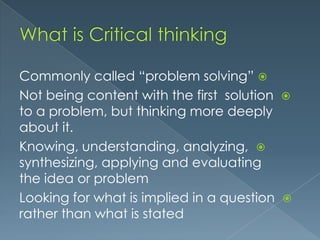
Commonly called “problem solving” 
Not being content with the first solution
to a problem, but thinking more deeply
about it.
Knowing, understanding, analyzing, 
synthesizing, applying and evaluating
the idea or problem
Looking for what is implied in a question
rather than what is stated




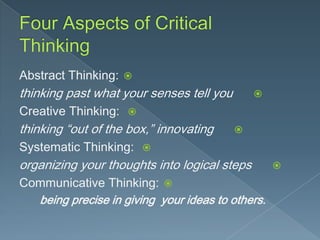
Abstract Thinking: 

thinking past what your senses tell you



Creative Thinking: 

thinking “out of the box,” innovating



Systematic Thinking: 

organizing your thoughts into logical steps
Communicative Thinking: 
being precise in giving your ideas to others.


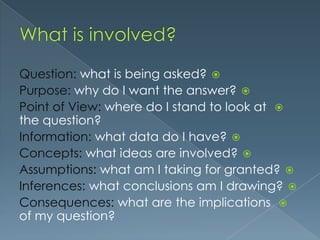
Question: what is being asked? 
Purpose: why do I want the answer? 
Point of View: where do I stand to look at 
the question?
Information: what data do I have? 
Concepts: what ideas are involved? 
Assumptions: what am I taking for granted? 
Inferences: what conclusions am I drawing? 
Consequences: what are the implications 
of my question?
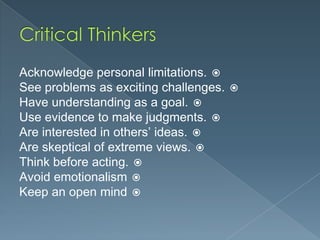
Acknowledge personal limitations. 
See problems as exciting challenges. 
Have understanding as a goal. 
Use evidence to make judgments. 
Are interested in others’ ideas. 
Are skeptical of extreme views. 
Think before acting. 
Avoid emotionalism 
Keep an open mind 
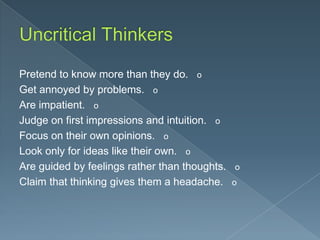
Pretend to know more than they do. o
Get annoyed by problems. o
Are impatient. o
Judge on first impressions and intuition. o
Focus on their own opinions. o
Look only for ideas like their own. o
Are guided by feelings rather than thoughts. o
Claim that thinking gives them a headache. o
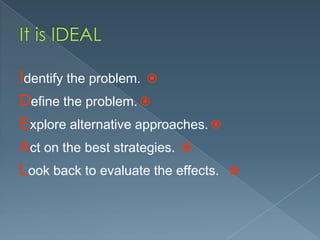
Identify the problem. 
Define the problem. 
Explore alternative approaches. 
Act on the best strategies. 
Look back to evaluate the effects.


One quality of a good critical thinker is the ability to ask 
on-target questions.
If you don’t usually ask questions, is it because you 
Fear embarrassment? 
Worry what others will think of you? 
Worry that the instructor will think your question 

is strange?
Worry that others will think you’re showing off? 
When you don’t ask questions, you sacrifice your 
education.
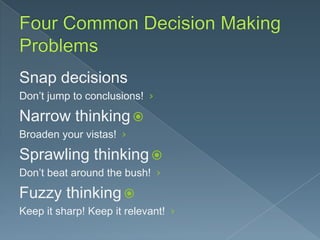
Snap decisions
Don’t jump to conclusions! ›

Narrow thinking 
Broaden your vistas! ›

Sprawling thinking 
Don’t beat around the bush! ›

Fuzzy thinking 
Keep it sharp! Keep it relevant! ›
Be willing to argue 
Use deductive reasoning 
Check your assumptions 
Know your own biases 
Observe carefully 
Stay positive and persistent 
Show concern for accuracy 
Take time before concluding 
1- Narrow concepts
**A lack of differentiation between some aspect of self and
other**
**The tendency to see reality as centered on oneself**

2-Broad concepts
The inability to differentiate subjective and objective
perspectives

It encompasses :
Realism
Animism
Artificialism
There are four stages of egocentrism
development:
-The sensory-motor period
-Preoperational thought-Concrete operation
-Formal operation
The characteristic of adolescent thinking that
leads young people (teenagers) to focus
on themselves to the exclusion of others
a young person might believe that his or her
thoughts, feelings, and experiences are
unique, more wonderful or awful than
anyone else’s.
1-Barrier to friendship and intimate
relationship
2-Constraint on skill performances that are
crucial for academic achievement
3-Lack of social knowledge or social skills
4-1Emotional problems
Characteristics of an egocentric person:
1- Selfish
2- Self-assertive
3- Self-interested thinking
4- Superior
5- Self-serving bias
SELF AWARNESS
to reflect on our reasoning and behavior; 
to make our beliefs explicit, critique them, and, 
when they are false, stop making them; to apply
the same concepts in the same ways to ourselves
and others;
to consider every relevant fact, and to make our 
conclusions consistent with the evidence; and
to listen carefully and open mindedly to others. 
Egocentric memory 
Egocentric myopia 
The irrational tendency 
Egocentric self-righteousness
Egocentric hypocrisy 
Egocentric oversimplification
Egocentric blindness 
Egocentric immediacy 
Egocentric absurdity 



1- You must recognize that this is the way you think.
2- You must realize that it is fixable! It isn't really hard
to fix, but it will take time.
3- You need to change your thinking styles.
4- Install a Self-Monitor in your mind.
5- Ask people you trust to also monitor you.
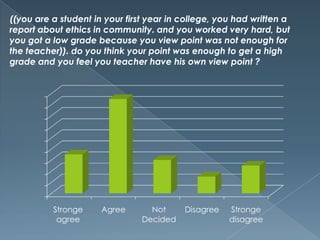
((you are a student in your first year in college, you had written a
report about ethics in community. and you worked very hard, but
you got a low grade because you view point was not enough for
the teacher)). do you think your point was enough to get a high
grade and you feel you teacher have his own view point ?

Stronge
agree

Agree

Not
Decided

Disagree

Stronge
disagree
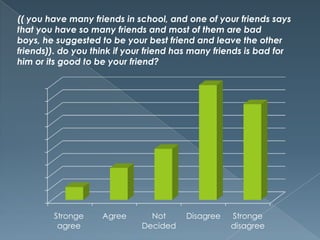
(( you have many friends in school, and one of your friends says
that you have so many friends and most of them are bad
boys, he suggested to be your best friend and leave the other
friends)). do you think if your friend has many friends is bad for
him or its good to be your friend?

Stronge
agree

Agree

Not
Decided

Disagree

Stronge
disagree
Stronge
agree

Agree

Not
Decided

Disagree

Stronge
disagree
Ct pptx

Ct pptx

  • 1.
  • 2.
    Commonly called “problemsolving”  Not being content with the first solution to a problem, but thinking more deeply about it. Knowing, understanding, analyzing,  synthesizing, applying and evaluating the idea or problem Looking for what is implied in a question rather than what is stated  
  • 4.
    Abstract Thinking:  thinkingpast what your senses tell you  Creative Thinking:  thinking “out of the box,” innovating  Systematic Thinking:  organizing your thoughts into logical steps Communicative Thinking:  being precise in giving your ideas to others. 
  • 5.
    Question: what isbeing asked?  Purpose: why do I want the answer?  Point of View: where do I stand to look at  the question? Information: what data do I have?  Concepts: what ideas are involved?  Assumptions: what am I taking for granted?  Inferences: what conclusions am I drawing?  Consequences: what are the implications  of my question?
  • 6.
    Acknowledge personal limitations. See problems as exciting challenges.  Have understanding as a goal.  Use evidence to make judgments.  Are interested in others’ ideas.  Are skeptical of extreme views.  Think before acting.  Avoid emotionalism  Keep an open mind 
  • 7.
    Pretend to knowmore than they do. o Get annoyed by problems. o Are impatient. o Judge on first impressions and intuition. o Focus on their own opinions. o Look only for ideas like their own. o Are guided by feelings rather than thoughts. o Claim that thinking gives them a headache. o
  • 8.
    Identify the problem. Define the problem.  Explore alternative approaches.  Act on the best strategies.  Look back to evaluate the effects. 
  • 9.
    One quality ofa good critical thinker is the ability to ask  on-target questions. If you don’t usually ask questions, is it because you  Fear embarrassment?  Worry what others will think of you?  Worry that the instructor will think your question  is strange? Worry that others will think you’re showing off?  When you don’t ask questions, you sacrifice your  education.
  • 10.
    Snap decisions Don’t jumpto conclusions! › Narrow thinking  Broaden your vistas! › Sprawling thinking  Don’t beat around the bush! › Fuzzy thinking  Keep it sharp! Keep it relevant! ›
  • 11.
    Be willing toargue  Use deductive reasoning  Check your assumptions  Know your own biases  Observe carefully  Stay positive and persistent  Show concern for accuracy  Take time before concluding 
  • 13.
    1- Narrow concepts **Alack of differentiation between some aspect of self and other** **The tendency to see reality as centered on oneself** 2-Broad concepts The inability to differentiate subjective and objective perspectives It encompasses : Realism Animism Artificialism
  • 14.
    There are fourstages of egocentrism development: -The sensory-motor period -Preoperational thought-Concrete operation -Formal operation
  • 15.
    The characteristic ofadolescent thinking that leads young people (teenagers) to focus on themselves to the exclusion of others a young person might believe that his or her thoughts, feelings, and experiences are unique, more wonderful or awful than anyone else’s.
  • 16.
    1-Barrier to friendshipand intimate relationship 2-Constraint on skill performances that are crucial for academic achievement 3-Lack of social knowledge or social skills 4-1Emotional problems
  • 17.
    Characteristics of anegocentric person: 1- Selfish 2- Self-assertive 3- Self-interested thinking 4- Superior 5- Self-serving bias
  • 18.
    SELF AWARNESS to reflecton our reasoning and behavior;  to make our beliefs explicit, critique them, and,  when they are false, stop making them; to apply the same concepts in the same ways to ourselves and others; to consider every relevant fact, and to make our  conclusions consistent with the evidence; and to listen carefully and open mindedly to others. 
  • 19.
    Egocentric memory  Egocentricmyopia  The irrational tendency  Egocentric self-righteousness Egocentric hypocrisy  Egocentric oversimplification Egocentric blindness  Egocentric immediacy  Egocentric absurdity   
  • 20.
    1- You mustrecognize that this is the way you think. 2- You must realize that it is fixable! It isn't really hard to fix, but it will take time. 3- You need to change your thinking styles. 4- Install a Self-Monitor in your mind. 5- Ask people you trust to also monitor you.
  • 22.
    ((you are astudent in your first year in college, you had written a report about ethics in community. and you worked very hard, but you got a low grade because you view point was not enough for the teacher)). do you think your point was enough to get a high grade and you feel you teacher have his own view point ? Stronge agree Agree Not Decided Disagree Stronge disagree
  • 23.
    (( you havemany friends in school, and one of your friends says that you have so many friends and most of them are bad boys, he suggested to be your best friend and leave the other friends)). do you think if your friend has many friends is bad for him or its good to be your friend? Stronge agree Agree Not Decided Disagree Stronge disagree
  • 24.