The Material Glass
Fundamentals of Building Construction, Materials & Methods, 5th Edition
Copyright © 2009 John Wiley & Sons. All rights reserved.
17 Glass & Glazing
Fundamentals of Building Construction, Materials & Methods, 5th Edition
Copyright © 2009 John Wiley & Sons. All rights reserved.
The Material Glass
Advanced Glazing
Systems
• Glass is the most-used cladding
material for tall buildings due to its
strength, light weight, durability, and
wide range of available optical and
thermal properties
Fundamentals of Building Construction, Materials & Methods, 5th Edition
Copyright © 2009 John Wiley & Sons. All rights reserved.
The Material Glass
Advanced Glazing
Systems
• Glass has seemingly unlimited
optical and aesthetic possibilities
Glass Ingredients and
Thicknesses
• Glass is made from
– Sand (silicone dioxide)
– Soda ash (sodium hydroxide or
sodium carbonate)
– Lime (calcium)
– Alumina
– Potassium oxide
• Glass is supercooled liquid and in
sheet form strength is impacted by
imperfections in glass
• Thicknesses range from
approximately 3/32 inch (single
strength) to 1/8 inch (double
strength) to 1 inch.
• Heat treatments such as tempering
impact glass strength and uses
Fundamentals of Building Construction, Materials & Methods, 5th Edition
Copyright © 2009 John Wiley & Sons. All rights reserved.
The Material Glass
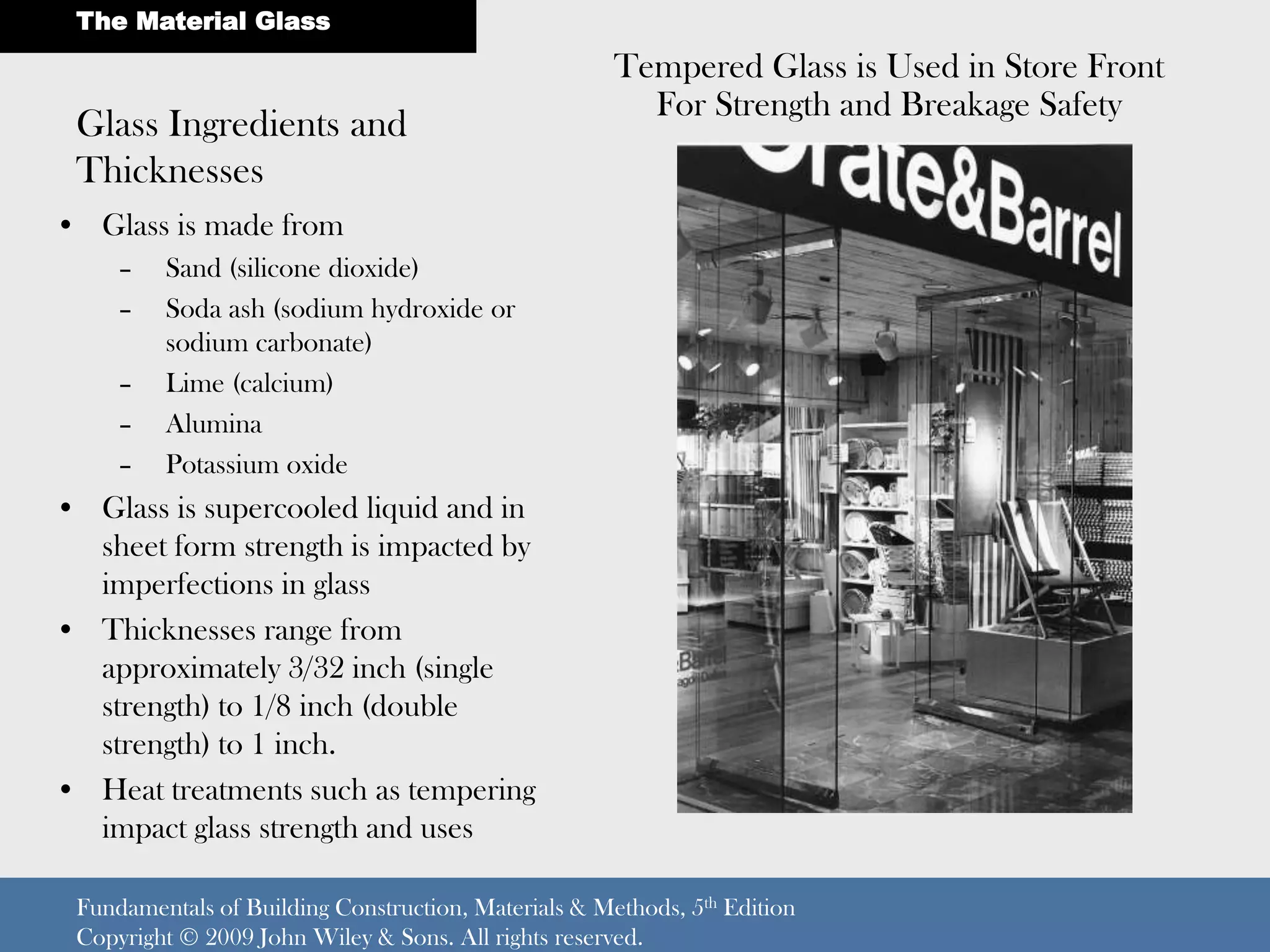
Tempered Glass is Used in Store Front
For Strength and Breakage Safety
Glass Types by Heat
Treatment and Strength
• Annealed glass
ˉ Regular float glass which is cooled slowly
to reduce in built stress
• Tempered glass
ˉ Produced by cutting annealed glass to
required size, reheating and then cooling
rapidly. Higher strength and breaks into
small shards
• Heat-strengthened glass
ˉ Between annealed and tempered with
breakage behavior like annealed
• Laminated glass
ˉ Sandwich of multiple layers of glass with
PVB interlayer. Suitable for security
applications as glass stays in place
• Fire-rated glass
Fundamentals of Building Construction, Materials & Methods, 5th Edition
Copyright © 2009 John Wiley & Sons. All rights reserved.
The Material Glass
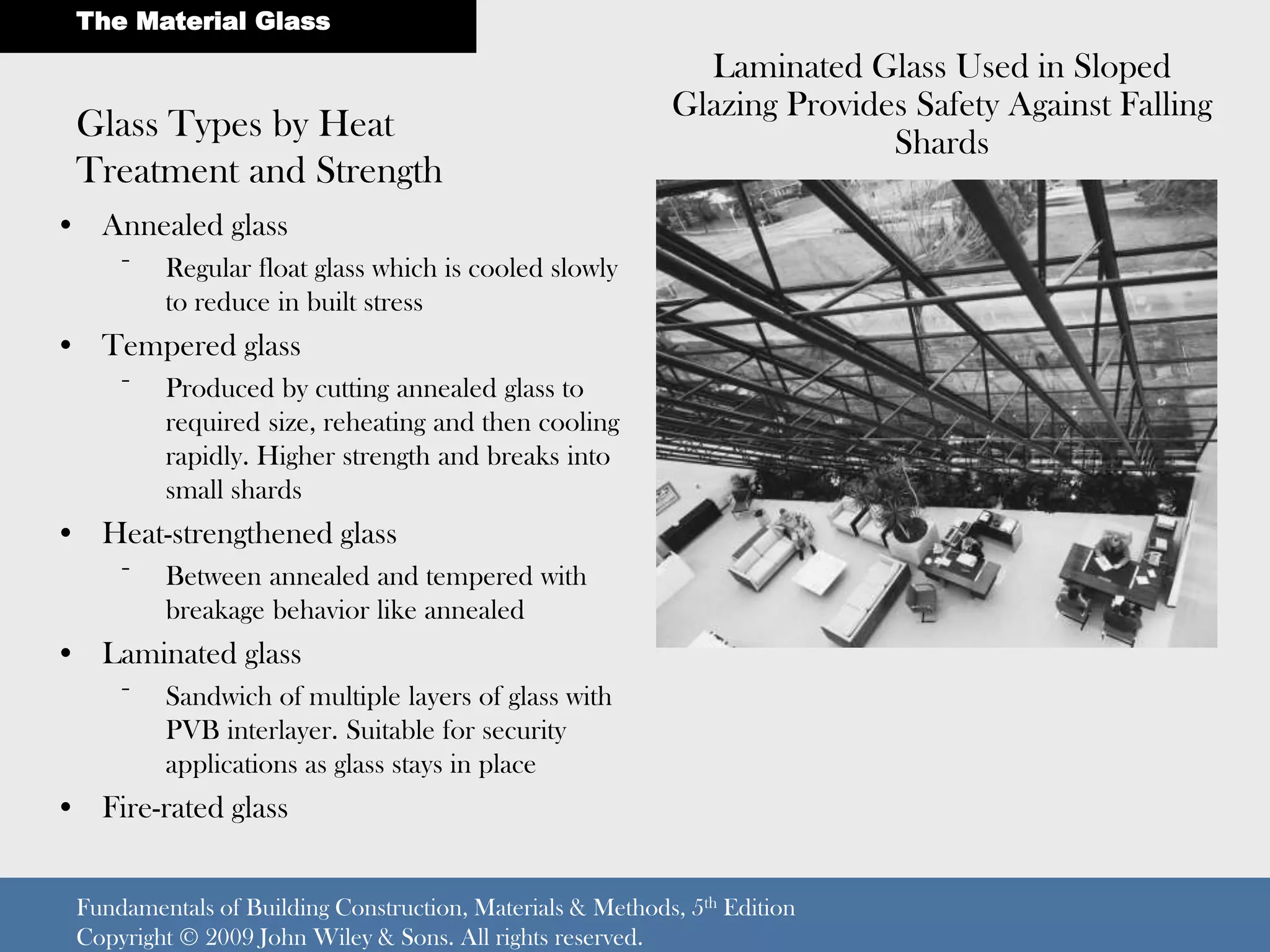
Laminated Glass Used in Sloped
Glazing Provides Safety Against Falling
Shards
Glass Types by
Architectural Treatments
• Patterned glass
ˉ Hot glass can be rolled into sheets with
many different surface textures and
patterns to obscure vision for privacy
• Fritted glass
ˉ Pigmented glass particles called frits are
used to imprint glass. Glass is dried and
fired in tempering furnace to make it
permanent
• Spandrel glass
ˉ Used to cover bands of floor/wall
around the floor edges. Usually
tempered or heat strengthened with
insulation behind them
Fundamentals of Building Construction, Materials & Methods, 5th Edition
Copyright © 2009 John Wiley & Sons. All rights reserved.
The Material Glass
Fritted Glass Used
to Create Patterns
Darker Colored
Spandrel Glass
Glass For Controlling
Solar Radiation
• Tinted Glass
– Made by adding small amounts of
selected chemical elements to the
molten glass mixture
• Reflective Glass or Solar Control Glass
– Thin Durable films of metal or metal
oxide are deposited on the surface of
either tinted glass or clear glass to make
the glass reflective. The film turns away
significant portion of solar radiation
Fundamentals of Building Construction, Materials & Methods, 5th Edition
Copyright © 2009 John Wiley & Sons. All rights reserved.
The Material Glass
Building With Reflective Coated Glass
Impact of Glass Type on
Control of Visible Light
and Solar Radiation
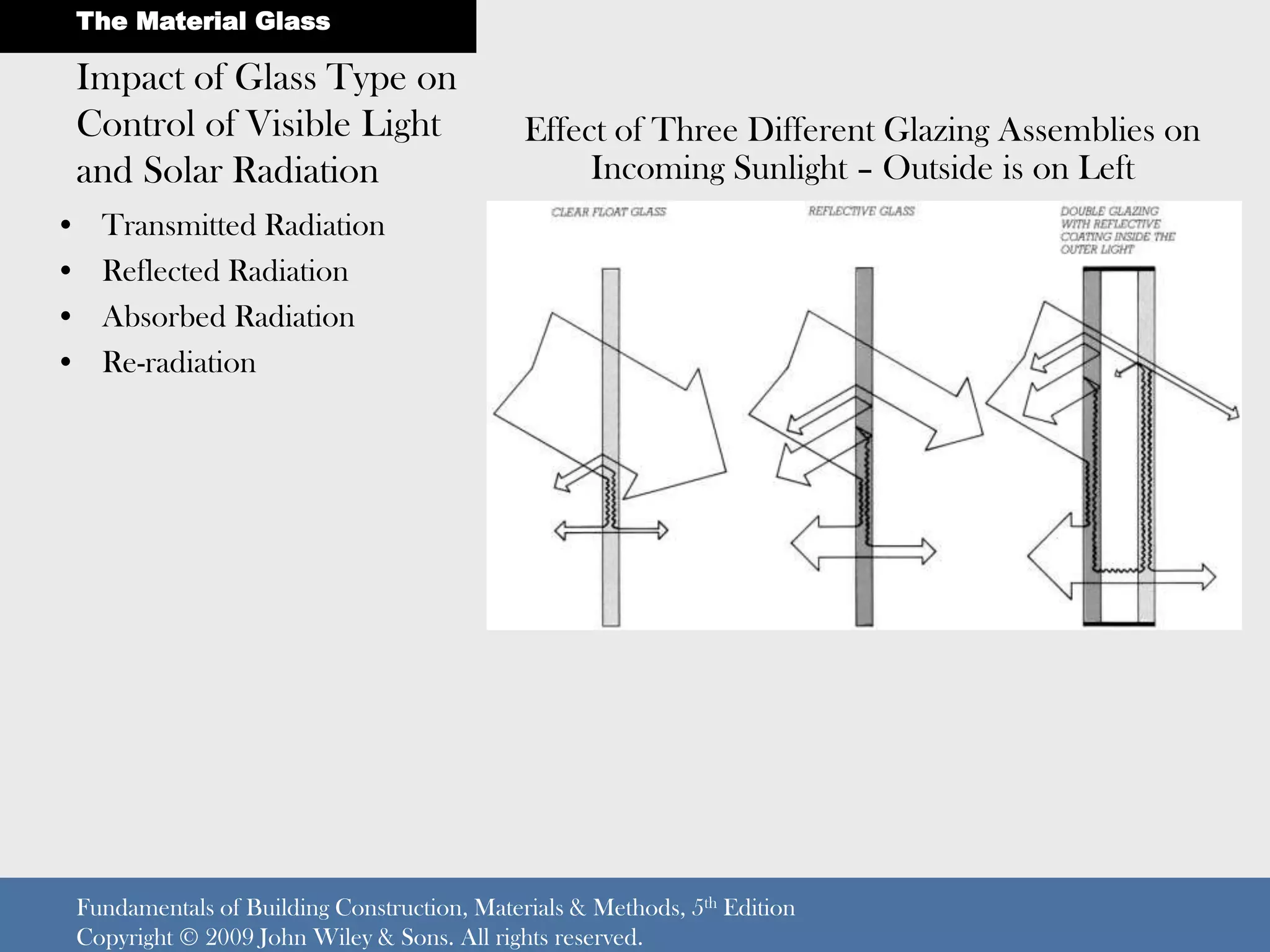
• Transmitted Radiation
• Reflected Radiation
• Absorbed Radiation
• Re-radiation
Fundamentals of Building Construction, Materials & Methods, 5th Edition
Copyright © 2009 John Wiley & Sons. All rights reserved.
The Material Glass
Effect of Three Different Glazing Assemblies on
Incoming Sunlight – Outside is on Left
Glass and Thermal
Considerations
• IGU – Insulating Glass Unit
– Made of multiple glass with sealed air space
reducing conductance, single glazing is single
glass, double glazing is two sheets and triple
glazing is three sheets of glass
– Space filled by air or inert gas in a
hermetically sealed cavity
– Different spacers used including warm-edge
spacer
– Performance given in terms of U values
• Low Emissivity coated glass (Low-e)
– Formed with transparent metallic coating to
improve thermal performance
– Located on surface 2 and sometimes on
surface 3.
– Improves thermal performance
Fundamentals of Building Construction, Materials & Methods, 5th Edition
Copyright © 2009 John Wiley & Sons. All rights reserved.
The Material Glass
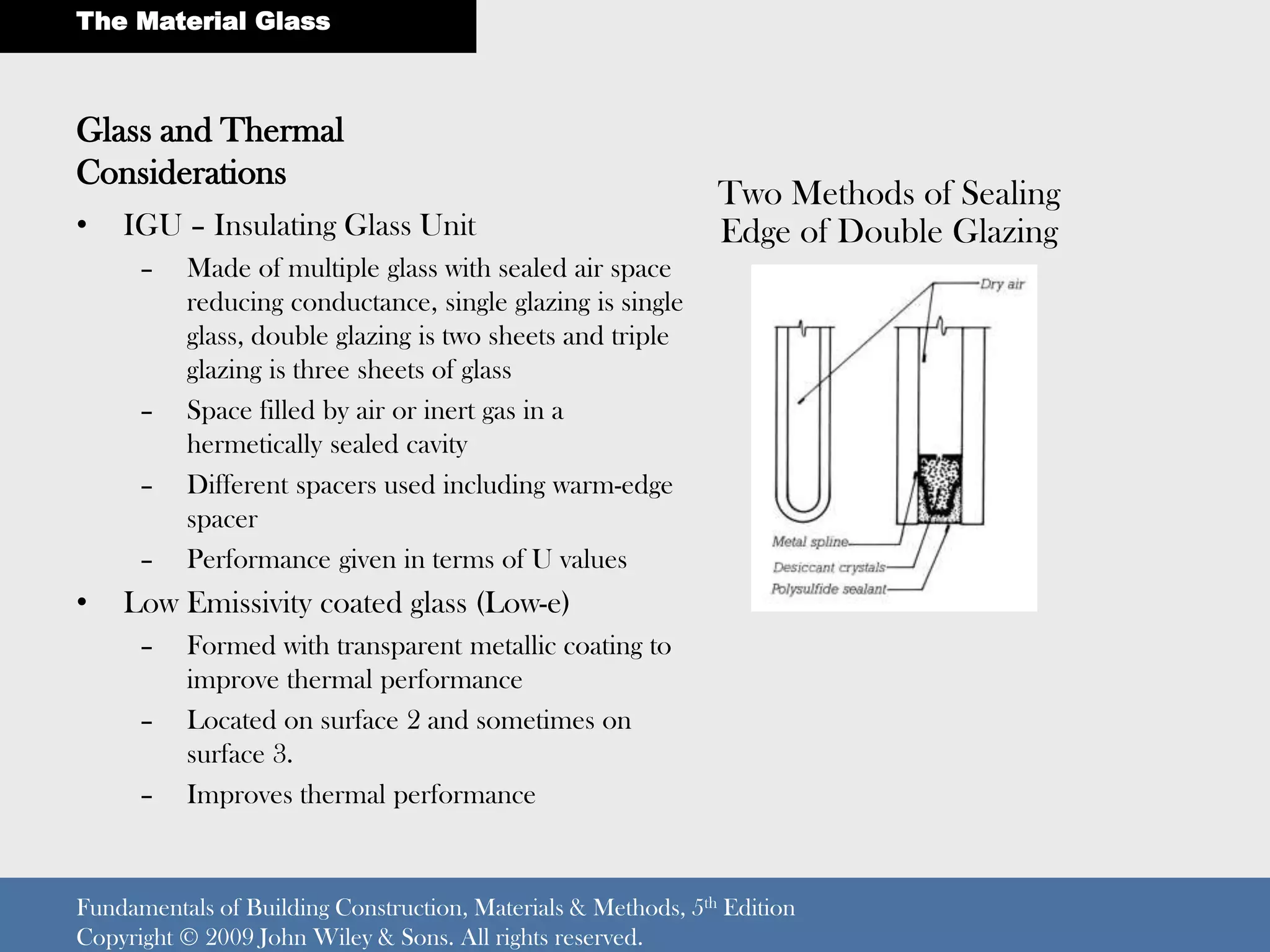
Two Methods of Sealing
Edge of Double Glazing
Glass and Thermal
Considerations
• Visible Light Transmittance - VT
– Ratio of visible light passing to the
amount striking the glass
• Solar Heat Gain Coefficient - SHGC
– Ratio of heat admitted to the amount
striking the glass
• Light Solar Gain Ratio – LSG
– Ratio of VT to SHGC
Fundamentals of Building Construction, Materials & Methods, 5th Edition
Copyright © 2009 John Wiley & Sons. All rights reserved.
The Material Glass
Glazing Type VT SHGC LSG U
1
R
2
Single glazing
, clear 0.90 0.85 1.3 1.1
6.3
0.91
0.16
Double glazing, clear 0.79 0.70 1.1 0.47
2.7
2.1
0.37
Double glazing,
medium gray tinted
0.40 0.45 0.9 0.47
2.7
2.1
0.37
Triple glazing, clear 0.53 0.52 1.0 0.34
1.9
2.9
0.52
Double glazing,clear,
low-e (low SHGC)
0.64 0.27 2.4 0.28
1.6
3.6
0.63
Double glazing, clear,
low-e (high SHGC), argon filled
0.78 0.63 1.2 0.27
1.5
3.7
0.65
1
U-Factor: Btu/ft
2
-hr-
o
F followed byW/m
2
-
o
K
2
R-Value: ft
2
-hr-
o
F/Btu followed bym
2
-
o
KW
Glass Properties Impacting Thermal
Visual Performance
Fundamentals of Building Construction, Materials & Methods, 5th Edition
Copyright © 2009 John Wiley & Sons. All rights reserved.
The Material Glass
Glass and Thermal
Considerations
• The label on this fabricator's
glass sample indicates that this
IGU consists of
– a ¼"-thick low-e, annealed lite
(with the trade name
Solarban 60)
– a ½" spacer and
– a ¼" clear annealed light.
– VLT of 0.70
– SC of 0.44
– SHGC of 0.38
– U-Value of 0.29
Glazing
Fundamentals of Building Construction, Materials & Methods, 5th Edition
Copyright © 2009 John Wiley & Sons. All rights reserved.
17 Glass & Glazing
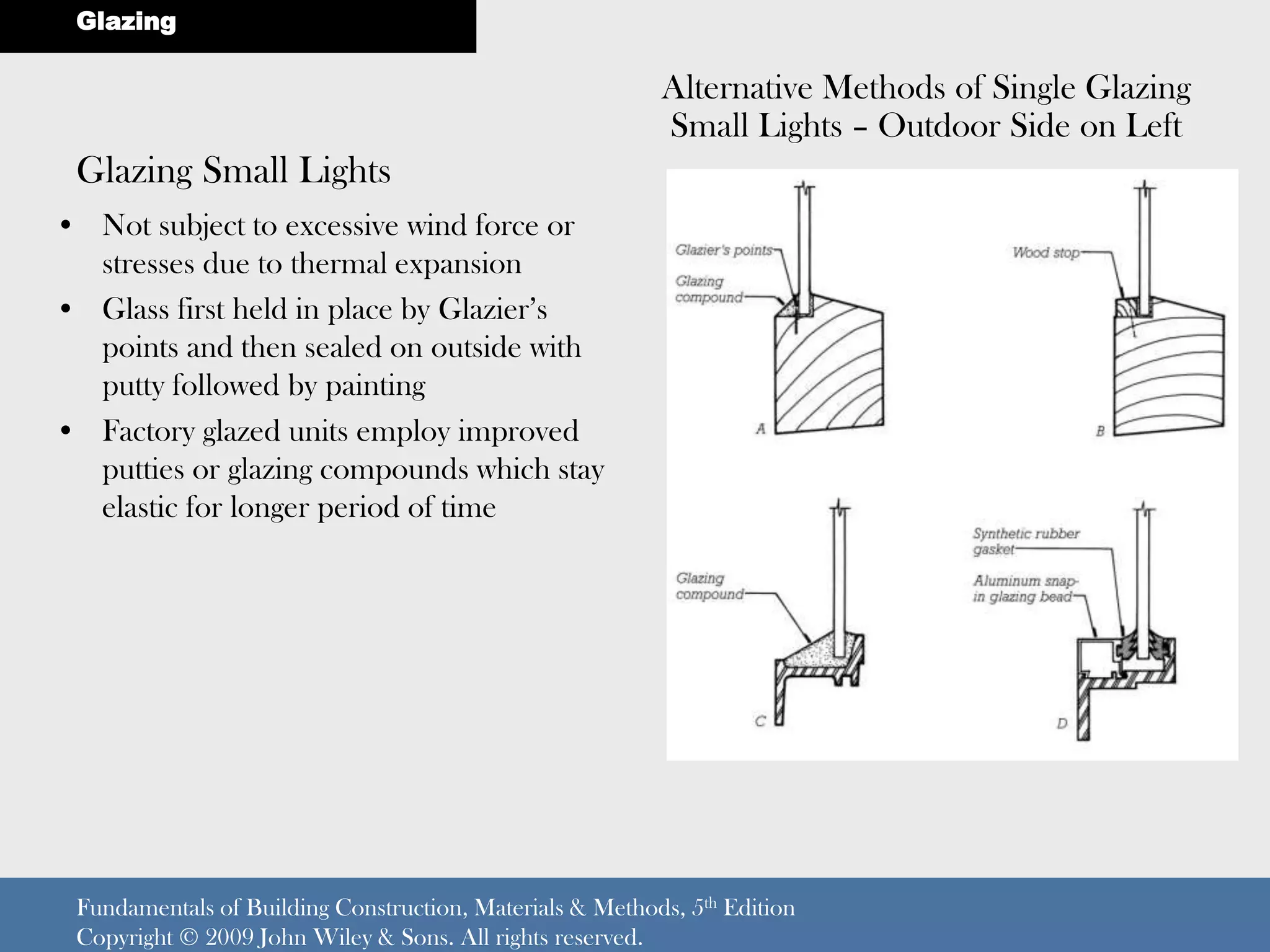
Glazing Small Lights
• Not subject to excessive wind force or
stresses due to thermal expansion
• Glass first held in place by Glazier’s
points and then sealed on outside with
putty followed by painting
• Factory glazed units employ improved
putties or glazing compounds which stay
elastic for longer period of time
Fundamentals of Building Construction, Materials & Methods, 5th Edition
Copyright © 2009 John Wiley & Sons. All rights reserved.
Glazing
Alternative Methods of Single Glazing
Small Lights – Outdoor Side on Left
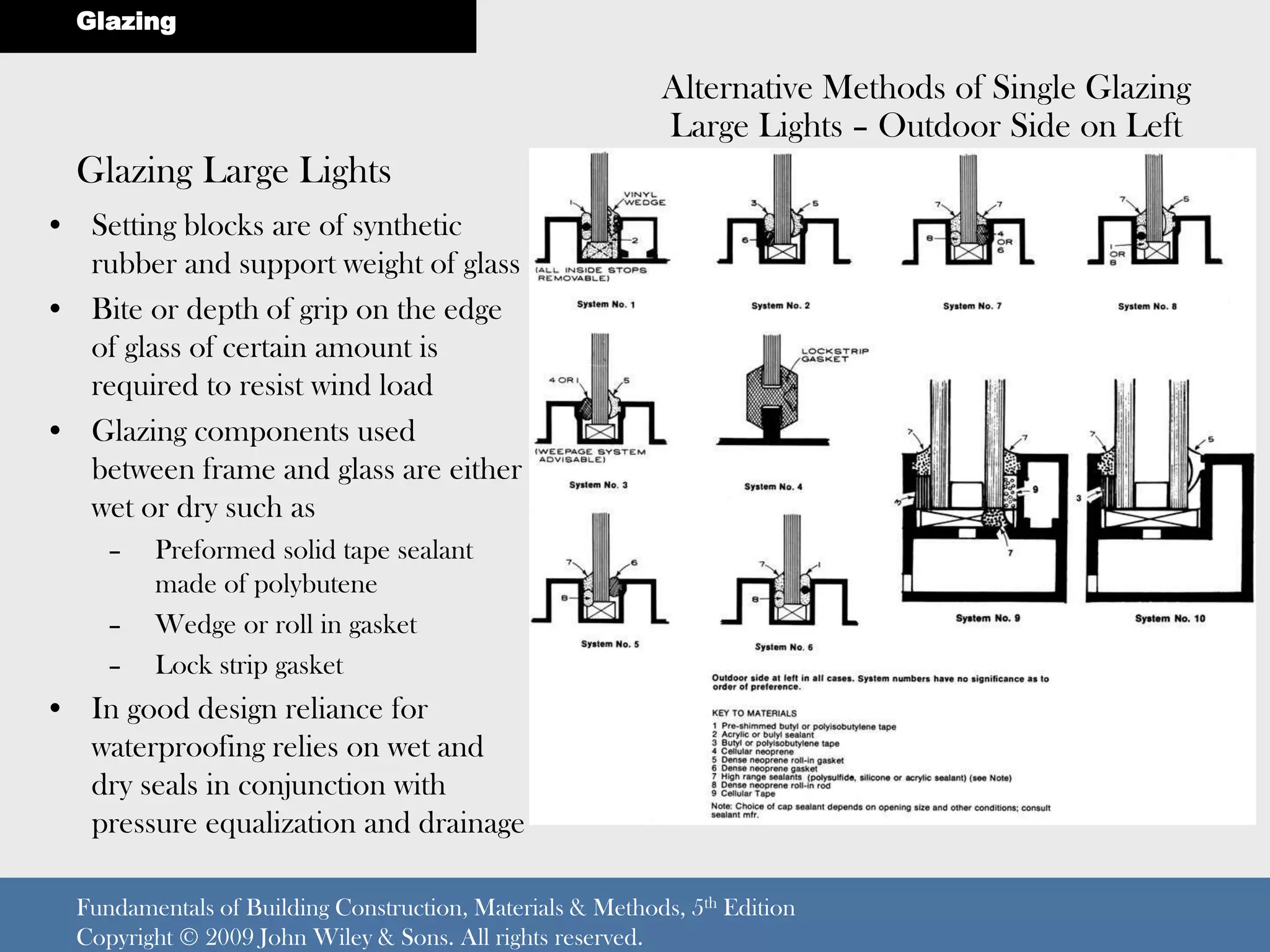
Glazing Large Lights
• Large lights, those over 6 ft2 (0.6 m2)
require more care in glazing due to
stresses
• Design objectives are
– Support weight of glass without
abnormal stress patterns
– Support glass against wind pressure and
suction
– Allow for expansion and contraction of
glass and frame without damage
– Avoid contact of glass with any hard
material such as frame
Fundamentals of Building Construction, Materials & Methods, 5th Edition
Copyright © 2009 John Wiley & Sons. All rights reserved.
Glazing
Glaziers Install Lights of Glass that
Weigh as Much as 125 pounds (57 kg)
Glazing Large Lights
• Setting blocks are of synthetic
rubber and support weight of glass
• Bite or depth of grip on the edge
of glass of certain amount is
required to resist wind load
• Glazing components used
between frame and glass are either
wet or dry such as
– Preformed solid tape sealant
made of polybutene
– Wedge or roll in gasket
– Lock strip gasket
• In good design reliance for
waterproofing relies on wet and
dry seals in conjunction with
pressure equalization and drainage
Fundamentals of Building Construction, Materials & Methods, 5th Edition
Copyright © 2009 John Wiley & Sons. All rights reserved.
Glazing
Alternative Methods of Single Glazing
Large Lights – Outdoor Side on Left
Glazing Large Lights
• Lockstrip gasket is a dry glazing method
• It is faster, easier and less dependent on
workmanship then wet glazing method
• Wet glazing with good workmanship is
more effective
Fundamentals of Building Construction, Materials & Methods, 5th Edition
Copyright © 2009 John Wiley & Sons. All rights reserved.
Glazing
Lockstrip Gasket Installation in
Progress and Completed
Advanced Glazing
Systems
• Butt-joint glazing system
– Head and sill of the
glass sheets are
supported
conventionally in metal
frames, but vertical
mullions are eliminated
– The vertical joints
between sheets of glass
are made by injection of
colorless silicone sealant
– There is a strong effect
of unbroken horizontal
band of glass around the
building
Fundamentals of Building Construction, Materials & Methods, 5th Edition
Copyright © 2009 John Wiley & Sons. All rights reserved.
Glazing
Mullionless Butt-Joint Glazing With
Single Glazing
Advanced Glazing
Systems
Fundamentals of Building Construction, Materials & Methods, 5th Edition
Copyright © 2009 John Wiley & Sons. All rights reserved.
Glazing
Mullionless
Butt-Joint
System Seen
from the
Outside
Fundamentals of Building Construction, Materials & Methods, 5th Edition
Copyright © 2009 John Wiley & Sons. All rights reserved.
Glazing
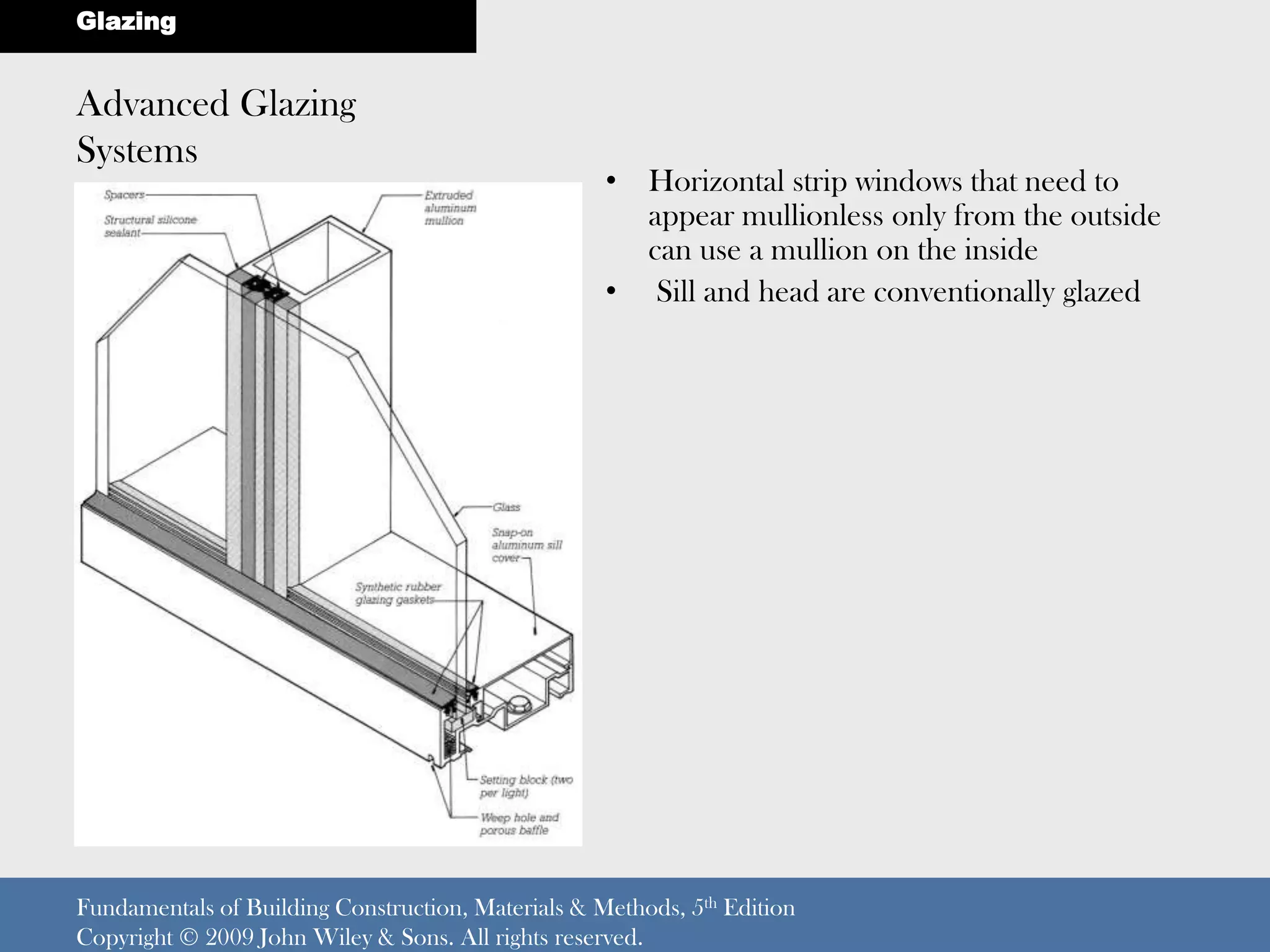
• Horizontal strip windows that need to
appear mullionless only from the outside
can use a mullion on the inside
• Sill and head are conventionally glazed
Advanced Glazing
Systems
Advanced Glazing
Systems
• Structural silicone flush
glazing
– The metal mullions lie
entirely inside the glass
with glass adhered to the
mullion by silicone
sealant
– Outside skin is
completely flush
– Systems with critical
silicone work done in
factory are also possible
Fundamentals of Building Construction, Materials & Methods, 5th Edition
Copyright © 2009 John Wiley & Sons. All rights reserved.
Glazing
Glass Mounted With Four-Side
Structural Silicone Glazing
Fundamentals of Building Construction, Materials & Methods, 5th Edition
Copyright © 2009 John Wiley & Sons. All rights reserved.
Glazing
Steps in assembly of a mullion for a four-side
structural silicone exterior flush glazing system
Advanced Glazing
Systems
Fundamentals of Building Construction, Materials & Methods, 5th Edition
Copyright © 2009 John Wiley & Sons. All rights reserved.
Glazing
• Structural Spacer Glazing is a proprietary
system
• The glass is fastened to the mullion with an
aluminum pressure plate.
• The face is then sealed
• Desiccant is integrated into the system
Advanced Glazing
Systems
Advanced Glazing
Systems
• Suspended Glazing Systems and
Glass Mullion System
– Used primarily for high walls of
glass around building lobbies
– Tempered glass sheets are
suspended from above and
stabilized by tempered glass
perpendicular stiffeners
– Metal fittings are used to join
multiple sheets of glass
– Stainless steel cables and fittings
are used in roof applications
Fundamentals of Building Construction, Materials & Methods, 5th Edition
Copyright © 2009 John Wiley & Sons. All rights reserved.
Glazing
Glass Suspended from Above With
Vertical Glass Stiffeners
Fundamentals of Building Construction, Materials & Methods, 5th Edition
Copyright © 2009 John Wiley & Sons. All rights reserved.
Glazing
• Four point spider fitting
• Adjustable vertical stainless steel rod carries
the load to the structure above
Advanced Glazing
Systems
Fundamentals of Building Construction, Materials & Methods, 5th Edition
Copyright © 2009 John Wiley & Sons. All rights reserved.
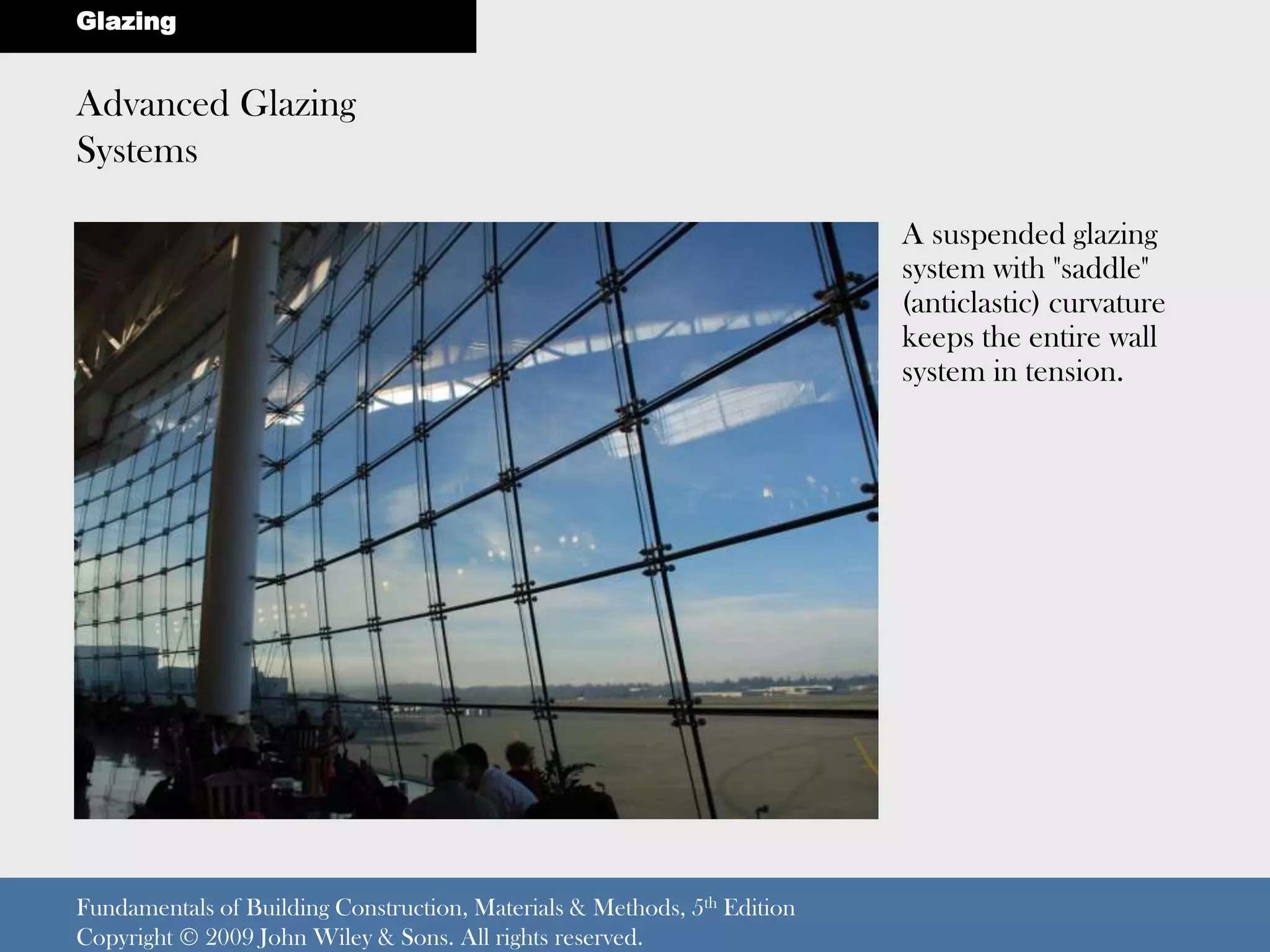
Glazing
A suspended glazing
system with "saddle"
(anticlastic) curvature
keeps the entire wall
system in tension.
Advanced Glazing
Systems
Fundamentals of Building Construction, Materials & Methods, 5th Edition
Copyright © 2009 John Wiley & Sons. All rights reserved.
Glazing
The spider fittings and cable
system must resist wind,
seismic, and dead loads
without inducing bending
forces in the glass or creating
stress concentrations around
the points of attachment
Advanced Glazing
Systems
Fundamentals of Building Construction, Materials & Methods, 5th Edition
Copyright © 2009 John Wiley & Sons. All rights reserved.
Glazing
The glass wall obtains additional
stiffness where the cable system is
tied to adjacent columns.
Advanced Glazing
Systems
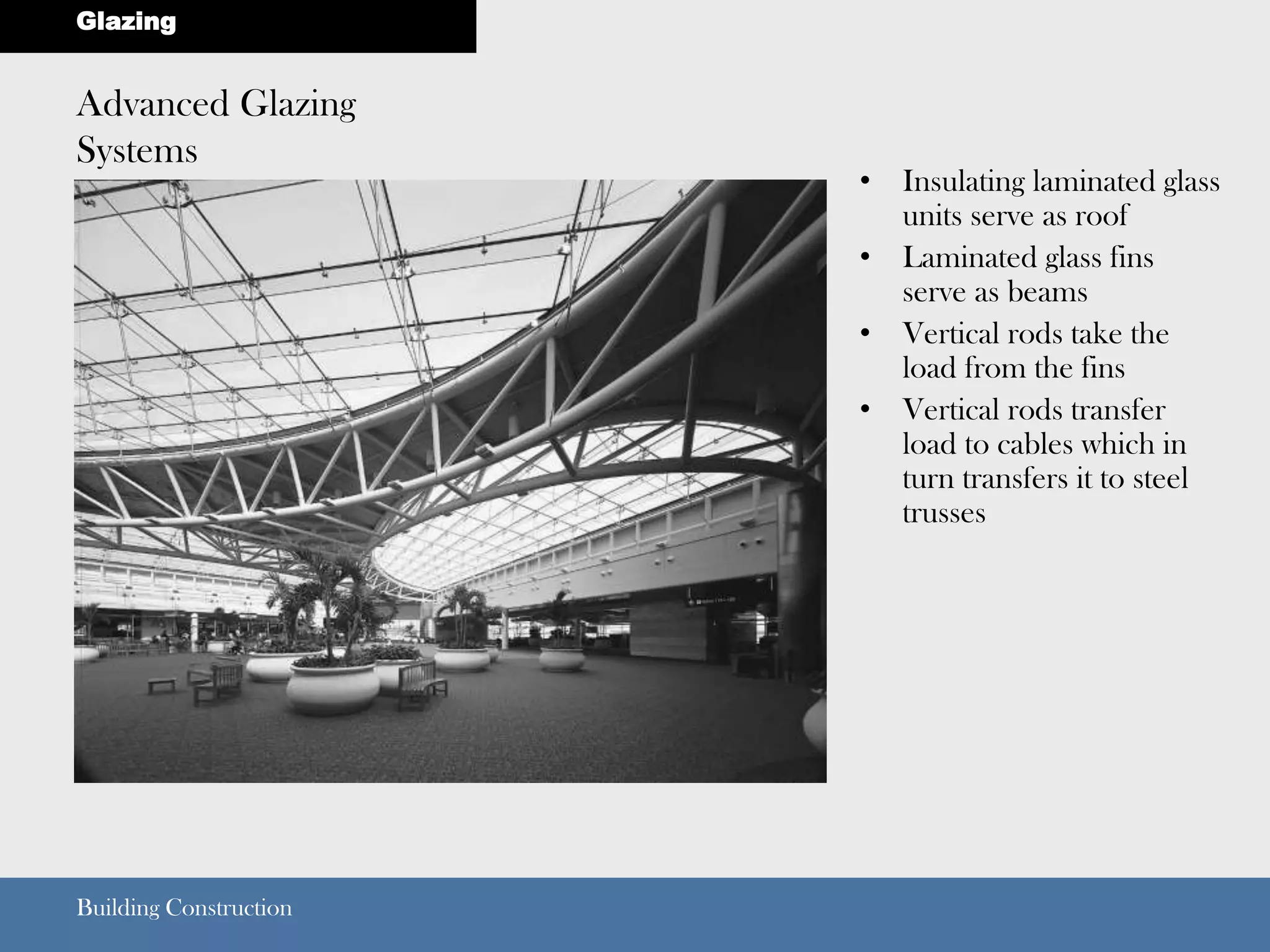
Building Construction
Glazing
• Insulating laminated glass
units serve as roof
• Laminated glass fins
serve as beams
• Vertical rods take the
load from the fins
• Vertical rods transfer
load to cables which in
turn transfers it to steel
trusses
Advanced Glazing
Systems
Fundamentals of Building Construction, Materials & Methods, 5th Edition
Copyright © 2009 John Wiley & Sons. All rights reserved.
Glazing
• Vertical rods take the
load from the fins
• Vertical rods transfer
load to cables which in
turn transfers it to the
steel trusses
• Upward arching cables
provide wind uplift
resistance
Advanced Glazing
Systems
Glazing
Leaded Stained Glass
MasterFormat Sections For
Glass
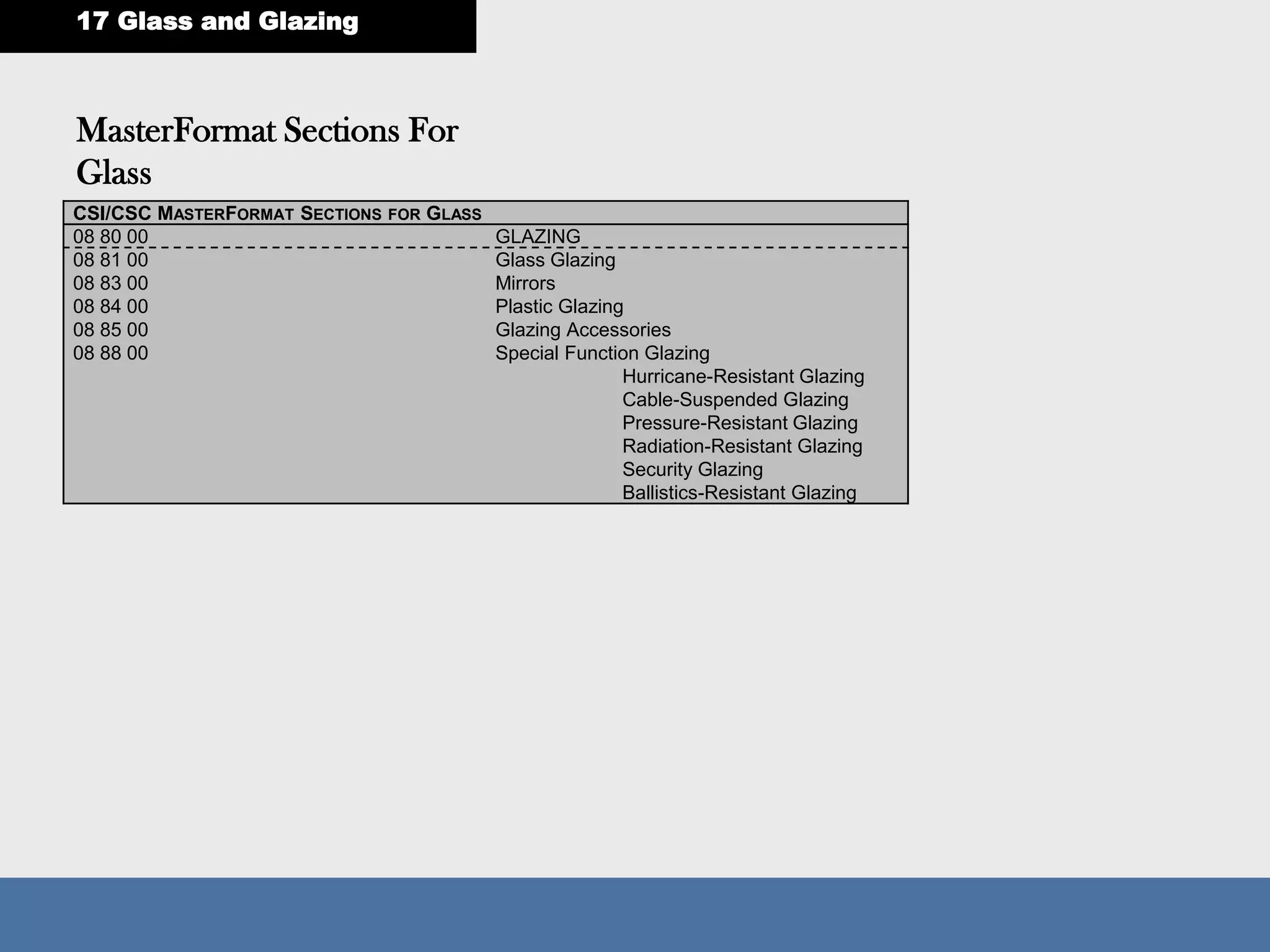
17 Glass and Glazing
CSI/CSC MASTERFORMAT SECTIONS FOR GLASS
08 80 00 GLAZING
08 81 00 Glass Glazing
08 83 00 Mirrors
08 84 00 Plastic Glazing
08 85 00 Glazing Accessories
08 88 00 Special Function Glazing
Hurricane-Resistant Glazing
Cable-Suspended Glazing
Pressure-Resistant Glazing
Radiation-Resistant Glazing
Security Glazing
Ballistics-Resistant Glazing

Glass And Glazing

  • 1.
    The Material Glass Fundamentalsof Building Construction, Materials & Methods, 5th Edition Copyright © 2009 John Wiley & Sons. All rights reserved. 17 Glass & Glazing
  • 2.
    Fundamentals of BuildingConstruction, Materials & Methods, 5th Edition Copyright © 2009 John Wiley & Sons. All rights reserved. The Material Glass Advanced Glazing Systems • Glass is the most-used cladding material for tall buildings due to its strength, light weight, durability, and wide range of available optical and thermal properties
  • 3.
    Fundamentals of BuildingConstruction, Materials & Methods, 5th Edition Copyright © 2009 John Wiley & Sons. All rights reserved. The Material Glass Advanced Glazing Systems • Glass has seemingly unlimited optical and aesthetic possibilities
  • 4.
    Glass Ingredients and Thicknesses •Glass is made from – Sand (silicone dioxide) – Soda ash (sodium hydroxide or sodium carbonate) – Lime (calcium) – Alumina – Potassium oxide • Glass is supercooled liquid and in sheet form strength is impacted by imperfections in glass • Thicknesses range from approximately 3/32 inch (single strength) to 1/8 inch (double strength) to 1 inch. • Heat treatments such as tempering impact glass strength and uses Fundamentals of Building Construction, Materials & Methods, 5th Edition Copyright © 2009 John Wiley & Sons. All rights reserved. The Material Glass Tempered Glass is Used in Store Front For Strength and Breakage Safety
  • 5.
    Glass Types byHeat Treatment and Strength • Annealed glass ˉ Regular float glass which is cooled slowly to reduce in built stress • Tempered glass ˉ Produced by cutting annealed glass to required size, reheating and then cooling rapidly. Higher strength and breaks into small shards • Heat-strengthened glass ˉ Between annealed and tempered with breakage behavior like annealed • Laminated glass ˉ Sandwich of multiple layers of glass with PVB interlayer. Suitable for security applications as glass stays in place • Fire-rated glass Fundamentals of Building Construction, Materials & Methods, 5th Edition Copyright © 2009 John Wiley & Sons. All rights reserved. The Material Glass Laminated Glass Used in Sloped Glazing Provides Safety Against Falling Shards
  • 6.
    Glass Types by ArchitecturalTreatments • Patterned glass ˉ Hot glass can be rolled into sheets with many different surface textures and patterns to obscure vision for privacy • Fritted glass ˉ Pigmented glass particles called frits are used to imprint glass. Glass is dried and fired in tempering furnace to make it permanent • Spandrel glass ˉ Used to cover bands of floor/wall around the floor edges. Usually tempered or heat strengthened with insulation behind them Fundamentals of Building Construction, Materials & Methods, 5th Edition Copyright © 2009 John Wiley & Sons. All rights reserved. The Material Glass Fritted Glass Used to Create Patterns Darker Colored Spandrel Glass
  • 7.
    Glass For Controlling SolarRadiation • Tinted Glass – Made by adding small amounts of selected chemical elements to the molten glass mixture • Reflective Glass or Solar Control Glass – Thin Durable films of metal or metal oxide are deposited on the surface of either tinted glass or clear glass to make the glass reflective. The film turns away significant portion of solar radiation Fundamentals of Building Construction, Materials & Methods, 5th Edition Copyright © 2009 John Wiley & Sons. All rights reserved. The Material Glass Building With Reflective Coated Glass
  • 8.
    Impact of GlassType on Control of Visible Light and Solar Radiation • Transmitted Radiation • Reflected Radiation • Absorbed Radiation • Re-radiation Fundamentals of Building Construction, Materials & Methods, 5th Edition Copyright © 2009 John Wiley & Sons. All rights reserved. The Material Glass Effect of Three Different Glazing Assemblies on Incoming Sunlight – Outside is on Left
  • 9.
    Glass and Thermal Considerations •IGU – Insulating Glass Unit – Made of multiple glass with sealed air space reducing conductance, single glazing is single glass, double glazing is two sheets and triple glazing is three sheets of glass – Space filled by air or inert gas in a hermetically sealed cavity – Different spacers used including warm-edge spacer – Performance given in terms of U values • Low Emissivity coated glass (Low-e) – Formed with transparent metallic coating to improve thermal performance – Located on surface 2 and sometimes on surface 3. – Improves thermal performance Fundamentals of Building Construction, Materials & Methods, 5th Edition Copyright © 2009 John Wiley & Sons. All rights reserved. The Material Glass Two Methods of Sealing Edge of Double Glazing
  • 10.
    Glass and Thermal Considerations •Visible Light Transmittance - VT – Ratio of visible light passing to the amount striking the glass • Solar Heat Gain Coefficient - SHGC – Ratio of heat admitted to the amount striking the glass • Light Solar Gain Ratio – LSG – Ratio of VT to SHGC Fundamentals of Building Construction, Materials & Methods, 5th Edition Copyright © 2009 John Wiley & Sons. All rights reserved. The Material Glass Glazing Type VT SHGC LSG U 1 R 2 Single glazing , clear 0.90 0.85 1.3 1.1 6.3 0.91 0.16 Double glazing, clear 0.79 0.70 1.1 0.47 2.7 2.1 0.37 Double glazing, medium gray tinted 0.40 0.45 0.9 0.47 2.7 2.1 0.37 Triple glazing, clear 0.53 0.52 1.0 0.34 1.9 2.9 0.52 Double glazing,clear, low-e (low SHGC) 0.64 0.27 2.4 0.28 1.6 3.6 0.63 Double glazing, clear, low-e (high SHGC), argon filled 0.78 0.63 1.2 0.27 1.5 3.7 0.65 1 U-Factor: Btu/ft 2 -hr- o F followed byW/m 2 - o K 2 R-Value: ft 2 -hr- o F/Btu followed bym 2 - o KW Glass Properties Impacting Thermal Visual Performance
  • 11.
    Fundamentals of BuildingConstruction, Materials & Methods, 5th Edition Copyright © 2009 John Wiley & Sons. All rights reserved. The Material Glass Glass and Thermal Considerations • The label on this fabricator's glass sample indicates that this IGU consists of – a ¼"-thick low-e, annealed lite (with the trade name Solarban 60) – a ½" spacer and – a ¼" clear annealed light. – VLT of 0.70 – SC of 0.44 – SHGC of 0.38 – U-Value of 0.29
  • 12.
    Glazing Fundamentals of BuildingConstruction, Materials & Methods, 5th Edition Copyright © 2009 John Wiley & Sons. All rights reserved. 17 Glass & Glazing
  • 13.
    Glazing Small Lights •Not subject to excessive wind force or stresses due to thermal expansion • Glass first held in place by Glazier’s points and then sealed on outside with putty followed by painting • Factory glazed units employ improved putties or glazing compounds which stay elastic for longer period of time Fundamentals of Building Construction, Materials & Methods, 5th Edition Copyright © 2009 John Wiley & Sons. All rights reserved. Glazing Alternative Methods of Single Glazing Small Lights – Outdoor Side on Left
  • 14.
    Glazing Large Lights •Large lights, those over 6 ft2 (0.6 m2) require more care in glazing due to stresses • Design objectives are – Support weight of glass without abnormal stress patterns – Support glass against wind pressure and suction – Allow for expansion and contraction of glass and frame without damage – Avoid contact of glass with any hard material such as frame Fundamentals of Building Construction, Materials & Methods, 5th Edition Copyright © 2009 John Wiley & Sons. All rights reserved. Glazing Glaziers Install Lights of Glass that Weigh as Much as 125 pounds (57 kg)
  • 15.
    Glazing Large Lights •Setting blocks are of synthetic rubber and support weight of glass • Bite or depth of grip on the edge of glass of certain amount is required to resist wind load • Glazing components used between frame and glass are either wet or dry such as – Preformed solid tape sealant made of polybutene – Wedge or roll in gasket – Lock strip gasket • In good design reliance for waterproofing relies on wet and dry seals in conjunction with pressure equalization and drainage Fundamentals of Building Construction, Materials & Methods, 5th Edition Copyright © 2009 John Wiley & Sons. All rights reserved. Glazing Alternative Methods of Single Glazing Large Lights – Outdoor Side on Left
  • 16.
    Glazing Large Lights •Lockstrip gasket is a dry glazing method • It is faster, easier and less dependent on workmanship then wet glazing method • Wet glazing with good workmanship is more effective Fundamentals of Building Construction, Materials & Methods, 5th Edition Copyright © 2009 John Wiley & Sons. All rights reserved. Glazing Lockstrip Gasket Installation in Progress and Completed
  • 17.
    Advanced Glazing Systems • Butt-jointglazing system – Head and sill of the glass sheets are supported conventionally in metal frames, but vertical mullions are eliminated – The vertical joints between sheets of glass are made by injection of colorless silicone sealant – There is a strong effect of unbroken horizontal band of glass around the building Fundamentals of Building Construction, Materials & Methods, 5th Edition Copyright © 2009 John Wiley & Sons. All rights reserved. Glazing Mullionless Butt-Joint Glazing With Single Glazing
  • 18.
    Advanced Glazing Systems Fundamentals ofBuilding Construction, Materials & Methods, 5th Edition Copyright © 2009 John Wiley & Sons. All rights reserved. Glazing Mullionless Butt-Joint System Seen from the Outside
  • 19.
    Fundamentals of BuildingConstruction, Materials & Methods, 5th Edition Copyright © 2009 John Wiley & Sons. All rights reserved. Glazing • Horizontal strip windows that need to appear mullionless only from the outside can use a mullion on the inside • Sill and head are conventionally glazed Advanced Glazing Systems
  • 20.
    Advanced Glazing Systems • Structuralsilicone flush glazing – The metal mullions lie entirely inside the glass with glass adhered to the mullion by silicone sealant – Outside skin is completely flush – Systems with critical silicone work done in factory are also possible Fundamentals of Building Construction, Materials & Methods, 5th Edition Copyright © 2009 John Wiley & Sons. All rights reserved. Glazing Glass Mounted With Four-Side Structural Silicone Glazing
  • 21.
    Fundamentals of BuildingConstruction, Materials & Methods, 5th Edition Copyright © 2009 John Wiley & Sons. All rights reserved. Glazing Steps in assembly of a mullion for a four-side structural silicone exterior flush glazing system Advanced Glazing Systems
  • 22.
    Fundamentals of BuildingConstruction, Materials & Methods, 5th Edition Copyright © 2009 John Wiley & Sons. All rights reserved. Glazing • Structural Spacer Glazing is a proprietary system • The glass is fastened to the mullion with an aluminum pressure plate. • The face is then sealed • Desiccant is integrated into the system Advanced Glazing Systems
  • 23.
    Advanced Glazing Systems • SuspendedGlazing Systems and Glass Mullion System – Used primarily for high walls of glass around building lobbies – Tempered glass sheets are suspended from above and stabilized by tempered glass perpendicular stiffeners – Metal fittings are used to join multiple sheets of glass – Stainless steel cables and fittings are used in roof applications Fundamentals of Building Construction, Materials & Methods, 5th Edition Copyright © 2009 John Wiley & Sons. All rights reserved. Glazing Glass Suspended from Above With Vertical Glass Stiffeners
  • 24.
    Fundamentals of BuildingConstruction, Materials & Methods, 5th Edition Copyright © 2009 John Wiley & Sons. All rights reserved. Glazing • Four point spider fitting • Adjustable vertical stainless steel rod carries the load to the structure above Advanced Glazing Systems
  • 25.
    Fundamentals of BuildingConstruction, Materials & Methods, 5th Edition Copyright © 2009 John Wiley & Sons. All rights reserved. Glazing A suspended glazing system with "saddle" (anticlastic) curvature keeps the entire wall system in tension. Advanced Glazing Systems
  • 26.
    Fundamentals of BuildingConstruction, Materials & Methods, 5th Edition Copyright © 2009 John Wiley & Sons. All rights reserved. Glazing The spider fittings and cable system must resist wind, seismic, and dead loads without inducing bending forces in the glass or creating stress concentrations around the points of attachment Advanced Glazing Systems
  • 27.
    Fundamentals of BuildingConstruction, Materials & Methods, 5th Edition Copyright © 2009 John Wiley & Sons. All rights reserved. Glazing The glass wall obtains additional stiffness where the cable system is tied to adjacent columns. Advanced Glazing Systems
  • 28.
    Building Construction Glazing • Insulatinglaminated glass units serve as roof • Laminated glass fins serve as beams • Vertical rods take the load from the fins • Vertical rods transfer load to cables which in turn transfers it to steel trusses Advanced Glazing Systems
  • 29.
    Fundamentals of BuildingConstruction, Materials & Methods, 5th Edition Copyright © 2009 John Wiley & Sons. All rights reserved. Glazing • Vertical rods take the load from the fins • Vertical rods transfer load to cables which in turn transfers it to the steel trusses • Upward arching cables provide wind uplift resistance Advanced Glazing Systems
  • 30.
  • 31.
    MasterFormat Sections For Glass 17Glass and Glazing CSI/CSC MASTERFORMAT SECTIONS FOR GLASS 08 80 00 GLAZING 08 81 00 Glass Glazing 08 83 00 Mirrors 08 84 00 Plastic Glazing 08 85 00 Glazing Accessories 08 88 00 Special Function Glazing Hurricane-Resistant Glazing Cable-Suspended Glazing Pressure-Resistant Glazing Radiation-Resistant Glazing Security Glazing Ballistics-Resistant Glazing