Heredity Unit: Cornell Notes Mr. Forde  Black Team  2008
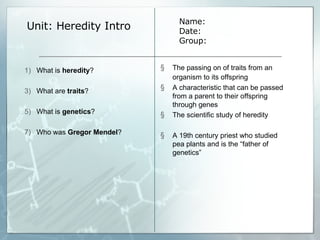
Unit: Heredity Intro The passing on of traits from an organism to its offspring   A characteristic that can be passed from a parent to their offspring through genes The scientific study of heredity A 19th century priest who studied pea plants and is the “father of genetics”  Name: Date: Group: What is  heredity ? What are  traits ? What is  genetics ? Who was  Gregor Mendel ?
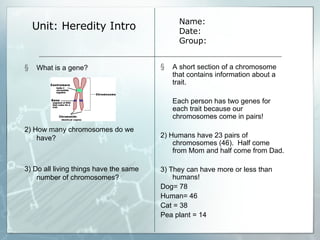
Unit: Heredity Intro A short section of a chromosome that contains information about a trait.  Each person has two genes for each trait because our chromosomes come in pairs! 2) Humans have 23 pairs of chromosomes (46).  Half come from Mom and half come from Dad. 3) They can have more or less than humans! Dog= 78 Human= 46 Cat = 38 Pea plant = 14 Name: Date: Group: What is a gene? 2) How many chromosomes do we have? 3) Do all living things have the same number of chromosomes?
Unit: Heredity Different forms of a gene.  (e.g. TT ot Tt for tallness in plants.)  2) An allele whose trait always shows up when the allele is present. 3) An allele that is covered up when the dominant allele is present. 4) A hybrid has a mix of alleles for a trait. (e.g. Tt, Bb, and Gg) An organisms genetic make-up, or allele combinations.  (e.g. Bb) 6) An organisms physical appearance (e.g. Brown eyes) Name: Date: Group: What are alleles? What is a dominant allele? What is a recessive allele? What is a hybrid? What is an organisms Genotype? What is an organisms Phenotype?
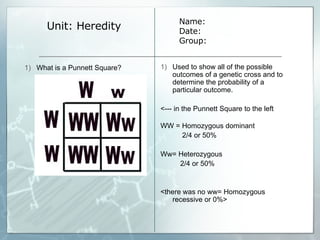
Unit: Heredity Used to show all of the possible outcomes of a genetic cross and to determine the probability of a particular outcome. <--- in the Punnett Square to the left  WW = Homozygous dominant 2/4 or 50% Ww= Heterozygous 2/4 or 50% <there was no ww= Homozygous recessive or 0%> Name: Date: Group: What is a Punnett Square?
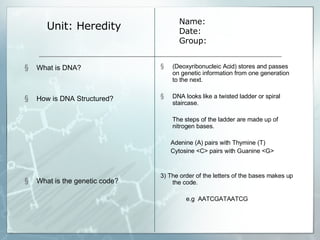
Unit: Heredity (Deoxyribonucleic Acid) stores and passes on genetic information from one generation to the next. DNA looks like a twisted ladder or spiral staircase. The steps of the ladder are made up of nitrogen bases. Adenine (A) pairs with Thymine (T) Cytosine <C> pairs with Guanine <G> 3) The order of the letters of the bases makes up the code. e.g  AATCGATAATCG Name: Date: Group: What is DNA? How is DNA Structured? What is the genetic code?
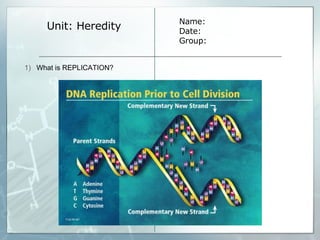
Unit: Heredity Name: Date: Group: What is REPLICATION?
Unit: Heredity A picture of the size, shape and number of chromosomes of an organism. (Chromosome pairs look alike.) 2) The removal of a small amount of fluid around a developing baby, which contains the baby’s cells,  in order to examine the chromosomes of the baby. 3) When a chromosome pair does not separate properly during meiosis.  This results in a cell being formed with more or less chromosomes than normal. Name: Date: Group: What is a karyotype? What is an amniocentesis? What is non-disjunction?
Unit: Heredity Gametes are sex cells.  The egg cell and sperm cell are gametes.  2) This is so the gametes will have 1/2 the amount of DNA when they combine to form the zygote. 3) A zygote is a fertilized egg. 4) A somatic cell is a body cell.  It has a full set (46) of chromosomes.  Al l cells that are not gametes are considered somatic cells. 5) This is what happens in sexual reproduction due to the mix of chromosomes from a male and female combining.  A unique combination is formed. Name: Date: Group: What are gametes? Why are gametes produced through meiosis? What is a zygote? 4) What is a somatic cell? 5) What is genetic variability?

Unit Three Cornell Notes B

  • 1.
    Heredity Unit: CornellNotes Mr. Forde Black Team 2008
  • 2.
    Unit: Heredity IntroThe passing on of traits from an organism to its offspring A characteristic that can be passed from a parent to their offspring through genes The scientific study of heredity A 19th century priest who studied pea plants and is the “father of genetics” Name: Date: Group: What is heredity ? What are traits ? What is genetics ? Who was Gregor Mendel ?
  • 3.
    Unit: Heredity IntroA short section of a chromosome that contains information about a trait. Each person has two genes for each trait because our chromosomes come in pairs! 2) Humans have 23 pairs of chromosomes (46). Half come from Mom and half come from Dad. 3) They can have more or less than humans! Dog= 78 Human= 46 Cat = 38 Pea plant = 14 Name: Date: Group: What is a gene? 2) How many chromosomes do we have? 3) Do all living things have the same number of chromosomes?
  • 4.
    Unit: Heredity Differentforms of a gene. (e.g. TT ot Tt for tallness in plants.) 2) An allele whose trait always shows up when the allele is present. 3) An allele that is covered up when the dominant allele is present. 4) A hybrid has a mix of alleles for a trait. (e.g. Tt, Bb, and Gg) An organisms genetic make-up, or allele combinations. (e.g. Bb) 6) An organisms physical appearance (e.g. Brown eyes) Name: Date: Group: What are alleles? What is a dominant allele? What is a recessive allele? What is a hybrid? What is an organisms Genotype? What is an organisms Phenotype?
  • 5.
    Unit: Heredity Usedto show all of the possible outcomes of a genetic cross and to determine the probability of a particular outcome. <--- in the Punnett Square to the left WW = Homozygous dominant 2/4 or 50% Ww= Heterozygous 2/4 or 50% <there was no ww= Homozygous recessive or 0%> Name: Date: Group: What is a Punnett Square?
  • 6.
    Unit: Heredity (DeoxyribonucleicAcid) stores and passes on genetic information from one generation to the next. DNA looks like a twisted ladder or spiral staircase. The steps of the ladder are made up of nitrogen bases. Adenine (A) pairs with Thymine (T) Cytosine <C> pairs with Guanine <G> 3) The order of the letters of the bases makes up the code. e.g AATCGATAATCG Name: Date: Group: What is DNA? How is DNA Structured? What is the genetic code?
  • 7.
    Unit: Heredity Name:Date: Group: What is REPLICATION?
  • 8.
    Unit: Heredity Apicture of the size, shape and number of chromosomes of an organism. (Chromosome pairs look alike.) 2) The removal of a small amount of fluid around a developing baby, which contains the baby’s cells, in order to examine the chromosomes of the baby. 3) When a chromosome pair does not separate properly during meiosis. This results in a cell being formed with more or less chromosomes than normal. Name: Date: Group: What is a karyotype? What is an amniocentesis? What is non-disjunction?
  • 9.
    Unit: Heredity Gametesare sex cells. The egg cell and sperm cell are gametes. 2) This is so the gametes will have 1/2 the amount of DNA when they combine to form the zygote. 3) A zygote is a fertilized egg. 4) A somatic cell is a body cell. It has a full set (46) of chromosomes. Al l cells that are not gametes are considered somatic cells. 5) This is what happens in sexual reproduction due to the mix of chromosomes from a male and female combining. A unique combination is formed. Name: Date: Group: What are gametes? Why are gametes produced through meiosis? What is a zygote? 4) What is a somatic cell? 5) What is genetic variability?