Unit One: Part One: Notes Why Study Social Studies?Map ReadingMeasuring TimeElements of GeographyLatitude and Longitude
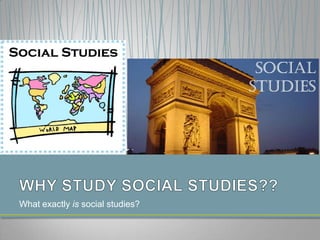
What exactly is social studies? WHY STUDY SOCIAL STUDIES??
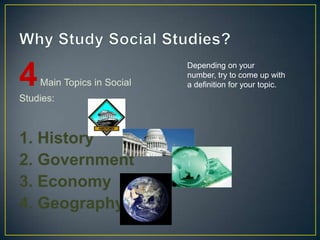
Why Study Social Studies? 4 Main Topics in Social Studies:1. History2. Government3. Economy4. Geography Depending on your number, try to come up with a definition for your topic.
Parts of a Map- TOGKS	TitleOrientationGridKeyScale
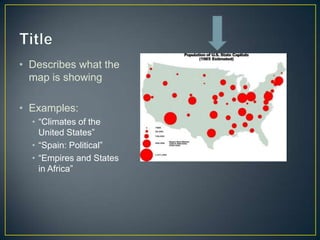
TitleDescribes what the map is showingExamples: “Climates of the United States”“Spain: Political”“Empires and States in Africa”
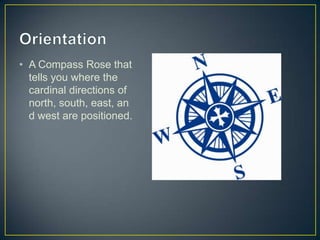
OrientationA Compass Rose that tells you where the cardinal directions of north, south, east, and west are positioned.
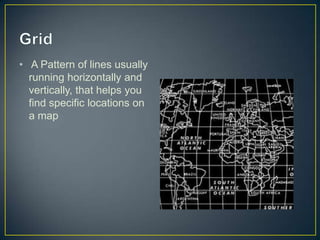
Grid A Pattern of lines usually running horizontally and vertically, that helps you find specific locations on a map
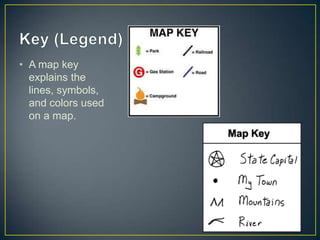
Key (Legend)A map key explains the lines, symbols, and colors used on a map.
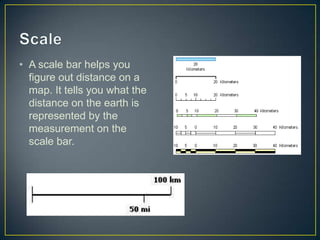
ScaleA scale bar helps you figure out distance on a map. It tells you what the distance on the earth is represented by the measurement on the scale bar.
Measuring TimeHistorians rely on calendars and the dating of events to measure timeB.C.= Before Christ Treat like negative numbers A.D.= Anno Domini, Latin for “ in the year of our Lord” Like positive numbers
To date events before the birth of ChristCount backwards from A.D. 1There is no Year 0!!So, the year before A.D. 1 is 1 B.C. Notice how A.D. comes before the year; and B.C. comes after the yearTo date events after the birth of ChristCount forwards from A.D. 1
How many years between?The rise of Mesopotamia (3000BC) to the fall of Rome (AD 475)	Answer: 3475 years The beginning of the Renaissance  (AD 1500) to the end of the Age of Exploration  (AD 1800)															Answer: 300 yearsThe rise of Chinese civilization (2200 BC) to its collapse (1100 BC)	Answer: 1100 yearsThe rise of Greece (2600 BC) to the fall of Rome (AD 475)Answer: 3075 years The rise of Rome (625 BC) tothe end of the Middle Ages (AD 1500) Answer: 2125 yearsThe rise of Mesopotamia (3000 BC) to the end of the Age of Exploration  (AD 1800)Answer: 4800 years
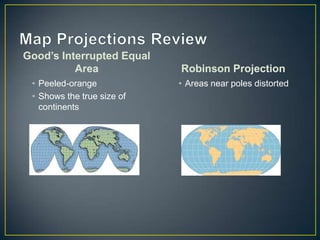
Map Projections ReviewGood’s Interrupted Equal AreaPeeled-orangeShows the true size of continents Robinson ProjectionAreas near poles distorted
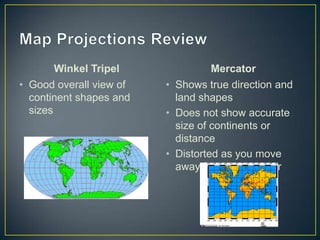
Map Projections ReviewWinkelTripelGood overall view of continent shapes and sizesMercatorShows true direction and land shapesDoes not show accurate size of continents or distanceDistorted as you move away from the equator
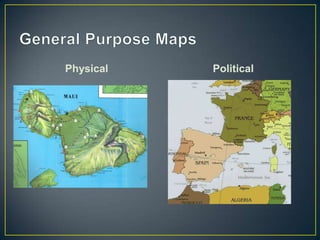
General Purpose MapsPhysicalPolitical
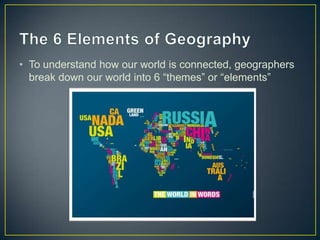
The 6 Elements of Geography To understand how our world is connected, geographers break down our world into 6 “themes” or “elements”
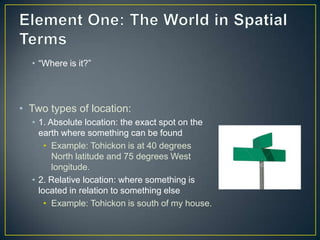
Element One: The World in Spatial Terms“Where is it?”Two types of location:1. Absolute location: the exact spot on the earth where something can be foundExample: Tohickon is at 40 degrees North latitude and 75 degrees West longitude.2. Relative location: where something is located in relation to something elseExample: Tohickon is south of my house.
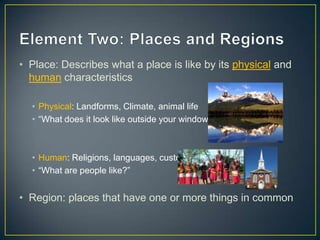
Element Two: Places and Regions Place: Describes what a place is like by its physical and human characteristics Physical: Landforms, Climate, animal life“What does it look like outside your window?”Human: Religions, languages, customs“What are people like?” Region: places that have one or more things in common
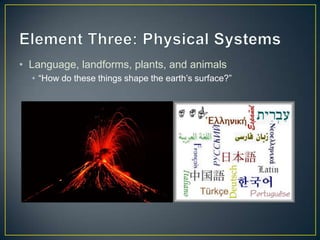
Element Three: Physical Systems Language, landforms, plants, and animals “How do these things shape the earth’s surface?”
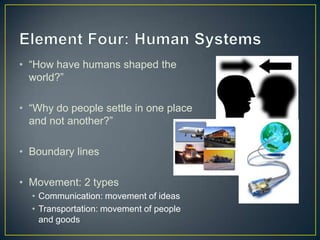
Element Four: Human Systems “How have humans shaped the world?”“Why do people settle in one place and not another?”Boundary lines Movement: 2 typesCommunication: movement of ideasTransportation: movement of people and goods
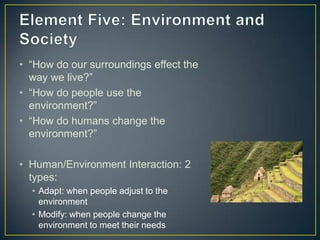
Element Five: Environment and Society“How do our surroundings effect the way we live?” “How do people use the environment?”“How do humans change the environment?” Human/Environment Interaction: 2 types:Adapt: when people adjust to the environmentModify: when people change the environment to meet their needs
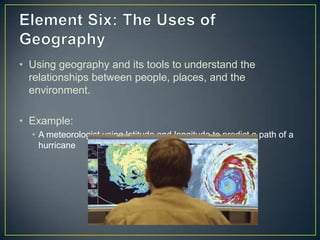
Element Six: The Uses of GeographyUsing geography and its tools to understand the relationships between people, places, and the environment.Example:A meteorologist using latitude and longitude to predict a path of a hurricane
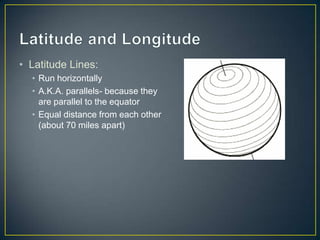
Latitude and LongitudeLatitude Lines:Run horizontally A.K.A. parallels- because they are parallel to the equatorEqual distance from each other (about 70 miles apart)
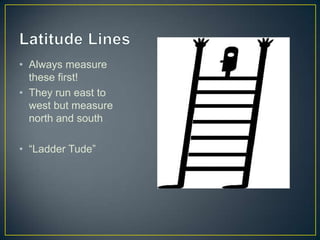
Latitude LinesAlways measure these first!They run east to west but measure north and south “Ladder Tude”
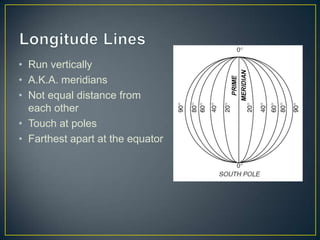
Longitude LinesRun vertically A.K.A. meridians Not equal distance from each other Touch at poles Farthest apart at the equator
How do we write latitude and longitude?Latitude, LongitudeExamples: 38° N Lat., 96° W Long.35° S Lat., 30° E Long.

Unit One Notes 1

  • 1.
    Unit One: PartOne: Notes Why Study Social Studies?Map ReadingMeasuring TimeElements of GeographyLatitude and Longitude
  • 2.
    What exactly issocial studies? WHY STUDY SOCIAL STUDIES??
  • 3.
    Why Study SocialStudies? 4 Main Topics in Social Studies:1. History2. Government3. Economy4. Geography Depending on your number, try to come up with a definition for your topic.
  • 4.
    Parts of aMap- TOGKS TitleOrientationGridKeyScale
  • 5.
    TitleDescribes what themap is showingExamples: “Climates of the United States”“Spain: Political”“Empires and States in Africa”
  • 6.
    OrientationA Compass Rosethat tells you where the cardinal directions of north, south, east, and west are positioned.
  • 7.
    Grid A Patternof lines usually running horizontally and vertically, that helps you find specific locations on a map
  • 8.
    Key (Legend)A mapkey explains the lines, symbols, and colors used on a map.
  • 9.
    ScaleA scale barhelps you figure out distance on a map. It tells you what the distance on the earth is represented by the measurement on the scale bar.
  • 10.
    Measuring TimeHistorians relyon calendars and the dating of events to measure timeB.C.= Before Christ Treat like negative numbers A.D.= Anno Domini, Latin for “ in the year of our Lord” Like positive numbers
  • 11.
    To date eventsbefore the birth of ChristCount backwards from A.D. 1There is no Year 0!!So, the year before A.D. 1 is 1 B.C. Notice how A.D. comes before the year; and B.C. comes after the yearTo date events after the birth of ChristCount forwards from A.D. 1
  • 12.
    How many yearsbetween?The rise of Mesopotamia (3000BC) to the fall of Rome (AD 475) Answer: 3475 years The beginning of the Renaissance (AD 1500) to the end of the Age of Exploration (AD 1800) Answer: 300 yearsThe rise of Chinese civilization (2200 BC) to its collapse (1100 BC) Answer: 1100 yearsThe rise of Greece (2600 BC) to the fall of Rome (AD 475)Answer: 3075 years The rise of Rome (625 BC) tothe end of the Middle Ages (AD 1500) Answer: 2125 yearsThe rise of Mesopotamia (3000 BC) to the end of the Age of Exploration (AD 1800)Answer: 4800 years
  • 13.
    Map Projections ReviewGood’sInterrupted Equal AreaPeeled-orangeShows the true size of continents Robinson ProjectionAreas near poles distorted
  • 14.
    Map Projections ReviewWinkelTripelGoodoverall view of continent shapes and sizesMercatorShows true direction and land shapesDoes not show accurate size of continents or distanceDistorted as you move away from the equator
  • 15.
  • 16.
    The 6 Elementsof Geography To understand how our world is connected, geographers break down our world into 6 “themes” or “elements”
  • 17.
    Element One: TheWorld in Spatial Terms“Where is it?”Two types of location:1. Absolute location: the exact spot on the earth where something can be foundExample: Tohickon is at 40 degrees North latitude and 75 degrees West longitude.2. Relative location: where something is located in relation to something elseExample: Tohickon is south of my house.
  • 18.
    Element Two: Placesand Regions Place: Describes what a place is like by its physical and human characteristics Physical: Landforms, Climate, animal life“What does it look like outside your window?”Human: Religions, languages, customs“What are people like?” Region: places that have one or more things in common
  • 19.
    Element Three: PhysicalSystems Language, landforms, plants, and animals “How do these things shape the earth’s surface?”
  • 20.
    Element Four: HumanSystems “How have humans shaped the world?”“Why do people settle in one place and not another?”Boundary lines Movement: 2 typesCommunication: movement of ideasTransportation: movement of people and goods
  • 21.
    Element Five: Environmentand Society“How do our surroundings effect the way we live?” “How do people use the environment?”“How do humans change the environment?” Human/Environment Interaction: 2 types:Adapt: when people adjust to the environmentModify: when people change the environment to meet their needs
  • 22.
    Element Six: TheUses of GeographyUsing geography and its tools to understand the relationships between people, places, and the environment.Example:A meteorologist using latitude and longitude to predict a path of a hurricane
  • 23.
    Latitude and LongitudeLatitudeLines:Run horizontally A.K.A. parallels- because they are parallel to the equatorEqual distance from each other (about 70 miles apart)
  • 24.
    Latitude LinesAlways measurethese first!They run east to west but measure north and south “Ladder Tude”
  • 25.
    Longitude LinesRun verticallyA.K.A. meridians Not equal distance from each other Touch at poles Farthest apart at the equator
  • 26.
    How do wewrite latitude and longitude?Latitude, LongitudeExamples: 38° N Lat., 96° W Long.35° S Lat., 30° E Long.