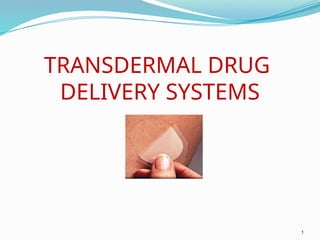
TRANSDERMAL DRUG
DELIVERY SYSTEMS
1
CONTENTS
Introduction
Objectives of TDDS
Advantages & disadvantages
Origin of TDDS
Mechanism of percutanious absorption
Factors affecting transdermal Permeability
Kinetics of transdermal drug delivery system
Factors affecting permeation
Formulation approaches used in development of TDDS
Recent developments in TDDS
Evaluation
References 2
INTRODUCTION
 Medicated plasters – are first TDDS
 China – Chinese medicated plaster
 Japan - Cataplasms & salonpas
 England – Allcock’s porous plaster
 Germany – ABC (arnica/belladonna/capsicum)
 USA - Belladonna plaster
Mustard plaster
Salicylic acid plaster
Female syndromes in male operators working in
production of estrogen pharmaceutical dosage form
3
4
 To maintain a constant, prolonged and
therapeutically-
effective drug levels in the body.
 To by pass first pass metabolism
 To reduce systemic side effects
 To improve efficacy
 to have a better patient’s compliance
Objectives of TDDS
 Transdermal drug delivery system was first introduced
more than 20 years ago.
 The technology generated tremendous excitement and
interest amongst major pharmaceutical companies in
the 1980s and 90s.
 First transdermal patch was approved in 1981 to
prevent the nausea and vomiting associated with
motion sickness, the FDA has approved, throughout
the past 22 years, more than 35 transdermal patch
products, spanning 13 molecules.
5
Brief History of TDDS
INTRODUCTION
• Definition:
Transdermal means entry of the drug through the
skin from topical admistration/application of drug as a
patch /semisolid dosage form.
6
POTENTIAL BENEFITS OF
TRANSDERMAL DRUG DELIVERY
(ADVANTAGES)
• Easy to use.
• Avoid GIT absorption problems for drugs.
• Avoids FP hepatic metabolism of drugs.
• More improved and convenient patient compliance.
• Rapid termination in case of toxicity is possible.
• Self medication is possible.
• Reduces frequency of dosing.
• Maintains therapeutic level for 1 to 7 days.
• Controlled delivery resulting in more reliable and
predictable blood levels.
7
DISADVANTAGES
• Daily dose of more than 10mg is not possible.
• Local irritation is a major problem.
• Drug requiring high blood levels are unsuitable.
• Drug with long half life can not be formulated in TDDS.
• Uncomfortable to wear.
• May not be economical.
• Barrier function changes from person to person and within the
same person.
• Heat, cold, sweating (perspiring) and showering prevent the
patch from sticking to the surface of the skin for more than one
day. A new patch has to be applied daily.
8
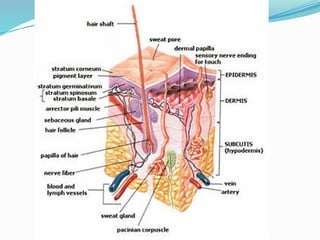
STRUCTURE OF SKIN
• Epidermis:
Stratum corneum (Horny cell layer)
 Stratum lucidum (Clear layer)
 Stratum granulosum ( Granular Layer)
 Stratum spinosum (Prickly layer)
 Stratum germinativum
• Dermis:
• Hypodermis or Subcutaneous layer:
9
The drug must traverse three layers, the stratum cornium, the epidermis, and
the dermis.
Of these, the toughest barrier is the stratum corneum, which consists of 10-25
layers of keratinized cells.
The stratum corneum is the outermost layer of the epidermis and is composed
mainly of dead cells that lack nuclei.
These are sloughed off during the day and replaced by new cells from the
stratum germinativum.
Introduction to Transdermal Drug Delivery
Stratum Corneum is the barrier in TDD
(Rate limiting step)
STRUCTURE OF SKIN
Epidermis:
 The outer layer of skin is made up of Stratified
Squamous epithelial cells.
Epidermis is thickest in palms and soles.
The stratum corneum forms the outer most layer (10-
15µm thick ) which consists of many layers of
compacted , flattened, dehydrated keratinized cells.
Keratin contains cells called as Corneosites.
 Stratum corneum layer forms permeability barrier for
external environment.
14
Water content of stratum corneum is around 20%.
The moisture required for stratum corneum is around
10% (w/w) to maintain flexibility and softness.
It consists of Ceramides and neutral lipids such as
Sterols, free fatty acids and triglycerides.
 The stratum corneum is responsible for the barrier
function of the skin and behaves as a primary barrier to
the percutaneous absorption.
15
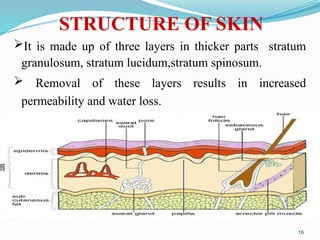
STRUCTURE OF SKIN
It is made up of three layers in thicker parts stratum
granulosum, stratum lucidum,stratum spinosum.
 Removal of these layers results in increased
permeability and water loss.
16
STRUCTURE OF SKIN
DERMIS:
 The dermis is made up of regular network of robust
collagen fibers of fairly uniform thickness with regularly
placed cross striations .
This network or the gel structure is responsible for the
elastic properties of the skin.
It is supplied by blood to convey nutrients, remove waste &
regulate body temp.
Drug is well absorbed by this route.
Upper portion of the dermis is formed into ridges
containing lymphatics and nerve endings.
17
STRUCTURE OF SKIN
SUBCUTANEOUS TISSUE:
This is a sheet of the fat containing areolar tissue
known as the superficial fascia attaching the dermis to the
underlying structures .
SKIN APPENDAGES:
Sweat glands produces sweat of pH 4-6.8 & absorbs
drugs, secretes proteins, lipids and antibodies. Its function
is to control heat.
HAIR FOLLICLES
They have sebaceous glands which produces sebum
and includes glycerides, cholesterol and squalene.
18
STRUCTURE OF SKIN
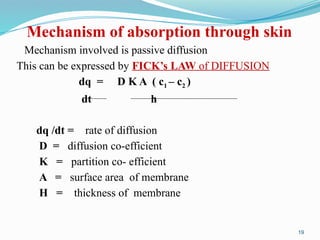
Mechanism of absorption through skin
Mechanism involved is passive diffusion
This can be expressed by FICK’s LAW of DIFFUSION
dq = D K A ( c1 – c2 )
dt h
dq /dt = rate of diffusion
D = diffusion co-efficient
K = partition co- efficient
A = surface area of membrane
H = thickness of membrane
19
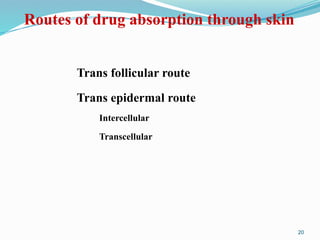
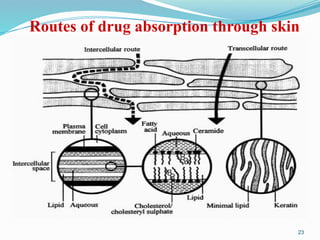
Routes of drug absorption through skin
Trans follicular route
Trans epidermal route
Intercellular
Transcellular
20
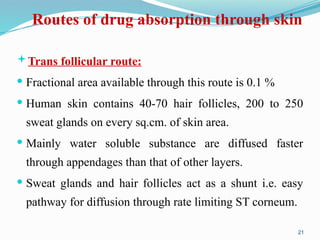
Routes of drug absorption through skin
Trans follicular route:
 Fractional area available through this route is 0.1 %
 Human skin contains 40-70 hair follicles, 200 to 250
sweat glands on every sq.cm. of skin area.
 Mainly water soluble substance are diffused faster
through appendages than that of other layers.
 Sweat glands and hair follicles act as a shunt i.e. easy
pathway for diffusion through rate limiting ST corneum.
21
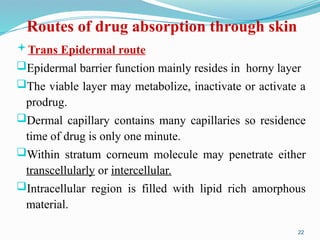
Routes of drug absorption through skin
Trans Epidermal route
Epidermal barrier function mainly resides in horny layer
The viable layer may metabolize, inactivate or activate a
prodrug.
Dermal capillary contains many capillaries so residence
time of drug is only one minute.
Within stratum corneum molecule may penetrate either
transcellularly or intercellular.
Intracellular region is filled with lipid rich amorphous
material.
22
Routes of drug absorption through skin
23
FACTORS AFFECTING TRANSDERMAL
PERMEABILITY
Physico chemical properties of parent molecule
Solubility and partition co- efficient
pH condition
Penetrant concentration
Physico chemical properties of drug delivery system
Release characteristic
Composition of drug delivery system
Permeation enhancer used
24
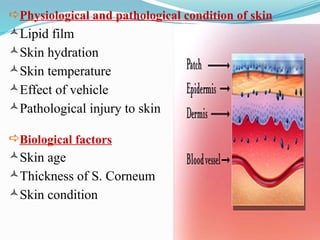
Physiological and pathological condition of skin
Lipid film
Skin hydration
Skin temperature
Effect of vehicle
Pathological injury to skin
Biological factors
Skin age
Thickness of S. Corneum
Skin condition
25
Solubility and partition co- efficient:
 Solubility of a drug influences its ability to penetrate
the skin.
 pKa is index of solubility of drug in vehicle and ST
corneum has influence on transfer of drug from vehicle
to skin.
Drug solubility determines concentration presented to
absorption site which will effect rate and extent of
absorption.
 Skin permeation can be enhanced by increasing
lipophilic character of drug, so that drug penetrates
through STC but not through epidermis due to decreased
water solubility.
 Drug which is lipid & water soluble is favored.
26
pH & Concentration:
 Moderate pH is favorable because high or low pH will
result in destruction of the skin.
 Higher the concentration of the drug in vehicle faster
the absorption.
 At higher concentrations than solubility the excess
solid drug will function as a reservoir and helps to
maintain a constant drug constitution for prolonged
period of time.
27
FACTORS AFFECTING TRANSDERMAL
PERMEABILITY
28
Physico-chemical properties of drug delivery system
Release characteristic
 Solubility of drug in vehicle determines the release rate.
Composition of drug delivery system
 It not only effects the rate of drug release but also the
permeability of STC by means of hydration mixing with
skin lipids. Example methyl salicylate is more lipophilic
than its parent acid (Salicylic acid). When applied to skin
from fatty vehicle methylsalicylate yielded higher
absorption.
FACTORS AFFECTING TRANSDERMAL
PERMEABILITY
29
Physiological and pathological condition of skin
Lipid film:
It acts as protective layer to prevent removal of
moisture from skin. Removal of this film will decrease TD
absorption.
Skin hydration:
It can be achieved by covering skin with plastic
sheeting, which leads to accumulation of sweat, condensed
water vapors, increase hydration and increase porosity.
FACTORS AFFECTING
TRANSDERMAL PERMEABILITY
30
Effect of vehicle:
A vehicle can influence absorption by its effect on
physical state of drug and skin. Example greases, paraffin
bases are more occlusive while water in oil bases are less.
Humectants in bases will dehydrate the skin and decrease
per-cutaneous absorption.
FACTORS AFFECTING
TRANSDERMAL PERMEABILITY
31
Biological factors:
Skin age:
Skin of foetus, young ones and elders is more
permeable than adult tissue.
Skin metabolism:
Viable epidermis is metabolically active than
dermis. If topically applied drug is subjected to
biotransformation during permeation local and systemic
bioavailability is affected.
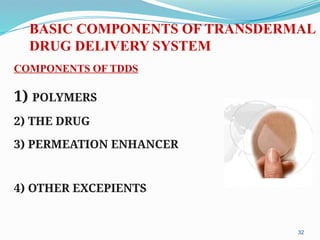
BASIC COMPONENTS OF TRANSDERMAL
DRUG DELIVERY SYSTEM
COMPONENTS OF TDDS
1) POLYMERS
2) THE DRUG
3) PERMEATION ENHANCER
4) OTHER EXCEPIENTS
32
POLYMERS
Following criteria to be considered in selection a
polymer:
Molecular weight, physical nature of polymer must
allow diffusion of drug at desired rate.
 Polymer must be non-reactive, inert, non-toxic, easy
to manufacture, inexpensive.
 It should not decompose on storage of the device &
not deteriorate when large amount of active ingredient is
incorporated into it.
33
LIST OF POLYMERS USED
NATURAL POLYMERS:
Cellulose derivatives, Zein, Gelatin, Shellac, Waxes,
Gums & Natural rubber
SYNTHETIC ELASTOMER POLYBUTADIENE:
Polysiloxane, Silicon rubber, Nitrile, Acrylonitryle, Butyl
rubber, Styrene butadiene rubber.
SYNTHETIC POLYMER
Poly vinyl alcohol, Poly vinyl chloride, Polyethylene,
Poly propylene, Poly urea, PVP, Polymethacrylate
34
DRUG
For successful developing transdermal delivery,
drug should be chosen with great care
physicochemical properties
1. Mol. wt. less than 1000 Daltons
2. Affinity for both lipophilic & hydrophilic phase
3. Drug should have low melting point
35
DRUG
It should be potent with daily dose of few mg/ day.
Half life of drug should be short.
Non irritant to skin.
Drug prone to ‘first pass effect’ and which degrade in
GIT are ideal candidate.
36
Ideal properties of drug candidate
PARAMETER PROPERTIES
Dose Sh’d be low( < 20mg/day)
Half life 10 hrs or less
Molecular weight < 1000 daltons
Skin permeability co- efficient > 0.5 X 10 -3
cm/ hr
Skin reaction Non irritating & non sensitizing
Oral Bioavailability low
Therapeutic index low
37
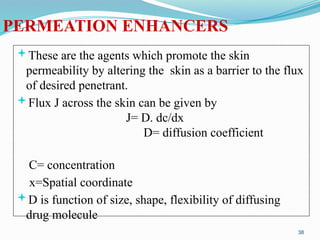
PERMEATION ENHANCERS
These are the agents which promote the skin
permeability by altering the skin as a barrier to the flux
of desired penetrant.
Flux J across the skin can be given by
J= D. dc/dx
D= diffusion coefficient
C= concentration
x=Spatial coordinate
D is function of size, shape, flexibility of diffusing
drug molecule
38
Activity of penetration enhancers
Interaction with the polar head groups of lipid via
hydrogen and ionic bonding.
Change in hydration sphere of lipids and affect the
packing at the head region.
Increase volume of the aqueous layer:swelling and
hydration.
Protein modification- open up the dense keratin
structure and make it more permeable.
39
Ideal Characteristic Of Penetration Enhancers
1) IT SHOULD BE INERT
2) NON-TOXIC, NON- IRRITATING
3) ACTION SHOULD BE IMMEDIATE& PREDICTABLE
4) SHOULD NOT CAUSE REMOVAL OF BODY FLUID
5) SHOLD BE COMPATIBLE WITH DRUG& EXIPIENTS
6) COSMETICALLY ACCEPTABLE
7) ODORLESS, TASTELESS, COLORLESS & CHEAP
40
SOLVENTS
The compounds increase penetration possibly by
swelling the polar pathway and fluidizing the lipid
e.g.. Methanol, ethanol, DMSO, DMA, DMF,
pyrolidiones, propylene glycol, glycerol etc..
SURFACTANTS
They enhance polar pathway transport of hydrophillic
drugs
41
ANIONIC SURFACTANTS -
Dioctyl sulpho succinate, SLS, decodemethyl
sulphoxide
CATIONIC SURFACTANTS -
Pluronic F127, pluronic F58
42
BINARY SYSTEMS
 These systems open up the multilaminate path way as
well as the continuous path way
e.g. Propylene glycol-oleic acid.
1,4, butane diol- linoleic acid.
MISCELLANIOUS CHEMICALS
e.g. Urea, N,N- dimethyl m- toluamide
43
44
44
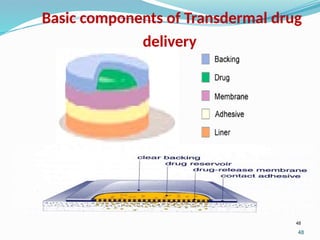
Backing membrane
They are flexible and provide a good bond to the drug
reservoir, prevent the drug from leaving the dosage form
through top.
It is an impermeable membrane that protects the product
during the use on the skin.
 Contains formulation throughout shelf-life and during
wear period
 Must be compatible with formulation (non adsorptive)
 Printable
E.g.: Metallic plastic laminate , plastic backing with
adsorbent pad adhesive foam pad.
45
45
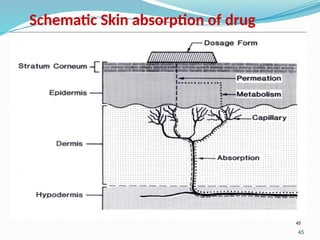
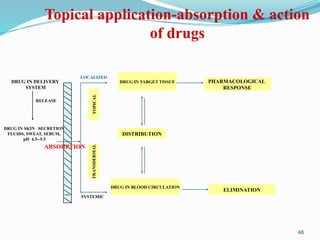
Schematic Skin absorption of drug
Topical application-absorption & action
of drugs
SYSTEMIC
DRUG IN TARGET TISSUE
DRUG IN BLOOD CIRCULATION
DISTRIBUTION
ELIMINATION
PHARMACOLOGICAL
RESPONSE
TOPICAL
ABSORPTION
DRUG IN DELIVERY
SYSTEM
DRUG IN SKIN SECRETION
FLUIDS, SWEAT, SEBUM,
pH 4.5--5.5
TRANSDERMAL
LOCALIZED
RELEASE
46
FORMULATION APPROACHES FOR
DEVELOPMENT OF TRANSDERMAL DRUG
DELIVERY SYSTEM
47
48
48
Basic components of Transdermal drug
delivery
TDD Patch Construction (Technologies)
Four Major Transdermal Systems
Polymer Membrane Permeation Controlled TDDS.
Polymer Matrix Diffusion Controlled TDDS.
Drug Reservoir Gradient Controlled TDDS.
Microreservoir Dissolution Controlled TDDS.
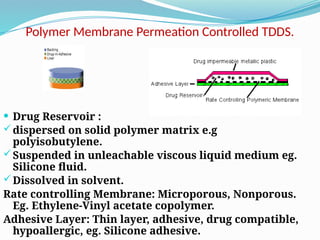
Polymer Membrane Permeation Controlled TDDS.
 Drug Reservoir :
dispersed on solid polymer matrix e.g
polyisobutylene.
Suspended in unleachable viscous liquid medium eg.
Silicone fluid.
Dissolved in solvent.
Rate controlling Membrane: Microporous, Nonporous.
Eg. Ethylene-Vinyl acetate copolymer.
Adhesive Layer: Thin layer, adhesive, drug compatible,
hypoallergic, eg. Silicone adhesive.
polymer membrane permeation controlled
system
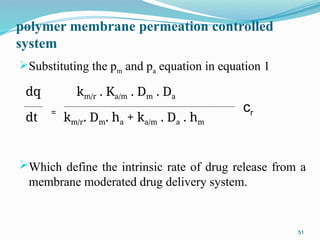
Substituting the pm and pa equation in equation 1
dq km/r . Ka/m . Dm . Da
dt km/r. Dm. ha + ka/m . Da . hm
Which define the intrinsic rate of drug release from a
membrane moderated drug delivery system.
51
= cr
polymer membrane permeation controlled
system
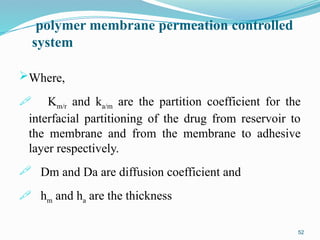
Where,
 Km/r and ka/m are the partition coefficient for the
interfacial partitioning of the drug from reservoir to
the membrane and from the membrane to adhesive
layer respectively.
 Dm and Da are diffusion coefficient and
 hm and ha are the thickness
52
polymer membrane permeation controlled
system
 Scopolamine-releasing transdermal system for 72 hr.
prophylaxis of motion sickness.
 Clonidine releasing transdermal system for 7 day
therapy of hypertension.
 Estradiol-releasing transdermal system for treatment
of menopausal syndrome for 3-4 days.
53
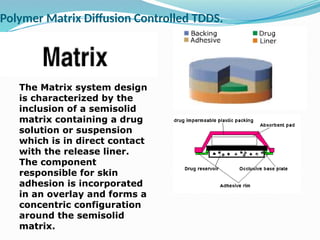
Polymer Matrix Diffusion Controlled TDDS.
The Matrix system design
is characterized by the
inclusion of a semisolid
matrix containing a drug
solution or suspension
which is in direct contact
with the release liner.
The component
responsible for skin
adhesion is incorporated
in an overlay and forms a
concentric configuration
around the semisolid
matrix.
. Polymer Matrix Diffusion Controlled TDDS
System
The rate of drug release from this type of system is
defined as:
 A is the initial drug loading dose dispersed in the polymer matrix and Cp
and Dp are the solubility and diffusivity of the drug polymer respectively.
 Since only the drug species dissolved in the polymer can release .
55
1/2
=
dq ACp Dp
dt 2t
Polymer Matrix Diffusion Controlled TDD System
E.g. of this type of system is nitro-dur I and nitro-
dur II. for continuous transdermal fusion of
nitroglycerine at a daily dose of 0.5 mg/cm2
for
therapy of angina pectoris.
Nitro dur II is modified version of I in which the drug
is dispersed in acrylic based polymer adhesive with a
resinous cross linking agent which result in much
thinner and more elegant patch.
56
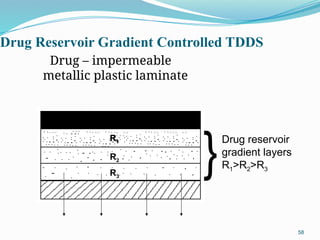
Drug Reservoir Gradient Controlled TDDS.
The Multi-layer Drug-in-
Adhesive is similar to
the Single-layer Drug-in-
Adhesive in that the
drug is incorporated
directly into the
adhesive. However, the
multi-layer
encompasses either the
addition of a membrane
between two distinct
drug-in-adhesive layers
or the addition of
multiple drug-in-
adhesive layers under a
single backing film
Drug Reservoir Gradient Controlled TDDS
Drug – impermeable
metallic plastic laminate
58
Drug reservoir
gradient layers
R1>R2>R3
R1
R1
R2
R3
}
Microreservoir Dissolution Controlled
TDDS
Suspend drug in aqueous solution of water
drug solubilizer eg. PEG.
Homogeneously disperse drug with controlled
aqueous high shear mechanical force
( unstable thermodynamically).
Stabilize by immediate cross-linking the
polymer chain in-situ.
Microreservior Type Or Microsealed Dissolution
Controlled System
The rate of release of drugs of the micro
reservoir system is defined by,
dq Dp .Dd .m .kp
dt Dphd+Ddhpmkp
60
DISl (1-n)
+
n.Sp
hI
1
kI
1
km
=
MICRORESERVIOR TYPE OR MICROSEALED
DISSOLUTION CONTROLLED SYSTEM
Where, m=a/b is the ratio of the bulk of the elution
medium over drug solubility of the same medium and
b is the ratio of drug concentration at the outer edge of
the polymer coating for the drug solubility in the same
polymer composition.
 n is the ratio of the drug concentration at the inner
layer of the interfacial barrier over drug solubility in
the polymer matrix.
61
MICRORESERVIOR TYPE OR MICROSEALED
DISSOLUTION CONTROLLED SYSTEM
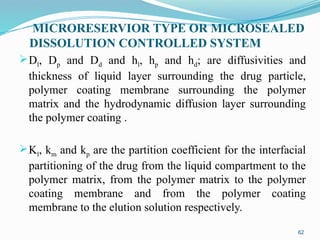
Dl, Dp and Dd and hl, hp and hd; are diffusivities and
thickness of liquid layer surrounding the drug particle,
polymer coating membrane surrounding the polymer
matrix and the hydrodynamic diffusion layer surrounding
the polymer coating .
Kl, km and kp are the partition coefficient for the interfacial
partitioning of the drug from the liquid compartment to the
polymer matrix, from the polymer matrix to the polymer
coating membrane and from the polymer coating
membrane to the elution solution respectively.
62
MICRORESERVIOR TYPE OR MICROSEALED
DISSOLUTION CONTROLLED SYSTEM
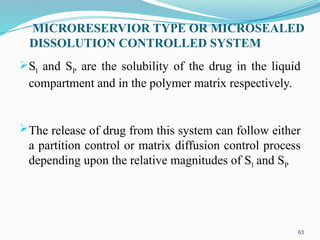
Sl and SP are the solubility of the drug in the liquid
compartment and in the polymer matrix respectively.
The release of drug from this system can follow either
a partition control or matrix diffusion control process
depending upon the relative magnitudes of Sl and SP
63
Microreservior Type Or Microsealed Dissolution
Controlled System
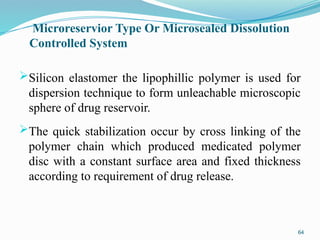
Silicon elastomer the lipophillic polymer is used for
dispersion technique to form unleachable microscopic
sphere of drug reservoir.
The quick stabilization occur by cross linking of the
polymer chain which produced medicated polymer
disc with a constant surface area and fixed thickness
according to requirement of drug release.
64
Microreservior Type Or Microsealed Dissolution
Controlled System
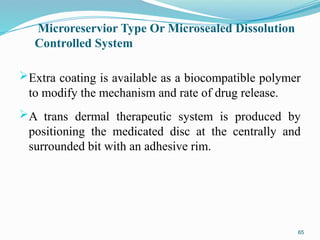
Extra coating is available as a biocompatible polymer
to modify the mechanism and rate of drug release.
A trans dermal therapeutic system is produced by
positioning the medicated disc at the centrally and
surrounded bit with an adhesive rim.
65
Microreservior Type Or Microsealed Dissolution
Controlled System
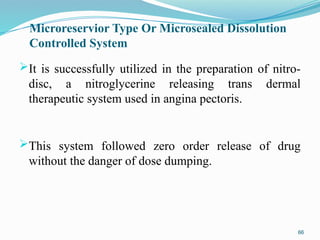
It is successfully utilized in the preparation of nitro-
disc, a nitroglycerine releasing trans dermal
therapeutic system used in angina pectoris.
This system followed zero order release of drug
without the danger of dose dumping.
66
POROPLASTIC TYPE SYSTEM
Poroplastic film consists of ultra micro porous
membranes which are not sensitizing to skin and are
fairly stable at higher than normal temperature and at
biological pH.
It is made utilizing the concept of water coagulation
of cellulose triacetate solution in organic acid at low
temperature.
The coagulation is performed under controlled
condition.
67
TRANSDERMAL DELIVERY OF THE
MACROMOLECULE
Macromolecules such as Hormones, interferons,
bioactive peptides can be delivered by Trans dermal
delivery system.
The devices used for this purpose are divided in to two
categories….
1. Devices based on ethylene vinyl acetate
copolymers (EVAc).
2. Devices based on silicone elastomer.
68
TRANSDERMAL DELIVERY OF THE
MACROMOLECULE
This both the system utilize one common concept i.e.
 Matrix must have channel to facilitate the release of macro
molecule
 This device is used as implants
69
Other TDDS
 Built-in battery layer
 Comparable in size to a normal transdermal patch
 The Lectro Patch, General Medical Co.
 Treatment time : 20 min
 Recommended maximum current : 4mA
 Lidocaine (local anesthesia), dexamethasone (arthritis),
hydrocortisone (arthritis), acetic acid (calcified tendinitis)
etc.
70
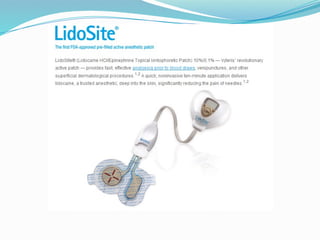
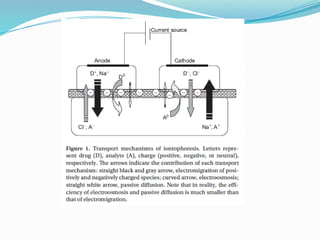
 IONTOPHORESIS
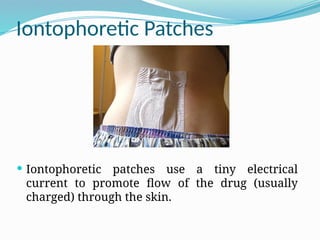
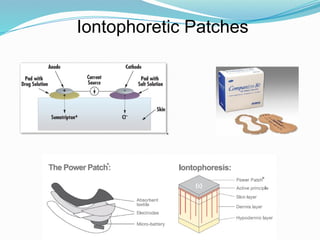
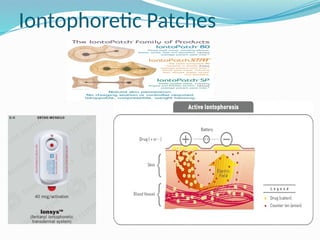
Iontophoretic Patches
 Iontophoretic patches use a tiny electrical
current to promote flow of the drug (usually
charged) through the skin.
73
IONTOPHORESIS
Iontophoretic Patches
Other TDDS
Sonophoresis:
 The application of high frequency ultrasound to enhance
drug penetration.
Examples:. Lidocaine, hydrocortisone, salicylic acid.
Electroporation:
 Transient high-voltage electrical pulses, to cause rapid
permeabilization of the stratum corneum through which
large and small peptides, oligonucleotides and other
drugs can pass in significant amounts.
77
Other TDDS
Reverse iontophoresis:
 Current passage causes ions and other molecules to
move in both directions under both electrodes. Hence
it is possible to sample an analyte in the body, and to
provide a drug in response to the analyte level, e.g.,
sugar, glucose.
78
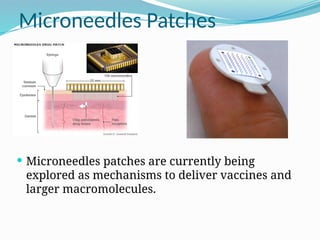
Microneedles Patches
 Microneedles patches are currently being
explored as mechanisms to deliver vaccines and
larger macromolecules.
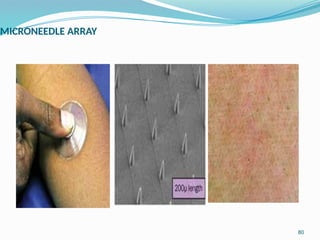
MICRONEEDLE ARRAY
80
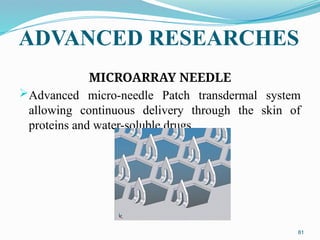
ADVANCED RESEARCHES
MICROARRAY NEEDLE
Advanced micro-needle Patch transdermal system
allowing continuous delivery through the skin of
proteins and water-soluble drugs.
81
ADVANCED RESEARCHES
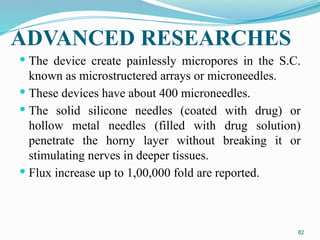
 The device create painlessly micropores in the S.C.
known as microstructered arrays or microneedles.
 These devices have about 400 microneedles.
 The solid silicone needles (coated with drug) or
hollow metal needles (filled with drug solution)
penetrate the horny layer without breaking it or
stimulating nerves in deeper tissues.
 Flux increase up to 1,00,000 fold are reported.
82
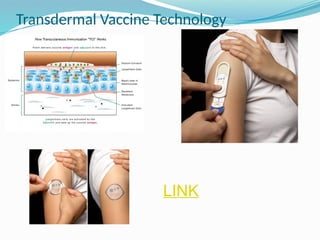
Transdermal Vaccine Technology
LINK
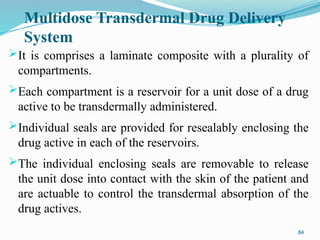
Multidose Transdermal Drug Delivery
System
It is comprises a laminate composite with a plurality of
compartments.
Each compartment is a reservoir for a unit dose of a drug
active to be transdermally administered.
Individual seals are provided for resealably enclosing the
drug active in each of the reservoirs.
The individual enclosing seals are removable to release
the unit dose into contact with the skin of the patient and
are actuable to control the transdermal absorption of the
drug actives.
84
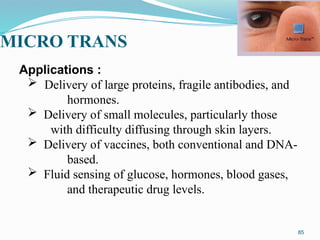
MICRO TRANS
85
Applications :
 Delivery of large proteins, fragile antibodies, and
hormones.
 Delivery of small molecules, particularly those
with difficulty diffusing through skin layers.
 Delivery of vaccines, both conventional and DNA-
based.
 Fluid sensing of glucose, hormones, blood gases,
and therapeutic drug levels.
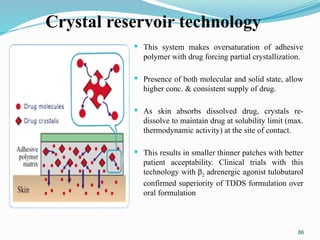
 This system makes oversaturation of adhesive
polymer with drug forcing partial crystallization.
 Presence of both molecular and solid state, allow
higher conc. & consistent supply of drug.
 As skin absorbs dissolved drug, crystals re-
dissolve to maintain drug at solubility limit (max.
thermodynamic activity) at the site of contact.
 This results in smaller thinner patches with better
patient acceptability. Clinical trials with this
technology with β2
adrenergic agonist tulobutarol
confirmed superiority of TDDS formulation over
oral formulation
86
Crystal reservoir technology
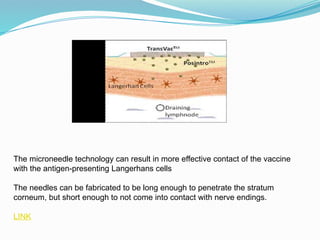
The microneedle technology can result in more effective contact of the vaccine
with the antigen-presenting Langerhans cells
The needles can be fabricated to be long enough to penetrate the stratum
corneum, but short enough to not come into contact with nerve endings.
LINK
Trandermal Matrix patch designs
88
Matrix
Reservoir
Drug in adhesive
Multilaminate
Backing Drug Membrane Adhesive Liner / skin
Transdermal Production Process
89
Products on the market, or in development include:
 Clonidine
 Works as an agonist of adrenaline at the
presynaptic a2 adrenergic
 Product name = Catapres-TTS®
 used to treat hypertension
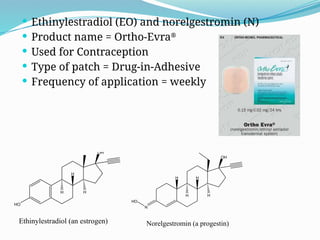
 Ethinylestradiol (EO) and norelgestromin (N)
 Product name = Ortho-Evra®
 Used for Contraception
 Type of patch = Drug-in-Adhesive
 Frequency of application = weekly
N
OH
H H
HO
H H
Norelgestromin (a progestin)
OH
H
H H
Ethinylestradiol (an estrogen)
HO
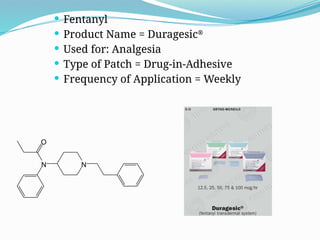
 Fentanyl
 Product Name = Duragesic®
 Used for: Analgesia
 Type of Patch = Drug-in-Adhesive
 Frequency of Application = Weekly
N
O
N
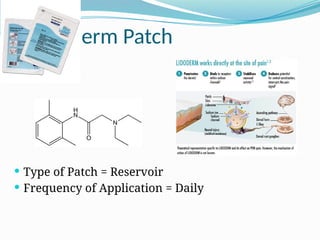
 Lidocaine
 Product Name = Lidoderm®
 Used for: analgesia of postherpetic neuralgia
(PHN), a painful condition caused by the
varicella zoster virus (herpes zoster =
shingles)
Lidoderm Patch
 Type of Patch = Reservoir
 Frequency of Application = Daily
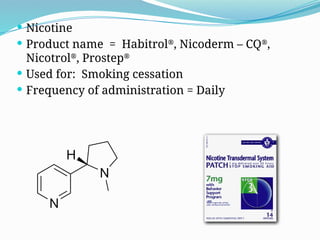
 Nicotine
 Product name = Habitrol®
, Nicoderm – CQ®
,
Nicotrol®
, Prostep®
 Used for: Smoking cessation
 Frequency of administration = Daily
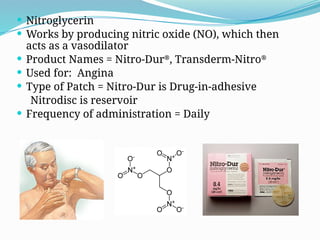
 Nitroglycerin
 Works by producing nitric oxide (NO), which then
acts as a vasodilator
 Product Names = Nitro-Dur®
, Transderm-Nitro®
 Used for: Angina
 Type of Patch = Nitro-Dur is Drug-in-adhesive
Nitrodisc is reservoir
 Frequency of administration = Daily
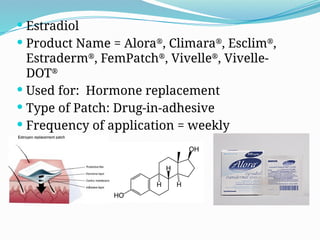
 Estradiol
 Product Name = Alora®
, Climara®
, Esclim®
,
Estraderm®
, FemPatch®
, Vivelle®
, Vivelle-
DOT®
 Used for: Hormone replacement
 Type of Patch: Drug-in-adhesive
 Frequency of application = weekly
 Estradiol + Norethindrone
 Product name = CombiPatch®
 Used for: Hormone Replacement
O
OH
H H
H H
Norethindrone
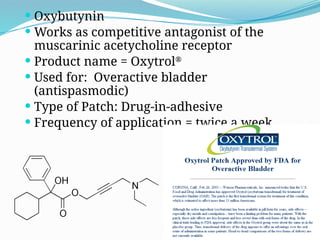
 Oxybutynin
 Works as competitive antagonist of the
muscarinic acetycholine receptor
 Product name = Oxytrol®
 Used for: Overactive bladder
(antispasmodic)
 Type of Patch: Drug-in-adhesive
 Frequency of application = twice a week
 Scopolamine
 Works as competitive antagonist of
acetylcholine at the muscarinic receptor
 Product Name = Transderm Scop®
 Used for: Motion Sickness
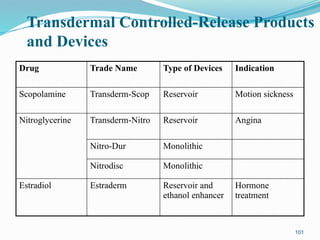
Transdermal Controlled-Release Products
and Devices
101
Drug Trade Name Type of Devices Indication
Scopolamine Transderm-Scop Reservoir Motion sickness
Nitroglycerine Transderm-Nitro Reservoir Angina
Nitro-Dur Monolithic
Nitrodisc Monolithic
Estradiol Estraderm Reservoir and
ethanol enhancer
Hormone
treatment
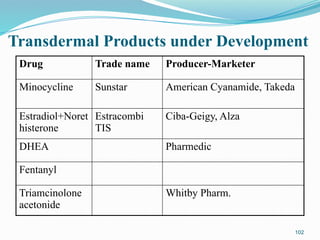
Transdermal Products under Development
102
Drug Trade name Producer-Marketer
Minocycline Sunstar American Cyanamide, Takeda
Estradiol+Noret
histerone
Estracombi
TIS
Ciba-Geigy, Alza
DHEA Pharmedic
Fentanyl
Triamcinolone
acetonide
Whitby Pharm.
Recently approved transdermal contraceptive
Recently approved by FDA (Ortho-McNeil)
Once a week for three weeks, fourth week patch free
99 percent effective when used as directed
Combination estrogen and progestin
One-and-three-quarter inch square applied to the
lower abdomen, buttocks or upper body.
Skin irritation or detachment reported in 2-5% of
patients
103
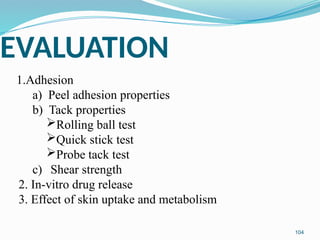
EVALUATION
104
1.Adhesion
a) Peel adhesion properties
b) Tack properties
Rolling ball test
Quick stick test
Probe tack test
c) Shear strength
2. In-vitro drug release
3. Effect of skin uptake and metabolism
4. In-vivo evaluation
 Animal model
 Human model
5. Cutaneous toxicological evaluation
 Contact dermatitis
a) Contact irritant dermatitis
b) Contact allergic dermatitis
105
1.EVALUATION OF ADHESIVE
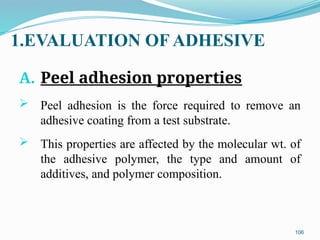
A. Peel adhesion properties
 Peel adhesion is the force required to remove an
adhesive coating from a test substrate.
 This properties are affected by the molecular wt. of
the adhesive polymer, the type and amount of
additives, and polymer composition.
106
1.EVALUATION OF ADHESIVE
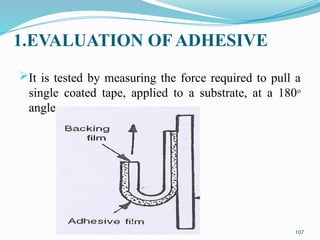
It is tested by measuring the force required to pull a
single coated tape, applied to a substrate, at a 180o
angle.
107
B. Tack properties:
Tack is ability of the polymer to adhere to substrate
with little contact pressure.
It is dependent on the molecular weight and
composition of polymer as well as the use of
tackifying resin in the polymer.
Tests for tack include....
108
1.EVALUATION OF ADHESIVE
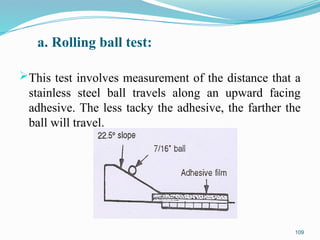
a. Rolling ball test:
This test involves measurement of the distance that a
stainless steel ball travels along an upward facing
adhesive. The less tacky the adhesive, the farther the
ball will travel.
109
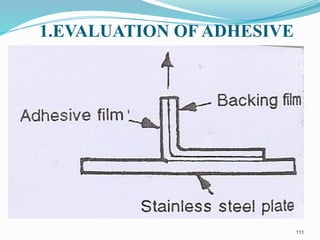
b. Quick-stick (or peel-tack) test:
The peel force require to break the bond between an
adhesive and substrate is measured by pulling the tape
away from the substrate at 90o
at a speed at 12
inch/min.
The force is recorded as the tack value and is
expressed in ounce or grams per inch width with
higher values indicating increasing tack.
110
111
1.EVALUATION OF ADHESIVE
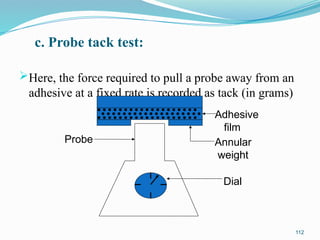
c. Probe tack test:
Here, the force required to pull a probe away from an
adhesive at a fixed rate is recorded as tack (in grams)
112
Adhesive
film
Annular
weight
Dial
Probe
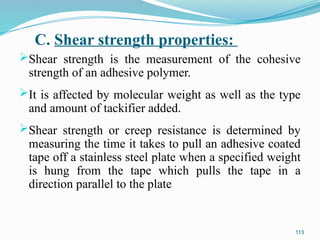
C. Shear strength properties:
Shear strength is the measurement of the cohesive
strength of an adhesive polymer.
It is affected by molecular weight as well as the type
and amount of tackifier added.
Shear strength or creep resistance is determined by
measuring the time it takes to pull an adhesive coated
tape off a stainless steel plate when a specified weight
is hung from the tape which pulls the tape in a
direction parallel to the plate
113
114
Stainless steel plate
Adhesive
coated tape
Weight
1.EVALUATION OF ADHESIVE
2. IN-VITRO DRUG RELEASE
EVALUATION
In these studies, excised skin is mounted on skin
permeation cells.
Skin of hairless mouse is used rather than human
cadaver skin.
In-vitro system should be designed in such way that
the intrinsic rate of release or permeation which is
theoretically independent of the in-vitro design can be
accurately determined.
115
2. IN-VITRO DRUG RELEASE
EVALUATION
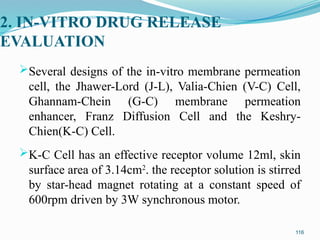
Several designs of the in-vitro membrane permeation
cell, the Jhawer-Lord (J-L), Valia-Chien (V-C) Cell,
Ghannam-Chein (G-C) membrane permeation
enhancer, Franz Diffusion Cell and the Keshry-
Chien(K-C) Cell.
K-C Cell has an effective receptor volume 12ml, skin
surface area of 3.14cm2
. the receptor solution is stirred
by star-head magnet rotating at a constant speed of
600rpm driven by 3W synchronous motor.
116
Franz Diffusion Cell
117
ADVANTAGES
It can help in investigating the mechanism of skin
permeation of the drug before it can be developed in
TDDS.
Time needed to attain steady state permeation and the
permeation flux at steady state can be obtained.
It is use to optimize the formulation before more
expensive in vivo studies are performed.
Studies on skin metabolism can also be performed.
118
ADVANTAGES
It includes also ease of methodology, analytical assay
since there are no complication arising from the
disposition of the drug in the body and better control
over experimental condition than is possible in vivo.
119
3. EFFECT OF SKIN UPTAKE AND
METABOLISM
In this study, a piece (3cm by 3cm) of full thickness skin
(human cadaver skin) or stripped skin freshly excised
from a hair less mouse, 5-7 week old, was mounted
between the two compartments of each V-C permeation
cell.
It was mounted in such a way that either the stratum
corneum or the dermis faced the drug solution and the
other side of the skin was protected with impermeable
aluminum foil.
120
3. EFFECT OF SKIN UPTAKE AND
METABOLISM
The compartment with the skin surface uncovered was
filled with a saturated solution of drug in normal saline
and the compartment with the skin surface covered with
aluminum foil remained empty.
Both the compartment were maintained isothermally at
37o
C. Samples were withdrawn from solution
compartment at predetermined times and assayed for
drug and any possible metabolite.
121
4.IN-VIVO EVALUATION
a. Animal models:
The rhesus monkey is the most reliable model for in
vivo evaluation of transdermal drug in man.
Standard radiotracer methodology is used.
The application site is generally the forearm or
abdomen which are the least hairy sites on the animal’s
body.
122
4. IN-VIVO EVALUATION
Limitation of using this animal include cost and handling
capabilities required.
Ethical consideration also limit the use of rhesus
monkey.
Other animals are weanling pig and human skin grafted
nude mouse.
Difficulties in using these animals are their non
availability and the facilities and skill required for their
handling.
123
4. IN-VIVO EVALUATION
b. Human models:
Procedure for in vivo evaluation in humans were first
described by feldmann and maibach in 1974.
They involve the determination of cutaneous
absorption by an indirect method of measuring radio
activity in excreta following topical application of the
labelled drug.
This method is used since plasma level following trans
dermal administration of a drug are too low to use
chemical assay procedure.
124
4. IN-VIVO EVALUATION
The % of dose absorbed transdermally is
calculated by
Total radioactivity excreted after topical adm.
Total radioactivity excreted after i.v. adm.
Various modification have been made for this method, it
is given below.
125
% Drug absorbed =
RESERVOIR TECHNIQUE
It is simple technique, short exposure of the skin to the
compound (radio-labelled) under study followed by
removal of the stratum corneum.
From this analysis, it is possible to predict the amount of
drug that will penetrate over a longer period of time.
LIMITATION:
oInvasive nature of the technique due to the tape stripping
required.
oThe single measurement obtained which does not allow
detailed kinetic analysis & adm. of large dose of radio
active material is required.
126
5. CUTANEOUS TOXICOLOGICAL
EVALUATION
 CONTACT DERMATITIS:
It can be either
I. Contact irritant dermatitis or
II. Contact allergic dermatitis
III. Contact irritant dermatitis:
 It results from direct toxic injury to cell membrane,
cytoplasm or nuclei.
127
5. CUTANEOUS TOXICOLOGICAL
EVALUATION
 Two types of protocols are used
o Ten days primary irritation test &
o Twenty one days irritation test
II. Contact allergic dermatitis:
 It involves a host immunological reaction to an
antigen.
 It can be screened by the guinea pig maximization
test.
128
Key Features
Simple for patient to use, and fully disposable.
Unique manufacturing techniques result in very
low cost.
Accurate, reliable delivery of drug to epidermis or
dermis, circumventing the stratum corneum.
Passive or active drug delivery profiles.
Can be used with Valeritas' e-Patch and h-Patch™
device to deliver a wide range of drug volumes
under various extended or time-release profiles
129
Choose a dry, unbroken, non-hairy part of your skin. The
buttocks, lower abdomen, lower back, and upper arm (outer
part) are good choices. If the area you choose has body hair,
clip (do not shave) the hair close to the skin with scissors.
Make sure that the area is clean. If there is any oil or powder
(from bath products, for example), the patch may not stick
properly.
Attach the adhesive side of the patch to your skin in the
chosen area.
130
Find an appropriate place to put the patch
A stiff protective liner covers the sticky side of the patch
- the side that will be put on your skin. Hold the liner at
the edge and pull the patch from the liner. Try not to
touch the adhesive side of the patch. Throw away the
liner.
Press the patch firmly on your skin with the palm of
your hand for about 30 seconds. Make sure the patch
sticks well to your skin, especially around the edges. If
the patch does not stick well, or loosens after you put it
on, tape the edges down with first aid tape.
Wash your hands after applying the patch.
131
Find an appropriate place to put the
patch
132
Find an appropriate place to put the patch
Product Development Challenges
Flux sufficient but manageable size
Adequate skin adhesion
Adequate shelf life stability
Non-irritating
Aesthetically pleasing
Easy to handle and use
Comfortable
Unobtrusive
Product cost 133
REFERENCES
Transdermal controlled systems medication by Y.W. Chein.
 Controlled drug delivery – Fundamental and Application, 2nd
edition, by Joseph R. Vincent, H.C. Lee page no.: 524 – 589.
Controlled drug delivery – Concepts and Advances, by S.P. Vyas
and Roop K. Khar page no.: 411 – 447.
Novel drug delivery systems, 2nd
edition, by Y.W. Chein page no.:
338 – 380.
The Eastern Pharmacist - “Transdermal drug delivery system”,
vol.34,1991
http://www.google.com
134
THANKING YOU
135
E-mail: ocusertraji@yahoo.co.in
Cell No: 00917708895874

Transdermal Drug Delivery System Modified.pptx

  • 1.
  • 2.
    CONTENTS Introduction Objectives of TDDS Advantages& disadvantages Origin of TDDS Mechanism of percutanious absorption Factors affecting transdermal Permeability Kinetics of transdermal drug delivery system Factors affecting permeation Formulation approaches used in development of TDDS Recent developments in TDDS Evaluation References 2
  • 3.
    INTRODUCTION  Medicated plasters– are first TDDS  China – Chinese medicated plaster  Japan - Cataplasms & salonpas  England – Allcock’s porous plaster  Germany – ABC (arnica/belladonna/capsicum)  USA - Belladonna plaster Mustard plaster Salicylic acid plaster Female syndromes in male operators working in production of estrogen pharmaceutical dosage form 3
  • 4.
    4  To maintaina constant, prolonged and therapeutically- effective drug levels in the body.  To by pass first pass metabolism  To reduce systemic side effects  To improve efficacy  to have a better patient’s compliance Objectives of TDDS
  • 5.
     Transdermal drugdelivery system was first introduced more than 20 years ago.  The technology generated tremendous excitement and interest amongst major pharmaceutical companies in the 1980s and 90s.  First transdermal patch was approved in 1981 to prevent the nausea and vomiting associated with motion sickness, the FDA has approved, throughout the past 22 years, more than 35 transdermal patch products, spanning 13 molecules. 5 Brief History of TDDS
  • 6.
    INTRODUCTION • Definition: Transdermal meansentry of the drug through the skin from topical admistration/application of drug as a patch /semisolid dosage form. 6
  • 7.
    POTENTIAL BENEFITS OF TRANSDERMALDRUG DELIVERY (ADVANTAGES) • Easy to use. • Avoid GIT absorption problems for drugs. • Avoids FP hepatic metabolism of drugs. • More improved and convenient patient compliance. • Rapid termination in case of toxicity is possible. • Self medication is possible. • Reduces frequency of dosing. • Maintains therapeutic level for 1 to 7 days. • Controlled delivery resulting in more reliable and predictable blood levels. 7
  • 8.
    DISADVANTAGES • Daily doseof more than 10mg is not possible. • Local irritation is a major problem. • Drug requiring high blood levels are unsuitable. • Drug with long half life can not be formulated in TDDS. • Uncomfortable to wear. • May not be economical. • Barrier function changes from person to person and within the same person. • Heat, cold, sweating (perspiring) and showering prevent the patch from sticking to the surface of the skin for more than one day. A new patch has to be applied daily. 8
  • 9.
    STRUCTURE OF SKIN •Epidermis: Stratum corneum (Horny cell layer)  Stratum lucidum (Clear layer)  Stratum granulosum ( Granular Layer)  Stratum spinosum (Prickly layer)  Stratum germinativum • Dermis: • Hypodermis or Subcutaneous layer: 9
  • 11.
    The drug musttraverse three layers, the stratum cornium, the epidermis, and the dermis. Of these, the toughest barrier is the stratum corneum, which consists of 10-25 layers of keratinized cells.
  • 12.
    The stratum corneumis the outermost layer of the epidermis and is composed mainly of dead cells that lack nuclei. These are sloughed off during the day and replaced by new cells from the stratum germinativum.
  • 13.
    Introduction to TransdermalDrug Delivery Stratum Corneum is the barrier in TDD (Rate limiting step)
  • 14.
    STRUCTURE OF SKIN Epidermis: The outer layer of skin is made up of Stratified Squamous epithelial cells. Epidermis is thickest in palms and soles. The stratum corneum forms the outer most layer (10- 15µm thick ) which consists of many layers of compacted , flattened, dehydrated keratinized cells. Keratin contains cells called as Corneosites.  Stratum corneum layer forms permeability barrier for external environment. 14
  • 15.
    Water content ofstratum corneum is around 20%. The moisture required for stratum corneum is around 10% (w/w) to maintain flexibility and softness. It consists of Ceramides and neutral lipids such as Sterols, free fatty acids and triglycerides.  The stratum corneum is responsible for the barrier function of the skin and behaves as a primary barrier to the percutaneous absorption. 15 STRUCTURE OF SKIN
  • 16.
    It is madeup of three layers in thicker parts stratum granulosum, stratum lucidum,stratum spinosum.  Removal of these layers results in increased permeability and water loss. 16 STRUCTURE OF SKIN
  • 17.
    DERMIS:  The dermisis made up of regular network of robust collagen fibers of fairly uniform thickness with regularly placed cross striations . This network or the gel structure is responsible for the elastic properties of the skin. It is supplied by blood to convey nutrients, remove waste & regulate body temp. Drug is well absorbed by this route. Upper portion of the dermis is formed into ridges containing lymphatics and nerve endings. 17 STRUCTURE OF SKIN
  • 18.
    SUBCUTANEOUS TISSUE: This isa sheet of the fat containing areolar tissue known as the superficial fascia attaching the dermis to the underlying structures . SKIN APPENDAGES: Sweat glands produces sweat of pH 4-6.8 & absorbs drugs, secretes proteins, lipids and antibodies. Its function is to control heat. HAIR FOLLICLES They have sebaceous glands which produces sebum and includes glycerides, cholesterol and squalene. 18 STRUCTURE OF SKIN
  • 19.
    Mechanism of absorptionthrough skin Mechanism involved is passive diffusion This can be expressed by FICK’s LAW of DIFFUSION dq = D K A ( c1 – c2 ) dt h dq /dt = rate of diffusion D = diffusion co-efficient K = partition co- efficient A = surface area of membrane H = thickness of membrane 19
  • 20.
    Routes of drugabsorption through skin Trans follicular route Trans epidermal route Intercellular Transcellular 20
  • 21.
    Routes of drugabsorption through skin Trans follicular route:  Fractional area available through this route is 0.1 %  Human skin contains 40-70 hair follicles, 200 to 250 sweat glands on every sq.cm. of skin area.  Mainly water soluble substance are diffused faster through appendages than that of other layers.  Sweat glands and hair follicles act as a shunt i.e. easy pathway for diffusion through rate limiting ST corneum. 21
  • 22.
    Routes of drugabsorption through skin Trans Epidermal route Epidermal barrier function mainly resides in horny layer The viable layer may metabolize, inactivate or activate a prodrug. Dermal capillary contains many capillaries so residence time of drug is only one minute. Within stratum corneum molecule may penetrate either transcellularly or intercellular. Intracellular region is filled with lipid rich amorphous material. 22
  • 23.
    Routes of drugabsorption through skin 23
  • 24.
    FACTORS AFFECTING TRANSDERMAL PERMEABILITY Physicochemical properties of parent molecule Solubility and partition co- efficient pH condition Penetrant concentration Physico chemical properties of drug delivery system Release characteristic Composition of drug delivery system Permeation enhancer used 24
  • 25.
    Physiological and pathologicalcondition of skin Lipid film Skin hydration Skin temperature Effect of vehicle Pathological injury to skin Biological factors Skin age Thickness of S. Corneum Skin condition 25
  • 26.
    Solubility and partitionco- efficient:  Solubility of a drug influences its ability to penetrate the skin.  pKa is index of solubility of drug in vehicle and ST corneum has influence on transfer of drug from vehicle to skin. Drug solubility determines concentration presented to absorption site which will effect rate and extent of absorption.  Skin permeation can be enhanced by increasing lipophilic character of drug, so that drug penetrates through STC but not through epidermis due to decreased water solubility.  Drug which is lipid & water soluble is favored. 26
  • 27.
    pH & Concentration: Moderate pH is favorable because high or low pH will result in destruction of the skin.  Higher the concentration of the drug in vehicle faster the absorption.  At higher concentrations than solubility the excess solid drug will function as a reservoir and helps to maintain a constant drug constitution for prolonged period of time. 27
  • 28.
    FACTORS AFFECTING TRANSDERMAL PERMEABILITY 28 Physico-chemicalproperties of drug delivery system Release characteristic  Solubility of drug in vehicle determines the release rate. Composition of drug delivery system  It not only effects the rate of drug release but also the permeability of STC by means of hydration mixing with skin lipids. Example methyl salicylate is more lipophilic than its parent acid (Salicylic acid). When applied to skin from fatty vehicle methylsalicylate yielded higher absorption.
  • 29.
    FACTORS AFFECTING TRANSDERMAL PERMEABILITY 29 Physiologicaland pathological condition of skin Lipid film: It acts as protective layer to prevent removal of moisture from skin. Removal of this film will decrease TD absorption. Skin hydration: It can be achieved by covering skin with plastic sheeting, which leads to accumulation of sweat, condensed water vapors, increase hydration and increase porosity.
  • 30.
    FACTORS AFFECTING TRANSDERMAL PERMEABILITY 30 Effectof vehicle: A vehicle can influence absorption by its effect on physical state of drug and skin. Example greases, paraffin bases are more occlusive while water in oil bases are less. Humectants in bases will dehydrate the skin and decrease per-cutaneous absorption.
  • 31.
    FACTORS AFFECTING TRANSDERMAL PERMEABILITY 31 Biologicalfactors: Skin age: Skin of foetus, young ones and elders is more permeable than adult tissue. Skin metabolism: Viable epidermis is metabolically active than dermis. If topically applied drug is subjected to biotransformation during permeation local and systemic bioavailability is affected.
  • 32.
    BASIC COMPONENTS OFTRANSDERMAL DRUG DELIVERY SYSTEM COMPONENTS OF TDDS 1) POLYMERS 2) THE DRUG 3) PERMEATION ENHANCER 4) OTHER EXCEPIENTS 32
  • 33.
    POLYMERS Following criteria tobe considered in selection a polymer: Molecular weight, physical nature of polymer must allow diffusion of drug at desired rate.  Polymer must be non-reactive, inert, non-toxic, easy to manufacture, inexpensive.  It should not decompose on storage of the device & not deteriorate when large amount of active ingredient is incorporated into it. 33
  • 34.
    LIST OF POLYMERSUSED NATURAL POLYMERS: Cellulose derivatives, Zein, Gelatin, Shellac, Waxes, Gums & Natural rubber SYNTHETIC ELASTOMER POLYBUTADIENE: Polysiloxane, Silicon rubber, Nitrile, Acrylonitryle, Butyl rubber, Styrene butadiene rubber. SYNTHETIC POLYMER Poly vinyl alcohol, Poly vinyl chloride, Polyethylene, Poly propylene, Poly urea, PVP, Polymethacrylate 34
  • 35.
    DRUG For successful developingtransdermal delivery, drug should be chosen with great care physicochemical properties 1. Mol. wt. less than 1000 Daltons 2. Affinity for both lipophilic & hydrophilic phase 3. Drug should have low melting point 35
  • 36.
    DRUG It should bepotent with daily dose of few mg/ day. Half life of drug should be short. Non irritant to skin. Drug prone to ‘first pass effect’ and which degrade in GIT are ideal candidate. 36
  • 37.
    Ideal properties ofdrug candidate PARAMETER PROPERTIES Dose Sh’d be low( < 20mg/day) Half life 10 hrs or less Molecular weight < 1000 daltons Skin permeability co- efficient > 0.5 X 10 -3 cm/ hr Skin reaction Non irritating & non sensitizing Oral Bioavailability low Therapeutic index low 37
  • 38.
    PERMEATION ENHANCERS These arethe agents which promote the skin permeability by altering the skin as a barrier to the flux of desired penetrant. Flux J across the skin can be given by J= D. dc/dx D= diffusion coefficient C= concentration x=Spatial coordinate D is function of size, shape, flexibility of diffusing drug molecule 38
  • 39.
    Activity of penetrationenhancers Interaction with the polar head groups of lipid via hydrogen and ionic bonding. Change in hydration sphere of lipids and affect the packing at the head region. Increase volume of the aqueous layer:swelling and hydration. Protein modification- open up the dense keratin structure and make it more permeable. 39
  • 40.
    Ideal Characteristic OfPenetration Enhancers 1) IT SHOULD BE INERT 2) NON-TOXIC, NON- IRRITATING 3) ACTION SHOULD BE IMMEDIATE& PREDICTABLE 4) SHOULD NOT CAUSE REMOVAL OF BODY FLUID 5) SHOLD BE COMPATIBLE WITH DRUG& EXIPIENTS 6) COSMETICALLY ACCEPTABLE 7) ODORLESS, TASTELESS, COLORLESS & CHEAP 40
  • 41.
    SOLVENTS The compounds increasepenetration possibly by swelling the polar pathway and fluidizing the lipid e.g.. Methanol, ethanol, DMSO, DMA, DMF, pyrolidiones, propylene glycol, glycerol etc.. SURFACTANTS They enhance polar pathway transport of hydrophillic drugs 41
  • 42.
    ANIONIC SURFACTANTS - Dioctylsulpho succinate, SLS, decodemethyl sulphoxide CATIONIC SURFACTANTS - Pluronic F127, pluronic F58 42
  • 43.
    BINARY SYSTEMS  Thesesystems open up the multilaminate path way as well as the continuous path way e.g. Propylene glycol-oleic acid. 1,4, butane diol- linoleic acid. MISCELLANIOUS CHEMICALS e.g. Urea, N,N- dimethyl m- toluamide 43
  • 44.
    44 44 Backing membrane They areflexible and provide a good bond to the drug reservoir, prevent the drug from leaving the dosage form through top. It is an impermeable membrane that protects the product during the use on the skin.  Contains formulation throughout shelf-life and during wear period  Must be compatible with formulation (non adsorptive)  Printable E.g.: Metallic plastic laminate , plastic backing with adsorbent pad adhesive foam pad.
  • 45.
  • 46.
    Topical application-absorption &action of drugs SYSTEMIC DRUG IN TARGET TISSUE DRUG IN BLOOD CIRCULATION DISTRIBUTION ELIMINATION PHARMACOLOGICAL RESPONSE TOPICAL ABSORPTION DRUG IN DELIVERY SYSTEM DRUG IN SKIN SECRETION FLUIDS, SWEAT, SEBUM, pH 4.5--5.5 TRANSDERMAL LOCALIZED RELEASE 46
  • 47.
    FORMULATION APPROACHES FOR DEVELOPMENTOF TRANSDERMAL DRUG DELIVERY SYSTEM 47
  • 48.
    48 48 Basic components ofTransdermal drug delivery
  • 49.
    TDD Patch Construction(Technologies) Four Major Transdermal Systems Polymer Membrane Permeation Controlled TDDS. Polymer Matrix Diffusion Controlled TDDS. Drug Reservoir Gradient Controlled TDDS. Microreservoir Dissolution Controlled TDDS.
  • 50.
    Polymer Membrane PermeationControlled TDDS.  Drug Reservoir : dispersed on solid polymer matrix e.g polyisobutylene. Suspended in unleachable viscous liquid medium eg. Silicone fluid. Dissolved in solvent. Rate controlling Membrane: Microporous, Nonporous. Eg. Ethylene-Vinyl acetate copolymer. Adhesive Layer: Thin layer, adhesive, drug compatible, hypoallergic, eg. Silicone adhesive.
  • 51.
    polymer membrane permeationcontrolled system Substituting the pm and pa equation in equation 1 dq km/r . Ka/m . Dm . Da dt km/r. Dm. ha + ka/m . Da . hm Which define the intrinsic rate of drug release from a membrane moderated drug delivery system. 51 = cr
  • 52.
    polymer membrane permeationcontrolled system Where,  Km/r and ka/m are the partition coefficient for the interfacial partitioning of the drug from reservoir to the membrane and from the membrane to adhesive layer respectively.  Dm and Da are diffusion coefficient and  hm and ha are the thickness 52
  • 53.
    polymer membrane permeationcontrolled system  Scopolamine-releasing transdermal system for 72 hr. prophylaxis of motion sickness.  Clonidine releasing transdermal system for 7 day therapy of hypertension.  Estradiol-releasing transdermal system for treatment of menopausal syndrome for 3-4 days. 53
  • 54.
    Polymer Matrix DiffusionControlled TDDS. The Matrix system design is characterized by the inclusion of a semisolid matrix containing a drug solution or suspension which is in direct contact with the release liner. The component responsible for skin adhesion is incorporated in an overlay and forms a concentric configuration around the semisolid matrix.
  • 55.
    . Polymer MatrixDiffusion Controlled TDDS System The rate of drug release from this type of system is defined as:  A is the initial drug loading dose dispersed in the polymer matrix and Cp and Dp are the solubility and diffusivity of the drug polymer respectively.  Since only the drug species dissolved in the polymer can release . 55 1/2 = dq ACp Dp dt 2t
  • 56.
    Polymer Matrix DiffusionControlled TDD System E.g. of this type of system is nitro-dur I and nitro- dur II. for continuous transdermal fusion of nitroglycerine at a daily dose of 0.5 mg/cm2 for therapy of angina pectoris. Nitro dur II is modified version of I in which the drug is dispersed in acrylic based polymer adhesive with a resinous cross linking agent which result in much thinner and more elegant patch. 56
  • 57.
    Drug Reservoir GradientControlled TDDS. The Multi-layer Drug-in- Adhesive is similar to the Single-layer Drug-in- Adhesive in that the drug is incorporated directly into the adhesive. However, the multi-layer encompasses either the addition of a membrane between two distinct drug-in-adhesive layers or the addition of multiple drug-in- adhesive layers under a single backing film
  • 58.
    Drug Reservoir GradientControlled TDDS Drug – impermeable metallic plastic laminate 58 Drug reservoir gradient layers R1>R2>R3 R1 R1 R2 R3 }
  • 59.
    Microreservoir Dissolution Controlled TDDS Suspenddrug in aqueous solution of water drug solubilizer eg. PEG. Homogeneously disperse drug with controlled aqueous high shear mechanical force ( unstable thermodynamically). Stabilize by immediate cross-linking the polymer chain in-situ.
  • 60.
    Microreservior Type OrMicrosealed Dissolution Controlled System The rate of release of drugs of the micro reservoir system is defined by, dq Dp .Dd .m .kp dt Dphd+Ddhpmkp 60 DISl (1-n) + n.Sp hI 1 kI 1 km =
  • 61.
    MICRORESERVIOR TYPE ORMICROSEALED DISSOLUTION CONTROLLED SYSTEM Where, m=a/b is the ratio of the bulk of the elution medium over drug solubility of the same medium and b is the ratio of drug concentration at the outer edge of the polymer coating for the drug solubility in the same polymer composition.  n is the ratio of the drug concentration at the inner layer of the interfacial barrier over drug solubility in the polymer matrix. 61
  • 62.
    MICRORESERVIOR TYPE ORMICROSEALED DISSOLUTION CONTROLLED SYSTEM Dl, Dp and Dd and hl, hp and hd; are diffusivities and thickness of liquid layer surrounding the drug particle, polymer coating membrane surrounding the polymer matrix and the hydrodynamic diffusion layer surrounding the polymer coating . Kl, km and kp are the partition coefficient for the interfacial partitioning of the drug from the liquid compartment to the polymer matrix, from the polymer matrix to the polymer coating membrane and from the polymer coating membrane to the elution solution respectively. 62
  • 63.
    MICRORESERVIOR TYPE ORMICROSEALED DISSOLUTION CONTROLLED SYSTEM Sl and SP are the solubility of the drug in the liquid compartment and in the polymer matrix respectively. The release of drug from this system can follow either a partition control or matrix diffusion control process depending upon the relative magnitudes of Sl and SP 63
  • 64.
    Microreservior Type OrMicrosealed Dissolution Controlled System Silicon elastomer the lipophillic polymer is used for dispersion technique to form unleachable microscopic sphere of drug reservoir. The quick stabilization occur by cross linking of the polymer chain which produced medicated polymer disc with a constant surface area and fixed thickness according to requirement of drug release. 64
  • 65.
    Microreservior Type OrMicrosealed Dissolution Controlled System Extra coating is available as a biocompatible polymer to modify the mechanism and rate of drug release. A trans dermal therapeutic system is produced by positioning the medicated disc at the centrally and surrounded bit with an adhesive rim. 65
  • 66.
    Microreservior Type OrMicrosealed Dissolution Controlled System It is successfully utilized in the preparation of nitro- disc, a nitroglycerine releasing trans dermal therapeutic system used in angina pectoris. This system followed zero order release of drug without the danger of dose dumping. 66
  • 67.
    POROPLASTIC TYPE SYSTEM Poroplasticfilm consists of ultra micro porous membranes which are not sensitizing to skin and are fairly stable at higher than normal temperature and at biological pH. It is made utilizing the concept of water coagulation of cellulose triacetate solution in organic acid at low temperature. The coagulation is performed under controlled condition. 67
  • 68.
    TRANSDERMAL DELIVERY OFTHE MACROMOLECULE Macromolecules such as Hormones, interferons, bioactive peptides can be delivered by Trans dermal delivery system. The devices used for this purpose are divided in to two categories…. 1. Devices based on ethylene vinyl acetate copolymers (EVAc). 2. Devices based on silicone elastomer. 68
  • 69.
    TRANSDERMAL DELIVERY OFTHE MACROMOLECULE This both the system utilize one common concept i.e.  Matrix must have channel to facilitate the release of macro molecule  This device is used as implants 69
  • 70.
    Other TDDS  Built-inbattery layer  Comparable in size to a normal transdermal patch  The Lectro Patch, General Medical Co.  Treatment time : 20 min  Recommended maximum current : 4mA  Lidocaine (local anesthesia), dexamethasone (arthritis), hydrocortisone (arthritis), acetic acid (calcified tendinitis) etc. 70  IONTOPHORESIS
  • 72.
    Iontophoretic Patches  Iontophoreticpatches use a tiny electrical current to promote flow of the drug (usually charged) through the skin.
  • 73.
  • 75.
  • 76.
  • 77.
    Other TDDS Sonophoresis:  Theapplication of high frequency ultrasound to enhance drug penetration. Examples:. Lidocaine, hydrocortisone, salicylic acid. Electroporation:  Transient high-voltage electrical pulses, to cause rapid permeabilization of the stratum corneum through which large and small peptides, oligonucleotides and other drugs can pass in significant amounts. 77
  • 78.
    Other TDDS Reverse iontophoresis: Current passage causes ions and other molecules to move in both directions under both electrodes. Hence it is possible to sample an analyte in the body, and to provide a drug in response to the analyte level, e.g., sugar, glucose. 78
  • 79.
    Microneedles Patches  Microneedlespatches are currently being explored as mechanisms to deliver vaccines and larger macromolecules.
  • 80.
  • 81.
    ADVANCED RESEARCHES MICROARRAY NEEDLE Advancedmicro-needle Patch transdermal system allowing continuous delivery through the skin of proteins and water-soluble drugs. 81
  • 82.
    ADVANCED RESEARCHES  Thedevice create painlessly micropores in the S.C. known as microstructered arrays or microneedles.  These devices have about 400 microneedles.  The solid silicone needles (coated with drug) or hollow metal needles (filled with drug solution) penetrate the horny layer without breaking it or stimulating nerves in deeper tissues.  Flux increase up to 1,00,000 fold are reported. 82
  • 83.
  • 84.
    Multidose Transdermal DrugDelivery System It is comprises a laminate composite with a plurality of compartments. Each compartment is a reservoir for a unit dose of a drug active to be transdermally administered. Individual seals are provided for resealably enclosing the drug active in each of the reservoirs. The individual enclosing seals are removable to release the unit dose into contact with the skin of the patient and are actuable to control the transdermal absorption of the drug actives. 84
  • 85.
    MICRO TRANS 85 Applications : Delivery of large proteins, fragile antibodies, and hormones.  Delivery of small molecules, particularly those with difficulty diffusing through skin layers.  Delivery of vaccines, both conventional and DNA- based.  Fluid sensing of glucose, hormones, blood gases, and therapeutic drug levels.
  • 86.
     This systemmakes oversaturation of adhesive polymer with drug forcing partial crystallization.  Presence of both molecular and solid state, allow higher conc. & consistent supply of drug.  As skin absorbs dissolved drug, crystals re- dissolve to maintain drug at solubility limit (max. thermodynamic activity) at the site of contact.  This results in smaller thinner patches with better patient acceptability. Clinical trials with this technology with β2 adrenergic agonist tulobutarol confirmed superiority of TDDS formulation over oral formulation 86 Crystal reservoir technology
  • 87.
    The microneedle technologycan result in more effective contact of the vaccine with the antigen-presenting Langerhans cells The needles can be fabricated to be long enough to penetrate the stratum corneum, but short enough to not come into contact with nerve endings. LINK
  • 88.
    Trandermal Matrix patchdesigns 88 Matrix Reservoir Drug in adhesive Multilaminate Backing Drug Membrane Adhesive Liner / skin
  • 89.
  • 90.
    Products on themarket, or in development include:  Clonidine  Works as an agonist of adrenaline at the presynaptic a2 adrenergic  Product name = Catapres-TTS®  used to treat hypertension
  • 91.
     Ethinylestradiol (EO)and norelgestromin (N)  Product name = Ortho-Evra®  Used for Contraception  Type of patch = Drug-in-Adhesive  Frequency of application = weekly N OH H H HO H H Norelgestromin (a progestin) OH H H H Ethinylestradiol (an estrogen) HO
  • 92.
     Fentanyl  ProductName = Duragesic®  Used for: Analgesia  Type of Patch = Drug-in-Adhesive  Frequency of Application = Weekly N O N
  • 93.
     Lidocaine  ProductName = Lidoderm®  Used for: analgesia of postherpetic neuralgia (PHN), a painful condition caused by the varicella zoster virus (herpes zoster = shingles)
  • 94.
    Lidoderm Patch  Typeof Patch = Reservoir  Frequency of Application = Daily
  • 95.
     Nicotine  Productname = Habitrol® , Nicoderm – CQ® , Nicotrol® , Prostep®  Used for: Smoking cessation  Frequency of administration = Daily
  • 96.
     Nitroglycerin  Worksby producing nitric oxide (NO), which then acts as a vasodilator  Product Names = Nitro-Dur® , Transderm-Nitro®  Used for: Angina  Type of Patch = Nitro-Dur is Drug-in-adhesive Nitrodisc is reservoir  Frequency of administration = Daily
  • 97.
     Estradiol  ProductName = Alora® , Climara® , Esclim® , Estraderm® , FemPatch® , Vivelle® , Vivelle- DOT®  Used for: Hormone replacement  Type of Patch: Drug-in-adhesive  Frequency of application = weekly
  • 98.
     Estradiol +Norethindrone  Product name = CombiPatch®  Used for: Hormone Replacement O OH H H H H Norethindrone
  • 99.
     Oxybutynin  Worksas competitive antagonist of the muscarinic acetycholine receptor  Product name = Oxytrol®  Used for: Overactive bladder (antispasmodic)  Type of Patch: Drug-in-adhesive  Frequency of application = twice a week
  • 100.
     Scopolamine  Worksas competitive antagonist of acetylcholine at the muscarinic receptor  Product Name = Transderm Scop®  Used for: Motion Sickness
  • 101.
    Transdermal Controlled-Release Products andDevices 101 Drug Trade Name Type of Devices Indication Scopolamine Transderm-Scop Reservoir Motion sickness Nitroglycerine Transderm-Nitro Reservoir Angina Nitro-Dur Monolithic Nitrodisc Monolithic Estradiol Estraderm Reservoir and ethanol enhancer Hormone treatment
  • 102.
    Transdermal Products underDevelopment 102 Drug Trade name Producer-Marketer Minocycline Sunstar American Cyanamide, Takeda Estradiol+Noret histerone Estracombi TIS Ciba-Geigy, Alza DHEA Pharmedic Fentanyl Triamcinolone acetonide Whitby Pharm.
  • 103.
    Recently approved transdermalcontraceptive Recently approved by FDA (Ortho-McNeil) Once a week for three weeks, fourth week patch free 99 percent effective when used as directed Combination estrogen and progestin One-and-three-quarter inch square applied to the lower abdomen, buttocks or upper body. Skin irritation or detachment reported in 2-5% of patients 103
  • 104.
    EVALUATION 104 1.Adhesion a) Peel adhesionproperties b) Tack properties Rolling ball test Quick stick test Probe tack test c) Shear strength 2. In-vitro drug release 3. Effect of skin uptake and metabolism
  • 105.
    4. In-vivo evaluation Animal model  Human model 5. Cutaneous toxicological evaluation  Contact dermatitis a) Contact irritant dermatitis b) Contact allergic dermatitis 105
  • 106.
    1.EVALUATION OF ADHESIVE A.Peel adhesion properties  Peel adhesion is the force required to remove an adhesive coating from a test substrate.  This properties are affected by the molecular wt. of the adhesive polymer, the type and amount of additives, and polymer composition. 106
  • 107.
    1.EVALUATION OF ADHESIVE Itis tested by measuring the force required to pull a single coated tape, applied to a substrate, at a 180o angle. 107
  • 108.
    B. Tack properties: Tackis ability of the polymer to adhere to substrate with little contact pressure. It is dependent on the molecular weight and composition of polymer as well as the use of tackifying resin in the polymer. Tests for tack include.... 108 1.EVALUATION OF ADHESIVE
  • 109.
    a. Rolling balltest: This test involves measurement of the distance that a stainless steel ball travels along an upward facing adhesive. The less tacky the adhesive, the farther the ball will travel. 109
  • 110.
    b. Quick-stick (orpeel-tack) test: The peel force require to break the bond between an adhesive and substrate is measured by pulling the tape away from the substrate at 90o at a speed at 12 inch/min. The force is recorded as the tack value and is expressed in ounce or grams per inch width with higher values indicating increasing tack. 110
  • 111.
  • 112.
    c. Probe tacktest: Here, the force required to pull a probe away from an adhesive at a fixed rate is recorded as tack (in grams) 112 Adhesive film Annular weight Dial Probe
  • 113.
    C. Shear strengthproperties: Shear strength is the measurement of the cohesive strength of an adhesive polymer. It is affected by molecular weight as well as the type and amount of tackifier added. Shear strength or creep resistance is determined by measuring the time it takes to pull an adhesive coated tape off a stainless steel plate when a specified weight is hung from the tape which pulls the tape in a direction parallel to the plate 113
  • 114.
    114 Stainless steel plate Adhesive coatedtape Weight 1.EVALUATION OF ADHESIVE
  • 115.
    2. IN-VITRO DRUGRELEASE EVALUATION In these studies, excised skin is mounted on skin permeation cells. Skin of hairless mouse is used rather than human cadaver skin. In-vitro system should be designed in such way that the intrinsic rate of release or permeation which is theoretically independent of the in-vitro design can be accurately determined. 115
  • 116.
    2. IN-VITRO DRUGRELEASE EVALUATION Several designs of the in-vitro membrane permeation cell, the Jhawer-Lord (J-L), Valia-Chien (V-C) Cell, Ghannam-Chein (G-C) membrane permeation enhancer, Franz Diffusion Cell and the Keshry- Chien(K-C) Cell. K-C Cell has an effective receptor volume 12ml, skin surface area of 3.14cm2 . the receptor solution is stirred by star-head magnet rotating at a constant speed of 600rpm driven by 3W synchronous motor. 116
  • 117.
  • 118.
    ADVANTAGES It can helpin investigating the mechanism of skin permeation of the drug before it can be developed in TDDS. Time needed to attain steady state permeation and the permeation flux at steady state can be obtained. It is use to optimize the formulation before more expensive in vivo studies are performed. Studies on skin metabolism can also be performed. 118
  • 119.
    ADVANTAGES It includes alsoease of methodology, analytical assay since there are no complication arising from the disposition of the drug in the body and better control over experimental condition than is possible in vivo. 119
  • 120.
    3. EFFECT OFSKIN UPTAKE AND METABOLISM In this study, a piece (3cm by 3cm) of full thickness skin (human cadaver skin) or stripped skin freshly excised from a hair less mouse, 5-7 week old, was mounted between the two compartments of each V-C permeation cell. It was mounted in such a way that either the stratum corneum or the dermis faced the drug solution and the other side of the skin was protected with impermeable aluminum foil. 120
  • 121.
    3. EFFECT OFSKIN UPTAKE AND METABOLISM The compartment with the skin surface uncovered was filled with a saturated solution of drug in normal saline and the compartment with the skin surface covered with aluminum foil remained empty. Both the compartment were maintained isothermally at 37o C. Samples were withdrawn from solution compartment at predetermined times and assayed for drug and any possible metabolite. 121
  • 122.
    4.IN-VIVO EVALUATION a. Animalmodels: The rhesus monkey is the most reliable model for in vivo evaluation of transdermal drug in man. Standard radiotracer methodology is used. The application site is generally the forearm or abdomen which are the least hairy sites on the animal’s body. 122
  • 123.
    4. IN-VIVO EVALUATION Limitationof using this animal include cost and handling capabilities required. Ethical consideration also limit the use of rhesus monkey. Other animals are weanling pig and human skin grafted nude mouse. Difficulties in using these animals are their non availability and the facilities and skill required for their handling. 123
  • 124.
    4. IN-VIVO EVALUATION b.Human models: Procedure for in vivo evaluation in humans were first described by feldmann and maibach in 1974. They involve the determination of cutaneous absorption by an indirect method of measuring radio activity in excreta following topical application of the labelled drug. This method is used since plasma level following trans dermal administration of a drug are too low to use chemical assay procedure. 124
  • 125.
    4. IN-VIVO EVALUATION The% of dose absorbed transdermally is calculated by Total radioactivity excreted after topical adm. Total radioactivity excreted after i.v. adm. Various modification have been made for this method, it is given below. 125 % Drug absorbed =
  • 126.
    RESERVOIR TECHNIQUE It issimple technique, short exposure of the skin to the compound (radio-labelled) under study followed by removal of the stratum corneum. From this analysis, it is possible to predict the amount of drug that will penetrate over a longer period of time. LIMITATION: oInvasive nature of the technique due to the tape stripping required. oThe single measurement obtained which does not allow detailed kinetic analysis & adm. of large dose of radio active material is required. 126
  • 127.
    5. CUTANEOUS TOXICOLOGICAL EVALUATION CONTACT DERMATITIS: It can be either I. Contact irritant dermatitis or II. Contact allergic dermatitis III. Contact irritant dermatitis:  It results from direct toxic injury to cell membrane, cytoplasm or nuclei. 127
  • 128.
    5. CUTANEOUS TOXICOLOGICAL EVALUATION Two types of protocols are used o Ten days primary irritation test & o Twenty one days irritation test II. Contact allergic dermatitis:  It involves a host immunological reaction to an antigen.  It can be screened by the guinea pig maximization test. 128
  • 129.
    Key Features Simple forpatient to use, and fully disposable. Unique manufacturing techniques result in very low cost. Accurate, reliable delivery of drug to epidermis or dermis, circumventing the stratum corneum. Passive or active drug delivery profiles. Can be used with Valeritas' e-Patch and h-Patch™ device to deliver a wide range of drug volumes under various extended or time-release profiles 129
  • 130.
    Choose a dry,unbroken, non-hairy part of your skin. The buttocks, lower abdomen, lower back, and upper arm (outer part) are good choices. If the area you choose has body hair, clip (do not shave) the hair close to the skin with scissors. Make sure that the area is clean. If there is any oil or powder (from bath products, for example), the patch may not stick properly. Attach the adhesive side of the patch to your skin in the chosen area. 130 Find an appropriate place to put the patch
  • 131.
    A stiff protectiveliner covers the sticky side of the patch - the side that will be put on your skin. Hold the liner at the edge and pull the patch from the liner. Try not to touch the adhesive side of the patch. Throw away the liner. Press the patch firmly on your skin with the palm of your hand for about 30 seconds. Make sure the patch sticks well to your skin, especially around the edges. If the patch does not stick well, or loosens after you put it on, tape the edges down with first aid tape. Wash your hands after applying the patch. 131 Find an appropriate place to put the patch
  • 132.
    132 Find an appropriateplace to put the patch
  • 133.
    Product Development Challenges Fluxsufficient but manageable size Adequate skin adhesion Adequate shelf life stability Non-irritating Aesthetically pleasing Easy to handle and use Comfortable Unobtrusive Product cost 133
  • 134.
    REFERENCES Transdermal controlled systemsmedication by Y.W. Chein.  Controlled drug delivery – Fundamental and Application, 2nd edition, by Joseph R. Vincent, H.C. Lee page no.: 524 – 589. Controlled drug delivery – Concepts and Advances, by S.P. Vyas and Roop K. Khar page no.: 411 – 447. Novel drug delivery systems, 2nd edition, by Y.W. Chein page no.: 338 – 380. The Eastern Pharmacist - “Transdermal drug delivery system”, vol.34,1991 http://www.google.com 134
  • 135.

Editor's Notes

  • #13 The greatest challenge for transdermal systems is penetrating the skin.
  • #49 There are four typical constructions used in transdermal patches. In the matrix design, which is probably the simplest approach, the drug formulation is contained in a non-adhesive reservoir that is held in contact with the skin by an adhesive overlay. In the reservoir design, the drug formulation is held in an envelope formed between the backing and the membrane. In the single-layer drug-in-adhesive design, the drug formulation is incorporated within the skin-contacting adhesive. The multi-layer drug-in-adhesive configuration is similar to the single-layer design. However, it incorporates either a membrane between two distinctive drug-in-adhesive layers or the addition of multiple drug-in-adhesive layers under a single backing film.
  • #53 jjjjj